VI. THE TEMPLE OF WADY ABÂD.
Reading edition
The small shrine in the Eastern Desert, which I have here called the Temple of Wady Abâd, is known to Egyptologists as the Temple of Redesiyeh, although it is thirty-seven miles or more from the village on the Nile, five miles above Edfu, which bears that name. Redesiyeh seems to have been the point from which Lepsius, the German archæologist, and other early travellers set out to visit the desert shrine; and hence the name of this wholly unimportant village was given to the ruin, and nobody has bothered to find one more suitable. By the natives the building is called El Kaneis, “the Chapel”; and since it is situated in the well-known Wady Abâd, it would seem most natural to call it the “Chapel, or Temple, of Wady Abâd.” Modern prospectors and mining engineers have been puzzled to know what Redesiyeh has to do with the place; and the fact that an old German antiquarian half a century ago collected his camels at that village being wholly without significance to them, they have regarded the word Redesiyeh as a probable corruption of Rhodesia, and have spoken, to the amazement and confusion of the uninitiate, of the Temple of Rhodesia in the hills of the Upper Egyptian Desert.
The shrine was built by King Sety I. (B.C. 1300), the father of Rameses the Great, for the benefit of the miners passing to and from the various gold mines near the Red Sea; and the story one hears from the modern engineers, which vaguely relates that the temple was erected by King Ptolemy as a memorial to his son, who died at this spot on his return from the mines, does not require consideration. During the brilliant reign of Sety I. the gold mines were energetically worked, and the produce of those upon the road to which this shrine was built was intended especially for the upkeep and ornamentation of the king’s great temple at Abydos, about 180 miles by river north of the Wady Abâd. There are so many old gold workings between the river and the Red Sea that one cannot say definitely where Sety’s miners were bound for who stopped to offer a prayer to the gods at this wayside shrine, but one may say certainly that Edfu, the old Apollinopolis Magna, and El Kab, the old Eileithyiaspolis, were the cities from which they set out. It will, perhaps, be best to state that Edfu stands on the Nile about half-way between Aswan and Luxor—i.e., about 520 miles above Cairo—and that El Kab is situated some 10 miles down-stream from Edfu. The Wady Abâd enters the desert exactly opposite Edfu; the shrine stands about 35 miles east of that town; and the Red Sea coast is about 100 miles farther east as the crow flies.
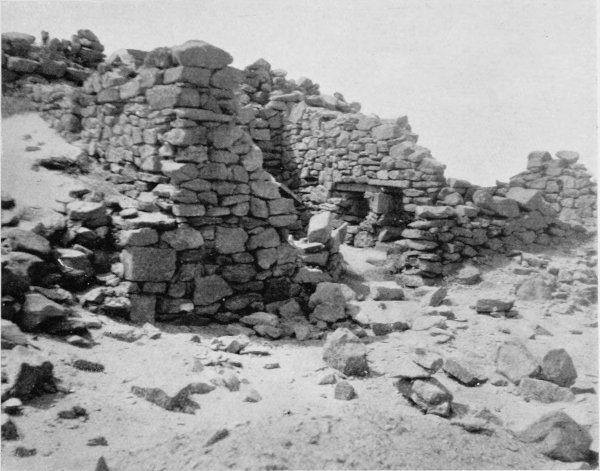
The Roman station of Abu Gehâd. Some of the rooms as seen from the court, looking west.—Page 152.
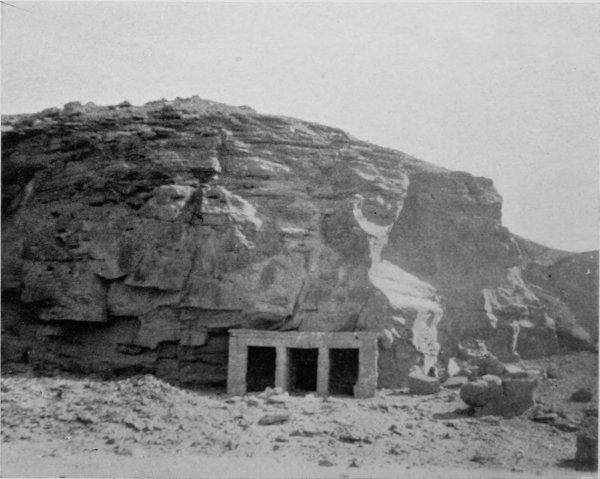
Front view of the Temple of Wady Abâd.—Page 155
Pl. xxv.
Towards the end of March 1908, when the hot south winds were driving the tourists towards the sea, and the trains from Luxor to Cairo were full to overflowing, the writer and his wife set out in the opposite direction, travelling southwards in an empty train as far as the little wayside station of Mahamîd, the nearest stopping-place to the ruins of El Kab. The camels which were to carry us and our camp to Sety’s temple in the desert were awaiting us upon the platform, surrounded by an admiring throng of native loafers. The caravan, according to orders which were ultimately carried out, was to consist of ten baggage and four riding camels, and an assortment of camelmen under the leadership of a Shêkh; but more than double that number of camels lay grunting in the sunlight as the hot train panted into the station. This was due to the fact that a rival and more wealthy camel proprietor, who had not been invited to do business on this occasion, had sent a few camels to the rendezvous on the chance of their being required, and this move the chosen proprietor met by the doubling of the number of his camels. The disappointed owner was himself at the station, and eloquently dilated upon the danger of trusting oneself to a Shêkh of inferior standing. In the infallible ‘Baedeker’ one reads that for this journey it is necessary “to secure the protection of the Shêkh of the Ababdeh tribes”; and though the edition in which these ominous words appear is a few years out of date, one realised in what a dilemma a traveller who did not know the country might have found himself. The Shêkh, it appeared, had even telegraphed his warning to me at the last moment; but this having been really the last of a short series of cards which it seems that he had played, it did not require many words to soothe matters into the normal condition of hullabaloo which everywhere prevails in Egypt at the departure of a caravan.
The baggage at last being dispatched southwards, we set out towards the ruins of El Kab, which could be seen shimmering in the heat-haze a few miles away. It was our purpose to ride to Edfu, thence into the desert, and thence back to Edfu and on to Aswan. The first night was to be spent under the ruined walls of the ancient city of Eileithyiaspolis, and it did not take long to trot to the camping-ground by the river-side. Here, in explanation of the route which we followed, I must be permitted to enter into some archæological details in connection with El Kab and Edfu.
In archaic days, when the great Hawk-chieftains who glimmer, like pale stars, at the dawn of history were consolidating their power in Upper Egypt before conquering the whole Nile valley, there stood a city on the west bank of the river, opposite El Kab, which in later times was know as Hieraconpolis, “the city of the Hawks.” This was the earliest capital of Upper Egypt, and here it is probable that the great king Mena, “the Fighter,” the first Pharaoh of a united Egypt, was born and bred. This king and his father conquered the whole of Egypt, and for that conquest a certain amount of wealth was necessary, even in those days when might was as good as money. For this purpose, and for the reason that the arts of civilisation were already in practice, the gold mines of the Eastern Desert began to be worked. This industry led to the establishment of a station on the east bank of the river opposite the capital, where the miners might foregather, and where the caravans and their escort of soldiers might be collected.
As larger deeds and wider actions became the order of the Pharaoh’s day, so the mines were extended and the number of workmen increased; and it was not long before the station at El Kab grew into a city almost as large as the metropolis. In Dynasty XII. (B.C. 2000) a wall was built around it, which stands to this day, in order to protect it from incursions from the desert. Gradually great temples were erected here, and the city, now known as Nekheb and later as Eileithyiaspolis, was one of the busiest centres in the world.
The ruins of the old caravanserai are of wonderful interest. One may pass through the narrow doorway of the fortified enclosure, and in the silent area where once the soldiers and miners camped, and where now a few goats graze, one feels completely shut off from the world of the present day. The dark walls rise around one almost to their full height, and one may still ascend and descend the sloping ramps where the sentries paced in the olden days. Here there are the ruins of the temple where the vulture-goddess was worshipped; and yonder one sees the mounds of potsherds, bricks, corn-grinders, and all the débris of a forsaken town. In the side of a hill which overlooks the great ramparts one observes the long row of tombs in which the princes of the district were buried; and here in the biographical inscriptions on the walls one reads of many a feat of arms and many a brave adventure.
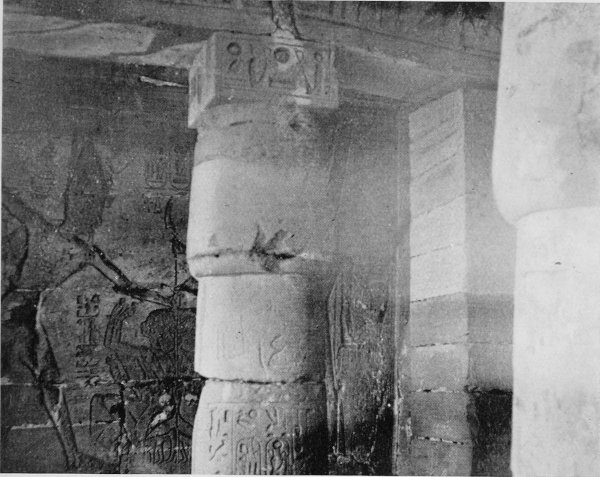
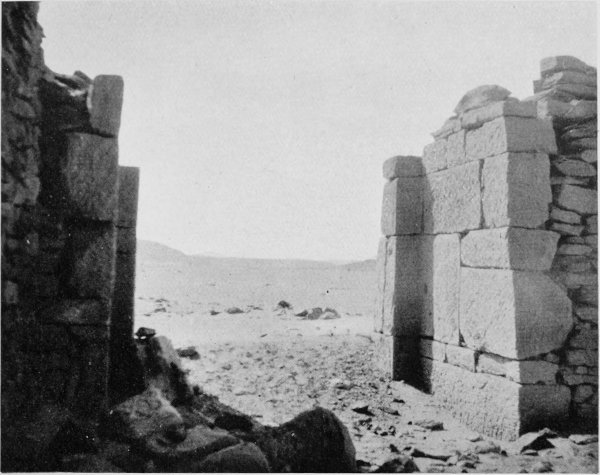
The Temple of Wady Abâd. The east end of the Portico. The square pillar was built in Græco-Roman times to support the broken architrave.—Page 155.
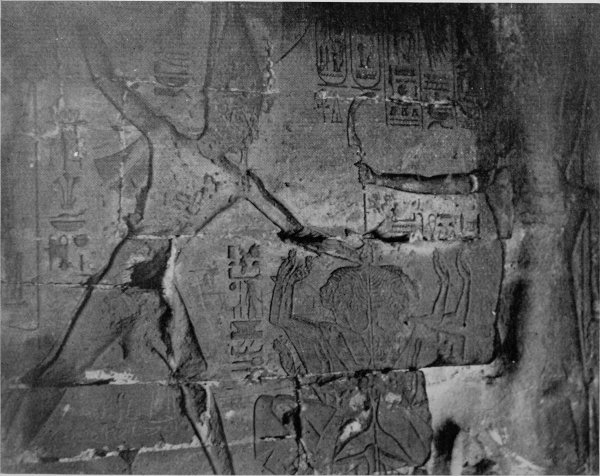
The Temple of Wady Abâd. The east wall of the Portico. The king is seen smiting a group of negroes.—Page 156.
Pl. xxvi.
The hills of the desert recede in a kind of bay here, and if one walks eastwards from the town one presently sees that there is, at the back of the bay, an outlet through the range, five miles or so from the river and the enclosure. It was through this natural gateway, which the ancient Egyptians called “the Mouth of the Wilderness,” that the caravans passed in early days into the great desert; and once through this doorway they were immediately shut off from the green Nile valley and all its busy life. There is a great isolated rock which stands in the bay; and in its shadow the miners and soldiers were wont to offer their last prayers to the gods of Egypt, often inscribing their names upon the smooth surface of the stone. Here one reads of priests, scribes, caravan-conductors, soldiers, superintendents of the gold mines, and all manner of officials, who were making the desert journey, or who had come to see its starting-point.
In Dynasty XVIII. Amonhotep III. (B.C. 1400) erected a graceful little temple here, to which one may walk or ride out from El Kab over the level, gravel-covered surface of the desert, and may stand amazed at the freshness of the colouring of the paintings on its wall. Another little shrine was built, close by, a century and a half later; and in Ptolemaic times a third temple was constructed. Thus one is surrounded by shrines as one sets out over the hills away from this land of shrines: it is as though the gods were loath to leave one, and in solemn company came out to speed the traveller on his way.
The road which the gold miners trod passed through the hills, and then turned off towards the south-east; and presently it met the road which started from Edfu, or rather from Contra Apollinopolis Magna, which, as has been said, is ten miles distant from El Kab. Edfu was also a city of great antiquity, and was famous as the place where at the dawn of Egyptian history the Hawk-tribes overthrew the worshippers of Set, the god who afterwards degenerated into Satan. The great temple which now stands there, and which is the delight of thousands of visitors each winter, was built upon the ruins of earlier temples where the hawk of Edfu had been worshipped since the beginning of things. The record of a tax levied on Edfu in the reign of Thothmes III. (B.C. 1500) shows that it was mainly paid in solid gold, instead of in kind; and one thus sees that the precious metal was coming into the country at that time along the Wady Abâd route, as indeed it was along all the great routes. Edfu was the main starting-point for the mines in the days when Sety I. built his temple, if one may judge from the fact that the hawk-god of that city is one of the chief deities worshipped in the shrine, while the vulture-goddess of El Kab has only a secondary place there; and in Roman times the Edfu road was perhaps the only one in general use.
This was the route which was selected for our journey; and after spending the night at El Kab, we rode next morning along the east bank of the river to a point at the mouth of the Wady Abâd, opposite the picturesque town of Edfu, where the pylons shoot up to the blue sky and dominate the cluster of brown houses and green trees. A morning swim in the river, and a trot of somewhat over two hours, was sufficient exercise for the first day; and the afternoon was spent in camp, while the camelmen collected the food for the journey and led their beasts down to the river to drink.
On the following morning, soon after daybreak, we mounted our camels and set out over the hard sand and gravel towards the sunrise. A fresh, cool wind blew from the north, and the larks were already singing their first songs, as we trotted up the wady. The brisk morning air, the willing camels, the setting out into the freedom of the desert: how shall one record the charm of it? Only those who have travelled in the desert can understand the joy of returning there: a joy which, strangely enough, has only one equal, and that the pleasure of returning to water, to flowers, and to trees after a spell of some days or weeks in the wilderness. Here there are no cares, for there are no posts nor newspapers; here there is no fretfulness, for one is taking almost continual exercise; here there is no irritation, for man, the arch-irritant, is absent; here there is no debility and fag, for one is drinking in renewed strength from the strong conditions around. But ever enthusiasm, that splendid jewel in the ring of life, shines and glitters before one’s eyes; and all one’s actions assume a broader and a happier complexion. The desert is the breathing-space of the world, and therein one truly breathes and lives.
The main entrance of the Roman station of Wady Abâd, looking west from inside the enclosure.—Page 164.
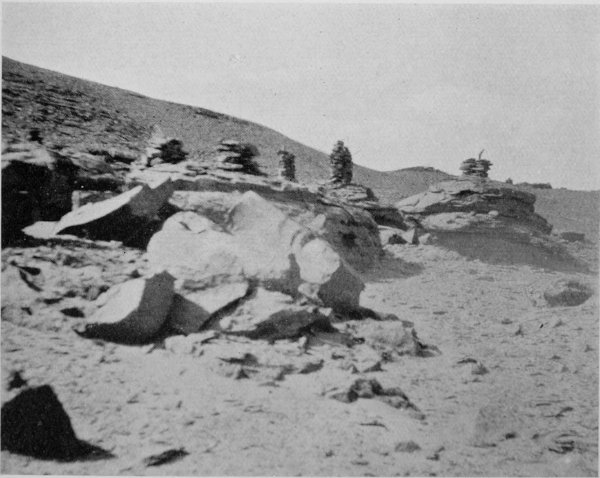
The piles of stone erected opposite the Temple of Wady Abâd.—Page 164.
Pl. xxvii.
A trot of about two hours brought us to the well known as Bir Abâd. The well is but a small, stagnant pool of brackish water, around which a few trees grow. There are six acacias, three or four small palms, a curious dead-looking tree called Heraz by the natives, and a few desert shrubs. Some attempt has been made to cultivate a small area, but this has not met with success, and the native farmers have departed. The sand under the acacias offers a welcome resting-place, and here in the shade we sat for a while, listening to the quiet shuffle of the wind amongst the trees and to the singing of the sand-martins. While playing idly with the sand an objectionable insect was uncovered, which the natives call a “ground-gazelle.” It is a fat, maggot-like creature, about an inch in length, possessing a pair of nippers similar to those of an earwig. It runs fast upon its six or eight legs, but, whenever possible, it buries itself by wriggling backwards into the sand. A more loathsome insect could not well be imagined; and, since the species is said to be by no means uncommon, one will not delve with the fingers so readily in the future as one lies in the shadow of the trees. A ride of about half an hour’s duration along the valley and past a Shêkh’s tomb, known as Abu Gehâd, brought us to the ruined Roman fortified station named after this tomb. It is much like other stations of this date, and consists of an enclosure in which a few chambers are to be seen. One enters from the west, and in the open area forming the courtyard there is a cemented tank in which a supply of water was stored for the use of travellers. The south wall of the enclosure to this day looks formidable from the outside, still standing some twelve feet in height, and being solidly built of broken stones. On this side of the station there are traces of an outbuilding, which may have been the animal lines. In the main enclosure a block of sandstone was found bearing the cartouches of the Pharaoh Tutankhamen (B.C. 1350), one of the successors of the “heretic king” Akhnaton, and by its form it seems to have been part of a shrine which perhaps had stood at this spot. The road from El Kab here joins the Edfu route, and the Pharaoh may have marked the meeting of the ways by a little wayside temple at which the gold miners might offer a prayer to the gods of the wilderness.
In Roman days when this station was built it is probable that the gold mines no longer formed the main objective of the caravans which passed along this road. Emeralds, almost unknown to the ancient Egyptians, were now deemed an ornamentation of worth and beauty; and the emerald mines of Gebel Zabâra, which are most easily approached along this route, were vigorously worked by the Romans. It was on his way to these mines that Cailliaud in 1816 discovered the temple of Sety I. There was also a road from Edfu to the Græco-Roman port of Berenice on the Red Sea, which was much used at this period; and stations similar to that of Abu Gehâd are to be met with at fairly regular intervals for the whole distance to the coast.
Trotting on for another two hours and a quarter, we camped under the rocks of the Gebel Timsah, a well-known landmark to travellers. A head of rock projects into the level valley, and upon it the people of the desert for untold generations have set up small heaps of stones, the original idea of which must have been connected with religious worship. The two tents were no sooner pitched than a gale of wind, suddenly rising, tore one of them down, and almost succeeded in overthrowing the other. A tempest of dust and sand beat in at the doorway, and covered all things with a brown layer, so that one knew not where to turn nor how to escape. Fortunately, however, like all things violent, it did not last for long; and a calm, starlit night followed.
The distance from Gebel Timsah to the temple which was our destination may be covered in about an hour and a half of trotting. We set out soon after sunrise; and presently a low ridge was crossed, the path passing between two piles or beacons of stones, set up perhaps in Roman days to mark the road; and from this point a wide, flat valley could be seen, stretching between the low hills, and much overgrown with bushes and brambles. Over the plain we jogged in the cool morning air, directing the camels to a high bluff of rock in the east, in which, the guide told us, the temple of Sety was excavated. Soon a Roman fortress came into sight, and later we were able to discern the portico of the temple sheltering under the rocks. Slowly the features became more distinct, and at last we dismounted at the foot of the cliffs and scrambled up the slope to explore the picturesque shrine.
It is strange that of the many Egyptologists who have travelled in Egypt, only two, Lepsius and Golénischeff, have visited this spot. It may be that the statement of the old Baedeker, which says that the wandering Ababdeh tribes “assume a hostile attitude” to travellers, has confined them to the banks of the Nile; or perhaps the reported antics of the much-maligned camel have induced them to leave unvisited this pearl of the past. For that matter, however, the place might be reached upon the back of the patient ass, there being water at Bir Abâd, and, for the last few years, at the temple itself. When one sees this building, one of the best preserved of all the Egyptian temples, one is amazed at the lack of enterprise which has caused it to be uncared for, unprotected, and unvisited for all these years. A few mining engineers and prospectors alone have seen the shrine; and, since they have disfigured its walls with their names, one could wish that they too had stayed at home.
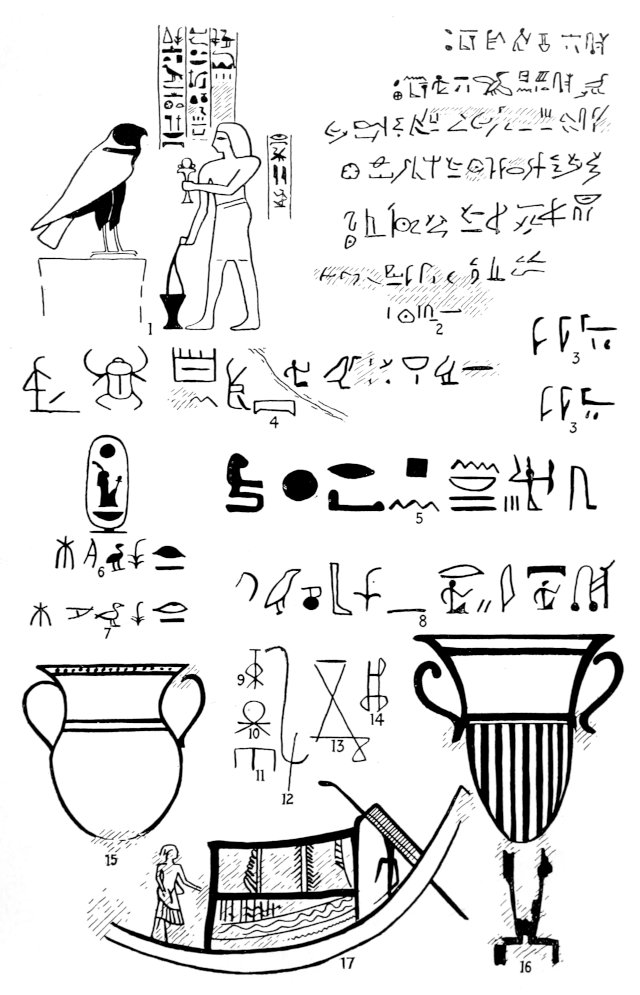
INSCRIPTIONS AND DRAWINGS IN AND NEAR THE TEMPLE OF WADY ABÂD.
1, 6, 7. North face of cliff, east of Temple.—Page 158.
2. Façade of Temple, east side.
3. Two examples of five similar inscriptions, on cliff east of Temple.
4. On face of cliff just west of Temple.
5. Face of cliff, west of Temple.—Page 163.
8. On face of cliff just east of Temple.—Page 162.
9-14. Façade of Temple, west side.
15, 16. South-east pillar of Portico.—Drawings in red paint.
17. East wall of Portico.—Drawings in red paint.
Pl. xxviii.
(Large-size)
Pl. xxviii.
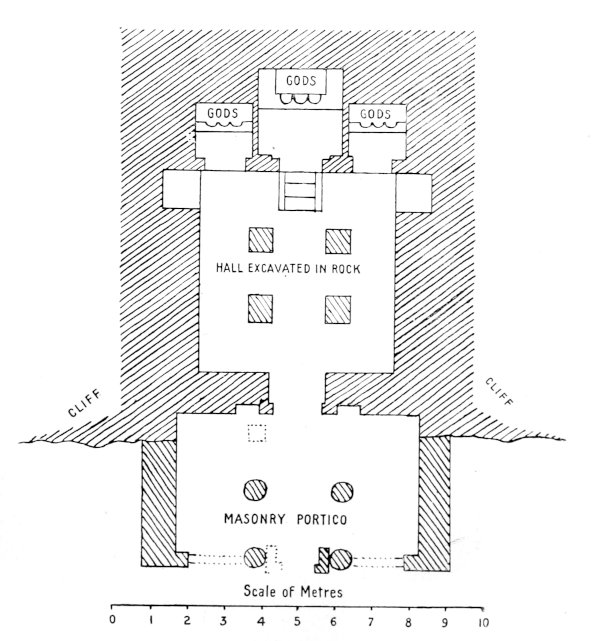
The little temple consists of a rectangular hall excavated in the rock, the roof being supposed to be supported by four square pillars, though in reality these also are part of the living rock. At the far end there are three shrines in which the statues of the gods are carved. In front of this hall there is a built portico, the roof of which rests upon four columns with lotus-bud capitals. One enters from the north, up the slope of fallen stones and driven sand, and so passes into the shade of the portico. Through a hole in the roof, where a slab of stone has fallen in, one may look up at the towering rocks which overhang the building. Then, through a beautifully ornamented doorway, one passes into the dimness of the rock-cut hall, where one may be conscious that the whole height of the hill rests above one’s head. Both this hall and the portico are richly decorated with coloured reliefs, and in the inner portions of the temple one stands in wonder at the brightness of the colours in the scenes which are seen on all sides. It has been said that the brilliancy of the painting in the temple of Amonhotep III. at El Kab is surprising; but here it is still fresher, and has even more admirably held its own against the assaults of time. We see the Pharaoh smiting down his negro and Asiatic enemies in the presence of Amen Ra and Horus of Edfu; we watch him as he makes offerings to the gods; and to the ceiling the eye is attracted by the great vultures with spread wings which there hover above one, depicted in radiant colours rendered more radiant by contrast with the browns and the yellows of the scenery outside. In the niches at the end of the hall the gods sit in serenity; and, though these figures have been damaged almost beyond recognition by pious Musslemans, there still clings around them their old majesty, and still one may find something solemn in their attitude, so that one almost pays heed to the warning inscribed on the doorway that a man must be twice purified before entering the little sanctuary where they sit.
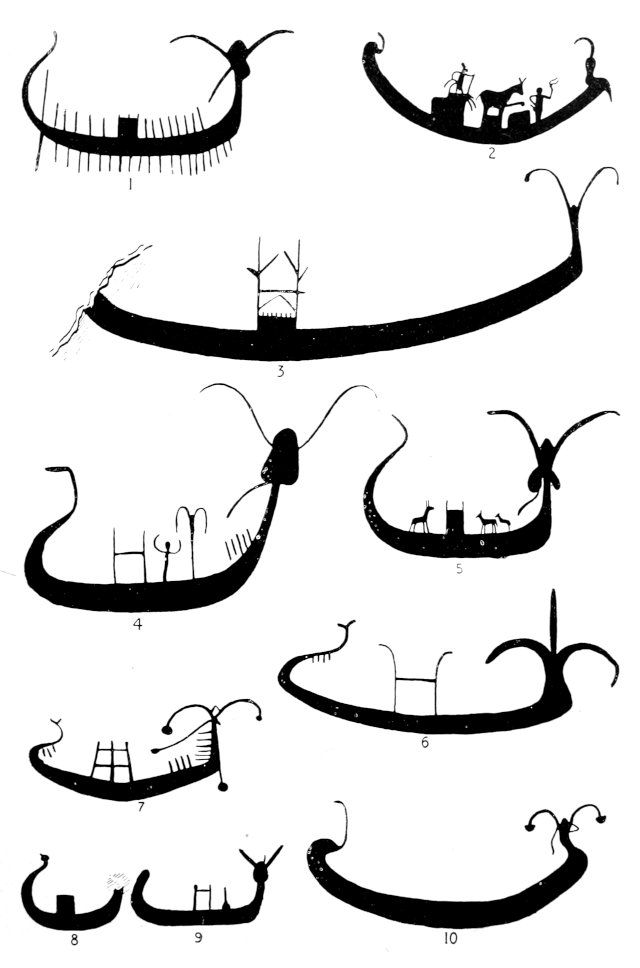
1, 2, 4, 5, 8, 9. North face of cliff, east of Temple.—Page 157.
3. Smaller of two large fallen rocks, east of Temple.—Page 157.
6, 7, 10. Larger of two fallen rocks, east of Temple.—Page 157.
Pl. xxix.
(Large-size)
Pl. xxix.
It may be asked why Sety selected this spot for his temple, for, except that it lies on the route to the mines, the reason for its location is not at once apparent. The explanation, however, is not far to seek. This great bluff of rock has a smooth cliff-like surface on its north side, and for the earliest travellers, as for those of the present day, it has cast a welcome shadow in which one might take the midday siesta in comfort. Here, scratched or chiselled on the rock, there are very many drawings which undoubtedly date from archaic, and even prehistoric, times. Numerous representations of curious boats are seen, and their character justifies one in supposing them to be the sacred arks which formed in ancient times such an essential part of Egyptian religious ceremonial. In most of these vessels one sees the shrine which contained the god, and in one drawing a figure with flail raised, before which an animal is being sacrificed, is certainly the god Min himself, the patron of the desert. A few animals and figures are also drawn, and when human beings are represented in or near the arks their arms are shown held aloft in the regular Egyptian attitude of worship.
Thus it seems that, from being a place to rest and to dream in, the rock had already in archaic times become a sacred spot, at which early man bowed himself down before the representations of the ark of Min. From this period until Dynasty XVIII. it seems, from the lack of inscriptions here, that the mines were not much used. Amonhotep III., however, sent his Viceroy of the South out here, whose name, Merimes, is written upon the rocks near the temple; and his temple at El Kab, at the beginning of the route, is a further indication of his interest in the gold workings. Just as this king had built his temple near the sacred rock at “the Mouth of the Wilderness,” so Sety I., following half a century later, decided to erect his shrine at the foot of this more distant sacred rock, the half distance having been already adventured by the intermediate Pharaoh Tutankhamen. Since the place was just about a day’s express ride from Edfu and El Kab, its situation was convenient; and, moreover, there was no other head of rock in the neighbourhood which offered so fine a position for a rock temple.
In the inscriptions near the mouth of the excavated portion of the shrine, Sety caused to be recorded the story of the building of the temple; and parts of this are of sufficient interest to be quoted here:—
In the year 9 (B.C. 1304), the third month of the third season, the twentieth day. Lo! his majesty inspected the hill-country as far as the region of the mountains, for his heart desired to see the mines from which the gold is brought. Now when his majesty had gone out from the Nile valley, he made a halt on the road, in order to take counsel with his heart; and he said, “How evil is the way without water! It is so for a traveller whose mouth is parched. How shall his throat be cooled, how shall he quench his thirst?—for the lowland is far away, and the highland is vast. The thirsty man cries out to himself against a fatal country. Make haste!—let me take counsel of their needs. I will make for them a supply for preserving them alive, so that they will thank God in my name in after years.” Now, after his majesty had spoken these words in his own heart, he coursed through the desert seeking a place to make a water-station; and lo! the god led him in order to grant the request which he desired. Then were commanded quarrymen to dig a well upon the desert, that he might sustain the fainting, and cool for him the burning heat of summer. Then this place was built in the great name of Sety, and the water flowed into it in very great plenty. Said his majesty, “Behold, the god has granted my petition, and he has brought to me water upon the desert. Since the days of the gods the way has been dangerous, but it has been made pleasant in my glorious reign. Another good thought has come into my heart, at command of the god, even the equipment of a town, in whose midst shall be a settlement with a temple. I will build a resting-place on this spot, in the great name of my fathers the gods. May they grant that what I have wrought shall abide, and that my memory shall prosper, circulating through the hill-country.”
Then his majesty commanded that the leader of the King’s workmen be commissioned, and with him the quarrymen, that there should be made, by excavation in the mountain, this temple. Now after the stronghold was completed and adorned, and its paintings executed, his majesty came to worship his fathers, all the gods; and he said, “Praise to you, O great gods! May ye favour me forever, may ye establish my name eternally. As I have been useful to you, as I have been watchful for the things which ye desire, may ye speak to those who are still to come, whether kings, princes, or people, that they may establish for me my work in this place, on behalf of my beautiful temple in Abydos.”
The last words tell us for what purpose this route to the gold mines had been bettered. A second long inscription is devoted to blessings on those who keep up this shrine and the mines with which it was connected, and to curses on those who allow it to fall into neglect. A third inscription is supposed to give the speech of the travellers who have benefited by the king’s thoughtfulness:—
Never was the like of it (the temple and the well) made by any king, save by the King Sety, the good shepherd, who preserves his soldiers alive, the father and mother of all. Men say from mouth to mouth, “O Amen, give to him eternity, double to him everlastingness; for he has opened for us the road to march on, when it was closed before us. We proceed and are safe, we arrive and are preserved alive. The difficult way which is in our memory has become a good way. He has caused the mining of the gold to be easy. He hath dug for water in the desert far from men for the supply of every traveller who traverses the highlands.”
Sety dedicated his temple to Amen Ra, whom he identified with Min, the old god of the place, and to Harmachis, the sun-god, whom he seems to have identified with the hawk, Horus of Edfu. He also here worshipped Ptah, the Egyptian Vulcan, and his lion-headed consort Sekhmet; Tum; Hathor, the Egyptian Venus; Nekheb, the vulture-goddess of El Kab; Osiris and Isis; Mut, the mother goddess; and Khonsu, the moon-god who was the son of Amen Ra and Mut, and with them formed the royal trinity at Thebes. All these gods one sees upon the walls of the temple, and before them Sety is shown offering incense, wine, flowers, and food. Some inscriptions on the rocks near the temple, written by high officials of this period who visited the mines, make mention of two other deities: Ra, the sun-god, and a strange goddess who rides a horse and brandishes a shield and spear.
When Sety died the temple was still not quite finished, and for some reason or other which we shall probably never know, it so remained. His temple at Abydos, too, was neglected, and the revenues ceased to be collected. Thus, in spite of the curses inscribed on the walls of the desert shrine, the king’s plans for the continual working of the mines, in order to pay for the maintenance of his great masterpiece, were not carried out. At Abydos Rameses II., in an inscription written a few years later, states that he found the temple of Sety there unfinished, and that it had not been “completed according to the regulations for it of the gold-house.” He, however, finished the building, and perhaps re-established the gold workings along the Wady Abâd route, for on one of the pillars of the hall of the desert shrine there is an inscription written by an official which reads: “Bringing the gold for the festival in the temple of Rameses II.”
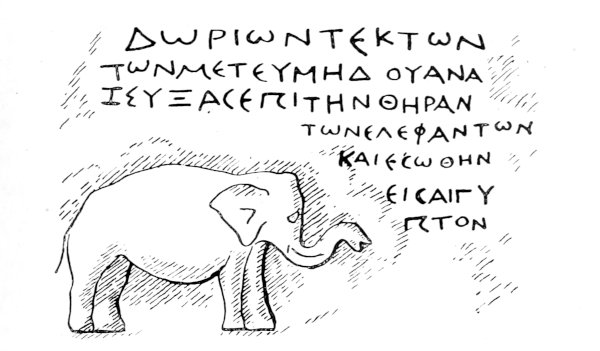
Since that time until the present day the gods in the sanctuary have looked out at a long stream of travellers, soldiers, miners, and officials. Upon the rocks and on the walls of the temple there are several hieroglyphical and Greek inscriptions which tell of the coming of all manner of people. A chief of the custodians of El Kab here records his name, and a scribe of the king’s troops is immortalised near by. Many of the Greek inscriptions are ex-votos dedicated to Pan, with whom the old Min had been identified; and as the latter was the god of desert travel, so the sprightly Pan becomes the sober patron of the roads. Miners from Syracuse and from Crete tell of their advent; and one traveller describes himself as an Indian, a voyager, perhaps, in one of those trading vessels which brought to the port of Berenice the riches of the East, to be conveyed across this great desert to the markets of Alexandria. A man named Doriōn states that he had returned in safety from an elephant hunt, probably in the south. Two inscriptions are written by Jews, thanking God for their safe journeys; and it is interesting to notice that one of them is called Theodotus, son of Doriōn, and the other Ptolemy, son of Dionysius—all pagan names. A troop of Greek soldiers have recorded their names in the temple, and state that they kept a watch before “Pan of the Good Roads.”
ARCHAIC DRAWINGS OF SACRED BOATS, ANIMALS, ETC., ON ROCKS NEAR TEMPLE OF WADY ABÂD.
1, 4, 7, 8, 9, 11, 12, 14. North face of cliff, east of Temple.—Page 157.
2, 3, 6, 10, 15, 16, 17. Larger of two fallen rocks, east of Temple.—Page 157.
5. West face of cliff projection, east of Temple.—Page 157.
13. Smaller of two fallen rocks, east of Temple.—Page 157.
Pl. xxx.
(Large-size)
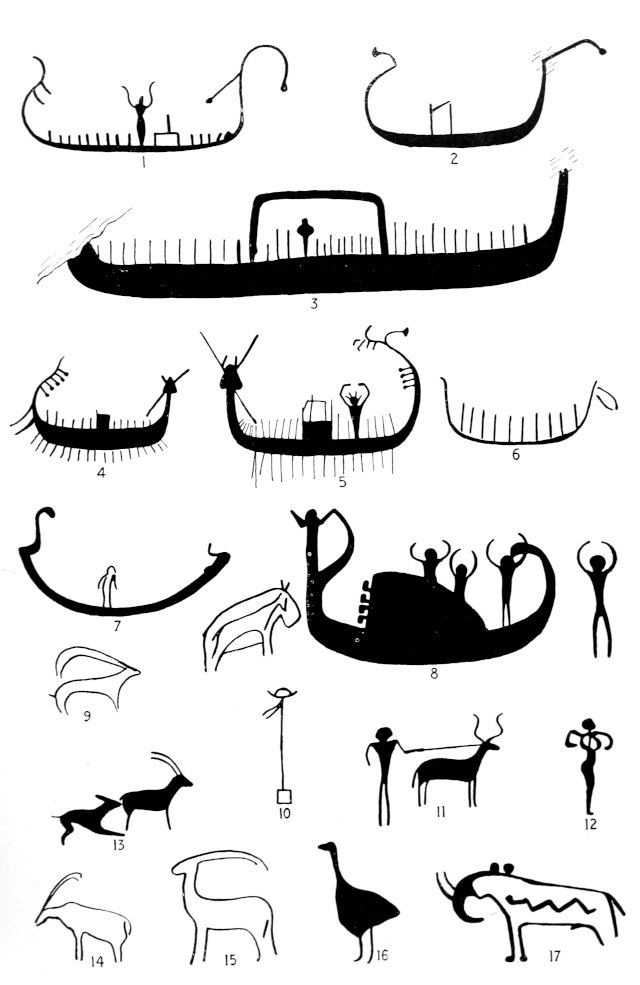
Pl. xxx.
These travellers, besides, or instead of, writing their names, seem often to have piled a few stones at conspicuous points as a memorial of their passage. At various places in the neighbourhood, and especially at the foot of the hills opposite the temple, there are many such piles of stones; and when well built they rise from the rocks like altars, three feet or so in height, and perhaps two feet in diameter. In one or two cases there are fragments of old Egyptian pottery lying beside them, and there seems no question that they are connected with religious worship. The same custom still prevails amongst the desert people, though now its significance is not remembered; and yet its meaning is not entirely forgotten, for on a hill-top near the temple we found, near such a pile of stones, three pairs of gazelle horns and a collection of Red Sea shells pierced for stringing, a modern offering to the old gods.
In Græco-Roman times a large fortified station was constructed near the temple, and this still stands in fairly good preservation. It is built in the plain in front of the temple, not more than a hundred yards from the foot of the cliffs. The enclosure is somewhat larger than is usual in these stations, but the greater part of the area has never been built upon. The enclosing wall still stands to a height of ten feet or so in parts, but here and there it is almost entirely ruined. It is built in three thicknesses, so that on the inside there are two heights at which one might walk around the rampart without showing above it. One enters through a well-built masonry doorway, and on either side one may see the hole into which the beam was shot to close the wooden door at nights. On one’s right there is a group of small chambers; and here an isolated house, in one wall of which a window is still intact, forms the best-preserved portion of the ruin. On one’s left there is a large hall, in which there was a tank, parts of which, now half-choked with sand, can be seen. The next building on one’s left is also a hall of considerable size—the common mess-room, probably, of the travellers. One then passes into the open courtyard, which bears off to the left, or north, and does not contain more than a trace or so of walls.
Although one sees so many of these Roman stations in the Eastern Desert, their charm and interest never palls; and, more than any other ancient buildings, they bring back the lost ages and recall the forgotten activities of the old world. These ruins, too, are always picturesque, and gather to themselves at dawn and at sunset the hues, the lights, and the shadows of the fairest fancy. At dawn, at noon, at sunset—all day long—this fortress in the Wady Abâd is beautiful; and for those who love the desert there is here and in its surroundings always some new thing to charm. The walls of the enclosure, and beyond them the pillared portico of the temple sheltering under the rugged brown cliffs, form as delightful a picture as may be found in Egypt. As one sits in the blue shadow one may watch the black-and-white stone-chats fluttering from rock to rock, and overhead there circles a vulture, as vividly coloured as those which form the ceiling decoration in the temple. The wide flat plain, shut in by the distant hills on all sides, entices one from the fortress on to its sparkling surface, though the tumbled rocks near the temple soon call one back to their breezy humps and shady nooks. The hundred surrounding hill-tops vie with one another in the advertisement of their merits, and one attains a summit but to covet a further prospect. Or, attracted by the two or three trees and the few bushes which grow in the plain over against the fortress, one walks to their welcoming shade; and there one may listen to the song of the sand-martins and to the strange, long-drawn note of the finches.
“A book of verses underneath the bough. . . .”
One knows now what the old philosopher desired to express; for the wilderness is indeed Paradise, and here one may find the true happiness.
The day slips past in a half-dream of pleasure, and to the student of archæology, who finds so much for his pencil to record and his mind to consider, the hours race by at an absurd speed. The two days which we spent here passed like an afternoon’s dream, and the memories which remain in the mind are almost too slight to record. Writing here in the study one reconstructs the rugged scene, and searches for the incidents which gave gentle colour to it. There was a flight of cranes, which sailed overhead, moving from south-east to north-west, on their way to spend the summer in Europe. Why should one’s memory recall so charmedly the passage of a hundred birds? There was a hyæna which, in the red dusk, stood upon a hill-top to watch us, and presently disappeared. There were three vultures which rose from the bones of a dead camel, soared into the sky, and alighted again when we had passed. There came a flock of goats and sheep at noonday to the well, with much bleating and with the gentle patter of many hoofs. The shepherd in his picturesque rags eyed us curiously as his charges drank, and, still watching us, passed down the wady towards the west when they had quenched their thirst. And so one’s memory wanders over the two days, recalling the trivialities, and passing over the more precise details of camp life and of work, until presently one sees the tent struck and the baggage bumping down the valley once more on the backs of the grunting camels. The return journey to Edfu was soon accomplished, and the accumulated mail of five or six days which was in waiting at the end of the ride quickly brought one back to the business of life, and relegated the Wady Abâd to the store-chamber of happy recollections.
Greek inscription relating to an elephant hunt, on a rock to the east of the Temple of Wady Abâd.—Page 163.
Sketch-plan of the Temple of Wady Abâd.
Pl. xxxi.