III. THE RED SEA HIGHROAD.
Reading edition
In the reach of the Nile between Quft and Keneh, a few miles below Luxor, the river makes its nearest approach to the Red Sea, not more than 110 miles of desert separating the two waters at this point. From Quft, the ancient Koptos, to Kossair, the little seaport town, there runs the great highroad of ancient days, along which the Egyptians travelled who were engaged in the Eastern trade. It happened by chance that this route led through the Wady Fowakhîeh in which the famous quarries were situated; and in the last chapter I have recorded an expedition made to that place in 1907. From the quarries I set out with my three friends for the sea; and, as the route from the Nile to Wady Fowakhîeh has already been described, it now remains to record its continuation eastwards and our journeying upon it.
The history of this highroad is of considerable interest, for it may be said to be the most ancient of the routes of which the past has left us any record; and its hard surface has been beaten down by the fall of feet almost continuously from the dawn of human things to the present day. It has been thought by some that a large element of the prehistoric inhabitants of the Nile valley came into Egypt by this road. Excavations at Quft (Koptos) have shown the city to date from Dynasty I., if not earlier; and the great archaic statues of Min, the god of the desert, one of which is to be seen at the Ashmolean Museum, Oxford, were here found. The ancient Egyptians always believed that the home of their ancestors was in the land of Pount, the region around Suakin; and since so many archaic remains have been found at Koptos, the terminus of a route which in historical times was sometimes used by persons travelling to Pount, it seems not unlikely that there was a certain infiltration of Pountites into Egypt by way of Kossair and Quft. These people travelling in ships along the coast, Arabians sailing from the eastern shores of the Red Sea, or Bedwin journeying by land from Sinai and Suez, may have passed over this road to trade with the inhabitants of Upper Egypt; but, on the other hand, there is no evidence to show that any extensive immigration or invasion took place. The coast of the Red Sea is utterly barren, and the wells are few in number; and one could more readily imagine the prehistoric inhabitants of Egypt pushing eastwards on hunting expeditions until they encountered the sea, and thus opening up the route, than one could picture these Eastern peoples penetrating from an untenable base to a hostile country at the dawn of known days.
Upon the archaic statues of the god Min at Koptos there are many rude drawings scratched on the stone surface. These represent pteroceras shells, the saws of sawfish, a stag’s head, the forepart of an elephant, a hyæna, a young bull, an ostrich, and a flying bird. It is evident that these drawings would not have been scratched upon the statue of the tribal god without some sort of meaning being attached to them, and it seems probable that one may see in them the articles of commerce which the people of Koptos imported from the Red Sea: shells, horn, ivory, feathers, and skins.
The earliest written record of a journey to Kossair dates from Dynasty XI., B.C. 2020, when an official named Henu travelled from Koptos to Kossair, and thence to Pount. “The king sent me,” says Henu, “to dispatch a ship to Pount to bring for him the fresh myrrh from the chieftains of the desert which had been offered to him by reason of the fear of him in those countries. Then I went forth from Koptos upon the road as his Majesty commanded me. Troops cleared the way before me, overthrowing those hostile to the king; and the hunters and the children of the desert were posted as the protection of my limbs. . . . Then I reached the Red Sea, and I built this ship, and I dispatched it with everything, after I had made for it a great oblation of cattle, bulls, and ibexes.” Henu, no doubt, carried the material for building the vessel across the desert, and settled down on the coast to build it, his supplies being sent to him from Koptos as often as necessary. He tells us in another part of the inscription that he dug several wells in the desert; and one can imagine his little company living quite happily beside one of these wells near the seashore while the vessel was hammered together on the beach below. After the lapse of four thousands of years one may still picture these scenes: the launching of the ship into the blue waters, when the savour of burnt-offerings streamed up to heaven, and the shouts of the workmen rang across the sandy beach; the tedious journey along the barren coast, always the yellow hills upon one’s right and always the boundless sea upon one’s left; the landing on the strange shores of Pount, where the precious myrrh-trees abundantly grew and there was talk of gold as of a thing of little worth; where sleek, bearded men and amazingly fat women sat at the doors of bee-hive huts raised from the ground upon piles; and where, walking abroad, one might meet with giraffes and other surprising creatures whose existence would not be credited by one’s friends at home. An Englishman feels that it would almost have been worth the four thousand years of subsequent oblivion to have seen what these adventurers saw!
During the next twenty centuries the road seems to have been in almost continual use, but there are no interesting inscriptions recording expeditions made along it, though one may be sure that many of the trading expeditions passed over this route to the land of Pount. The town of Kossair seems to have been called Thaau at this period, but in Græco-Roman days this name has developed into Tuau or Duau, a word written in hieroglyphs simply with three stars. The trade with Arabia and India which flourished during the rule of the Ptolemies brought the road into very general use, and Kossair became as important a trading town as any in Egypt. The harbour, however, was so poor that a new port and town was constructed some five miles to the north, where a natural bay was easily able to be improved into a very fair harbour. This new town was named Philoteras, in honour of the sister of Ptolemy Philadelphos (B.C. 285), while the older port was now known as Aennum by foreigners, though to the Egyptians both towns were called Duau. I was fortunate enough to find some blocks of a Ptolemaic temple at the older Kossair, and on one of them was the name Duau, followed by the hieroglyph representing a town written twice to indicate the existence of the two ports. Not infrequently one finds at Koptos and elsewhere short inscriptions of this period relating to journeys made along this route to Kossair, and thence over the high seas. One example may here be quoted: “To the most high goddess Isis, for a fair voyage for the ship Serapis, Hermæus dedicates this.”
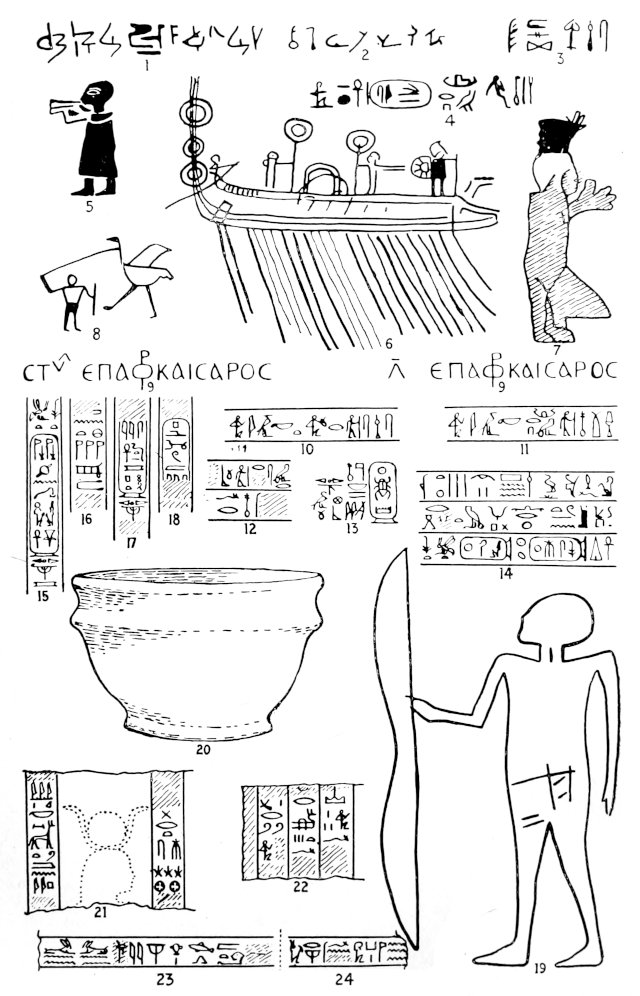
1, 2. Inscriptions near the archaic inscription on Plate vii.
3. Old Kingdom inscription, Wady Fowakhîeh.
4. Inscription giving name of King Unas, Wady Fowakhîeh.—Page 39.
5, 6, 7. Drawings of the Greek period in Wady Fowakhîeh.—Page 51.
8. Archaic drawing, Wady Fowakhîeh.
9. Greek inscriptions on blocks of quarried stone, Wady Fowakhîeh.—Page 50.
10, 11, 12. Old Kingdom inscriptions at Wady Fowakhîeh.
13. Misspelt inscription of Thothmes III. at Wady Fowakhîeh.
14. Inscription of Rameses IV., Wady Fowakhîeh.—Page 46.
15, 16, 17, 18. Inscriptions on Temple at Wady Fowakhîeh.—Page 49.
19. Archaic drawing near Bir el Ingliz.—Page 70.
20. Typical blue-glazed bowl found on ruins of Old Kossair.—Page 86.
21-24. Fragments of Temple at Kossair.—Page 81.
Pl. x.
(Large-size)
Pl. x.
I must be permitted to give in full a very interesting tariff of taxes imposed on persons using the road during the Roman occupation, which was found in a ruined guard-house just behind Koptos, at the beginning of the highway. It reads as follows:—
By Order of the Governor of Egypt.—The dues which the lessees of the transport service in Koptos, subject to the Arabian command, are authorised to levy by the customary scale, are inscribed on this tablet at the instance of L. Antistius Asiaticus, Prefect of the Red Sea slope.
For a Red Sea helmsman drachmas 8
„ „ bowsman „ 10
„ an able seaman „ 5
„ a shipyard hand „ 5
„ a skilled artisan „ 8
„ a woman for prostitution „ 108
„ „ immigrant „ 20
„ a wife of a soldier „ 20
„ a camel ticket obols 1
„ sealing of said ticket „ 2
„ each ticket for the husband, if mounted, when a caravan is leaving drachmas 1
„ all his women, at the rate of „ 4
„ a donkey obols 2
„ a waggon with tilt drachmas 4
„ a ship’s mast „ 20
„ „ yard „ 4
The ninth year of the Emperor Cæsar Domitian Augustus Germanicus on the 15th of the month of May.
In the above tariff it will be seen that the persons or articles on which taxes were levied were such as one might expect to have passed between the Nile and the sea; and only those items concerning women seem to call for explanation. The very large tax imposed upon prostitutes must indicate that Indian or Arabian females coming into Egypt along this route, and liable to bring with them the evils of the East, could only be admitted when they were of the richest and, consequently, best and highest class. Such women were always taxed in the Roman Empire, and in this regard a rather humorous story is told in Philostratus’ Life of Apollonius of Tyana. That holy man was accosted by a tax-collector when about to cross the Euphrates, and was asked his wares. He replied with the somewhat banal remark that he had with him Sōphrosúnē kai Dikaiosúnē kai ’Andreia—“Temperance, Righteousness, and Courage.” The official at once assessed these as Doúlas, “Female slaves,” and would have taxed them as prostitutes, had not the prophet hastily corrected him by saying that they were not Doúlas but Despoínas, “Ladies of the House”! The “wives of soldiers” mentioned in the tariff shows that Mommsen was right in stating that the rule of the emperors was laxer in Egypt than elsewhere, for before the time of Severus it was not possible for legionaries to contract legal marriages while on active service; but in Egypt the marriages were so far recognised that the wives could be taxed as such, and the children could be enrolled as legionaries.
During mediæval times this Red Sea highroad was much used by traders, but its river terminus was now removed from Koptos to Kus, a town a few miles farther up-stream, which soon became second only to Cairo in size and wealth. A pottery figure of Buddha, some mediæval Chinese vases, and a few Arabian antiquities, found in Upper Egypt, are records of the use of this route at that time. In later days the terminus again shifted to Keneh, a few miles to the north of Koptos, and to that town there still come Arabian traders from across the Red Sea, and pilgrims sometimes use it as the base of the journey to Mecca.
From Wady Fowakhîeh our party set out along this highroad at about 7 A.M. on a bracing morning in November. From Bir Fowakhîeh the road branched off to the right along a fine valley, shut in by hills fantastic in shape and colour. Clustering on either side of the path for some distance there were groups of huts, and in the hillsides there were traces of gold mines long since abandoned. The road beneath one was hard, flat, and blue-grey in colour, as though some mighty torrent had brought down masses of gravel and had laid it level over the bottom of the valley. Gradually it sloped upwards, and as the hills drew in on either side one felt that the highest point of the whole road was soon to be reached. We were already half-way between the Nile and the sea, and so far there had been a continuous slope upwards, so gradual as to be almost imperceptible. The valley now twisted and turned narrowly between the dark hills, and the gravel bed became humped and banked up where the early waters had raced down some narrow gauge and had churned themselves through a natural basin into the wide bed beyond. The cold wind beat in our faces as we trotted up the narrowing valley, and the sun had not yet gained much power when, after a ride of two hours, we reached the rugged pass which forms the apex of the route.
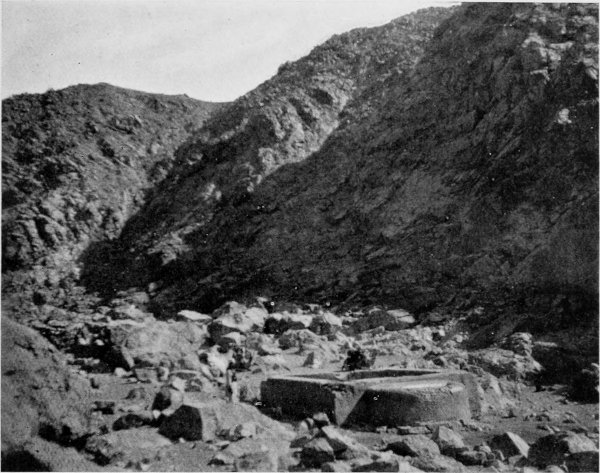
The scenery here is superb. The pathway, such as it is, threads its way through a cluster of great grey boulders tumbled into the few yards’ width between the rocks of the hillside, so that on foot one may jump from stone to stone up the whole length of the pass, and on camelback one has to twist and turn, rise and descend, until the saddle-straps come near to bursting. Amidst the rocks there is a well, known as Bir es Sid, which may have been opened in ancient times, perhaps by the redoubtable Henu. A few natives were encamped near by, and not far away their goats were to be seen in the charge of a small girl, whose dark dress fluttering in the wind caught one’s eye amidst the pale grey of rocks and the cold blue of the shadows.
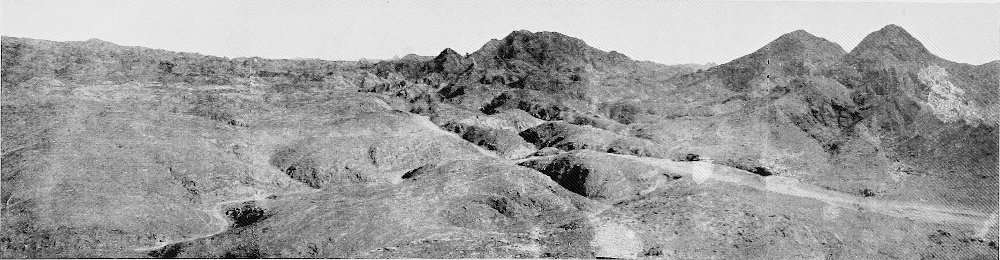
Riding on for another two hours we reached an open ridge from which an extraordinary prospect of rolling hills and innumerable humps was obtained. On the left of the pathway there was a hill at the top of which stood a ruined Roman watch-tower, one of a chain of such posts which crowned the higher peaks all along the route. Up this hill we scrambled on foot, and climbed the tower at the summit, burning a pipeful of tobacco to the gods of Contentment thereon. The array of hills around us, as closely packed and yet as individual as the heads of a vast crowd of people, were of a wonderful hue in the morning light. Those to the north were a dead grey, those to the east were pink and mauve, and those to the south every shade of rich brown, while the shadows throughout were of the deepest blue. The wind tore past us as we sat contemplating the fair world at our feet, and two black ravens sailed by on it to take stock of us. Far below the path wound its way through the humps; and in the distance the peaks and spires of the darker rocks into which it penetrated bounded the scene, and hid the sea from view.
Bir es Sid, the well at the highest point of the Red Sea highroad.—Page 65.
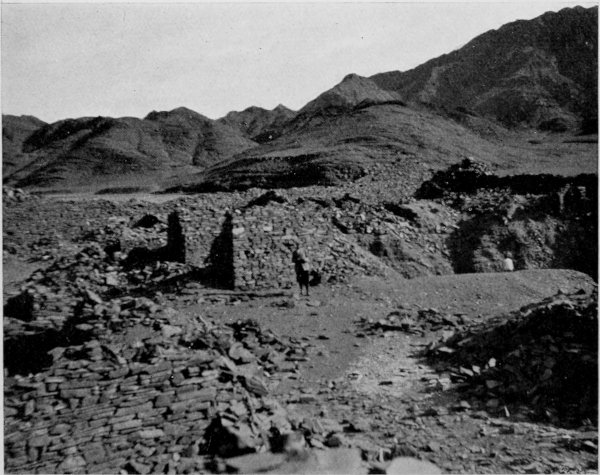
The Roman fortress of Abu Zerah, looking south-east.—Page 67.
Pl. xi.
Mounting the camels once more we defiled down the steep path, and for a time were lost amidst the hills. We lunched an hour later in more open country; and riding on afterwards for somewhat over two hours we reached the Roman station of Abu Zerah, which lies in the plain at the foot of a range of fine purple hills. As is usual in these buildings, the station consists of a rectangular enclosure, the wall being still some twelve feet in height in parts. The door-posts of the main entrance are made of sandstone, and upon one of them is the almost obliterated Latin inscription: SER . . . INV. . . . There are several rooms inside the enclosure, built against the wall, a space being left open in the middle. Just to the north there are a few graves, around which some broken pottery of Roman date lies scattered.
A ride of less than an hour brought us to another Roman station known as Hosh el Homra, “the Red Enclosure,” where we only halted for a moment or so in order to ascertain that there was no unique feature in this building. In the afternoon light the scene was of great beauty. Range upon range of hills surrounded us, which assumed a thousand varying colours: pink, rose, purple, blue, and olive-green in the foreground. Spires of rock shot up to a soft sky in which floated the already visible moon, and overhead seven black ravens soared past upon the wind. Soon the sun went down, and, resting in the lee of a group of dark rocks, we watched the pageant of colours go by and waited for the baggage camels to come up.
The journey was resumed at an early hour next morning, and after a trot of about three-quarters of an hour we reached the well and Roman station of Hagi Suliman. The ancient well, lying within the enclosing wall, has been restored in modern times, and upon a tablet let into the wall is rudely written: “Briggs, Hancock, and Wood, 1832.” At this point the road is joined by another from the north-west, along which we made our return journey to Bir Fowakhîeh by way of Wady el Esh and Wady Adolla. From Bir Hagi Suliman to Bir Fowakhîeh by this route is a trot of about six hours. The morning was bitterly cold, and the wind swinging up the valley chilled one to the bone. The tracks led now this way and now that, around sharp corners where the wind buffeted one suddenly, across patches of sunlight where there was some hope of warmth, and then again up shaded valleys where one might see an occasional wagtail or sand-martin puffing its feathers out against the cold airs. A trot of two and a half hours brought us to yet another Roman ruin, called El Litêmah. Here there is as usual an enclosing wall surrounding an area in which several chambers are built and a well is dug. The door-posts of the entrance are made of sandstone, and some Cufic inscriptions are written upon one of these by travellers in the middle ages. As we entered the building a number of sand-grouse rose from the midst of the ruins and went off to the north, their swift flight being visible for some time against a background of pale limestone hills, which told of our approach to the sea. Near here we passed a party of Arabian traders, some riding camels and others walking. A more evil-looking set of men I have seldom seen, and as they eyed us and whispered together one felt that some mischief was afoot. It was therefore not surprising to learn when we returned to the Nile that a caravan had been attacked with considerable bloodshed at about that place and time, by Arabians answering to this description.
An hour and quarter later we emerged from the hills into an open plain in which the well known as Bir el Ingliz is situated. This well was dug by English troops at the beginning of the nineteenth century, during operations against Napoleon’s generals, of which further mention will be made. A few Ababdeh natives were here encamped, and hastened to draw water for our thirsty camels, begging a cigarette as a reward for the labour. In the shade of some rocks to the south-east we partook of our luncheon. The seat which I selected for myself proved to be that chosen by a prehistoric hunter some sixty centuries ago, for upon the face of the rock beside it there is a rude archaic drawing of a man holding a bow. Two French soldiers of 1799 have here written their names—Forcard and Materon—which remain as memorials of a page of history little remembered at the present time.
In the afternoon we trotted over open desert and through shady valleys for about the space of an hour, at the end of which we reached the spring known as Bir Ambagi, situated in a fine wady, with grey-green cliffs on either hand and pink limestone hills ahead. In this fair setting there grew the greenest reeds and rushes amidst pools of the bluest water. A few Ababdeh goats grazed across the valley, bleating merrily as they went; and not a few birds added their notes to the happy fluting of the wind, which, blowing from over-seas, seemed to set the rushes nodding to “songs of Araby and tales of old Cashmere.” Leaving this valley we travelled down a rather dull wash-out sloping towards the sea, which at length opened sufficiently to show us a glimpse of the blue water. There is always something which penetrates to the heart in one’s first view of the sea after an interval of months; and now, the eyes having accustomed themselves to the barren desert, the old wonder came upon one with new weapons, and attacked the senses with new vigour. One might have shouted for the sheer pleasure of it; and when, presently, a group of green palms passed into view lit by the afternoon sun, and stood between the sand and the sea, one felt to the full the power of the assault.
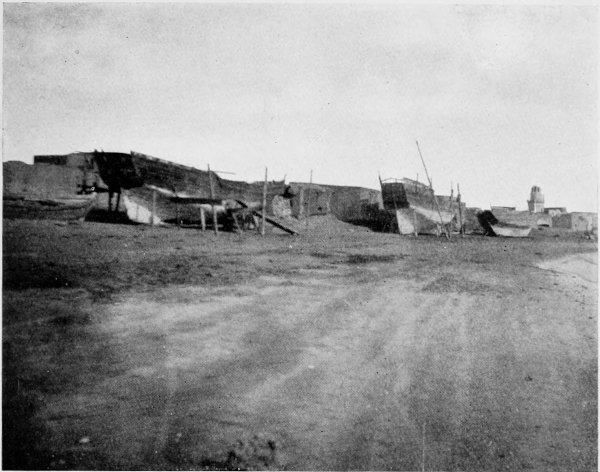
As the hills fell back on either side we passed on to the wide, flat beach and headed our camels towards the blue sea, dismounting at last a hundred yards from the rippling water. Except for the slow pulse of the waves there was an unbroken silence over the world. Southwards the sand stretched to the foot of the hills, beyond which rose the dreamy peaks of the Tourquoise Mountains; northwards the little town of Kossair lay basking in the sunlight; to the west the dark hills through which we had passed stood waiting breathlessly to surround the setting sun; and to the east the wonderful sea seemed quietly to be sleeping and sighing in its sleep. Had one stumbled against the slumbering forms of the lotos-eaters themselves one would hardly have felt surprise; for here one might suppose that one was in a land “where it was always afternoon,” a land “where all things always seemed the same.” In the little bay, or high and dry upon the sand, lay vessels of a bygone age—two-masted hulks with high ponderous sterns. Beside them one could just discern two men fast asleep; and had one awakened them there seemed hardly a doubt that they would have been found to be as mildeyed and melancholy as the men of Tennyson’s poem.
Presently, as we sat listening to the sea, the sun set, and from the minaret of a mosque in the town a boy called to the sleepy Faithful their daily summons to prayer. His voice drifting to us on the quiet air was the first human sound which had risen from the little town; but hardly had it died away before the distant sound of voices, and the grunts of camels, warned us of the arrival of our baggage. A few figures sauntered idly out of the town to watch us, as the tents were pitched on the beach; and thus the dream was broken, and we awoke, as it were, to the knowledge that once more a human habitation had been reached and officials had to be interviewed.
A note to the Maltese Mudir or governor of the town brought that gentleman speedily to our tents, obviously pleased almost to tears to have the opportunity of relieving for an hour the utter boredom of his existence. The Mudir is an enforced lotos-eater. Corpulent of figure, and suffering the discomforts of a wall-eye; having practically no duties to perform other than those of the brief official routine; and having no European to talk to except his wife, his little daughter, and an Austrian mechanic, there is nothing left for him to do but to dream of the time when a benevolent government shall transfer him to a less isolated post. The four of us will not soon forget the ample figure of our guest, clad in white duck, as he sat upon the edge of our one real chair in the candle-light, and told us in disused English how little there is to tell regarding a man’s life in this sleepy town. There was never a more desolate smile than that which wreathed his face as he spoke of the ennui of life, nor a braver twinkle than that which glinted in his single eye as the humour of his misfortunes touched him; and though we should meet again in many a merrier situation—for officials are not left over long at Kossair—none of us will cease to picture this uncomplaining servant of the government as, with unsmoked cigarette and untasted whisky-and-soda, he told us that evening the meaning of four years of exile.
Kossair, when he first entered upon his duties, was a town of 1500 inhabitants; but these persons were so miserably poor, and found so little to do, that at their own request the government transported about a thousand of them to Suez and the neighbourhood, where the lotos does not grow and a man has to keep awake. Now there are but 500 souls in the town, 300 of whom are women and children. These people wed very young, and there is much family intermarriage; but, though they are a poor lot to look at, there is little mental degeneracy which can be traced to this cause. The Mudir, who is also in charge of the coastguards, is responsible for law and order in Kossair; there is a Syrian doctor in charge of the government dispensary; the above-mentioned Austrian mechanic looks after the engine for distilling the salt water; a coastguard officer and three men patrol the coast; four or five sailors are attached to the port; and a native schoolmaster teaches the children to read and write: this constitutes the official element in the town. The inhabitants are all either of Arab or Ababdeh stock, Egyptians being entirely wanting. They live mainly on fish and a little imported bread; but before the population was reduced some of the poorer families were actually eating chopped straw and other food fit only for animals.
Desert panorama from a hill-top two hours’ ride east of Eir es Sid, looking east. The road is seen passing to north and south of this hill and joining up further to the east.—Page 66.
Pl. xii.
There is very little to be done here, and most of the inhabitants sleep for two-thirds of the day. A fast-diminishing trade necessitates the occasional building or mending of a boat. This trade is done with camels and goats, which are brought across from Arabia and are led over the desert to the Nile, where they are sold at Keneh or elsewhere, the money being partly expended on grain, which is then carried back to Arabia. Pilgrims on the way to and from Mecca use these vessels occasionally, but the mariners of Kossair cannot be bothered to extend the tariff.
Except for one small group of palms there is absolutely no vegetation whatsoever in the neighbourhood, and even an attempt to grow a few bushes or flowers near the governor’s quarters, though carefully persisted in for some time, proved an utter failure. For his supplies the Mudir is entirely dependent on the arrival of the government steamer every second month; and if, as had happened at the time of our visit, this steamer was late, the unfortunate gentleman becomes comparatively thin from sheer starvation. Except for occasional travellers or prospectors no white men ever visit Kossair; though if there is cholera at Mecca an English doctor is sometimes sent to prevent the disease from passing into Egypt along this route. Letters and telegrams are every week conveyed across the desert by an express rider to Keneh, and an answer to a telegram might be expected in about a week.
A large sea-water distillery, set up some twelve or fourteen years ago, provides the town with pure water; but so few are the inhabitants that it is only worked twice a month. This good supply of water is largely responsible for the lack of sickness in the town. During the last four years only twenty persons have died, and of these ten were very young children and ten very old people. During these years the serious illnesses have only consisted of two cases of diphtheria: there has been no cholera, enteric, dysentery, or plague. Many of the inhabitants live to be centenarians, and in the town we saw several tottering old Methuselahs, who looked as though the gods of the underworld had forgotten them utterly.
Of sports there are none for the Mudir to indulge in. There is no shooting; he cannot bathe even if he desired to, because of the sharks; there are no boats to sail in worthy the names; he cannot leave his post to make camel trips to interesting localities, even if that amused him, which it does not; and the one pastime, the catching of crayfish on the coral reefs, bores him to distraction. The climate is so monotonously perfect that it does not form a topic even of thought: in winter it is mild and sunny, in summer it is mild and sunnier. It is never very cold nor very hot, except for the few days in summer when a hot east wind is blowing. The Mudir says that he neither increases nor decreases the amount of his clothing the whole year round, but always he wears his underclothes, his tight white-duck tunic, his loose white-duck trousers, his elastic-sided boots, and his red tarbush or fez.
After breakfast next morning we walked along the beach to the stiff, mustard-coloured government buildings, which stand on a point of land projecting somewhat into the sea. A spick-and-span pier and quay, ornamented with three or four old French cannon and some neat piles of cannonballs, gave us the impression that we had been transported suddenly to a second-rate English watering-place; but passing into the building that impression was happily removed at once. Through the sunny courtyard we went, and up the stair, saluted at intervals by the coastguardsmen, who had donned their best uniforms for the occasion, and at last we were ushered into the presence of our Maltese friend, now seated in state at his office table at the far end of a large airy room. The windows overlooked the glorious blue sea, and the breath of an English summer drifted into the room, bringing with it the sigh of the waves. Nothing could have been more entrancing than the soft air and the sun-bathed scene, but to the Mudir it was anathema, and his back was resolutely turned to the windows.
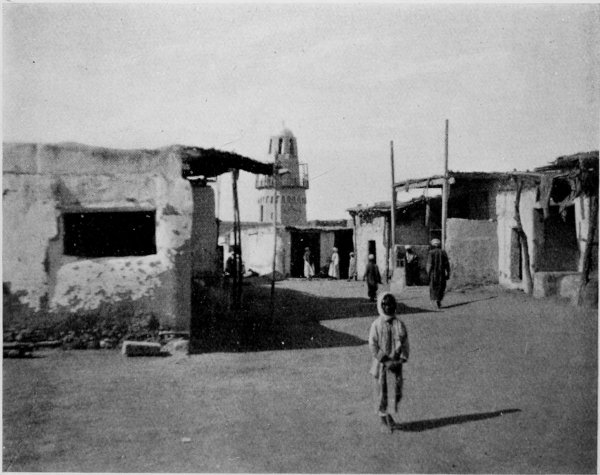
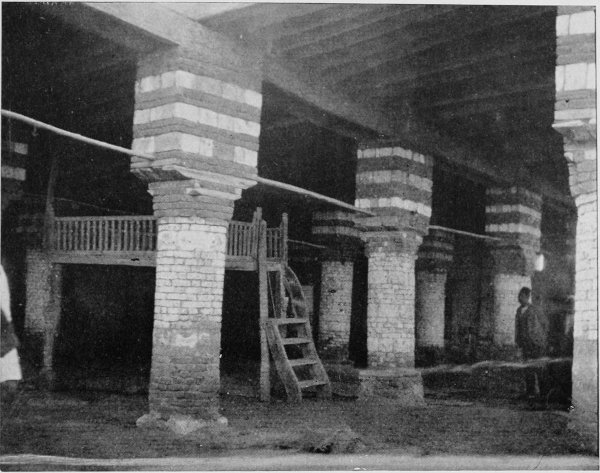
After coffee and a brief conversation we were taken to see the water distillery, of which the town is immensely proud; and from thence we were conducted to the chief mosque of the place, a picturesque old building which has seen better days. We were readily admitted by the Reader, who, however, turned up the grass matting which covered the floor in order, so the Mudir said, that our feet might not be dirtied by it, but in reality in order that the footstep of a Christian should not defile it. A few men were praying languidly at one side of the building, and in the opposite corner a man lay snoring upon his back. There was the silence of sleep upon the place, and, returning to the almost deserted lanes between the houses outside, there was hardly a sound to disturb the stillness of the morning. In the bazaar a few people were gathered around the two or three shops, at which business had nigh ceased. A limp-limbed jeweller was attempting to sell a rough silver ring to a yawning youth, and, if I am not mistaken, a young girl who watched the transaction with very mild interest from the opposite side of the road was to be the recipient of the jewel. Soon we passed the open door of the schoolroom, where a dozen children chanted their A B C in a melancholy minor; and presently we came to the chief sight of Kossair—the old fortress built by the French at the end of the eighteenth century.
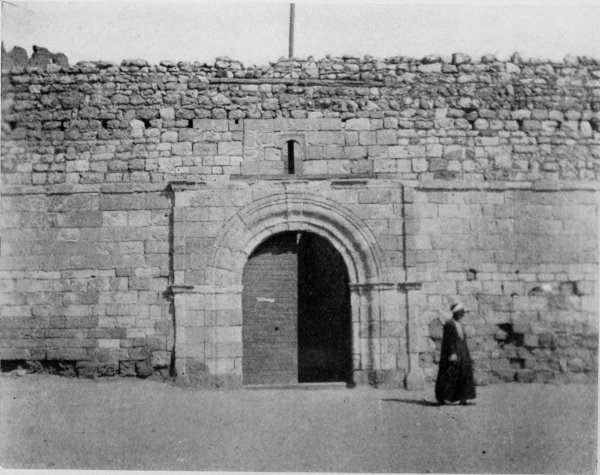
One enters the building through a masonry archway, closed by a heavy wooden door clamped with iron. There are still three or four cannon inside it to tell of its past life, but now the rooms and courts are whitewashed and are used as camel stables by the coastguards. I have no books here in Upper Egypt which will tell me the details of the Anglo-French struggle for the possession of Kossair, and I must therefore leave it to my readers to correct my ignorant statements. It appears, then, that a French force occupied the fortress during the time of Napoleon’s rule in Egypt, and that one fine day in the year 1800 there came sailing over the sea a squadron of English men-o’-war, which landed a storming party so formidable that the French were constrained to evacuate the place and to retreat across the desert to Keneh. With the English force there were a large body of Indian troops, and these were marched across to the Nile in pursuit of the French; but ere more serious operations had taken place the capitulation of Napoleon’s army brought the campaign to a close. It is said that when the Indian soldiers saw representation of the sacred cow of Hathor upon the walls of the temples of Koptos and Kus, they fell upon their knees and did obeisance as in their own temples.
The inhabitants of Kossair live to such an age and in such stagnation that the stirring events of these old days are still talked of, and Englishmen are here still endowed with the prestige of conquerors. Involuntarily one held one’s head higher as an old Shêkh pointed out the gate through which the French fled, and that through which the English bluejackets entered; and, walking through the quiet streets back to the tents, one gave a nautical hitch to the trousers, talked contemptuously of “Boney,” discussed the plans of Lord Nelson, named the yawning natives whom we passed “lazy lubbers,” murmured “Shiver my timbers,” called one another “me hearty,” and, in a word, acted faithlessly to the entente cordiale.
Kossair. Arabian boats on the beach.—Page 72.
A street in Kossair.
Pl. xiii.
In camp the remainder of the day was spent in that vague pottering which the presence of the sea always induces. There were some beautiful shells upon the shore to attract one, and natives brought others for sale, lying down to sleep in the shade of the kitchen tent until we deigned to give them attention. There were sketches to be made and photographs to be taken. Amidst the houses at the south end of the town some fragments of a Ptolemaic temple were stumbled upon, and the inscriptions thereon had to be copied. These were too fragmentary to be of much importance, and, except for the above-mentioned ancient name of Kossair there written, no point of particular interest requires to be noted here. We lunched and dined off the most excellent fish, a species named belbul being particularly palatable, while crayfish and a kind of cockles were immoderately indulged in. Having arranged to try our hand at the catching of crayfish during the night hours, we turned in early to sleep for a short time until the fishermen should call us.
The summons having come at about 11 P.M., we set out along the moonlit shore, two fishermen and a boy accompanying us, carrying nets and lanterns. Our destination was a spot at which the coral reefs, projecting into the sea, presented so flat a surface that the incoming tide would wash over the whole area at a depth of not more than a few inches. In the shallow water, we were told, the crayfish would crawl, attracted by our lanterns, and we could then pick them up with our fingers. These crayfish are not at first sight distinguishable from larger lobsters, though a second glance will show that the difference lies in the fact that they have no claws, and therefore can be caught with impunity. They are fearsome-looking creatures, nevertheless, often measuring twenty inches or so from head to tail. In eating them it is hard to believe that one is not eating the most tasty of lobsters.
A tedious walk of over three miles somewhat damped our ardour; and as the fishermen told us that the moon was too high and the tide too low for good hunting, we were not in the best spirits when at last we turned on to the coral reef. Here, however, the scene was so weirdly picturesque that the catching of the crayfish became a matter of secondary import. The surface of the reef, though flat, was broken and jagged, and much seaweed grew upon it. In the uncertain light of the moon it was difficult to walk without stumbling; but the ghostly figures of the fishermen hovered in front of us, and silently led the way out towards the sea, which uttered continuously a kind of sobbing as it washed over the edges of the coral reef. This and the unholy wail of the curlews were the only sounds, for the fishermen had imposed silence upon us, and the moonlight furthered their wishes.
As we walked over the reef we had to pick our way between several small patches of water some five or six feet in breadth, which appeared to be shallow pools left by the last tide in the slight depressions of the rock. Presently one noticed that in these pools white clouds appeared to be reflected from the sky, but quickly looking up one saw that the heavens were cloudless. Staring closer at the water, it suddenly dawned upon one that these white clouds were in reality the sand at the bottom of the pools, and as suddenly came the discovery that that bottom lay at a depth of fifteen feet or more. Now one went on hands and knees to gaze down at those moonlit depths, and one realised that each pool was a great globular cavern, the surface area being but the small mouth of it. One found oneself kneeling on a projecting ridge of coral which was deeply undermined all round; and, looking down into the bowl, one was reminded of nothing so much as of an aquarium tank seen through glass. In the moonlight the cloudy bottom of the caverns could be discerned, whereon grew great anemones and the fair flowers of the sea. Sometimes an arched gallery, suffused with pale light, led from one cavern to the next, the ceiling of these passages decorated with dim plants, the floor with coloured shells. Not easily could one have been carried so completely into the realms of Fairyland as one was by the gazing at these depths. Presently there sailed through the still water the dim forms of fishes, and now through the galleries there moved two shining lamps, as though carried by the little men of the sea to light them amidst the anemones. Two more small lamps passed into the cavern and floated through the water, now glowing amidst the tendrils of the sea plants, now rising towards the surface, and now sinking again to the shells, the sand, and the flowers at the bottom.
It was not at once that one could bring oneself to realise that these lights were the luminous eyes of a strange fish, the name of which I do not know; but now the fishermen, who had suddenly drawn their net across the edge of the reef and had driven a dozen leaping creatures on to the exposed rock, beckoned us to look at this curious species at close quarters. Their bodies were transparent, and from around their mouths many filmy tentacles waved. The eyes were large and brown in colour, and appeared as fantastic stone orbs set in a glass body. Many other varieties of fish were caught as the tide came in; but it appeared that the moon was too powerful for successful sport in regard to the crayfish, and the catch consisted of but four of these. The sight of the fairy caverns, however, was entertainment sufficient for one night; and it was with discontent that one turned away from these fair kingdoms of the sea to return in the small hours of the morning to the tents. The moonlight, the sobbing of the ocean, the deep caverns lit by unearthly lamps, left an impression of unreality upon the mind which it was not easy to dispel; and one felt that a glance had been vouchsafed through the forbidden gates, and a glimpse had been obtained of scenes unthought of since the days of one’s childhood. Had we also tasted of the lotos, and was this but one of the dreams of dreamy Kossair?
Upon the following day I rode northwards along the coast to visit the site of the Ptolemaic port, which lies about five miles from the modern town. An hour’s ride against a hard wind brought us to the little inlet, around which the mounds and potsherds of the town are scattered. The water in the bay was of the deepest blue; a rolling plain of yellow sand lay eastwards, backed by the darker ranges of mountains; and overhead the white clouds raced by. The sea washed up in a line of white breakers on to a rising bar of sand, sparkling with a thousand varieties of shells. Behind this bar there were pools of water passing inland, and here there may have been an artificial harbour. On the south side of the bay bold rocks jutted into the sea, and on the north there rose a series of mounds upon which the remains of the old town were strewn. Walking over these mounds, where the rhythmic roar of the waves falls continuously upon the ears, one’s mind was filled with thoughts of the ancient port which has so utterly fallen, and of that ancient commerce with the East which must have been so full of adventure and romance to the men of old. Here from these mounds the townspeople have watched the great galleys set out over the seas for the mysterious land of Hind, and have seen the wealth of Pount and Arabia unloaded upon the quay; and here so many centuries later the labours of Egyptologists are beginning to permit one to recall something of what they saw, though the spade of the excavator has not yet touched this site.
The interior of the mosque at Kossair.—Page 78.
The main entrance of the fortress at Kossair.—Page 79.
Pl. xiv.
There are two wells within reach of this spot, but both are two or three hours’ journey away, and the water question must have been a serious one. The well to the north is named Bir Guah, and the other to the west is called Bir Mahowatât. This latter is the name of a tribe of Bedwin living at Suez, who state that they came originally from El Wij in Arabia. It is interesting to find that a well here should be named after them, for El Wij is nearly opposite this point, and one may realise thus what intercourse there is and always has been between Arabia and Egypt, even as far south as Kossair.
Returning with the wind at our backs we soon reached Kossair, and rode through the streets of the sleepy town to our tents. To tea in the afternoon came the Mudir, who for an hour or so entertained us with tales of ennui. Kossair fell asleep when the Roman Empire fell, awoke for a moment in the days of Napoleon, but slid into slumber once more over a century ago. There was a time when the east coast steamers used to call here, but now even they have left the town to its long siesta. As one listened to the story of decaying trade and languid idleness the vision of Tennyson’s lotos-eater was ever in the mind; and one’s sympathy was as profound for an official stationed here as was one’s envy of the man who might be permitted to rest himself for awhile from his labours upon this mild, sunny shore. The Mudir was, at the time of our visit, anxiously awaiting the tardy arrival of the steamer which was to take him and his family to Suez for three months’ leave, and his eye fixed itself upon the sea at every pause in the conversation; and when he bid us farewell at the door of the tent, it was but to return to his own doorway, where he might watch for the distant smoke until the sun should set.
Early next morning we commenced the return journey to the Nile. As we rode away over the sloping sand towards the hills in the west we turned in our saddles to obtain a last view of the strange little dream-town which was sinking so surely to its death. The quiet sea rippled upon the sunlit shore in one long line of blue from the houses on the north to the Tourquoise Mountains on the south. Not a trace of smoke nor a sound rose from the town. On the beach a group of three men lay sleeping with their arms behind their heads, while two others crouched languidly on their haunches watching our disappearing cavalcade. Then, in the silence of the morning, there came to us on the breeze the soft call to prayer from the minaret of the mosque. One could not hear the warbled words; but to the sleeping figures on the beach, one thought, they must surely be akin to those of the song of the lotos-eaters:—
“How sweet it were, hearing the downward stream, With half-shut eyes ever to seem Falling asleep in a half-dream! To hear each other’s whispered speech; Eating the lotos day by day, To watch the crisping ripples on the beach, And tender curving lines of creamy spray; To lend our hearts and spirits wholly To the influence of mild-minded melancholy. . . .
On the quay in the far distance we could just discern a portly white figure gazing steadfastly out to sea to catch the first glimpse of the steamer which had been awaited so patiently for so long.