I. THE EASTERN DESERT AND ITS INTERESTS.
Reading edition
I know a young man who declares that after reading a certain explorer’s description of a journey across the burning Sahara, he found to his amazement that his nose was covered with freckles. The reader will perhaps remember how, on some rainy day in his childhood, he has sat over the fire and has read sea-stories and dreamed sea-dreams until his lips, he will swear, have tasted salt. Alas, one’s little agility in the art of narration is wholly inadequate for the production, at this time of life, of any such phenomena upon the gentle skins of those who chance to read these pages. Were one a master-maker of literature, one might herewith lead the imaginative so straight into the boisterous breezes of Egypt, one might hold them so entranced in the sunlight which streams over the desert, that they would feel, wherever they might be seated, the tingling glow of the sun and the wind upon their cheeks, and would hold their hands to their eyes as a shelter from the glare. The walls of their rooms would fall flat as those of Jericho; and outside they would see the advancing host of the invaders—the sunshine, the north wind, the scudding clouds, the circling eagles, the glistening sand, the blue shadows, and the rampant rocks. And the night closing over the sack of their city, they would see the moonlight, the brilliant stars, the fluttering bats, the solemn owls; and they would hear the wailing of the hyænas and the barking of the dogs in the distant camps. If one only possessed the ability, one might weave such a magic carpet for those who knew how to ride upon it, that, deserting the fallen Jericho of their habitation, they would fly to the land of the invaders which they had seen, and there they would be kept as spell-bound and dazzled by the eyes of the wilderness as ever a child was dazzled by a tale of the sea.
But with this ability lacking it is very doubtful whether the reader will be able to appreciate the writer’s meaning; and, without the carpet, it is a far cry from Upper Egypt, where these words are written, to the fireside where they are read. Nevertheless I will venture to give an account here of some journeys made in the Upper Egyptian desert, in the hope rather of arousing interest in a fascinating country than of placing on record much information of value to science; although the reader interested in Egyptian archæology will find some new material upon which to speculate.
The Upper Egyptian desert is a country known only to a very few. The resident, as well as the visitor, in Egypt raises his eyes from the fertile valley of the Nile to the bare hills, and lowers them once more with the feeling that he has looked at the wall of the garden, the boundary of the land. There is, however, very much to be seen and studied behind this wall; and those who penetrate into the solitudes beyond will assuredly find themselves in a world of new colours, new forms, and new interests. In the old days precious metal was sought here, ornamental stone was quarried, trade-routes passed through to the Red Sea, and the soldiery of Egypt, and later of Rome, marched from station to station amidst its hills. The desert as one sees it now is, so to speak, peopled with the ghosts of the Old World; and on hidden hill-slopes or in obscure valleys one meets with the remains of ancient settlements scattered through the length and breadth of the country.
The number of persons who have had the energy to climb the garden wall and to wander into this great wilderness is so small that one might count the names upon the fingers. Lepsius, the German Egyptologist, passed over some of the routes on which antiquities were to be met with; Golénischeff, the Russian Egyptologist, checked some of his results; Schweinfurth, the German explorer, penetrated to many of the unknown localities, and mapped a great part of the country; Bellefonds Bey, the Director-General of Public Works in Egypt under Muhammed Aly, made a survey of the mineral belt lying between the river and the Red Sea; and during the last score of years various prospectors and miners have visited certain points of interest to them. The Government Survey Department is now engaged in mapping this Eastern Desert, and two most valuable reports have already been published; while for a few years there existed a Mines Department, whose director, Mr John Wells, made himself acquainted with many of the routes and most of the mining centres. Thus, most of the journeys here to be recorded have not been made over absolutely new ground; though, except for the expert reports of the Survey Department and some papers by Schweinfurth, it would be a difficult matter to unearth any literature on the subject. In describing these journeys, however, one is often enabled to indulge in the not unpleasing recollection that one is writing of places which no other European eyes have seen.
Those who have travelled in Egypt will not need to be told how the Nile, flowing down from the Sudan to the distant sea, pushes its silvery way through the wide desert: now passing between the granite hills, now through regions of sandstone, and now under the limestone cliffs. A strip of verdant cultivated land, seldom more than six or eight miles wide, and often only as many yards, borders the broad river; and beyond this, on either side, is the desert. In Upper Egypt one may seldom take an afternoon’s ride due east or due west without passing out either on to the sun-baked sand of a limitless wilderness or into the liquid shadows of the towering hills. For the present we are not concerned with the western desert, which actually forms part of the great Sahara, and one’s back may therefore be turned upon it.
Eastwards, behind the hills or over the sand, there is in most parts of the country a wide undulating plain, broken here and there by the limestone outcrops. Here the sun beats down from a vast sky, and the traveller feels himself but a fly crawling upon a brazen table. In all directions the desert stretches, until, in a leaden haze, the hot sand meets the hot sky. The hillocks and points of rock rise like islands from the floods of the mirage in which they are reflected; and sometimes there are clumps of withered bushes to tell of the unreality of the waters.
The scenery here is often of exquisite beauty; and its very monotony lends to it an interest when for a while the grouping of the hills ceases to offer new pictures and new harmonies to the eye. Setting out on a journey towards the Red Sea one rides on camel-back over this rolling plain, with the sun bombarding one’s helmet from above and the wind charging it from the flank; and, as noonday approaches, one often looks in vain for a rock under which to find shade. Naturally the glaring sand is far hotter than the shady earth under the palms in the cultivation; but the stagnant, dusty, fly-filled air of the groves is not to be compared with the clear atmosphere up in the wilderness. There are no evil odours here, breeding sickness and beckoning death. The wind blows so purely that one might think it had not touched earth since the gods released it from the golden caverns. The wide ocean itself has not less to appeal to the sense of smell than has the fair desert.
Descending from the camel for lunch, one lies on one’s back upon the sand and stares up at the deep blue of the sky and the intense whiteness of a passing cloud. Raising oneself, the Nile valley may still be seen, perhaps, with its palms floating above the vaporous mirage; and away in the distance the pale cliffs rise. Then across one’s range of sight a butterfly zigzags, blazing in the sunlight; and behind it the blue becomes darker and the white more extreme. Around one, on the face of the desert, there is a jumbled collection of things beautiful: brown flints, white pebbles of limestone, yellow fragments of sandstone, orange-coloured ochre, transparent pieces of gypsum, carnelian and alabaster chips, glittering quartz. Across the clear patches of sand there are all manner of recent footprints, and the incidental study of these is one of the richest delights of a desert journey. Here one may see the four-pronged footprints of a wagtail, and there the larger marks of a crow. An eagle’s and a vulture’s footmarks are often to be observed, and the identification of those of birds such as the desert partridge or of the cream-coloured courser is a happy exercise for one’s ingenuity. Here the light, wiggly line of a lizard’s rapid tour abroad attracts the attention, reminding one of some American globe-trotter’s route over Europe; and there footprints of the jerboa are seen leading in short jumps towards its hole. Jackals or foxes leave their dainty pad-marks in all directions, and one may sometimes come across the heavy prints of a hyæna, while it is not unusual to meet with those of a gazelle.
In the afternoon one rides onwards, and perhaps a hazy view of the granite hills may now be obtained in the far distance ahead. The sun soon loses its strength, and shines in slanting lines over the desert, so that one sees oneself in shadow stretched out to amazing lengths, as though the magnetic power of night in the east were already dragging in the reluctant darknesses to its dark self. Each human or camel footprint in the sand is at this hour a basin filled with blue shade, while every larger dent in the desert’s surface is brimful of that same blue; and the colour is so opaque that an Arab lying therein clad in his blue shirt is almost indistinguishable at a distance. Above one the white clouds go tearing by, too busy, too intent, it would seem, on some far-off goal to hover blushing around the sun. The light fades, and the camp is pitched on the open plain; and now one is glad to wrap oneself in a large overcoat, and to swallow the hot tea which has been prepared over a fire of the dried scrub of the desert.
The nights in the desert are as beautiful as the days, though in winter they are often bitterly cold. With the assistance of a warm bed and plenty of blankets, however, one may sleep in the open in comfort; and only those who have known this vast bedroom will understand how beautiful night may be. If one turns to the east, one may stare at Mars flashing red somewhere over Arabia, and westwards there is Jupiter blazing above the Sahara. One looks up and up at the expanse of star-strewn blue, and one’s mind journeys of itself into the place of dreams before sleep has come to conduct it thither. The dark desert drops beneath one; the bed floats in mid-air, with planets above and below. Could one but peer over the side, earth would be seen as small and vivid as the moon. But a trance holds the body inactive, and the eyes are fixed upon the space above. Then, quietly, a puff of wind brings one down again to realities as it passes from darkness to darkness. Consciousness returns quickly and gently, points out the aspect of the night, indicates the larger celestial bodies, and as quickly and gently leaves one again to the tender whispers of sleep.
When there is moonlight there is more to carry the eye into the region of dreams on earth than there is in the heavens; for the desert spreads out around one in a silver, shimmering haze, and no limit can be placed to its horizons. The eye cannot tell where the sand meets the sky, nor can the mind know whether there is any meeting. In the dimness of coming sleep one wonders whether the hands of the sky are always just out of reach of those of the desert, whether there is always another mile to journey and always another hill to climb; and, wondering, one drifts into unconsciousness. At dawn the light brings one back to earth in time to see the sun pass up from behind the low hills. In contrast to the vague night the proceeding is rapid and business-like. The light precedes its monarch only by half an hour or so; and ere the soft colours have been fully appreciated, the sun appears over the rocks and flings a sharp beam into the eyes of every living thing, so that in a moment the camp is stirred and awakened.
In the Desert. The Author is seen on the near camel.
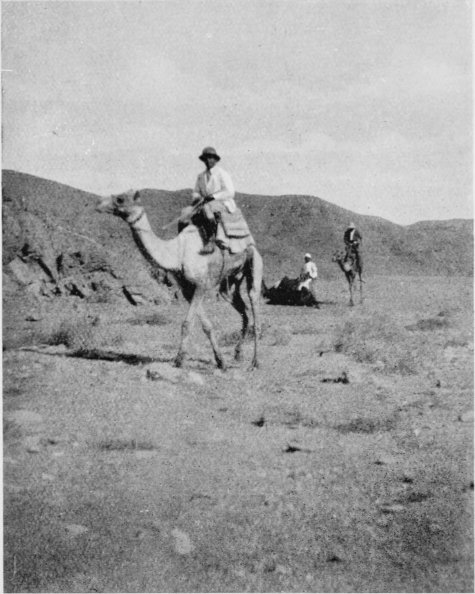
On the edge of the Eastern Desert.—Page 30.
Pl. i.
During the second or third day’s ride one generally enters the granite regions, and one is lost amidst the intricate valleys which pass between the peaks of the hills. Here one may find plenty of shelter from the sun’s rays in the shadow of the cliffs; and as the camel jogs along over the hard gravel tracks, or as one sits for refreshment with the back propped against a great grey boulder, the view which is to be enjoyed is often magnificent. On the one side the dark granite, porphyry, or breccia rocks rise up like the towered and buttressed walls of some fairy-tale city; while on the other side range rises behind range, and a thousand peaks harmonise their delicate purples and greys with the blue of the sky. When the sun sets these lofty peaks are flushed with pink, and, like mediators between earth and heaven, carry to the dark valleys the tale of a glory which one cannot see. There is usually plenty of scrub to be found in the valleys with which to build the evening fires, and with good luck one might replenish the food-supplies with the tender flesh of the gazelle. Every two or three days one may camp beside a well of pure water, where the camels may drink, and from which the portable tanks may be refilled.
Near these wells there are sometimes a few Bedwin to be found tending their little herds of goats: quiet, harmless sons of the desert, who generally own allegiance to some Shêkh living in the Nile valley. One’s guides and camel-men exchange greetings with them, and pass the latest news over the camp fires. Often, however, one may journey for many days without meeting either a human being or a four-footed animal, though on the well-marked tracks the prints of goats and goatherds, camels and camel-men, are apparent.
No matter in what direction one travels, hardly a day passes on which one does not meet with some trace of ancient activity. Here it will be a deserted gold-mine, there a quarry; here a ruined fortress or town, and there an inscription upon the rocks. Indications of the present day are often so lacking, and Time seems to be so much at a standstill, that one slips back in imagination to the dim elder days. The years fall from one like a garment doffed, and one experiences a sense of relief from their weight. A kind of exhilaration, moreover, goes with the thought of the life of the men of thousands of years ago who lived amongst these changeless hills and valleys. Their days were so full of adventure: they were beset with dangers. One has but to look at the fortified camps, the watch-towers on the heights, the beacons along the highroads, to realise how brave were the “olden times.” One of the peculiar charms of these hills of the Eastern Desert is their impregnation with the atmosphere of a shadowy adventurous past. One’s mind is conscious, if it may be so expressed, of the ghosts of old sights, the echoes of old sounds. Dead ambitions, dead terrors, drift through these valleys on the wind, or lurk behind the tumbled rocks. Rough inscriptions on these rocks tell how this captain or that centurion here rested, and on the very spot the modern traveller rests to ease the self-same aches and to enjoy the self-same shade before moving on towards an identical goal in the east.
On the third or fourth day after leaving the Nile one passes beneath the mountains, which here rise sometimes to as much as 6000 feet; and beyond these the road slopes through the valleys down to the barren Red Sea coast, which may be any distance from 100 to 400 miles from the Nile. Kossair is the one town on the coast opposite Upper Egypt, as it was also in ancient times; and Berenice, opposite Lower Nubia, was the only other town north of Sudan territory. Kossair does a fast-diminishing trade with Arabia, and a handful of Egyptian coastguards is kept mildly busy in the prevention of smuggling. The few inhabitants of the Egyptian coast fish, sleep, say their prayers, or dream in the shade of their hovels until death at an extremely advanced age releases them from the boredom of existence. Those of them who are of Arab stock sometimes enliven their days by shooting one another in a more or less sporting manner, and by wandering to other and more remote settlements thereafter; but those of Egyptian blood have not the energy even for this amount of exertion. There is a lethargy over the desert which contrasts strangely with one’s own desire for activity under the influence of the sun and the wind, and of the records of ancient toil which are to be observed on all sides. It must be that we of the present day come as the sons of a race still in its youth; and in this silent land we meet only with the worn-out remnant of a people who have been old these thousands of years.
There was a threefold reason for the activities of the ancients in the Eastern Desert. Firstly, from Koptos, a city on the Nile not far from Thebes, to Kossair there ran the great trade-route with Arabia, Persia, and India; from Suez to Koptos there was a route by which the traders from Syria often travelled; from Edfu to Berenice there was a trade-route for the produce of Southern Arabia and the ancient land of Pount; while other roads from point to point of the Nile were often used as short-cuts. Secondly, in this desert there were very numerous gold mines, the working of which was one of the causes which made Egypt the richest country of the ancient world. And thirdly, the ornamental stones which were to be quarried in the hills were in continuous requisition for the buildings and statuary of Egypt, Assyria, Persia, and Rome.
There is much to be said in regard to the gold-mining, but here space will not permit of more than the most cursory review of the information. Gold was used in Egypt at a date considerably prior to the beginning of written history in Dynasty I., and there are many archaic objects richly decorated with that metal. The situation of many of the early cities of the Nile valley is due solely to this industry. When two cities of high antiquity are in close proximity to one another on opposite banks of the river, as is often the case in Upper Egypt, one generally finds that the city on the western bank is the older of the two. In the case of Diospolis Parva and Khenoboskion, which stand opposite to one another, the former, on the west bank, is the more ancient and is the capital of the province, and the latter, on the east bank, does not date earlier than Dynasty VI. Of Ombos and Koptos, the former, on the west bank, has prehistoric cemeteries around it; while the latter, on the east bank, dates from Dynasty I. at the earliest. Hieraconpolis and Eileithyiapolis stand opposite to each other, and the former, which is on the west bank, is certainly the more ancient. Of Elephantine and Syene, the latter, on the east bank, is by far the less ancient. And in the case of Pselchis and Baki (Kubbân), the former, on the west bank, has near it an archaic fortress; while the latter, on the east bank, does not date earlier than Dynasty XII. The reason of this is to be found in the fact that most of the early cities were engaged in gold-mining, and despatched caravans into the Eastern Desert for that purpose. These cities were usually built on the western bank of the river, since the main routes of communication from end to end of Egypt passed along the western desert. Mining stations had, therefore, to be founded on the eastern bank opposite to the parent cities; and these stations soon became cities themselves as large as those on the western shore. Thus the antiquity of the eastern city in each of these cases indicates at least that same antiquity for the mining of gold.
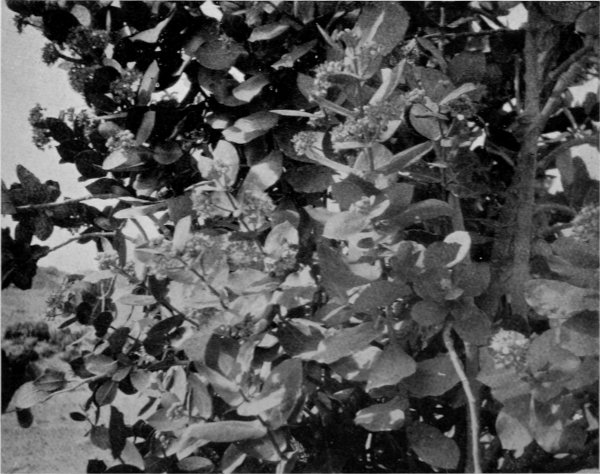
Desert vegetation. The Coloquintida plant.
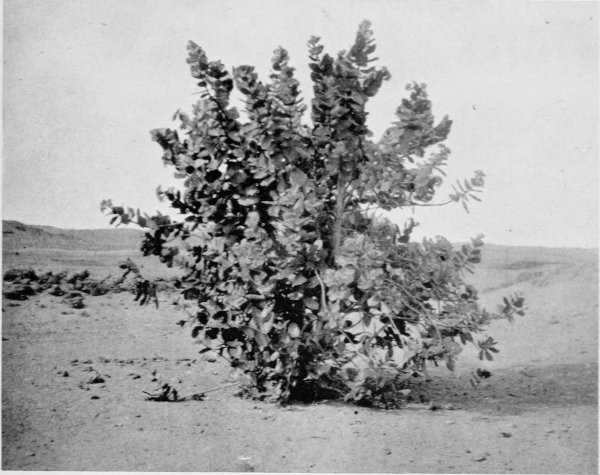
A near view of the Coloquintida plant. Photographed in the Wady Abâd.
Pl. ii.
Throughout what is known as the old kingdom, gold was used in ever-increasing quantities, but an idea of the wealth of the mines will best be obtained from the records of the Empire. About 250,000 grains of gold were drawn by the Vizir Rekhmara in taxes from Upper Egypt, and this was but a small item in comparison with the taxes levied in kind. A king of a north Syrian state wrote to Amonhotep III., the Pharaoh of Egypt, asking for gold, and towards the end of his letter he says: “Let my brother send gold in very large quantities, without measure, and let him send more gold to me than he did to my father; for in my brother’s land gold is as common as dust.” To the god Amon alone Rameses III. presented some 26,000 grains of gold, and to the other gods he gave at the same time very large sums. In later times the High Priest of Amon was made also director of the gold mines, and it was the diverting of this vast wealth from the crown to the church which was mainly responsible for the fall of the Ramesside line.
A subject must here be introduced which will ever remain of interest to the speculative. Some have thought that the southern portion of this desert is to be identified with the Ophir of the Bible, and that the old gold-workings here are none other than “King Solomon’s Mines.” In the Book of Kings one reads, “And King Solomon made a navy of ships in Ezion-geber, which is beside Eloth, on the shore of the Red Sea, in the land of Edom. And Hiram sent in the navy his servants, shipmen that had knowledge of the sea, with the servants of Solomon. And they came to Ophir, and fetched from thence gold, four hundred and twenty talents, and brought it to King Solomon.” Ophir cannot be identified with Arabia, since there is no gold there; and hence one may seek this land of ancient wealth at the southern end of the Eastern Egyptian Desert. If it is argued that the Hebrews would have found difficulties in carrying on mining operations unmolested in Egyptian territory, it may be contended on the other hand that King Solomon may have made some bargain with the Pharaoh: for example, that the former might mine in a certain tract of desert if the latter might cut timber in the Lebanon. The purchase of cedar-wood by the Egyptians is known to have taken place at about this period, payment in gold being made; and therefore it does not require an undue stretch of the imagination to suppose that the Hebrews themselves mined the gold. Again, at the time when King Solomon reigned in all his glory in Palestine, the short-lived Pharaohs of Egypt sat upon tottering thrones, and were wholly unable to protect the Eastern Desert from invasion. The Egyptians often state that they encountered hostile forces in this land, and these may not always have consisted of Bedwin marauders.
No savant has accepted for a moment the various theories which place Ophir at the southern end of the African continent; and the most common view is that Solomon obtained his gold from the land of Pount, so often referred to in Egyptian inscriptions. This country is thought to have been situated in the neighbourhood of Suakin; but, as Professor Naville points out, it is a somewhat vague geographical term, and may include a large tract of country to the north and south of this point. One cannot imagine the Hebrews penetrating very far over the unknown seas to the perilous harbours of Middle Africa: one pictures them more easily huddled in the less dangerous ports of places such as Kossair or Berenice, or at farthest in that of Suakin. It is thus quite probable that some of the gold-workings in the desert here described are actually King Solomon’s Mines, and that the country through which the reader will be conducted is the wonderful Ophir itself. Certainly there is no one who can state conclusively that it is not.
Work continued with unabated energy during the later periods of Egyptian history, and the Persian, Greek, and Roman treasuries were filled consecutively with the produce of the mines. Several classical writers make reference to these operations, and sometimes one is told the actual name and situation of the workings. Diodorus gives a description of the mines in the Wady Alagi, and tells how the work was done. The miners wore a lamp tied to their forehead. The stone was carried to the surface by children, and was pounded in stone mortars by iron pestles. It was then ground to a fine powder by old men and women. This powdered ore was washed on inclined tables, the residue being placed in earthen crucibles with lead, salt, and tin for fluxes, and was there baked for five days. Agatharchides describes how the prisoners and negroes hewed out the stone, and, with unutterable toil, crushed it in mills and washed out the grains of gold. The Arabic historian, El Macrizi, states that during the reign of Ahmed ben Teilun there was great activity in the mining industry throughout the Eastern Desert, and Cufic inscriptions of this date found in the old workings confirm this statement. From then, until modern times, however, little work was done; but in recent years, as the reader will no doubt know, many of the ancient workings have been reopened, and one must admit that if these are really to be regarded as King Solomon’s Mines, that potentate must have had a somewhat lower opinion of Ophir than tradition indicates.
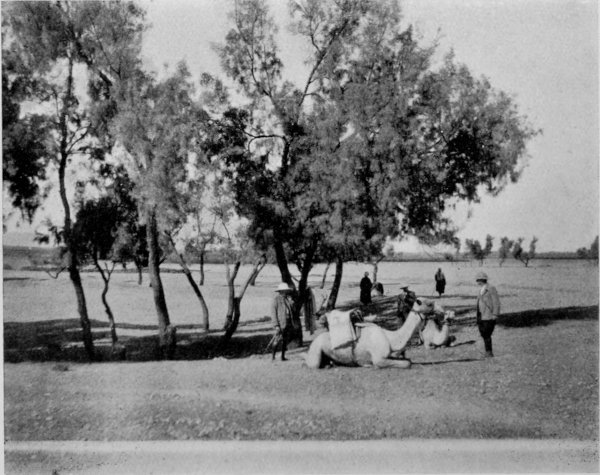
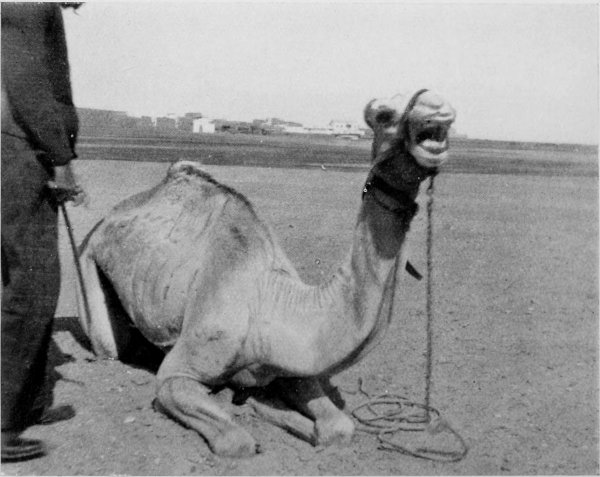
One of the riding-camels.
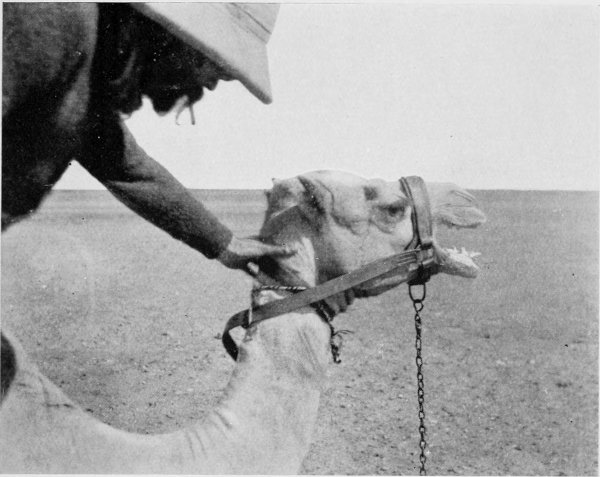
One of the camels.
Pl. iii.
The other cause for the ancient activity in the Eastern Desert was, as has been said, the need of ornamental stone for the making of vases, statues, and architectural accessories. From the earliest times bowls and vases of alabaster, breccia, diorite, and other fine stones were used by the Egyptians, and the quarries must have already formed quite a flourishing industry. Soon the making of statuettes, and later of statues, enlarged this industry, and with the growth of civilisation it steadily increased. The galleries of the Cairo Museum, and those of European museums, are massed with statues and other objects cut in stone brought from the hills between the Nile and the Red Sea. The breccia quarries of Wady Hammamât were worked from archaic to Roman days; the Tourquoise Mountains, not far from Kossair, supplied the markets of the ancient world; white granite was taken from the hills of Um Etgal; there were two or three alabaster quarries in constant use; and in the time of the Roman Empire the famous Imperial porphyry was quarried in the mountains of Gebel Dukhân. One may still see blocks of breccia at Hammamât, of granite at Um Etgal, or of porphyry at Dukhân, lying abandoned at the foot of the hills, although numbered and actually addressed to the Cæsars. The towns in which the quarrymen lived still stand in defiance of the years, and the traveller who has the energy to penetrate into the distant valleys where they are situated may there walk through streets untrodden since the days of Nero and Trajan, and yet still littered with the chippings from the dressing of the blocks.
In the old days the provisioning of the mining and quarrying settlements must have taxed the ingenuity even of the Egyptians; and the establishing of workable lines of communication with the distant Nile must have required the most careful organisation. The caravans bringing food were of great size, for there were often several thousands of hungry miners to be fed. In Dynasty VI. one reads of 200 donkeys and 50 oxen being used in the transport, and in Dynasty XI. 60,000 loaves of bread formed the daily requirements in food of one expedition. In late Ramesside times the food of an expedition of some 9000 men was carried on ten large carts, each drawn by six yoke of oxen, while porters “innumerable” are said to have been employed. The families of the workmen generally lived on the spot, and these also had to be fed—a fact which is indicated, too, by an inscription which states that in one expedition each miner required twenty loaves of bread per diem.
Whenever this organisation broke down the consequences must have been awful. In this quarrying expedition in Ramesside times, consisting of 9000 men, 10 per cent of them died from one cause or another; and later writers speak of the “horrors” of the mines. In summer the heat is intense in the desert, and the wells could not always have supplied sufficient water. The rocks are then so hot that they cannot be touched by the bare hand, and one’s boots are little protection to the feet. Standing in the sunlight, the ring has to be removed from one’s finger, for the hot metal burns a blister upon the flesh. After a few hours of exercise there is a white lather upon the lips, and the eyes are blinded with the moisture which has collected around them; and thus what the quarrymen and miners must have suffered as they worked upon the scorching stones no tongue can tell.
In ancient Egyptian times the camel was regarded as a curious beast from a far country, and was seldom, if ever, put to any use in Egypt. Only three or four representations of it are now known, and it never occurs amongst any of the animals depicted upon the walls of the tombs, although bears, elephants, giraffes, and other foreign and rare creatures, are there shown. It was an Asiatic animal, and was not introduced into Egypt as an agent of transportation until the days of the ubiquitous Romans. Donkeys, oxen, and human beings were alone used in Pharaonic days for transporting the necessities of the labourers and the produce of their work; and probably the officials were carried to and fro in sedan-chairs. Even in Roman days there is nothing to show that the camel was very largely employed, and one may not amuse oneself too confidently with the picture of a centurion of the Empire astride the hump of the rolling ship of the desert.
Nowadays, of course, one travels entirely by camel in the desert. For an expedition of fifteen days or so one generally requires about a dozen camels all told, and one or two guides. Some of the animals carry the water in portable tanks; others are loaded with the tents and beds; and others carry the boxes of tinned food and bottled drinks. The whole caravan rattles and bumps as it passes through the echoing valleys, and one’s cook rises from amidst a clattering medley of saucepans and kettles which are slung around his saddle. The camels are obtained, at the rate of two to three shillings per diem, from some Shêkh, who holds himself more or less responsible for one’s safety. With a steady steed and a good saddle there are few means of locomotion so enjoyable as camel-riding. Once the art is learnt it is never forgotten, and after the tortures of the first day or so of the first expedition, one need never again suffer from stiffness, though many months may elapse between the journeys. This preliminary suffering is due to one’s inability at the outset to adjust the muscles to the peculiar motion; but the knowledge comes unconsciously after a while and ever remains.
One jogs along at the rate of about four and a half or five miles an hour, and some thirty miles a-day is covered with ease. The baggage camels travel at about three miles an hour. They start first, are passed during the morning, catch one up at the long rest for luncheon, are again passed during the afternoon, and arrive about an hour after the halt has been called. If possible, all the camels drink every second day, but they are quite capable of going strongly for three or four days without water, and, when really necessary, can travel for a week or more through a land without wells.
While the Mines Department was in existence experiments were tried with automobiles and motor bicycles, which were by no means unsuccessful. Many of the main roads in the Eastern Desert pass over hard gravel, and a motor may be driven with safety over the unprepared camel tracks. If wells were sunk every ten or fifteen miles, there would be no dangers to be feared from a breakdown; and under favourable circumstances the journey from the Nile to the Red Sea might be accomplished in a morning. In the future one may picture the energetic tourist leaving his Luxor or Cairo hotel, whirling over the open plains where now one crawls, rushing through the valleys in which the camel-rider lingers, penetrating to the remote ruins and deserted workings, and emerging breathless on to the golden coast of the sea, to wave his handkerchief to his friends upon the decks of the Indian liners.
The time must surely come when the owners of automobiles in Egypt will sicken of the short roads around Cairo, and will venture beyond the garden wall towards the rising sun. Whether it will be that the re-working of the gold mines and the quarries of ornamental stone will attract the attention of these persons to this wonderful wilderness, or that the enterprising automobilists will pave the way for the miners and the quarrymen, it is certain that some day the desert will blossom with the rose once more, and the rocks reverberate with the sound of many voices. Had I now in my two open hands pearls, diamonds, and rubies, how gladly would I give them—or some of them—for the sight of the misty mountains of the Eastern Desert, and for the feel of the sharp air of the hills! One looks forward with enthusiasm to the next visit to these unknown regions, and one cannot but feel that those who have it in their power to travel there are missing much in remaining within the walls of the little garden of the Nile. One hears in imagination the camels grunting as their saddles are adjusted; one feels the tingle of the morning air; and one itches to be off again, “over the hills and far away,” into the solitary splendour of the desert.