II. TO THE QUARRIES OF WADY HAMMAMÂT.
Reading edition
The so-called Breccia Quarries of Wady Hammamât are known to all Egyptologists by name, owing to the important historical inscriptions which are cut on the rocks of the valley. In reality the stone quarried there was mainly tuff, or consolidated volcanic ash; and the real name of the locality is Wady Fowakhîeh, “the Valley of the Pots”; but such niceties do not trouble the average archæologist. Many of the inscriptions were copied by Lepsius, the late German Egyptologist, and further notes were made by Golénischeff, a Russian savant; but except for these two persons no Egyptologist has studied the quarries. They have been seen, however, on a few occasions by Europeans; and, as the caravan road to Kossair passes along the valley in which they are situated, they are known to all the natives who have crossed the desert at this point. In November 1907 I found it possible to visit this historic site, and I was fortunate enough to obtain the companionship of three English friends who happened, very opportunely, to be in search of mild excitement at the time.
We set out from Luxor one morning in November, our caravan consisting in all of twenty-three camels, nine of which were ridden by our four selves, my servant, two guards, the Shêkh of the camelmen, and the guide, while fourteen were loaded with the three tents, the baggage, and the water-tanks, and were tended by a dozen camelmen who made the journey mainly on foot. Our road led eastwards from Luxor past the temple of the goddess Mut at Karnak, reflected in its sacred lake, and so along the highroad towards the rising sun. The day was cool, and a strong invigorating breeze raced past us, going in the same direction. Before us, as we crossed the fields, the sunlit desert lay stretched behind the soft green of the tamarisks which border its edge. Away to the right the three peaks of the limestone hills, which form the characteristic background of Thebes, rose into the sunlight; and to the left one could discern the distant ranges behind which we were to penetrate.
On reaching the desert we turned off northwards towards these hills, skirting the edge of the cultivated land until we should pick up the ancient road which leaves the Nile valley some twenty miles north of Luxor. After luncheon and a rest in the shade of the rustling tamarisks the ride was continued, and we did not again dismount until, in the mid-afternoon, the Coptic monastery which is situated behind the town of Qus, and which marks the beginning of the road to the Red Sea, was reached; and here the camp was pitched. The quiet five-hours’ ride of about twenty miles had sufficed to produce healthy appetites in the party, and, when the sun went down and the air turned cold, we were glad to attack an early dinner in the warmth of the mess-tent—one of the camel-boxes serving as a table, and the four saddles taking the place of chairs.
The next morning we set out soon after sunrise, and rode eastwards into the desert, which here stretched out before us in a blaze of sunlight. The road passed over the open gravel and sand in a series of parallel tracks beaten hard by the pads of generations of camels. Gebel el Gorn, “the Hill of the Horn,” was passed before noon; and, mounting a ridge, we saw the wide plain across which we were to travel, intersected by a dry river-bed marked for its whole length by low bushes. Unable to find shade, and these bushes being still some distance ahead, we lunched in the open sunlight at a spot where the wind, sweeping over the ridge, brought us all the coolness which we could desire.
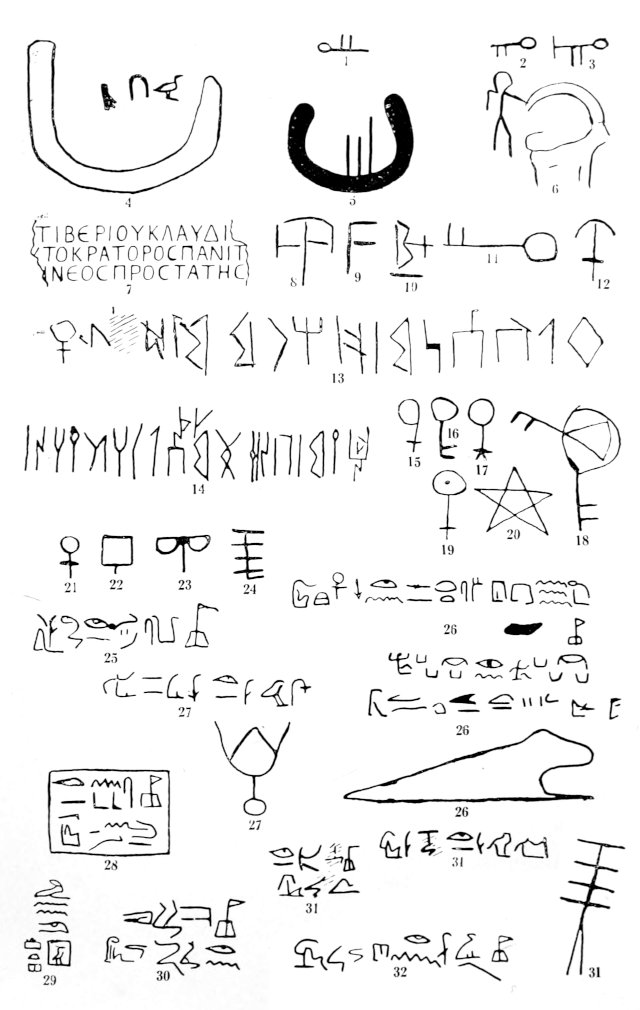
1-3. Marks on a rock near Quft.
4-6. On a rock near Qus. Old kingdom drawings
7. On a stone at Lagêta.—Page 32.
8, 9. Inside Kasr el Benât.—Page 33.
10-12. On rocks opposite Kasr el Benât.—Page 34.
13, 14. Sinaitic inscription opposite Kasr el Benât.—Page 34.
15-20. Opposite Kasr el Benât.—Page 34.
21-24. Marks on rocks of Abu Kueh.—Page 34.
25-32. Middle kingdom inscriptions, and marks at Abu Kueh.—Page 34.
Pl. iv.
(Large-size)
Pl. iv.
We were now on the great mediæval highway from Qus to Kossair, by which the Arabian and Indian trade with Egypt was once conducted. The quarries of Hammamât lie on the main road to the sea. Nowadays the road starts from Keneh; in ancient times it started from Koptos, now called Quft, about ten miles south of Keneh; and in mediæval days it started from Qus, about ten miles south of Quft again. The roads from these different places join at the little oasis of Lagêta, which lies some four-and-twenty miles back from the Nile valley.
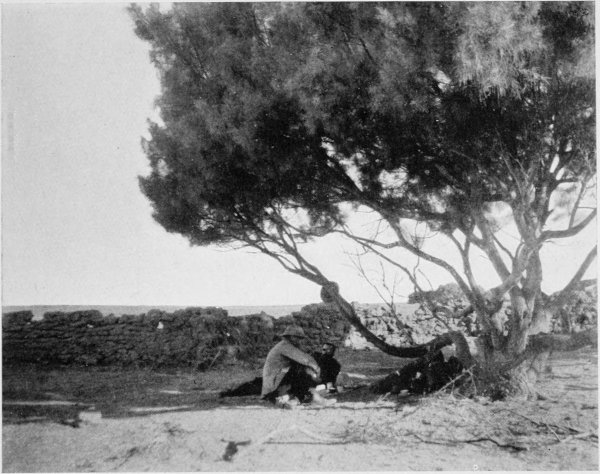
Riding into Lagêta in mid-afternoon the scene was one of great charm. The flat desert stretched around us in a haze of heat. In the far distance ahead the mountains of Hammamât could be seen, blue, misty, and indistinct. The little oasis, with its isolated groups of tamarisks, its four or five tall palms, its few acacias, and its one little crop of corn, formed a welcome patch of green amidst the barren wilderness; and the eyes, aching from the glare around, turned with gratitude towards the soft shadows of the trees. A large, and probably ancient, well of brackish water forms the nucleus around which the few poor huts cluster; and two or three shadufs, or water-hoists, are to be seen here and there. A ruined, many-domed building which may have been a caravanserai, or perhaps a Coptic monastery, stands picturesquely under a spreading acacia; and near it we found the fragment of a Greek inscription in which, like a light emerging momentarily from the darkness of the past, the name of the Emperor Tiberius Claudius was to be seen. The few villagers idly watched us as we dismounted and walked through the settlement, too bathed in the languor of their monotonous life to bother to do more than greet with mild interest those of our camelmen whom they knew; and while we sat under the tamarisks to drink our tea, the only living thing which took any stock of us and our doings was a small green willow-wren in search of a crumb of food.
The camp was pitched to the east of the oasis, and at dawn we continued our way. The temperature was not more than 38° Fahrenheit when the sun rose, and we were constrained to break into a hard trot in order to keep warm. Two desert martins circled about us as we went, now passing under the camels’ necks, and now whirling overhead; while more than once we put up a few cream-coloured coursers, who went off with a whirr into the space around. After a couple of hours’ riding over the open, hard-surfaced desert, we topped a low ridge and came into view of a ruined Roman station, called in ancient times the Hydreuma, and now known as Kasr el Benât, “the Castle of the Maidens.” The building stands in a level plain around which the low hills rise, and to the east the distant Hammamât mountains form a dark background. From the outside one sees a well-made rectangular wall, and entering the doorway on the north side one passes into an enclosure surrounded by a series of small chambers, the roofs of which have now fallen in. In these little rooms the weary Roman officers and the caravan masters rested themselves as they passed to and fro between the quarries and the Nile; and in this courtyard, when haply the nights were warm, they sang their songs to the stars and dreamed their dreams of Rome. The building is so little ruined that one may picture it as it then was without any difficulty; and such is the kindness of Time that one peoples the place with great men and good, intent on their work and happy in their exile, rather than with that riff-raff which so often found its way to these outlying posts.
Across the plain, opposite the entrance to the Hydreuma, there is a large isolated rock with cliff-like sides, upon which one finds all manner of inscriptions and rough drawings. Here there are two Sinaitic inscriptions of rare value and several curious signs in an unknown script, while Ababdeh marks and Arabic letters are conspicuous.
We mounted our camels again at about eleven o’clock, and rode towards the wall of the Medîk es-Salâm hills ahead, passing into their shadows soon after noonday. We halted for luncheon in the shade of a group of rocks, and our meal was enlivened by the presence of two butterflies which seemed out of place in the barren desert, and yet in harmony with the breezy, light-hearted spirit of the place. Early in the afternoon we rode on, but an hour had not passed when some obvious inscriptions on the rocks to the left of the track, opposite a point where the road bends sharply to the right, attracted my attention. These proved to date from the Middle Empire, about B.C. 2000, and no doubt marked a camp of that date. The names of various officials were given, and a prayer or two to the gods was to be read. Rounding the corner, we had no sooner settled ourselves to the camels’ trot than another group of inscriptions on the rocks to the right of the path necessitated a further halt. Here there were two very important graffiti of the time of Akhnaton; and considerable light is thrown by one of them upon the fascinating period of the religious revolution of that king. One sees three cartouches, of which the first is that of Queen Thiy, the second reads Amonhotep (IV.), and the third seems to have given the name Akhnaton; but both this cartouche and that of Thiy are erased. The three cartouches are placed together above the symbols of sovereignty, and below the rays of the sun’s disk, thus showing that Akhnaton was but a boy of tender years under his mother’s guidance when he first came to the throne, and that the Aton worship had already begun. It would be too long a matter to explain the significance of this inscription here, but those who are of an inquiring mind may turn to the article on this subject in the October number of ‘Blackwood’s Magazine’ for 1907, where I have described how the recently found mummy of Akhnaton proved to be that of a very young man.
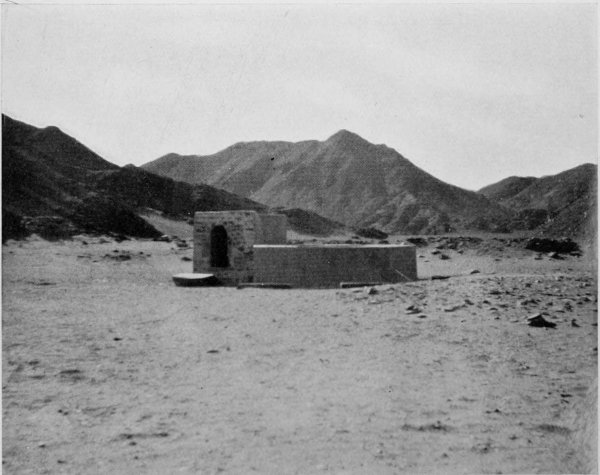
The shadows were lengthening when we once more mounted and trotted up the valley, which presently led into more open ground; but after half an hour’s ride a second Roman station came into sight, and again the grumbling camels had to kneel. The building is much ruined, and is not of great interest to those who have already seen the Hydreuma and other stations. As we continued the journey the sun set behind us, and in the growing moonlight the valley looked ghostly and wonderfully beautiful. The shapes of the rocks became indistinct, and one was hardly aware when the well known as Bir Hammamât was at last reached. This well lies in a flat, gravelly amphitheatre amidst the rugged hills, which press in on all sides. It is in all about six hours’ ride—i.e., twenty-eight or thirty miles—from Lagêta; but our several halts had spread the journey over twice that length of time. The well is circular and fairly large, and stones dropped into its pitch-dark depths seemed a long time in striking the water. A subterranean stairway, restored in recent years by a mining company, runs down at one side to the water’s level; and at its doorway in the moonlight we sat and smoked until the baggage camels came up.
The next morning we rode up a valley which was now tortuous and narrow. This is the Wady Hammamât of the archæologist, and the Wady Fowakhîeh of the natives. Dark, threatening hills towered on either side, as though eager to prison for ever the deeds once enacted at their feet. One’s voice echoed amongst the rocks, and the wind carried the sound down the valley and round the bend, adding to it its own quiet whispers. A ride of about half an hour’s length brought us to some ruined huts where the ancient quarrymen had lived in the days of the Pharaohs. From this point onwards for perhaps a mile the rocks on either side are dotted with inscriptions, from which a part of the history of the valley may be learnt. The place is full of whispers. As the breeze blows round the rocks and up the silent water-courses it is as though the voices of men long since forgotten were drifting uncertainly by. One feels as though the rocks were peopled with insistent entities, all muttering the tales of long ago. Behind this great rock there is something laughing quietly to itself; up this dry waterfall there is a sort of whimpering; and here in this silent recess one might swear that the word to be silent had been passed around. It is only the wind and the effect of the contrast between the exposed and the still places sheltered by the rocks; but, with such a history as is writ upon its walls, one might believe the valley to be crowded with the ghosts of those who have suffered or triumphed in it.
Under the tamarisks of the oasis of Lagêta.—Page 31.
Bir Hammamât, looking south.—Page 36.
Pl. v.
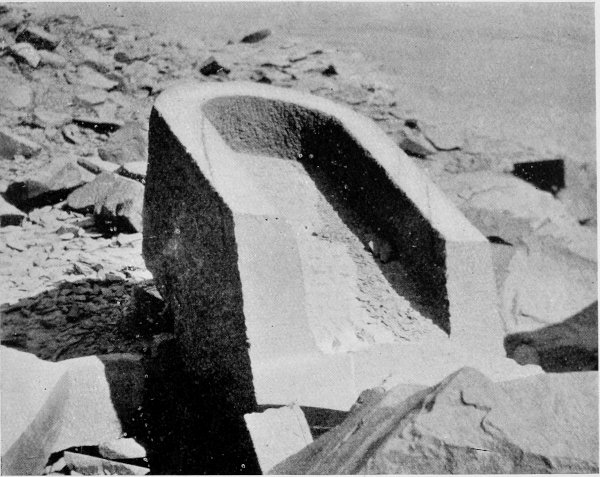
Wady Fowakhîeh extends from the Bir Hammamât to the well known as Bir Fowakhîeh, which lies in the open circus at the east end of the valley. Although the tuff quarried here is of a blue or olive-green colour, the surface of the rocks, except where they are broken, is a sort of chocolate-brown. One thus obtains an extraordinary combination of browns and blues, which with the flush of the sunset and the dim purple of the distant hill-tops forms a harmony as beautiful as any the world knows. The flat, gravel bed of the valley is from fifty to a hundred yards wide, and along this level surface run numerous camel-tracks, more or less parallel with one another. Besides the inscriptions there are other traces of ancient work: an unfinished shrine, and a sarcophagus, abandoned owing to its having cracked, are to be seen where the workmen of some five-and-twenty centuries ago left them; and here and there a group of ruined huts is to be observed.
Amidst these relics of the old world our tents were pitched, having been removed from Bir Hammamât as soon as breakfast had been finished; and with camera, note-book, and sketching apparatus, the four of us dispersed in different directions, my own objective, of course, being the inscriptions. The history of Wady Fowakhîeh begins when the history of Egypt begins, and one must look back into the dim uncertainties of the archaic period for the first evidences of the working of the quarries in this valley. Many beautifully made bowls and other objects of this tuff are found in the graves of Dynasty I., fifty-five centuries ago; and my friends and I, scrambling over the rocks, were fortunate enough to find in a little wady leading northwards from the main valley a large rock-drawing and inscription of this date. A “vase-maker” here offers a prayer to the sacred barque of the hawk-god Horus, which is drawn so clearly that one may see the hawk standing upon its shrine in the boat, an upright spear set before the door; and one may observe the bull’s head, so often found in primitive countries, affixed to the prow; while the barque itself is shown to be standing upon a sledge in order that it might be dragged over the ground.
In Dynasties II. to IV. the objects in the museums show that the quarries were extensively worked, and in Dynasty V. one has the testimony of local inscriptions as well. An official under King Asesa, B.C. 2675, has left his name on the rocks on the south of the valley; and the name of another who lived in the reign of Unas, B.C. 2650, is to be seen there. Of the reign of Pepy I., B.C. 2600, of Dynasty VI., one has more definite information. Scanning the rocks one reads of chief architects, master builders, assistant artisans, scribes, treasurers, ship-captains, and their families stationed at the quarries to procure stone for the ornamentation of the pyramid buildings of the king, which are still to be seen at Sakkâra, near Cairo; and these inscriptions mention a certain Thethi, who was the “master pyramid-builder of the king,” and therefore was probably in charge of the expedition.
In the reign of Aty, B.C. 2400, a ship’s captain named Apa came to procure stone for his master’s pyramid; and with him were 200 soldiers and 200 workmen. King Imhotep, B.C. 2400, sent his son Zaty with 1000 labourers, 100 quarrymen, and 1200 soldiers, to obtain stone; and he supplied 200 donkeys and 50 oxen daily for its transport. But the first really interesting inscription on the rocks of the valley dates from Dynasty XI., B.C. 2050. Here an all too brief story is told by a great official named Henu, recording an expedition made by him to the distant land of Pount in the eighth year of the reign of Menthuhotep III. The king had ordered Henu to despatch a ship to Pount in order to bring fresh myrrh from that land of spices, and he had therefore collected an army of 3000 men. He set out from Koptos, travelled over the open desert to the little oasis of Lagêta, and so struck the road which we had followed. He seems to have had much consideration for his men, for he says, “I made the road a river, and the desert a stretch of field. I gave a leather bottle, a carrying pole, two jars of water, and twenty loaves of bread to each one of the men every day.” When one considers that this means 60,000 loaves of bread per day, one’s respect for the organising powers of the ancient Egyptians must be considerable. At Wady Fowakhîeh he seems to have organised some quarry works for the king, and presently he pushed on towards the Red Sea, digging wells as he went. The expedition, which will be recorded later, is then described; and Henu states that, on his return to Wady Fowakhîeh, he organised the transport of some five blocks of stone which were to be used for making statues.
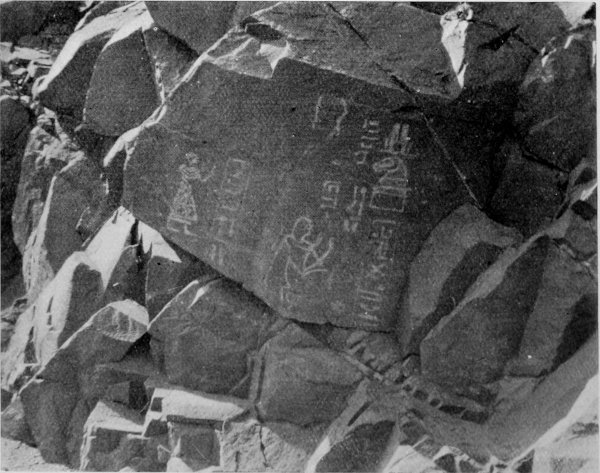
Cartouches of Sety II. on the rocks between Bir Hammamât and Wady Fowakhîeh.
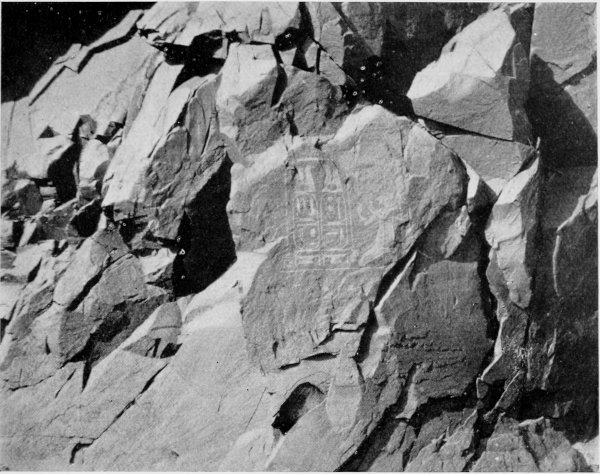
Inscriptions on the rocks between Bir Hammamât and Wady Fowakhîeh.
Pl. vi.
In the second year of the reign of Menthuhotep IV., B.C. 2000,—so runs another long rock inscription,—the Vizier Amonemhat was sent to the quarries with an expedition of 10,000 men, consisting of miners, artificers, quarrymen, artists, draughtsmen, stone-cutters, gold-workers, and officials. His orders were to procure “an august block of the pure costly stone which is in this mountain, for a sarcophagus, an eternal memorial, and for monuments in the temples.” The presence of gold-workers indicates that the gold mines near Bir Fowakhîeh were also opened. Ancient workings are still to be seen near this well, and in recent times an attempt was made to reopen them, which, however, was not very successful. One must imagine this expedition as camping at that well—Bir Hammamât—where we had camped on the previous night, and as passing up the valley each day to and from the quarries. This was a tedious walk, and a nearer water-supply must have been much needed. One day there was a heavy fall of rain, which must have lasted several hours, for when it had ceased the sandy plain at the head of the valley was found to be a veritable lake of water. Rain is not at all a common occurrence in Upper Egypt. Even now the peasants are peculiarly alarmed at a heavy downpour; and in those far-off days the quarrymen were ready enough to see in the phenomenon a direct act of the great god Min, the patron of the desert. “Rain was made,” says the inscription, “and the form of this god appeared in it; his glory was shown to men. The highland was made a lake, the water extending to the margin of the rocks.” The presence of the water seems to have dislodged an accumulation of sand which had formed over an ancient and disused well; and when the lake subsided the astonished labourers discovered its mouth, ten cubits in length on its every side. “Soldiers of old and kings who had lived aforetime went out and returned by its side; yet no eye had seen it.” It was “undefiled, and had been kept pure and clean from the gazelle, and concealed from the Bedwin.” If this well is, as I suppose, the Bir Fowakhîeh, it must have been a great boon to the workmen, for it is but a few minutes’ walk from the quarries, and must have saved them that weary tramp down to the Bir Hammamât at the end of their hard day’s work.
When the great stone for the lid of the sarcophagus had been prised out of the hillside, and had been toppled into the valley, another wonder occurred. Down the track there came running “a gazelle great with young, going towards the people before her, while her eyes looked backward, though she did not turn back.” The quarrymen must have ceased their work to watch her as she ran along the hard valley, looking back with startled eyes as the shouts of the men assailed her. At last “she arrived at this block intended for the lid of the sarcophagus, it being still in its place; and upon it she dropped her young, while the whole army of the king watched her.” One can hear the quarrymen, as they clattered into the valley, shouting, “A miracle, a miracle!” and surrounded the incapacitated creature. The end of the tale is told briefly. “Then they cut her throat upon the block, and brought fire. The block descended to the Nile in safety.”
Another inscription states that this sarcophagus lid was dragged down to the river by an army of 3000 sailors from the Delta, and that sacrifices of cattle, goats, and incense were constantly made in order to lighten the labour. It must have been an enormous block to drag along; for even after it was dressed into the required shape and size by the masons in Egypt, it was some 14 feet in length, 7 feet in width, and 3½ feet in thickness. Two other blocks brought down from these quarries at about the same date are said to have been 17 feet in length, while a third was about 20 feet long.
In the reign of Amonemhat I. of Dynasty XII., B.C. 2000, an officer named Antef was sent to the quarries to procure a special kind of stone, so rare that “there was no hunter who knew the marvel of it, and none that sought it had found it.” “I spent eight days,” says Antef, “searching the hills for it, but I knew not the place wherein it might be. I prostrated myself before Min, before Mut, before the goddess great in magic, and before all the gods of the highlands, burning incense to them upon the fire.” At last, after almost giving up the search in despair, he found the required block one morning just as the sun had topped the dark hills of the valley, and while his men were just scattering in all directions to renew the search. Although so many centuries have passed since Antef found his stone, one feels, when one reads this inscription upon the rocks, that it was but yesterday; and one may picture the sunlit scene when, as he says, “the company were in festivity and the entire army was praising, rejoicing, and doing obeisance.”
Under other kings of this dynasty one reads, as one walks up the valley, of works being carried on. One man quarried and carried down to the river ten blocks which were later converted into seated statues 8½ feet high. Another official speaks of his army of 2000 men which he had with him in this now desolate place; and a third has left an inscription reading, “I came to these highlands with my army in safety, by the power of Min, the Lord of the Highlands.”
So the work continued from generation to generation, and the quarrymen, as they sat at noon to rest themselves in the shade, could read around them the names of dead kings and forgotten officials carved upon the rocks, and could place their own names in the illustrious company. The troubled years of the Hyksos rule checked the quarrying somewhat; but in Dynasty XVIII. the labours were renewed, though unfortunately no long inscriptions have been left to illuminate the darkness of the history of the valley. An inscription of the time of Akhnaton is to be seen high up on the rocks, but other figures have been cut over it by Sety I.
Various kings of Dynasties XIX. and XX. are mentioned on the rocks; but the only important inscription dates from the second year of the reign of Rameses IV., B.C. 1165. It seems that this king, with a degree of energy unusual in a Pharaoh of this debased period, made a personal visit to the quarries. “He led the way to the place he desired; he went around the august mountain; he cut an inscription upon this mountain engraved with the great name of the king.” This inscription is to be seen on the rocks of the valley, almost as fresh as when the scribes had written it. On his return to Egypt he organised an expedition for the purpose of quarrying the stone he had selected. A complete list of the personnel of the expedition is recorded, and, as it gives one an idea of the usual composition of a force of this kind, I may be permitted to give it in some detail.
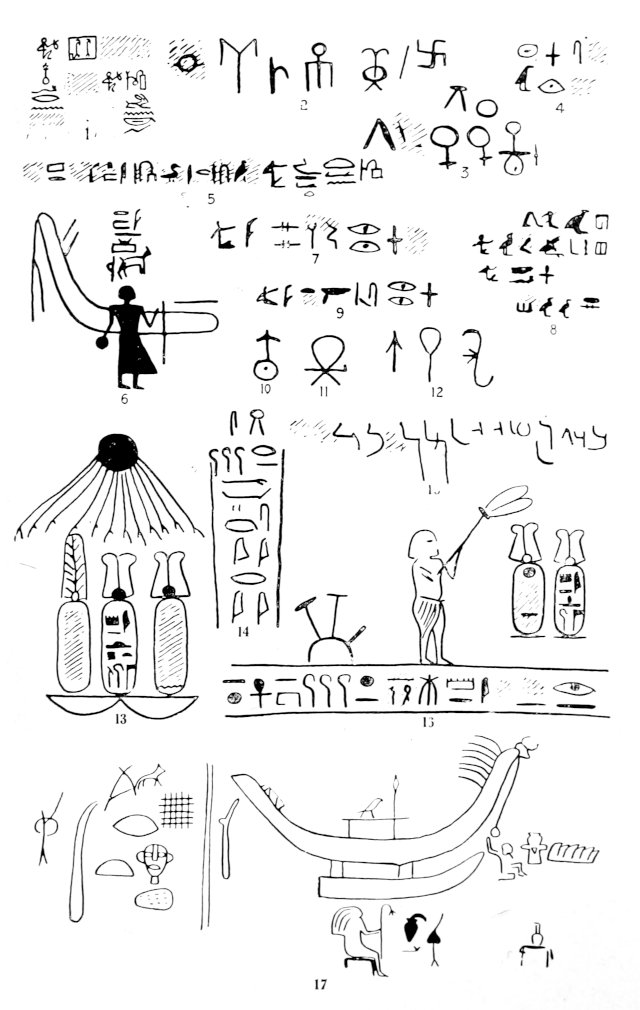
1. Inscription at Abu Kueh.
2, 3. Foreign inscriptions at Abu Kueh.
4. Inscription at Abu Kueh.
5-12. Inscriptions and marks near Abu Kueh.
13, 14, 16. Inscriptions at Abu Kueh, reign of Akhnaton.—Page 35.
15. Aramaic inscription at Abu Kueh.
17. Archaic drawing and inscription in a valley leading from Wady Fowakhîeh.—Page 39.
Pl. vii.
(Large-size)
Pl. vii.
The head of the expedition was none other than the High Priest of Amon, and his immediate staff consisted of the king’s butlers, the deputy of the army and his secretary, the overseer of the treasury, two directors of the quarry service, the court charioteer, and the clerk of the army lists. Twenty clerks of the army, or of the War Office as we would say, and twenty inspectors of the court stables were attached to this group. Under a military commandant there were 20 infantry officers and 5000 men, 50 charioteers, 200 sailors, and a mixed body of 50 priests, scribes, overseers, and veterinary inspectors. Under a chief artificer and three master quarrymen there were 130 stone-cutters and quarrymen; while the main work was done by 2000 crown slaves and 800 foreign captives. Two draughtsmen and four sculptors were employed for engraving the inscriptions, &c. A civil magistrate with 50 police kept order amongst this large force, which altogether totalled 8362 men, not including, as the inscription grimly states, the 900 souls who perished from fatigue, hunger, disease, or exposure.
The supplies for this large expedition were transported in ten carts each drawn by six yoke of oxen; and there were many porters laden with bread, meat, and various kinds of cakes. The inscription then tells us of the sacrifices which were continuously made to the gods of the desert. “There were brought from Thebes the oblations for the satisfaction of the gods of heaven and earth. Bulls were slaughtered, calves were smitten, incense streamed to heaven, shedeh and wine was like a flood, beer flowed in this place. The voice of the ritual-priest presented these pure offerings to all the gods of the mountains so that their hearts were glad.”
In this remote desert how easy it is to dream oneself back in the elder days! The valley, pressed close on either side by the rocks around which the whispers for ever wander, echoes once again with the ring of the chisels; and in the wind that almost ceaselessly rushes over the ancient tracks, one can see the fluttering garments of the quarrymen as they pass to and from their work. As we sat at the door of our tents in the cool of the afternoon, the present day seemed now as remote as the past had seemed before; and, when that great moment of sunset was approached, one almost felt it fitting to burn a pan of incense to the old gods of heaven and earth, as the officers of Rameses IV. had done.
The names of later kings, Shabaka, Taharka, Psametik, Nekau, Aahmes II., and others, look down at one from the rocks; and sometimes the date is precisely given, and the names of the officials are mentioned. During the Persian period the green tuff was in considerable demand for the making of those lifelike portrait statuettes so many of which are to be seen in the various museums; and the coarser tuff, which is practically breccia, was much used for shrines and sarcophagi. It is curious to see in this distant valley the names of the Persian kings, Cambyses, Darius I., Xerxes I., and Artaxerxes I., written in Egyptian hieroglyphs in the rock inscriptions, together with the year of their reigns in which the quarrying was undertaken. Nectanebo I. and II., B.C. 370 and B.C. 350, have left their names in the valley; and dating from this and the subsequent periods there are various Egyptian and Greek inscriptions.
In the reign of Ptolemy III., B.C. 240, a little temple was built near the Bir Fowakhîeh at the east end of the valley of the quarries. Wandering over this amphitheatre amidst the hills we came upon the remains of the little building, which had been constructed of rough stones augmented by well-made basalt columns. It was dedicated to the god Min, the patron of the Eastern Desert; but as it was only about 12 feet by 22 in area the priests of the god could not have commanded the devotion of more than a few of the quarrymen. Near the temple there are three or four groups of ruined huts, nestling on the hillsides amongst the rocks; and here the quarrymen of the Ptolemaic and Græco-Roman ages dwelt, as the broken pottery indicates. There are many traces of ancient gold workings near by, and a ruined house of modern construction stands as a sad memorial of the unsuccessful attempt to reopen them. In the inscriptions of Dynasties XVIII.-XX. one reads of “the gold of Koptos,” which must be the gold brought into Koptos from this neighbourhood; and at this later period the mines appear to have been worked. A very fine pink granite began to be quarried just to the east of this well in Roman days, and one may still see many blocks cut from the hillside which have lain there these two thousand years awaiting transport.
In Wady Fowakhîeh itself there are many blocks of tuff, addressed to the Cæsars, but never dispatched to them; nor is there anything in this time-forsaken valley which so brings the past before one as do these blocks awaiting removal to vanished cities. There are many Greek inscriptions to be seen, the majority being grouped together in a recess amidst the rocks on the south side of the valley. Here one reads of persons who worked for Tiberius, Nero, Domitian, and other emperors; and there are their drawings of men, animals, and boats before one, as fresh as when an hour at noon was whiled away in their making. From these the last days of the quarrying dates a causeway which passes up the hillside on the south of the valley, and which was intended to ease the descent of blocks quarried higher up. The Romans have also left watch-towers on the hill-tops, which indicate that peace did not always reign in the desert.
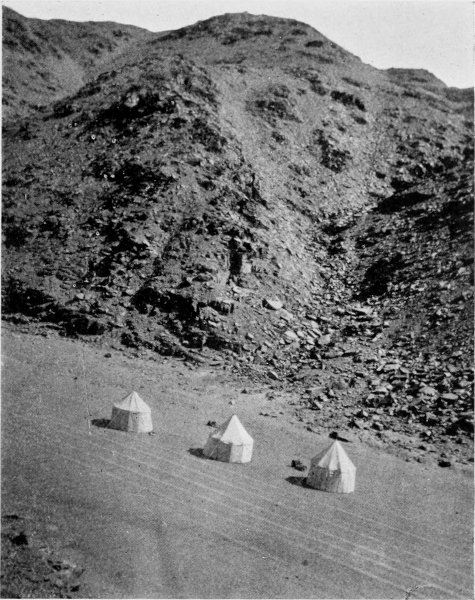
The camp in Wadi Fowakhîeh, looking down from the hills on the north side. The camel tracks are seen passing along the valley.—Page 38.
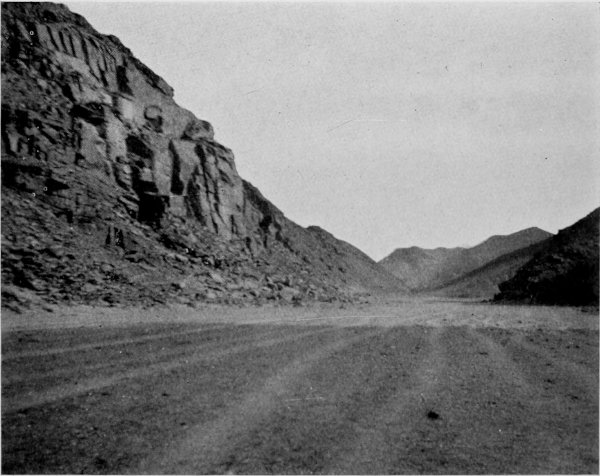
Wady Fowakhîeh, looking east. The camel tracks will be noticed again.
Pl. viii.
The night which closed in on us all too soon brought with it the silence of the very grave. The wind fell, and the whisperings almost ceased. The young moon which lit the valley seemed to turn all things to stone under its gaze; and not a sound fell from the camelmen or from the camels. The evening meal having been eaten and the pipes smoked, we quietly slipped into our beds; and when the moon had set behind the hills and absolute darkness had fallen upon the valley, one might have believed oneself as dead and as deep in the underworld as the kings whose names were inscribed upon the black rocks around.
On the following morning we continued our journey eastwards towards the Red Sea, along the old trade route. This expedition forms a subject which will be treated by itself in the next chapter, and therefore one may here pass over the week occupied by the journey, and may resume the thread of the present narrative at the date when we set out from Wady Fowakhîeh on our homeward way. The day was already hot as we trotted down the valley and past the Bir Hammamât, where, by the way, we put up another family of cream-coloured coursers. A couple of hours’ trotting brought us to a cluster of sandstone rocks on the north of the now open and wide road, these having been passed in the dusk on the outward journey. Here I found one or two inscriptions in unknown letters, a few Egyptian graffiti, and a little Græco-Roman shrine dedicated to the great god Min. On these rocks we ate our luncheon, and rested in the shade; and in the early afternoon we mounted once more, passing the second Roman station half an hour later. A ride of two and a half hours brought us to the Hydreuma about sunset, and here we halted to smoke a pipe and stretch our legs. Then in the moonlight we rode on once more over the open desert, which stretched in hazy uncertainty as far as the eye could see. The oasis of Lagêta was reached at about seven o’clock, and, the night having turned cold, we were glad to find the camp fires already brightly burning and the kettle merrily boiling.
We were on the road again soon after sunrise, and, riding towards Koptos, about ten or twelve miles from Lagêta we passed another Roman enclosure now almost entirely destroyed. Our route now lay to the north of the hills of el Gorn, the south side of which we had seen on our outward journey; and after three and a half hours’ riding we came into sight of the distant Nile valley. The thin line of green trees seemed in the mirage to be swimming in water, as though the period of the inundation were upon us again. At the point where this view is first obtained there are some low hills on the south side of the tracks, and in one of these there is a small red-ochre quarry. The sandstone is veined with ochre, and the quarry had been opened for the purpose of obtaining this material for the making of red paint; but whether the few red markings on the rocks are ancient or mediæval one cannot say. Here we ate an early luncheon, and about noon we rode on over the sun-bathed plain down to the cultivation. Leaving the desert our road passed between the fields towards the Nile; and by two o’clock we reached the picturesque village of Quft, which marks the site of the ancient Koptos. We spent the afternoon in wandering over the ruins of the once famous caravanserai, and in the evening we took the train back to Luxor.
Such are the quarries of Hammamât, and such is the road to them. It is a simple journey, and one able to be undertaken by any active person who will take the trouble to order a few camels from Keneh. There will come a time when one will travel to the quarries by automobile, for even the present road is hard-surfaced enough to permit of that form of locomotion, and with a little doctoring it will be not far from perfection. A place such as this wonderful valley, with its whispers and its echoes, seems to beckon to the curious to come, if only to be lost for awhile in the soothing solitudes and moved by the majestic beauty of the hills. To those interested in the olden days the rocks hold out an invitation which one is surprised to find so seldom responded to; but let any one feel for an hour the fine freedom of the desert, and see for an hour the fantasy of the hills, and that invitation will not again be so lightly set aside. On camel or automobile he will make his way over the ancient tracks to the dark valley of the quarries; and there he will remain entranced, just as we, until the business of life calls him back to the habitations of present-day men.
Abandoned sarcophagus on the hillside in Wady Fowakhîeh.—Page 38.
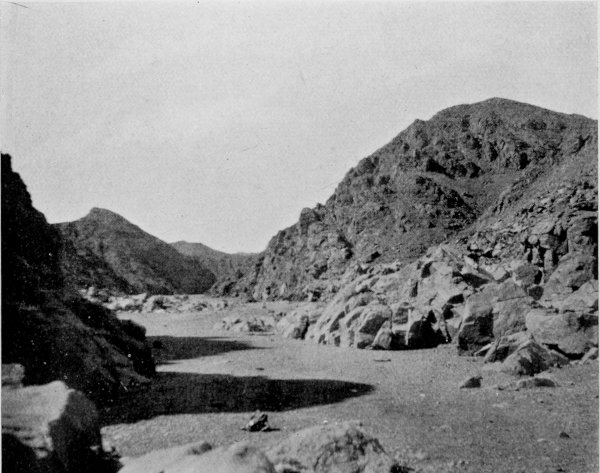
A typical valley near Wady Fowakhîeh.
Pl. ix.