THE SOUTH KENSINGTON MUSEUM.
Reading edition
“COME,” said my friend, Professor Omnium, one clear morning, “let us take an excursion round the world!” My friend is a German, and he has such a calm familiarity with the unconditioned and the impossible, that a suggestion which, coming from another, would appear astounding, from him appears normal. This time, however, I look through his spectacles to see if his eyes have not a merry twinkle: they are quite serene. Visions of the Parisian play entitled Round the World in Eighty Days, thoughts of Puck and excursion tickets, rise before me, and I gravely pronounce the word “Impossible!”
“But,” says the professor, “Kant declares that it is too bold for any man, in the present state of our knowledge, to pronounce that word.”
“My dear friend,” said I, “it is among my dreams one day to visit India, China, Japan, California; but at present you might as well ask me to go with you to the moon.”
“You misunderstand,” replies Professor Omnium: “I do not propose to leave London. We can never go round the world, except in a small limited way, if we leave London. How much does an excursionist in India see of that country? Only a few cities, a few ruins, and the outside of some old temples, and he only sees a little of them. I stayed in Rome three days once—all the time I had there—trying to get a glimpse of some antiquarian treasures in the Bocca della Verita Church: first day, the church was closed to all outsiders by regulation; second day, the building was occupied by a pious crowd, and services were going on from daybreak to midnight; third day was so dark and rainy that I couldn’t see anything. On my way back I met an archæologist who had been in Nuremberg a week trying to scrutinize an old shrine; he had seen many priests, but only caught glimpses through railings of the shrine (St. Sebald’s, which exists in full-sized fac-simile at South Kensington), and the net result of his journey was represented in fifty photographs, just a little inferior to my own collection of the same—bought in Regent Street. I tell you, sir, there are few greater humbugs than this travelling about to see Objects (with a big O) of Interest. It’s expensive. Somebody says most travellers carry ruins to ruins, but the purses they carry away are the worst ruins of all. A man may well travel to see the world of men and women; but so far as art and antiquity are concerned, he who goes away from London shall have the experience of the boy in the fable, who dreamed about the beautiful blue hills on the horizon until he left his own flinty hill-side and journeyed to them; he found them flintier than his own, and, looking back, saw his own hill to be bluest after all.”
“Ah, then,” I put in—when Omnium is talking it is well to put in when one can—“you begin by asking me to go round the world, and end with sneering at all my dreams of India and Japan—”
“Not a bit of it,” cried the professor; “but ten thousand people and a dozen governments have been at infinite pains and expense to bring the cream of the East and of the West to your own doors: you turn your back, and pine for the skim-milk. Yesterday I was talking with Dr. Downingrue, an amiable and learned gentleman, who has been an official in the India House here for twenty years, and was lately given furlough for a year. That year he passed in Turkey and Persia. He told me that he wished to see a certain sacred book, written in ancient Zend, curiously illustrated with the most ancient pictures in the world, one of them possibly a portrait of the great Zoroaster himself. It was, he had heard, kept in the archives of the city of Bam Buzel, and he went a journey of three days and nights in a wagon to see and examine its text. Fancy his disgust at finding only an entry that the volume in question had been removed by order of the Shah in 1855, and that the Keeper of the Archives knew nothing whatever of its whereabouts. I took Downingrue by the hand, led him up one flight of stairs, and took down the old Zend book from its shelf there in Downing Street, where it had remained quietly, twenty feet over his head, while he worked twenty years for freedom to go searching for it in Persia! Now I heard you talking a few evenings ago about your hopes of one day seeing Shiraz and Mecca, the Topes in India, and the great Daiboots Buddha in Japan. I have called this morning to say, firstly, Don’t! secondly, Come, go round the world with me here in London! There is in the South Kensington Museum as noble a Buddha as that at Daiboots, which hundreds of thousands of pilgrims have journeyed for weeks to see: you have only to walk fifteen minutes to see it—not a copy either, but the huge bronze itself. You may travel through Mexico, Peru, and Chili for ten years, and in all that time never see one-hundredth part of the vestiges of their primitive life and history which you shall see in the British Museum. Greece?—and be captured by brigands. Professor Newton has Greece under lock and key, from Diana’s Temple to the private accounts of Pericles. Assyria?—you go, and find that the human heart of it has migrated; you come back, and George Smith reconstructs it for you—”
There was no sign that Omnium was ever coming to an end: the only way of stopping him is surrender; and it was not long before we were making our pilgrimage through Stone Age and Bronze Age, as recovered by the ages of Iron and Gold, and still more by the ages of Art and Science. The professor held a very positive theory that to travel round the world profitably you must first travel up to it, assimilating its past ages. Two recent stories had taken a strong hold on his imagination: one was about a learned historian of his own Germany, who had resolved that it was essential to the complete culture of his little son that the child should begin where the world began, believe implicitly in its fetiches, follow them till they changed to anthropomorphic gods and goddesses, these again till the Christian wand transformed them to fairies and demons, and so on. By this means the historian meant that his boy should bear in his individual periods of life corresponding periods in the growth of the race, and sum up at last the long column in a total of rational philosophy; but the boy is now growing old, and at last accounts had got only as far as Roman Catholicism, and there—stuck! The other story which haunted Omnium’s mind came from California, and was to the effect that upon the head of a woman in mesmeric sleep there was laid the fossil tooth of a mammoth, whereupon she at once gave as graphic a description of the world the extinct animal had inhabited when alive as could have been given by any paleontologist. “Both good stories, eh?” said the professor, with a hearty laugh; “almost as good as Pilpay’s fables: both of them fictitious notions ending in fantasies; but both, so to speak, prophetic types of what real science with real materials enables us to do to-day. We can, indeed, ‘interview’ the mammoth, as you Americans say; we can hang his portrait on our walls along with our other ancestors; and we can assimilate the education of the human race, not by beginning with being assimilated by its embryonic ages, risking failure to pick through the egg-shell at last, but by bringing to bear the lens of imagination, polished by science, and carrying so a cultured human vision through all the buried City of Forms.”
Since the few mornings when I had the pleasure of rambling with my German friend in the museums of London, and listening to his raptures, I have passed a great deal of time in those institutions, and with a growing sense that his enthusiasm was not misplaced. Indeed, so far as the museum at South Kensington is concerned—to which the present paper is especially devoted—to study it with care, and then stand in it intelligently, must, one would say, convey to any man a sense of his own eternity. Vista upon vista! The eye never reaches the farthest end in the past from which humanity has toiled upward, its steps traced in fair victories over chaos, nor does it alight on any historic epoch not related to itself: the artist, artisan, scholar, each finds himself gathering out of the dust of ages successive chapters of his own spiritual biography. And even as he so lives the Past from which he came over again, he finds, at the converging point of these manifold lines of development, wings for his imagination, by which he passes on the aerial track of tendency, stretching his hours to ages, living already in the Golden Year. There is no other institution in which an hour seems at once so brief and so long. A few other European museums may surpass this in other specialties than its own; though, when the natural history collections of the British Museum are transferred to their magnificent abode at South Kensington, one will find at the door of this museum a collection of that kind not inferior to the best with which Agassiz and others have enriched the Swiss establishments; but no other has so well classified and so well lighted an equal variety and number of departments, and objects representing that which is its own specialty—Man, as expressed in the works that embody his heart and genius.
The museum has been in existence about twenty-five years (1882). Its buildings and contents have cost the nation about one million pounds: an auction on the premises to-day could not bring less than twenty millions. Such a disproportion between outlay and outcome has led some to regard South Kensington as a peculiarly fortunate institution; but there has been no luck in its history. Success, as Friar Bacon reminds us, is a flower that implies a soil of many virtues. If magnificent collections and invaluable separate donations have steadily streamed to this museum, so that its buildings are unceasingly expanding for their reception, it is because the law of such things is to seek such protection and fulfil such uses as individuals can rarely provide for them. I remarked once to a gentleman, who did as much as any other to establish this museum, that I had heard with pleasure of various American gentlemen inquiring about it, and considering whether such an institution might not exist in their own country, and he said: “Let them plant the thing and it can’t help growing, and most likely beyond their powers—as it has been almost beyond ours—to keep up with it. What is wanted first of all is one or two good brains, with the means of erecting a good building on a piece of ground considerably larger than is required for that building. The good brains will be sure to recognize the fact that we have been doing a large part of their work for them at South Kensington. It is no longer a matter of opinion or of discussion how a building shall be constructed for the purpose of exhibiting pictures and other articles. The laws of it are as fixed as the multiplication table. Where there have been secured substantial, luminous galleries for exhibition, in a fire-proof building, and these are known to be carefully guarded by night and day, there can be no need to wait long for treasures to flow into it. Above all, let your men take care of the interior, and not set out with wasting their strength and money on external grandeur and decoration. The inward built up rightly, the outward will be added in due season.”
There is no presumption in the high claims of the curators and architects of the South Kensington Museum for the principle and method of their building. For it must be borne in mind that every difficulty that could conceivably present itself had to be solved by them in its extreme form: they had to deal with the gloomiest and dampest climate and the smokiest city in the world, and, a fortiori, they have solved every difficulty that can arise under less dismal skies. Nevertheless, this museum need not rest upon the claims made in its behalf by any authority. No statement can be so instructive and impressive as its own history, so far as that history exists; for, great as is the success it has attained, there is no one aspect of it which, if examined, does not reveal that it is rapidly growing to a larger future. I applied to a man who sells photographs of such edifices for pictures of the main buildings. He had none. “What, no photograph of the South Kensington Museum!” I exclaimed, with some impatience. “Why, sir,” replied the man, mildly, “you see, the museum doesn’t stand still long enough to be photographed.” And so, indeed, it seems; and this constant addition of new buildings, and of new decorations on those already erected, is the physiognomical expression of the rapid growth and expansion of the new intellectual and æsthetic epoch which called the institution into existence, and is through it gradually climbing to results which no man can foresee.
From a valuable paper on local archæological museums, contributed to the Building News, June 11th, 1875, I gather some of the following facts relating to the origin of the chief English museums. In the middle of the seventeenth century there was formed at Lambeth, in London, the first place that could be described as a museum. It was called “Tradescant’s Ark.” It consisted of objects of natural history collected in Barbary and other states by Tradescant, sometime gardener to Queen Elizabeth. This valuable collection was bequeathed, in 1662, by the younger Tradescant to Elias Ashmole, who gave it to Oxford in 1667, and it was the basis of the now valuable Ashmolean Museum of that place. Sir Robert Bruce Cotton, after graduation in 1585, associated with the antiquaries of his day, Joscelin, Lambard, Camden, and Noel, and collected rare books and antiquities, which became the nucleus of the British Museum. Sir Hans Sloane died one hundred and twenty years ago, and by will offered his collection of MSS. and artistic and natural curiosities (for which he had paid £50,000) to the nation for £20,000. In 1753 the Harleian collection was purchased. When a place in which to deposit these treasures was sought, Buckingham House (now Buckingham Palace) was offered for £30,000; but an offer by Lord Halifax of Montague House (built by Hooke, the mathematician) for £10,000 was accepted, and so the museum stands at Bloomsbury. The public was first “admitted to view” (the phrase is still used at the museum) the collections in 1759. George II. presented the old Royal Library, founded by Henry VII., containing monastic spoils. The Lansdowne MSS. were bought in 1807 for £4925; the Burney collection, eleven years later, for £13,500; and in 1820 Sir J. Banks bequeathed his library of natural history. At the time of the foundation of the British Archaeological Association in 1844 there were outside of London but three museums, namely, at Oxford, York, and Salisbury. Now nearly every large town has its museum in which to treasure the monumental relics and natural curiosities of its neighborhood. York has the sarcophagi, tessellated pavements, and altars of Eboracum, Salisbury the spoils of Uriconium, Colchester the remains of Camulodunum, Bath those of Aquae Solis, and Cirencester those of Corinium. The Brown Museum at Liverpool is rich in Anglo-Saxon remains, and the important collection described by Wylie in his Fairford Graves is in the Ashmolean at Oxford. The Brown Museum derives its name from Sir W. Brown, who not only added to it a large building, but his collection (which cost him £50,000) of consular diptychs, Etruscan jewelry, Limoges enamels, Wedgwood pottery, and important Roman and Saxon antiquities. The Scarborough Museum has interesting British relics, among them a tree coffin of great rarity. The Exeter Museum has a good set of Celtic pottery, and bronze implements found in Devon. Wisbech possesses superb examples of mediaeval art and important Egyptian antiquities. In the Torquay Museum may be found the vast collection of flint implements found in the famous Kent’s Cavern through the industry of Mr. Pengelly, the geologist, along with remains of extinct animals discovered beside them. The Halifax Museum, in which Professor Tyndall passed his early scientific apprenticeship, is rich in the curiosities of the coal measures, and has important Egyptian as well as Roman remains. There are many other museums in the country—indeed, hardly any important town is without one; but I must not fail to mention a very interesting one at Canterbury. It contains Roman tessellated pavements; a large number of ancient terra-cotta forms, presented by the late Viscount Strangford, who brought them from the Greek isles, Egypt, and Asia Minor; two extremely interesting Runic stones found near Sandwich; and many such interesting antiquities as the “Curfew Bell” and “Couvre Feu;” and some very odd ones—for instance, the severed hand of Sir John Heydon, who was killed by Sir Robert Mansfield in a duel, anno 1600.
In a graphic article published some years ago Sir Henry Cole described (what it is almost impossible for the Londoner of to-day to realize) the condition of this metropolis at the beginning of the century. The only institution which then existed for preserving any object of art or science was the British Museum, which was founded in 1753, in which year a sum of £300,000 was raised by lottery to purchase certain collections—as that of Sir Hans Sloane, and the Cotton MSS.—over the drawing of which lottery (100,000 tickets at three pounds each), at Guildhall, the Lord Chancellor, the Speaker of the House of Commons, and the Archbishop of Canterbury presided! But this sole institution excited the very smallest interest in the country, and so late as forty years ago Croker jeered in Parliament at Bloomsbury as a terra incognita, and Carlyle’s brilliant friend and pupil, Charles Buller, wrote an article describing a voyage of exploration he had made to that region, with some account of the curious manners and customs of the inhabitants. “About a hundred visitors a day on an average,” says Sir Henry Cole (there are now as many visitors to the British Museum per hour), “in parties of five persons only, were admitted to gape at the unlabelled ‘rarities and curiosities’ deposited in Montague House. The state of things outside the British Museum was analogous. Westminster Abbey was closed except for divine service, and to show a closet of wax-work. Admittance to the public monuments in St. Paul’s and other churches was irksome to obtain, and costly: even the Tower of London could not be seen for less than six shillings. The private picture-galleries were most difficult of access, and, for those not belonging to the upper ten thousand, it might be a work of years to get a sight of the Grosvenor and Stafford collections. No national gallery existed, and Lord Liverpool’s government refused to accept the pictures now at Dulwich, offered by Sir Francis Bourgeois, even on condition of merely housing them. The National Portrait Gallery, the South Kensington Museum, and the Geological Museum were not even conceived. Kew Gardens were shabby and neglected, and possessed no museum. Hampton Court Palace was shown, by a fee to the house-keeper, one day in the week. No public schools of art or science existed in the metropolis or the seats of manufacture. The Royal Academy had its annual exhibition on the first and second floors of Somerset House, in rooms now used by the Registrar-general, whose functions then had no existence. It was only at the British Institution or at Christie’s auction-rooms that a youthful artist like Mulready could chance to see the work of an old master, as he has often told us. Dr. Birkbeck had not founded the present Mechanics’ Institute in Southampton Buildings, and the first stone of the London University, in Gower Street, was not laid. Not a penny of the public taxes was devoted to national education. Hard drinking was as much a qualification for membership of the Dilettanti Society as the nominal one of a tour in Italy. Men’s minds were more anxiously engaged with bread riots and corn laws, Thistlewood’s conspiracy and Peterloo massacres, Catholic emancipation and rotten boroughs, than with the arts and sciences, for the advancement of which, in truth, there was hardly any liking, thought, or opportunity.”
This being the condition of London, the state of things in other parts of the United Kingdom may easily be inferred. There are now fifteen important public museums and art galleries in or near London. The ancient buildings of interest are shown without fees. More than a million people visited a single one of these museums last year. There are seven large schools for art training in London alone, and 151 in the whole country, with 30,239 pupils. The number of pupils at South Kensington Art School for the scholastic year ending July, 1880, was 824. These numbers refer exclusively to those who mean to devote their lives to art. The official report for 1881 gives 4758 as the number of elementary schools in which art is taught, 768,661 as the number of children instructed, the total amount of the grants in aid of them being £43,203 in the same year.
Public interest in the treasures of art and science in London—whose extent was unknown to any one—first manifested itself in 1835, when Parliament caused an inquiry to be made into the state of the British Museum; a second committee inquired in 1847, a third in 1859. The result of these inquiries was a series of ponderous Blue-books, which few ever saw, but which that few studied very carefully. It finally burst upon the country that the British Museum and its collections had, up to 1860, cost three millions of pounds, and that it was “in hopeless confusion, valuable collections wholly hidden from the public, and great portions of others in danger of being destroyed by damp and neglect.” The commissioners of 1859 who made this report also pointed out the cause of the evils they recognized. The museum was in the hands of forty-seven trustees, each of whom seemed to think that there were plenty to manage the affair without his concerning himself individually in the matter. Never was costlier broth so near being spoiled by multiplicity of cooks, when Panizzi, by a sort of coup d’état, brought a strong executive control to bear upon it. It is a singular fact that even now the British government does not formally adopt the British Museum. The vote for supplies of its ways and means is given each year on a motion made by a member sitting on the opposition benches. During Mr. Gladstone’s administration it was made by the Right Hon. S. Walpole, a trustee of the museum; when Lord Beaconsfield was in power it was made by the Right Hon. Robert Lowe, also a trustee. The money is supplied grudgingly. There can hardly be found elsewhere men of such eminence in their own departments as Professor Newton, Reginald Stuart Poole, and Story-Maskelyne (the mineralogist); there can be found none who have done such enormous work in bringing order out of chaos in the British Museum; yet they receive salaries of six hundred and fifty pounds each for labors that deserve a thousand. The condition of this museum has much improved of late. The vast growth of its collections had crowded its literary and scientific employés into miserable unventilated cells, and their murmurings of years have until now been unheeded. When the first victim, the Talmudic scholar, Emanuel Deutsch, was dying, he said, “Perhaps when I am gone they will do something.” This was the hope of the thirty-eight scholars buried alive in the printed-book department. He died, and nothing was done. Then fell the second victim, Mr. Warren, head of the transcribing department. This caused a panic. The readers of the reading-room, many of whom suffer from the now medically recognized “Museum headache,” took the matter up. The trustees visited the room where the two scholars had perished, and condemned it. But several rooms only a little better were still used, and another able assistant, an eminent author, barely saved his life by resigning a post he had held in the museum for over twenty years. The principal librarian, Bond, and keeper of printed books, Bullen, have done much to improve the state of things: but there is still a great want of private rooms for the assistant librarians, who generally have to sit in draughty galleries, where no open fires are to be got at. That this huge building should have become absurdly inadequate for its contents and its original purpose indicates the vast progress of English science in recent years. The keepers of antiquities felt themselves bound to declare that there were valuable Egyptian, Assyrian, and Greek monuments and inscriptions, in the crypts and corners of the museum, quite as useless for scientific purposes as if they had remained buried in the lands where they were exhumed. Much relief, both to the assistants and to the scholars who have had to dig like Schliemann for some of the museum’s treasures, will follow the removal of the vast zoological collections to South Kensington. The final result will be that the British Museum will be specialized, and become the treasury of the national archives and the national library.
As for the matter of payment, it certainly constitutes the gravest problem besetting institutions of this character. The best work done for literature, art, and science (so far as they are connected with the state) is done on small salaries, a thousand pounds being considered a vast sum for great men. Even such men as Tyndall and Lockyer get less than that by their official positions. But these gentlemen all feel the danger that might arise if such work became so well paid as to allure the incompetent, and its offices become objects of political intrigue. At present no country is better served in such matters than England, such men as those mentioned being content with small salaries because of the ample means of research afforded them. And indeed it would appear enough to prevent the offices for scientific and other work of an intellectual character being sought for gain, if some clever statesman would invent a way of paying the additional sums needed “in kind,” but in some kind, also, not transmutable into values for other than the learned. It must be admitted that thus far no English minister has appreciated the necessity that scholars should have salaries sufficiently large to raise them above anxiety, and to render unnecessary the too frequent frittering away of invaluable time and power in a multiplicity of extraneous and lucrative employments.
The redemption of the British Museum, so far as it has proceeded, as well as the establishment of nearly every institution of importance to art or science in the country, was largely due to the instruction by example represented in the South Kensington Museum. This institution, it is important to remember, did not grow out of any desire to heap curiosities together or to make any popular display; it grew out of a desire for industrial art culture, and the germ of it was the School of Design which opened in a room of Somerset House, June 1st, 1837. This poor little school is now a thing to make fun of. It took over a month for it to obtain the eight pupils with which it began. The first act of its regulators seems to have been a rule that “drawing the human figure shall not be taught to the students.” Haydon insisted that there could be no training without the human figure. The government did not want artists, but men who could draw such patterns as should render it no longer necessary for English manufacturers to go to Lyons and Paris for such. Etty and Wilkie sat in the council beside silk-weavers and portly warehousemen. Fine-art students were actually excluded—this mainly because of the cry that the government would otherwise be taking bread out of the mouths of private teachers—and the School of Design in 1842 consisted of 178 pattern-drawers. Schools of a similar character were gradually established in some of the provincial manufacturing cities. And there had been about ten years of this sort of thing when the great Exhibition of 1851-52 took place.
Queen Victoria has described the May day when the Palace of Glass was opened in Hyde Park as the happiest of her life. She had witnessed one of those noble victories which leave no tears behind but such as may welcome glad tidings of good-will, and she had seen her hero wearing the only crown he coveted—that of success in a great achievement for European civilization. It is sad indeed that only as a widow does she live to realize the latest results of that day on her country.
The great Exhibition may be termed, so far as English art is concerned, the great revolution. Such a display of “florid and gorgeous tinsel,” to use Redgrave’s description, was never seen, unless in the realms of King Coffee. The articles from the Continent were glittering and showy enough, but those of Great Britain outglittered all, exciting the laughter of cultivated foreigners to such an extent that English gentlemen were scandalized and abashed without knowing precisely what was the matter. The Prince Consort, who was especially ashamed at the general disgust manifested for this tawdry English work, had brought with him from his careful training in Germany and at Brussels one excellent habit—that of deferring to the judgment of accomplished men in matters relating to their own specialties. When he found himself, as Chief Commissioner of the great Exhibition, the hero of a great aesthetic failure and of a great financial success—blushing for the fame of the country which had bestowed its highest honor upon him, and at the same time contemplating a net surplus of £170,000—the idea took possession of him that the least the money could do would be to begin the task of raising English work from the abyss of ugliness which had been so admirably disclosed; and that idea led him to consult artists of ability and men of taste, and to mediate between them and her Majesty’s complacent ministers, whom he managed to rouse into a happy state of bewilderment, which resulted in action.
The Prince Consort was, during his brief life, a fortunate man in many respects, but in nothing was he so fortunate as when, inspired by the best artistic minds in England, he induced the Queen to set apart some rooms at Marlborough House (now the residence of the Prince of Wales) for an industrial art collection and for art training, and when he persuaded her ministers to devote £5000 to the same purpose. He has thus made the great head-quarters of British art in some sense his monument. In 1852 the small collection of the School of Design in Somerset House was removed to Marlborough House, and the Board of Trade confided to Owen Jones, R. Redgrave, and Lyon Playfair the work of reorganizing the whole art training of the country. The collection transferred from Somerset House was trifling enough, but now there were added a number of articles that had been purchased from the Exhibition, and a still more remarkable collection, which has a curious history. After the French Revolution, when the infuriated people were prepared to destroy not only the noblesse, but the works associated with them, fine cabinets and beautiful china vanished out of Paris. At this time George IV.’s French cook gathered up a superb collection of old Sèvres china. This had long been distributed through the English palaces, and was even used for ordinary table service; it was now, by the Queen’s order, removed from the various palaces to Marlborough House, where it was at once recognized as the finest existing collection of a class of articles which was already exciting that competition among collectors which at present amounts to a mania. But the Queen’s best loan was her example. Ministers took up the matter with unwonted courage. Mr. Henley, of the Board of Trade, secured the Bandiuell pottery, Mr. Gladstone the Gherardini models, and the precedent was set which has since added the Bernal, Soulages, Soltikoff, Pourtalès, and other collections—one of the most curious being that of the Rev. Dr. Bock, a collection of mediaeval religious vestments. There is a myth still current that in one or two cases the secret agent of the British Museum had been bidding for some treasure against the secret agent of South Kensington; but it has no foundation. Once upon a time the British Museum and the Tower of London found themselves bidding against each other for a piece of old armor; but no similar accident could have occurred under the keen eye of Sir Henry Cole, who from first to last has been felt in the progress of this museum. Sir Henry developed a power of getting money for the museum, from the stingiest chancellors, unknown in the history of the English exchequer. He, with Mr. Richard Redgrave, explored Italy, and brought back many valuable treasures of early art.
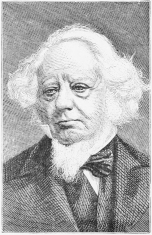
SIR HENRY COLE, K.C.B.

In 1854 the first report of the newly-established Department of Science and Art was laid before Parliament. It was a Blue-book of 642 pages—so much being required for those interests of the country to which the Board of Trade had, in 1836, devoted the half of one page. This report and those which followed bore witness that a new enthusiasm had arisen in England for recovering its lost arts; but they increasingly proved also that the collections evoked from their hiding-places were already overflowing Marlborough House. In one sense this overflowing was of signal advantage, for it enabled the department to send a collection of four hundred beautiful specimens as a circulating museum through the provincial cities and towns—a plan which has been maintained by the museum, and also by the National Gallery of Fine Arts, with excellent results. The commissioners had not at that time, so far as their reports show, any notion of localizing the various schools of science and art at South Kensington. Indeed, no such expression as “South Kensington” had existed until 1856, when Earl Granville so christened the “Brompton Boilers,” which the government had empowered Mr. Cole to prepare for the transfer of the Marlborough House collection (voting £10,000 for the purpose), and which, with their three boiler-shaped tops, still stand as the seed-shell of the museum. It was little supposed then that the “Mr. Huxley” whom the report of 1856 speaks of as employed to collect specimens on the coast would ever be seated as he is now in a palatial science school at Kensington. There must, however, have been some very far-seeing eyes looking at things in those days, for the commissioners of the great Exhibition of 1851 persuaded the government to add to the Exhibition surplus of £170,000 enough to make £300,000, and to invest the sum in the vast Kensington Gore estate. This estate comprised between twenty-five and thirty acres of land, twelve of which belong to the museum, and has become the site of a great metropolis of science and art. The museum was opened on June 22d, 1857, by the Queen, accompanied by the Prince Consort and the Heir Apparent.
The removal of the collections of Marlborough House to South Kensington, and the establishment of the new movement in a centre of its own, with room to grow, was speedily followed by a grand event, namely, the donation by Mr. Sheepshanks of his superb collection of pictures to the nation. Mr. Sheepshanks supplies to gentlemen who wish to benefit the public about as good an example as they can find in modern annals. For many years he had welcomed artists to study and copy in the gallery opening from his dining-room, which so many of them now remember as an oasis in the wilderness which surrounded them in the last generation. But the owner of this gallery had observed that the Philistines of Parliament were still very strong: they had once refused to accept even a valuable collection of pictures (as already stated) from unwillingness to house them; and although they had got beyond that, and thankfully accepted the Vernon Gallery, he saw that the arrangements for giving shelter to this gallery were made very slowly. The National Gallery had a large portion of its Turner and its Vernon bequests housed at South Kensington, and a much larger portion of them hid away in its crypt, for twenty-five years, awaiting the hour when England should find out the magnificent works of which it is the heir, by seeing them on the new walls completed in 1876. Mr. Sheepshanks resolved to see his gallery—which was worth even then a hundred thousand pounds—attended to while he was yet alive. He offered his pictures to the country on the following conditions: that a suitable building should be erected at Kensington (which would remove them from the dust and smoke of the city); that they should never be sold; must be open to art students, and at times to the public; and that the public, especially the working-classes, should be permitted to view the same on Sunday afternoons. The government assented to all of these conditions except the last, and Mr. Sheepshanks was reluctantly compelled to add to that provision the words, “it being, however, understood that the exhibition of the collection on Sundays is not to be considered one of the conditions of my gift.”
Having thus summed up the history of the museum, it remains for me to consider its three aspects: (1) as to architecture and decoration; (2) its collections of objects; (3) its educational or art training method and character.
The accompanying map will show the series of buildings at South Kensington. There exists to the west of Exhibition Road a park of about ten acres, holding at the north the Royal Albert Hall, at the south the Museum of Natural History, and between these, on either side, the long line of arcade buildings containing the National Portrait Gallery, the Indian section, Naval Museum, Patent Office, the Museum of Scientific Apparatus, and, in addition, spacious halls for the display of machinery during exhibitions, for horticultural shows, and Mr. Frank Buckland’s methods of pisciculture. Such a collection of museums, answering the varied needs of science and art, cannot be found elsewhere—even within the limits of a nation. The gardens adjoining this series of buildings are beautifully adorned with statues and fountains, and will remain in the future, as they have been in the past, a favorite promenade, entered from Albert Hall and its extended galleries, in summer always bright with flowers, with music, and gay companies.
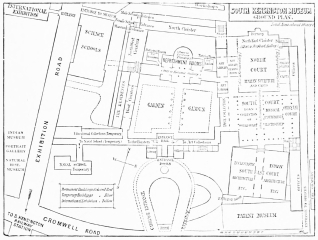
SOUTH KENSINGTON MUSEUM—GROUND PLAN.
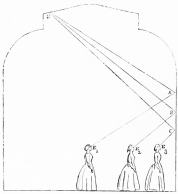
DIAGRAM SHOWING GLITTER POINTS IN A PICTURE-GALLERY.
The building containing the courts was designed by the late Captain Fowke, of the Royal Engineers, and, I believe, there is no other building in this country more adapted to its purpose. The task assigned Captain Fowke was to build a picture-gallery eighty-seven feet long by fifty wide, with two floors, the upper to be lighted from above, and the lower open to the light from side to side, and to make the whole as near fire-proof as possible. The building is thirty-four feet above the ground-line to the eaves, and fifty to the ridge, and consists of seven equal bays, twelve feet in length and of the width of the building. The upper floor contains four separate rooms, two of forty-six by twenty feet, the others of thirty-five by twenty feet, lighted entirely from the roof, and giving a wall space of 4340 square feet available for hanging pictures. The lower floor is thrown into two unequal rooms of forty-six by forty-four feet and thirty-five by forty-four feet, each having a row of piers along the centre, the play of light from side to side being thus nearly unimpeded. Thus the upper floor has no windows, but as much wall space as possible, while the lower has no walls, but piers, as is demanded for the exhibition of objects in cases. The roof is double glazed, and the rule of lighting is that the height and width of the gallery should be the same, and the skylight half of the same. This renders it always easy for the spectator to avoid the glitter point on a picture, as may be seen by the accompanying diagram. The glitter point, altering with the position of the beholder, is at B, nine feet from the floor, when the beholder is at E2, or five feet from the wall; and the glitter descends to C, seven feet from the floor, when the beholder advances to E3. But if the spectator can recede to fifteen feet, the wall has no glitter up to thirteen feet. The skylight at South Kensington is brought as near as is consistent with avoiding glitter, and is twenty feet nine and a half inches from the floor. Just below the skylight run horizontal gas-pipes, with fish-tail burners projecting on two-inch brass elbows, and the light at night is as nearly as possible the same as in the day. When the gas was first put in this building there occurred an interesting controversy concerning the effect of gas on pictures, which elicited a valuable statement, jointly signed by Faraday, Hofmann, Tyndall, Redgrave, and Fowke, who had been appointed as a commission of inquiry, to the effect that coal-gas is innocuous as an illuminator of any pictures, if kept at a sufficient distance above them to avoid bringing into contact with the pictures the sulphuric acid caused by its combustion (22½ grains per 100 cubic feet of London gas).
In the large courts electric lamps are now used with much success. It is wonderful to note the beauty of porcelain and all objects of delicate decoration under the new light; it brings out the minute traceries better than daylight.
Security from fire here has been made as nearly absolute as possible, and Sir Philip Cunliffe Owen believes it impossible by any device to fire the museum; yet the water arrangements and vigilance at South Kensington are as complete as if the building were built of the ordinary materials. As a matter of fact, the choice of materials was made after long and patient scientific experiments. The main material is the best gray stock brick, with ornamental work of certain blue, red, and cream-colored bricks peculiar to some English counties. Some iron it was, of course, necessary to use for joists and girders, but in every case this iron has been isolated by being surrounded with a thick fire-proof concrete. The floor is of Minton tiles imbedded in Roman cement. The double roof is Mansard, and covered with a French tile (tuile courtois), selected at the Paris Exhibition of 1855.
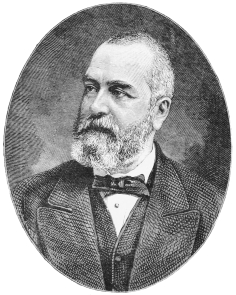
SIR PHILIP CUNLIFFE OWEN, DIRECTOR OF SOUTH KENSINGTON MUSEUM.
The picture-gallery described above, made to hold the Sheepshanks collection, has had additions made behind it, in accordance with the original plan, of three large rooms, which contain various collections of pictures, and near the back entrance to these is the gallery of Raphael’s cartoons. All this series of picture-galleries constitutes an upper floor of a wing to two vast double show-rooms. One of these is a large square apartment, in which large numbers of marble and other antique monuments are displayed. The other, connected with it, is architecturally divided by slender pillars—between which, as an avenue, are show-cases, above and below—into two noble rooms with splendid arched ceilings. The first-named of these rooms (that which is without division, and single-roofed) has not yet received its wall decorations, which are to be a distemper half-way up, and above, a frieze of frescoes large as Raphael’s cartoons. The other show-room—with the double-arched ceiling—furnishes, as may be imagined, fine opportunities for wall decoration, as also for the ornamentation of floor and ceilings. The decoration here has not been completed, but it has gone far enough for the scheme to be judged by its effect.
And it is just here that a careful criticism is necessary. While the purely architectural work merits all the praise that can be claimed for it, securing an admirable play of light, making each division add its light to the other, and reducing the space occupied by pillars and other accessories to a minimum, the decorations are but measurably successful. The faults are due, I think, to the intention that the ornaments themselves should present some of the features of a collection of styles. The result proves that it would be better if the varied styles were exhibited in a court set apart for the purpose. The floor, for example, is rich in its varieties of tiles, there being some five or six of different designs and shades. It is true that the great central floors are made of tiles of uniform design and color, and that these—a deep brick red, with small green spots at the corners of each tile—are grave and good; but all around, where we pass through arch or door, there is a deep fringe of brilliant tiles, which are reflected into the glass cases nearest them, to the injury of the objects shown; and in the series of “cloisters,” as the spaces beneath the picture-gallery may be called, there are further experiments in floor tiles which militate against the effect of the articles exhibited in them. The ceilings in these cloisters, or side spaces, have been covered with Oriental decorations by the late Owen Jones; they are Indian, Persian, moresque, and of the greatest beauty, each coffer in the ceiling and each archway presenting a new design, and yet all in harmony: these being too far above the show-cases to affect any objects in them, are rightly placed; but the floor, as the necessary background to many objects in the rooms—many of which depend on delicate shades of color for their effect—will eventually, I suspect, have to be reconstructed, and made entirely of the grave hue which has happily been already adopted for the greater part of it. Ascending a little above the floor, it must be said also that there is too much brilliancy about the lower arches and their spandrels—too much white and gold. It is not only that this does not give a sufficiently subdued background for the bright glass or chased metals in the upper parts of the cases (on the ground-floor), but they are by no means the best supports for the grand series of life-sized figures in mosaic, on deep gold surfaces, which make the magnificent frieze of the upper wall.
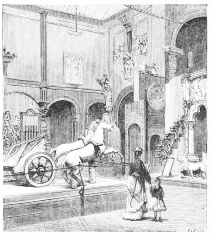
NORTH COURT, NORTH-WEST CORNER, SHOWING CASTS OF THE BIGA (OR TWO-HORSE CHARIOT), FROM THE ORIGINAL IN MARBLE AT THE VATICAN, AND OF THE PULPIT BY GIOVANI PISANO, FORMERLY IN THE CATHEDRAL AT PISA.
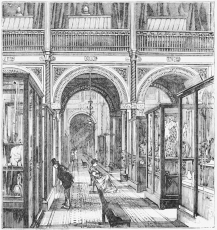
SOUTH COURT, SHOWING THE PRINCE CONSORT’S GALLERY.
It is these superb figures, representing the great artists of the past, which constitute the most salient feature of decoration in the museum. In this case (as in so many others in the museum) the scheme—due to the late Mr. Godfrey Sykes—of combining the purposes of general decoration with subjects of special interest in a museum, has been most fortunate: the general effect is noble, the figures interesting as portraits and as representations of costume, the varieties of mosaic in which they are produced being of value for comparison. There are thirty-six flat alcoves—eighteen on each side—and the figures in them are those of the chief artists in ornamentation, with the names of their designers beneath: Phidias (by Poynter); Apelles (Poynter); Nicola Pisano (Leighton); Cimabue (Leighton); Torel, the English goldsmith, d. 1300 (Burchett); William of Wykeham, bishop and architect of Winchester Cathedral, d. 1404 (Burchett); Fra Angelico (Cope); Ghiberti (Wehnert); Donatello (Redgrave); Gozzoli, one of whose Florentine frescoes, containing his own portrait, is in the museum, d. 1478 (E. Armitage); Luca della Robbia, specimens of whose terra-cotta work in the museum show him to have been a man of genius, d. 1481 (Moody); Mantegna (Pickersgill); Giorgione (Prinsep); Giacomo da Ulma, friar at Bologna and painter on glass, d. 1517 (Westlake); Leonardo da Vinci (J. Tenniel); Raphael (G. Sykes); Torrigiano (Yeames); A. Dürer (Thomas); P. Vischer (W. B. Scott); Holbein (Yeames); Giorgio, painter in majolica, d. 1552 (Hart); Michael Angelo (Sykes); Primaticcio, the Italian who made the decorations at Fontainebleau, d. 1570 (O’Neil); Jean Goujon, to whom is attributed the old carving in the Louvre, d. 1572 (Bowler); Titian (Watts); Palissy (Townroe); François du Quesnoy, Flemish ivory carver, d. 1546 (Ward); Inigo Jones (Morgan); Grinling Gibbons (Watson); Wren (Crowe); Hogarth (Crowe); Sir J. Reynolds (Phillips); Mulready (Barwell). The only very modern artist in this list is Mulready, and he is certainly unfortunate, looking as if Mr. Punch’s most cynical artist had been employed to depict him. The late Mr. Owen Jones has been well represented in a mosaic set in the wall near a staircase leading from the Oriental Court decorated by him. Mulready is the only bit of really ugly work in the series, although, of course, the merits of the others are unequal. The artists have evidently given careful archæological study to the costumes of each period, and in some cases—as Prinsep’s Giorgione, Scott’s Vischer, and Pickersgill’s Mantegna—the work is such as the grand old workers around need not be ashamed of. Of great interest, too, are the varieties of material of which the mosaics are composed, concerning which I can only say here that the Italian glass appears to me incomparably superior to the experiments in English ceramic wares.
The shape of this double room, it will be borne in mind, implies four large lunettes, one, that is, at each end of the two large roof-spans. One of these has been already filled by Sir Frederick Leighton, P.R.A., with an admirable allegorical painting representing the “Arts of War.” Here we see workmen forging every variety of armor, shields, weapons, and women buckling them on to knights, as is written in fabliaux of the Round Table. Sir Frederick has put his most graceful drawing and purest colors into this fine work. There is also in the gallery a design for a companion picture of the “Arts of Peace,” wherein the ladies are engaged in the pleasanter work of adorning themselves, and utilizing mirrors, while the men are toiling to provide the sinews for the gentler siege in which their own hearts are liable to capture. These works are scholarly, almost hypercritically exact in archæological details, and when the second is completed the court will be greatly improved.
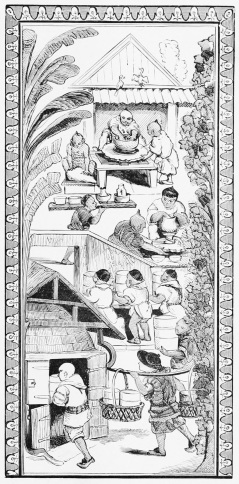
CHINESE POTTERS AT WORK.—WINDOW IN THE CERAMIC GALLERY.
To Mr. F. W. Moody, one of the most energetic and accomplished teachers at the museum, the institution is indebted for many instructive experiments and designs in the way of decoration. No one should fail to observe the very remarkable exterior wall decoration covering one entire side of the new School of Science, which is a most complete revival of the sgraffito work of the fifteenth century. This experiment by Mr. Moody of the high Renaissance in Italy has been placed on a wall of the building not visible from the streets, but only from the windows of the museum. It is analogous to the niello, which was graven in silver and the lines filled in with carbon, making a black picture on a white ground. (There is a good account of this ornamentation, said to be the origin of all engraving for printed work, in W. B. Scott’s Half-hour Lectures.) Mr. Moody’s experiment is made by filling in the hollows of the cement, presenting a multiplicity of scrolls, symbols, allegorical figures—Natura, Scientia, etc.—and portraits of scientific men. The stairway from which this vast work—covering the wall for four or five stories—can best be seen is another interesting experiment of Mr. Moody’s. As befits a stairway leading to the Ceramic Gallery, its ornaments are made of Minton porcelain. The steps and facings of the steps are a kind of mosaic made of hexagon pellets painted; the walls are panelled with white porcelain; and their effect under the light falling through large figured windows, toned rather than colored, is very good indeed.
Entering now the Ceramic Gallery, we find its contents illustrated by a very ingeniously devised series of window etchings (as they may be called), which are probably unique in the history of work on glass. The windows on one side of this room, fifteen in number, each double, were intrusted to Mr. William B. Scott, who as an archaeologist in art has few superiors. Mr. Scott designed no fewer than forty-eight large pictures, representing the history of ceramic art from the most ancient Chinese, Egyptian, Indian, and Persian down to Wedgwood; and these he has placed in the fifteen windows, where, unhappily, they are little observed, being without mention, much less description, in any work except that now before the reader. They are for the most part in black and white, colors being introduced only once or twice, and then but slightly. The first and second windows are devoted to the Chinese, their work being, if not the earliest, the most ancient in porcelain, and that which has most influenced the European art. Here is shown their whole method, from the preparation of the clay, the half-naked natives bringing the kaolin from caves in panniers, others steeping it in water, refining it in large mortars, and kneading it on tables. The potter is seen before his rude wheel, and forming the vessel by hand-pressure. And after this we trace his work to the furnace, and on to its place in the shop. This work implies the most patient study of original Chinese models. One window represents characteristic Chinese ornamentation—such as the royal dragon and the bird of paradise, and a bazar at Pekin. The third window represents early Egyptian art. The upper part shows the casting of brick by packing in boxes, and then turning it out, all under the whip of the taskmaster, the work and the whip being but little different to-day from what they were in the ancient days whose relics have been so diligently studied by Mr. Scott on the papyri of the British Museum. Beneath, a skilled workman is painting a large Canopus: he is on his knees, with his feet doubled behind him. One page, so to speak, of this window represents Assyrian art by a triumphal procession, in which immense vases are carried on ox trucks, and smaller ones on the heads of prisoners—a design based upon discoveries in Nineveh which show the great importance that people ascribed to earthenware. The fourth window is Greek and Etruscan. The Greek legend of the origin of painting—the daughter of the potter of Sicyon tracing on the wall the shadow of her lover on his leaving her for a journey—is exquisitely done. Next we see the girl applying her plan to her father’s vases. We have also depicted with learning the honorary uses of pottery among the Greeks, the vases given as prizes in public games, or as votive offerings for the dead, by which custom the finest examples we have were transmitted; and, finally, there is the genius of Death holding in her hand the cinerary urn. The fifth window is Hispano-Moresque. The earliest ware in Europe after the Samian of which we have any examples was that made by the Moors, who brought the art of making it from east of the Mediterranean. This was the famous “lustre-ware” which was supplied from Spain, which is now so eagerly sought by collectors, both on account of its beauty and as the origin of the Italian majolica. Specimens of this kind of pottery have been found by Layard at Nineveh and at Ephesus. There appears to be little doubt that it is of Persian origin. It must have been always very difficult to make; in the modern manufacture about fifty per cent. of the pieces come out of the furnace dull and worthless. The fine specimens seem to the workmen happy accidents rather than the steady results of any normal process upon which they can depend. The first design in this window of Mr. Scott’s represents the master-potter amidst his swarthy workmen watching the hour-glass beside the fire. This wonderful lustre was the result of some utilization of smoke in modifying the copper glaze, and was probably discovered by accident, as so many fine effects in the ceramic art have been. This beautiful ware has lately attracted especial attention in England because of the experiments which Mr. De Morgan, son of the late mathematician of University College, is making. He has tried nearly every kind of smoke influence upon copper and silver pigments, in contact with glaze and his success has been remarkable. These lustre-wares are still, I believe, made in some parts of Spain in a small way; also at Gubbio, in Italy; but the furnace of Mr. De Morgan at Chelsea is the most active and successful in bringing out such wares in all their varieties.
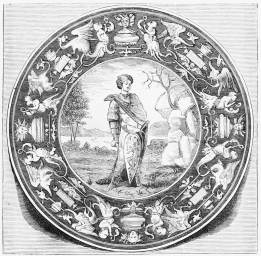
ITALIAN MAJOLICA (URBINO). SIXTEENTH CENTURY.
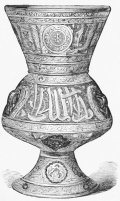
LAMP FROM AN ARABIAN MOSQUE—FOURTEENTH CENTURY.
It adds greatly to the charm of these windows that they are as a frame around the objects whose history they tell. Fine examples of the “lustre-ware” from the earliest ages are in this gallery. And we have only to turn round from admiring another part of this fifth window, showing the building of the Alhambra, and its wonderful vase, to see the finest copy of that unparalleled piece of lustre-ware. The vase is four feet five and a half inches high, by eight feet two and a half inches in circumference; it is decorated with two antelopes, and foliations covering the body of the vase, intermingled with which are African characters whose sense is “Felicity and Fortune,” “Permanent Prosperity;” and the colors are brown and blue on a yellow ground, the lustre being of a mother-of-pearl tint. From rich specimens of ancient Italian majolica we in turn refer to the sixth window, which shows us the embryonic and later phases of this beautiful art. The Italians imitated the Hispano-Moresque lustre as well as they could, but not being able to attain it exactly, they secured new tints of their own, especially a very fine ruby lustre. Afterward they painted their wares without trying to get lustres, to obtain which was perhaps a work too slow and precarious to be profitable. The vast development of ceramic art in Italy has required three windows—sixth, seventh, and eighth—for its representation. First we have bird’s-eye views of the localities with which it was chiefly associated: Urbino, the seat of the finest ware made in the time of Raphael, wherein is portrayed their process of softening and refining the clay by putting it in square pits in the ground; Duranto, with its method of grinding the clay in a sort of water-mill; Gubbio, with its own ingenious processes. Then we have other Italian methods—foot-mill, hand-mill, horse-mill. An artist is seen in his studio, receiving as sitters ladies whose portraits he paints on plates that are to be their marriage gifts—a design taken from a plate in the gallery painted by Maestro Giorgio—while other details have been taken from a MS. by Piccolpasso, also preserved in the museum. And, finally, we have a representation of Luca della Robbia, of the fifteenth century, who used earthenware medallions, admirably modelled and fired with white glaze, which were fixed on the outside of buildings, and may be seen to-day on the Foundling Hospital and several churches at Florence. The very word “majolica” (Majorca) shows that the Italians found their art where the Moors left it. But if they could not equal the moresque lustres, they certainly developed and enriched their designs. Such decorations as that encircling the figure of St. George on the Urbino plate (see engraving) may be called “arabesque,” but they are equally Italian. It is curious to compare such arabesques with the ornament on a piece of real Arabian work, such as the accompanying ancient lamp. (This lamp, singularly enough, is of a form represented in very early Italian bronze carvings of sacred subjects.) Window ninth is devoted to Dutch tiles and pots and Flanders-ware, which were once imported in such vast quantities to this country: here they may be traced from their manufacture in Holland to their sale in the Thames docks. Window tenth relates the curious story of the Dresden-ware. Here it was that the famous material of the best porcelain (kaolin), which was so long the secret of China, was discovered by a happy accident—Böttcher, the alchemist, having taken a notion to analyze the white dust which his barber had used to powder his wig in a year of dear flour. The two men are represented, and also the château of Meissen, where the first Dresden porcelain was secretly made. Window eleventh tells the story of Palissy, who, instructing himself, ruined his family: one leaf of the window shows him feeding his furnace with his broken furniture, while his wife with her babe stands beseechingly by; the other shows his triumph, as he builds and decorates the grottoes in the Tuilleries garden. The story recalls that of Benvenuto Cellini, who, having been seized with a fever while casting his Perseus and Medusa, heard that his work was ruined. Leaping from his bed, he found the furnace burst, but he saw the metal was partly fused; he cast in two hundred pieces of his table-service, and the mould was filled. The great work was saved, and so was the artist; he ate a hearty meal with his workman, slept soundly, and was himself again. Window twelfth is devoted to Sèvres, where porcelain was carried to its highest perfection. The famous “Rose du Barry” and “Bleu du Roi” are represented—and here exquisite colors are used—by Louis XV. and Madame Du Barry exchanging vases of those colors. The old manufactory is pictured, and some of its finest designs, in the lower panes of the window. Near by is the beautiful specimen of Sèvres which France contributed to the first International Exhibition in London. In window thirteenth we are introduced to English wares, at present the most excellent in the world. The processes described are—preparing the clay, making different colored clays, stamping tiles, filling color into moulds, “throwing,” “turning,” applying printed patterns. It takes two of the double windows to display this, which brings us to the fifteenth and last, in which there are four designs of the greatest historical interest: Dr. Doddridge’s mother teaching her child Bible history from the tiles in the fireplace; Dr. Samuel Johnson trying experiments; figures of Josiah Wedgwood and Bentley, his partner; Flaxman and Stothard, the painter. The two artists last named both worked in decorating earthenware for Wedgwood. Flaxman was underpaid by Wedgwood for the numerous models he supplied—models still used by the firm. The poor artist has made the fortunes of three generations of his employer’s family, whose present representatives are so liberal that one must suppose their ancestor to have hardly realized the value of the artist’s work until it was too late to reward him.
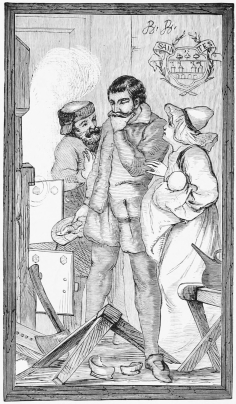
PALISSY, THE POTTER—WINDOW IN THE CERAMIC GALLERY.
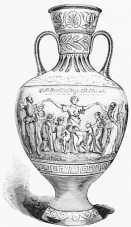
SÈVRES PORCELAIN VASE.—MODERN.
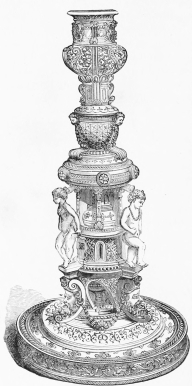
HENRI DEUX CANDLESTICK.
The visitor to the Ceramic Gallery in this museum will be apt to admit that there were never windows that shed more light than these of the kind required by a student. He will see lustres on the lustre-wares beyond what mere sunlight can give, and the huge dragons, deer, and horned birds on the Moresque-Spanish dishes will link the culture of 1882 with the barbaric mediæval mythology. He will, indeed, find at every step that he is really exploring in this gallery of pots and dishes strata marked all over with the vestiges of human and ethnical development. Nothing can be more complete than the arrangement of the gallery. Not only is it chronological, but beneath each particular specimen a card tells when and where it was made, and the price paid for it by the museum. If it has gone off with the floating collection, the card reports that also. One may learn what changes have occurred in the prices of such wares by finding Sèvres vases, for instance, marked at £100 or £200, of a like character with those six for which Lord Dudley recently paid £17,500. These are articles which, when first collected, incited the first cabinet minister who inspected them to ask, “What’s the use of all this trash?” There is a single candlestick in this room now worth all the “trash” in that noble lord’s mansion. It is a specimen of that famous “Henri Deux ware” of which only fifty-five pieces exist, so far as is known. This elegant ware has been such a puzzle to antiquarians that no fewer than thirteen different works have been written about it. It was finally ascertained by M. Riocreux, of the Imperial Ceramic Museum at Sèvres, that the pottery was made at Oiron, in France; that two artists made it in the earlier part of the sixteenth century for Henry II. and his queen, whose initials or monograms are on several of the pieces; and the artists were François Cherpentier and Jean Bernard. Cherpentier, the chief maker, had been an architect, and when he set about working in earthen-ware he was fond of moulding it in little monumental shapes, and filling in the hollows with different colors. The candlestick has a pale yellow ground, with arabesques, etc., in reddish-brown. The base is circular, with projecting brackets, on which stand three boys holding shields inscribed with the arms and cipher of Henri Deux. Above are three terminal figures of satyrs. This work (which it is to be hoped will some day be called by the artist’s name instead of the king’s) is less than a foot high; it cost £750, and is one of the cheapest purchases ever made. Seven of the fifty-five specimens of this ware are in the collection of Sir Anthony de Rothschild, two in that of Baron Lionel de Rothschild, two in that of Baron Gustave de Rothschild, three in that of Baron Alphonse de Rothschild, while the Louvre has the same number as the South Kensington Museum—five. Three very beautiful specimens (candlestick, ewer, and large salt-cellar) were found some years ago, very carefully wrapped in a blanket, placed in a wicker clothes-basket, under a bed in a garret of Narford Hall. Our engraving (p. 56) represents the candlestick so found. The pieces were no doubt collected by Sir Andrew Fountaine in France, in the last century, and, put away perhaps by some provident house-keeper, now turn up as a more valuable bequest to the old connoisseur’s descendants than he could have imagined, but which is rightly appreciated by the present owner of the pieces, Mr. Andrew Fountaine. The other specimens of this Henri Deux ware in this gallery are two tazzas, a plateau, and a wonderful salt-cellar, of which last the skill of a pupil at South Kensington enables me to give the linear design.
HENRI DEUX SALT-CELLAR.
But it must not be supposed that this is merely an antiquarian collection: the best work now going on all over the world is represented, and one may see by the superb examples of modern Berlin work and of Minton that England and Germany are engaged in a competition for excellence which bids fair to distance anything done in the past. What admirable work Minton can do may be estimated by the embossed and tinted tiles surrounding the ten columns which support the roof of this gallery. They reproduce the finest colors of the Celadon porcelain of Sèvres. Around each column are letters forming the names of the ten greatest potters—Vitalis (whose name was found on a red vase of Samian-ware discovered in London in 1845), Giorgio Andreoli, Luca della Robbia, Veit Hirschvogel of Nuremberg (1441-1525), Xanto of Urbino (1547), Palissy (1510-89), François Cherpentier (maker of the Henri Deux ware, otherwise called faïence d’Oiron), Böttcher (1681-1719), Wedgwood (1730-95), and last, not least, Pousa, with whom began the list of wondrous accidents with which the history and traditions of pottery abound. Pousa is said to have been a workman in the imperial porcelain factory of China. On one occasion the emperor had ordered some great work, and Pousa tried long to produce it—in vain. Finally, driven to despair, he plunged into the furnace. His self-immolation caused such an effect upon the ware in the furnace that it came out the most beautiful piece of porcelain ever known. Pousa is now the patron saint of porcelain-workers in China, and is kept near them in a little corpulent figure (porcelain), which is familiar to many parts of the world where its story and sanctity are unknown. The South Kensington Museum has carried out in its own case this tradition of happy accidents, having been remarkable for its good-luck. Some instances of it are in the Ceramic Gallery. Some years ago a terrible explosion of gas occurred in the house of the famous art collector and dealer, Mr. Gambart, at St. John’s Wood, by which the house-maid was killed. M. Alma Tadema was a guest in the house, and he had the presence of mind to open a window when he first perceived that gas was escaping, by which means the disaster was mainly limited to the dining-room. In this room were two large cabinets filled with splendid specimens of Flemish “graybeards,” beakers, and similar wares, and some of the best were smashed. As the fragments were about to be cleared away, a friend of Mr. Gambart’s, who was also connected with this museum, brought him an offer from the institution of £800 (as I have heard; at any rate, a sum that was generous) for the collection, broken and unbroken, and it was gratefully accepted. The skilled workmen at the museum have put the bits together with such adroitness that it requires a practised eye to distinguish the wares that suffered. The magnificent reproduction of the Alhambra Vase by Baron Davillier, elsewhere described, was exhibited at the Paris Exposition of 1867, and an agent of the museum found it “going a-begging;” he purchased it for far less than its actual value. And, indeed, I might instance a vast number of similar cases not only in this particular gallery—which we must now leave—but throughout the museum. The truth is, the South Kensington Museum has shown that the present is the great opportunity of museums, while it has done much to turn that tide on whose flood it floated to fortune, by awakening nations to the value of their treasures. The Oriental world, and, indeed, some portions of Southern Europe, have hitherto been unconscious of the value of their monuments, because only culture can prevent familiarity breeding contempt. Miss Frances Power Cobbe once expressed in my hearing the shock she received when, on first arriving at Old Alexandria, in Egypt, she found her luggage set down on an ancient monument resembling those treasured in the British Museum. How much the South Kensington Museum has reaped from the indifference to objects whose value is not intrinsic, and which for that reason are unique and inestimable, may appear incidentally as I proceed to describe some of them, adding what particulars I have been able to learn concerning their acquisition.
The little sixpenny guide-book sold at the door is necessarily provisional; the historical and descriptive volume which such an institution requires must remain a desideratum so long as the museum itself is changing and growing daily before our eyes. But the materials for that work exist; specialists have studied well the various departments; there exist nearly twenty large Blue-books recording the origin and growth of the museum; and when all these are sifted and their connected story told—enriched, as we may hope it will be, from the memories of those men who have founded and conducted the work to its present condition—the history so told will be in itself a sort of literary museum, replete with curiosities, picturesque incidents, and romance. In this scattered condition of the facts I have had to depend mainly on information given by the gentlemen just referred to, and what scraps I could pick up in old newspaper files and Blue-books. This it has appeared to me right to mention here, in explanation of any slightness and unsatisfactoriness that may be found in the details, or of the motley way in which they are put together.
If the history of this museum of civilization would record strange instances of popular neglect for great works of art, it must at the same time show that works of genius, in whatever perishable material embodied, have a strange vitality. The Milonian Venus, twice buried in the earth that she might not be harmed by the wrath of her Mars, has had experiences hardly more significant than those through which the sacred forms designed by Raphael—preserved by aid alike of king and regicide, by aid, too, of the neglect which left them hidden for a hundred years in lumber-rooms—have become the glorious inheritance of South Kensington.
The seven cartoons—what would not now be paid for the three that are lost![A]—were designed and drawn by the great artist and his scholars at the request of Pope Leo X. (1513) as copies for tapestry, and the tapestries made from them are now in the Vatican. They were made at Arras, and the cartoons—so called because drawn on card-board—were thrown into the warehouse there. Here they remained neglected until they were seen by Rubens, who advised Charles I. to purchase them for a tapestry establishment at Mortlake, near London. On the death of the king, Oliver Cromwell paid £300 for them, intending that the tapestry-works should be continued. On the fall of Cromwell they were confiscated, and, for a second time, were thrust away into a lumber-room, this time at Whitehall. Fortunately the designs were on strips of paper twelve feet long, which could roll up, and so they were able to survive such usage. The next time they attracted notice was in the reign of William III., by whose order Sir Christopher Wren prepared a room for them at Hampton Court. They were then carefully lined with cloth. They were never removed again until placed in the gallery prepared for them here, with the sometimes criticised and certainly remarkable inscription beneath each, “Lent by the Queen.” The last individual who clearly owned them was Oliver Cromwell, who paid what was supposed a large sum (£300) for works which no amount could purchase from the Protector’s true heir—the English Nation.
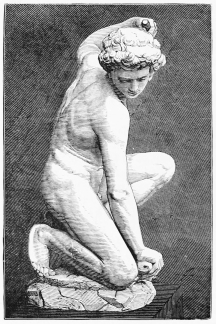
MICHAEL ANGELO’S EROS.
The museum is especially rich in old Italian glass. Some of these wine-glasses are nearly as light in weight as ordinary letter-paper, and the iridescence is most wonderful. One of the oldest forms has on it red Indian girls, dressed like Italian ballet-dancers of a very early period. There is reason to believe that this piece of glass was made soon after the discovery of America, when the enthusiasm about the region which the great Genoese had discovered filled all Italy. It is very plain that no portraits of the squaws could have reached the countrymen of Columbus when these dancers were designed. Mr. G. W. Cooke, Academician and landscape-painter, had in early life a studio in Venice, and he had a way of picking up bits of old glass in the shops, the keepers of which were often willing, for a few soldi, to part with things now worth (in some cases literally) their weight in gold. Afterward he had, I believe, a studio in Agerola, and there also found beautiful Italian glass. He collected in this way enough to fill three or four large cases. After they were collected a considerable quantity of ancient Spanish glass was obtained, and the fact was made apparent that the latter was in some cases an imitation of the former—the reverse being probably the case with the majolica, in which Italy would seem to have imitated the Hispano-Moresque “lustre-wares.” It is possible that a transfer of art-initiative from Spain to Italy may have been one of the first bad results of the banishment of the Moors, whose exquisite works are now models for our finest architects. With reference to the hypothesis that the theatrical squaws are to be referred to the interest that followed the discovery of America, I may mention that there are several curious instances in the museum where dates have been approximately fixed by the treatment of subjects. One notable example is a Japanese dish, on which is a rude but reverent representation of the baptism of Christ. Although certainty cannot be reached yet in the matter, it is possible that this dish was made before the extermination of Christianity from Japan (1641). However, it is known that before the discovery of kaolin in Europe the English and Dutch used to send over to China designs to be put on wares that were ordered. There are various pieces of china which are marked with English coats of arms, and a clergyman in Somersetshire has three pieces marked with scenes of the Passion. But I believe there is no instance where any such work is known to be Japanese, and, indeed, the latter had not formerly any great reputation in England.
There are eight magnificent Japanese bronzes in the museum, of which one is a figure of the beatified Buddha. It is impossible to gaze upon this grand figure (about fifteen feet high), seated with crossed legs, and open hands lying one in the other, without being impressed by a certain majesty in the ideal it represents, as well as astonished at the largeness of the undertaking which has produced a bronze of such size. The figure is seated, as it were, on the ground, and the round, infantine fulness and health of the face and the closed eyes render it probable that it was meant to represent the supreme moment when Sakya Muni attained, through humility and meditation, that sacred Buddhahood (enlightenment) which he had vainly sought by practising the severe asceticisms which the Brahmins enjoined upon him. “He met a certain Brahmin,” says the Siamese version, “named Sotiya, and from him accepted eight handfuls of long grass. The Master spread the grass on the ground to the east of the Bo-tree, and sat thereon, and the grass became a jewelled throne. The Lord, with well-steadied mind, turned his whole thought to attain through purity and love the exaltation of knowledge. And around him gathered the angels of many worlds with fragrant offerings, and the strains of their celestial concert resounded in the most distant universe.”
It is interesting to observe the strong impression made upon the casual visitors by this face so sweetly serene, so free from the lines which care and ambition trace upon the European face. I heard a little girl of thirteen years say, after her silent gaze, “How I would like to climb up and sit in his lap! Perhaps I would get some of his goodness.” How many little ones of the East have felt the same as they looked upon this face of perfect holiness!
The history of some of the other bronzes is as follows: An English sea-captain saw three large bells, each seven or eight feet high, about to be taken on a Japanese ship for ballast. He saw that they were of antique and curious design, and was told that they had belonged to a temple that had been destroyed. The Japanese seamen gladly parted with them for a small sum, and told him of similar things near by. These, which were two bronze vessels something like huge candlesticks, each four and a half feet high—probably meant to support large masts for flags—he found lying amidst rubbish of old metal. These noble bronzes are elegantly modelled with dragon ornaments, and indicate a development of skill in this direction which has never been equalled in Europe. Besides these there are two large incense-burners eight feet high, and wonderfully wrought with beautiful decorative and symbolical forms.
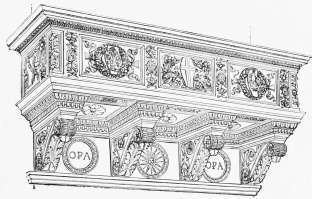
MARBLE CANTORIA. BY BACCIO D’AGNOLO.
But the indifference of the Japanese to their ancient relics is paralleled by that which prevailed in the cathedral at Bois-le-Duc, Holland, a few years ago, and led to the transfer to this museum of one of the finest specimens of the French Renaissance that now exist. In the rage for repairs the authorities of the cathedral pulled down this, its magnificent rood-loft—which is marked 1623, and consists of the finest colored marbles and many perfectly sculptured statues—and substituted for it a conventional Gothic structure. This great rood-loft—it covers one whole wall, sixty feet in width, and is from thirty to forty feet high—was actually carted out in pieces as rubbish, and lay in a corner of the cathedral yard, when some English tourist, attracted by the beauty of one of the statues, made a small offer for it, and finally purchased the entire structure for a few pounds. Finding some difficulty in carrying it off, the tourist wrote to the directors of the museum about it, and was overjoyed when they agreed to purchase it for a thousand pounds. The museum was no less happy in securing for a tithe of its value this unique and admirable work, which is without damage of any kind, and stands in the New Court just as it did in the cathedral which was unable to appreciate its finest treasure. When the Queen of Holland recently visited the Museum, she was not a little disgusted when she came to this rood-loft and heard its history.
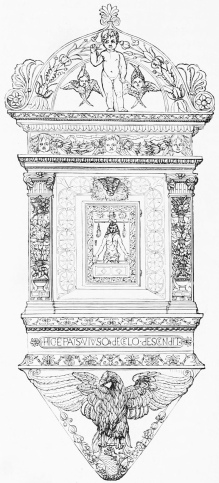
TABERNACLE. ANDREA FERRUCCI.
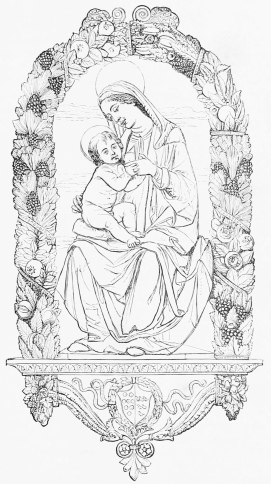
ALTAR-PIECE—THE VIRGIN WITH THE INFANT SAVIOUR.—ENAMELLED TERRA-COTTA, OR DELLA ROBBIA, IN HIGH RELIEF.—BY ANDREA DELLA ROBBIA.
Most of the “finds” by which the collection of ecclesiastical architecture has been enriched have been made in Italy. One of the most valuable of these is a Florentine “Cantoria,” which has been affixed to the wall over the lower door-way of the North Court, and thus supplying promenaders in the corridor above with a little balcony from which the contents of the great room below may be best seen. This singing-gallery was the work of Baccio d’Agnolo, and was set up in the Church of Santa Maria Novella, in Florence, about the year 1500.
In the neighborhood of the same city, namely, at Fiesole, the Church of San Girolamo was found willing, for small sums, to despoil itself of two fine examples of its own great artist (1490), Andrea di Fiesole, otherwise Ferrucci, and two works of the artist, not without honor save in his own country—an altar-piece and a tabernacle—grace an arcade of this museum. But the most precious possessions of this character are the specimens of Della Robbia ware, of which this museum has more than fifty examples. There were two men who gave this ware its name—Luca and Andrea, uncle and nephew—and their work is almost equally excellent. One of the pieces is a large terra-cotta medallion, eleven feet in diameter, bearing the arms and emblems of King René of Anjou, which was fixed in an exterior wall near Florence about fifty years before America was discovered, and, after undergoing the weather of over four centuries, its colors are as brilliant and its finest mouldings as clear as if it had been made this year. An altar-piece, probably by Andrea della Robbia, representing the Adoration of the Magi, is certainly one of the finest works of art, pictorially as well as in modelling, that have come to us from the era in which he lived. There are some twenty figures in relief, and each face has its own physiognomical distinctiveness, each head its phrenological peculiarities, all as carefully portrayed as if Lavater and Spurzheim had watched over the work. A figure of the Virgin and Child, with an arched border of fruit and flowers, presents us with an expression which could only be conveyed fully if the matchless colors could be transferred to my page, but which entitles it to be classed among those great Madonnas of art history which have influenced civilization.
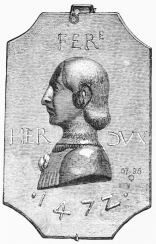
HERCULES, THE DUKE OF FERRARA.
The most conspicuous object in the North Court is the reproduction by Mr. Franchi of a pulpit erected in the cathedral at Pisa by Giovanni Pisano in 1302-11. A fire occurred in the cathedral in 1596 by which this great work was damaged, and the panels—carvings in relief of Scripture subjects—were deposited in the crypt; other parts of the pulpit were removed to the arcades of the Campo Santo, and some others incorporated in the new pulpit of the cathedral. Some ten years ago Mr. Franchi, of whose wonderful skill the museum contains many evidences, obtained from the cathedral authorities permission to take casts of all these scattered parts of Pisano’s greatest work, and having done so, he put them together; and now, more than two centuries and a half after the structure vanished from Pisa, it has been set up at South Kensington. The reproduction has been so perfect—even to the toning of the marble (as it seems to be) by age—that no one could imagine it to be a reproduction. And it was certainly worthy of all this care. The supports of the circular tribune are groups of statues—Fortitude, holding a lion by the tail, head downward; Prudence, with compass and cornucopia; Justice, with scales; Charity, nursing twins; Temperantia, who, oddly enough, is quite nude and in the Medicean attitude; and the Evangelists. The statues, two-thirds the size of life, are grouped around eight columns, which they nearly conceal. At the top of these the tribune is enclosed by seven large panels, in which are finely carved the Nativity, the Adoration of the Wise Men, the Presentation in the Temple, the Massacre of the Innocents, the Betrayal, the Crucifixion, the Resurrection. This noble work justifies the ancient fame of Pisa as the home of sculpture.
The museum is particularly rich in Michael Angelos, considering that it has had to glean after the Glyptothek of Munich, the Vatican, and the Louvre. It possesses the beautiful Eros (see page 62) executed in the great sculptor’s twenty-fourth year (1497), also his statuette of St. Sebastian, unfinished, and showing the last touches of his chisel—as, without the intervening appliances of modern sculpture, he carved his idea directly on the marble. There is a female bust ascribed to him, and another work in which he participated, which is quite unique: this is a case of small models in wax and terra-cotta, of which twelve are by Michael Angelo. This case was for a long time in the Gherardini family, and was purchased by a Parliamentary grant in 1854 for the sum of £2110. One of these little models is that of the slave. Buonarotti’s two slaves or prisoners, the originals of which are in the Louvre, are here in good copies, the one exhibiting the physical suffering of the fettered man, the other the mental anguish of bondage. There are also admirable casts of other works by the same artist, the finest being the colossal figure of David, which stands in the new Tribune at Florence. This copy was presented to the museum by the late Grand-Duke of Tuscany, and is one of the many excellent fruits which have been gathered from the international league which European princes have entered into for the purpose of exchanging works of this character, and reciprocally aiding in the work of enriching the museums which constitute so important a feature of modern civilization. It is a happy characteristic of this museum that one meets in it very few objects whose interest or beauty is marred by association with war. The spoils are few, the tokens of friendship with foreign nations innumerable. Some pieces of work in gold brought back from Abyssinia and from the kingdom of Ashantee—the latter close to the famous umbrella of King Koffee—were exhibited, and a few of them remain here to show by their exquisite chasing that blows aimed at so-called savages are likely to fall upon the springing germs of civilization. The poorly designed but wonderfully chased and jewelled symbols of Theodore excited general admiration. The bird that was perched on the top of King Koffee’s state chair is also of fine workmanship. It is rude in design, truly; but it is hardly ruder than the gold dove, the ampulla which holds the oil used at English coronations; and perhaps, like the latter, it purposely imitated a primitive and consecrated form. These African trophies are unpleasantly suggestive of the worst phase of British policy, or impolicy; but they are slight incidents in a museum which will forever be considered the ripest fruit of the long Victorian and victorious era of Peace.
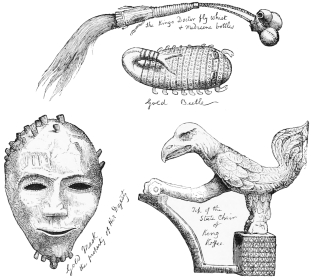
ASHANTEE RELICS.
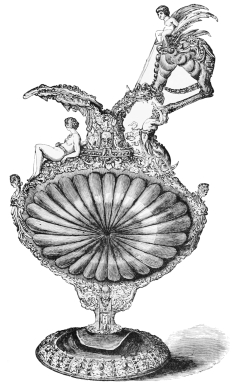
THE CELLINI SARDONYX EWER, MOUNTED IN ENAMELLED GOLD, AND SET WITH GEMS—ITALIAN. SIXTEENTH CENTURY.
It is quite impossible for me to invite my reader to an exploration of the loan collections. Some of the ancient jewellery and gold work which has been, or is, shown here is not only intrinsically priceless and beautiful, but also historical, e.g., the Mexican sun-opal; the largest known aqua-marine, set as a sword-hilt, formerly belonging to the King of Naples (Joachim Murat); a cat’s-eye (largest known), formerly belonging to King Candy; a piece of amber in which is a small fish—all of which have been loaned by Beresford Hope, M.P. But the great treasure belonging to this gentleman, and long exhibited here, was the famous Cellini ewer. Previous to the great Revolution, it was part of the crown-jewels of France, and Mr. Hope has recently sold it to a collector in that country. This matchless work is ten and a half inches in height; the body is formed of two convex pieces of carved sardonyx, with a similar piece for pedestal; the handle and spout are of gold, covered with masks and figures richly enamelled, and set with rubies and diamonds. In place of this fragment of old French royalty, which the explosion sent flying and the Republic has lured back, is the brilliant gold missal case of Henrietta Maria. Some of the most beautiful specimens of ancient repoussé gold work and enamels were, until recently, in a case made up chiefly from the collection of Mr. Gladstone, whose fondness for things of this kind, though rather indiscriminate, has done something to popularize the taste for them. In a recent Christmas satire, “The Fijiad,” the Prime Minister has been portrayed rather cleverly in his right environment:
“Great Homer’s bust upon the table stood— Homer much talked of, little understood; Around the bust were ranged, with curious care, Gems of old Dresden or of Chelsea ware, Cracked teapots, marvels of ceramic art, Choice Faïence and Palissy set apart; For great Gladisseus, warrior of renown, For plates and pottery ransacked the town. Made dowagers and virtuosi stare, Collectors, jealous, tear their scanty hair.”
When the Gladstone collection was brought to the hammer, it did not require many hours for the same cases to be refilled with objects quite as beautiful from the large accumulation which the museum always has on hand or obtainable in excess of its present room for their exhibition. It is rather droll, however, to find one of Mr. Gladstone’s specimens of sacred art replaced by a wonderful racing prize, a silver cup three feet high, representing the “Birth of the Horse.” The winged steed is rampant on top, while the gods and goddesses of Olympus gather around it in homage. It is modern English work, and would do for an allegorical representation of the august divinities of Parliament adjourning to honor the American winged winner of the Derby in 1881.
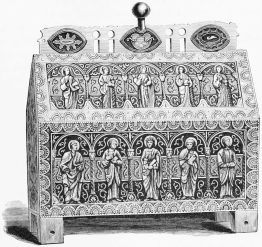
CHÂSSE, OR RELIQUARY—LIMOGES ENAMEL. THIRTEENTH CENTURY.
One of the most important loan exhibitions ever opened at the museum was completed at the end of May, 1881. It consists of Spanish and Portuguese ornamental art. On my way to visit this exhibition I read in a daily paper the invitation extended by the present King of Spain to the Jews of Russia to take refuge from their persecutions in the Peninsula from which they were so cruelly expelled three hundred and eighty-nine years ago. The first object which met my eye in the exhibition was traced with the spirit which led to that inhuman decree. It is a large altar-piece, or retable, painted in distemper on panel, in seventeen Gothic compartments, the subjects being from the legend of St. George. It is of wood, twenty-two feet in height, sixteen feet in width, and is from a destroyed church in Valencia. One of the three centre compartments represents James I. of Aragon rescued by St. George in battle against the Moors. At the bottom there are ten compartments painted with subjects from the life of Christ. In these pictures the figures and faces of the Jews have been carefully mutilated. Jesus and his disciples remain to prove how beautifully the artist had done his work; the hacked and scratched figures around them remain to attest that in the fifteenth century, to which the work belongs, fanaticism was strong enough in Spain to invade the altar and destroy the most beautiful works by which Art was seeking to soften human ferocity. In one of the panels Jesus, with a face of utmost benignity, is represented receiving the kiss of Judas on his left cheek, and at the same time extending his right hand to touch the ear of Malchus. This servant of Caiaphas would seem, from so much of him as is left, to be in a half-kneeling posture. Peter, with angry face, holds over Malchus his short sword. One may see here the spirit of fanaticism making its choice between the gentle healer of wounds and the fierce inflicter of them. Upon this stony hatred the Inquisition built its church. The knife which hewed and hacked the Jewish figures of these once beautiful panels was presently mutilating the Spanish Jews themselves. In 1492 the greatness and littleness of Spain culminated together: by the nobility of Isabella, Columbus was enabled to discover America; by the meanness of Ferdinand, the Jews and the Moors were driven out of Spain with every circumstance of inhumanity.
And now King Alfonso wants them back. There was once an Alfonso who thought he could have suggested a better world than this, if the Creator had consulted him; the present Alfonso will not be censured for thinking he could have created a better Spain than was fashioned by the Inquisitors. One need only look around upon this wonderful collection of Spanish objects of art to see that it was Spain’s self as much as Jews or Moors that the sword of fanaticism mutilated and disfigured. Here is the splendid débris of arts which Moorish genius and Jewish wealth combined to render possible. From the time of their expulsion Spanish art suffered a progressive decline. Dark and symbolical seems the purple velvet banner of the “Holy Office” sent here by Madrid, where it used to be carried in procession to every auto-da-fé. On it embroidered angels hold the instruments of Christ’s suffering, which Inquisitors turned upon humanity, and the inscription is, “Clamaus voce magna emissit spiritum.” The color of this strange banner is that of blood grown darker with time. It came from the side of crucified humanity. But it was Spain that breathed out its spirit, now loudly recalled.