THE SOUTH KENSINGTON MUSEUM. (continued 2)
Reading edition
Of the Moresque porcelain I have already spoken in pages of this work written before the Loan Exhibition was opened. Suffice it to say that there are here the best specimens of that lustre-ware in existence. “During the sixteenth century,” says Senor Riaño, “the Spaniards did nothing but imitate what was done in other countries.”[B] In the seventeenth century, when a Spanish pictorial art was born with Velasquez, Murillo, and Zurbaran, it was reflected in some of the wood-carvings, notably in those of Alonso Cano. The most artistic piece of such work at South Kensington is a statue of St. Francis of Assisi by that artist; it is carved in walnut, and exquisitely painted. Lady Charlotte Schreiber has loaned a remarkable circular jewel, sixteenth century, of which there is a legend. When Charles V. was visiting the northern towns of his paternal duchy, a Frisian gentleman, Governor of Harlingen, named Humalda, warned him against embarking on the Zuyder Zee with some troops he was despatching to the opposite shore. The emperor reluctantly yielded; the tempest Humalda predicted arose, and every man was lost. Charles said to Humalda, “Thou art my Star of the Sea” (sternsee); and afterward had this jewel made for the Frisian, who thenceforth assumed the name Sternsee, borne by his descendants. The jewel represents Charles V. standing on a star-spangled orb, rocked by the Devil from below, and at the sides figures of Death and War. The inscription around it is, “Carolus V. Sternsee. In te Domine speravi.”
Many of the inscriptions found upon Spanish ornamental works were in Cufic characters even after the banishment of the Moors. The workmen seemed to realize the value of letters which made beautiful fringes while they conveyed meanings. But it is only in ancient Hispano-Moresque carvings that the Cufic inscriptions are found in their perfection. An ivory casket, eleventh century, is covered with deeply-cut figures of conventional birds and animals, and around the margin of the lid is a Cufic inscription saying, “In the name of God. The blessing of God, happiness, prosperity, good-fortune, perfect health and peace of mind, perpetual pleasures and delight to the owner of this casket.” Another ivory box has round its dome-shaped cover, “I display the fairest of sights. Beauty has cast upon me a robe bright with gems. Behold in me a vessel for musk, for camphor, and ambergris.”
On the opposite side of the hall, facing the altar-picture of the disfigured Jews, is a great reredos from the high altar of the cathedral of Ciudad Rodrigo. It was painted about twelve years before the discovery of America, it is believed, by Fernando Gallegos, greatest Spanish painter of that century, and three assistants. This picture also has traces of disfigurement which have their story to tell. It is owned by Mr. J. C. Robinson, to whose explorations of Spain and enthusiasm for antiquarian art this fine exhibition is mainly due. Mr. Robinson’s account of this picture shows that its injuries came by English guns, in 1811, during the Peninsular War. The cathedral stands near the fortress of Ciudad Rodrigo, and the English shot traversed it from end to end. The grand reredos was so injured that a new one was erected. Twenty-nine of the panels, though in some cases perforated, were preserved separately in a corridor of the chapter-house. In 1879 they were sold to a local dealer, who forwarded them to Madrid, whence they were brought to this country. In some of the panels the faces and costumes are Moorish. It is still a magnificent work, and must originally have been over fifty feet high, by twenty-five in width. Its panels, beginning with Chaos and the Creation of Eve, pass at once to the life and Passion of Christ. It is likely that this monument of so many eras, thus curiously brought to the country which marred it, will not be followed by many similar treasures. The Spaniards have lately learned the value of such things. The Spanish collection made at South Kensington by Mr. Robinson, for a long time superintendent of the art-collections, chiefly led to the formation of the Archæological Museum at Madrid. When Mr. Robinson began his visits to Spain (about 1862) things were in a fair condition for foreign collectors. “At the period in question,” he says, “railways had scarcely yet made their appearance in the Peninsula, photography was almost unknown, and the country was not overrun by the professional dealers, native and foreign, who have since ransacked every nook and corner of the land. On the other hand, in these comparatively early days of the collecting furore, facilities for the discovery and purchase of specimens were few, and the work of acquisition slow and difficult. A few brokers and silversmiths alone occupied themselves casually in the commerce of antiquities in Madrid, Lisbon, and one or two other of the chief cities. Neglect and destruction were still the rule. Ancient things, once out of use, if their materials had any intrinsic value, were forthwith demolished and utilized. The fine enamelled jewels of the sixteenth century were often broken up for the stones and the gold. The most admirable works in silver were currently consigned to the smelting-pot; the splendid iron ‘rejas’ were converted into mules’ and asses’ shoes; and the gorgeous carved and gilded wood-work of dismantled churches and convents burnt for the sake of the bullion to be derived from the rich gilding on its surface.” This is now all changed, and the Peninsula boasts its band of dealers as well organized as any in Europe; nor is it behindhand in their shadows—the fabricators of fraudulent specimens of the kinds most in request.
The visitor to South Kensington should bear in mind that there may be Loan Exhibitions in some of the adjacent buildings of a highly important character. As I write there is a collection on exhibition which will well repay a visitor for the exploration required to reach it, for it has had to find rooms on the west side of the Gardens: this is the anthropological collection gathered by General Pitt Rivers, who, before he became heir of the late Lord Rivers, had made the name of Lane Fox so noble in the scientific world that one almost regrets that his good-fortune, in which all rejoice, involved a change of name. In this collection the evolution of savage and barbarian weapons, ornaments, utensils, and the like may be studied. General Pitt Rivers has arranged boomerangs in series, so that the completest form may be traced back to the first slightly curved stick found to carry some increase of force. The development of a shield from a mere stick grasped in the hand, next with a protection for the hand, may be traced. There is a series of paddles upon which may be followed a human form, degraded from one surface to another, until a grotesque conventional figure appears on the last without a trace of human semblance. The ornamental marks on the bodies of pots are found in some instances to have been suggested by the net-work print left by their corded holders. These are but a few instances of the way in which objects are made by a man of science to tell their own history. Among the articles which have received the attention of General Pitt Rivers are the caps worn by the women of Brittany, and a few supplementary cases of these have been added to his wonderful collection. An examination of these caps—which are considered of so much importance that a woman is not allowed to enter church without one, nor with one of a pattern belonging to another parish—shows good reason for the supposition that their sanctity is derived from their having been all developed from the head-dress of the nun. Such is the opinion that General Pitt Rivers expressed when he conducted me through his rooms. He showed me that each cap has parts which correspond to parts of the normal cap of the nun. These parts have grown small in some cases; in others they are pinned up; but in the latter case they are let down on important occasions—funerals and weddings—and the wearers are then all nun-like.
These little French things, however, are hardly to be included in this great collection—perhaps the most important private collection of objects illustrative of anthropology in the world. Nor is there any book more useful to the student of anthropology than the illustrated and explanatory catalogue of 1847 of these objects prepared by General Pitt Rivers, and published by the Science and Art Department.[C]
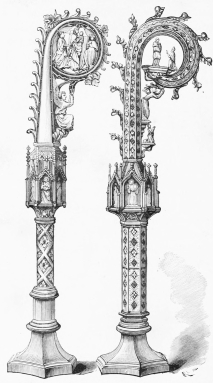
PASTORAL STAVES—IVORY AND ENAMEL. FOURTEENTH CENTURY.

Various public men sent their treasures to the museum in its earlier days, when they were more needed than now; but it has been found necessary to select fastidiously from the too numerous articles offered every year as loans. Many families owning valuable collections find it difficult to keep them in perfect safety, and more begin to realize that such articles should not be of private advantage. Some collections, originally received as loans, it is pretty certain will never be removed; and I am assured by the director that the museum has been notified of being remembered in many wills. This gentleman, Sir Philip Cunliffe Owen, and his predecessor, Sir Henry Cole, said to me, in conversation about the prospect of building museums in the American cities, that they had no doubt such institutions, if good and safe buildings were erected, would there as well as here find themselves centres of gravitation for the art treasures and curiosities owned by the community around them. This museum, though hardly out of its teens, has received seven great collections, worth collectively more than two million dollars; thirteen bequests, worth over half a million dollars; and a large number of donations whose aggregate money value is very great, though not yet estimated. Among the more important donations sixteen have been from the Queen, nineteen from the late Prince Consort, three from Napoleon III. (very valuable too—Raphael’s “Holy Family,” in Gobelin tapestry; four pieces of Beauvais tapestry, and a collection of 4854 engravings from the Louvre), three from the Emperor of Russia, and thirty Egyptian musical instruments from the Khedive. Thirty-one donations, including, of course, a much larger number of objects, have been received from twenty-eight governments. In this list Japan (two), Würtemberg (two), and the United States (three) are the only governments which appear more than once; but I am sorry to say the presents of the American Republic are limited to department reports, the last being one from the War Department on gunshot wounds. Twenty European museums have sent valuable gifts to this youngest member of their family. Among private individuals, other than the donors of collections, Sir Henry Cole, K.C.B., father of the museum, and his family, are represented by twenty-eight valuable gifts—gifts, however, which are little compared with the enthusiasm and intelligence they lavished on the institution they saw planted as a seed, and may now from their windows behold grown to its present large proportions.
Among the numerous gifts and bequests which the museum has received during the past twenty years the following are the most important:
In 1857. By John Sheepshanks, Esq., 233 oil paintings, 289 water-color paintings, etchings, and other drawings. (Gift.) Mr. Sheepshanks died in 1863.
In 1860 and in 1873. By Mrs. Elizabeth Ellison, 100 water-color drawings. (Acting in the spirit of the intention of her late husband, Richard Ellison, Esq., of Sudbrook House, Lincolnshire.) For the purpose of forming a National Collection of Watercolor Drawings. (Gift.)
In 1864. By Rev. R. Brooke, 396 objects, consisting of textiles, watches, rings, etc., and 718 volumes of books. (Gift.)
In 1867. By Mrs. Wollaston, 270 drawings of mosaics. (Gift.)
In 1867. By W. Minshull Bigg, Esq., 3 works in marble by Lough: “Puck,” “The Melancholy Jaques,” “Titania.” (Bequest.)
In 1867 and 1868. By Sir Charles Wentworth Dilke, Bart., M.P., 297 volumes, 862 pamphlets, and 155 prints illustrating the Great Exhibition, 1851. (Gift.) Died in 1869.
In 1868. By Mrs. Louisa Plumley, 43 enamel paintings by Essex, Bone, etc. (Bequest.)
In 1868. By Professor Ella, 329 volumes of music, printed and in MS.; 6 busts, 1 oil painting (a portrait of Rossini). From the Library of the Musical Union Institute. (Gift.)
In 1868. By Rev. Chauncy Hare Townshend, 211 objects, chiefly jewels, 189 oil paintings, 174 water-color paintings, 4218 Swiss coins, 831 volumes, 390 drawings, 1815 prints. (Bequest.)
In 1869. By Rev. Alexander Dyce, 80 pictures, 63 miniatures, 802 drawings. 1511 prints, 74 rings, 27 art objects, 13,596 books. (Bequest.)
In 1870. By William Gibbs, Esq., Roman and Anglo-Saxon ornaments and other antiquities, chiefly found in Kent. (Bequest.)
In 1870. By Alfred Davis, Esq., a collection of coral. (Bequest.)
In 1870. By John Meeson Parsons, Esq., a collection of 92 oil and 47 water-color paintings. (Bequest.)
In 1871. By C. T. Maud, Esq., 6 oil paintings of the English School. (Gift.)
In 1871. By W. S. Louch, Esq., 2 oil paintings, 2 water-colors, etc. (Bequest.)
In 1871. By W. Smith, Esq., 86 early English water-color drawings. (Gift.)
In 1872. By Thomas Millard, Esq., 197 gold and silver coins, chiefly English. (Bequest.)
In 1872. By Mr. Tatlock, 15 drawings and paintings by De Wint, and by Hilton. (Gift.)
In 1872. By Lady Walmsley, 13 oil paintings. (Gift.)
In 1873. By C. T. Maud. Esq., 11 water-color-drawings. (Gift.)
In 1874. By Alexander Barker, Esq., Venetian furniture of a boudoir. (Bequest.)
In 1875. By Assimon, Delavigne, et Cie, a collection of French lace. (Gift.)
In 1875. By Mrs. A. Nadporojsky, a collection of Russian lace. (Gift.)
In 1876. By John Forster, Esq., 48 oil paintings, 74 frames of water-color paintings and drawings, collections of drawings, sketches, and engravings; collection of manuscripts and autographs, library of printed and illustrated books.
In 1876. By Sir M. Digby and Lady Wyatt, 148 fans. (Gift.)
In 1876. By William Smith, Esq., 136 water-color drawings, and also 700 volumes.
In 1882. By John Jones, Esq., pictures and virtu amounting to £240,000. (Bequest.)
For the purpose of industrial and art education, the museum has found the perfect casts and reproductions that can now be made not inferior in value to original works. In this respect the international convention, to which reference has already been made, has been of immense advantage. As one of the signs of better times, to be set against standing armies, the agreement deserves insertion in any account of this museum. It was entered into during the Paris Exposition of 1867, and in the following year communicated by the Prince of Wales to the Lord President of the Council:
Convention for Promoting Universal Reproductions of Works of Art for the Benefit of Museums of all Countries.
Throughout the world every country possesses fine historical monuments of art of its own, which can easily be reproduced by casts, electrotypes, photographs, and other processes, without the slightest damage to the originals.
(a). The knowledge of such monuments is necessary to the progress of art, and the reproductions of them would be of a high value to all museums for public instruction.
(b). The commencement of a system of reproducing works of art has been made by the South Kensington Museum, and illustrations of it are now exhibited in the British section of the Paris Exhibition, where may be seen specimens of French, Italian, Spanish, Portuguese, German, Swiss, Russian, Hindoo, Celtic, and English art.
(c). The following outline of operations is suggested:
I. Each country to form its own commission, according to its own views, for obtaining such reproductions as it may desire for its own museums.
II. The commissions of each country to correspond with one another, and send information of what reproductions each causes to be made, so that every country, if disposed, may take advantage of the labors of other countries at a moderate cost.
III. Each country to arrange for making exchanges for objects which it desires.
IV. In order to promote the formation of the proposed commissions in each country, and facilitate the making of reproductions, the undersigned members of the reigning families throughout Europe, meeting at the Paris Exhibition of 1867, have signified their approval of the plan, and their desire to promote the realization of it.
The following Princes have already signed this convention:
Great Britain and Ireland{Albert Edward, Prince of Wales.
Alfred, Duke of Edinburgh.
Prussia Frederick William, Crown Prince of Prussia.
Hesse Louis, Prince of Hesse.
Saxony Albert, Prince Royal of Saxony.
France Prince Napoleon (Jerome).
Belgium Philippe, Comte de Flandre.
Russia The Czarowitz.
" Nicolas, Duc de Leuchtenberg.
Sweden and Norway Oscar, Prince of Sweden and Norway.
Italy Humbert, Prince Royal of Italy.
" Amadeus, Duke of Aosta.
Austria {Charles Louis, Archduke of Austria.
Rainer, Archduke of Austria.
Denmark Frederick, Crown Prince of Denmark.
Paris, 1867.

ELKINGTON’S MARK. FRANCHI AND SON’S MARK.
Cincinnati is already sharing these reproductions; and the signers of the above document would gladly have the Governors of the American States which possess museums add to it their names, and transatlantic museums avail themselves of its advantages. These advantages are very great, as, after one cast has been made, the cost of the rest amounts to little more than that of material and transportation. This kind of work is now done in such perfection that it were easy for an untrained eye to doubt which is original and which reproduction. The firms officially connected with the Science and Art Department always use marks which have a money value in Europe. For three or four pounds any museum or private collector may obtain perfect copies of ancient shields, salt-cellars, tankards, tazzas, fire-dogs, knockers, whether chased or repoussé. Old specimens of this kind are rare and costly. A beautiful pair of bronze fire-dogs —pedestals surrounded by Cupids, and supporting respectively Venus and Adonis—made in Venice about 1570, are rather costly, the work being intricate and the figures four feet high; but Franchi’s copper-bronze copies at £30 are nearly as good as the originals, which were considered cheap at the £300 paid by the museum. A wonderful old Italian bronze knocker (1560), fourteen and a half inches in height and thirteen inches wide, which cost £80, is reproduced by the same firm for £4.
It is, however, the large casts of Oriental objects and ancient German shrines that will probably be of paramount interest to an American. It is here shown that the most notable and interesting objects in the world can be copied with the utmost exactness, and in their actual size, and brought within reach of the people of any country. Even Trajan’s Column is here; and, though in this case it has had to be set up in two columns instead of one, many others have confirmed my experience of the impossibility in tracing out at Rome the figures which cover it so satisfactorily as they can be made out at South Kensington.
The 17th of May, 1880, is an historic day in the annals of the museum. On that day was thrown open to the public its Indian section. A small collection of Indian curiosities has long been wandering from one place to another in London, and had finally been shelved at the very top of the India Office. So, at any rate, it was stated, and most persons were willing to accept the statement on faith by the time they reached the third story of that edifice. However, the collection steadily increased up there, and it was at length removed to some rooms at South Kensington. But there it attracted little attention from the public, though much from scholars, and it was publicly announced that it would be closed because it did not pay expenses. The authorities ultimately followed better counsels: they gave it up to the Direction of the South Kensington Museum. The Queen loaned it the magnificent collection of Oriental armor from Windsor Castle; Indian treasures hitherto dispersed through the other courts of the museum were gathered together in the new section; Dr. Leitner’s collection of Græco-Buddhist sculptures was added; the walls adorned with Carpenter’s water-colors illustrative of Indian scenery and life; and lo! London awaked one morning to find that it had a new and splendid institution, which the Queen and her family had visited the day before with “the greatest satisfaction.”
It is indeed a noble section; and if any one has read about India, is at all interested in its pantheon, its mythology, or its relation to the evolution of humanity, he may pass many fruitful days or even weeks in these wonderful rooms. There is no university in the world where one can learn so much about India, especially if he should study these objects in connection with Fergusson’s History of Indian and Eastern Architecture. Immediately on entering, one passes those strange remains brought by Dr. Leitner from Peshawar, which exhibit the influence of Greek art upon India at the time when Buddhism was there in its zenith of power. Next we pass beneath the model of the great Sanchi Tope Gate. The Buddhist Tope is a sort of mound or barrow, only built of earth and stone with great care; it is shaped like a regular dome, surrounded by a double railing, and is reached through four large gates of the finest and most elaborate carvings. This hill-like dome, wherever found, appears to have no other use than to contain some tiny relic—one of Buddha’s hairs, say, or his toe-nail. In the Mahawanso, the Buddhist history of Ceylon, it is said: “The chief of the Devos, Sumano, supplicated of the deity worthy of offerings for an offering. The Vanquisher, passing his hand over his head, bestowed on him a handful of his pure blue locks from the growing hair of his head. Receiving and depositing it in a superb golden casket, on the spot where the divine teacher had stood, he enshrined the lock in an emerald dagoba, and bowed down in worship.” The thorax-bone of Buddha is a great relic; but most sacred of all is his left canine tooth, whose shrine probably originated the famous Car of Juggernaut. Among the treasures in this section is a drum-shaped reliquary of pure gold; it is about three inches high by two in diameter, and panelled with saints in relief. It was found in one of these huge topes; inside it were wrappings within wrappings, and last of all some hardly distinguishable speck representing an unknown saint.
The model of the great gate is probably the largest achievement of the copying art ever known. In 1869 the party set out with twenty-eight tons of materials, chiefly plaster-of-Paris; these were drawn by bullocks one hundred and eighty miles; and in a year’s time three full-sized casts of the magnificent structure were completed without a flaw—which is marvellous, considering the extremely fine and complicated character of the carvings. This structure, erected in the first century of our era, is thirty-three feet in height. There are two high pillars—every inch of whose surfaces is covered with symbolical carvings—supporting capitals made of elephant-heads—the elephant being the animal in whose shape Buddha descended for his incarnation. Above the elephants three cross-beams are stretched, upholding pinnacles bearing the phallic Trisul, the Wheel, the Lion. There are winged lions that remind us of Assyrian influence; there are sieges and wars (no doubt about the relics); scenes relating to the princely and amorous years of Siddharta, but nothing of his asceticism or his lowliness; everywhere symbolical forms, especially the serpent, which is always intertwined with the emblems of early Buddhism, indicating that his first converts were the serpent-worshippers called Nagas. The intricacy and fineness of all this work, constituting, as Fergusson has said, the “picture Bible of Buddhism,” are indescribable.
Throughout this Indian section there are large photographs of the temples and palaces representing the eras of Indian architecture—Buddhist, Dravidian, Jain, Moslem—and near many of them actual specimens or casts of their ornamentation. Some of these specimens of sculptured ornamentation fill one with amazement at the degree of art-culture they imply, and by their refined beauty. Here the capital of a pillar is fringed round with small elephant-heads; there a pedestal is adorned with mounted horsemen in relief, so regularly dispersed that at first they might hardly be noticed. There are some architraves from Rajpootna, of the eleventh century, made up of gods, goddesses, and symbolic forms, the tracery of which is so refined and the execution so delicate that it would be impossible to find any European work of like antiquity to equal it. These arts are still kept up. There are some screens from Mirzapore and from Agra, made of perforated sandstone or marble, which are meant for ventilation and also to admit a little light: they are so delicate, and the figures so fine-edged, as to induce one to touch them and make sure they are not made of paper or wax.
Dr. Birdwood has prepared in two small volumes a fair hand-book of this section, which, however, contains no direct references to the objects. Useful as it is, a student will find that it is too apt to take the conventional view of things, as, for example, when it speaks of Hindoos throwing themselves beneath the Car of Juggernaut—an error which Dr. Hunter exploded long ago. There is no doubt that the real way to understand these objects, and to derive high benefit from this unique collection, is to study them in connection with Dr. Fergusson’s great work on Eastern architecture—certainly one of the greatest archæological and descriptive books ever written.
The throne of Akbar was set in the air at the convergence of bridges, so that no man might approach him without being inspected from the surrounding windows, and any arms he might have about him observed. Before removal to the new section it stood in all its grandeur, but it has been considered sufficient to preserve the central column and the large capital which supported the famous throne. It is wonderful, indeed, that it should be left to this age and to England to appreciate the romance of the East, and to revise, correct, and estimate the traditions of the Oriental world concerning its own monarchs. Akbar, for instance, bears the reputation in the East of having been an archtyrant and a blasphemer, and the care he took in preparing this curious building, with his throne suspended, as it were, in mid-air for safety, is regarded as confirming the Oriental view. But the fact is now known that the hostility excited by Akbar was through his liberality in entering upon a comparative study of all religions, arousing thereby the enmity of all their priesthoods. From being a saint, to whom the people brought their sick that his breath might heal them, the Emperor became in popular regard a demon. He instituted at Delhi (A.D. 1542-1605) discussions on every Thursday evening, to which he invited the most learned representatives of all religions, allowing each his statement with strict impartiality; he had as many as he could of the sacred books of each religion translated for his library, though neither his threats nor bribes could extort from the Brahmans their Vedas, which now are open to every English reader through the labors of Max Müller. He tried in turns worshipping Vishnu, Allah, the Sun, and Christ. Badáoní writes that “when the strong embankment of our clear [Mussulman] law and our excellent faith had once been broken through, his Majesty grew colder and colder.” This sad result (in the view of Badáoní) being proved by the fact that “not a trace of Mussulman feeling was left in his heart,” and “there grew gradually, as the outline on a stone, the conviction in his heart that there were sensible men of all religions.”
He had three wives representing these religious—Mehal (Hindoo), Roumi (Moslem), Miriam (Christian). A great deal of Akbar’s toleration and independence may be ascribed to the influence of his favorite sultana, Mehal. She was a faithful, wise, and educated lady, who always held the Emperor to his high standard. There is a miniature of her in this museum, showing her in a rich gauze, or dress, diaphanous above the waist; she is not burdened with jewels, as was the case with some of her wealthy subjects, but wears the ornaments of a lowly and quiet spirit.
There is also here a picture of the superb tomb, the Taje, at Agra. It is the most beautiful monument in the world; even that of the Prince Consort, in Hyde Park, is poor beside it. It is to be remembered, however, that, according to the imperial custom of that period and region, such tombs were built while those for whom they were intended were yet living. They were by no means what Western people would imagine to be tombs, but beautiful pleasure-domes of purest marbles. During the lives of their builders they were wont to invite their friends to gay feasts in them, and this continued until the pretty palace received the dead bodies of those who had enjoyed them, and were so turned into monuments.
It is not always that these ancient monuments, as in Akbar’s case, survive to remind the world of to-day what forerunners some of its characteristic tendencies had in early times and unsuspected places. Indeed, it might surprise some of the magnificent princes of the East in the far past if they could now visit London and observe the kind of interest their monuments excite. Here, for example, is an exact and full-sized copy of that ancient iron pillar of Delhi which some think gave the province its name. It was set up in the fourth century, and is twenty-two feet above ground. All manner of superstitions have grown around it. The Hindoos have a belief that it rests upon the head of the king-serpent Vásaki, near the earth’s centre; that the founder of a great dynasty was told by an oracle that if he planted it there his kingdom would never be shaken so long as it should stand; that one of his successors, doubting this legend, dug it up, and found the bottom stained with the serpent’s blood; and that in consequence the dynasty passed away before Mussulman and then English conquerors. For ages this pillar has been kept polished by the vast numbers who climbed or tried to climb it every year, success in this feat being deemed a proof of high pedigree. But during fifteen centuries there were two rather obvious things which the Hindoos appear never to have attempted—one was to really dig about the bottom of this pillar, the other to translate an old Sanscrit inscription on it. Both of these have recently been done by Englishmen. The bottom was found to reach only twenty inches beneath the surface of the earth, there resting on a gridiron of iron bars. The inscription testifies that it was set up by a prince unknown in other Hindoo annals. This prince, Dháva by name, would appear to have been the most extraordinary being that the sun ever shone upon, or, rather, that ever shone upon the sun. A clause of the inscription runs: “By him who obtained with his own arm an undivided sovereignty on the earth for a long period, who united in himself the qualities of the sun and the moon, who had beauty of countenance like the full moon—by this same Rajah Dháva, having bowed his head to the feet of Vishnu, and fixed his mind on him, was this very lofty arm of the adored Vishnu [the pillar] caused to be erected.” There was probably a figure of Garuda on it originally, which the Mohammedans would have removed; but the real object of the pillar, Mr. Fergusson thinks, was to celebrate the defeat of the Balhikas (A.D. 364 or 371). “It is,” says Fergusson, “to say the least of it, a curious coincidence that, eight centuries afterward, men from that same Bactrian country should have erected a Jaya Stambha ten times as tall as this one, in the same court-yard, to celebrate their victory over the descendants of those Hindoos who so long before had expelled their ancestors from the country.” The chief present value of the monument of this magnificent individual is the light it enables such archæologists of metals as Day, Percy, Murray, and Mallet to cast on the early use of iron. It is pure malleable iron, without alloy; and though since it was forged it has been exposed to the weather, it is unrusted, and the capital and inscription are as clear as when it was set up fourteen centuries ago. Mr. Day has shown the remarkable interest of this pillar in that respect, though I believe that the iron sickle found beneath the feet of a Sphinx, and now in the British Museum, brings us nearer to Tubal-cain by a thousand years, being assigned to B.C. 600.
The Indian section has sundry “trophies,” among which the “Tippoo Tiger” is conspicuous. As it is just possible that some transatlantic readers may be so benighted as not to know what the “Tippoo Tiger” is, I will explain that it is a musical instrument contrived for the delectation of Tippoo Sahib. It is a large-sized tiger, under whose claws lies a prostrate Englishman, dressed pretty much in the fashion of a London City merchant of East India Company times. When this emblematic organ is played the music that issues consists of blended tiger-growls and human groans. This instrument was made for Tippoo Sultan by a fellow-citizen of the tiger’s victim! It brought much satisfaction to the royal breast of Tippoo, and still more perhaps to the boys who used to be taken to see and hear it when it was a show in Leadenhall Street. Not far from it is also a beautiful cannon which belonged to Tippoo Sahib; it was captured at Mysore, and presented to the Queen. Instead of the cross with which the godly guns of Christendom are decorated, this one is adorned with the sun and moon; but it has also a lion, to remind Britannia where her own emblem may have originated. Tippoo Sahib’s throne was supported by massive gold tiger-heads, admirably wrought, one of which is also in the Windsor collection. He would seem to have been fond of animals.
There is in the Oriental fire-arms a notable resemblance to the old arquebus. It looks as if when the Orientals received gunpowder from the West they received also the cross-bows with which it was first connected; and, while that shape has been completely modified here, it has been retained in the East. The powder-horns and other accoutrements also have a curious resemblance to the mediæval shape of such things in Europe.
Prominence is given to another “trophy,” the throne of Runjeet Singh, whom the English overthrew. It is a large throne, wrought of pure gold, and too softly cushioned to have ever fulfilled the much-needed duties of that Eastern throne whose velvet seat turned to rough flint whenever any subject of him who sat on it was suffering an injustice.
There are a good many things in this Indian section which one meets with surprise. For example, here is a tablet of marble which belonged to the Parsees of Bombay, but is decorated with Assyrian figures; also, there is a panel brought from the Audience Hall of the Great Mogul, on which is fashioned in marbles of various colors a fair copy of Orpheus charming the beasts with his violin, as it was found frescoed in the Catacombs. It is surmised that Austin de Bordeaux, who worked for a time at Delhi, copied it from Raphael’s picture, and made Orpheus a portrait of himself. But it is not so easy to explain the close resemblance between the ancient pottery of Gour and the Delia Robbia ware.
The collection of jade in this section is superb; it cannot be worth much less than fifty thousand pounds. The splendid jewellery, the rich stuffs, the models of Hindoos of all castes, the conventionalized figures of the deities, the pottery of all times and places in India here collected, make this new section one of unique interest, and one which cannot fail to prove of importance to the industrial arts as well as to Oriental studies.
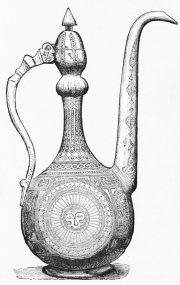
MODERN PERSIAN EWER (COPPER-COATED, WITH WHITE METAL).
South Kensington Museum contains a noble collection of Persian articles, ancient and modern, made for it in that country by Major E. Murdoch Smith, of the Royal Engineers. I say ancient and modern; but where an art has had a continuous evolution it would be perhaps more philosophical to pronounce its last results the oldest, and its “modern” period that in which it was newest. In no other part of this museum have I seen works which reminded me so much of that long conspiracy between man and nature by which wild-briers have turned to roses. It seemed to me there might be written on the walls this beautiful page of the “Rose Garden” of Sâdi: “I have heard that in the land of the East they are forty years in making a china cup: they make a hundred a day at Bagdad, and consequently you see the meanness of the price. A chicken, as soon as it comes out of the egg, seeks its food; but an infant hath not reason and discrimination. That which was something all at once never arrives at much perfection; and the other by degrees surpasses all things in power and excellence. Glass is everywhere, and therefore of no value; the ruby is obtained with difficulty, and on that account is precious. Affairs are accomplished through patience: the hasty man faileth in his undertakings.”
It was probably under the inspiration of these very words of Sâdi that Bagdad in the end vindicated itself. “The powerful Abbaside Caliphs of Bagdad,” says Major Murdoch Smith, “no doubt summoned to their court men of science and learning from all the countries under their sway—Persia furnishing them with architects and other artists. Skilled Persian workmen were no doubt employed in large numbers in decorating the mosques and palaces in the Arab capital, situated as it was on the very frontier of their own country. Thence, we believe, arose the so-called Arabian or arabesque style of ornament, afterward so widely spread, and now so well known. The peculiar pendent ornamentation of vaults and niches, of which the Alhambra is so typical an example, is identical in style with that used throughout Persia down to the present day.” If this theory be true—and really these works appear to sanction it—the Arabs derived their arts from Persia, as the Romans did from the Greeks, and consequently the Moors imported a Persian art into Spain. The Shah of Persia, in wishing to carry back with him Owen Jones’s reproductions of the Alhambra at the Crystal Palace, had good reason for his selection.
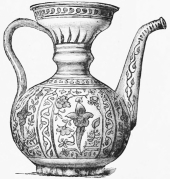
OLD PERSIAN EARTHENWARE (WATER-BOTTLE).
It is difficult to tell the age of most of this Persian work, and I think the enterprising collector of these specimens is not always happy in his estimates. Thus there is a beautiful vase (No. 1224) which Major Smith thinks over 500 years old, on the ground that it bears an inscription in Pehlevi; but that is no more evidence than would be a Latin epitaph in Westminster Abbey that the monument was erected during the Roman occupation of Britain. The collection shows that Persian art is by no means in such a state of decay as many have supposed. This is especially true of the exquisite damascene work still executed at Ispahan. “The true damascene,” says our collector, “is made of a particular kind of iron. After the object is forged it is placed for six or eight days in the furnace of a hot bath, where the greatest attention has to be paid to the even heating of the article. The bath is heated with the dried dung of cows and other animals, which gives a steady and not very intense heat, and is supposed to contain the salts necessary for the formation of true damascene. When the article is taken out of the furnace it is left at the temper it has therein acquired. It is then finished and polished. To bring out the grain a certain mineral (of which a specimen may be seen in the museum) is then applied in the following manner: about three parts of the mineral are dissolved in ten of water, over a slow fire, in an earthenware or leaden vessel. The object is then slightly heated, and a little of the liquid applied with a cotton wad, after which it is washed in cold water. If the damascene does not appear sufficiently the operation is repeated. The object must be thoroughly cleaned and polished before the mineral is applied.”
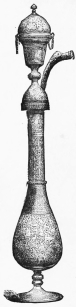
PERSIAN KALIĀN.
It is very doubtful if Corsinet, the French artist who carried the art of damascening to such an extent in the time of Henry IV., has left any such beautiful work as this now being wrought by artists whose names are unknown in Europe. The three kinds of ornamentation known as “damascening” are elegantly represented—the delicately lustred and watered blade, the light etching on polished steel, and the rich inlaying of steel with gold and silver. One of the most beautiful pieces of work is a kaliān or hookah (for smoking tobacco) of brass open-work, with turquoise and other ornamentation. In the head of this great and solemn pipe the tobacco is placed, slightly moistened, under pieces of live charcoal, which are prevented from falling off by the movable top of the bottle containing the water, into which the end of the stem descends. The tobacco smoked is the mild Tombaku, produced near Shiraz, which really is the best “Turkish,” though Turkey never produced a leaf of it. If any one will gaze on this Persian hookah he will see why it is imposing enough to warrant such religious treatment as its Indian counterpart, the hubble-bubble, has received at the hands of an eloquent Vedantist preacher of my acquaintance (Chintamon). The hubble-bubble is generally made of a cocoa-nut shell, with a receptacle for water, through which the smoke passes before being inhaled. In Chintamon’s parable the stem represents the body; passions are the tobacco; the bowl is mind; understanding is the plug which prevents the tobacco-passions from blocking up the stem-body; knowledge is the fire which separates passion—the pure from the impure; the evil is reduced to ashes, and vanishes in the vapor of folly; while through the purifying water of reflection, and the mouth-piece of mental satisfaction, man draws the desirable aroma of content, and hears a bubbling noise which suggests the still small voice of Reason.
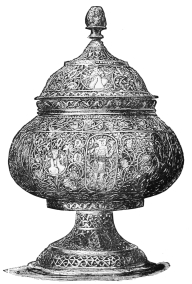
ANCIENT PERSIAN INCENSE-BURNER (PIERCED AND CHASED BRASS).
Among the many exquisite books, manuscripts, and paintings—the latter being oftenest upon the covers of the finest books—there is one of surpassing beauty. It is a copy of the works of Sâdi, a modern manuscript with six illuminated pages forming the head-pieces of the six books, all the pages being bordered in gold and colors. The covers have been painted by the artist Nadjaf, who lived about fifty years ago, on the outside with certain battles between some shahs, sultans, and their like; but on the inside of one cover is a picture of the poet Hafiz surrounded by his friends; on the inside of the other cover is a picture of Sâdi conversing with his pupils. What grace, what honor, was in the heart of him who drew these pictures! Amidst such tints Sâdi might be saying to his pupils one of the passages that are here written: “I saw a peacock’s feather in the leaves of the Koran. I said, ‘I consider this an honor much greater than your quality deserves.’ He replied, ‘Be silent; for whosoever has beauty, wherever he puts his foot doth not every one receive him with respect?’ A little beauty is preferable to great wealth.”
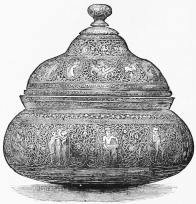
MODERN PERSIAN INCENSE-BURNER (BRASS).
I hear of some prosaic young Englishmen who are wandering about the banks of the Euphrates to try and find the locality of Eden. I venture to affirm that with the Kaliān, plenty of Tombaku, Sâdi’s Gulistan, and this rose-garden manuscript, I can get nearer Eden reclining on yon English grass than those young gentlemen seeking it so far away. Yet it is pleasant, in a melancholy way, to see the never-failing fascination which the Oriental world has for these Northern races. The hardest, least imaginative Englishman will feel some sweeter pulsation about his heart when he sees one of Holman Hunt’s pictures of Palestine, or hears the solemn roll of Oriental poetry.
“A pine-tree’s standing lonely In the North, on a mountain’s brow, Nodding with whitest cover, Wrapped up by the ice and snow. “He’s dreaming of a palm-tree, Which, far in the Morning Land, Lonely and silent sorrows ‘Mid burning rocks and sand.”[D]
But here my rambles through these unlimited fields must draw to a close. One must, amidst such numberless treasures gathered from the great streams of Time, more especially remember Sydney Smith’s advice, based on the post-diluvial brevity of human life, that writers should “think of Noah, and be brief.” It is with a certain distress that I feel compelled to pass by the great galleries of pictures, including some of the finest Turners, Wilkies, and Gainsboroughs, and a large number of historic paintings. The Forster bequest, with its charming souvenirs of famous actors, actresses, and authors, in the shape of portraits, character-sketches, and autographs—among the latter the MSS. of most of the works of Dickens—were of itself the sufficient theme for a treatise.
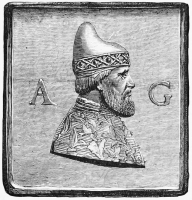
ANDREA GRITTI, DOGE OF VENICE—ITALIAN. ASCRIBED TO VITTORE CAMELO. SIXTEENTH CENTURY.
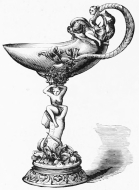
TAZZA—ALGERIAN ONYX AND ENAMEL. MODERN FRENCH.
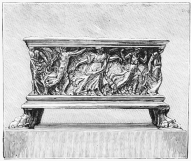
SALT-CELLAR—SILVER GILT; ITALIAN. FIFTEENTH CENTURY.
No collection in the museum is more deserving of attention than that of the musical instruments, which show the entire evolution of the art, from the first savage bark drum and the pipe that Pan might have played to his flocks, up to the last grand piano; but for twelve shillings the reader may procure Mr. Carl Engel’s admirable résumé of this department. Since it was written an interesting series of instruments has been added (Indian section), and it is to be hoped that these will be included in a new edition of Herr Engel’s work. The Indian instruments have not changed in many centuries, some not for two thousand years; their harp (chang) is identical with one represented in the Nineveh sculptures. Unfortunately there is no catalogue to the museum; but there may be had full works on the ancient ivories (one guinea), textile fabrics (one and a half guineas), majolica (two guineas), furniture and woodwork (one guinea). There are small shilling “Handbooks,” giving succinct histories of the arts of working in gold and silver, bronze, pottery, etc., with general reference to objects in the museum, which are useful and interesting. There also exists a full catalogue of books on art (two guineas); and I may mention that at the present moment it is possible to collect in London an admirable art library for a moderate sum—an advantage that will soon disappear. The present art library in the museum is the only one possessing anything like completeness in Europe; it contains 45,000 volumes. This is quite distinct from the educational library, which has an equal number of volumes.
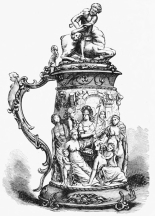
IVORY TANKARD—AUGSBURG. SEVENTEENTH CENTURY.
But we must not part from South Kensington without considering how fares therein the aim and purpose out of which it grew, namely, culture and training in every variety of art. It will at once be recognized that the art schools, enjoying such an unparalleled environment as to examples, carried on also in rooms of vast extent, perfectly lighted, heated, ventilated, and furnished, must be judged by a higher standard than other institutions of the kind in Europe or in America. And, retrospectively, the schools must be conceded to have done wonders. For one thing, it may be claimed that it found the art education of the nation at zero and raised it enormously. By wisely using its power to send floating through the provincial cities a loan exhibition, and by a judicious distribution of the annual fund (now about £2500) granted it by Parliament to aid institutions of a like character, which are willing also to aid themselves, the Commission has been the means of establishing throughout the kingdom schools devoted to art, and in forming classes in colleges to teach art, to an extent which has increased by 150 per cent. the number of those who study art to prosecute it for itself, or to apply it to make their work more artistic. Between the years 1855-‘77, 27,000 objects of art and 24,000 paintings were circulated by the museum through the United Kingdom. In the various provincial towns and cities where they have been left for several months at a time, these works have been visited by over 6,000,000 of persons and copied by many students, the cost to the Science and Art Department being over £100,000. In order to tempt Schools of Art to acquire permanent objects for museums of their own, the Department offers a grant in aid of fifty per cent. on the cost of such objects. Parliament is continually inquiring into the means of increasing the utility of the collections in this direction. South Kensington has already awakened a higher taste throughout the nation, and especially in London. The number of visitors has increasingly exceeded a million each year; and should the museum be opened on Sunday afternoons—a step which can hardly fail to be taken ere long—this number must be vastly increased. These crowds, however, never make the rooms seem crowded; their decorum is equal to that which is preserved in the best drawing-rooms; there have been only two cases in the history of the museum where persons have been ejected (the fault being tipsiness); and no article of value has ever been missed. In strolling through the building with George Boughton we concluded to follow some very rough-looking youths and observe what objects attracted their attention. We were surprised to find them passing by King Koffee’s umbrella and trinkets to devote all their time to the statues of Michael Angelo. I have repeatedly observed similar phenomena in the picture-galleries—the roughest people crowding around the best works of art.
The way in which all this has told upon the work of the country has been jealously watched, and also fairly recognized by foreign critics. The first gold medal awarded on the Continent for art education, awarded to South Kensington, was not given by any favor, and it was won by a great deal of hard work. In the introduction to the seven-volume report presented to the French Government in 1862, M. Chevallier says: “Rivals are springing up, and the pre-eminence of France may receive a shock if we do not take care. The upward movement is visible, above all, among the English. The whole world has been struck with the progress they have made since the last Exhibition in designs for stuffs, in the distribution of colors, also in carving and sculpture, and generally in articles of furniture.” M. Rupet urged the establishment of a museum in Paris similar to that at South Kensington, saying: “It is impossible to ignore the fact that a serious struggle awaits France from this quarter.” The report from Lyons—whose School of Design was, to a large extent, the model copied by England—says: “With Great Britain we shall have some day to settle accounts, for she has made great progress in art since the Exhibition of 1851.” These statements are much more true now than when they were written. In the direction to which they refer—that of decorative art—South Kensington has certainly taken a leading position in Europe. The evidences of this are appearing daily. For example, the firm of Messrs. Corbière & Sons, which was established in London about twenty-eight years ago as an importing house for French patterns and goods, has now been almost changed into an exporting house, sending to France patterns and designs for goods which it obtains from South Kensington. Even this is hardly so grateful to the English as a report lately made by a large Glasgow firm, that it has for some years been obtaining from this museum, at the annual cost of a few hundred pounds, designs such as it had been for many years previously securing from Paris and Lyons at a cost of £2000 per annum.
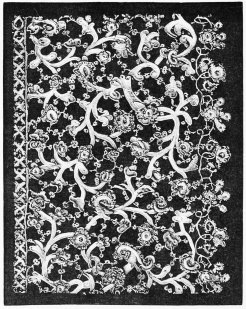
FINEST RAISED VENETIAN POINT LACE—FLORAL DESIGN. ITALIAN. SEVENTEENTH CENTURY.
Lyons, indeed, after teaching England its art of war, has itself lost it. Neither Paris or London will use their newest patterns, one of which, I understand, represents huntsmen and hounds in full chase after a stag, careering all over a drawing-room carpet! In Paris, and even more in England, taste has for some years been tending to demand richness in substance, vagueness in pattern, quietness in color, for all stuffs used in rooms. It is greatly to be regretted that the great manufacturers of textile fabrics declined to participate in the Centennial Exhibition, having concluded that their goods would have too much protection in one sense, and not enough in others. It would have excited astonishment in America to see what transformation has been wrought in carpets and curtains, and it would be at once recognized that the old fabrics, with their fixed scrolls, their glare and glitter, have become barbarous. Messrs. Ward, of Halifax, recently rolled out for me on a floor side by side the old patterns and the new, and it was to the eye like passing from poppies to passion-flowers. “Those blazing ones,” said Mr. Ward, “have gone out of fashion in this country since the new schools of design began, and we never sell a yard of them here; we made them for America until the last tariff, and now the manufacture has ceased altogether.” The new curtain stuffs have always an unobtrusive, almost a dead, ground of saffron, or olive, or green, and on it flowing conventional leaves with some heraldic form—as daisy, pomegranate, etc.—to supply spots of color; and the carpets are of much the same character, with somewhat larger forms.
These exquisite designs are universally recognized as results of South Kensington. But there is one point where the results are less satisfactory. The best designs, which include the human figure, have still to be obtained from the Continent; and these being of especial importance in pottery, the great porcelain factories say that their needs cannot yet be met by English art schools. The truth is, there was long an opposition in controlling quarters to permitting studies of the female nude at South Kensington at all, though now the female students have that privilege. In the male school the male nude is studied; but still the students—those who mean to devote themselves to fine, as distinguished from decorative, art—have to unite and employ female models in rooms outside the school. It is as difficult to see what benefit is secured by modesty, in thus placing a necessary study beyond the regulation of the masters, who might preserve decorum, as it is to find any advantage to religion gained by shutting the door to the pictorial gospels of Raphael on Sunday and keeping open the door of the gin-shop. Both the piety and the prudery are anomalous. The Zoological and the Botanical Gardens, in London, the Dublin Museum, Hampton Court, and Kew Gardens are all open on Sunday, while the museums and galleries of the metropolis are closed: the Royal Academy has nude models of both sexes, under the same Government which prohibits the like at South Kensington. The queerest anomaly, however, existed until lately in the Slade School of Art, at University College, where the vexed question was settled by permitting the male pupils to have female models, and the female pupils to have male models! This restriction of the ladies to (nearly) nude models of the other sex was made in the interest of propriety, as the masters felt disinclined to enter and instruct them in the presence of a female model.
The former restrictions at South Kensington as to models fell heavily upon the female pupils. The young female artists were not permitted to see so much of their model as they would be required to reveal of their own persons at one of her Majesty’s drawing-rooms. The late head-master, Mr. Burchett, himself an able figure painter, knew well, as all experienced figure painters in Europe know, that female models are far oftener secured from vice by their occupation than exposed to it, and that life schools are not inconsistent with decorum, under proper management; and he (Mr. Burchett) made efforts, one of which was to have the model encased in flesh tights, to secure for his pupils the advantages so freely offered in Continental schools. But his contrivances were stopped by threats of Parliamentary questions. His successor has, however, secured to the female pupils the advantage of the nude model of their own sex and male model with caleçon; and, if he can now secure like privileges for the males, South Kensington may some day be able to point to as high results in the direction of the fine as in the ornamental arts. Until then young men of genius will continue to prefer schools which are without such restrictions. It can only be ascribed to the consummate care with which studies of the antique are conducted, and to the full supply of the finest casts offered by the museum, that decorative art itself at South Kensington has suffered so little from the limitations referred to; for it is certain that the human figure is the key to all other forms in nature. It is certain, also, that the female form is the very flower of all natural beauty—“the sum of every creature’s best,” as Shakspeare says of Perdita—and no arrangements for art training can be considered complete which do not include accessibility to such studies of the same as are required, by those who have given evidence of their fitness to interpret the sacred secrets of nature.
Beyond this there is no special deduction to be made from the method of training at South Kensington, which as a school is steadily improving. The following official memorandum of its regulations (with which is given the names of its faculty) will show the large scope of instruction included:
DIRECTOR-GENERAL FOR ART, AND PRINCIPAL, THOMAS ARMSTRONG.
Head-Master, J. Sparkes.
Mechanical and Architectural Drawing, H. B. Hagreen.
Geometry and Perspective, E. S. Burchett.
Painting, Free-hand Drawing of Ornament, etc., the Figure and Anatomy, and Ornamental Design, J. Sparkes, C. P. Slocombe, T. Clack, F. M. Miller.
Modelling, M. Lanteri.
Etching, A. Legros.
Female Classes.
Lady Superintendent, Miss Trulock.
Female Teachers, Mrs. S. E. Casabianca and Miss Channon.
Occasional Lecturers: Dr. Zerffi, Historic Ornament; E. Bellamy, Anatomy; F. W. Moody, the Figure, as applied to Decoration.
1. The courses of instruction pursued in the School have for their object the systematic training of teachers, male and female, in the practice of Art and in the knowledge of its scientific principles, with the view of qualifying them to impart to others a careful Art education, and to develop its application to the common uses of life, and to the requirements of Trade and Manufactures. Special courses are arranged in order to qualify School-masters of Elementary and other Schools to teach Elementary Drawing as a part of general education concurrently with writing.
2. The instruction comprehends the following subjects: Free-hand, Architectural, and Mechanical Drawing; Practical Geometry and Perspective; Painting in Oil, Tempera, and Water-colors; Modelling, Moulding, and Casting. The Classes for Drawing, Painting, and Modelling include Architectural and other Ornament, Flowers, Objects of still-life, etc., the Figure from the Antique and the Life, and the study of Anatomy as applicable to Art.
3. The Annual Sessions, each lasting five mouths, commence on the 1st of March and the 1st of October, and end on the last day of July and the last day of February, respectively. Students can join the School at any time, the tickets running from date to date. The months of August and September, one week at Christmas, and one week at Easter or Whitsuntide, are Vacations. The classes meet every day except Saturday. Hours of Study: Day, 10 to 3; Evening, 7 to 9.
4. In connection with the Training School, and open to the public, separate classes are established for male and female students; the studies comprising Drawing, Painting, and Modelling, as applied to Ornament, the Figure, Landscape, and still-life.
Fees.
For classes studying for five whole days, including evenings: £5 for five months.
For three whole days, including evenings: £4 for five months.
For the half-day—morning, 10 to 1; or afternoon, 1 to 3: £4 for five months.
To all these classes there is an entrance fee of 10s.
Evening Classes: Male School: £2 per session.
Artisan Class: 10s. per session; 3s. per month.
Female School: £1 per session, three evenings a week.
No students can be admitted to these classes until they have passed an examination in Free-hand Drawing of the 2d Grade. Examinations of candidates will be held weekly, at the commencement of each session, and at frequent intervals throughout the year.
5. Students cannot join the School for a shorter term than five months, but the students who have already paid fees for five months may remain until the end of the scholastic year on payment of a proportional fee for each month unexpired up to the 31st of July in each year.
6. Classes for School-masters, School-mistresses, and Pupil-teachers of Elementary Schools meet on two evenings in each week. Fee 5s. for the session. Teachers in private schools or families may attend the day classes on payment of a fee of £1 per month.
7. The morning classes for Practical Geometry and Perspective are open to all students, but they may be attended independently of the general course on payment of a fee of £2 per session for those classes.
8. Students properly qualified have full access to the collections of the Museum and Library, either for consultation or copying, as well as to all the School Lectures of the Department.
9. A register of the students’ attendance is kept, and may be consulted by parents and guardians.
Nothing can exceed the care and devotion with which the great work of South Kensington is carried on by both teachers and pupils. In walking through the rooms with the head-master I could only marvel at the indications unintentionally furnished by the pupils, from moment to moment, of his intimate knowledge of their work and their progress, however remote from such details he might be officially. In his room he keeps all the works sent in by the pupils in competition for the many valuable prizes offered by the school at each stage of progress, and these are preserved in large albums, each marked with the young artist’s name, so that by looking through it we trace the unfolding in this or that direction of a human mind, from the first crude geometrical drawing to mastery of the finer strokes of form and color. The pupil applying for admission is not simply put in at one end of a machine-like system to be turned out at the other, but a specimen of his or her work is demanded, and a place assigned in accordance with it.
NETTLE IN ITS NATURAL STATE. NETTLE IN GEOMETRICAL PROPORTIONS.
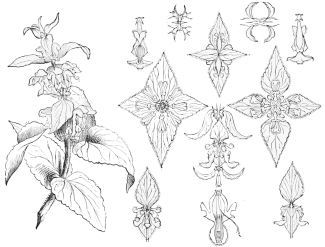
It was morally impressive to witness the large numbers of women who have here found a field for the cultivation of their powers. In one room—that of geometrical proportions—the students of both sexes are taught together, and no doubt the co-educational system will gradually creep from this to other classes, as it has to some extent done in University College and other institutions. But the museum is able to supply both schools with any quantity of models and aids. The young female artists have excited the admiration of their teachers and examiners by the remarkable perfection to which they carry ornamental designs, especially such as may be derived from flowers, fruits, and leaves. In one part of the museum there is a series of grottoes, filled with all manner of ferns and other plants, which serve the double purpose of adorning the room, from which they are seen through large glass doors, and of supplying subjects for the study of decorative foliation. They who see the beautiful combinations of these plants made in the training schools will discover that their previous acquaintance with some very common things has been very limited. In this study of the geometrical capacities of plants for decorative purposes the female pupils seem to excel. The exquisite art of one of them, Miss Louisa Poole, enables me to present an example of this kind of work, for which she recently received a gold medal. The subject of this very clever piece of combination is the common nettle; and, even without the beautiful colors with which Miss Poole’s original work was rendered, these outlines she has drawn for me will perhaps enable the reader to understand the kind of work by which this school has relieved England of its former dependence on Paris and Lyons. It is but just, however, to state that Miss Poole’s work, when exhibited, on occasion of a distribution of prizes by the Duke of Richmond, was surrounded by a score of similar sketches which had brought their designers well-merited prizes. No one could examine them without perceiving that the young artists have learned the main secret of ornamental art—that nature is but an alphabet, which it is the task of the artist to combine into words and sentences that shall convey human purpose and thought.
Some of the best work done at South Kensington is the copying of rare and beautiful specimens of ancient majolica and other wares. The Rothschilds and other collectors gladly lend their choicest possessions for this purpose, and the copies are of high value to this and other museums. It is wonderful to observe with what refinement of taste and with what sympathy some of the pupils enter into the subtle secrets of the old masters of decorative work. The illustration of the Henri Deux salt-cellar was made for me by Mr. William Broad, while a pupil at South Kensington, from a work sent in by him to the Examiners. The reproduction of Cherpentier’s rich and delicate colors in this young artist’s original work was exceedingly fine. His design of the top of the salt-cellar is given on the following page.
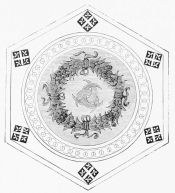
PLAN OF TOP OF HENRI DEUX SALT-CELLAR.
It is quite certain that a peculiar excellence has been given to the work of this institution by the atmosphere of general culture surrounding it. Each pupil works amidst the splendors of ancient art, amidst the shades of the great, and each lives in the presence of men who to-day best represent the accumulated knowledge of the world. The spirit tells more than the letter of instruction. Moreover, no art is here studied in isolation: each is studied along with literature and science; and, what is of great importance to thoroughness, all the arts are studied in connection with their own history. Through the literary works of such archæologists as William B. Scott, the ever-careful teaching of Thomas Armstrong and Mr. Sparkes, and the practical labors of such experts as Mr. Moody and Mr. Bowler, the pupil may study, by theory and experiment, the evolution by which his task has come to him, when and how great successes were attained, and so inherit the vital spirit which of old quickened the flowers of beauty by which he or she is at every moment surrounded. The pupil will realize here the immortality of good work. He will see that an old blacksmith, ordered to make iron grilles for Hampton Court garden, put such heart and soul into his work that his four pieces must now be brought hither as a monument of which Thor might be proud. Never was more beauty wrought in iron than this by Huntington Shaw, of Nottingham, anno 1695. Under his hand rose, shamrock, and thistle have grown on the metal so tenderly that it would seem a breath might stir them, while from the Irish harp in the centre one might almost listen for Æolian strains. But that was done in a day when to work for a king was felt to be working for God. And all through this museum shines the great fact that the best work was never done merely for money, but for the altar, for love and loyalty. It is a Museum of Civilization, where each work is a heart. There sat a man doing his very best to advance the whole world; there marched a brave invader of Chaos and Disorder; a reason worked through him like that which turns a bit of mud into a lily. It is a supreme joy to trace these footprints of the universal Reason. A flute-key that wins one more soft note from the air; a pot flushed with some more intimate touch of the sunlight; an ornament which detaches a pure form from its perishable body—such things as these exhibit somewhat finer than themselves, namely, man elect still to carry on the ancient art which adorned the earth with grass and violet, and framed the star-gemmed sky and the spotted snake. The student shall also learn here the solidarity of genius. In distant regions of the world these men worked at their several tasks, sundered by land and sea, but here they are seen to have been members of one sacred guild, like that described of old: “They helped every one his neighbor; and every one said to his brother, Be of good courage. So the carpenter encouraged the goldsmith, and he that smootheth with the hammer him that smote the anvil, saying, It is ready for the soldering: and he fastened it with nails, that it should not be moved.” From manifold regions of the world, through ages linked each to each by natural piety, their works have come here to unite in one mystical symphony of excellence. By the spirit that worked through them they are made members one of another. Some little time ago the Professor of Political Economy at Oxford formed a class of youths of both sexes, and said to them one day: “There are two great distinctions between man and the lower animals; one of them is the root of labor, the other is the root of civilization. What are they?” The first was soon explained; the root of labor is that the animal has only to seek his food to find it prepared for him, and his clothing is made for him by nature, whereas man must cook and modify his food, and make his clothing. The second puzzled all in the class except one young maid, who said: “The root of civilization is progressive desire. Give an animal all that satisfies its present want—good shelter and food enough—it will never be restless, nor show a further want; but satisfy man in any moment, he will want something better the next. This craving for the better and the best leads on to civilization.” But it is the combination of these various lines of improvement which finally creates a civilization. Savages improve on their own roads, but the Kaffir never borrows for his own hut any advantage belonging to the hut of the Zulu, not more than the bee borrows for its cell a hint from the bird’s nest. The savage has the root but not the flower of civilization. But then each civilization in turn is to a great extent special; the human race has a wider life, into which all separate streams of blood are poured, and all arts blend. By a higher law of evolution man’s moral and intellectual powers are selected from the isolated tribes and nations through which they have for ages been distributed. In this our museum men are taken as varied pigments to make the study of Man.
“Man, one harmonious soul of many a soul, Whose nature is its own divine control, Where all things flow to all.... Man, oh, not men! A chain of linked thought, Of love and might, to be divided not.”
Of all countries America is that to which mankind must look for the fulfilment of those aspirations which are the creative force, carving on the world the ideals of poetry and art. Each fine work will reflect the culture of the race. Emerson has reminded us that for the best achievement we must have instead of the Working-man the Man working, and it were a pity if the great man’s countrymen should not realize that whole work must be done by the whole man. In walking through the school at South Kensington once, I met a young lady who had passed several years in the schools at Philadelphia and the Cooper Institute, but had never found what she required for her training until she came here. The picture on her easel proved her to be an accomplished artist, and her experience appears to me worth mentioning. The school at Philadelphia, she said, was the best she had known anything of in the United States, but when she was there it lacked trained teachers. The teachers were artists in all but the art of teaching. She believed, however, that the Philadelphia school, if associated with a good collection, would turn out well. But of the Cooper Institute she was not so hopeful. It was rather too philanthropic to be a good school of art. The great aim was to qualify the pupils—girls particularly—to make money. The pupils are urged on to the paying work rather than to that which is excellent. It must be understood that these criticisms are here detached from this lady’s pleasant plaudits to things in America other than its schools of design, her experience of which was that one with a high standard had no means of attaining it, while the other, with more resources, had a low standard and aim. This lady’s experience has been several times confirmed by American artists with whom I have walked through the South Kensington Museum. One of the most eminent of them said: “What a revolution it would cause in American art to have some such museum as this in each large city! It would in each case draw around it an art community, and send out widening waves of taste and love of beauty through the country.”
These expressions, however, were used ten years ago, and it may be hoped that to those now in the American institutions mentioned that may appear a dim past. Within that period my own visits to the chief schools of high art in New York have convinced me that their teaching is of the highest character, while the resources for culture of decorative art are slight.
If there be among the readers hereof one of those sensitive patriots who resent the idea of borrowing any ideas or methods from the Old World more modern than the Decalogue, I would submit even to him whether it be not less humiliating to import European experience than to export American brains. It is no dishonor for America to claim her inheritance from the past; it is no degradation to recognize what has been done as done, and not needing to be done over again; but it may well be pondered by the patriotic whether the Coming Artist will go abroad, or whether he shall find in his own country the resources essential to his culture and his finest fruit.