DECORATIVE ART AND ARCHITECTURE IN ENGLAND.
Reading edition
MICHAEL ANGELO was once commissioned to lead in the destruction of the beautiful villas around Florence. He of all men! The expelled Medici, now of papal dignity, were menacing the city. The first thought of the great artist was to save the Campanile, and he covered that noble work of Giotto with protecting wool-sacks. But the suburban villas must not stand to give aid to the enemy, and at word of command he started out, and for once the track of the great artist was indicated in the destruction instead of in the creation of beautiful things. But he came upon one house whose wall was covered with a beautiful fresco, and he had not the heart to destroy it; the soul of the artist held back the hand of the patriot, and in the field of desolation one mansion remained standing alone—saved by the protecting genius of Beauty.
It is but one incident in the long history of the career of Use and Beauty through the world, hand in hand, undivorceable. All our science is engaged in spelling out their story. Every spot of color on bird or insect it finds to be the trace of a utility. What weary struggles carried on through ages to mimic blossom and leaf, and so hide from pursuing foes! The same force works on when the art of man enters the arena for new creation. The thin and feeble blossom of the brier passes through all the phases of culture until it becomes the full rose of the horticulturist, like unto some little maiden’s face for size and lustre, all by merest mercenary influence. Our fairest flowers have migrated from East to West, cherished and preserved for highest use as oracles and symbols of successive goddesses and saints, transplanted from temple courts to flourish under the holier chrism of convent gardens. Despite his proverb, man has painted the lily and adorned the rose, until we may almost say with the Persian Nizámi, “Every flower growing in the many-colored garden of the earth is a drop of blood from the heart of a man.” Out of a dry and hard necessity comes still the beauty of the world. Behind our tinted Salviati glass, our painted Sèvres china and Minton majolica and shining silver plate, are the long rows of pallid faces inhaling poison in stifling rooms, breathing death that they may live. Sad experience is the prelude to each charming symphony. The noblest statues and paintings which the world cherishes were wrought in a “sad sincerity;” in the divine depths of sorrow were found the quarries from which emerged the Apollo Belvidere and the Laokoon; the blood of great hearts supplied the chief pigment of the Dresden Madonna and the Transfiguration; and the magnificent frescoes of Italian churches were born of the hopes and fears of millions, for whom they meant not picturesque beauty, but a world’s redemption. Man in his best epochs of art has thus carried on the ancient creative power of Nature, giving her potential germs and forms a new blossoming under the heat of his never-ending battle of life. And where it is not thus impelled by nor surrendered to this utilitarian, this most real, force, what does Art amount to? Mere copying of works which denote that force in the past; mere Art Ritualism, crying to other ages, Give us of your oil, for our lamps are gone out!
If Michael Angelo could to-day be set on a work of general demolition in London, one may fear it would hardly require patriotism to encourage his zeal. Would he, in what the London Times once called “this our ugly but not altogether uncomfortable metropolis,” have reached a single building which would have made him pause? Here and there he might meet one of those ancient mansions whose bricks have hardened into one solid stone that will stand, as Carlyle once said, “till Gabriel’s trump blows it down;” but of the miles of modern houses in which—to remember the Chelsea sage again—“every brick is a lie,” one may fancy that but few would be saved by any genius of Beauty.
And yet this is, after all, not so certain. That an artist filled with iconoclastic rage might quickly despatch most of the mansions and many of the churches of English suburbs, erected specially for beauty and effect, is quite probable; but there are a number of buildings built without reference to beauty which might perhaps have made Michael Angelo pause with a feeling not unrelated to admiration. If any one will stand beside the Thames River near Charing Cross and gaze for a while on the tremendous sections of the railway bridge there, at its huge iron supports and girders—if he will then go up on it and realize its vast breadth, see four trains passing each other, with room enough between, and room enough for the men and women moving to and fro on their own side-path—he will surely bear away an impression of grandeur. Nay, there will blend with it an impression of beauty also: there is no arch, no slightest foliation or other prettiness, not even a relief to the iron hue save the gilded heads of certain enormous rivets and the gilded monograms of the railway company fixed on the supports of the triple gas-lamps; the bridge is not even straight; and yet beauty there is, and it arises from two sources. The first is the beauty of adequacy for a purpose, involving at once strength and proportion, suggesting what the Greeks may have meant when, in their myth, they wedded Aphrodite to Hephaistos. The second is a beauty almost indescribable in physical terms, but resembling the simplicity which expresses character—the subtle charm playing unconsciously through eye and voice of even a homely man, who in word and act is content with the simple truth. In fact, the beauty of this Charing Cross bridge, which has least aimed at architectural effect among those spanning the Thames, is closely related to its ugliness. If any one find this assertion paradoxical, he shall at least find it not doubtful if he can and will do three things—read Oersted’s chapter on “Ugliness in Nature,” observe carefully Turner’s “Rain, Wind, and Speed” (a railway train thundering over a viaduct through English rain and fog), and finally give twenty minutes to the bridge in question, especially taking care to pass beneath it on one of the small iron steamers (water omnibuses) that ply the river. When afterward he shall see the many ornaments of the present copied from the utilities of the past—the towers, steeples, cupolas, crenelles—and remember that they were constructed originally for landmarks, cross-bows, and the watches of war, he will acquire an imaginative respect for this unpretending product of the Iron Age. The same simple grandeur invests old Newgate Prison—perfect reality, entire adequacy for its purpose, a relation of every part to the end for which it was built, like the harmonies that make the lion. Did man forbear, it were by no means inconceivable that when Macaulay’s artistic New Zealander came he might sit upon a broken column of St. Paul’s to sketch the still strong, gray fortress of Newgate!
He who explores the cities of England to discover that kind of beauty in architecture which is familiar in other lands will not find it. In a late satire on the royal family published in London, The Silliad, the Queen is represented as reproaching her eldest son with not taking more after his father, and interesting himself in the industrial affairs of the country. The poor Prince of Wales can only reply, “I’ve not a model-farming soul.” And a somewhat similar answer is all that England can return to the immeasurable scoldings poured out upon her because she cannot do the work of the old Italian and Dutch masters. But the time was when England had a reputation such as no other country possessed for just one thing—genuineness of work. It was almost proverbial in Europe to say that you could get pretty things in every capital on the Continent, but if you wanted a thing which would do what it professed to do—the knife that would cut, the carriage that would bear and wear—you must go to England for it. Nay, I remember in my boyhood in Virginia that the belief in the solid character of everything English was such, that even articles which could by no possible means have come from England were yet called “English” to enhance their value; not merely watches made in New England, but I have known American fanciers commend a bird unknown to England by calling it the “English mocking-bird!” All this was a droll re-appearance of the reputation which Eastern gold once had in England, the word “sterling” being a relic of “Easterling,” as applied to the British pound of silver when represented in gold. But the most enthusiastic Briton must admit that the virtue of the “English” label has followed that of the “Easterling,” and is now a mere survival. The absence of prettiness remains, but the old compensation of genuineness can no longer be claimed, or certainly not in the same general way. The genuine and thorough thing is now exceptional enough to strike one as almost ornamental. But still the word “solidity” has a meaning in Great Britain, and whenever Englishmen undertake to have anything done, their first effort is to have it substantial and useful. They may not get it, but that is what they pay for, and a real demand is likely in the long-run to overtake its real supply. It has already to some extent overtaken it, and that not alone in the great viaducts and railway bridges which the age of steam has called about it.
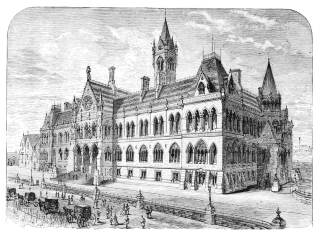
ASSIZE COURT, MANCHESTER.

An age of municipal and civic development has found for the buildings it requires a representative architect in Mr. Waterhouse, who has erected most of the magnificent town-halls and court-houses of the great provincial cities. These vast, and in a certain sense beautiful, buildings are the only ones that can compare with the old cathedrals and castles of England, built with as serious a purpose as theirs, and with as physiognomical a relation to the age that produced them. Mr. Waterhouse takes the Gothic style for his basis, just as a pomoculturist might take a russet as the basis of the apple he means to produce, and, like him, modifies only in obedience to the fundamental law of the style he has selected. His Gothic building has in it nothing capricious or eccentric. So genuinely as, under change of conditions and needs, the bent and bound boughs were copied in the first pointed stone arch, even so, by lawful adaptation, may the window point become more obtuse or the lancets more luminous; but the lesson of this style, which, above all others, has no part or trait not traceable to a use, is never lost, and the Gothic of Mr. Waterhouse is the natural evolution of that found in Westminster Abbey. In one of his buildings, and one of the best structures in the world, the Manchester Assize Court, I could discover but two things which appeared to me without special use or meaning. These were two small figures, a snail and a frog, carved in granite, sitting in the angles of a wall on each side of the main door-way. Of course these may not be mere jeux; they may have some connection with a previous bit of eccentricity in an older building (such as it is often desirable to copy and preserve for archaeological reasons); but these two forms, each about as large as one’s two fists, were the only things in the vast building which appeared “not to the point.” In going over this building I speedily found that it would not do to pass anything, as the most casual-seeming bit of ornament was apt to possess a root in history. Thus the superstructure of the great portico at the entrance is supported by detached shafts of solid granite two feet in diameter, which stretch out into foliage as they meet the low roof; but on examination it is discovered that, framed in this foliage, are finely carved and most appropriate representations of ancient modes of punishment—persons undergoing the pillory or some ordeal, broken on the wheel, wearing the mask, or bridle, for scolds, and the rest. On the outside wall the decoration of the upper edge of a large corbel is twined about the words, “He shall judge thy people with righteousness, and thy poor with judgment.” Over a gate leading to the judges’ residence the tympanum of the gable is adorned with a fine mezzo-relievo of the Judgment of Solomon. On each side of the grand entrance are carved two chained dogs, imposing enough to be mythologically descended from Cerberus and Orthros themselves. There are but two figures on the outer walls, one of “Justice,” another of “Mercy.” The building is a parallelogram in form, with a frontage of 335 feet. Within is a grand hall 100 feet long, 50 feet wide, 75 feet high, with an open timber roof of eight carved bays, the principals having moulded brackets and ribs forming pointed arches, and the spandrels filled in with elegant tracery. Carved figures hold the chandeliers. Around this hall, which is for state receptions and banquets, run in ancient letters the words of the Great Charter: “Nullus liber homo capiatur vel imprisonetur aut disseisiatur de aliquo libero tenemento suo vel libertatibus vel liberis consuetudinibus suis, aut utlagetur aut exulet aut aliquo modo destruatur, nec super eum ibimus nec super eum mittemus, nisi per legale judicium parium suorum vel per legem terræ. Nulli vendemus nulli negabimus aut differemus rectum vel judiciam.” This makes about as beautiful a cornice edging as can well be imagined. The last sentence is repeated on a stained window at the end of the hall:
To none will we sell To none will we deny To none will we delay Right or Justice.
The subject of the window illustrates the history of the Great Charter—King John in the centre, and Archbishop Langton and Chief Baron Robert Fitzwalter on either side. There are three miles of corridors, all with a dado of tiles more than a yard deep, of a rich brown tint, and capped with a scroll made of lighter colors. On the whole, I can hardly express adequately my admiration of this superb building, the total cost of which was £130,000.

MINTON TILE.
In the centre of Manchester the same architect has erected a larger building, a Town-hall, which cost £1,000,000. Rich and admirable as it is, it is not, on account of the crowding of houses around it, and the irregularity of the ground upon which it is built, so effective in appearance as the Assize Court. The interior decoration is remarkable for the beautiful variety of colors secured by a careful mingling of English, Scotch, and Irish granites grouped as double stems in the balustrade of a spiral stairway. The Irish granite is a bluish-gray, the Scotch has a faint red tint, and the English Shapfels has salmon-colored spars, which are as large as raisins. They all take a beautiful polish, and I think that for a large public building the effect is better than if they were marble.
Manchester has shown good sense and good taste in having employed Mr. Ford Madox Brown to paint six, at least, of the panels in the great hall of this Town-hall. These mural paintings are not surpassed by any recent work of the kind which I have seen. Mr. Madox Brown is pre-eminent for his archæological knowledge and poetic conceptions, and his genius has been at its best in these noble works. At the time of this writing three panels have been finished. The first represents the Romans building a fort at Mancenion (Manchester), anno 60. Agricola, Governor of Britain, is represented with a centurion beside him, examining a parchment plan of the Camp; a standard-bearer holds the silken Dragon-standard—emblem borrowed from the “barbarians”—which floats in the wind. The Legionaries are doing mason-work; Britons bear the stones and cement. Agricola’s wife and little boy are in the scene. The second panel represents the Baptism of Edwin, at York, in the year 627. The artist follows the account of Bede, who says that a small wooden church was hastily erected for this purpose on the site where York Minster now stands, but has introduced a Roman mosaic floor. In his noble picture of Edwin he has been inspired by Wordsworth’s sonnet, “Paulinus:”
“Mark him, of shoulders curved, and stature tall, Black hair, and vivid eye, and meagre cheek, His prominent feature like an eagle’s beak; A man whose aspect doth at once appall And strike with reverence.”
The third panel is the Expulsion of the Danes from Manchester. One less acquainted than this artist with ancient fact might be surprised at the beardless, boyish appearance of the escaping Danes; but it is true that the Vikings began their adventures early—at the age of fifteen, it is said—and became respectable married men a few years later. The town-folk are hurling missiles at the retreating party, one of which—thrown by a young woman from a house—strikes down the “Raven” standard. Mr. Madox Brown’s further designs include “The establishment of Flemish Weavers in Manchester, 1330;” “William Crabtree (draper, of Broughton, near Manchester) observing the transit of Venus, 1639;” and “The Decree Court Leet that all weights and measures are to be tested, 1566.” No man is better able to invest with beauty these events connected with the history of Manchester. Mr. Madox Brown is using for these mural paintings the “Gambier-Parry” process. The medium consists of a mixture of wax, resin, and essential oil, with which the stucco of the wall is coated and the colors ground. Every color ever used with oil, water, or fresco is admissible with this medium; and the surface when dry is without shine, while yet the utmost luminosity pertaining to any other method is attainable with it. It seems likely to become the general mode in this climate, and has given equal satisfaction to Sir F. Leighton and Mr. Madox Brown.
One other of the immense buildings which have become so characteristic of the populous centres of England I must mention, namely, the new Midland Railway-station, at St. Pancras, in London. This is probably the finest railway-station in the world, and it is the chief work of Sir Gilbert Scott. It is a vast pile, of which every outward detail is graceful and substantial, its turrets and great clock-tower superb. This immense building conveys, however, an unpleasant impression of being out of place. It implies a park, or at least a larger and more picturesque space than the irregular and ugly one at King’s Cross, to secure the perspective needed for any sight of it as a whole. Entering, we find ourselves beneath a vast span of iron and glass, almost like a sky. The front part of the building is a hotel. It has been decorated by Robert Sang, and furnished by Gillow, in the most expensive style, and certainly presents some rich interiors. The reading-room has green cloth-paper, and a ceiling gay with huge leaf frescoes; it is divided by a double arch with gilded architraves. The mantel-pieces are of dark marble, with two small pillars of yellow marble set on either side. The coffee-room has a general tone of drab, with touches of gold in the paper, and a sort of sarcophagus chimney-piece, surmounted by an antique mirror of bevelled glass. The sitting-room has red floral paper, and an imitation mosaic ceiling. One of the bedrooms which I visited had deep-green paper, with gold lines and spots, and bed-curtains somewhat similar. The furniture was of heavy oak, tastefully carved. The halls and corridors have a dado of fine dark brown tiles, and bright fleur-de-lis paper above. All of which was rich, costly, and, with slight exceptions, by no means gaudy. Yet I could not altogether like it, or think the decorations entirely appropriate for a hotel. It looked as if there had been more exercise of ingenuity to find things costly than to find things beautiful. The salon, the reading-room, may naturally be made gorgeous, but the bedroom ought to be more quiet. One does not desire to sleep amid purple and gold. The traveller who needs rest may well spare these things—which, however, he knows will not spare him; for if there is gold paper on the wall, there will be gold paper in the bill.
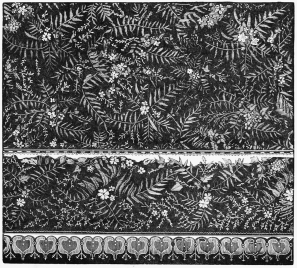
KIDDERMINSTER CARPET—FERN DESIGN.
For its purpose it would be difficult to fancy, impossible to find, a more complete structure than “The Criterion,” which the great London caterers, Messrs. Spiers & Pond, have erected at Piccadilly Circus. This building includes social and private dining-rooms, room for table d’hôte, hall for public banquets and balls, restaurant, and buffet; and beneath all these a theatre large enough to entertain a thousand people. The architect, Mr. Thomas Verity, plainly had it in his mind to raise a great gastronomic temple, and when one enters the door, what he sees on every side is the apotheosis of eating. Through an archway we enter, and find ourselves amid the French Renaissance. The façade outside, and the door-way, with its glazed framing and superb bronze columns, make one feel that he is about to dine superbly. Really he does dine remarkably well, though the French Renaissance hardly extends to the culinary art of the establishment, for that would imply a revolution in the Briton’s constitution. Mr. Wyon has placed some fair sculptures, the Seasons, etc., in the niches and on spandrels of the wall outside, but the inside decorations of Mr. Simpson are truly, in the words of Messrs. Spiers & Pond, “upon a scale which has hitherto never been attempted.” The grand hall rises squarely through three stories to a light Mansard-roof, from which sunburners blaze down at night, and outside of which is a promenade commanding a fine view of London. All of the sides of this grand and lofty hall are of tiles made for this establishment, and combining to form large pictures, the subjects of which were designed and painted by A. W. Coke. Over the right-hand door, leading to the restaurant, is a semi-classical scene of youth and maid by the sea-side gathering in fish; on the opposite side, over the door opening into the buffet, is a picture of two girls in a wheat field, where there is an apple-tree, the one attending to the sheaves, the other to the apples; around the lower hall are—still in tile mosaic—large figures of Euterpe and Terpsichore (for there will be music and dancing above), Pomona, Flora, Bacchus, and, of course, Diana, goddess of venison. The floor of the hall is as fine as any mosaic in London, and is adorned at the edges with the monograms of the firm. In the restaurant there are all manner of allegorical figures on the walls, the Seasons, and the genii which dig and delve and hunt, all with the object that humanity shall be fed. In the buffet there are charming tile pictures representing chubby boys and girls; one party up the tree gathering fruits, the other beneath catching the same and putting them into baskets; in each picture a different tree and fruit. On one side of the main stairway is the figure of a boy stealing up to a bird’s nest, over which a bird hovers; opposite, the boy has the nest, the bird flies away. This device is not immoral; it means that plovers’ eggs are on the bill of fare. One of the finest things in this staircase is an ebony hand-railing, three inches in diameter, with plated silver mountings. Also a very fine effect has been produced by framing the door-ways in white majolica, although greater simplicity in the designs than human faces festooned with flowers would, I suspect, have been better. I must not omit to mention that the cornice inside the grand hall, at the top of the first and here floorless story, has the unique ornament of sentences from Shakspeare running all around the walls, with picturesque lettering:
“None here, he hopes, In all this noble bevy, has brought with her One care abroad: he would have all as merry As first-good company, good wine, good welcome, Can make good people.” “A good digestion to you all: and, once more, I shower a welcome on you;—Welcome all.”
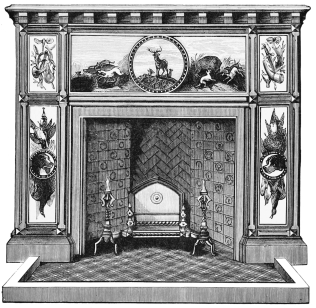
MINTON TILES FOR MANTEL.
So it is that money enough enables common folk now to dine in palaces and enjoy banquets quite as royally served and surrounded as Bluff Harry offered to Cardinal Wolsey and the lords and ladies at the Presence Chamber in York Place. But even that monarch could not have entertained his guests so luxuriously in one particular as Messrs. Spiers & Pond theirs; for these, having dined, may pass through a door and descend by a stairway adorned with Muses and mirrors, and rich with floral clusters, to a theatre all glorious in blue and gold, cushioned chairs, boxes with curtains of yellow satin and lace, and a good drab background to set them off, and pass the rest of the evening in enjoyment of well-acted comedies or operettas.
So far as most of the hotels and restaurants of London are concerned, one may with satisfaction follow the advice of the Duke of Gloster to Anne, in the first act of Richard III.:
“Leave these sad designs To him that hath more cause to be a mourner, And presently repair to Crosby Place.”
For the old Gothic palace in the City, which Sir John Crosby built on a piece of land with one hundred and ten feet frontage, for which he paid a little over eleven pounds, which his widow sold to the duke who afterward became Richard III., and which in Shakspeare’s time had fallen to the richest of Lord Mayors (Sir John Spencer), has now followed the course of so many royal buildings, and become the banqueting-hall of the public.
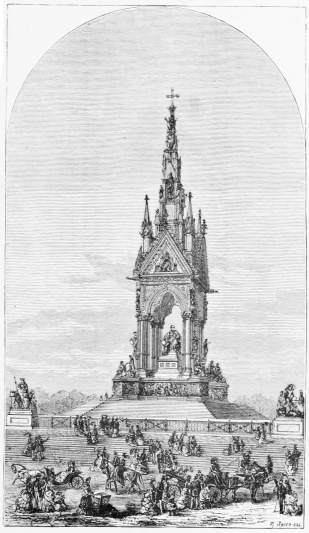
ALBERT MEMORIAL, HYDE PARK.
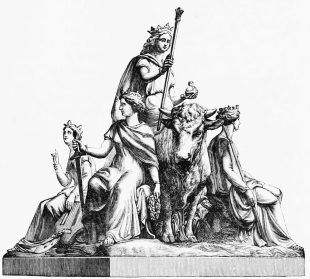
ALBERT MEMORIAL. EUROPE.
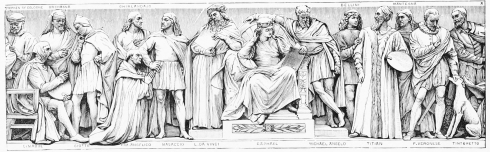
ALBERT MEMORIAL—EAST FRONT. PAINTERS.
Crosby Hall is haunted by memories of the great. It gives flavor to everything one eats in it to know that it has been celebrated by Shakspeare, that from the year in which it was built (1466) it was associated with whatever has been most romantic in the history of London. Here Sir John Rest was installed as Lord Mayor in the days (1516) when the Lord Mayor’s Show meant something. The civic procession which accompanied him contained four giants, one unicorn, one dromedary, one camel, one ass, one dragon, six hobby-horses, and sixteen naked boys. Here resided Sir Thomas More, Under-treasurer and Lord High Chancellor of England. Here he wrote his best works, and received the visits of Henry VIII. Here Erasmus visited the author of Utopia, whose domestic life he described: “With him you might imagine yourself in the academy of Plato; but I should do injustice to his house by comparing it to the academy of Plato, where numbers and geometrical figures, and sometimes moral virtues, were the subjects of discussion; it would be more just to call it a school and an exercise of the Christian religion. All its inhabitants, male and female, applied their leisure to liberal studies and profitable reading, although piety was their first care. No wrangling, no idle word, was heard in it; every one did his duty with alacrity, and not without a temperate cheerfulness.” In 1672 the hall was arranged for Non-conformist meetings. For ninety-seven years it was devoted to this purpose, and among those who preached here was Thomas Watson, who wrote the famous tract (Heaven Taken By Storm) which converted Colonel Gardiner. It is not wonderful that its old splendors then began to depart. The Mercury of May 23, 1678, advertised a sale at Crosby Hall, where would be disposed of, among other things, “tapestry hangings, a good chariot, and a black girl about fifteen years of age.” Then it became the office of the old East India Company; next a literary and scientific institute; next a wholesale wine warehouse; and at length came into the hands of its present proprietors, who have restored it to its original purpose by making it a banqueting-hall. They have preserved it, and stained its windows with portraits and pictures representing all its history. The decorations are in perfect keeping with the beautiful Gothic style of the building, and the colors seem to have expanded on it as a flower on its stem. One seems to be dining here in an older Guildhall and at a daily Lord Mayor’s banquet, with ancient Shakspearian characters for company. It is particularly entertaining to observe what a rich frieze can be secured for a hall in England by a skilful arrangement of the historic shields and coats of arms which belong to the country; while if some beautiful central figure on wall or glass is desired, it may be obtained in any one of the suggestive and mystical devices which are associated with the olden time—the boar, the lamb with its flag, and so on.
But neither the Criterion nor Crosby Hall furnishes, as I think, the same degree of beauty appropriate to dining-halls as may be found at the South Kensington Museum. Here one of the rooms was intrusted for decoration to Mr. Poynter, for a time President of the Art School there. He has made exquisite designs for the tiles of which the walls are altogether composed. The simple blue and white colors, and the purely decorative character of the figures thus made, make one almost regret that these figures are not Chinese instead of classic or allegorical, in which case one might eat with a feeling of comfortable seclusion in a china dish. The regular dining-room in the Museum was intrusted to Morris & Co., who have placed on the upper part of the walls a rich floral decoration of embossed plaster, colored (gray-green) by hand. The lower part of the wall, extending over two yards from the floor, consists of panels, on each of which is painted, on a gold ground, some allegorical figure. These figures represent the sun, the moon, and signs of the zodiac; they were designed by Burne Jones, and bear too much of that mystical light and expression which invest all forms and faces evoked by his magic touch to be gastronomically suggestive. In this respect neither Burne Jones nor the young artist (Murray) who painted his designs could rival the decorator of the Criterion; but one may dine at South Kensington amid one of the pleasantest little picture-galleries in existence. When Ralph Waldo Emerson was last in London, a poet who wished to give him a dinner conceived the happy thought of bringing him here, and the sage of Concord no doubt approximated his friend Alcott’s ideal of “dining magnificently;” even the “bowls of sunshine” with which A. would replace wine were supplied by the rich stained windows of Morris, and by the brilliant white-and-gold of the restaurant which separates the two rooms so exquisitely decorated.
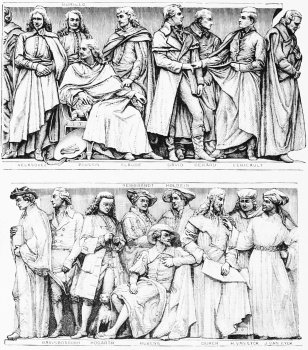
ALBERT MEMORIAL—CONTINUATION OF EAST FRONT. PAINTERS.
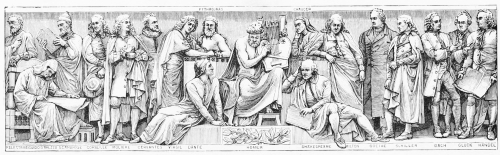
ALBERT MEMORIAL—SOUTH FRONT. POETS AND MUSICIANS.
There is no doubt that the barbaric element in English taste received a fresh accession of vigor with the advent of the Georges to England. What it was capable of, and what it found pleasing to the aristocratic butterflies who flitted around him whom they adored as “the first gentleman in Europe,” may be discovered in the Pavilion, at Brighton. That building may be regarded as the physiognomical monument of George IV. It is his cerebral interior projected into stone and decoration. The secret stairways and passages leading up to fictitious wardrobes, really door-ways to rooms which his majesty desired to visit, represent the prince that sent horsemen to trample down laborers at Peterloo, whose only guilt was to discuss their wrongs; the bizarre carvings, which make fine stone look like terra-cotta, illustrate the fop who had come to prefer figment to fact. The interior decorations do not represent so well the monarch whom Thackeray analyzed, and found in his h nds only a heap of pad, paint, gold-lace, but no man at all. Those frescoes were made during the first furor which occurred in England about Chinese and Japanese art; and, though ludicrously gorgeous, they are not without a certain interest, arising from the boundless freedom of their design and colors. How this can be it will be difficult for my reader to imagine, when he is told that the walls are covered with large dragons (life size, one might say, if dragons existed), serpents, wild cormorant-like birds, all having a grand field-day amid ladies and pleasure-grounds. The pillars are like barbers’ poles, with the archæological serpent twined around each instead of the red stripe. The Pavilion is said to have found in Mr. P. T. Barnum its only admirer. English critics have been rather hard upon it. Sydney Smith said that the structure looked “as if the dome of St. Paul’s had come down to Brighton and pupped.” William Cobbett thought that “a good idea of the building might be formed by placing the pointed half of a large turnip upon the middle of a board, with four smaller ones at the corners.” The main intent of the building is to imitate a Chinese pagoda, and it was with that aim that the Prince of Wales (for he seems to have been mainly his own architect) committed this enormity. Two years ago the British Association for the Advancement of Science gathered for its charming summer séances at Brighton, and the rooms of the Royal Pavilion were placed at their service. Never were the sessions of the Association so well housed, but it was amusing to witness the difficulty which even eminent savants had in the rivalry between the attractions of the wall-papers and the scientific papers. On the whole, it is to be feared that the grotesque ornaments left by the Regent carried the day. On one occasion, when a discussion occurred in the anthropological section on serpent-worshippers, the dragons and serpents on the wall were so appropriate that the room had the appearance of being frescoed for the archæological purposes of the day. But the ordinary contrast between the severe disquisitions of the scientific men and the luxuriant and barbaric colors and forms of the Pavilion was not so great as I witnessed recently in the same place. In the room which above all the rest might be regarded as the temple of vanity, a hundred ritualistic gentlemen and ladies had gathered to hold a prayer-meeting! In the evening there was a ball in the same room, and then it appeared plainly what had been the final cause of the Brighton Pavilion. I may add that the large building which George IV. erected for his stable, and whose roof is a vast dome, is now the chief concert-room of Brighton, and that another outlying building of the place is occupied by a fair picture-gallery, a good museum, and a capital library. Huish, in his Memoirs of George IV., says: “Nothing could exceed the indignation of the people when the civil list came before Parliament, in May, 1816, and £50,000 were found to have been expended in furniture at Brighton, immediately after £534,000 had been voted for covering the excess of the civil list, occasioned entirely by the reckless extravagance of the Prince Regent, whose morning levees were not attended by men of science and of genius, who could have instilled into his mind wholesome notions of practical economy; but the tailor, the upholsterer, the jeweller, and the shoemaker were the regular attendants of his morning recreations.” These mechanics were no doubt the worthiest folk who frequented the building they had made so fine, and probably most of them had to take their pay in royal smiles; but it would have relieved the indignant minds of the middle classes, who chiefly had to supply the exorbitant civil list, if they could have foreseen that their money was destined in the end to supply their favorite watering-place with an agreeable, instructive, and useful institution.
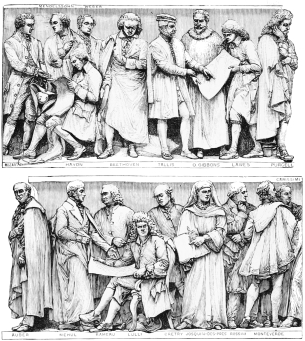
ALBERT MEMORIAL—CONTINUATION OF SOUTH FRONT. MUSICIANS.
When the English people now look upon the Royal Albert Hall they are quite warranted in drawing pleasant conclusions as to the change which has come over the spirit of royalty since the Pavilion was erected. Here we have the real monument of the late Prince Consort, who, however he may be estimated, certainly did have the ambition to be associated with the progress of science and art in England. Since the erection of the Coliseum in Rome no building so stupendous and noble has been built as this. It is a pile worthy of Rome in its palmiest days; and, with its superb oval form, and external frieze and cornice moulded after the Elgin Marbles, devoted to international industrial and art exhibitions and to music, it stands as grandly amid the European civilization of to-day as the Parthenon stood in Greece. This palace of art, and the Albert monument in the park opposite, make the beauty-spot of London. The latter is beyond question the finest monumental structure in Europe. This afternoon, while the golden sunset of a balmy spring day was glorifying the sky, I walked to it, passing by the old Kensington Palace, where the little girl was informed that she was Queen of England who has since had her name associated with her country’s longest period of peace and prosperity, passing beneath the ancient patriarchal trees and through the gardens beautified by flowers and plants from every region of the world, until at length I saw the spire of the monument shining like flame through the boughs. There against the clear, orange-tinted sky the monument stood forth, with its grand marbles at the four corners—Asia, with its genius mounted on a camel; America on her buffalo, Europe on her bull, Africa on her elephant, and each the centre of a representative group—and its noble reliefs and frescoes rising up to the winged angels at the top; and it appeared to me that every one of the one hundred and sixty-nine life-size portrait figures—the painters from Cimabue to Turner, the architects from Cheops to Gilbert Scott, who designed this monument; the sculptors from Chares to Thorwaldsen; nay, the very composers and poets from St. Ambrose to Rossini, from Homer to Goethe—had done something to raise this triumphal pile, about which their forms seem to move in stately procession. The architects and sculptors are the work of Philip; the poets, composers, and painters by Armstead; and while both have done admirably, it must be said that the reliefs by the latter are not surpassed by any modern sculpture. The group of Michael Angelo, Raphael, and Leonardo da Vinci, the kneeling form of Fra Angelico, are works such as can only be ascribed to that fine degree where intellect passes beyond ordinary analysis, and is called genius. Its central figure—Prince Albert—under the grand canopy, seems at first a conspicuous example of contemporary Hero-worship, showing that its highest and costliest homage is paid, not to any great Englishman—not to Shakspeare, not to Turner—but to a German, of whom it is certain that, had he not been a prince, he could never have excited so much attention as a hundred others of his fellow-men. At present the figure, not yet tested by time, is brassy enough, and is throned in brass; never was man more gilded over! But there is another side to this. The inscription runs: “Queen Victoria and her people to the memory of Albert, Prince Consort, as a tribute of their gratitude for a life devoted to the public good.” The Prince received no such credit during his life; he got smirching enough then; but, if time tells as well on his statue as it has on his reputation, this figure will become increasingly worthy of its environment. Though no great man, he will sit there surrounded by the allegorical representations of art, commerce, and the various types of peaceful civilization, to which he did unquestionably devote himself. And it is something that the noblest monument in Europe, though better deserved by some who have no monument but their work, has at any rate been raised, not to any brilliant devastator of human homes, not to any royal oppressor or scheming diplomatist, but to an ordinary man, who used the position and means intrusted to him for the refinement and moral well-being of the country that adopted him. While the legend of one section of Europe is Napoleonic, there is some significance in the fact that Albert should have transmitted that of another section; and the essential—the moral—beauty of every admirable monument is thus not wanting to that which graces the largest and wealthiest city of the civilized world.
If the spirit of Prince Albert revisits the glimpses of Rotten Row, his once favorite haunt, he must long for the day when wind and weather shall have subdued some of the obtrusive glitter of his statue. It is too bad to be seen with too little light during life, and too much after death. It is sufficiently curious, while gazing on this overpowering mass of gilded metal, to remember what his private feelings were when some snobbish officials of London City proposed to erect a monument to him twenty-three years ago. The following letter, all the more creditable because necessarily private—the matter never having assumed such shape that he could speak of it publicly—was written at a time when its writer was believed by many to be the real instigator of the proposed monument to himself. It was addressed to Lord Granville, and is as follows:
“Windsor Castle, 3d November, 1853.
“My dear Lord Granville,—Many thanks for your letter, evincing such kind interest in what concerns me.
“I did not see the letter in the Times, but I read yesterday’s leading article, which led me at once to considerations similar to those which struck you. Moreover, it is evident to me that the Lord Mayor started the plan chiefly as the means of bringing himself into notice, after other Mayors had gone to Paris, taken the lead in education, etc., and that the Times is attacking the plan chiefly to hit the Lord Mayor, as it had hit his predecessors. My unfortunate person will thus probably become their battle-ground; and, although the first article of the Times is civil, its music generally goes on crescendo, and the next may be purposely offensive, and meet with shouts of applause from a portion of the audience.
“Still, I do not see how I can, with any dignity or respect for myself, take notice of the squabble, and cry out for mercy, or to whom I could write such a letter as you suggest. I have never been consulted in any way in the matter, and the people have a perfect right to subscribe for and erect a monument in remembrance of the Great Exhibition; nor could I volunteer to say, ‘You must not connect it in any way with me.’
“I can say, with perfect absence of humbug, that I would much rather not be made the prominent feature of such a monument, as it would both disturb my quiet rides in Rotten Row to see my own face staring at me, and if (as is very likely) it became an artistic monstrosity, like most of our monuments, it would upset my equanimity to be permanently ridiculed and laughed at in effigy.
“The Times argument, however, that it would be premature to place a statue to me, is of no great force in this instance, as I suppose it is not intended to recognize general merits in me, which ought yet to be proved, and might possibly be found wanting on longer acquaintance, but rather to commemorate the fact of the Exhibition of 1851, over which I presided; which fact will remain unaltered were I to turn out a Nero or a Caligula.
“As in all cases of doubt what to do it is generally safest to do nothing, I think it better to remain perfectly quiet at present. If I were officially consulted, I should say, ‘Mark the corners of the building by permanent stones, with inscriptions containing ample records of the event, and give the surplus money to the erection of the museums of art and science.’
Believe me, etc., “Albert.”
Foley’s statue would be nobler if the last paragraph of this letter could be read on it, and if he could have contrived some plan to let every observer know that the book held by the Prince is the Catalogue of the Great Exhibition of 1851.
There is some reason why the English artists should have done their best work upon the monument of Prince Albert. He may be regarded as the first man to teach this country that money might well be largely expended for the encouragement of fine art, and that it had artists capable of the best work, if the means were adequately supplied to them. He was the means of employing scores of fine brains that had otherwise been unable to make their mark on the country, and he extorted from a grumbling, shop-keeping public the splendors which now render the South Kensington Museum and its surroundings institutions an art university for the world. Very different have been the resources and rewards of the artists who have built and adorned the structures I have been mentioning from those which were alone available when the frescoes were placed in the corridors of the Houses of Parliament. Nevertheless, the Prince Consort himself had to be taught by a German artist to look around him for the ability which was needed for English work. When he was appointed the commissioner for the decoration of the Houses of Parliament (1841) he made overtures to Cornelius to come over and do the work. The German artist replied, “Why should you come to me when you have the man by your side—Dyce?” Dyce, who had studied at Rome with Cornelius and Overbeck, was then professor in the School of Design at Somerset House; but he was little known as an artist, and had not competed when designs for the decoration of Westminster Hall had been invited. The Prince Consort at once suggested to him that he should send in a design; and having too little notice to make a new one, he sent in a study he had made for a fresco for the Archbishop’s palace at Lambeth. It was severely criticised, as too German, too papistical, etc.; but it was selected; and the result is the beautiful frescoes of the Baptism of Ethelbert, in the House of Lords, and of the Morte d’Arthur, in the Queen’s robing-room. How slowly the ability of Dyce was recognized in England may be estimated by the fact that one of his most admired works—“Paul Preaching to the Gentiles”—now in the South Kensington Museum, was employed at an art exhibition in Manchester as background to an umbrella-stand!
But Prince Albert does not appear to have required a hint from Germany to appreciate the Scotch artist—son of a shoemaker—whose superior genius overshadowed that of his wealthy Irish brother. Already, while Dyce was as yet undiscovered, Maclise had been appointed to set about those grand works which adorn the passage to the House of Commons. But the poor sums which were paid to both of these artists, and the grudging way in which they were dealt with, are now remembered only as a scandal. Dyce was sharply censured because he would not promise exact dates for the completion of his seven frescoes whose payment had been fixed by the Treasury at stated periods. Being rich, he offered to refund; but the Treasury, knowing that this would arouse some indignation, found it convenient to reply that “no precedent” could be found justifying its acceptance of his offer! Any one who looks upon Maclise’s two pictures—“Trafalgar” and “Waterloo,” the latter with three hundred figures, each perfect in line and expression—can but feel scandalized that Parliament proposed to pay him only £2000. Goaded by the outcry among the artists, it at length raised the sum to £10,000, but then grew sulky and cut off many of the commissions. In reality Maclise paid £30,000 for the honor of making those pictures. He gave the whole of four years to them at a time when his regular work never brought him less than £10,000 a year. When Cornelius passed through a South German town the ovation was such as no prince could command. When Maclise had completed his frescoes the artists of London presented him with a gold chalk-holder. The Prince Consort did all he could to raise an enthusiasm for decorative art in this country, and to raise the wages and the position of the artist and of the artisan, and he succeeded measurably; but time has sadly shown that he must have imported the climate of Italy rather than its schools to make this a country of beautiful frescoes. Although Cornelius magnanimously declined the overtures made to him, as above stated, in favor of Dyce, he consented to come to London and give advice concerning the proposed works. It was owing to him that frescoes were determined upon. He had seen the glory of the great frescoes of Munich; he could not see that in a few years they would be peeling off (as they are now) even there. Fortunately, Maclise resolved to put on his frescoes in silica, and they are yet fairly preserved; but all the pictures in the Houses of Parliament have had to be retouched from time to time, and the silica has such an attraction for the atmospheric moisture that the effect of the colors is frequently diminished. While it is thus manifest that the corroding damp of the English climate is hostile to mural ornamentation, and fatal to external frescoes, there is a steady increase of the desire for such things. This has been especially manifested among the English nobility, who have everything in the wide world that their hearts can desire, excepting only the climate that might comport with luxury and beauty.
That barbaric element in the English aristocracy, of which I have before spoken, which Mr. Matthew Arnold half likes while he impales its eccentricities, is constantly revealed in the contrasts between the baronial halls of England and the majority of the homes of the wealthy middle class. One may take as a specimen of the taste of the latter any one of the fine club buildings on or near Pall Mall. Here one feels that he is stepping on floors which the Pompeians would have thought somewhat sombre, but would have enjoyed, and amid walls and arches which they would have recognized as familiar, though strangely gloomy. The halls are large and spacious, rather costly than rich, built of purest granites and marbles of various hue; the reading, dining, and smoking rooms are comparatively quiet, and built with a view to comfort alone. The clubs represent the desire of gentlemen of means to pass their hours of leisure in palaces, and these are secured at an expenditure of less than a hundred pounds each per annum, even in the best of such institutions. But when one visits the castles of the nobility, such as are still inhabited, the fondness for color and romance is at once manifest. They love their rooms now blue, now green, and again rose-colored. They love classical frescoes—nude Muses, Graces, and Cupids chiefly—on the ceilings, and gay tints on the walls even of sleeping-rooms. In a word, my lords were sensational, and in some cases descended to the most vulgar tricks, as in the case which Wordsworth rebuked so sternly. On the occasion of a visit to Dunkeld the poet was taken into a room lined with mirrors, and where an artificial water-fall was set going by a spring being touched. The water-fall was reflected one way in the mirrors, but another way in the poet’s face, and soon after in his rebuke of such mimicry of Nature:
“Ever averse to pantomime, Thee neither do they know, nor us Thy servants, who can trifle so.”
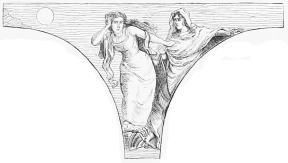
SPANDREL PICTURE.
But what could come of a generation trained by the royal standard which thought it beautiful to tie oranges bought in Covent Garden Market on the twigs of trees at Hampton Court for a garden party? The mansions of the nobility are still really the most tawdry and inartistic in their decorations of any class that have attempted decorations—mere blazings of white-and-gold; but there is an increasing number of exceptions, represented especially by some ancient families which have manifested a laudable desire to have their halls painted with pictures of legends or historical events connected with their neighborhood or their ancestors. Mr. William B. Scott, artist and poet, who has done excellent mural work of this character, has, I believe, fairly persuaded both the aristocracy and the artists of England that they cannot have Italian frescoes in this country, and must depend upon mural painting. In exhibiting specimens of his own excellent mural painting, before the Institute of British Architects, Mr. Scott made some interesting remarks on fresco. “In Italy,” he said, “the reign of fresco was a little more than a century in length. All the earlier works remaining are in tempera. Not many years ago it was not unusual to hear people talk of all early Italian wall paintings as fresco, but it is quite certain no such thing exists; the earlier frescoes, such as Mantegna’s works, in the Eremitani Chapel, in Milan, are miserable ruins; while the tempera pictures of Giotto, a century and a half older, in the Arena Chapel, in Padua, for example, are perfect. How, then, did it come about that fresco, which died out in Italy very shortly after Michael Angelo finished the Capella Sistini, had a revival in this nineteenth century in Munich and London? A very short narrative of the circumstances attending this revival will, I think, be enough. The associated body of young German students assembled in Rome in the beginning of this century aspired to better things than they found existing in the lifeless art about them. They reverted to the study of earlier art—to the actual reproduction of former art. They were also pietists—at least the two leaders, Overbeck and Cornelius; they found that their patron saint, Fra Angelico, painted in fresco; they found also that all the mythological, anti-religious pictures of the Bolognese school and later period were in oil: they determined on the revival of fresco. King Ludwig seconded them, and furnished an ample field for their success. The misfortune was, they did not go back far enough; they were self-denying men, and even the hardships and difficulties of fresco had attractions for them. It was like a revival of Tudor in mistake for a revival of the best period of Pointed architecture. Several English artists living in Rome, after the great success of the first very able works of these revivalists—my brother, David Scott, of Edinburgh, and William Dyce, for example—were smitten with the same feeling.”
Some eight years ago I had the pleasure of seeing the mural paintings with which Mr. W. B. Scott has decorated Sir Walter Trevelyan’s house, at Wallington, in Northumberland. No person could have been more appropriately selected for the work than Mr. Scott, who passed much of his early life in that region, and has written such beautiful poems upon its ancient legends. The first (ground-floor) series of paintings is on panels, enclosed between pilasters supporting arches; and a second is on the spandrels above the arches, in a corridor leading to the bedrooms, on the upper floor. The mansion is near the ancient Scottish Border, so haunted by romance, and near it may still be seen the remains of the ancient Roman Wall. In four of the panels the subjects are (1) the building of the Roman Wall; (2) King Egfrid offering the bishopric of Hexham to Cuthbert, hermit on Farne Island; (3) a descent of the Danes on the coast; (4) death of the Venerable Bede. On the opposite side are later subjects, but equally related to the same region of country: (1) “The Spur in the Dish”—the sign to the moss-trooper that the larder is empty; (2) Bernard Gilpin taking down the gage of battle in Rothbury Church; (3) Grace Darling and her father saving the shipwrecked crew; (4) “Iron and Coal”—the industry of the Tyne. The pilasters and the arcaded ends are also slightly decorated with foliage. The pictures on the spandrels are a series of eighteen on the old Border ballad of Chevy Chase. They are full of spirit, and their rich colors are like bursts of sunset along the ancient corridor. So much, indeed, depends on this color that it is impossible to convey the artist’s idea of mural painting by a woodcut. Nevertheless, I must confide to the imagination of my reader one characteristic design (page 147), “Women looking out for their Husbands and Brothers after the Battle of Chevy Chase.”
For his decoration of Penkill Castle, Ayrshire, Mr. Scott appropriately selected the old Scottish poem of The King’s Quair, or book (cahier, or quire, of paper), said to have been written by James of Scotland when a prisoner at Windsor, in 1420, on his love for Jane, granddaughter of John of Gaunt. The first picture shows the king in prison, turning from his reading for his pen. According to the canto in which the king describes his rising with the matin bell, there is pictured the bell, the warder, the night-watch going home, etc. In the second picture he looks from his window, and sees the fairest of womankind listening to the birds in the terraced garden. She has with her two maids and a little dog. Cupid—the Cupid of early art, a sort of pretty page—shoots at the king from behind a hedge. The third picture represents the royal poet’s dream, in which Master Cupid descends from the starry sphere to carry him away to the court of Venus, to obtain her assistance. These three pictures run along a flight of stairs, and the series is taken up with the next flight. In the fourth picture the poet finds all the lovers of history at the shrine of Venus. James prays on his knees to her, but she sends him to Dame Minerva’s court of wisdom for advice. Then we have the poet at the court of Minerva; next Lady Jane sending off the carrier-pigeon; and finally the royal poet receiving it. It requires but little reflection for any one to realize that to an ancient baronial castle such a series of paintings as this would be as the breathing of a soul beneath its gray ribs of rock. It must be mainly for the want of such pictures in them that servant-maids and children so often imagine ghosts rustling along old corridors and haunting antique stairways.
The castle of the Earl of Durham is graced by a fine stained window, illustrating the legend belonging to it of the slaying of the great worm, or dragon, by the Knight of Lambton; and the similar legend of Moore Hall is finely told in that mansion by the art of Professor Poynter. The last, however, is simply on canvas, and appeared as a large framed painting at the Royal Academy. It is, of course, necessary that a house should be very large and stately to bear mural paintings. The painting of panels is, indeed, becoming common in old houses which are well wainscoted, but as a general thing it is confined to the doors of more modern dwellings. However, a very fine effect has been produced in the dining-room of Mr. Birket Foster, at Witley, in Surrey, by inserting in the wall around the room a continuous painting by Burne Jones representing the legend of St. George and the Dragon. The stained glass which Morris & Co. have placed in the landing of the staircase, in the same beautiful residence, shows also that even a cottage-mansion of moderate size admits of a great deal more decorative color than is ordinarily supposed.
In passing from the consideration of works of a public and semi-public character I cannot refrain from paying some tribute to the most influential decorative artist whom England has produced, and whose death in April, 1874, all lovers of beauty are still mourning. Mr. Owen Jones carried into decorative art that spirit of archæological accuracy—one might almost say that profound scholarship—which was brought into pictorial art by Delaroche in France, Baron Wappers in Belgium, and Maclise in England. It is said that there was but one thing in England which the Shah of Persia wished to carry back with him to his palace—the Alhambra rooms, at the Crystal Palace; but of all their possessions, in the way of art, there is hardly one that the London people would so unwillingly part with. Yet it is probable that as little as the Shah the thousands who every week find in those rooms their châteaux en Espagne realize what it really cost to put them there. Mr. Owen Jones had passed his youth and his early manhood journeying, both personally and mentally, on the track of the race to which his fine culture belonged: he had studied the mystical figures and lines of Egyptian temples; he had pondered the principles by which reason and truth find expression in stone amid the ruins of Greece; he had learned the secrets of simplicity and grandeur in Rome, where were poured the converging streams of beauty from many tribes, each bearing its freight of faith and aspiration, to be deposited in marbles and monuments which are the gospels and bibles of a primitive world. By this path, which meant for him a growing culture, he came to dwell on the heights of Granada, as the recluse and devotee of Beauty, and when he thence returned to his native land he brought with him a new era. He expended a fortune on the grand folio of colored drawings of the Alhambra, which brought him no return, but a single copy of which is now a collector’s treasure. When proposals were being received for the decoration of the glass palace of the International Exhibition of 1851, Mr. Owen Jones offered to Prince Albert and the Royal Commissioners his plans. The Prince held out against them for some time; but the fascination was on him, and again and again he returned to the exquisite designs, until he surrendered to their charm. He selected Owen Jones with some tremor, but every year since the Palace has been transferred to Sydenham has shown that it was a felicitous incident of his life to have encountered the right man for a task which was to be of far more permanent importance than he supposed. Since then Mr. Owen Jones has not only given the large interiors of various great business establishments that beauty which makes many of them worthy of study and admiration, but he has won for himself and his country the highest honors of the three great Continental Exhibitions. It was with some amazement that the world found itself pointed to England as the leader in decorative art by the French Exposition of 1867. “It requires,” said the official catalogue of that exposition, “but a slight insight into modern domestic life in England to perceive how great a change has taken place within the last ten or fifteen years in the internal embellishment of the dwelling-houses of the upper and middle classes of society; and there can be little doubt that the extension of art education will lead still farther to the production and appreciation of articles which combine the three requisites of fitness of purpose, beauty of design and ornament, and excellence of workmanship.” It might be supposed by those who have not seen this master’s work that it consisted merely in clever imitations of the Moorish and other designs with which his name is associated; but, on the contrary, his chief excellence was, that he showed how the ideas and principles which underlie the great works of the past were capable of being led out into new forms and adaptations. In taking the chair at the Society of Arts, in 1851, on the occasion of a lecture on the arts and manufactures of India, by Professor Royle, Mr. Owen Jones, having accorded superiority to the Indian and Tunisian articles in the Exhibition of that year over all contributed by Europe, added: “Many of these specimens have been purchased by government for the use of the School of Design, and will, no doubt, be extensively circulated throughout the country. But it is to be hoped that they will do more than merely teach us to copy the Indian style. If they only led to the origination of an Indian style, I should think their influence only hurtful. The time has arrived when it is generally felt that a change must take place, and we must get rid of the causes of obstruction to the art of design which exist in this country.”
The Daily News, in an editorial article on the death of Owen Jones, said: “It was to bring the beautiful in form and color home to the household, and to mingle its subtle influences with the whole frame-work of social and family life, that the great designer we are lamenting labored all his life with the patient, unselfish enthusiasm of one to whom, though full of the keenest sympathy with all the great historic movements and events of his time, his art was his life.”
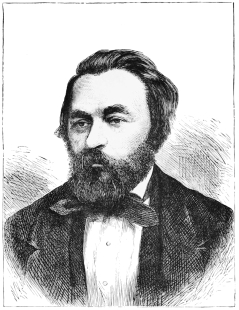
OWEN JONES.
The devotion of such a scholar and refined gentleman as Owen Jones to decorative art has helped to make an era in that kind of work. Before that it suffered in England from being regarded as a sort of upholstery, implying neither talent nor culture. Some gentlemen of culture and wealth recognized the genius of Mr. Owen Jones at a time when the Prince Consort was still inclined to regard him as a superior kind of upholsterer or house-painter, among whom must be especially mentioned Mr. Alfred Morrison, well known for his antiquarian and numismatical accomplishments. His residence in Carlton House Terrace is the truest monument of the genius of Owen Jones, and it is a work which need fear no comparison with any other, of whatever age or country. It makes the chief palaces of Northern Europe vulgar. Sádi tells us of one recovering from an ecstasy, who said he had been in a divine garden, where he had gathered flowers to bring to his friends; the odor of the flowers so overcame him that he let fall the skirt of his dress, and the flowers were lost. Some such account one must needs give of a visit to Mr. Morrison’s house. A thousand of the touches, the felicities, which combine to produce the happiest effects in this mansion, can by no means be conveyed from the place where they would appear to have grown. I will only mention a few suggestive features of this system of decoration.
The house is one of those large, square, lead-colored buildings, of which so many thousands exist in London, that any one passing by would pronounce characteristically characterless. It repeats the apparent determination of ages that there shall be no external architectural beauty in London. Height, breadth, massiveness of portal, all declare that he who resides here has not dispensed with architecture because he could not command it. In other climes this gentleman is dwelling behind carved porticos of marble and pillars of porphyry; but here the cloud and sky have commanded him to build a blank fortress, and find his marble and porphyry inside of it. Pass through this heavy door-way, and in an instant every fair clime surrounds you, every region lavishes its sentiment; you are the heir of all the ages. Entering a room for reading and writing, near the door, we are conscious of a certain warmth of reception even from the walls. They are of silk, made in Lyons, after a design by Owen Jones. The shade and lustre are changeable, but the prevailing color dark red. The design is as if an endless series of the most graceful amphoræ had suddenly outlined themselves, and the lines had taken to budding off into little branches. The surface is Persian, and the whole sentiment of the room is Oriental, without having in it a single instance where Oriental work has been copied. The carpet is Persian, but the design is by Owen Jones, the most noticeable figure being the crossed squares, making a star-shape to match a similar one on the coffered ceiling. This tapestry of silk starts a theme, so to say, which is carried, with harmonious variations, throughout the building, expanding in the larger rooms, until it recalls every variety of Etruscan shape, and taking on the most beautiful colors. There is a Blue Room, a Pink Room, a Yellow Room; yet in no case is there anything “loud” or garish in the tints. The ceiling of the reading-room is somewhat after the fashion of the best Italian work of four centuries ago—a kind of moulding in deep relief, which probably ceased to be much used because it was found difficult to make it without incurring the danger of its falling, so great would be the weight. But Owen Jones invented something which he called “fibrous plaster,” by which the most heavily coffered ceilings can be made with perfect security. It consists in first making the shapes to be used in wood; the wood is then covered with canvas, and this canvas is covered with repeated coats of the finest plaster, which is rubbed down into any mouldings required, and painted. The coffers here are star-shaped, and in each an inverted convoluted shell of gold. It is an indication of how finely the decorator has blended Oriental lustres and classic designs that the various antique objects and fine metal-work, done by the best Spanish, Italian, and Viennese workmen, after classic models, everywhere set about the rooms, have an easily recognizable relationship with the scrolls and forms on carpets, ceilings, and walls.
But neither the Lyons silk nor the Persian carpets can be pronounced unique in the same sense as the wonderful use made of various woods in this house. In the dado, jambs, chairboarding, we find no carved work, but simply the most exquisite combinations of ebonized and many-colored woods. Some of these, as the Indian holly, are so fine that the grain is invisible to the closest inspection. Other woods are so soft and beautiful that they have the surface of petals. Trees belonging to every land and clime of the earth have sent here their hearts, and, without a particle of pigment being used on any one of them, they gather to form rosettes on the chimney-pieces, cappings for the dados, and finest featherings around the doors—white, golden, red, cream-colored, brown, and these of every shade. The tables and chairs of several rooms are of this tarsia-work of forms untouched by staining or by metal.
In the library the book-shelves, which do the duty of a dado around the room, have alternate doors of glass and wood, and the latter are adorned with a foliation, over two feet high, growing from the bottom of the panel and leafing out at the top, which cannot be surpassed by any ancient marquetry. Above these shelves the green and gold lustres of the wall rise to a cone, which has the appearance of a blue and gold enamel, above which is an early Tudor ceiling of checker pattern, between reliefs of a large star with four shadings of different colors, or star within star, golden, dark, and white. The chimney-piece here may be regarded as a large arched cabinet, with fire-grate beneath, having two wings, in which are contained specimens of porcelain from Persia and Cashmere, which, old as they are, have an appearance of having been designed by the decorator of the room, who certainly never saw them until they came into the harmony he had prepared for them.
The drawing-room, whose windows overlook St. James’s Park, is a very large apartment, whose division, if it ever had any, has disappeared, giving an unbroken range to the eye, which, whether it takes in the whole effect or pauses to examine a detail, is simply satisfied. The fretted ceiling; the frieze of damask picked out with gold; the tarsia dado, a necklace surrounding the room; the chimney-pieces, one of which Lepec of Paris was two years in making—they are all fine without frivolity, cheerful without fussiness. One mantel-piece reminded me of what Baron Rothschild is said to have remarked once, when a fop was displaying his malachite shirt-studs, “Very pretty: I have a mantel-piece of it at home.” Some of the incised ornaments here are gems indeed, but in no case have they the appearance of being set there for their costliness; they are all parts of the general artistic work. One of the best features of this drawing-room is, that it is not “stuffed” with things. The objects in it are comparatively few, yet they are sufficient in number and variety; and being beautiful and interesting, one can look at each without being bewildered, as in some houses, where an idea seems to prevail that the model for a reception-room is a museum.
Mr. Morrison is a strenuous opponent of the general belief that the arts are deteriorating. He believes that as good work of any kind whatsoever can be done now as in any other age of the world, if one will only look carefully after the men who can do it. His experience has certainly been fortunate in discovering those who are able to make entirely original designs, and yet conceived in a purely artistic spirit; but then he has had all Europe at his command. The best metal-workers he has found in Spain and Vienna. In the former country he found out Zouloaga, a workman residing in the little town of Eybar, and from him has obtained chased and engraved metal-work such as almost any of our connoisseurs would be apt to date before the Renaissance on a cursory glance. One piece of work by Zouloaga is in the drawing-room—a large coffer, nine feet by three, covered with all manner of figures and scrolls in iron, wrought in relief, and with a finish which would have made Andre Buhl himself rejoice that his own fine cabinet (of which Mr. Morrison is the fortunate possessor) should have found a place under the same roof with that of the Spaniard. Mr. Morrison told me that he felt sure the man could do a fine piece of work, if encouraged, so he advanced him a thousand pounds, and told him to begin something on that. Zouloaga worked at the coffer for four years, and its owner saw at once that he had but paid an instalment of the real value of this marvellous work.
But though Mr. Morrison has had to go to Spain for ornamented metal-work, to Paris for his mantel-pieces, to Lyons for his silk, he has found that in no other country than his own was he able to secure the best wood-work. It may be, indeed, that if his desire had been for the most perfect carving, he might not have had the satisfaction of obtaining it in his own country—though some of the workers that Mr. George Aitchison appears to have got hold of may render even that doubtful. But in pursuing inquiries as to the means by which the exceedingly bold designs of Owen Jones for ornamentation with the colors of woods could be carried out (and the inquiries were not confined to this country), Mr. Morrison found that no house out of London was prepared to undertake a task that necessitated importations of select woods from all parts of the world. In Mr. Forster Graham, Owen Jones found a man able to enter into his ideas and to give practical effect to them. Indeed, the famous architect and decorator acknowledged his indebtedness to Mr. Graham for some effective suggestions for the improvement of the original designs. Those who know Mr. Morrison will easily understand that he too was by no means a mere by-stander while the work was going on. At any rate, he may now rejoice in having secured a home that has converted some portion of his wealth into a more real value. For there is nothing in this house not harmonious with its purpose. Every chair is as philosophically as it is beautifully constructed, and nearly every one is different from the other—one suggesting the perforated chairs of the Delhi palaces, and another the old Saxon throne in Westminster Abbey. It is related of a sensible and busy banker that, on being visited by some one, he said, “I have a line or two to write; pray take a chair.” “Do you know who I am, sir?” said the visitor, haughtily. “I am the Envoy Extraordinary of ——.” “Oh, are you?” said the banker; “then pray take two chairs!” This little story occurred to me as I was looking upon Mr. Morrison’s chairs, and I fancied the Envoy Extraordinary, if asked to take one, would probably have considered it as a significant mark of respect.
There is no sham in this house—no wood pretending to be metal, and no iron affecting to be marble. As each particle of a rose under the microscope has the rose’s beauty, so here each part of the mansion bears witness to the care and taste with which the whole is constructed—the table-leg as truly as the Lepec mantel-piece. We may ascend the magnificent stairway, past the globes of light upheld by bronze candelabra rising seven feet from the floor, and as we go from story to story find good, painstaking work meeting us everywhere—in the bedrooms, the nursery, the closets—some of the best ornamentation in the house being a pale blue-and-gold scroll surrounding the skylight at its top.
It is a pleasure to know that decorative skill has not passed away with Owen Jones. The house of Frederick Lehmann, Esq., in Berkeley Square, is the chef-d’œuvre of Mr. George Aitchison, one of the most celebrated architects and decorators in England, who has made the most of very favorable conditions, has called to his aid congenial artists and carvers, and has completed rooms which one would fain see themselves hung upon the walls of the Royal Academy, and not merely the designs of some of them, which were, indeed, exhibited there. The house is ancient, and, though not very large, built liberally and substantially, evidently in the days when Berkeley Square was near enough to “the country” for space to be of less consideration than now. In the course of the recent improvements there was found behind an old chimney-piece a playing-card, upon the back of which is written an invitation from a Mrs. Murray to Lady Talbot to pass the evening at her house; and Mr. De la Rue declares that no card of a similar character has been manufactured for a hundred and fifty years. Even farther back in time than that we may safely place the old-fashioned, nearly square hall—about twenty feet by seventeen—which is at once hall and vestibule. It contains tables, cabinets, and a stand for flowers, and the modern decoration sympathizes with what appears to have been the old idea of a vestibule—a sheltered cortile. The general tint is a very pale green, the surface-panelling large, and ornamented with stems starting from a common root and ending each in cones. The stems and cones curve toward each other, and form a sort of circular grouping. A door on the left introduces us to the library, whose walls are shelves of richly carved walnut, above which is a dark leather frieze, which elegantly sets off the treasures of ancient pottery and other antique objects which make the interesting finish of the well-stored book-shelves all the way around the room. At a certain point the books prove to be dummies, an unsuspected little door flying open at a touch and revealing a lavatory. In this library, where startling effects of any kind would be out of place, there are no plays of color, but ample light falling upon the exquisitely carved table for writing in the centre, which is the most remarkable for its conveniences and contrivances that I have ever seen.
Ascending to the drawing-rooms, we enter first a small apartment, whose floriated ceiling gives the effect of a bower. Between this and the golden cornice is a cove of inlaid gold, upon which are traced leaves of wistaria, interspersed with light pink clusters of the phlox. The chief ornament is a large cabinet, reaching nearly to the cornice—ebony and ivory—recently brought from the Vienna Exhibition: it contains specimens of Eastern porcelain and various curiosities collected by Mr. Lehmann, who would appear to have voyaged around the world and found relics of all civilizations and all the ages of art. This, however, is but an anteroom to the chief drawing-room, with which it communicates by a large double sliding-door. This door and another like it which admits to the dining-room are truly superb. They have a frame of ebonized wood, enclosing panels of finest-grained amboyna. The ebonized wood is foliated with gold, and the long central panels are adorned with ovals of olive-colored Wedgwood ware, presenting classical figures. The smaller panels above and below have at their centres squares of the same. Each door has a capping of gold floriation and a draping of French embroidered silk, at once heavy and delicate, like tapestry. The walls are of a dark reddish-brown color, arranged in large panels (from floor to cornice), enclosed by a fine painted edging. This background elegantly sets off the pictures, which are all excellent, some of them being among the best water-colors of Turner. The ornament which chiefly strikes the eye in this room is a matchless frieze, painted by the eminent artist Albert Moore, the design being peacocks, their long trains in repose. The cornice above this is of the egg-pattern, with a fretting above. The ceiling is, in a manner, panelled; that is, it has on each side stiles or beams crossing each other, making the large central space and the side spaces almost deep enough to be called coffered. These cross-beams are finely feathered with gold, and the interspaces are adorned with curved boughs, which have small pointed leaves terminating in round decorative flowers. The fireside of this room is highly ornamented. The grate is antique in general appearance, but novel in structure; the silver owls (life-size) sitting on either end of the fender-bar, and the old brass mountings of the fire-dogs, have come from the past to guard a grate which slides backward and forward as the regulation of the heat given out may require. The tiles are representations of six varieties of humming-birds, a paroquet, a sun-bird, and several other feathered beauties. Near by is a folding screen of brilliant Japanese silk. The room is covered to the border of the parquetage with a bright Persian carpet. In the dining-room the original ceiling, with dark oak reliefs (curved), has been retained—not happily, I am afraid, such ceilings always absorbing too much light. Mr. Aitchison has given the spaces a luminous decoration, but nevertheless the dark wood-work above can only be retained by the use of a corresponding shade in the furniture. This furniture is of rare beauty. The sideboard is most delicately carved, and the serving-table inlaid with medallions of ivory, the designs of which, by Albert Moore, represent various animals and fruits suggestive of the uses of the room. There is a chimney-piece of ancient work—ebony, with side pillars and excellent gold settings; but a comparison of this bit of last century work with the furniture recently made is likely to raise a question in the minds of those conservatives who insist that the making of beautiful things is a lost art. It is a pleasure to find hung in a room where each object bears the trace of really fine art that portrait which has long been acknowledged to be the ablest work of Millais, representing Mr. Lehmann’s little daughter seated upon a Minton garden-seat on a lawn. When this picture was exhibited at the Royal Academy, a few years ago, a writer in the Fortnightly Review pronounced it the work which, among modern English productions, most recalled the peculiar vitality and sentiment which have given the old masters their fame. I had the pleasure of seeing the little lady at that time in her boudoir, to make which beautiful Mr. Aitchison appears to have put forth his talent as earnestly as Mr. Millais to paint her picture. A blue border encloses the large panels of the walls, on which are fleur-de-lis spots, and a bittern at each panel centre. The frieze is painted in graceful floriations of lemons, and the cove above is adorned with balsam and jasmine. The apartments of Miss Lehmann, thus tenderly but not gaudily adorned, open into the sleeping-room of her parents. This also is simply beautiful. The walls are of a delicate blue shade, and all the textures appear as if inwoven with softened sunshine. Mr. Smallfield’s genius has here been brought into requisition, and he has painted beautiful groups of flitting birds over the doors. The same artist has painted boughs of apple-blossoms upon the door-panels in the boys’ room. But his finest work is a frieze in Mrs. Lehmann’s boudoir—for such her monogram, woven in the Persian carpet and carved in the marble mantel-piece, announces it to be—which consists of doves, swallows, and flowers in pots. Mrs. Lehmann’s boudoir is on the same floor with the dining-room, from which it is separated by a charming little sitting-room. The walls of this last-named room are entirely covered with the finest Gobelin tapestry, above which a deep cornice of chased gold supports a cove, chocolated, with decoration of silver leaflets.
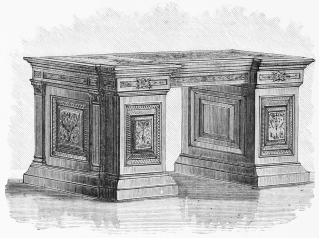
EBONY SERVING-TABLE, MR. LEHMANN’S HOUSE.
No wall-paper at all is used in this house. The ornamentation of the walls throughout has been put on by the hand, and generally by pouncing. Perhaps it may be well enough to state that the method of pouncing is far more expensive than that of stencilling. In pouncing, the figures to be painted on the wall are first pin-punctured on paper; this paper is then laid on the wall and beaten with bags of colored powder. When the paper is removed, each ornamental form is delicately outlined on the wall in innumerable fine points. It is then necessary that the decorative artist should trace the figures with a pencil, and afterward paint them. Stencilling, which is less costly than this by about one-third, consists simply in direct painting through perforated metal, though it is necessary in most mural work that the blank interstices so left should be painted over by hand. The latter work is, however, always more stiff than the pounced. The friezes have been painted on canvas, of course, since no gentleman would allow his possession of works by such artists as those whom Mr. Lehmann has employed to depend upon his remaining in any particular house. It is, indeed, a very significant thing that such men as Albert Moore and Smallfield should have been found ready to undertake work of this description; for, though it is a return to such work as Giotto and Michael Angelo were glad to do, we have heard of late years occasional sneers at “mere decoration.” Strictly speaking, all art is mere decoration. There are other instances also where artists of the greatest eminence have done excellent work of this character. In the house of the Hon. Percy Wyndham, Belgrave Square, there is a grand staircase, which has on the wall, near one of its landings, five life-sized classical figures, by Sir Frederick Leighton, and at the top a deep frieze of cormorants, storks, and other wild birds; and the dining-room of the same beautiful mansion has been elegantly adorned by Mrs. Wyndham—herself an artist—aided by Mr. V. Prinsep.
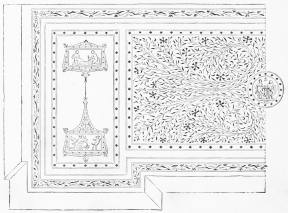
TOP OF SERVING-TABLE, MR. LEHMANN’S HOUSE.
The pleasure with which I have visited Mr. Lehmann’s house is just a little tempered by the difficulties I have found in the effort to convey some impression of it. Passing down the stairways amid the delicate hues lighting them up at every turn, and through the door-ways curtained off from halls by rich Oriental draperies, and finding myself again in the embowered square at the front of the house, I feel conscious of an utter inability to give any reader an adequate conception of the decorations amid which I have invited him to wander in imagination. Let any one who has passed a morning in visiting the interiors of the old Venetian palaces attempt to describe them! He will have a dreamy impression of soft colors fading into each other, of apartments that have caught on their walls the tints of rosy morning and golden evening, and held them in a thousand little contrivances to catch such sunbeams, and he will feel that the subtle influences of beauty have overpowered his analysis. The finer secrets of art elude detection, much more explanation, like those of nature.
The houses I have been describing are those of millionnaires. Whatever may be thought of the large sums expended on their mansions, they do not suggest the remark made by a wit to a gentleman as remarkable for spending little as for making much, “You cannot take all this gold with you, and if you did, it would melt.” They have preferred that their gold should be transmuted in this world, and into forms that are none the less beautiful for being costly. They are men who occupy a somewhat abnormal position even in wealthy London, and one which admits of a correspondingly rich and even grand environment. They have occasion, and are able, to have rooms which relate them to a large and cultivated world, while they can reserve for domestic privacy apartments that fulfil the want which to others is the only end of a home—a centre amid a busy and weary world for friendship, love, and repose. Even in these grand palaces one may, indeed, witness a modesty and reality which contrasts favorably with the at once stimulating and exhausting splendors of the princely dwellings of the past. There is no attempt here to heap into the rooms the great works of art which appropriately belong to the community, and should be set up in edifices built for the common benefit. One perceives, too, that the time has passed away when Madame de Guerdin could define the life of an apartment as consisting in “fires, mirrors, and carpets.” The life of an apartment consists in the degree to which it subserves its end. The decoration of the salon may well sympathize with the gayety of festive occasions, for it does not exist for the family alone; but in the more private rooms the tired limbs will require rest on chair or couch, and equally the eye will need rest upon soft and subdued shades.
There will, however, arise in the mind of many a reader of the poor descriptions I have been able to give of these two houses (which represent an exceptional class) a moral misgiving. Is not all this a waste of money that might have been expended for greater and nobler purposes? Is not all this mere luxury and extravagance? Well, in the first place, it is difficult to draw the line between the beauty which Nature seeks as she climbs to flowers and man as he decorates his dwelling, and the luxuriousness which makes external beauty in itself an end rather than a means. Take away all that has been added to our homes by art, and we all become naked savages living in mud or log huts. But, in the second place, what about this “waste of money” so often charged against expensive decorations? Poor Zouloaga, working in a little peasant village of people poor as himself, might not have the same charge to bring against the wealthy Englishman who found him out. He and a host of artists and artisans in this and other countries might find more wisdom in Rhodora’s philosophy, that
“if eyes are made for seeing, Then Beauty is its own excuse for being;”
and they might add that if the taste and skill which are able to make beautiful things exist, there may be good reason why a demand should also exist for what they can supply. I do not propose to argue the vexed question of political economy concerning the degree to which luxury is justified by its distribution of capital among laborers, but it seems very clear that there can be no reason to deplore the free or even lavish expenditures of the wealthy for objects which are not in themselves pernicious.
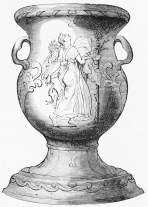
POT DESIGNED BY MISS LEVIN.
It has been one particularly gratifying incident of the passion for decoration in this country that it has been the means of opening to women beautiful and congenial employments. Miss Jekyl, who was one of the first to take up this kind of work, attracted the attention of Sir Frederick Leighton, Madame Bodichon, and other artists by her highly artistic embroidery, and has since extended her work to repoussé, or ornamental brass-work—especially sconces—and many other things. She has, I hear, acquired not only distinction but wealth by her skill, some specimens of which are exhibited in the International Exhibition at South Kensington this year. There, also, may be seen the work of other ladies who have followed in her footsteps, some of the finest being by a Miss Leslie, a relative of the celebrated artist of that name. Indeed, there has now been established in Sloane Street a school for embroidery, which has succeeded in teaching and giving employment to a number of gentlewomen who had been reduced in circumstances, and whose success those who observed their contributions to the Centennial Exhibition at Philadelphia will not underestimate. Miss Philott, whose paintings have often graced the walls of exhibitions, and have gained the interest of Mr. Ruskin, has of late been painting beautiful figures and flowers on plaques, which, when the colors are burnt in by Minton, make ornaments that are eagerly sought for. A Miss Coleman has also gained great eminence for this kind of work. Miss Lévin has displayed much skill in designing and painting pots, plates, etc., with Greek or Pompeian figures. The painting of panels with vines, blossoming branches, and even birds, is also a pretty industry of this kind. The late Miss May Alcott was very ingenious in this kind of work, and several specimens of her art are preserved with care in England. Many of these ladies have begun by undertaking such work as this for personal friends, but have pretty generally found that the circle of those who desire such things is very large, and that their art is held in increasing esteem among cultivated people. It is even probable that the old plan which our great-grandmothers had of learning embroidery will be revived in more important forms, and be taught as something more than the accomplishment it was once thought.