DECORATIVE ART AND ARCHITECTURE IN ENGLAND. (continued 2)
Reading edition
It has been found, too, that artists, architects, decorators, and the numerous workmen they employ have great respect for any woman who can do anything well, which contrasts favorably with the jealousy which the efforts of that sex to find occupation in other professions appear to have aroused. One example of this is particularly striking. A good many years ago I heard of a young lady of high position who was making almost desperate efforts to win her way into the medical profession. She had taken a room near one of the largest hospitals in London, to which she was not openly admitted, that she might study cases of disease or injury, but where, through the generosity of certain physicians, she was able, as it were, to pick up such crumbs of information as might fall from the table of the male students. By dint of her perseverance means of information and study increased. I visited her room near the hospital, and found this young lady surrounded by specimens such as are conventionally supposed to bring fainting-fits on any person of that sex at sight. I found that, being excluded from the usual medical and surgical schools, she had been compelled to employ lecturers to teach her alone. Fortunately she had the means of doing this, but it amounted to her establishing a medical college, of which she was the only student. That lady is now known as Dr. Elizabeth Garrett-Anderson, an eminent physician, who has done not her sex alone but this entire community a great benefit, by showing that a woman’s professional success is not inconsistent with her being a devoted and happy wife and mother. By the side of the long struggle through which she had to go to obtain her present position—a struggle in which many a woman with less means and courage has succumbed—I am able to place the experience of her younger sister and of her cousin, Agnes and Rhoda Garrett, who have entered into a partnership as decorative artists. These young ladies, it may be premised, have by no means been driven to their undertaking by the necessity of earning a livelihood. They belong to an old family of high position, and are as attractive ladies as one is likely to meet in the best society of London. But, like the better-known ladies in the same family, Dr. Garrett-Anderson and Mrs. Professor Fawcett, they are thinkers, and they have arrived at conclusions concerning the duties and rights of their sex which forbid them to emulate the butterflies. A few years ago, when the decorative work of such firms as Messrs. Morris & Co. began to attract general attention, it appeared to them that it offered opportunities for employment suitable to women. They determined to go through a regular apprenticeship; and though they were met by looks of surprise, they were not met with any incivility. One gentleman allowed them to occupy a room at his offices, where they might pick up what knowledge they could in the art of glass-painting, and here they awaited farther opportunity. The architect who had been connected with this glass-staining firm separated from it, and, having begun a business of his own, accepted the application of the Misses Garrett to become his apprentices. They were formally articled for eighteen months, during which they punctually fulfilled their engagement, working from ten to five each day. Of course there were good stories told about them. Some friend, calling upon them, reported that, though the interview was interesting, the ladies could not be seen, as they were up on a scaffolding, lying flat on their backs close to a ceiling which they were painting. From that invisible region their voices descended to carry on the conversation. The ladies themselves were quite able to appreciate all the good-humored chaff attending their serious aim. When their apprenticeship reached its last summer they went on a tour throughout England, sketching the interiors and furniture of the best houses, which were freely thrown open to them. They are now an independent firm, with extensive business, and have gained fame, not only by their successful decoration of many private houses, but by their admirable treatment of the new female colleges connected with the English Universities. Mr. J. M. Brydon, of Marlborough Street, is the architect who has the honor of having had these ladies for apprentices; and these ladies assure me that during their stay there and in their work since they have met with no act of incivility. Occasionally the workmen may stare a little at the unaccustomed sight of ladies moving about with authority, but they are most respectful when they find that there is intelligence behind the authority. From a friend of these ladies I heard a significant anecdote. They directed that a certain kind of mixture with which paint is generally adulterated should not be used. When they came to look at the work they found that the mixture had been used, though it is what no untrained eye could detect. They called the painter to account, and he said he had used very little of the mixture indeed.
“That is true,” said one of the ladies, “but we told you not to use a particle of it.”
The painter was amazed, and at last said, “Will you be kind enough to tell me how you knew that mixture had been used?”
It is precisely this knowledge which everywhere secures respect. The Misses Garrett have made themselves competent decorators; they undertake the wall decorations, upholstery, furniture, embroidery, etc., as fully as any other firm.
There are many ladies employed in the new Kensington School of Embroidery, which has a branch at Belgravia, in ornamenting with needle-work stuffs for chairs, sofas, screens; and I have heard of a scheme which includes art-work for ladies’ dresses. In the ancient code of Manu it is said, “A wife being gayly adorned, her whole house is embellished; but if she be destitute of ornament, all will be deprived of decoration.” It is not a little curious to find the remote descendants of those whom Manu thus instructed including female dress among the concerns of decorative art. This is, indeed, theoretically done in the lectures given at South Kensington, and Charles Eastlake has interspersed some valuable hints concerning ladies’ dress in his work on Household Taste. In this matter a quiet revolution has been for some time going on in London. It is said that the artists of England once thought of getting together and making some designs for dresses, which they would recommend to ladies; they did not do so formally, but they have certainly availed to modify very materially the costumes visible in thousands of English drawing-rooms. The “pre-Raphaelist lady,” with her creamy silk, short-waisted and clinging—at once child-like and antique—was the earliest revolutionary figure in evening companies. She was followed by the Queen Anne dame, budding and great-grandmotherly, whose raiment Punch and theatrical Judies have been “taking off” just a little after the dame herself had transformed it into its beautiful variations. These pretty reformers have emancipated Fashion herself: there is no uniform for ladies any more. At a fashionable party lately I was unable to pick out any two ladies out of a hundred whose dresses were cut alike, and the variety of colors suggested a fancy-dress ball. Yet these colors were all of moderate shades, and Hippolyte Taine himself must have admitted that very few of them were “loud.” It would not at all surprise me if the world which has so long laughed at the Englishwoman’s dress should some fine evening glance into one of these modern interiors and feel as if the ladies are among the most agreeably dressed of womankind. But I must return from this digression.
The Misses Garrett appear to have an aim of especial importance in one particular. They tell me that they have recognized it as a want that a beautiful decoration should be brought within the reach of the middle-class families, who are not prepared or disposed to go to the vast expense which the very wealthy are able and willing to defray, thereby occupying the most eminent firms. They believe that with care they are able to make beautiful interiors which shall not be too costly for persons of moderate means. This can surely be done, but it can only be through a co-operation between the owners of the house and the decorators which shall make it certain that there shall be nothing superfluous. If an individual wishes a beautiful home, especially in dismal London, it is first of all necessary that he or she should clearly understand what is beautiful, and why it is desired. The decoration will then, in a sense, be put forth from within, like the foliage of a tree. In each case the external beauty will respond to an inward want, and be thus invariably an expression of a high utility. Nowhere more than in the homes of the great middle classes is there need of beauty. Their besetting fault is a conventionality which often lapses into vulgarity, and their thoughts (so-called) are apt to be commonplace. The eye is often starved for the paunch. The pressure of business sends every man engaged in it home fatigued, and yet it is only when he enters that home that his real life, his individual and affectional life, comes into play. On the exchange, in the office or shop, he has been what commerce and the world determine; he has been but perfunctory; but now he shuts the door behind him, and his own bit of the day is reached. What is the real requirement for this person? Does a house that furnishes him bed and board suffice him? or, which is of greater importance, does so much alone suffice others who dwell habitually in it?
Here I may mention a work of much importance by J. J. Stevenson, of the Royal Institute of British Architects, entitled House Architecture. It is in two volumes—the first devoted to Architecture, the second to House-planning. The general aim of this work is stated by the author, one of the ablest and most successful architects in England, in an introductory chapter from which I quote. “To build a house for one’s self is an excellent education in architecture. By the time it is finished, and the owner has lived in it, he feels how much better a house he could build with the experience he has acquired, if he had to do it over again. While the work is going on his attention is called to questions he had never thought of before, which are now of the greatest interest to him. He examines the houses of his friends, and discovers features in them which he wishes, when too late, he had introduced in his own plans. The designs are altered and the cost increased. His taste in architecture and his ideas about planning are changed by his new experience; the building is too far advanced to adopt the improvements, and the house which he had hoped would be perfect is a source of trouble and disappointment. He could build another house to his mind, but to go through the experience once in a lifetime is enough for most people. To have, before commencing the building of a new house, the knowledge which the experience of building gives in some imperfect and fragmentary way at the end of the process, would save the owner trouble, expense, and after-regret. To attempt to supply this is the object of this book.” An admirable book it is! There are a hundred and ninety excellent wood-cuts in it also. The entire science of lighting, warming, ventilation, drainage, materials, and construction is here clearly set forth. A man who has the means to build a house for himself, and who really wishes it to be as genuinely related to his human self as to the nautilus its shell, should study carefully this work, unless he can get a better, in which case he will be more fortunate than I have been.
But Mr. Stevenson’s book does not extend to the decoration of walls after they are built. The house stands in native worth, but not yet in honor clad. There ought not to be less reality and utility in the ornamentation of a house than in its construction. In the ancient Chinese Analects we read that Kih Tsze-Shing said, “In a superior man it is only the substantial qualities which are wanted; why should we seek for ornamental accomplishments?” Tsze-Kung replied, “Ornament is as substance; substance is as ornament: the hide of a leopard stripped of its hair is like the hide of a dog stripped of its hair.” It would be difficult to find in literature a finer or more philosophical statement of the deep basis of Beauty than thus comes to us from a period of near three thousand years ago, and from a race whose applications of decorative art to objects of every-day use are models for Europe. The spots of the leopard are the sum of its history; its hair is the physiognomy of its passion and power; it bears on its back the tracery of the leaf and sunshine amid which it hides, and the purpose of the universe hides with it. Transferred to floor or sofa in a room, the coat of that cat is a bit of the wild art of nature, full of warm life, purely pictorial; more beautiful than the skin of our domesticated cats, because these have been adapted to other purposes, and reduced to an environment of less grandeur. But strip the two of their hair, and they are only larger and smaller pieces of leather, and the depilated hide of a dog is the same. All of which confirms Tsze-Kung’s dictum, that ornament is substance; and it at the same time suggests the converse truth, that throughout the universe there must be substance to insure true ornament. When we ascend to the region of finer utilities—those, namely, which are intellectual, moral, spiritual, social—we discover that household art is another name for household culture. What germ in the child’s mind may that picture on the wall be the appointed sunbeam to quicken? What graceful touch to unfolding character may be added by the modest tint of a room? Who can say how much falsehood and unreality have been shed through the life and influence of individuals by tinsel in the drawing-room and rags up-stairs?
Just now we are the victims of two reactions. Our ancestors made external beauty everything, and the starved inner life of man rebelled. Puritanism arose, with grim visage, turning all beautiful things to stone. From it was bequeathed us a race of artisans who had lost the sense of beauty. A reaction came, in which the passion for external beauty displayed itself in an intemperate outbreak of gaudiness and frivolity. We are sufficiently surrounded by the effects of the reaction, sustained by wealth without knowledge or taste, to make Charles Eastlake’s description appropriate to ninety-nine out of every hundred English homes: “This vitiated taste pervades and infects the judgment by which we are accustomed to select and approve the objects of every-day life which we see around us. It crosses our path in the Brussels carpet of our drawing-rooms; it is about our bed in the shape of gaudy chintz; it compels us to rest on chairs and to sit at tables which are designed in accordance with the worst principles of construction, and invested with shapes confessedly unpicturesque. It sends us metal-work from Birmingham which is as vulgar in form as it is flimsy in execution. It decorates the finest possible porcelain with the most objectionable character of ornament. It lines our walls with silly representations of vegetable life, or with a mass of uninteresting diaper. It bids us, in short, furnish our houses after the same fashion as we dress ourselves, and that is with no more sense of real beauty than if art were a dead letter. It is hardly necessary to say that this is not the opinion of the general public. In the eyes of materfamilias there is no upholstery which could possibly surpass that which the most fashionable upholsterer supplies. She believes in the elegance of window-curtains of which so many dozen yards were sent to the Duchess of ——, and concludes that the dinner-service must be perfect which is described as ‘quite a novelty.’” Mr. Eastlake well says, also: “National art is not a thing which we may enclose in a gilt frame and hang upon our walls, or which can be locked up in the cabinet of a virtuoso. To be genuine and permanent, it ought to animate with the same spirit the blacksmith’s forge and the sculptor’s atelier, the painter’s studio and the haberdasher’s shop.” Under the influence of such scornful words as these, persons of taste and culture have risen in reaction against the reaction, and the result is that there are now in London several thousands of homes which have filled themselves with those old shreds of beauty which Puritanism cast to the winds. Most of these are the homes of artists or virtuosi, and, as they have thus set the fashion, a still larger number have tried to follow them. A genuinely old thing is competed for furiously; and as it is apt to go with the longest purse rather than the finest taste, we find the past as often re-appearing in a domestic curiosity-shop as in a beautiful interior.
Now, Puritanism in its day was one of the useful things, and if we do not see the traces of beauty which it has left, the fault is in our own eyes. The artists know very well that if it had spared the old furniture for the main uses of our present society, the effect would be as unlovely as if our homes were all buttressed and turreted in feudal style. Feudalism and Puritanism have alike left to us just as much of the styles of their ages as we need—enough to give, as it were, a fair fringe to the appropriate vestment of to-day. A house made up of antiquarian objects is a show-room, a museum, but not a home. We have fallen upon an age when cultured people know that external beauty is but one means to integral beauty, and when the prophets of that higher end can see that the very flowers of the field are ugly, if they drink up that which ought to turn to corn and wine. Much is to be said for the antiquarian taste, if it does not run into an antiquarian passion. It may safely be admitted that our churches need not be sombre nor our services gloomy; that a few good pictures would not harm the one, nor more poetry and music the other; but what is to be said of those who find in albs and chasubles and incense-burners the regained Paradise of man? Old lamps are not always better than new.
Much is said from time to time about the ugliness of London street architecture. I have already quoted the London Times’ sentence about “our ugly but not altogether uncomfortable old metropolis.” The ugliness is mentioned at various points of this work. But there are two kinds of it; as the famous Boston divine said there are two kinds of fools—“the natural fool, and what the carnal mind, oblivious of its duty, would call a d—fool.” When Temple Bar was removed from Fleet Street because it was an impediment, the Corporation of London devoted £10,000 to putting up in the centre of the street a columnar monstrosity, carved with busts of royal personages, griffin-crowned. This is the kind of London ugliness which suggests the definition of the carnal mind. An effort was made in Parliament to get it removed; but it was too large for Madame Tussaud’s “Chamber of Horrors;” and perhaps it is as well that it should remain, as the monument of that vast amount of wealth which is continually embodied in the ugliness which Puritanism made a passion in the average middle-class Englishman. But the other kind of London ugliness is represented in the miles on miles of yellow-gray and sooty, brick houses, each as much like the other as if so many miles of hollow block were chopped at regular intervals. And yet there is something so pleasant to think of in these interminable rows of brick blocks, that they are not altogether unpleasant to the eye. For they are houses of good size, comfortable houses; and their sameness, only noticeable through their vast number, means that the average of well-to-do people in London is also vast. It implies a distribution of wealth, an equality of conditions, which make the best feature of a solid civilization. There is much beauty inside these orange-tawny walls. Before any house in that league of sooty brick you may pause and say with fair security: In that house are industrious, educated people; there is good music there; and good English, French, and German literature; pictures of noble men and heroic events are on the walls; they have made there, within their mass of burnt clay, a true cosmos, where love and thought dwell with them; and between all that and a fine outside they have chosen the better part.
But, while not forgetting that the body is more than raiment, we need not forget that it can never be fairly expressed, in any but a coarse way, save through the raiment related to it. On this we must insist, that when individuality has been cultivated there should be an harmonious and organic relation between the individual and his dwelling-place. In a normal society each man would be able to build his house around him as he builds his body, and to take the past, the east, the west, for his materials as much as brick or stone. “Let us understand,” says the wisest adviser of our time, “that a house should bear witness in all its economy that human culture is the end to which it is built and garnished. It stands there under the sun and moon to ends analogous and not less noble than theirs. It is not for festivity, it is not for sleep; but the pine and the oak shall gladly descend from the mountains to uphold the roof of men as faithful and necessary as themselves, to be the shelter always open to good and true persons—a hall which shines with sincerity, brows ever tranquil, and a demeanor impossible to disconcert; whose inmates know what they want; who do not ask your house how theirs shall be kept.”
One residence particularly has connected itself in the course of my observations with the high place given, in this extract from Emerson’s chapter on Domestic Life, to the individuality so essential to a home, and so difficult to obtain. Those who have found delight—as who has not?—in the paintings which the American artist, Mr. George S. Boughton, A.R.A., has given to the world will not be surprised to learn that he has built up around him a home worthy of his refined taste and his delicate perception of those laws of beauty which enable it to harmonize with individual feeling without ever running into eccentricity. Boughton was one of the first to make his home harmonious with his art, and before he built West House, his present residence, he made the interior of an ordinary house, Grove Lodge, Kensington, into a residence as unique as one of those charming pictures of his which so tenderly invest the human life of to-day with the sentiment and romance of its own history. Passing once through that hall, touched everywhere with the toned light of antique beauty, to his studio, the picture just finished for the Royal Academy appeared as a natural growth out of the aesthetic atmosphere by which he was surrounded—some girls of Chaucer’s time beside an old well and a cross, filling the water-bottles of pilgrims on their way, amid the spring blossoms, to the shrine of St. Thomas à Becket, “the holy, blissful martyr,” at Canterbury. The embowered English landscape closed as kindly around the figures and costumes and symbols of the olden time as they do now about the features of a new age; and no less harmoniously did the ornaments and decorations of that home surround the cultured society which the young host and hostess gather to their assemblies. Although Grove Lodge is no longer the home of the Boughtons, its decorations were so instructive as well as beautiful, that I insert here an account of them.
Entering the door, we find ourselves in a square vestibule, separated from the main hall by rich and heavy curtains of greenish-blue tapestry. The walls are here, for a distance of one-third of their height from the floor, covered with a panelled wainscot, colored in harmony with the hangings. For the rest, the walls are covered with a stamped leather papering of large antique scrolls, outlined in gold. A rich light fills this little apartment by reason of the quaint and deep-hued glass of the door and side-window. In these both roundels and quarries are used. In the door there are roundels above and quarries beneath, furnishing a neat border to larger stainings, representing marguerites and clover-blossoms on a blue ground. Above the door is a curious horizontal glass mosaic, set in lead, as indeed are all the squares and circlets of both window and door, with bees and butterflies at the angles of the irregular lines. The zigzag flight of the little winged symbols of industry and pleasure required that the pieces of glass should be irregular, and this result was secured by an odd device. The decorator having come with his oblong pane of precious glass, asked how he should cut it up. The artist promptly ordered him to let it fall through some feet on the door-step, and then gather up the fragments. This was done, and as the pieces came of the fall so were they put together, with the bees and butterflies at their angles. The effect of this irregularity is very fine indeed, as setting off the precision of the patterns in the rest of the door.
Passing through the curtains, we enter a hall running about two-thirds of the depth of the house to the dining-room. The hall is lined with fine old engravings and cabinets, with here and there an old round convex mirror. The general color of the walls of the dining-room is sage-green, thus setting off finely the beautiful pictures and the many pieces of old china. There are several cabinets which have been designed by Mr. Boughton himself, and a buffet somewhat resembling that drawn by Charles Eastlake (Fig. 12, Hints on Household Taste), but improved, as I think, by being made somewhat higher, and having a small ornamental balustrade on the top shelf. And I may here say that Mr. Boughton’s art has enabled him to make his many beautiful cabinets, the antique ones as well as those designed by himself, particularly attractive by introducing small paintings on the panels of their doors or drawers. These figures are generally allegorical and decorative, and are painted upon golden backgrounds. They are of rich but sober colors, and usually female figures, with flowing drapery, great care being taken that their faces shall have dignity and expression. In some cases an old cabinet has small open spaces here and there which will admit of medallion busts and heads being painted; and if care be taken that the colors shall not be too loud, and especially that the designs are not realistic, the beauty and value of the cabinet are very much enhanced. The buffet to which I have referred has a curtain over the arch beneath, and such an addition may be also made to a cabinet which rests upon legs with good effect as well as utility, if care be taken that the color of the curtain shall not be obtrusive.
This dining-room is lighted by a large window set back in a deep recess, curtained off from the main room with hangings of red velvet, and exquisitely environed by original designs. The window is composed of the richest quarries, holding in their centres each its different decorative flower or other natural form, and these being collectively the frame of large medallions of stained glass, representing Van Eyck, Van Orley, and the burgomaster’s wife, from Van Eyck’s picture in the National Gallery.
It is a notable feature of the ideas of glass decoration, and, indeed, of paper decoration, in houses where English artists have superintended the ornamentation, that realism in design is severely avoided. In this respect I cannot doubt that we are in London far more advanced in taste than those decorators of Munich, and some other Continental cities, who try to make the figures, in their glass at least, as commonplacely real as if they were painting on canvas. Even if the material with which the glass-stainer works admitted of a successful imitation of natural forms, the result could not be beautiful. No one desires roses to blossom on his window-panes, nor butterflies to settle on the glass as if it were a flower. The real purpose of the glass can never be safely forgotten in its decoration: it is to keep out the cold while admitting the light; the color is to tone the light, and prevent its being garish; and if, farther, any form is placed upon the glass, it is merely to prevent monotony by presenting an agreeable variation from mere color. But the form must be in mere outline, transparent, else it suggests an opaque body, which were a denial of the main purpose of the glass, i.e., to do away with opaqueness. Even when the ornaments on the little panes are thinnest, they are hardly suited to the English sky, which sends us little superfluous light.
The drawing-room at Grove Lodge was, and that of West House is, adorned on the theory that its function is one which requires a degree of richness bordering on brilliancy, which were out of place in a study, or studio, or sitting-room. Here are to be happy assemblies of light-hearted people, in gay dresses, and the room must be in harmony with the purpose of pleasure which has brought them together; but then the drawing-room must not obtrude itself—it must not outshine their lustres or pale their colors; rather it must supply the company with an appropriate framing, and set them all in the best light. The drawing-room at Grove Lodge seemed to me a purely artistic creation of a beautiful out of a poorly constructed room. A paper of heraldic pink roses, very faint, with leaves in mottled gold, makes a frieze of one width above a wall-paper of sage-gray, which has no discernible figures at all on it. This sage-gray supplies an excellent background to the pictures—which are moderate in quantity, charming in quality—and for the picturesque ladies, who are too often fairly blanched by the upholsterer’s splendor, as they might be by blue and silver lights in a theatre. At the cornice is a gold moulding and fretting, making an agreeable fringe to the canopy (as the star-spotted ceiling may be appropriately called). The ceiling is not stellated, however, with the regularity of wall-paper designs, but with stars of various magnitude and interspaces. It must be, of course, a room in which the deep tones of color preponderate which could alone make such a ceiling appropriate. In this instance it is rendered appropriate not only by the character of the hangings of the room, at once rich and subdued, and by the carpet, which Mr. Boughton had made for the room, the basis of whose design is the greensward, touched here and there with spots of red, but also by the fact that it is a double drawing-room, lighted in the daytime only at the ends, and requiring, therefore, a bright ceiling. There are two old Japanese cabinets: one is richly chased, but with nothing in relief except the gold lock-plates, and some twenty-eight hinges (themselves a decoration); the other is more complex, and has figures in relief. In addition to these there are two cabinets of unique beauty, designed by Mr. Boughton—one possessing a bevelled mirror running its whole width at the top; the other with panels, on which the artist has painted Spring and Autumn in gold.
In this residence some of the best effects were produced by the extraordinary lustre of color and quality of surface in the stuffs used for curtains, furniture-covers, and upholstery. These are such as are not ordinarily manufactured, and can be procured in London only by searching for them. Manufacturers in this country, and no doubt in America also, are in the habit of bleaching their stuffs as white as possible, and the consequence is they will not take rich and warm dyes. The secret of those Oriental stuffs upon whose surface, as they appear in our exhibitions, English manufacturers are so often seen looking with despair, is that they never bleach to whiteness anything that is to be dyed. If the Eastern dyers should put their deep colors upon a surface bleached to ghastliness, their stuffs would be as ghastly as our ordinary goods speedily become. The Oriental dyer simply leaves the natural color of the wool or cotton creamy and delicate, and the hues never turn out crude and harsh, as do those of English stuffs. This bleaching, moreover, takes the life out of a natural material, and is the reason of the superior durability of colored Oriental fabrics.
Mr. Boughton has named the grand mansion built for him on Campden Hill, “West House,” in honor of Benjamin West, the first American artist who received in England honors similar to those which have been accorded himself. In this house he has had ample room to develop his ideas of decoration. It is Grove Lodge, as it were, in full flower. An excellent effect has been secured by giving to each of three large rooms, opening into each other through richly-draped door-ways, tints of their own; each is different, while harmonious with its neighbor. It would require a pamphlet to do justice to all the decorations of West House, and I must content myself with having already given an extended analysis of the ideas of ornamentation which our American Academician has done so much to diffuse. But one thing I must not omit to mention. In the removal to this house a large and magnificent old bevelled mirror was cracked irregularly across the entire surface. The eye of the artist detected in the misfortune an opportunity for a novel touch of decoration. He painted the blemish into a beauty. A beautiful vine in leaf and blossom now runs across the mirror, which, I hear, has been imitated by some who have seen it, in ignorance, perhaps, that the pretty device was suggested by a flaw. Boughton’s mirror might well have an inscription beneath it from Shakspeare: “Best men are moulded out of faults.”
Another American artist adorned his London residence in a way quite notable. The ancient mansion of the Lindsays (300 years old) on the northern bank of the Thames, at Chelsea, was divided up into six houses, and one of these was for some years occupied by Mr. Whistler. This gentleman’s enthusiasm for Japanese and Chinese art is well known; but that large number of people who are in the habit of holding up their china plates at dinner as texts from which to descant on the strange ignorance of drawing and perspective under which the Chinese and Japanese labor, would find good reason to check their laughter should they be fortunate enough to see Mr. Whistler’s rooms. The Chinese and Japanese have known for a good many centuries certain principles of art which Europeans are only beginning to recognize; one of these is, that a plate or pot is by no means the proper place for a realistic picture, but, on the contrary, that the only use of art on such an object is to give it spots of color. The chief object is not the picture, but the pot. No people know the laws of perspective better than the Chinese and the Japanese, or have greater realistic power. Mr. Whistler dots the walls and even the ceiling of his rooms with the brilliant Japanese fans which now constitute so large an element in the decoration of many beautiful rooms; but in his drawing-room there were fifteen large panels made of Japanese pictures, each about five feet by two. These pictures represent flowers of every hue, and birds of many varieties and of the richest plumage. The very lustre of nature is on every petal and on every feather; the eyes of the birds are as gems that emit light, and their tortuous necks are painted with a boldness which no European art can rival. The Japanese, when they aim at nature, have the rare courage to paint nature as it is; and, as a result, the tortuous necks of their birds tell the story of their reptilian relationship as clearly as it has been told by Professor Huxley. There are also in the room an ancient Chinese cabinet with a small pagoda designed on the top, an old Japanese cabinet of quaint construction, and several screens from the same region, altogether making one of the most beautiful rooms imaginable. Mr. Whistler did much to light up and beautify a somewhat dark staircase in his house by giving the walls a lemon tint above a dado of gold, on which he has painted butterflies such as adorn the frames of his pictures, and constitute the signature of his work. I have become convinced, however, by a visit to the beautiful house which Chambrey Townshend arranged at Wimbledon, that there can be nothing so suitable for somewhat dark corridors and staircases as a faint rose tint. In Mr. Townshend’s house, however cold and cheerless the day may be, there is always a glow of morning light. This gentleman has shown that a sage-gray paper with simple small squares (such as Messrs. Marshall & Morris make) furnishes a good dado to support the light tints upon walls not papered. Where the walls are papered several gentlemen of taste have substituted for the usual dado, made of somewhat darker paper, one of matting. If the matting has a dark red stripe the effect is good, but checker marks are not pleasant. Mr. Ionides, a Greek gentleman, of London, arranged a remarkably beautiful hall and stairway in his house at Notting Hill by using a plain straw-colored matting for the continuous dado, uniting it by an ebonized chairboarding with a light-colored Morris wall-paper. Of course tiles are sometimes used to make the dado, but either because of their common use in hotels and public buildings, or for some other reason, they appear with increasing rarity in private houses in any other capacity than that of adorning the fireplace. This remark does not include the use of tiles as plaques, to be hung as works of fine art—a use of them which is now frequent, and is the means of producing a great deal of beautiful work.
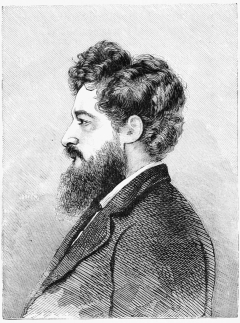
WILLIAM MORRIS.

It is easy to understand that the house in which one resides must have a large share in determining the decorations which shall be placed in or upon it. An historic or semi-palatial mansion of the olden time will require to have its great halls and stairways and deep rooms illuminated with colors, and its large spaces intersected with pictorial screens. Mr. William B. Scott, of whose mural paintings I have already spoken, and whose occupation it is to study effects of ornamentation, has a happy field for his taste and task in his residence, Bellevue House, at Chelsea. This mansion merits particular attention, both on its own account architecturally, and for its decorations, added recently. These have been chiefly devised by the artist himself in carrying out the original plan, and add a suggestive and, properly speaking, imaginative character to the interiors. The house was built, it is said, by the Adamses, the architects of the Adelphi, in the Strand, where the Society of Arts holds its meetings (the approach to which is still called Adams Street). At that time, about a century ago, decorations in the way of carved mouldings running around door-ways, and passing all round the rooms on the surbase and dado, were in use. Previously to that time the entire walls were generally panelled, but then began the system of panelling or boarding flatly to the height of three feet only, at which height began the lath-and-plaster wall. Along the top edge of this dado—which, being just over the height of a chair or table, gives a very well-furnished and comfortable air to a room, and ought on that account to be again adopted—ran a more or less ornamental moulding. That mostly used in Bellevue House is carved in wood, and very good, closely resembling, indeed, those on the best specimens of Chippendale furniture, which belongs to the same date—about 1770. I may add here that the demand among artistic designers for a recurrence to the dado is shown by the increasing frequency with which a darker paper than that above, with paper cornice, is made to do duty for it.
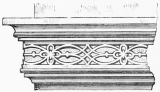
MOULDING OVER DADO.
A hundred years ago the hall of a mansion was a more important part of the plan, and more decoratively treated, than now. The entrance is here divided by folding-doors from the hall proper, which is ample enough in area to place the stair a good way back, and to give a correspondingly wide space above, on the drawing-room landing, filled in the olden time by a table, cabinet, eight-day standing clock, and other objects. The ends of the steps were carved, sometimes very elegantly. But the most ornamental feature then in use was the moulded ceiling, which was planned in ovals and spandrels, according to the shape of the room, sometimes with medallions of Cupids, and occasionally with a picture, representing an emblematic personage or some such matter, in the centre. A few of these are still to be seen in London. There is one in Knight-Rider Street, painted by Cipriani. In Bellevue House the two drawing-rooms possess very pretty arrangements of fan-shaped ornaments and delicate foliage. These are now “picked out” in colors—blue and white for the most part—producing an effect resembling that of Wedgwood ware.

CHIPPENDALE MAHOGANY MOULDING, BELMONT HOUSE.
The plan on which the rooms of large London houses were originally arranged was en suite, entering one through another, connected by double doors if the walls were thick enough, so that on great occasions they could be opened throughout. On either side of the drawing-rooms at Bellevue House are smaller rooms connected in this way, one of which is at present used as a library and evening sitting-room, and, I must also add, as a room on the walls of which the ever-bourgeoning studies of the idealist take shape and color. The wood-work—that is to say, the dado, doors, etc.—is painted Indian red, with black or light yellow edgings; above this the wall is covered by a green pattern, but the upper part of this surface is divided by painting into panels two feet deep by a foot and a half wide, the stile, or division, between being half a foot. The ceiling is, in the centre, a very faint blue, with a darker blue meeting the cornice (two feet wide); this darker blue—the blue of the sky—also fills the painted panels, which thus resemble the openings for ventilation in some Oriental countries. Across these openings a flight of vermilion birds—Virginian nightingales, plumed and winged by imagination, red being evidently chosen for bright effect against the blue—is represented. The birds reappear above the cornice, and stream in pretty migration round the ceiling, decreasing in size till they nearly disappear.
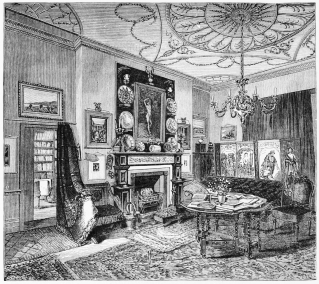
DRAWING-ROOM OF BELLEVUE HOUSE.
The chimney-piece of this little room is exquisite, and is much like one designed by Sir E. Landseer, which I saw among his sketches, except that the jambs were caryatides. The white marble jambs and architraves in Mr. Scott’s design are diapered with leaves—laurel and ivy—of Indian red color, and above the chimney-shelf is a second chimney-piece and shelf, thus giving double accommodation for objects of ornament or use. The artist’s collection of old china, majolica, and other objects of similar kind serves to render his chimney-pieces particularly beautiful. I have not seen a more attractive work of this kind than the chimney-piece in his principal drawing-room. The jambs here are panelled, the panels being filled with mirrors, and divided half-way, two feet nine from the floor, by a shelf large enough to accommodate a lamp or candle, with a teacup or other object. The arrangement is admirable both for utility and beauty. A supplementary chimney-shelf is added here, also, to the marble one; and rising nearly to the ceiling is a surface of black wood, with brackets, for the exhibition of some very fine old Hispano-Moresque ware, the golden, metallic lustre of which is favorably seen against the black. The centre is filled by Mr. Scott’s own most beautiful picture of Eve, which, with a large screen covered with classical figures, sheds a glory of color through this unique room, which has, besides, the good fortune to command from its windows the finest views of the Thames.
Entirely different from either of these residences is that of Mr. George W. Smalley, the distinguished correspondent of the New York Tribune, in Chester Place. Birket Foster, George Boughton, W. B. Scott, and J. McNeil Whistler have naturally decorated their houses with an eye to picturesque effect; theirs are the homes of men whose daily life is consecrated to art, and a use of colors seems appropriate to their environment which might not so well accord with persons differently occupied. Those who have experienced some of the wear and tear of this busy London existence can hardly enter the door of this American gentleman without finding a sufficient justification for the growing desire of families to surround themselves with household beauty, against all the charges of the puritanical. “Thus I tread on the pride of Plato,” said Socrates, as he stepped on the carpet of his famous friend. “With a pride of thy own,” answered Plato, who is supposed to have got the better in this little encounter. Nature is not nowadays in such discredit as formerly for having blended beauties with utilities, making even her pease and potatoes bear graceful blossoms. And there would appear to be some reason in the tendency of her yet higher product, a home, to wear a fitting bloom as the sign of its reality. Such a suggestion is made by the subdued and delicate tints and tones which here meet the eye. One may have stepped from other houses of this fashionable neighborhood to find here a sweet surprise. There is, then, no absolute and eternal law making it compulsory to select ugly things instead of pretty things. Tinsel is not intrenched in the decalogue. Here is a hall in which gray and brown shades prevail in dado and paper, where a soft light prevails, and the garish light and the noise of the street can hardly be remembered. One may enter the nursery and find the children at play or study amid walls that bring no shams around their simplicity, no finery, but sage-gray and straw-color, setting off well their bright faces and those panels in the bookcase which tell the story of Cinderella.
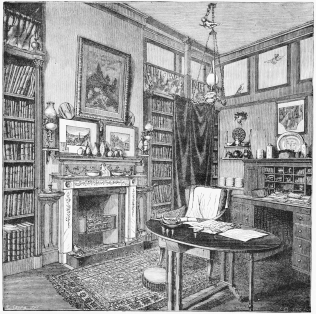
LIBRARY IN BELLEVUE HOUSE.
To the suite of drawing-rooms every excellence must be ascribed. They consist of two large rooms and a large recess, all continuous, whose decorations adapt them to any domestic or social purpose whatever. It is an apartment in which the finest company would feel itself in an atmosphere of refinement and taste, and it is a place to lose one’s self in a good book; it is a place where the mind can equally well find invitation to society or solitude. Perhaps it is the rich Persian carpet that gives such grace. It is after a pattern more than a thousand years old, but which in all that time has never repeated itself, each carpet coming forth with its own tints and shades, and in which every color is surrounded by a line which mediates between it and the next. It is not stretched up to the walls and nailed, as if its business were to conceal something, or as if it were too flimsy to lie still except by force of iron: it is as a large rug laid for comfort on the waxed parquet, which is ready to display more of its own beauty when the proper season arrives. Beginning with this rich carpet, with its sober tints, the eye ascends to the dado, to the walls, to frieze, cornice, and ceiling, and finds variation at every stage, but no break in the harmony of all. The golden tints in the carpet are more fully represented in the dado, which is of an olive-golden color, with a small turquoise line on its cornice leading to the main papering. This paper is of a French tapestry pattern, in which the golden thread, which is its basis, weaves in colors that are rich but always subdued, and of every shade. There is no pattern to rivet the eye; it has no certain relation to the vegetal, or floral, or animal kingdom. This paper rises to a Moresque frieze of about one foot in depth, which holds hexagonal medallions containing the ghosts of plants. There is next a cornice of three mouldings—arabesque, Egyptian, and floral—leading to the ceiling, which is covered with paper of a rich creamy color, with very light cross-bands passing between figures in which a fertile fancy may trace the decorative symbols of earth, air, and water in an orb, a butterfly, and certain waving lines. It may be remarked here that it is only on a ceiling that any forms, even in such abstract shapes as these, are admissible. Here they are noticeable only if one is lying flat on one’s back and gazing upward, in which case, especially if invalidism be the cause, some outlines of a dreamy kind are not without their value. Moreover, any designs, when raised to the ceiling, require to be larger than similar ones on the floor or line of the eye, in order that they may be at all similar in effect. The plan of covering or coloring the ceiling has a good foundation in the fact that a mere white wall overhead conveys the sorry impression that the house is left naked in every corner and spot not likely to be gazed at. The ceiling in Mr. Smalley’s drawing-room exemplifies, however, one important fact: although a mere color placed on a ceiling depresses it, a good pattern has just the contrary effect. By good pattern I mean one that shows a double ground—the lower one being open work, through which a farther ground is seen. Mrs. Smalley, whose taste has been the life of the ornamentation of her house, told me that when this ceiling was being painted the decorated part appeared to rise more than a foot higher than the blank part.
The wood used in the drawing-room is ebonized, and of it are several cabinets—one displaying some fine specimens of china—bracket-shelves, and two remarkably beautiful chimney-pieces, supporting bevelled mirrors, framed with shelves which display porcelain and other ornaments. The recess which has been mentioned is what might be better understood, perhaps, if described as a bay-window. Its chief object is to hold a large window, in five contiguous sections, which admit a toned light, and have each a cluster of sunflowers at the centre. This little room has a broad divan, covered with stamped green (Utrecht) velvet, running around, and its wall is decorated with gold-tinted leather, on which are two bright tile ornaments. The large opening into this recess is adorned by two antique bronze reliefs of great beauty, and the whole is related to the drawing-rooms by an open drapery of greenish-golden curtains—a velvet of changeable lustre—uniform with the other hangings of these beautiful rooms.
It is remarkable, indeed, how much may be accomplished with rooms inferior in size to those we have been visiting by the skilful use of curtains. If a gentleman in London enters a house with the intention of decorating it in accordance with principles of art, his first work, probably, will be either to tear away doors that divide the drawing-room, and substitute a draping, or else frame it round with looped and corded drapery, which, having in itself an artistic effect, shall change the barrier into beauty. Nothing is better understood than that no square angles should divide a drawing-room, and the curtain is more graceful than any arch or architraves for that purpose. The following sketch may convey some idea of an effect which has been secured in Townsend House, Titchfield Terrace, residence of the distinguished artist Mr. Alma Tadema; though the impression can be but feeble, on account of the exquisite use he has made of the colors, which must be left to the reader’s imagination, with a warning that they are as quiet as they are rich.
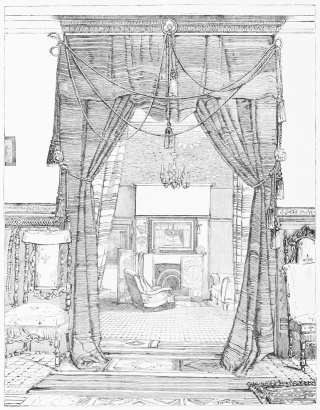
DRAWING-ROOM IN TOWNSEND HOUSE.
The question as to the best color for a wall, one of whose chief objects is to show off framed pictures, is a vexed one. Messrs. Christie & Co., the famous art auctioneers, have their rooms hung with dark green baize from floor to sky-light, and certainly the result justifies their experience; but I think any one who enters the hall of Sir F. Leighton, P.R.A., will see that there may be a more effective wall-color to set off pictures than green, not to speak of certain other effects of the latter which really put it out of the question. It is difficult to say just what the color in Sir Frederick Leighton’s hall is. It is a sombre red, which at one moment seems to be toned in the direction of maroon, and at another in the direction of brown. It has been made by a very fine mingling of pigments; but the general result has been to convince me that there can be no better wall for showing off pictures, especially in a hall with a good deal of light, than this unobtrusive reddish-brown. I remember that when the Boston Theatre was first opened a wall of somewhat similar color added greatly to the brilliancy of the scenery. But there are many eyes to which this would not be a pleasing color or shade even for a hall—it would hardly be beautiful in a purely domestic room—and such will do well to try some of the many beautiful shades of olive or sage-gray. Mr. W. J. Hennessy, the eminent American artist, made his house in Douro Place, before he left it for the old château in Calvados, remarkably charming by a careful use of such shades throughout. His quiet rooms were restful as they were pervaded by refinement, and each frame on the walls had a perfect relief, each picture a full glow.
The house of Sir Frederick Leighton, in Holland Park Road, is, in the first place, a remarkably interesting house architecturally, and shows plainly that Mr. George Aitchison has not only been in classic regions, but imbibed their spirit. In this house, which he has built for the artist who beyond all Academicians displays the most sensitive sympathies with various styles, there is nothing foreign, and yet the whole feeling about it is classic. The little balcony would have done for the sweet lady of Verona, and yet there is as much of Shakspeare’s England in the substantial arches at the base of the wall. It is rare, indeed, that any house built in England in recent times has about it as much elegance and simplicity as this. Entering the house, the impression conveyed at once is that it is the residence of an artist. He has employed decorators, indeed, but he has watched over them, and he has secured thereby this—that there is nothing ugly in his house. A great merit! Many rooms upon which large sums have been lavished have something lugged in that makes all the rest appear vulgar or pretentious. It is a large part of the art of decoration to know what not to have in a house. In this house is also realized the truth of the old French saying, “Peu de moyens, beaucoup d’effet.” For example, the doors are of deal, painted with a rich black paint; on each jamb there is at the bottom a spreading golden root, from which runs a stem with leaves; half-way up the stem ends in the profile of a sunflower in gold; another stem then passes up, ending in the full face of the sunflower, which at once crowns the foliation of the jambs, and makes a noble ornament for the capping of the door, which also has a central golden ornament. This black door, with its black jambs and its golden flowers, varied on other doors to other conventional forms, has an exceedingly rich effect. The hall also bears witness, notwithstanding its mosaic floors, marquet chairs, and the grand old stairway that runs with it to the top of the house, that the wealth of knowledge and experience has done more for it than riches of a more prosaic kind, though there has been no stint of the latter. One thing in the hall struck me as especially ingenious, and at the same time beautiful. Just opposite to the entrance from the vestibule into the hall the stair begins to ascend beyond large white pillars. Now, between the first and second of these pillars there is a little balcony, about as high above the floor as one’s head. On examination it is found that this balcony is made out of an inlaid cabinet chest, the top and farther side of which have been removed to make way for cushions. These cushions have been finely embroidered with various delicate tints upon a lustrous olive satin by Miss Jekyl, and the little balcony, with pretty ornaments on it here and there, becomes a main feature of the hall. There are several other pieces of Miss Jekyl’s work in the house, one of the most beautiful being a red table-cloth in the dining-room, upon which she has worked four figures of pots, whose flowers converge toward the centre. This cover is appropriate to the red color which prevails in the dining-room—a color which I do not much like in a dining-room, though here it well sets off the large ebonized and inlaid sideboard, which is adorned with a great deal of the finest Rhodian porcelain. Sir Frederick Leighton on returning from a visit to the East brought back a whole treasury of china and tiles; and he has also brought a large number of beautiful Persian tiles, with which he has made a little interior rotunda and dome which is a marvel of beauty. A sentence of the Koran runs along the cornice; stained glass throws a rich light through the room; a fountain plays in the centre. Mr. Dillon, an artist, has for some time had a studio in which every article came from Egypt, even to the inscription from the Koran (Sura 91) which makes its frieze—
“By the brightness of the sun when he shineth, By the moon when she followeth him,” etc.
Sir Frederick Leighton’s chief room is his studio; it covers more than half of the whole area of the top floor of the house. The walls are hung with stuffs from many countries—tapestries, rugs, ancient Japanese silks—which fall from the cornice to the floor. There are some fine ebonized bookcases and cabinets, designed by Mr. Aitchison and Sir Frederick together. The roof is arranged with sky-lights and sliding curtains of various descriptions, so that there is no kind of light or shade whatever that the artist is not able to bring upon his work. The drawing-room has a white coffered and tinted ceiling, and neat mouldings above the bay-window gather round a fine oil-picture, by Eugene Delacroix, fixed in the ceiling. It is beautiful, but I could not help feeling that some mural painting by another artist might well be substituted, and the Delacroix placed “on the line.” There is suspended a very rich central candelabrum of Venetian glass in many colors. The walls are hung with cigar-tinted cloth, with modified fleur-de-lis spots, beneath which a floor of ash-blue is disclosed for the width of a yard between the wall and the bright Persian carpet.
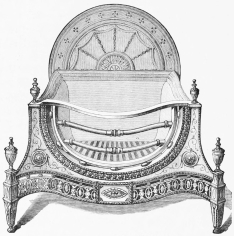
A GRATE OF ONE HUNDRED YEARS AGO.
In all the houses which are carefully decorated in London great use is made of tiles. The tiles which are unrivalled in the esteem of artists are the old Dutch, which consequently have been nearly all bought up. A single old Dutch tile, which when made hardly cost more than a sixpence, now finds eager purchasers at a pound. It is a singular fact that our manufacturers can imitate Persian and Egyptian tiles, but have still to send to Holland to get anything resembling the old Dutch, and even there they can obtain but an approach to the rich coloring and quaint designs of old times. Mr. Stevenson, the architect whose book has been referred to on a previous page, obtained a large number of these old tiles, which when put together formed large pictures; but several of them were wanting, and he had to make designs of what those he possessed appeared to imply were on the others. He had tiles made which, at any rate, completed the pictures; and though the new ones were carefully made, they may be easily picked out from the old. These tile pictures have been placed by Mr. Stevenson on the side of a sheltered entrance that leads from the street across the front-yard to his beautiful residence in Bayswater. Inside of this house there are many beautiful things, but it is chiefly remarkable for the admirable mantel-pieces on the ground-floor and that above it—in the hall common to both—which show rich old carvings set with tiles, chiefly Persian and Dutch, which are built from floor to ceiling. In the children’s school-room there is a chimney-piece covered with Dutch tiles representing most quaintly all the most notable scenes in the Bible, which must be a source of endless amusement to the little ones. The finest designs for tiles which I have seen in London are those of Messrs. Morris & Co., whose pictures, however, are often so beautiful that one dislikes to see them ornamenting fireplaces. Nevertheless, the grate and its arrangements are becoming matters of serious importance in every room, and a walk through the establishment of Messrs. Boyd, in Oxford Street, will show that the “warming engineers” have not been behindhand in providing stoves, tiles, and grates that may be adapted to many varieties of decoration. These gentlemen tell me that they are continually on the watch to get hold of old grates, fenders, fire-dogs, and so forth, that were made a hundred years ago, on account of the great demand for them, and that they reproduce them continually; nevertheless they believe that they can produce a prettier grate now than could have been made in the last century. The engraving on page 198 represents a grate found in an English mansion about one hundred years ago. The one on this page represents a grate recently made for the late Baron Rothschild. The one on page 200 represents a grate and fireplace designed and made by Messrs. Boyd, which appears to me one of the most beautiful I have yet seen.
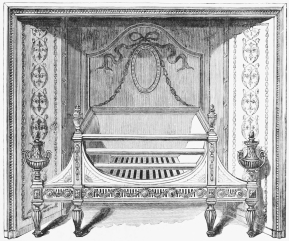
GRATE MADE FOR BARON ROTHSCHILD.
In the houses thus far described I have mentioned several which have been decorated in whole or in part by Messrs. Morris & Co., but have reserved until now a special treatment of their style. Their decorations, apart from their undeniable beauty, derive importance from the fact that they can be adapted to the requirements of persons with moderate incomes, or to the needs of those who are prepared to pay large sums. The firm in question—as befits a company whose head is one of the most graceful of living poets—has mastered the Wordsworthian secret of
“The eye made quiet by the power Of harmony.”
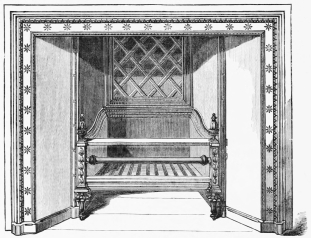
BOYD’S GRATE.
Of the many different papers with which they hang rooms, only a few have appeared to me unsuited for the purposes of a refined decoration of almost any room. One, an imitation of square trellis-work, with a bird sitting in each opening, I have seen on the walls of a bedroom (which, I suspected, might have been originally intended for a nursery; in which case I am not prepared to say that it might not have appeared in place), where it was not pleasing, and it has appeared to my eye frivolous in sitting-rooms. Nor do I altogether like their lemon-yellows, which are so well placed in corridors, to find their way (as they sometimes do) into drawing-rooms; that color, however adapted for daylight, suffers bleaching by candle or gas light. But generally their wall-papers are of beautiful grays—pearl, sage, or even darker—and, while full of repose and dignity by day, light up well under any artificial light. This firm also does the finest wall mouldings in relief that I have met with. A remarkable instance of this may be found in the Grill Room at the South Kensington Museum, to which reference has already been made. And a somewhat similar moulding is still more effectively used in the drawing-room of the Hon. Mr. Howard, in his house at Palace Gardens—a willow pattern, with buds, on a cream-colored background, which rises to a deep frieze of green. In two rooms of the same mansion the light pomegranate paper, with shut and open flowers, is used with good effect. In the dining-room the general hue is faint pink, and this is also pleasing. In the nursery there is an exceedingly beautiful paper of wild daisies on a mottled ground. Mr. Howard is not only an artist himself, but a collector of pictures and other objects of art. His walls have in a great measure been decorated with the idea of adapting them to the purpose of displaying to the best advantage the quaint old cabinets which he possesses, and the many fine pictures of pre-Raphaelist art which adorn his walls. On one of the landings of the stairway there is a fine organ, upon which Dr. Burne Jones has painted a charming picture of St. Cecilia playing on her keys. This picture sheds light and beauty around, and shows how much may be done in a house by having such objects brought into the general system of ornamentation adopted in the house. It is hardly enough to bring into the house furniture of a color which is vaguely harmonious with the wall-paper; by a little decoration even the piano, the cabinet, the book-case, may be made to repeat the theme to which the walls have risen.
Dr. Burne Jones—for Oxford has bestowed on him its D.C.L., to its own honor as much as his—has decorated a grand piano with finest art. Around its bands is told the fable of Orpheus, the potency of music, in scenes of classical, but not conventional, treatment. On the lid is a Muse leaning from an oriel of the blue sky; beneath stands a poet musing; and between them is a scroll inscribed with a bit of old French, “N’oublié pas”—motto of the family for whom the piano was made. At another end of the lid is painted amid bay-leaves the page of a book, with illuminated letters here and there, the lines being those of one of Dante’s minor poems, beginning, “Fresca rosa novella.” But all these beauties are surpassed when the lid is lifted. Amid the strings, which are exposed, there is a drift of roses, as if blown into little heaps at the corners by the breath of music. On the interior surface is painted a picture to be gazed on with silent admiration, for few can be the strains from those keys which will interpret the subtle sense of the picture. The only name given is Terra Omniparens. Between the thorns and the roses sits this most beautiful Mother, naked and not ashamed, with many babes around her. Above, beneath, around, amid the foliations they are seen—impish, cherubic, some engaged in ingenuities of mischief, others in deeds of kindliness and love. Greed, avarice, cruelty, affection, prayer, and all the varieties of these are represented by these little faces and forms. Some nestle around the Mother; one has fallen asleep on her lap. The fair Mother is serene; she is impartial as the all-nourishing, patient Earth she typifies; all the discords turn to harmonies in her eternal generation. Her impartial love waits on the good and the evil; she is one with the art that “shares with great creating Nature.”
Although the hangings of Morris & Co. do not imply a lavish, but only a liberal, expenditure, they do not readily adapt themselves to a commonplace house inhabited by commonplace people. There must be thousands of these square-block houses with square boxes for rooms which would only be shamed by the individualities of their work. The majority of houses attain the final cause of their existence when the placard inscribed “To Let” may be taken down from their windows. No doubt the decorative artist might do a great deal toward breathing a soul even into such a house, if it were inhabited by a family willing to pay the price. But there are houses built with other objects than “to let,” built by or for persons of taste and culture, and to such the decorations of Messrs. Morris & Co. come as a natural drapery. Mr. Ionides, who has just entered a new house in Holland Park Villas, has shown, by adopting in it decorations similar to those of the smaller house he has left, that, after many years, the hangings of Morris & Co. still appear to him the most beautiful; and it is significant of the spirit in which he has carried out his own feeling in both cases that he has steadily refused to let the house his family had outgrown to all applicants who proposed to pull down its papers and dados, and convert the house into the normal commonplace suite of interiors. He preferred to retain for some time, at a loss, that which he and his artistic friends built up with so much pains, rather than have it pass into inappreciative hands. In the new residence of Mr. Ionides he has found a beautiful hanging for his drawing-room in a Morris paper of willow pattern, with two kinds of star-shaped blossoms, white and yellow, which harmonizes well with the outlook of the room into a conservatory. The curtains of the bay-window in the spring season are of Oriental cream-colored linen, with flowers embroidered in outline (light gold), and at wide intervals, upon them. The paper in the large dining-room is the small floral square (sage-gray) pattern of Messrs. Morris & Co., which harmonizes well with the red carpet, the pictures, and the green-golden lustres of the velvet curtains. Mr. E. Danreuther, in whose brilliant successes as interpreter of the “Music of the Future” America as well as Germany has reason for pride, has his residence in Orme Square decorated mainly with the Morris patterns. The house is quaint and old, and nothing can exceed the sympathetic feeling with which these designs harmonize with the style of the halls and rooms. It is a picture for the imagination to think of Carlyle and Sterling (who once resided here) conversing on great themes amid these quietly rich, these even poetical designs and colors. Nearest to that imaginary picture is the real one which I have seen a little way from Orme Square, namely, in the villa of the late Mr. Edward Sterling, son of the poet John Sterling, himself an artist, who had used his own excellent taste, and that of his wife (a sister of Marcus Stone), in adorning his house at Kensington. An especially fine appearance has been given to a high wall which stretches through two stories beside the stairway by changing the style and color of the (Morris) paper midway, and thus breaking the monotony. The hangings of the lower hall are dark, and the light shed down from the higher wall is thus heightened. In this, as in the majority of beautiful houses, the first effect at the entrance is that of shade. The visitor who has come from the blaze of daylight is at once invited to a kindly seclusion. Beyond the vestibule the light is reached again, but now blended with tints and forms of artistic beauty. He is no longer in the hands of brute Nature, but is being ministered to by humane thought and feeling, and gently won into that mood
“In which the heavy and the weary weight Of all this unintelligible world Is lightened.”
That mood, my reader will easily understand, cannot be secured by the papers of Morris & Co.; but where a true artist is able to find such artistic materials as theirs to work with, he is able, as in the case of Mr. Sterling, to weave them on the warp of his own mind and sentiment into a home which shall not fail to distribute its refining and happy influences to all who enter or depart.
Among the younger artists of high position and achieved fame in the fine arts who have aimed to include house decoration within their poetic domain, the most successful has been Mr. Walter Crane, who is fortunate in having a firm of skilful paper-stainers (Jeffrey & Co., of Islington) to embody his beautiful and quaint designs. Mr. Crane’s “Chaucer,” or “La Margarete,” paper received a special medal and diploma at the Philadelphia Exhibition, and his more recent designs are not inferior. The “Margarete” paper, which takes almost any color that is not garish, has become a prime favorite among the lovers of chaste decoration in London, and the light olive tint is preferred. The daisy is the motive, taken from Chaucer:
“As she that is of allë floures flour, Fulfilled of all virtue and honour, And ever alike fair and fresh of hue.”
The burden of the daisy-song (in the “Legend of Good Women”)
“Si douce est la Margarete,”
is exquisitely blended with the pattern. The superb frieze shows, on a background of gold, the youthful God of Love holding Alcestis, the ideal wife, by the hand; next Diligence, with her spindle; Order, with hour-glass; Providence, with well-filled basket; and Hospitality, with her jar and extended cup. These figures support the roof as caryatides. Plants of alternate leaf and flower, in pots, stand between the figures and beneath the Chaucerian text: “To whom do ye owe your service? Which will you honour, tell me, I pray, this yere? The Leaf or the Flower?” In the dado are the types of purity and innocence—lilies and doves. Mr. Walter Crane’s services to decorative art are well appreciated by the little folk in some households, for he has designed papers representing the most fascinating of Cinderellas and Boy Blues, and as I write is bringing out an apotheosis of Humpty Dumpty and cognate classicisms. That this artist is ambitious of canonization among the young is farther suggested by the fact that he has actually turned his hand to designing valentines, thus tempting staid persons to indulge in that kind of thing—or, at any rate, to condone it—who have long eschewed such pinky frivolities. He has designed three or four valentines only, but they have been endlessly imitated. I must not omit to mention that a great deal of the best needle-work done in London has been after Mr. Crane’s designs, and also that he is at present engaged in making tiles which promise to surpass all other recent designs. These represent generally each some simple, graceful figure—classic, allegorical, or antique—with flowers surrounding them; but the charm is in the very pleasing expression this artist conveys in a few lines by his careful drawing, and also by his delicate sense of color. Whatever he does, however conventional the accessories may have to be (and they must often be such with the real artist, who will never dignify incidents with the same work as his main designs, any more than he will paint his picture-frame like his canvas), no one acquainted with his work can ever mistake the touch. When I first saw Walter Crane’s papers I felt a certain heaviness of heart that one could not have them all on the walls of some favorite room—all at the same time!
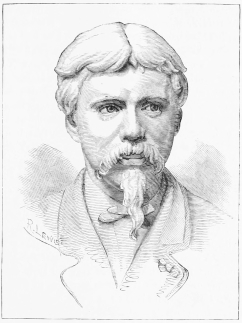
L. ALMA TADEMA.—[FROM A BUST BY J. DALOU.]
Perhaps the most complete rendering of the effects at which William Morris and Burne Jones have aimed in their efforts at beautifying London households is to be found at Townsend House, to which I have before alluded. Mr. L. Alma Tadema, the finest colorist, has of course been as one of the partners of the firm so far as his own home is concerned, and the touches of his art are met with at every step in it. Passing beneath the cheery “Salve” written over the front-door, we at once meet with a significant piece of art. On each side of the rather narrow hall is a door; one leads into a parlor, the other into a library, and, as they are just opposite each other, the doors are made to open outward, and, when open, meet. Now, when it is desirable, the two doors when open make a wall across the hall; this extemporized wall has its panels painted, and thus a pretty passage is made to connect the separate rooms. One thing in Townsend House is very peculiar: the ceilings are generally covered with the same paper as the walls. There is a dado of matting with touches of color in it, or else painted in some color related to the paper but of deeper shade, and above this a uniform paper, with but slight frieze (most of the rooms being comparatively small, a deep frieze would be out of place). I confess that I have some misgivings about this continuance upon the ceiling of the wall-paper. It would certainly answer very well in rooms that were of very high pitch, for the heavier the color on a ceiling the more it is depressed to the eye. But here the sense of comfort and snugness secured—important as they are in this moist, chill climate, which often makes one willing to be folded up in a warmly lined box—is paid for by a sense of confinement. A ceiling ought not to be white nor blue, which, not to speak of the quickness with which they become black from the chandeliers, convey the feeling of exposure to the open air, but there should be above one a lighter tint and shade, lest the effect should be that of being in a cellar. The underground effect nowhere occurs in Townsend House, because therein true artists have been at work, but one might not be so secure if the papering had been left to less judicious decorators. The corridors have the creamy pomegranate paper, which carries a cool light through them. A small back-room on the first floor has been Orientalized into a charming place by a skilful use of rugs, skins, etc., on the floor, and on the Persian divans fixed against the wall, which is covered with a silvery and pinkish paper. The chief bedroom in the house presents the novelty of walls entirely hung with a rich dark and reddish chintz, with wide stripes flowing from ceiling to floor, the effect being a grave Persian. The bed is hung and covered with the same stuff, and the lower part of each window is made into a cushioned seat of the same. The ceiling in this case is of a pearl-white, and there is plenty of light. This room appeared to me, though at first a surprise, one that was suggestive of every kind of warmth and comfort; it was, indeed, an entire room made into the appropriate environment of a bed. In another bedroom I observed how beautifully the light may be regulated by the use of double curtains, one of dark green, when darkness is desired, the other of a fine tracing-cloth, which is more snowy than the glass of an astral lamp, while it similarly softens and diffuses light.
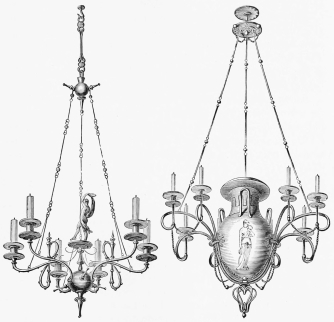
CANDELABRA, TOWNSEND HOUSE.
Mr. L. Alma Tadema—a fine bust of whom by J. Dalou appeared in the Royal Academy in 1874—had contributed, as his picture of that season, an admirable representation of his own studio, with a number of his friends looking upon a work on his easel, the back of which is turned to the spectator. But one can readily imagine those friends of his dividing their attention between the picture and the rich ornamentation of the room they are in. An artist’s studio is apt to be, and ought to be, as much a picture as any work of art born in it, but it hardly comes within the scope of this article to describe rooms that are expressions of individual genius and purpose; yet in every house where cultivated persons are found individual aims are found also, and there will be the effort to give to each of these its fit environment. The first point to be secured in the study, or studio, or workshop is, that everything in it shall be related to the work which is its end and raison d’être. When Carlyle was engaged in writing his Life of Frederick he had prepared a special study apart from his library, whose walls were covered with books and pictures of which each one, without exception, was in some way connected with the man of whom he was writing. They who are not, even for a time, specialists may nevertheless follow his example so far as to take care not to surround themselves with distracting objects. That which is beautiful in a studio may be ugly in a study. The studio of Alma Tadema sympathizes in its minutest object with the artist, who is so much at home in all the ages of art. Touches of Egypt, of Pompeii, of Greece, of Rome, blend in the decorations of his studio, as their influences are felt in his powerful works. And, indeed, throughout Townsend House there is a beauty derived from the fact that every ornament is subordinate to the purpose of the room which contains it. The dining-room, for instance, opens into a beautiful garden; it is, therefore, not simply an eating-room, but must in some weathers do duty as the salon for a garden party. The rich dado of matting is especially well placed in such a room as this, which is large and luminous. It is capped by a chair-board, which is ingeniously adorned with cockle-shells, and still more at one point with the first name of the mistress of the house painted in antique golden letters. Above this there is a cream-colored paper of squares, with roses and birds, a hanging which I have already spoken of as unpleasant in bedrooms or sitting-rooms; but in this large dining-room, which opens into a garden, the effect of it is remarkably fine. The cornice is Easter-eggs (variously and carefully colored), beneath a higher member of grape and leaf, also colored. The whole of one end of this room is covered by a rich drapery of fine Indian dyes, elegantly striped. The servants’ entrance is behind a large screen of gold leather.
Throughout this beautiful house there are little arrangements for convenience, always attended by beauty, which are altogether indescribable—a head or a sprig of ivy painted in some panel, or a little gauze curtain draping a casual opening. But I must particularly note in the drawing-room a beautiful capping to the dado. It is a white moulding of the Elgin marble reliefs, and most beautifully fringes the dark-figured stuff of the dado. I have already described the fine drapery of this room. I need only now say that Mr. Alma Tadema has designed some candelabra which appear to me most beautiful. The reader will, I fear, be but little able to obtain from one of the drawings an idea of the rich minglings of the bronze with the rose porcelain egg-shaped centre-piece, and the figures painted upon it. Both of the candelabra which I have selected as specimens are for rose-colored candles. In the houses of many artists ancient oratory (suspended) candelabra are used for the centres of rooms, and also brass repoussé sconces bracketed with bevelled mirrors. The English upper classes have never been reconciled to the use of gasaliers in their drawing-rooms, and the artists have pretty generally opposed the use of gas, which is believed to be damaging to oil-pictures.
In concluding this account of the most interesting examples of decorative art with which I am acquainted in England, I add, in preference to any general observations of my own, a few extracts from very high authorities, affirming principles whose truth seems to me to be illustrated by every exterior, and interior to which I have referred. The first of these quotations is the placarded principles of decorative art hung up in the school at South Kensington:
I.
1. The decorative arts arise from, and should properly be attendant upon, architecture. 2. Architecture should be the material expression of the wants, the faculties, and the sentiments of the age in which it is created. 3. Style in architecture is the peculiar form that expression takes under the influence of climate and the materials at command.
II.
Metal-works, Pottery, and Plastic Forms Generally.—1. The form should be most carefully adapted to use, being studied for elegance and beauty of line as well as for capacity, strength, mobility, etc. 2. In ornamenting the construction care should be taken to preserve the general form, and to keep the decoration subservient to it by the low relief or otherwise; the ornament should be so arranged as to enhance by its lines the symmetry of the original form, and assist its constructive strength. 3. If arabesques or figures in the round are used, they should arise out of the ornamental and constructive forms, and not be merely applied. 4. All projecting parts should have careful consideration, to render them as little liable to injury as is consistent with their purpose. 5. It must ever be remembered that repose is required to give value to ornament, which in itself is secondary and not principal.
III.
Carpets.—1. The surface of a carpet, serving as a ground to support all objects, should be quiet and negative, without strong contrast of either forms or colors. 2. The leading forms should be so disposed as to distribute the pattern over the whole floor, not pronounced either in the direction of breadth or length, all “up-and-down” treatments being erroneous. 3. The decorative forms should be flat, without shadow or relief, whether derived from ornament or direct from flowers or foliage. 4. In color the general ground should be negative, low in tone, and inclining to the tertiary hues, the leading forms of the pattern being expressed by the darker secondaries; and the primary colors, or white, if used at all, should be only in small quantity, to enhance the tertiary hues and to express the geometrical basis that rules the distribution of the forms.
IV.
Printed Garment Fabrics, Muslins, Calicoes, etc.—1. The ornament should be flat, without shadow and relief. 2. If flowers, foliage, or other natural objects are the motive, they should not be direct imitations of nature, but conventionalized in obedience to the above rule. 3. The ornament should cover the surface either by a diaper based on some regular geometrical figure, or growing out of itself by graceful flowing curves; any arrangement that carries lines or pronounces figures in the direction of breadth is to be avoided, and the effect produced by the folding of the stuff should be carefully studied. 4. The size of the pattern should be regulated by the material for which it is intended: small for close, thick fabrics, such as ginghams, etc.; larger for fabrics of more open textures, such as muslins, baréges, etc.; largely covering the ground on delaines, and more dispersed on cotton linens.
In all the beautiful effects which I have observed the ornamentation has been in more or less accordance with the fundamental principle of these rules—namely, the subordination of decoration to use. Many persons of taste and culture have had to wage a sometimes unequal conflict with architecture whose object was a low one—to sell; but they have been rewarded just in the proportion that they have regarded the principles just quoted. It will be especially observed that realism, in the sense of exact imitations of nature, is entirely repudiated. Conventionalism, precisely because it is a degradation in human character, is a first necessity in ornamentation. The rationale of this is admirably given in a little book on the Oxford Museum, by Dr. Acland and Mr. Ruskin, not likely to have been seen by many American readers. The following remarks by Mr. Ruskin, taken from it, constitute my second extract:
“The highest art in all kinds is that which conveys the most truth, and the best ornamentation possible would be the painting of interior walls with frescoes by Titian, representing perfect humanity in color, and the sculpture of exterior walls by Phidias, representing perfect humanity in form. Titian and Phidias are precisely alike in their conception and treatment of nature—everlasting standards of the right. Beneath ornamentation such as men like these could bestow falls in various rank, according to its subordination to vulgar uses or inferior places, what is commonly conceived as ornamental art. The lower its office and the less tractable its material, the less of nature it should contain, until a zigzag becomes the best ornament for the hem of a robe, and a mosaic of colored glass the best design for a colored window. But all these forms of lower art are to be conventional only because they are subordinate; not because conventionalism is in itself a good or desirable thing. All right conventionalism is a wise acceptance of, and compliance with, conditions of restraint or inferiority. It may be inferiority of our knowledge or power, as in the art of a semi-savage nation, or restraint by reason of material, as in the way the glass-painter should restrict himself to transparent hue, and a sculptor deny himself the eyelash and the film of flowing hair which he cannot cut in marble. But in all cases whatever right conventionalism is either a wise acceptance of an inferior place, or a noble display of power under accepted limitation; it is not an improvement of natural form into something better or purer than Nature herself.
“Now, this great and most precious principle may be compromised in two quite opposite ways. It is compromised on one side when men suppose that the degradation of the natural form, which fits it for some subordinate place, is an improvement of it, and that a black profile on a red ground, because it is proper for a water-jug, is therefore an idealization of humanity, and nobler art than a picture by Titian. And it is compromised equally gravely on the opposite side when men refuse to submit to the limitation of material and the fitnesses of office, when they try to produce finished pictures in colored glass, or substitute the inconsiderate imitation of natural objects for the perfectness of adapted and disciplined design.”
I was much struck on a recent occasion with an illustration of how little the principles thus explained by Mr. Ruskin are understood even among the learned. It was at the Anthropological Society, where archæologists, antiquarians, metallurgists, and experts of various kinds were examining a collection of specimens of the gold-work of the Ashantees. One of the leading authorities present gave it as his opinion that the specimens, though of a fineness which English workmanship could not rival, nevertheless represented a degradation of art and of civilization among the Ashantees; and the reason assigned was, that the ornamentation indicated that an original imitation of forms—some natural, others of European design—had been departed from till the significance of the forms had been lost. Of course the argument really proved a progress in art among the Ashantees, and a fine perception of the laws that must govern all work upon gold. But it is of great importance that no one should confuse conventionalism in the decorative flower or other form with conventionalism in the use of them in any house or on any object. The houses of the millions are, indeed, conventionally decorated now, and they are ugly; the individual taste will convert the commonplace forms and colors into individual expression, as his soul has previously transmuted the commonplace clay into a physiognomy like and unlike all others.
But it were a serious error to suppose that the words “conventional,” “heraldic,” “decorative,” etc., employed to express those ornamental forms which are derived without being copied from nature, really express the significance of those forms. They do represent the spirit of nature. In the extract with which I conclude, the growth of such flowers and forms in a fairer field is most subtly described. It is from the best existing work on the genesis and evolution of the decorative arts, Mr. Scott’s History and Practice of the Fine and Ornamental Arts, now used as a manual and official prize-book at the South Kensington School of Design:
“Taste is that faculty by which we distinguish whatever is graceful, noble, just, and lovable in the infinitely varied appearances about us, and in the works of the decorative and imitative arts. The immediate impulse in the presence of beauty is to feel and admire. When the emotion and the sentiment are strong we are compelled to imitate. We cannot make ourselves more beautiful physically than Providence has decreed, but we wish to see again, to feel again, what caused in us so vivid a pleasure; and we attempt to revive the image that charmed us, to re-create those parts or qualities in the image that we found admirable, with or without those other parts or qualities which did not touch us, but which were necessary to its existence in a conditional and transitory life. Hence a work original and peculiar to man—a work of art.”
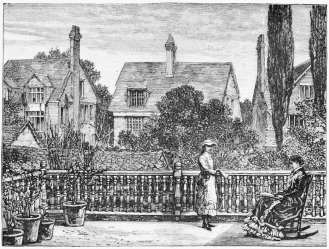
VIEW FROM A BALCONY.