Front matter
Reading edition

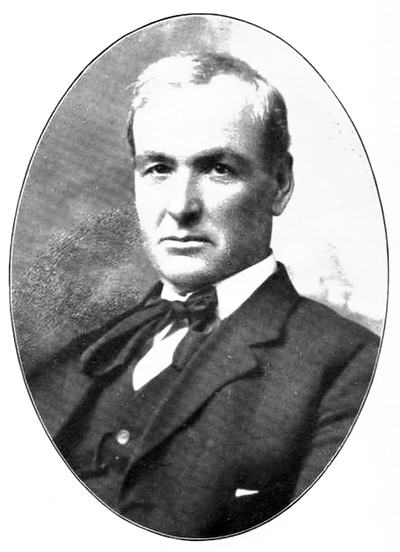
E. W. HOWE

Travel Letters from New Zealand Australia AND Africa
By E. W. HOWE

CRANE & COMPANY, TOPEKA, KANSAS
Copyright 1913 By Crane & Company Topeka
Travel Letters from NEW ZEALAND, AUSTRALIA, AND AFRICA
TRAVEL LETTERS FROM NEW ZEALAND, AUSTRALIA, AND AFRICA.
SATURDAY, JANUARY 4, 1913.—This is written in the Pacific ocean, on the ship “Sonoma,” two days out of Sydney, Australia, where we expect to land next Monday. We have been on the ship seventeen days, and the passengers and servants seem as familiar as people with whom we have associated many years. In the main, we have had a pleasant voyage, although the weather was somewhat boisterous the first few days out of San Francisco. We stopped eight hours at Honolulu, and five hours at Pago Pago, in the Samoa Islands. There was an elaborate celebration on board on Christmas day, which included a big dinner, speeches, and a dance, and we also had a similar New Year celebration, although we actually had no New Year’s day. At a late hour on the 31st of December we crossed the 180th meridian, and, when we awoke the following morning, the date was January 2, 1913. Ships sailing westward drop a day on crossing the 180th meridian, and ships going eastward add a day. In traveling toward the sun, the day increases in length, and, in a trip around the world, this increase amounts to exactly twenty-four hours. Every day we set our watches back from twenty to thirty minutes, and when we reach Canton, Ohio, on our return, this daily increase in the day’s length will have amounted to the day we dropped. In traveling eastward, you set your watch forward every day, and, on completion of your journey around the world, you will have gained a day.... Few young people travel; only the old or middle-aged seem able to afford it, while only the young are able to enjoy it. Adelaide, my niece, is the only youngster on the ship, and, although she never saw the sea until this trip, she is thoroughly enjoying it. She was ill in a quiet, ladylike way two or three days, but now she has forgotten all about the motion, and dreads to leave the “Sonoma” at Sydney. The stewardess calls her “dear,” but invariably refers to me as “Mr. Works.” I am trying to get even by inventing a new name for the stewardess every time I speak to her. Her name is Mrs. Coombs, but I began by calling her Mrs. Ashton, and followed it with Mrs. Bullard, Mrs. Comstock, Mrs. Davis, Mrs. Everett, and on down the alphabet until I now call her Mrs. Wheeler. James, the room steward, and George, our dining-room steward, know my name, but to the stewardess I am always Mr. Works. She is an American, but most of the crew are English, or Australians, outside the captain and his chief officers. It is ship gossip that the first officer is a very able man, but so ill-natured that he has never been given a ship, although an older man than the captain. It is important to understand your trade, but if you hope to get into fast company, you must also be polite.
Among the passengers is a life insurance man named Adams, en route to Australia to protest because of unfriendly legislation. His wife has been seasick almost continuously, and the women say he keeps her sick because of too much kindness: that the moment she gets a little better, he stuffs her with unsuitable food, and thus brings on another spell. He has heard somewhere that champagne is good for seasickness, and keeps her full half the time. But however mistaken he may be in his treatment, he is certainly an attentive husband, and the men are proud of him. It is a beautiful sight to see this good husband modestly taking the air on deck, after devoting hours to his sick wife. His duty is to his wife, and he does not seem to care for other people. The women take turns in going down to sit with his wife. It was Adelaide’s turn this afternoon, and the good husband walked awhile with me on deck. He says that a good many years ago there was a demand from total abstainers that they be given a better life-insurance rate than smokers and patrons of barrooms. The rate was granted, but, after long experience, the experts of the Equitable and Mutual life companies found that the death-rate among total abstainers was slightly greater than the average death-rate among all classes.
Another interesting passenger as far as Honolulu was the manager of a sugar plantation who receives $18,000 a year salary. He spent several years in Porto Rico and in the Hawaiian Islands, but is now opening a plantation in Mexico. He frequently has two thousand employees, and, as they are constantly scheming to get the best of him, he delights in scheming to get the best of them. He told me he had been marked for assassination several times, but had always heard of it. He finds that when any body of men engage in a disreputable transaction, several of them are always anxious to turn informers, and secure a reward. An informer nearly always asks a thousand dollars, but he will usually compromise, and take two hundred. If you engage in any kind of dirty work, remember that some one will know about it, and sell you out.... The sugar man says that reliable Mexicans tell him that during the thirty-two years Diaz was president of Mexico, he ordered forty thousand men shot, and that he didn’t make a mistake in a single case.
The “Sonoma” is a ten-thousand-ton ship, and has been in the Australian trade only a few months since it was rebuilt last winter. It ran between San Francisco and Sydney several years ago, but the owners claimed the business did not pay, so the three ships in the line lay in San Francisco bay a long time. Then the owners decided to try it again, and the ships were rebuilt, and fitted with oil-burners. This is the fifth voyage of the “Sonoma” since the owners changed their minds. A good deal of the trade has been lost, and the employees are very polite, with a view of recovering the lost business. We have enough fuel oil on board to run the ship to Sydney and back to Honolulu. We all like the ship, except that it is a great roller. The other night, while the passengers were at dinner, a big roll sent the dishes and food into heaps on the floor, and those on deck were shot against the rail with great force.
Captain Trask is a very pleasant man, and most of the passengers know him. Some captains, particularly those on the Atlantic, see very little of the passengers, but on the Pacific, captains have little to do, and are more genial. On the Atlantic, there is always something for captains to do. Ships are seen frequently, and if it isn’t ships, it is fog. But the Pacific is very lonely; a ship is rarely seen here, although we have seen one on this voyage: the “Ventura,” the sister ship of the “Sonoma.” We met the “Ventura” on Christmas day, two days out of Honolulu, but it went by like a race-horse, and we saw little of it.... Adelaide sits on Captain Trask’s left, a lady with a maid having secured the coveted place on his right. He likes to talk, and we are already in possession of many of his reminiscences. He learned his trade as most Americans do—from the ground up, and went to sea as a common sailor when fifteen years old. By degrees he learned the technical side of his trade, and has been around the world many times in sailing-ships. He is a big fellow, and I imagine he has quelled many a mutiny with his fists. Occasionally, early in the morning, I catch him punching the bag on deck, and no other man on board is equally expert at it. Not long ago, the crew of the “Sonoma” mutinied at Sydney, in trying to enforce some rule of the union, and he landed sixty-two of them in jail. He took the ship back to San Francisco with a new and inexperienced crew, and reached port on time. He is very good-natured now, but I imagine that, on occasion, he would be real rough, and I shall behave myself while on board.... Poets love to use the expression, “As true as the needle to the pole,” but Captain Trask says the needle is not true to the pole, and does not point toward it. It isn’t the pole that attracts the needle of the compass, but the Magnetic North. A good many degrees west of the pole there is a great magnetic mountain, and this, and not the pole, attracts the needle by which mariners guide their ships. The pole has no attraction whatever for the needle of the compass.
Stories told by the captain at dinner: In Australia there once lived a very rich and very eccentric old bachelor. A certain old maid was very anxious to capture him, and pursued him so steadily that there was considerable talk among the neighbors. On one occasion the old bachelor gave a reception at his home, and the old maid was one of the guests. During the evening, the old bachelor invited the old maid to walk on the terrace. She thought he was about to propose.
“You have a beautiful place here,” she said to him, as they walked about in the moonlight.
“Yes,” he said, “yet it lacks one thing. But for that, I would be a very fortunate and happy man.”
The old maid thought she had him; that he could mean but one thing: the refining influence of a wife.
“And what is that?” she asked, coyly.
“Water,” the old bachelor replied.
Australia is a very dry country, and the average Australian longs for water as you long for money.... The captain says dogs never do well at sea; that they soon get fits, and die. In order to have good health, a dog must have grass to eat. But cats do well at sea. When the captain was master of a sailing vessel, he owned a cat which made three voyages around the world with him. He tells of the smart tricks of this cat as you tell of the smart tricks of your dog. While his ship was once tied up at the London docks, the cat was prowling around other vessels, and one of them carried it three miles away, to another loading-dock. The crew mourned the cat as dead, but one day he turned up: he had found his way back to the ship through three miles of London’s streets.... The captain says there is nothing in the story that rats will desert a sinking ship; he never knew a ship to go down that was not full of rats. In the Indian ocean he once came across an abandoned ship, and went aboard of it. He found the deck covered with rats that had starved to death. He tried to burn the ship, as it was a menace to navigation, but failed. Six months later, two thousand miles away, he ran across the same dangerous, drifting hulk. This time he succeeded in burning it.... Captain Trask says that in the old days of wooden sailing-ships the rats frequently gnawed holes in the bottom, in seeking water. They could hear the rush of water outside, and, not knowing it was salt water, worked toward it. When a ship was known to be full of rats, they were watered regularly, to prevent their sinking it.
Captain Trask says that on one of his voyages in a sailing-ship, he was in company every day with another vessel forty-seven days. The ships were of about equal size, and bound in the same direction. On another occasion, he left New York with a cargo of wheat, bound for Liverpool. Another sailing-ship went out of the harbor at the same time, bound also for Liverpool. They did not sight each other during the entire voyage, but arrived at Liverpool at almost the same hour.... The captain says that after a sailor has been ashore a few weeks, he finds the first part of a voyage very irksome, but after that he doesn’t care; he has spent six weeks beating around Cape Horn without minding it much. Frequently a bad wind will undo all that has been accomplished in weeks of hard work. But that is part of the game, and sailors usually take it philosophically.... But a story is told of one captain who fought two months to round Cape Horn, where the current and the wind flow in a south-easterly direction three hundred days of the year. He was finally compelled to put back to Buenos Aires for provisions. Again he struggled for two months without rounding the cape, and again he put back to Buenos Aires for provisions; but while lying in the harbor, he killed himself. Thereupon the first officer took command, and rounded the Cape without the loss of an unnecessary day, the wind and current being favorable for the first time in months.
At two o’clock one afternoon, Old Neptune came aboard the “Sonoma,” the ship having crossed the equator early in the morning. Neptune was dressed in a fantastic way, and followed by a numerous train, including his wife, several policemen, a physician, a barber, etc. A recorder read a long proclamation, and the passengers took pictures. It had been rumored that all those who had not crossed the line before, and could not produce a certificate showing they had been across, would be shaved with a wooden razor, and ducked in the swimming-tank. There was a good deal of nervousness among the passengers, but it turned out that the ceremony only referred to new members of the crew. About a dozen of these were operated on, greatly to the amusement of the passengers gathered on the upper deck. A platform had been erected beside the swimming-tank, and the victims were seated on this, one by one. First they were examined by the doctor, and given a huge pill. Then they were lathered with a paste made of flour and water, and shaved with a huge wooden razor. This being completed, the victim was thrown into the tank, and ducked. Sometimes the victim fought, and this caused great amusement. One of the passengers, a young athlete, went through the ceremony, to amuse his friends, and he pulled the barber into the tank. This angered the barber, and he began a rough tussle with the passenger. The passenger was getting the best of it, when another member of the crew went to the barber’s assistance. A friend of the passenger, who had been perched in the rigging, watching the exercises, climbed down hurriedly, and was preparing to go to his friend’s assistance, when a word from the captain stopped the row; but for a time it looked as though there might be a fight between passengers and crew. A young member of the crew who was being shaved, became gay, and also pushed the barber into the tank. There was a shout of merriment, and when the young fellow was chased and brought back to the platform, he continued his joke, and pushed the doctor in. This caused the barber to strike the young fellow, which brought forth a round of hissing from the passengers looking on. Altogether, the affair was pretty rough, but everything soon calmed down, and Neptune and his lady, and the doctor, and the barber and his assistant, and the policemen, marched around the deck and took up a collection. A collection was also taken up by a passenger for the twelve new members of the crew who had been ducked. Neptune was represented by a tall young fellow we had seen scrubbing the decks every morning. He wore a grotesque costume, and represented his part very cleverly, as did the others. Soon after Neptune and his court had counted the money taken in the collection, the big whistle blew for a fire drill, and we had quite a busy afternoon.
We had rather a pleasant Christmas, in spite of hot weather. Christmas eve we went to bed in sweltering rooms, with electric fans going, and slept without covering. At dinner next day we found the dining-room prettily decorated. We had turkey with cranberry sauce, plum pudding, pumpkin pie, etc. A good deal of champagne was ordered, as it costs but $2.75 per quart on a ship sailing to a foreign port, as against $4.50 at the average restaurant. The captain’s health having been proposed, he made a speech in which he complimented England, America, Santa Claus, and the passengers. He also said the “Sonoma” had been talked about unjustly by officers of a rival line. How readily rivals in any calling talk about each other! ... While cracking nuts, we began throwing little rolls of paper at each other. This soon filled the room with colored strips of paper, and the waiters got about with difficulty. The captain began the paper-throwing, which was accepted as license by the others. While still seated in the dining-room, the second-cabin passengers passed through the aisles in a procession, the captain having given them permission to dance on the main deck. They brought a good violinist and piano-player with them, and the dancing and music continued until midnight. There is a larger company in the second-cabin than in the first, and they are much livelier. One woman, a professional whistler, gave a performance, and attracted great applause. She is on her way to Australia to fill an engagement. The pianist is a young newspaper man from Chicago.... Maud Powell, possibly the best woman violinist living, was a first-cabin passenger to Honolulu, but she did no playing, although she was agreeable and much liked by the passengers. My room is on the upper deck, near where the deck piano is located, and early one morning Miss Powell’s accompanist played awhile; to exercise his fingers a little, I imagine. It was really a remarkable performance, and I enjoyed it almost alone. Miss Powell was entered on the passenger list as Mrs. Turner, her married name, and her husband accompanied her, as business manager.
Nearly all the passengers on the “Sonoma” are old travelers. On the Atlantic you meet many people who have never been over before, but Australia is out of the way, and is usually visited only by old travelers. Several people I have talked with have been nearly everywhere, and one man is making his seventh trip around the world.... We often have three or four rainstorms and rainbows in a day. A squall of rain came up this afternoon very suddenly, but in five minutes we were admiring the rainbow that accompanied it.
We have a wonderful country in the United States, but we pay very little attention to ships. I heard the captain say at dinner today that the United States sends only twelve passenger ships to foreign countries, the “Sonoma” being one of them, whereas England sends eleven thousand. Germany comes next with five thousand, and little Japan has five hundred. Our decline in shipping began with the Civil War; we have given our attention to building up the country, and neglected ship-building. The captain says that many of our rich men are interested in foreign ship lines, and that they impudently maintain a lobby in Washington to fight every measure intended to benefit domestic shipping. Our financiers will in time gain control of many of the big foreign ship companies; this, in the captain’s judgment, will be the final solution of the problem.
The Atlantic ocean is small compared with the great bulk of the Pacific. Immense fields of water never parted by the cut-water of a ship or steamer lie between the Cape of Good Hope and Cape Horn. Perhaps half of the Pacific is as yet unexplored and uncharted. In the lonely South Seas lie the Samoa islands, two of which belong to the United States. The “Sonoma” stopped at one of these on the 29th, and we found the harbor at Pago Pago exceedingly pretty. The captain said we should reach Pago Pago at 4 P.M., and at 3:50 P.M. we went ashore. The “Sonoma” makes its time as accurately as a railroad train. Two hours before, the island had been in sight, and long before turning into the harbor we skirted the island so closely that we could see children waving at us from the shore. The island is mountainous, but along the shore were many villages of grass-covered houses, and many groves of cocoanut trees. The harbor of Pago Pago is completely land-locked, and has deep water, but the mountains surrounding it are very high, and we found the weather very warm. As we approached the dock we passed the little gunboat “Princeton,” the captain of which acts as governor of American Samoa. His crew comprises the defensive force, except that fifty natives are employed by our government to act as police. These men receive a dollar a day, and the sons of the most aristocratic native chiefs are anxious to enlist. The entire native population of Tutuila and Manua, the two islands we control, is seven thousand, whereas the total white population is only a hundred. This is made up largely of the crew of the “Princeton.” Mail is received from home only once a month, and as the “Sonoma” was their Christmas boat, you can imagine that nearly all of the white population greeted our landing. Packages of newspapers were thrown out before the lines were made fast, and soon there was cheering: we brought the news that the naval school at Annapolis won the football game from Hartford. Mingling with the white men and women of the naval establishment were hundreds of natives, who looked a good deal like our Indians, except that they were better dressed. One swell we saw was barefoot, and carried a cane. The officers told us he was the head chief of a village. Sometimes the villages are not half a mile apart, but every one has a chief. Three native villages were in sight from the deck of the ship when we landed. The best building in Pago Pago is the house of the governor, which occupies a sightly position on top of a hill overlooking the sea and harbor. There are perhaps a dozen houses for the officers and men, and these, with a cold storage and electric-light plant, coal bunkers, and a small custom-house, make up the naval station. In addition to the “Princeton,” we found two or three smaller boats in the harbor. These had come from the other islands after freight and mail from the “Sonoma.” The “Dawn” I shall long remember as the dirtiest boat I have ever seen. It runs to Apia, fifty miles away. Apia is controlled by the Germans, and is much larger than Pago Pago. You may recall that a good many years ago several gunboats were loafing in Apia harbor when a great storm came up. Two gunboats belonging to the United States and two belonging to Germany went ashore, and a good many sailors were drowned. The incident was one of the big sensations at the time. Robert Louis Stevenson is buried near Apia, and he wrote that the Samoa islands furnish the finest climate in the world.... We spent five hours at Pago Pago, walking about and visiting with the naval officers and their families. Most of them came to the islands on the “Sonoma,” and a dozen or more of them dined with us. The government has built a reservoir in the hills back of the town, and water is piped to all of the houses occupied by the officers. The naval people were so glad to see us that they permitted us to fill the ship’s water tanks without charge. There are two or three American girls visiting married sisters in Pago Pago, and they told us they had not tired of the place after an experience of several months. All of them came over on the “Sonoma,” and they hurried on board to see their friend, the captain. He dined at the executive mansion. Governor Crose’s lady had peanut soup, and the captain said it was not only new, but very good. She also had fried chicken, mashed potatoes, apple salad, and several other things the captain could not remember when questioned next morning at breakfast, although he spoke particularly of home-made butter. The governor owns the cow we saw tied on the hillside near the executive mansion.... Hundreds of the natives were permitted to come on board the “Sonoma.” Usually they give a dance on the parade ground, and assess the passengers twenty-five cents each, but the day being Sunday, the missionaries objected to the usual dance being given. However, Adelaide and I saw the dance. When we came in from one of our three excursions on shore, we found sixty or seventy native women and girls in the ladies’ saloon of the ship, and they were coaxing each other to dance; it reminded me of a country party when the different guests are coaxed to sing. Two sailors from the “Princeton” wandered in, and one of them was coaxed to play the piano for the dancing. He played awhile, but as no one danced, he finally quit in disgust. Then a native girl, after much giggling and coaxing, was persuaded to play, and three or four of the girls danced. Two of them were particularly good; so Adelaide and I saw the much-discussed Samoan dance, in spite of the missionaries. But we were the only passengers present; the others were ashore looking at postal cards. The dance will be given at the approaching San Francisco exposition, a speculator having arranged already for a Samoan village. I am certain I saw three hundred natives on board during our stay at Pago Pago. When I went down to the barber shop to get shaved before dinner, I found the room packed with native women looking at the barber’s wares. A ship barber operates a little store, and his wares include toilet articles, clothing, medicines, confectionery, plug tobacco, etc. I don’t know that the Samoan women chew plug tobacco, but I saw a good many of them smoking. By-the-way, the barber on the “Sonoma” was barber on the “Siberia” when I went to Japan several years ago.
The afternoon we left Honolulu a new passenger came aboard, and I saw him first in the smoking-room. He was very plain, and I thought it my duty to be nice to him. He was agreeable enough, but not much disposed to talk. Later I learned that he is a member of the British Parliament, and that he has twenty-eight pieces of luggage. He is traveling with a doctor, and woman nurse, as he is not well. Ship gossip is to the effect that he is a son of Sir John Lister, a noted Englishman who has done much in a scientific way. Listerine was named for Sir John Lister. I do not see many talk to the British celebrity, except his doctor. His nurse has been seasick ever since coming on board, and she cannot be of much use to her employer. The man sits almost opposite me at the table, and I am satisfied that if anyone should look at him steadily, he would leave the dining-room. He is very plain, and knows it, in which respect he is different from Andrew Carnegie. He is known as “Mr. Lister,” and is going to South Africa to hunt lions. At first, the passengers picked at him a good deal, but during the long voyage to Sydney he became one of the most popular men on board, largely because he is quiet and well-behaved.
One of the passengers is an Australian who lived for a time in South Africa, and made money in mining. Disposing of his holdings to advantage, he went to Oregon, and engaged in apple-growing. It is very interesting to hear him tell of his experiences. He knew nothing about apple-growing when he went to Oregon, but “picked up” a practical knowledge of the business through experience. One of his “experiences” was losing $40,000 in buying a bad orchard. This taught him caution, and later he made money. His apple-pickers are compelled to wear gloves, and to twist rather than pull fruit from the trees. His specialty is buying orchards of shiftless owners, and reviving them. I heard him say last night that there were two sure ways of making money in the United States: the best is apple-growing, and the second is sheep-raising. It interested me greatly to hear that a man might learn a new business and make a success of it in three or four years, as this man did in the apple business.... Captain Trask has great contempt for the modern sailor; he says any old woman of fifty could do the work of a sailor these days, but in the old days of sailing-ships, seamen were compelled to work very hard, and their trade was a difficult one. The sailors on the “Sonoma,” almost without exception, wear blue overalls, and not the wide pantaloons you associate with sailor-men.
There is a wireless apparatus on board, and every day news of no importance is posted in the companionway. The night before Christmas, when we were twenty-four hundred miles out, a good many passengers sent messages to friends.... When you sit on your porches at home, on summer evenings, you hear locusts in the trees. Old-fashioned colored people call them jar-bugs. The wireless, when in operation, sounds exactly like a locust buzzing: a good many of the passengers have remarked the similarity. There are two operators, one of whom is always on duty. One of them is a tall young fellow who does great stunts in the swimming-pool, and the other looks and talks exactly as Lieutenant Rowan did when he carried that famous message to Garcia.
We had an enjoyable time at our New Year celebration. First there was an elaborate dinner, followed by a concert and dance, participated in by the second-cabin passengers. At the conclusion of the concert, we all joined hands and sang, “Should Old Acquaintance be Forgot?” When the dancing began, quadrilles soon became the fashion, and the affair reminded me of “a good time” among neighbors who had known each other many years. Most of the talent for the concert was furnished by the second-cabin, although the best two numbers came from first-class passengers. Refreshments were passed around, and the gayety continued until after midnight. Late in the evening, some one tied down the ship’s big whistle, and the trouble was not located for five minutes. Members of the crew also got up a grotesque parade, headed by the young man who blows a cornet three times a day to announce when meals are ready. Between quadrilles, the passengers stood at the rail, and looked at the Southern Cross, and found it rather disappointing; near it is a false cross which looks rather better than the genuine. The Southern Cross is seen only in the far South, and down here everything in the heavens is new to Northern eyes. Stars are more numerous than at home, and the night of the dance the heavens were particularly clear, and the sea very smooth. Further on, in South Africa, the nights are said to be so brilliant that it is possible to read comfortably by moonlight. During the dance and concert, the first-class passengers became so well acquainted with those in the second-cabin that they now go down to visit them, which they are at liberty to do, although the second-cabin passengers cannot come up on our deck without a special invitation from the captain or purser. Once a week the captain dines in the second-cabin. The food is about the same in the two dining-rooms, but our location is amidships, while the second is far aft, and the motion is more pronounced. The difference in fare is considerable, amounting to one-quarter or a third.
One of the most interesting men on board is J. L. Dwyer, secretary of native affairs in American Samoa, and chief district judge. He is on his way to Sydney, on a vacation. Judge Dwyer has been in Pago Pago five years. When he arrived, he found a king ruling over the island of Manua, but he managed to amicably dispose of His Majesty by making him a district judge. The king lived in a five-room house, and Judge Dwyer says he was a man of intelligence, and ruled justly, but he abdicated quietly, and, as district judge, did all he could for his people for a salary of $25 a month. The king died a year or two ago, but left a daughter, now twenty years old, who will be married shortly to a white clerk in a store at Pago Pago. The clerk gave Judge Dwyer $50 with which to buy a wedding ring in Sydney, and the judge says I may help select it. I have never before been on equally intimate terms with royalty.... The Samoan men believe it beneath their dignity to be annoyed by anything a woman does, so there are almost no quarrels among them on account of jealousy. But if a Samoan woman becomes jealous of another woman, trouble may be expected promptly.... The natives have no income except from the sale of copra, which is the dried meat of the cocoanut. Traders formerly robbed them unmercifully, so the United States Government now attends to the selling of copra, without expense to the natives. The income from this source amounts to $20 per inhabitant per year.... In going into Pago Pago, we saw a great many churches; every village seemed to have at least two. Judge Dwyer says there are too many churches in the islands. Many of the preachers are natives, and much of the money obtained from copra is sent away to missionary societies, for evangelistic work in other communities.
Five of our second-cabin passengers were Mormon missionaries for Pago Pago. The missionaries are thrifty: I was told that every big institution in the Hawaiian islands is owned by a descendant of the old missionaries. But there is little in the Samoan islands to develop; almost no agricultural land, and the little there is (in the vicinity of Apia) is in the hands of Chinese. At Pago Pago, all vegetables come from San Francisco, 4,400 miles away. A monthly paper is printed in Pago Pago, by the government, and distributed gratuitously among the natives. One column out of eight is devoted to English local news.... In the two American islands in Samoa there are but four vehicles, and these are two-wheel carts. There are no agricultural implements, and no farms. Wealth is calculated by the number of cocoanut trees a man owns. The trees are worth $5 each, and the nuts from each tree average about $1 per year in value. The waters surrounding the islands produce many food fish, but the natives do not much care for them. There are a good many pigs of an inferior breed, and some of these run wild, and are hunted with dogs. The only other game in the island are wild pigeons, though there is talk that wild cattle may be found on Tutuila island, a story Judge Dwyer does not believe. Every little while the natives hunt the wild cattle, but never find them. Sugar-cane is grown in Samoa, but is used for no other purpose than to thatch the queer circular houses of the natives.... A village chief is simply the village mayor, and is elected annually. Occasionally the elections are very exciting, and fraud freely resorted to, but in the main the Samoans are a peaceful people, and fairly honest.... It is impossible to get away from taxes, and the Samoan head of a family pays 270 pounds of copra as his annual contribution to the state. This is all used to pay local chiefs, and none of it goes to the United States.... Communism is practiced by the people, and when a man earns $20 a month working as a servant in an American household, he is compelled to divide with members of his family, but the industrious Samoans are tiring of this plan, and resort to all sorts of subterfuges to avoid dividing their wages.... Pago Pago is a beautiful place for naval lieutenants to take their brides, and it was delightful to spend five hours in the American colony there, but we have no more use for it than we have for Guam, or the Philippines. The supplies come from San Francisco, and cost a great deal; coal costs $13 a ton for the cruises of the “Princeton,” but our government does not receive ten cents a day income from American Samoa. In our career of conquest in Samoa, we have not robbed the Samoans; they have robbed us.
At breakfast-time on the morning of December 31, we passed Turtle island, of the Fiji group. We could see smoke ashore, and that was about all. The 180th meridian crosses one of these islands, and the captain says a native has a house on the line. In one end of his house the day of the week is Thursday, while in the other end it is Friday.
Most of the passengers are English. Among the Americans is a Chicago doctor named Beeson, who greatly interests me. Dr. Beeson has a son who is thirty years old, and when the father is away the son attends to his business, as the son is also a doctor. When the father returns, the son will take a trip. Harry Clay Blaney and wife, who toured the country for years in a play called “Across the Pacific,” are also interesting passengers. Mr. Blaney and his brother Charles operate theatres in New York, Philadelphia, Brooklyn, Jersey City, and in other cities, in addition to owning several road shows. Mrs. Blaney is an actress, but is very domestic, and spends most of her time sitting on deck doing fancy work.

SUNDAY, JANUARY 5.—We celebrated our approach to Sydney, Australia, by running into a storm. I have never seen worse weather at sea. Heavy seas continually broke over the prow, and at breakfast only one woman appeared in the dining-room. It will surprise you to learn that this lone woman was Adelaide, the farmer’s daughter. The gentlemen gave her quite a reception, but I wasn’t there to witness it: I was sick in bed. Women are very much more subject to seasickness than men, as a rule.... The night before the storm, we had another impromptu dance, and Adelaide, who never danced in her life, danced the lancers with Judge Dwyer, chief judge of American Samoa. There were two sets, and a good-natured doctor from London called the figures in an amusing way. I hear it frequently remarked that we have a very agreeable passenger list; not a disagreeable person on the list. At the captain’s dinner the captain made another speech, in which he threw us gorgeous bouquets.
MONDAY, JANUARY 6.—The captain said we should see land on the morning of the 6th, at 8 o’clock. At almost exactly that hour, land appeared off the starboard beam (I take this to mean off to the right). When land first appears at sea, it is very faint, and is only distinguished from clouds with difficulty. At 10 A.M. we were in plain sight of Sydney’s famous harbor, and saw other ships entering ahead of us. A half an hour later, we took on a pilot, and at 11 o’clock we stopped at quarantine to wait for a doctor. When this official came, we found him a huge man who would create a sensation in a museum. After the usual inspection, the “Sonoma” steamed toward her dock, eight miles away, and we had an opportunity to see the harbor.... In reading, you are almost constantly in sight of the statement that Sydney has the finest harbor in the world, and, after you have seen it, you are disposed to admit the truth of the statement. After passing in from the sea, a ship travels eight or ten miles to the city docks, and the course winds around through hills almost large enough to be called mountains. On either side are bays, and everywhere on top of the hills you see houses with red tile roofs. Sydney is a city of more than seven hundred thousand, and has doubled its population in the past twenty-five years. It is only a question of a few years until Sydney has a million population, and is destined to become one of the great cities of the world. Its houses are nearly all built of a native stone of yellow cast. Through this wonderful harbor we steamed slowly, and finally landed at noon, as the captain said we would.
TUESDAY, JANUARY 7.—This morning we employed a messenger boy to show us around Sydney. The boy is fourteen years old, and was educated in English schools. He talks no other language than English, but we could not understand half he said: there is this marked difference in American and English pronunciation. Sydney is an English city, and its signs are in English, but we do not understand many of them. Australia is not only an English colony, but the people of its larger towns have a dialect of their own. Sydney is a fine city, but looks more like Manchester or Liverpool than it looks like London. There are no sky-scrapers here, in the American sense; one of the Sydney newspapers wanted to build a sky-scraper, and occupy it as an office, but Parliament would not permit it. Everywhere you see American goods, and signs calling attention to them, and Bud Atkinson’s American Wild West is giving exhibitions daily in one of the parks. It seemed queer to me that an exhibition of this character should be granted permission to exhibit in one of the parks; imagine an Australian Wild West in Central Park in New York. And I do not recall Bud Atkinson as a noted American in the Wild West line. This show came over a month ago, in the ship ahead of ours. I should say a jump of three weeks is a tolerably big one. This is the summer season here, and the show will return to the United States in April.... In the fruit stores in Sydney you see strawberries, cantaloupes, peaches, green corn, tomatoes, etc. At home you hear a good deal about low prices in Australia. I only know I paid fifty cents each for cantaloupes, which are known as Rock Melons here, but they are particularly large and fine. Strawberries were fifty cents a quart, but they were extra good. I am told that the people here do not care much for Rock Melons. The melons we bought we carried to a restaurant, and the woman who served them had never tasted melons, and thought we had queer taste.... A thing that attracted our attention in Sydney was an unusually large number of young women. At one of the bathing-beaches I saw a party of twelve, and nine of them were young women. We entered Sydney harbor early Monday morning, and the bathing-beaches were already crowded; there seems to be more merrymaking here than in American cities. On Monday and Tuesday the parks were crowded, as were the bathing-beaches. And the parks here are wonderfully fine, and the zoölogical garden I visited was the best I have ever seen. The impudent English sparrows may be seen here in great numbers, and in the parks they enter the cages of rare birds and rob them of their feed.... Adelaide is very polite, but she says the people here look funny to her; that it is a constant source of amusement to her to walk the streets and see the people. She says the women wear afternoon dresses in the morning, on the street. Along the docks this morning, we came upon a big crowd witnessing the departure of a ship. Half the women wore fancy white dresses, and big picture hats.... The residences here do not seem to be numbered, but each has a name; a flat with four occupants will have four names, and a double house will have two. Out in the suburbs, little houses of two and three rooms will have tremendously big names. And we passed through miles of suburbs where every house seemed to be new: there is no doubt that Sydney is growing rapidly.... An attraction here at one of the theatres is “Faust,” of which America tired years ago. “Marguerite” is exploited after the fashion of “Little Eva” in an “Uncle Tom” show, and somehow it looks ridiculous. “Faust” is a ridiculous play, so far as that goes, and the story of “Marguerite” foolish. One of the bills now being shown in Sydney represents “Marguerite” being transported alive into heaven, by angels, in spite of the devil, who is flying along with the angels, and snorting fire.... We hear in the United States that there are no labor troubles in Australia; that everything is settled by arbitration. But I see much more about labor troubles in the Sydney papers than I ever see in the papers of America. One of the unions now making trouble is that of the Rabbit Trappers. You may think I made that up, but I didn’t: there is really such a union here, and it is just now prominent because of some sort of controversy. Many years ago rabbits were imported to Australia, to afford sport for the people. Conditions are so favorable for rabbits here that they soon became a great pest. Farmers are now compelled to fence against rabbits, and millions of the animals are caught, frozen, and sent to the London market.... At least one of the leading newspapers here, The Morning Telegraph, denounces unionism, saying it was originally in the interest of workingmen, but lately it has become political despotism, and union labor leaders political adventurers. “Capital,” said The Telegraph, in an editorial this morning, “will leave Australia, and go where labor is not a political despot.” I do not know of a leading paper in the United States that would care to print a similar editorial. Plenty of such editorials are printed in the United States, but in trade papers, and not in leading daily newspapers.
WEDNESDAY, JANUARY 8.—We sailed at noon today for Auckland, New Zealand, on the ship “Maheno.” It is about the size of the “Sonoma;” six thousand tons.... We are accomplishing so much by law now that I suggest the adoption of a law providing that no ship of less than twelve thousand tons be permitted to carry passengers; a six-thousand-ton ship is too small. Adelaide drew seat No. 13 at the table, but I did worse than that: I drew two men in my room. I resent two men in my room as I do going to jail, but resentment did me no good; the ship is crowded, and I was compelled to stand it. But what do you think happened to Adelaide, who occupies seat No. 13 at the table? She has a room to herself.... One of the men in my room is a New-Yorker named Bond, an importer who has a branch house in Sydney. The man with him is one of his traveling salesmen. Mr. Bond is an old traveler, and has made this trip many times. He hates the “Maheno,” and predicts a disagreeable experience. He says the “Maheno” can kick up a rough sea when the weather is fine, and that there is nothing commendable about the boat except that it usually gets across in a little less than four days.... You can never know what it means to be crowded until you have been one of three in a steamship stateroom. It was a disagreeable experience, getting to bed, which we attempted at 8:30, as the weather was rough. After I was in bed with my two roommates, I began thinking: “Suppose one of them should snore!” I am a bad sleeper at best, and the thought of a snoring man in my room all night set my nerves on edge.... The opportunity was too good to be neglected. Mr. Bond and his friend talked business awhile, another thing I am not accustomed to in my sleeping-room, and then Mr. Bond began snoring. For years, people around me have paid attention to my nerves, because I am a bad sleeper, and I resented this snoring as a spoilt child does when whipped by a neighbor. I stood it until midnight, and then I crawled out of bed, found a bath-robe and slippers, and spent the night on a sofa in the music-room.
THURSDAY, JANUARY 9.—A ship is no place for an early riser. A ship bed becomes unbearable to me by 5 A. M., and half an hour later I am on deck. I can’t sit in the music-room or smoking-room, because the stewards are cleaning up, and when I walk the decks I am in the way of sailors who are washing them with hose. In addition, the early riser never has his shoes shined, and gets no early breakfast in bed. On a ship, the servants will not respect you if you do anything for yourself.... The second passenger to appear on deck was a woman; possibly she had a snorer in her room, too. Much to my surprise, the woman calmly proceeded, after seating herself in a deck chair, to put on her stockings. They say women always sit on the floor when they put on their stockings, but this woman didn’t.... Bare legs are quite common here. The fourteen-year-old messenger boy who showed us about in Sydney wore stockings only a few inches long, and above them his legs were bare to his knees. This is the rule with boys and girls, and their legs are sunburned and cracked, and often covered with pimples.... So far as I know, all the passengers on the “Maheno” are Australians or New Zealanders, except ourselves and Mr. Bond, and we expect him to quit speaking to us because I do not enjoy his snoring. At home I have always had members of my family bluffed because of my nervousness, but here everyone seems to think it perfectly absurd that snoring should disturb me.... I hear the passengers talking about “the bush.” In our country we call it the “short-grass country;” both mean the frontier. I have always been interested in Australia because Abel Magwitch made his money there. Charles Dickens created this man out of his fancy, but no character was ever more real to me. There is something about the old fellow that appeals to me as Falstaff or Macbeth never did, and to my mind “Great Expectations” is the greatest book ever written. Abel Magwitch made his money in Australia in sheep, and at the Sydney hotels you see sheep farmers from “the bush” who are timidly spending their money. Australia is an ideal sheep country, and fortunes are easily made, until there is a drouth. Then there is neither water nor grass for the animals, and they die off in great numbers. The last drouth occurred seven years ago, and thousands of sheep sold at a shilling a head. Many of those who bought sheep at that price, lost them all, and became bankrupt. But sheep are prolific, and in two or three years after the drouth they seemed to be as numerous as ever. It is said the Australians make money easily, and are much like Americans. The New Zealanders are much like the Australians, although the distance from Sydney to Auckland is thirteen hundred miles.... Abel Magwitch was sent to Australia as a convict from England, as Australia was formerly a penal colony, but that was many years ago; Australia is now one of the most prosperous countries in the world, and it has been of great use to mankind because it has tried so many experiments in trying to make the common lot easier. Many of the advanced political notions in the United States came from Australia and New Zealand. The per-capita wealth is higher in those countries than in any other; there is more wealth in other countries, but it is not so evenly distributed among the people as in Australia and New Zealand. The government owns most of the public utilities, and no one can help remarking the fine system of street-railway in Sydney. For short distances the fare is two cents, and the fare increases after passing certain limits. I am told that in some lines of business there is a holiday at Christmas here, lasting two weeks. There is no severely cold weather, and the people are not compelled to spend a great deal for fuel. Wages are not as high as with us, but living is cheaper. I had heard so much of the low cost of beef in Australia that I inquired the price at several markets. The best cuts sold at twenty cents per pound: altogether, meat is cheaper than in the United States, but the difference is not so great as I expected it to be.... Everything indicates that the Australians are good people, and hospitable, enterprising, and intelligent; I have only admiration for them, until they begin to talk. Then their pronunciation is a reproach to me. I have always called it Austraylia; they call it Austrylia. “Well, old chap,” I heard a man say to a friend in Sydney, on parting, “tyke care of yourself!” ... There is a woman on this ship with three little children. To look at her, she seems like any other worthy woman: devoted, unselfish, kind, polite, and always busy. But when you hear her talk, it is different from anything you ever heard. There are two little girls on board, and they are very kind to the mother with three children. It is very nice to see them caring for the baby, and running errands for the tired mother, but as soon as they begin to talk they do not seem so much like little girls you have known. “I was a bit groggy meself yesterday,” I heard one of them say to the mother. She meant that she was seasick.... The English themselves do not agree on pronunciations; Cambridge University authorizes one pronunciation of many words, and Oxford another. I can understand how dialects originate with people speaking the same language, and who do not associate much with each other except locally, but the English and American see enough of each other to get together in pronunciation.
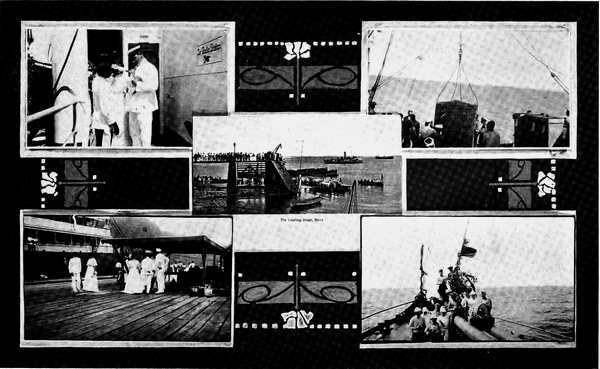
Captain Feeding his Pet / Transferring Passengers in a Basket at Sea The Landing Stage, Beira The Dock at Pago Pago / Christmas at Sea
FRIDAY, JANUARY 10.—Last night I laid my case before the chief steward, and he said he would fix me up; that he would take me out of 27, where Mr. Bond devotes the nights to snoring, and put me in No. 7, with Mr. Martin. I went to bed in No. 7, complimenting the chief steward for his disposition to please the passengers, but in ten minutes Mr. Martin began snoring, and I spent the night trying to decide if his snore was not rather more rasping than that of Mr. Bond. At a late hour I dressed and retreated again to a sofa in the music-room. But I have not lost my temper; I am rather disposed, on the contrary, to laugh at myself for spending a large amount of money in an attempt to have a “good time.” ... The sea has been smooth today and we are all much more comfortable, although I do not believe anyone is getting his money’s worth. About the only excitement on board is the fact that a flock of albatross are following us. I have always understood that albatross are rather scarce at sea, but certainly twenty are in sight as I write this. They often fly within twenty feet of the ship, and we have opportunity to examine them carefully. They follow the ship for hours without moving a wing; they seem to fly by taking advantage of the wind.... We saw several whales today, and the captain, at whose table we sit, says he once ran into one, and was compelled to back out of it.
SATURDAY, JANUARY 11.—A story one always hears on approaching New Zealand: In a strait near the coast is a fish known as “Pilot Jack,” which escorts every ship through, except one. Some years ago a passenger on a certain ship fired at the fish, and wounded it. The fish disappeared for several months, but finally it appeared again, and resumed its old habits of piloting ships through the strait; but it never shows itself when the ship appears from the deck of which it was fired upon. The shooting incident caused the New Zealand Parliament to pass an act protecting “Pilot Jack.” The fish is about twenty feet long, and photographs showing it swimming ahead of ships are common. These photographs, it seems to me, are faked, and made specially to sell to tourists. Seamen do not know why “Pilot Jack” appears whenever a ship invades his territory, but certain it is that he does appear, and swims ahead of the ship several miles. The captain of the “Maheno” says it is possible “Pilot Jack” likes to rub his back on the bottom of ships, and thus get rid of certain annoying parasites. Another theory is that the fish simply plays about the ships, which is not improbable; I have myself seen dolphins play in the waves thrown up by the prow of a ship, and keep it up several minutes at a time.... Last night I sent a wireless message to the Grand Hotel at Auckland, engaging accommodations on my arrival there. I was compelled to pay $2 for the service, and sign an agreement that I would not ask recovery in case the message was not delivered.... No one seems to know much about the albatross which are following us. A sailor told me that if an albatross should light on the water, it couldn’t get up again. Ten minutes later, I saw twenty of them alight on the water, apparently fight over something thrown from the ship, and then get up again. The sailors once caught an albatross, and concluded to take it to the zoölogical garden at Sydney, but it became seasick, and was such a nuisance that they knocked it in the head and threw it overboard. A passenger once jumped from the “Sonoma,” with a view of committing suicide. A number of albatross were following the ship and they picked the man’s eyes out before a boat could reach him. Although very beautiful and graceful, the bird is said to be a disgusting vulture. Where or how it lives no one seems to know; but it is certain that it will follow a ship night and day from Wellington to Cape Horn, a trip of three weeks. It is not seen when land is in sight; it seems to sail about the lonely ocean as easily as a zephyr, and the stronger the head-wind, the easier it sails against it.... There is a peculiar character on board at whom everyone laughs. For awhile I feared he might be a fool American, but he turned out to be a New Zealand school teacher. He wears a tall hat and clerical clothes, and everyone supposed for a time that he was a missionary. One day he went after his music, and began singing in the ladies’ parlor. He cannot sing, and cannot play the piano, although he attempts both. A crowd soon gathered, and vigorously applauded when he concluded “The Lost Chord.” The howling of a dog, accompanied by a child banging on a piano, would not have been worse, and it was so ridiculous that the man was asked to sing again. He readily consented, and attempted a tenor aria from “The Messiah.” The passengers now call the man “the professor,” and two or three times a day he is asked to sing. He always complies promptly. There are half a dozen excellent musicians on board, and when they sing or play, “the professor” is plainly bored. He seems more like a character from a play or book than a real man, and is mild and inoffensive. I talked awhile with him today, and found him an educated man, and apparently quite intelligent, but he is not able to understand that he cannot sing, or play the piano; he cannot realize that all the passengers are making fun of him. I suppose all of us are made fun of when we do not know it, but the case of “the professor” is more than usually glaring. A concert is being arranged for tonight, as this is the last day of the voyage, and “the professor” has been put on the programme, to avoid hurting his feelings. Last night he was the only man on board who dressed for dinner; he put on a swallow-tailed coat much too long for him, and looked odd in other particulars. And after all the trouble he went to, in dressing for dinner, he was compelled to dine at the second sitting. He is a small man, with smooth, white face, and wears his dark hair quite long. The passengers are learning to like him, for he is evidently a gentleman, but none of us can understand why the man so readily consents to make a fool of himself. Perhaps the other passengers make fools of themselves, too, and are as unconscious of it as “the professor.” When not playing or singing, he carries an algebra about, and works problems. He has two pairs of spectacles, and is constantly changing them, and forgetting in which pocket he placed the pair he wishes to use next. ... I am very proud of the men on this ship, they are so modest and well-behaved. I hear no swearing, or rude talk, and there is almost no drinking at table or in the smoking-room. The three men I have roomed with are quiet, and genteel, and I should admire them very much did they not snore. I am certain Mr. Martin was annoyed because I was put in with him, but he is so considerate of me that I can almost forgive his bad habit. I think he knows he snores, and when I hear him threshing about in his bed, I almost conclude he is keeping awake in order that he may not annoy me. He is an elderly man, and frequently gets up in the night, but he does it so quietly that I rarely hear him.... A man I supposed to be an Episcopal rector turns out to be a Presbyterian preacher named Thompson. He is an Englishman, but was educated at Yale, and now has a charge in a small town in New Zealand. I walk the decks with him a good deal. He says he has been taking a vacation, and that, during his idleness, he has been thinking a great deal.
“Many times,” he said, “I asked myself the question: ‘In view of modernism, what is the best thing to do for my people?’ and I always came to the conclusion that there is nothing better for any of us than fairness, politeness, temperance, and industry; I could come to no other conclusion than that the oldest and simplest doctrine is the best.”
Another passenger is a little man who rides running horses in races. The Australians are very fond of racing, and the favorite riders are noted and prosperous men. All of them are small; this man has a wife almost twice his size. Some of them become as noted as Nat Goodwin, the actor, and marry as often. A little intelligence and coolness at a critical moment will often win a race, and the noted jockeys are usually men of intelligence. The man showed me a number of scars, the result of accidents. In racing in Australia, the horses jump hurdles, and often fall.... At 3 o’clock this afternoon we passed the “Three Kings,” barren islands without a light, which have caused many shipwrecks. An hour later we sighted the coast of New Zealand, and followed it throughout the night.... This evening we had a concert in the music-room, lasting two hours. This is a great country for amateur singing; every traveler seems to carry music, and on the slightest provocation will go to his room and get it. In addition to singing and piano-playing, we had four recitations; the recitation habit seems respectable here.... A New York traveling-man says the fashions in New Zealand and Australia are always a year or two behind New York, and that goods going out of style in the United States are just coming in here. Goods that are unsalable in New York, because they are out of fashion, may be picked up at low prices, and sold here at a good profit, according to the New York traveling-man, who has been visiting Australia and New Zealand for fifteen years.
SUNDAY, JANUARY 12.—At daylight this morning we passed into a land-locked gulf, and continued in it all the way to Auckland. At 8 o’clock, while at breakfast, the suburbs of Auckland began to appear, but we did not get through the custom-house and go ashore until two hours later. We hurried to the Grand Hotel, where we had ordered rooms by wireless, paying two dollars for the service. The manager said he had not received the message, therefore had not reserved the rooms. While he was talking, he excused himself to attend to a telephone call. On his return, he said our wireless message had just been telephoned him from the ship. That is the service you get from the much-advertised wireless. Later I met an officer of the ship on the street, and he said I was entitled to a return of my money, but I will never get it; on paying for the service two days ago, I was compelled to sign an agreement not to ask for my money back in case no service was rendered.... The manager of the Grand recommended the Royal, which is under the same management. At the Royal we found a woman clerk so polite that we liked the place at once. When she called a boy to show us our rooms, she called him “Buttons.” This young man took us up in a primitive elevator, which stuck, and the servants were compelled to pull us out. When we finally reached our rooms, we liked them, and probably we are as well off here as we would have been at the Grand.... All the hotels in Auckland, with five unimportant exceptions, are owned by a Jew named Ernest Davis. He owns hotels in other places, and they are all compelled to sell Hancock beer, as Davis also owns the Hancock brewery. One hears a good deal here about the five free hotels of Auckland. Freedom in this case means freedom to sell any beer the manager chooses to buy. In the United States, breweries own saloons, but I have never before heard of breweries owning hotels.... The Royal is very modest in its charges; we pay ten shillings and sixpence per day each for accommodations. This means $2.62 a day for room, three regular meals, early morning tea, and supper at 10 P.M. And the hotel is really good; I do not care for anything better, although the rooms are old-fashioned, and the elevator does not work half the time. When you want anything, you step into the hall and push a button marked Maid’s Bell. When the maid appears, you order hot water for shaving, or whatever it may be you need. There are four bathrooms near my room, which include needle and douche baths. The New Zealanders are fond of bathing, and there is never a lack of bathrooms in their hotels.... I have before referred to the fact that women out here wear afternoon and evening dresses in the morning; I believe I would have noticed the custom had not Adelaide called my attention to it. When the ship landed this morning, a pretty woman we admired, dressed in white satin and white kid slippers for the occasion.... On our way up-town, we passed a store labeled the Clobbery. The stock seemed to consist of gents’ furnishing goods. Perhaps an English friend can tell you where the word Clobbery comes from; I never heard of it before.... After dinner, we walked about the streets of Auckland. Adelaide wore what is known at home as a “Peter Thompson suit,” and it attracted so much attention that I asked her to return to the hotel and change it. There were great crowds on the streets, and they seemed to think Adelaide was a member of a lady brass band of which I was director. She took off the “Peter Thompson,” and put on a gray suit made by a man tailor in Kansas City, but she still looked funny to the people, for they continued to stare at her. She wore a Panama hat for which I paid $12 (marked down from $20), and I thought she looked pretty well, but she was a sight to many of the people of Auckland.... We heard a brass band, and walked that way. It turned out to be a Salvation Army band of thirty men. The players wore red coats, and played like professionals. The men and women in the procession were much more decent-looking than members of the Salvation Army at home. There were no guitars, and no tambourines; the music was furnished by an excellent band of thirty men. It was a very respectable outfit in every way, and finally disappeared into a theatre. In Auckland, Sunday theatricals are prohibited, and religious services are held in every theatre twice on Sunday. In the early evening, while on the streets, we encountered the big Salvation Army band again; also, the Mission band. I was told that the Mission was much like the Salvation Army, except that it was more modest. The Mission had a good band of twenty-four men, and a little organ, which two men carried. After a selection by the band, there was singing, with organ accompaniment. The song was entitled, “Just the Same Jesus,” and was so simple, and repeated so often, that I was soon able to sing it with the others. The leader asked for people to give their experiences, and a good many stepped into the middle of the ring, and talked briefly and modestly. One old fellow was a particularly good talker, and said he had been a soldier in the Civil War in the United States, and traveled all over the world, but had always found Jesus his friend in time of trouble. As each speaker ceased, the same song was sung, “Just the Same Jesus,” and I joined with the others in the singing. Presently the leader came to me, and said:
“You are evidently a religious man, and a stranger. Won’t you make a few remarks?”
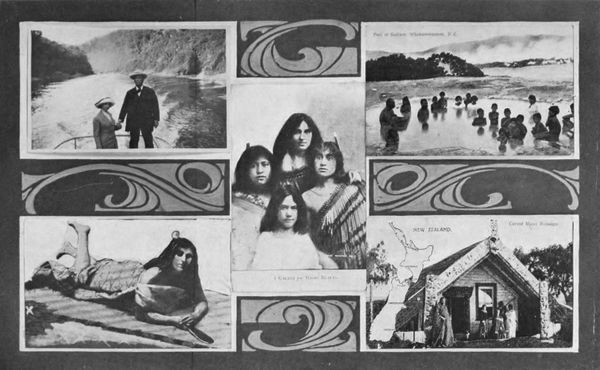
Maunganui River / Pool of Bathers, Whakarewarewa A Galaxy of Maori Beauty A Maori Girl / Native House, New Zealand
I excused myself, and he then asked the band to play.... When we walked up the street, in front of every theatre we found men announcing special religious services. In front of the theatres, also, were choirs singing religious songs as the people went in, precisely as at a street fair in America, a party of the performers will come out to the front to assist the ticket-seller in attracting a crowd. The New Zealanders are evidently a very religious people; I have been hearing church bells all day. Everything is closed tight except drug stores and restaurants.... Both bands I have mentioned had only brass instruments; no clarinets. In each one I noticed that there were cornet players who could play an octave higher than the score, and thus get what we used to call “the clarinet tone” when I played in brass bands in country towns. I have never seen as respectable a Salvation Army outfit as I saw in Auckland, and the Mission outfit was still better looking.... As in Australia, January is like July or August in New Zealand; snow is unknown about Auckland. All the vegetables and fruits are at their best here now, and the bathing-beaches are crowded.... On the “Sonoma” I heard the steward say that when anything came from New Zealand, it was always the very best. We have found the butter particularly excellent, and the mutton is better than the turkey.... An American I met today says that in New Zealand it is no uncommon thing to see girls of fourteen with complete sets of false teeth; that something in the water here is very hard on teeth.
MONDAY, JANUARY 13.—The meals and rooms at the Hotel Royal are so good that we are almost ashamed to accept them at $2.62 per day each. The taxi system here is also very agreeable. In most cities, taxis are disreputable-looking vehicles you are almost ashamed to ride in. Here they are new automobiles of different makes, and they cannot be distinguished from private vehicles. Today we rode about in a Cadillac of 1913 model that had been in service only three weeks. The charge was $3.12 per hour. At home the Cadillac costs about $2,000; here it costs a third more. The driver told us he paid forty cents a gallon for gasoline (known as petrol here); we pay about eighteen cents a gallon. An exposition will be opened here in nine or ten months, and the buildings are being erected in a park adjoining the city. We went out in the Cadillac to see them, and it was very pleasant to hear the sound of the open muffler again, for Auckland is a very hilly city. One park we visited consists of four hundred acres, and it was given to the city by Sir John Logan Campbell. Before he died, citizens of Auckland erected a statue in his honor, and he was present at the unveiling, which seemed to me rather unusual. From the top of a mountain in this park, we could see across New Zealand. The country is nearly a thousand miles long, and has an average width of one hundred and fifty miles, but at Auckland the width is only seven miles. The city will soon extend across the isthmus, and there is already talk of digging a canal.... Auckland is accustomed to giving. One of the handsomest and largest structures here is a Y. M. C. A. building, and near it is a Y. W. C. A. building. The campaign in which the money was raised for these two buildings must have been a strenuous one.... Workingmen’s clubs are common here. I have often wondered that we do not see them in the United States.... A few days ago, the New Zealand Press Association, which answers to our Associated Press, sent out a telegram which offended labor-union men. Thereupon the firemen in an Auckland ferry service went on strike, and greatly inconvenienced the public. The firemen had no quarrel with their employers, but quit work because their dignity had been offended by the newspapers. The newspapers of Australia and New Zealand criticise the labor unions much more freely than do the newspapers of the United States. Here business houses are compelled by law to close on certain days, and the workingmen have become so powerful that they have divided into two parties, and are fighting each other. Many New Zealanders have told me that the big fight is yet to come, and that this fight will be between the people and the labor unions.... I went into a meat market today, and inquired prices. A rib roast of beef costs twelve cents a pound; a sirloin roast, fourteen cents. Round steak costs thirteen cents a pound; the butcher told me he rarely sold a sirloin steak, but when he does, he gets twenty cents a pound for it. Leg of mutton sells for twelve cents a pound, and mutton chops, thirteen. Pork chops are sixteen cents a pound, and ham and bacon twenty-four cents. The butcher makes a difference in price when a customer has meat delivered and charged. Butchers at home do not make this distinction; the man who pays cash, and carries his purchase home, is charged as much as the patron who runs an account, and has everything delivered. The beef here is inferior to ours; there is no such thing in New Zealand as corn-fed cattle.... We also visited a dry-goods store, and, so far as Adelaide was able to judge, prices were not much lower than at home. Besides, everything seemed out of style.... In Atchison, market gardeners sell tomato and cabbage plants growing in boxes. Today we saw plants grown in exactly the same way in front of Auckland grocery stores, as this is the season for making garden here.... I have never seen better-looking horses anywhere than I see in Auckland. They are usually of the Clydesdale strain. All sorts of live-stock seem well fed and well bred.... This is a poor trip, compared with the trip through Japan, China, India, etc. There the people dress and look different; here the people are so much like those at home that we do not seem to have been away, if we can forget the pronunciations.... In the poorer quarters of Auckland, we saw a meal advertised for twelve cents. It consisted of tea, bread and butter, and fish.... Anything that sells for a nickel at home, is six cents here. I had my shoes shined at a street stand today, and the price was six cents. There is no five-cent piece in English currency, but there is a six-cent silver piece. There is nothing here answering to our ten-cent piece except the sixpence, which is worth twelve cents. There are five and ten-cent stores here, but their prices are six and twelve cents.... When we want a guide, we get a boy from the hotel, who is known as “Buttons.” At meal-times, his business is to go through the dining-room, and take orders for liquor. He also sings in the vested choir in the largest Episcopal church in town. We passed his church yesterday, and he offered to take us in and introduce us to the pastor, but we were compelled to decline the honor, owing to lack of time. Wherever I go, I employ boy guides. They know the interesting places, and point them out, but have no problems to discuss as men have.... A sign we see here frequently is “Private Bar.” What is a private bar? Does it mean a bar operated by a man who has a saloon for his own private use, and a bartender who waits on no one else? ... In the bar connected with the Hotel Royal are two girl bartenders, and they are good-looking, stylish girls.... A big store near our hotel is operated by “John Court, Limited.” That word Limited is frequently seen abroad, and seems to mean the same thing as “Incorporated” with us.... At home, we have a saying that oysters are good only in the months which have an “r” in them. Here, oysters are at their best in April, May, June, July and August, and out of season in the months which have an “r” in them.... In an early walk this morning, I saw a man riding a horse, and driving a big bunch of sheep and cattle through the streets. He was assisted by three of the cleverest shepherd dogs I have ever seen, and it was a sight well worth seeing. During the same walk I ran across a man who was selling rabbits from a cart. He told me the rabbits had been trapped the day before, and shipped to Auckland by rail. He sold two young rabbits for a shilling, or twelve cents each, and called out as he drove along: “Wild rabbits; wild rabbits.” In Australia, rabbits have become so numerous that they are a menace and a danger, but this Auckland rabbit-seller told me that in New Zealand the supply of rabbits is not equal to the demand.... New Zealand is not an old country; its history really dates from about 1840. Although Captain Cook, in 1769, discovered and explored the two islands composing New Zealand, its real history did not begin until almost a century later, when the native Maoris, after a war lasting eleven years, concluded a treaty with the English. Australia and New Zealand, although nominally English colonies, are as free and independent as any countries in the world.
TUESDAY, JANUARY 14.—We have devoted this day to a railroad journey from Auckland to Rotorua, the center of the Lake district. Here are located the geysers which are said to rival those in Yellowstone Park. Here are located, also, famous baths, and Rotorua is probably the most noted watering-place in Australasia.... The railway station in Auckland is located next to the postoffice, and very properly, since the government owns the railway as well as the postoffice. No trains are run at night, as a rule, and none on Sunday, except an important mail train between Auckland and Wellington. The railway is a narrow-gauge, and we traveled on it very comfortably from 10 A.M. until 6 P.M. At noon, luncheon was served in a dining-car, and at 3:30 P.M. the dining-car servants announced afternoon tea. When we gave our tickets to the conductor, he said “Thank you;” over here, when a hotel waiter shows you the bill of fare, and you say you will take soup, he always says “Thank you.” ... For miles and miles we saw nothing but pasture land, and cattle and sheep; a hundred sheep, probably, to ten cattle. In a railroad journey of eight hours, we saw only half a dozen cultivated fields. These were devoted to oats and turnips. Oats were in the shock, and we saw several orchards containing ripe fruit. But mainly we saw pastures. The country is beautiful, and it is prosperous, but its prosperity comes mainly from sheep. At several places we saw this sign: “Poison laid for dogs.” ... All the stations are named for the original Maori settlers, as many of our towns have Indian names. At many stations we saw the Maoris in considerable numbers.... I do not believe there is a shingle roof in New Zealand; the roofs of the cheaper houses are of corrugated iron while the roofs of the better class houses are of red tile. Nearly all the houses in the country have fireplaces, and most of them are built of sheet-iron. The winters here are very mild, and a little fire in a grate is all that is needed. New Zealand is a wonderful stock-raising country, because of its mild winters.... In the smoking-car of the train, the spittoons were holes in the floor, with a brass top of the regulation spittoon pattern.... In Australia and New Zealand you see the sign “No smoking” very much oftener than anywhere else in the world.... There is no prairie land in New Zealand. There is a bush to be cleared off all the farm land; I don’t know what it is, but it looks like scrub cedar. All along the route we saw this burning; that seems to be one method of clearing land here. And after the land is cleared, it must be heavily manured; at one country town I saw a store sign which announced dry goods, artificial manures, iron mongery, etc. There is as much evidence of prosperity here as in the best sections of the Middle West, and you wonder where it comes from, since you see almost nothing but sheep. I didn’t see a poverty-stricken looking house all day, nor at any of the dozens of stopping-places did I see anyone who seemed to be poor.... About 2 P.M. we approached the mountains, and traveled in them until we reached the summit, and ran rapidly down the other side. Near the top we encountered several sawmills, but they were rather small affairs. At 5 P.M. we began seeing, in the distance, steam ascending from geysers. At 6 P.M. we steamed into Rotorua. The railroad stops here, and all the passengers left the crowded train. There are dozens of boarding-houses and hotels; excellent accommodations may be had for $10.50 a week, and the Grand, the best hotel, charges only $3.12 a day for board and room. The baths rival the best in the most famous watering-places of the Old World, and many spouting geysers may be seen in an hour’s walk. In addition, Rotorua has a beautiful lake, and anyone can catch fish in it; so, little wonder that the town is growing rapidly.
WEDNESDAY, JANUARY 15.—At 10 o’clock this morning we left for a trip on the lake. There were about a dozen other passengers in the motor boat, and in half an hour most of them were seasick, as the wind was blowing a gale. Our destination was a famous spring eight miles away. This spring heads a river so large that we sailed in it in a boat. The water gushes up from a great hole, and with such force that a coin will not sink in it. The flow is twelve million gallons in twenty-four hours, and the water as cold as ice. From the wonderful spring, we went through a wonderful river to a wonderful fall. Three other boats accompanied us; tourists are as common here as they are in Egypt. At the wonderful fall, we ate lunch. The Grand Hotel sent a hamper along, and we ate while sitting on a cliff overlooking the mighty rush of water. At the fall we left the boat, and took a stage back to Rotorua, stopping on the way at a thermal center of great interest: Tikitere. An Irishman married a Maori woman who owns the place, and he insists upon charging fifty cents admission. This is the only sight in the district for which a charge is made; the Irishman is smarter than the New Zealand government, and every visitor is compelled to pay two shillings, or miss one of the best sights in the district. Tikitere covers several acres, and is mainly devoted to boiling mud springs. There are thousands of these springs, some of them not much larger than your hand, and some of them big enough to float a ship. Imagine a loblolly of mud boiling violently, and you have the main idea. At one place there are cold and hot springs within five feet of each other. Near them is a fall of hot water from two boiling lakes. Then we drove to Blue Lake, an extinct crater filled with water of a perfect blue, and returned to the hotel at 6 P.M., badly sunburned as a result of our trip on the lake and in the stage-coach.... When I tell people I had no sleep on the “Maheno” because of snoring gentlemen, they say, “Let me tell you what they did to me.” And then they relate inconveniences suffered on different ships. But in spite of these uncomfortable incidents of travel, nothing can keep the people at home.... The stage in which we traveled today was pulled by five horses: two wheelers, and three hitched side by side ahead of them. The roads were so dusty that the driver was frequently compelled to stop, and wait until he could see his way.... Speaking of differences in the English language at home and abroad: opposite my room at the Grand Hotel is a livery and bait stable. Rotorua is a great place for livery and bait stables, owing to the tourist trade. From my window early in the morning, I see men and women coming from the different bath-houses, with towels over their arms. Frequently stages drive up in front of the hotel, and passengers depart for sights quite distant from the town. There are a good many automobiles, also, and we shall travel in these quite extensively when we leave Rotorua to see the other sights in the district. On an average, there are fifteen hundred visitors in Rotorua, and a resident population of 2,500. The great watering-places in Europe are insignificant compared with this place, because of the variety of natural baths procurable here. The government has spent $200,000 on a bathhouse, and surrounded it with a very beautiful garden in which sweet peas are now in bloom. This is also the home of the gladioli; I see these flowers everywhere in splendid profusion. In the park surrounding the government bathhouse are several spouting geysers, steam whistlers, sulphur springs, etc. Outside the park grounds may be seen many sanitariums, with invalids on the porches. There is nothing as effective in restoring health as natural hot springs, and the variety is so great here that I wonder the visiting population is not much larger than fifteen hundred.
THURSDAY, JANUARY 16.—The Maoris, or native inhabitants of New Zealand, look very much like our Indians, and have most of their characteristics. They are lazy and shiftless, but good fighters, which will be generally recognized as a trait of the North-American Indians. At the photograph galleries we see pictures of beautiful Maori girls, but none are to be seen in the native villages, two of which are located near Rotorua. In both of these are hot springs, and the natives use them for cooking, heating their houses, and for bathing. In the hot springs are placed pots containing meat and vegetables, and the springs are then covered over with old gunny-sacks until the cooking is complete. The women also do their washing in the same way; the clothes are boiled in a hot spring, and then soaped and rubbed in a stream of cooler water. While the women are washing, their children are bathing in warm pools near by. The houses are built over hot springs, and in cool weather the warmth is found very agreeable. A few feet away from the hot springs may be found a geyser in constant eruption, or which erupts every ten minutes, every hour, every day, or every month. Yesterday all the geysers were going, but most of them were quiet today. The district where I saw the native village covers many acres, in a depression between mountains, and is marked by white patches which look like old lime-kilns. These white patches were made by the geysers; the water is strongly impregnated with lime, and the steam and spray give everything touched a coating of white. We saw great holes in the earth filled with blue water, and the bottom as white as snow. Not far away would be found another geyser; a great loblolly of mud, boiling lazily. Beside a rushing stream of cold water we saw a hot spring, and heard the old story that a man might stand in one spot, catch a trout, and boil it. A Maori woman was our guide, and we greatly admired her beautiful voice. She was elderly, and ugly, but her voice was soft and musical. She took us to a native Maori fort, and pointed out a sort of bird-box situated on top of a pole. This was a Spirit House; a spirit lived in it, and, when danger threatened, the spirit would speak in a loud voice, and tell the people what the danger was, and when it would appear.
“Most ladies and gentlemen do not believe it,” the Maori woman said.
I asked her if she believed it, and she replied in her broken English: “I used to did.” She said that when she was a child, her people always put food in the spirit house for the spirit, but that lately the custom is going out of fashion. In the village are Catholic and Episcopal churches; the Catholic priest is a native Maori, and the church is heated in cool weather from a hot spring beneath it.... The Maoris were originally cannibals, but the guide said they ate each other, and did not bother the whites much. In one place we visited here, we saw forks made of human bones.... We called at the guide’s home, and saw one of the tin fireplaces which are seen in seven-tenths of the poorer houses. They cost about $8 put up, and are used for cooking purposes, as well as for heating. They burn out, after a time, but a tinner will rivet in a patch for a small charge. They are certainly very much cheaper than the stone and brick fireplaces we have. A native Maori village looks much like a negro suburb in an American town, but the Maoris are not black; they look like Indians and have straight hair. Some of the women have their lips tattooed, to indicate submission to their husbands, but there is a Suffragette movement on here, as elsewhere, and the Maori woman who showed us about laughed scornfully at the notion that woman is inferior to man.... Just then we came to a place called the Frog Pond: a mud lake, and there is just enough steam below to cause particles of mud to jump like frogs. Near by, in a hole in the earth, the escaping steam made a sound like the croaking of frogs. The Maori woman described these things, and then walked on in silence, with a mean look in her eyes; she was evidently still thinking of the foolish women of her race who tattoo their lips to indicate submission to their husbands. I didn’t have a very good time after the woman suffrage question came up, and was glad that we soon after reached the last sight on the list. When women look at me in that funny way indicating that I impose on them, I am thoroughly uncomfortable. So we walked back to the entrance to the geyser field, and took a carriage to Rotorua. On the way, we met dozens of other carriages containing visitors; here people are always departing for a trip, or returning from one, and when the sights are exhausted they go on to Wairakei, where there is another collection of geysers, hot springs, etc. Between trips, they take baths, and there is a great variety to choose from; no other place in the world has as many different baths as Rotorua, but the town is not easily reached, and it doesn’t attract as many people as Hot Springs, Arkansas, which has only simple hot springs; no chain of lakes, no wonderful fishing, no oil baths, no geysers, and no mud baths, as has Rotorua.... There are only two geyser fields in the world; the other is in Yellowstone Park, in the United States. So far as I am able to judge, the geysers in Yellowstone Park are much finer. There are no terraces here, as in the Yellowstone, and in every way the Yellowstone district seems superior. But in a way, they are much alike. The geysers here are undoubtedly losing their force; citizens tell me they can see a difference from year to year. I have not seen a geyser so far more than ten or twelve feet high, but I saw many big ones in the Yellowstone. All the geysers were going yesterday, and it is said some of them shot steam and hot water into the air to a height of forty feet, but I was on the lake trip yesterday, and did not see the big geyser display which everyone is talking about today. But in the Yellowstone you can see a big geyser display any day; indeed, Old Faithful goes off every hour, and shoots steam and hot water 150 to 200 feet into the air. Here soap is frequently put into the geysers, to make them show off for visitors, but this is not necessary in the Yellowstone. This district had terraces until a few years ago, when they blew up, and now there are no others like those in Yellowstone Park. Besides, the Yellowstone district is much wilder and grander than the Hot Lake district of New Zealand. This is a wonderful place, but the Yellowstone is much more wonderful, it seems to me.... We are the only Americans at the hotel, and, except that a St. Paul man was here two months ago, we are the only Americans who have been here in a long time, the manager says.... In the fine park surrounding the government bathhouse, this afternoon, we saw dozens of games going. There was bowling, tennis, archery, cricket, and croquet, but principally bowling. In this game a good many elderly men participated; it is an old man’s game, but lately young men are playing it. The lawn was as smooth as a floor, and the game seemed to be to roll wooden balls to a goal. The men over here carry the wooden balls, when traveling, and engage in the game at different places. I had never seen the game before, and watched it for an hour. The players were very polite and genteel, but all had the pronunciation which seems so queer to us. I have seen no golf here, but I am rarely out of sight of a tennis court; that seems to be the universal game.... The New Zealand government has been so successful in business that it is now branching out; it is operating a tourist agency in opposition to Thos. Cook & Son, who have offices all over the world. People living off the main lines of travel cannot realize how valuable travelers are. In Europe, many cities devote millions of dollars to securing tourist travel, and find that it pays. Paris spends millions annually in this way, and rival cities are lately doing a good deal in the same direction; it is generally said that Berlin is now a rival of Paris in attractions for travelers. At this little town of Rotorua, a train-load of tourists arrives every day, and without them the town would not amount to much.