Front matter (continued 4)
Reading edition

TUESDAY, FEBRUARY 18.—I read a good deal, as the ship has an excellent library; frequently I take out two books a day. One I read this morning is entitled, “The Cruise of the ‘Falcon.’” In 1880, an Englishman named E. F. Knight conceived the notion of taking a long voyage in a small yacht called the “Falcon.” The vessel was only forty-two feet long and thirteen feet wide, yet he cruised in it for twenty months, going from England to South America, and thence to the West Indies, where he sold his boat, and took a steamer home. The crew consisted of Knight and three friends, and a boy. One of these friends, Jerdein, had been an officer on a P. & O. liner, and was a skilled navigator and seaman, while Knight was an amateur yachtsman of considerable experience; but the other two, Andrews and Arnand, were landlubbers. The boy was fifteen years old, and had been to sea several times. On the way to South America they stopped at several islands, and had a prosperous and agreeable voyage. Their undertaking was thought to be a foolhardy one, and the newspapers at the time devoted much space to the voyage, but the little “Falcon” turned out to be quite fast, and rode the seas well; two thousand miles were made in ten consecutive days off the coast of South America. Five months were devoted to a trip up the Parana and Paraguay rivers. At Buenos Aires, Jerdein, Andrews and Arnand concluded that they had had enough of it, and quit the little boat. Knight was not discouraged, and hired three Italian sailors, in addition to the boy. With these he put to sea, and had a very rough voyage.... There are two islands called Trinidad; one of them in the West Indies, and the other off the coast of lower South America. Knight determined to visit the latter island, and had a very remarkable experience. The landing was bad, and he found the island an unwholesome and inhospitable place. At one spot on the island he found a great lot of wreckage; it looked as though many foundered ships had drifted in there and gone to pieces. He believed treasure might be found in the wreckage, but the weather was stormy, and he did not know what moment the “Falcon” might be compelled to sail away for safety, so he gave up the treasure, and left the island, where he spent three or four very uncomfortable days. From Trinidad he went to Bahia, and to the Amazon, meeting with all sorts of adventures, finally landing at Barbadoes, where he sold the “Falcon,” and sailed for home on a steamship.... I suppose Knight elaborated his dangers and adventures; talkers do this, and I see no reason why writers should not. Many of his most remarkable stories he had second-hand; the wonderful incidents recorded happened a day, or a week, or a month, after he arrived at certain places. This is true of most very remarkable circumstances; the narrators do not say they witnessed them, but gentlemen they had every reason to believe truthful told them the stories, etc. Dozens of men have told me of the famous pilot-fish of New Zealand, which pilots all ships through a certain channel. None of these gentlemen have actually seen the pilot-fish at work, but they met a gentleman only last week, or the week before, who had seen it. By-the-way, a recent Sydney paper says the famous pilot-fish has not been seen in six months; it is feared that he has been killed by the crew of some whaling-ship.... Another favorite story is of the fogs in London, yet I have never seen anyone who has witnessed one of these fogs. And the Scientific American stated not long ago that the old-fashioned London fog has disappeared; that one has not been seen in a good many years.... Speaking of whalers, it is generally agreed that in the old days when that industry was flourishing and profitable, the Yankees were the smartest men at the business. Indeed, when an English firm built and equipped a whaling-ship, Yankees were employed to teach the English crew the business. I have been grumbling a little because of this voyage of nineteen days. The old whalers used to be gone three years on their voyages; sometimes they did not see land for ten months at a time. Capturing a whale was as dangerous as a naval battle. The sailors went after it in small boats, and a whale was rarely captured under six or seven hours.... The sea is supposed to be very dangerous. As a matter of fact, a sea voyage is not as dangerous as a railroad journey. Take a hundred thousand people who travel a given number of hours by rail, and compare them with a hundred thousand who travel a like number of hours by sea, and those traveling by sea will have very much the best of it, so far as safety is concerned. Indeed, going to sea is safer than staying at home. Ever remark the great number of people who are killed around home? The newspapers are full of dreadful accidents occurring in quiet, rural communities where life is supposed to be particularly safe. Every time a farmer hitches up a team, he runs a risk. A buggy-ride is dangerous; the hold-back straps are liable to break, in going down hill; and a buggy running onto the heels of a horse is almost sure to cause an accident. And public streets and roads are more dangerous than ever since automobiles became so numerous.... In seacoast towns everywhere may be seen thousands of old men who have spent their lives at sea almost without accident. An insurance company regards a seaman as a safe risk; as safe as a farmer. It isn’t the danger that should keep you off the sea; it is seasickness, and four in a room 9×10 feet. Nor is it the expense that should keep you off the sea. For this voyage of practically twenty days I pay $150; or $7.50 a day. It would cost that at a New York hotel for room and board. And there are sea voyages much cheaper than this one: there is a White Star boat running between Sydney and London, by way of South Africa, which charges about $5 a day for the journey. It combines first, second and third-class into one class, but is said to be very fair.
WEDNESDAY, FEBRUARY 19.—We are the only Americans on board the “Anchises,” although a passenger from London once met an American who lived in Connecticut. The Londoner asked me today if I knew his Connecticut friend. I was compelled to confess I did not know him, although the London man said his friend was one of the prominent men of that part of the world.... It seems we are not a musical crowd; although a concert has been announced for the night before we reach Durban, there is no one to play the piano. I suggested to a member of the Sports Committee that some of us might learn, as we would have ample time, but he did not believe my scheme practical. A man on board has a graphophone, with sixty records, and this is going a good deal. Last night he loaned the machine to his nurse girl, and she gave a concert on the lower deck for the benefit of the crew. One of the firemen plays the violin, and the laundry girls, stewardesses and nurse girls danced with members of the crew. It was a bright moonlight night, and this social event attracted more attention than anything else we have had on board. There was a euchre tournament in the smoking-room, but it did not attract as much attention as the dance. Euchre is called a “nigger’s game” here; it is said to be so simple that niggers can learn it.... Women are in the smoking-room of the “Anchises” constantly, but some captains do not allow this: they say the smoking-room is for men, and that if women are allowed in the room, some of the men will keep out.... The Eurasian on board speaks no English, and, in addition, has had toothache for more than a week. Toothache is one of the dangers of the sea. Captain Trask told me that he once suffered seven weeks with toothache, when on a sailing-ship, and was not free from pain a moment during all that time. On a sailing-ship there is no doctor; the captain doctors the sailors when they become ill, and usually he doesn’t know much about medicine.... We have had an unusually smooth sea today, but the weather has been cloudy; we have not had a clear day since leaving Adelaide, although the sun occasionally shows itself for a short time.... The English people are as crazy about cricket as Americans are about baseball. A man who attends all cricket games, and knows all the fine points, is called a “barracker.” But he does not abuse the players, as do our baseball fans; a “barracker” seems to be more of a gentleman than a “fan.” ... I don’t believe I look at the sea more than once a day; usually, when I get up in the morning, I look out the window, and remark that the sea is smoother or rougher than yesterday, but that is about all. I have never seen anything beautiful or unusual at sea, except one evening when on the “Sonoma.” I was leaning over the rail forward, as the sun was setting. The rays of the setting sun were reflected in the waves rolled up by the prow of the ship; I could see all the colors of the rainbow, and the effect was very unusual and beautiful. But as a rule, the sea is never majestic, though it is frequently what the English call “nasty.” ... This is our seventh day out, and we have not seen a sail or ship. One day we saw a black spot which might have been smoke from a steamer, but that is all. Even the albatross have deserted us, and we are as lonely as lonely can be. The members of the Sports Committee are working hard to Keep Something Going On, but they are not meeting with any great success. It is amusing to see them hunt up players for the different games. The head of the Sports Committee is a fine old gentleman named Irons, a friend of ours, and we find a good deal of amusement in watching him worry around like the man who proposed a picnic which isn’t going very well. We try to take the Sports Committee seriously, since the other passengers would probably think us “funny” if we did not (if they do not already entertain that suspicion), but as a matter of fact the Sports Committee is a joke to us. “Well,” one member of the committee said to me this evening, “it has been a strenuous day.” I thought it the dullest day I ever experienced anywhere. We hear this evening that our friend Mr. Irons, head of the Sports Committee, is in bed as a result of the excitement of the day, and we are laughing at him, in which his wife joins us.... It is at least clean at sea; no dust and no dirt. If it were not for the idea of it, you might wear a collar a week at sea.... Somewhere out in this wilderness there is said to be a large island where the women greatly outnumber the men; of six hundred adults, five hundred are women. I have forgotten the name of the place, but I have heard the men talk about it a good deal. On this island, the men do nothing, and the women wait upon them with great cheerfulness. A man is at liberty to have as many wives as he pleases; the men tell very amusing stories about life on the island, and usually they tell them in the presence of the women, to adorn a moral. This paradise for men is known in a general way as “The Island,” and I am of the opinion that it is an invention of some man who has dreamed of such a place, after being imposed upon a good deal by women and girls.
THURSDAY, FEBRUARY 20.—In Australia, what we call a tramp is known as a “Sundowner,” because of his habit of appearing at sundown, and asking for a night’s entertainment.... The best thing we have to eat on the ship is oatmeal, which is served every morning for breakfast. I have been neglecting this nutritious and palatable food for years, having drifted off to new breakfast foods extensively advertised, but I shall drift back to the Old Reliable, as I find it surprisingly good.... Opposite me on deck today sat a woman reading an English magazine. On the front cover was an advertisement of “Black and White” whisky. The magazine was about the size of our Ladies’ Home Journal; imagine that fine publication with a whisky advertisement occupying two-thirds of the front cover page.... A passenger named Grice was telling this morning of an uncomfortable experience. He was riding after cattle on the plains of Australia, when his horse fell over an ant-hill. The horse broke its neck, and fell on the man in such a way as to pin him to the ground. After six or seven hours, help arrived. There was no surgeon in the district, and the man was carried to Melbourne, 180 miles. Here he was operated on seven times, and is just out of the hospital, where he spent eight months. He is on his way to Mombasa, in Africa, to hunt. When surgeons and hospitals are mentioned, I find that the Mayos, of Rochester, Minnesota, are known everywhere.... I have heard that some men, when they return from a long trip abroad, are very conceited about it, and talk too much of their experiences. In case I am so fortunate as to return from this trip, I shall be very modest, and greatly admire those who had sense enough to remain at home. How I admire Uncle Bruce, of Potato Hill farm, who has nothing to do this winter except haul manure from town for his next year’s crop! What good things he has to eat down at the farm-house! And what an appetite he has! I wish I could change places with him. For dinner today we had venison and pheasant, but they tasted like leather. Game kept a long time isn’t fit to eat.... Last night there was a dance on deck, and members of the Sports Committee were indignant because of the small attendance. “We have worked hard to provide amusement,” they said, “and almost no one is dancing.” It has probably never occurred to the members of the Sports Committee that they are a nuisance rather than a blessing. It would be very much pleasanter on board if a Gay Time had never been thought of. I do not care to dance; nor do I care to have members of the Sports Committee urge me to dance. If I care to play quoits, or any other of the deck games, I do not need a Sports Committee to urge me. The members of the Sports Committee think it an outrage that Adelaide does not dance, and look at me reproachfully. I tell them I had nothing to do with it; that her parents are church members, and do not believe in dancing. This also greatly astonishes them. It wouldn’t surprise me if the members of the Sports Committee did not finally get into trouble with some of the other passengers who want to be let alone. I hear a good deal of grumbling in the smoking-room from men who are being constantly urged to dance, take part in the concert, play skittles, or quoits, or deck billiards, or sea croquet. The members of the Sports Committee remind me of five or six men who decide that a town needs another lodge, and bore all the other citizens to join. Wherever you go, on land or sea, you find impudent men who urge others to do things there is no necessity for doing. Our pastor, the tall clergyman heretofore mentioned, is far more considerate of us than members of the Sports Committee. Sunday morning he sends a steward about the deck tolling a gong, to give notice that religious services will shortly be held in the music-room; but those who do not care to attend are not reprimanded by the holy man for absence. I thoroughly dislike a man who is forever protesting because others do not accept his notions, or admire whatever he happens to admire. Always remember that what you regard as the greatest thing in the world may be regarded as the most useless by many worthy and intelligent people.
FRIDAY, FEBRUARY 21.—On this ship are eighteen thousand frozen sheep carcasses, en route from Australia to London. In order to keep this meat properly, great refrigerators are necessary. This frozen-meat trade is the source of Australia’s prosperity; before it was inaugurated, Australian sheep were not worth much except for their wool and tallow; old-timers in Australia remember when a sheep carcass might be bought for a shilling. This frozen-meat trade is also carried on between South America and England, and the result is that the English have cheap meat. The people of the United States might have cheap meat, also, were it not for the tariff. Our admiration for the farmer is so great that we pay a third or half more for meat than is necessary, in order that the farmer may receive high prices for his live-stock. When an American goes to a meat market, would he cheerfully pay thirty cents instead of twenty for a piece of meat were it not for his Statesmen? I have always doubted that the people see the advantage of a high tariff; it is the Statesmen who are able to figure it out.... The men who thought of the frozen-meat scheme did a lot for humanity, but probably no one knows who they are; hundreds of men had a little to do with it.... The captain says a ship loaded with frozen meat arrives in England from Australia or South America every day of the year.... The “Anchises,” on its last voyage out to Australia, was in a great storm in the Bay of Biscay, and the ship’s doctor was seasick four days. “Tell me,” I said to the doctor today, “how a big storm at sea looks.” “Blessed if I know,” he replied; “I was sick in bed; I didn’t see anything of it.” ... My dining-room steward says the captain is always sick for a day or two after leaving port, but the other ship employees deny this. They say that on leaving port the captain has his meals served in his room, which is near the bridge, and thus the story of seasickness started.... We have had a bad sea all day, with drizzling rain. Not many are sick, owing to the ship’s unusual steadiness. It rolls and pitches, but gently, and I wonder the “Anchises” is not famous the world over for its unusual sea-going qualities. Some ships cut up at sea, however carefully they were built, while occasionally one will prove unusually steady. The “Maunganui” was a big ship, and very handsome, but it had a certain little movement of its own that was atrocious. While lying in my bed, the ship came up under me in such a way as to make me feel as though I were hanging on a clothesline, with the back of my head dangling against my heels.... The English have many customs and pronunciations I do not understand. How much do you suppose a hundredweight is in England? Not a hundred pounds, but a hundred and twelve pounds.
A ton, consequently, is not 2,000 pounds, but 2,240 pounds; and this system bothers every country with which England does business. The English also use the term guinea in reckoning money, although there is no such coin, nor is English paper money issued in guineas. A guinea is as much more than $5 as a pound is less. If the people of the United States should invent a slang term meaning $1.03, and occasionally use it in reckoning money, instead of the dollar, it would be about the same thing as the English custom of occasionally dragging out the word guinea, and using it, to confuse strangers.... Some Americans say, “Don’t you know?” in conversation, and it is a very bad habit, since the term is meaningless, and soon gets on the nerves of the listener. The English make fun of the expression, and represent all Americans as saying “Don’t you know?” It is a fact that too many of them do. But Australians add, “You see” to their statements a great deal. I believe a majority of the Australians say “Yis,” instead of “Yes,” and they have many other oddities of speech which grate on the nerves of Americans, who believe in pure as well as free speech.... On a rough night, the squeaks in a ship sleeping-room are worth mentioning. Last night as I lay in bed, I made note of the squeaks, and could distinctly count four different ones: two for each pitch, and two for each roll. When the weather is fine, there is no strain on the ship, and the squeaks disappear.... This morning at 10 o’clock the captain made a calculation, and said the time in Atchison was 10 P.M. Thursday night. He showed me how he figured it. Atchison is in 96 degrees longitude; therefore it is six hours and twenty-four minutes behind Greenwich time. The ship today is in 80 degrees longitude, and therefore five hours and twenty minutes ahead of Greenwich. To be exact, the difference in time between Atchison and the position of the ship today is eleven hours and forty-four minutes.... The lady who has five children and two nurses on board says that babies should be made to mind when six months old. I told her that in America we did not begin spanking that young; that our rule was to spank girl babies at eight months, and boy babies at one year.... Which recalls the fact that I have lately been reading R. A. Wallace’s “Malay Archipelago.” Wallace spent several years in that section in hunting the orang-utan, the monkey-like animal which is most like man. One day he killed an adult female, and found that it had a baby six or seven weeks old. This he tried to raise, hoping to present it to the British Museum. He found the baby orang-utan very much like a human baby. It cried for food, or when uncomfortable, and became so badly spoilt that he was compelled to spank it when it became four or five months old. Unfortunately the little orang-utan contracted an illness about this time, and all Professor Wallace could do was not sufficient to save its life.
SATURDAY, FEBRUARY 22.—A howling gale has been raging all day. On the upper deck this afternoon, many of the passengers were soaked by a wave which came aboard. The wind is following us, and pushing the ship along; the sailors say that a head-wind would have resulted in as bad a day as is usually seen at sea. The decks are slippery, and those who go out are in constant danger of being soaked with spray. For a wonder, I am not seasick, and spent my time talking with passengers who have visited strange places. One man lived for a time in one of the remote islands of the Malay archipelago, where the natives wear very little clothing, and he says the men have the handsomest figures he has ever seen; that the marble figures in art galleries do not equal living examples in Borneo. The figures of the men are much superior to the figures of the women. Occasionally a very young girl will have a good figure, but never equal to a boy of the same age; men of thirty have splendid figures, whereas women of that age have no figures at all.... A bird known as the hornbill is found in Borneo. When the female has laid a sufficient number of eggs, the male seals her up in the nest, which is in a hollow tree, and compels her to sit until germination takes place. While the female is a prisoner, the male feeds her faithfully. Another bird deposits its eggs in a pile, covers them over with sand, and leaves hatching to the sun. A half-dozen hens will place their eggs in the same pile. When the eggs are hatched, the young are immediately able to look after themselves.... In some of the islands of the archipelago there are no judges, courts, or policemen, yet the natives are well behaved, and crime is almost unknown. This, my informant says, is probably the natural state of man; wherever crime is rampant among savages, it has usually been introduced by members of civilized races. In a state of nature, a man soon learns that if he expects his rights, he must respect the rights of others; therefore if he desires peaceable possession of his house, or his cattle, or his wives, he must respect the property rights of others. Crime seems to be the product of civilization, and not of savagery.... Captain Warrall says there is nothing in the story that he becomes seasick every time he leaves port. But he says it is a fact that when he goes to sea after a long stay on land, he suffers with a headache for several hours. This headache is due to the motion of the ship, and he believes most sea-going men are affected in the same way. The second engineer told me he had the same experience as the captain, and my room steward says that on leaving London or Sydney he always gets a headache, which does not entirely disappear until the second day out.... In the old days when I was a reporter on the Atchison Globe, I thought it a good item when I found a farmer’s boy with forty rabbits. I found a better rabbit story than that today. On this ship are one hundred and eighty thousand frozen rabbits, en route for London, every one of them trapped. Rabbits in our country are ruined by being shot; we have never learned the art of trapping them. I have been familiar with rabbits all my life, but never knew a man who could trap them. In Australia, rabbit-catching is a trade, and the rabbit-catchers have a union, which was raising quite a disturbance while I was there, by threatening a strike. The rabbits caught in Australia and shipped to England bring in a tremendous sum of money annually; I have forgotten the figures, but the total is enormous. Rabbits were imported into Australia by members of an energetic Sports Committee. In the early days certain of the citizens of Australia said: “Our people have no amusement; let us import rabbits from England, that there may be something to hunt.” So a Sports Committee was formed, and members of it held public meetings, and passed subscription papers, and abused those who did not give. As a result of it all, rabbits were imported from England, and they are now a far greater pest than English sparrows are in the United States.
SUNDAY, FEBRUARY 23.—Our tall pastor conducted Holy Communion services at 7 o’clock this morning, in the music-room. There were four present: the pastor, his wife, his nurse maid, and myself. I am a very early riser, and this service was the only thing going on; besides, I nearly always sympathize with a small attendance. Our pastor carries two uniforms with him; a white one fringed with black, and another entirely of black, which he wore this morning. I am inclined to believe that he is Low Church. The most animated and vicious church row I was ever familiar with started because a certain pastor insisted on using wafers in his communion service, whereas a bossy woman in the congregation preferred bread. Bread is Low Church; wafers represent the High, I am told.... Although only three persons attended the communion service, out of a total of possibly three hundred on the ship, our pastor does not go around making sneering remarks about his efforts not being appreciated, as do members of the Sports Committee. I am inclined to believe that the tall pastor is right. The communion service was advertised by posting notice of it on the bulletin board. The passengers know about hell, and about its rewards offered by the church; the pastor is quite right in letting them alone. As old-fashioned children used to say, you can lead a horse to water, but you can’t make him drink.... We feel tonight that we are almost within sight of Durban; we are still more than two thousand miles away, but we should be there in six more days, and we shall not mind the last two or three, in making preparations to land. The sun came out this afternoon, and the sea is smoother, so that we are all feeling better.... Back of the smoking-room there is a balcony where the passengers often sit. The young engineers also come up from the deck below, and sit in the balcony at times, when off duty. I have become acquainted with a number of them, and ask them questions about the sea. They explained to me where the Pacific ocean ends, and the Indian ocean begins. The line is somewhere in the vicinity of Melbourne, so that Australia is partly in the Indian ocean and partly in the Pacific. Flowing eastward from Africa, there is a great current. After reaching the vicinity of Melbourne and Tasmania the current turns, and flows westward five or six thousand miles. The two currents are a thousand miles apart. The “Anchises” came out in the current flowing eastward, and did not stop at Durban, but, on its homeward voyage, it is in the current flowing westward. The engineers say this current probably caused the Indian ocean to be distinguished from the Pacific....
At dinner tonight, the decline of American shipping came up. “When I went to sea as a boy,” Captain Warrall said, “the American clipper ships were the pride and envy of all seamen. They could sail all around the English, and the Maine Yankees could do it today, as they have repeatedly proven in the international yacht races. I often think it is incorrect to speak of the decline of American shipping. Some of the finest ships afloat should carry the stars-and-stripes, since they are owned and controlled by American capitalists. Were it not for the American policy of protection, the seas would glisten with the stars and stripes. As a famous American says, ‘There’s a Reason’ for American cargoes being carried in foreign ships. The reason is that English seamen receive about half as much pay as your seamen receive. The fact that you Yankees do not own ships is really another of your cute tricks; you get your carrying done cheaper in another way.” ... A citizen of Melbourne was at the table, and he said he saw the fleet of American warships come into that harbor a few years ago. He spoke very highly of the crews; he was on the streets of Melbourne constantly, and saw thousands of American sailors, but did not see one who was drunk or rude. It is the commonest sort of thing here to hear both English and Colonists speak in the highest possible terms of America and the American people.... I frequently hear this, too: “You Americans give tips too liberally.” So far as I am concerned, I only conform to a custom established by the English. I give because it is the custom, and give no more than seems to be necessary to prevent a riot. The English also have an exaggerated notion of tipping in America. One of them told me today that he understood that when a bell-boy took a guest to a room in an American hotel, he was impudent unless he received a dollar. Nothing in the story, of course; and many of the other stories told of Americans over here are equally untrue and absurd.... On the “Maunganui,” in which I sailed from New Zealand to Australia, there was no concert. But an active, meddlesome man could have arranged one, and organized a Sports Committee to unnecessarily bother at least three-fourths of the passengers. Behave yourself, and let others alone, is a good rule.... At 3 o’clock this afternoon a woman slipped into the music-room, and began singing, playing her own accompaniments. There is nothing quite so absurd as an amateur singer who cannot sing much, and who is quavery and uncertain. This woman was very bad, and I understand she is to appear at the Grand Concert arranged by the Sports Committee.
MONDAY, FEBRUARY 24.—There is a sick woman on board, and the other women pay her a great deal of attention. Two of them attend her constantly, in her room and on deck, and a dozen others would gladly do as much, if opportunity presented. Another woman passenger looks after the sick woman’s two children.... There is also a sick man on board. He is very ill, and I doubt if he will live to reach Liverpool. Occasionally, on fine days, a steward brings him on deck, where he looks pale and unhappy, and pants for breath, but as a rule he is confined to his stuffy room, where no one sees him except the doctor. I have never seen a sick man more completely neglected, whereas the woman passenger who is ill receives every possible attention. The women say the sick man prefers to be let alone, but I don’t believe it. The sick man is a tragedy in loneliness. He came out on the “Anchises” from London, hoping the voyage would benefit him, but it has harmed him instead.... The sky is very brilliant at night, and we see many shooting stars; and every time we see a shooting star we wish that Mr. Riley will fall overboard. Mr. Riley is indulging in a great big drunk, and I hear he has borrowed money from half the men on board, promising to pay on arrival at Durban. Mr. Riley is a very active member of the Sports Committee, and prominent in everything except the Holy Communion services held every Sunday morning. I do not believe he has heard of these, as he gambles in the smoking-room until a late hour every night, and does not get up very early. If Mr. Riley should hear of the early communion service in the music-room, he would certainly advise the tall pastor as to its ceremonies, for he offers advice in everything else. My room is near the bar, and I never go to it that I do not hear Mr. Riley calling on the barkeeper to hurry along the grog. Mr. Riley also has a very irritating laugh, and I have come to dislike him as much as a menagerie monkey dislikes a boy. Last night there was a dance held near my room, and this, in addition to Mr. Riley and the bar, kept me awake until long after midnight.... “Of course you know why the men wear colored socks,” a man said to me on deck last night. “It is because colored socks do not show dirt, and can be worn until they are filthy. I wear white socks, and probably change them oftener than any other passenger on the ship, but I think I am a marked man because of my white socks. I often catch the other passengers looking at my feet in wonder.” I asked him if he also wore a night-gown, instead of pajamas, and he said he did, whereupon we organized a club, as I also wear white socks and a night-gown. Pajamas do not seem enough of a change from pants and shirts, and I cannot sleep in them; and colored socks irritate my ankles.... On the ship, children are almost universally called kids, or kiddies, another form of bad English which Americans deplore. There are eighteen children on board, and the ship resembles a nursery. Even the stewards privately complain of the incessant racket. This morning most of the passengers shifted to the port side of the deck, but we remained on the starboard side, because all of the children went with the crowd. “You must be enjoying a quiet and pleasant day,” the deck steward said to us. A good many of the passengers had their chairs shifted back to the starboard side, and I heard them grumbling about the noise; from which I am led to believe that if the passengers spoke their minds freely, a protest would go up to the captain about Mr. Riley, the Sports Committee, and the “kiddies.” ... A passenger was telling today of a man he once knew in Melbourne who took thirty drinks of whisky a day. Finally, during an illness, the doctor advised him that he must be more temperate; that twenty drinks a day were enough. The man tried twenty drinks a day, but the almost total abstinence from alcohol killed him.... A prominent citizen of Sydney, with whom I talk a great deal, says many of his fellow-citizens believe that if the government had kept out of railroad building, and left it to private enterprise, the country would have many more miles of railroad, and double its present population. Considering the resources of the country, the railroad facilities of Australia are insignificant. There are half a dozen different railroads running finer trains in little Kansas than may be seen in Australia. And both freight and passenger rates are lower in Kansas than in Australia; service is better, and the employees receive higher wages. There is something wrong with the Australian railways, and I believe it is government ownership.
TUESDAY, FEBRUARY 25.—Today we had a cricket match between members of the crew and the passengers. Score, 29 to 27, in favor of the crew. The features of the game were: 1. The batting of Mr. Connell, who sits at our table; 2. The bowling (which means pitching) of Mr. Connell; 3. The bad playing of Mr. Riley, whom we hate; 4. The appearance of a Mr. May, a passenger, as a barracker for the crew. A barracker in cricket means the same thing as a fan in baseball, and Mr. May’s line of talk in making fun of the passenger players was very good. I coached him a little in baseball talk, and the mean way in which he said, “Take him out!” when a pitcher was hit freely, was quite a pleasant reminder of home.... One of the players in the ship’s team was the young man who appears when you press a button in the smoking-room; in short, he is one of two bartenders employed on the “Anchises.” This young man was a particularly good pitcher. The best batter on the ship’s team was the second officer. There is a democracy in sport which levels all rank. The game lasted nearly two hours, and I picked up a smattering of the rules. There are eleven players on a side, and each player must take his turn at batting; but the best pitchers of the team may do all the pitching. Before a batter is out, the pitcher must knock down the wicket with the ball; sometimes a batter knocks the ball about a long time before he is out. Mr. Connell, who sits at our table, made nineteen scores before they got him out, and batted three-quarters of an hour.... A good many of the passengers are mining men from South Africa. Among these is a man who was born in America, but who has lived among Englishmen so long that he cannot be distinguished from them. He married an English woman, and has three children who have a very rich brogue. The man told me today that he very naturally fell into the ways of the English within a year after going to South Africa, and that now our pronunciations amuse him as much as they amuse the English. He plays cricket, likes it better than baseball, and pitches with the peculiar twist which distinguishes the English game.... This evening I saw a man sitting on deck apparently curling his moustache. Later it developed that he was getting a string around an aching tooth; this accomplished, he pulled the tooth with a single jerk. He said to me: “In a year or two I shall have them all out, and put in a full set of good teeth.” All the people here seem to look forward to the time when they will have all their teeth out, and put in a full set of the kind supplied by dentists. One of the first things you notice here is the great number of people with full sets of false teeth. I believe I could name a dozen comparatively young women on this ship who have no teeth of their own.... We have been in the South-east trade-winds several days; the smoke from our funnels is always ahead of us. On this track the wind blows in the same direction for months at a time; there is also a current flowing with the wind. A thousand miles south of us, the current flows eastward, and the winds blow eastward as steadily as they blow westward here.... There is gossip on board to the effect that the two women passengers who have been nursing the sick woman, have quarreled. The invalid is carried on deck every fine day, and reclines on a cot, and it has been remarked that one of her volunteer nurses has disappeared; she is sulking in her room over some affront offered her by the other volunteer nurse. The passengers are much interested in the row. The nurse who is still on duty will leave the ship next Sunday, at Durban, and her rival will have a clear field during the run of nearly three weeks to Liverpool. The invalid was injured in a hunting accident; her horse fell while going over a hedge. She is a particularly nice woman, and one of the amusements on deck is to visit with her as much as the nurses will allow. And she has a baby boy called “Captain,” who is loved by everybody.... On deck this afternoon, a woman ordered her two boys to go to their room, and wash their faces. Much to my surprise, they did it. In America, when a woman tells her child to do anything, he attempts to argue her out of the notion, and usually succeeds. The children on the ship are somewhat annoying; not because they do not mind well, but because they are left to themselves. Their mothers are generally members of the Sports Committee, and their nurses are flirting with members of the crew. There is one very noisy youngster who is rapidly driving me to distraction. She has a nurse, but I have not seen the nurse all day.... The mother of a ten-year-old boy on board says he does not know anything about money; that he can’t tell a shilling from a penny. At home, a boy of that age would be packing a newspaper route, and know all about money. I particularly admired Captain Trask, of the “Sonoma,” because he told me two of his sons were carrying newspaper routes. That’s the way to bring up a boy in town; buy him a newspaper route by the time he is nine or ten years old, and let him learn who is good, and who is not.... Mr. Riley, who has not yet fallen overboard, although all of us have wished it on every shooting star since leaving Adelaide, believes he is the life of the ship, and a general favorite, although I believe I have never known anyone to be more generally disliked. He is always half-drunk, and thinks that is the proper thing on shipboard. There is a disagreeable smell about a steady drinker, and Mr. Riley has it in a very marked degree. I once heard him say to a modest, gentlemanly man with whom he was arguing: “You must confess that you admire a good fellow who spends his money more than you admire the saving, industrious man who doesn’t.” ... Mr. Riley is that sort of a fool; and that sort is the very worst kind. The man Mr. Riley was arguing with made a stinging reply, but Mr. Riley is usually so drunk that he doesn’t know it when repartee goes against him.... Next to our table in the dining-room sit a father and mother and their grown son. Every morning the wife and mother gives her orders to her men-folks for the day, and points out what they did the day before that was displeasing. They talk in low tones, but we can generally hear what they say. The son seems to be the principal culprit, as he is paying attention to a certain Miss Helen the mother does not like; but the husband is well trained, for I have noticed that he takes his orders humbly.
WEDNESDAY, FEBRUARY 26.—This evening members of the crew gave a concert on deck, for the amusement of the passengers. The concert did not begin until 9 o’clock, as most of the performers are waiters in the dining-room, and they were compelled to “do up” their work before starting.... As is common at amateur concerts, the stage was the best part of it. There were elaborate lighting effects, including footlights, and much nice furniture, and palms, had been loaned for the occasion. As usual, the disturbance was not ten feet from my door; as a matter of fact, I loaned my cabin for a dressing-room. Toward the sea, the space above the rail was covered with flags, and the result was a very elaborate little theatre.
Steamerchairs were arranged in rows for the convenience of the passengers, and these chairs are much more comfortable than theatre chairs. As is customary at such events here, there was a chairman: John Adams, the chief engineer, who announced the numbers, although elaborate programmes had been printed, and sold at a shilling each. Mr. Adams sat near the stage, with a table in front of him, and on the table was a pitcher of water and a tumbler. “The first item on the programme,” Mr. Adams announced, “will be a song by W. Mansbridge, entitled ‘Captain Ginjah, O. T.’” An American would have said, “The first number on the programme,” but here they always say “The first item on the programme.” ... W. Mansbridge turned out to be the steward who has charge of Adelaide’s room, and we were quite proud of his performance, as he was called back twice. The affair throughout was considerably better than the average amateur concert in a town the size of Atchison. The young man who waits on us in the dining-room appeared as a female impersonator, but was very awkward; in fact, about the worst of the lot. He thought he must “act natural,” and walk about, and all the performers had the same notion. Another of the singers was the assistant barkeeper who had distinguished himself the day before in a cricket match. But he was painfully frightened, when singing before an audience, and could not show off a voice which was really quite good. A dining-room steward named R. Morris was positively clever; if he had a little training, he could make a living as an actor-singer, as he has an excellent voice, and is young and good-looking.
J. S. Tait, the purser’s clerk, appeared in a series of crayon sketches which were very good. Another clever performer was W. A. Dalton, who, I believe, is storekeeper.... At the conclusion of the entertainment, Mr. Adams, the chairman, proposed a vote of thanks to Miss Woodburn, a passenger, who had volunteered as accompanist. Thereupon the chairman of the Sports Committee made a speech, and endorsed the motion to adopt a vote of thanks to Miss Woodburn; indeed, he moved a vote of thanks not only to Miss Woodburn, but to the captain, crew, etc. At mention of his name, Captain Warrall, who had come down quietly from the upper deck, slipped out; I don’t think he cares much about mingling with the passengers. Anyhow, he acts bored when with them, and we do not see much of him. But the proposition of the chairman of the Sports Committee was adopted, and, this being accomplished, we sang “God Save the King,” and went to bed, or to the smoking-room, or to walk the decks. “God Save the King” is sung at the conclusion of every entertainment here, including dances; it is the same air as our “My Country, ’Tis of Thee.” But the words are different; the English words begin: “God save our gracious king, long live our noble king. Send him victorious, happy and glorious, long to reign over us. God save the king.” While we stole the tune from the English, they stole it from the Germans; so it is to the Germans that both Americans and English should apologize.... Mr. Riley, of course, attended the concert, and, being drunk, and knowing most of the songs on the programme, sang as loudly as the performers, very much to the disgust of the passengers.
A good many have threatened to “speak” to Mr. Riley, and tell him plainly that he is a nuisance, but so far no one has done so, and he is still of the opinion that all of us will greatly miss him when he leaves the ship at Durban.... I have had neuralgia in the face several days, and the ship doctor said to me: “When a man has used tobacco many years, and quits, the effect upon his system is very great. Try smoking two strong cigars.” I had his prescription filled at the bar, and enjoyed an exquisite pleasure; cigars never tasted so good before. I hoped that I had lost my taste for them, but found I hadn’t. The men were very much amused over the doctor’s prescription. Did the cigars do the neuralgia any good? The pain stopped within five minutes after I began smoking, and has not returned since. I smoked only two, and I shall not smoke again except on the advice of a physician.
THURSDAY, FEBRUARY 27.—I find that Mr. May, the fine old gentleman who was attended by so many friends when he embarked at Adelaide, is manufacturer of May’s Complete Harvester, the Australian machine which strips off the heads of wheat. This machine also threshes the wheat, or separates it from the husks, and, within an hour after cutting, the grain is ready to be sent to market. At home we cut wheat with a binder, which drops it in sheaves. These sheaves are then set up in the field to dry, and, in a few days, stacked. After the stack has gone through a sweat, a thresher is sent for, and the grain made ready for market. Some farmers thresh out of the field, within a few weeks after cutting, but old-fashioned farmers prefer stacking. The Australian way seems very much better than our way, and Mr. May says that with his machine, wheat may be harvested at an expense of only 25 cents an acre for labor. The May machine sells for from four to six hundred dollars, cuts from five to eight feet, and is drawn by from four to six horses. The machine has cut as high as thirty acres in a day, with everything running favorably, and has been in practical use in Australia for twelve years. There is waste in any method, but Mr. May says his complete harvester saves as large a per cent of the wheat as the best machine manufactured in America. He told me of a farmer with 400 acres of wheat who harvested it with the assistance of a man and a boy. It is probable that the May machine would not work satisfactorily in our section, although it might prove successful in the dry districts further west. Mr. May admits that his complete harvester is a success only when the wheat is very dry and very ripe. A little dampness would necessitate the use of the older-fashioned binder.... Mr. May says wheat-growing in Australia has been revolutionized by the discovery that the land needed phosphate. This was supplied at a cost of about $2 an acre, and the wheat yield doubled. Virgin land is now fertilized with phosphate, which is drilled in with the wheat. The discovery that the land needed additional phosphate was made by a young scientist in an agricultural college; farmers everywhere should pay more attention to the doings of agricultural colleges, horticultural societies, etc.
... Another great machine invented in Australia is the jump plow. Much of the land in Australia is full of either stumps or stones. The jump plow jumps the stumps or stones by means of a clever device, the main feature of which is a hinge attachment. Most of the Australian plows are in gangs of six to twelve, all of them supplied with the jump attachment.... So far as I was able to judge from what Mr. May said, our wheat yield is one-third or one-fourth greater per acre, without fertilizer, than the wheat yield of Australia; but our land costs a third more.... In Australia, when a young woman is called upon regularly by a young man, he is known as a “follower.” In the section of country where I live, he would be called the young woman’s “steady,” or steady company.... Nine-tenths of the passengers on this ship are Australians or New Zealanders, en route to England, and most of them will return home by way of the United States, a route considerably shorter than by way of Cape Town or the Suez Canal. Most of them have interviewed me about routes, and I am now getting even with those American railroads against which I have grudges.... Today we are off the southern coast of Madagascar, but a drizzly rain is falling, and we cannot see a half-mile from the ship. At noon the distance to Durban is about the distance from New York to Chicago, which is made by railroad train in eighteen hours, but we shall not make it under three days and nights, as we steam only 330 miles a day. This is our fifteenth day at sea, without sight of land, and neither of our double engines has stopped once since they were started at Adelaide.... I believe I admire our tall pastor as much as anyone on board. He lets us all alone, and does not ask us if we read the Bible, and say our prayers. To let people alone is the most agreeable thing you can do for them.... When you send a wireless telegram at sea, you are compelled to sign the following agreement: “No company concerned in the forwarding of this telegram shall be liable for any loss, injury, or damage from non-transmission or non-delivery or neglect, in relation to this telegram, or delay, or error, or omission in the transmission thereof, through whatever cause such non-transmission, non-delivery, neglect, delay, error or omission shall have occurred. Having read the above conditions, I request that this telegram may be forwarded according to said conditions, by which I agree to be bound.” ... Under that agreement, the wireless operator might tear up every telegram, and senders would have no redress. A wireless contract is as one-sided as the contract you sign when you buy a steamship ticket. When I bought two tickets for Durban from Adelaide, I was compelled to sign a contract which relinquished every right I have in law. If the captain sees fit, he may change his destination from Durban to Capetown or Montevideo, and not go to Durban at all. In case he should conclude to go to London direct, and not stop at any South-African port, I agreed to pay him the price of two tickets between Durban and London. If for any reason he finds it necessary or convenient to put into any other port, to make repairs, I agreed to pay my board while such repairs were being made. If the captain should take a dislike to me, and put me off on the coast of Madagascar, I agreed not to ask damages for the inconvenience when I purchased my tickets. Fortunately, these cutthroat contracts are almost never enforced, but they could be enforced should necessity arise.
FRIDAY, FEBRUARY 28.—This has been the most miserable day I have ever spent at sea. A steady rain began falling at daylight, and continued without intermission until evening. The passengers were driven from the upper deck, and congregated on one side of the main deck, where the children made more noise than ever. The dampness was of the penetrating kind that reached our clothing and our rooms, and we could not be comfortable anywhere.... About five o’clock the rain ceased, and a boy went about beating a gong. This was notice of a meeting of the general Sports Committee in the music-room, to decide whether the fancy dress ball arranged for tonight should be given up on account of the rain. The vote was in favor of going ahead with it. The sailors at once began arranging the dry side of the deck into a ball-room, and the passengers were forced to go to their cabins, or sit in the smoking-room.... The fancy dress ball proved to be more creditable than was anticipated. Those who took part wore their costumes to dinner at 7 o’clock, and the children, nurses and stewards gathered in the main hallway to see them go in. There were about twenty-five costumes in all, nearly all of them made on board. One young woman appeared as “Topsy,” and her feet were bare. Women usually dislike to show their feet, and there was a good deal of surprise expressed because this woman appeared with nothing much on except a dress made of coarse sacking. She not only appeared barefooted in the dining-room, but danced in her bare feet. Afterwards the passengers voted on the best costume, and “Topsy” won the second prize, the first going to an English actor who appeared as Cardinal Wolsey.... Mr. Riley borrowed a greasy suit of working-clothes from a sailor, and, appearing at the dance as a Sundowner, or tramp, it became necessary to take him away.... The gents who appeared in fancy dresses talked about the ball until 1:30 A.M., as amateur actors talk about the performance, and of course this talk centered around the bar. As my room adjoins the bar, I heard the talk and the accompanying rattle of glasses. So my disagreeable day began at 5:30 A. M., and ended at 1:30 the following morning. I shall long remember February 28, 1913.
SATURDAY, MARCH 1.—On the lower deck this morning there was a Pillow Fight, arranged by the Sports Committee. A spar, or smooth pole, was fixed about six feet from the deck. Beneath the spar was arranged a net made of heavy sail-cloth. Two men climbed out on the pole, and fought with pillows, the aim of each man being to knock his opponent off. The participants were not permitted to hold to the pole with their hands, and they fell off very easily. This was the only really amusing thing arranged by the Sports Committee at many meetings announced by the disagreeable beating of a gong. The passengers witnessed the pillow fights from the deck above, and screamed with laughter. The sea was rough, and every player got one or more tumbles into the net.... Soon after the pillow fight, I got even with members of the Sports Committee. They were standing on the weather side of the lower deck, displaying their usual gravity in superintending a foolish game, when a big wave came over the side and soaked them all. This was even funnier than the pillow fight, and the passengers enjoyed it quite as much.... The storm which began with rain yesterday morning, increased in violence as the day wore on, and it was soon necessary to suspend the sports. By noon, the sea was much rougher than it has been at any time since we left Adelaide on the 12th of last month. The passengers dreaded to go to their rooms, as all portholes were closed; so the stewards found it necessary to distribute the little tin affairs which add to the discomfort of a sea voyage.... Throughout the day I did not feel the slightest discomfort because of the terrific motion, and for the first time witnessed a storm at sea from the deck of a ship. On a quiet day the sea is very uninteresting, but on a rough day it is wonderful; the waves seem to fight each other and the ship. Ten or twelve of the passengers had gone to the upper deck to finish some foolish deck game, when a wave swept over them. The ship reeled from the blow, and we saw the water pouring in torrents from the roof of the deck where we sat. Then down the stairway came not only a flood of water, but the soaked passengers who had been playing the foolish game. They were as wet as though they had been in swimming without removing their clothing. The same wave poured water into the skylight over the dining-room, and flooded everything. After that, passengers were not permitted on the storm side of either deck.... Late in the afternoon I went to my room to take a nap. In order to get about the ship, it was necessary to catch a quiet moment, and then take a run. I soon went to sleep after reaching my room, but was awakened by a tremendous rattle and bang in the bar, next door. A big roll had sent most of the glassware crashing to the floor, and Mr. Riley will be compelled to drink out of bottles. It was a great comfort to me to get even with the barroom.... The stewards say the approach to the coast of South Africa is always rough. The passengers are saying that the storm will be very much worse during the night; that a sailor told them so, but the chief engineer told me that a wireless message announces that the weather at Durban is calm, and that we shall certainly run out of the storm during the night.... At dinner, not half the passengers were in their places, but Adelaide and I occupied our usual seats at table, although we had a difficult time getting down the two stairways to the dining-room. The dishes were fenced up, so that they could not roll off the tables, and the portholes were under water at every roll of the ship. The sick man who has been seen on deck nearly every day of the voyage, surprised us all by appearing at dinner for the first time, although he was almost literally carried down the stairways, and across the dining-room floor. The diners at the two centre tables were forced to go to other tables, owing to a crash in the skylight above, and a downpour of water.
But in spite of all this confusion, Mr. Connell, a very calm and well-informed man who sits at my table, interested me by telling of something he had read during the day. At the battle of Waterloo, in 1812, less than 170,000 men were engaged. The battle lasted twelve hours, yet the casualties amounted to 61,000. The battle of Lule-Burgas, fought between the Bulgarians and Turks in 1912, lasted five days, and, although 300,000 men took part with modern implements of war, the casualties amounted to only 35,000. We moderns have more effective weapons than the ancients, but seem afraid to use them. The modern man has more sense than bravery. The old savage man had a fool notion that it was bravery to fight for a ruler, but modern man has discovered that bravery is to fight for himself, and meet his ordinary difficulties with patience and fairness. The prizefighter is brave in that he is able to stand a great deal of punishment, but in private life he is not very nice, and often keeps a saloon and whips his wife.... At dinner, Mr. Connell also told me that in Australia, where the women have full suffrage, the wives of the workingmen often vote against their husbands. In a certain election of 1911, the Labor party demanded the adoption of a measure that would result in many strikes and much disturbance. It was believed that the measure would carry by a large majority, but the wives of the labor men generally voted for peace, and the measure demanded by their husbands was defeated by two to one.
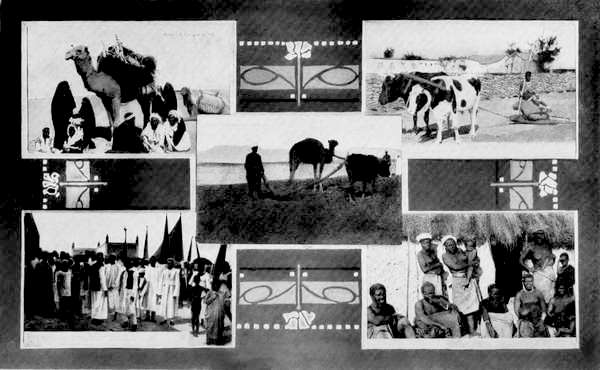
A Caravan at rest / A Native Sledge Cultivating Land, Egypt Mohammedan Procession / Natives and Hut
SUNDAY, MARCH 2.—I passed out of sight of land at Adelaide, South Australia, at 7:20 on the evening of February 12, and picked it up again at 7 o’clock this morning, when I awoke and looked out of the window to see how the weather was. The land was South Africa. The voyage we have just completed takes the passenger out of sight of land longer than any other now being made in steamships. There are longer voyages, but on none of them is the passenger out of sight of land for eighteen days. And during the eighteen days we did not see a ship; no signs of life whatever, except a few birds and a few flying-fish. It was a monotonous, dreary experience I do not care to repeat.... South Africa, as seen in the vicinity of Durban, is mountainous, and the mountains are covered with verdure.... By 8:30, Durban could be plainly seen, and it did not look unlike a portion of Sydney, with its residences scattered over the hills, and almost every house covered with red tile roofing imported from France.... The officers said we should tie up at the dock by ten o’clock, and that is exactly what we did, although we did not reach the hotel until nearly noon. The delay was caused, it was said, by the slowness of the doctor and the customs officer, but I did not see the doctor at all, and the customs officer, when I finally got to him, did not open one of my packages. However, he charged me $3.75 duty on a portable typewriter which I cannot learn to use, having so long been accustomed to a different key-board. Once out of the customs house, we called two negro ricksha men, and were soon on our way to the Marine Hotel; we avoided the Royal because we had heard Mr. Riley say he intended to stop there. Most of the passengers will spend the night ashore, as a relief from the long experience with ship beds and ship fare. The negro ricksha men who pulled us to the hotel wore cow-horns on their heads, and pieces of leopard skin on their backs. The rickshas were marked: “For Europeans only,” and the negroes carried us to the hotel on a keen trot, for a shilling each. Our men carried cow-bells, which they rang frequently as warning for pedestrians to get out of the way.... I have not lately been surprised as agreeably as I am in Durban. Instead of being a rough, crude place, it is one of the finest cities I have ever seen. The hotel at which we are staying is as fine in every way as the Australia in Sydney, a city of over half a million, and the price is the same: $3.60 per day, including everything. The town hall in Durban is almost as fine as the capital in some of the Australian states; and this town of sixty thousand people, half of them black, has parks, business blocks, zoölogical gardens, and private residences that would do credit to any city of any size anywhere. We hired a new Overland automobile, driven by an intelligent Englishman, and although gasoline costs forty cents a gallon here, the charge was only $3 an hour. He took us to one of the finest bathing-beaches I have seen anywhere, and many of the hotels around it would be creditable in Atlantic City. Durban is tropical, and the luxuriant growths of flowers and plants reminded us of Honolulu. Another thing I did not know about Durban is that it has thousands of Hindus; citizens of India. All the servants at the hotel where we are staying are Hindus, and wear the picturesque costumes seen in India; during our ride today we saw literally thousands of these people, and almost as many women and children as men. In certain sections of Durban you see only Hindus, and temples are almost as numerous as churches in other sections of the town. All sorts of strange shops are kept by men with strange names; and all the Indians we saw look much more prosperous than their relatives in India. The Hindus were brought here by the English a good many years ago, under indenture and promise to return them to India at the end of a certain number of years, but they liked the country, and most of them did not care to return. There are upwards of a hundred thousand of them in Natal, but their importation is now prohibited. The Hindus are like the Chinese in that they are willing to work and behave, and their entrance to most countries is therefore prohibited.... We passed a sugar mill during our automobile ride today, and were told that all the workmen in the mill, and in the great fields of cane surrounding it, were Hindus, or coolies. Just now the cane is being cut and hauled to the mills.... At lunch today, we saw the waiters serving roasting-ears. On the bill of fare they are called Mealie Cobs. We ordered some, and the waiter offered to cut the corn from the cob. I ate mine in true American fashion, but Adelaide had hers cut off the cob. The variety was Early Adams, and it wasn’t very sweet. The best thing they have at this fine hotel is pineapple. They also have alligator pears. The best alligator pears grow in the Samoa Islands, and we had them on the “Sonoma,” but did not care for them. They are eaten with pepper and salt and vinegar and oil; an alligator pear is more vegetable than fruit. Today we also had mangoes, which resemble the American paw-aw, but they are much better fruit. You peel them, and eat them as you do green corn, the seed representing the cob.... This being Sunday, we saw two Salvation Army meetings on the street. All the “soldiers” were negroes, and there was the usual drum in the centre of the circle, and the usual pleas for money.... Now that I am out of Australia, and off the “Anchises,” which carried Australian water, I am free to drink all the water I want. I saw so many false teeth in Australia, and heard so frequently that the bad teeth of the Australians were due to the water, that I never took a drink that my teeth didn’t ache.... We learned this evening that all the money Mr. Riley spent in gambling and drinking was loaned him by a Mr. Wilson, who came ashore this afternoon, and is trying hard to get his money. At a late hour, Mr. Riley had not been able to satisfy his creditor. You meet strange characters on ships. Think of a man going to sea without money, and being financed by a stranger.... We knew a woman on the ship who was so unhappy because of a big waist that she imagined her husband was mean to her, and she told a good many of the women that were it not for her children, she would seek forgetfulness by enclosing her head in a pillow-slip, and inhaling chloroform.... Durban had a small harbor which did very well in the days of small ships, but when big ships became fashionable the town was compelled to spend millions in improvements. The result is that ships drawing thirty feet can tie up at its docks. Good coal is found not far from Durban, and its coal trade is very important. Much of the coal used on the railways in India comes from Durban, and every ship coming this way coals here.... Before going to bed tonight, we went down in front of the hotel, called a ricksha, and went for a ride to the beach to cool off. The negro who pulled us was a huge fellow wearing a pair of cow-horns as a sort of head-dress; seven-tenths of the hundreds of ricksha men wear the same amusing head-dress. Our man trotted all the way to the beach and back, up hill and down. It is a considerable task for a man to pull a buggy and two passengers for nearly an hour, and always keep up a trot. On our return to the hotel at 10 P.M., the man did not seem very tired. The road to the beach was lined with hundreds of other people riding in rickshas, and there were many ricksha stands on the way. At the beach we saw thousands of people sitting around in chairs, or dining, or listening to music. Some of the restaurants had moving-picture shows to attract customers. And it seems to me I never saw such big rollers as came in from the Indian ocean at Durban beach. Four years ago this beach was a dreary piece of sand. Durban has lately been spending money like a drunken sailor, and has made it pay.
MONDAY, MARCH 3.—Owing to a tremendous rain and wind storm, we have been confined all day to our rooms at the hotel. Yesterday was bright and fine, and we were rather disposed to laugh at the statement that this is the rainy season in South Africa; but the storm today has given us more confidence in the guide-books. The wind was so strong that the “Anchises,” lying at its dock, twice broke its hawsers, and was only saved from drifting by the prompt use of the anchors. The passengers who were ashore found it very difficult to get back to the ship, and from our windows at the hotel we could see that the wind was doing considerable damage.... And this in spite of the finest, largest and brightest rainbow I have ever seen, this morning.... White women are scarce in South Africa. In the big dining-room of the Marine Hotel, at dinner tonight, all the guests were men, except four. Englishmen come to this country as Americans go to the Klondike.... The Marine Hotel introduces one feature that is entirely new to me; dinner is commenced with a hors-d’œuvre—a sort of salad of pickled fish, as an appetizer. Then follows the regular dinner, starting with soup. When a king dines, he begins with a hors-d’œuvre, the head waiter says.... One of the ricksha men who stands in front of the hotel has carried us three times, and regards us as his property. When we appear, he runs up to us, and bows almost to the ground; if other ricksha men appear, he pushes them angrily away. The negroes here are exactly like our negroes, except that they talk Kaffir; we have not seen any who are able to speak English easily. The negro women wear their hair in a peculiar way, and many of them dress as the men do. The ricksha men who stand in front of the hotel are always laughing and talking in a noisy, good-natured way. There are several tribes of negroes here, and all of them have different characteristics in dress.... Before Durban’s present harbor was completed, passengers disembarked from ships in baskets. The big ships, not being able to come into the harbor, were met outside by tenders. Passengers leaving the ship were locked in a huge basket, and this basket was hoisted over the side with a steam winch, and lowered to the deck of the tender rolling alongside. This method of embarking and disembarking is still used at many points along the coast, and we shall test it on our way to Zanzibar.... The amateur humorist is a great task not only in private life, but in books as well. Today I bought a book to obtain information of the East Coast route to England, but found it so full of jokes that I could get no information out of it. Every man, when he writes or talks, thinks he must use a great many jokes; everyone seems to make too much of the fun, fun, fun, and laugh, laugh, laugh idea. I often wish people were more serious.... My next ship journey will be up the East Coast of Africa to Aden, and thence through the Red Sea to the Mediterranean and Naples. I have spent considerable of my time in Durban in arranging for a cabin to myself on the German ship. Occupying a room with three others is the red flag that brings out the bull in my nature. I not only object to other men in a room with me, but I don’t like them very well in the hall outside. I am particular about having things of my own, and in the list, a sleeping-room is near the top.... In this fine hotel, it is impossible to get a good cup of coffee, and I drink tea instead, although I abominate tea. I have not had a decent cup of coffee in nearly three months. As I am accustomed at home to the best coffee in the world, the deprivation is a severe one. I have no doubt that all the hotels where I have lately been a guest use the best coffee obtainable, but their way of making it is not my way. You get the best coffee at home because it is made your way.... As in coffee, so it is in politics, religion, the choice of a wife, and a hundred other things: what suits others does not suit you. You want coffee made your way; and you are entitled to it.... I do not say my way of making coffee is the best, but I do say it suits me better than any other way I have ever tried. I venture to say that nine out of ten guests at every hotel abuse the coffee.... Every morning at 6:30 there is a rap on my door. I look out, and find a Hindu servant with tea. I tell him I do not want tea, but would appreciate hot water for shaving. This the Hindu cannot understand, so I now take the tea, and shave with it.... I was on the “Anchises” so long that I almost used up a cake of shaving-soap. I wonder I didn’t get the scurvy; they say that is the scourge of a long sea voyage.
TUESDAY, MARCH 4.—This day opened with genuine inauguration weather; the storm of yesterday continued all night, and seemed as fierce as ever at 8 A.M.... The Natal Mercury of this morning devoted a full page to the inauguration of Woodrow Wilson, as president. It also printed an editorial of a column and a quarter entitled, “The Future of America,” which was funny because of absurd statements. “Rural America,” the editorial says, “knows little of decent roads, well-organized police, or mail facilities, and consists largely of wide-spreading areas that do not contain one human being to the square mile.” ... If newspapers print such statements about America, is it any wonder that the English people have absurd notions of the Americans? The editorial views with alarm the race problem in America; it also fears that the American people are today where the Romans were just before the decline began.... The Natal Mercury contains sixteen eight-column pages, and is a more creditable newspaper than will be found in the average American town of 32,000 population. Durban has 66,000, but 34,000 are negroes who do not read or speak English. Nine pages of the Mercury’s issue of this morning are devoted to advertising; the people of all the British colonies seem to be well trained in newspaper advertising. Although the Mercury prints eight columns about the inauguration of America’s new president (most of it absurd, but probably not more absurd than would be my comments on a similar event in Africa), it says nothing about the “Anchises” breaking from its moorings during yesterday’s storm, or of its detention in the harbor. The local news is badly handled in all the papers I see over here; the people do not seem to care for local news, so long as they get telegrams from England.... Durban people are just now excited because His Majesty’s Ship “New Zealand” will arrive in a day or two. This is the battleship of dreadnought type which was built with New Zealand money, and presented to the English government. Canada will give three battleships to the English, and Australia three. All the other English colonies have been called upon to show their love for the mother country in a similar way; and this really amounts to an order. India, Ceylon, Africa, and all the other countries controlled by Great Britain, must assist the English in keeping ahead of Germany in the race for naval supremacy. It seems an absurd situation to me, but possibly I know as little about it as the editorial writer on the Natal Mercury knows about America. (NOTE.—Since the above was written, Canada has balked, and refused to vote money for English battleships.) ... Some writers say that Africa is the Coming Country; that thousands of years hence, when Europe and America have become as dry as India or the Sahara desert, Africa will be about right, and contain cities like New York and London. By that time, New York and London will have been deserted, as old Memphis, Thebes and Babylon are now deserted. This is said to be the history of the world: Countries wear out like men; the country around the Red Sea was once fertile and populous, but is now a desert, owing to slowly changing climatic conditions; the world is so old that mountain ranges have been worn level with the surrounding plains by the wind, rain, heat and cold of many centuries. This is what will finally happen to our Rocky Mountains. The country where we live was once tropical, and it will become tropical again, in the course of time. The one thing we do not realize is the great age of the world, having long been taught that it is ten or twelve thousand years old. It is more than ten or twelve million years old; some geologists say its age is certainly forty or fifty million years.... My father left Indiana because he believed fever and ague would always be a pest. Indiana is now one of our finest states. Africa is getting rid of the sleeping sickness, of the mysterious fly which causes death, of fever and ague, and of other menaces to health; it is said that South Africa has shown a greater development in the past twenty years than any other country has ever shown in a similar length of time. Johannesburg is as fine a town as Kansas City, and almost as large. Durban is a wonder, and Capetown claims to be a health resort. This in South Africa only, whereas the real growth in the future, many believe, will come from East Africa.... The mythical “Cape to Cairo” railway extends from the Cape of Good Hope, in South Africa, to Cairo, in North Africa, or Egypt. Capetown has built a railroad far into the interior, northward, and Cairo has built far into the interior, southward; some day it will be possible for travelers to go from Capetown to Cairo by rail. I am going from Capetown to Cairo, but, the “Cape to Cairo” line still being a dream, I shall go to Victoria Falls by rail, and thence to Beira, where I will take a German ship for a long journey to Port Said, the Mediterranean entrance to the Suez Canal, and only a few miles from Cairo.... I have been compelled to quit eating roasting-ears American fashion at the Marine Hotel in Durban. The Hindu waiters stood around and watched me in surprise, and other guests were also greatly interested. Finally a strange man appeared at the entrance, and seemed to be studying the lights with a view of getting a moving-picture of the performance; so I now have my corn cut off the cob, which is the universal practice here.... The “Anchises” will not get away for Capetown and London until noon on Thursday. The chief engineer and doctor dined at our hotel tonight, with two of the lady passengers, and they told us that when the ship left Adelaide, it was followed by a pigeon, which was no doubt attracted by the grains of wheat on deck. The first night out, the pigeon probably rested in the rigging; anyway it was flying about the ship the second morning. Then it was too late to go back, and the bird has been adopted by the crew. It flies about the ship while at sea, but soon returns to the deck or rigging. It has become quite tame, and will take food from anyone, and grumble for more, as pet pigeons do. The sailors thought the bird would leave them at Durban, but it didn’t make up with the other pigeons that called to see it, and will probably accompany the “Anchises” to Liverpool.... Mr. Riley slept on board last night, as he is in love with a married woman who detests him. His ticket read to Durban only, but he will probably attempt to go on to Capetown, in order that he may further enjoy drunkenness, love, and the Sports Committee.
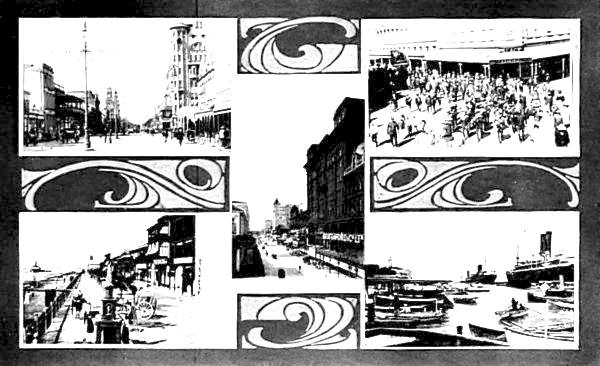
Street in Durban, South Africa / Labor Day Parade, Johannesburg Pritchard Street, Johannesburg Port Said / Port Said Port
WEDNESDAY, MARCH 5.—Rain has fallen three days in succession. Until Monday last, there had been a drouth so long and severe that the mealie crop is said to be ruined. Mealie is the name given corn here; wheat is called corn. The farmers in South Africa grow two crops of corn per year, and export a great deal to London. I saw the statement in print recently that the Argentine Republic, in South America, exports more corn than the United States. We raise much more corn than Argentine, but use most of it, whereas Argentine uses very little.... This afternoon, in spite of the rain, we visited a steam whaling-ship lying in the harbor. Twenty similar vessels make headquarters in Durban, and the whales caught are converted into oil in six factories located on the seashore, at a point so distant that the smell is not objectionable to the town-people. All whales caught are brought into Durban harbor; then loaded on flat cars, and sent down to the factories.... In 1911, the luckiest boat in the Durban whaling-fleet caught two hundred whales; in 1912, the lucky boat caught only one hundred. The boat with the least luck caught only sixty in 1912, as whales are becoming scarcer. Last month, the boat I visited caught only one whale; the month before eight—three of the eight were caught in one day. In certain whaling-grounds off the coast of South America, fourteen whales have been caught in one day by one ship. A fifty-six foot sperm whale is said to be worth $1,750. The stock of the local whaling-companies is quoted every day by the Durban papers, and the best of them pay big dividends.... The whaler I visited is a seventy-ton affair, a small ship compared with the 10,000 tons of the “Anchises.” The captain of the whaler showed us about, and he looked like a carpenter or other mechanic who calls at your house to do a job of work. But he is compelled to understand navigation as well as the captain of a liner, and pass the same examination. He brought the ship from England, a voyage of fifty-nine days. Its engines can make only about ten miles an hour, and its boilers require only eight tons of coal per twenty-four hours. There is a crew of ten men, including mate, engineer, gunner, and cook. In these ships, whales are not chased in small boats; when a whale is sighted, it is pursued by the ship, under full steam. At a distance of fifty or a hundred yards, a harpoon is fired into the whale from a good-sized cannon. There is a time fuse attached to the harpoon, and this explodes a bomb which should kill the whale. A chain is then attached to its tail, and the carcass is towed to the rendering works in Durban. When a harpoon is fastened in a whale, and the bomb does not explode properly, it sometimes makes a run, and pulls the ship as easily as it might pull a row-boat. In such a case, another harpoon is fired into it as soon as opportunity offers. Frequently the whale breaks the great rope which attaches the harpoon to the ship. The reader will probably understand that a two-inch rope is attached to the harpoon fired from the cannon, and if the harpoon hits fairly, the whale is hooked and handled as a fisherman handles a small fish with a light line. If the whale runs away, the rope is let out slowly, being kept just taut enough to prevent breaking. If the whale rushes toward the ship the rope is hauled in rapidly, with a steam winch, as a fisherman reels in his line. If the bomb explodes inside the whale, as intended, it is usually killed at once, but this does not always happen, and then a fight is necessary. At Durban, the whaling-ships usually go out at 4 o’clock every morning, and return after nightfall. The captain is also the pilot, and he took me up on the bridge. I have never before been on the bridge of a ship; on a liner, it is a violation of law for a passenger to go on the bridge. The captain also took me down to his cabin, which is reached by a ladder. The mate, engineer and gunner occupy the cabin with him, and it is the darkest and worst ventilated place I have ever visited. Two of the beds are simply holes-in-the-wall, and the rooms of the gunner and mate are the funniest holes ever occupied by men. The ladder leading to the officers’ quarters was so steep and slippery that Adelaide was afraid to attempt to go down. The captain invited me to go out with him next Friday, and I accepted; but when the time comes, I suppose I will back out. He says he often has visitors, and that a good many of them have seen whales caught. In the best season for whaling, a whale is caught every day, and always within fifteen or twenty miles of Durban. If the weather is stormy, the whaling-ships do not go out, as nothing can be done in rough weather. The captain, who is a Norwegian, also invited us to stay for dinner, but we declined, although we saw the dinner on the table. It consisted of boiled beef and potatoes, bread and butter, dried-apple sauce, and tea.... On the way to visit the whaling-ship we passed the Durban courthouse. It was surrounded by negroes. The inferior races everywhere have a passion for going to law. To go to law a good deal—to have confidence in the justice dealt out by lawyers and judges—is everywhere a sign of feeble intelligence.... There are only 90,000 whites in all of Natal, and 300,000 natives. The Hindus number about 180,000, and lately the whites are refusing them license to do business. If they are willing to work as laborers, for low wages, well and good, but if they attempt to engage in business for themselves, they are to be told that business is for Europeans only.... The present storm is the worst in two years. This afternoon I went past the harbor, and saw great waves dashing over the sea-wall and lighthouse. I also saw four ships lying outside, waiting to get in, and a number inside waiting to get out. No ship has passed in or out of Durban harbor since the arrival of the Atchison hoodoo, and forty bath-houses at the beach were demolished by the waves Tuesday morning.... A man who has lived here fifty-four years tells me that while this section is very good for agriculture, lung fever carries off so many cattle and horses as to seriously threaten the stock-raising industry.... When a native African woman marries, she mixes clay with her wool, and makes a circular dome out of it which looks like a stove-pipe hat tilted on the back of the head. This head-dress forces the woman to sleep on a wooden pillow, as the Japanese women do, since the hair when once put up is not taken down for months.... The Natal Mercury, a Durban paper I buy every morning, contained the following amusing telegram in its issue for today: “London, March 4.—Reuter’s correspondent in Washington telegraphs that Dr. W. Wilson has arrived there, preparatory to his induction into the presidency. Suffragists have been debarred from participating in the presidential procession. Numbers of the demonstrators paraded yesterday, and women mounted on horseback helped the police to clear the route.” This was all the paper contained about the inauguration, although issued the day after the inauguration took place, and the editor’s motto is: “The Natal Mercury prints all the news all the time.” All American news in the Australian, New Zealand and South-African papers is equally brief and absurd. Little wonder that the English and Americans do not understand each other.... From the window of my room at the hotel, I can look into the office of a big wholesale house across the street. Every afternoon, the bookkeepers and stenographers may be seen drinking tea. A cup of tea at four o’clock in the afternoon is a universal custom here. Sometimes bread and butter or cakes are served with it.... Nearly opposite our hotel is an apartment house where a great many negro servants are employed, and a crowd of them may usually be seen in front of the servant’s entrance. They are so far away that while we can hear them talk, we cannot hear what they say, and they act so much like our negroes that they seem to be talking English, although they are not. Negroes have been taken to almost every portion of the earth, and speak nearly all languages. In some of the islands of the West Indies they speak only French, having never heard anything else. In English colonies they speak English, but do not use the broad R, as do the negroes in our Southern states. Probably millions of them speak Arabic. Many of them are Mohammedans, and many of them speak Hebrew. But wherever you see them, they have the same good-natured, care-free way. In Africa, there are dozens of different tribal languages in use among the blacks, but in foreign countries the young negroes soon forget their mother-tongue. Probably among all the millions of negroes in the United States, not one has the remotest knowledge of the original language of his ancestors. The Hindus, Chinese, Japanese and Hebrews always retain their own language and religion, in whatever part of the world they may live, but the negroes soon adopt the language of the people with whom their lot is cast, and become Methodists, Mohammedans, Catholics or Hebrews in religion with equal facility.