Front matter (continued 6)
Reading edition

TUESDAY, MARCH 18.—This morning at 9 o’clock we left Bloemfontein by train for Kimberley. The hotel porter carried our baggage into a compartment for four, and said:
“You are to have this to yourselves all day. I have arranged it.”
I thought it was simply the talk of a somewhat fresh but obliging hotel porter; but he didn’t do a thing but deliver the goods. And, what is more, the train conductor frequently came into our compartment, and pointed out the sights of interest.... I have known railroad men all my life, and been familiar with their practice of buying butter and eggs on the line, where they are cheaper, and carrying them home. The railroad men of South Africa do the same thing; the conductor told me that he buys eggs along the line at thirty cents a dozen when they are frequently 75 cents at the division point where he lives. He also buys his meat out in the country; a dressed sheep weighing eighty pounds costs him $4.80, so that he gets his meat at six cents a pound. Sometimes potatoes sell in South Africa at $11.50 for a sack of 165 pounds, and poor people pay three cents for every potato they buy in small quantities. On this run the conductor makes a round trip of 210 miles a day, which occupies him eleven hours. He says he earns about $120 a month, but in order to do this, he is compelled to get in forty days in a month. The engineer makes $5 for a day’s work of eleven hours.... On the way we passed a flock of thirty or forty ostriches grazing in a field, like cattle, but this isn’t considered a very good ostrich country. We also passed through the Paardeburg battle-field, on the Modder river, where General Cronje surrendered 4,000 men to a superior force of British. There are two cemeteries on the field, in which are buried the English and Boer soldiers who were killed in the battle. The Modder river battle-field does not look unlike the Custer battle-field on the Little Big Horn river in Montana. Indeed, the country between Bloemfontein and Kimberley does not look unlike the dry country in Montana.... We saw almost no cultivated fields on the way, but a great many cattle, and a few sheep. There is not a town between Bloemfontein and Kimberley: it is a frontier country, and the railroad has been in operation only four or five years. A man I met on the train says that in his section of the Orange Free State the soil is black and rich, and that fine crops of corn are raised; but I have seen no such country. He lives in a country town of 800 people, off the railroad, and says he pays only fourteen cents a pound for the best beef, while butter sells at 24 cents, and eggs at from 18 to 30 cents. In his country, the Boer women do their own cooking, but hire negroes to wait on them, and do the rough work. An ordinary negro house servant receives $4 a month; a particularly good one, $1.25 per week.... Kimberley, as you approach it by railroad, looks like Johannesburg, though it is much smaller. You see the same mountains around the mines, but at Kimberley the mountains are composed of blue mud that has been taken from the mines, washed for diamonds, and then piled up in waste heaps. The country is not unlike that around Johannesburg: large hills in every direction, and a rolling desolate country between them. Kimberley has warmer weather than Johannesburg, and we struck it on a tremendously hot day.... The first thing you notice at Kimberley is the great number of mulattoes, whereas there are almost none at Johannesburg or Durban.... I was told at Johannesburg that the hotels at Kimberley were abominable; they were so generally abused that I hoped to find them better than their reputation, but the Royal Palace, which I was told was the best, is the worst hotel I have ever patronized. And in an advertisement, I read that the Royal Palace was the “Hotel de luxe” of Kimberley. I am writing this in my room by the light of a tallow candle, as the electric light refuses to work. The hall servants (negro women) are the most slovenly creatures I have ever seen, and there does not seem to be any head to the place; I don’t know who runs it, but whoever he is, he doesn’t give much time to his job.... There are probably a half-dozen really excellent hotels at Bloemfontein; some of them only half patronized. Will some one please tell me why one of the good hotels at Bloemfontein, an insignificant country town, was not built at busy, hustling, prosperous Kimberley? ... Johannesburg is a modern, beautiful city; Kimberley is a mining camp, with narrow, irregular streets. It has many good shops, but many of the people said to me:
“No one lives in Kimberley because he likes the town; we only remain here to make money.”
Johannesburg people are proud of their town, and they have reason to be, but Kimberley people are always apologetic. The population is thirty thousand, a large number of the inhabitants being negroes and Hindus. The rich mine-owners have race-tracks, clubs and resorts, but cannot be very comfortable, owing to the dust and the heat. The few Americans I have seen here are tanned until they are as brown as Indians, and they do not say much in praise of the town except that it is the greatest diamond camp in existence.
WEDNESDAY, MARCH 19.—The De Beers Company represents one of the greatest corporations in the world. You hear of De Beers in every conversation when in Kimberley. De Beers owns private cars for use on the railways; De Beers gives millions to public enterprises, and to the government; De Beers owns parks, hotels, street- railways, and eight of the greatest diamond mines in the world.... De Beers was a Dutch farmer on whose land diamonds were found. He never made much out of the discovery, and has been dead a good many years, but, like our John Brown, his soul goes marching on. Cecil Rhodes and Alfred Beit were the real geniuses of Kimberley and its diamond fields, and they are represented in monuments here, but De Beers is heard of much more frequently because his name was given to the trust which took over the mines.... Diamonds were originally discovered in South Africa in 1867, by some Dutch children playing on the Orange river. Three years later, the great Kimberley deposit was found, and now the output is twenty-seven million dollars a year. It is a saying around Kimberley that if the De Beers company should put on the market all the diamonds it has on hand and could produce, diamonds would sell at a shilling a gallon, but the De Beers company only sells as many as it can get a good price for. Diamond-mining, according to experts, will continue at Kimberley for at least a hundred years; it has not been thought necessary to make figures beyond that time. South Africa produces ninety-five per cent of the diamonds of the world, and the De Beers company is the principal factor in the diamond-production of South Africa. The De Beers company does not represent the De Beers family, but many noted English and French capitalists, with a sprinkling of Americans; the diamond trust is one great trust in which Americans have little interest.... Originally, the diamond mines at Kimberley were divided into thousands of claims, 31×31 feet, but Cecil Rhodes saw that diamonds would soon become very cheap unless conditions were changed; so by hook and by crook he formed the great De Beers trust, which now produces only as many diamonds as the world will pay high prices for. Prosperous America takes the greater part of the output, and dull times in America means dull times in Kimberley. Alpheus Williams, an American, is general manager of the De Beers company, and many of the officials under him are Americans. There are other diamond mines in South Africa, including alluvial diggings, and the Premier mine near Pretoria, where was found the great Cullinan diamond, which weighed, before cutting, 3,025 carats, or a pound and a quarter. But Kimberley is the centre, and will remain so, unless other discoveries are made. At the end of 1908, it was estimated that eleven tons of diamonds, valued at $350,000,000, had been found at Kimberley. Diamonds weighing over an ounce are not infrequent; the largest found at Kimberley weighed over four ounces.... Before the passage of the Diamond Trade Act, thefts amounted to five million dollars a year, but the De Beers company regulated stealing as well as output, and the losses are now insignificant.... The finest diamond-cutting is lately being done in New York, and not in Amsterdam, as formerly. The diamonds cut in New York show more fire than diamonds cut in Amsterdam; they have a greater number of facets, and represent finer and better work. Cutting adds forty per cent to the value of diamonds, and an attempt is being made to put a tax of 20 per cent on all uncut diamonds sent out of South Africa. No cutting is done here, and the passage of such a law would add enormously to the country’s labor roll.... The average man, in thinking of a diamond mine at Kimberley, imagines a great open hole in the earth, and thousands of men working at the bottom of it. As a matter of fact, no such mining is now done in Kimberley, although visitors may see great holes in which such mining was formerly carried on. Diamonds are now mined very much as gold is mined. Shafts are sunk to great depths in the earth, and drifts run in every direction from the bottom. Some of these shafts are more than three thousand feet deep, and the diamond dirt is hoisted and treated very much as gold-bearing rock is hoisted and treated.... Diamonds are found in blue dirt, in what the miners call “pipes.” These pipes are the craters of extinct volcanoes, and taper toward the bottom like a funnel. The pipes are round, as may be seen in the old open workings, some of which are a thousand feet deep. The deepest working in any “pipe” is now at a depth of three thousand feet, but a diamond drill has been sent down a thousand feet further without the blue dirt giving out; so no one knows how deep they are.... The old open holes in the ground were found very expensive to work at a depth of eight hundred or a thousand feet, so the blue dirt is now hoisted by means of modern cages operating in timbered shafts, as coal is hoisted; down below, drifts are run, and the blue dirt hauled to the hoisting-shafts as is done in coal-mining. As the blue dirt is exhausted, the shafts are sunk deeper, and drifts run lower down. The “pipe” at the biggest diamond mine at Kimberley is three hundred yards across at the top, and, as I have already said, this tapers toward the bottom like the funnel you use in pouring vinegar into a jug. The Premier mine, near Pretoria, is very much larger than any mine at Kimberley, being eight hundred yards across at the top. This great Premier mine, which you hear little of, mines forty thousand tons of blue dirt per day, and employs twelve thousand men, as against twenty thousand employed in all the Kimberley mines. The Premier dirt, however, is worth only one dollar per ton, whereas that at Kimberley averages something like three times as much.... Briefly, the process of finding the diamonds is as follows: The blue dirt in which the diamonds are found is brought to the surface precisely as coal is hoisted, and mined in about the same way. It is then placed in little iron cars, and hauled to a level field, where it is spread over the surface to a depth of two feet. This is done to permit the weather to disintegrate the dirt, and render its washing easier. Today I saw a field of four thousand acres covered with this blue dirt. It will remain out in the weather a year before it is treated in the washing-mills.... You might pause a moment and think of that four-thousand-acre field, covered to a depth of two feet with the blue dirt in which diamonds are found. The four-thousand-acre field I saw represented the output of only one mine; there are eight in the Kimberley district, only two of which are known to be duffers, as they say here; that is, of little value.... And you may rest assured that this four-thousand-acre field is carefully guarded; it is surrounded with a barbed wire fence fourteen feet high, and on top of the fence are four wires spread out in such a way that no one could possibly climb over. At night, the fence is illuminated with electric lights, and there is a patrol of armed guards day and night. But you might be turned loose in the four-thousand-acre field, and not find a diamond in a year; the process of finding them is very intricate, expensive, and difficult. Many of the natives who work in the diamond mines have never seen a diamond: they see only the blue dirt.... After the blue dirt has lain out in the weather a year, and been plowed up at intervals with steam plows, that all portions of it may have a chance at the sun, it is washed in enormous mills, and reduced in the proportion of one to four million: that is, for every pound of diamonds found, four million pounds of blue dirt are mined, hoisted, exposed in the field a year, and then run through the washing-mills.... In these washing-mills, the blue dirt is first crushed between rollers, and then run through shaking washing-pans three different times. What is left is then taken in cars to another mill, called the pulsator, and here the precious dirt is again washed three times. Finally the diamonds and the heavier pebbles remaining after six washings, go in a stream of water over a shaking-pan, the bottom of which is covered with vaseline. The diamonds stick to the vaseline, for some reason yet unexplained, while the pebbles roll away with the water. The diamonds on the screen are then easily collected and sorted. Some of the sorters, greatly to my surprise, were negroes in charge of white men.... Today I saw the result of one day’s washing from one mine; a pile of rough diamonds, many of them as small as pin-heads. One of them was said to be worth a thousand dollars. Dozens were of fairly good size, but the bulk of them were very small. These small diamonds will be used in cutting the big ones. There were many straw-colored diamonds, and some of them were black; the black ones will be used in diamond drills. It seemed to me that there were half a pint of these diamonds; Adelaide says a pint. But anyway, three or four thousand men, aided by the most enormous machines I have ever seen, work a day, and turn out—what? A half-pint or pint of bright stones of no actual value except in cutting glass and in diamond drills. The diamonds when found are in all sorts of shapes, but some of them look somewhat like diamonds after they have been cut. When taken out of the washing-machines they look like ordinary rock crystals; but they do not flash or sparkle. Cutting gives them that quality. The De Beers company last year made ten million dollars profit, I am told, and I am also told that one gold mine at Johannesburg last year made half that amount.... The mining of the blue dirt is done by natives who live in compounds, or quarters, and who are never permitted to leave the place until they quit, or are discharged; but no native is employed who will not agree to work at least four months. Today I visited one of these compounds, occupied by 2,500 natives. The place looked to be a thousand feet square. In the centre is a place where the men bathe after coming from underground. The houses where the men sleep form the square, and thirty men are provided with sleeping-bunks in one room. The bunks are in tiers, three deep, and reminded me of my quarters on the ship “Maunganui” between Wellington and Sydney.... In front of the houses the men do their cooking, at open fires, with wood furnished by the company. The men earn an average of eighty-two cents a day each, and are compelled to board themselves. They usually live in messes, one man in the mess doing the cooking for a week. The company has stores in the compound where all sorts of provisions may be had at about cost.... The men come from the interior, and, when they arrive, are given a number. This number is retained until the man quits, or is discharged. There is a system of piece work, and some of the men make $1.25 a day. The eight-hour system prevails, but the system of team work is such that all the men work steadily; the company sees to it that there are no shirkers. So the De Beers company has the services of excellent workmen at an average cost of eighty-two cents a day. There is a modern hospital in the compound, and men who are injured are treated free, and, in addition, receive their usual wages while laid up. The compound is much cleaner than an ordinary negro village, and many of the men remain with the company for years.... There is a good deal of water in the Kimberley mines. In one of them, 25,000 gallons an hour is pumped without trouble from a depth of 1,500 feet.... The blue dirt is hauled from the mine to the field, where it is exposed to the weather for a year, in iron cars holding about a ton each. The cars are pulled by an endless cable, and one of the sights of Kimberley is these cars going and coming without attendance on a double-track railway two or three miles long. The cars run in bunches of three, about twenty yards apart, and reminded me of ants coming and going.... When the blue dirt is ready to be treated, it is hauled to the washing-mills in the same cars, and in the same way. At the washing-mills there is a large residue known to contain no diamonds, and this is carried to the top of the dump and thrown away, and thus are formed the gray mounds seen around the town of Kimberley.... The Transvaal government has an interest in the Premier diamond mine near Pretoria, and gets sixty per cent of its profits. The government’s share amounts to two and a half million dollars a year. Whenever a diamond mine shows a disposition to amount to a good deal, the De Beers company buys it. The stockholders in the De Beers company have gradually acquired a large interest in the Premier mine, so that there is a “gentlemen’s agreement” in the disposition of diamonds.... A great deal of hauling is done from Kimberley to points off the railroad, and donkey teams are used in freighting. Every time I go on the streets I see donkey teams of ten to fourteen span hitched to enormous freight wagons. The donkey teams are usually driven by three Kaffirs.... The favorite vegetable in South Africa seems to be cabbage. At the public markets I see particularly big stacks of it, but little else. In the public market of Kimberley, vegetables are placed on the ground; I saw string beans lying on the ground, in the filth of the market-place, this morning.... Kimberley is very dusty and dirty. The days are about as hot now as they are at home in July and August, but the nights are much cooler. An American woman who has lived in South Africa nineteen years, says she has never slept a night without blankets over her.... I was frequently told in Kimberley I should look up a man named Brink, the only man in the town who could give away diamonds, if so disposed, and not be responsible to anyone. I did not see Brink, but I saw a man who sent me permits which enabled me to see most points of interest. The De Beers officials are very polite to visitors, and anyone who comes recommended may easily see all there is to see.... Kimberley has one long business street which is very creditable, but outside of that the town does not look very well. Rain is very scarce, much scarcer than at Johannesburg, and when the wind blows, all doors must be closed, owing to the dust from the mine dumps. It is much hotter here in summer than in Johannesburg, and general conditions of living worse. I shouldn’t mind living in Johannesburg, but I don’t believe I could be content in Kimberley.
THURSDAY, MARCH 20.—Today we traveled from Kimberley to Bloemfontein, and the same polite conductor was in charge of the train. He not only gave us a compartment to ourselves, but presented me with a Zulu war-club which I am bringing home as a souvenir. When the Zulus go to Kimberley to work in the mines they are not allowed to take their war-clubs into the compounds, and sell them at low prices. The one I have is a fancy affair, and probably the late owner worked on it for two weeks. It looks as though it has been in action, and has probably cracked a good many heads.... We were compelled to wait nearly three hours at Bloemfontein for a train to Johannesburg, and dined at Polly’s Hotel Cecil. Mr. Polly is a model hotel man, and knows his business so well that his place is constantly crowded, while the opposition hotel, just across the street, and a newer and larger place, is almost deserted. It is surprising what a clever man can do to a dull one; if Mr. Polly wants the larger and newer hotel, my prediction is that he will have it in six months.... We walked about Bloemfontein for an hour in the moonlight. I like this town, because it is dull, and the people are consequently polite. I have always been accustomed to dull towns, and like St. Louis better than Chicago because St. Louis people are not so struck on themselves. Every citizen of Chicago is as badly spoilt as a pretty woman.... It being the night before Good Friday, which is a holiday here, there was a rush of passengers for Johannesburg, and the friendly conductor could not get us a compartment to ourselves. But I was quartered with two very interesting and polite men in a compartment for four, and rather enjoyed the night ride.... Let the passenger conductors on American railroads prepare to scream with horror and indignation over an incident I am about to relate. The train on which we rode from Bloemfontein to Johannesburg was composed of twelve coaches, nearly all of them used as sleepers at night. The conductor not only took up the tickets, and looked after the train, but he acted as porter in all the sleepers, and made up the beds. The crowd was so large that we did not get our beds made up until midnight, although we left Bloemfontein at nine o’clock. We paid sixty cents each for the use of the beds, when we finally got them. The beds were done up in separate bundles, two sheets, two pillows and two blankets in each bundle, and the conductor of the passenger train was compelled to take these out of lockers, and change all the seats into beds. He had no help whatever, and all the time he was at work, passengers were snarling at him in an impudent way. I have never before seen anything like it anywhere. At every station the conductor was compelled to go out to the platform, and, when the train started, he didn’t say “All aboard,” but “All seats.” Translated, “All seats” means: “The train is about to start; all passengers take their seats.” ... After we got to bed at midnight, country boys were constantly racing through the corridor outside, and looking into our compartment for seats. We could not lock the door, and, although the train was crowded when we left Bloemfontein, we took on passengers at every station. In American sleeping-cars, you engage a sleeping-berth in advance, and after bedtime the cars are quiet; no racing through the aisles. Here you take your chance of getting a bed. A similar train on an American railway would have had a train conductor, a Pullman conductor, and a porter in each sleeping-car. The door of our compartment was thrown open a dozen times during the night, but my two companions, important mining men, were accustomed to it, and were not annoyed. The beds were narrow, but clean and comfortable; I had no fault to find except the racing of country boys through the corridors. There were three of us in a compartment that would have seated eight. I suppose the country boys had a right to chase us out, and demand that five of them be given seats in the compartment, but fortunately they did not do it, and we slept a little toward morning.
FRIDAY, MARCH 21.—We returned to Johannesburg at 8 o’clock this morning, and it was a little like getting home. We found two excellent rooms awaiting us at the Langham, as the proprietor expected us, and we soon forget the discomforts of the night ride. We found an invitation to dinner awaiting us at the hotel, and among other agreeable guests we met at this agreeable affair was Edwin N. Gunsaulus, American consul. Mr. Gunsaulus of course keeps in touch with American affairs, and he gave us a good deal of news from home. The consul is a cousin of Rev. Frank Gunsaulus, the noted American preacher and lecturer, and comes from a town in Ohio smaller than Atchison. Another fact that endeared him to me is that he formerly ran a weekly newspaper, and was editor, publisher, business manager, reporter, and one of the type-setters.... I may as well tell here of the reprehensible conduct of an American now a resident of Johannesburg. I refer to Isham F. Atterbury, formerly of St. Joseph, Missouri, but now manager of the African Realty Trust. I expect the American women to be as indignant over his conduct as the American passenger conductors will be over the treatment of the conductor of the train on which we traveled last night. Mr. and Mrs. Atterbury were also guests at the dinner, and the story I shall relate of Mr. Atterbury’s conduct I had first-hand from his wife’s lips. Mr. Gunsaulus also heard the story, and I called his attention to it particularly by recommending that, as American consul, he do something about it.... The story is as follows: For years Mrs. Atterbury kept house, and slaved, as American women do, in preparing delicacies for her husband to eat, in order that she might keep him good-natured. But human endeavor has a limit, and Mrs. Atterbury’s slaving for her husband’s comfort finally resulted in a collapse, and a trip to a sanitarium. After her partial recovery, they went to an English boarding-house, which Mrs. Atterbury declares is worse than an American boarding-house, to live. And here is where Mr. Atterbury’s baseness developed: he ate as heartily of the boarding-house fare as he had ever eaten of his wife’s cooking.... Although the incident happened years ago, Mrs. Atterbury is still mad about it. “And,” she added, in telling of her wrongs, “some people say I am a pretty fair cook. After that, I quit the kitchen for good, and have been boarding ever since.” ... Their young gentleman son, Manfred Atterbury, is afraid to take sides in the controversy, but he did say that his father doesn’t pay much attention to what he eats; that when he goes to the table he usually carries American newspapers or magazines with him, and doesn’t eat anything at all unless his attention is called to the fact that the body requires a certain amount of nourishment.... The American women I meet here all say American men are more considerate of their wives than the men of any other nation. I believe that at home we men are rather unpopular as husbands, and that our conduct attracts a good deal of unfavorable criticism from American wives; but abroad we are everywhere toasted because of our devotion to our women-folks.... At the dinner tonight, an American woman said: “Another reason I want to go home: I want to see pretty girls again.” There are not many pretty women over here, whereas America is full of them; particularly in dull towns.... Another guest at the dinner tonight was H. T. Hofmeyer, a prominent Boer lawyer of Johannesburg, and who has just served two terms as mayor. He is much interested in American newspapers, magazines, books, and citizens. The ex-mayor and Mr. Gunsaulus, the American consul, were quite impatient with me because I had arranged to leave Johannesburg at 10 P.M. on Monday evening, whereas they said no train left at that hour. So we all took a walk to the railroad station, to get the facts. It turned out that I was right about it, and the consul and Mr. Hofmeyer walked all the way home with me, in explaining how they happened to be mistaken.... Merchants everywhere work the words “reduction” and “cut prices,” for all they are worth. Wherever we have been, we have encountered “reduction” sales, and merchants side by side abuse each other in the placards displayed. “This is a real reduction sale,” one placard read; “do not be deceived by false pretenses elsewhere.” One shoe store in Johannesburg displays this sign: “Shoes for next to nothing.” Every storekeeper thinks he is a public benefactor, because of his low prices.
SATURDAY, MARCH 22.—When I left home I was told that the name of this town is pronounced Yohonnesburg by its citizens, but I find that they call it “Joburg” almost universally.... In Durban, the best people ride in rickshas; here, these vehicles are used very sparingly. A law has been passed whereby their use will be entirely prohibited in two years. It is claimed that the ricksha men become overheated while running, and contract consumption.... A sign frequently seen in Johannesburg reads: “This house and stand for sale.” It is equivalent to “This house and lot for sale.” ... I was out this afternoon with five Americans, and at 4 P.M. we went into an enormous place to drink a cup of tea. There were certainly fifty girl waiters, and hundreds of customers. The tea-room included a long balcony above the sidewalk, and similar places are very numerous in Joburg. I am told that tea-drinking is one English habit American residents soon acquire.... The ordinary natives work long hours here. This evening I heard a boss say to a gang of street laborers: “Remember that we begin work Monday morning at 5:30, not at 6:30.” ... There are fourteen annual holidays here, observed by the whites as religiously as we observe Christmas, Thanksgiving, and the Fourth of July, but the natives do not seem to participate in them. If there is anything in having an abundant supply of cheap labor, South Africa should flourish.... Over in Missouri, many of the farmers have private graveyards. I find a similar custom among the Boer farmers in South Africa.... A big sign I saw at Bloemfontein contained this imprint: “D. Jones, writer.” Meaning that D. Jones was the sign-writer who made it. Near the Hotel Cecil in Bloemfontein I also saw this sign: “Hotel Cecil Toilet Club.” You might guess a week without guessing what the sign meant: the place was the hotel barber shop.... At hotels, I always hate to see the sign, “Fire Escape;” somehow it disturbs me. But the proprietor of the Langham thought up something more delicate; instead of the words “Fire Escape,” he uses “Emergency Exit.” ... I am always meeting queer people; I met a woman lately who said she would as soon drink a cup of castor oil as a cup of rich cream.
SUNDAY, MARCH 23.—Johannesburg and Kimberley have experienced the usual high life incident to all boom camps. While great fortunes have been made, much money has been lost, and suicide is almost as common here as in Monte Carlo. Barney Barnato, one of the conspicuous figures in both camps, committed suicide at sea, by jumping overboard while en route to England. But his act was not due to lack of money, as he was rich at the time, and was just completing the finest residence in South Africa. The building is now used as a school; it was a gift for school purposes from the Barnato estate.... Barney Barnato came to South Africa as a circus clown; his real name was Barnett Isaacs, and he was a Hebrew. “Barney Barnato” was his circus name, and it stuck to him in the days of his prosperity, when he became a diamond broker, and married a “Cape woman;” that is, a negress. She was of light color, but so dark that she was never received socially. Kimberley and Johannesburg can forgive much in a woman, if she has money, but Mrs. Barnato was never forgiven. It is said here that she lived with Barnato before she was married to him, and he sent her to London to dispose of diamonds acquired illegally. Instead of depositing the money in a London bank in Barnato’s name, she deposited it in her own name, and Barnato was compelled to marry her to get his own money.... Barnato prospered greatly, and when Cecil Rhodes and Alfred Beit organized the great De Beers Consolidated Company, they were compelled to treat with him, as he owned many of the best claims. He was made a life director in the De Beers Company, and the evidence is that he was popular, and a good fellow. All the big interests here have holdings in Johannesburg as well as at Kimberley, so the towns are closely related.... In the days immediately following the Jameson raid, and just preceding the Boer war, Paul Krueger was an autocrat, and very unfair with the big English interests in Johannesburg, which is in the Transvaal. Krueger was then president of the Transvaal republic, and you hear it stated in whispers to this day that Barney Barnato, or some one for him, hired an adventurer named Von Veldtheim, a Londoner, to assassinate Krueger. In a quarrel Von Veldtheim killed Wolf Joel, Barnato’s uncle. Von Veldtheim was arrested, and while he was in jail, awaiting trial, Barnato committed suicide, fearing, it is said, that Von Veldtheim would tell the whole story when tried for his life. But Von Veldtheim plead self-defense, and was acquitted by the Boer courts. He returned to London, and again attempted to blackmail members of the De Beers Company. The English courts sent him to jail, and he is there now.... Cecil Rhodes was the best man of the lot, and he did much for South Africa, as he had ideals greater than making money. Rhodes was a bachelor, and, like many men of big schemes, a hard drinker. His death was due, I have often heard, to heavy drinking. He is buried at Bulawayo, in Rhodesia, which he placed on the map, and which is named for him. Alfred Beit was a financial man, and not a great deal can be said for him except that he was very capable, and accumulated an enormous fortune.... Of the original crowd of boomers, Dr. Jameson is about the only one still living, and he is everywhere highly spoken of. He was originally Cecil Rhodes’s physician, but had business ability, and, with the patronage of Rhodes, soon became an important figure in South Africa. It was this man who headed the Jameson raid, intended to turn the Transvaal republic into an English colony, but the Boers captured him and his men in less time than it would take to write the story. Jameson and his chief lieutenants were sentenced to death, and Cecil Rhodes, who really inspired the raid, got them off. This was accomplished by the payment of money to the Boer chiefs, and there was so much of it that you hear of Paul Krueger’s buried treasure almost as frequently as you hear of Captain Kidd’s. The row over the Jameson raid finally resulted in the Boer war, and the flight of President Krueger to Switzerland, where he died. There is still a good deal of friction between the English and Boers: an English paper issued this morning complains that at an agricultural fair to be opened in Johannesburg this week, only fifteen per cent of the exhibitors are Boers.... The week beginning with Easter is a holiday week, and the crowd in Johannesburg is so large now that tents have been erected in many places to accommodate the visitors. The streets this afternoon were packed, and certainly nineteen out of twenty were men. This is a man’s country.... The American consul told me today that he does not hear much of missionaries in this section, except of a few Mormons, who are unpopular because of the notion, probably mistaken, that they teach polygamy. We called at the consul’s office today, and were much pleased with the many pictures we saw there of American saints: Washington, Lincoln, McKinley, Roosevelt, Taft, Wilson, etc.... In going down in the elevator at the Langham hotel today, I saw a cheap book the elevator boy had been reading. Picking it up, I saw that the title was: “Buffalo’s Bill’s Warning.” So it seems American literature, which is said to be unknown abroad, is getting a start.
MONDAY, MARCH 24.—This evening we had six American guests at dinner at our hotel: Mr. Gunsaulus, the American consul at Johannesburg; Mr. and Mrs. Atterbury and their son Manfred, and Mr. and Mrs. Mark Cary. Mr. Cary had been at Capetown and Durban during our stay in Johannesburg, but returned late this afternoon, and drove direct from the train to the hotel. The hotel orchestra, as a compliment to our party, played American rag time. At 9:30 P.M. the entire party walked with us to the railway station, where we were to take a train for Bulawayo, en route to Victoria Falls. Our baggage had been sent to the station in advance, and we carried nothing except an enormous package of American newspapers: copies of the Chicago Tribune and New York World.... The train did not get away until 10:25 P.M., being late, but our friends remained until we departed. I tried to coax them to go home, but they wouldn’t do it; when people are very nice to me it makes me as uncomfortable as when they are not nice enough.... When we arrived at the station we found a chart displayed against a wall showing that “Mr. and Miss Howe” had been assigned to a compartment large enough for four, and from the interest Mr. Gunsaulus and Mr. Atterbury took in the matter, I imagined they had a good deal to do with securing this very agreeable and unusual concession.... I should like to have the pleasure of entertaining Mrs. Atterbury, particularly, when she makes her long-delayed visit home. She has been away nineteen years, and if ever there was a true patriot, she is one; her enjoyment at being among Americans again would be worth witnessing. She is always talking of “going home,” and telling of the many nice people she knows there, and nothing would please me more than to assist in realizing, as far as possible, all her present expectations. Isham, her husband, has been promising a long time to take her home “next year,” but she now declares that if he doesn’t keep his promise by March 1, 1914, she will go alone. We spent half our time in Johannesburg with the Atterburys; in addition to innumerable meals we ate with them, they gave us one dinner at which we had four kinds of wine. So if her friends in St. Joe will let me know the date of her arrival, I will be at the station to welcome her.... Soon after the train conductor looked at our tickets, he proceeded to lug two huge bags of bed-clothing into our compartment, and make up two beds. We paid $1.20 for the use of the bed-clothing two nights; the charge would have been the same for one night. So that we will have a large compartment to ourselves two nights and a day, and pay only $1.20 above the regular fare. The beds were comfortable, though somewhat narrow, but we slept as well, I imagine, as people usually do on a sleeping-car. On our door and on our window were placards announcing that the compartment was reserved, and we were not disturbed during the journey. The South-African sleeping-cars are not at all bad, except that the train conductor has so much to do that he cannot keep them as clean as they should be. The conductor did not polish my shoes at night, but I knew he was very busy, and overlooked his neglect.... On one or two trains we have been on, there was a man who helped the conductor, but on at least two crowded trains on which we traveled, the conductor has had no help whatever in making up the beds; the most curious thing I have ever noted in railroad travel. There is a guard on the train, who is what we call a brakeman, but he does not assist the conductor in the chamber-work. When these conductors are taking the tickets, they are as haughty as are American conductors, but when they begin lugging in sheets, pillows and mattresses, they are as humble as the most timid traveler could wish.
TUESDAY, MARCH 25.—This is written on the Imperial Mail train, on the line of South-African railway extending from Capetown to Victoria Falls and beyond. This will eventually become the “Cape to Cairo” railway, extending from Capetown, on the seacoast in South Africa, to Cairo, in Egypt. You may recall that Colonel Roosevelt, on his famous hunting trip in Africa, went by rail as far as he could, and then tramped through the wild country to the end of the line extending south from Egypt, and then went to Cairo. Alfred Beit, one of the bonanza kings of Johannesburg and Kimberley, left six million dollars to be used in completing the gap between the African and Egyptian lines. When the “Cape to Cairo” line is finally completed, it will become as famous as the line from Moscow, in Russia, to a port on the Sea of Japan. This line was built by the Russians, and the distance from Moscow to Japan is now made in comfortable trains in ten days. Think of ten days of continuous travel in the same coaches, in the same train, and on the same railway! Great as is America, it has nothing like it; although we are talking of a line from New York to Buenos Aires, in South America. Thousands of miles of the proposed line are in operation, but there are gaps in Central and South America so difficult that it may never be completed, while the “Cape to Cairo” line may be a reality within the next twenty years.... Always remember that in South Africa there is no rich, black soil such as you see in Illinois, Iowa, eastern Kansas, and other of our best states. At least, I have not seen any. The soil in Africa is usually thin and red, and stones abound nearly everywhere. No part of Africa has as reliable a rainfall as the best parts of the United States. But nevertheless there is a fascination about this frontier country to an American; were I a younger man, probably the “spirit of the Veldt” would appeal to me more strongly than it does. All sorts of problems, including irrigation and dry-farming, are being worked out here. I have seen little country in Africa that looks any better than Kansas looks two hundred miles from the river, and the trouble is lack of a dependable rainfall. Along the coast there is so much rain that sugar-cane is grown without irrigation, and there is much good country, but today, eight hundred miles from the coast, we are in a dry, mountainous district which reminds one of Arizona.... Today we are seeing blanket negroes; native blacks who wear nothing but blankets, still a habit with some of our Indians. Between the lonely stations, we see native villages which seem as primitive as anything Africa can produce; at the stations, also, we see some negro men and women dressed as well as our best negroes at home. This morning we saw negro beggars for the first time: black children ran beside the train at a stopping-place, and, patting their stomachs, indicated that they were hungry, as a means of inducing the passengers to throw pennies to them.... At the stations, also, we see strong, capable Englishmen. These are the men who are engaged in working out the South-African problems, and they are undoubtedly making progress.... The white race can only flourish in certain parts of Africa; in sections four thousand feet or more above sea-level. Other portions of country must be left, for a long time at least, to the natives. Just what proportion of Africa is 4,000 feet or more above sea-level, I do not know, but I have seen the proportion stated as one-fourth in a certain section.... Most of the native male children we are seeing today are entirely naked, and their parents wear nothing but blankets when they come out to see the train go by; no doubt they wear less when not under observation.... Tomorrow morning we will leave the train at Bulawayo, for a two-days stay. This town is in Rhodesia, which is as big as half of Europe. All of this immense territory belongs to and is administered by a British company, and is not a member of the South-African union. In Rhodesia there are 25,000 Europeans and a million natives. The head of every native family is compelled to pay the British company an annual tax of $5, with $2 extra for each additional wife. Many of the native men who work in the mines in Johannesburg and Kimberley came from the poor villages we are seeing today. The villages are all alike: the houses are straw-covered huts, and the inhabitants seem to be as poor as people can be. The native men only work as a means of buying wives.... When Abel and Sampson return home, they probably return to wretched villages such as we are seeing today. Abel and Sampson are the servants at the home of Mr. and Mrs. Mark Cary, in Johannesburg. Abel has a sweetheart, and is saving money to buy her of her father. She is probably a fourteen or fifteen-year-old girl living in a village such as we are seeing today.... Since leaving Sydney, Australia, six weeks ago, we haven’t seen an American traveler. They seem to be very scarce in this part of the world. At one of the diamond mines we visited in Kimberley, there was a book in which all visitors registered. We looked through twenty or more pages without finding a visitor registered from the United States.... I have seen only two bunches of ostriches on the trip; the second this morning near Mafeking. This town was conspicuous during the Boer war, because of the operations of General Baden-Powell. It is a pretty and important place, and has railroad shops, as the Johannesburg branch joins the main line there. It has 1,400 people, but near it is a native town with three times as many.... In some places along the line, the soil is so thin that the railroad dump is made of stones; there is not enough dirt for the purpose. The telegraph poles and ties are of iron, which indicates the lack of timber. The track is excellent, and the train runs rapidly. We have become so accustomed to the narrow- gauge that we do not notice the difference.... The dining-car on this train is clean, and the meals very good. When we went in for the first meal, we were told to pay at the end of the journey; so tomorrow morning I will pay for three meals. Which is another unusual incident of railroad travel. We notice here that hotel and train employees always know our names. When we went into the dining-car for lunch to day, the waiter asked if we were Mr. and Miss Howe. Being informed that we were, the man escorted us to a table that had been reserved. We are charged seventy-two cents for lunch and dinner, and sixty cents for breakfast.... In Johannesburg and Kimberley, we frequently saw the native miners going to the station to take trains for their homes. Here at nearly every station we see native miners who have completed their visit home, and are going back to work.... In one little valley we passed through were a good many fields of kaffir corn, and in every case the workers were women and children. Possibly the men were away working in the mines.... The country in which we are traveling this afternoon is eleven hundred miles from Capetown, and the track is not fenced. The occasional bunches of goats and cattle—I see no sheep—seem to love the railroad track, and the engineer is compelled to slow up, and drive them off with his whistle.... This evening we are about as far in the interior of Africa from Capetown as the Mississippi river is from New York, and are beginning to have trouble with dust. I believe I have never been bothered with dust as I am here; but we cannot see it—it seems to be a part of the air.... We passed within thirty miles of Serome, containing thirty thousand people, and one of the largest native towns in South Africa. The chief of this tribe does not allow liquor to be sold in his territory, and is quite progressive. He rules over a territory a hundred miles square. In his town of Serome there are a good many white storekeepers and traders, who buy corn, skins, etc., and ship them to the railroad by ox teams. Serome is in a vast territory known as the “Protectorate;” the British government protects the natives in their right to rule through chiefs. British officials, usually army officers, are scattered throughout the territory, to advise and really rule the chiefs. The natives have their own petty courts, but the superior courts are British. We are well out of the Boer territory now. The Boers once planned to annex the vast territory now known as Rhodesia, which fact caused Cecil Rhodes to hurry into the country with an armed force, and claim it for the British.... The tracks of the South-African railway are uniformly good, and as night approached, the weather became cooler. The dust we experienced earlier in the day came from a desert where discomfort is always experienced.... At one place, we saw a negro hoeing corn in a field, stark naked. Whether the negro was man or woman, I could not tell at the distance, but as women do most of the field work here, I fear it was a woman, and that I saw a very improper sight while innocently endeavoring to broaden my mind by travel.... Railroad grading is done here with pick and shovel, and not with horse or steam scrapers. At one station a long siding was being put in, and the necessary cut was being made by negroes who used only picks and shovels.... The passengers on this train, which is a Limited, are a nice lot, and very polite. Although all men are supposed to be equal, the difference between the passengers on a Limited train and the passengers on an excursion train is very marked. The difference between the patrons of a first and second-class hotel may also be noted without difficulty.
WEDNESDAY, MARCH 26.—The distance from Mafeking to Bulawayo is 485 miles, and our train made it in twenty-four hours. If there is a town between Mafeking and Bulawayo, we passed through it during the night; we stopped at a good many lonely stations, but saw no towns. And we passed but one train on the way: a passenger train coming from Victoria Falls.... We arrived at Bulawayo this morning at 9:30, on time to the second, although we left Johannesburg and Mafeking late. We were taken to the Grand Hotel in an automobile, of which the hotel porter was the driver, and the manager met us with the question: “Mr. and Miss Howe?” You travel by schedule here, and your coming is known in advance.... Last night the weather was chilly, although the afternoon was almost insufferably hot and dusty. All day yesterday we traveled through a country covered with scrubby trees; trees so bent and twisted that they looked as though they had rheumatism in every limb and joint. This morning we awoke in Rhodesia, and the country improved in character, though the land was still of the Arizona kind rather than of the Iowa or eastern Kansas kind. In Rhodesia we saw larger cornfields than we saw yesterday, but the fields were many miles apart. Corn is the staple crop all over Africa, but the corn I have seen was small.... Africa is an enormous country; when it comes to size, we must take off our hats to it. But nine hundred miles in the interior, you do not find a city like Chicago; the fourth or fifth city in the world, and built up from agriculture. Africa was known before Columbus discovered America; had it been as rich agriculturally as North America, the negroes would have been chased out by farmers as promptly as the Indians were chased out of North America. In Africa today there are negro tribes as wild as were the wildest tribes hundreds of years ago. There is here a tribe known as the Bushmen. Their language is a collection of clicks and grunts, these last, absent in the other African dialects, being said to bear a resemblance to the different cries of the baboon. The Bushman is so much like the baboon that he has no conception of right or wrong; it is as impossible to civilize him as it is impossible to civilize the monkey. He is the missing link between the monkey most like man, and the human animal. He can no more understand the rights of property than can the lion or the jackal; theft is not a crime with him, because he cannot appreciate that theft is wrong. So it has been found necessary to drive him to the wildest and most inaccessible sections of the country, and, when he appears in civilization, is hunted as ruthlessly as are cunning and dangerous wild animals. No Bushman has ever been known to cultivate a field; he lives entirely by hunting animals, wild berries, roots, etc., and no white man has ever been able to understand the Bushman’s language.... Africa is behind us in civilization because its land is poorer. In many of our best states it was possible in early times, before fences were introduced, to plow a furrow hundreds of miles long, and every foot of the land represented a rich, deep, black soil that would produce marvelous crops without irrigation or fertilizing. There is no such land in Africa; the abundance of such land in North America explains why it has a hundred million progressive people, and is everywhere known as the best country the sun shines on. Possibly modesty should cause us to boast less, but the big talk we use in Fourth of July addresses is not far from the truth.... Do Americans boast a good deal? On the contrary, I sometimes fear they habitually deny nearly every good thing that may be said about their country. In Johannesburg I was given a big bundle of American newspapers and magazines, and read them in coming here. I saw no boasting; on the contrary, I read dozens of sensational scandals that were in the main baseless. One worthy and useful old gentleman, I read, is being harassed by an impudent investigating committee, although so ill that he cannot speak above a whisper. I read that a prominent American manufacturer, who certainly deserves well of his country, has been sentenced to jail and fined $50,000, on a charge that seems trifling. I read of a case wherein a negro assaulted a worthy white woman in the South. The papers are determined to make out that the woman was assaulted and cut with a knife by her husband, who caught her flirting with another man. The woman and her husband, and all their friends who were about them at the time, swear in court that the assault was committed by a mulatto, whom none of them knew; there is no sworn evidence whatever to the contrary. It was rumored for months before the trial began that a newspaper reporter was smuggled into the office of the prosecuting attorney when the husband and wife were examined, soon after the assault, and that the reporter heard the husband say incriminating things to his wife, during the temporary absence of the prosecuting attorney; but at the trial, the reporter was a witness, and swore to no such incident. At this distance, it looks as though the gossips have the assistance of the courts and the newspapers in making good their vicious and untruthful tales.... Is this boasting? Is it not, on the contrary, making ourselves mean when we are usually creditable and decent? ... To a hurried visitor, Bulawayo seems even handsomer, and duller, than Bloemfontein, the old Dutch town in the Orange Free State which I admired so much. The Grand Hotel here is excellent, and the town clean and handsome, but I see little business going on. It may be that the farmers come in some other day in the week, but I wonder at and enjoy the quietness in Bulawayo. So far I have seen no great number of pretty women, who always distinguish a dull town, but possibly they have been kept in by a rain which began falling soon after my arrival. Work is in progress here on a government building which would do credit to a state capital in America, but this not the capital of Rhodesia; that honor belongs to Salisbury, three hundred miles away. The new building will be occupied by officials of the British company which owns Rhodesia, and the postoffice.... When the Union Pacific Railway was built, in the days immediately following the Civil War, the government gave the company a strip of land on both sides of the track, as a reward for developing the country. In like manner, the English government gave Rhodesia to certain capitalists, except that in this case the capitalists govern the country; they collect taxes, try criminals, hang them when necessary, collect customs, and otherwise administer public affairs. The police and militia of Rhodesia serve the Rhodesia company; when a man buys public land, he buys it of the Rhodesia company; but back of the Rhodesia company, John Bull is a silent but powerful figure, and nothing can be done without his approval and consent. India was governed many years by the East India company, but finally Victoria was made Empress of India. Rhodesia will eventually become a member of the South-African union, certainly; it may be even closer than that to the British crown.... Flies and mosquitoes terrorize me in Africa. There is a fly here which gives the dreaded Sleeping Sickness with its bite, and there is a mosquito which gives you typhoid. I strike at both insects as promptly as the average man strikes at a moth miller when around home. I never knew a man so dignified that he wouldn’t take a smash at a moth miller.... The Bulawayo newspaper, issued this morning, tells of the depredations of lions in the surrounding country. Several cattle and one native were killed. Let American country editors think of exciting country correspondence of that kind.
THURSDAY, MARCH 27.—Thirty miles from Bulawayo is a district known as the Matopo Hills, one hundred miles long by twenty-five broad. During the Matabele rebellion of 1896‒7, these rough hills of granite proved impregnable when occupied by the natives, as they are full of passes and gigantic caves, and occasional fertile but almost inaccessible valleys. Cecil Rhodes loved this district, because of its wildness, and one of his last requests was that his body be buried on top of the highest of the Matopo Hills. We visited his grave today, during the course of an automobile ride. There is no monument over his grave; a simple flat stone covers it. Two hundred feet away, and on top of the same hill, is a monument “In Memory of Brave Men.” It is a huge affair of granite, in memory of Major Allan Wilson and his party, who fell on the Shangaui river in 1893. It is a common habit of discreet men to erect handsome monuments over the graves of foolhardy adventurers, and call them brave. Thousands of men lost their lives in order that Cecil Rhodes might become noted, and be the subject of statues at Kimberley, Johannesburg, Bulawayo, etc. Other noted men have sacrificed the lives of their followers with equal recklessness.... On the four sides of the notable monument near Rhodes’s grave are bronze panels showing scenes from various campaigns in Rhodesia; the figures are of heroic size, and executed with so much faithfulness by John Tweed that many of the faces may be recognized.... From Rhodes’s grave, the Matopo Hills may be seen in all their remarkable desolation. The place looks like hell with the fires out; like the world upside down. Rhodes had a model farm of 115,000 acres just outside the Hills, and spent $150,000 on an irrigating dam. He expected this dam to irrigate 2,000 acres, but it actually irrigates less than 700. Rhodes spent considerable time on this farm, and frequently went to the high hill where his body was afterwards buried. In moods of despondency, when he knew his illness must soon result in death, he spent several moonlight nights on the spot where his grave is now located. Several attendants accompanied him, but he said little to them; he silently looked around at what is probably the most majestic scene of desolation in the world. Rhodes was less than fifty when he died, and his thoughts about the vanities of life would have been exceedingly interesting in print. He was one of the remarkable characters of recent history, and I shall long remember him; especially because of a statue erected in his memory at the crossing of two principal streets in Bulawayo. This statue is a wonderfully lifelike reproduction of a man, and I have repeatedly looked at it with more interest than I usually look at works of art.... On the journey to the Matopo Hills, we saw frequent bunches of wild baboons; in one lot there must have been twenty or thirty. These animals are a nuisance to farmers, as they kill sheep; it is therefore necessary to hunt them with dogs.... On the way to the Matopo Hills is a hotel. We ate lunch there on our return trip, and a bride and groom started out ahead of us, in an automobile. We finally overtook them, but the bride and groom were utterly unconscious of our presence, and hugged and kissed most of the way to Bulawayo. A mother and daughter, traveling acquaintances, accompanied us, and the daughter was particularly interested in the actions of the bride and groom. Later, when we punctured a tire, and stopped for repairs, the girl confessed that she is to be married in a few weeks. She is the daughter of a big farmer in the Transvaal, and will marry a young banker. A banker is as particular about marrying a rich woman as an army officer. Ever know a banker or an army officer to marry a poor girl? ... The bride and groom in front of us greatly interested our party, and we laughed until our sides ached. They were fooling the driver of their automobile, but utterly unconscious of five spectators in the rear. In fooling one man, you are usually unconscious of several others who are watching you.
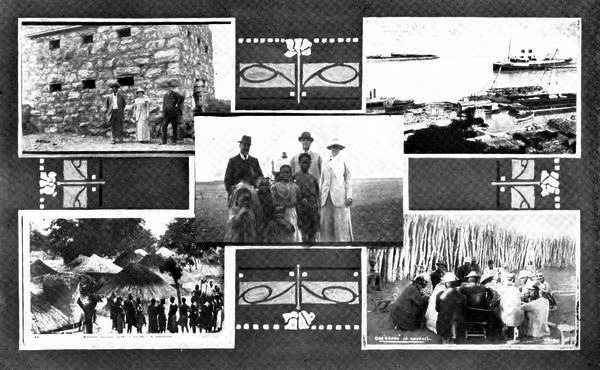
Block House used by the English in the Boer War / Entrance to Suez Canal Native children, South Africa Native Village, Rhodesia / An African King meeting with his Cabinet
FRIDAY, MARCH 28.—The mother and daughter with whom we have been traveling several days, Mrs. and Miss Meek, live fifteen miles off the railroad between Durban and Johannesburg, on a farm of twenty thousand acres. Mr. Meek, the husband and father, goes in principally for sheep, of which he has many thousand head, but he does general farming as well, and has two hundred and fifty natives on his farms, counting women and children. These live in small villages or kraals on the land, and both Mrs. Meek and her daughter speak the Kaffir language. Some of the Kaffir men on the Meek farm have six wives; the farm foreman has that number, and Mrs. Meek says he is a very reliable and capable man, in spite of his love affairs. The foreman has twenty-eight children, and each of his six wives lives in a different hut. When he takes a new wife, there is no marriage ceremony; he simply invites his friends to a wedding feast, which the other wives prepare. He buys his wives, usually paying ten head of cattle each; there are no love preliminaries, except that occasionally a young girl comes to the foreman’s kraal, and remains until he takes her as his wife. He is a prosperous man, and prosperous men are everywhere popular with the girls. The wives of the foreman get along very well together; they have always been accustomed to the system of plural wives, and do not seem to object to it. The children living in the kraals, Mrs. Meek says, are very healthy; more so than white children living in modern houses in the same vicinity. The grass-covered huts in which the natives live are less liable to leak in rainy weather than the houses of the whites, which are almost universally covered in South Africa with corrugated iron. Mr. Meek pays his native workmen about $2.50 per month, and board, providing they are reliable and steady. Their board consists of a certain amount of shelled corn; about all they eat is corn-meal porridge, and their idea of luxury is to have brown sugar to sprinkle over it. Most of them have gardens, and Mr. Meek loans them oxen and plows for cultivating them. A young native boy who herds cattle gets seventy-two cents a month. The native workmen employed on the Meek farm have their porridge ground and cooked by a native employed for the purpose, who never gives them too much, because the work of grinding corn in a handmill is a considerable task, and this task falls to the cook. The natives on the farm go to church once on Sunday, but they seem to attend the services as a means of seeing and being seen rather than because they are religious. A railroad is building toward Mr. Meek’s farm, and lately he refused $20 an acre for it. I am somewhat confused about the yield of corn per acre in South Africa, as the people always say a field yields so many bags per morgen; a morgen being a little over two acres, and a bag holding a little less than three bushels. But it may be safely stated that the yield of corn in no part of South Africa is equal to the yield in the corn belt in our section. Disastrous drouths are also very common; corn has been almost a failure for the past three seasons. I have not seen a good field of corn in South Africa. But Mr. Meek is a very prosperous farmer, because of his sheep, cattle and horses. He also milks a good many cows, and sends the cream to the railroad, “five hours” from his farm: distances are always computed here by hours, and not by miles. Five miles from his farm-house is a country village without a railroad, and there he does his “trading.” He is making an exhibit of stock at the Johannesburg fair, and his wife and daughter are very anxious to know whether they took any prizes.... Mr. Meek was born of English parents, but has never been to England. During the war he would not fight the English, and he would not fight the Boers, as his wife is of Dutch descent. So he left home, and went into Natal. His wife remained on the farm throughout the war, and was constantly surrounded by troops of the contending forces. Once, when they had an artillery battle, the shells flew over her house for hours; some of the shells fell in her door-yard, and, exploding, tore down fences and outhouses. Her children were away at school when the war began, and did not come home for eighteen months. Mrs. Meek managed to smuggle a good deal of the farm live-stock into Natal, where her husband received it and cared for it on land rented for the purpose. In smuggling sheep and cattle out of the country, Mrs. Meek’s main reliance was the native foreman, the wretch who has six wives; he was as faithful and efficient as it is possible for a servant to be. Occasionally the English talked of sending Mrs. Meek to the concentration camp, and burning her house, but she was always able to coax them out of the notion.... She has a native cook, a man, and pays him a dollar a week. The native women do her washing and ironing, and do it very well, for a dollar a week; in addition, they clean and sweep.... Mrs. Meek has never heard of a divorce among the natives on the farm where she lives. The men of some native tribes are married in church, by a negro preacher; in such a case, they are compelled to pay two shillings for a license, but this civilized plan is so expensive and troublesome that it is not popular. Besides, when a man is married in church, and pays two shillings for a license, he is liable to arrest if he marries another wife.
SATURDAY, MARCH 29.—We are at the far-famed Victoria Falls today, and traveled here from Bulawayo at the terrific pace of fourteen miles an hour. The conductor on the train wore a natty white suit, but did not make up the beds, though he sold the bedding tickets; the actual chambermaid was a very black native boy. I do not understand why sleeping-car porters are permitted on some night trains, and not on others.... I was in a sleeping compartment with a captain in the English army, who is on his way to a station in the interior, seventy miles from Victoria Falls. There, in company with another army officer, he will rule a district, assisted by a few native police. He says hunting is excellent where he is going, and he showed me his assortment of guns; including one specially intended for elephants.... The country between Bulawayo and Victoria Falls (280 miles) looks superior to that between Mafeking and Bulawayo, but we ran into the inevitable desert, and suffered considerably from dust. As we approached the falls the country became rougher, and an hour before we finally left the train we could see a cloud of mist hanging over the great cataract. When the train stopped at Victoria Falls station—the railroad runs four hundred miles beyond this point—we could hear the roar which will be in our ears constantly until we leave next Wednesday at 1 P.M.... There is no town at the Falls; only a hotel, a rambling, comfortable affair which can accommodate two hundred people. The charge is $5.25 per day each. Five miles away is the town of Livingstone, capital of North-west Rhodesia, but it has only a handful of inhabitants. From my room at the hotel I can see the famous railroad bridge which spans the Zambesi river just below the falls, and passing my window are wet and bedraggled people who have been through the Rain Forest. In order to see the falls to best advantage, it is necessary to go through the Rain Forest and get a ducking. Many of those who arrived on our train at 7 o’clock this morning will return at 1 o’clock this afternoon, thus avoiding a delay here of four days; after the train leaves this afternoon, there will not be another train until next Wednesday.... I doubt if anyone has ever seen, or ever will see, all of Victoria Falls. It may only be seen in pieces, and the spray will always hide much of the great spectacle from the most industrious visitor; whereas Niagara may be seen in a single glance, in all its majesty. Victoria Falls is a mile long; about twice as long as Niagara, and four hundred feet high, whereas Niagara makes a leap of only 162 feet.... Every time I looked at Victoria Falls, there was usually an Englishman present to inquire: “Well, what about it?” Meaning, “How does it compare with your Niagara?” The two falls are not alike, and cannot be compared; both are wonderful in a different way. Niagara is situated within a few miles of Buffalo, New York, one of the largest and busiest cities of the United States, and surrounded by a fertile and well-settled country. Niagara is in the center of parks, hotels, mills, street-railways, and civilization of many other varieties; an American bride who is not taken to Niagara on her wedding trip, may get a divorce on that ground, if the fact is presented to a court of proper jurisdiction, but Victoria is in a wild country in the mountains of Africa, seventeen hundred miles from Capetown, and Capetown is nineteen days from London, and twenty-nine from New York. Niagara makes a straight leap, whereas Victoria is more of a cataract. At Niagara, a great solid wall of sea-green water pours over a precipice; here, the force of the fall is broken in many places by huge rocks—at one place the fall is separated by a wooded island, and there are many other smaller breaks. At Niagara, the river above the fall is clean and swift, with no rocks. At Victoria, the river above the fall is broken into a thousand different islands; it looks like a shallow river overflowing in brush and timber land after a torrent of rain, and much of the water pouring over the falls is yellow and dirty.... Victoria Falls is in shape like a huge capital T; the falls represented by the top of the letter, and the outlet by the stem. The water pours into a great pool a mile long, and escapes by a narrow outlet not more than 150 feet wide in places. The water pours into the pool with a roar that may be heard twenty-eight miles, and stirs up a spray that causes constant rain to fall in its immediate territory. This spray is so great that it looks like a cloud against the sky, and may be seen before you hear the roar of the falls.... Yet the water from this great pool escapes almost as quietly as water from an undisturbed lake. After the water escapes from the great pool below the falls, through the stem of the letter T, it makes a turn at right angles, and sweeps around like the capital letter U; yet there is no great disturbance in any part of the outlet from the falls. At Niagara, the whirlpool rapids is one of the world’s wonders; at Victoria, the river a few hundred feet below the falls seems to be navigable—it does not look unlike the Waunganui river in New Zealand, down which we traveled in boats. I believe one of the Waunganui river boats could come up the gorge below Victoria Falls.... Every visitor, after looking at the wall of water pouring over the falls, asks the same question: “What becomes of the water?” Dr. Livingstone, who discovered the falls, asked the question. I was with a party of four when I first saw the falls, and all agreed that, in places, the river a few hundred feet below was not more than fifty feet wide, although the guidebooks say the width is greater. And this narrow river is not greatly disturbed a few yards below the great Victoria Falls; there is no swirling, leaping rapids, as may be seen four or five miles below Niagara. When looking at Victoria Falls, very much more water seems to pour over the brink than at Niagara; when looking at the river below, you are disposed to think the quantity is much less—as a matter of fact, the quantity is about the same, with Niagara a little in the lead.... At Niagara, you may see the falls from an electric car, and go down the Niagara river on top of the hills, and return beside the whirlpool rapids; but seeing Victoria is much more difficult. For nearly a mile you walk in what seems a pouring rain, but which is actually spray from the falls. Most visitors put on old clothes at the hotel, and quietly submit to the ducking; on their return, they take a hot bath, put on dry clothing, and sit on the verandas, and talk about the wonderful trip. During this walk of half a mile in pouring rain from the spray of the falls, you pass through what is called the Rain Forest. As rain is always falling, the vegetation is luxuriant, but not as luxuriant as I had expected. The path through the rain forest is always wet; sometimes you step into water over your shoe-tops, and the trees are always dripping; you cannot see the falls to the best advantage without passing through this Rain Forest, and you cannot make this trip without becoming as wet as though you had plunged into a lake with your clothes on. During this trip you frequently stand not a hundred feet from the falls, and the spray coming up from the pool is so thick that you cannot see a hundred feet beyond you. And all the time the great roar is in your ears, and the rain shifting with the wind. The sun nearly always shines here, and on this trip along the edge of the falls you may see a thousand rainbows; I am sure I saw that many today.... The Rain Forest is not down in the canyon, as one might imagine; it is on a level with the top of the falls, and sometimes not a hundred feet away from it. Imagine a street one mile long, and 400 feet below sidewalks on either side. One sidewalk represents the Rain Forest. Opposite you is Victoria Falls pouring into the chasm below, and causing a spray which shifts with the wind, and not only drenches you, but hides much of your view. The Rain Forest is simply the other side of the falls, and, to travel its entire length, you must make a detour, and cross the narrow outlet of the falls chasm by means of the rail road bridge.... The bridge below the falls is the highest in the world, and in walking across it you are 420 feet above the water in the gorge below. When it was being built, in 1903‒5, it was frequently described in the magazines as one of the great wonders of engineering. The bridge is of one span only, of the cantilever type, and 610 feet in length. From the bridge, the hotel, a half-mile away, and near the edge of the canyon, is in plain view. The bridge-tender is a negro boy, and visitors pay him a shilling each to cross and return.... The present is known as the wet season, and, the Zambesi river being at a high stage, the falls is rather more gorgeous now than it will be later on, when the river is lower. The Zambesi is one of the great rivers of Africa, and is referred to in a big way as we refer to the Mississippi or Missouri; citizens here frequently refer to “the vast territory south of the Zambesi,” as the Mississippi and Missouri rivers are dividing-lines in the United States.... The falls were discovered by Dr. David Livingstone in 1854, and named in honor of Queen Victoria. Livingstone died in Africa, of the fever. He had faithful friends among his native followers, and when they found him dead, they embalmed his body as best they could, and carried it fifteen hundred miles to the sea, whence it was taken to England, and buried in Westminster Abbey.... The hills around Victoria Falls are covered with a growth of inferior timber, and this continues until the end of the railway is reached, 400 miles to the north.... It is estimated that nearly a million and a quarter of visitors see Niagara every year; barely two thousand see Victoria Falls annually, owing to its location far in the interior of Africa. In order to reach the falls from the sea at Durban, we were compelled to travel five days and nights by railroad train.... It is said the fall is 420 feet. It does not seem so great, because the lower part is hidden in the spray arising from the chasm into which the water drops. But while you cannot appreciate the unusual fall, you can easily appreciate that the fall is a mile wide, although broken all along the edge by islands and huge rocks. In thinking of Victoria Falls don’t imagine it a solid sheet of water a mile long, falling 420 feet. The falls are broken into a thousand different streams, and some of them strike rocks in the wall and break into spray.... I was not greatly moved when I first saw the falls, but felt that the sight was worth coming a long distance to see. Pictures of the falls are deceiving, as are pictures of everything. In taking pictures of Victoria Falls, photographers look for the fine views; the commoner aspects of the cataract are rarely photographed. I recall a noted photograph of the falls which is one of the most majestic things I have ever seen in pictures; but in order to take it, the photographer was compelled to climb down a cliff by means of ropes; so the picture is really unnatural.... There are thirty or forty guests at this hotel, and I have talked with most of them. They all seem to be well satisfied with the trip, but none of them rave about the falls as do the writers in the guidebooks.... No one seems to know the depth of water in the narrow gorge through which the water from the falls is discharged; soundings of 150 feet have been made without touching bottom.
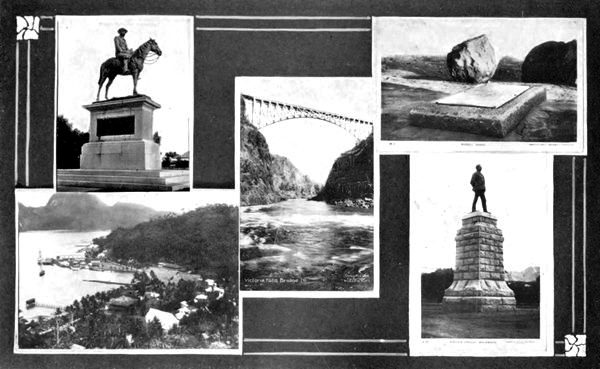
Rhodes Memorial, Kimberley / Rhodes’ Grave Victoria Falls Bridge Naval Station, Pago Pago / Rhodes Statue, Bulawayo
SUNDAY, MARCH 30.—Today we again walked to the Falls from the hotel, a distance of half a mile. Captain Mosley, of the British army, who shared a sleeping apartment with me on the train coming here, accompanied us. The captain is changing his station, and has with him four hunting-dogs and a black boy who has been his cook seven years. This black boy accompanied us on the walk, to exercise the dogs, and on the way, the dogs in ranging about, encountered a bunch of baboons. The captain and black boy ran into the woods, toward the big noise the fight stirred up, and I followed them, arriving just in time to see the dogs whipped, and the baboons scamper up the trees. The captain says the dogs would have been killed had they found full-grown male baboons, instead of small-sized females and young ones. Baboons are a great nuisance all over this section. They have almost human intelligence, and are very adroit thieves. I have been told that baboons will attack a woman, if they find her alone, but that they have great respect for men, whom they associate with a gun. Near the hotel is a camp of soldiers, and they have a tame baboon. They also have a tame deer of a variety not much larger than a jack rabbit. The soldiers pick up the deer, and stand it on a table. There are dozens of different kinds of buck here, ranging from the size of a rabbit to the size of an ox. The soldiers told me that plenty of reed buck may be found within four miles of the Falls, but this is the closed season, and one of the duties of the soldiers is to protect the game. Last night one of the soldiers saw a leopard prowling around the camp. A few days ago a lion was killed within a few miles of the falls; the man who killed it brought in the skull and hide, and received a bounty of $7.50. Lions destroy a great deal of game, and the government pays for their destruction. The soldiers patrol a district 100 miles square, and say they rarely hear of lions attacking a man; they hear lions nearly every night, but rarely see them, as the animals are as sly as our foxes. The corporal with whom I talked says that during an experience of seven years in this section, he never personally knew a lion to attack man. He has heard of such cases, but you all know how common it is to hear stories that are not true.... The British captain with whom I spend a good deal of time, walking about, or sitting on the hotel veranda, is one of the quietest men I have ever known. He has always lived among soldiers, having been born in Benares, India, where his father was an officer in the English army. He lived there until he was twelve years old. Benares is as old as Babylon; when old Babylon was a flourishing city, Benares was in existence, and has remained a city continuously ever since, while Babylon has been completely destroyed, and its location almost forgotten. The captain tells of his experiences, when I question him, but is very reticent in speaking of the numerous forays in which he has engaged. I have no doubt he has had many thrilling experiences as a big-game hunter, but I cannot induce him to say much about them.... Another Englishman, named Green, who is with us a good deal, talks enough for half a dozen. He is a business man at Sheffield, England, and says that in case of war between England and Germany, the United States should assist England. Indeed, Mr. Green thinks the United States should even now present England with a battleship, and assist in “bluffing” Germany, as New Zealand has done. One of the ladies present asked me:
“What are England and Germany quarreling about?”
“They have no quarrel,” I replied. “They are simply bullies strutting around and daring each other to fight. I have forgotten the exact number, but we will say for illustration that England had a hundred battleships, and Germany fifty. Germany ordered two additional battleships built, and England immediately ordered four new dreadnoughts. And this ridiculous proceeding has been kept up for years; England is pledged to build two warships for every one built by Germany. The two countries have nothing to quarrel about, but the English declare they must have twice as many battleships as Germany, and the Germans say they must have as many battleships as England. And an apparently intelligent Englishman named Green says that in case this foolish contest finally results in war between the two countries, the United States should quit agriculture, and mining, and manufacturing, and trade, and assist England, simply because the Americans and English read the same language, although they understand each other with difficulty when they talk.”
The Victoria Falls Hotel is owned by the railroad company, and when you visit the falls you will have no fault to find with it. Two hundred guests could be easily entertained, but I doubt if there are two dozen here now, as this is the dull season. Fall begins in this section with April, and visitors are most numerous during the cool weather. The most terrible cold-weather story I have heard here is that ice sometimes forms at night during the terrific cold prevailing in July and August.... The present temporary buildings of the Victoria Falls Hotel are to be replaced shortly with permanent buildings to cost $150,000. But in the present temporary buildings, guests willing to pay the price may have rooms with private bath, and during the worst weather the nights are cool. My bed is covered with a mosquito netting, as is the universal rule here, instead of putting netting at the windows and doors, but I have heard no mosquitos.... The Mr. Green referred to above has been looking at land in Africa with a view of buying for friends in England. English people have a great deal of cold, damp, foggy weather, and they hear much of the glorious sunshine of Africa; so Mr. Green’s report as to the possibilities of farming here will influence a good many. His report will not be very favorable. He has spent weeks in the different farming districts, and says he found farmers suffering from a three-years drouth. One man had a splendid prospect for corn, and thought the harvest would make him rich. Suddenly the hot winds came on, and in a few days the crop was ruined. This man offered his farm of 7,000 acres for sale at a dollar an acre; Mr. Green says he can buy millions of acres at that price, but will not advise his friends to take it, as the rainfall is uncertain, and the country infested with ants, ticks, flies dangerous to stock, etc. Possibly these pests will disappear in time; certain districts formerly dangerous are now free from the cattle-fly. ... Mr. Green says that in many of the best sections of England, agricultural land can be bought at $50 an acre; the choicest at from $100 to $150 per acre. This statement particularly interested me because that is about the range at which land sells in the district where I live. I had always imagined that land in England sold at much higher prices than in Atchison county, Kansas, fifteen hundred miles west of the sea at New York.... Mr. Green says that last January, in his section of England, there were only five days without rain; last summer, he saw only fourteen bright days. There is plenty of sunshine and plenty of dry weather in Africa, but Mr. Green says he will not recommend the country to his neighbors.
MONDAY, MARCH 31.—This morning a dozen guests from the hotel, including the two travelers from Kansas, took a boat trip of fifteen or twenty miles on the Zambesi river above the falls. After a walk of half an hour we embarked in a large gasoline launch, and ascended the river until about noon, when we went ashore on an island, and explored it until lunch was ready at 12:30. A Hindu servant, with a native helper, accompanied us from the hotel, carrying two large hampers, and they prepared tea, and served an excellent lunch.... The Zambesi river above the falls is a wide, rambling affair, full of islands, and so shallow that the course of our launch was marked for several miles. When we finally landed, it was because we could go no further on account of a rapids. The river contains more water than the Missouri or Mississippi river, I should say, but is not navigable. At places it is said to be a mile and three-quarters wide. A river in this dry country is a novelty, and people make long excursions to see the Zambesi. On either side there is a line of hills which do not look unlike the hills bordering the Missouri river, but the valley is covered with trees and brush, as was the case in the Missouri “bottom” fifty years ago. On the Zambesi, the river valley seems to shift from one side to the other, instead of being confined always to the east side, as is the case with the Missouri river in its entire course. The trees along the Zambesi are of a stunted variety; along the African railways, a fairly large tree attracts almost as much attention as a river. The African trees are not large and graceful, as are our maples, oaks, walnuts, etc. One of the wonders here is a cream-of-tartar tree which measures ninety-eight feet in circumference. It is actually a dozen stunted trees growing in a bunch, but it is regarded as a wonder, and every visitor carves his initials in the bark.... Hippopotami are quite dangerous above the falls, as they upset boats in a spirit of mischief. They are being shot, and two were killed the day before we went up the river. Some time ago four tourists rowed on the river, in small boats. Hippos upset both boats, and two of the tourists went over the falls; the other two drifted against islands, and were rescued. It was a man and a woman who were rescued, strangers to each other, but the tragedy made them friends, and a few days ago they were married.... There are also crocodiles in the river, and they are also a nuisance. The man who ran the launch lives on the hotel farm, and says that since August last, crocodiles have captured twenty of the farm cattle. The cattle go to the river to drink, or to stand in the water during the heat of the day, and the crocodiles, some of which are eighteen feet long, drag them in. One of the soldiers from the camp near the hotel shot a crocodile while we were on the river.... I heard a curious discussion while we were eating luncheon on the island. An Englishman, a church member, had great respect for missionaries. All the others were residents of Africa, and their testimony was against them. One man said the superintendent of a penitentiary told him recently that ninety per cent of the convicts had been “converted” by missionaries. A mining man testified that negroes who had been under the influence of missionaries were nearly always less honest and less useful than natives who had had no such experience. A woman who lived on a South-African farm of 20,000 acres gave similar testimony, as did an army man who had served in Africa since the Boer war. Wherever I have gone, I have heard the missionary experiment denounced by white residents. I am taking no part in the controversy, but record as a remarkable fact that in Africa, China, Japan, India, etc., the testimony of white residents is nearly always against the missionary experiment. Every traveler remarks this, and comments on it.... This morning at 3 o’clock a rifle-shot rang out back of the hotel; one of the soldiers in the camp saw a leopard prowling around, and shot at it. A photographer living near the hotel has a cow, a calf and a donkey, and every night these are carefully locked up in pole fences that are leopard-proof.... This morning, when I awoke, I found a gentle rain falling in front of my room at the hotel. It turned out to be mist from the falls. This mist shifts with the wind, and in whatever direction we walk we run into it occasionally. At points quite distant from the falls it amounts to only a mist, or a very gentle rain, but at other places there is a heavy downpour. Along certain walls of the canyon below the cataract, dozens of waterfalls may be seen, and these are fed by the mists rising from the falls. There is seldom an hour during the day that a rainbow may not be seen from the hotel veranda. During moonlight nights a lunar rainbow may be seen which, experts say, shows one color not seen in the rainbow in daylight.... I was looking over the hotel register today, and ran across this entry: “Mrs. Annie E. McConnell, U. S. A.” I made some remark about finding a visitor from home, and the clerk said, laughingly: