Front matter (continued 8)
Reading edition

WEDNESDAY, APRIL 16.—At noon today we left Mombasa for Aden; no more stops for five or six days. Loading at Mombasa continued without interruption for eighteen hours, and when the colored laborers went away on barges, they cheered because of the completion of their long task.... Outside the harbor, we encountered the first motion of the voyage, and several of the passengers went to bed. The motion was not great, but it was the first we have had. We had been wondering what the “Burgermeister” would do in case of heavy weather, and found her specialty is a pitch. The pitch is far more agreeable than the roll.... We had been told by the captain to expect the hottest weather of the voyage between Mombasa and Aden, but found the weather cooler at Mombasa than at any other stopping-place, and at sea there were actually spots on deck that were too cool.... At Mombasa we took on an entirely new lot of deck passengers, and lost a number who greatly interested me. One was a negro boy of fourteen, whom a woman passenger was taking to Nairobi as a servant. She met him on the streets of Mozambique, and, being attracted by his fair promises, took him on board. The boy claimed to be able to speak five languages in addition to “Kitchen Kaffir.” This is a language which all Kaffirs understand, and it is the native language usually learned by whites. I have a notion that a half-savage boy of fourteen speaking five languages, speaks some of them very imperfectly.... The captain, or some one for him, has suppressed the six babies on board. Nearly all of them have male nurses, and these negro men, who are traveling on deck-passage tickets, almost monopolized the first-cabin deck. They had cribs and fences in which they confined their charges, and getting about was almost impossible. There was so much grumbling that the babies and nurses have been sent to the deck below, and we see no more of them, although we can hear them. The halls of the baby deck are encumbered with all sorts of nursing-bottles and other apparatus of that nature, and we are compelled to wade through it when we go to our rooms.... The lower class of Hindus are the filthiest people in the world, judging from what I see of them on the lower deck, where a good many of them are located as passengers. I cannot avoid seeing all their domestic arrangements, and their indifference to dirt is amazing. I notice that a good many of the negroes in Africa have adopted the Hindu religion, having learned it from the Indians, who come to the East Coast in great swarms. Religion naturally appeals to the negro, and he adopts any form of it which attracts his fancy. But the great bulk of the negroes on the East Coast are Mohammedans, having learned that doctrine from the Arabs who sold them into slavery. You would think the negroes would detest the Mohammedan religion and the Arabs, but they do not. Many of the natives who are unmistakably Africans, claim to be Arabs, and this evening I saw six Mohammedan negroes saying their prayers at the same time. They observed me watching them, and took particular pains to “show off.” One of them had a string of beads of the kind used by the Catholics, and I am certain that he had picked up this addition to his Mohammedan religion from the Catholics. All religions become badly mixed by their different forms appealing to other sects.... The orchestra played a concert on deck this evening, for the first time in several days; we have been so busy loading cargo that there was no time to think of music.... I find that we took on an American passenger at Mombasa; A. B. Hepburn, of the Chase National Bank, of New York, and Comptroller of Currency under President Harrison. He has been hunting in the Niarobi section, and told me he was the only one in his outfit who did not get the fever.
THURSDAY, APRIL 17.—We crossed the equator at noon today, and are once more in our proper hemisphere. There were no exercises; usually the sailors engage in foolishness, and scare those who have not crossed before, by threatening to duck them in the swimming-tank. There is not a great deal of foolishness on German ships; on the English ships, so much is made of sports that many passengers seriously object. I selected a German ship instead of an English because I was thoroughly disgusted with the Sports Committee on the “Anchises.” Every hour of the day, almost, on the “Anchises,” a boy went about beating a gong, to announce another meeting of the Sports Committee, which arranged for potato races, sack races, and other silly performances. Nothing of that kind on the “Burgermeister;” the passengers are genteel and quiet, and let each other alone.... The English universally speak of the tomato as “tomahto.” If that pronunciation is correct, why do they speak of the potato as “potayto?” If “tomahto” is a correct pronunciation, “potahto” is also better than “potayto.” ... I notice that nearly everyone speaks a little English. We have on board Germans, Russians, Portuguese, Chinese, Belgians, French, Arabs, Hindus, and Kaffirs, and all of them speak English, more or less. English will soon become the universal language; there is no need of Esperanto, a language I have never heard of anyone speaking. A band of reformers are urging that all races learn Esperanto, in order that all men may have a common language, but Esperanto is not making much progress.... Owing to the crowd in the dining-room, my bath-room steward assists in waiting at my table. He is a very capable and agreeable man; every morning when I go to the bath-room, he says: “Good morning, please.” ... I believe that every woman on board, with one notable exception from Kansas, smokes cigarettes. Young women walk about the decks alone, smoking, and it always seems to me to be foolish. The fact that Adelaide does not smoke, causes a good deal of favorable comment among the men. “I may be old-fashioned,” I have heard many men say, “but I don’t like to see women smoke.” ... We have heard no American news for weeks, except that J. Pierpont Morgan’s body has arrived in New York. I see this announcement in every newspaper I pick up; when a cablegram is received here, the newspapers warm it over for days.... In the cablegram announcing Morgan’s death, the impression was given that he had a bad stomach, and starved to death. The passengers talk a good deal about this very rich man starving to death.... An Englishman whom I know very well, and who talks Kaffir, takes a good deal of interest in the negro passenger who has two wives. Today we went down to the lower deck, and discussed matrimony with the man. Asked if the system of plural marriages pleased him, he replied that if he had it to do over, he wouldn’t marry at all. It seems that all the Kaffirs who are deck passengers try to flirt with the man’s two wives, and he is very uncomfortable. He says he showed his respect for women in a practical way, by marrying two of them; that he pays their fare on the present journey, but that a lot of young fellows expect his wives to neglect him in order that they may amuse them. There is a good deal of the same thing in the first-cabin, and several wives make their husbands very uncomfortable by flirting with the young men.... The barber on this ship charges only twelve cents for a shave; the price on all other ships I know anything about is double that amount.... The Germans and English have talked of fighting so long that I almost hope they will finally be punished by getting at it. War is so unnecessary, atrocious and wicked that every nation that even talks about it should be punished.... This morning we passed an Arab dhow. It was not more than sixty feet long, yet vessels of this type have been sailing these seas for centuries. They have but one sail, and a crew of only four or five men, but they are often entrusted with valuable cargoes. They are stoutly but crudely built, and the one deck is covered with straw thatch. The captain of an Arab dhow has no scientific knowledge of navigation, and no instruments to take the sun, yet he knows the currents and the stars, and makes as good time as modern sailing-ships. Captain Ulrich looked at the dhow through his glass this morning, and said the captain was taking every advantage of wind and current, and that the most able navigator could not do better. Ships of exactly this type were used thousands of years ago, and some I have seen along this coast looked to be fully that old. An Arab dhow has no conveniences whatever, yet they carry passengers as well as freight. Passengers and crew live together under the single roof of thatch, and cook and live in the most primitive manner. If the Arabs are not the dirtiest people in the world, only the lower order of Hindus can wrest that distinction from them.... Many of the passengers who came on board at German East Africa ports, are half sick, and say they have had enough of the African climate. I hear no praise of rural Africa from those who have lived there; there are prosperous and healthy people around Capetown and Durban, and in the Transvaal and Orange Free State, but the interior of the country is grievously afflicted with dry weather and serious physical pests.
FRIDAY, APRIL 18.—We have not been in sight of land for several days, but the sea remains calm, and the weather cool; nothing going on except the band concert at 10:30 A. M., and the orchestra concert at 9 P. M. After the last-named event, we walk around awhile, and then go to bed.... There are two amateurs on board who are returning from a hunting trip, and on the aft deck they have a number of trophies. A majority of the male passengers live in Africa, and have hunted a great deal, so the two amateurs do not attract much attention. Leopards are the great pest of the country, as they are very numerous. One man told me this morning that only a few weeks ago, a leopard killed a negro boy in his hunting camp. No hunting story is more than half true, so I do not pay much attention to them. A hunter offered me a pair of buffalo horns today, but I refused the offer; they were not worth the trouble of carrying them home.... Captain Ulrich, of the “Burgermeister,” does not sit at the head of the centre table in the dining-room, but occupies a side seat at a side table.... Men object to wearing evening clothes because of the stiff shirt. Soft shirts with pleated fronts are generally worn with dress suits on the “Burgermeister,” and they are said to be the latest in London. A coat and vest of white duck, the coat as short as a waiter’s jacket, are also substituted for the black coat and vest.... Every little while I meet a man who says he prefers second-class to first class on a ship, because of the lack of formality in the second-cabin. At Victoria Falls I became acquainted with a man, and saw him again today on the second-cabin deck. He says the informality there is so pronounced that some of the Englishmen spend half the morning in the smoking-room wearing nothing but pajamas. That, it seems to me, is carrying informality too far. When a man travels in the second-cabin, he does it to save money, and not because it is “more democratic.” I hate democracy when it amounts to impoliteness and rudeness, as is frequently the case.... There is a burly German officer on board in whom I am much interested, because of the scars on his head and face. The scars were evidently received in a student duel at the university, and I should like to see the bully boy who decorated him so artistically.... I hear it stated every hour of the day that Africa is a country of “great promise.” It seems to me that Africa has been “promising” long enough, and should cease being a game country. The United States turned the buffalo ranges into farms; Africa would also get rid of its game if there were any demand for its land from agriculturists.
SATURDAY, APRIL 19.—Today we are off Samoliland, the most worthless part of Africa. It is controlled by the Italians, and is about as savage as it ever was. There is one seaport in Samoliland, but steamers rarely touch there, as it has no business.... The weather, which we expected to be very hot in this part of the world, remains cool. You often miss it when you expect misfortune.... There is a young Canadian on board named Goult. It was at first reported that he was an American, and he does look like one, as all Canadians do. He and his wife have been on a hunting trip into the interior of Africa. They had an outfit consisting of one hundred and fifty native men, who packed their supplies and tents. The natives carried their own food, which consisted of several thousand pounds of corn-meal; in addition to this, they had meat when game was killed. The hunt lasted nearly four months, and very few of the men deserted. When a native porter deserts, he loses all pay coming to him; besides, he is liable to arrest and imprisonment. Mr. Goult had a professional guide and hunter with him, who organized and managed his outfit. They killed four lions, but no elephants, although other game was fairly plentiful. Mr. Goult says game animals in this section are infested with a tick which renders them disgusting at times. Mrs. Goult told me this evening that she suffered no hardship; that roughing it in Canada is very much rougher.... The band on the “Burgermeister” is a very good one; much better than is usually found on ships, and the leader has excellent taste in choosing his selections. And this man is a waiter in the dining-room, and young and good-looking. ... The “Burgermeister” is a slow ship, and makes about fifteen miles an hour: only half as much as some of the big liners on the Atlantic. The Atlantic is the dandy of oceans: no other has equally fine ships. But on the fast ships of the Atlantic there is a vibration from the engines that is disagreeable. The slow ships are much more comfortable than the fast ones. And the Atlantic is also the bully of oceans; a voyage without rough weather is rare. If the Atlantic were as smooth as the Indian ocean from Beira to Aden, people would hear less of seasickness.... The captain is taking home with him a baby deer that certainly does not weigh a pound and a half. It is not as big as a rabbit, as it belongs to a family of deer noted for diminutive size. The captain amused the passengers this evening by feeding his baby with a bottle. First the captain smelt of the bottle, to see that the milk was not sour. The baby has been ill, and the ship doctor has been attending to it.... By-the-way, the doctor has been behaving very well since his sweetheart left the boat at Tanga. The women expected him to be gay, but he has been very quiet and thoughtful, and the men are proud of him.... There is nothing lazier or duller than a voyage in quiet seas. At one time this afternoon, every passenger on my side of the deck was asleep.
SUNDAY, APRIL 20.—We were awakened this morning by the ship’s band playing hymns in the halls. Soon after I went on deck, land appeared, the first we have seen in four days, and we remained in sight of it all day. Between us and land a ship was steaming southward, and a school of porpoises also appeared, disturbing the sea for miles. They were as lazy as the natives, and jumped in a leisurely, slow way that amused us. About noon, Cape Guardafui appeared. Guardafui is the most eastern extremity of the African continent, and when we rounded it about noon, we were in the Arabian sea, and the ship’s prow was pointing toward home: due west. The rocky point around which we turned to enter the Arabian Sea, bears a striking resemblance to a huge crouching lion, when viewed from a distance. We passed quite near the shore, but saw no signs of life: nothing but a desolate waste of sand and rock.... After rounding Guardafui, we were in the Gulf of Aden, which looks small on the map, but we shall steam on its surface thirty hours, out of sight of land, before reaching Aden and the entrance to the Red Sea. We are now in that section referred to by Kipling as “East of Suez:” land of poor crops, poverty and misery. A few days’ sail to the east from Guardafui, and the traveler reaches India, where ignorance is worshipped as mystery, and where men of the tenth or hundredth generation know no more than did their fathers.... Africa is larger than North America; it is almost as large as the American continent, and is controlled by such enlightened natives as England, Germany, France, Italy, Belgium and Portugal, yet from one end of the country to the other there is no such thing as a public school for the natives. Indeed, I have heard many Englishmen openly declare that education is the ruination of the native. I don’t dispute the statement; I only call attention to two different ideas of the importance of education. In the Philippine Islands, in Guam, in Porto Rico, in Honolulu, in Cuba, we are insisting upon education as the solution of the native problem; over here, the powers insist that education only makes the native problem worse. At home, we are called upon to contribute money with which to send missionaries to the heathen. Over here, where the heathen lives, the whites almost universally say that the missionary causes useless trouble. I am not trying to settle the question, or argue it: I am merely calling attention to a queer phase of it.... A gentleman told me today that in Portuguese East Africa, where he lives, there is a Catholic mission in charge of French priests. In the chapel, there are huge oil paintings showing pictures of hell. The devil is represented as a negro. In one picture, a native is dying, and hundreds of fiends surround his bed, waiting until life is extinct, that they may torture him. There is education of this sort in Africa, but no school-house for the natives.... Religious services were held in the dining-room at five o’clock this afternoon, conducted by a German. The full band was used instead of an organ; the preacher would line a hymn, and then those present would sing it, accompanied by the band.... The ship’s library contains books printed in German, English, French, Portuguese, and Dutch, which will give you an idea of the different nationalities patronizing this line.
MONDAY, APRIL 21.—At 9 o’clock this evening we came to Aden, in Arabia, said to be the hottest town in the world. Every drop of water used there is condensed from the sea, although there is a white population of two thousand, including English soldiers, and an Arab population of forty thousand. There is a tradition that rain fell at Aden three years ago, and that every roof in town leaked, but previous to that time no rain had fallen in the town or its vicinity for many years; many of its elderly citizens had never seen a rain-storm, and looked with wonder upon the one which fell three years ago. Aden is located on a rock seventeen hundred feet high, and this rock may be seen far out at sea. The town is an important coaling station, and the English have tremendous fortifications—almost equal to Gibraltar—in the rocks. The harbor is a large one, and almost land-locked, and we thought the place a very pretty one, by moonlight. Although Aden has such a bad reputation for hot weather, the evening was delightfully cool. We were not permitted to land, owing to the plague, but our ship was promptly surrounded by Arabs in boats, who bartered with the passengers until after midnight. The Arabs had ostrich feathers, cigarettes, post-cards, and dozens of other articles to sell, and these they sent up the ship’s side in baskets, for the inspection of the passengers. If the passengers were interested in the goods offered, they asked the price, said it was too much, and offered half; then the dealer became excited, and screamed back that he wouldn’t take it, although he often did. There were dozens of these boats, and the uproar was so incessant that sleep was impossible. The ostrich feathers offered were poor, and those who bought, even at greatly reduced prices, were probably worsted.... The old town of Aden dates back to the days of Tyre and Sidon, and was a celebrated commercial centre long before our Christian era; for many centuries it has been a fortified town because of its strategetical position. From the eleventh to the thirteenth centuries it did an enormous trade with China, India and Egypt, and its market was the clearing-house of that day for the treasures of the East. For tens of centuries, Aden has been the cockpit of fierce fights for ascendency amongst the Arabs, Abyssinians, Persians, Turks, and Egyptians.... A gentleman who lives at Aden says he pays $20 a month for water, which is delivered at his door in tank-wagons drawn by camels. Some of the numerous shops in Aden sell nothing but condensed and bottled water, and the price in quantity is usually a dollar per hundred gallons.... Many years ago, great tanks were built at Aden, to catch the precious rainfall, but these have not been in use for many years, although tourists usually visit them.... Aden is a great camel market, and much of the famous Mocha coffee is shipped from this point. There is just one industry in the town: the manufacture of cigarettes, which is in the hands of Greeks, and who bring their tobacco duty-free from Turkey and Egypt. The walls of the houses are built of a cheap concrete, and plastered.... A third-class passenger on the “Burgermeister” is a little German girl, five years old, traveling alone. She was brought on board at Dar-es-Salaam, to be taken back to Germany. Her mother died three days before, and her father was somewhere in the interior, trying to make a fortune. The little girl’s mother arrived in Dar-es-Salaam only a week before her death. Now the child is very ill, and it is not believed she will live to reach her friends in Germany. The women passengers are doing all they can for the child, but she cries almost constantly for her mother, and not much can be done for her.
TUESDAY, APRIL 22.—This morning at 11 o’clock we entered the Red Sea, through the Straits of Bab el Mandeb. The straits are about ten miles wide, and are made narrower at the entrance to the Red Sea by Perim Island, which the English have fortified. On our right, Asia; on the left, Africa,—two continents in sight. The Red Sea is a great highway for ships since the completion of the Suez Canal; ships for India, China, Japan, Ceylon, Australia and Africa now pass this way. From 7 o’clock this morning until 3 P.M. we passed fourteen ships: six were in sight at one time. Most of them passed us so closely that we could read their names.... All over the world, you hear how terribly hot and disagreeable a passage through the Red Sea is. I have been through it twice, and both voyages were cool and pleasant. Ask anyone who has been through the Red Sea, and he will tell you he had a pleasant voyage, but those who have not made the trip, say it is dreadful. If you have a head-wind, they say, the voyage is endurable, but if you have a following wind,—well, passengers can’t stand it, and beg the captain to run the other way for a time, and give them some relief. We have a following wind today,—that is, the smoke from our funnels is ahead of us,—but we find the weather more agreeable than it was at Beira, or other points on the east coast of Africa.... We are rarely out of sight of land, and this afternoon we passed the Arabian town of Mokka. We spell it Mocha, and famous coffee comes from its vicinity. Mocha coffee is like the Blue Point oyster; it is very rare, and there are many imitations. The town of Mocha has no harbor, and ships rarely call there, so the little coffee it produces is sent to Aden. Further up the coast is the town of Jiddah. It is from this place that pilgrims start for Mecca, sacred city of the Mohammedans. Only one white man has ever visited Mecca, as white people are not allowed in the place. This man, an English officer named Burton, disguised himself as an Arab physician. He spent several years in familiarizing himself with the Mohammedan religion and the Arab language. After his preparations were complete, he shipped as a deck passenger at Suez and successfully deceived the dozens of real Arabs and Mohammedans with whom he was intimately associated. The pilgrims to Mecca from Jiddah are cruelly robbed by the Arabs through whose country they must pass, and the party Burton traveled with had one pitched battle with the thieves. Burton wrote a book telling of his experiences, and I know of nothing more interesting in the way of adventure. A railroad is now being built to Mecca, if it has not been actually completed, and Jiddah will lose much of its former importance. War and slavery are common in most of the Arab towns along the Red Sea, and it is dangerous for ships to send parties ashore, unless heavily armed. During the hot, dry season, many of these towns are entirely deserted; the inhabitants go into the mountains, and remain there until the weather becomes endurable. The Red Sea has a shore-line of more than three thousand miles, yet the country surrounding it is so worthless that there is almost no town of importance on its shores, and no river runs into it. There is no rain in the vicinity of the Red Sea, and it loses eight feet every year from evaporation, which must be made up from other seas where there is more rain and less heat.... You hear a great deal of the “Mysticism of the East.” This mysticism is as foolish as the doggerel used by children when they count the buttons on your coat: “Rich man, poor man, beggar man, thief; doctor lawyer, merchant chief,” etc. Mysticism never means anything. The West solves riddles, and discovers how to produce a hundred bushels of corn per acre: the East pays great attention to Mysticism, and has more poor, dirty and ignorant people than any other part of the world. When the plague breaks out in the East, as a result of foolish pilgrimages to Mecca or Benares, the pilgrims say the plague is a part of the Mysticism of the East, and continue to drink holy and dirty water. But the men of the West have a better doctrine: its chief tenet is, “Clean Up,” and the plague disappears before it.... All our deck passengers left us at Aden. Men who spend half their time saying their prayers do not flourish in the great world west of Suez.... The passengers spend a good deal of their time in reading. I often hear them talking of the books they are reading. “How do you like it?” one will ask. “Oh,” the other will reply, “it serves to kill time, but is rather foolish.” What queer things you find in books! And how much alike many of the famous ones are. “Adam Bede,” “The Manxman,” and “The Scarlet Letter,” were all written around an “idea” that is unnatural, unclean and absurd.
WEDNESDAY, APRIL 23.—We are in a wider part of the Red Sea today, and are not meeting so many ships; the few we have seen have been far away. Yesterday we were in a part of the sea almost as narrow as a river, and we could not avoid meeting all passing vessels. At one time last night so many brilliantly lighted ships were in sight that we were reminded of a night parade of electrical features at a celebration.... We have had a strong head-wind all day which travelers pray for in the Red Sea, and toward evening the “Burgermeister” acquired considerable motion.... The English passengers on board organized a Sports Committee this morning, and are now busily engaged in arranging for such elevating sports as “In a Pig’s Eye,” “Are You There?” potato-races for women, etc. The traveling Englishman has lately gone crazy about ship sports; he is like a Methodist who believes in sanctification by baptism: he will talk of nothing else, and insists on arguing the question with you. In England, only cheap people at country fairs engage in such sports, but on English ships, dukes and princes are expected to take part, for the honor of Old England. The German passengers are not enlisting for the sports, but the English urge them to take part to the point of annoyance.... I have heard none of the passengers mention the fact that the water in the Red Sea is not red; the fact that the water in the Red Sea is blue, now seems to be generally known.... A passenger in the third-class is very ill, and the ship doctor, and a German military doctor who volunteered his services, decided that the man has malaria of the head. Malaria is so common in the tropics that now they have it in the head.... A peculiar thing about the “Burgermeister” is that several of the gentlemen passengers wear white socks. Somewhere on this trip I met a man who was irritable because his white socks attracted attention. He should be on the “Burgermeister,” where they are quite common.... I heard a woman make a remarkable statement last night. She said: “I have been traveling four months, and have not seen a single married man attempt to flirt; all the flirting I have seen has been done by married women with young men.” I submit the statement as unusual, without comment.... The dance last night was a failure; the orchestra played several numbers which did not attract any dancers at all, and only five couples danced during the entire evening. All the women dancers were married, and their husbands sat around and frowned at the young fellows who were dancing with them. There is nothing in the notion that husbands want their wives to be very popular with other men.... During the concert this evening, the tall negro man nurse who has whiskers, appeared with a bottle of milk, and submitted it to the inspection of his employer. The woman smelt and then tasted the milk; it seemed satisfactory, for she gave it back to the tall Kaffir, and he disappeared, probably to feed his charge.
THURSDAY, APRIL 24.—I awoke early this morning because of a strange and unusual sensation. I feared I might be catching the fever, or plague, but later discovered I was cold. A chilly head-wind was blowing, and this in the Red Sea, which rumor says is as hot as a furnace! The passengers went about wearing overcoats all day. At 2:30 P.M. we passed out of the tropics.... For two days we have been in that part of the Red Sea which is two hundred miles wide, and have not seen many ships; but tonight we were in a narrow part, and four ships were in sight at one time. All of them were small; there are many ships in the east, but no very big ones. If one of the big ships of the Atlantic should appear at Bombay or Colombo, people would travel hundreds of miles to see it.... The general impression in America is that an English lord is an effeminate little man who only knows enough to carry an eyeglass in one eye. As a matter of fact, some of them seem to be quite useful and manly. Lord Delamere is one of the conspicuous figures in the development of British East Africa, and has done much for that country. In addition, he is the world’s greatest lion-hunter. Up to 1911, he had killed seventy lions, single-handed. Of the first forty-nine he shot, not one escaped. No other lion-hunter has a record half as good as Lord Delamere.
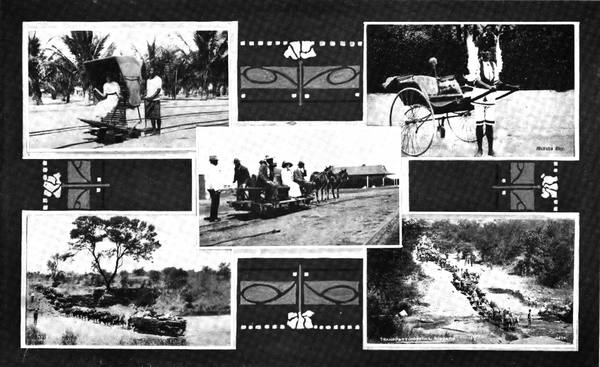
Street-Car in East Africa / Ricksha Boy, South Africa Car to Kimberley Diamond Mines Bullock Teams, Victoria Falls / Transport Wagons, Rhodesia
Another useful man in Africa is Lord Carnworth, who is an extensive farmer, as is Lord Delamere. Both these men engage in expensive agricultural experiments for the general good. Lord Carnworth lately wrote a book entitled, “A Colony in the Making.” It displays a wonderful knowledge of British East Africa. Among other things, he says the American hunters who come here are game hogs, and places Mr. Roosevelt in that class. He also speaks jestingly of the dangers of hunting in Africa. The terrible rhino, which in books is never content unless he has a hunter impaled on his single terrible horn, is not thought to be dangerous by hunters who live in this country.... In his book, Lord Carnworth discusses the native labor question quite frankly. He says what practically all the whites here say: that the missionaries are doing no good—that their converts are worse than the unconverted negroes. I quote his exact language:
“Inevitably but unfortunately the mission-educated native does not bear a good name, either among his fellow natives or among Europeans. It is, alas, a very generally accepted fact that one should beware of mission servants, who almost invariably lie, drink and steal.”
Speaking of Roosevelt reminds me that in German East Africa I saw his hunting book, translated into German, on sale at the bookstores. Everyone knows of him, and around Mombasa all the natives say with pride that they saw him. There are dozens of big-game hunters on this boat; most of them know men who were with Roosevelt, and one of them was in Roosevelt’s party for a time. They all say Roosevelt was very popular in Africa, but that Kermit, his son, was cordially despised. Roosevelt himself, they say, is a thorough sportsman, and a man of undoubted courage. He is not considered a particularly good shot, but they say he is the luckiest hunter who ever handled a gun. Besides, everything was specially arranged for his hunt. Not only all the white residents, but all the native chiefs, did what they could to locate game for him; he did not have the trouble of the usual hunter. It is further said over here that Roosevelt was a great talker, and that he would quit hunting any time to tell about his well-known theories for bettering humanity.... It is also agreed that hunters are very unpopular among the actual residents of Africa; not that the residents object to the game being killed, but every hunter requires a large number of natives for his outfit, and these are drawn mainly from the farms, where labor is scarce, and badly needed. There are millions of native men able to work, but most of them won’t work. In the native settlements, the hard labor is mainly performed by the women, children, and old men; the stalwart fellows who would do the work in a civilized community, strut about covered with grease, looking for fights with other tribes. The whites say these idlers should be made to work; that it is better that they work for a shilling a day than spend their time in idleness and mischief, and I would not be surprised to hear that the British have adopted a Vagrancy Act to reach the loafers.
FRIDAY, APRIL 25.—One of the passengers plays the piano a good deal, and plays it well, and I have just learned that he is a noted lion-hunter. That is the funniest combination I have ever heard of; a piano-player who is a lion-hunter.... There is on board a captain in the British army, and a captain in the German army. You would think they would affiliate, but they do not; on the contrary, they glare at each other. The German captain wears his uniform a good deal, and as the British captain does not, I am satisfied that he thinks the German is lacking in taste.... Among the passengers are two elderly men married to young wives; Germans who occupy official positions of some kind in German East Africa. They are the most loving couples on board; the old husbands always have their arms about their wives when on deck. If there is any one thing particularly fitted for privacy, it is love. I think the old gentlemen believe that the other passengers talk about them—and they do—and want to show them that their young wives are satisfied.... We have been having Sports today, the English gentlemen having had their way.... Every little while two men dash by with their legs tied together. They are practicing for the three-legged race, and have already run over two babies and one negro boy nurse. In the Ladies’ Potato Race, two women fell headlong, and the exhibition of dry goods was as indelicate as that seen in a dry-goods window to show new spring underwear. There is something wrong with every woman’s figure, and a potato-race brings out the irregularities.
SATURDAY, APRIL 26.—We reached Suez at 1:30 this afternoon, after a chilly ride through the narrow end of the Red Sea, which is known as the Gulf of Suez. All morning, land was in sight on both sides, and lighthouses on lonely islands were frequent. At 3 o’clock this morning we passed Mount Sinai. I have asked about half the passengers what happened on Mount Sinai to make it famous, and they don’t know.... Three hours before reaching Suez we saw a steamship that had gone ashore during the night. Another vessel was assisting it, and we did not stop.... We had a long wait at Suez before being admitted to the canal. The port doctor, a woman, amused us by coming on board, and marshaling us in the music-room for inspection. As our names were called, we walked past the doctor, and she looked at us in a manner intended to be searching. I was called out as “Herr Howe,” while Adelaide answered to “Fraulein Howe.” ... We had a scheme to go to Cairo by special train from Suez, and rejoin the ship at Port Said, but the authorities would not let us land, owing to our taking on a dozen or more Arab firemen at Aden, where there is plague. But dozens of Egyptians surrounded the ship, in little boats, and offered us all sorts of articles, which they sent up for our inspection in baskets. One ship went into the canal ahead of us, having been waiting longer, and a dozen or more boats came out carrying mud from the canal dredgers. Finally a launch appeared, bringing the long-expected pilot, and at 5:30 P.M. we steamed slowly into the canal, passing within a few hundred feet of the main streets of Suez. In an hour, we passed two freight steamers, and they gave us right of way, as ours is a mail-boat.... The Suez Canal, as everyone knows, runs through the Egyptian desert, and the desolation on the Arabian side interested me greatly. The canal requires so many workmen that it is fringed with residences of one sort and another; some are boat-houses, some are huts, and some are sightly stations. And every quarter of a mile there seems to be a dredge, to keep the channel the required depth. Every foot of the canal, on both sides, is being lined with stone, and for this work a great many Egyptian laborers are required.... On the Egyptian side there is a fresh-water canal, supplied from the Nile, and this is used to irrigate a considerable stretch of country. With a glass, we could see a good many typical Egyptian farm-houses, and Egyptian agricultural life in various stages; but on the Arabian side, there was the lonely desert you have seen in pictures and read about. At one place we saw a caravan of camels in camp for the night: the drivers in one group, and the camels in another. At another place we saw a jackal among the little hills composed of dirt from the canal. The animal was gaunt and ugly, and looked at the ship indifferently. There was a great deal to see, but the sun was declining rapidly, and at 7:30, when we left the deck and went down to dinner, we could see nothing fifty feet beyond the lighted decks.... There was to be a dance after dinner, beginning at 9 o’clock, but the night was cold, and before that hour the travelers from Kansas went to bed; just as the ship entered one of the lakes which form thirty miles of the canal. In this lake we steamed at full speed, whereas in the canal proper we had been running at five miles an hour. At Suez, we took on a special lighting apparatus; not a headlight, but a searchlight. This was attached to our prow, and lighted our way.... The engineer of the “Burgermeister,” a fat German we all admire, sat on deck while we were passing through the canal, reading a newspaper. I asked him how often he had been through, and he guessed that he had made the trip seventy times. His ship makes four trips a year around Africa.
SUNDAY, APRIL 27.—When I went on deck at 5:30 this morning, the sun was just peeping out of the Mediterranean, and Port Said was in sight. I was the only passenger on deck, and although I expected Adelaide every moment, she did not appear until we were tied up in Port Said, an hour and a half later; the Suez Canal greatly excited me, although I had been through it before, but it did not greatly excite Adelaide. Half a dozen Arab sailboats, loaded with coal, passed in the canal; they had the peculiar sails seen on boats on the Nile, and were so old that I wondered they did not fall to pieces. On the larger boats were three men, and two on the smaller ones. The masts were very tall, and in this flat country the sails catch enough wind to push the boats along.... When Adelaide appeared at 7:30, I proposed that we go ashore before breakfast. She agreed to the proposition, and we were walking the streets of Port Said ten minutes later, as the ship was tied up within a hundred feet of the principal street.... Port Said is said to be a very high-priced and dishonest town, but the boatman charged only six cents each to take us to land, and the price of a carriage is only fifty cents an hour. We engaged a guide, because one followed us, and began explaining things, and we could not get rid of him. Besides, he said his price was only a shilling an hour. In no other town we have visited have we found prices as low as in Port Said, which has a worse reputation than any other town in the world. Port Said has regulations for the protection of visitors, and enforces them. When you go ashore, you do not pay the boatman, who may charge you any price he sees fit, but you pay an official at the landing. Get rid of the notion printed everywhere that Port Said is “tough.” In addition to being an orderly place, it is very interesting. Sunday is not observed in the town, for two reasons: 1. Ships arrive and send passengers ashore nearly every hour of every day, and these want supplies on Sunday the same as on other days; 2. The sixty thousand inhabitants are mainly Mohammedans, and they have no Sunday.... There were several other ships in the harbor, and the streets were crowded at 8 A.M. In front of one café, an orchestra of fifteen men and women was playing, and playing well. Most of the shops are devoted to tourist trade, but we visited an Arab market instead of the curio stores. The older portion of Port Said is as purely Egyptian as Cairo, and as dirty and oriental. The streets are narrow, and the houses high, and the native shops are as interesting as they are anywhere. Our guide was an Arab, and took us to his church: a Mohammedan mosque, which we could not enter without putting coverings on our feet. Everywhere we heard exploding fire-crackers; today is some sort of Mohammedan festival.... We received a lot of mail from home; the first in more than four months. After getting our mail, we lost interest in Port Said, and went back to the ship to read our letters. We found these so interesting that at 10:30, when the “Burgermeister” left for Naples, we barely glanced at the famous statue to Ferdinand de Lesseps which adorns the entrance to the canal.
MONDAY, APRIL 28.—We are approaching the Blessed Country of Bad Weather again. This morning the sky is as threatening as it is on the morning when you give a picnic, and when you wish it would do one thing or the other. No country can amount to much without bad weather: the trouble with Africa and Arizona is too much fine weather.... The Mediterranean, which we all dreaded, was as smooth last night as a millpond, and shows no disposition today to change its pacific character.... The first thing you think of, on boarding a ship, is that funny people travel. We meet a few nice, normal, sane people, but most of them are freaks. On every ship we meet the foolish son of a rich man, who is allowed to travel to keep him away from home. The woman traveler is nearly always peculiar; she is usually an old widow with money, and as ugly as she is cranky. There is a professional traveler always met with who has no sense, and very little politeness, but he has been everywhere. It is a mistake to imagine that only rich and agreeable people are met in traveling. The best people remain at home; we have met neither dukes nor princesses on the trip, and very few we remember from one ship to another.... There is a kind of traveler who annoys you by his looks. A man of this type came on board at Port Said. He is a faded-out old rat with gold teeth, very thin and sandy hair, and a waxed moustache. He is quite impatient because he has not created a flutter on board, since it is plain to be seen that he has traveled a great deal; he is not content to wait a few days, until news of his exploits gets about easily and naturally.... Another man came on board at Port Said who is accompanied by a wife and three daughters. The ship is crowded, and this man, who is paying five fares, sleeps on the floor! People are that foolish about traveling. People generally are as crazy and disagreeable about traveling as the English are about Sports.... The women have great respect for the bishop of their church, but they have greater respect for a woman traveling with a maid. Every woman believes she is entitled to a maid. There is a woman on board who has one. The other women say she is the slouchiest dressed person on the ship. You may say that is envy, but it isn’t: it’s the truth.... When you buy anything, pay for it in cash. It is so easy to sign a check, or have it charged. When the passengers buy wines, they sign their names to a slip of paper, and settle once a week. One of the amusing things on board is to see the men studying their bar bills. Every passenger thinks he has been robbed, but his signature confronts him for every item, and he cannot get a fair start at indignation.... The New York banker, Mr. Hepburn, mentioned elsewhere as returning from a hunt, does not have much confidence in the future of Africa. It has too many pests and too much dry weather, he says. Besides, much of the country is volcanic, and the soil a thin vegetable and leaf mold. Mr. Hepburn says that while hunting, one of his guides was an Englishman who was once a member of parliament, with an income of $60,000 a year. But he went the pace, and spent his money, and is now a guide in Africa at $5 a day. Another guide in the Hepburn party was a man named Cunningham, who was attached to the Roosevelt expedition. Cunningham is a very noted man, and receives $400 a month for his services. Although Mr. Hepburn is a New York banker, a former comptroller of the currency, and noted big-game hunter, it is so dull on board that he spends a good deal of his time teaching Adelaide card tricks. He is an elderly man, and so modest and polite that we regard him as a credit to his country.... A party of eight came on board at Port Said, and I am glad they are not Americans. They are English or Colonials, and have taken the ship. They are very superior in three particulars: 1. They went to Port Said two weeks ago in the “Tabora,” a larger and newer ship than the “Burgermeister;” 2. They were in Cairo four days; 3. They have been in Palestine. They sit together in the dining-room, and every other word they use is “Tabora,” a leviathan of 8,000 tons. These people are going to London, and this is their first trip. There are three girls in the party, all of them in love with one sweet young man, and they hold his hand on deck. The other passengers look at them in astonishment, if not disgust. Americans are said to be “loud.” I don’t believe they are half as bad as they are reported to be. A German ship captain once said to me: “The Americans are, as a rule, our best behaved passengers, followed by the Germans. The worst behaved are the English.” ... In the traveling I have done, I have seen few “loud” Americans, but I have seen many “loud” English. And it is the English who criticise us most.
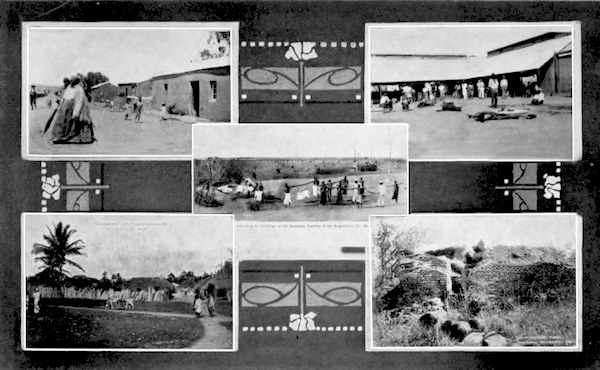
A case of middle-age spread in Africa / Native Workmen, Kimberley Diamond Mine Traveling by Machillas on the Zambesi Native Village in German East Africa / Khami Ancient Ruins
TUESDAY, APRIL 29.—We have seen no land since leaving Port Said, except that we passed the island of Crete. Some say we passed it last evening, and some say we passed it this morning: it has been pointed out to me twice, and both sights of it were very hazy.... Ships are not seen as frequently in the Mediterranean as in the Red Sea; we have seen but one steamship in two days—a big P. & O. liner en route to India. On the Red Sea, a half-dozen were frequently in sight at one time. The explanation is that the Mediterranean is wide, and ships keep a considerable distance from each other, whereas the Red Sea is often almost as narrow as a river.... There are two women on board from Johannesburg, but they did not know each other there; indeed, they had never heard of each other before coming on board. Each says of the other: “I cannot imagine who she can be.” ... When a German leaves the ship’s table, he bows very politely to those passengers remaining. I believe this very pretty custom is confined entirely to the Germans.... The barkeeper has been humiliated, and relieved from duty; I don’t know what his offense was, but I hear he is charged with becoming impatient while on duty. The Germans say that when a man is employed to serve the public, impatience is a gross offense, and I agree with them. For a day or two, the barkeeper did nothing, and was the most contrite and penitent human being I have ever seen, but this morning he appeared as a waiter in the dining-room, and is trying hard to regain the favor of the chief steward.... There are many foolish things for men to do, but probably the most foolish is to buy champagne. Every day at dinner I see dozens of men pay three or four dollars for a bottle of champagne, simply to “act smart.” Boys are not the only ones who “act smart” in company, and force their parents to whip them.... The passenger who has his wife and three daughters with him attracts a great deal of attention from the men. His women-folks have four pieces of fancy work under way all the time; think of that man’s dry-goods bills! And I cannot sleep at night from thinking what his laundry bill must be. There is a laundry on board, operated by Chinese, who do excellent work, but their prices are something to talk about. I sent out a little dab of washing the other day, and the bill was $6. I pay for waists for only one woman, whereas that other man must pay for waists for four. It should be against the law for any man to take care of four women.... The New York banker who is returning from a hunting trip in Africa, is a director in the Texas company, which is trying to become as great a robber as the Standard Oil Co. He told me today that a few months ago his company let a contract to an American firm for an additional tank steamer, at $590,000. A foreign builder offered to build exactly the same ship for $380,000. The Texas company was compelled to pay forty per cent additional because of our policy of protection. What becomes of that additional $210,000? Does it go to American labor? ... Most of it, probably. When you pay high prices for meat, the farmer is being benefited; when the Texas company pays a high price for a ship, the workmen who fashion the ship, and mine the steel that goes into it, are benefited. Taxes, however collected, mean a burden to the consumer. When you pay twenty cents for an article which formerly cost ten cents, three cents of the excess goes to the workman, and seven cents of the excess is charged by the American politician for cost of collection. It is the workers who pay taxes and the tremendous cost of collection.... I have frequently spoken in these notes of hearing the English everywhere compliment America. The notion that foreigners sneer at us, is a mistaken one. In the London Telegraph, a copy of which I picked up today, I read a page reference to the death of J. Pierpont Morgan.
“The field of the American financier,” the article said, “is a country sixty times the area of England, the most richly endowed territory in the world, inhabited by ninety millions of the most energetic wealth-producers on the face of the globe.”
In the same article I read that Mr. Morgan once called on the German Kaiser. Afterwards the Kaiser said he was surprised to find Mr. Morgan “not well informed regarding the philosophical development of nations.” I often think the philosopher is an unimportant man; he looks into the future, and sees many things that are not there. The philosopher is a recluse; a thinker. He hides away from mankind, and writes books about subjects he does not know much about. J. P. Morgan knew mankind intimately, and benefited it because of his knowledge. He made bets that the people would do certain things at certain times, and became rich because of the accuracy of his knowledge; yet he is accused of knowing nothing about “the philosophical development of nations”! He had a tremendous fund of practical knowledge, and that beats all the philosophy in the world. Morgan believed that in the human family, character was everything; that character was the basis of all credit, and that the simple doctrine of good conduct for its own sake, is the greatest religion in the world. How superior Morgan’s simple religion was to the Hindu’s philosophy! Morgan was an humble citizen, yet he accomplished more than did Kaiser Wilhelm, a philosopher and a king. A nation fought Morgan continuously and bitterly, yet he was undoubtedly a public benefactor. Wilhelm had the love of a great nation, yet he undoubtedly talks too much, and has been repeatedly humiliated for the habit. Wilhelm is great in spite of his indiscretions, being a king; but J. P. Morgan was great in spite of the fact that he lacked the friendship of his own nation, and was compelled to do his good work in the face of bitter and often malicious opposition.
WEDNESDAY, APRIL 30.—When I went on deck this morning, several of the passengers were ahead of me, gazing at mountains off to the right: Italy. By 9 o’clock we were close to the shore, and with a glass could see many villages still in ruins from the earthquake of five years ago. The sides of the mountains were terraced, and used as vineyards. In one place, in a canyon far up the mountain, we saw a village which seemed to have been built around an old castle. We were approaching the Strait of Messina, and ships were as numerous as they were in the narrowest part of the Red Sea; at one time, seven sailing-ships were in sight, and several steamers. Presently, on the left, Sicily appeared, and we gazed at Sicily awhile, and then went over to the other deck and looked at Italy, unable to decide which was the more interesting. Both are very mountainous, and much alike. Villages are thick, not only along the shore, but the sides of the mountain are spotted with them, and in both Italy and Sicily we saw many curious old castles and monasteries. On both sides, also, we saw many ruins from the earthquake, although they seemed to be rather more numerous in Sicily than in Italy.... Just before entering the Strait at the narrowest part, where it is only two miles wide, we saw the town of Messina, which was almost completely destroyed by the earthquake of 1908. Hundreds of the wrecked houses seem never to have been rebuilt, and they present a scene of desolation, but around them many new houses have been built. This is also true on the Italian coast. Many of these new houses were sent from America, ready to set up. Messina had a population of eighty thousand. Its old citadel was not destroyed, and we saw a good many ships in its harbor. Opposite Messina is the Italian town of Riggio, which is six or seven hundred years older than the Christian era. On both sides of the Strait we could see broad streams (perfectly dry as a result of a recent drouth) coming from the mountains.... The captain said we should be in the most interesting part of the Strait at 1 P.M., the lunch hour, and ordered lunch postponed half an hour. His prediction was exactly verified, and nothing could have driven the passengers from the decks at 1 P.M., there was so much to see.... At 4 P.M. we came to Stromboli, a volcanic island in the sea. Captain Ulrich said he would pass on the south side of the mountain, that we might better see the volcano; the distance was greater, but this change in the ship’s course enabled us to get a very fine sight of Stromboli. From the south side we saw the crater, and the smoke pouring out of it in great volume. There is no lighthouse on Stromboli, as the volcano furnishes a red glare by which mariners steer their course at night. You would think people would keep away from a lonely island in the sea which smokes all the time, and is liable to erupt, and destroy everything for many miles around, but they don’t. We saw two villages on Stromboli: one of them of good size. The larger one is located a considerable distance from the crater, but the other is not a thousand feet from the track of the lava as it descends to the sea. And these smoking volcanoes not only bark; they bite. Only a few miles away is Messina, where eighty thousand people were destroyed only five years ago. In the other direction is Vesuvius, which has taken a greedy toll of human life for many years; the last time in 1906.
THURSDAY, MAY 1.—I have seen many prettier sights than the far-famed Bay of Naples. Many people say a look at the bay caused them to forget the frets and worries of life, but I had no such feeling. We arrived early in the morning, when the town was partly hidden in mists, but later I saw the bay in bright sunshine, from several points of advantage, but it did not greatly impress me. The Bay of Naples is so large that it is not a harbor, therefore a breakwater has been constructed, and behind this our ship anchored, in company with a good many others.... I have spoken elsewhere of English becoming the universal language. This morning I heard the Italian pilot telling the captain of the ship a piece of war news. The pilot talked broken English. A Frenchman, a Portuguese, a Belgian and a Hollander gathered to hear the war news, and they all understood English.... After the usual medical inspection, which always seems ineffective and useless in the first-cabin, the passengers were allowed to land. We went to the Hotel Vesuve, where I had been before, and were given two excellent rooms overlooking the bay. In front of the hotel was a street, and then the sea, and from my window I watched the fishermen at work; they were so close that I could have hailed them, and asked what sort of fish they were taking out of the nets. Directly in front of our windows was an old castle and fort, and soldiers were always passing in or out of the gate. The Hotel Vesuve is the best of the dozens at which we have stopped, and the price is only thirty-six francs per day; that is, we have two of the best rooms in one of the best hotels in Italy, and the price is $3.60 per day each, including meals. Living at the hotels in South Africa is pioneering compared with living at the Hotel Vesuve in Naples. Living at hotels is a joke at home, but living at the Hotel Vesuve in Naples makes a man think of breaking up housekeeping.... Adelaide thinks Naples is the most delightful town we have seen; and the list of towns we have visited includes Pompeii, which was destroyed by an eruption from Mount Vesuvius in the year 79. It was so completely covered up by ashes that its site was forgotten, and it lay neglected for seventeen hundred years. Then the work of digging it out began, and is still in progress, and will continue for many years to come. Pompeii existed long before Naples; it was an old city when Christ was born, and was a seaside resort of the Romans. Probably everyone has read the story of Pompeii, and I shall not print it again, except to express my astonishment over the fact that much of the finest art work in the world today was found in the ruins of Pompeii; the moderns have not been able to equal it. Everything of interest found in the ruins may now be seen in the museum at Naples. The people of Pompeii had excellent plumbing at the time of the eruption; probably the ancients thousands of years earlier knew much that we now call modern. In the museum at Naples may be seen jewelry from Pompeii that would pass for an exhibit made in 1913; patterns are the same, and the work equally good. The implements used today by dentists and doctors may also be seen among the relics from Pompeii. There is an ugly instrument known as the speculum, which may be seen in drug stores and doctors’ offices; I have no doubt it was used too much three thousand or more years ago, for I saw one in the museum at Naples. It was found in the ruins of Pompeii, and it is exactly like the instrument used too much today.... I will mention another thing about Pompeii the general reader may not know. The Romans and Greeks who occupied the town were a dissolute, pleasure-loving lot, and they left many relics that are shown to men only. In the big museum at Naples, there is one room probably forty feet long, and half as wide. In it are preserved literally thousands of disreputable things found in Pompeii. They include statuary and pictures in mosaics. I heard a woman say lately that she despised Pompeii so much that she did not enjoy her visit to the place; probably her husband had told her what he saw in the Dirty Room, and she hated the people who formerly occupied the deserted houses and streets. The people are certainly improving in morals all the time; we are not as good as we should be now, but we are better in every respect than the ancients were. I often wonder that the ancients, who believed in so many gods, were not scared into better conduct.... Pompeii is reached by railroad train from Naples. If you take an express train, the twenty miles may be traveled in half an hour. Electric cars also run there, but they make many stops, and are much slower. When you are in Pompeii, you are near Vesuvius, the mountain which has destroyed so many lives. It is particularly peaceful just now, and I saw no smoke issuing from the crater. Seven years ago it went on a rampage, and destroyed several villages and six or seven hundred lives. At that time the mountain lost three hundred feet of its top, and is so insignificant-looking now that a good many visitors to Naples do not make the journey to the summit, which is easily accomplished by electric and cog railway. A mountain near Vesuvius is now higher than Vesuvius itself, but the wicked old pile will grow, and no doubt will erupt at some time in the future, and kill thousands again. Stromboli, which we saw yesterday, is a much more impressive sight at present than Vesuvius.
FRIDAY, MAY 2.—It has been said a good many times that Italy has too many churches and royal palaces. Naples has two royal palaces, although the king lives at Rome. One is in town, and the other in the country, near the sea. We visited the king’s town palace, as it is open to the public two days of the week. There are eight hundred rooms in the place, and twelve hundred servants care for it.... A room in a king’s palace is usually a huge affair, probably 100x50 feet, with an oval ceiling, and great chandeliers containing candles specially manufactured for royalty. The furniture in each room is of a different pattern; fancy chairs and divans made of gilt and brocade. No palace seems to have been made as a place of residence for a family, but for show, and intrigue, and murder, and dancing, and alarms, and riots. Most of the famous murders in history have taken place in palaces. Not far from the king’s town palace in Naples is an old palace now occupied by soldiers as a barracks. It is a dirty place, but we were taken to the upper rooms where are preserved relics of royalty nearly a thousand years old. These include a chapel, decorated by artists of great fame. Then we were taken down a winding stairway into a terrible place where dead bodies were displayed in coffins. The dead bodies in the coffins were those of princes, and cardinals, and all of them had died violent deaths. One cardinal had an expression of agony on his face which will haunt me for months; he had been smothered in the most inhuman way. The bodies we saw were dressed in the magnificent clothing they wore when they were murdered. This sight was seen in a noisome hole underground, and was so terrible that Adelaide almost cried when she begged me to take her out. We had a guide with us, and a warder from the castle, but neither of them could tell us much about the place, except that it is a relic of Spanish occupation in the eleventh and twelfth centuries.... In thinking of the magnificence of palaces and castles, always remember the terrible murders that have disgraced them. A king fills us common people with awe, but he always has a brother, an uncle, a cousin, or some other near relative who knows that he deserves death. I think I have longed for nearly everything else, but I never longed to be a king, nor would I care to live in a palace with twelve hundred servants, any one of whom would poison me for two dollars and promise of a postoffice.... On the way to the king’s town palace we passed through the old part of Naples; a district of tall houses, all of them crowded with poor people. The street was very narrow, and the sun was almost obscured by clothes newly washed, and drying in the sunlight. The wash-lines ran across the streets, and were so thick that I thought the sight the most curious I had ever seen. The streets were so crowded with children that we got through them with difficulty, and every little while some one who had been to America, hailed us in bad English. The lower floor of every house was nearly always occupied with a little shop, in which a family also lived. In one of these places, a little child was lying dead. The body was surrounded with candles, and five women sat in the room. For some reason, the mother of the child wanted us to look at it; she came out into the street, weeping, and made motions indicating that she wanted us to go in, which we did. The guide said the woman’s husband was in America, and that she felt a friendly interest in us on that account.... The street was a steep one; so steep that we went down it by means of broad steps. I have seen a street almost exactly like it in Jerusalem. The cross-streets were narrower and steeper than the main street we traveled, and I was almost disposed to agree with Adelaide that Naples is the most interesting place we have visited.... James Gordon Bennett, of the New York Herald, issues an edition of his paper in Paris, and it is sold all over Europe by street peddlers. Twenty times a minute we were offered a copy of the Herald; the peddlers knew we were Americans, and were so insistent that I always carried a copy of the paper in my pocket, to show them I had one. They also sold the New York Times, and I carried a copy of that paper, too.... Flowers grow in great profusion in Italy, and are sold by street peddlers who are hanging onto your carriage half the time. I bought fifteen very fine roses, on one occasion, for ten cents.... The Italian lire and the French franc are of the same value, twenty cents, and the franc circulates everywhere in Italy, as the lire circulates everywhere in France. If you ask for Italian money in Italy, you are as apt to get francs as lires.... Prices may have advanced abroad, as at home, but I doubt if the advance has been as great. Adelaide needed a pair of gloves, and the price at one of the best shops in Naples was fifty cents a pair. The same gloves would cost $1.50 at home.... You hear a great deal about tips abroad: how the servants mob you at hotels, etc. The tip nuisance is worse in New York than it is in Naples; besides, larger tips are exacted in New York. Carriage-hire here is less than half what it is in New York, and when I land in that American city I shall pay for rooms at the Waldorf-Astoria more than I paid for rooms and meals at the Hotel Vesuve. And Naples is one of the greatest resorts in Europe, and the Hotel Vesuve is one of the best hotels in Naples.... We expressed a desire to see the San Carlos theatre, one of the most famous in the world, and the guide promptly took us there, and had it lighted up for our special benefit. I was willing to give the theatre man forty cents, but our man said twenty cents was enough, and that was what we paid. The cathedral in Naples is also a famous place, built in imitation of St. Peters, in Rome. And it is a very good imitation. The guide took us through this church, and never gave the priest guides more than half a franc, or ten cents each. I suppose he robbed us a good deal, but I never caught him at it. You are always hearing that when you shop in Naples, the shopkeeper is compelled to add something to the price for the guide. One day the guide left us for a few minutes, in a famous arcade, and we found prices the same as when the guide was along. English is spoken nearly everywhere in Naples and throughout Italy, because so many of its citizens have been to the United States.... The Italian girls are nearly all good-looking when young, but after they are married and have children, most of them become too fat. I have always thought it a good joke on a man to marry a girl weighing a hundred pounds, and have her increase her weight to two hundred, or two hundred and fifty. And the joke on the man is particularly good if his daughters, on reaching fifteen or sixteen, are also very fat.
SATURDAY, MAY 3.—I had intended sailing from Naples on the North German-Lloyd ship “Princess Irene,” a favorite, but when I reached Cook’s office I found the ship crowded. I was offered the second officer’s room, if I paid $60 extra, but in pursuance of my vow to avoid favorites in future, I concluded to travel to New York on the French ship “Canada.” This ship is new, and has not yet had time to become a favorite, so I secured very much better accommodations at a lower price than was demanded for the German boat.... In Cairo, Egypt, is a famous hotel known as Shepherd’s. There are at least four hotels in Cairo better than Shepherd’s; there are half a dozen just as good, and another half-dozen where you may secure satisfactory accommodations. Avoid favorites of every kind, if you wish fair treatment.... Wherever a traveler goes, he encounters free advertising for the United States, but I saw a stars-and-stripes sight in Naples this afternoon that greatly impressed me. The “Canada” and “Princess Irene” were docked side by side, and as both were to sail at 6 P.M. for New York, both displayed the American flag. When I went to the dock at 4 P.M., the decks of both ships were black with emigrants, and they were still going up the gangways as thick as ants. When Adelaide and I went aboard the “Canada,” the sailors were compelled to clear a way for us to the first-class decks, where there were fifty passengers, as compared with three or four hundred in the second-cabin, and nearly two thousand in the steerage. Once on the upper decks of the “Canada,” we could see a similar crowd of emigrants on the “Princess Irene,” which lay alongside, and the emigrants kept coming until six o’clock, when the big whistle blew, and the gang-plank was drawn in. Three ships left Naples for New York today, and all of them were crowded with emigrants. And this doesn’t happen occasionally; it is of daily occurrence—not only here, but in many other ports. In every part of the world the people know about the United States, and go there in constantly increasing crowds, although South Africa, and Australia, and South America, and New Zealand, and Canada, and many other countries, are offering inducements to immigrants.... We got away a little after 6:30 o’clock, and found the sea kind again; this is our twenty-fifth day at sea without discomfort. There was a shower of rain just before we left Naples, which drove to cover the thousands of weeping women who had come to the dock to see friends depart, but outside the bay the sea was calm. Ten or fifteen poor children were on the dock, begging the passengers for pennies, but the rain didn’t bother them. There was one boy who could turn handsprings, but while he was showing off his accomplishment, the other children got the pennies. The moral is, attend to business, and don’t show off.
SUNDAY, MAY 4.—When we awoke this morning, the “Canada” was lying in the harbor of Palermo, in Sicily, where it spent the day in taking on more emigrants. As the ship was to remain until evening, we went ashore at 8:30 for the day, accompanied by an old gentleman of seventy-six, who acted as guide.... I have neglected Palermo in my reading; I knew almost nothing about it. I didn’t know it contained another palace belonging to the king of Italy, and about four hundred thousand people.... A few men are natural-born gentlemen. Our old guide was such a man. He lived in the United States, as a young man, and we were much pleased with him.... In Italian and Sicilian towns, nearly every family owns a milk goat. These goats are sent to the country, to graze, and are brought in every night and morning to be milked. We drove up-town in Palermo just as the milk goats were being collected by the herd boys. The goats know where they belong, and often climb two or three flights of stairs, to be milked. Milch cows are also driven into town, and milked in the streets. The calves accompany their mothers, and to insure that they will not get lost, are tied to their mother’s tail. There is a certain brand of Italian cattle, and they have not changed since the days of the Romans; every section of the Old World has its particular kind of cattle. In South Africa we saw a good many queer-looking cattle from Madagascar, imported after the rinderpest had killed nearly everything in Africa. In Egypt we saw another kind. India has another variety, and the Scotch and Irish also have varieties of their own. In the United States we are constantly improving cattle, and have no favorite except the best.... Although we visited Palermo on Sunday, the public market was in full blast. One man was making a tremendous outcry to attract attention to his beef. He said it was very cheap; the price was thirty-two cents a pound. Beef is very high-priced in Sicily, and so are fish, but poultry is quite cheap.... Palermo has a wonderful cathedral, and the guide took us there, during a mass. There was a large choir of men and boys, and an archbishop conducted the service. The old guide was a devout Catholic, and frequently crossed himself while in the cathedral, but he took us through the worshipers, to look at the different wonders, and the worshipers didn’t seem to mind it, or pay any attention to us. Occasionally we stopped, afraid to go on, but the old guide motioned for us to come on, and we walked among kneeling women to join our conductor. There were several chapels in the place, all of which were shown us, but the big service finally became so interesting that we spent a quarter of an hour in witnessing it. We saw many very old priests in the enormous building, and our guide seemed to know all of them; indeed, he seemed to know everybody everywhere, and to be universally respected. There were certain valuable relics and jewels belonging to the cathedral. In order to see these the guide conducted us into apartments which seemed to be private, and occupied by a considerable number of clericals. The guide knew all these men, and they bowed to him respectfully.... Then he took us to the private grounds of a count. The gatekeeper saluted our old guide with great respect, and, as we strolled about the grounds, the guide was at liberty to pick fruits and flowers for Adelaide. He next took us to a very old church, where we saw a quaint lot of monks. These queer men knew our guide, too, and he took snuff with one of them who opened a door to what seemed to be subterranean vaults of some kind. We walked down several long flights of steps, and entered a place where thousands of dead bodies were displayed. Many of the bodies were in coffins with glass tops or sides, but most of them were fastened against the stone walls. The guide said the bodies were buried for a year or two, and then taken up, and displayed in this queer way. There was nothing offensive about the place, except as thousands of grinning skulls are offensive. The guide did not know how many bodies were displayed in the place, but I should say the number was far above ten thousand. Some of the bodies were of infants, some of old men, some of young girls, some of priests. I had never before seen anything like it, nor did I know any such thing existed in Palermo or elsewhere.... Then we went to the royal palace, built in 1132, and which is occupied once or twice in a decade by the King of Italy and his family. We went into the private rooms of the king and queen, and saw their beds, and their baths; we saw the kitchen, and dining-room, as well as the state apartments. And all the palace attendants were very respectful to our old guide; he was permitted to roam about with us without restraint. Once, when he wanted to show us a certain apartment, he took a key out of a private drawer, and we walked a long way down one of the battlements to a tower where the room was.... But the best thing we saw during the day was the chapel of the old palace. It was a wonderful piece of art work, the entire interior being covered with valuable paintings and more valuable mosaic work. This chapel was in the class of the wonders to be seen in India. We visited it twice, and both times services were in progress. As we had done at the cathedral, the guide conducted us among the kneeling worshipers, and he knew every priest and monk he encountered, and they all spoke to him respectfully. I don’t believe I have ever seen anything that attracted me more than this chapel, built in the eleventh century. The interior is of marble, and the decorations of mosaic work laid in designs cut in the marble.... At 1 P.M. we rested at a little hotel on the side of the mountain overlooking Palermo. The old guide knew the proprietor, who waited on us himself, and tried hard to give satisfaction. We had macaroni cooked in Italian style, fish, wine, and quite a hearty lunch, but the charge for four of us—including the guide and driver—was a little less than $1.40. Then we went on up the mountain to a wonderful old church in a wonderful old town, the name of which I have forgotten. It was a feast day of some kind, and a great celebration was being held in the wonderful old town. The streets were packed with the merrymakers, and all sorts of hawkers were selling all sorts of articles that were queer to us. On our way down the mountain we saw a wonderful valley devoted to lemon orchards. The owner of one of these orchards lived several years in St. Louis, and, knowing we were Americans, invited us to see his lemon crop. The lemons were just ready to pick, and the yield was very good, apparently. The proprietor told me he had twelve acres; that the land was worth $1,000 an acre; and that all of his lemons were shipped to the United States. He was much interested in a rumor that the new president, Mr. Wilson, would remove the duty on lemons, but I was compelled to confess I did not know anything about it. As it was Sunday, all of the farmer’s family, including his wife and children, and hired men followed us about. There were two boys in the family, and they climbed trees, and loaded Adelaide down with various kinds of fruit. The lemon orchard, I noticed, is irrigated, but neither the proprietor nor the guide could tell me where the water came from. Usually it comes from wells, and is raised with sweeps turned by donkeys and horses.... We returned to the docks at 5:10 P.M., after eight very delightful hours in Palermo. The boatman was waiting, and the old guide went aboard with us, carrying Adelaide’s great collection of fruits and flowers. During our absence we had taken on six hundred more steerage passengers, and their friends surrounded the ship, in boats. In half an hour the big ship backed out of the harbor, and pointed its nose for New York.
MONDAY, MAY 5.—I think every man believes his “luck” is atrocious, and that he rarely gets an “even break.” But I am perfectly satisfied with what they have done to me on the “Canada.” It is a new ship of fourteen thousand tons, and there are only fifty passengers in the first-cabin. As a result, we have plenty of room, and the officers give us whatever we want. I have a room to myself on the best deck, and Adelaide has another just like it next door. Between our rooms there is a private bath, which has been turned over to us for good measure. On most ships the beds are hard. On the “Canada,” our beds are provided with springs, and we have real bedsteads. I have two windows in my room, and Adelaide has two in hers; our bath-room is as big as a stateroom, and is provided with a shower-bath, in addition to the usual tub.... In the dining-room, we have a table to ourselves; a small table for two, with a side electric light, in addition to the ceiling lights. On our table twice a day are quart bottles of red and white wine, always full. This wine is free; it is a feature of all French boats. The cooking is the best I have ever enjoyed on a steamship or hotel, and the attendance perfect. Our waiter is a Frenchman who speaks almost no English, but the chief steward (a German, by-the-way) speaks English, and sees that we are not neglected. The meals are French, except that we have an English breakfast; which means that we have eggs, chops, fish, bacon, etc. On the continent, breakfast almost universally consists of coffee, bread and butter, and jam. At the fine Hotel Vesuve, in Naples, we had this sort of breakfast, although we could have eggs if we called for them. In Paris it is almost impossible to get anything to eat before noon, except at hotels patronized by Americans and English.... Our rooms are in charge of a woman; we see a man in overalls occasionally, but the woman is in charge. On German ships, the dining-room stewards not only care for the rooms, but play in the band; on the “Canada,” waiters in the dining-room have nothing to do with the sleeping-rooms.... The first-class passengers have two big decks. In the rear of the upper deck is a handsome smoking-room. At the rear of the next deck below, the deck on which our rooms are located, is a music-room. At the other end of the deck is a writing-room. Just below the writing-room, and reached by a grand stairway, is the dining-room. All these rooms are very handsome, as the ship is less than a year old.... What do we pay for all this luxury and magnificence? Less per day than we paid on the “Maunganui,” between Wellington and Sydney, where I shared a room 9×10 with three others. Adelaide shared a room of similar size on the “Maunganui” with three other women. The “Maunganui” was a favorite; the “Canada” is a new and unknown ship struggling for recognition from the traveling public. Moral: Keep away from favorites; they will always impose on you.... Another pleasant thing about the “Canada” is that there is not a single Englishman on board. There is no Sports Committee, no loud talk, and no noise. About half the first-cabin passengers are Americans, and they are so well-behaved that I am proud of them. The others are French and Italian, and they are also quiet and modest.... When we look down on the lower decks, we see a seething mass of humanity: Italian and Sicilian emigrants. Fortunately the weather is fine, and most of them are on deck; only a few of them are seasick. Some people can’t go on a millpond without becoming sick, and we have a few of this sort in the first-cabin. The three or four hundred passengers in the second-cabin we cannot see, as they are on a deck under ours.... This morning I saw four barbers at work among the emigrants; barbers who are going to the United States to work at their trade. The barbers charge four cents for shaving, and six cents for hair-cutting. The barber in the first-cabin charges only fifteen cents for a shave, and he is a good workman. The emigrants eat on deck, now that the weather is fine. Each one seems to get a loaf of bread, and a bucket containing soup and meat. A cheap wine is also given them; also macaroni. They are well treated, as the Italian government has a commissioner on board to look after their interests. This commissioner sits on the captain’s right in the dining-room, and has one of the best rooms on the ship.... The emigrants are all poor people, but very wasteful, now that they have plenty. Every day enough bread is wasted on their deck to feed dozens of people, and this is swept up and thrown overboard by the sailors.... These emigrants are objectionable, in one way. In case of a panic, we would all go to the bottom. Nothing could control them, and we haven’t enough boats to float twenty-five hundred people, even if order were maintained. But the “Princess Irene,” the favorite, is carrying even more emigrants than the “Canada.” I have never before been on a ship where the decks were black with emigrants; there are a few hundred on nearly every ship, but the crowd on the “Canada” frightens me.
TUESDAY, MAY 6.—The weather remains fine, and the sea is as smooth as we found it in the Red Sea, or on the east coast of Africa. The Mediterranean narrows up at its western end, as we approach Gibraltar, and becomes a great harbor. At six o’clock this evening we were within a few hundred yards of the mountainous coast of Spain. The Mediterranean being narrow at this point, we are seeing many ships: seven were in sight at one time this evening.
WEDNESDAY, MAY 7.—At 4:30 this morning, a steward knocked on my door, and said:
“Gibraltar.”
I climbed out of bed, hurried into a little clothing, and went on deck. Daylight was faintly appearing. On the right, two or three hundred yards away, was the rock of Gibraltar, where the English have a huge fortification which is said to be so old as to be a joke. No one is allowed in the fortification, but it is common report that the big guns are so old and rusty that it would be dangerous to fire them. The rock of Gibraltar is an island, and puts out into the sea. Behind it is the town of the same name; a place as big as Atchison. The picture of Gibraltar shown in advertisements of the Prudential Life Insurance Company looks exactly like it, except that the bay and town behind the rock are not shown accurately. Half-way up the rock of Gibraltar was a light, and a long shelf; I suppose the shelf is a part of the fortification. In the town were occasional clusters of electric lights, as may be seen in any modern town just as daylight is appearing, and I could see a lighthouse on the African shore off to the left. Creeping through the straits were a number of ships, one of them within two or three hundred feet of the “Canada.” Then I went back to bed. I aroused Adelaide, and told her of the sight on the opposite side of the ship, but she concluded not to get up.... Soon after breakfast, we passed Tangier, and left Africa for good. We have been in sight of Africa almost constantly since March 2, when we landed at Durban. During the twenty-four days we were on the “Burgermeister,” we were out of sight of it a few days after leaving Port Said, but this morning we saw the African continent again, at its north-western end, at Tangier, in Morocco.... An hour later, we were out of sight of land in the Atlantic ocean, which Adelaide had been afraid of, but there was little motion, and the weather was warmer and brighter than it has been since leaving Port Said. The barber, when he shaved me this morning, predicted rough weather when we get behind the Azores, but certainly we are having beautiful weather now, and have had it continuously for thirty-two days.... There is an American on board who said to me this morning: “I shall never travel at sea again. Wherever you go by ship, travel is rendered disagreeable by the English. The English are intensely disagreeable to me, and in future I shall keep away from them. They are the most impolite people in the world, and do not realize that everything English is not perfect. They pronounce words wrong, and regard you with pity if you pronounce the same words correctly. The English are headed for a big tumble. You and I will not live to see it, but Canada and Australia will throw off the English yoke. That will encourage India, and Africa, and many other countries, to do the same thing. England is seeing its best days right now; let the Englishmen swagger while they may. The English remind me of a big trust: they paid too much for their various possessions, and are bound to ‘bust.’” ... I do not feel that bad about the English, but I certainly remark that the “Canada” is much quieter than it would be were a majority of the passengers sons of John Bull. So far, I have not seen a single passenger running around in pajamas.