TOBIAS O' THE LIGHT
Reading edition
Cover
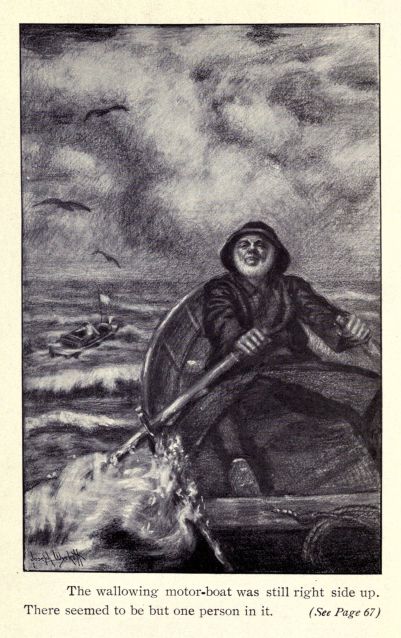
The wallowing motor-boat was still right side up. There seemed to be but one person in it. (See Page 67)
TOBIAS O' THE LIGHT
A STORY OF CAPE COD
BY
JAMES A. COOPER
AUTHOR OF "CAP'N ABE, STOREKEEPER" AND "CAP'N JONAH'S FORTUNE"
ILLUSTRATED BY JOSEPH WYKOFF
NEW YORK GEORGE SULLY & COMPANY
COPYRIGHT, 1920, BY GEORGE SULLY & COMPANY
All rights reserved
PRINTED IN U. S. A.
BOOKS BY JAMES A. COOPER
CAP'N ABE, STOREKEEPER CAP'N JONAH'S FORTUNE TOBIAS O' THE LIGHT
CONTENTS
CHAPTER
A Cry in the Night
Confidences
The Apex of the Storm
Prophecies
The Unexpected
Dead Men's Shoes
A Newcomer
Philosophy and Other Things
The Drop of Wormwood
Starting Something
The Black Squall
Troubled Waters
Cross Purposes
A Variety of Happenings
Decisive Action
Poison
Real Trouble
A Clue
Suspicions
Put to the Question
The Rising Tide of Doubt
What Frets Lorna
More than Weather Indications
Understanding
Across the Years
High Tide
What the Night Brought
Desperation
Daybreak
A Silver-Banded Pipe
ILLUSTRATIONS
The wallowing motor-boat was still right side up. There seemed to be but one person in it. (See Page 67) . . . . . . Frontispiece
"I'll run up to the light to dress," she said
"Oh, sugar, Heppy! What's the matter o' ye?"
"We must do something!" she cried. "Tobias! We *must*!"
TOBIAS O' THE LIGHT
CHAPTER I
A CRY IN THE NIGHT
Old Winter wrapped in his grave clothes stalked the flats and sand dunes about the Twin Rocks Light. Spring had smiled at the grim old fellow only the day before. She would flutter back again anon to dry the longshore wastes and warm to life the scant herbage that tries its best to clothe the Cape Cod barrens.
But now the wind blew and the sleet charged against the staff of the lighthouse, masking thickly the glass that defended the huge Argand lamp. Its steady ray filtered through this curtain with difficulty.
Tobias Bassett pulled on his oilskins and buckled down the sou'wester over his ears preparatory to venturing upon the high gallery to scrape the clinging snow from the glass.
"You have a care what you're doing up there, slipping around outside the light," advised his sister Hephzibah, who should have been named "Martha," being cumbered by so many cares. "You ain't so young as you used to be, Tobias."
"And you don't have to throw it up to me. I know my age well enough without looking into the family Bible, Heppy," chuckled the lightkeeper. "I'm sure you ain't changed it. I ain't cal'latin' to be like old Miz' Toomey that when she went to vote for the first time told the poll clerk she was thirty-six years old but had lived in this district fifty-four years. I ain't goin' to let go all holts yet. Leastways, not while I'm climbing about that gallery!"
"You'd ought to have an assistant, Tobias," sighed his sister, who was preparing supper, always served at an early hour in winter on the Cape. "A young fellow to do the hard work. The Government ought to give you one."
"They think one man to a stationary lamp like this is enough. But I can have a helper if I want one," her brother announced.
"Then, why don't ye?"
"'Cause I'd have to pay his wages out o' my own pay check, and feed him in the bargain," chuckled the lightkeeper. "I figger we can't afford that."
"Oh, dear!" croaked the lachrymose Heppy, "if Uncle Jethro Potts would only leave us some of his money when he dies. The good Lord knows we need it as much as ary rel'tive he's got."
"Wal," commented Tobias, picking up his lighted lantern, "Jethro Potts has got to slip his cable pretty soon to do us much good, Heppy. We're getting kind o' along in years to enjoy wealth."
"Speak for yourself, Tobias Bassett!" said his sister, more energetically. "I ain't too old to know what to do with money—if I had it."
"Ho, ho!" ejaculated her brother. "Slipper's on t'other foot, ain't it? I wonder what age you give the poll clerk?" and he went out of the kitchen chuckling.
He mounted the spiral stairway leading up through the lighthouse. After passing the level of the second story, where were the family bedrooms, at intervals there were narrow windows—mere slits in the masonry. These were blocked with glass and only on the leeward side could Tobias see through them.
"Winter's dying hard," was his comment, climbing steadily to the lamp room. "This squall come as sudden and as savage as ary storm we've had this winter. And the sleet sticks to the glass like all kildee!"
He stepped into the lamp room, closing the door at the top of the stairway. It was warm in here, with a strong and sickish smell of burning oil. He shaded his eyes with the sharp of his hand to look into the lamp, the wick of which he had ignited half an hour before.
It was burning evenly and with a white clear light. But warm as the lamp room was and strong as was the reflection of the light upon the outer panes, the sleet had frozen to the glass, making a lacework curtain which the warning ray of the lamp could pierce only with difficulty.
Tobias took a steel scraper and an old broom, opened a door at the back, and went out upon the leeward gallery of the light. The snow wraiths swept past the staff on either hand, whipping away over the sand dunes and disappearing in the pall of darkness that hovered over the land.
When he ventured around to the front gallery he found a pallid radiance on the sea superinduced by the muffled ray of the lamp. The snow, driven by the gale, plastered the light tower on this side from its cap ten feet above the lamp to that point twenty feet above its base to which the spray from the wavecaps was thrown. There was a drift of snow, too, on the railed balcony, through which the lightkeeper waded.
"Whew!" he gasped, turned his back to the blast, and began using the scraper vigorously. "I can see I've got an all night's job at this off an' on if this sleet holds to it. Ain't going to be heat enough from that old lamp to melt the ice as fast as it makes."
He muttered this into the throat-latch of his storm coat while using the scraper. The frozen sleet rattled down in long ribbons. He dropped the scraper finally and seized his broom. It was then that he first heard that cry which was the tocsin of the unexpected series of events which marched into Tobias Bassett's life out of this late winter storm.
He dropped the broom and strained his ears for a repetition of the cry. Was it the voice of some lost seafowl swept landward on the breast of the storm? A gale out of the northeast brought many such to be dashed lifeless at the foot of the lamp tower.
There was a human quality to this sound he had heard that startled Tobias. If from the sea, then the craft on which the owner of the voice was borne, was doomed.
There had not been a wreck on the Twin Rocks within the present lightkeeper's experience. He shuddered to think of the horror of such a catastrophe.
A vessel driven upon the grim jaws of the reef that here were out-thrust from the sands, would be wracked to mere culch within the hour. The life savers from Lower Trillion could never put off a boat or shoot a line into the teeth of such a gale as this.
Tobias stooped for the broom again. Then he heard the cry repeated. If it came on the wings of the wind——
He scrambled around to the leeward side of the tower. Here the savage pæan of the storm was muffled. The drumming of the waves on the rocks, the eerie shriek of the wind, the clash of the snow and sleet as they swept by, left the lightkeeper in a sort of unquiet eddy.
Against the gale came a repetition of the cry—a faint "Ahoy!"
Tobias struggled with the latch of the lamp room door, and finally got inside the tower. He hurried to the stairway and descended to the warm and odorous kitchen where Heppy was heaping the brown and flaky fishcakes upon the platter on the stove-shelf.
"What is the matter with you to-night, Tobias Bassett?" she demanded. "You're as uneasy as a hen on a hot brick. Where are you going now?" as he started for the outer door.
"There's somebody out in this storm," he told her. "I heard 'em shouting."
"For love's sake! In a boat?"
"No. From the land side. Somebody on the road."
Tobias banged the door behind him. In clear weather there was not much to be seen from the entrance of the lighthouse in this landward direction, save sand. Now about all Tobias could see was snow.
"Ahoy! Aho-o-oy the light!"
The cry was shattered against the singing gale. But the lightkeeper made out the direction from which it came and started down the road toward Lower Trillion. In the other direction were the summer residences of certain wealthy citizens on the Clay Head. While beyond lay Clinkerport at the head of the bay, the entrance to which the lighthouse guarded.
Tobias announced his coming by a hearty hail. He saw a muffled glow in the snow pall ahead. Then the outlines of a low-hung motor car that was quite evidently stalled in a drift.
"Hey!" he demanded. "What you doing in that contraption out in this storm? Ain't you got no sense?"
"Now don't you begin!" rejoined a complaining voice, and a rather stalky figure appeared in the half-shrouded radiance of the headlights. "I've been told already what I am and where I get off. It isn't my fault that blame thing got stalled."
"It is your fault that we came this way from Harbor Bar," interposed a very sweet but at present very sharp voice. ("Jest like cranberry sarse," Tobias secretly commented.) "We should not have taken the shore road."
"You didn't say so when we started," declared the tall young man, indignantly.
"I was not driving the car. You insisted on doing that," chimed the tart voice instantly.
"One would think you expected me to be omniscient."
"Well, you appear to be omnipresent—you are always in the way," and a much shorter figure, muffled in furs, and quite evidently that of a young woman, appeared beside the taller individual from the stalled car.
"And I cal'late, Heppy," Tobias explained, relating the event later to his sister, "that them two socdologers of words would have brought on a fist fight if I hadn't stepped into the breach, so to say, and the smaller of them castaways hadn't been a gal! Some day when I get time I'm going to look up 'omniscient' and 'omnipresent' in the dictionary. They sound like mighty mean words."
It was the lightkeeper's interference that saved further and more bitter words between the two stranded voyagers. Tobias got another look at the taller figure's face, and in spite of the pulled-down peak of his cap and the goggles he wore, recognized it.
"If 'tain't Ralph Endicott!" exclaimed the lightkeeper. "And who is that with you? Not Miss Lorna?"
"Oh, Mr. Bassett!" cried the young woman, stumbling toward him. "Take me to the light. I shall be so glad of its shelter. Is Miss Hephzibah at home?"
"She was when I left," said Tobias. "An' I cal'late she won't go gaddin' endurin' this gale. It don't show right good sense for anybody to be out such a night."
"That's what I tell him," the girl cried. "Anybody with sense——"
"You wanted to come over here and see what shape the house was in, Lorna Nicholet!" stormed Ralph Endicott. "I was only doing you a favor."
"Do you call this a favor?" demanded the girl.
"Anybody would think I brought this storm on purposely."
"You certainly tried to get through a road that you should have known would be drifted when it did begin to snow. Bah! Give me your arm, Mr. Bassett. He's the most useless——"
"Ain't no good you staying out here, Ralphie," advised the old lightkeeper. "Nobody will run off with that little buzz-cart of yourn. Heppy's got fish balls for supper—a whole raft of 'em."
The young man followed through the snow, grumbling. The prospect of a good meal, as Tobias later acknowledged, did not seem to influence a college man as it once might the long-legged harum-scarum boy who had raced these beaches for so many summers.
Endicott and Lorna Nicholet were of the sandpiper class. So Tobias usually referred to the summer visitors who fluttered about the sands for several months of each year. These young folks had been coming to Clay Head each season since they were in rompers. Lorna's aunt, Miss Ida Nicholet of Harbor Bar, and head of the family, owned the rambling old house overlooking the mouth of the bay. The Endicotts—"the Endicotts of Amperly," to distinguish them from numerous other groups of the same name whose habitat dot the sea-coast of Massachusetts—usually occupied one of the bungalows on Clay Head during the summer.
"See what the gale blowed in, Heppy," was the lightkeeper's announcement as he banged open the outer door.
His sister turned, frying-fork in hand, and peered through her spectacles at the snow-covered figures of the visitors. She was a comfortably built person, was Hephzibah Bassett, with rosy-brown, unwrinkled face, despite her unacknowledged age of fifty-odd. Her iron-gray hair was parted in the center and crinkled over her ears in tiny plaits, being caught in a small "bob" low on her plump neck behind. She never went to bed at night without braiding her hair on the side in several "pigtails" (to use her brother's unsavory expression) to be combed out into this wavy effect when she changed her house gown in the afternoon. It was a style of hair-dressing which, if old-fashioned, became her well.
There was something very wholesome and kindly appearing about Hephzibah Bassett. She might not possess the shrewdness of her brother, the lightkeeper, and she did nag a good bit. Yet spinsterhood had not withered her smile nor squeezed dry her fount of human kindness.
"For love's sake!" she cried now, when she had identified the petite figure shaking its furs free of the sticky snow. "If 'tain't Lorny Nicholet! Do come and give me a kiss, Lorny. I can't leave these fishballs or they'd scorch."
The girl wriggled out of her coat and let it drop to the braided mat. She was just such a looking girl as one might expect from her name. There was French blood in the Nicholets. Lorna was distinctly of the brunette type, small limbed, as lithe as a feline. Perhaps that was why she could scratch! There were little short curls framing her broad, low forehead. The gloss of a crow's wing accentuated the blackness of her hair.
Her face glowed now from facing the storm—or was it from indignation? Her eyes sparkled so luminously that one could not be sure whether they were black or brown. She was one of those girls who seem all alive, all of the time. She had the alert appearance of a wild bird on the twig—ready for instant flight.
"Oh, how good it smells in here, Miss Heppy!" She fluttered across the big kitchen and imprinted upon the woman's cheek a warm kiss. She hugged, too, the ample arm that Heppy did not use in turning the fishballs in the deep frying kettle.
"You certain sure give us a surprise, Lorny," said the lightkeeper's sister.
"Of course I intended giving you a call as we passed," the girl said. "But I started for the special purpose of looking over the house for Aunt Ida and listing such new things as we shall need for the summer. This doesn't look much like summer, does it?"
"Oh, it's the last quintal of winter, I cal'late," said the woman, spearing a brown cake. "Lucky I made a mess of these. I didn't really expect any visitors to-night."
"That's just it, Miss Heppy! How will I ever get back to Harbor Bar to-night?"
"You won't. Why should you? Your aunt will know you are safe—with him."
Miss Heppy glanced slyly around at Ralph Endicott, whom she had but briefly greeted. The girl, seeing her glance, pouted.
"I wish you wouldn't!" she said in a low voice. "It fairly gets on my nerves. Everybody does it."
"Does what, child?" asked Miss Heppy, with surprise.
"Takes it for granted that Ralph Endicott and I are engaged."
"Wal—you be sort o' young, I suppose——"
"If I was forty I wouldn't be engaged to him!" flared up Lorna.
"For love's sake!" exclaimed the woman. "Don't say that. Though at forty you ought to've been married to him a good many years," and she broke into an unctuous chuckle that shook her ample bosom like jelly.
"I'll never marry him!" cried the girl, but under her breath.
"Now, now!" urged Miss Heppy. "You always be quarreling with Ralphie. But you know they're jest love spats. He's a good fellow——"
"You don't know what it means, Miss Heppy, to a girl to have a man just forced on her. Everybody trying to make her take him, willy-nilly."
"Um-m. None warn't never forced on me," admitted the woman, dividing her attention between the frying fishballs and Lorna's affair of the heart. "But I reckon, Lorna, they couldn't force a better boy on you."
"That is one of the worst phases of it," declared the girl seriously. "There is not one single, solitary thing to be said against Ralph's character. Unless—well, there was a girl when he went to college. At least, so they say. But I suppose all boys must have their foolish puppy-love affairs," concluded Lorna, with an owllike appearance of wisdom that revealed the quite unsophisticated girl who believes she "knows it all."
Miss Heppy merely stared. In her secluded life love was love. There were no gradations known either as "puppy-love" or by other terms of rating.
"It isn't that Ralph isn't good enough, Miss Heppy," whispered the girl. "But he's been thrown at me all my life long!" She was not yet twenty-one. "I just won't marry him."
She stamped her foot on the hearth. Tobias, who had been leisurely taking off his storm coat and unbuckling the strap of his sou'wester as he talked cheerfully to the rather glum looking Ralph, now turned to the women.
"I feel some like stomping in my stall, too," was his comment upon Lorna's emphatic punctuation of her whispered defiance. "Bear a hand with the supper, Heppy. I've got to go up to the gallery again and clear the snow off the lamp. It surely does stick to-night. I was just getting the glass clear when I heard you young folks shouting for rescue.
"Come, Miss Lorna! Come, Ralph! Pull up cheers for yourselves. Supper's ready, I cal'late, ain't it, Heppy?"
CHAPTER II
CONFIDENCES
The blast struck the light tower so heavily that Ralph Endicott felt the whole structure vibrate as he followed Tobias up the spiral stairway after supper. In spite of the lightkeeper's jollity and Miss Heppy's kindness, the supper had seemed to hearten but little the spirits of the young man.
He had offered to attend Tobias in his duty at the top of the tower more for the purpose of getting away from the women than for any other reason. He seized the broom and followed Tobias with the scraper out upon the open gallery. If the storm had seemed furious before supper, it had risen to a top gale now. The two men could scarcely face it on the windward side.
The gale came in blasts that slapped their burden of snow against the lighthouse with great force. Ralph was barely able to keep his feet. But the sturdy lightkeeper went about the task with a certain phlegm.
They managed to free the glass of its curtain of snow. Then Ralph staggered around to the sheltered gallery, on the heels of Tobias. The younger man's was a gloomy face when they once more entered the lamp room.
"Cheer up," said Tobias, getting his breath and eyeing Ralph aslant. "They tell me the worst is yet to come. Though I tell you fair, Ralphie, if the last end o' my life is anywhere as hard as what happened me when I shipped cabin boy on the old Sarah Drinkwater, the good Lord help me to bear it!
"Why, Ralphie, from the time she was warped out o' the dock at Provincetown till we unloaded them box shocks at Santiago I didn't git to git my clothes off—no, sir!
"We did have bad weather, I cal'late, though I never got out on deck often enough the whole endurin' v'y'ge to observe the sea and sky. I was washing dishes, making up berths, cleaning pots and pans, peeling 'taters and turmits, and seeding raisins for the skipper's plum duff most o' the time.
"Seeding raisins! Oh, sugar, I got to thinkin' that if that was all going to sea meant, I might better have got a job in a scullery and kept on an even footing. And I purty nigh got my lips in such a pucker whistling while I seeded them raisins (cookie wouldn't trust me otherwise) that I never did get 'em straight since.
"Say, lemme tell you!" proceeded Tobias, his weather-stained face beaming in the glow of the great Argand light. "Cap'n Drinkwater demanded his plum duff for supper ev'ry endurin' day of the v'y'ge, no matter what the weather was. He had an old black cook, Sam Snowball, that had got so's he could make that pudding to the queen's taste.
"Lemme tell you! The skipper was that stingy that he fed the crew rusty pork and weevilly beans, and a grade of salt horse that would make a crew of Skowegians mutiny. But the Sarah Drinkwater never made long enough v'y'ges for her crew to mutiny—no, sir!
"But that plum duff—oh, sugar! Bein' the boy, I never got more'n the lickin's of the dish. If I got enough 'taters and salt horse to fill my belly so's to keep my pants up, I was lucky. The skipper and the mate divided the duff between 'em.
"Ahem!" he added critically, "you don't look as though there was any plums at all in your duff, Ralph."
"There isn't," returned the young man shortly.
"Oh, sugar!" ejaculated the lightkeeper, drawing forth a short clay pipe and a sack of cut tobacco. "I cal'late that you folks with money have more real troubles than what we poor folks do."
"Huh! Money!" scoffed Endicott.
"Yep. It's mighty poor bait for fish, I cal'late. You can't even chum with it."
"Money isn't everything," said the young man shrugging his shoulders.
"True. True as preaching," cried Tobias. "But 'twill buy most everything you're likely to need in this world. And you've got enough, Ralph, to keep you from getting gray-headed before your time worrying about where your three meals a day are coming from. I don't see what can be wrong with you. And that purty gal——"
"Now stop, Tobias Bassett!" exclaimed Endicott. "Don't keep reminding me of Lorna. I get enough of that at home."
"Wal!" gasped the lightkeeper. "For you to speak so of Lorna! Why, that's the main-skys'l-pole of the whole suit of spars—only needs the main-truck to cap it. What do you mean?"
"Now, mind you," Endicott said earnestly. "I haven't a thing to say against Lorna. She's a nice girl—for some other fellow. But I declare to you, Tobias, I won't marry her."
"Oh, sugar!"
"Just because my Uncle Henry and her Aunt Ida have planned for us to do so since we were little tads running about the beaches here, is no reason why I should be tied up to Lorna forever and ever, Amen!"
"That's a mighty hard sayin'——"
"You think, like everybody else, that Lorna and I were made for each other. We weren't! We'd fight all the time. We always do fight. Look at to-night. The first little thing that goes wrong she jumps at me. I'm sick of playing dog and rolling over every time Lorna orders me to.
"And look at the mess we're in to-night!"
"What's the matter with you, boy?" demanded the lighthouse keeper. "You're under shelter. There's grub enough in the light to stave off starvation for a spell. Nothing can't happen to your buzz-cart worse than its being drifted under with snow."
"Oh, you don't understand, Tobias!" said the exasperated Ralph. "Our going off in my car the way we did, and not getting back to-night—why! it'll be all over Harbor Bar that we've eloped."
"I see," said the lightkeeper between puffs of his short pipe. Then: "You don't cal'late to marry Lorna?"
"I won't have her thrown at me."
"I never had no gal throwed at me," Tobias reflected. "I dunno how 'twould feel. But I will say that if I had to catch such a throw as Lorna Nicholet, I surely wouldn't make a muff of it!"
"That's all right," observed Endicott. "I'm not saying she isn't a nice enough girl. But I don't believe she really wants me any more than I want her. In fact, I know there was another fellow last year that she was interested in. A chap named Conny Degger. He was in my class at college. Kind of a sport, but I guess he's all right, at that. But Lorna's Aunt Ida broke it up. Wouldn't let Conny shine around Lorna any more when she learned about it.
"They've got us both thrown and tied, Tobias! That's the way Uncle Henry, and Aunt Ida, and all the rest of my family and Lorna's people have got us fixed. They act as though we'd just got to marry each other. And after this mischance—breaking down here in the snow—they'll all say we're disgraced forever if we don't announce the engagement."
"Oh, sugar!" said the lightkeeper again, puffing away placidly.
In the kitchen Lorna Nicholet was making a confidante of Miss Heppy quite as Ralph had trusted Tobias. Nor was the girl less determined to thwart the intention of her family in this matrimonial affair, than was Ralph in his attitude toward his relatives.
"For love's sake!" murmured the lightkeeper's sister, realizing at last how much in earnest the girl was, "Miss Ida'll near about have a conniption. She's set her heart on you an' Ralph marrying, for years."
"And his Uncle Henry is just as foolish," sighed Lorna, wiping her eyes. "Why will old people never have sense enough to let young people's affairs alone?"
"Well, now, as you might say," Miss Heppy observed, "Miss Ida and Henry Endicott ain't re'lly old. Forty-odd ain't what ye might call aged—not in a way of speaking. But I cal'late they are some sot in their ways."
"'Some sot' is right, Miss Heppy," repeated Lorna, suddenly giggling and her vivid face a-smile once more. "In her own case Aunt Ida is a misogamist; yet she urges marriage on me. And Ralph's Uncle Henry is a misogynist in any case. Why he is so anxious to force Ralph into the wedded state I do not see."
"Seems to me them air purty hard names to call your aunt and Henry Endicott," murmured Miss Heppy.
"Oh!" Lorna laughed again. "They just mean that Aunt Ida hates marriage and Uncle Henry hates women."
Miss Heppy waggled a doubtful head.
"They wasn't like that when I first remember them, Lorny," she said. "Miss Ida Nicholet is a fine looking woman now. She was a pretty sight for anybody's eyes when she was your age, or thereabout."
"I know she was quite a belle when she was young," Lorna agreed, rather carelessly.
"And Henry Endicott wasn't any—what did you call him jest now?"
"A misogynist—a hater of women."
"He didn't hate 'em none when he come here that first summer," said Miss Heppy, with a reflective smile. "He was a young professor at some college then. I expect he didn't know as much about inventing things then as what he does now. But he knowed more how to please women. He pleased your Aunt Ida right well, I cal'late."
"Never! You don't mean it, Miss Heppy!" exclaimed Lorna, sensing a romance.
"Yes, I thought then Miss Ida and Henry Endicott would make a match of it. But somehow—well, such things don't always go the way you expect them to. Both your aunt and Professor Endicott were high-strung—same's you and Ralph be, Lorny."
"Why," cried the girl smiling again, "I'd never fight with Ralph at all if they didn't try to make us marry. I wonder if it is so, that Aunt Ida and Ralph's uncle were once fond of each other! If they could not make a match of it, why are they so determined to force Ralph and me into a marriage?"
"Mebbe because they see their mistake," Miss Heppy said judiciously. "I don't believe your aunt and Henry Endicott have been any too happy endurin' these past twenty-odd years."
"Tell me!" urged the girl, her cheeks aglow and her eyes dancing. "Is remaining single all your life such a great cross, Miss Heppy? Are there not some compensations?"
The woman looked up from darning the big blue wool sock that could have fitted none but her brother's foot. The smile with which she favored the girl had much tenderness as well as retrospection in it.
"I don't believe that any woman over thirty is ever single from choice, Lorny. She may never find the man she wants to marry. Or something separates her from the one she is sure-'nough fitted to mate with. So, she must make the best of it."
"But you, Miss Heppy?" asked Lorna, boldly. "Why didn't you ever marry?"
"Why—I was cal'lating on doing so, when I was a gal," said the woman gently. "Listen!"
The girl, startled, looked all about the room and then back into Miss Heppy's softly smiling face.
"Do you hear it, Lorny? The sea a-roaring over the reef and the wind wailing about the light? That's my answer to your question. I seen so many women in my young days left lone and lorn because of that sea. Ah, my deary, 'tain't the men that go down to the sea in ships that suffer most. 'Tis their wives and mothers, and the little children they leave behind.
"When I was a young gal I never had a chance to meet ary men but them that airned their bread on the deep waters. My father was drowned off Hatteras, two brothers older than Tobias were of the crew of the windjammer, Seahawk. She never got around the Horn on her last v'y'ge. In seventeen homes about Clinkerport and Twin Rocks, the women mourned their dead on the Seahawk.
"No, no. I didn't stay single from choice. But I shut my ears and eyes to ary man that heard the call of the sea. And I never met no other, Lorny."
The uproar of the storm was an accompaniment to Miss Heppy's story. The solemnity of it quenched any further expression of what Lorna Nicholet considered her troubles. Within the kitchen there was silence for a space.
CHAPTER III
THE APEX OF THE STORM
Bedtime came, and Miss Heppy led Lorna, with the little whale oil hand lamp, up one flight of the spiral stairway and ushered her into the best bedroom. It was the whitewashed cell facing the ocean.
The waves boomed with sullen roar upon the rocks, breaking, it seemed, almost at the base of the lighthouse. Spray, as well as the sleet, dashed against the single unshuttered window. It was sheeted with white. But Miss Heppy drew the curtains close.
"You won't be afraid to sleep here alone, will you, child?" asked the lightkeeper's sister. "Tobias and I are only just across the landing. Though I guess Tobias will be up most o' the night watchin' the lamp, and he'll likely put your young man in his bed."
"I wish you wouldn't!" sighed Lorna. "He's not my young man, whatever else he may be. I here and now disown all part and parcel in Ralph Endicott."
"I dunno what Miss Ida will say," the woman observed mournfully. "It'll be a shock to her. Wal, try to sleep, deary, if the wintry winds do blow. I guess 'twill clear, come morning. These late winter storms never last."
She had shaken out a voluminous canton-flannel nightgown which she laid over the foot of the bed. Now she pricked up the two round wicks of the lamp with a pin, and after kissing the visitor left her to seek repose.
She heard a heavy step on the stair as she reached the foot of it, so held the kitchen door open for her brother. Tobias had left Ralph to watch the lamp while he came down on some small errand. Finding his sister alone, the lightkeeper lingered.
"I give it as my opinion, Heppy," he said, slowly puffing on his clay pipe, "that it was lucky we was born handsome instead o' rich."
"You speak for yourself, Tobias," rejoined his sister, with good-natured irony. "My beauty never struck in, so's to be chronic, as ye might say. And I could do right now with lots more money than we've got."
"You'd only put it in the Clinkerport Bank—you know you would," chuckled Tobias. "And the most useless dollar in the world—to the owner I mean—is a dollar in the bank."
"You never did properly appreciate money."
"No, thanks be! Not according to your standard of appreciation, Heppy. Money is only good for what you spend it for. A dollar in the bank that airns ye three cents a year ain't even worth thinkin' of—let alone talking about. You might just as well hide it under the hearthstone. It would be less worry."
"We ain't got enough in the Clinkerport Bank to worry you none," scoffed his sister.
"I dunno. Arad Thompson, the president of the bank might run off with the funds. Such things do happen."
"And he confined to a wheel chair for ten years now!" ejaculated Miss Heppy. "I shall never worry over our little tad of money—save that it is so little."
"I give it as my opinion that money don't seem to do folks all the good in the world that it oughter. Look at these two young ones, now, Lorna and Ralph. Their folks has got more wealth than enough. And yet Ralph croaks as though he saw no chance at all ahead of him but trouble."
"I do allow," admitted Miss Heppy, "that Lorna thinks as little of Ralph's money as she seems to of the boy himself. And he's a nice boy."
"And she's just the nicest gal that ever stepped in shoe-leather," rejoined the lightkeeper stoutly.
"They don't 'preciate each other," sighed Miss Heppy.
"Ain't it so? I give it as my opinion that if they was poor—re'l poor—they would fall in love with each other quick enough."
"I dunno——"
"I do," declared the confident lightkeeper. "It's a case o' money being no good at all to them young ones. If Ralph had to dig clams or clerk it in a bank for a living, and Lorny didn't have more'n two caliker dresses a year and could not get any more—why! them two would fall in love with each other so hard 'twould hurt. That's my opinion, Heppy, and I give it for what it's worth."
He knocked the heeltap out of his pipe on the stove hearth. His sister was not giving him her full attention. She raised her eyes from her darning and listened to the storm.
The wind shrieked like a company of fiends around the tall tower. The sleet and spray slapped viciously against the shutterless windows on the exposed side of the structure. The woman shook her head.
"It's a terrible night, Tobias. Listen!"
From the ocean rose the voice of a blast seemingly worse than any that had gone before. It was the apex of the storm. It drowned anything further Tobias might have said.
The hurricane from the sea took the light tower in its arms and shook it. The roar of it made the woman's face blanch.
As the sound poured away into the distance the two in the kitchen heard a crash of glass—then a scream. Tobias dashed for the stairway door.
"The lamp!" he shouted.
"That ain't no lamp, Tobias," declared his sister.
When he opened the door a gale rushed in and sucked the flame out of the top of the lamp chimney with a "plop!" The stairway seemed filled with a whirling cyclone of wintry air.
Tobias heard the clatter of Ralph Endicott's boots on the iron treads coming down from above. A door was banging madly on the second floor. Lorna screamed again.
"The window of the best room's burst in, Tobias," shouted Miss Heppy. "That poor child!"
The lightkeeper had seized his lantern, and now he started up the stairway. But youth was quicker than vigorous old age. Ralph plunged into the bedchamber, the door of which had been burst open by the blast from the wrecked window.
The cowering figure of the girl at the foot of the bed, wrapped in Miss Heppy's voluminous nightgown, was visible in the whirlwind of snow. She sprang toward Ralph with a cry of relief, and the young man gathered her into his arms as though she were a child.
"Oh, Ralph!"
"All right, Lorna! You're safe enough. Don't be frightened," soothed Endicott.
For a long moment he sheltered her thus, bulwarking his own body between her and the blast from the window. She cowered in his arms. Then:
"For love's sake!" gasped Miss Heppy at the head of the stairs.
The lantern in her brother's hand broadly illumined the two young people. Tobias himself was enormously amused.
"Don't look as though you hated each other none to speak of," was his tactless comment.
"Tobias!" shrieked Miss Heppy.
Lorna struggled out of Ralph's arms in a flame of rage.
"How dare you, Ralph Endicott?" she cried. "I thought you were at least a gentleman. You go right away from here—now—this minute! I'll never speak to you again!"
"Why, I—I——"
Ralph was too startled for the moment to be angry. The girl ran in her bare feet to the comfort of Miss Heppy's ample person.
"Take me somewhere! Take me to your room, Miss Heppy. I never want to see him again. How dared he?"
"Oh, sugar!" murmured the perfectly amazed lightkeeper.
But the fires of rage began to glow within Ralph Endicott's bosom now, blown by the blast of Lorna's ingratitude. His face blazed.
"What do you mean?" he demanded. "I did not come here because I wanted to. You yelled loud enough for help. I—I——"
"That will do!" exclaimed Lorna, her head up, as regal as any angry little queen could be. "If you were a gentleman by nature you would have refused to stay here in the first place, when you knew the light was my only shelter."
"Well, of all the——"
"You can go on to Clinkerport. Telephone from the hotel to Aunt Ida and tell her where I am and whose care I am in. If the story that you and I remained here all night together is circulated about Harbor Bar, I'll never forgive you, Ralph Endicott!"
"Great Scott!" shouted the young man, coming out into the hall and closing the door of the bedroom. "You don't suppose for a moment I want such a story circulated among our friends, do you? No fear!"
He started down the stairs, pulling his cap over his ears and buttoning his automobile coat up to his throat.
"For love's sake!" again gasped the troubled spinster, who still held the girl in her arms.
"Hold on! Hold on!" exclaimed Tobias. "'Tain't fit for to turn a dog out into this storm."
"I don't care!" cried the hysterical girl wildly. "He never should have let the car stall in that snowdrift. He should have gone on to Clinkerport alone instead of making a nuisance of himself around here."
The lower door banged as punctuation to her speech.
Tobias started to descend the stair. His sister motioned him commandingly toward the door of the best room.
"You find some way to stopper that window, Tobias," she said, "and then go back to your lamp. You can't do no good interfering in this."
She led the sobbing girl into her own room and closed the door. The lightkeeper shook his head.
"I give it as my opinion," he muttered, "that women folks is as hard to understand as the Chinee language. And they begin their finicking mighty airly."
Lorna sobbed herself into quietness in Miss Heppy's feather bed, cuddled into the good spinster's embrace. The latter did not speak one word of criticism. But as her passion ebbed, Lorna's conscience pricked her sorely. She only appeared to fall asleep. In truth she remained very wide awake listening to the bellowing of the gale.
Suppose something should happen to Ralph out in the storm? It was hours, it seemed to her, before the wind calmed at all. She visualized her friend staggering along the road toward Clinkerport, back of the Clay Head cottages that were all empty at this time of year. Suppose he was overcome by the storm, and fell there, and was drifted over by the snow?
She lay and trembled at these thoughts; but she would not have admitted for the world that she cared!
After all, Ralph had been her playmate for years. Why, she could not remember when Ralph was not hanging upon the outskirts of the Nicholet family. He was as omnipresent, as she had told him, as Aunt Ida. And Miss Ida Nicholet had ever been Lorna's guardian.
The girl was the youngest of a goodly number of brothers and sisters; but her mother, Mr. Nicholet's second wife, had died at Lorna's birth. Miss Ida had come into the big house at Harbor Bar at that time and assumed entire control—at least of Lorna.
The other girls and boys had grown up and flown the nest. Mr. Nicholet was a busy man of studious habits who, if the housemaid had come into his library, kissed him on his bald crown, and asked him for twenty dollars, would have produced the money without question, said, "Yes, my child," and considered that he had done his duty by his youngest daughter.
Lorna had often passed him on the street and he had not known her.
But Mr. Nicholet subscribed to everything Miss Ida, his energetic sister, said. If she declared it was the right thing for Lorna to marry Ralph Endicott—that ended the matter as far as Mr. Nicholet was concerned. Lorna knew it to be quite useless to appeal to him.
By and by it began to rain—torrentially. This, following the snow which had drifted so heavily during the evening, somewhat relieved Lorna's anxiety. The rain would flood the roads and make them impassable, even if Ralph could repair his car; but no wanderer on foot would be drifted over by rain.
She heard Tobias go down and up the spiral staircase more than once. He even went out of the lighthouse on one occasion. That was soon after Ralph had gone and while the storm was still high. But the lightkeeper had quickly returned.
Dawn came at last, clutching at the window with wan fingers. The pale light grew slowly. Lorna heard Tobias rattling the stove-hole covers as he built the kitchen fire. Then the odor of coffee reached her nostrils, and Miss Heppy awoke.
CHAPTER IV
PROPHECIES
Lorna appeared in the lighthouse kitchen with red eyelids and the bruised look about her eyes that usually advertises the lack of sleep in the case of all dark-eyed people. But she smiled and thanked Miss Heppy and Tobias briskly for their kindness.
"I am sure I do not know what I should have done if you had not taken me in. Did the storm do much damage in your best chamber, Miss Heppy?"
"I ain't had time to see, child," replied the spinster. "Tobias will have to get a new winder frame, I cal'late. You got it boarded up tight, Tobias?"
"Tight's the word," her brother assured her.
"I hope nothing has happened to our house on Clay Head," Lorna said.
"Not likely. Them storm shutters and doors Miss Ida insisted on putting on are a good thing, I allow," the lightkeeper observed.
"We'd ought to have outside blinds to our lower windows," his sister complained. "But the Government don't think so."
"Now, don't let's get onto politics," said Tobias, his eyes twinkling. "Ye know, Lorny, Heppy and me votes dif'rent tickets, and jest at present she's ag'in the Government."
"Oh, you hush!" said Miss Heppy, as Lorna's laugh chimed in unison with Tobias's mellow chuckle.
"Is it going to clear, Mr. Bassett?" the girl asked.
"I guess likely. Ain't been but one storm so fur that didn't clear. And that's this one. But I give it as my opinion that it was a bad night. Bad," he added, cocking an eye at Lorna, "for anybody who had to be out in it."
"Now, Tobias!" ejaculated his sister.
"Them on shipboard, I mean, o' course," the lightkeeper hastened to say.
Lorna ignored this byplay. She would not reveal in any case that she had felt anxiety for Ralph. She would only show interest in the condition of the Nicholet house on the bluff, and after breakfast she bundled up against the cutting gale that still blew, and ventured to journey cross-lots to the summer residences.
The road, as Lorna had supposed, was badly washed by the rain where it was not drifted with mushy snow. She wore Miss Heppy's overshoes and waded ankle deep in slush as she crossed the barrens toward the steep ascent of the Clay Head. At the foot of this bluff she struck into the patrol-path—that well-defined trail made by the surfmen who patrol every yard of the outer Cape Cod coast, from the Big End at the tip near Provincetown, down to Monomoy Point south of Chatham.
It was slippery under foot, and the wind was still strong. The clouds were breaking, however, and Lorna could see clear across the wide-mouthed bay. She observed a gleam of light reflected from the cupola of the life-saving station at Upper Trillion. A steam tug towing a brick barge, that had run into Clinkerport ahead of the storm, was now breasting the after-swell, putting out to sea.
The Nicholet house was the first in the row of summer houses which overhung the beach toward Clinkerport. Lorna was sheltered from the wind when she approached the side door to which she had the key.
As she mounted the steps she noted with surprise that one of the cellar windows right at hand was uncovered. The plank shutter lay upon the snow, and there were marks about the window that might have been made by somebody entering the house.
"And such a night as last night was," murmured the amazed girl. "I can scarcely believe there was a thief here."
Indeed, marauders of any character were seldom a menace upon the Cape. The summer people who occupied the houses along Clay Head merely locked their doors in winter and left them until the next season without fear of trespassers.
Lorna slowly fitted the key in the lock and opened the door. She entered softly. Could it be possible that an intruder was now in the house?
At the left of this side entry was a small sitting-room. When the outer door was closed she distinctly felt a warm current of air from between the draperies that had been left hanging in the sitting-room doorway.
Amazed, she stepped hurriedly forward and held aside the curtain to look in. There was a smouldering fire in the grate. Lying outstretched upon the floor, with a rug wrapped about him, was a man. He was asleep, and for the moment Lorna could not see his face, nor did she imagine who he could be.
She tiptoed around the table, and then she saw the sleeper's flaxen head. Suddenly he started, rolled over, and sat up. He opened sleep-clouded eyes.
"Is—is that you, Lorna?" he yawned.
The girl's face flamed and her eyes fairly sparked with wrath. She made a futile gesture with both hands as she backed away from Ralph Endicott.
"Oh, you—you——"
She could not articulate her disgust. Of all the perfectly useless fellows she had ever heard of, Ralph took the palm!
Without uttering another word the girl left the room and the house. Ralph had managed to spoil everything, after all. He had not gone to Clinkerport and telephoned to Harbor Bar. The tongue of scandal would not be stilled as she had hoped it might. And Lorna Nicholet considered it quite scandalous for her friends to believe that she and Ralph Endicott were "as good as engaged."
"I'll never forgive him! I'll never forgive him!" she cried over and over, as she tramped back to the light.
She made no comment then to either Miss Heppy or Tobias about what she had found at the house. She did not even notice the old lightkeeper's sly glances. He had followed Ralph's footprints by lantern-light in the storm the night before and knew where the young man had taken shelter after being driven from the lighthouse by Lorna's sharp tongue.
Endicott did not appear that day at the Twin Rocks Light. But he must have gone on to Clinkerport after Lorna's unexpected visit to the house on Clay Head aroused him, for the next day—the shell road having become passable again for motor cars—he came out with a truck from the garage to tow his roadster into town.
"You can go back with the garage man and me, and I will hire a car to take you home to Harbor Bar to-night," Endicott said sullenly enough, to Lorna.
"I will go to Clinkerport with the garage man," the girl promptly rejoined. "But you need not bother about me after I arrive there. I can manage to get home by myself. The trains are running."
"Well, I telephoned your Aunt Ida I would bring you home," he said gloomily. "They—they were some stirred up about us."
"They need be stirred up no further about us. I tell you I have got through with you, Ralph Endicott—for good and all! I will not be forced by my family to endure your company."
"It's fifty-fifty," he rejoined. "You don't have to ride any high horse about it. I'm no more pleased with the prospect of catering to your whims, I assure you."
"You are no gentleman!" she declared, her little fists clenched.
"At least, I am telling you the truth, Lorna," he said grimly. "Perhaps being a gentleman precludes one's being candid."
"Oh—you!" she ejaculated again and turned her back on him.
Tobias watched them depart with puckered face. Separately the young folk had shaken hands with the lightkeeper and his sister, and thanked them warmly for their hospitality. But when the two cars started Lorna sat up stiffly, "eyes front," beside the garage man and would not look back for fear of seeing Ralph Endicott in the rear car.
"Just as friendly to each other as a couple o' strange dogs," observed Tobias. "She's on her ear, sure enough. And Ralphie is just as stuffy as they make 'em. What do you reckon will come of it, Heppy?"
"I know one thing, Tobias, and that ain't two," declared his sister flatly. "None o' your interference is goin' to help matters. Don't you think it."
"Wal—now—I dunno. If I can help a likely couple like Lorna and Ralph to an understanding——"
"Huh! Matches are made in heaven," said his sister.
"Oh, sugar! They don't often smell so when you light 'em," chuckled Tobias.
"Oh, you hush!"
"I'm thinkin' serious, Heppy, of helping them two foolish young ones to an understanding."
"You'd better mind your own business, Tobias Bassett."
"Ain't it my business?" he queried, his head cocked on one side watching the disappearing motor cars. "You know the Bible says we should all turn to an' help get our neighbor's ass out o' the pit——"
"An' you'll be the biggest jack of all if you interfere in the affairs of them young ones."
"I dunno——"
"You'd better know!" exclaimed Miss Heppy, exasperated. "For love's sake! who ever told you, Tobias Bassett, that you knowed enough to venture where even angels fear to tread?"
"Oh! Hum! Then I guess you don't cal'late after all that matches is made in heaven," he chuckled. "And I give it as my opinion, Heppy, that marrying and giving in marriage ain't never been angels' jobs. Mebbe a mere human being like me might have more of a sleight at matchmaking than the heavenly host—if anybody should drive up an' ax ye."
CHAPTER V
THE UNEXPECTED
Miss Heppy took pride in her front yard. The immediate vicinity of a lighthouse is not often a beauty-spot, and that of the Twin Rocks Light was for the most part bleached sand. Nevertheless the lightkeeper's sister never failed to make her garden in early May.
The soil in which she coaxed to cheerful bloom old maid's pinks, bachelor buttons, ladies' slippers, marigolds and a dozen other old-fashioned flowers, was brought from a distance. The boisterous autumn winds always drifted over the beds with sand; yet each spring Miss Heppy, like nature herself, made all things new again.
"I vum!" said her brother in his good-natured, if critical way, "I don't see why you do it. All you have to begin on every year is the conch-shells and white pebbles for borders. Sea sand mixed with its loam in such quantity would ha' sp'iled the Garden of Eden for any agricultooral purposes."
"This ain't no Garden of Eden, I do allow," his sister said. "Wherever them scientific fellers undertake to locate what was mankind's first home, they never say 'twas here on the Cape."
"Oh, sugar!" chuckled Tobias. "It took them frozen-faced Puritan ancestors of our'n to choose the Cape to locate on an' set the Provincetown folks and the Plymouth folks a-fightin' over which town should be celebrated in song an' story as the real landin' place of the Pilgrim Fathers."
"Humph!" sniffed Hephzibah, "we hear enough about the Pilgrim Fathers. I cal'late if it hadn't been for the Pilgrim Mothers there wouldn't have been any settlement here a-tall."
"Ye-as," agreed Tobias, pursing his lips. "But the women didn't have the vote then, so they didn't get advertised none to speak of. Of course, there was Priscilla Alden—she that was a Mullens. Longfeller advertised her a good bit. She's the only woman among the Pilgrims that we hear much about. I cal'late 'twas because she was one that knowed her own mind."
"No," said his sister, whose habit of looking at the darker side of life could not be denied. "No. The first woman the history of them times tells about was drowned off the Mayflower as she lay in Provincetown Harbor."
"Oh, sugar! That's so," chuckled Tobias. "She was crowded overboard by the deckload of furniture the packet carried. I never did understand how such a small craft could have brought across all that household stuff folks claim was in her cargo."
But Miss Heppy's reflections were not to be turned by frivolity.
"She," the spinster said, with a sigh, "was the first of us Cape Cod women to suffer from the savage sea."
"Oh, sugar, Heppy!" ejaculated Tobias. "You're the beatin'est for seining up trouble and seeing the blackest side of things. Enough to give a man the fantods, you are! Hello! Here's the mail packet heaving into sight."
A bony horse with a head so long that he might easily eat his oats out of a flour barrel, appeared from around the turn in the Lower Trillion road. He drew behind him a buckboard which sagged under the weight of Amos Pickering, the rural mail carrier.
"Maybe he's got a letter for us," suggested Miss Heppy with some eagerness. "You go see, Tobias."
The lightkeeper dropped his spade and made a speaking trumpet of his hands. "Ahoy! Ahoy, Amos! What's the good word?"
The mail carrier waved an answering hand before diving into the sack at his feet and bringing to light, as Tobias strode down to the roadside, a letter and a paper.
"Wal, now," said the lightkeeper, "that's what ye might call a heavy haul for us. I cal'late, Amos, if all your customers got as few parcels o' mail as what me and Heppy does, you'd purt' near go out o' business."
"It's got a black border onto it, Tobias," said the mail carrier, voicing the curiosity that ate like acid on his mind. "And it's postmarked at Batten. Ain't that where your Uncle Jethro lives?"
"Sure enough!" agreed the lightkeeper. "But 'tain't his hand o' write—nossir!"
"Be you sure?"
"Surest thing you know, Amos. 'Cause why? Cap'n Jethro Potts never learned to more than make his mark—if that much."
"I cal'late he's dead, Tobias."
"Then it's sartain he didn't send this letter with the black border."
"Well, it must be something about him, don't you think?" suggested the mail carrier leaning forward, his eager eyes twinkling.
"Why, we ain't in correspondence with nobody down there to Batten," said Tobias slowly, and holding the letter far off as though he feared it might explode.
Miss Heppy had got to her feet now and came forward.
"What's the matter with you, Tobias?" she cried. "Why don't you open it? Amos won't get home to-night if you don't."
Her gentle sarcasm was quite lost on the two men. Her brother shook his head.
"Can't open it," he said.
"Why not, for love's sake?" demanded the exasperated Heppy.
"'Cause it's for you," chuckled Tobias, thrusting the letter into her hand.
"For love's sake!" repeated Miss Heppy much flustered. "I can't read it, Tobias. I ain't got my specs here."
"No more have I," her brother rejoined. "But I cal'late I can read it for you if 'tain't writ in Choctaw."
The others, Amos no less than Heppy, remained eagerly expectant while Tobias worked his stubbed finger under the gummed flap of the envelope and tore it open. The folded sheet of paper he drew forth was likewise bordered with black. He held it off, for he was far-sighted, and read aloud slowly:
"'Batten, Mass.
"'Miss Hephzibah Bassett,
"'Twin Rocks Light.
"'Dear Miss Heppy:—
"'Your uncle, Captain Jethro Potts, of this town, passed into rest this day at noon. The funeral is set for Thursday at ten in the morning, that being high tide. You and your family is hereby notified and are requested to be present at the unsealing of Captain Potts' will in Judge Waddams' office which will follow the ceremony at the grave.
"'Your relation by marriage,
"'ICIVILLA POTTS.'"
Then followed the date. The reading of the letter for the moment left the trio—even the mail carrier—stunned. The latter finally said:
"Well! Well! That's sad news—'tis, for a fact. I expect he left a tidy bit of money?"
"Poor Uncle Jethro!" murmured Miss Heppy.
"I don't know how much money Uncle Jethro had to leave," said Tobias slowly. "But however much or little 'twas, he left it all. That's sure."
Amos gathered up the reins.
"Course you'll both go down to the funeral?"
"'Tain't likely," Tobias said. "Somebody's got to stay and nuss this light, and I cal'late 'twill be me."
But Miss Heppy would not hear to that. She declared it to be her brother's duty to go and represent their branch of the family. To tell the truth, Miss Heppy had never in her life been farther from Clinkerport than to the East Harwich Fair, while Tobias was, of course, like all deep-bottom sailors, "a traveled man."
Came Thursday, and Zeke Bassett arrived with his motor car to take Tobias to the train. It was rather an early hour for a man to climb into his Sunday suit, and the lightkeeper hated formal dress.
He should have been well used to the black suit by this time. It had served him for state occasions for full twenty years. When it was bought Tobias had not been so full-bodied as he was now. He was a sturdy man, built brickwise, with more corners than curves, and the black short-tailed coat strained at each and every seam to keep him within its bounds.
To have buttoned it across his chest would have rent button from fabric. It was so tight at the armholes that his elbows were held from his sides and his shoulders squared in a most military fashion. Tight as the coat was at these points, there were three sets of wrinkles plainly evident at the back—two perpendicular and one set horizontal. Altogether this ensemble of dress gave one the impression of a rather bulgy man being slowly choked to death by his own habit.
"I don't mind wearin' 'em on the Sabbath," confessed Tobias. "To keep in a proper frame of mind to enjoy one of Elder Hardraven's sermons, who's as melancholy as a widder woman with six small children, a feller needs to have something wearing on his mind b'sides his hair. It makes me right religious feeling to put on Sunday-go-to-meeting clothes."
"For love's sake!" his sister said tartly, "you're going to a funeral. I should think you would expect to feel religious."
"If I do," rejoined Tobias grimly, "me and the minister will be 'bout the only ones there that feel that way. This here is going to be a gathering of the vultures, Heppy."
"Why, Tobias, how you do talk!"
"Yep. The Pottses and their rel'tives are going to gather from far and near to hear the reading of Uncle Jethro's will. Icivilly Potts would never have writ us if Judge Waddams hadn't told her to. The Pottses of Batten would like to make the fun'ral and reading of the will a close-corporation affair, I cal'late. But 'tis evident Uncle Jethro must have mentioned others in his last will and testament."
"Oh, Tobias!" gasped his sister, clasping her hands.
"Yep," he rejoined. "If the old captain left us something, you'll be getting your wish, won't you?"
"Oh, don't Tobias!" she cried. "That sounds awful!"
"Oh, sugar!" drawled the practical lightkeeper, "we might's well own to it. We never bothered Uncle Jethro none endurin' his life. He was here and took pot-luck with us many's the time. He did seem to like your fishballs an' biscuit, Heppy. If he hadn't had prop'ty to watch down there at Batten, I cal'late he might nigh have lived here all the time. So why shouldn't we have expectations?"
"Oh, Tobias!" she murmured.
"I am frank to say," the lightkeeper declared, "that I'm going down there to Batten with expectations. Uncle Jethro is dead, and I cal'late to show respect to his memory. If the sermon is long I'll likely go to sleep during it. But I don't cal'late to sleep none in Judge Waddams' office when the will is being read."
His perfectly frank acknowledgment shocked Miss Heppy. But that was Tobias Bassett's way. He gave no hostage to Mrs. Grundy in any particular. No odor of hypocrisy clung to anything he did or said. If he had ever occasion to be untruthful he lied "straight from the shoulder"—without any circumlocution.
In his Sunday clothes, however, Tobias o' Twin Rocks Light was not likely to go to sleep under the dreariest funeral sermon that was ever preached on the Cape. The embrace of the Iron Virgin of the Inquisition could have been little more uncomfortable than that of his Sunday suit.
The Mariners' Chapel at Batten was set upon one of the loneliest sites to be found along the entire length of the Cape's ocean shore. Weather-bleached dunes and flats on which sparse herbage grew surrounded the chapel. But the building was centrally located and tapped a good-sized community. The gulls clamored about its squat bell-tower and the marching sands drifted against its foundation. The northeasterly windows which overlooked the sea were ground by the flying sand to a pebbly roughness. The high roof beams were hand-hewn, for the chapel had weathered at least four-score years. The pews were high-backed pens with doors. The old-time worshipper in the Puritan House of God preferred to be shut in from his neighbors, and he likewise kept his religion a matter of close communion. The uncushioned seats were the most uncomfortable that the ingenuity of man could devise.
There had been no service at the house. Such a thing as a private funeral was not known in this community. A funeral is one of the most important incidents in the existence of Cape Cod folks, and at Batten (which was a clam-digging village) was held at high sea. It was expected of the minister that he should preach a full and complete sermon over the remains.
The bustling old undertaker, in shabby black broadcloth and with his iron-grey hair brushed forward over his ears, giving him the look of a super-serious monkey, marshaled the audience after the sermon to march down one aisle past the coffin and out the other aisle.
The grim, mahogany-hued face of Captain Jethro Potts, the lines of which even the touch of death could not soften, confronted his neighbors from the coffin. His countenance was not composed as the dead usually are; but looked as though he lay there in ambush, ready to jump out at one. There was even the glitter of a beady eyeball behind the thin lashes drawn down over his eye.
"He looks mighty like he was a-watchin' of ye," observed the undertaker to Tobias. "I never see a corp' more nateral."
"You said it. 'Nateral' is right," agreed the lightkeeper. "I cal'late Uncle Jethro has got something to spring on his rel'tives. He's watchin' of 'em yet."
Whether the other members of the family had the same feeling about the dead man's alertness or not, they saw the lid of the coffin screwed down with complacency. Tobias was one of those who bore the coffin out to the churchyard and lowered it into the newly opened grave, the sides of which had to be bulkheaded to keep the sand from caving in.
Following the prayer there was a little lingering in the graveyard. Judge Waddams had announced that he would read the dead man's will in his office an hour later. Those interested began drifting back to the village along the white shell road.
CHAPTER VI
DEAD MEN'S SHOES
A dozen or more grim-faced men and women were gathered in the lawyer's office when Tobias Bassett entered. He had seen them all at the church and grave, but there had been no opportunity to greet personally the Pottses, the Bassetts and the Dawsons, names which for the most part made up the roster of Captain Jethro's immediate family.
The lightkeeper proceeded to speak to each in turn. He was of no grim disposition himself, and was sport enough in any case to shake hands with his deadliest enemy before the battle.
His smile and cheerful word were for all, even for Icivilla Potts who was, of all the dead captain's relatives, the one who considered that Tobias's interest in the will should be infinitesimal. She had lived next door to Captain Jethro's little box of a house for thirty years, and had kept a sharp and hungry eye upon him and his affairs during all of that time.
"Yes," she was saying, "he depended upon me for everything. If Cap'n Jethro had been my own father I could have taken no more pains with him."
"I don't doubt it! I don't doubt it!" put in Mrs. Andrew Dawson, as sharp as any sparrow. "Cap'n Jethro told me that you'd interfered with everything you could, the whole endurin' time. He said, the Cap'n did, that you'd change the sun and moon, let alone the stars, in their courses, if so be you could!"
"Haw! Haw!" chortled Isaac Bassett, a bewhiskered old man whose bleary eyes and empurpled nose told the tale of much secret tippling. "Le's speak right out in meetin' and tell all we know. Who'll be the first of you women to tell how ye fished ter get the old Cap'n ter come and live with ye?"
"Why, Ike Bassett! How you talk!" was the chorus of denial.
"'Tis so," chuckled Isaac. "Jethro told me once that purt' nigh every woman that was any kin to him—and some that warn't—had offered to make a home for him. Come to think of it, though," he added, turning a bleary eye on Tobias, "there was one he said that hadn't bothered him none that-a-way. How is your sister Heppy, Tobe?"
"Wal, she ain't no younger," said the lightkeeper, cheerfully. "Otherwise she is spry."
Judge Waddams entered at this point, before the tide of family acrimony could rise higher. He was a soft-stepping, palm-rubbing man, with a bald crown and iron-grey burnsides. His clean-lipped mouth was a slit no wider than the opening of his hip pocket. Yet he was not an unsympathetic man, as his mild brown eyes betrayed.
"Well, friends, we are gathered here on an occasion that I had hoped might be put off for a score of years yet. But Cap'n Jethro broke up fast during the past year, as such men as he often do. When their old hulks strike the rocks of age they go to pieces quickly.
"But Cap'n Jethro took time by the forelock and made all his property arrangements in good season. He converted everything into cash—even to the house he lived in to the last—and to settle his estate is going to be a very easy matter.
"Are we all here?" proceeded Judge Waddams, looking slowly about the room. His gaze fastened upon Tobias. "I don't see your sister, Miss Heppy, Mr. Bassett?"
"You'll have to look twice at me, then, Judge," chuckled the lightkeeper. "She couldn't make it to come, nohow."
Judge Waddams gravely nodded, unlocked a drawer in his table, and drew forth a folded document of portentous appearance. There was considerable stiffening in the chairs and a general clearing of throats. The Judge adjusted his eyeglasses.
"Captain Jethro Potts entrusted me with the drawing of this will, and it was sealed in my presence, and in that of two witnesses who have absolutely no interest in the provisions of the instrument," he said officially. "I will now read it."
The introduction and opening paragraphs held the breathless attention of his audience. There followed itemized gifts of personal property, such as the ancient furnishings of Captain Potts's little home—keepsakes that might or might not satisfy a sentimental feeling in the hearts of the recipients.
Icivilla Potts preened herself over the fact that the walnut highboy which had been the chief piece of furniture in Captain Jethro's parlor had been left to her by the maker of the will. Then:
"'Item: One certain two-gallon jug containing Jamaica rum, to my mother's second cousin, Isaac Bassett—that remaining portion as he shall not have already drunk at the unsealing of this instrument.'"
"Heh? By mighty! An' I drunk the last drop o' that rum just before we took him to the church to-day," exploded Isaac, more in sorrow than in anger. "Wal, I always did say that you couldn't get the best of Cap'n Jethro Potts, dead or alive—an' this proves it!"
"Sarves ye right," declared Mrs. Andrew Dawson, as the lawyer frowned down Isaac's interruption.
All those present—and some others—had been named for legacies of personal property, saving Tobias. The other relatives of the dead man began to gaze curiously upon the lightkeeper as the list was concluded—Icivilla with scorn.
The lawyer read gravely the next partition of the will. It was to the effect that the testator, having seen clearly that his relatives hereinbefore named were covetous of his money, and would little consider the sentimental value of the above legacies, bequeathed to each person the sum of one dollar to be paid out of his estate by the administrator, Edward Waddams.
This stunning statement smote dumb every listener save Isaac Bassett. He burst into a raucous "Haw! haw!" and slapped his knee as he weaved back and forth in his chair.
"By mighty!" he exploded, "I ain't the only one old Jethro fooled. Haw! Haw!"
The high squeal of Andrew Dawson, who occasionally asserted himself in spite of his wife, rose above the general murmur of disappointment and anger:
"I wanter know, then, what's to become of all Jethro's money! I wanter know that!"
"If you folks will keep quiet long enough for me to do so, I will read the remainder of the instrument," Judge Waddams said sharply.
They subsided. But there were few but red and wrathful faces in the company. Icivilla Potts was almost bursting with rage. Judge Waddams continued.
The residue of the estate, which would amount, after all bills were settled and fees paid, to about six thousand dollars, was to be divided equally between Hephzibah Bassett and Tobias Bassett, of Twin Rocks Light, the two relatives of all Captain Jethro Potts's clan, as the will stated, who had never made him feel that they were covetous of his money or wished him out of the way that they might get it.
"Oh, sugar!" murmured Tobias, actually disturbed. "Too bad Cap'n Jethro felt that way about it. I don't believe all of them wished him dead."
Judge Waddams looked scornfully over the company now expressing to each other in no unmistakable terms their disappointment and chagrin, and observed to the lightkeeper:
"There's a-many people's feet feel that itch for dead men's shoes, Tobias. I'm glad you and Miss Heppy were favored by Cap'n Jethro. I know of none of his family more deserving."
"Oh, sugar!" rejoined the lightkeeper, "I cal'late Cap'n Jethro didn't much consider me and Heppy's deserts. It was to satisfy his own grudge ag'in 'em that he done this. Still, we are as near to him in blood as ary one of the others. And we didn't never cal'late on getting his money, though I'm frank to say we hoped he'd give us some if he died first.
"Wal, Judge, when you want Heppy and me to sign papers we'll meet you at the Clinkerport Bank. This ain't no place for me just now. Icivilly could purt' near tear me apart. I am going to escape while the escapin' is good," Tobias concluded, chuckling.
He could not play the hypocrite by commiserating with the disappointed crowd. Nor did he wish any of them to congratulate him when their hearts were not at all attuned to such feeling.
"Least said, soonest mended," Tobias secretly observed. "Give 'em time to trim their sails. But won't Heppy be purt' near surprised to death over this? Oh, sugar!"
He was in no mood to discuss the surprising outcome of the funeral of Captain Jethro Potts, even to the curious Clinkerport folks who knew of the reason for his trip down the coast, and who saw him alight from the up train that afternoon.
"Wal, how'd ye make out, Tobias?" asked Ben Durgin, the Clinkerport station agent.
"Purt' tollerble," responded the lightkeeper cheerfully. "Though my feet do ache some in these shoes."
"Did your Uncle Jethro leave much, Tobe?" asked a bolder spirit.
"Wal, as the feller said, he left the earth," chuckled Tobias.
"I say!" exclaimed Ezra Crouch, whose bump of inquisitiveness could only be equaled by Amos Pickering, the mail carrier's, "didn't they read the will, Tobias?"
"Oh, sugar! Yes. So they did," agreed the lightkeeper.
"Wal, then, who's to get his money?"
"Why—there wasn't nobody forgotten," Tobias assured him. "No, sir, not a soul! There ain't no rel'tive of Cap'n Jethro' that can honestly say he or she was forgotten in the will."
Nor was he more communicative when he chanced to meet Ralph Endicott getting out of his roadster in front of the Clinkerport Inn.
"Wal, young feller!" exclaimed the lightkeeper, "what brings you over here from Amperly? Ain't got your lady friend with ye, eh?"
"If you mean Lorna, I have not. She has gone to New York on a visit, I understand. But Uncle Henry made me come over here and arrange for one of Tadman's bungalows. He won't hear to our going anywhere else for the summer."
"Which don't please you none, I can see," commented Tobias. "Which one of them bungalows are you going to have?"
"I had to take the one right next to the Nicholet house," said the disgruntled young man. "That was the only one left—it is so late in the renting season. I was hoping to get Uncle Henry to agree to a change for one summer, at least. But nothing doing!"
"I see," observed Tobias, grinning privately.
"Uncle Henry is all wrapped up in a new invention. He wants to be where it is quiet. The goodness knows it's quiet enough at Clay Head."
"I cal'late. Come over to the light, Ralphie, and have a mess of Heppy's fishballs."
"Well, I might drive you home just as well as not," the young fellow agreed, smiling.
"You're a re'l bright boy, Ralphie, even if you can't appreciate Lorny Nicholet."
"Now, stop that, Tobias Bassett!" exclaimed his young friend, exasperated, "or I'll surely overturn you in the ditch," and he threw in his clutch with a vicious jerk as the engine began to purr.
CHAPTER VII
A NEWCOMER
Tobias postponed the telling of the wonderful news to Miss Heppy until after supper and after Ralph Endicott had wheeled away from the Twin Rocks Light in his car. She had crowded down the question until then; but it finally came out with a pop.
"Who did Uncle Jethro leave his money to, Tobias?" she demanded, as he turned away from closing the door.
"To me an' you, Heppy—pretty near every last cent of it."
"Now, stop your funnin'!"
"Ain't funning. It is the truth," her brother said. "Six thousand dollars, nearabout. And if you'd seen Icivilly Potts's face!" he chuckled.
"For love's sake!" gasped Miss Heppy. "It can't be!"
"It can be, for it is."
"Why, Tobias, we're rich!"
"I cal'late."
"I—I never would have believed it!" exclaimed his sister, and sinking into her chair she threw her apron over her head and began to sob aloud.
"Oh, sugar! what you cryin' for?" Tobias demanded. "'Cause Icivilly and them others didn't get Uncle Jethro's money? Have some sense, do! This ain't no time for weeping. Just think of what you can do with three thousand dollars."
"You just said six thousand!" ejaculated Miss Heppy, hastily reappearing above the hem of her apron. "Where's half of it gone?"
"Oh, you're to get half and me half. What you going to do with your three thousand, Heppy?"
"Just what you will do with yours, Tobias Bassett!" she exclaimed. "Put it into the Clinkerport Bank to our joint account. We got 'most two thousand there now. We'll have eight thousand against the time when we can't work no more and will need it."
"Oh, sugar!" muttered her brother. "I might ha' knowed it. Your idea of a pleasure spree always was going to the bank to make another ten dollar deposit."
"Now, Tobias," she said with gravity, "don't you let no foolish, spendthrift idees get a holt on your mind. I won't hear to 'em. You never would have had a penny in the bank if it hadn't been for me."
"That's the truth," sighed Tobias. "You got me so that every time a quarter comes my way the dove of peace on it screams for mercy. Yessir! I'm getting to be a reg'lar miser, 'long o' you, Heppy."
The lightkeeper and his sister fully understood and appreciated each other's virtues. That Tobias was generous to a fault and that Hephzibah's saving disposition had long since warded him from financial wreck, they both were well aware. Tobias publicly scorned, however, to acknowledge this latter fact.
"I certainly shall hate to see you turn the key on every dollar of that money, Heppy," he complained, preparing to mount to the lamp to see that all was right up there. "We ain't never cut a dash in our lives. I certainly should like to make a splurge for once."
"You'd fly right in the face of Providence if I wasn't here to hold you back," declared his sister. "Experience can't teach you nothing."
"Oh, sugar! I know I've always spent my paycheck like ducks and drakes," he chuckled. "Wal, leave it to you, Heppy, and Uncle Jethro's money won't get much exercise, for a fact."
When he came down from the lamp he announced a change in the weather. The wind began to whine around the tall staff and rain squalls drifted across the sullenly heaving sea outside the Twin Rocks. The night dissolved into a windy and tumultuous morning, and the fishing fleet remained inside the capes.
Tobias went aloft after breakfast to clean and fill the lamp before taking his usual morning nap. To the eastward rode a dun-colored object that at first could scarcely be made out, even by his keen eyes.
"It's a craft of some kind—sure is!" he muttered. "But whether it's turned bottom up, or is one o' them there motor-boats, decked over for'ard and without no mast—Hi! There's a mast of a kind, and with a pennant to it, or something. Mebbe 'tis the feller's shirt."
That the motor craft was in some trouble the lightkeeper was confident. The heavy seas buffeted it without mercy. He saw that the master of the craft could not keep steerageway upon it.
"He'll be swamped, first thing he knows," muttered the anxious lightkeeper. "Yep! he's put up some kind of a flag for help. But, sugar! nobody won't see him from inside the harbor—an' there ain't another livin' craft upon the sea."
Tobias hurried down from the lamp gallery. The cove between the light and the Clay Head was empty of all craft so early in the season. In fact, the only boats in sight were his own sloop, still high and dry upon the sands at the base of the lighthouse, and the heavy dory from which he trolled for rock-fish as he chanced to have time on the outer edge of the reefs.
He flung a word to Heppy, and she ran out and helped him launch the dory.
"You have a care, Tobias," she cried after him as he settled the oars between the thole-pins. "Remember you ain't so young as you used to be."
"Oh, sugar!" he returned, "I ain't likely to forget it as long as your tongue can wag, Heppy."
The heaving gray waves roared over the rocks in great bursts of foam. The tiny, sheltered bight between the reefs had offered a more or less quiet launching for the dory, but the lightkeeper was soon in the midst of flying spume, his craft tossed and buffeted by the broken water that eddied off the points of the reef.
He drove clear of this in a few moments and pushed out to sea. Rising on a "seventh wave"—a particularly big one—Tobias glanced over his shoulder. The wallowing motor-boat was still right side up. There seemed to be but one person in it. The pennant whipped from the short staff in the stern where the figure of the man was likewise to be distinguished.
"She's broken down complete," muttered the old lightkeeper, "and he's keeping her head to it with an oar."
He settled himself for the long and arduous pull before him. In his youth he had many times managed a dory—sometimes laden with fish from the trawl-lines—in a worse sea than this. Tough in fibre as the ash oar he drove, was Tobias Bassett. He did not overlook the possible peril in this trip to the unmanageable motor-boat, but he had taken just such chances often and again.
Spoondrift, dashed from the caps of the waves, drenched him. When he turned his head now and again to make sure of his course, this spray spat viciously in his face. Little whirlwinds swooped down upon the sea and turned certain areas of it into boiling cauldrons of yellow foam.
"Looks like a caliker cat in a fit," was Tobias's comment on one occasion.
But these squalls were for the most part ignored by the lightkeeper. They were unpleasant visitations, but he knew the dory could weather them.
He pushed on unfalteringly. Glancing from time to time over his shoulder, Tobias saw that the occupant of the stalled motor-boat had sunk down in her cockpit. He seemed to have lost his steering oar, and the craft was being tossed whithersoever the sea would.
"The poor fish!" growled Tobias. "He's likely to find a watery grave after all. Must be something the matter with him."
As the dory drew nearer the lightkeeper saw a pallid face staring at him over the gunnel of the motor-boat. The boat had shipped considerable water and was wallowing deep in the sea; but the man seemed unable even to bail out.
"Crippled—must be," decided the rescuer, at last. "I'd better get to him soon, or he'll lose all holts."
Despite the boisterous seas the lightkeeper brought his dory skilfully alongside the tossing motor-boat. The wan face of the young fellow in it advertised his woe.
"What's the matter with ye?" bawled Tobias.
"I've hurt my foot!" replied the man. "I guess I've sprained it."
"Oh, sugar! That might ha' kept ye from walking ashore. But what's the matter with your boat?"
"The engine won't run, and the steering-gear is fouled. I haven't been able to do a thing with it since daybreak."
"Hard luck!" returned Tobias. "Better come aboard here. Can ye make it alone?"
"Can't you tow me? I don't want to lose my boat. It cost a lot of money."
"Likely. But I ain't no sea-going towboat," said the lightkeeper. "If I undertook to try to tow your boat, we'd bring up about to the Bahamas. You'll have to kiss it good-bye, I cal'late."
"I'll pay you well," cried the other.
"Can't be did," said Tobias confidently. "Now, then, when I throw her to ye, be ready to crawl over the gunnels. We ain't got no time to jabber. Stand by!"
Seeing that the old man was firm in his intention, the castaway prepared awkwardly to make the exchange. He was doused between the two boats, but Tobias Bassett's strong hand helped him inboard, or a tragedy might have been enacted. The castaway was a man in the early twenties, and not at all robust looking. Nor did his countenance very favorably impress the rescuer.
"Still, ye can't scurcely judge the good points of a drowned rat," Tobias considered, as the man he had rescued squatted in the stern of the dory, nursing his right foot and groaning.
"Tell me all about it," the rescuer suggested. "How did it happen?"
"I left Nantucket yesterday noon, going to Boston."
"All the weather-wise folks on Nantucket must be dead, eh? Or didn't nobody tell ye to take the inside passage?"
"Well, I thought I could make it outside before it blew really hard. And I could have done so, only for that engine."
"I see."
"Then I fell and twisted my foot. It's swollen, you see. Can't put my weight on it."
"Too bad," grunted the lightkeeper between strokes. "And you been battin' off and on here all night?"
"Pretty near."
"Lucky I spied ye. It's going to blow harder before it gets through. You didn't stand much chance of being picked up by any other craft, so far inshore."
"I hate to lose my boat," complained the castaway.
"You like to have lost your life, young feller," said Tobias, seriously. "You can get another motorboat easier. What's your name?"
"Conway Degger. I belong in Boston."
"Do ye, now? Come o' rich folks, I cal'late?"
"Not rich enough to throw away a motor-boat like that."
"Oh, sugar! I s'pose not. If the wind shifts she may come ashore."
"She'll be smashed up."
"Mebbe not past mending," said Tobias, trying to be comforting. "Anyhow, you be glad, young feller, that ye got out of it as slick as ye did."
"I don't want you to think I'm ungrateful," groaned Degger, caressing his bruised foot. "But motor-boats don't grow on bushes."
"Never thought they did. Or I should try if one o' them bushes would grow in Heppy's garden," chuckled the lightkeeper.
It was a long and hard pull to make the lighthouse landing. It was near noon, and Tobias had rowed steadily for four hours, when the dory grounded upon the sands with the surf roaring over the reefs between which he had skilfully steered.
"Wal, we made it, didn't we?" sighed the lightkeeper, with a measure of sarcasm quite lost upon Mr. Degger. "One spell I didn't know as we would—you bein' crippled and helpless like you be."
"I am a thousand times obliged to you, Skipper," said Degger, quite warmly, as he cautiously stood on one foot like a sandhill crane. "I don't know how to thank you."
"No, I see ye don't," observed Tobias. "But ne'er mind. I got an attic full of 'thank-yous.' Don't try to give me no more. Come up to the light and have dinner. I smell fish chowder, and I do think my Sister Heppy can make fish chowder 'bout right."
Conway Degger evidently agreed with the lightkeeper regarding Miss Heppy's cooking. After Tobias had aided the cripple to hop up the strand and to the light, and had introduced him to Miss Heppy, Degger proceeded to make himself quite at home. Miss Heppy plodded up the spiral stairway to the lamp room after dinner to consult with her brother.
"He wants I should take him to board for a spell," she said. "He seems a civil spoken sort of boy. I s'pose we could put him in the spare room, now that you've finally got new winder-sashes for it."
"Wal, I s'pose you could."
"He wants to stay till his foot gets better. It's as black as your hat. I been bandaging it."
"Did he want a bandage put on his pocketbook, too?"
"Now, Tobias! He's going to pay me four dollars."
"For the bandage?"
"A week. For his board."
"That's mighty good——"
"Why——"
"For him," finished the lightkeeper. "But it's your business, Heppy, not mine. Seein's we are only going to have 'bout eight thousand dollars in the bank, I presume you'd better take boarders to help out."
"Now, Tobias Bassett! it behooves us to make money while we may. We ain't gettin' any younger."
"I agree with you," said her brother. "And I don't believe we'll be wickedly overburdened with all the money you make out of this Degger feller."
For Tobias had judged fairly accurately that young man's idiosyncrasies. There was nothing of the spendthrift about Mr. Conway Degger.
CHAPTER VIII
PHILOSOPHY AND OTHER THINGS
Tobias Bassett was a social soul and the "boarder," as he insisted upon calling the young man he had rescued from the motor-boat, was not tongue-tied. Get Degger set on a course, as Tobias termed it, relating to his own exploits, and the young fellow became more than voluble.
The lightkeeper and Miss Heppy certainly were surprised to learn that their visitor was acquainted with the Nicholets.
"You don't mean to tell me that that is the Nicholets' summer home up on that bluff? That first one yonder?" said the young man.
"That's it," replied Tobias, sitting on the bench beside the lighthouse door to smoke an after-supper pipe. "I see the storm shutters are down. They'll be coming soon, I cal'late."
"And Miss Lorna comes here every summer? A charming girl."
Tobias looked at him fixedly.
"I don't suppose you'd be knowing Ralph Endicott? The Endicotts will occupy the house next to the Nicholets."
"The Endicotts of Amperly?"
"Them's the ones. Ralph is the one I mean. Feller 'bout your age, mebbe."
"If it is the Ralph Endicott I know," said Degger, the expression of his face changing, "he and I were at Harvard together."
"You don't say!" Tobias's eyes twinkled. The reason for the familiar sound of the boarder's name was suddenly explained. This was the "Conny Degger" Ralph had spoken of, for whose society Lorna had once shown a penchant. "I cal'late you know Ralph pretty well, then?" insinuated the lightkeeper.
"Oh, I was never chummy with Ralph Endicott," Degger observed. "He and I were scarcely in the same set." Which was strictly true. Nobody could doubt it. Then he verged on rather thin ice: "You see, Ralph's kind are high-flyers." He dropped his voice a notch and glanced around to make sure that Miss Heppy was not within hearing. "Fellows like Ralph Endicott don't go to college altogether to study."
"I give it as my opinion," admitted Tobias, placidly smoking, "that some of 'em go mostly to learn about the breeds o' bulldogs—both pipes and canine. And they study how to play cards, and to dress as fancy as a nigger minstrel. I've seen some of that kind. But Ralph——"
"No. He did not run to those foibles, I believe. But there was a girl—well, you know how it is with some fellows, Skipper. Every pretty face attracts them, and there are plenty of girls of light ideas in every college town. Cambridge is no exception."
"Oh, sugar!" ejaculated the lightkeeper. "I wouldn't think it of Ralph."
"Sly boy!" chuckled Conny Degger grinning. "Guess his folks never knew much about it. They are straight-laced, I fancy. But he was seen a good deal with Cora Devine—and she was not all she should be."
"Oh, sugar!" exclaimed Tobias again. "Maybe 'twas only a boy and girl flirtation."
"She was no innocent kid. Believe me, Skipper, that Devine girl knew her way about. Why, I was told she'd been trooping with a burlesque show. Ralph Endicott made a perfect jack of himself over her. It was even rumored that they ran off and were married once when he was half-stewed."
Tobias jumped on the bench and uttered a startled exclamation.
"What is the matter, Skipper?"
"Must o' been one of them pesky sandfleas," muttered the lightkeeper. "Wal, go on with your tale o' crime."
"Ha! Ha! No crime about it. Just Endicott's foolishness. If he did marry her, I'm sorry for him. She'll be bobbing up to confront him later. Such girls always do. They are expensive trimmings to a fellow's college career."
"I cal'late," agreed Tobias, more calmly.
But later he sounded Heppy on a topic which he had not touched upon since back in the late winter when Lorna and Ralph had been stormbound at the light.
"Didn't Lorny say something to you about Ralph paying 'tentions to some gal at college? Wasn't she some worked up about it?"
"For love's sake, Tobias, she never spoke as though she'd feel jealous any if Ralph Endicott had forty girls! I should say not! She did mention that Ralph had some love affair when he was at school. But she called it puppy love," concluded Miss Heppy, with a sniff.