TOBIAS O' THE LIGHT (continued 4)
Reading edition
Yet when the latter arrived back at Clinkerport the whole town seemed to know about that knife, and most of the excited inhabitants were quite positive that it belonged to Ralph Endicott.
"You kin believe it or not, as ye see fit," Ezra Crouch was saying to a group of soap-box warmers in Compton's store, "his going away the other day was all a bluff. Just a bluff. He was back again that night."
"Prob'bly. If he was one of the burglars," commented the storekeeper.
"Of course he was one of the burgulars. He was like enough the ring-leader of 'em," declared Ezra.
"I never did like that feller much," breathed one easily convinced listener.
"Too uppity," said another.
"All them Endicotts is proud as Punch," declared a third.
"Here! Here!" cried Compton. "You fellers air jumpin' at a conclusion that's got mighty leetle evidence behind it. Ye air grabbing at it just like a snapper at a sandworm. You ain't sure he come back after he left town, bag and baggage, day 'fore yesterday."
"Yes, I be," said Ezra, nodding. "He was seen. As late as ten o'clock that night. Right here on Main Street."
"Ye don't say!" was the excited chorus.
But Silas Compton was not so easily convinced. He snorted and looked over his spectacles at Ezra, balancing back and forth on his soap-box as perky as any catbird.
"There ain't no sense in it," declared the storekeeper. "What need of that rich feller robbin' a bank?"
"He ain't rich," cackled Ezra Crouch. "It's his uncle—that crazy inventor. He's got all the money. Not this boy."
"What's the difference?"
"A good deal, I cal'late," declared the confident Ezra. "Mebbe he had need of a lot of money that his uncle wouldn't give him. You know how them college boys air. Purt' tough, if ye ask me."
"But, my goodness!" gasped Compton, rather balked by the other's confidence, "nobody ever heard of anything like this against the Endicotts of Amperly—nossir!"
"There's most always a black sheep in every flock," replied Ezra, pursing his shaven lips. "At any rate, that there penknife Tobias found is his'n, and they tell me the detective Arad Thompson sent for is huntin' Ralph Endicott high and low."
This last was a fact. The detective had stronger reason than the finding of the penknife for making inquiries about Ralph. But the public did not know about the address book—not as yet.
It seemed peculiar that after all the friends Ralph was supposed to have made in Clinkerport, so few of them were in the front rank, so to speak, at this juncture. Zeke Bassett returned to the Twin Rocks Light that evening quite disturbed over this surprising fact.
"Does 'pear," he said to Tobias, when he entered the kitchen after putting away the car, "that Clinkerport folks is about as faithful to their friends as rock adders! Talk about warmin' a viper in your bosom, Tobias. Ralph Endicott has warmed a whole seine full o' vipers, seems to me. I never would have believed a nice feller like him could have made so many friends that turned out to be enemies when he got into trouble."
"Oh, sugar!" murmured the lightkeeper. "I give it as my opinion that Clinkerport folks is purt' average human—that's all."
But his face was grim enough as he listened to Zeke's further narration. It seemed the local police were working hand in hand with the detective, and their main effort seemed to be along the line of hunting Ralph and trailing his movements during the few days subsequent to the burglary.
"I don't know how much they think they've got on him," concluded the surfman. "But just now, before I come back, Gyp Pellet—— Know him, Cousin Tobe? Lives down to Peehawket."
"I know him," confessed the interested lightkeeper.
"Well, Gyp Pellet came up to town and told the constable and this here bank detective that he'd rented Ralph his catboat—the old Gullwing—early on the morning after the bank was burgled."
"Yesterday morning? Oh, sugar! What was Ralph doing down to Peehawket Cove?"
"Got me. Gyp says he seen him walkin' up the railroad tracks carrying a heavy bag about daybreak. O' course, everybody says he had the bank's money—or part of it anyway—in that bag. They kind of figger he and the other burglars went down the railroad on a hand car, and separated somewhere below Peehawket. Ever hear such foolishness?"
"It listens purty foolish," admitted Tobias.
"Gyp says Ralph was terrible anxious to get away in the Gullwing. Ye know that old cat ain't wuth the new caulkin' Gyp put into her seams this spring. And you bet he held out for his price, seein' Ralph was in need. He didn't exactly say how much he stung the young feller; but if he don't never see that old tub again, I reckon he don't cal'late to lose much."
"What do you s'pose Ralph is up to?" sighed Tobias. "He put out yesterday morning from Peehawket Cove, did he? And Gyp ain't got no idea where he went?"
"Says he tacked southerly after he got outside. Beyond that Gyp declares he don't know a thing."
"Wherever Ralph is, I hope he's moored safe to-night," muttered the lightkeeper.
He rose and went to the door, peering out into the darkness. The wind was moaning in the distance while the deeper bourdon of thunderous breakers on the reefs added to the audible threat of the elements.
"We're going to have a humdinger," said Tobias, with fuller assurance, returning from the door. "And if that boy went to sea in that leaky old tub——"
The door from the stairway was pushed wide open and Lorna Nicholet came into the kitchen. Her countenance was pale and there was a deep smudge under each eye. But the eyes themselves were very bright—perhaps tear bright. And yet she was not a girl who often wept.
She carried a tray on which was a teapot, crusts of toast, and part of a glass of jelly. Before she spoke she set the tray upon the Turkey-red cloth that always covered Miss Heppy's table between meals. Indeed, Zeke, making ready to go aloft for a look at the lamp, was first to ask:
"How's Cousin Heppy?"
"She managed to eat a little supper. She is quiet now," Lorna said. "Is the bank matter settled? That is what is worrying Miss Heppy. If her money is lost——"
"Oh, sugar!" muttered the lightkeeper, while Zeke shook his head.
"Arad Thompson ain't let out a peep," the surfman declared. "I don't suppose he wants to shoulder all the loss. I don't know anything about the law on it."
He went out to the stairs and closed the door behind him. Lorna turned like a flash upon the old lightkeeper.
"Tobias Bassett!" she ejaculated, "what is it now about Ralph?"
"Heh?" She had managed to startle him that time. "Why, Lorna, I don't know——"
"What has happened to him? I heard you say something about his going to sea. What do you mean?"
"Why, there's a story that he went out from Peehawket Cove in a catboat yesterday morning. But we don't know what he went for, or where he's gone."
"I heard you say it was an old tub. If he is out there and there is a storm coming up, what is going to become of him?"
"Oh, sugar! Ralph's a good sailor. You know he is. He wouldn't likely run into no danger. When he see the storm coming he'd run for it somewhere. Sure!"
"And where would he run, if he knew that the police were looking for him in every port up and down the Cape?" demanded the young woman.
She brought out the question pantingly and one hand clutched at her bosom. Tobias stared. That Lorna Nicholet should display such abundant emotion puzzled him.
"Good glory, Lorna!" he gasped. "Air all women alike? You talk about Ralph just the same as Heppy does about our money. Ain't a spark o' hope in either of your hearts, I don't believe. You talk like you was sure Ralph is mixed up in that burglary."
"He is, isn't he?" she demanded with sharpness. "At least," she supplemented, "he is accused."
"I never thought, Lorny," the lightkeeper rejoined gravely, "that you'd go back on an old friend this-a-way. Why! if Ralph's friends are going to believe such tommyrot about him, no wonder strangers—as ye might call 'em—air so fickle."
"What do you mean, Tobias Bassett? Haven't we reason enough to be suspicious of him?"
"I can't see it, Lorny."
"Why! That penknife! And that address book! What of them?"
Tobias shook his head, puckering his lips thoughtfully.
"And see how he has acted! Going off without telling anybody where he is bound, or what he means to do. Oh! even if he isn't guilty, I've no patience with him."
"I kin see that," admitted Tobias reflectively.
"There is more than that. You know there is!" cried Lorna, on the verge of tears at last. "He—he has lost his money and he may be desperately in need of some for—for a certain purpose. How do we know what temptation he may have been under these last few weeks? I—I feel condemned! I should have offered to help him!"
She said it wildly, and fairly ran out of the kitchen again before Tobias could recover his powers of speech. On the stairway she stopped to wipe away her tears. Were they tears of rage, or of actual fear for Ralph Endicott's safety? Lorna could scarcely have told had she been asked.
In her pocket was a crumpled bit of paper—a leaf torn from that very address book which now seemed to be plain evidence against Ralph Endicott. He had torn it out in anger and thrown it at Conny Degger—the page on which was written Cora Devine's address. The very thought of that girl stabbed Lorna to the heart!
For, deny it as she would, Lorna was jealous. She was enraged that a girl of that character could attract, even for a little while, a man who had been her friend. With all his faults, Lorna had always considered Ralph manly and decent. That he should have found entertainment—even for a brief time—with a girl of such character!
It did not enter into Lorna's consideration that the only testimony she had as to Cora Devine's character came through Conny Degger. And at the present moment she would not have taken Degger's word as final on any subject.
What she thought she knew, however, had festered in Lorna's mind until it discharged nothing but evil suspicion against Ralph. Shrewd Conny Degger had said just enough to turn Lorna's milk of human kindness acid. At least as far as Ralph was concerned.
She finally climbed the stairs to Miss Heppy's whitewashed cell. The old woman had fallen asleep at last. She sobbed now and then into her pillow, like a heart-broken child.
"Poor Miss Heppy!" the girl murmured. "The loss of that money spells tragedy for her. It is almost the greatest blow that could have befallen her."
But she was not exactly thinking of Miss Heppy's trouble—not in particular. She sat down at the little table on which stood the shaded lamp. There was a bottle of ink on the table with a penholder and a rusty pen in it. There was a cheap box with "Elite Writing Paper" ornately printed on it. She took out a sheet of paper and an envelope.
Very slowly, and with much thought between phrases, Lorna wrote a letter and addressed it to "Miss Cora Devine, 27 Canstony Street, Charlestown, Mass." Afterward, Miss Heppy having fallen deeper into sleep, Lorna turned down the wick of the lamp and crept out of the room.
There was nobody in the kitchen when she descended the stairs, Tobias having joined Zeke Bassett in the lamp room. Lorna slipped into her jacket and wound a veil about her head. Outside the boom of the surf and shrieking of the wind frightened her. A fierce storm was gathering. If Ralph was out in a small boat in this hurricane——
She fought her way across the sands and climbed the bluff. There was a light in Jackson's room over the garage. It was not yet ten o'clock, and a mail train went through Clinkerport just before eleven.
She called to the chauffeur. He came down immediately and was only too willing to do her errand. The letter was to be stamped for special delivery and was to be mailed on the train.
CHAPTER XXIII
MORE THAN WEATHER INDICATIONS
August seldom breeds such a gale along the Cape Cod coast as this threatened to be. At that date the Life Saving Service was administered more economically than it should have been.
But duty is a high mark—and always has been—to the men in this service. The threat of this mounting gale called the Lower Trillion crew together on their own responsibility. Not long after midnight Zeke Bassett left the Twin Rocks Light, got out his little car, and ran down to the station to see if the captain had need of him.
Zeke returned for early breakfast at the light and to get some of his chattels that he needed. Hurricane signals were out all along the coast, and although Captain Edgar of the Lower Trillion station would not send out beach patrols, he was glad to have his crew within call. The wind was out of the northeast and had already spun the gauge to sixty-five miles an hour.
"We've been overhauling the gear and soaking up the old lifeboat since mid-watch," said Zeke between huge mouthfuls of Tobias's johnnycake and fried pork. "I dunno why the Service don't give us a power boat. They've got one at Upper Trillion. But there's a whole flock of millionaires up there that have got influence with Congress. Huh!"
"I give it as my opinion that money does have some influence sometimes."
"Say, speakin' of money! That reminds me. Jefferson Gallup—he's Number Six on our crew—gave us a different line on that Endicott boy this morning."
"Oh, Ralph?"
"Yes. Seems he did go to sea in the Gullwing. Jefferson was out with his brother-in-law in the sloop fishing, and they spied Endicott and the cat going out and coming in last night. He was hanging around the jaw of Cape Fisher. He's a good sailor, Jefferson says."
"I cal'late," agreed Tobias, wagging his head. "But what was he doin' out there?"
"Course," said Zeke, reflectively, "at that time Jefferson Gallup hadn't heard a word about the bank burglary. Comin' in they ran close to the Gullwing and hailed Endicott—asked him what he was loafing around there for. He didn't 'pear to have no fish."
"And what did he say?" asked Tobias eagerly.
"Why, he shouted something about waiting there to spy the Nelly G."
"The Nelly G.?" repeated Tobias. "Why, she's a Banker."
"Yep. Hails from New Bedford. I heard tell she was making an early start for the Georges. And it seems, from what Jefferson Gallup gathered, that Ralph Endicott was cal'latin' on going with her."
"Oh, sugar!" exclaimed the lightkeeper. "Of course. He's said to me more than once that he'd admire to take a trip on one o' them haddockers. But why didn't he go down to New Bedford and board her proper?"
"I cal'late," said the sober Zeke, "that other folks is goin' to ask that same question, Tobias Bassett. If he boards that schooner he's got to abandon the Gullwing. And I bet he paid Gyp Pellet every cent she's worth for the use of her. Looks suspicious."
"There you go!" ejaculated Tobias, with heat. "That boy never did value money. If he wanted to do a thing he'd do it, never mind if it cost him his last cent."
"Wal," was the dry response, as Zeke got up from the table, "if Endicott had in that suitcase what folks say he had, I reckon it didn't cost him his last cent to satisfy even such a hog as Gyp Pellet."
Tobias wagged his head and said nothing further. He was more puzzled than ever now. It did look as though there was something peculiar about Ralph's departure from home.
The old-lightkeeper would not believe anything against the character of the boy he had watched grow up and loved so well. He knew Ralph Endicott was not perfect; but he was "toler'ble sure," as he expressed it, that Ralph was no bank burglar.
He was as anxious now over the absent youth as Lorna was, and Lorna had spent a most unhappy night. She arose on this wild and turbulent morning unable to hide from even the casual glance the traces of tears and sleeplessness.
And Miss Ida's glance was never casual. The moment Lorna slipped into the breakfast room—a wee bit late, perhaps—her aunt looked up from behind the coffee percolator. She was saying:
"I do wish John Nicholet would return. All I get is a scrawl here," she tapped the letter beside her plate, "saying that he may be delayed a day or two longer in Boston. I am worried, Lorna, about Prof—about the Endicotts. If only Ralph had not gone away I certainly would put the question to him frankly. If the family is in financial difficulties—— What is the matter, Lorna?"
Her tone was sharp. For once Miss Ida's calm was fretted by her niece's appearance.
"Are you ill?" she cried.
"Why, no, Aunt Ida."
"What is the matter then?"
"I—I—oh, Auntie! The Clinkerport Bank! They say Ralph robbed it!"
"They say—— Are you crazy, child?"
"No, no! It's true!"
"What is true?" demanded Miss Ida, her cheeks actually reddening. "Do you mean to tell me, Lorna Nicholet, that you for one instant believe such a vile calumny about Ralph Endicott?"
"But—but the police are hunting him. He has run away. He hired a boat down at Peehawket Cove and nobody knows where he has gone in it."
"What has that to do with the bank robbery?" asked Miss Ida severely.
Finally Lorna recovered her voice sufficiently to give a detailed account of the events connecting Ralph's name with the burglary. Miss Ida listened with haughty impatience. When her niece had finished the spinster actually snorted—no other word just expresses it!
"Lorna! I think you are a fool," she declared. "If Ralph told me himself he had committed a burglary I should not believe it."
"You do not know what temptation he may have had," faltered the girl.
She would not breathe a word regarding Cora Devine and her fear that Ralph might have been hounded for a sum of money that he could not honestly obtain. It was not that Lorna was really convinced Ralph was a thief. She feared that the general suspicion that had settled upon him might be supported by seeming evidence. If he was brought to arrest, what then?
Miss Ida arose from her seat, leaving her breakfast almost untouched.
"I am going to see Henry Endicott at once. He must take me into his confidence, as John is not here. If this bitter humiliation comes upon him at such a time—when he must be already overwhelmed with trouble—no knowing what the result may be."
"But he is shut up in his laboratory. He even sleeps there. You can't talk to him, Aunt Ida."
For once Miss Ida spoke impulsively. Indeed, she fairly blazed the reply at her startled niece.
"I am not afraid of Henry Endicott or of his foolish orders about being let alone when he is at work. Once I might—well, this is a different matter. I am not a silly girl, I hope. Henry Endicott must be dragged out of his shell if need be!"
She made her exit, leaving Lorna wondering just whom Miss Ida had referred to. Was the "silly girl" mentioned Miss Ida or Lorna? Was it possible that her aunt harked back to an incident of her past association with Professor Endicott that Lorna knew nothing about?
She finished her own breakfast hastily and then got into her storm coat and boots. She had promised the lightkeeper's sister to go this morning and put in order the living rooms in the light tower. But when she stepped out of the side door and felt the blast off the sea, Lorna was almost staggered.
The skyline, where it met and merged with the sea, was blue-black in hue, and the slate-colored clouds hung low. Racing shoreward the lines of white-maned waves seemed striving to overtake each other—running a handicap that left the observer breathless. The thunderous crash of the waves' recurrent breaking on the reefs was all but deafening. Lorna, beaten on like a leaf across the sands, had never experienced such a gale—surely not in midsummer—as this. It was frightful!
The greater powers of both wind and sea were unleashed. Not a spar was visible on all the wide expanse of tumbling sea. The hurricane had been long gathering, and the fishermen and other seafarers were forewarned.
Yet this poignant thought smote Lorna Nicholet's mind: Where was Ralph at this very moment? If he had remained outside in that leaky catboat, surely he had come to grief. Even large vessels must make plenty of searoom in such a gale as this, and the Gullwing surely was not a seaworthy craft.
She staggered to the door of the lighthouse and flung it open. Tobias Bassett was puttering about the stove. There was a smell of scorched toast in the air and the eggs he was trying to poach were being cooked to rags in a saucepan of furiously boiling water.
"My soul and body, Lorny! I sartainly be glad to see you. I thought mebbe you wouldn't get over, it's such a gale."
He did not notice her agitation, for his attention was fixed upon the maltreated eggs.
"I could cook once for a crew of haddockers good enough; but none of them was invalids. An egg is the loosest thing! I vum! how d'ye make 'em stay together, Lorny?"
But the almost breathless girl had that on her mind that precluded her taking any interest in culinary puzzles. She leaned against the door she had closed behind her, and gasped:
"What about Ralph? Have you heard anything more? Do you know if he is safe?"
"Why, I cal'late he is," the lightkeeper rejoined slowly, looking at her now with attention. "I don't know just why he put to sea out of Peehawket Cove 'stead o' going to New Bedford to jine the Nelly G.——"
"To join the Nelly G.?" repeated the young woman. "What for?"
"Going to the Banks, I cal'late. He let it be known that he was waiting outside o' Cape Fisher for the Nelly G. to come along."
"He is running away, then!" cried Lorna.
"What do you mean?" said Tobias, forgetting the eggs entirely. "You ain't got no reason, Lorny, to think so bad of Ralph. He didn't have nothing to do with that bank robbery—nossir!"
"You cannot prove that, Tobias Bassett," she cried wildly. "You—you don't know all—all that might have tempted him. And he being without money."
"Oh, sugar!" muttered the worried lightkeeper, reddening like a schoolboy caught in a peccadillo. Then: "I tell you there ain't no reason. He ain't poor."
"Why, Tobias Bassett! if Professor Endicott has lost all his money——"
"But he ain't! It's all torn foolishness. I—I just told you I'd heard 'twas so, Lorny. And I did hear it. You know how gossip goes in Clinkerport. Them story-mongers has had Henry Endicott ruined financially because of his inventions a score of times."
"But you told me——"
"Oh, sugar! I didn't have no business to tell you such a thing. I never ought to have said it," stammered the lightkeeper. "I was figgerin' that the matter with you young folks—you and Ralph—was that you both had too much money. If you was poor I cal'lated you'd begin to have pity for each other and, as the feller said, 'pity is akin to love.'"
"Tobias Bassett, you deliberately deceived me? Ralph Endicott is not poor at all?"
Her face was suddenly aflame. Her eyes sparkled with rage. She stamped her foot. Tobias had no difficulty in keeping a straight face now. In truth he could not have called up a grin to save his life.
"That's just what I done, Lorna," he confessed. "I cal'late I trimmed my sails purt' close to the truth and no mistake. Didn't just foresee this difficulty, that's a fact. But you disabuse your mind right now of the idea of Ralph Endicott being anything different from what he's always been—as straight as a main stick and as clean as a whistle."
"But that penknife you found—and his address book?" she gasped.
"I ain't trying to explain them. I don't have to—just like I told that detective feller. I give it as my opinion that somebody is trying to tie something on Ralph. But no evidence they could show me would make me believe he was a bank burglar—nossir!"
Suddenly Lorna shrieked and ran at him. The old lightkeeper skipped out of her path with surprising agility.
"Aw—now—Lorny!" he gasped, "don't be too hard on a fellow."
"Tobias Bassett! Those eggs!"
"Oh, sugar! They be a mess, now, ain't they?" And he chuckled.
CHAPTER XXIV
UNDERSTANDING
It is admitted that those eggs saved Tobias Bassett from feeling the full weight of the young woman's wrath. And that is as well. For the eggs were by this time absolutely useless for any other purpose. One cannot poach eggs for twenty minutes and pronounce them edible.
"And this toast! What a black mess!" scolded Lorna. "The tea must have been boiling half an hour, too. Tobias Bassett, would you serve such a meal as that to your poor, sick sister?"
"Oh, sugar! I tell you I ain't no fancy cook, Lorny. I—I guess I'll go up and fill the lamp. Zeke ain't going to be with us to-day. My, my! hear that wind, will ye?"
He was glad to get out of the kitchen. That young woman, he opined, was some spitfire! But he chuckled hugely as he clumped up the stairs.
"I dunno whether my matchmaking is so tarnal bad, after all," he reflected. "She was scare't Ralph was in trouble because she does care for him—just as sure as aigs is aigs."
Perhaps, too, it was better for Lorna that she had to give her attention just then to the preparation of a more dainty repast for the invalid than Tobias could have furnished.
"Poor Miss Heppy!" she sighed.
Her thoughts reverted again to Ralph. So, he was not poor. He did not deserve the pity she had been wasting on him. Or was it wasted?
The fact that he had possibly not even the reason of poverty for entering into that scheme to rob the Clinkerport Bank did not, after all, clear him of suspicion. Lorna could not—as Tobias Bassett did—flout the evidence of the address book and the penknife. The atmosphere was not immediately cleared of doubt.
The young woman did not know much about judicial procedure or the laws governing circumstantial evidence; but she was quite sure that Ralph Endicott would have to explain away the discoveries at the bank that pointed so directly to his participation in the burglary.
And the curious thing he had done in leaving town! How explain that mystery?
He had evidently shipped his trunk and taken the train himself for New Bedford; yet he had returned to Clinkerport during the evening. At daybreak he was walking the railroad track at Peehawket Cove. How had he got there from Clinkerport?
His putting to sea with the avowed intention of hailing the banker Nelly G. capped the mystery. Why had he not gone on with his baggage to New Bedford and boarded the fishing schooner there?
"And why? And why? And why?" murmured Lorna at length. "I might ask myself these questions from now till doomsday and be none the wiser."
She shook her head sadly as she prepared Miss Heppy's tray. These puzzling queries were not all—nor the greatest—that troubled Lorna Nicholet.
The young woman confessed in secret that more than curiosity inspired her interest in Ralph's association with Cora Devine. Why should her name and address have been in his notebook if he had not a close acquaintance with her?
From the very first time she had heard of the girl (and Conny Degger had mentioned her slurringly in connection with Ralph's name more than a year before) Lorna had felt secret jealousy. But never until now would she acknowledge it.
This phase of the mystery angered her. It was that which had caused her more than anything else to doubt Ralph's honesty and good intentions. So she still wondered if he were not really in trouble through the Devine girl and if this fact were not behind his strange actions in leaving home. Even if he had no part in the bank burglary (and of course he had not) Lorna could not absolve him of possible disgrace.
In addition, Ralph might be out on the open sea in this gale. Whether he had stuck to the leaky catboat during the night or had managed to board the Nelly G., Lorna feared for his safety. She hoped, however, that he had given up that wild attempt to go to the banks with the fishing craft and had made safe harbor before the hurricane had risen to its present height.
The staunch tower of the Twin Rocks Light fairly quivered in the blast. Lorna could feel the vibration of the spiral stairway as she mounted to Miss Heppy's bedroom.
"What a dreadful storm! What a dreadful storm!" the lightkeeper's sister moaned when Lorna came into the room. "Dear-oh-dear! Everything seems to come on us to once't. Feel this old stone tomb a-tremble, Lorna! When there's a storm like this I always do dread trouble. And we've all got trouble enough now, I do allow."
"But, Miss Heppy, it may not be as bad as you think," said the young woman, trying to speak cheerfully.
"For love's sake!" was the rather tart rejoinder. "I've give up all hope of ever getting our money back. I guess Arad Thompson ain't responsible for burglaries. And I should think you'd be pretty well worrited yourself, Lorna, over Ralph Endicott."
"Oh!" gasped the girl in surprise.
"Yes. Tobias was in here this morning and told me what Zeke said. Ralph—the foolish boy!—has gone to sea. And in such weather! Oh, my dear, I long since told you why I'd never marry one o' these here longshoremen. 'Them that go down to the sea in ships,' the Bible calls 'em. Many of 'em go down under the sea in ships—ah, yes!
"Lorna, you are right to give up Ralph Endicott. Tobias says you ain't. He 'pears to think you two was made for each other. But if Ralph is so determined about seagoing I don't wonder that you give him over."
"But, Miss Heppy!" cried Lorna, "I am not at all sure Ralph cares particularly for me. I—I think he is all over that."
Miss Heppy, sitting up in bed with her nightcap awry, stopped sipping her tea for a moment to look over the cup at the younger woman.
"Be you blind, Lorna Nicholet?" she asked.
"Why, of course not!"
"You must be if you can't see that that boy is crazy about you. He goes mooning around here like a stray pup. I never did see anybody take it so hard as he does."
"Take what so hard?" demanded Lorna, with some exasperation.
"Your turning of him down the way you have," rejoined Miss Heppy more briskly. "Now, don't say you can't see it. Ralph Endicott isn't one that gets over a hurt easy. His feelin's air deep. Your running about with Mr. Degger just about finished Ralph."
"Why, Miss Heppy!" complained Lorna, "you are very much mistaken. He doesn't care anything about me at all. I know how he acts, I hope, when we are alone together——"
"You give him his orders long ago, didn't you?" said the shrewd old woman. "I heard you. Right here in this lighthouse."
"Oh! You mean that night we got stuck in the snowdrift?" The young woman flushed more deeply. "But I was angry. We were both angry."
"Uh-huh!" rejoined her friend.
"And I told you long ago that I would not allow the family to force me into a marriage that I did not want and with a man of whom my heart did not approve."
"I know—I know, my dear," said the old woman, nodding. "And I am not blaming you. Besides, I do think Mr. Degger is an awful friendly young man."
Lorna winced at this. Her head was turned so that Miss Heppy could not see her face.
"Somehow, Tobias don't seem to like Mr. Degger," went on the lightkeeper's sister. "But I never did think all the wisdom in the world was lodged under Tobias's sou'wester. No, indeed! You have a perfect right to say no to Ralph. But that don't keep me from being sorry for him, just the same."
"I am quite sure you are mistaken, dear Miss Heppy," Lorna rejoined seriously. "I mean about Ralph's caring anything for me—in that way. Of course we are friends. I—I should feel very bad if I thought he was in danger."
"And he certainly is, my child, if he is out in this gale," groaned Miss Heppy in her most lachrymose manner. "Ain't a mite o' doubt of that."
Lorna carried away the tray, urging the old woman to remain in bed for the day. Even if Miss Heppy's illness was mostly of the mind, resting in bed would do her more good than any medicine. But Lorna was glad to have the work of clearing up the house on her hands. Bodily exercise eased her mind.
Tobias Bassett kept strictly away from the living rooms for most of the forenoon. He knew himself to be in bad odor with the black-eyed girl, who, swathed in one of Miss Heppy's voluminous aprons, briskly went about the homely tasks.
Tobias came down about noon for some tools. He no longer looked sheepish, nor did he grin when he beheld Lorna's very serious face.
"I give it as my opinion that this is the worst summer storm we ever had," the lightkeeper said. "I'm a-getting anxious, I am."
"Is there anything in sight, Tobias?" she asked him fearfully.
"Meaning any sail? I should hope not! I don't want to see no craft inshore with the wind in this quarter—nossir! I'm in trouble 'nough, as it is. I never see the beat on it. Just when Zeke is away, too."
"What has happened?" she asked.
"I'm 'fraid one o' the plates o' glass up there will blow in. The copper flange holding it is weakened—I dunno but it's giving way. Why! if that should happen we couldn't mebbe light the lamp to-night. She'd blow out or explode."
"Oh, Tobias!"
"I've got to try to fix it," he said, finding the hammer and cold chisel in the cupboard. "But it ain't no one-man job."
"Can I help you?" she asked.
"Wal, ye might. If Heppy was only up and about she'd give me a hand."
"I can help you just as well as Miss Heppy," Lorna declared with confidence.
She followed the old man up the spiral stairway with lighter tread. The higher they went the louder in Lorna's ears sounded the pæan of the gale. The tower trembled through all its height. The thunder of the breakers down below was, too, a threatening sound.
They reached the lamp room. The wind seemed to burst against the glassed front of the room. There was such a creaking and rattling of joints and of window frames that Lorna was actually frightened. She cowered for a moment at the back of the room, her hands over her eyes. If Ralph was out in this awful storm!
"Here ye be, Lorny!" shouted the lightkeeper. "See if you can give me a hand."
She ventured forward. At first she scarcely dared look out across the sea. The spectacle of lowering masses of cloud with the white scud flying beneath and the foaming billows racing landward shook the girl's very soul. The drum-beat of the breakers at the foot of the tower seemed to menace it.
"Oh! aren't we in danger up here?" she cried.
"I cal'late the old Light will stand some pounding yet," Tobias grimly replied.
She read the words on his lips rather than heard them. She dragged her attention from the view without to the work of repair that Tobias was engaged in. The pressure of her hand above and below the point on the broad flange where he was tapping was just the aid needed.
"That's it, Lorny. You're as good at a pinch as ary boy. If we can keep this sheet of glass from shaking out of the frame——"
"Oh, Tobias!" she gasped, "it is dreadful! I never imagined the power of the wind was so great."
"I cal'late this is some gale," he agreed. "And if the wind don't shift before the tide turns, the sea's going to roll in here clean across the flats. She'll pour over the reefs in a reg'lar flood."
"Oh, never, Tobias!"
"I believe 'twill," he repeated. "We're likely to have such another high tide as we had in ninety-eight. Our cellar was full then, and no mistake."
"Why, Tobias Bassett, there isn't any cellar to this lighthouse."
"Oh, sugar! So there ain't. Ne'r mind. It would have been full if we'd had a cellar," he chuckled. "And this comin' tide may be like it. It'll maybe wash out the shell road. It did that time."
"Then I would better hurry home. I may be marooned here all night if I don't."
"Wal, maybe so. But you're welcome to stay, and I guess Miss Ida won't worry none about ye."
When Lorna ran downstairs she felt, after all, that she could not leave Tobias alone to fumble with the housekeeping. He had all he could do unassisted to attend to the light.
"And poor Miss Heppy in bed," the girl murmured. "I'll get dinner for them anyway before I go. An invalid would fare poorly in this tower to-day with only Tobias about."
No staples were lacking in the lighthouse pantry, and Lorna was a capable housewife. Her culinary attempts might not match Miss Heppy's, but the latter praised her willing helper.
"I dunno what I should have done without ye, Lorna," she declared. "I just felt as though I was all in. I couldn't lift a finger to help myself, nor Tobias either."
"I am not sure that you shouldn't have a doctor, even now, Miss Heppy," the younger woman observed.
"For love's sake! What do I want a doctor messin' with me for? Doctors air for broken bones and young children. Common sense is the only doctor I've had for a good many years. And I know as well as you do, Lorna, that there ain't nothing re'lly the matter with me, only worriment. I'm an old fool, and that's all there is to it! But it does seem as though I couldn't begin all over again, saving the pennies and going without, and stinting ourselves. We'll end in the poorhouse, Tobias and me, like enough. Oh, dear, oh, dear!"
She concluded with a sob, and Lorna stole out of the room. There was nothing she could say that would really comfort Miss Heppy. She had, as Tobias said, "let go all holts." If the money was actually lost, the young woman pitied Tobias as much as she did Miss Heppy. The latter was going to be more lachrymose than ever.
"Perhaps Tobias is more than half right," Lorna thought, as she bustled about her work. "They never have had any good of the money they scrimped so hard to save; or of Captain Jethro's legacy, either. Just knowing it was in the bank was no very great satisfaction. And now it isn't!"
She prepared a hearty meal for Tobias, who ate gratefully but in a more serious mood than he was wont to display. He went up to the lamp room again as soon as the meal was over.
"There don't seem to be any let-up in sight," he told Lorna, "and I feel like I'd ought to be right on the job, as the feller said."
She cleared away and washed the dishes. All the time the booming of the breakers and the crash of the wind against the trembling light tower made unhappy music in her ears.
She went to the door to look out. The sand barrens were being most viciously beaten by both wind and spray. She dreaded the walk back to Clay Head. When she went she thought she would better follow the shell road even if it was much the longer way home. Not a moving object appeared in the near-by landscape.
Suppose Ralph had boarded the fishing schooner? It was now probably far out to sea. Any craft must make a good offing in such a hurricane to be safe.
Ralph's possible peril kept recurring to the girl's anxious mind. The accusation that he had helped in the bank burglary might, in the end, prove ridiculous. But his peril from the elements could not be gainsaid.
Yes, she was angry with Ralph. He had shown, she thought, little appreciation of her personal attractions that day when they returned in his motor boat from Lower Trillion after the black squall. Lorna had been in a tender mood that afternoon and Ralph—he had practically ignored her!
That she had forbidden him to display any lover-like attitude toward her did not enter into Lorna's consideration. There are times when even the most practical young woman does not expect a man to believe she means what she says.
In addition, the spectre of Cora Devine continually rose in Lorna's thoughts. There was a mystery between Ralph and that girl. It had to be explained before Lorna could readmit her old friend to her confidence.
When Lorna climbed the stairs once more to the lamp room it was mid-afternoon, and she realized that darkness would shut down very early upon sea and land. Already Miss Heppy's chickens had gone to roost. Lorna had beaten her way out to the coop to feed them and found them cowering upon their perches. There was the element of threatening disaster in the very air.
As she came up into the lamp room the turmoil of the gale seemed to have increased tenfold. One could not have stood in safety upon the narrow gallery outside the windows.
Tobias had his old-fashioned "captain's glass" to his eye—an ancient telescope that had been round the world on many a voyage—and held it focused on a point some miles to the southward.
"What is it, Tobias?" Lorna asked, coming close to him before he realized her presence.
"I give it as my opinion that it is a craft of some kind, and she's making heavy weather of it. But I can't make out if it's a two-stick or a three-stick vessel. Seems to have lost some of her gear for'ard."
He allowed Lorna to take the heavy glass and aided her to fix upon the exact spot where, now and then, the masts of the laboring vessel heaved into view.
"Is she in danger, do you think, Tobias?" Lorna asked.
The question was expressed in her countenance, and Tobias nodded. "Naterally!" he mouthed with vigor. "Any sort o' craft is in danger so near shore. I warrant the boys air watchin' her down to Lower Trillion. She's about off their station now.
"Come on," he added, putting the glass away in its beckets and starting for the hatchway. "Let's go below for a spell." He did not want the girl to watch that staggering, gale-buffeted craft out there. "I feel sort o' famished for a cup o' something hot. Heppy usually has her teapot on the stove about this time, and she's gettin' me purt' near broke in to liking that old maid's tipple," and he chuckled.
But when they descended to the kitchen Tobias chanced to peer out of the window overlooking the road first of all. He ejaculated:
"My soul and body! what's come to pass now, I want to know?"
Lorna ran to look over his shoulder. The big blue limousine belonging to the bank president had just halted before the lighthouse. The shabbily dressed detective was getting out.
"Oh!" Lorna cried. "What can he want here again?"
"I cal'late he thinks this is a bubblin' fount of information," grumbled Tobias. "Huh! But maybe we'll l'arn more than he does, Lorny."
They did. The detective entered unsmilingly when the lightkeeper opened the door.
"Have you heard anything more of that young Endicott?" he asked Tobias, merely nodding to the young woman.
"Wal, nothing that ye might call authoritative," the old man said slowly. "There's rumors——"
"Yes. We've run some of them down. He was mixed up in that break at the bank as sure as guns," the detective interposed with much assurance.
"Oh!" gasped Lorna, sitting down suddenly.
The man flashed a glance at her that seemed questioning; but he continued to address Tobias.
"We have learned that he is a pretty shrewd fellow—up to a certain point. All these crooks fall down at some place or another."
Again Lorna spoke. "How dare you?" she demanded, but under her breath.
The man gave her another swift glance but made her no reply. He went on coolly to Tobias:
"He planned his alibi with some smartness. Shipped his trunk to a New Bedford wharf where a fishing schooner called the Nelly G. was tied up. Sent it on his ticket. But he slipped off the train and came back to Clinkerport in the evening. This was the night of the robbery, you understand."
"How do you know all this?" demanded the young woman, with strong emotion.
"Well, the chap that first put me wise to it was a fellow named Degger. Stopping at the hotel in town. Oh, he knows Endicott well," added the detective confidently. "Went to college with him. That's where the boys show up their real characters oftentimes. They're away from home and cut loose from mamma's apron-strings. This Endicott certainly was a cut-up at Cambridge."
"So Degger says, eh?" muttered the lightkeeper.
"Oh, he only gave me the first steer. I soon beat up further evidence. And, anyway, he was back in Clinkerport late that evening," added the detective. "He was seen by more than one. It seems Endicott had about five hundred dollars in the bank. He could not check it out over the bank counter so late, but he got the postmaster to cash his check for that sum."
"Five hundred dollars?" murmured Tobias. "Oh, sugar! That's a mort o' money to take with him on a fishing v'y'ge. Humph!"
"He's got more than that with him," said the other grimly. "But that's the reason he and his friends didn't blow the post-office safe. There was nothing left in it but the stamps. That young sharper cleaned up all the cash the postmaster happened to have on hand."
"Humph!" again repeated Tobias. "So he did all that, did he? And then?"
"Don't fret," said the detective airily. "We know about everything he did in Clinkerport that evening before the bank burglary. Yes, sir. He sent a registered package—let's see? Yes, here's the address. Do either of you know this woman?"
He thrust forward a card which he took from his vest pocket. Tobias did not offer to accept it, but Lorna leaned forward and repeated aloud the name and address:
"'Miss Cora Devine, 27 Canstony Street, Charlestown, Mass.'"
"There's always some woman mixed up in these affairs. This Devine girl is probably a crook's light o' love. I've put our Boston office onto her. Oh, we'll round up the whole gang before we get through."
"How about rounding up the money that was stole?" demanded Tobias with some disgust. "Seems to me that'd be more to the p'int."
"Don't you worry about that, either, old scout," said the detective. "We know where a part of the money is all right—the biggest share of it in all probability."
"Huh? Where?"
"In that suitcase this gay young Endicott took aboard that catboat down to Peehawket Cove," snapped the other.
"Oh, sugar!"
"And where is he and that catboat?" ventured Lorna, in a very small voice.
"According to report, the catboat is a wreck down there on what is called the jaw of Cape Fisher."
"Now, now, Lorny!" exclaimed Tobias, rising suddenly and going around the table to the young woman's side. "Don't you believe it!"
"Oh, to the best of my belief," the detective hastened to say, "Endicott abandoned the catboat. Over the long-distance 'phone, by way of Harbor Bar, I got the tip that Endicott did board that fishing boat, the Nelly G. I understand she is bound for the Grand Banks. That was his scheme for an alibi. He thought himself pretty shrewd, no doubt. But we'll get him yet."
"You're sure o' that, be ye?" sighed Tobias.
"Well, I'd bet money on it," rejoined the man with confidence.
"So he got aboard the Nelly G. after all?" ruminated Tobias.
"He was seen to by two witnesses. He had to abandon the catboat, the sea was so heavy. It was just before dark last evening."
"Oh!" and the lightkeeper comfortingly patted Lorna's shoulder. "Then she's well on her way to the banks. Of course."
"Don't be too sure of that," said the detective. "That is what brings me down this way. I am on my way to the Lower Trillion life-saving station. It is reported that the Nelly G. is in trouble somewhere off there. The wires are down, so that we could not communicate with the station direct. But a fellow was up from Peehawket—that old fellow that owned the catboat—and he came to the bank and told Mr. Thompson."
"You mean to say," Tobias asked hoarsely, "that the schooner's in trouble? This schooner that Ralph Endicott boarded?"
"That's what I'm trying to tell you. What's the matter with that girl?"
Tobias with flushed visage and angry eyes faced the detective. Lorna sat rigidly in the chair, her eyes closed, her face pallid.
"What did Gyp Pellet say? What's the matter with the Nelly G.?" demanded the lightkeeper. "She has been beating off and on all night and to-day. She has got distress signals flying. I am going down there to find out what it means. I guess that Endicott fellow won't get so far away, after all."
Tobias took both the small hands of the girl in his big one. He leaned above her, patting her shoulder tenderly. There was understanding in his attitude, as there was at last in Lorna's heart.
She no longer could deny the truth. Ralph Endicott was in dire peril if the Nelly G. was threatened with disaster. And she could not hide the fact that she loved him!
CHAPTER XXV
ACROSS THE YEARS
The Nicholets and the Endicotts had been sworn allies for generations. Their genealogical roots were entwined in early Massachusetts Bay history. Their forebears had perhaps helped each other burn witches and slaughter Indians in the ancient days. Basicly the families were even now as puritanical as the Sacred Codfish.
Yet under ordinary circumstances the Endicotts and the Nicholets, although living side by side, would seldom think of interfering in—or even discussing—each other's private affairs. New England people are that way—the better class. Without being invited to do so Miss Ida would not have concerned herself in the Endicotts' financial difficulties except in this extraordinary situation.
The shocking story that Lorna had brought home—this utterly preposterous accusation against Ralph—quite startled Miss Ida out of the rut of usage. Although she had been consulted in their trouble by no member of the Endicott family, she felt that she must offer sympathy and—if possible—assistance. Although she seldom troubled her mind about financial affairs—leaving those details to her brother—Miss Ida was really the head of the Nicholet family. The bulk of the family wealth was hers, as well as the homestead at Harbor Bar.
She was in a position therefore to aid Henry Endicott privately, were he in need—as she believed he was. The professor's awkwardness when he had called on her several evenings previous, when he had really come to offer his assistance to Lorna's father, had served to convince Miss Ida that the Endicotts were in need.
For years everybody who knew him had said that Professor Endicott was wasting his substance in experiments that would never amount to anything of a practical nature. Miss Ida herself believed that he had frittered away much time and money since resigning as a young man from the chair of experimental chemistry in a mid-New England college.
Just what had happened twenty and more years before this present date to drive the wedge between Miss Ida and Henry Endicott no member of either family knew. A match that at the time was considered eminently fitting had suddenly become impossible. That was all anybody—save the two most interested persons themselves—ever learned about it.
It was years later, when Ralph and Lorna were half grown, that Professor Endicott and Miss Ida Nicholet began to agree on one important subject. The two families should be united through Ralph and Lorna. The young people, they both said, were made for each other.
That this statement had likewise been made en famille about themselves when they were young, Miss Ida and Henry Endicott perhaps had forgotten. At least—as has been shown—neither would admit to nephew and niece any good reason why the latter should not fulfill the arrangement.
On this particular morning Miss Ida was not thinking of her niece's opposition to being joined with Ralph Endicott in wedlock. She flung a shawl about her shoulders and wound a knitted scarf around her head to venture out into the gale. A less important errand than the one she had in view might have caused her to hesitate on the side porch. The gale off the water was all but breath-taking.
On a day like this Mrs. Lucy Markham would not leave her own apartment. The children would be in the playroom at the top of the house, as they could not race the beaches below the clay cliff. Professor Endicott?
Miss Ida saw Jerome coming from the direction of the stable and garage, the main part of which building was devoted to the experimental laboratory. So she did not go to the house, but halted the old serving man on the walk.
"Where is Professor Endicott, Jerome?"
"He's in his study—I mean the laboratory, Miss Nicholet. He's just had me in to shave him, Miss. Isn't this a dreadful morning?"
"I wish to see the professor at once, Jerome," said Miss Ida, and hurried on without rejoinder to his question, such was her agitation.
When she turned the knob of the door the wind drove both the door and herself inward with a crash.
"Hoity-toity! What's this?" ejaculated the professor.
He stood at the sink with a towel in both hands, wiping his face dry after applying the shaving embrocation. He stared at his visitor over this towel as though she were an apparition.
"Miss Ida? My goodness! Let me shut the door." He sprang to it and put a sturdy shoulder to the barrier, for he was no weakling. "Do sit down, Ida. You are all out of breath. What has happened?"
He aided her to the swivel chair which stood before the desk he sometimes used. At first glance Miss Ida's fingers itched to set it to rights. It was heaped with papers and books and retorts and glasses, as well as a multitude of riffraff.
Professor Endicott stood off from her and stared. He was without coat or vest. There was a much warmer expression in his eyes now that they were not veiled by the shell-rimmed spectacles he usually wore.
"What has happened, Ida?" he asked again.
"It is about Ralph," she told him, having recovered her breath if not her tranquillity.
"Oh? Yes. Ralph," he murmured.
He looked puzzled, but he searched and found among the papers on the desk an unfolded letter ("How could he place it in that mess?" was Miss Ida's thought) and looked at it attentively.
"I found this tucked under the door after Ralph had gone away, it seems. To tell the truth, Ida, I have been too deeply engaged recently to attend to any exterior matters. Let us see, when was it I saw you last? Has John returned from Boston?"
"No, John has not returned," she said coldly. "I know you have shut yourself up here. I do not see how you dare make a recluse of yourself. How do you know what is happening to your family?"
"Oh! I—— There is Cousin Luce, you know."
"Yes. I know and you know just how much of a housekeeper and manager she is!" ejaculated Miss Ida. "It cannot truthfully be said that Lucy Markham neglects your brother's family—and you. For she never in this world paid any attention to such a duty. How you expect the younger children will grow up——"
"Oh, now, Ida. They seem to get along very well," he demurred. "Healthy and happy and all that. And Ralph—— By the way, this letter now—— I have neglected something which he reminds me of in this. But, believe me, these final experiments have been most enthralling.
"You must know, my dear Ida, that I have been associating myself with certain government chemists. They come to me when they can get no further in their experiments. We have finally completed a chemical formula that will revolutionize the expansion of balloons—if you know what I mean? It is a lighter and positively un-inflammable gas.
"My royalties will be rather large. Not that I have aided our government solely for a monetary consideration," he added parenthetically. "But our income will be quite doubled by these royalties I have agreed to accept."
"What?" gasped Miss Ida, so astounded that she was more than abrupt. "You say—you make money—from these—these——?"
She stared around at the littered place. Mentally, on entering, she had called it a pig-sty!
"Oh, yes. I have made quite a lot of money in the past. Much more than I ever could have obtained from a salaried position. But nothing like these royalties from this last invention. Of course, it is commercial, in a way, and the Endicotts have never been commercially inclined. But, then——"
"Henry Endicott!" she breathed, "then you are not in—in financial difficulties?"
"Financial difficulties? Not at all! Not at all! Far from it, I may confidently say. Indeed, my dear Ida," and he flushed painfully, "I am so situated that if you—if John—— That is, if you would allow me, as an old and tried friend——"
"Well?" demanded Miss Ida, sitting very straight in the chair and looking at him most uncompromisingly it seemed.
"Why, I—— You see, my nephew says here," the professor hastily went on, referring to the paper in his hand. "Ahem! Let me see. Yes. 'I am going on a voyage with Captain Bob Pritchett on the Nelly G. No! That is not the place. Oh, here: 'Look out for Lorna, Uncle Henry. See her father just as soon as he gets home. If they need help you know whatever I have they are welcome to.'"
Miss Ida rose to her feet in a flame of indignation.
"What under the sun does the boy mean?" she asked haughtily. "Such impudence! Does that mean, Henry, that Ralph has defaulted in the understood arrangement that he and Lorna were to marry? I thought that it was entirely my niece's fault that her engagement to Ralph was not yet announced."
"Does that sound cold, Ida?" rejoined the professor earnestly. "The boy offers all he possesses to help Lorna—and you—in your trouble."
"Our trouble! What trouble? I do not know what you mean."
The professor broke through his restraint at last. Ralph's letter fluttered to the floor. He seized Miss Ida's hands.
"There, there!" he said. "We know all about it, Ida. Nobody can feel more sympathy for you than Ralph and I. I hoped to see John Nicholet and talk it over with him. It would have been easier—for both you and me.
"This is something that you cannot bear alone, Ida. Let me help. God knows I, like my nephew, and for a greater reason, would gladly give you every cent of my personal fortune——"
"Henry Endicott!" she finally gasped vehemently. "Do you think we need financial assistance?"
But she did not withdraw her hands from his grasp. She looked into his face (she was almost as tall as he was) with a strangely tender expression flooding her own countenance.
"So the story goes, Ida," he said gently. "Hasn't John met with some heavy losses? Or don't you know about it?"
"Nothing of the kind!" she cried. "It is ridiculous. And you—— Why! we were told—— Where could Lorna have heard it? We believed you had lost the greater part of your property. I came over here this morning to offer assistance. I was afraid you had shut yourself up here in this awful place, worrying over your losses. Oh, Henry!"
Suddenly he smiled. Like Ralph's, the professor's smile was a most winning one. But it was not wholly the warmth of that smile that drew the woman closer to him.
"Ida," he said, in some wonderment, "would you have done that for me?"
"We—we have been friends so many years, Henry."
The flush in her cheek was like a girl's, but she did not drop her gaze. She met his look squarely.
"So many wasted years, Ida," the man repeated softly.
"You don't seem to have wasted them after all, Henry," she breathed. "I only thought you were a waster. You know I always did despise any person who, in this busy and needy world, was non-productive."
Professor Endicott glanced about the laboratory. He shrugged his shoulders.
"All this is vanity, Ida," he said. "Financial gain is a very small part of life. We have existed, you and I, that is all—merely vegetated. What we should have had—what was meant for us—has been lost. We are bankrupt, Ida."
"No, no!"
His grasp of her hands relaxed. Her left hand stole up, up—across his shoulder and around his neck. She pressed against him and at last her gaze fell.
"No, no!" she whispered. "Not bankrupt, Henry. It is not too late——"
A little later Miss Ida raised her head from the professor's shoulder. Her eyes were tear-drenched, but her smile was warm.
"Henry," she said, "I had forgotten. Do you know that they accuse Ralph of helping to rob the Clinkerport Bank?"
CHAPTER XXVI
HIGH TIDE
Tobias Bassett for probably the second time in his life (the first occasion was when Conway Degger left the Twin Rocks Light) did not urge his visitor to lengthen his call. He followed the detective outside the door, however, and watched Rafe Silver get the blue limousine under way for Lower Trillion.
"I hope I see the last of you in this neighborhood right now," muttered the lightkeeper, referring to the detective. "You're a Jonah, that's what you are."
He went around to the exposed side of the tower and faced the wind, sheltering his eyes with his hand from flying spray and sand. He peered seaward.
"It's comin'," he thought. "I give it as my opinion that she's going to be a humdinger of a tide. Why, right now it's above usual high-water mark, and 'tis still two hours and more to full sea. It's comin'.
"And that schooner—if that is the Nelly G. we spied off to the south'ard—she's in a bad fix. No doubt on't. Oh, sugar! I wish that gal hadn't peeked through the old telescope and seen her."
He rather dreaded to return to the kitchen and face Lorna. Of course, he was free to admit, the girl had not shown that she really loved Ralph Endicott. For old time's sake, he told himself, she would be anxious for the young man's fate. But thus far she had not appeared as warmly interested in the absent man as the lightkeeper wanted her to be. Yet, somehow, Tobias felt if actual peril threatened Ralph, the girl "would take a tumble to herself." So he expressed it.
"Oh, sugar, yes!" he muttered. "She don't know just where she stands, that is all the trouble. It can't be possible them two young folks is going to drift apart same as Miss Ida and the professor did years ago—nossir! I ain't goin' to let 'em!"
Just how he expected to bring about the greatly-to-be-desired match he did not clearly see. He had stirred pity in Lorna's heart for Ralph when he had suggested to her that the Endicotts had lost their wealth. Now that she knew this was not so, he wondered if the reaction in Lorna's mind would be disastrous for his matchmaking schemes. Pity was only akin to love sometimes.
"But, sugar! It don't always work out right, I do allow," grieved Tobias, wagging his head. "Women air ornery, I vum! Mebbe Lorna will turn right around t'other way and blame Ralph for what I done."
He returned to the kitchen therefore with lagging steps. Lorna was not there. It was growing dusk outside. On a night like this he often lit the lamp a little early. He would do so now—and had reason, with that craft he had spied wallowing in the offing.
He walked through the kitchen to the hall and started up the spiral stairway. He presumed Lorna was with Miss Heppy. But when he came to the first landing he distinctly heard a sound from the best chamber, the door of which was ajar.
He hesitated. It came again—the sound of a half-stifled sob and a murmured word. The old lightkeeper's heart was wrung with sympathy. He crept to the door.
It was Lorna. She had flung herself down beside the bed, her face hidden in her arms. Her shoulders quivered under the throe of her sobs. She was more wrought upon by emotion than Tobias had ever before seen her!
Kindly impulse urged the old man to enter and offer encouragement. His better judgment, however, held him back. He quite knew Lorna's nature. To display her deeper feelings in public had always been abhorrent to the girl.
The emotion that racked her now, Tobias realized, stirred Lorna's nature to its very dregs. As she rocked on her knees beside the bed, a cry burst from her lips which held the old man back:
"God, bring him back! Ralph! Ralph! Save him, dear God, for—for I love him! I love him so!"
The passion of tears that followed brought a lump into the lightkeeper's throat that all but choked him, while the salt drops stung his eyelids. He backed away from the bedroom door and tiptoed to the stairs.
He mounted softly to the lamp room. He felt that he had somehow been indelicate in listening to that cry of the girl's burdened heart. He had looked upon something which she had wished to keep hidden—a secret that Lorna had heretofore denied.
Tobias's weather-blown face was puckered into a very serious expression. Used as he was to the sea and sea-going, having taken a man's part in the trade all his days, Ralph's peril aboard the Nelly G. seemed a matter of course in his mind. His sister's inbred terror of the sea (shared by so many longshore women) made little impression on Tobias Bassett.
But the sudden revelation of Lorna's despair shook his calmness. He had loved her ever since she and Ralph had toddled along the beach in rompers, each clinging to one of his hairy, tar-stained fingers. Now that she had grown to beautiful womanhood he was both fond of her and proud of her and had always considered that her growth and advancement was partly due to his watchful care during the long summers she had played along the beach.
Her deep concern now because of the gale and its threat began strongly to affect the lightkeeper. Under the depression of his discovery Tobias forgot to exult that at least half his matchmaking plans had come to fruition. Lorna loved Ralph!
If that was the Nelly G. out yonder—and he believed it was—and if Ralph was aboard her, what could he do to avert a calamity? Aside from his personal feeling for Ralph Endicott, the thought that Lorna was suffering, sobbing and praying in that whitewashed cell downstairs fanned into flame the lightkeeper's desire to help.
What could he do?
Tobias shook his head doubtfully. He took down the long telescope from its beckets against the rear wall of the lamp room and went forward to the great window. He had tightened the broad flanges that held the panes in place so that they no longer rattled. But there was no lessening of the voice of the gale. The rush of the wind past the vibrating tower still sounded a threatening tocsin.
Tobias adjusted the spy glass and focused it with practiced hand and eye upon the spot where the tossing masts of the laboring vessel heaved ever and anon into view. There was some lower canvas set. The craft was beating up the coast and was already much nearer the lighthouse than when he had last viewed it.
"She must be the Nelly G.," muttered the lightkeeper. "Ain't no two ways about it. But what can have happened to her? Bob Pritchett is a purt' good navigator, I do allow. I don't see, after he picked up Ralph (that must ha' been arranged between 'em by telegraph) why the Netty G. didn't go kiting out to sea, this gale comin' so plain and all!
"It's a puzzle. Mm-m! Easy enough to see, though, why the crew at Lower Trillion ain't done nothing for her even if she is showing distress signals. Puttin' out their old lifeboat in the teeth of this wind would be just about suicidal, I give it as my opinion.
"Now, if she continues to beat up this way and can claw off the Twin Rocks here, she might make the mouth of the bay in safety. Yep, I cal'late that is what Bob Pritchett is figgerin' on doing.
"He couldn't make the breach at Lower Trillion. It's too narrow. But if he can win past these reefs here and get into Clinkerport Bay, the Nelly G. will be as snug as a bug in a rug. That's whatever!"
The surges coming in over the reefs raised such a clamor now that Tobias knew his fears for a high sea would be realized. He touched off the lamp, early as was the hour, waited only to see that the wick burned evenly, and then started below again.
As he went downstairs where the wind sounded less boisterously, the rush of the boiling surf up the strand and the sound of its retreat grew louder. He got into his slicker, buckled the throat-latch of his tarpaulin hat, and ventured out of doors once more. But he went no farther than the broad stone that lay before the door.
Up past the lighthouse raced a waist-high roller, to lap over the road and drain away into the cattail swamp on the other side. Its retreat tore away a full line of Miss Heppy's cockleshells that bordered the yard. Again the sea rolled in, and like a ravenous beast it tore and bit at the road's edge, guttering and washing away the sand and hard-packed shell in great mouthfuls.
"Dad fetch it!" ejaculated the worried lightkeeper. "I give it as my opinion that we're going to be purt' nigh surrounded by water afore this is over."
The waves were rolling in across the sands between the Light and the Clay Head. The road to Clinkerport would soon be shut off completely.
Tobias was aware that the door had been opened behind him.
"Oh, Mr. Bassett! That wave! Look at it! Why—why, I can't get home!"
"Cal'late you'll have to stay and throw in your lot with me and Heppy," he cheerfully rejoined. "But, sugar, Lorny! I guess the Twin Rocks Light will stand for a spell yet. We don't need to worry."
As he turned, smiling broadly, he saw that her face was haggard. Her eyelids were inflamed, and there were dark wales beneath the eyes. She looked at him pitifully.
"No, no, Lorny," he repeated, "we don't need to worry."
She gestured seaward. Her voice shook with emotion.
"But how about those out there, Tobias?" she whispered. "The schooner! What about her?"
CHAPTER XXVII
WHAT THE NIGHT BROUGHT
Hour after hour the billows rolled in over the barrier of the Twin Rocks reefs and guttered the sands and the highway beyond until the sea finally breached through the shell road and spread, waist high, upon the lowlands. No such unseasonable tide had ever before been marked by the natives of the Cape. Even the "great tide of ninety-eight" had not reached this high mark.
Tobias remained with Lorna in the kitchen. It was useless for her to attempt to go home, even when the water receded. Tobias could not leave the light to attend her, and there was nobody else to accompany her to Clay Head.
So she set about getting their supper. They spoke of the tide and the wonder of it. It was now too dark to see anything at all in the direction of the sea, save where that ray of light streamed forth from the top of the tower. It was quite impossible even to observe the water boiling over the reefs.
"I give it as my opinion," said Tobias, "that them that's got small craft in the Cove yonder will find 'em either smashed along the inner side of the rocks or sunk. I know my dory's sunk long ago."
"Oh, not your Marybird or Ralph's Fenique, I hope!" cried Lorna.
"I put a spring on the motor boat's hawser," rejoined the lightkeeper. "And the Marybird is hauled up on the sand with a kedge out, bow and stern. I don't reckon she'll drag 'em, no matter how high the tide is. I would not want anything to happen to Ralph's craft—nossir!"
But their minds—neither Tobias's nor the girl's—were not fixed upon these things. Secretly both were concerned with the distressed fishing schooner, the Nelly G. What would this night that had now shut down bring to that imperiled craft?
Immediately after supper Tobias went up to the lamp again. But he came down quickly. He feared that Lorna might follow him.
When she asked him if he had seen the schooner's topmasts again, he shook his head. It was true. As far as he knew she might have gone down already. Yet he hoped. If she was beached, or being driven inshore, surely the crew of the Nelly G. would burn Coston lights or send up signal rockets.
Tobias, of course, could not think of bed on such a night as this. And Lorna was far too seriously wrought upon to join Miss Heppy upstairs. The lightkeeper suggested it, but she shook her head in positive refusal. She would keep watch with him. Every hour the old man climbed the stairs and searched the turbulent sea as well as he could by the light of the steady ray of the lamp. He owned no night glasses, and unless the endangered schooner came within range of the light's beam there would be small chance of spying her.
He saw no signal rockets. He could report nothing at all when he returned to the kitchen where Lorna continued to sit. If there was any hope at all, it lay in that fact. The Nelly G. must still be under control. She might, even, have wore off and made a greater offing. Yet he scarcely believed that possible with wind and tide as they were.
It was ten o'clock when the first startling incident of this never-to-be-forgotten night occurred. Full sea was long since past and the tide had run out again over the sands. But the road was impassable for any vehicle. Tobias, lighting his pipe at the stove, suddenly desisted to cock his ear.
There was a sound outside other than that made by the gale and sea. Lorna heard it, too. She sprang up, but Tobias was first at the door. He opened it with care, for fear the wind would suck in and put out the lamp.
"Ahoy!" bawled a voice from the road.
"There's somebody in trouble out there, sure's you're a foot high, Lorny," the lightkeeper observed. "Fetch me my slicker. Got to see what they want."
He was out in half a minute, answering the hail in stentorian tones. The girl held the door open a crack to peer forth. She made out the bulk of some object in the roadway before the lighthouse door; but the wind whipped the flying sand into her face and she was forced to withdraw.
By and by there was a fumbling at the door. It was flung open and there appeared the wind-blown figure of the detective, his long rain-coat flapping about his legs. From outside Tobias bawled:
"You'll have to back around and run down to Ez Condon's, Rafe. His shed's the only shelter, I cal'late, that there is for a car. That's where Zeke keeps his when he's up here to the light."
Tobias clumped into the house. His face was quite as grim as that of the visitor.
"You've heard of the bad penny, Lorna," the lightkeeper said with sarcasm. "Here it is. Road's all torn up and they can't get that car of Arad's through to Clinkerport to-night."
"I am sorry to have to take advantage of your hospitality, Mr. Bassett," sneered the visitor.
"I cal'late you be," returned Tobias dryly. "But that's your own fault. You've made yourself sort o' disliked around here, and I'm frank to tell you so. But I wouldn't leave a dog stay out such weather as this. And Rafe——
"Why, do you know, Lorna," he added, turning to the girl. "Rafe Silver's got his hand in a sling. Broke his wrist, or something, trying to crank that big car down there to the station. The self-starter wouldn't work. Lucky old Cap Edgar is no slouch of a bone-setter."
"Oh, I'm sorry!" cried the girl. "But what about the Nelly G.?" she added, her hands clasped, and looking pleadingly from the lightkeeper to the detective.
The latter appreciated her emotion now. He answered in a much more sympathetic tone than he had used when he was previously at the lighthouse.
"She is still out there, and is not, they tell me, in immediate danger. If the gale drops she will be all right."
"But what's happened to her?" demanded Tobias. "Don't they know at the life-saving station?"
"They made out her signals during the day. She lost her rudder, and they can't ship another in these seas."
"Oh, sugar! I should say they couldn't," agreed Tobias.
"She may pull through all right. They think her skipper is hoping to get into Clinkerport."
"I cal'late," observed Tobias nodding. "Well, Lorny, I reckon we can take hope of grace. If Bob Pritchett can beat off these sands till he claws around the p'int of the Twin Rocks, he'll make Clinkerport Bay, of course."
The door was flung open again. The little mahogany-faced Portuguese staggered in. It was plain to be seen that something fresh had happened.
"What is it?" cried Lorna, rising.
Even the detective turned from the stove to look at Rafe Silver. The latter spat out a word in his own tongue. Tobias laid a quick hand on his shoulder.
"Hey! What's happened to you now?" he demanded. "That wrist of yours——?"
But Silver writhed away, holding his injured hand well out of contact with Tobias. "Not me! Not me!" he shrilled. "Out there!"
He pointed seaward. The girl whipped about and reached the seaward window before any of them, jerking up the shade.
At the instant a red streak curved upward from the surface of the sea, far out from the shore. Another followed.
"Signal rockets!" murmured the lightkeeper.
"Oh, Tobias!" cried Lorna. "From the schooner?"
"That's what it is," muttered the detective.
Rafe was chattering to the lightkeeper in broken English. The old man seemed to understand him fully. He turned swiftly toward the stairs.
"It's the Nelly G., all right," he flung back over his shoulder. "She's likely lost the sea-anchor they put out, and there ain't nothing to keep her from going on these rocks at last."
"Oh, Tobias!" gasped the girl.
"We've got to face it. No use trying to dodge the worst when it does come. If Ralph is aboard the schooner——"
"Oh, Endicott is aboard of her, all right," grumbled the detective. "I wish I was as sure of those yeggs that helped him rob the bank."
He sat down by the stove and continued to warm his hands. Rafe Silver followed the lightkeeper to the stairs and, in a moment, with a glance of disdain at the detective, Lorna followed the Portuguese.
At the door of Miss Heppy's room she halted and listened. Nasal announcement of the old woman's sleep could be heard, despite the gale without. Lorna went on to the lamp room.
Standing at the edge of the broad window Tobias held the telescope to his eye. Although it was no night glass, the broad ray of lamplight aided the eye to descry objects out there on the tumbling sea.
Silver uttered a shout of amazement and pointed with his uninjured hand before the lightkeeper could get the telescope focused.
"Oh, sugar!" exclaimed Tobias. "You seen her first, did ye?"
Lorna ran into the room and joined the two men. Her sharp eyes, like those of Silver's, descried the tossing masts of the laboring schooner. She was heaving up and down upon the waves directly in the path of the lamp's beam.
"Is it the Nelly G.?" she cried. "Really?"
Before either of the men could reply another scarlet streamer shot up from the surface of the sea, describing a long curve and winking out at last, far tip toward the hovering gray clouds.
"A rocket, by kinky!" gasped the lightkeeper.
"Ah! What I tell you, my friend?" croaked Rafe Silver.
The girl seized Tobias's arm. She shook him a little, sturdy as the old man was and firm upon his feet.
"We must do something!" she cried. "Tobias! We must!"
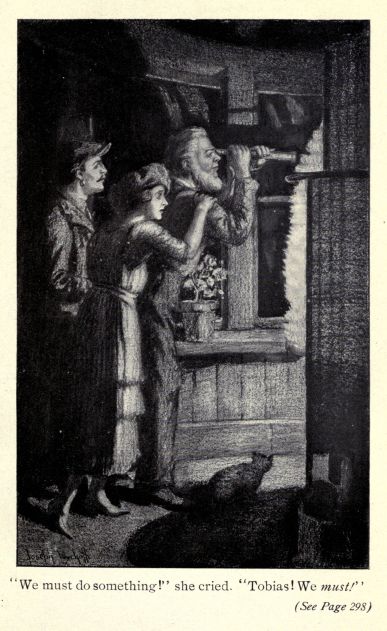
"We must do something!" she cried. "Tobias! We must!"
"Oh, sugar! What can we do," muttered the lightkeeper, "if them life-savers can't get out to the schooner?—and of course, they can't. What did Cap Edgar say, Rafe?"
The Portuguese shook his head till the rings in his ears twinkled in the lamplight, and raised his shoulders in a truly Latin shrug.
"What can heem do?" Silver sighed. "He has only ol' boat down theer. The men, heem weeling. But no can row against thees wind."
"That's just it," groaned Tobias.
"Then why don't they get the gear out and shoot a line to the schooner?" demanded Lorna. "Can't they use the breeches-buoy?"
"Why, my dear," said the lightkeeper gravely, "if you just stop and think you'll see that if the wind is too strong for the boat, it's too strong to shoot a line. Couldn't noways reach out there, with even a double charge of powder in the gun—nossir!"
The girl clapped her hands together in despair. "There must be something that can be done," she said. "Are we all helpless?"
"Wal—I dunno——"
"Think, Tobias! There must be some way to reach them. Think of Ralph out there."
"Oh, sugar, gal! don't you s'pose I be thinking of him? I ain't doin' much of anything else."
"If they only have motor lifeboat down theer to Lower Trillion," said Rafe Silver, "they go out for heem."
"Tobias, they've got one at Upper Trillion!" the girl exclaimed suddenly.
"Oh, sugar! So they have," the lightkeeper agreed.
Silver shrugged his shoulders again. "They no see her out theer from Upper Trillion station. Amposseeble!"
"But haven't the Lower Trillion crew sent word, do you suppose, to the Upper Trillion station?" demanded Lorna.
The lightkeeper shook his head. "You forget the wires air down, Lorny. That is why this here detective and Rafe went over to Lower Trillion in the car. And now they can't get back to Clinkerport, even if the telephone is working from there to Upper Trillion."
"Oh, Tobias! are you sure they will not see those rockets? Ah! There goes another."
"They ain't likely to. The headland's between. My soul and body! this is sartain sure an awful thing."
The three were silent for a time. Their vision was fastened upon the plunging fishing craft. Her fore-topmast had been torn away. There was still some of her lower canvas set. Doubtless Captain Bob Pritchett and his crew were doing all they could to keep the Nelly G. from broaching to.
But to make a better offing was impossible unless the wind changed. A sea-anchor would help keep her head to the wind, but continually the gale was forcing the schooner broadside on the coast.
"Mebbe they'd better have beached her down there by Lower Trillion," Tobias finally said, but shaking his head doubtfully. "Anyway, that chance is past and gone. And ye can't really blame a skipper for trying to save his ship—nossir!
"She's off the rocks now. No two ways about it. What do you say, Rafe?"
"Santa Maria!" exploded the mahogany-faced man with a final shrug. "She is loss! No help—no!"
Tobias looked quickly at Lorna. The girl could have become no whiter in any case. But her eyes flamed. The lightkeeper was not astonished to hear her say with conviction:
"I do not believe it! There must be something we can do to aid them. Think, Tobias Bassett! Think!"
"I give it as my opinion, Lorna," he drawled, "that this here so-called absent treatment ain't going to do that schooner or them that's aboard of her much good. We've got to do something more'n thinking."
CHAPTER XXVIII
DESPERATION
The trio went down from the lamp room again and joined the detective in the kitchen. That individual evidently thought much more about his own comfort than he did of the peril of the storm-racked schooner and her crew.
Lorna wept no more; but the inaction rasped her nerves. Tobias's deep reflection made him look preternaturally solemn—an owl-like gravity that at another time would have amused her.
Rafe Silver muttered in his own tongue and nursed his injured hand. His bead-black eyes continually shifted from one to another of the group.
Tobias filled his pipe from the pouch on the mantel and then passed the tobacco to Silver. The latter produced a brown paper and dexterously rolled himself a cigarette with his uninjured hand. The other man brought out a cigar, and all three proceeded to smoke. Tobacco is said to soothe the nerves. It did not soothe Lorna's.
Finally the lightkeeper spoke:
"I give it as my opinion that there ain't nothing we can do just now. There!" he added, leaning forward to gaze through the single window that gave a view of the sea. "There goes another rocket. The Nelly G. is gettin' closer. If Bob Pritchett can claw her around the end of the Twin Rocks, he'll mebbe make safe harbor in the bay. But if she goes slam on the reefs——
"Wal, no use meeting trouble more than half way. If she does hit, she does, and that's all there is to it. And if she does, the only way to reach and help 'em is with the power lifeboat from Upper Trillion."
"The breeches-buoy, Tobias?" cried Lorna.
"No, no, I tell ye, Lorna. Not a chance. Unless the Nelly G. comes inshore on the next full sea. And she ain't going to last that long. Either she'll be on the rocks or safe in the harbor long before another tide. At full sea she might be carried over the outer reefs and lay so that a line could be shot over her. Otherwise the power boat is the only hope. That is sure."
"Oh, Tobias, they must see those rockets at Upper Trillion!"
"Lorna, it's impossible. Not from the station. And none o' the crew is patrolling the beaches. Cap'n Edgar's men air watching this schooner. Shouldn't be noways surprised if they was out there right now. But none of the Upper Trillion crew are coming down yonder to the other side of the bay mouth to the key-box like they do when they are on patrol. Dickson P'int being so high, shut's off all view of this here stretch of coast from Upper Trillion. And the telephone ain't working."
"Oh, Tobias!"
"I know, Lorny; I know," he said. "But what can I do? The light can't be left untended—'specially a night like this. If somebody could get across the bay and run to the Upper Trillion station——"
"We can, Tobias! There is Ralph's Fenique"
"Yes, I cal'late she's there in the cove all right," he muttered. "But who's going to manage her? If I could go, I am free to confess I don't know much about handling that motor-boat. If Zeke was only here——"
He suddenly turned his gaze on Rafe Silver. But the momentary flash of confidence in his face faded almost instantly.
"Oh, sugar!" muttered Tobias. "Rafe can't run a motor-boat with a broken wrist."
"Tobias Bassett!" exclaimed the girl, getting to her feet with decision. "I can manage Ralph's boat. I can run the Fenique just as well as Ralph can himself. Ralph said so."
"Oh, sugar, girl! you couldn't get across the bay to-night in it. Alone? Why, I wouldn't hear to it. No, indeed!"
"Somebody must go, Tobias. Can't—can't this man go with me?" and Lorna pointed to the detective, who listened open-mouthed.
"What? Me?" he gasped, quite horrified. "I could not think of such a thing."
"I bet you couldn't," observed the lightkeeper, with disgust. "I cal'late you air too precious to have your hide risked where it might get scraped a bit. Humph! Tell ye what, Lorny: You and me will have to go."
At this decision she displayed instant satisfaction. She seized her jacket and veil. But Tobias was looking at Rafe Silver.
"Rafe," he said, "I've got to depend on you if I go with Lorny. Somebody's got to watch the light. You savvy?"
"Si, si! Captain Bassett can depen' on heem," and he struck his chest with his uninjured hand.
"If you need a man's two hands for anything, ring that fellow in," and Tobias nodded scornfully at the detective. "If anything goes wrong here and me gone, remember it means I'll lose my job. And the good Lord knows," he murmured, "me and Heppy's lost enough, seems to me—money and all."
The girl was already at the door; but Tobias took his time. He refilled and lit a lantern. He searched out a can of gasoline from the storeroom. He burdened Lorna with a stout ash oar. And last of all he coiled a length of strong line over his arm. He insisted that the girl be buckled into a lifebelt and he put on its mate himself.
"We don't know what we're going to run up against, Lorny. This ain't no picnic we're setting out on. But I know you air full aware of that. We may get through as slick as a whistle. Then again——"
"I am not afraid, Tobias," she said firmly.
"I cal'late you ain't," he said, looking at her with pride. "But I'm kind o' glad Heppy ain't down here to see us start. She sartain would have a conniption!"
The detective did not offer to go out with them. Rafe Silver, however, insisted on accompanying the lightkeeper and Lorna down upon the sands. The radiance of the hand lantern revealed the water-swept shore. Toward the cove the damage by the high sea had not been so great. But, as Tobias had prophesied, there were few boats left afloat in the cove.
Here and there was a craft overturned high on the strand—sometimes in a wrecked condition. Tobias held the lantern above his head. Its light revealed something of what lay upon the heaving surface of the sheltered basin.
"I see the motor-boat!" Lorna cried, knowing exactly where to look for the Fenique's mooring buoy. "It is afloat."
"I should hope so," rejoined Tobias. "There wouldn't be much use in trying to get across the bay without she was afloat. Hey, Rafe! do you s'pose that skiff yonder will hold together long enough to take us out there to that boat of Mr. Endicott's?"
The skiff in question had been tossed upon the shore, bottom uppermost.
"Heem no broken, I t'ink," said the Portuguese.
"I cal'late you are right," said the lightkeeper. He handed Lorna the lantern and put down his other burdens. "Come on now, Rafe. Give us the help of your hand that ain't busted. Heave ho!"
Lorna flooded the skiff with lantern-light when the men turned it over. It was sound enough for their purpose. Tobias put his sturdy shoulder to the stern and ran the light craft down to the water's edge.
The waves surged in, almost to ordinary full-sea mark. The surface of the basin was not very rough. What the bay was like beyond, they could only guess.
It was necessary for them to shout to each other to be heard, for the waves broke over the reefs noisily. It was Tobias's gesture that instructed Lorna to seat herself in the skiff, forward. He ran the boat out, wading into the sea half-leg deep, and then scrambled in.
Seizing the oar he fixed it in the stern and began to scull. The waves were choppy and the skiff was knocked about a good deal. Tobias was a sturdy old man and Lorna was too good a sailor to be fearful. She clung to the gunwale with one hand and held the lantern so that its light was cast over the bow.
In half a minute they picked out the bulk of the motor-boat. It heaved up and down on the turbulent water, but had evidently shipped but little of that element. Ralph had put on the canvas cover and battened it securely before leaving home.
"Stand by to grab that line that's trailing overboard, Lorny!" bawled Tobias from the stern of the skiff. "See it?"
She nodded, for the wind was blowing so strongly in her face that she could not verbally answer him. The skiff swerved in toward the side of the Fenique. The girl tossed the lantern over the rail, seized the line, and scrambled inboard. Then she turned and threw the slack of the rope to Tobias.
"Oh, sugar, Lorny!" he exclaimed, as he came aboard. "You are just as good as ary boy. I always said so. And if you can handle this motor——"