TOBIAS O' THE LIGHT (continued 3)
Reading edition
But Endicott knew exactly what he was about. He wanted to worry the driver of the big automobile. His was the speedier machine of the two, and he knew how to handle it to a hair. As Burtwell slowed down, Ralph shut off speed accordingly. The road was narrow here, and he waited for a wider stretch of it before proceeding with a plan he had.
"Get back!" yelled Conny Degger, gesticulating with his hand.
Grimly Endicott held to his course. Burtwell slowed still more. They came to the wider piece of road for which Ralph had been waiting.
He pulled out from behind Burtwell's car and went past like the wind. There was less than a mile on which to maneuver, and it was a lonely piece of road.
For twenty seconds the roadster dashed ahead with a thuttering roar of its exhaust. Then Ralph shut off, applied the brakes cautiously and, just as he was stopping, turned the car squarely to block the road.
Burtwell's horn emitted a scared squawk. He came to a stop with clashing gears and Burtwell himself spouting profanity.
"What do you mean, you crazy fool?" he bawled, hopping out from behind the wheel when his car had stopped with its radiator almost touching the mudguard of Ralph's roadster.
"I have no business with you, Burtwell," Ralph replied, carelessly tossing his gloves and the cap and mask into his driving seat as he stepped from his own car. "My business is with Degger."
"What kind of a hold-up is this, anyway?" demanded Burtwell blusteringly. "Do you want to talk to this fellow, Conny?"
"I haven't got a bit of use for him," declared Degger, remaining in the seat.
Ralph's smile was grim enough.
"I've only one use for you, Degger," he said. "I'm going to mop up a part of this road with you. Get out and take your medicine."
"What's this?" snapped Burtwell. "You ruffian! Get your car out of my way and let us pass, or I'll show you something altogether new."
"Keep out of this, Burtwell," advised Ralph quietly, yet never losing sight of the promoter. "I am going to give Degger the thrashing of his young sweet life."
"What for?" demanded Burtwell.
"He knows. Perhaps it is because I don't like the color of his tie—or the cut of his coat—or that hat he wears. In any case, it is going to be just as good a thrashing as though I had the best reason in the world——
"Ah! Would you?"
Burtwell's hand had gone to his hip and he started to draw something from his pocket. Ralph stooped, leaped forward, and drove his right shoulder into the fellow's midriff as he wound his long arms tightly about his waist. Endicott had not played tackle on the scrub team for nothing!
The breath was driven out of Burtwell with an explosive grunt. Ralph wrenched the weapon from his hand, stood up, and threw the fellow full length in the dust.
"That will be about all for you," he said sharply. "A pretty little automatic." He tossed the weapon over the nearest fence. "Now, Degger, get out of that car. Or are you packing some such plaything as your partner?"
He leaped to the side of the automobile and seized Degger by the shoulders. The fellow screamed as Ralph dragged him out over the door.
"Put up your fists, Degger," commanded Ralph, setting him staggeringly on his feet in the road. "Defend yourself! Whether you fight, or don't fight, I am going to do my best to change your face if I can't your morals."
"You brute!" bawled Degger, growing white.
"That won't save you," Ralph declared, and struck a blow that, landing upon Degger's forehead, knocked him clear across the road.
"Get up and take it!" exclaimed Ralph fiercely. "Or shall I come after you?"
But the blow had roused every ounce of fight there was in Conny Degger. He bounded across the road and swung his right hand high above his head. Just in time Ralph saw there was a stone in it.
He dodged, and the missile sailed over the roadside fence.
"Good!" shouted Ralph, and, leaping into the fray, struck again and again. "I don't—much care—how you fight—as long—as you—do fight!"
Each punctuation was a punch delivered. A dozen healthy blows landed about Degger's head. He was already groggy. He began to yell for Burtwell to help.
"Get something! Out of the tool box! Knock him out!" he shouted.
Ralph had not overlooked the possibility of Burtwell's coming into the fight from that angle. The man had scrambled to his feet and was doing exactly what Degger begged him to do. He was rummaging in the tool box.
At this moment Degger received a terrific blow on the jaw. He sank under it, and his eyes rolled up.
Ralph caught him before he could fall, wheeled with him in his arms and heaved him up just as Burtwell started with a heavy wrench in his hand for the common enemy.
"Didn't I tell you to keep out of this?" Ralph panted, and with a great heave of his shoulders flung the almost senseless Degger into Burtwell's face.
The two went down together, and neither immediately tried to rise.
Ralph went to his car, looked back over his shoulder, and with a flash of teeth and a bitter grin demanded:
"Got enough? You, Degger, know what this is for. If you don't put a bridle on your tongue after this, better put many a mile between us. For if I come after you again I won't let you off so easy."
He got into the car, started it, backed it around, and shot up the road on the return journey to Clinkerport before his two victims were on their feet.
Ralph was not entirely unmarred. When he had backed his roadster into the stable behind the bungalow that served the Endicotts for a garage, he went into the washroom and bathed his bruises and the cut above his right eye.
There was room in the stable for his small car and the family automobile. The remainder of the floor space had been turned into a laboratory and workshop by Professor Endicott.
The latter caught sight of his nephew before he could plaster up the cut. He opened the door of the washroom, and, standing there, a tall, sapling-like figure in his white smock, stared rather grimly at Ralph.
"Another smash-up?" he asked.
"No, sir. The car isn't hurt. Just a little trouble with a fellow."
"With whom, may I ask?"
"That Degger." For Ralph was nothing if not perfectly frank.
A smile wreathed Professor Endicott's lips. He was an austerely handsome man with abundant hair which was gray only at the temples, and a smoothly shaven face. His eyes saw all there was to be seen through amber-tinted glasses.
That he kept much to himself, seemed not fond of society, and was wholly wrapped up in his experiments, made Professor Endicott seem less human than he really was. His sense of humor was by no means blunted.
"So you finally awoke to the presence of the worm in the apple?" he suggested.
"Degger has a dirty mouth. I had to stop it," muttered Ralph.
"It went as far as that?"
"Say! how am I going to tell Lorna who she shall, or shall not, associate with?"
"You should have a right to."
"Let me tell you, Uncle Henry, Lorna is not a girl to be bidden in any matter. No man will ever dominate her."
"You used to," said the professor, with a sudden smile.
"Yes. When we were kids. But no more. Believe me, Lorna is a young woman who knows her own mind and means to have her own way."
"Even with the man she marries?"
"She has no intention of marrying me."
"Don't you mean, Ralph, that the lack of intention is on your side?" said the professor, his brow bent sternly. "The fault lies at your door, young man. There has been a well understood arrangement for years——"
"Between the families—yes," interrupted Ralph. "But Lorna and I never agreed.'
"How can you talk so childishly?" said Professor Endicott in much the same tone Miss Ida Nicholet used with Lorna. "It is too late to hedge now, Ralph. Be a man. Fulfil your family obligations. If the girl seems indifferent it is because you have not been sufficiently loverlike. Can't you see?"
"I see well enough; but you do not," his nephew returned bluntly. "I am quite sure Lorna cares nothing for me in that way. And I am not at all sure that I wish to marry her."
"Yet you interfere with this Degger——"
"If she was my sister I'd do that. He is a scurrilous scoundrel."
"Of course," was Professor Endicott's thoughtful comment. "I presume Lorna will attract plenty of such fortune hunters until you and she let it be publicly announced that you are engaged."
Ralph's expression changed. He wagged his head in a regretful negative.
"No, uncle, I think not. Degger, even, was bound to learn in time that the Nicholets are not as well off as they are counted."
"What? What's that?" demanded the professor, startled.
"Haven't you heard anything about it?"
"That the Nicholets have lost money?"
"All of their money. So I understand. I bet Lorna's father has been speculating—and with her money and Miss Ida's as well as his own."
"Great heavens, Ralph! this is not a joke, is it?" gasped his uncle.
"I don't see anything to joke about in the loss of one's fortune. Either it is so, or it is not so."
"John Nicholet is visionary. He was at me not long ago to join in one of his financial schemes. I could not be bothered. Besides, I told him plainly I needed all my ready cash for these experiments I am making.
"I—I—Ralph! If this is true—if our neighbors have sustained severe losses—surely you would not break off with Lorna because of that? What if she has no dowry?"
"Uncle Henry!"
"Of course not," said the professor hurriedly. "We have plenty of money, Ralph. There will be enough for you and Lorna. The little girl never need feel the pinch of poverty."
"But suppose she will not have me in any case?" cried the younger man. "I can't carry her off to the minister's and marry her, willy-nilly."
"Pooh! Pooh! Cave-man tactics are quite out of date. You are a most unromantic chap, Ralph. Why don't you try to make the girl like you? And surely she must marry somebody with money. It would be a calamity if she secured a penniless fellow like that Degger.
"It is your duty, Ralph, to fulfil the plans made by the two families for your welfare and the girl's. Under the disturbing circumstances you speak of, it is all the more important that you and Lorna come to a prompt understanding. Suppose they—Miss Ida, for instance—should believe for a moment that because of their misfortune we were—er—unwilling to have the engagement announced? Why, Ralph, the Endicott name would be forever disgraced!"
"Huh!"
"If Lorna's fortune has been unwisely invested by her father—and Miss Ida's money, too—something must be done about it! Something certainly must be done!"
CHAPTER XVI
POISON
So near did Tobias Bassett's matchmaking schemes come to naught that had he known it he would have—in his own words—"let go all holts."
It seemed that his intimation to Ralph and Lorna regarding the supposed loss of their respective fortunes was a bubble that was bound to be punctured. For Professor Henry Endicott, in spite of his seemingly self-centered existence, possessed a proper share of kindliness, and considered the Nicholets' financial troubles as his own.
He seldom left his own premises. Between meals, and sometimes until late into the night, the professor lived in his laboratory, reading and experimenting. The white smock he wore while thus engaged had become much more familiar to him than evening dress.
Yet after dinner on this evening Ralph was surprised to see his uncle, arrayed in the prescribed garments for an evening call (and rather rusty they were, for Mrs. Mallow, the housekeeper, knew little about grooming a man, and their old valet, Jerome, was purblind and fairly tottering with age), march across the two lawns to the Nicholet house.
Ralph himself was seriously considering the journey which he had already hinted to Lorna he purposed taking. He was not saying anything about it at home, for he feared his Uncle Henry and his Cousin Luce would object. He was determined, however, not to waste the entire summer in loafing about Clay Head and the Twin Rocks Light.
Ralph planned for this escape from home entanglements just as another and lighter-minded young fellow might have schemed for some forbidden spree. He packed his steamer trunk in secret.
Professor Endicott came to the dimly lit veranda of the Nicholet house, which overlooked the starlit bay. The white beam of the Twin Rocks Light was flung far seaward. Its illumination did nothing to abate the pale rays of the stars which glittered on the ruffled water of the almost land-locked harbor.
A figure in white, quietly swaying in a basket rocker, leaned forward to distinguish the man's features.
"Henry! Professor Endicott! Come up. You are an unexpected caller."
"Er—yes, Miss Ida. I am not very neighborly in my habits, I acknowledge. So busy—always. You know. Er—is John in his room?"
"My brother has gone to Boston," said Miss Ida, pushing a light chair toward him with her neatly slippered foot. "Will you sit down, Professor Endicott?"
"Thanks, Miss Ida. Has John gone for any length of time?"
"He could not tell me how long he would be away. But he did say he might be detained for some days. Did you wish to see him particularly?"
"Yes. I did, really. But of course I can wait for his return," Henry Endicott added hastily. "There is nothing troubling him in business, Miss Ida, is there?" he finally blurted out.
"No. Not that I know of," was the slow reply.
"I fancied the last time John spoke to me he was in some business difficulty. Nothing of—er—importance, of course. But I was so deep in the theory of an experiment at the time—ah, perhaps I did not pay sufficient attention. Of course you would know, Miss Ida?"
"My brother confides a good deal in me," said the woman placidly. "I believe he has under way some new business deal. Perhaps it is that you mean."
"Perhaps that was it," returned Endicott.
How could he come out bluntly with this suspicion Ralph had put in his mind regarding the loss of the Nicholet fortune? He could not do it!
He uttered a few commonplace remarks. He was vastly disturbed, and even a téte-à-téte with Miss Ida did not calm him. It was on the tip of his tongue all the time to venture upon the ground of financial difficulties. Yet it was quite plain to the professor's observation that Miss Ida was not after all in her brother's confidence regarding this very serious matter. If outsiders were informed of the disaster that threatened or had overtaken the Nicholets, the head of the family had managed thus far to hide it from the other members thereof.
Miss Ida was quite unaware of any present or coming disaster. The professor desired greatly to get hold of John Nicholet. He finally said:
"When John returns, tell him to come and see me." He rose from his seat. "I really wish to talk with him. Perhaps there is something I may be able to do——"
His words trailed off again into silence. He said good-night and descended the steps. When his figure was only a dim outline across the lawn, Miss Ida sighed.
A dainty person in a shimmering frock came lightly to her side from the darker end of the porch.
"What did the professor want, Aunt Ida?"
"I really cannot imagine," Miss Ida said, quite composedly.
"But didn't he seem disturbed—more than usually difficult?"
"'Difficult' does express it, Lorna," said Miss Ida. "He said he wished to talk with your father."
"On business?" Lorna asked with some eagerness.
"Yes. He intimated as much. But why——"
"Oh, Auntie!" exclaimed the girl. "I am afraid it is true! I told father."
"What did you tell him? What are you talking about?" asked Miss Ida Nicholet in her most placid manner.
"I believe Professor Endicott is in financial difficulties. They say he has lost his money—has quite ruined the family."
"Lorna!"
"Yes. I told father. I wish he were at home now. He is so full of this new business deal that he must have forgotten what I told him I had heard about the Endicotts. I believe that is what is troubling Ralph so much—makes him go mooning about as he does."
"Indeed!" ejaculated Miss Ida. "Are you quite sure that it is not your treatment of the boy that causes his moodiness?"
"Oh, dear, Aunt Ida! Ralph Endicott does not care how I treat him. I wish you could have heard him when we were coming up from Lower Trillion the other day in his Fenique. Called me 'kid'! Girls mean nothing to him. At least, not this girl," and she laughed airily.
"But, Lorna," said her aunt, "can it be possible that this tale you have heard is true—about the loss of Henry's money?"
"Well, Aunt Ida, how did the professor impress you just now?"
"As acting very strangely—even for him. And his peculiar manner did not seem to arise as usual from his habitual absent-mindedness."
"That is what I thought. Of course the poor old fellow always does have a 'lost, strayed, or stolen' way about him——"
"Why, Lorna! Professor Henry Endicott is not old—not at all!" admonished Miss Ida heatedly.
So near did Tobias Bassett's scheme fall through. Had John Nicholet been at home the fanciful tale of financial disaster, at either the Nicholet or Endicott side of the big lawn, would have been exploded!
As it was, the next morning, before Miss Ida could make up her mind to go to Professor Endicott and put a plain question or two, the latter had plunged into a new series of experiments from which the family did not dare to try to recall him under any circumstances. And on the professor's part, he had quite forgotten the Nicholets' financial troubles.
Ralph "fiddled about," as Tobias Bassett said, as uncertain in his direction as a crab.
"I give it as my opinion," the lightkeeper observed to Miss Heppy, "that the boy can't make up his mind whether to go about or keep on the main tack. He is as onsartain as April weather."
"I do hope he ain't sick," said his sister. "Maybe he's comin' down with something."
"Oh, sugar! There ain't nothing the matter with that fellow's health," chuckled Tobias. "All he's sickenin' for is girlitis—got it the worst way. Only he don't know it."
Nor was it thought of Conny Degger that disturbed Ralph's mind. At least he did not fear that individual's approach to the Clay Head or the Twin Rocks Light. He did not, however, take into consideration the possibility of Lorna's meeting the treacherous Degger at a distance.
One must occasionally shop. An entire summer could not pass without the need of renewal in the Nicholet household of clothing and domestic necessities. Clinkerport stores did not carry much variety in any merchandise. So Lorna started early one morning, driven by Jackson, the Nicholets' gardener and chauffeur, for the Big Town.
It was when she was returning and was still several miles on the far side of Clinkerport that Lorna spied a familiar figure walking ahead of the automobile in the road. She leaned over the back of the driver's seat and spoke to Jackson:
"That is Mr. Degger ahead of us, Jackson. Stop when you reach him. I wish to speak to him."
They were almost upon the pedestrian before Lorna saw the bandage about his head and that he carried his left hand in a sling. The noise of the stopping car made him look around.
Ralph had certainly fulfilled his promise. He had so greatly changed Conny Degger's facial appearance that only from the rear was he to be easily recognized.
Besides his swathed forehead he had one rainbow-colored eye and a bruise on his cheek that gave him the appearance of carrying what the children call an "all-day-sucker" in that side of his mouth. When he opened his lips to speak to Lorna the absence of two teeth made an ugly gap in an otherwise perfect upper set.
"Mercy's sake!" gasped Lorna. "What has happened to you, Mr. Degger?"
For the second time since she had known him, Lorna gained a look right into the very soul of the fellow. She had seen him display cowardice in the face of danger. She scorned him for that, yet realized that he was a landsman and—unlike Ralph and herself—was unused to the more boisterous phases of the sea.
Here was something different. He did not sneer. It was a positively wolfish snarl that he displayed in reply to her question. The blood rushed into his face, making the whole of it almost as dark as though his bruises were a complete mask.
"So you haven't heard the glad news?" he lisped through his missing teeth.
"What do you mean, Mr. Degger?" she demanded. "Get in here. I wish to speak with you. Oh! is your arm broken?"
"My finger. When I hit him," said Degger, with a harsh laugh. "I guess he carries the mark. Haven't you seen him?-"
"Seen whom?"
"Endicott."
"I don't understand," murmured Lorna. "I have not spoken with Ralph for two days. You—were you fighting with him?"
"I tried to defend myself," snarled Degger. "He caught me unaware. I had no idea he was such a brute."
"Oh!"
"He'll come to you and brag about it, all right, when time has erased the few marks I put on him. I fought back the best I could. But he gave me no real chance—none at all."
"What did Ralph attack you for?" the girl asked, her practical sense coming to the fore. It was not easy for her to believe that Ralph Endicott had been so unfair as Degger declared.
"Oh, we had words," was the latter's hesitating reply.
"Over what?"
He looked at her from under lowered lids. The color receded from his face. The corners of his lips curled in a wolfish smile. He was not a pretty sight.
"It was nothing you would care to hear about, Miss Nicholet," was his apparently evasive reply.
She knew he desired her to urge his confidence. It would have been wiser had she refused to be thus baited. But curiosity is a most irritating complaint, and Lorna was not immune.
"I want to know what you quarreled about, Mr. Degger," she said. "I know you and Ralph had words when you left us aboard the Fenique down there at Lower Trillion. You were angry, or you would not have gone away from the light without bidding any of us good-bye. I think you two men are very foolish. Fighting and quarreling. Like dogs! It is most disgraceful.
"And if I thought," she added, "that you and Ralph quarreled about me——"
He flashed her another lowering glance. His smile now was most malicious.
"No, Miss Nicholet," he said quite truthfully, "your name was not mentioned between us." Then: "Our difficulty arose over quite a different person."
"Yes?"
"I was a fool!" he exclaimed with apparent anger. "I tried to do somebody a favor. I thought I might be able to show Endicott wherein he was wrong. Never will I try again to point out his duty to a man!"
Lorna listened with growing amazement. This certainly was a new side to Degger's character!
"Just what do you mean?" she asked wonderingly.
"Well, I do not feel myself bound to secrecy. It is Endicott's affair. I only tell you what is common knowledge. There was a girl Endicott was chasing after more than a year ago."
"Indeed?" said Lorna stiffly. "I do not believe I care to hear——"
"Well, you wanted to know what the row was about, didn't you?" he snarled. "I have mentioned Cora Devine before to you. I thought it was something of a joke then. But since I have found out that Endicott treated her very shabbily. She was a silly girl, I guess—one of that kind that believe everything a fellow like Endicott tells her. And she probably knew he was rich, too."
"Oh!" gasped Lorna.
"It's a sordid piece of business," said Degger, ruminatively. "Whether he really did take her away from her folks or not, I don't know. But she needs help now, and I heard about it. I put it up to Endicott and—well, you can see what I got for my pains," he concluded with a bitter laugh.
Lorna was shaken by his words. She was disgusted and horrified. Ralph Endicott to be connected with such a sordid affair as this that Degger intimated? She could scarcely believe it. She thought she knew Ralph so well!
"I cannot imagine Ralph doing such a thing as you suggest, Mr. Degger," she said gravely. "I think I know him quite as well as anybody—better than you do, for instance——"
"I don't doubt it," interposed Degger, grimly. "But a fellow is sometimes quite different away from home—and at college—from what he is among his family and friends." He laughed harshly. "Oh, Endicott knows the girl well. See here! This he tore from his address book and threw at me when he said he'd got through with her—well, you can look or not as you please," as Lorna turned her face from him.
He had dragged from his pocket the crumpled leaf of a memorandum book and offered it to her. In spite of herself the girl could not refuse to look at it.
She recognized a leaf of the little red book she had often seen in Ralph's possession. Yes! That was his writing. She would know it anywhere. Boldly Ralph had set down:
"Cora Devine
"27 Canstony Street "Charlestown, Mass."
Lorna was not likely to forget that name and address. A flame of anger shot all through her trembling body. She did not realize that Degger was watching her with sly delight at the mental pain he caused her.
"I would not have believed!" she murmured.
"Oh, Endicott is sly—dee-vilish sly," chuckled Degger. "But I guess Cora Devine has been causing him some worriment of late. She wants money. She's been nagging him for it, like enough. That is what made him so sore, I suppose, when I tried to say a good word for her to him.
"Oh, well! I was a fool. I assure you, Miss Nicholet, I've washed my hands of them both. If the girl finds a shyster lawyer to take up her case, Endicott will sweat. Let him. He deserves to."
"Now, I'll get down here, if you don't mind," added the fellow, as they came to the Outskirts of Clinkerport. "Thanks for the lift. I've had my lesson, I have. I'm going to mind my own affairs strictly in the future. I'm sorry for the Devine girl; but she'll have to fight her own battles as far as Endicott is concerned. Good-day, Miss Nicholet."
Lorna could not even find voice to tell Jackson to drive on. But he did so on his own initiative while Lorna sat very upright in the tonneau of the car, clutching that leaf of Ralph's address book in her hand.
CHAPTER XVII
REAL TROUBLE
Many a Paul Revere has ridden through New England hamlets since the original courier of that name and fame saw the lights twinkle in Old North's steeple. None ever carried more exciting news to the rural folk than Zeke Bassett in his motor car brought to the Twin Rocks Light early on this summer morning.
For two months the life saving crews were excused from duty at the stations. Only the captain of the crew remained on guard at the Lower Trillion station. These two summer months Zeke usually spent with Tobias and Heppy at the Light.
Occasionally Zeke made an odd dollar taking a passenger to and from the railroad station. On this morning he had driven a neighbor to the early train—"the clam train"—that stopped at Clinkerport at 5:30. When he came back he scattered along the shell road driblets of news that was destined to flash over the countryside in wide excitement.
Zeke kept his car under Ezra Condon's shed down the road, but he stopped before Miss Heppy's flower garden, where she was weeding, to tell her the news. He startled her so that the lightkeeper's sister fell back in the sand, trowel in hand, her broad face paling slowly under the peak of her sunbonnet.
"Zeke! You don't mean it's true?" demanded Miss Heppy in a smothered shriek.
"Cross my heart, Cousin Heppy!" declared the young man. "There's a crowd around the door already—and it's shut. They'll be howlin' there like wolves b'fore noon."
He started the shaking car again, and it wheezed away. Miss Heppy was several moments getting upon her feet. All strength seemed to have left her limbs.
She tottered into the lighthouse. Tobias was up in the lamp room polishing the brasswork. She might have called to him, but it did not seem to her that she could lift her voice sufficiently to make him hear. Weak as she felt bodily, she started to climb the spiral stair.
That climb was an unforgettable experience for Hephzibah Bassett. The higher she climbed the lower her spirits fell. In all her long life disaster had never looked so black and threatening before her as it did now.
For many years she and Tobias had worked, and she had scrimped and saved, against that "rainy day" that is the dread of most cautious souls of middle age. Each dollar added to their slowly growing hoard had seemed positively to lighten the burden of fear of old age on Miss Heppy's heart.
Tobias frequently called her "Martha." She admitted she was cumbered by many cares. She believed they had been very real, those troubles she saw in the offing.
And here, of late, had come the unexpected good fortune—a blessing long hoped for, yet never really believed possible by either Miss Heppy or her brother. A few hundred dollars from the estate of Cap'n Jethro Potts would have delighted them. But six thousand dollars! The gain of that sum had been quite outside their imagination.
Altogether to their joint account in the Clinkerport Bank their bankbook showed now just a few dollars over eight thousand—to these plain longshore people an actual fortune.
And now——
Miss Heppy panted her way up the last few steps. Ordinarily her flesh would have caused her to more than pant. Her face would have been as red as a sunset.
But it was positively a pallid countenance that appeared to Tobias as he briskly polished brasswork and whistled a wandering little tune through his teeth. He did not look at her at first as she appeared through the hatchway; but he recognized her step.
"I give it as my opinion," he said reflectively, "that if I had to puff and blow like a ship's donkey-engine, comin' up them stairs, I wouldn't come aloft no oftener than I could help. What's sprung a leak now to bring you 'way up here, Heppy?"
"Tobias! Tobias!" gasped Miss Heppy.
"Oh, sugar! Take your time. Get your breath. If it's bad news I'd just as lief not hear it at all. If it's good news I've found that expectation is a sight more satisfying than fulfilment most times. I can wait——
"Dad fetch it, Heppy! what's the matter o' ye?"
She had fairly tottered into his arms. She hung to him, sobbing and gasping for breath. Tobias staggered under her weight. It was a minute or more before Miss Heppy could make audible her trouble.
"Tobias, it's gone!"
"What ye lost? Them false teeth again? I knowed——"
"Tobias, it's worse than that. It's the money!"
"What money?"
"Our money, Tobias! All our money! Uncle Jethro's legacy and all!"
"Oh, sugar, Heppy, you been dreamin'? You know that money's safe in the bank," he urged.
"But it ain't safe. The bank ain't safe. We've been robbed!" she cried, her voice rising to a thin shriek.
"Heppy! What ever do you mean? That dratted Arad Thompson! You don't mean to say he's got away with it? And in that wheel chair?"
"It isn't Arad Thompson! Oh, it isn't him!" wailed his sister. "The bank has been robbed! Burglars! Last night! Every penny of cash in it! A hundred and forty thousand dollars, so Zeke says!"
"My soul and body!" murmured the lightkeeper reverently. "A hundred and forty thousand? My! My!"
"The bank's closed——"
"Course it is this time in the morning. Them bank fellers don't work the morning tide—never."
"But there's a sign on the door. 'Tisn't going to be open. Our money's gone!"
"Say!" ejaculated Tobias, his brain beginning to function, "a hundred and forty thousand dollars oughtn't to break the Clinkerport Bank—nor yet Arad Thompson. We'll get our money——"
"'Tain't likely. Not all of it. We'll have to stand our sheer of the loss, Tobias. If 'twas burglary! Think of it!"
"Oh, sugar!" exclaimed her brother, seating her on a stool. "You needn't never mind about that. I'm thinking of it all right. I can't think of nothin' else. Who'd you say told ye?"
"Zeke."
"Cal'late it's pretty straight then. I give it as my opinion he ain't no false alarm. Well! Well!"
He started for the stairway.
"What you goin' to do, Tobias?" sobbed Heppy.
"I cal'late to change out o' these ily clo'es and go to town. Zeke will stand by ye. I got to know the wust, as the feller in jail for murder said when they interduced the hangman to him."
Miss Heppy could not follow him at the moment. The promptness of the old seaman soon put Tobias in a presentable suit—though not the funeral garments before described. He got away before his sister was able to descend the stairs.
Zeke appeared. Tobias put a question or two and learned that the disaster was all Heppy had said. A hundred and forty thousand dollars was indeed a great fortune for Clinkerport people. Nor was it a small slice of the bank's capital.
"They tell me, Tobias," Zeke said, "that Mr. Thompson had called in a lot o' money just lately from small loans and sech, so't the bank could make an investment that he cal'lated would yield a much bigger return. Somebody must ha' knowed this for a fac', to have busted the vault door open at jest this time."
"Oh, sugar!" observed the lightkeeper. "They don't mean to say it's what them city detectives that you read about call an inside job?"
"Gosh blame it! Of course it was done inside. How'd they git to the vault door otherwise?" demanded Zeke.
Tobias grinned. He asked:
"Did they bust the door with dynamite, or did they open it fair an' proper by workin' out the combination of the vault?"
"I dunno. They busted it open an' got the money. That's all I know."
"Wal, you stay here and stand by Heppy. I'm going to town to see about it," Tobias concluded.
"Don't you want my car?"
"No. I cal'late somebody'll be along to pick me up."
In fact the lightkeeper's sharp eye had already descried a bustle about the Nicholet garage. Jackson had the car out.
When he reached the road gate of the Nicholet property, the car was just sliding down into the highway. Lorna waved him a friendly hand from the tonneau.
"Am I lucky enough to catch you going to town, Mr. Bassett?"
"I cal'late," said Tobias grimly, "the luck ain't all on one side."
"Do get in," she said as Jackson brought the automobile to a throbbing halt once he was on the highway. "I want to talk to you, anyway. What do you suppose is the matter with Ralph Endicott?"
"Huh? Oh, sugar! Why don't you ax me to explain this here fourth dimension they talk so much about? I can easy tell how wide, high, and thick Ralph Endicott is," and his eyes twinkled despite his inner trouble. "But I can't tell you the why of him. That's beyond all nater."
"Then you do not really know why he has gone away?"
"Oh, sugar! He has gone, has he? I'd disremembered. He did bid me an' Heppy good-bye night b'fore last."
"He went away with his trunk yesterday afternoon. Jerome told me nobody knew at the house where Ralph was going. They did not dare tell Professor Endicott, for he was completely submerged in some experiment and had locked the laboratory door. Ralph tucked a note under the door when he left."
"You don't say?"
"Did he not explain to you, Mr. Bassett?"
"Not a word."
"Nor to us. He came over and bade us good-bye just before he left, in a very formal way. I did not get a word with him alone. Aunt Ida asked him where he was going, and he said he could not tell just where he would finally bring up. Tobias Bassett!"
"Yes, ma'am?"
"I believe Ralph has gone away to get a job of work and is ashamed to tell us."
"If it's honest work he ain't no call to be ashamed."
"Too proud to tell us, then," flashed the girl.
"That sounds more likely."
"Anyway, he's gone!" She could not hide something besides vexation in her voice. Disturbed as Tobias was by his own trouble, he marked this fact. He believed his matchmaking scheme, as far as Lorna was concerned, was working!
"Hard work never hurt nobody." He firmly believed this fallacy. "And Ralph is rugged and capable."
"But he has not been trained to any kind of work," cried the girl with anxiety.
"Why ain't he? He can do most anything any other fellow can on a ship. And he's got a good idea of navigation into the bargain. He favors the sea, too."
"A sailor!" There was dread more than disapproval in Lorna's tone. She had never forgotten Miss Heppy's explanation of her own fear and hatred of the sea. She repeated: "A sailor!"
"No. A mate. Then a skipper. A lad like Ralph can soon work up——"
"And is that all his college training can do for him?"
"College l'arnin' won't hurt him none for a sea-farin' life," said Tobias complacently. "He can aspire to walkin' the bridge of one o' them big liners. You hafter be part dancin' master as well as navigator to sit at the head o' the captain's table on one o' them floatin' palaces. Ralph would shine there."
"Oh, Mr. Bassett! he would not be so foolish, would he? I wish I had offered to lend him some money—enough money to straighten out the family's affairs."
"Do you cal'late what I told you I'd heard whispered about the professor foolin' away their money is so?" asked Tobias slyly.
"Oh, yes. Father is away just now. Professor Endicott came to the house to find him, and he seemed in great trouble. He as good as let the cat out of the bag."
"That he was broke?" ejaculated the startled lightkeeper.
"Yes. Something like that. To Aunt Ida."
"Oh, sugar!" murmured Tobias. Then: "Guess we're all in the same pickle."
"What do you mean?" asked Lorna, a little startled by the sudden change in the expression of the old man's countenance.
"Ain't you heard?"
"Heard what? I have heard nothing at all startling."
"Didn't your folks have any money in the Clinkerport Bank?"
"Only Aunt Ida's household account. A matter of a few hundred dollars. Why?"
"You're terrible lucky, I cal'late." Tobias sighed and shook his head. "You kin afford to lose that much."
"Why! what do you mean?" she repeated. "What has happened to the bank?"
"Been robbed. Burglars. Last night. Said to have cleaned out the cash. And the bank's shet up tight."
"Mercy!"
"Heppy's purt' near done up. She——"
"But you won't lose your money, will you? You and Miss Heppy?"
"I cal'late. And we never had a mite of fun out of it. Heppy wouldn't hear to our making no splurge with that legacy we got from Cap'n Jethro Potts. It's a judgment on us, I believe. I might have got me that silver-banded pipe I've always wanted."
She looked at him with understanding.
"You never would have smoked it, Tobias Bassett."
"Well, I could have hung it up over the mantel, couldn't I, for an ornament? Oh, sugar! My doughnut always did have the biggest hole!"
"But if the bank has been robbed——"
They came into the head of Clinkerport's main street as she spoke. Their gaze swept the thoroughfare as far as the bank building which stood directly beside the post-office.
A crowd—really a throng for Clinkerport—was gathered in front of the bank's door. The stores were deserted while the excited people milled before the barred windows and grated door of the bank, and more were coming on foot and in vehicles from all directions.
"I cal'late folks is some stirred up," observed Tobias, as he proceeded to get out of the car.
CHAPTER XVIII
A CLUE
Coatless men and bareheaded women made up the excited company before the Clinkerport Bank, while shrill-voiced children circled the outskirts. It was like a circus or a street-fair day for the youngsters.
But among the adults there were grave faces. This disaster was a very real one to many who had scrimped and saved—like the Bassetts—for a bank account.
The Clinkerport Bank was a "one man institution." If Arad Thompson had mismanaged it, or had not taken sufficient precautions against burglary, the result might be a lasting blow to the community.
These people were not familiar enough with law and with banking affairs to understand why the Clinkerport Bank should be closed if the institution itself—and Arad Thompson—had not "gone broke" through the robbery that was reported.
"What d'ye think of it? What d'ye think, Tobias?" demanded Ezra Crouch of the lightkeeper when the latter approached the scene. "Ain't it a shame—a rascally shame? That Arad Thompson——"
"I hadn't heard tell that Arad burgled his own bank. Did he, Ez?"
"Wal, no. I dunno as he did," admitted the much-wrought-upon Mr. Crouch, who had never deposited a dollar in the bank in all his shiftless career and probably never would. "But Arad's responserble, ain't he?"
"I cal'late," agreed Tobias mildly. "Guess we better give him a chance to straighten things out——"
"I guess you ain't heard much about it, Tobias," interrupted the busy-tongued Ezra. "Something mighty funny about this robbery. Arad called in all the money he could an' seemed to get his cash-drawer crammed with it, jest so's 'twould make a good haul for these burglars. A hundred and forty thousand dollars! My!"
"Does seem a whole lot o' money to take chances with," admitted Tobias.
"Huh! And why does Arad, fust-off, telegraph to some feller they call a 'bank examiner' and get him down here on the airly train? And why does he shut the bank up as tight as a herrin' can and put a sign on the door? That's what I want to know."
"Time'll tell. I wouldn't get excited if I was you, Ez," advised the lightkeeper soothingly.
"Wal, that Arad Thompson——"
"I know. We got to watch him—and that wheel chair. Where is he?"
"Inside. In his office," snorted Ezra Crouch.
"Smokin' twenty-five cent see-gars an' takin' it easy."
"Looks suspicious," agreed Tobias, his eyes twinkling. "These times it does seem as though a feller must have come by his money dishonest if he smokes quarter cigars. Hullo, Mr. Compton!"
Compton kept one of the general stores. He was a bald-headed, keen-eyed man. His smile was rather grim as he acknowledged the lightkeeper's greeting.
"Good-day, Tobias. What you and Ezra doing? Going to get a rope and pick out a good tree for a necktie party? To hear some of these folks talk you'd think Arad had robbed his own self."
"How was it done?" asked Tobias.
"Plain to be seen. Back window forced from the outside. They must have worked a long time on those window-bars, to saw 'em through. But they opened the safe by learning the combination."
"Get out!"
"Fact. Didn't hurt the lock none. Either they knew the combination 'fore they started in, or they was smart enough to puzzle it out."
"They knowed the combination because they knowed it," snorted Ezra Crouch cryptically.
"But where was the watchman?" Tobias asked.
"Doped," said Compton. "You know Bill Purvis? Good man, but never any too smart. Always keeps his lunch basket and bottle of cold tea on a beam under the shed back of the post-office. Everybody in town knew 'twas there and that Bill took a snack about 'leven o'clock, or a little later.
"They drugged his tea last night, and he woke up under the shed just before four o'clock this morning. He see the bank window open and the bars bent up and he ran to Arad's house. Arad telephoned a message to the telegraph operator at the station, who put it through for this bank examiner, before he even tucked his shirt in, so they say."
"Yep," ejaculated the suspicious Mr. Crouch. "Looks mighty like Arad knowed the bank had been robbed, spang off!"
"He could easy guess it," said Compton, with a dry chuckle, "considering the look of that back window."
"I see," said Tobias. "Nobody ever could accuse Arad Thompson of being slow."
"Oh, he's smart enough," sneered Ezra. "That's what we all air worried about."
The lightkeeper asked the storekeeper:
"Mr. Compton, haven't they found any of them there clues ye read about? Burglars always leave clues, don't they?"
"There's the open window and the sawed bars," returned Compton.
"Huh!" sneered the sparrowlike Ezra, "they couldn't very well take 'em away with them, could they?"
Tobias gave him no further heed. He was "studying."
"Mr. Compton," he said again, "I've noticed them winder bars. They are master thick."
"You are right, Tobias."
"Nobody could saw through one of them—not with a meat saw—in a short time. And I have read that them sort of saws is made out o' watch springs. Mighty flimsy they must be. 'Twouldn't be like cutting cheese with a dull knife."
"I believe you, Tobias."
"If Bill Purvis," went on the lightkeeper reflectively, "went for his lunch about 'leven, then them burglars couldn't have been sawin' on the bars much before midnight. Humph! Let's go 'round there and take a squint."
Tobias and the storekeeper, with Ezra Crouch tagging them, entered the lane between the bank building, which was built of cement blocks, and the post-office, which was a frame structure. The window in question overlooked a stableyard at the back.
"I give it as my opinion," said the lightkeeper, "that them burglars couldn't have worked here till after Bill was dead to the world in that shed yonder. Else he'd have seen 'em."
"You're right, Tobias."
"And look at them bars," continued the lightkeeper. "Ha'f as thick as my wrist. How'd you like to stand here—on a flimsy box, 'tis likely—and saw away at them two bars? For how long? I cal'late 'twas something of a job. 'Twould take more'n one hour—nor yet two!"
"Uh-huh!" agreed the storekeeper.
"And then they crawled in and worked on the door of the vault, and got it open. Well, well! That must have taken some time, too. And they got clean away with the money before four o'clock?"
"They worked quick," said Compton.
"But they couldn't work quick sawin' them bars. That would take just so much time, however smart they was."
"Well?"
"Why," said Tobias, "I don't see how they could have done it all in one night."
Ezra Crouch laughed raucously. "O' course they done it last night," he said. "If they'd cut the bars before, somebody would have seen it."
"Not so sure," Tobias rejoined. "I give it as my opinion that they must have worked here before—mebbe on several nights. Almost sawed through the bars and smutched dirt over the cracks to hide 'em. About all they had to do last night was to force the bars apart after Bill was asleep. And then they got in and worked on the safe."
"But why didn't Bill Purvis see 'em the other nights?" Compton wanted to know.
"Like enough because he was sleeping like he was last night," Tobias rejoined promptly. "Nobody had to drug his tea. You always see Bill Purvis wanderin' around before folks go to bed. But who ever kept tabs on him after 'leven or twelve o'clock? I cal'late Bill rolled out of the hay this morning 'bout his usual time and found the bank robbed."
"I swanny!" murmured Ezra.
"It might be like you say, Tobias," agreed Mr. Compton.
"Yes. It might. Huh! What's this?"
The lightkeeper stooped and picked something out of the sand just under the forced window. It was a small, flat, gold penknife. There were a few gold links attached to one end. It had been torn from a watch chain.
"I give it as my opinion," murmured Tobias, "that it was scraped off as the feller worked his way in over that winder-sill. I reckon, Mr. Compton, here is a real clue."
"Huh!" muttered the doubting Ezra. "I don't believe Arad Thompson ever wore that dinky little thing."
"Oh, sugar!" exclaimed the amused lightkeeper. "I don't guess Arad was anywhere hereabout when the burglars crawled in at that window. And he never wore this here doo-dad on his watch chain, nohow."
He shook his head, staring at the penknife reflectively. He had seen that knife—or one much like it—before. In whose possession?
"Cal'late I better see Arad about this," he said finally. "When the perlice come to take holt on this case, Arad will want to give them all the help he can."
"Then," said Compton, the storekeeper, with growing admiration, "you don't believe this robbery was done by nary couple of burglars that come to town last night and got clean away before morning?"
"I don't know about their getting away," said Tobias. "Maybe it would be well to look about to see who's missing. But these burglars must have been in town some time and knowed all about the bank and Bill Purvis. No doubt o' that, Mr. Compton."
"Wal," croaked Ezra Crouch, his eyes like big porcelain buttons, "who's gone away since last night? I dunno, 'less 'tis old Miz Janey Ring that's gone down to Harbor Bar to visit with her darter-in-law."
"Oh, sugar!" snorted Tobias.
"And it ain't sure they got away by train," said the storekeeper. "Who has gone out by boat, or left in an automobile?"
"That's what I say," Tobias observed, still staring at the gold knife. "Maybe them burglars ain't left town at all. No tellin'. Humph! I cal'late I'd better give this to Arad."
He walked to the side door of the bank—the door opening on the lane—and punched the button.
CHAPTER XIX
SUSPICIONS
Lorna Nicholet was some time doing Miss Ida's marketing on this morning. When she finally came out of the butcher's shop and started for her car she observed Conny Degger sitting on the Inn porch. The young man threw away his cigarette and started up, evidently intending to greet her.
To tell the truth, Lorna was sorry to see Degger. Just at this time she did not crave any conversation with him. Had Jackson not stepped out of the car and crossed over the way to join the crowd before the bank, she would have given Degger a very curt "good-morning" and told the chauffeur to drive home.
She did not know, however, that she had any personal reason for snubbing Degger. She sighed, and as he raised his cap nonchalantly, she offered him a polite smile.
"At last something has struck Clinkerport to wake it up, Miss Lorna."
His bruised face was much more presentable, but the two missing teeth made his smile sinister. Lorna had found no opportunity to question Ralph about that fight before he had gone away. She knew but one side of the story, yet, somehow, she failed to make herself believe that Degger's tale had been exact.
The insinuations—more, the direct accusation—Degger made regarding Ralph and the Devine girl seemed less reasonable the more Lorna thought about it. She had known Ralph ever since she had known anybody. He was chivalrous by nature, generous to a fault, kindly of motive, and always the gentleman. Might not these very attributes of character have led him into some entanglement with a designing girl that the latter was now trying to take advantage of? What Lorna so well knew of Ralph's character did not fit the college reputation Degger gave him.
Lorna's ready tongue replied with little hesitation to Degger's remark:
"What a dreadful thing! If the depositors have to lose any of their money——"
"Oh, if the bank officers were up to date they carried burglary insurance enough to cover the loss."
"But a hundred and forty thousand dollars!"
Degger's eyes twinkled. "Some haul—I'll say it is!" he agreed. "Those yeggs must have been vastly astonished when they found all that in the safe. No wonder they did not stop to tinker with the post-office."
"Oh! Have they discovered already who did it?"
"Why," laughed Degger, "of course the bank people and the local police are running around in circles. But it is easy to understand that a crack like this was made by a bunch of yeggs who probably came into town last night on a hand-car. Usually such gangs tap both the bank and the post-office in such a burg as this. But the bank yielded such a harvest they left the P.O. alone."
"Did nobody see or hear them?"
"I did not, anyway; although I was up half the night with a toothache. I expect I'll have to run up to Boston to see my dentist. He's put a crown on a tooth that is kicking up rusty.
"I was up, as I say, more than once during the night doctoring that tooth. But the Inn is on this side of the street, and our rooms—Lon Burtwell's and mine—are at the back of the hotel. If those yeggs had used dynamite to blow open the vault door I imagine I wouldn't have heard it."
"My!" said Lorna, much interested after all, "I hope the poor people won't have to lose their money. Just think! All the money Tobias and Heppy Bassett had in the world was in that bank."
"Yes?" said Degger carelessly. "But the fact that the bank examiner is here and has taken charge doesn't mean anything particular. The depositors needn't be so frightened, I guess. But of course the bank officers can't be held wholly accountable for a burglary."
"But you said——"
"They should have carried burglary insurance sufficient to cover the cash in hand—yes. And the Clinkerport Bank probably does belong to the American Bankers' Association, so that the best detectives in the country will be sent out after the yeggs.
"Still, and nevertheless, every bank burglary is not satisfactorily explained nor the burglars captured. And for a small institution like this, it is a big loss."
"I am thankful we didn't have much on account here," said Lorna reflectively. "I don't know about our neighbors on Clay Head. Perhaps the Endicotts——"
"That hard-boiled egg, Ralph Endicott, will be half crazy if he's been nipped by this," sneered Degger. "If he had money in the bank I wonder he isn't over here now, roaring about it."
Lorna's manner changed.
"Ralph is not at home," she said rather tartly. "He has gone away."
"Indeed! When did that happen?"
"He went yesterday."
"Not so early, I guess," Degger rejoined confidently. "I saw him here last evening."
"In town?"
"Yes. Fact is, I saw him twice. Once about nine and again an hour or so later. I was sitting on the Inn porch and saw him pass the bank and post-office on the other side of the street. He went slouching by under the trees there."
"Why, Mr. Degger, I thought he left town in the afternoon."
"If he did he came back again. Of course, I did not speak to him. But I am not likely to make a mistake in identifying him, wherever I see him. And he couldn't have got out of town after I saw him, come to think of it, until this morning. Not by train; for there are no trains in either direction after the time I saw him. That's sure."
"That is strange," murmured Lorna. "I am sure the family thought he had gone——"
She noted the oddly curious gaze Degger had fixed upon her face, and she halted. She felt uncomfortable. She wondered what it meant—this odd performance of Ralph's. She wished Jackson would return to the car. But somebody did break away from the excited crowd before the bank and cross the wide thoroughfare toward the automobile.
Ezra Crouch's bald face shone with curiosity and his glance shifted from Degger to the girl in the car. The tale that Degger himself had told about town, implicating Lorna Nicholet and Ralph Endicott, had been a choice morsel under Ezra's tongue. He thought the present situation pregnant of further gossip.
"He, he! Ain't this a queer set-to?" he wanted to know. "Those folks that have lost money think they can talk it back into their pockets. I can tell 'em——"
"Haven't they any idea who the burglars were, Mr. Crouch?" interposed Lorna.
"Not the fust idee. 'Nless it's Tobias. Tobias is sharp. He's found the only clue, as they call it, that's been found so far. But that Arad Thompson——"
"What has the skipper found, Ezra?" asked Degger, lighting another cigarette.
"A gold knife. Found it right under that winder where the burglars sawed through the bars."
"A gold knife!" repeated Lorna with interest. "They surely did not use such a tool to cut the window bars?"
"Bless ye, no, Miss Lorny! But 'tis evident—an' so Tobias says—that one o' the burgulars tore it off his watch chain when he scrambled in over the winder-sill."
"Oh! It was a gold penknife? And he wore it on a watch chain like——"
Again she halted in the middle of a sentence. She paled and then flushed, flashing a sly glance at Degger. He seemed not to have noticed what she said. He was not even looking at her.
"Oh!" she whispered again, and was glad that Jackson saw her waiting and that he hurried back to the car.
"Good-day, Mr. Degger. Good-day, Mr. Crouch," she said, as Jackson got in and started the engine.
Lorna did not show Degger her face again. She continued to think about that gold penknife that had been found under the bank window. Ralph Endicott wore such a knife on his watch chain. And Degger said he had seen Ralph in town last evening—long after he was supposed to have left Clinkerport by train.
Of course, any thought linking Ralph with the mysterious penknife was ridiculous. It could not be that the most evil-intentioned tongue would dovetail Ralph's movements with the Clinkerport Bank robbery. Yet—Lorna did not trust Conway Degger!
What would Degger say, in his sneering way, if he learned the Endicotts were impoverished and that Ralph probably had very little money left?
Ralph had been seen by Degger in the village late the previous evening—too late to have left town by train thereafter. Suppose that awful Devine girl was pressing Ralph for money and threatening to disgrace him if he did not produce it?
Was that why Ralph had left home so suddenly and mysteriously? Did he fear disgrace? Was it because he could not satisfy Cora Devine, and so close her lips?
If Degger's story of Ralph's misstep should be true! Supposing Degger knew Ralph was being hounded for money he could not pay, what would he say if Ralph was in the most remote way linked by suspicion to the bank robbery?
Tobias Bassett meanwhile had gained entrance to the bank after some parley with Rafe Silver, Mr. Thompson's Portuguese servant. Arad Thompson had been skipper of a smart bark in his youth and had brought Silver back from Fayal with him on one of his voyages. Silver was a grim little man, black as aged mahogany, thin-lipped and gray of hair, wearing tiny gold rings in his ears.
"This ain't nothing to do with my money, Rafe," Tobias said. "You tell Arad Thompson I have something to tell him about them burglars."
So, after a time, the lightkeeper was admitted. Two pale-faced and scared looking clerks were at the beck and call of the bank auditor. The other employees of the institution, like the general public, were shut out of the building.
In the railed-off enclosure he used as an office, and where he met the bank's customers, Arad Thompson sat in the wheel chair, in which he spent most of his waking hours, before his table-topped desk.
He was a big-bodied man, his torso quite filling the wide-armed chair. His withered limbs were hidden by a soft robe, the upper edge of which was never allowed to fall below his waistline.
He was a handsome man of a patriarchal cast of countenance, his genial expression enhanced by waving silvery hair and a heavy beard of the same color—that silvery hue which revealed the fact that originally the hair of head and face had been jet black.
With his ruddy cheeks and sharp gray eyes, the bank president gave abundant evidence of possessing, aside from his crippled limbs, a healthy body and a thoroughly alert brain. Arad Thompson had been studying a little red-covered memorandum book. He laid it aside as Tobias came near.
"Well, Tobias," he asked directly, "what is it? I can answer no question about the bank or its loss until the bank examiner makes his report."
"Not to say I ain't anxious for me an' Heppy's money—for I be. But I will say, Mr. Thompson, that 'tain't about that I want to see you."
"So Rafe tells me."
"I was wandering around back of the bank there just now with Silas Compton. We looked at the winder where them bars was sawed. I give it as my opinion, Mr. Thompson, that them burglars didn't saw them bars in two in one night—nossir!"
"I had thought of that, Tobias," said the bank president patiently.
"Don't look like it was just a gang of burglars that come in here last night for the first time and happened to hit it lucky."
"No. I am convinced they had advice, if not assistance, in turning the trick."
"Maybe you got your suspicions of who helped 'em?" said Tobias shrewdly.
"If I have I'm not going to tell you, Tobias."
"I don't want you should—nossir!" said the lightkeeper. "I'd just as lief not know. But I am going to show you what I picked up under that winder just now. Compton and Ez Crouch seen me."
The bank president sat up straighter. He flashed a glance at the little red book. Then he looked again at Tobias.
"What is it?"
The lightkeeper brought his hand out of his pocket and displayed the gold penknife.
"You picked that up under the window?"
"Yes."
"Any mark on it? Anything whereby the owner can be identified? Do you know, Tobias, who it belongs to?"
"Oh, sugar!" declared Tobias. "It might not have been lost by one of the burglars. Then again——"
Thompson took the knife, opened the blade, and turned the little toy over and over on his palm.
"Of course," he murmured, "there might be a dozen men wearing things like this on their watch chains——"
"Not here in Clinkerport," interposed Tobias.
"No. That's so. But there is no identifying mark."
"Look at the chain. Drefful fine links, but awful strong."
"It is platinum. An expensive chain. Not likely, after all, to be worn by many."
"That kind of narrows suspicion down, doesn't it?" said Tobias with some eagerness.
"It must. A platinum watch chain costs a deal of money, Tobias. There must be an excellent watch at the other end of the chain. No ordinary person would be likely to wear such an ornament. These burglars——"
"Maybe they stole it," suggested Tobias.
Thompson looked at the red book again. He wagged his bushy head, and sat, tight-lipped and thoughtful.
"That is possible," he finally agreed. "But if the knife and the few links of chain can be traced——"
"'Tis a clue," Tobias said. "Looks like somebody might be in this job who wasn't just an ordinary burglar. Heh?"
"I'll allow that, Tobias."
"Well, that is all I had to tell you, Mr. Thompson. I reckon you'll give the knife to the city detectives when they come?"
"Naturally. I will put all possible clues into their hands," the bank president rejoined, glancing again at the little red book.
"Course, there may be nothing to it. But who else could have lost that knife there without making talk about it—advertised the loss, as ye might say?"
"True," agreed Thompson.
"Probably it belongs to somebody who is kind of a fancy dresser. No ordinary longshore clam digger would own such a thing. I give it as my opinion that it might have been lost by some feller—whoever he was—that has been hangin' around the port long enough this summer to l'arn all them burglars wanted to know about the bank, and the watchman, and all. Heh?"
"Sounds reasonable, Tobias."
"I cal'late. And he must be one of the summer folks."
"That is so, too. Whom do you suspect, Tobias?"
The lightkeeper grinned. He wagged his head.
"Oh, sugar!" he said, paying Arad Thompson back in his own coin. "If I am suspecting anybody, I ain't going to tell you, Mr. Thompson. Nossir!"
CHAPTER XX
PUT TO THE QUESTION
Tobias had more than satisfied his curiosity in coming to town. His discovery of the gold penknife was the sum of the assistance he could give Arad Thompson, the bank's president, at this time. His interest in the burglary, however, continued to be keen; but he went back to the Twin Rocks Light soon after noon.
He could take little cheer to Heppy. For just how much the depositors of the bank must suffer because of the loss of the hundred and forty thousand dollars, Tobias had no idea. Nobody with whom he talked seemed to know. All were pessimistic.
"Looks like something was the trouble besides just the burglary," croaked one bird of ill-omen, perched like a buzzard on the horse rack before Silas Compton's store. "Else Arad would have sent for some cash from somewhere and gone on with business, same as usual. This shutting the bank tight's a drum——"
"They say it's the new bankin' law done it," interposed somebody.
"Dunno. Don't look right. If the bank's rotten we'd ought to have a chance to get what money we can out of it."
"That's right! 'Fore we lose it all."
"Guess it's all gone by now," groaned another.
"Say!" observed Tobias, after listening to this talk for some time, "I give it as my opinion Arad Thompson is a purty slick citizen. He was smart to get that bank examiner here—no two ways about it! Otherwise there would have been a run on the bank. We'd all have been crazy to try to get our money."
"Why shouldn't we get it? It's our'n."
"Wal," Tobias said slowly. "I don't s'pose Arad can call all his loans in on the dot. Nossir! Why should we expect him to pay us just whenever we want it—all in a lump?"
The lightkeeper could study out the reason for the bank president's attitude and logically come to the conclusion he did. Arad Thompson knew Clinkerport folk well. Suspicion would be rife in any case and the moment announcement was made of the robbery many would rail against his management of the bank's funds. The president was taking no chances.
Without a penny of cash left in the bank, the depositors would have been clamoring at the cage windows like wolves had the doors not remained barred.
There were those people, too, who had "inside information." There are always these "know-it-alls" in every community.
"No use trying to smooth it over, Tobias," whispered one of these to the lightkeeper. "There's something fishy about Arad's bank. I ain't got a cent in it—never would put any in. I always have had my suspicions of Arad Thompson.
"But Phil Henry is my next-door neighbor, an' Phil Henry is cashier. He ain't been let into the bank this morning no more than the other officers. And Phil told me that right lately Arad's been getting his hands on all the cash he could. Mebbe he did have as much as a hundred and forty thousand there."
"Wal?" proposed Tobias, unshaken.
"Drat it all, Tobe? Don't you see? Or won't ye? Mebbe there ain't been no real burglary at all. Looks funny. They say the vault door was opened on the combination. That 'twasn't busted."
"Huh?"
"Arad just says there was a burglary. S'pose he'd arranged for somebody to saw them bars on the sly and bust the winder-lock and drug Bill Purvis's tea? Heh? S'pose Arad robbed the bank hisself?"
"Oh, sugar!" murmured Tobias. "That's what they all say. Why don't you suggest something new?"
"All right! All right! Don't you believe it, Tobe," said his acquaintance. "You will remember what I told ye when you don't see hide nor hair of your money again."
"I don't see it now," confessed Tobias rather ruefully. "But I still have hopes of Arad's being pretty average honest."
He found Heppy one of the most pessimistic of all those affected by or interested in the bank burglary. She was actually ill. Whether it was the excitement or the over-exertion of climbing the lighthouse stairs to the lamp room, the woman gave every indication of bodily as well as of mental illness.
She sat in her rocking chair before the kitchen stove, weaving back and forth, and sobbing. When she raised her head to look at her brother as he entered, he was actually startled by her appearance.
"Oh, sugar, Heppy! What's the matter o' ye?"
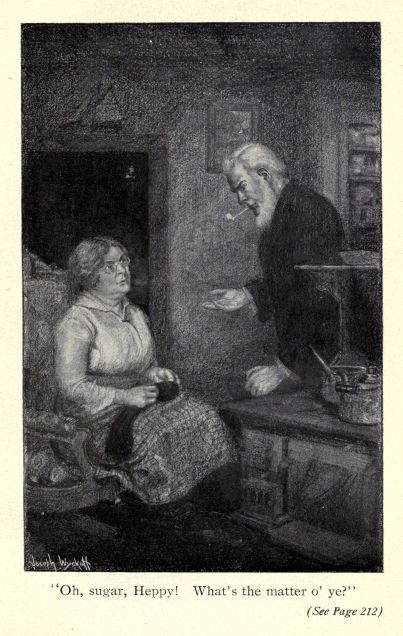
"Oh, sugar, Heppy! What's the matter o' ye?"
"Did—did you get our money, Tobias?" she gasped.
"No, no! O' course not. Things have got to be straightened out."
"Did you see Arad Thompson?"
"Yes. I talked personally with him, Heppy."
"What did he say?" urged the woman.
"Why, he couldn't say nothin' yet. Not till the bank's books was gone over. It's bein' done."
"Tobias, that's only an excuse. We'll never see a penny of our money again!" And his sister broke into passionate sobs.
"Dad fetch it!" ejaculated Tobias, "I give it as my opinion that there ain't never been such a unanimity of opinion on one subject in this community since Noah stepped ashore from the ark. You folks have got it all settled that Arad Thompson is so crooked that he can't lay straight in bed. Oh, sugar!"
It was a very gloomy afternoon and evening at the Twin Rocks Light. The men got what little supper there was. Heppy went to bed still weeping and with a hot brick at her feet.
"An' I give it as my opinion, 'Zekiel," said the lightkeeper to the younger man, with frank disgust in his tone, "that Heppy can think with that hot brick just as good as she can with her head. There ain't no mortal sense in her fussin' and fumin' the way she does."
"But, Tobias! if the money is gone?"
"Oh, sugar!" snorted Tobias. "Mourning over it won't bring our money back. If we've got to lose it, we've got to—that's all."
"But—eight—thousand—dollars!"
"I know. You say it like 'twas eight hundred thousand. But neither sum seems to mean so much to me—not re'lly. I sure won't lose no sleep over it—nor ary meal o' victuals, if I can help it.
"'What can't be cured must be endured,'" repeated this longshore philosopher. "I never re'lly felt that I had much part nor lot in our savings. Once I was in New Bedford when some whalers was paid off after a four-year cruise. A drunken boat steerer stood on the corner of the street an' fed silver dollars into the mouth of a sewer till the police stopped him.
"Puttin' money in the bank always seemed to me something like that, 'Zekiel. You see it go in, but where it goes to, an' what happens to it, is like what the Scriptures says about the ways of the Almighty—they are 'past finding out.'"
"Huh!" said Zeke. "Looks like we know what's happened to this money. 'Twas stole by somebody."
"Oh, sugar!" murmured Tobias. "Is that any satisfaction?"
Tobias Bassett had refused to admit to Arad Thompson that he had any suspicion as to the identity of the owner of the gold penknife he had found under the bank window. Nor did he have such suspicion.
It was merely that the old lightkeeper felt that sometime, somewhere, he had seen such a toy worn on a watch chain by somebody he knew. Unlike Lorna Nicholet he did not remember that Ralph Endicott owned such an ornament.
The young woman rode home from her marketing expedition in a very anxious condition of mind. One moment she mentally castigated herself for considering at all the suggestion that the penknife might be Ralph's property. The next instant the suspicion would attack her from another angle and his possible connection with the bank burglary would expand until she was fairly terror-stricken.
If Ralph had been seen in the town the previous evening by other eyes than those of Conway Degger! If Ralph had seemed to leave Clinkerport in the afternoon, how explain his later presence there?
If Degger thought he could cast any reflection upon Ralph by reporting his observation of the latter in town the night of the burglary, of course he would do so. There was no doubt of that in Lorna's mind. She had no longer any illusions regarding the character of Degger, no matter how much she might disapprove of Ralph. Degger was Ralph's enemy, and a bitter enemy indeed.
Innocent men have fallen under the burden of false accusation, often and again. Several things seemed to yield circumstantial evidence connecting the bank robbery with Ralph Endicott, ridiculous as such evidence must be to the minds of those who really knew him.
If the penknife was his—or like the one he wore! If he really had returned to Clinkerport secretly last evening! If it was a fact that Cora Devine was hounding Ralph for money! And if, as Lorna supposed, the Endicotts were in financial straits and Ralph was without funds!
These suppositions and possibilities wrought upon the young woman's mind until, when she arrived home, she found it almost impossible to hide from the family her perturbation. Her father had not yet returned from Boston. Had he been at home she would have put her fears and suspicions before him.
For, after all, John Nicholet bred a greater confidence in his daughter's mind and heart than did the self-repressed Miss Ida. With the latter Lorna could not bring herself to discuss the mystery of Ralph Endicott's affairs.
She gave to her aunt the bald statement of the bank's loss, and that was all. But Lorna felt that she must search and find all she could that might explain the mystery which, like a haze, surrounded Ralph's absence from home.
She went to Jerome, the Endicott's doddering old servant whom the professor's "Cousin Luce," who was supposed to preside over the household, was forever threatening to pension off.
Miss Ida had scornfully stated that "Lucy Markham ran the Endicott house by fits and starts—the fits being frequent and the starts but seldom!" a statement which was scarcely a libel. If Cousin Luce did not feel like leaving her bed, or had a more than usually interesting novel to read, she remained unseen by the family, sometimes for a couple of days. But the family somehow muddled along without her.
Ralph was too old to lose much by the lack of system in the home. And of course Professor Endicott did not even notice when household matters went wrong. The children helped each other, and somehow were happy.
As it chanced, Mrs. Markham was not visible when Lorna made her appearance at the Endicott house. Whether it was a new novel or a twinge of rheumatism that kept Cousin Luce in her room Lorna did not inquire. An interview with Professor Endicott, had she wished it, was quite out of the question, for he was deep in his experiments.
"Jerome," said Lorna to the old servant, "do you know if Ralph lost that little gold penknife that he wears on the end of his watch chain?"
"No, Miss. I do not know. Was it lately he lost it?"
"That is what I wish to know. Did he lose it?"
"I couldn't say, Miss. He said nothing about losing it to me."
"Then it is pretty sure he did not lose it before he went away yesterday—if he lost it at all," murmured the young woman thoughtfully. "You would probably have missed it yourself, Jerome."
"I don't know about that, Miss. I don't have much to do with Master Ralph's things. No, Miss. Maybe Mrs. Malloy——"
But the housekeeper knew no more than Jerome. Lorna dared go no further with her inquiries. She feared that she might rouse suspicion in the minds of the servants.
She heard nothing more about the bank burglary that day, or what was being done regarding it. She spent a most miserable night. By morning she could not longer remain idle in the matter. She felt that she must confer with somebody and she started for the Twin Rocks Light. Lorna wanted to learn if Tobias Bassett likewise suspected that the gold penknife he had found belonged to Ralph.
Although the time was mid-forenoon, Tobias was smoking his pipe on the bench outside the lighthouse door. And he wore one of Miss Heppy's voluminous kitchen aprons.
"Why, Mr. Bassett! what is the matter?"
"Oh, sugar! That you, Lorny? I've been promoted to be chief pot-walloper of this here craft. 'Zekiel is aloft, cleaning the lamp."
"But Miss Heppy?"
"She's abed. I cal'late she's down for a spell o' suthin', I dunno what 'tis, and I reckon she don't. But whatever 'tis it's struck in."
"Tobias! She is not really ill!"
"She's sick enough," he rejoined, shaking an anxious head. "Bein' sick is mostly in your mind, it always did seem to me. If your mind ain't ready for doctorin' you manage to keep on deck and muddle through somehow. But once your mind gets sick, you lose all holts. And Heppy's lost all holts this time, I do allow. She thinks she won't never see none o' that money we had in the Clinkerport Bank again—never! And it's just about scuttled the ship for her—yessir!"
"But, Tobias! of course the bank isn't bankrupt. There will be no great loss for each individual depositor."
"We dunno that. Dunno much of anything about it. I give it as my opinion that it looks queer. And, as I said afore, Heppy's gin up all hope."
"Oh, that is too bad!" Lorna said. "I must see her. Is she alone?"
"Ain't no women folks around, if that's what you mean. 'Zekiel and me air the whole crew and afterguard. The captain's forsook the ship."
Lorna hesitated before going into the lighthouse, staring down at the rather despondent looking Tobias. She spurred her courage to ask:
"I am told that you found a penknife under the bank window that may have been dropped by one of the burglars."
"So I did," replied Tobias placidly.
"Do you really think it was lost by one of the robbers?"
"Likely. Don't see how else it would have got there."
"Have you no idea who the owner is?"
The lightkeeper wrinkled up his eyes shrewdly and stared at her. He removed the pipe from his mouth.
"I don't count a wide acquaintance among burglars and such, Miss Lorny."
"But—but it might not belong to a burglar!"
"Sure enough. Who do you cal'late it might belong to?"
"Oh!" she exclaimed. "I—I—why do you ask that?" Then, her eyes searching the highway in the direction of Clinkerport, she cried: "Who is this coming, Tobias?"
He turned from her to stare at the blue motor car approaching. He still held his pipe at a reflective poise, for Lorna's evident disturbance of mind had impressed him.
"Oh, sugar!" he murmured. "This here is Arad Thompson's car. You don't s'pose he's come to bring me and Heppy our money, do you? It 'ud please Heppy purt' nigh to death."
CHAPTER XXI
THE RISING TIDE OF DOUBT
Lorna Nicholet made no further comment, waiting anxiously for the big blue limousine to approach. Surely it would stop before the lighthouse.
It did. The door of the car opened. But the crippled Arad Thompson did not appear. Instead, a broad-hatted stranger in a rusty black suit stepped out of the car.
"That's Rafe Silver driving, as usual," murmured Tobias. "But who is this fellow? He ain't no acquaintance of mine."
The stranger came promptly to the lighthouse door. He glanced sharply from the lightkeeper sitting on the bench with his pipe to the young woman in the doorway, and back again.
"You are Mr. Tobias Bassett?" was his opening speech.
"I cal'late."
"Mr. Arad Thompson has sent me to you for some information."
"I'm chock-full of it," rejoined Tobias easily, putting his pipe between his lips again and waving his hand.
"Confidential information," continued the man, glancing again at Lorna.
"That's all right," said Tobias. "This young woman knows almost as much as I do, and a little extry information won't hurt her a mite. What was you lookin' to find out?"
"My inquiry is in regard to the robbery of the Clinkerport Bank night before last."
He threw back the left lapel of his coat with a practiced gesture, revealing a glittering badge pinned near the armhole of his vest.
"Oh, sugar!" murmured Tobias. "A real detective? I cal'late I'm pinched."
Lorna dropped a fluttering hand upon his shoulder, but then saw that the old lightkeeper was still smiling cheerfully.
"You fire ahead, Mister."
"Did you ever see this knife before you picked it up under the bank window?" and the detective displayed the toy in his palm.
"Oh, sugar! Can't say as I did. And yet I might. Seems to me—wal, I cal'late I better say no and be done with it. I can't somehow seem to place that thing," declared the lightkeeper, in deep reflection.
He did not notice Lorna's expression of countenance.
"I hope you will not withhold your opinion, Mr. Bassett," said the detective.
"You take it from me, Mister," Tobias rejoined grimly, "I ain't going to refuse any information that may lead to the recovery of the bank's money and the arrest of the burglars. Me and Heppy's got an eight thousand dollar interest in the robbery, as ye might say."
"You are prepared to help us, then, no matter who is hit, are you?"
"I cal'late," agreed Tobias wonderingly.
The detective produced a little red-covered notebook from his pocket. He thrust it toward the lightkeeper.
"Did you ever see this before?"
"I don't know. Can't be sure that I ever did. But, mebbe."
"This address book was found on a ledge right by the vault door. There seems to be no doubt as to whom it belongs, for the owner's name in his own handwriting is on the fly-leaf. Mr. Thompson is quite convinced of the ownership of the book, for there are specimens of the same handwriting on file in the bookkeeping department of the bank."
"My goodness!" gasped Tobias, staring at the book but refusing to take it from the other's hand.
"This book could not have been on the ledge where it was found at the time the bank closed day before yesterday. The vault door was opened on the combination. And the combination is written on one of the pages of this address book."
"Oh, sugar!" murmured Tobias. "Then you've just as good as got one of the burglars, ain't you?"
"Oh, no!" gasped Lorna, cowering in the doorway.
The men did not appear to notice her agitation. Tobias still smoked calmly. The detective hesitated for a moment before he fairly forced the red memorandum book into the lightkeeper's hand.
"Look at it," he said. "See that name on the front page? Do you know his handwriting?"
Lorna dared not look over the lightkeeper's shoulder. At first glance she had recognized the red-covered notebook. There might have been some doubt regarding the ownership of the penknife; but of the notebook—never!
"My soul and body!"
The pipe dropped from the lightkeeper's fingers and was shattered at his feet. He gave this no attention. He was staring, quite fascinated, at the flyleaf of the little book.
"Doesn't the knife belong to the same person?" asked the detective, with sharp insistence.
For once Tobias was ready with no reply. He fluttered the leaves of the book with unsteady fingers. The visitor continued:
"Mr. Thompson said you would know if anybody did. He says you are a great chum of this fellow's—that he hangs about the lighthouse here a good deal.
"Now, there is no possibility of the book's having been left there before the vault door during banking hours. That fellow was never inside the cage for any purpose whatsoever."
Tobias finally regained his voice.
"You don't mean to say you think he'd be foolish enough to leave this book right in sight if he was one o' them burglars?"
"But I tell you it was found there. And you yourself found the knife under the window. Isn't that his, too?"
"I wouldn't go so far as to say it was, nor I wouldn't say it wasn't," announced the old lightkeeper with emphasis. "But it looks right senseless for him to have left the book there—let's see where you say he marked down the combination? That looks right silly, too. If he knowed the combination well enough to open the safe, why bother to write it down?"
"There it is," said the detective, pointing, and with emphasis. "Those figures in pencil. That is the bank vault combination. Or it was. Of course, it will be changed now."
"Yes. I see. Lockin' the garage door after the tin Lizzie's been stole," commented Tobias.
He squinted a long time at the row of numbers and letters written across the otherwise blank page. He turned back a leaf or two, and appeared to study the addresses written thereon.
"Yes," he muttered. "Writ down in pencil. All the rest in ink. He most always does carry a fountain pen."
"No doubt about that knife being his, too, is there?" insisted the detective eagerly.
"I couldn't say. I give it as my opinion that I shall have to think it over purt' serious afore I can say one way or another."
"You don't claim," the detective said in some heat, "that there are so many fellows around here wearing platinum watch chains that you can't guess?"
"Oh, sugar! I wouldn't take so much for granted, if I was you, Mister. I don't 'low ary one o' them burglars belonged around here."
"How do you explain that address book?" snapped the other. "Left right on that ledge beside the vault door. And the combination written in it."
"Say, Mister," Tobias rejoined gravely, "seems to me I ain't got to explain it. You are the detective, not me. I've come across lots of things in this world o' toil and trouble that I couldn't begin to explain."
"You're stalling," said the detective harshly. "That is what you are doing. And it won't help this fellow any. Where is he? Have you seen him around here this morning?"
"I cal'late I ain't," said Tobias, shaking his head. "Is it true what they say, that he's run away?"
A slow red climbed the lightkeeper's wind-tanned cheek. Even his hairy ear became inflamed. Lorna, who was watching him breathlessly, knew that this dark flush signaled wrath—and Tobias was not prone to lose his temper easily.
"Lemme tell you something, Mister Man," he finally rasped. "I give it as my opinion that you air one o' them 'dead-sure' fellows. You know more than the Creator that made ye—or you think you do."
"I'm here to investigate this burglary," interposed the detective.
"Investigate all you dern please!" exclaimed Tobias. "But don't you come here and try to trip me up, fur I'm purt' sure-footed. I've gone as far as I'm going to. That is, until I know more than I do now. That there book probably belongs to Mr. Ralph Endicott. That leetle gold knife may belong to him, too. Further than that I can't and won't say."
"They tell me down at the village that he's skipped out."
"I don't know nothing about that."
"Is that the house his folks live in—that second one up there on the bluff?"
"Yes."
"Well, I'll go up there and see what they know about him. I guess I'll learn something."
"I cal'late you will," rejoined Tobias, with scorn. "I cal'late that if you see Professor Henry Endicott and tell him his nephew is a bank burglar you—an' Arad Thompson, too—will l'arn more than you expect. I shouldn't wonder."
The detective tramped away across the sandflat. Tobias secured his bandana and mopped his heated brow.
"Oh, sugar!" he murmured. "I ain't got no business bein' all het up this a-way. Won't nothing come of it. I give it as my opinion that fellow is purt' near half a fool!"
"But Tobias!"
He started and looked around. Lorna, pale and red by turns, suddenly clung to his shoulder.
"Tut, tut!" the old man muttered. "I'd forgot you was here, Lorny. Thought you'd gone upstairs to see Heppy."
"I—I am going. But I had to wait to hear what that man had to say. It's awful! Ralph——"
"Ain't no sense to that," interrupted Tobias with scorn. "O' course not."
"But that knife. It is his. I'm almost sure it is!" sobbed the girl.
"Oh, sugar! Wish't I'd never picked it up," complained Tobias. "Ain't nothing positive about it, I tell ye. I was too keen after a clue, I was."
"The book! That is surely his."
"Wal—yes. I cal'late. But it don't look sensible that he'd leave it there in the bank. Somebody picked it up, and put it there. Sure!"
"Tobias Bassett! how do you explain the combination being written in Ralph's address book?"
"Don't believe he ever wrote it there," the lightkeeper replied doggedly.
"Why, Tobias?"
"Them figgers don't look like what Ralph makes. I took a squint at some of his'n. Of course, folks writes diff'rent with a pencil from what they do with a pen 'most always. But, then——"
"Oh, Tobias! you are saying these things just to try to convince yourself—and me—that Ralph is not guilty."
"Oh, sugar! I don't have to convince myself of any such thing. I'd have to try mighty hard to made myself believe that he was guilty."
The young woman stared at him, her countenance very much troubled. She said at last slowly:
"There is no reason in your mind for a belief in his possible guilt, Tobias Bassett?"
"Nary reason," he declared in amazement.
"How about his poverty? If he is penniless? Suppose he needed a large sum of money to save him from trouble—from disgrace?"
"What the——"
The lightkeeper's eyes were staring—almost popping out of his head!
"I know it sounds terrible," moaned the young woman. "But if the Endicotts have lost all their money how do we know what financial trouble Ralph may be in? Oh! can't you see? He might have been desperately tempted. I hate to think of such a possibility. But——"
She burst into uncontrollable weeping at this juncture and, turning swiftly, ran into the house. Tobias had started erect upon the bench. It was several moments before he could utter any comment. Then:
"Now I have done it!" he ejaculated. "I've gone an' put my foot into it half-laig deep, and no mistake. I dunno. Mebbe Heppy's right. Enterin' in where angels fear to tread has its dangers. I cal'late my matchmaking scheme was all right. But who'd have ever thought anything like this would turn up?
"Oh, sugar!"
CHAPTER XXII
WHAT FRETS LORNA
After some further consideration Tobias Bassett came to the conclusion that the startling suspicion regarding Ralph Endicott's connection with the burglary of the Clinkerport Bank was no joke.
That Lorna should actually fear there was truth in the accusation was disturbing enough. But the lightkeeper believed that by revealing to her his own ill-advised deceit in the matter of the Endicotts' financial situation, he could assuage Lorna's anxiety.
It seemed, however, that the public in general—and Clinkerport folk in particular—were likely to jump to the same conclusion that the bank detective and Arad Thompson held.
"It looks right silly, knowing the Endicotts as everybody about here does, and all," muttered the matchmaking lightkeeper. "But if ever that story I told Lorny gets spread abroad——
"Oh, sugar! Telling even a white lie is just like dropping oil on a woolen garment. It spreads, an' spreads——
"I give it as my opinion that if ever Heppy hears tell of my interferin' as I have in these young folks' love troubles, I won't never hear the last of it. Unless Heppy dies before I do—the Lord forbid!"
He sat there and watched the detective come away from the Endicott bungalow after a while. Rafe Silver had turned the car about and waited for the man at the foot of the lane. From where Tobias sat it looked as though the detective had not gained much by his visit.
"I doubt if he even see Henry Endicott," considered the lightkeeper, "he's that dissatisfied. I'd give something to know what that shabby looking sleuth thinks he'll do now. Trying to tie such a thing to Ralph Endicott. Oh, sugar!"
The big blue limousine went back to Clinkerport. The inhabitants of the town by this time were in a ferment. Thirty hours had elapsed—or thereabout—since the discovery of the burglary. The bank had not opened its doors nor had Arad Thompson made a public statement.
Rumor and surmise scuttled through the narrow streets of the port like thunder-frighted fowl. Shopkeepers stood at their street-doors and housewives on their side porches. Gossip was rife and suspicion was bound finally to pounce hawklike on some victim.
Who first tarred Ralph Endicott's name with the brush of suspicion seemed a mystery. Only Silas Compton and Ezra Crouch had seen the little gold penknife Tobias had found under the bank window. The bank president had spoken to nobody save the detective about the toy, and the sleuth was as close-mouthed as a clam.