TOBIAS O' THE LIGHT (continued 2)
Reading edition
"Humph! Sort o' scorned it, did she? It didn't seem to worry her none?"
"Worry her? I should say not! But I guess 'twas only gossip at that. I don't believe Ralph Endicott is the sort of a boy to play fast and loose with any girl."
"Does seem as though we feel about alike on that score, Heppy," reflected her brother. "Ralph, it strikes me, is purt' sound timber. But I wonder, now, where Lorna Nicholet got her information about Ralph's chasing around after that chorus gal? Does seem as though such a story might be one o' the things that makes Lorna so determined to cut Ralph adrift. Oh, sugar!"
But these final reflections of the lightkeeper were inaudible. He had by no means lost interest in his matchmaking intrigue regarding the two young people who he was convinced were "jest about made for each other."
His scheme—if scheme he had—had been in abeyance all these weeks. Now that the families of the young people were about to take up their residence on the Clay Head, he proposed to enter upon a more active campaign for what he believed to be the happiness of all concerned.
Not alone was Miss Heppy aware of the long-past bond of affection between Miss Ida Nicholet and Ralph's Uncle Henry. Tobias Bassett had been just as observant as his sister—or anybody else.
Like others, he had wondered twenty years before why the then young Professor Endicott had not pursued with more vigor the charming, if independent, Ida Nicholet, and made her his bride. There was a romance nipped in the bud which Tobias always felt he might have mended—"if he'd put his mind to it."
In any case he determined not to see the ship of Ralph and Lorna's happiness cast on the rocks if he could help it. He felt that it might be within his power to avert such disaster. The strategic yeast of the true matchmaker began to stir within him.
"Miss Ida," as everybody called Lorna's assertive aunt, could not be long in any place without making her presence felt. Her original and independent character never failed to make its impress upon all domestic, as well as other, affairs. The Nicholet ménage was run like clockwork. Miss Ida was the clock. Everything at the big house on Clay Head was soon working smoothly, and Miss Ida could look about.
She was a tall, free-striding, graceful woman without a gray thread in her abundant dark hair. She piled that hair low at the back of her head, and her neck and throat were like milk, and flawless.
When she came across the barrens under her rose-tinted parasol to see Miss Heppy at the Light, her plain morning dress was arranged as carefully as a ball gown would be on another woman. In addition, her pleasant eyes and round, firm chin, together with her Junoesque figure, made her appearance most attractive.
"Well, Heppy, how do you do?" she asked, her voice mellow and full. "How has the winter gone with you?"
"'Bout the same as usual, Miss Ida," the lightkeeper's sister replied. "You be a pretty sight. None o' the young ones can put anything over you, Miss Ida. You ain't got a wrinkle or a fleck of gray in your head."
Miss Ida laughed. "I'm forty-two. I'm frank to admit it. Why shouldn't a woman be well preserved and in good health at my age if she has never made herself a slave to some man?"
"For love's sake! As for that, I ain't never been married. But look at my wrinkles!"
"Those are creases, not wrinkles, in your case, Heppy," laughed the visitor. "You are getting too fat. And you have been practically a slave for Tobias."
"Sure she has," agreed the lightkeeper grinning. "I've been thinking of putting a nose-ring on her. She's abused, all right."
"You hush, Tobias! I ain't slaved for nobody but him, Miss Ida," declared Hephzibah warmly. "While you, Miss Ida, have shouldered the responsibility for your brother and all his family. If you'd married," added the longshore woman wisely, "like enough you wouldn't have had nowhere near so big a family to care for."
"I wonder?" laughed the other woman. Yet her expressive countenance became immediately serious. "My family is pretty well grown now, Heppy. I am sure even Lorna is old enough to make a nest for herself. She has been out two years."
"Out o' what?" Tobias asked, taking the pipe from his mouth and staring. "Looks to me as though she was well supplied with most everything a young gal ought to have, an' wasn't out o' nothing."
"I mean she has been in society two years."
"Oh, sugar! That's a case, is it, of when you're out, you're in?" chuckled the lightkeeper. "I give it as my opinion that the only thing Lorny lacks is a good husband."
Miss Ida flushed softly. "I hope she will see the advisability of choosing wisely in that matter," the aunt said, speaking intimately to these two old friends, at the expression of whose interest in her family affairs she was far too sensible to take offence.
"Yes," she pursued. "You know what hopes her father and I have for her. An eminently fitting alliance. And Ralph is a manly fellow. It does seem as though those two were quite made for each other."
"Humph! Yes. 'Twould seem so," muttered Tobias. "But it does appear sometimes as though the very things that ought to be don't somehow come around to happen."
"You are a philosopher, Tobias."
"Dunno as that's a compliment, Miss Ida," rejoined the lightkeeper, his eyes twinkling. "I got all my wits about me yet, and most of them philosophers you hear tell about ain't. They get on some hobby and ride it to death. And a man ain't really broad-minded unless he can see both sides to a question.
"Now, takin' the chances for and against your Lorna and Ralph Endicott marryin'. What would you say, Miss Ida, was the one best bet?"
He looked up at her shrewdly, holding his pipe with that familiar gesture of his. Miss Ida's gravity grew more profound.
"I believe you and Heppy must know that of late my niece and Ralph have seemed to fret one another?" she queried.
"They give themselves away some when they stopped over here that time they got stalled in Ralph's car," admitted Tobias. "Warn't it jest a leetle spat?"
"I am afraid not. They have not seemed the same since. And I am afraid it is Lorna's fault," sighed Miss Ida. "She is so hot-tempered. I have warned her. The families have never considered any other possible outcome but an alliance between Lorna and Ralph. I have told her so."
"I cal'late you have," murmured Tobias softly, pulling on his pipe again.
"When she returns from New York—as she will in a day or two—I shall put the matter to her very strongly. If you and Heppy have noticed their drifting asunder, other people must have noticed it too. The Nicholets would be utterly disgraced if it were said that Ralph Endicott—er—dropped Lorna. And if he should, I fear it will be my niece's own fault."
When she was gone Tobias snorted suddenly.
"Oh, sugar!" he said. "If I scorch 'em a mite graced, I want to know, when Miss Ida's love affair with Professor Endicott busted up? Seems to me that leetle gal, Lorny, is going to be put upon by her folks. That won't do."
"Now, do try to mind your own business, Tobias," advised his sister, comfortably rocking. "I know it will be hard for you to do so. But you'll burn your fingers, like enough, if you don't."
The lightkeeper spread out his gnarled, work-blunted fingers to observe them reflectively.
"Oh, sugar!" he said. "If I scorch 'em a mite helping that leetle gal and Ralph Endicott out o' their muss, what's the odds, Heppy? You know, we're put here to help each other."
"That is what most folks say that have an itch for minding other people's business. Now, you have a care what you do, Tobias Bassett."
CHAPTER IX
THE DROP OF WORMWOOD
When Lorna Nicholet first appeared at the Twin Rocks Light after arriving at her summer home, she gave no evidence of needing the lightkeeper's—or any other person's—good offices. She was her usual brisk, contented and fun-loving self.
Conway Degger chanced to be present when Lorna came to the Light. Miss Ida had not seen the young man when she had called on Tobias and Heppy.
"What a surprise, Mr. Degger!" the girl said, giving him a warmly welcoming hand. "I had no idea you were in this locality."
"I am a waif from the sea, Miss Nicholet," he told her. "You ask the skipper, here, about it. I can never thank him enough. And Miss Heppy, too, who has so kindly taken me in and ministered to my well-being."
"He says it pretty, don't he now?" whispered Miss Heppy to Tobias.
"Pretty is as pretty does," muttered the lightkeeper. "Somehow them fanciful speeches of his'n don't bait much trawl with me."
But Miss Heppy considered Conny Degger quite worthy of approval. Lorna found him interesting, too. Perhaps the very fact that her Aunt Ida had opposed her acquaintance with the young man caused Lorna to be the more contrary. And, really, Degger betrayed some rather attractive traits.
During the next few days the girl and the boarder at Twin Rocks Light became close companions. They went fishing together in Tobias's dory. They tramped the beach as far as the Lower Trillion life-saving station, Degger's sprained foot being quite well again. And the young man appeared regularly on the Clay Head bathing beach at the morning bathing hour.
Among the few families already at the resort, who made up a little social world of their own, it soon became a topic of conversation—this companionship of Lorna Nicholet and Conny Degger. Particularly was it commented upon, because for so many summers the girl and Ralph Endicott had been such close chums.
Although the Endicotts had already arrived at the Clay Head, Ralph did not at once put in an appearance. This fact perhaps threw Lorna the more into Conny Degger's company. Tongues began to wag.
"I should say," squeaked Amos Pickering, who was a very busy man these days because of the influx of summer visitors, "that Lorny Nicholet has got another feller. That long-laiged Endicott boy's always been tagging her other summers. Now this here boarder you got, Tobias, is stickin' to her like a barnacle. What d'ye think it'll amount to?"
"I give it as my opinion," retorted the lightkeeper, pursing his lips, "that it won't add none to your burdens, Amos. I don't see no weddin' invitations in the offing for you to distribute."
"She's jest a-flirtin', is she?"
"Like a sandpiper," declared Tobias. "Keepin' her hand in as ye might say. There ain't a mite o' harm in Lorny, but she's got to have some amusement."
He was nevertheless glad to see Ralph arrive. The lightkeeper believed that Lorna would much better have her old friend at hand to compare Degger with.
Had he been present at the first meeting of the trio, Tobias Bassett might have experienced some doubt of the value after all of such comparison. Lorna greeted Ralph very coolly. She and Degger were about to launch the lightkeeper's dory for a fishing trip when Ralph came striding down from the Clay Head.
"'Lo, Ralph," was the girl's careless hail. "Did you put the bait-pail in, Mr. Degger?"
"All right, Miss Lorna. It's right here. How do, Endicott?"
"I heard you were here, Degger," said Ralph, merely nodding to Lorna. "What's running now?"
"Mostly squeteague and fluke," replied the girl. "Occasionally a tautog on rocky bottom. No snappers yet."
"Nothing worthy of Your Majesty's prowess," gibed Degger. "I understand you are a real fisherman," and he pushed off the boat.
Ralph's gaze narrowed and his brow clouded. He sat down on the sand. There was room enough in the dory for a third; but neither of them had suggested his joining them.
Perhaps Ralph's attitude was not exactly that of a dog in the manger. But it did trouble him to see his erstwhile chum so friendly with Conny Degger. Not that he knew of anything actually bad about the fellow. Merely, he had seemed so inconsequential and, at times, rather vulgar.
Ralph was quite aware that some men are one thing to their masculine friends while they act entirely differently in the company of women. Degger, he thought, was of that kind. He hated to see Lorna "mixing up," as he termed it, with the fellow.
He was not wise enough—wise in women's ways—to hide this feeling from Lorna's sharp vision. She flattered herself that her old friend was displaying jealousy. This supposition could not fail to please her. Ralph had become such a nuisance in her opinion, that she was determined to show him that she could easily attract other men. She would flout him and his whole family—as well as her own—by playing about with Conny Degger.
"Ralph thinks that he is the only man who ever pays me any attention," Lorna secretly ruminated. "And goodness knows, he has hung around so close that almost everybody else has been driven off. Conceited! That is just what Ralph Endicott is. Always looking over a tall collar at the rest of the world. If he didn't believe that Adam's last name was Endicott he never would admit relationship with the first of the race! Humph!"
So she treated Degger particularly nicely on this occasion. She overlooked some rather crude things about the young man, and from the shore where Ralph lay she appeared to be having a most delightful time with her fishing partner.
It made her angry to see how Ralph hung around. She delayed coming ashore as long as she could, hoping he would go away. She did not want a scene with him.
Ralph, however, did not even rise from his recumbent position when the fishing party beached the dory on the strand between the out-thrust reefs. Lorna hurried away, and Ralph did not attempt to join her, as she had feared he would. Instead, he got up slowly and aided Degger draw up the lightkeeper's dory.
"Awf'ly nice girl, that," said Degger boldly.
"Yes."
"Good sport, too. I never met a nicer girl."
"I don't believe you ever did," said the other, his level gaze boring Degger rather unpleasantly.
"Oh, I don't know!" ejaculated Degger, with sudden warmth and a sneer on his lips. "I've known a lot of girls——"
"But not of her kind," broke in Ralph. "And don't you think it! Watch your step with Lorna."
"What's the matter with you, Endicott?" snapped Degger. "I don't have to take orders from you."
"Not as long as you go straight you don't," Ralph assured him. "But we all think too much of Lorna Nicholet around her to see anybody try to misbehave with her."
"Oh—you——"
"I know a few things about you. It's none of my business what you try out with other girls," Ralph hastily added. "But you be mighty careful with Lorna."
He turned on his heel then and strode away. Degger sneered after him.
"Think's he is the Great I Am!" he muttered. "You'd think he owned the girl. And putting on his airs with me!" Degger's scowl grew darker as he added: "Guess the beggar wants me to pay up. That is like these rich fellows. They are mighty free offering to lend you money; but they make you feel the obligation forever after."
Now, Conway Degger quite wronged Ralph on this point. The latter had entirely forgotten that Degger was in his debt from some time back in their college days.
Indeed, Ralph Endicott was never one to trouble about money, for he never remembered putting his hand into his pocket when he wanted that commodity without finding it. His family had been wealthy for generations. Just how well-to-do they were in the present generation he had never troubled to ask. Uncle Henry and the family attorneys attended to all that.
It did seem odd that just at this time the money matters of other people should begin to disturb Ralph Endicott. Not that he bothered his head about Conny Degger's affairs. It was somebody entirely different of whose financial difficulties he was unexpectedly made aware.
Coming up from the shore following his brief conversation with Degger, Ralph found the old lightkeeper mending a seine outside the lighthouse door.
"Wal, now," said Tobias, "ye look some het up. I seen ye soaking yourself out there on the sand in the sun, and I cal'lated you'd look like a b'iled lobster when you come up. And you do."
Ralph knew that it was an angry flush Tobias saw on his face. He grinned ruefully.
"More than the sun to make a fellow's blood boil, Mr. Bassett, sometimes."
"Oh, sugar!" rejoined the lightkeeper. "Ye don't let that feller bother ye none, do you, Ralph?"
"I do not like him much," the young man said stiffly.
"You mean you don't like him to be fooling around Lorny, hey?" said Tobias, his head shrewdly on one side.
"It is none of my business——"
"Course it is! Course it is!" exclaimed the lightkeeper vigorously. "I've just about sized this Degger feller up, I cal'late. His folks ain't any too well off, and I bet he'll never get round-shouldered carrying his money around."
"What has that to do with it, Mr. Bassett?" demanded Ralph, rather startled.
"Why, Lorny can't afford to waste her time with a feller like him," the lightkeeper declared coolly. "She's got to marry somebody with money. I know by the way Miss Ida was talkin' the other day over here, she was worried about Lorny marrying."
"What do you mean, Tobias Bassett?" ejaculated Ralph, dropping down on the bench beside him.
"Why, I cal'late you know more about the Nicholets' affairs than I do."
"I don't understand you at all," said the young man. "Do you mean to say——"
"That Lorny's got to marry money—yep!" exclaimed Tobias, pursing his lips and nodding. "It 'ud ease matters a whole lot for Miss Ida and Lorny's father if she gets a rich husband. Why, Ralph! I s'posed you knowed that."
"I never dreamed it!"
"Cal'late that is why they were so anxious for you and her to make a match of it," pursued the lightkeeper. "O' course, she don't know nothing about it. But I give it as my opinion that a rich husband for Lorny is going to take a great burden off the shoulders of her family."
"You amaze me." Ralph's face was a study.
"So ye see," said Tobias, with a cheerfulness that grated on Ralph's nerves, "this Degger feller, unless he's got more money than he's showed any sign of having, ain't got no chance with Lorna. Leastways," he added, "not with her folks."
"I—I never thought of it before," said Ralph reflectively, "but I do not think Degger has much money."
"Then he'd better be shooed away from the vicinity, as ye might say," the matchmaker said vigorously. "For if you air bound not to marry her yourself, Ralph, no use her fallin' into the lap of a poor man."
"You know very well Lorna wouldn't marry me, Tobias Bassett!" exclaimed Ralph angrily. "You needn't talk as though I were at fault."
"Oh, sugar! I don't see you fallin' over your own feet none, young man, to make her marry ye."
"Don't you remember how she talked to me that night we were stormbound here? Didn't she fairly drive me out of the lighthouse right at the worst of the gale? You said yourself it wasn't a night fit for a dog to be out in. If I'd undertaken to walk to Clinkerport they'd have found me along the road somewhere, frozen stiff! That's all she cared about me."
"Oh, sugar!" said Tobias again, "I wouldn't hold that against her. She's spirited, Lorny is. She was mad with you——"
"I should say she was!"
"But she didn't re'lly mean it," pursued the lightkeeper. "If she had thought you were in danger she'd never driv' you out. I'm sartain sure, Ralph, that she thinks a heap of you."
"She shows it!"
"No, she don't show it. No more than you show how you re'lly feel toward her."
"Huh!"
"Oh, I know," declared Tobias wagging a confident head. "You wouldn't see no harm come to Lorny. That's why I tell you as I do that this Degger—'nless he's a sight richer than he 'pears to be—ain't got no business shining around her. I give it as my opinion that Lorna's friends have got to come to her rescue and see that she marries a rich man."
He stopped right there. Tobias Bassett was wise in his iniquity. Without coming out unequivocally and stating in so many words that the Nicholets had lost the greater part of their wealth, he had intimated enough to trouble the waters of Ralph's mind.
The latter could not visualize the luxury-loving, softly-bred girl as a poor man's wife. Why, Lorna never could in this world endure privation, or even a lack of those things which only money—and plenty of it—could purchase.
"Poor girl!" was the young man's secret thought. "She has always expected to have plenty of money in her own right some day. Wonder what John Nicholet has been doing with the family fortune? Speculating, I bet! He's a visionary chap.
"But—but it seems terrible for Lorna if she must marry wealth to save the family from penury. And she all unconscious of the fate in store for her. It is a wicked, wicked shame!"
CHAPTER X
STARTING SOMETHING
It was long before this that the lightkeeper and his sister had been put in possession of Jethro Potts' personal estate by Judge Waddams. The nine days' wonder of that happening was past for Clinkerport folk, and as the old couple made no splurge with their fortune, the neighbors put aside the matter for fresher gossip.
With a stern hand Miss Heppy had put down incipient rebellion on her brother's part. The legacy added to what they already had in the bank made "just a little bit more."
"And that's purt' average unsatisfying," complained Tobias on occasion.
"You mean to tell me, Tobias Bassett, that it ain't a satisfying feeling to know you got nigh eight thousand dollars in the bank?"
"It's jest so much more of a temptation to Arad Thompson," sighed her brother. "Dunno as we'd be found guiltless if the bank did bust and Arad Thompson should run off with the funds."
"I cal'late he won't run far in that wheel chair," said Heppy, perhaps with additional confidence because of the bank president's affliction.
However, their simple minds could not fail to be fixed upon the nest-egg a good part of the time. When one has worked and scraped to get together a few dollars over a long stretch of years, the sudden access of comparative riches cannot fail to become and continue to be a very important topic of thought.
Whenever Tobias took his pay check to the bank and drew the cash needed for their household expenses, he secretly desired to ask the cashier, Mr. Bentley, to let him see that eight thousand in real money so as to be sure the bank was still safely guarding it.
Tobias usually went to Clinkerport in the sloop Marybird on these marketing expeditions, now that the weather was good. Conny Degger on a certain occasion went with him.
Degger's salvage from the wrecked motor-boat had been an oar, one seat-cushion, and a broken pennant staff. In other words the craft had been a total loss. And this fact appeared to worry the boarder considerably.
He paid his weekly stipend of four dollars to Miss Heppy with admirable promptness, and he had sent for a fairly well-filled trunk, so that he made a presentable appearance in public. But he seemed to be, as Tobias had hinted to Ralph, not overburdened with money.
At least, he spent little in the sight of the lightkeeper. He did not even treat the latter to a good cigar, as might have been expected when Tobias gave him passage in the Marybird to and from Clinkerport.
"He ain't no three-minute egg, that's sure," was the lightkeeper's comment to his sister. "He's hard-boiled all right."
Nor did Degger seem to make himself popular with the loafers around the Clinkerport Inn and the livery stable, as so many of the youthful summer visitors did. On one occasion, however, Tobias heard, and saw the boarder in earnest conference with a man who seemed to be quite well acquainted in Clinkerport, although he was not a resident.
"Well, Conny, take it from me," said this individual, "somebody has got to pay for that motor-boat. When a fellow treats me right I'm the easiest person who ever did another a good turn. But they say patience runs out of virtue after a while. That's my case exactly."
"But I haven't any money to spare at present, Burtwell," complained Degger, quite loud enough for the lightkeeper to hear.
"Get busy then and find some. How do you manage to live, I want to know?"
"On expectations," Degger rejoined airily.
"Huh! I've seen her. She looks all to the good," Burtwell said coarsely. "Folks rich, I suppose?"
"As cream," admitted the optimistic Degger.
"And you expect to make a killing, Con?"
"I fancy I am not altogether wasting my time," the younger man drawled in a tone that made Tobias want to kick him.
"Well," Burtwell said, "I can't afford to wait forever for the money I had to advance on that motor-boat transaction. I tell you there is a limit to my patience. But there may be a way for you to help me—and yourself—to some of the wherewithal."
The lightkeeper took his packages then and passed the couple on the store porch. He did not glance at Degger, nor did he wait for the fellow to join him at the dock. He got under way in the Marybird and let the boarder exercise his legs on the shell road if he wanted to get back to the Light for supper.
"Something's got to be done," ruminated Tobias, tacking for the cove, in which he moored the sloop hard by the lighthouse. "This here feller may be able to rush Lorny an' tie her up to some contract 'fore she knows what he's about. He seems a'mighty sure of himself.
"I cal'late," pursued the lightkeeper, "that as the angels fear to tread on this matrimonial path—as Heppy says—it's up to me to do so. I ain't going to see little Lorny get stung in no marriage game. Nor yet I don't mean Ralph shall lose all holts. Something's got to be done."
It seemed as though circumstances played into his hands. Tobias was conceited enough perhaps to believe that he really was foredoomed to act the part of matchmaker. At any rate, there was Lorna on the shore when the Marybird drifted in to her moorings, the site of which was marked by a nail keg.
Tobias picked up the bight of the anchor cable and looped it upon a becket, taking a turn or two for safety. Then he drew up the dory, put aboard his purchases, locked the Marybird's cabin, and sculled ashore. Lorna smiled upon him.
"Nice day, Lorny."
"So it is, Mr. Bassett. Didn't Mr. Degger come home with you?"
"Oh, sugar! I forgot all about him, didn't I? Did you want to see him partic'lar, Lorny?"
"Just wanted somebody to play with," she confessed.
"Wal! wal! you air to be pitied," he said. "Won't Ralph do?"
She made him a little face, but flushed too.
"Ralph Endicott is no fun any more. He's as grouchy as a sore-headed bear."
"I want to know!"
"Yes. He's going away soon, anyway, I understand. And I'm glad of it," the girl declared.
"Oh, sugar! I suppose that's so," reflected Tobias, filling his pipe. "Wal, a feller can't always appear chirpy an' lively when things is going wrong with him."
She flashed him a look of suspicion. "What do you mean by that, Tobias Bassett?"
"Er—wal, like enough he don't feel any too happy. I give it as my opinion that none of the Endicotts do, right now. Wal!"
He sighed reflectively, and slowly pulled on his pipe to get it well alight. Lorna continued to stare at him, a little puzzled frown marring her brow.
"You are the most mysterious person," she said. "Tell me straight out what you mean."
"Oh, sugar! I don't guess I need to tell you what Ralph's trouble is."
She flushed more deeply then, and her eyes began to spark. "If you are hinting that I have anything to do with making Ralph Endicott unhappy——"
"Not a-tall! Not a-tall!" the lightkeeper hastened to say. "But I reckoned you'd know full as much about the Endicott's private affairs as I do."
"Mr. Bassett! what is it?"
"Why, ain't you even heard about it?" exclaimed the old fellow most innocently. "Didn't nobody tell you how the Endicotts have lost purt' near all their money? Oh, sugar! ain't you heard?"
"Never!"
"Wal, they do say Henry Endicott has jest about wrecked the family fortune putterin' with them inventions of his. 'Tain't to be wondered at. Might have been expected. Foolin' away both time and money. Yessir!"
Each of these phrases was emitted between puffs of tobacco smoke which served as a screen for the expression on the lightkeeper's countenance.
"Lost their money? The Endicotts? You can't mean it!" ejaculated Lorna.
"Does seem too bad," went on Tobias. "'Twarn't Ralph's fault, of course. But he feels it, I cal'late, as bad as any of 'em. Like enough he's goin' away from here, like you say, to get him a job of work. I shouldn't wonder," sighed the guileful Tobias.
"Why, Mr. Bassett, this is awful!" There was real sympathy in Lorna's shocked tone.
"I cal'late that if your Aunt Ida did have a liking for Professor Endicott years ago she was wise to turn him down. Yes'm. She likely foresaw the snarl that was comin' through Henry's puttering with these inventions. Your Aunt Ida is a wise woman, Lorny."
"Why, Mr. Bassett!" ejaculated Lorna, some displeasure in both her tone and look, "Aunt Ida is not like that. She is the least mercenary person I know."
"Wal, p'r'aps. I don't know. But she'll mebbe be just as well satisfied now that you did turn Ralph down. Of course, a feller that's got to work for his livin'—has his own way to make in the world—wouldn't do for you."
"I don't know what you mean, Mr. Bassett," cried the girl, her head high, her cheeks red, and already tight-lipped with wrath. "You have no right to say that."
"Oh, sugar! I warn't meaning nothing out the way," said Tobias easily. "It's a good thing you and Ralphie got over your foolishness 'bout each other. Now, ain't it so?"
"You have no right—I won't listen—oh, Tobias Bassett! Is it really so that the Endicotts are poor? Has Ralph really got to go to work? Why! he never hinted at such a thing when he told me he was going away."
"Guess you ain't been showing him much sympathy, have ye?" rejoined the callous Tobias. "But now see here!" His manner changed suddenly. "Don't you go and run off to him and say that I told you all this. I cal'late the Endicotts wouldn't be likely to want all the world and Dick's hat band to know they'd lost their money. Ralph's proud—you know he is."
"Oh, that is true," agreed Lorna, displaying much disturbance of mind. "Ralph is the proudest fellow! It's in the Endicott blood. I suppose they would starve before they would tell their dearest friends of the straits they are in."
"I cal'late," agreed the quite unruffled lightkeeper.
"Perhaps that is what has made Ralph so grouchy."
"I shouldn't wonder a mite."
"I—I really can't think what to do," murmured Lorna.
"Oh, sugar! you can't do anything, child. Ralph wouldn't let you help him. He wouldn't borrow money of a girl. Why, he wouldn't let me lend him any," and the lightkeeper nodded his head ponderously.
It was plain that what he had said had made its impression on Lorna Nicholet's mind. She wandered away, deep in thought and forgetting all about Conny Degger.
"I cal'late," muttered Tobias, "I have started something at last. Now, let 'er simmer!"
CHAPTER XI
THE BLACK SQUALL
Lorna Nicholet was of a joyous heart—a joy-bringer and a joy-giver. She had spent a happy childhood. Miss Ida's firm government had been the very best bringing up the girl could have had, for not only was she of a lightsome disposition, but she was inclined to carry that chief trait of her character to recklessness.
Left to herself, impulse would more often have guided her decisions—both momentous and unimportant—than the really good sense with which she was endowed. She was a charming mixture of infantile trustfulness and downright practicality. She was wont to trust in the good intentions of everybody, yet she often shrewdly evaded pitfalls that girls of her cheerfully optimistic type sometimes get into.
Her happy association with Ralph Endicott caused Lorna to look upon all young men as being like her chum. Because Ralph was chivalrous and a "good fellow," Lorna believed such was the character of all young men. She treated Conway Degger as she always had Ralph. Degger was shrewd enough (or was it because of the warning word Ralph had once given him?) in most instances to pattern his attitude after the example set by the frank and clean-minded Endicott.
Occasionally there were crudities shown in Degger's nature that rather shocked the gently bred Lorna. But she overlooked these lapses on his part, and their companionship was in the main that of two healthy-minded boys, rather than that of a young man and a young woman.
She had insisted upon blaming Ralph Endicott for the determination of their families to force Ralph and herself into an engagement. She felt that if he had "put his foot down like a man" and refused to hear of any such arrangement the Endicotts and the Nicholets, in conclave assembled, would give up the idea. That she had not yet declared in her own household that she scorned Ralph and would not marry him, did not count in her opinion. If Ralph was a real man he would not put such a burden upon her. And then, secretly, she knew her Aunt Ida and her father would take any such declaration on her part very lightly indeed.
"Lorna is very young yet, John," Miss Ida said to Lorna's father, and in the girl's hearing. "Too young to really know her own mind. But surely, when she throws off this childishness of thought, she must agree with us that there is only one proper course to pursue. Ralph is a splendid boy, and his family is irreproachable."
"He's a good deal like his Uncle Henry, I should say," observed John Nicholet.
Miss Ida bridled, as she frequently did when Henry Endicott was mentioned. Lorna had more than once noted it.
"I should hope Ralph would have some traits of character not patterned upon those of his uncle," she said. "I believe that if Lorna takes Ralph Endicott for a husband, she will do extremely well."
What could a girl say in rejoinder to such calm and over-riding statements? Individuality was not to be considered at all! She must look upon a marriage contract as of more importance to the family than to herself.
"I might as well be a French girl, instead of a real Yankee," she furiously complained. "What did our ancestors come here for? For freedom! And I mean to have my share."
"There, there!" sighed Miss Ida, smiling faintly. "At least, my dear, don't be loud if you do insist on being childish."
What could one do under these circumstances? Run away? Flout her family—and the Endicotts—directly? But Lorna had no place to run away to, and nobody she cared to run away with. Least of all at this time did she have any idea of running away with Conny Degger!
That young man bided his time with admirable composure. If he was deeply enamored of Lorna, he succeeded in hiding the feeling from public view. The girl wanted a male companion to "play with." Beyond having a good time swimming, and boating, and fishing, and following other longshore pursuits, Lorna had no thought. Degger was a patient waiter.
The old lightkeeper's suggestion that Ralph and his family were in financial difficulties gave Lorna certain pause. She had been treating Ralph whenever they met to a mixture of careless comradery and downright snubbing. He could consider himself as being, in her opinion, of small importance. She thought this had begun to make its impression on what she called "His High-Mightiness."
Of late she had caught Ralph looking at her with an expression of countenance that she could not altogether fathom. Was it a look of compassion? And why? Or did it display his secret fear of losing Lorna altogether? The girl never had believed that Ralph Endicott was as much opposed to the determination of the two families to get them married as she herself was. What girl with a proper amount of pride and vanity could have believed such to be the fact?
Tobias Bassett's matchmaking, brought to bear upon Lorna's mind, caused the girl to reconsider Ralph's evident disturbed mental state. If Mr. Henry Endicott had frittered away the family fortune, as Tobias intimated, naturally Ralph's family would insist more strongly than ever that he marry Lorna.
Upon coming of age Lorna would have a considerable fortune in her own right. This dowry the Endicotts naturally would consider as being the salvation of Ralph's fortunes, if not of the family's. Nor did this thought seem at all shocking to the girl's mind.
The idea of Ralph going away to look for a business opening seemed much more disturbing to Lorna. That an Endicott should be obliged to seek a livelihood in the ordinary marts of trade was a most upsetting thought. She really wished—did Lorna—that she might do something for her old chum in a financial way without thereby pledging her hand to him in marriage.
The effect of all these disturbing thoughts upon her own peace of mind was to be considered. Already her Aunt Ida had emphatically declared it to be Lorna's duty to marry Ralph. If Miss Nicholet knew of the waning fortunes of the Endicotts, would she not be the more insistent that her niece keep faith with Ralph and fulfil the contract so long arranged by their kin?
"My goodness!" sighed Lorna, being sorry for Ralph, yet more sorry for herself, "if it would only enter Aunt Ida's head to marry Professor Endicott. That would be a logical way out of it, and would relieve me. And if Aunt Ida was once in love with Ralph's uncle, why shouldn't she come to the rescue instead of making me the sacrificial offering? Oh, dear!"
Lorna's confidential relations with Ralph, however, were broken. Instead of planning the day's activities with her old chum, it was to Conny Degger she turned for assistance in pleasurably killing the idle hours alongshore.
Degger did nothing quite as well as Ralph—unless his small talk was more amusing. He did possess a fund of amusing chatter; whereas Ralph had been wont to lapse into long spells of silence while he and Lorna were fishing or sailing. Lorna often accused Degger of "talking the fish off their feeding grounds."
Still, the light chatter of her new chum was not altogether unentertaining. She could not expect any other young man to be just like Ralph Endicott. Indeed, she told herself she did not want Conny Degger to be the same sort of man as Ralph.
Now she had a chance to take the lead when they went fishing or boating. She knew infinitely more (thanks to Ralph) about such sports than Degger. Lorna could not, however, manage a boat—not even the lightkeeper's dory—as well as Ralph. No fisherman's son in all Clinkerport was a better sailor of small craft than Ralph Endicott.
So it was that the day came when Lorna (whether she would or no) desired the presence of Ralph instead of Conny with her in the dory off the Twin Rocks. She had ample opportunity on this occasion to compare the two young men.
The weather had been uncertain all day. When Lorna and Conny Degger came over from the Clay Head and borrowed the lightkeeper's dory, Tobias would surely have warned them against going out had he seen them. But he was taking his daily nap, for his care of the lamp in the tall tower kept him awake a good part of each night.
Gusts of wind were swooping down upon the sea and ruffling it into lurid patches far off shore—certain indication of coming trouble. After the dory was beyond the shelter of the reefs the pleasure seekers saw streaks of driving rain racing across the wave tops, away out on the open sea. But the fish began to bite ravenously.
It was while their luck was so good that Lorna saw suddenly a figure scrambling over the shore-end of the outer reef, and waving an energetic arm to them.
"Now, what does he want?" the girl demanded, with no little exasperation.
"Who is it? The skipper?" Conny asked lightly, and without turning his head.
"It's Ralph," she said shortly.
"Oh! Endicott? He is always trying to butt in, isn't he?" suggested Conny, laughing. "Sour grapes, I suppose. Let him swing his arm off. He doesn't own this boat."
Lorna giggled. "It's funny," she commented, glancing back at the figure gyrating on the rock. "Ralph doesn't often get so excited. And over what, I wonder."
Neither she nor her companion looked skyward. Over the bay a black mass of cloud had risen and was rolling toward the open sea. Lurid lightnings played upon its edges.
The dory in which the girl and Conny Degger sat was several cable-lengths off the jaws of the reef. It seemed as though they had plenty of clear-way in which to manage the craft if a squall did strike. Neither, however, expected what was threatening from the cloud.
When Ralph, mooning alone alongshore, as had become his wont of late, spied the coming squall and the couple's danger therefrom, there was ample time for the fishers to have got up anchor and gained shelter between the Twin Rocks.
It was several minutes before Ralph realized that Lorna at least was deliberately ignoring his effort to warn her of peril. Or was she so much under Conny's influence that she considered his wisdom in weather matters above that of Ralph?
The latter might be stung in his pride—a vulnerable spot—by such a thought; but the occasion was too serious for him to shake off responsibility by a shrug of his shoulders.
He saw at last that the fishers were determined to yield him no attention. So, turning swiftly, he scrambled back to the sands. At the cove lay his own motor-boat, the Fenique, the fastest of the small flock of craft moored in the cove. In five minutes he reached the strand, pushed in a skiff, and sculled out to the Fenique's moorings.
Already the oily black mass of cloud had spread over the greater part of Clinkerport Bay. Thunder muttered behind it. The vivid lightnings intermittently lit the edges of the cloud. Behind that screen lurked an electric storm that, when it burst, promised disaster. Any light craft in its path would be as mere culch before a cyclone!
The barren backbones of the two reefs hid the dory on their seaward side from the site of the Fenique's moorings. Lorna and Conny might see their danger in season and make for shelter while Ralph was getting his motor-boat out of the harbor. But Endicott must take the risk of this. As the girl and her companion in the dory had refused to heed his warning, Ralph must needs risk his own life.
In spite of the seaworthiness of the lightkeeper's dory, Ralph did not believe Degger was seaman enough to handle the boat in a black squall. On him might rest the burden of the couple's rescue from the tempest that threatened.
He snubbed the skiff's painter to the mooring buoy. The motor-boat was in readiness for immediate use. He cast off the mooring hawser and went forward to turn the wheel. The spark caught the first time he threw the wheel over. The exhaust coughed sharply. Ralph eased on the engine and seized the spokes of the steering wheel as the propeller blades began to revolve.
The Fenique swam out into the open cove, and he headed her for the points of the double reef. The mouth of sheltered Clinkerport Bay was filled with racing, foam-crested waves, the slate-hued sides of which were veined with yellow. It was a wicked-looking patch of water into which Ralph steered the motor-boat.
Above the thunder of the breakers on the rocks and the roar of the surf along the shore he could now hear the high whine of the coming squall. The black cloud seemed suddenly to have expanded into a smothering mantle over both shore and sea.
As he steered the motor-boat around the out-thrust rocks, the black squall burst. The dory had not escaped the peril of it. Lorna and Conny had got up the kedge, and now Degger was at the oars tugging vainly to drive the dory shoreward.
"The poor fish!" was Ralph's rather futile comment.
A good boatman would have known instantly that to head into the wind was a perfectly useless undertaking. There was a short mast and a sail lashed under the thwarts. To step the mast and spread a hand's breadth of canvas, so keeping the dory before the wind and to outrun the waves that were already beginning to climb, was the seamanly thing to do. Just as Ralph had feared, Degger was doing what most surely would bring the girl and himself into jeopardy.
"Ought to be a law against fellows like him ever getting into a boat!" muttered Endicott, increasing the speed of his own craft when clear of the point. "He's lost one boat already. You'd think that would satisfy him. And to lug Lorna along with him——"
Ralph might have been somewhat unfair in this criticism of Degger; but he was much worried for Lorna Nicholet's safety. Under the increasing strokes of the propeller the Fenique began fairly to bound over the waves. She shook all through her length when her propeller blades plunged out of the water. She was only "hitting the high spots" when she came into view of the two in the dory.
Lorna screamed in satisfaction at sight of the Fenique with Ralph standing in her cockpit. It was a cheering sight.
But Conny missed his stroke as he glared over his shoulder to see the approaching rescuer. A wave slapped aboard the dory, half filled it, and dragged one of the oars from Degger's hand.
Lorna screamed again, this time in actual fear. She was waist deep in the sea that had come inboard. Degger showed no white feather, although he was awkward in getting into the stern with the remaining oar. The dory had begun to swing broadside to the bursting seas, and their situation was indeed perilous.
Ralph shouted a command that the two in the dory did not hear. Degger knew of but one thing to do. He saw the dory in danger of being swamped in the trough between two waves, and he plunged the oar into the sea to right her. The next instant another wave came inboard, the impact of it all but throwing him on his face in the bottom of the boat.
The dory began to settle under this weight of water. Their submersion seemed to be at hand.
CHAPTER XII
TROUBLED WATERS
Each succeeding wave was likely to slop over the gunwale and add to the cargo of salt water already shipped by the dory. She was squattering down like a wounded duck, and seemingly quite as helpless.
Degger was able only to cling to the steering oar, and that was a most futile thing to do. Lorna seized the bailer and threw the water out as fast as she could. But one person could not bail as fast as the sea came inboard.
The Fenique, meeting the cross-seas as Ralph Endicott steered her down upon the wallowing dory, rolled enormously, but her owner knew the craft's seaworthiness. Her water-tight compartments, bow and stern, would keep her afloat even if the cockpit filled and she became quite unmanageable.
The dory was fairly water-logged. That indeed was the salvation for the moment of her two passengers. The dory would not turn turtle while it swam so low in the sea.
Lorna was at last thoroughly frightened. It was not that she had never been in equal peril. Once, when they were half-grown, she and Ralph had been swept out to sea in a never-to-be-forgotten tempest, and had taken refuge upon the Quail Shoal lightship. That was an occasion to be remembered in very truth!
But the girl had not experienced at that time this terrible sinking feeling of helplessness that she now endured. It was born in her mind that it had been her perfect trust in Ralph Endicott that had buoyed her up on those other occasions when they were in peril together. She felt her own helplessness at the present time, and in Conny Degger's face she marked nothing but an equal fear. Degger possessed none of Ralph's initiative nor any degree of his cool courage.
She was face to face with death. She could not swim to the shore in such a sea as this. Indeed, no swimmer could live in it. If Ralph in his motor-boat did not overtake them soon, Lorna believed there was little hope for Degger and herself.
She continued to bail desperately. The water in the boat rose against her breast and almost choked her. The chill of it made her gasp. Dimly she saw Degger struggling with the oar. She looked away at the plunging Fenique with Ralph standing amidships and clinging to the wheel.
"Ralph! Oh, Ralph!" she cried aloud.
The words were driven back into her throat by the gale. Degger's wildly glaring eyes betrayed his complete panic. His very soul had turned to water. It was mere muscular reaction—like that of a dead man—that caused him to cling to the oar. He was positively transfixed with terror.
The motor-boat plunged awkwardly toward the water-logged dory. Its bow seemed aimed to ram the smaller craft amidships. The girl stopped bailing.
If the motor-boat plunged upon them, what could save the two in the dory? Lorna stretched her arms out to Ralph, Conny Degger released the oar, ashen-faced and trembling.
Ralph's voice (how full and unshaken it seemed!) came down the wind to them:
"Stand by to grab the rail! Look out for yourself, Degger!"
He threw the steering wheel over and lashed the spokes to hold it steady. As the Fenique's bow swerved off from the floundering dory, Ralph sprang upon the roof of the cabin and flung himself along its slippery surface to reach Lorna's out-stretched hands.
"Hold hard, Lorna!" he shouted.
The motor-boat slid past the dory. Ralph fairly snatched the girl out of it.
Astern he heard an awful cry. Hugging Lorna tightly in the embrace of his right arm, Ralph looked back.
Conny Degger had missed the Fenique's rail, but he had gripped the bight of a rope trailing overboard. He was being towed in the sea; dragged through the bursting waves rather than over them. His precarious situation was not to be derided.
A curling sea toppled over their heads and fell, a smashing weight, upon the Fenique. The motor-boat staggered under the impact of the blow. The cockpit was awash as Ralph stumbled down into it with Lorna in his arms.
The girl struggled out of his grasp. She seized the rail, gripping it with both hands.
"Conny! Save him!" she shrieked.
At this juncture her anxiety for Degger seemed to mark a deeper interest than Ralph had suspected she felt for the man.
But Ralph had first their ultimate safety to think of. He leaped for the wheel and relieved the strain under which the Fenique labored. He payed off carefully until the motor-boat began to ride the billows more buoyantly.
When he stoppered the wheel again and turned to aid Degger, Lorna was creeping aft with the evident intent of laying hold of the rope to which the man clung. But she did not possess the strength to drag him inboard.
Ralph set her aside with a fending arm and seized the rope. With a long haul and a heave, he brought the gasping Degger under the rail of the motor-boat.
As the craft rolled, Ralph leaned over the rail and seized the half drowned Degger just as the latter's grip slipped from the rope. While the rail dipped to the running sea the rescuer heaved him in-board.
Then Ralph leaped back to the wheel and righted the motor-boat again. When she was once more headed right, flying ahead of the blast, he glanced over his shoulder. Lorna was on her knees in the bottom of the boat with Conny Degger's head in her lap. The tableau was somewhat startling.
Of course, if she really cared for the fellow——
Then what Tobias Bassett had said about its being necessary for Lorna to marry a wealthy man flashed into Ralph's mind. Degger certainly was not wealthy. Ralph had reason to know this to be a fact.
If the Nicholets were in financial straits and looked to Lorna to make a moneyed marriage, the girl had picked the wrong partner in her match-making.
Ralph did not feel any scorn for Lorna in this supposition. He only pitied her. Determined as she was not to marry Ralph, Endicott knew she must be forced by family pressure to accept the next best marriageable possibility. But he was sure Lorna was misinformed regarding Degger.
Of course, the latter believed the Nicholets to be wealthy. He was, Ralph was confident, nothing more nor less than a fortune hunter. That his old friend and this Degger were mutually mistaken in each other's financial affairs was not a situation from which Ralph could extract any amusement. Not at all! He hated to see Lorna waste any of her thought—perhaps a measure of her confidence—upon such a character as Degger.
"She has gone through the wood and picked up a crooked stick, after all," Ralph reflected, while maneuvering the motor-boat. "I didn't think she was such a little fool!"
There was some bitterness in this expression of his thought. Although he had no wish to marry Lorna (or so he almost hourly told himself) Ralph Endicott felt a certain proprietorship in the girl because of their years of intimacy. Had she been his sister he believed he would have felt the same.
When Degger learned that Lorna would have no dowry, he would leave her flat. He was not a fellow to really fall in love with any girl. He was too much in love with himself, was Conny Degger.
Ralph looked around again. The man was recovering, and Lorna had drawn away from him. She was saturated as well as Degger, and Ralph saw now that she shook with the cold.
"Come here, Lorna, and hold the wheel. Just as she is. There! I'll get you something to put on."
Ralph drew out his keys and unlocked the cabin door. He found a heavy pilot-cloth coat and made the girl put it on.
"If Degger wants anything let him look around for it," Ralph said, not altogether graciously.
Lorna flashed him an inquiring glance from under her wet curls. Was it possible that he was showing jealousy of Conny Degger? In spite of their perilous position, she was amused by this suggestion.
That they were by no means out of danger was evident. The sea was running high, the wind still blew, and driving rain flattened the tops of the waves and beat upon the voyagers on the Fenique most viciously.
The motor-boat was still running before the gale. Seaworthy as she was, Ralph did not dare put back for the harbor's mouth. Lower Trillion was the nearest port they could hope to make in safety.
It was too stuffy and uncomfortable in the low cabin to attract the girl. Besides, one felt safer outside with the seas running as they were.
She looked at Conny Degger's face again. Its expression declared so plainly his panic that she turned her gaze away quickly. Never again, Lorna told herself, would she be able to look at that young man without remembering his cowardice.
Ralph however did not understand this. He had mistaken the natural pity the girl showed Degger for a much more tender feeling.
Endicott had no suspicion that Lorna had been playing Degger all the time for the express purpose of making Ralph himself feel slighted. It wickedly delighted the girl to feel that she was making her old chum jealous.
This possibility Ralph would not have admitted in any case. Professor Henry Endicott and the other members of his family were constantly hinting at a contract between Ralph and Lorna. Of late more than a little had been said to him regarding the girl's association with this Degger. Why did Ralph not put a stop to it, they inquired.
Although he denied to himself that he felt any jealousy, he had begun to believe that it was his duty to separate Conny and Lorna. He was not so lacking in humane instincts as to wish that Conny had lost his grip on the rope when he was overboard so that the difficulty would have been quite satisfactorily settled; and yet the thought flashed into his mind.
As Ralph conned the course of the plunging Fenique he likewise conned the problem of how to get rid of Conway Degger without inspiring in Lorna's breast a greater liking for the fellow than he believed she already sustained.
They raised the Lower Trillion life-saving station and drove on for the mouth of the harbor. A can buoy marked the channel and a deep-mouthed bell in a bracket on the end of the stone pier tolled intermittently. Ralph skilfully steered into the calm pool behind this breakwater.
"Some traveling," he observed, when he had shut off the engine and looked at his watch. "Forty-five minutes from the light. The old tub never made better time, even in a flat calm."
"Are we safe at last?" gasped Degger, sitting up.
"Just as safe as though you were at home and in bed," rejoined Ralph rather bruskly.
"What shall I do?" Lorna asked. "I look a fright."
"Why, Miss Lorna," Conny said, quickly regaining his spirits, "you'll have time enough to dry your things in the cabin. We'll be here for hours, I suppose."
"We may," Ralph said quickly. "But Lorna can go home by land. I'll find somebody with a flivver to take her up to Clay Head."
"Oh!" exclaimed Degger. "Then I guess I'll go with her."
"Guess again," Ralph rejoined. "I need you."
"What's that?" ejaculated the other.
"We'll start back in the Fenique just as soon as the wind hauls off a little. She's fluttering now."
"Do you think for one moment that I would risk my life outside in this dinky little craft again unless it is calm? I guess all these motor-boats are alike—as unsafe as they can be!"
"Oh, I'll not start back for the light until all danger is over," Ralph told him quietly. "The clouds are breaking. In a couple of hours it may be all right. And we must pick up Tobias's dory and tow it in."
"Of course!" Lorna said cheerfully. "I had forgotten that."
"Say!" exclaimed Degger loudly, "the skipper's dory can drift to the Bahamas and back again, as far as I am concerned. I wouldn't trust myself outside again to-day——"
"Then who will pay Tobias for his boat?" demanded Ralph sharply.
Lorna had been about to suggest this very point—although more diplomatically—when Ralph blurted out his question. The scorn expressed on his face and the fire in his eyes stirred her to some defense of Degger's selfishness.
"Of course I will pay Mr. Bassett," she said decisively. "It is my fault that we lost the dory. I asked Conny to take me out in it. I will pay Mr. Bassett if it is lost."
"It isn't going to be lost if I can help it," growled Ralph. "You can't sink one of those dories very easily. I believe I can find it, if we go back before night. Tobias is fond of that boat, too."
"Well, find it, if you are so set on doing so," snarled Degger. "I refuse to risk my life."
"You are a lot keener on saving your life than anybody else, I imagine," Ralph rejoined scornfully. "I shall need somebody to help when I catch the dory, and you're elected."
"You can't bully me, Endicott!" cried the other. "I don't like your manner, anyway."
"That makes me sad," drawled Ralph. "I'm going to weep over that—when I find time. But we'll have a try for Tobias's dory first."
"I won't go with you. You can't make me. I will accompany Miss Lorna."
"We'll see about that," was Ralph's rejoinder. He turned to the girl.
"I'll signal the station. Perhaps Zeke Bassett can get off, and he will take you up in his car. He can find a boat to take you ashore. I don't want to beach the Fenique."
"That's all right, Endicott. You need not bother about Miss Lorna," put in Degger. "I'll attend to her transportation to Twin Rocks."
Lorna had hesitated to speak while the young men quarreled. Slowly however her expression of countenance had hardened. She turned from Degger and asked Ralph abruptly:
"Do you really think you can find the dory? Will it be afloat so long?"
"Oh, yes. Hard work to sink one of those boats. With somebody to help me I'm almost sure to recover it."
"You needn't look to me to help you," sneered Degger.
"I'll go back with you," Lorna said quickly. "I can manage the Fenique while you fish for the dory."
"Miss Lorna! You won't think of such a thing!" Degger cried.
She ignored him.
"I'll go below and light a fire, Ralph. My things will be dry in an hour. You put on this coat, or you'll catch cold," and she slipped out of the pilot-coat.
"Not me," said Ralph easily. "Let Degger put it on. He'll be cold riding up to the light in that open car of Zeke's."
Lorna dropped the coat on the bench and without looking again at Degger opened the cabin door and slipped below. Degger's face displayed his chagrin. Ralph chuckled audibly, turned his back on the fellow, too, and shouted shoreward.
The coming of the Fenique had been marked by the lookout in the cupola of the life-saving station, and the very member of the crew of whom Ralph had spoken, Zeke Bassett, now appeared upon the sands.
"Got your car handy, Mr. Bassett?" called Ralph. "Got a passenger for you to take to the Twin Rocks Light—and beyond."
"Sure, I'll take him," was Bassett's reply, seeing that Ralph indicated Degger. "Got enough of the briny, has he? I'll come right out in Sam's skiff for him. You had some weather comin' down, didn't you, Mr. Endicott?"
"'Some weather' is right," agreed Ralph. "But she's clearing now, don't you think?"
"Sure," said the surfman. "Them black squalls don't really amount to nothin'—after they are over."
Ralph turned to Degger again. The fellow was recovering a measure of his usual confidence. He put on a somewhat uncertain smile.
"If you all think the trouble is over, I don't know but I might go back with you after all."
"I do know that you won't!" Ralph retorted. "You get into that skiff, Degger, when Bassett comes out for you."
"Say! who are you bullying, I'd like to know?"
"I'm telling you. I did pick you out of the sea, but I don't have to keep you aboard here any longer than I wish to. You'll go ashore now."
"Oh, yes! That is the kind of fellow you are," snarled Degger. "You've had it in for me ever since I borrowed some of your loose change back there at Cambridge. I haven't forgotten it—don't think!"
"I thought you had," was Ralph's mild sarcasm.
That did not even cause Conway Degger to blush. He still spoke heatedly. "I presume you expect me to fall down and worship you for saving my life."
"Not you," sighed Ralph. "Gratitude I am sure is not your besetting sin."
"Oh, you're only jealous," sneered the other. "Anybody can see that. And you think you'll have a better time alone with Lorva aboard than you would if I went back to the light with you."
Ralph started for him. Then he halted, holding himself in. If there was a fight here on board the motor-boat Lorna must surely be aware of it. He bent on Conway Degger a look that warned him that he had gone far enough.
"I know just the sort of scamp you are, Degger," he said in a low voice. "I should not have let you hang around as you have. Your rep at college was enough."
"How about your own?" sneered Degger. "There was that Cora Devine—how about her?"
"Well, how about her?" rejoined Ralph, with unmoved countenance.
"You try to interfere in my affairs," Degger said furiously, "and somebody will hear all about that Devine girl—believe me!"
"I don't just get you, Degger," Ralph returned calmly. "But if for no other reason, that threat would make me promise to interfere—and to some purpose."
"You——"
"Listen!" commanded Ralph, with a gesture that silenced the oath on Degger's lips. "When Zeke Bassett takes you as far as the Twin Rocks Light, you pack your grip and go on with him to Clinkerport. I don't care how far you travel beyond Clinkerport. But if you are still at the Light when I get back there, I'll thrash you out of your skin! Believe me, Degger, I mean it. I hope you will be unwise enough to wait for me at the Light. You'll be glad enough to go after I give you what you are suffering for."
He turned to catch the loop of the painter Bassett tossed him, and drew the skiff alongside the motorboat. Degger did not even hesitate. He stepped down into the small boat, shaking with the cold, if not with fear. He scorned Ralph's pilot-coat. The surfman grinned up at Ralph, nodded, and pulled back to the strand.
Ralph Endicott had taken the bit in his teeth. He was determined to run certain matters his way from this time on!
CHAPTER XIII
CROSS PURPOSES
An odor of coffee was wafted through the cracks around the cabin door. In a little while Lorna called him.
"I've made a hot drink, Ralph," she said. "Just as soon as I get my clothing dry you must come down and change."
"Thanks, Lorna," Endicott said, accepting the cup of coffee. "But I don't need to. I didn't take a header into the briny as you did. You'd better put on my oilskins. Your dress won't be fit to wear."
He had removed his shoes and socks and rolled up the legs of his trousers. In this free-and-easy costume he could the better get about the wet boat. He swabbed out the cockpit and set the waterproof covered cushions on their edges to dry. He wiped off the machinery with a handful of waste, and tried the spark. The mechanism of the Fenique seemed to have suffered but little from the battering of the heavy seas.
The clouds scattered quickly. The sun appeared again, low hung in the west and of a golden-red—prophesying that old weather-wise doggerel:
"Red at night
Sailors' delight."
The slate-colored seas outside the harbor still ran high, but they heaved now without breaking into foam. Their rumbling thunder against the breakwater was more subdued; no longer did the fierce insistence of the black squall mark the sound of the surf. The brief tempest had winged its way out to sea.
"Shall we start soon, Ralph?" asked Lorna, appearing from the cubby in the mannish apparel he had suggested.
"If you are not afraid that it is still too rough."
"Nonsense! I'm not afraid with you," she said with a frankness that secretly pleased him. She seemed quite unconscious that her words marked a comparison of Conway Degger and Ralph. She added: "The Fenique is a good boat."
"We'll try it, then," Ralph said cheerfully and without looking directly at her.
But she was worth looking at! With her glossy curls banded with one of Ralph's old neckties that she had found below, her dark and glowing face was more piquant than usual. The oilskins swathing her figure made it seem veritably boyish.
She, too, was barefooted, and her tiny, high-arched feet were as white as milk. Ralph looked at them shyly; but Lorna seemed quite unconscious of his scrutiny.
They did not speak of Conway Degger. Yet Ralph thought—it was a poignant flash in his mind—that the girl had been just as unconsciously frank with Degger as she was with him. Was she not too old now to play about with men, like the little tomboy she was wont to be?
Never until Degger had come into their life had this thought ruffled Ralph's tranquillity. Surely Lorna Nicholet was a woman grown. She should leave off childish things.
Yet she was such a bewitching morsel of a girl! Ralph moved nervously. He cast another glance at those wondrously white, blue-veined insteps.
She was so slim, yet perfectly formed! The ankles sticking out of the rolled-up legs of the oilcloth trousers were wonderfully sculptured. She sat on the bench with her ankles crossed before her, for all the world like a thoughtless boy. Nevertheless her sex-charm took hold upon Ralph Endicott's senses as it never had before. "Why," he told himself, "what a sweet wife Lorna would be for the man who wooed and won her!" It was sacrilege for a fellow of Conny Degger's kind to be accorded even the most innocent association with her!
"She's nothing but a child in thought," Ralph told himself. "She's had too much freedom. Or have I grown up in this last year while she has remained just what she looks to be—a little, winsome child?"
Ralph Endicott should have looked twice, perhaps. As he turned determinedly away the girl shot him a roguish glance from under her tumbled curls. Then she drew in the tiny feet, and the voluminous trouser-legs fell over and hid them.
Ralph did not understand the new feelings stirring within him. Without another word or glance he started the engine and steered the motor-boat for the narrow entrance to Lower Trillion Harbor.
The sea was extremely choppy at the harbor mouth. The motor-boat danced about, her propeller wiggling wildly out of the water more than half the time. But Lorna expressed no perturbation. She only clung to the rail with both hands, and when a billow chanced to break and dash a bucket of water over her, she laughed aloud.
"Plucky kid!" thought Ralph with pride. "There never was a girl to beat her—never!"
Yet he had by no means forgotten how unkindly she had treated him. There was that time back there in the late winter when they had been cast upon the hospitality of the lightkeeper and his sister. Ralph could not overlook that occasion.
"If she thinks she can pick me up and throw me away again, like an old glove and just as she pleases, she's a lot mistaken," the young man told himself. "I believe Lorna is a born flirt."
He could not really harden his heart toward his little chum. But he told himself he was not blind to her faults. He had always excused her waywardness, even of late. And now what Tobias had said about the Nicholets' financial trouble made Ralph feel even more consideration for the girl.
Of course Miss Ida and John Nicholet were particularly desirous that Lorna should marry Ralph, especially in view of the family's misfortune. And if Ralph did not marry her the Nicholets might make it very unpleasant for Lorna.
"I'll say they will," sighed Ralph. "She doesn't know about their poverty, poor girl. They are covering it up all right. But it is going to put us both in a mighty tight corner. Lorna can't marry a poor man in any case. Why! that is preposterous to consider even. But if she doesn't favor me—and heaven knows she doesn't—how will she ever square it with her family? They have never given her a chance to meet the right chaps.
"Great grief! Do I want to marry Lorna or not? I wonder!"
He cast another glance at her over his shoulder. She still sat on the bench. She had shaken the curls over her face, and her red lips were pursed in a most adorable pout.
Ralph sighed hugely, shrugged his shoulders, and looked forward again. It certainly was a puzzle!
Suddenly he saw something that brought a cry from his lips. Lorna jumped up and ran to him, clinging to his arm and pressing close against him as she looked over his shoulder.
"Oh! do you see it, Ralph?" she cried.
He pointed. The dory heaved into view again on another billow—a dark patch upon the slate-colored sea.
"Can we catch it?" breathed Lorna in his ear, a curl brushing his flushing cheek.
"To be sure," and he moved aside. "You take hold here. She doesn't kick much. Steady now!"
"Oh!" she pouted, "I can manage the old wheel well enough," and she crowded in beside him.
She had rolled up the sleeves of his storm jacket, and her little brown hands gripped the wheelspokes in a most capable fashion. Ralph stepped back and allowed her to take his place. He grew cool again and grinned to himself. She certainly was one plucky girl!
He had no idea that he had overlooked a chance that perhaps would never be offered to him again.
He got a bucket from below and then coiled down a length of halyard and held the end of it in readiness as Lorna brought the Fenique rubbing alongside the wallowing dory.
Ralph went over the side, carrying the rope and bucket with him and stood knee deep in water in the dory's bottom. He bent on the line and gestured to the girl to bear off so as to drag the dory astern of the motor-boat. Then he went to work to bail out with the bucket.
This was a hard fight at first, for the waves were still boisterous. Every now and then one broke over the dory and came near to filling it as full as it was when Ralph got aboard.
But the young fellow persevered. If he possessed one characteristic stronger than another, it was stubbornness. At this juncture it proved to be a virtue. He plied the bucket steadily, and at last lowered the water in the dory so that he could afford to take breath.
"Good boy, Ralphie," shouted Lorna, down wind, and he looked up to see her elfin face all asmile again for him. He waved his hand cheerily. "Shall I tune her up a little?" she asked.
"Little at a time, Kid! That's the boy!"
He had spoken to her that way ten years before when they were in the middle of some adventurous escapade. Lorna flushed and turned away her face again. More than a pout expressed her vexation now. Ralph did not show a proper appreciation of her "grown-upness." She had been for the moment too kind to him!
So after that, and when he had bailed the dory completely and had come inboard, Lorna snubbed him. Her fluctuating attitude certainly puzzled the young man.
"Now what have I done?" he secretly wondered.
But as she left the wheel to him without speaking and went to sit down alone in the stern of the Fenique, he did not urge conversation upon her. They sailed into Clinkerport Bay, and so around to the cove beside the lighthouse, both about as cheerful as had been their wont when together during the past few weeks.
Tobias came down to the shore to hail them.
"I give it as my opinion," the lightkeeper said, "that you sandpipers air all lackin' in good sense. 'Tis a mystery to me how you come to get raised to the age you be without getting drowned a dozen times over!"
"I was born to be hung," Ralph told him. "The sea isn't wet enough to drown me."
"But you've no business riskin' Lorny's life in your tom-fool v'y'ges."
Ralph did not even bother to deny the lightkeeper's charge. He snubbed the motor-boat to the mooring buoy and then sculled Lorna ashore in the dory. She still wore his oilskins and was bare-footed, but carried her dress over her arm.
"I'll run up to the light to dress," she said. "In any case I must see Mr. Degger for a moment."
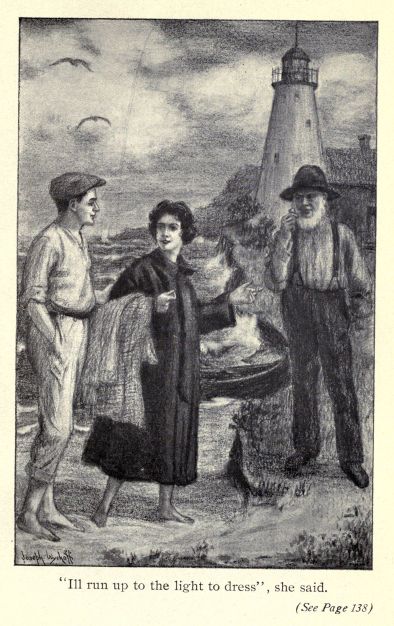
"I'll run up to the light to dress," she said.
"Your eyesight will have to be pretty average good, then," drawled Tobias.
"Why?" she asked, hesitating.
"He's left."
"Why, he was with us down at Lower Trillion!"
"Ya-as. I know. He come back up here with Zeke in the automobile, changed his clothes, packed his sea chist, and went on with Zeke to Clinkerport. Heppy's fair put out. She'd made a heap of fishballs for supper. Cal'late you an' Ralph better stop an' help us eat 'em, Lorny."
"Thank you. As Mr. Degger has gone I will go home immediately," the girl said. "Good evening, Mr. Bassett." She did not even cast a scornful glance at Ralph.
"Oh, sugar!" was Tobias's comment.
CHAPTER XIV
A VARIETY OF HAPPENINGS
Ralph remained at the lighthouse and did justice to the fishcakes. Miss Heppy was "all in a stew," as Tobias said, over the sudden departure of the boarder.
"I'm fair troubled that he wasn't satisfied with our table," the good woman said. "Fishballs and brown loaf and clam chowder and johnnycake and baked beans Saturday night and Sundays, is pretty tryin', I do allow, to them as ain't used to it. We never do have a piece of fresh meat."
"Oh, sugar!" chuckled Tobias. "Don't belittle your fodder, Heppy. You air a mighty good cook as fur as you go. If you had all kinds of fancy doo-dads you wouldn't know how to cook 'em, you know you wouldn't."
"What do you s'pose cookbooks was made for, Tobias Bassett?" demanded Miss Heppy.
"I cal'late they make good pipe-lights," rejoined her brother, suiting his action to his word as he stood at the mantel after supper and rolled himself a spill of a page of the culinary guide in question. "Come, Ralph, le's go up and see if the light is burning bright. 'You in your small corner, an' I in mine.' That allus seemed a cheerful sort o' hymn to me.
"Huh!" he added. "Got your own little packet of coffin-nails? That Degger feller was always havin' one o' them things stuck in a corner of his mouth."
Ralph promptly threw away the cigarette and filled his pipe from Tobias's sack of tobacco. The lightkeeper led the way, chuckling. When they reached the lamp room the old man turned a curious eye on his young friend and bluntly demanded:
"Tell us all about it, Ralphie. I see the mention of our ex-boarder stirred you up. What made him in such a hurry to leave us?"
"Don't tell Miss Heppy," begged Ralph, "but I guess it is my fault that she's lost her boarder."
"You ought to have a leather medal for bringing it about," declared Tobias. "I certain sure was glad to see him go. What happened? He and Lorny got out in my boat while I was asleep. I can't be about and stirrin' to watch the weather for 'em all the time."
Ralph briefly narrated the adventure while Tobias listened, puffing at his pipe and nodding his head.
"I cal'late Lorny's got something to thank you for, then?" he suggested.
Ralph laughed harshly.
"You saw how she acted when we came ashore. Did she seem overpoweringly grateful?"
"Oh, sugar!" chuckled Tobias. "What chance did you give her to fall on your neck and tell you how much she thought of you?"
"Now, Tobias Bassett! I don't want any girl to fall on my neck. Least of all Lorna Nicholet."
"Ain't ready yet to sacrifice yourself' for the good of her family?"
"I won't see a fellow like Conway Degger fool her," growled Ralph. "I will break up his game all right. But I tell you Lorna would not marry me on a bet."
"Oh, sugar! She's something of a sport, Lorny is. I cal'late you ain't ever made her that proposition?"
"Really, I don't have to wait for a ton of coal to fall on me to take a hint," Ralph said, but looking away from the amused lightkeeper.
"No? I dunno 'bout that," muttered Tobias, who found his matchmaking with this rather dense young fellow somewhat uphill work. "I'd like to see Lorny get a good fellow with as much money as you've got, Ralph, and almost as much sense."
"Huh!"
"And that Degger don't fill the bill."
"If he doesn't let her alone——"
"Yep. That's all right. But in removing him from the scene you don't give Lorny no other play-toy. And she's been used to having a chap at her beck an' call all of the time. You know that."
"But, Tobias! She doesn't want me. She has shown plainly enough that she cares nothing for me."
"Oh, sugar! I don't see how it is that you young fellers understand so little about womenfolks."
"To hear you talk! And you not even married!"
"That's why," rejoined Tobias slyly. "I cal'late I understand 'em too well. Now, s'posin' Lorna was a gal you'd just met and you was stuck on her? S'posin' you wanted to make a good impression on her—eh? How would you go about it? S'posin' you was really fallin' in love with Lorny?"
Ralph slowly flushed. The smoke from his pipe choked him—or seemed to. He coughed and turned from Tobias again.
Actually he was seeing in his mind's vision a tiny, milk-white, blue-veined foot sticking out of the leg of a pair of oilcloth overalls.
But Lorna Nicholet possessed dignity, too. Nor did she have always to wait on the ruffling of her temper to show it.
Miss Ida chanced to suffer an infrequent headache on this evening and there were guests at dinner, although it was quite an informal affair. An hour after she had run barefooted and in Ralph's suit of oilskins, along the beach and up the path to the house on Clay Head, Lorna, in a perfect dinner toilet, slipped into the seat at the head of the table after her father and his guests were seated.
There are raveled edges at every dinner to be hemmed. The perfectly served meal is usually the one over which the hostess has worried her nerves to the raw. There was a new maid—of the usual kind one gets at the seashore—and Lorna was obliged to cover her deficiencies and carry on at the same time a spirited conversation with the women guests.
The men were seated at her father's end of the table, and Lorna sensed early in the meal that this was a semi-business gathering. The wives had been brought along to make the occasion seem less like a board-room wrangle.
Now and then Lorna heard a few words of the business discussion that went steadily on from cherry-stone clams to black coffee, like an organ accompaniment to the chatter of feminine voices.
"But we can't count on Endicott."
"What is the matter with the fellow? He was strong for the proposition a year ago."
"Usually Henry Endicott will at least listen to plans for a public improvement."
"Wrapped in some new invention, like enough."
"Those experiments of his must cost him a pretty penny."
"And they bring in no dividends," was the conclusion of John Nicholet.
It was these observations coming to her ear that caused Lorna to seek her father in his den after the guests were gone. She rustled in and perched herself upon the broad arm of his smoking chair and set, as usual, a moist kiss upon the apex of his bald crown.
"A very satisfactory evening—yes, very satisfactory," said John Nicholet. "Let me see. Where was your aunt, child?"
"Headache, daddy. I believe that is more often than not a feminine excuse for escaping a dry-as-dust dinner. I don't blame Aunt Ida. I do think that your business friends' wives are the most unentertaining people!"
"Bless us! Are they? I had no idea. Really, pet, it was a business conference."
"So I gathered," Lorna said. "What was it all about, daddy?"
"Just a scheme for making two dollars grow where only one grew before. And I think it will succeed."
"Without Professor Endicott's cooperation?" she asked.
"Bless us! Do you—ah, you 'listened in,' rogue!" he accused, shaking an admonishing finger at her. "Keep a still tongue about it, please, for the present."
"Surely. But I was interested——"
"Of course. Of course," said her father. "Especially when you heard the name of Endicott. If your Ralph had any money of his own (which he hasn't, for it is all tied up in trust funds, I understand) I would let him in on this instead of his Uncle Henry."
Lorna had gone red and looked vexed at his mention of "her Ralph." But she was still curious.
"I suppose Professor Endicott really manages the whole Endicott estate, daddy?"
"Oh, yes. It is all in his hands. And I do not understand when we offer him such a bang-up investment why he doesn't come in."
"Could it be possible that he is short of funds, daddy?"
"Of ready cash, you mean? Why, I have always understood that the Endicott securities were so placed that they brought in a continual stream of dividends. Conservative in the extreme, yet safe investments. Otherwise, how has Henry managed to run that family in such an extravagant way and to pour money into his experiments as well?"
"Couldn't that be the very reason why he does not enter into this investment that you have offered him?" ventured Lorna. "Perhaps the Endicott fortune is depleted to such an extent that he has no surplus for investment."
"Bless us! Do you know that to be a fact, daughter?"
"I do not know anything about it. It may be only gossip. But it is reported that Professor Endicott has wasted the family fortune."
"Dear me! You don't mean that, Lorna? That would be a catastrophe. What does Ralph say about it?"
"I have never spoken to Ralph about such matters," said Lorna, a little stiffly.
"No, no. I presume not. Such a sordid thing as money does not interest you youngsters. And in any case, if Ralph didn't have a penny to bless himself with, we can be thankful that your money is well placed and you and he need not worry."
Lorna got off the arm of the chair quickly. She stamped her foot.
"Daddy, I tell you I have no intention of marrying Ralph Endicott!"
"Bless us!" gasped her father. "If Henry has made ducks and drakes of their money and Ralph hasn't a penny, who will marry the boy if you don't?"
Amos Pickering waved a flabby hand to attract the attention of the lightkeeper while yet the monster-headed horse was a long way from Miss Heppy's flower-beds where Tobias was sunning himself with his pipe.
"Here comes the Daily Bladder," remarked Tobias, speaking to his sister, who was inside the lighthouse. "Now we'll l'arn whose punkin is the biggest."
He arose slowly from his seat and went down the sandy slope to the road. Amos had a paper for the lightkeeper, but he was bursting with news himself.
"Ye ain't got no boarder no more, I understand, Tobias," the rural mail carrier began.
"You understand correct," agreed Tobias, biting on his pipe stem. "An' I give it as my opinion that Heppy maybe just about broke even on his board—if anybody should drive up and ax ye, Amos."
But the mail carrier brushed this financial consideration aside. There was the canker of gossip eating on his inquiring mind, and he blurted out the subject at once:
"I didn't just know whether you run that feller out, Tobe, or whether 'twas his fight with Ralph Endicott that sent him kitin'."
"His fight with Ralph?" questioned Tobias with pursed lips. "Did they fight?"
"So I'm told. Didn't you hear about it?" asked the eager Amos.
"Not as I know of."
"Why, so they tell me down to Little Trillion. Over that Nicholet gal. You know, Tobias, she's been playin' fast and loose with them two fellers all summer."
"No. I didn't know that, neither," declared the lightkeeper, puffing more rapidly on his pipe.
"Wal, now, you know, Tobe, she's got them two fellers on her string. It come to a head, they tell me, an' Endicott licked this Degger to a fare-ye-well, put him ashore at the Lower Trillion life saving station, and sailed away with the gal on that motor-boat of his'n. They tell me they was gone all night, nobody knows where—heh?"
For Tobias had dropped his pipe and his eyes suddenly blazed.
"I know all about that, Amos," he said sternly.
"Ye do? I thought ye didn't."
"I know it ain't so. Ralph went out after Lorna and that Degger in his motor-boat when they was in danger of being drowned as dead as Pharaoh's hosts. He put Degger ashore at Lower Trillion 'cause the feller was scare't. He brought Lorna back here less'n an hour after Degger arrived in Zeke Bassett's car. That's the truth on it. Who's tellin' this dirty story about town, anyway?"
"Wal, now, Tobias, mebbe it is nothin' but a pack o' lies. They was a-tellin' of it at the post-office. That Degger is stoppin' at the Inn. He an' a feller named Lon Burtwell. Mebbe you've seed him about town, off an' on, this summer?"
"Go on," said Tobias, ruefully scrutinizing the broken pipe he had picked up.
"An' they said that Degger said he'd had a row with Endicott. He said Endicott had sailed away with the gal. Intimated mebbe they'd e-loped. Degger said Endicott did just that with another gal once, when he was at college. There was a scandal about it."
"And I can see there's some scandal about this," Tobias rejoined reflectively. "Wal, Amos, dates is dates, and you can't fool the clock. I met Ralph and Lorny when they come ashore, and it was just in the shanks of the evening, 'fore supper.
"I don't reckon Ralph ever laid his hand on that Degger yet; but if he hears this story I shouldn't be surprised if there was a ruction. I knowed that Degger didn't have no more morals than a clam worm."
CHAPTER XV
DECISIVE ACTION
It was impossible that such a story should be wafted about the community without reaching Ralph Endicott's ears. Lorna might never hear it, but Ralph's association with the longshore folk was much closer than that of most of the dwellers on Clay Head.
In spite of the Endicott pride and a large measure of dignity for so young a man—which Lorna sometimes scoffed at—Ralph was not considered at all "stuck up" by the natives. He was quite at home on fishing smack or clam flat. He could hold his own in any work or rough sport with the younger men of Clinkerport. And, in addition, he could be depended on at any time to lend a hand.
For this very trait of which fellows of Degger's kidney had taken advantage at college, Clinkerport folk respected him. And the individual who brought to Ralph the unkind gossip that the mail carrier had repeated to Tobias o' the Light, thought he was doing Ralph a favor.
"'Course, we don't b'lieve nothing like that of you and Miss Nicholet," the gossip-laden tongue concluded. "And Amos Pickering says that Tobias Bassett says that you an' the gal was back at the Light from Lower Trillion an hour after Degger got back.
"But you know how such stories spread. The truth's a cripple while a lie wears the seven-leagued boots! An' this Degger does say that you had trouble over another gal up there where you went to college——"
"Where is Degger keeping himself?" demanded Ralph, breaking into his informant's story at this point.
"Why, he an' Lon Burtwell air around together a good deal. You know Burtwell? He's some kind of a promoter—or suthin'. I dunno but he's buyin' up cranberry bogs. There's his car standin' over yon'. He and Degger rides around together a good deal."
Ralph waited, his face rather blue looking, his eyes smoldering. After a time he saw Conway Degger come out of the hotel. He was with a dark, sleek-looking man.
They got into the touring car, the dark man, whom Ralph knew to be Lon Burtwell, settling himself behind the steering wheel. Ralph stepped into his own drab roadster.
The other car passed him, heading out of town on the road to Harbor Bar. Ralph pushed the starter. Then he let in his clutch. The roadster wheeled into the wake of the bigger car. Both left town at an easy pace.
Whether Degger looked back and saw that they were followed and by whom, or for some other reason, as soon as they were clear of the town the bigger car's speed was increased. It whirled away in a cloud of dust, and the roar of its muffler could have been heard for miles.
Ralph stepped on his accelerator and the low-hung roadster darted up the road as though shot out of a gun. There was no county constable by the way to time either of the cars.
The start Burtwell's car had gained in the beginning kept it well ahead for the first ten or twelve miles. The smaller car, however, was of racing model, and Ralph was a speed demon. He finally forced the nose of his machine almost under the rear axle of Burtwell's motor car and hung there with bulldog persistence.
Degger knew the pursuer was there, as was shown by his climbing upon the seat and looking over the crushed-back hood of the car. He motioned Ralph away. If the bigger car had to slow down there might be a collision.