VI Poppi and Counts Guidi
Reading edition
“Pupium agri Clusentini caput.” (Vasari.)
Poppi lies on a steep hill which rises abruptly from the valley of the Arno, forming a vantage ground, as it were, in regard to the upper part of the Casentino. The castle, its most notable feature, occupies the highest part of this hill looking south. This is the ancient stronghold, as it was rebuilt in the thirteenth century, curiously like the Palazzo Vecchio at Florence, but more commanding in appearance owing to the height on which it stands.
Poppi already in the tenth century was a centre of influence of the Guidi, one of the most powerful families of Tuscany during the Middle Ages. The property they owned extended far north and south of the Apennines, and the Casentino bristled with their strongholds. Romena, Porciano, Battifolle, Soci, all recall episodes in their history. With the exception of Poppi, all these castles lie in ruins; their walls stand desolate and their towers are open to wind and rain. Alone at Poppi the palace with
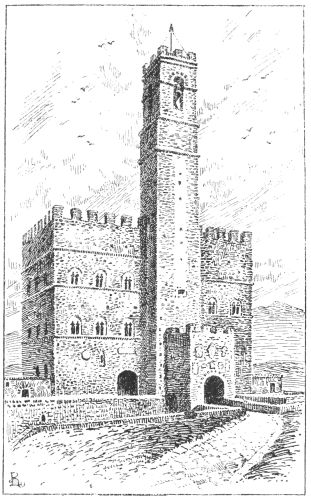
CASTLE OF POPPI
its soaring tower stands unbroken, a lasting monument of the power to which the Guidi attained.
The annals of this family have engrossed the attention of historians partly because the Guidi to some extent influenced the course of Florentine history, partly because Dante repeatedly referred to them in the Divine Comedy and was in personal relation to several members of the family. Their history goes back to the ninth century; in the thirteenth the climax of their influence was reached. But in Dante’s time the members of the family were still numerous, and in the remoteness of the Casentino their power continued unimpaired.
Poppi nowadays is a town of some importance. A steep, paved path and a driving road in wide zig-zags lead up into the town from Ponte di Poppi, a suburb which has grown up on the Arno at the foot of the hill. The paved path enters the town near the church, which lies on the point of the ridge farthest away from the castle, and from the church one walks up the main street with arcades and shops on either hand. And on either hand, whenever a gap occurs between the houses, or a shop is thrown open and a window appears in its depth, one looks right away across the dip of the hill and the plains below into the green distance of the mountains.
The place is first mentioned in the tenth century in connection with Count Tegrimo Bevisangue, who, with his wife Gisla, founded the abbey of Strumi in close proximity to the stronghold. The Guidi were of Langobard descent. They were one of the noble families who had come into Italy as part of a barbarian invasion, and who, in the course of time, came to rank among the great feudatories of the Empire. A legendary colouring is given to the opening chapter of their history, but its essentials are corroborated by contemporary references. Count Tegrimo is the first member of the family who figures in the annals of the Casentino. At the time he was the sole surviving member of the family. His father, Count Guido, married Engelrada, the daughter of Duke Martino of Ravenna. This gave him a place of authority at Ravenna. But a dispute arose between him and the archbishop; he caused the archbishop to be imprisoned. There was a popular rising, and Count Guido and all his family were put to death—all excepting Tegrimo, who was saved by his nurse. The name Bevisangue afterwards attached to him either because of the revenge he took on his father’s murderers, or else because he had contracted a habit of licking his sword after he had spilt blood.
At the time when Tegrimo founded Strumi—the original site of which is said to be marked by a church which is seen from Poppi lying in the midst of dark cypresses—the family already owned strongholds near Pistoja and Florence and the stronghold of Modigliana above Faenza, which is identical with the Castrum Mutilum mentioned by Livy. One by one the strongholds with which the counts fortified their possessions, or which they snatched from their neighbours, appear in the annals of the family. Tegrimo’s son Guido dated a charter from Porciano, which is situated at the uppermost end of the Casentino, a proof that here also a stronghold on a commanding site was in their possession.
Historians of a later date—Malespini and Villani, the contemporary of Dante—state that the ancestor of the Guidi came into Italy with the Saxon Emperor Otto I. and from him received the castle of Modigliana. Also that Otto IV. on his passage through Florence saw Gualdrada, the daughter of the rich citizen Berti, and that his follower, one of the Guidi, married her and received the Casentino in dower. As the Guidi owned Modigliana before Otto I. came to Italy, and held extensive property in the Casentino long before the days of Gualdrada, these stories in themselves are untrue, but a true estimation of facts underlies them. The Saxon emperors, in order to strengthen their authority over the greater barons of Italy, favoured the lesser, and among them they favoured the Guidi. The Count Guido who married Gualdrada was on good terms both with Florence and Otto IV.
After the time of Bevisangue we find the Guidi steadily increasing in power, fighting against other lords and against rising communes, sometimes on their own account, sometimes in support of the Imperial policy. True representatives of the rural nobility, they were at once turbulent and prosperous, and they made their influence felt in ecclesiastical as well as in other matters. It was owing to protection given him by a lady member of the Guidi family that Giovanni Gualberto became the founder of Vallombrosa, and in three different generations a member of the family was bishop of Pistoja. At the close of the eleventh century a father and a son Guido were in frequent attendance on Countess Matilda, the daughter and heir of the last margrave of Tuscany, whose strenuous opposition to the Imperial policy and support of the claims of Tuscany secured her lasting popularity. Probably to secure the father’s interest she adopted the son, to whom the surname il Marchese attached in consequence. This Count Guido in his youth joined the first crusade, and was imprisoned by Saladin. Property was mortgaged with the canons of Pistoja to pay for his ransom. After his father’s death he bestowed land on the faithful follower who had shared his hardships.
Count Guido il Marchese favoured various schemes conducive to his vassals’ welfare. He helped to carry out the plan of building the aqueduct by which Pistoja is provided with water from the hills; he became the founder of the city of Empoli; he built a leprosy near Poppi. About the year 1106 the “Great” Countess Matilda gave up the plan of constituting him her heir and bestowed her extensive property on the Church. Matilda enjoyed such popularity throughout Tuscany, that songs in praise of her were long sung in the churches of Florence according to Boccaccio. In the Divine Comedy she is described as guardian of the earthly Paradise, in which she led the way to the triumph of the Church. In remembrance of her the name Contessa or Tessa continues frequent to this day. The reader will recall the sweet contadina of Romola. In the Casentino Matilda is popularly credited with building a number of churches which are remarkable for the sculpture which adorns them.
One of these churches, that of San Martino di Vado, is about an hour’s walk from Poppi up the valley of the Solano; another flanks the hill of Romena; a third is at Stia, and another is at Montemignajo, high up a side valley. The column capitals inside these churches deserve attention for the place they claim in the history of early Tuscan sculpture. Not two of them are alike, and the way the foliage and figures on them is treated is always quaint and often beautiful. I have sometimes thought what a gain it would be if some of the numerous amateur photographers one meets would combine and systematically go over separate districts, issuing a list of the views taken by them. In the Casentino only a few general views were obtainable, and we in vain sought to procure photographs of interesting remains; I ignore if any have been taken. In this case one longed for photographs of these capitals to compare them with the early sculptures of Pistoja and Arezzo. One of the columns in the church of Romena bore the date 1152—the earliest sculptures at Pistoja are dated 1166—and the erection of the parish church at Arezzo belongs to the same period. As a direct connection existed between these places at the time owing to the rights of overlordship held by the Guidi, it may be owing to their influence that a style of sculpture which has so much of the Langobard spirit came to be introduced into the different parts of Tuscany.
The Count Guido, to whose lifetime the erection of these churches belongs, was the son of Guido il Marchese, and was known himself as Guidoguerra. In him the influence of the family reached its climax. The vastness of his possessions was such that Sanzanome, the earliest historian of Florence, spoke of them as
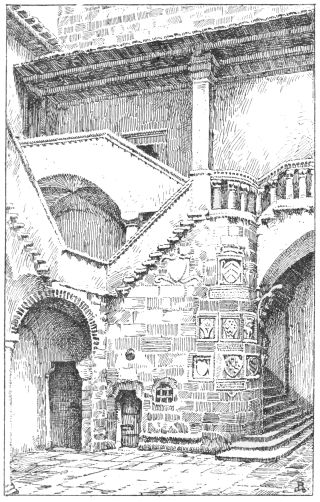
COURTYARD OF CASTLE, POPPI (CASENTINO)
constituting a state or province in themselves. Moreover, he was a shining representative of knighthood. His contemporary, the Bishop Otto of Freysing, described him as the most powerful lord of Tuscany, and Tolosanus, the chronicler of Faenza, who knew him, spoke of him as holding the foremost place in honour and courtesy. “All Italy wept at his death and especially Faenza,” he tells us, for the city of Faenza had appealed to him for help on account of the encroachments made on its territory by the city of Forli, and had found in him a powerful protector. The acts of Count Guidoguerra argue in favour of his mental horizon being wide. He joined the crusade of 1147, he stood in high esteem with the Emperor Frederick Barbarossa, and the enterprises he led in Italy were invariably successful. It was only by taking advantage of his temporary absence that the citizens of Florence succeeded in destroying Montedicroce, a most important stronghold of his which had therefore become an object of hatred to Florence.
For the city of Florence, as it increased in importance, was bent on improving the conditions of its trade. Florence is surrounded by hills, and these hills in the twelfth century bristled with the strongholds of nobles, who were ready to swoop down and plunder the trains of passing traders on the slightest provocation. In the interest of its further development the city was prompted to make war on the surrounding nobility, attacks which went hand-in-hand with a policy that was productive of important and unexpected changes.
The first attempts of the Florentines to subdue their troublesome neighbours belonged to the lifetime of Guido il Marchese. Emboldened by success, and encouraged by the inactivity of the margraves, they attacked Fiesole, the ancient Etruscan city which towered high above Florentine territory, for here, as Villani related, the rural nobles, whom he designated as cattani, collected and harboured outlaws who did damage to the trade and the territory of Florence. The undertaking proved successful in the campaigns of 1123-1125, and large parts of Fiesole were razed to the ground. Its “destruction” was followed by attacks on Montegrifone, which belonged to the Ormanni, and on Monteboni, which belonged to the Buondelmonti. A special significance attached to the latter event. For the Florentines, intent on securing friendly relations with their neighbours, made it a condition of peace that the nobles they defeated should reside inside Florence during a stated part of the year. The first to agree to the arrangement were the Buondelmonti; they were followed by a number of others, including the Guidi, who were nothing loth to gain a foothold inside the city. To the older inhabitants of Florence, which included the greater citizens—the illustri cittadini of Dante—and the lesser citizens, a third element was now added in the form of the rural nobles, who soon contracted a taste for city life while they remained indifferent to its responsibilities. They came into Florence with crowds of retainers; they built themselves houses which were strongholds to all intents and purposes; they fought out their private feuds inside the city walls, and as soon as occasion offered they turned the balance of the constitution in their favour. And more than this. They brought with them a taste for display and splendour which subverted all accepted standards, and which put an end to the simplicity and soberness of the older Florentines.
In the eye of Dante the influx of these rural nobles was a reason of the city’s misfortune. “Ever was the confusion of persons the origin of the city’s ills,” are the words which he put into the mouth of his ancestor Cacciaguida. Cacciaguida in the Comedy compares the state of Florence as it was in Dante’s time with what it had been a century and a half before, and he deplores the increased luxuriousness of the Florentines. In those simpler days “Bellincion Berti went about in leathern belt with bone clasp, and his dame came from the mirror unpainted.”
This Bellincion Berti and his wife were the parents of the lady Gualdrada, through whom not the Casentino, as Villani recorded, but the valuable Ravignani property in Florence near the Porta San Piero came into the possession of the Guidi. Gualdrada was the second wife of Count Guido, surnamed il Vecchio, and the epithet buona which Dante bestowed on her she doubtless owed to her attempts to soften her husband’s fierceness. For Guido Vecchio in the eyes of the chronicler of Faenza was the direct opposite of his father; knightly dignity and pride with him took the form of wilfulness and overbearing.
The incidents which led up to the marriage and its outcome are worth recording. Guido Vecchio began as the loyal supporter of the Imperial cause; he entertained Frederick Barbarossa in his castle at Modigliana, in 1167, and with the Imperial troops he marched on Rome, where Frederick succeeded in establishing the anti-pope. But the desire for municipal freedom was awakening in the smaller cities of Italy, and in order to frustrate the Emperor’s influence they began to form alliances among themselves and supported Pope Alexander. A struggle ensued which lasted seventeen years and in which Guido sided with the Emperor, thereby finding himself repeatedly plunged into war with Florence, and into supporting her rival Siena. When the Emperor and the Pope finally made peace at Venice, the relations between the cities of Tuscany were readjusted. Among the representatives of Florence who arranged the peace between this city and Siena was Bellincion Berti, the father of Gualdrada. In what year Guido married her is unknown, but he divorced his first wife Agnes in order to do so. His attitude towards Florence underwent a complete change in consequence. Henceforth there was friendship between them.
In other respects Guido lost ground. In opposing the growing municipalities he was tempted to strain his authority, with the result that he was defied more than once. Thus on one occasion he ordered his vassals at Modigliana to pull down their houses and rebuild them on the hill for greater safety. For five weeks they resisted, then they destroyed their houses and went to Faenza, which was outside their lord’s jurisdiction. This led to a war between the Count and the city of Faenza which extended over years. On another occasion he went to Camaldoli and carried off all the weapons which he found there to Poppi. He restored them afterwards, but only in return for an enormous amount of grain. Again he disputed with the nunnery of Rosano and won his suit, but in this case Countess Gualdrada carried the decision in person to Rosano, and declaring it annulled she tore it up. The acts of Guido Vecchio were such that the Pope wrote to him in his old age urging him to reform his ways, but even the warnings of a Pope were defied with impunity by these barons.
When Count Guido Vecchio died in the year 1213, the family split into five branches, each of his sons taking the name of count of the chief stronghold which fell to his share. Poppi in the first instance fell to Count Guido Magnifico of Bagno, then to his sons Guido Novello and Simone. The acts of these brothers, and the enmity which arose between them, take us into the very thick of the contentions which agitated Florence in the thirteenth century.
The terms Guelf and Ghibelline were used in Florence since 1215, marking the different tendencies of the citizens. The Guidi, like most other rural nobles, were Ghibellines; they wished to see the power of the city kept within certain limits, and in this they were opposed to the Guelf or patriotic party. Guido Novello and Simone, with other Ghibellines, left Florence for a time in 1248; ten years later they were altogether banished from the city. Shortly afterwards they fought at the battle of Montaperti, when the Florentines were beaten and the river Arbia, as Dante has it, ran red with blood. It was then that Count Guido Novello made the proposal that the city of Florence should be razed from the face of the earth, an insult which the Florentine patriotic party never forgave him. Farinate degli Uberti, also a Ghibelline, but one who felt some affection for the city, successfully opposed him; he is represented by Dante in Hell recalling this fact to the poet’s mind. Florence remained standing, but for the next six years it was at the mercy of the Ghibellines. Guido Novello, supported by the troops of King Manfred, ruled in a spirit which was little calculated to soften the acrimony of the Florentines against him. He caused Poppi to be fortified by a new wall in 1260; he then built the Porta Ghibellina at Florence, and constructed a new road out of it so as to be in direct communication with the Casentino. This road (the paved path which leads over the Consuma and along the valley of the Solano) he used to convey to Poppi crossbows, bucklers and armour which he abstracted from the arsenal at Florence. Villani tells how he showed his castle and these weapons to his uncle Tegrimo, Count of Modigliana and Porciano, asking him what he thought of them. Tegrimo replied that he liked them well enough, but that he knew the Florentines only “lent at a high rate of usury.” Subsequent events proved the truth of the remark. When King Manfred was overthrown, Guido Novello lost his support and was obliged to leave Florence. He did so without much dignity, and stones were thrown at him as he left the city. Twenty years later, at the instigation of the Bishop of Arezzo, he and other Ghibellines collected an army in the Casentino to march upon Florence. The Florentines came over the mountains and defeated them and ravaged the territory which belonged to the Guidi. And in the following year they came back and made an assault on Poppi, and finding the arms there which the Count had abstracted, they carried them back to Florence in triumph.
The battle in which the Florentines fought the Ghibellines in the plain of Campaldino below Poppi on June 11, 1289, is memorable since Dante, at the time a youth of twenty-four, fought in the ranks of the victorious Guelfs. He referred to the fact himself in a letter, in which he said how he found himself “no mere child in the practice of arms, and was in great fear, and in the end rejoiced greatly through the varying fortunes of the battle.” For luck at first went against the Florentines; the Ghibellines gained an advantage, but they did not follow it up. Guido Novello, who was now an old man, backed upon Poppi, the Bishop of Arezzo fell fighting, and Buonconte, another Ghibelline leader, was wounded and fled. In the Divine Comedy Buonconte is represented giving an account of his flight to Dante—how with pierced and bleeding throat he reached the point where the Archiano falls into the Arno, and how the waters carried him away and his final resting-place was never known.
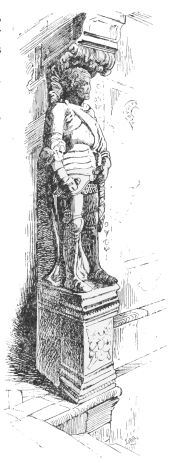
STATUE OF COUNT GUIDO, CASTLE OF POPPI
Guido Novello, who backed upon Poppi, cannot have stayed there, as the place was no longer his and no longer a stronghold of the Ghibellines. It had passed to his brother Simone and his son Guido of Battifolle, and Simone and his son, according to Villani, went over to the Guelfs because of Guido Novello’s cruelty. When therefore the Florentines made an assault on Poppi, they were damaging the property of a Guelf and an ally. Guido of Battifolle, sometimes also called Guido Novello, the son of Simone, pleaded in Florence for damage done to his property, and he received the sum of twelve hundred lire, which he spent in re-building his castle.
It is owing to this sequence of events that the remote little town of Poppi came to boast of its remarkable castle. Vasari in his Lives of the Painters and Architects tells us that Jacopo Lapo, called il Tedesco, “built many buildings in the Gothic style in Tuscany, among them the palace at Poppi in the Casentino.” And in the life of Arnolfo, whom Vasari wrongly called the son of Jacopo (he was his pupil), he adds that Arnolfo built the palace of the Signory at Florence on the plan of what his father had constructed at Poppi.
As one emerged from the streets and entered the open space before the castle the contrast was striking between our peace-loving, law-abiding age and that period when life was bound up with warfare. Trees veiled in spring foliage cast a fitful shadow over what was formerly an open ground for free fighting; near the ruined castle walls children played and old people loitered in the sun. We entered the courtyard without let or hindrance, and then the sound of a tinkling bell brought out a Government custode. With him we ascended to the first floor by the skilfully-constructed open-air staircase which leads from floor to floor round the four sides of the court. He led the way into the large hall, a beautiful room with carved and coloured beams and double arched windows set high in the thickness of the wall. We wandered from room to room and from storey to storey. Fragments of partitions taken down, of glaring wall-papers torn from the walls, of brick and mortar, lay about here and there—disfigurements of a later date which are now in course of being removed. After centuries of concealment the ceiling construction and the old fresco decorations of the walls were being bared to the light of day, for the castle is now in the hands of the Government and is in course of restoration as a national monument. The palace chapel contained curious frescoes attributed to Spinello Aretino and Jacopo del Casentino. Remains of old wall-painting in curious patterns and of earlier date decorated the dining and other halls. We ascended to the uppermost storey, and there in the way of a caryatide supporting a leafy volute, on which rested the inner cornice of the roof, stood the figure of Count Guido of Battifolle, the son of Simone, carved in stone. It is a beautiful youthful figure, the uncovered head full of clustering curls, the face strong and somewhat defiant in expression, the body clad in plate-mail, with the one hand holding a short dagger, and the other resting on the hilt of a long sword. Whose the thought thus to place the owner of the palace, who the artist to carry it out, are not recorded, but as it stands the figure may well have delighted him who made it and him whom it represents.

ARMS OF THE GUIDI