IV Camaldoli and St Romuald
Reading edition
“Qui è Romualdo Qui son’ li frati miei che dentro il chiostro Fermar li piedi e tennero il cuor saldo.” (Par. 22, 49 ff.)
A day’s walking and we were removed to a very different atmosphere, and to associations widely separated from those connected with the high retreat of La Verna. A wide gulf divides the temper of a man like St Francis from that of a St Romuald. Both are accepted saints of the Church, but while the one taught men how to be guided by love through the example of his own gentleness and forbearance, the other emphatically denounced those who interpreted the religious life differently from himself. St Francis is the gentle soul of the thirteenth century, that yields that it may conquer; St Romuald is the rough-and-ready champion of the tenth century, ever ready to start up in defence of Mother Church.
Camaldoli is a pearl among the many pearls of the Casentino. I have seen it in spring-time only; the Italians tell you that it is even more beautiful in summer, when its shady chestnut groves and dark pine forest give a sense of restored energy and renewed vigour to those who come here from the arid plains of Tuscany and the blinding heat of the streets of Florence. Camaldoli may be conveniently reached by a good driving road or by paths from the east or the west. We decided on striking into the former of these two paths, and on a genial day we bid adieu to Bibbiena, descending first and then mounting with the driving road which afterwards followed an even ridge for several miles.
The views from this ridge were extensive and varied. In the distance the panorama of the hills was slowly unfolding. Nearer at hand our attention was caught now by a peach-tree with its purple blossoms, then by a cherry-tree, its downy white branches swaying with the breeze. We passed several country-houses, always somewhat removed from the road and always flanked by a group of dark cypresses, which sometimes extended into an avenue down the slope of the hill. These old country-houses of Tuscany consist of a dwelling-house and a farm, which sometimes stand a little way apart, the dwelling-house marked by a look of greater trimness and reserve; sometimes they are brought closer together with an increased look of orderliness to the one and of homeliness to the other. Both houses are built of stone,
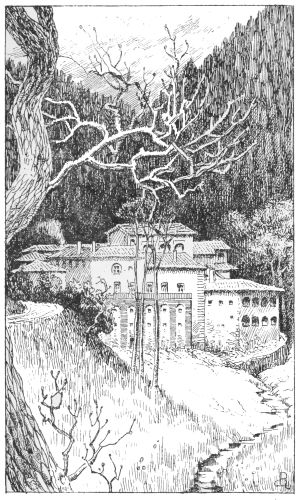
CAMALDOLI (CASENTINO)
usually two storeys high. And both are covered with red rough-tiled roofs that lie flat and broad over the entire dwelling and project on all sides into wide eaves.
We passed through Camprena, a posto which also had its peculiarity. The houses neither fronted the street nor stood at right angles to it, a want of arrangement not accounted for by any apparent irregularity of the ground. Such an Italian village has none of the neat clustering of its English or German namesake. There is no village church standing aloof to watch over the entrance and exit from life of suffering humanity; no village green with ancient oak suggesting a living protection to rights and liberties; no well-appointed inn betokening the love of an evening’s good cheer. The houses have come together anyhow, and few are the attempts made to brighten a portico or a window with a row of flower-pots. Sometimes the house itself is washed over with pink or yellow, but there is never a scrap of flower-garden to add a bright spot of colour to its surroundings.
Further along the road lay Soci, a place which went through stormy experiences in the early Middle Ages. Remains of its own castle walls and remains of the castles of Gressa and Marciano, which frown from heights above and beyond it, recall the times when might made havoc with right. At one time the Prince Bishop of Arezzo owned the place and made it over to the monks of Camaldoli. But, apparently on account of its insecurity, they parted with it to one of the Counts Guidi in exchange for rights of ownership at Bagno on the further side of the Apennines. However, the Guidi did not long remain in possession of the castle; they lost it to their enemies, the Tarlati of Pietramala.
Soci is now a growing centre of industry, and boasts of several factories. The high chimney of one of these figures is the attractive feature on the local picture post card. The thought often arises in these days at what a terrible cost to itself mankind is securing greater cheapness in goods—raising the standard of comfort, as economists put it; the thought was brought home in this outlying district. For the men and women we met in other parts of the district were robust in health and decently, if poorly, clad; the children were chubby, well-fed and full of buoyancy. But in places like Soci a blight seemed to have fallen on mankind. Men and women, girls and boys, all had the same look of mixed listlessness and craving, and the children were pale and neglected. No doubt here, as elsewhere, the people who flocked to the factories were impatient of the restraints and the penury of home; they escaped from the toil of home, but they did so at the cost of the home’s regularity of habit. Stranded in a strange place, bound by no responsibilities but those they chose to recognise, these men and women soon fell into irregular ways and formed illicit connections, with a consequent loss of physique to themselves and a deterioration of the race in a couple of generations.
Beyond Soci the mountains began to draw closer together. The road followed the river Archiano, which flowed in a narrower bed and assumed the character of a torrent. Only the land that was near the river was brought under cultivation. The slopes above were covered with a thin scrub of stunted oaks bearing only the sere foliage of last year’s growth. These mountains were chiefly of a brown mud-rock that had crumbled away along the water-courses, or else, undermined by them, had fallen in masses of soft earth, forming the gentler slopes. Side-valleys opened and closed as we passed onwards. The characteristics of the plain were disappearing more and more. We were entering the region of the Apennines.
At one point of the road we were doubtful if we should leave the valley, and seeing a man under a hay-stack munching bread and cheese we consulted him. But his look was interested, and he was so positive that the diverging path not being ours, we should never reach Camaldoli unless we consented to his guidance, that we became equally positive the map should be our only guide. We cut short further parleying by saying that we could but return if we missed the way altogether. Of this there was no chance. A short distance further and we sighted Serravalle, towering high on a steep eminence that fronted all quarters. On one side it commanded the bend in the road that led onwards across the Apennines into Romagna; on the other it stood well above a dip in the hills, and overlooked the side-valley down which the Fosso of Camaldoli flowed to join the Archiano. The mountain streams throughout the Casentino are spoken of as fossi, though not generally so designated on the map—a peculiar use of the word which suggests affinity to the northern fos rather than to the Latin fossa. In sight of Serravalle we sat for a while and feasted on our usual lunch of bread, eggs and wine. After that we followed the stream for a time, and then, parting company with it, we began the ascent up the steep winding slope.
On a clear day such as this, the steeper the ascent the more striking the observation how the nearer mountains sink into insignificance before the higher ranges that rise on the skyline beyond. Under the dome of blue, with its few sailing clouds, the air was of absolute transparency, and every detail of the level we had left, every detail of the level to which we were attaining, stood out in shining clearness. Each special portion of the world above, below, around had its distinguishing feature, from the flock of sheep grazing by the stream below to the man carrying stakes up the opposite slope, and to the dark birds hanging over Serravalle. But the observing faculty soon wearied with watching for new impressions. With the brighter sunshine, the keener air and the more fragrant vegetation of the height, a dreamy consciousness took possession of the mind—a consciousness of being nearer heaven—heaven, a fictitious limitation of space indeed, but a limitation the thought of which brought one’s own concerns into an amended relation to those of the world generally. After all, it is by drawing imaginary circles that the mind attains to a conception of relative size. The greater the height, the wider the outlook; the stronger the consciousness of the world we possess not, the clearer the conception of that part of the world which we have made our own.
Higher up patches of snow lay here and there on the shady side of the path. The shrubs and plants became stunted and nipped, with the exception of the flowering giant spurge that stood up from the stony ground vigorous and brilliantly decorative. We passed a cluster of dwellings, built of rock and founded on rock, grey and weather-worn, quite Alpine in character, where the necessities of life are wrung from nature in a close hand-to-hand fight. For a long time our path was rocky and uneven and lay between thorny undergrowth. Then it led down at a gentle gradient and drew nearer to the bed of the Fosso. Within a few minutes’ walk the character of the surroundings entirely changed. From a stony wilderness we had passed into an enchanted grove. The slopes lost their steepness, and the ground lost its bareness. We walked under high chestnuts along a moss-grown path that was soft to the tread, and then over a carpet of verdure bright with spring flowers, which recalled the emerald meadow dotted with shining flowers over which angels lead mortals to heaven in the painting of Fra Angelico. It was late in the afternoon, and the slanting sun-rays made golden lights on the trunks of the trees and set aglow the patches of primroses. The call of the cuckoo sounded at intervals, and there was the distant warbling of many woodland birds. One wished for the path to lengthen out indefinitely; all too soon the massive settlement of Camaldoli, set against a forest of pines, closed in the head of the valley.
There is a graceful legend concerning a monk (I forget his name) who was one day tempted to stray from the path of life; he was sore perplexed in his mind by the words of the Psalmist, “A thousand years in God’s sight are but as yesterday.” How could time, that uniform flow “unaffected by the speed or the motion of material things,” be robbed of the conception of its length? How could time ever cease to exist to one who was endowed with consciousness?
To the monk, as to many another, failing to see was failing to believe. With a heavy heart he wandered forth into the convent garden carrying his problem with him. Quod erat demonstrandum: would a greater intercede in his behalf? Time slipped by unawares. It was late at night when he regained the convent gate, but those who opened in answer to his call knew him not. His talk, his appearance, his manner were strange to them, and yet there was that in him which commanded attention—he was like as well as unlike. They admitted him, and after a while the memory of an old, old story came to one of the monks who listened to him—how long ago a member of the fraternity had been troubled in his mind and had wandered forth and never returned, but it had always been believed by some that he was still among the living. After much seeking his name was found in an old convent register. It was the name of the monk who had returned after a thousand years. Then they saw him as one of themselves. The miracle was accomplished. And the monk understood that eternities which are the products of human conception hold good for man only. God’s eternities may be different. It is said that a short time afterwards he passed away from life in peace.
And would it be very different if that monk had been one of the companions of St Romuald here at Camaldoli, nay not quite a thousand, just nine hundred years ago? If he came back now would he know these surroundings for those he had left? Would he feel it the same world as it was then, ruled by the same ideas—that a simple life is conducive to elevation of mind, and that the air of the heights and the pure water of undefiled springs make the body strong to withstand evil? And would they too know him as one of themselves, those venerable monks, bent with age and dignified in bearing, who were approaching the monastery along the upper road as we neared it along the lower? Their woollen robes of many folds were white, such as Romuald in his dream beheld his companions wearing, when, like Jacob, he saw a ladder set up on the earth and reaching up to heaven, and his monks were the angels ascending and descending on it. These men had drawn their hoods over their heads, and over them they wore large, wide-brimmed Tuscan straw hats. They were neatly stockinged and shoed, and most of them had flowing beards and a complexion that reminded one of the delicate tints of crumpled rose-leaves. To us they were figures of a distant past, and it was wonderful to think that if one of the old monks of Romuald’s time were to come among them, the great difference in them would be the first thing to strike him.
The monastic settlement of Camaldoli consisted of a monastery placed near a famous spring, Fonte Buona, and of a hermitage, the Eremo, which was situated further up among the mountains. One of the reasons of Romuald’s success lay in his refounding hermit life on a new basis—it is one mark of a genius to turn existing tendencies to new and profitable account. In the monastery all were made welcome; to the hermitage those were promoted whose temper proved their fitness for a solitary life. At the present time only a small wing of the monastery was inhabited by the monks, who rented it from the Government, the vast conglomerate of buildings having been turned into a hotel. But the hermitage up among the mountains was still entirely occupied by them. Up there lived those who were able to endure the privations of hermit life; up there they remained till, weakened by old age, they came down to the monastery to be tended in sickness, and after death their mortal remains were carried back to the Eremo to be buried in the ancient burial-ground.
The account of the life of St Romuald, which was written by St Peter Damian, who belonged to the following generation, gives curious glimpses of the attitude of men’s minds in a far-distant past. It is never easy to transport one’s self to the moral and ethical standard of another age, for the actions of the men who then stirred up the emotions and aroused enthusiasm can be very differently interpreted; in one aspect they are heroes, in another they are faddists. It is in this respect with Romuald as with the holy man of another age, Diogenes the Cynic. Looked at from one point of view, the courage with which Diogenes acted up to his convictions, the cheerfulness with which he bore the hardships of slavery, and the simplicity of life which he affected, bear the stamp of grandeur. Looked at from another side, he is a man of oddities and eccentricities. Prompted in a like direction, Romuald launched forth against misdeeds, discarded every comfort, and commanded respect from the most powerful. But his behaviour also appears absurd if we fix our minds on the way he courted dirt, weakened himself by fasting, and wore himself out by imaginary conflicts with the devil. And there are other points of similarity between the cynic of classical antiquity and the saint of early Christianity. The cynic called himself a citizen of the world, and the word cosmopolitan is held to be his invention; while the saint exaggerated the power of his efforts so vastly that “he looked forward to the time when the whole world would be transformed into a hermitage, and the mass of the nations united in one monastic order.” Both men were praised for their undisturbed serenity under tribulation, and both in unabated vigour reached the extreme limits of old age.
Let us look more closely into the account of Romuald’s life, an account written by a great man and telling of a great man is surely worth analysis. Romuald was a native of Ravenna, and was born early in the tenth century of a noble family. As a youth he was witness to how his father killed a relative; and he went to St Apollinare in Classe, to expiate the crime by forty days’ penance. The church of St Apollinare is little changed from what it was then, and visitors to Ravenna will recall with delight the simple proportions of the roomy basilica, and its brilliant mosaics, with St Apollinare preaching with his flock of sheep around him. A monk of the church proposed that Romuald should join the fraternity, and the young man agreed to do so, after spending a night in church, when St Apollinare himself appeared as the monk had foretold—a proof, as Romuald declared and as Peter Damian believed, that the saint really lay buried here. But Romuald’s innate spirit of restlessness and want of consideration for the shortcomings of others cut short his stay after three years’ noviciate. The monks would lie in bed when it was time to be in church singing, and Romuald, finding the church closed, sang in the dormitory. The monks decided to rid themselves of the inconvenient enthusiast by throwing him out of the window. Romuald, however, escaped to the woods, and there he found a companion to his heart’s desire in the unlearned but ardent Marinus. This holy hermit chanted through the entire psalter every day; he would repeat twenty verses under one tree, twenty under the next, and so on till his task was accomplished. Romuald joined him in his exercises, and mistakes in his performance were punished by a blow on the ear from the hermit’s staff. When his hearing became impaired in consequence, he turned his other ear for castigation, and his stern master was touched. On three days of the week the two hermits lived on a bit of bread and a handful of beans; on the other four, crushed corn, pulmentum, constituted their food. Their conduct was evidently considered unexceptionable, and in 978 when, in consequence of an insurrection in Venice, Count Petro Orseolo, who had headed it, was advised to seek refuge in a convent, Romuald and Marinus were among those chosen to escort him to a monastery near Perpignan in the south of France. There they resumed the old life, and were credited with great holiness. Romuald’s fame increased owing to incidents such as this. A lord of the neighbourhood, impeto barbarico, stole a cow from a peasant. The peasant begged Romuald to ask for the cow, but the lord laughed his request to scorn; the cow was roasted for the feast. However, the holy man’s interference was not wasted. When the lord came to eat of the cow, a bit of meat stuck in his throat and he died a wretched death. No wonder that the people of the neighbourhood, when they heard that Romuald was about to leave for Italy, as they could not retain him, decided to kill him so as at least to secure his corpse. It was a time when relics, especially on the further side of the Alps, commanded a high price in the market. Kings and emperors gave gold and jewels in exchange for them, ecclesiastics of the higher grades did not hesitate from stealing where they could not procure them otherwise. And the relics did not lose by being transferred; on the contrary, their wonder-working properties if anything increased. Romuald, however, was apprised of the country folk’s intention, and knew how to meet it. He rapidly shaved his head, and when they came, intending to kill him, they found him eating immoderately. This was contrary to all accepted ideas of saintliness; they thought he had gone mad and went away. The holy man was left to depart in peace for Italy, where he found a new work awaiting him. His father was about to leave the convent he had entered. This had to be prevented. Romuald fastened his father’s feet in stocks, loaded him with chains and whipped him till the old man’s senses returned. Romuald’s career as a reformer now began, but, as his biographer says, “the zeal was so great that glowed in this man’s breast that he was never satisfied with what he had accomplished, and ever turned to new undertakings.”
Thus we find him at one time dwelling in a solitary cell in the marshes, where, like St Guthlac in the fens of Lincolnshire, he was endlessly worried through the lawless agency of bad spirits. After that, thanks to the protection of Ugo, margrave of Tuscany, he collected about him a number of monks at Bagno, in Romagna. But he so incensed them by sending money to the relief of a distant monastery which had been consumed by fire that he had to flee before their rage. Some years later, Romuald became for a time abbot at St Apollinare in Classe, where he had stayed in his youth. The Emperor Otto III., when he crossed the Alps in 996, heard that this monastery was going to ruin, and he persuaded Romuald to reform the monks. The influence which Romuald exerted on the melancholy young emperor is full of interesting particulars. Otto went on a pilgrimage on foot from Monte Gargano to Rome, and he spent some time with the hermit Nilus, who was working for the reform of religious life in southern Italy along lines similar to those Romuald was following in the north. Finally, Otto spent forty days as a penitent in the convent at Ravenna, and was almost persuaded by Romuald to become a monk. Romuald’s stay as abbot at Classe was not, however, of long duration. He soon came and laid his crozier at the emperor’s feet; an abbot’s life was not what he desired. His zeal had taken another direction. He was fired by the thought of restoring hermit life on the model of what had existed in Egypt, and he travelled about from place to place collecting together wandering monks, the gyrovagi, whom St Benedict had denounced as evil. He arranged that they should dwell together, and join in the observance of certain rules.
This restoration of monastic life was part of a wider scheme. Reference has been made to the growth of simony, both among laymen and ecclesiastics. The evil had assumed such proportions towards the close of the tenth century that the prestige of the Church was seriously jeopardised. It was a critical epoch, and all depended on exposing the cause of the evil and on stirring men’s consciences with regard to it. Romuald came forward and openly declared that simony was the most damnable heresy, and that no one who had entered the Church for money could hope for salvation unless he gave up his benefice and became a layman. Peter Damian was of opinion that, while no one acted directly in compliance with this request, the stir which Romuald made was great. More than once he was in danger of his life, and the experiences through which he went are full of interesting particulars. At one time he lived for seven years as a hermit, and came back, his body shrivelled, weather-stained and of the colour of a newt. But his cutting himself off from the society of his fellows apparently led to many conversions. At another time he was fired by the wish to take a part in evangelising Hungary. Among the monks he had come across was a son of the Prince of Hungary. But it was not to be. When Romuald and his companions had gone some way on their journey, sickness overtook them, and sickness returned to the party whenever it attempted to proceed. There was nothing left to do but give up the undertaking and return to Italy.
Romuald’s fame was at its height when the Emperor Heinrich II. crossed the Alps in 1022. So much was he moved by Romuald that he expressed the wish that his soul were in the saint’s body. Romuald’s appearance at the time was peculiar. Hoary, unkempt and unwashed, he came to court wearing a dirty, shaggy skin. The Germans crowded round in the hope of snatching a few hairs from it, which they wished to preserve as relics.
Romuald first came to Camaldoli about the year 1018. It has been affirmed and denied that the site of the monastery was a gift to him from a certain Count Maldolo, and that the name Camaldoli represents the words Casa Malduli. The saint never stayed here long, and he died away from here in his hermit’s cell at Val de Castro in 1027. But the routine of life at Camaldoli was held to represent his aspirations, and Camaldoli gave its name to all the monasteries which Romuald had founded. These were never numerous. The order did not spread much beyond Italy and the south of France. But within these limits it exerted considerable influence.
And thus attended by thoughts of the enthusiast who laid the foundations of this vast establishment so many hundreds of years ago, we entered the building by a long arched stone passage, which led up from the garden without to the courtyard within. This courtyard is said to date from the tenth century; I have rarely seen one more impressive through the stern simplicity and perfect balance of its proportions. It is built throughout of the same grey stone, and there is little attempt at ornamentation. Pillars with slightly swelled shafts and simple capitals support round arches which extend round the four sides of a paved court. In the centre of this court stands a fountain with an unceasing flow of water. Passages, staircases and narrow corridors lead off in different directions. Surely there could be nothing more suited to the solitary side of one’s nature than to sit on one of the huge logs of wood that lay on one side of the court, listening to the flow of the water and watching the clouds that floated across the opening above. Now and again there was the sound of voices and of footsteps coming and going in the far distance. A man carried faggots across the court, a woman came to wash lettuces at the fountain—living figures that moved in the round of duty and seemed to emphasise the old-world solitude of the place. There is no greater solitude than an open-air solitude from which the life of nature is excluded. And within these walls there was no sign of animal or vegetable life—nothing to remind one of the stirring of the sap or the beating of a pulse, except that of which one was conscious of in one’s self.
That night we had the vast hotel of Camaldoli to ourselves. In the springtime there are few visitors. We ate and slept in some rooms off the
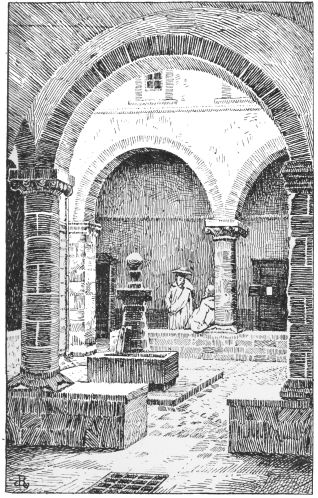
COURTYARD OF CAMALDOLI
ancient courtyard. We wandered into the roomy church. One of the old monks had died that afternoon, and prayers were being offered for his salvation. We met the bier as it was carried out from the church.
Like other monasteries, Camaldoli has experienced many vicissitudes in times of war and in times of peace. Throughout the Middle Ages it remained a famous goal for pilgrimages, and its woodland air and mountain freshness made it a favourite health resort. The converts to the order were at first devoted to outdoor pursuits—the hermits in their little gardens tended plants that were used for making drugs, and the monks were devoted to the culture of the forests. Later, they contracted a taste for learning, and a famous library was collected, chiefly by Ambrogio Traversari, who took an important place in the early Italian Renaissance. Of this intellectual life no trace remains. The books were scattered at the beginning of this century. Some are at Poppi, others are at Florence, and the love of letters is dead. But with the older achievements time has dealt more sparingly. A pharmacy still makes part of the settlement, and the surrounding forest retains the fame of being one of the finest in Europe. When the Government appropriated Camaldoli, the traditions of the monks regarding the cultivation of the trees were carried on, and Vallombrosa, the monastery on the further side of the Pratomagno, was turned into a school of forestry. All the forests throughout the district were placed under its care, and thus the great fir trees, the abete of Camaldoli, its chestnut groves, and its beech and oak forests have preserved some of their old grandeur.
LANDMARK OF CAMALDOLI