II Bibbiena and Cardinal Bibbiena
Reading edition
“Bibbiena ‘che una terra è sopr’ Arno molto amena.” (Berni: Orlando Innamorato, 3, 7, 1.)
The town of Bibbiena boasts of no special architecture and of no great works of art, but it has all the characteristic charm of a Tuscan hill city. Looked at from without, the remains of its great walls and the substructure of its buildings suggest line upon line of successive ages of builders; within, there are the usual open spaces and narrow streets, with sudden changes from dazzling sunlight to dim coolness. Apparently the town has not spread since it was dismantled at the beginning of the sixteenth century; its limits are still marked by the remains of its walls. And, as in all walled cities, its buildings, churches, palaces, dwelling-houses and store-houses stand shoulder to shoulder, the more important buildings stretching to greater height and overlooking the less important ones.
On ordinary days the town was quiet enough. Few people were seen abroad and the noise of a vehicle was an event. But inside the houses
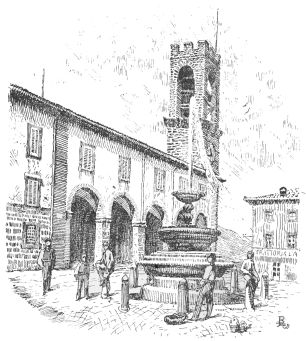
BIBBIENA MARKET-PLACE
various trades were plied. The main streets of the place were lined with vaulted cavernous shops, the doors of which were thrown open, and in the deep, shady recesses men were busy at work. As usual in hill cities, blacksmiths’ shops were numerous, and the owners of all seemed well employed. And as one passed along the street—those narrow, stony Italian streets—one’s attention was arrested by the sound of hammering. Presently the hammering ceased, the bellows stirred up a rush of sparks, and for a moment a ruddy light fell on the bending cyclopean figures at work, or perhaps on the bellows themselves, a panting monster couchant on the hearth. From the braziers’ shops sounded the din of the strokes falling on the metal. These shops too were numerous, and their roofs could hardly be seen for the number of large-bellied copper water pots hanging there. The roof too of the shop of smoked wares was almost invisible from rows upon rows of suspended sausages and hams, each tightly confined in a close network of string. There was the weaver’s workshop, from which sounded the regular thud of the beam thrown back on the woof, and there was the wheelwright’s, with its smell of stored timber and its floor strewn with crisp shavings as they were taken off by the plane. The greengrocer’s store was but a poor one as yet; there were lumps of boiled spinage and bunches of young artichokes, no other green-meats, but there were lemons, oranges, nuts and dried figs in plenty. There was the drug store too, with its clean, cool, deserted look. The apothecary and a friend were sitting down to a game of cards one day when we passed, and looked up in surprise as we entered in the hope of coming upon some pots of Savona ware—a desire for which was strong in the new-fledged M.D. Then there was the barber’s shop, with its nimble master, who could be seen operating on a customer, and the small window with panes of glass behind which the watchmaker sat bending over his work.
On market-days the town assumed a look of greater liveliness. Two-wheeled country carts came toiling up the hill. They were left on the terrace below or on one side of the market-place, and their inmates stood about in groups with the men of the town who had stopped work for the day. A number of stalls were set up on the market-place and wares of many kinds were displayed. There were stalls of butchers’ meat, loaded with the tiniest of lambkins, a sorry sight; there were stalls with a show of ribbons and laces, all of the cheapest; stalls with bales of homespun; stalls with hats and caps of felt. And on the ground brown and yellow and red earthenware was heaped up or spread about, jars and platters, and pots and pans, in the plainest of forms but most decorative in colour.
On such a day selling extended down the side streets. And the vendor of cheap literature was seen suspending tracts and booklets in rows by means of bits of string, while the hawker of cheap jewellery took advantage of a projecting window-ledge to set out his little trays. The display of outlandish wares invariably causes one’s money to burn, and one of us was tempted to buy a silver finger-ring with a crucified Christ—a pattern peculiar to Tuscany, I believe—while the other, from a mass of twopenny romances and stories of the saints, picked out the romance of Pia dei Tolomei, the story of a faithful wife’s cruel treatment and violent death. This was she, unforgotten in popular literature as it seemed, who started up before Dante in Purgatory and prayed him to recall her memory on earth.
But it was at night, when the dark of the evening filled the streets with gloom, when the last carts had rattled down the steep streets and were speeding away along the white country roads in the darkness, when men passed along the walls like shadows, and silence had laid her hold on the concerns of this world, that fancy began to stir and breathe more freely, and stepped forth to take her pleasure with the figures of the past.
One evening I had stayed in the Franciscan church looking at the altar-pieces of the Della Robbias, the Nativity and the Deposition—the latter a gift to the church from Cardinal Bibbiena—till the twilight drove me out and I went to walk on the terrace of the town, which commanded a view of the panorama of the hills. There had been a thunderstorm, and heavy rain-clouds hung over the Apennines. Their lower slopes were shrouded in mist, but spanned from side to side by a rainbow. Towards the south the skyline above the valley of the Arno was piled with masses upon masses of clouds. Further yet, towards the west, the sun had just set behind a rocky height, but its reflection was caught by the white vapour that filled the undulating plain and extended upwards into the numerous branching valleys beneath the snow-capped heights of the Pratomagno, revealing line upon line of rocky crag and sloping hillside. It was a sight that stirred emotion and roused the imagination. And wandering back through the dark, solitary streets, I seemed to see some of the figures of the shadowy past, whose mortal remains long ago had fallen to dust and decay, nay, for aught we knew, had gone to build up new forms of life again and again under the transforming agency of time.
Had they not all walked and talked here, the Etruscan potter, cunning of hand, worthy forerunner of the Tuscan painter of the Quattrocento?—The Roman centurion, proud of a system of government which embraced the known world, never equalled before, never since?—The Langobard hunter—the soft-treading monk—the sister of charity—had they not all walked and talked in sight of the surrounding hills? And had not these streets seen some of those feuds between commune and commune, very thorns in the eyes of Italian liberty in the fourteenth and fifteenth centuries, when the hope of national unification was shattered, and that for centuries to come, by the rise of the condottieri, those upstart rulers, spoilt children of fortune, to whom Italian history owes some of its most sombre and also some of its brightest pages? There is no English equivalent for the word condottiere, the thing and the term for it are unknown outside Italy. For in Italy alone a combination of peculiar circumstances made it possible for men, who were gifted with unlimited determination, to watch their opportunity inside the separate townships and to snatch at the reins of independent government by the help of mercenary troops, a tool, dangerous in itself, which they handled with consummate ability.
The development of communal life in the cities of northern Italy had been early. But placed between Emperor and Pope the citizens of different towns split into factions; some preferred allegiance to an Emperor who was on the other side of the Alps, others, more national in feeling, sided with the Pope. But when the respective authority of Pope and Emperor became a matter of dispute, and each sought to support his claims by introducing foreign armies into Italy, all alike were thrown off their balance.
Under these circumstances the joint action of citizens was inconceivable, much more the joint action of different cities, to the common end of national consolidation. Worn out by party conflicts, townships at last succumbed to the high-handed government of a military leader who brought security if nothing else, and the Republican Government of city after city fell a prey to men whose attitude recalled that of the tyrants of classical antiquity. For among the condottieri also there were men famous for their misdeeds, yet whose despotism was relieved by a trait of grandeur. Among them also there were men who held the prosperity of their subjects dear at heart and who made their courts into centres of learning and polite intercourse. A stormy period was followed by comparative quiet, and the arts of peace found their best patrons among parvenu princes.
The town of Bibbiena had experienced her share of these vicissitudes. Subject at one time to the Prince Bishop of Arezzo, the town was besieged and appropriated by the Republic of Florence, snatched back by members of the powerful Tarlati family, and reconquered by Florence thirty years later. For its vicinity to Florence, combined with its comparative remoteness, made Bibbiena a dangerous neighbour in times of warfare. This was especially the case after the expulsion from Florence of the Medici in 1494, when Piero, the eldest son and successor of Lorenzo the Magnificent, with his brothers and others, sought the help of Venice. An army of Venetians invaded the Casentino, and made Bibbiena its headquarters. The Florentines, having secured the help of the Sforza of Milan, in their turn invaded the Casentino, laying siege to Bibbiena, and the Venetian army was caught as in a trap. Bibbiena fell, and all possibility of her harbouring the enemies of Florence in the future was removed by the entire demolition of her town walls.
The Medici escaped. Piero, whom his father designated as the “fool,” threw himself into the arms of the Borgia and perished a few years later; Giovanni, Lorenzo’s “clever” son, who was a cardinal at the age of thirteen, and afterwards Pope Leo X., left Italy to seek solace by travelling in Germany, Flanders and France; and the third brother, the spirited and gifted Giuliano, called by his father the “good,” a few years later was staying at the Court of Urbino, together with the devoted friend of the family, Bernardo Divizio, afterwards Cardinal Bibbiena.
And these streets had seen him often, in obscure youth and again in the pride of successful manhood, Bernardo Divizio, surnamed Bibbiena, true representative of the spirit of the late Italian Renaissance, with its boundless faith in its own wisdom. Author of that most spirited and most licentious comedy, the Calandra, maître-de-plaisir at the court of Leo X., patron of Rafael, self-conscious, versatile, handsome, with glowing eye and scornful lip, he lives in the portrait which Rafael painted of him. Count Baldassare Castiglione, in his famous analysis of the Perfect Courtier, introduced Bibbiena as the man of mirth and wit. Paolo Giovio, the historian, to whose facile pen posterity owes so many biographies, says much in praise of him. Bembo addressed to him some of his most pleasing letters, and all accounts corroborate the impression produced by Bibbiena’s writings as they lie before us, and by the man’s portrait as it hangs in the Pitti, painted by one of the greatest artists the world has known.
Bernardo Divizio was of an obscure family of Bibbiena. The story that the Divizi had changed their name from Tarlati is an obvious invention, and the boy, at the age of nine, was sent to Florence, where his brother was secretary to Lorenzo the Magnificent. He was an able letter-writer at seventeen, and was the constant companion of Lorenzo’s son Giovanni, his junior by five years. The two young men rivalled each other in studying literature and the classics, but apparently there was never a cloud between them. Before the Medici went into exile Bibbiena acted as their envoy, and a letter of his addressed to Piero throws a curious side-light on the kind of love-adventure in which these young men found diversion. At a later period Bibbiena acted as secretary to Giovanni, advocating his cause at the Papal Court with Julius II. Later still he joined Giuliano at the Court of Urbino, which had become the rallying-place of many men of distinction.
For the Montefeltre of Urbino, condottieri by origin, belonged to those princes who set before them a high degree of excellence. Duke Federigo, whose boast it was never to have lost a battle, acted as patron to the translators and commentators on the Greek classics; he collected a library at Urbino and built a magnificent palace there. There is something pathetic in the fact that Federigo’s son Guidobaldo, himself a confirmed invalid, presided in person over the games by which the young men perfected their physical training. For athletic exercises, no less than culture and good breeding, were the object of attention at Urbino, where the best aspirations of the age, intellectual, artistic and social, found protection. Bramante, who designed St Peter’s at Rome, was from Urbino. Rafael was born here, and he always retained an affection for the home of his childhood, which he frequently visited. Several of his earlier pictures, including Christ on the Mount of Olives, were painted for Duke Guidobaldo. Guidobaldo’s wife, Elisabetta, was a Gonzaga of Mantua, a family of origin and ambitions similar to those of the Montefeltre at Urbino. And when her delicate husband had retired to rest, the Duchess, with the witty Lady Emilia Pia, entertained the company in her apartments, where social accomplishments and literary talents were fully displayed.
It was at these reunions that the discussions took place which Count Castiglione has immortalised in the Cortegiano, a book famous in its time, which has been translated into English more than once under the title, The Courtier, or the Perfect Gentleman and Gentlewoman. A number of distinguished visitors are represented as being assembled in the rooms of the Duchess, and among them are the names of several whose fame has descended through other channels. Here Count Lodovico Canossa spoke of the courtier’s outward bearing and behaviour, pursuing the questions into such byeways as, How far self-praise was commendable, and, How negligence could be affected without becoming unpleasant. When he had spoken Bibbiena was called upon to analyse how far facetiousness was compatible with good breeding, and he illustrated his argument by witticisms, bon-mots, and accounts of practical jokes in endless variety, a collection which forms a valuable addition to our knowledge of the facetiæ of the Renaissance. Bibbiena’s plea for fun was founded on the observation, I do not know if originally due to him, to Castiglione, or to some older writer, that man is the only living being capable of laughter. The company fully appreciated his jokes and the way he told them. To us, many of them seem rather out of date. One wonders that men of culture should have cared for humour that was so broad, and especially, that they should have thought fit to enlarge on it in the presence of ladies. Not that the stories in themselves have any of the offensiveness of those tales with which Boccaccio’s company amused themselves a century and a half earlier. On the contrary, Bibbiena maintained that in good society no pleasantry was acceptable which detracted from a woman’s honour, a remark which led up to the discussion of the perfect lady and of the nature of love. Giuliano de’ Medici, a known champion of women, espoused their cause in a spirit which cannot fail to delight all women who read the work. In the animated discussion which followed, Octaviano Fregoso, afterwards doge of Genoa, Bembo, Aretino and the Lady Emilia Pia all took part.
To judge from the Cortegiano, Bibbiena was not only handsome, but he was renowned for taking pride in his good looks, and in an age of self-consciousness he appeared as most self-conscious. The sentiments which he aroused and the impression which he made were ever present to his mind. And his self-consciousness was matched by his self-assurance. He apparently loved to give the conversation a personal turn, and to carry off feigned criticism of himself in a spirit of banter. When Count Lodovico insisted on beauty of feature as necessary to the perfect courtier, the conversation took an undesired turn. But Bibbiena recalled it and restored good-humour by drawing attention to himself. “As for grace and beauty of feature,” he said, appealing to Lodovico, “I know I have my share, the reason, as you know, why so many ladies fall in love with me, but as for beauty of person I am somewhat in doubt, especially regarding my legs, which are not as well shaped as I would have them.... Explain more particularly what you mean by beauty of person that I may be freed from suspense and my mind set at rest.”
Bibbiena not only entertained the company at Urbino with talk. His great triumph there was the performance, in 1508, of the Calandra, one of the earliest comedies in Italian prose. It called forth acclamations of delight among contemporaries; two generations later its flagrant indecencies had relegated it to oblivion. A full description of the performance was forwarded to Count Lodovico Canossa by Count Castiglione, who, judging from the tone of his letter, had a hand in the mise-en-scène. The curious part about this is its striving for realism. There is the downright realism of a street with palaces and an octagonal church, a town-wall and fortifications, partly decorated in stucco, for the comedy, and the affected realism of would-be classical figures and accessories for the interludes. And this a hundred years before improvised hoardings did service at the first representations of Shakespeare, or a hundred and fifty years before Inigo Jones designed elaborate sceneries for the representation of masques in England.
The Calandra itself was composed on the model of the Menechmi of Plautus, and is not without likeness to the Comedy of Errors. But in this case the two persons whose likeness gives rise to laughable mistakes are twins, brother and sister, neither of whom is aware of the other’s presence in the same town. The brother sometimes dresses up as a woman to gain access to his mistress, the sister sometimes wears men’s clothes to avoid detection. In the prologue the spectators are called upon to decide for themselves who is on the stage, brother or sister, a mystifying quid pro quo which apparently was a source of endless discussion and amusement to the perplexed audience. A vulgar husband, who is said to be drawn from life, and a witty go-between, are the most individual characters. A necromancer is introduced and is credited with transforming men into women, and this gives an opportunity for ridiculing the current belief in magic.
The play was in five acts. At the close of each act came an interlude, by which the classical taste of the age was gratified. There was Jason ploughing the field with imitation bulls which snorted real fire; he sowed dragons’ teeth, which presently started up into men who fell to performing a morisc or morris-dance. At the close of the second act Venus appeared in a chariot drawn by cupids, who bore flaming torches; they set free a number of gallants, who likewise performed a dance. Then came Neptune seated on a car, surrounded by sea monsters, the account of whose dance recalls the displays of a modern Christmas pantomime. Later on Juno appeared surrounded by a bevy of birds—peacocks, eagles, ostriches, parrots—all so entertaining in their antics that Castiglione knows no limit to his praise of them. The entire interludes were acted by children, whose freshness and want of affectation were felt a welcome change from the conventionality of the professional actors. The performance closed with an epilogue, in which Cupid spoke of love as the guiding power of life, and enlarged on the blessings of peace as opposed to the terrors of war.
The success of the performance was such that six years later (1514), when Giovanni de’ Medici had become Pope Leo X., and Bibbiena had been made cardinal by him, the play was repeated at Rome in the Papal Court for the entertainment of Isabella d’Este, Countess of Mantua. The Pope was persuaded by his cardinal to be present, and again no trouble was spared to secure a look of reality to the stage. Its decoration was entrusted to Perruzzi, who was studying architecture at Rome under Bramante, and whose marvellous talent for perspective equalled his fame as an architect. It was he who designed and built the Farnesina, the ceiling of which Rafael decorated with the history of Cupid and Psyche.
The name of Cardinal Bibbiena is indissolubly connected with the pontificate of Leo X., a period of which contemporaries spoke as the Golden Age restored. Giovio has left a most enthusiastic description of the life at Rome at the time. Art and learning, which had received new impulses, thanks to the determined policy of Julius II., found as liberal a patron in Leo. Bramante was at work raising the walls of St Peter’s, Michael Angelo was painting the Sistine Chapel, Rafael was devoting his energies to the Stanze and the Loggie of the Vatican. And at the same time Sadoleto, the famous Latinist, and his friend Bembo, distinguished alike as historian and art-connoisseur, were attached to the Papal Court in the capacity of secretaries. Pope Leo was surrounded by a circle of men of merit, and in this circle Cardinal Bibbiena played no subordinate part. His advice, we are told, was worth having in serious and in frivolous matters; and, judging from letters extant, he inspired Bembo with warm feelings of affection. We are told that his ready wit made it easy for him at any time to divert Leo, and in the matter of art his tastes fell in with those of his patron. It was for Cardinal Bibbiena that Rafael painted a small chamber in the Vatican Palace which is still known as the Cardinal’s bathroom. It was designed in the style of the antique wall-paintings which had been discovered in the thermæ at Rome. Small scenes were introduced among arabesques on the walls, and the subjects of these scenes were chosen by the Cardinal and recall the interludes of the Calandra. On each picture Cupid was depicted, driving sometimes birds, sometimes butterflies or other insects, to show the power of love over the animal world. Cardinal Bibbiena had taken a great fancy to Rafael; he persuaded him to become engaged to his niece Maria Antonia. The painter found he could not refuse though his affections were elsewhere. But he deferred the marriage from year to year, and his premature death cut off the possibility of the alliance.
Thanks to the efforts of the men whom Leo assembled about him, Rome enjoyed a time of undisturbed prosperity—a time of which all who care for buildings and books think with admiration and approval—a time when, once again in the history of mankind, all the elements of culture of which the age seemed capable were developed to their fullest and completest extent. And this while northern Europe, full of anger and discontent, was preparing to meet the coming storm, while travellers returned from Italy chiefly impressed by her vices, while England was waxing wroth at the thought of Papal extravagance, and Germany welcomed the charge that the Pope was a monstrosity with acclamation.
But, nevertheless, none but a northern European, sick at heart at the losses inflicted on his country by the Reformation, could look upon the men who made the greatness of this period at Rome as whited sepulchres. For they have all come down to us, drawn from life by Rafael—Pope Julius and Pope Leo, Count Castiglione and Cardinal Bibbiena, and Inghirami, the secretary of Julius, who likened his patron to the Neptune of Virgil, who rose above the waves and the storm was hushed. Excepting the portrait of Count Castiglione, which is at Paris, all these portraits are at present in the Pitti. And were it not that famous pictures disappear in an unaccountable manner, we should be in possession also of that of the spirited Giuliano de’ Medici, for there seems no reason to doubt the information that Rafael painted it.
It is said that Pope Leo owed his election greatly to the able policy of Cardinal Bibbiena; it is said also that, as Leo was troubled with an internal complaint, the cardinal laid his plans for becoming Pope in his turn. If this plan ever existed it was cut short by death. Cardinal Bibbiena died suddenly towards the close of 1520, a few months after Rafael and a few months before Leo.
The palace of the Divizi still stands at Bibbiena adjoining the Franciscan church. The abilities which secured the Cardinal and his brother the goodwill of the Medici, reappeared in the next generation in Angelo Divizio Bibbiena, who became secretary to Cosimo I., first Duke of Florence. After him the Divizi seem to have fallen back into obscurity. Their palace at Bibbiena is now owned by members of a different family.