III La Verna and St Francis
Reading edition
“Nel crudo sassa infra Tevere ed Arno Da Cristo prese l’ultimo sigillo Che le sue membra du’ anni portarno.” (Par. 11, 106 ff.)
Our first expedition from Bibbiena was to La Verna, ever memorable through its associations with St Francis of Assisi. Here in the depth of mountain solitude, when the thought of regenerating mankind was strong within him, St Francis found the spot of his heart’s desire. Hither he came some ten years later, broken by disappointment and broken in health, but strong in the joy that comes from bearing all things patiently in the consciousness of a pure heart. And here, as the legend tells us, he was quite transformed into Jesus by love and compassion and received the impress of the most holy stigmata.
The retreat of La Verna lies at a distance of about eight miles from Bibbiena, 3720 feet above sea-level, on a plateau that forms a ledge, as it were, on the southern slope of the precipitous Penna. The road from Bibbiena
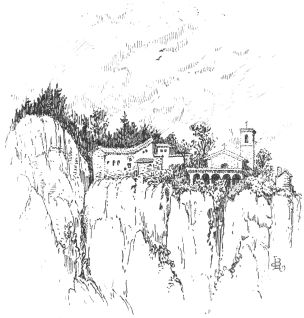
SITUATION OF LA VERNA
across the mountains into the valley of the Tiber skirts the Penna, which stands isolated, massive, and beetle-browed, among the loftier but less commanding heights of the Apennines. It is the “rough rock between the Tiber and the Arno,” as Dante has called it, a rock which commands a prospect without bounds. For the mountains of Tuscany, the plains of Romagna, and the rugged uplands of Umbria are all within sight, fading away in the blue distance that embraces the Tyrrhenian sea on one side and the Adriatic on the other. Quite apart from its historical associations, the spot, with its lofty beeches and pines, has many attractions; the near distance and the far outlook are both equally beautiful.
It was on a warm, sunny morning that we descended the hill of Bibbiena. Beyond the church of the Madonna del Sasso, the road mounted a ridge, and then descended and crossed the river Corsalone. Then began the steep, steady ascent of the Apennines. It was a beautiful day. The heights were lost in the morning haze, the air was laden with the vague perfume of spring growth. There is an Italian proverb which says that April calls up the flowers and May rejoices in their colours. As it was, the sun all around was at work softening sheath and leaf and bud. The hedge-rows were veiled in tenderest green, while here and there they were white with the flaky blossoms of the blackthorn. Violets, primroses, celandine and dark blue bell-hyacinths shone among the verdure of the roadside. Down by the river the fields were green with corn and waving herbage; further up the brown earth sloping away from the road was planted with trees, their trunks wedded to the stems of the vine. In these parts the vines are trained up pollard trees, over the stunted tops of which their branches are spread. These branches are then tightly wound round each other, two and two, tied together and their ends turned downwards. As we passed along, men were training and binding the vine, singing snatches of a song that ended with a minor cadence. From the hanging ends of the vine the shining sap was dropping, recalling the Italian simile of piangere a vite tagliata.
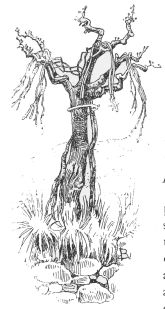
VINE CULTIVATION (CASENTINO)
In our progress we passed several roadside shrines, but we found them despoiled of their original contents. We afterwards found that all the open-air shrines of the Casentino have been dealt with in the same manner. In some a rude print or a small china figure has been substituted for the older object of reverence; oftener the niche is empty and the structure is falling to ruin.
For several miles our road was through land that had been brought under cultivation. Then it ascended through a wood, and beyond this we reached the uneven grassland of the mountains. The genial warmth of the lowland and the unchecked influence of spring were left behind. The grass on the hillocks was green, but in the hollows it was brown and sodden, as though the numerous patches of snow had only just shrunk away from it. Only here and there, close to the edge of the snow, purple crocuses were bursting through the soft mould of the rifts in the greensward. The silence of mountain solitude reigned undisturbed except for the sound of trickling, dripping water.
The plateau, at the end of which the convent of La Verna stands, is visible from afar. It was between one and two in the afternoon when we left the main road and soon afterwards reached the little inn that stands on the confines of the monastic property. Within its walls, at the foot of the rock, which is here almost perpendicular, a small chapel commemorates the spot where St Francis and his companions paused to rest before scaling the height. “And immediately flocks of birds came from all parts,” the legend tells us, “and with singing and beating of their wings they showed the greatest joy and gladness, and surrounded St Francis in such a manner that some perched on his head, some on his shoulders, some on his arms and some on his legs, and some around his feet. His companions marvelled, but St Francis, all joyful in his spirit, said to them—I see that it is pleasing to our Lord that we live in this solitary mountain, since so much joy is shown at our arrival by our little sisters and brothers, the birds.”
This incident in the legend of the saint illustrates one of the most lovable traits in his character—the sense of religious fellowship which united him to whatever claimed his attention in nature. The beasts of the earth, and the birds of the air, fire and water, the wind, the sun, the moon and the clouds—he felt the impress of the divine spirit in every one of them. In the happiest and in the most trying hours of his life he was ever ready to recognise the beneficence of the divine purpose in everything around him. It was this attitude of mind which enabled him not to shrink when the red-hot iron was drawn across his temple in the hope of saving his eye-sight. It was this attitude of mind which inspired him to compose the Canticle of the Sun, a hymn which in its simple framing and passionate utterances bears the stamp of the religious fervour of a new era.
The personality and influence of St Francis have great attractions under whatever aspect they be viewed. He is the representative of a new development of Christianity—of the period when the bearings of Christian teaching on the concerns of daily and domestic life were first realised, and when the masses of the laity ceased to look upon Christianity as a cult, and began to feel it as a living faith by which conduct could be regulated. It is in this sense that Ruskin, speaking of St Francis, says that it was he who taught men how to behave. By example chiefly. For the bearing of the man who would be guided solely by Christian love and charity had an irresistible charm for those who saw him, and the tidings of his influence, carried beyond the confines of his district by enthusiastic followers, acted as the breath by which latent emotional cravings were everywhere fanned into ardent devotion to the needs of suffering mankind.
To his companions the Poverello of Assisi appeared as the true representative of the Lord’s anointed, and it was owing to this that the movement which he inaugurated had so great an influence on life, on literature and on art. The measure of the man is not easy to recover. His companions never tired of drawing parallels between him and Jesus of Nazareth, and, as in the case of Jesus, a number of miracles wrought by him were introduced into the descriptions of his life, which throw darkness rather than light on his personality. But the influence of the man may well appear miraculous, considering how instantaneous and far-reaching was the impression which he produced—an impression to which history offers few parallels. This influence is so marvellous that the historian who would show it in the light of cause and effect must needs have a firm hold on the sequence of events that led up to it, and on the prevalent attitude of mind in the different strata of society that prepared it.
The influence of the Franciscan movement on literature and art has been made the subject of a number of interesting inquiries. Ozanam was the first to analyse it in its bearings on Italian poetry. The Canticle of the Sun (Laudes Creaturarum) by St Francis, is among the earliest poems in the vernacular, and it led to the composition of numerous poems and hymns. Apparently St Francis in early days himself sang the songs of the troubadours, and among his first converts was a troubadour who was afterwards known as Fra Pacifico. Hence an element in the religious poems of the Franciscans which reflects the poet’s delight in nature and the beggar’s freedom from care. Many celebrated hymns were written by Franciscans, among them the Dies Irae, first sung by Thomas of Celano, and the Stabat Mater Dolorosa written by Jacopone of Todi, a famous and prolific poet. As a companion to the Stabat Mater Dolorosa, the Hymn of the Virgin at the Cross, Jacopone afterwards wrote the Stabat Mater Speciosa, the Hymn of the Virgin at the cradle; the keynote of the one is sorrow, the keynote of the other is joy.
The study of Ozanam on the influence of the Franciscans on Italian literature might be extended to other countries. Some of the earliest and most beautiful writings in Middle English were the outcome of Franciscan influence. Wherever the friars gained a foothold they succeeded in identifying themselves with popular and national interests, and the Christianity which they preached was as a light by which the common realities of life appeared more beautiful and more worthy of praise in sermon and song.
In regard to art, Ruskin long ago drew attention to the spirit which the friars infused into painting; his keen sense of beauty and his desire for religious exaltation were soothed by no art so well as by that of the Quattrocento. In Italian painting the friars inaugurated a new era. Since the days when Byzantine artists had decorated churches and chapels with mosaics, practically no attempt had been made to represent incidents of Biblical history and saint legend in church. The friars were the first to favour the idea of having the stories of religion set forth on a large scale in effective and inexpensive frescoes. And compared to the artists of the Byzantine School, these painters were animated by the health-giving breath of a new kind of realism. To the Byzantine, as interpreted by his work, dispassionateness appeared as an adjunct of holiness in the saint. The fresco painter, on the contrary, did not hesitate in animating the saints with passion, which appears as additional strength, since it is passion brought well under control.
The Franciscan churches of Italy have recently been made the subject of an inquiry by Thode, who enters also into the incidents of the saint’s life which were there represented. In the choice of these incidents the painters were apparently guided by the early accounts of the saint’s life, but there is considerable diversity in the scenes which they chose for representation and combined together into a series. The early accounts of St Francis include a life written by Thomas of Celano between 1228 and 1229, which was afterwards re-written; a life written by three of the companions of St Francis, which was finished in 1246; and a life in which St Francis’s great follower, Bonaventura, combined all that had previously been written of the saint. It was completed in the year 1260.
But the development of the legend of St Francis did not stop here. The Little Flowers of St Francis, which were put into writing in the course of the fourteenth century, describe such incidents in the life of the saint as appealed to popular fancy, set down in a popular form. The thread of historical truth in this book is of the slenderest, and the incidents
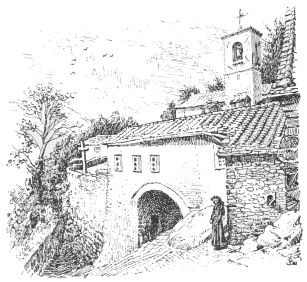
ENTRANCE TO LA VERNA
as they stand cannot claim to have happened. And yet the Little Flowers, in their bluntness and simplicity, have all the charm of an unreflective and uncritical belief in the beauty of the new teaching. They give a true picture of humble life in mediæval Italy and show us the early Franciscans in the light in which they saw themselves. The book was widely read, and the first part, which dealt with St Francis among his followers, was amplified by accounts of the mad and saintly freaks of Fra Ginepro, and of the steadfastness with which Fra Egidio kept to his resolve of living by the labour of his hands. The influence of the Poverello of Assisi was, in fact, felt by the highest and the lowest alike. While current fables made popular heroes of him and his followers, Giotto at Assisi represented the decisive incidents of his life in a series of paintings, which have been likened to an epic, and Dante devoted an entire canto of the Paradiso to his praise. In the Paradiso the praise of St Francis is sung by St Thomas Aquinas, the greatest of the followers of St Dominic, while the praise of St Dominic is sung by St Bonaventura, the most influential of Franciscans, a proof of the bond which united the two orders in Dante’s mind. The jealousy which afterwards estranged them was never as pronounced in Italy as north of the Alps. In many churches the figures of St Francis and St Dominic still stand side by side. And Andrea della Robbia, in a most charming relief in the Piazza Santa Maria Novella at Florence, gave expression to the affection of the two orders by representing their founders embracing as they meet.
And how shall we picture him in the flesh, the man who was so close to the best side of the religion and the morality of his age? In the year 1222 St Francis, attracted by the thought of St Benedict, went to stay at the ancient monastery at Subiaco, and here, in memory of his visit, his portrait was painted on the wall of a chapel which was completed before 1228. On this picture St Francis is represented without the stigmata and without a halo. He wears the penitent’s rough garb with a cord round his waist, and he is designated simply as Frater Franciscus. The Poverello is seen full face. His figure is slim, his hair and beard are crisp and fair, his face is long and thin. In spite of a certain awkwardness, due no doubt to the painter, he has an appearance of refinement and delicacy well in keeping with the stock from which he had sprung. His large eyes and parted lips suggest the enthusiast; his thin neck and slender hands belong to a physique which might well contract phthisis. There are other early pictures of St Francis. But the great painters who set forth his life’s history do not appear to have been directly influenced by them. Thode has shown how, in some parts of Italy, a bearded type of the saint is traditional, in others a beardless type. Sometimes he was painted dark, sometimes fair, sometimes comely in figure, sometimes emaciated. Even Giotto, judging by the two series of pictures he painted, the one at Assisi, the other in the church of Santa Croce in Florence, had before him different ideal types of the saint.
Were it not for the ravages of time, the convent at La Verna would possess one of the early cycles of pictures representing the story of St Francis. A chapel was erected in 1264 on the spot where St Francis received the most holy stigmata, and Taddeo Gaddi, the godson and pupil of Giotto, was summoned to decorate it. No trace of the work remains. Taddeo’s stay at La Verna was however productive of other results. A youth from the neighbouring Pratovecchio, Jacopo Landini, was sent to work under him, and he afterwards went to Florence and gained considerable renown as Jacopo del Casentino. In later life he returned to his native district, where some paintings of his are extant. Vasari includes an account of him in his Lives of the Painters, and he tells us that it was due to Jacopo that the painters of Florence first combined together in a guild (compania e fraternita) in 1350.
As it stands at present the retreat of La Verna is distinguished chiefly by the large number of its altar-pieces in glazed terra cotta by the della Robbias. Except in the museum at Florence there are nowhere so many fine examples of their work to be found together. They are gifts for the most part from distinguished Florentine families. They include a large altar-piece, on which the Virgin is seen handing her girdle to St Thomas; a Transfiguration, on a large scale, with the figures of the twelve Apostles standing below in beautiful grouping and the most varied expression. There is a Nativity with the figures of St Francis and St Anthony of Padua behind the Virgin and St Joseph, and an Annunciation; both of these are of exquisite grace. All these altar-pieces and other single figures, such as St Francis, are in the usual style of blue and white. I find them variously attributed to Luca and to Andrea della Robbia. In the gallery on the way to the chapel there is a large Pietà in polychrome. The most beautiful, however, of all is a large altar-piece of the Crucifixion, the sole decoration of the Chapel of the Stigmata.
Slowly we ascended the steep path which led up to the convent. We passed under an archway and found ourselves before the entrance to the main church. The site of La Verna was granted to St Francis by Count Orlando of Chiusi in the year 1213; it was the only gift of a site ever accepted by the saint, who held himself betrothed to poverty. Probably a small church was erected under his direction; but when the fame spread of his having here received the impress of the stigmata, a special interest attached to the site. Pope Alexander IV. took the “Mons Alvernus” under his protection; in 1260 a church was consecrated in the presence of Bonaventura and six bishops; and a few years later the Chapel of the Stigmata was built through the munificence of Count Simone of Battifolle. The chief church is now a large one; it was begun in 1348, but it was not completed till some time in the fifteenth century, when the whole settlement of La Verna, the “Seraphicus Mons,” as it was called, had passed under the protectorate of the Signory of Florence.
The churches at La Verna form part of a vast mass of buildings. We were told that the convent affords accommodation for five hundred friars. As we were about to enter the main church we met some of them walking in a procession, two and two. They had been celebrating service in church, and now they walked down the gallery to conclude it in the chapel, chanting as they went along. We afterwards met them again coming out. There were forty of them, vigorous men for the most part, wearing the rough brown frock and cord, with sandals on their bare feet. It was difficult to tell at a glance from what class they were drawn; certainly not from the higher and more refined. They greatly differed as to age, and the older men had the better appearance. On the whole they were not dignified in bearing, and in person did not look as clean as they might have done.
We spent a long time in church, looking at the altar-piece and reading what the guide-book to the Casentino of Beni had to say of La Verna. This is the only guide-book to the district as far as I know. It was our constant companion, but we found that it required close and repeated reading, for it is a queer jumble of all kinds of information. We then wandered along the gallery which bridges the abyss between the settlement and the isolated bit of rock on which stands the Chapel of the Stigmata. With its dark panelling and its one large altar-piece this chapel is a true place of rest. Its large della Robbia represents the Crucifixion, with the figures of the Virgin, St John the Baptist, St Jerome and St Francis standing and kneeling below. This association of saints of later date with the characters of Scripture comes at first as a shock to the historical mind; to the Middle Ages it appeared natural. St Anthony of Padua, in a vision, saw the child Christ sitting on his prayer-book. St Bernard, in a vision, saw the Virgin standing before him. When these scenes came to be represented in art they assumed the form of real incidents. And by a further development, St Francis and other holy men and women of the Middle Ages were pictured in contemplation of the Nativity, the Crucifixion and other decisive moments in Biblical history as though they had been present at them in the flesh.
There were other sights to be seen at La Verna: the rocky chasm where St Francis hurled aside the devil, and the Luoghi Santi, a number of grottoes and rock-hewn chambers where the saint once lived. Visitors from all parts of the world come to La Verna, and on Sundays they say there are crowds of country people all eager for the sights. For myself, I was content with what I had seen and glad to rest in the convent, where an old friar gave us wine and water to drink. He chatted about the convent and about himself. How long had he stayed there—forty years? Yes, quite that. Fifty? Quite likely, it came to much the same thing. I had recently been reading the Life of St Francis by Sabatier, a charming writer, who makes the joyful side of the saint’s nature very real. The old friar remembered his stay at La Verna, but he would not say much about him.
Then we sat outside under the huge beeches, as yet bare of foliage, listening to the birds, which seemed as numerous and as tuneful as they were seven hundred years ago. With the sun shining brilliantly we started homewards to Bibbiena. The ascent of the Penna, and a walk over to Chiusi, which lay below in a streak of blue mist, are expeditions I should wish to make if I ever again visit the district.