Chapter I · (continued 5)
Reading edition
Having at length procured a boat, we set off on our journey, the boatmen neither knowing where I intended to go to, or how long I was to be absent from Shanghae. I simply told them we were going into the country in search of plants, and that they must take a supply of rice for several days. My Chinese servant, who always accompanied me, also informed them, that it was a common thing for me to wander about the country in search of plants, but that I was perfectly harmless, and would take care that they should not get into any trouble on my account. This gave them some confidence, and as the wind and tide were both in our favour, we were soon a considerable distance away from Shanghae. As I knew pretty well in what direction Soo-chow lay, I took my course by a pocket compass which I always carried with me. After getting twenty or thirty miles from Shanghae, I judged it prudent to break the subject of my wishes to my companions. First of all, I took my servant aside; he was a most active fellow, and capable of persuading the others to do any thing he liked. "Now," said I to him, "I want to visit Soo-chow, and if you will persuade the boatmen to go on there, I will make you a present of five dollars when we return; besides, you may tell the men that I shall double the amount of the hire which I have already promised them." Upon this a long conference ensued, the result of which was that they determined to accept my offer.
I was, of course, travelling in the Chinese costume; my head was shaved, I had a splendid wig and tail, of which some Chinaman informer days had doubtless been extremely vain, and upon the whole I believe I made a pretty fair Chinaman. Although the Chinese countenance and eye differ considerably from those of a native of Europe, yet a traveller in the north has far greater chance of escaping detection than in the south of China, the features of the northern natives approaching more nearly to those of Europeans than they do in the south, and the difference amongst themselves also being greater.
In China, the canal is the traveller's highway, and the boat is his carriage, and hence the absence of good roads and carriages in this country. Such a mode of conveyance is not without its advantages, however little we may think of it in England; for as the tide ebbs and flows through the interior for many miles, the boats proceed with considerable rapidity; the traveller, too, can sleep comfortably in his little cabin, which is, in fact, his house for the time being.
The canal, after leaving Shanghae, leads in a northerly direction, inclining sometimes a little to the west; branches leading off in all directions over the country. Some very large towns and walled cities were passed on our route, at one of which, named Cading, we halted for the night just under the ramparts. I spread out my bed in my little cabin, and went to sleep rather early, intending to start by times with the tide next morning, and get as far as possible during the ensuing day. But, as my countryman says,—
"The best laid schemes of mice and men gang aft agee;"
and I awoke during the night by the cool air blowing in upon my head through one of the windows of the boat, which I had shut before I went to rest. I jumped up immediately and looked out, and through the darkness I could discern that we were drifting down the canal with the tide, now coming in contact with some other boat, which had been fastened up like ourselves for the night, and now rubbing against the branches of trees which hung over the sides of the canal. I lost no time in awaking my servant and the boatmen, who rubbed their eyes with astonishment, and exclaimed that some robber must have boarded us. This had never struck me before, but when I called for a light, I found that all my clothes, English and Chinese, were gone. Our visitor, who ever he had been, after taking possession of all the cabin contained, cut the rope by which we were fastened, and shoved us off into the centre of the canal, along which we had drifted a considerable way before I awoke. Fortunately for me, the few dollars I had with me were in my Chinese purse beneath my pillow.
"What shall we do," said my servant when we had made the boat fast again to some others on the side of the canal, "your clothes are all gone?"
"Do," said I, laughing; "I think the best thing we can do is to go to bed again until daylight." This being agreed to, we were soon all once more sound asleep. When morning dawned, I sent my servant into the town of Cading with a few dollars, which procured me another dress, and we proceeded on our journey.
The city of Cading is large and fortified, although the walls and ramparts are in a state of decay. It is evidently a very ancient place. Here a large quantity of the celebrated carving is done, for which the Chinese in the north are so well known. After leaving this town, the canal which was narrow, continued in a northerly direction for a few miles, and then, all at once, our little boat shot out of it into a broad and beautiful canal, resembling a lake or broad river, running nearly east and west, and probably connecting itself with the Yang-tse-kiang river, somewhere between Woosung and Nanking. The scenery here is extremely striking; the broad and smooth canal bears on its waters hundreds of Chinese boats of all sizes, under sail, and each hurrying to its place of destination; pagodas here and there are seen rearing their heads above the woods and Budhist temples, which are scattered over this wide and extensive plain. One of these temples crowns a solitary little hill named Quin-san, which at certain seasons of the year is visited by crowds of people from Soo-chow and the neighbouring towns; the whole country, as far as the eye can reach, is one vast rice-field, and everywhere the pleasing clatter of the water-wheels falls upon the ear, and hundreds of happy and contented Chinese peasants are seen engaged in the cultivation of the soil. After continuing its westerly course for some distance, the canal divided, and the branch we took soon led us to another town named Ta-tsong-tseu. It is a place of great size, walled and fortified like Cading and Shanghae, and is probably larger than the latter, although perhaps not so populous. A great number of large old junks are moored on the canal round the walls, apparently used as dwelling-houses, being now unfit for any other service. This town too, like Cading, is evidently in a decaying state, judging from the dilapidated condition of the houses and fortifications, but teems with an immense population of men, women, and particularly children.
On approaching Soo-chow some hills were seen, bounding the level plain, which I afterwards found were some few miles west from the town itself. The whole country here, as well as near Cading, is one vast rice-field. Many females are employed in driving the water-wheels, generally three or four to each wheel: these ladies have large feet, or rather their feet are of the natural size; indeed, if they were cramped in the usual way it would be impossible for them to work on the water-wheel. Small feet, however, are general amongst the lower classes who work in the fields, for of the hundreds whom I observed hoeing the cotton, or engaged in other agricultural operations, but a small proportion had feet of the natural size.
A few miles on the east of Soo-chow there is a large and beautiful lake, twelve or fifteen miles across, through which the boats from Sung-Kiang-foo and other places in that direction approach the city. After passing this lake the canal, which had widened considerably, now began to contract; bridges here and there were passed, villages and small towns lined the banks, and everything denoted the approach to a city of some size and importance. It was a delightful summer's evening on the 23rd of June, when I approached this far-famed town. The moon was up, and with a fair light breeze my little boat scudded swiftly, its masts and sails reflected in the clear water of the canal; the boats thickened as we went along, the houses became more crowded and larger, lanterns were moving in great numbers on the bridges and sides of the canal, and in a few minutes more we were safely moored, among some hundreds of other boats, under the walls of this celebrated city. Having taken all the precautions in our power against another nightly visitor, my servant, the boatmen, and myself, were soon fast asleep.
With the first dawn of morning I was up, and dressed with very great care by my Chinese servant, whom I then despatched to find out the nursery gardens in the city, in order to procure the plants which I wanted. When he had obtained this information he returned, and we proceeded together into the city, in order to make my selections.
When I left the boat, I confess I felt rather nervous as to the trial I was about to make. Although I had passed very well as a Chinaman in the country districts, I knew that the inhabitants of large towns, and particularly those in a town like this, were more difficult to deceive. My old friends, or I should rather say my enemies, the dogs, who are as acute as any Chinaman, evidently did not disown me as a countryman, and this at once gave me confidence. These animals manifest very great hatred to foreigners, barking at them wherever they see them, and hanging on their skirts until they are fairly out of sight of the house or village where their masters reside.
As I was crossing the bridge, which is built over the moat or canal on the outside of the city walls, numbers of the Chinese were loitering on it, leaning over its sides, and looking down upon the boats which were plying to and fro. I stopped too, and looked down upon the gay and happy throng, with a feeling of secret triumph when I remembered that I was now in the most fashionable city of the Celestial Empire, where no Englishman, as far as I knew, had ever been before. None of the loiterers on the bridge appeared to pay the slightest attention to me, by which I concluded that I must be very much like one of themselves. How surprised they would have been had it been whispered to them that an Englishman was standing amongst them.
The city of Soo-chow-foo, in its general features, is much the same as the other cities in the north, but is evidently the seat of luxury and wealth, and has none of those signs of dilapidation and decay which one sees in such towns as Ning-po. A noble canal, as wide as the river Thames at Richmond, runs parallel with the city walls, and acts as a moat as well as for commercial purposes. Here, as at Cading and Ta-tsong-tseu, a large number of invalided junks are moored, and doubtless make excellent Chinese dwelling-houses, particularly to a people so fond of living on the water. This same canal is carried through arches into the city, where it ramifies in all directions, sometimes narrow and dirty, and at other places expanding into lakes of considerable beauty; thus enabling the inhabitants to convey their merchandise to their houses from the most distant parts of the country. Junks and boats of all sizes are plying on this wide and beautiful canal, and the whole place has a cheerful and flourishing aspect, which one does not often see in the other towns in China, if we except Canton and Shanghae. The walls and ramparts are high, and in excellent repair, having considerable resemblance to those of Ning-po, but in much better order. The east wall, along the side of which I went all the way, is not more than a mile in length, but the north and south are much longer, thus making the city a parallelogram. That part of the city near the east gate, by which I entered, is anything but splendid; the streets are narrow and dirty, and the population seems of the lowest order, but towards the west the buildings and streets are much finer, the shops are large, and everything denotes this to be the rich and aristocratic part of the town. The city gates seem to be well guarded with Chinese soldiers, and all the streets and lanes inside are intersected at intervals with gates, which are closed at nine or ten o'clock at night. The Governor General of the province resides here, and keeps those under his control in excellent order.
The number of nursery gardens in this city had been exaggerated by my Chinese friends at Shanghae, but nevertheless there were several of considerable extent, out of which I was able to procure some new and valuable plants. Among these I may notice in passing a white Glycine, a fine new double yellow rose, and a Gardenia with large white blossoms, like a Camellia. These plants are now in England, and will soon be met with in every garden in the country. The Soo-chow nurseries abounded in dwarf trees, many of which were very curious and old, two properties to which the Chinese attach far greater importance than we do in England.
The ladies here are considered by the Chinese to be the most beautiful in the country, and, judging from the specimens which I had an opportunity of seeing, they certainly deserve their high character. Their dresses are of the richest material, made in a style at once graceful and elegant; and the only faults I could find with them were their small deformed feet, and the mode they have of painting or whitening their faces with a kind of powder made for this purpose. But what seemed faults in my eyes are beauties in those of a Chinaman, and hence the prevalence of these customs.
Soo-chow-foo seems to be the great emporium of the central provinces of China, for which it is peculiarly well fitted by its situation. The trade of Ning-po, Hang-chow, Shanghae, and many other towns on the south: Ching-kiang-foo, Nanking, and even Peking itself on the north, all centres here, and all these places are connected either by the Grand Canal, or by the hundreds of canals of lesser note, which ramify over all this part of the empire. Shanghae, from its favourable position as regards Soo-chow, will doubtless become one day a place of vast importance, in a commercial point of view, both as regards Europe and America.
I remained for several days in this city, and its neighbourhood, when, having done all that was possible under the circumstances, I set out on my way back to Shanghae. When I arrived, I was obliged to go on shore in my Chinese dress, as the English one had been stolen by my midnight visitor. The disguise, however, was so complete, that I was not recognised by a single individual, although I walked up the street where I was well known, and even my friend Mr. Mackenzie, with whom I was staying, did not know me for the first few minutes after I sat down in his room.
In the town of Shanghae, as well as in many other large Chinese towns, there are a number of public hot water bathing establishments, which must be of great importance as regards the health and comfort of the natives. I will describe one which I passed daily during my residence in Shanghae. There are two outer rooms used for undressing and dressing; the first, and largest, is for the poorer classes; the second, for those who consider themselves more respectable, and who wish to be more private. As you enter the largest of these rooms, a placard which is hung near the door informs you what the charges are, and a man stands there to receive the money on entrance. Arranged in rows down the middle and round the sides of both rooms are a number of small boxes or lockers, furnished with lock and key, into which the visitors put their clothes, and where they can make sure of finding them when they return from the bathing room, which is entered by a small door at the farther end of the building, and is about 30 feet long and 20 feet wide; the water occupying the whole space, except a narrow path round the sides. The water is from 1 foot to 18 inches deep, and the sides of the bath are lined with marble slabs, from which the bathers step into the water, and on which they sit and wash themselves: the furnace is placed on the outside, and the flues are carried below the centre of the bath.
In the afternoon anti evening this establishment is crowded with visitors, and on entering the bath room, the first impression is almost insupportable; the hot steam or vapour meets you at the door, filling the eyes and ears, and causing perspiration to run from every pore of the body; it almost darkens the place, and the Chinamen seen in this imperfect light, with their brown skins and long tails, sporting amongst the water, render the scene a most ludicrous one to an Englishman.
Those visitors who use the common room pay only six copper cash; the others pay eighteen, but they have in addition a cup of tea and a pipe of tobacco from the proprietors. I may mention that one hundred copper cash amount to about 4½d. of our money; so that the first class enjoy a hot water bath for about one farthing! and the other a bath, a private room, a cup of tea, and a pipe of tobacco for something less than one penny!
CHAP. XIV.
CHINESE COTTON CULTIVATION.—YELLOW COTTON.—DISTRICT WHERE IT GROWS.—COTTON COUNTRY DESCRIBED.—SOIL.—MANURE, AND MODE OF APPLICATION.—PRECEDING CROPS.—TIME OF SOWING.—METHOD.—RAINS.—SUMMER CULTIVATION.—EARLY RAIN ADVANTAGEOUS.—TIME OF REAPING AND GATHERING.—COTTON FARMERS AND THEIR FAMILIES.—DRYING AND CLEANING PROCESS DESCRIBED.—MARKETING.—INDEPENDENCE OF THE SELLER.—CROWDED STREETS IN SHANGHAE DURING THE COTTON SEASON.—WAREHOUSES AND PACKING.—HOME CONSUMPTION.—STALKS USED FOR FUEL.
The Chinese or Nanking cotton plant is the Gossypium herbaceum of botanists, and the "Mie wha" of the northern Chinese. It is a branching annual, growing from one to three or four feet in height, according to the richness of the soil, and flowering from August to October. The flowers are of a dingy yellow colour, and, like the Hibiscus or Malva, which belong to the same tribe, remain expanded only for a few hours, in which time they perform the part allotted to them by nature, and then shrivel up and soon decay. At this stage the seed pod begins to swell rapidly, and when ripe, the outer coating bursts and exposes the pure white cotton in which the seeds lie imbedded.
The yellow cotton, from which the beautiful Nanking cloth is manufactured, is called "Tze mie wha" by the Chinese, and differs but slightly in its structure and general appearance from the kind just noticed. I have often compared them in the cotton fields where they were growing, and although the yellow variety has a more stunted habit than the other, it has no characters which constitute a distinct species. It is merely an accidental variety, and although its seeds may generally produce the same kind, they doubtless frequently yield the white variety, and vice versâ. Hence, specimens of the yellow cotton are frequently found growing amongst the white in the immediate vicinity of Shanghae; and again a few miles northward, in fields near the city of Poushan on the banks of the Yang-tse-kiang, where the yellow cotton abounds, I have often gathered specimens of the white variety.
The Nanking cotton is chiefly cultivated in the level ground around Shanghae, where it forms the staple summer production of the country. This district, which is part of the great plain of the Yang-tze-kiang, although flat, is yet several feet above the level of the water in the rivers and canals, and is consequently much better fitted for cotton cultivation than those flat rice districts in various parts of the country,—such for example as the plain of Ning-po,—where the ground is either wet and marshy, or liable at times to be completely overflowed. Some fields in this district are, of course, low and marshy, and these are cultivated with rice instead of cotton, and regularly flooded by the water-wheel during the period of growth. Although the cotton land is generally flat, so much so, indeed, that no hills can be seen from the tops of the houses in the city of Shanghae, it has nevertheless a pleasing and undulating appearance, and taken as a whole, it is perhaps the most fertile agricultural district in the world. The soil is a strong rich loam capable of yielding immense crops year after year, although it receives but a small portion of manure.
The manure applied to the cotton lands of the Chinese, is doubtless peculiarly well fitted for this kind of crop. It is obtained from the canals, ponds, and ditches which intersect the country in every direction, and consists of mud which has been formed partly by the decay of long grass, reeds, and succulent water plants, and partly by the surface soil which has been washed down from the higher ground by the heavy rains. Every agricultural operation in China seems to be done with the greatest regularity, at certain stated times, which experience has proved the best, and in nothing is this more apparent than in the manuring of the cotton lands. Early in April the agricultural labourers, all over the country, are seen busily employed in cleaning these ponds and ditches. The water is first of all partly drawn off, and then the mud is thrown up on the adjoining land to dry, where it remains for a few days until all the superfluous water is drained out of it, and is then conveyed away and spread over the cotton fields. Previous to this, the land has been prepared for its reception, having been either ploughed up with the small buffalo plough in common use in the country, and then broken and pulverised by the three-pronged hoe, or, in those instances where the farms are small and cannot boast of a buffalo and plough, it is loosened and broken up entirely by manual labour. When the mud is first spread over the land, it is, of course, hard or cloggy, but the first showers soon mix it with the surface soil, and the whole becomes pulverised, and it is then ready for the reception of the cotton seed. Road-scrapings and burnt rubbish are saved up with care, and used for the same purpose and in the same manner.
A considerable portion of the cotton lands either lie fallow during the winter months, or are planted with those crops which are ready for gathering prior to the sowing of the cotton seed. Frequently, however, two crops are found growing in the field at the same time. Wheat, for example, which is a winter crop, is reaped in the Shanghae district generally about the end of May, while the proper time for putting in the cotton seed is the beginning of that month or the end of April. In order, therefore, to have cotton on the wheat lands, the Chinese sow its seeds at the usual time amongst the wheat, and when the latter is reaped, the former is several inches above ground, and ready to grow with vigour when it is more fully exposed to the influence of sun and air. The Shanghae season—that is, from the late spring frosts to those in autumn—is barely long enough for the production and ripening of the cotton, as it is easily injured by frost, and the Chinese farmer is thus obliged, in order to gain time and obtain two crops from his ground in one year, to sow its seeds before the winter crop is ready to be removed from the ground. When it is possible to have the first crop entirely removed before the cotton is sown it is much preferred, as the land can then be well worked and properly manured, neither of which can otherwise be done. The method of sowing one crop before the preceding one is ripe and removed from the land is very common in this part of the country; and even in autumn, before the cotton stalks are taken out of the ground, other seeds are frequently seen germinating and ready to take the place of the more tender crop.
In the end of April and beginning of May—the land having been prepared in the manner just described—the cotton seeds are carried in baskets to the fields, and the sowing commences. They are generally sown broad-cast, that is, scattered regularly over the surface of the ground, and then the labourers go over the whole surface with their feet and tread them carefully in. This not only embeds the seeds, but also acts like a roller to break and pulverise the soil. Germination soon commences, the seeds rooting first in the manure which had been scattered over the surface of the land. In some cases the seed, instead of being sown broadcast, is sown in drills or patches, but this mode is less common than the other. The rains, which always fall copiously at the change of the monsoon which takes place at this season of the year, warm and moisten the earth, and the seeds swell, and vegetation progresses with wonderful rapidity. Many of the operations in Chinese agriculture are regulated by the change of the monsoon. The farmer knows from experience, that, when the winds, which have been blowing from the north and east for the last seven months, change to the south and west, the atmosphere will be highly charged with electric fluid, and the clouds will daily rain and refresh his crops.
The cotton fields are carefully tended during the summer months. The plants are thinned where they have been sown too thickly, the earth is loosened amongst the roots, and the ground hoed and kept free from weeds. If the season is favourable, immense crops are obtained owing to the fertility of the soil, but if the weather happens to be unusually dry from June to August, the crop receives a check which it never entirely recovers, even although the ground, after that period, should be moistened by frequent showers. 1845 was a season of this kind, and the crop was a very deficient one compared with that of the previous year. The spring was highly favourable, and the plants looked well up to the month of June, when the dry weather set in, and gave them a check which they never recovered. Abundance of rain fell later in the season but it was then too late, and only caused the plants to grow tall and run to leaf, without producing those secretions which ultimately go to the formation of flowers and seed.
The cotton plant produces its flowers in succession from August to the end of October, but sometimes, when the autumn is mild, blooms are produced even up to November, when the cold nights generally nip the buds, and prevent them from forming seed. In the autumn of 1844 this happened on the night of the 28th of October, when the thermometer sunk to the freezing point, and then ice was found on the sides of the canals and ponds.
As the pods are bursting every day, it is necessary to have them gathered with great regularity, otherwise they fall upon the ground and the cotton gets dirty, which of course reduces its value in the market. Little bands of the Chinese are now seen in the afternoon in every field, gathering the ripe cotton and carrying it home to the houses of the farmers. As the farms are generally small, they are worked almost entirely by the farmer and his family, consisting sometimes of three or even four generations, including the old grey-haired grand-father or great-grandfather, who has seen the crops of four-score years gathered into his barns. Every member of these family groups has a certain degree of interest in his employment; the harvest is their own, and the more productive it is, the greater number of comforts they will be able to afford. Of course there are many cotton farms of larger size, where labourers are employed in addition to the farmer's family, but by far the greater number are small and worked in the way I have just described. It is no unusual sight to see the family goat too, doing their share of the work. Several of these animals are kept on almost every farm, where they are, of course, great favourites with the children, and often follow them to the cotton fields. Although the children with their little hands can gather the cotton as well as their elders, they are not strong enough to carry it about with them, and it is amusing to see their favourites the goats, with bags slung across their backs, receiving the deposits of cotton, and bearing it home to the houses, evidently aware that they too are working for the general good.
However fine the crop may be, the Chinese are never sure of it until it is actually gathered in. Much depends upon a dry autumn, for, if the weather is wet after the pods begin to burst, they drop amongst the muddy soil, and are consequently much injured, if not completely destroyed. When the cotton reaches the farm-yard, it is daily spread out on hurdles raised about four feet from the ground, and fully exposed to the sun. As the object is to get rid of all the moisture, it is of course only put out in fine weather, and is always taken into the house or barn in the evening. When perfectly dry, the process of separating it from the seeds commences. This is done by the well-known wheel with two rollers, which, when turned round, draws or sucks in the cotton, and rejects the seeds. It is a simple and beautiful contrivance, and answers well the end for which it is designed. The cotton is now sent to market, and a portion of the seeds are reserved for the next year's crop.
Early in the fine autumnal mornings, the roads leading into Shanghae are crowded with bands of coolies from the cotton farms, each with his bamboo across his shoulders and a large sack of cotton swung from each end. With these they hurry into the town, for the purpose of disposing of them to the merchants, who have numerous warehouses from which they send the cotton to the other provinces of the empire. These coolies or small farmers—for many of them bring their own produce to market themselves—are very independent in their dealings. Having reached the first warehouse, the cotton is exposed to the view of the merchant, who is asked what price he intends to give for that particular quality; and should the sum offered be below the owner's expectations, he immediately shoulders his load and walks away to another merchant. At this season it is almost impossible to get along the streets near the sides of the river where the cotton warehouses are, owing to the large quantities of this commodity which are daily brought in from the country. It is bought up by the large cotton merchants, who empty it out in their warehouses, and then repack it in a neat and compact manner before it is conveyed on board the junks.
Before the cotton is converted into thread for the purpose of weaving, it is cleaned and freed from knots by the well-known process common in our possessions in India. This is done by an elastic bow, the string of which being passed under a portion of the cotton placed on a table, throws it in the air by the vibration which is kept up by the workman, and separates the fibre without at all breaking or injuring it. At the same time the wind caused by the sudden vibrations carries off the dust and other impurities. After this process the Chinese cotton is particularly pure and soft, and is considered by good judges not to be surpassed by any in the world. It is much superior to that imported to China from Hindostan, and always commands a higher price in the Chinese market.
Every small farmer or cottager reserves a portion of the produce of his fields for the wants of his own family. This the female members clean, spin, and weave at home. In every cottage throughout this district the traveller meets with the spinning-wheel and the small hand-loom, which used to be common in our own country in days of yore, but which have now given way to machinery. These looms are plied by the wives and daughters, who are sometimes assisted by the old men or young boys who are unfit for the labours of the field. Where the families are numerous and industrious, a much greater quantity of cloth is woven than is required for their own wants, and in this case the surplus is taken to Shanghae and the adjacent towns for sale. A sort of market is held every morning at one of the gates of the city, where these people assemble and dispose of their little bundles of cotton cloth. Money is in this manner realised for the purchase of tea and other necessaries which are not produced by the farms in this particular district.
When the last crops are gathered from the cotton fields, the stalks are carried home for fuel. Thus every part of the crop is turned to account: the cotton itself clothes them, and affords them the means of supplying themselves with all the necessaries of life; the stalks boil their frugal meals; and the ashes even—the remains of all—are strewed over their fields for the purposes of manure. But even before this takes place, the system I have already noticed—of sowing and planting fresh crops before the removal of those which occupy the land—is already in progress. Clover, beans, and other vegetables are frequently above ground in the cotton fields before the stalks of the latter are removed. Thus, the Chinese in the northern provinces lengthen by every means in their power the period of growth; and gain as much as they possibly can from the fertility of their land. The reader must bear in mind, however, that the soil of this district is a rich deep loam, which is capable of yielding many crops in succession without the aid of a particle of manure. Nature has showered her bounties on the inhabitants of this part of the Chinese empire with no sparing hand; the soil is not only the most fertile in China, but the climate is capable of rearing and bringing to perfection many of the productions of the tropics, as well as the whole of those found in all the temperate regions of the globe.
CHAP. XV.
CLIMATE OF CHINA.—SUMMER AND WINTER.—TEMPERATURE OF HONG-KONG—OF SHANGHAE.—MONSOONS.—TYPHOONS.—SIGNS OF THEIR APPROACH.—DESCRIPTION OF A TYPHOON WITNESSED BY THE AUTHOR.—EFFECT PRODUCED UPON VEGETATION.—RAINS.—WET AND DRY SEASONS.—METEOROLOGICAL TABLE.
In order to understand Chinese agriculture, a knowledge of the climate of the country is of course necessary. The dominions of the Emperor of China stretch over twenty-three degrees of latitude—from 18° to 41° north, and from the 98° to the 123° of east longitude; thus including both tropical and temperate regions in its vast extent. Being placed on the east side and forming part of the large continent of Asia, it is liable to extremes of temperature—to excessive heat in summer, and extreme cold in winter—which are unknown in many other parts of the world within the same parallels of latitude. One of our best writers upon China[1] makes the following very sensible remarks on this subject:—"Although Peking is nearly a degree to the south of Naples—the latitude of the former place being 30° 54', of the latter 40° 50'—the mean temperature of Peking is only 54° of Fahrenheit, while that of Naples is 63°. But the thermometer at the Chinese capital sinks much lower during the winter than at Naples, so in summer does it rise somewhat higher; the rivers are said to be frozen for three or four months together, from December to March; while during the last embassy in September, 1816, we experienced a heat of between 90° and 100° in the shade. Now it is well known that Naples, and other countries in the extreme south of Europe, are strangers to such a degree of long-continued cold, and not often visited by such heats. "Europe," observes Humboldt, "may be considered altogether as the western part of a great continent, and therefore subject to all the influence which causes the western sides of continents to be warmer than the eastern; and at the same time more temperate, or less subject to excesses of both heat and cold, but principally the latter."
From my own tables, kept by Newman's best registering thermometers, I find that at Hong-kong, in the months of July and August—the two hottest months in the year—the mercury frequently stood as high as 90°, and one day at 94° Fahr. in the shade. The minimum was generally about ten degrees lower than the maximum. In the winter, from December to March, the thermometer frequently sinks nearly down to the freezing point, and sometimes, although rarely, snow has fallen at Canton and on the adjacent hills. The influence of the sea, however, in this part of the empire, has a tendency to check the extremes of both heat and cold; but these are much greater in the northern interior. The northerly winds in the winter and spring months are severely cold in the south of China; indeed, I have suffered more from cold at Hong-kong and Macao in the month of February, than I have ever done in England.
At Shanghae, in the province of Keangsoo, in latitude 31° 20' north, the extremes of heat and cold are much greater than what we experienced in the southern provinces. Through the kindness of Dr. Lockhart, who kept up my meteorological tables during my absence in different parts of the country, I have obtained a very complete set of observations for nearly two years. From these it appears that in July and August the heat is the greatest; the thermometer in the shade sometimes standing for several days at 100° of Fahrenheit. The heat during these days was almost insupportable to Europeans, who, when I was in Shanghae, were obliged to live in Chinese houses, which, from their construction, were ill calculated to exclude the heat. In the end of October the thermometer sometimes sinks as low as the freezing point. In the evening of the 28th of that month, in 1844, the remains of the cotton and other tropical plants which are cultivated in the fields during the summer, were destroyed by frost. December, January, and February are the coldest months in the year, the cold then being quite as severe as it is with us in the south of England. In the winter of 1844–45 the thermometer sunk as low as 26° Fahrenheit. On the night of the 18th of December, and again on January, the 4th, the index was left at 24°. But that winter, according to Chinese accounts, was peculiarly mild, so much so, that the usual supply of ice could not be procured. In ordinary years the ponds and canals are frequently frozen several inches in thickness, and afford a plentiful supply of ice. I have, therefore, little doubt that in most years the thermometer may be found at least twenty degrees below the freezing point, or at 12° of Fahrenheit, and perhaps even lower. Snow frequently falls, but the sun is too powerful to allow it to lie long on the ground.
If we except the extremes of heat and cold just noticed, the climate of Shanghae may be pronounced as fine as any in the world. Even the cold in winter is highly advantageous to the natives, and still more so to Europeans and Americans, as it strengthens their constitutions, and enables them to withstand the effects of the excessive heat. The months of April, May, and June are delightful, and although the sun is hot in the middle of the day, in the afternoon the air is soft and agreeable, and the evenings cool and pleasant. The autumnal months are generally of the same description; the wind then is cool and bracing, and the sky is much clearer than in England. The sun, for days, and sometimes for weeks together, rises in the morning, runs his course, and sets again in a clear and cloudless sky.
The prevailing winds blow from the south-west from the end of April to the middle of September; during the remaining portion of the year they are northerly and easterly: thus forming what are called the south-west and north-east monsoons. These monsoons blow with great regularity in the south of China, but are more variable towards the north. In the latitude of Chusan or Shanghae, although the monsoons prevail, the wind, not unfrequently, blows from other quarters. In the end of the summer season, that is, from July to October, the country is frequently visited by those dreadful gales called by foreigners typhoons. The name is a corruption of the Chinese word Ta-fung or "great wind." These storms commit the most fearful ravages both by land and sea. The barometer gives warning some hours before the gale commences, and, therefore, foreign ships can always send down their masts and yards, and, if possible, remove to a safe anchorage. Where that is not to be had, they have the dreadful alternative of standing out to sea. The Chinese, without the aid of the barometer, can always tell when the Ta-fung is coming on by the following signs. The wind, which blows from the south-west in the typhoon season, changes and blows from the north or north-cast, becoming gusty and gradually increasing in strength, the sky lowers and looks wild, the sea rolls in upon the bench with a dead heavy swell, and every thing portends a coming storm. When these signs appear, the fleets of fishing-boats on the coast take their nets in, crowd all sail, and make for the shore as fast as they can, where the boats are hauled up on dry land, or into some creek which is sheltered from the force of the winds and waves. The coasting junks, which are ill fitted for bad weather, lose no time in getting into some sheltered port where they can ride out the storm in safety. And, luckily, as a safeguard from the fury of these winds, nature has provided a great number of excellent well-sheltered harbours on the coast of China, all of which are well known to the pilots who are employed on board the junks.
During my residence in China, I witnessed two of these terrific gales—once at sea, and once on shore. Luckily, in the first instance, we were able to run into a deep bay, and with three anchors down rode out the gale in perfect safety. The other occurred on the 21st and 22d of August, 1844, when I was at Ningpo. I observed the Chinese running about in great consternation, and calling to each other that the "great wind" was coming, and to make preparations for it. Mats and rattan work, which had been placed over the doors and windows to afford shade from the sun, were hastily removed, and many of the houses, which were known to be in a weak state, were, in a rapid way, propped up and strengthened. Nor were the husbandmen less busy in the fields. The heads of the tall millet, being nearly ripe, were quicky cut, and the long stalks left to be reaped at another time. Millet is so heavy when nearly ripe, that had it been left exposed to the wind it must have been dashed to pieces, and the crop entirely lost. Crops on the sides of the rivers and canals were removed where it was possible to do so; otherwise, they would have been blown into the water, and carried away far beyond the reach of their owners. All the fruit which was nearly ripe was hastily gathered from the trees, unnecessary branches were cut away, and others tied up and supported.
The gale gradually increased in force until daylight on the morning of the 22d, when it seemed to be at its height. In Mr. Mackenzie's house, where I was staying at the time, we passed a fearful night. The wind howled and whistled round the roof, every blast seemingly more fierce than that which preceded it, until I really thought we should have the building down upon us and be buried in the ruins. At daylight the rooms presented a dismal appearance; all the floors, chairs, and tables were covered with dust and pieces of broken tiles and mortar which had been shaken out of the roof. As the storm still raged with unabated fury, Mr. Mackenzie and myself, glad to escape from the wreck by which we were surrounded, went out to see what effect the gale was producing on the other places in the vicinity. The wind was so powerful, that it was next to impossible to keep our feet; in fact, we were frequently blown off the path, and were obliged to scramble back to it again on our bands and knees. The river, which is generally beautiful and smooth, had now risen and completely overflowed its banks, having been forced back by the strength of the wind, and was as rough as the sea itself. The whole country was one vast sheet of troubled water, for the branches of the river, and the numerous canals by which it is intersected, had all overflowed their banks, and had spread in the low paddy fields. Most of the small boats were safe, as they were either in sheltered creeks, or drawn up beyond the reach of the water, but many of the large wood-junks which frequent this port were not so fortunate. These had been moored off the city, having, as usual, a large portion of their cargo lashed to their sides. In many instances, the combined force of the winds and waves snapped the lashings, strong as they were, and the spars of wood floated from their sides, and were either carried away by the force of the stream, or thrown on shore. Hundreds of the Chinese were now ready to seize the wood as it floated to land, and with a total disregard to the "rights of property" conveyed it at once to their own houses. No Mandarin or other government officer interfered to prevent this, and the Chinese servants of the English Consul and other foreign residents actually brought a considerable quantity to the houses of their masters, and seemed surprised when reproved for their dishonesty. The English of course honourably returned the spoil to its owners, much to the surprise of the Chinese. On the opposite side of the river, we observed great numbers engaged in the same lawless occupation. The city walls, here, run parallel with the river, and these rascals were coolly hoisting the wood over the wails and ramparts, assisted by their friends inside the city; nor was this attempted to be checked.
At about nine o'clock in the morning, the wind, which commenced from the north, had veered round to the east and south, but still raged with fearful power. On retracing our steps, which we had some difficulty in doing, owing to the flooded state of the country, and the force of the wind, we encountered a family group in the fields surrounding a coffin, which the wind seemed inclined to carry off in spite of all their efforts to fasten it to the ground. It is customary in this part of the country to place the remains of the dead upon the surface of the ground, sometimes supporting the coffins on short stakes, to raise them a few feet from the earth. In this instance the poor people were actually fighting with the winds, but were at last able to secure the remains of their relative, and allow him to sleep the long sleep of death in peace. At this time the barometer stood at 28° 30', but the wind was still blowing a perfect gale until about mid-day, when it gradually became less violent. In the evening, although the sky still looked wild, it was evident the gale had passed away, and the wind was then blowing from the south-west. The river soon returned to its former limits, boats began to sail up and down, and business, which had been entirely suspended, went on again as usual. Altogether, the typhoon lasted nearly twenty-four hours.
The following morning was calm and beautiful, but the scene was one of ruin and devastation. The streets were strewed with broken tiles and mortar; many of the houses were completely unroofed, walls were blown down, and every thing evinced the violence of the storm. In the fields the change was still more striking; but two days before the trees and hedges were green, the gardens were gay with flowers, and every thing bore the happy smiling aspect of summer; now vegetation had changed from green to withered sickly brown, flowers had faded, trees were torn lip by the roots and broken and shattered, and many of the crops were completely ruined.
The accounts which reached us from sea after this typhoon proved that the loss of life had been very great. For many days after the gale had ceased, our vessels on the coast frequently met with large portions of wreck floating about, the remains of Chinese junks, which told a fearful tale. An English vessel on her way to Chusan was obliged to cut away her masts, and was towed into the harbour a day or two afterwards by one of the government steamers. Mr. Shaw, one of her passengers, informed me that during the typhoon they had a perfect calm for some time, and that then the wind veered round to a different quarter, and blew with increased violence. This is not unfrequently the case, and during these short lulls the vessels roll and labour in a dreadful manner, owing to the heavy swell of the sea, as they are then entirely at its mercy, and have nothing to steady them.
In the preceding year, this part of the country was twice visited by typhoons, viz., on the 1st of September and 1st of October. In the island of Chusan, where they were particularly violent, the most disastrous effects were produced upon the crops. The little streams in the island were swollen into large rivers, and carried away every thing before them. The crops of entire fields, chiefly paddy, were in some instances swept away, and in others sanded completely up, and rendered useless. The patched-up houses of our officers who held the island at the time suffered severely. During the typhoon of 1844, a house built on the beach by one of the officers was actually lifting up, and would doubtless have been carried away by the force of the wind, but fortunately Brigadier Campbell, who was passing at the time, gave the alarm, and ordered out a number of men from the barracks, who held it down until it was rendered more secure.
The wet and dry seasons in the southern and tropical parts of China are more decided in their character than they are in the northern portions of the Empire. At Hong-kong and in the provinces of the south, the winter season, that is, from October to March, is generally dry, more particularly in November, December, and January. The most wet months in the year are those near the change of the monsoons, in May and June, and again in September, when the rains fall in torrents, probably owing to the stagnation produced in the atmosphere by the change in the direction of the winds.
The author before quoted explains this on the following principles. He says:—"The north-east monsoon, which commences about September, blows strongest during the above period, and begins to yield to the opposite monsoon in March. About that time the southerly winds come charged with the moisture which they have acquired in their passage over the sea through warm latitudes; and this moisture is suddenly condensed into thick fogs as it comes in contact with the land of China, which has been cooled down to a low temperature by the long-continued northerly winds. The latent heat given out, by the rapid distillation of this steam into fluid, produces the sudden advance of temperature which takes place about March; and its effect is immediately perceptible in the stimulus given to vegetation of all kinds, by this union of warmth with moisture. With the progressive increase of heat and evaporation those rains commence, which tend so greatly to mitigate the effects of the sun's rays in tropical climates. In the month of May the fall of rain has been known to exceed twenty inches, being more than a fourth of all the year, and this keeps down the temperature to the moderate average marked for that month."
The following table made from observations kept by the late Mr. Beale at Macao for a number of years, shows the amount of the average monthly fall of rain in inches:—
Thermometer.Mean Height of Barometer.Average Fall of Rain in Inches.
Mean Max.Mean Min.Mean Temp.Range.
FromTo
January February March April May June July August September October November December 57 58 71 76 78 84 88 86 84 76 68 63 45 45 60 69 73 79 84 83 79 70 61 52 51 51.5 65.5 72.5 75.5 81.5 86 84.5 81.5 73 64.5 57.5 65 68 79 84 86 89 94 90 88 85 79 69 29 33 45 59 69 74 81 79 75 60 48 40 30.23 30.12 30.17 30.04 29.89 29.87 29.84 29.86 29.90 30.04 30.14 30.25 0.675 1.700 2.150 5.675 11.850 11.100 7.750 9.900 10.925 5.500 2.425 0.975
Annual Means74.166.770.481.357.630.03
Total rain, 70.625
In the north the rains also fall copiously at the change of the monsoons, more particularly in spring, at which time they are of the greatest utility to the crops, which are sown or planted about that time. Those parts of China, however, which are included in the temperate zone, cannot properly be said to have a wet and dry season in the same sense as these terms are generally understood in the tropics. The winter months which are dry at Hong-kong are far from having the same character, at Shanghae, for example, where heavy and continued falls of rain and snow are of frequent occurrence. In fact, the climate of Northern China has a greater resemblance to that of the south of England or France, than it has to that of the southern parts of the Chinese empire; and although hotter, used always to remind me of the beautiful summers we have in England once in every ten and twelve years. The sky is for days and weeks together without a cloud, and in the evening a heavy dew falls and refreshes vegetation.
These remarks will assist the reader to understand more fully the theory and practice of Chinese agriculture, which form the subject of the following chapter.
CHAP. XVI.
CHINESE AGRICULTURE—EXAGGERATED STATEMENTS REGARDING ITS ADVANCEMENT.—SOIL OF THE HILLS.—TEA LAND.—SOIL OF THE PLAINS.—SUMMER CROPS.—RICE AND ITS CULTIVATION.—CHINESE PLOUGH AND HARROW.—NUMBER OF CROPS PRODUCED.—METHOD OF OBTAINING TWO CROPS OF RICE IN SUMMER IN THE PROVINCE OF CHEKIANG.—RICE HARVEST.—TERRACE CULTIVATION DESCRIBED.—THE TEIN-CHING PLANT, FROM WHICH THE NORTHERN INDIGO IS OBTAINED.—SUMMER HILL CROPS.—CULTIVATION OF SWEET POTATOES.—EARTH NUTS.—WINTER CROPS.—CELEBRATED SHAN-TUNG CABBAGE.—OIL PLANT.—WHEAT, BARLEY, ETC.—RIPENING OF WINTER CROPS.—MANURES—TWO PLANTS CULTIVATED FOR THIS TURPOSE—THEIR CULTIVATION AND MODE OF APPLICATION.—A MANURE FOR MIXING WITH SEEDS.—ITS UTILITY.—OTHER MANURES IN COMMON USE.—MANURE TANKS.—NIGHT SOIL AND URINE—MODE OF APPLICATION.—SUCCESSION AND ROTATION OF CROPS.
The profession of agriculture in China has been highly honoured and encouraged by the government of the country, from the earliest times down to the present day. The husbandman ranks higher here than he does in any other country in the world, and the emperor himself marks his sense of the importance of agriculture, by engaging in its operations at the commencement of every season. In his character of "Son of Heaven," or mediator between the gods and his subjects, he devotes three days to solemn fasting and prayer, after which he proceeds to a field, and with his own hands holds the plough, and throws a portion of the rice seed into the ground, thus showing the importance which government attaches to industry in the cultivation of the earth, that there may be plenty on the land to supply the wants of the teeming population.
The progress and advancement of the Chinese in agriculture as an art has been, however, greatly exaggerated by many who have adverted to this subject in their writings. The Chinese government has been always so jealous of foreigners entering the country, that those who were probably able to form a correct opinion on the subject were prevented from doing so, and were led away by the fertility of their imaginations; while, on the other hand, the Roman Catholic missionaries who travelled and resided in the interior, were evidently ignorant of the art itself, as well as of the progress it had made in other countries. But it must also be borne in mind, that whilst agriculture has been advancing rapidly towards perfection amongst the nations of the western world, the Chinese in this, as with most other things, have remained stationary, and hence there must be a much greater disparity between us and them now than there was when the early writers upon China published their works. To these writers, and more particularly to those who kept on faithfully copying their works, we must attribute the erroneous opinions which have been generally held by us in every thing relating to the agriculture of the Chinese. I have no doubt that, as a nation, they surpass the natives of India and other half-civilised states in this art, as they do in most other peaceful accomplishments; but it is ridiculous, now at least, to compare them for a moment with our intelligent farmers in England or Scotland. As well might we compare their coasting junks with the navy of England, or their merchants with ours, whose ships are met with on every sea, and whose commercial operations extend to every quarter of the world. In order, however, that the reader may form an opinion for himself, I will describe in detail what passed under my own eye connected with this subject, during my travels of nearly three years in the country. In that space of time I had an opportunity of seeing repeatedly the various methods of cultivation and their results, both in the north and in the south; all of which were carefully noted in my journal at the time.
I will begin with the southern provinces. These are, of course, tropical, and differ from those in the north in many respects, both with regard to soil and the nature of the plants cultivated.
The soil of the mountains in the south of China is of the poorest description. Rocks of granite are seen every where protruding themselves above the scanty vegetation, whilst the soil itself is composed of dry burnt clay mixed with particles of granite in a decaying or disintegrated state. This soil naturally so poor, is kept so by the practice of periodically cutting and carrying off the long grass and stunted bushes for fire-wood. Sometimes the natives set fire to this upon the mountains, for the purpose of affording a scanty manure, but nevertheless the soil is miserably sterile. Almost all the hilly portions of the south of China are in a state of nature "stern and wild" where the hand of man never attempts agricultural operations, and where it is almost impossible he ever can. Here and there, near the base of the hills, the far-famed terrace cultivation may be seen, where the natives grow small patches of rice and other vegetables, such as sweet potatoes and earth-nuts, but the portion of land in this part of the country used for such purposes, bears but an extremely small proportion to the vast tracts in a wild state.
At Amoy and over all that part of the province of Fokien the mountains are even more barren than those of Quantung. On some of the hills on the island of Amoy, the traveller may wander for miles and scarcely see even a weed. On every side there is nothing but masses of dark crumbling granite, and red burnt-looking clay. This, however, seems the northern boundary of the most barren part of China. When we reach the river Min near Foo-chow-foo, there is a great change visible in the vegetation of the hills, caused, of course, by the richer nature of the soil. This remark applies to the northern portion of Fokien and to the whole of the province of Chekiang. I have ascended hills near the mouth of the Min at least 3000 feet above the level of the sea, which were under cultivation to their summit. The soil here was composed of a gravelly loam; and though far from rich, it contained more vegetable matter or humus, and was also much deeper. This addition of vegetable matter rendered the soil sufficiently fertile to repay the Chinese fanner for the labour expended in bringing the crops to maturity. Some of the hills are of course much more productive than others. The tea districts, for example, both in the province of Fokien and Chekiang, are not only more fertile, but are very different from what they are generally supposed to be. One of the most accredited accounts of China gives the following analysis of the soil of these districts:—"The tea soil of China consists almost entirely of siliceous sand in a minute state of division—84 per cent. of sand, a quantity of carbonate of iron and alumina, and only 1 per cent. of vegetable matter." Where or how this analysis could be obtained, I have no means of knowing—most probably from the black tea districts near Canton; but it is certainly very far from being a correct one if meant to apply to the rich soil of the great tea districts.
But even here, and over all the most fertile mountain districts of Central China, it would be ridiculous to assert, as some have done, that the whole or even the greater part is under cultivation. On the contrary by far the greater part lies in a state of nature and has never been disturbed by the hand of man. I am anxious to state this fact in express terms, in order to set those right who have been led to believe that every inch of land in the empire, however bleak and barren, is under cultivation, having given way to Chinese industry and skill! I myself, before I visited China, was under the same impression; but the first glance at the rushed mountainous shores soon convinced me of my error. Unfortunately, our opinions of a distant unknown country are apt to go to extremes, either fancying it entirely barren, or else a paradise of fertility.
The soil of the valleys or plains varies quite as much in different provinces as it does in the hills. The level of these valleys or plains is generally very low; in many instances below that of the rivers and canals. In the south the soil consists of a strong stiff clay mixed with a small portion of sand, but containing scarcely any vegetable matter or humus. This is its composition about Canton and Macao, and in fact over all the provinces of the south, unless perhaps in the vicinity of large towns, where its natural character has been altered to a certain extent by the influence of manure. Where the hills lose their barren character, four or five hundred miles to the northward from Hong-kong, a visible change takes place also in the soil of the valleys and plains. In the district of the Min, for example, instead of being almost entirely composed of strong stiff clay it is mixed with a considerable portion of vegetable matter, and is an excellent strong loam, not unlike that which we find in some of our best wheat lands in England and Scotland, and capable of producing excellent crops. As a general rule it may be observed, that the lower the valleys are, the more the soil approaches in its nature to the stiff clay of the south, and vice versâ. For instance, the Shanghae district is several feet higher above the level of the rivers and canals than that of Ning-po, and the soil of the latter consists more of a stiff clay and has less vegetable matter in its composition, and is far from being so fertile as the cotton district of Shanghae.
Rice being the chief article of food is, of course, the staple production of the country, more particularly in the south, where two crops of it can easily be raised in the hot months, besides another crop of some more hardy vegetables in winter.
The ground is prepared in spring for the first crop of rice, as soon as the winter green crops are removed from the fields. The plough, which is commonly drawn by a buffalo or bullock, is a rude implement; but probably answers the purpose much better than ours would, which has been found to be too heavy and unmanageable for the Chinese.[1] As the land is always flooded with water before it is ploughed, this operation may be described as the turning up a layer of mud and water, six or eight inches deep, which lies on a solid floor of hard stiff clay. The plough never goes deeper than this mud and water, and consequently the ploughman and his bullock in wading through the field find a solid footing at this depth below the surface. The water buffalo generally employed in the south, is well adapted for this work, as he delights to wallow amongst the mud, and is often found swimming and amusing himself in the canals on the sides of the rice fields. But it seems a most disagreeable and unhealthy operation for the poor labourer, who nevertheless goes along cheerful and happy. After the plough comes the harrow; this is chiefly used to break and pulverise the surface of the soil or to bury the manure. Hence it has not long perpendicular teeth like ours; but the labourer stands upon the top of it, and presses it down upon the muddy soil while it is drawn along. The object of both plough and harrow is not only to loosen the earth, but to mix up the whole until it forms a puddle and its surface becomes smooth and soft. In this condition it is ready to receive the young rice plants.
Previously to the preparation of the fields the rice seed is sown thickly in small patches of highly manured ground, and the young plants in these seed-beds are ready for transplanting when the fields are in a fit state to receive them. Sometimes the Chinese steep the seeds in liquid manure before they sow them; but although this practice is common in the south, it is not general throughout the empire.
The seedling plants are carefully dug up from the bed and removed to the fields. These fields are now smooth and overflowed with water to the depth of three inches. The plants are put in in patches, each containing about a dozen plants, and in rows from ten to twelve inches apart each way. The operation of planting is performed with astonishing rapidity. A labourer takes a quantity of plants under his left arm, and drops them in bundles over the land about to be planted, as he knows, almost to a plant, what number will be required. These little bundles are then taken up, and the proper number of plants selected and plunged by the hand into the muddy soil. The water, when the hand is drawn up, immediately rushes into the hole, and carries with it a portion of soil to cover the roots, and the seedlings are thus planted and covered in without further trouble.
In the south the first crop is fit to cut by the end of June or the beginning of July. Before it is quite ripe, another crop of seedlings is raised on the beds or corners of the fields, and is ready for transplanting as soon as the ground has been ploughed up and prepared for their reception. This second crop is ready for cutting in November.
In the latitude of Ning-po, 30° north, the summers are too short to have the land cropped in the same way in which it is done in the south. The farmers here manage to have two crops of paddy in the summer by planting the second crop two or three weeks after the first, in alternate rows. The first planting takes place about the middle of May, and the crop is reaped in the beginning of August, at which time the alternate rows are only about a foot in height, and are still quite green. After the early crop is removed, the ground is stirred up and manured, and the second crop having now plenty of light and air, advances rapidly to maturity, and is ready for the reaping-hook about the middle of November.
About one hundred miles further north, in the Shanghae district, the summers are too short to enable the husbandman to obtain a second crop of rice, even upon the Ning-po plain, and he is therefore obliged to content himself with one. This is sown at the end of May, and reaped at the beginning of October.
A large quantity of rain always falls at the change of the north-east monsoon in May. This is of the utmost importance to the farmer, not only as regards his rice crops, but also as to many other operations at this season of the year. We are accustomed to hear a great deal of the machine-like regularity which pervades all the operations of the Chinese; but a little investigation of the circumstances in which they are placed—at least in so far as agriculture is concerned—will convince us that their practice is regulated, not so much by caprice and those "Mede and Persian" laws, as by the laws of nature herself, upon which the success of the varied operations of agriculture mainly depend. Thus the crops of rice and cotton are sown on the low lands, and the sweet potatoes are planted on the hills, year after year, exactly at the same time. But this regularity is not the effect of prejudice, nor in obedience to the imperial orders; it is simply the result of experience which has taught the farmer that this is the proper time for these operations, because there will then be a continuance of frequent and copious showers, which will moisten the earth and the air until such time as the young rootlets have laid hold of the soil and are capable of sending up sufficient nourishment to the stems.
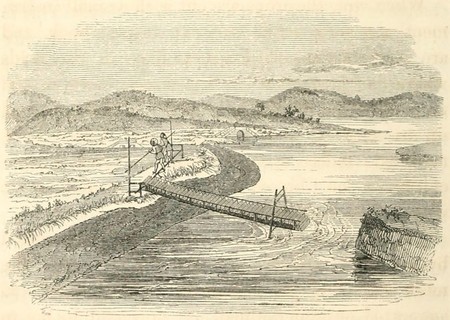
Water-wheel for Irrigation.
During the growth of the rice, the fields are always kept flooded when water can be obtained. The terraces near the base of the hills are supplied by the mountain streams, and the fields which are above the level of any adjoining river or canal are flooded by the celebrated water-wheel, which is in use all over the country. These machines are of three kinds. The principle in all of them is the same, the only difference being in the mode of applying the moving power; one is worked by the hand, another by the feet, and the third by an animal of some kind, generally a buffalo or bullock. The rice lands are kept flooded in this way until the crops are nearly ripe, when the water is no longer necessary. It is also necessary, or at least advantageous, to go over the ground once or twice during the summer, and stir the soil up well amongst the roots, at the same time removing any weeds which may have sprung up. If the weather is wet, the fields retain the water for a considerable time, and then it is not an uncommon sight to see the natives wading nearly up to the knees in mud and water, when they are gathering in the harvest.
When ripe, the crops are cut with a small instrument, not very unlike our own reaping-hook, and are generally thrashed out at once in the fields where they have grown. Sometimes, however, and more particularly in the north, the paddy is tied up in sheaves, and carried home before it is thrashed; indeed every thing in the northern agriculture of the Chinese has a great resemblance to what is practised in Europe.
The terrace cultivation of China has been noticed by nearly all writers upon this country, and, like most other subjects, it has been either much exaggerated or undervalued. It appeared to me to be carried to the greatest perfection on the hill sides adjacent to the river Min near Foo-chow-foo; at least I was more struck with it there than any where else. On sailing up that beautiful river, these terraces look like steps on the sides of the mountains, one rising above another, until they sometimes reach six or eight hundred feet above the level of the sea. When the rice and other crops are young, these terraces are clothed in luxuriant green, and look like a collection of gardens among the rugged and barren mountains. The terrace system is adopted by the Chinese, either for the purpose of supplying the hill sides with water where paddy is to be grown, or to prevent the heavy rains from washing down the loose soil from the roots of other vegetables. Hence these cuttings are seen all over the sides of the hills, not exactly level like the rice terraces, but level enough to answer the purpose of checking the rains in their descent down the mountain. For the same reason, the sweet potato and some other crops which are grown on the hills are always planted in ridges which run cross-ways or horizontally; indeed, were the ridges made in a different direction, the heavy rains which fall in the early summer months would carry both the loose soil and crops down into the plains.
Rice is grown on the lower terrace ground, and a stream of water is always led from some ravine and made to flow across the sides of the hills, until it reaches the highest terrace, into which it flows and floods the whole of the level space. When the water rises three or four inches in height, which is sufficiently high for the rice, it finds vent at an opening made for the purpose in the bank, through which it flows into the terrace below, which it floods in the same manner, and so on to the lowest. In this way the whole of the rice terraces are kept continually flooded, until the stalks of the crops assume a yellow ripening hue when the water being no longer required, it is turned back into its natural channel, or led to a different part of the hill, for the nourishment of other crops. These mountain streams, which abound in all parts of the hilly districts, are of the greatest importance to the farmer; and as they generally spring from a high elevation in the ravines, they can be conducted at pleasure over all the lower parts of the hills. No operation in agriculture gives him and his labourers more pleasure than leading these streams of water from one place to another and making them subservient to their purposes. In my travels in the country the inhabitants often called my attention to this branch of their operations, and I pleased them much when I expressed my admiration at the skill with which they executed it. The practice is not confined to the paddy fields; for I remember once, when superintending the planting of some large trees and shrubs in the garden of Messrs. Dent & Co. in Hong-kong, after I had given them a large supply of water at the time they were put into the ground, I desired the gardener to repeat the dose next morning. But, on the following day, when I returned to the spot I was surprised to find a little stream divided into many branches, and meandering amongst the roots of the newly planted trees. As there was no stream there before, I went up to examine its source, and found that it had been led from a neighbouring ravine; a work more easy than carrying a large supply of water in buckets, and at the same time more effectual.
Several other summer crops are cultivated in the lowlands. In the southern provinces, for instance, we find large quantities of the Nelumbium speciosum grown for its roots, which are much esteemed; the Trapa bicornis, the castoroil plant, Scirpus tuberosus, Convolvulus reptans, and several other vegetables, for which there is a great demand in all Chinese towns. The sugar cane also is extensively grown both in the provinces of Quantung and Fokien, and probably in other parts of the empire.
In the district of Kiangsoo my attention was directed to a plant called Tein-ching, which is largely cultivated by the inhabitants for the sake of its blue dye. In the southern provinces a great deal of indigo (Indigofera) is grown and manufactured, in addition to a large quantity which is annually imported from Manilla and the Straits. In the north, however, the plant which we call indigo is never met with, owing, I suppose, to the coldness of the winters; but its place is supplied by the Tein-ching (Isatis indigotica), the leaves of which are prepared in the same manner as the common indigo. The colour of the liquid at first is a kind of greenish blue, but, after being well stirred up and exposed to the air, it becomes much darker. I suppose it is thickened afterwards by evaporation; but this part of the process did not come under my observation. I am very much inclined to believe that this is the dye used to colour the green teas which are manufactured in the north of China for the English and American markets: this, however, is only conjecture.
The summer productions of the hilly country are, of course, different from those of the plains. From the province of Fokien northward to the great valley of the Yang-tse-Kiang, the hills are amongst the most fertile in China. They are frequently terraced in the manner I have described, and their staple productions, if we except the rice which is grown on the lower terraces, are sweet potatoes and earth-nuts. In the southern provinces, when the winters are mild, the roots of the sweet potato frequently remain in the ground all the winter. In the north the cold is too severe, and consequently the natives are obliged to dig up and protect the roots. In April those roots which have been saved for "seed" are planted thickly in beds near the houses or in the corners of the fields. They begin to push out their young shoots immediately, and these are ready to be taken off by the beginning of May. In the mean time the ground on the hill sides has been prepared, and horizontal ridges or drills formed about two feet apart. About the 10th or 12th of May these cuttings are taken off and planted, and seem to grow as readily as couch grass. It is astonishing how well they succeed, considering the little care expended upon them; but we must keep in mind that this is the commencement of the rainy season at the change of the monsoon, that the sky is generally cloudy, that scarcely a day passes without frequent showers, and that consequently the air is saturated with moisture. The earth-nuts are grown most extensively in the southern provinces, more particularly in Fokien; while the sweet potatoes are better a little farther north, where they form the chief hill crop.
The winter crops in the neighbourhood of Macao and Canton consist of large quantities of our European vegetables, such as potatoes, peas, onions, and cabbages, which are grown for the supply of the Europeans who reside at Hong-kong or Canton: our potatoes are generally planted here in October, which is considered the best time to insure a good crop; but as they always sell well in the markets, the growers manage to keep up a succession during the greater part of the year. Several varieties of the cabbage tribe, which seem indigenous to China, are grown extensively in the fields at this season both in the south and north. These never produce a solid heart like our cabbages, and are of no value when imported to England; but the celebrated "Pak-tsae" or white cabbage of Shantung and Peking, is a very different plant; it is never grown in the south of China, but is produced in the summer months in the north. Large quantities of this delicious vegetable are brought south every autumn, in the junks which sail at the commencement of the north-east monsoon in October.
In the northern provinces the principal winter productions are wheat, barley, peas, beans, the cabbage oil plant, and various other vegetables of lesser note. These crops are grown on the hills as well as on the low lands, and on the ground which produces sweet potatoes in summer. In the Nanking district they fire generally sown or planted in October upon those lands which produce rice or cotton during the summer months. Frequently the sowing takes place before the cotton or the dry summer crops have been removed from the ground, and the young plants are seen coming up amongst these crops, and ready to take their place when they are removed. This is done in order to give a longer season for the ripening of the different crops, and is very generally practised in the northern districts. The wheat and barley ripen in Fokien in April, and in the neighbourhood of Shanghae about the middle of May. About Chinchew and Amoy the wheat crops are so poor that the labourers pull them up by the hand, in the same manner as we do in our moorlands in England and Scotland. They are of course much better in the rich district of Shanghae, but the varieties of both wheat and barley are far inferior to ours; and as the Chinese sow them too thickly, they are generally much drawn, and the heads and corn small. The beans and peas seem to be exactly the same as our field kinds, and are certainly indigenous to the northern parts of China. Very large quantities of the cabbage tribe are cultivated for the sake of the oil which is extracted from their seeds. They are planted out in the fields in autumn, and their seeds are ripe in April and May, in time to be removed from the land before the rice crops. It must not be supposed, however, that the whole of the land is regularly cropt in this manner, and that, as some writers inform us, it never for a moment lies idle, for such is not the case.
In the island of Chusan, and over all the rice country of Chekiang and Keangsoo, there are two plants cultivated in the winter months, almost exclusively for manure: the one is a species of Coronilla; the other is Trefoil, or clover. Large ridges, not unlike those on which gardeners grow celery, are thrown up on the wet rice fields in the autumn, and the seeds of the plants are dropt in, in patches at five inches apart, on the surface of the ridges. In a few days germination commences, and long before the winter is past the tops of the ridges are covered with luxuriant herbage. This goes on growing until April, when it is necessary to prepare the ground for the rice. The ridges are then levelled, and the manure plants are scattered in a fresh state over the surface of the ground. The fields are flooded, and the plough and harrow are employed to turn up and pulverise the soil. The manure, thus scattered over the ground and half-buried amongst mud and water, begins to decay immediately, and gives out a most disagreeable putrid smell. This mode of manuring is generally adopted in all the rice lands in this part of China, and the young paddy doubtless derives strong nourishment from the ammonia given out in the decomposition of this fresh manure.
Fire-wood is so scarce in the country that a great portion of the straw, cotton stalks, and grass, which would go to manure the fields, is used for firing, and, therefore, the plan of growing manure for the land is forced upon the farmers by necessity. The plan of using manure in a fresh state, instead of allowing it first to decay, has doubtless been found from long experience to be the best for the young paddy. The Chinese farmer is not a chemist; he knows little or nothing of vegetable physiology, but his forefathers have hit accidentally upon certain systems which are found in practice to succeed, and to these he himself adheres, and hands them down unchanged to his children.
When the first crop of rice is cut, the second, which has been planted in the alternate rows, is left to grow and ripen in the autumn; the ground is stirred up, and the stubble and part of the straw of the first crop is immediately worked up with the mud and water between the rows: this decays in the same manner as the trefoil in spring, and affords manure to the second crop. Prawns and fish of various kinds are frequently used for the same purpose and in the same way.
Burnt earth mixed with decomposed vegetable matter is another highly esteemed manure, and is common in all the agricultural districts. During the summer months all sorts of vegetable rubbish are collected in heaps by the road-sides, and mixed with straw, grass, parings of turf, &c., which are set on fire and burn slowly for several days, until all the rank vegetable matter is decomposed, and the whole reduced to a rich black earth. It is then turned over several times, when it presents the same appearance as the vegetable mould used in gardens in England. This manure is not scattered over the land, but reserved for covering the seeds, and is applied in the following manner. When the seed time arrives, one man makes the holes, another follows and drops in the seeds, and a third puts a handful of this black earth on the top of them. Being principally vegetable matter, it keeps the seeds loose and moist during the period of germination, and afterwards affords them nourishment. This manure is useful mechanically as well as chemically in a stiff soil, like that of the low lands of China, where the seeds are apt to be injured in the process of germination. The young crop thus planted acquires a vigour in its first growth, which enables it to assimilate the matter which forms the strong stiff soil, and to strike its roots firmly into it.
What is commonly known by the name of oil-cake, is broken up and used in the same manner as the vegetable earth, and is also scattered broadcast over the land. The oil-cake is the remains or refuse of the seeds of several different plants, such as the tallow tree, various kinds of beans, and the cabbage formerly mentioned. There is a great demand for this manure in all parts of the country, and it forms a very considerable branch of trade both by sea and land. Bones, shells, old lime, soot, ashes, and all kinds of rubbish, are also eagerly bought up by the farmer for the purpose of manure.
In the Fa-tee gardens near Canton the proprietors have a curious kind of rich mud, which they cut up into small square bits, and sell at a very high price for the growing of plants in pots. This is obtained chiefly from the ponds and lakes in the vicinity, where the Nelumbium speciosum grows. This soil is so much esteemed, that the price for the best kind is 1 dollar for 3 peculs[2], and for the second 1 dollar for 4 peculs. The inferior sort has been frequently sent to England in plant cases from Canton.
For crops in a vigorous growing state no kind of manure is so eagerly sought after as night soil, and every traveller in China has remarked the large cisterns or earthen tubs which are placed in the most conspicuous and convenient situation for the reception of this kind of manure. What would be considered an intolerable nuisance in every civilised town in Europe, is here looked upon by all classes, rich and poor, with the utmost complacency; and I am convinced that nothing would astonish a Chinaman more, than hearing any one complain of the stench which is continually rising from these manure tanks. Almost every Chinese town is placed on the banks of a river or canal, and the water is generally led not only round the walls, thus forming a kind of moat, but also through many parts of the city. Long clumsy boats are placed in different departments of the town, into which the night soil and urine are emptied and conveyed from thence into the country. The fields in the neighbourhood of cities are generally supplied with it by coolies, who go every morning to market loaded with the produce of their firms. Each brings home two buckets of this manure, slung at the ends of his bamboo pole. In England it is generally supposed that the Chinese carry the night soil and urine to these tanks, and leave it there to undergo fermentation, before they apply it to the land. This, however, is not the case; at least, not generally. In the fertile agricultural districts in the north, I have observed that the greater part of this stimulant is used in a fresh state, being of course sufficiently diluted with water before it is applied to the crops. And there can be little doubt that in this the Chinese are perfectly right, as the manure must be much more efficient in this state than when a great portion of its ammonia has passed off into the air. The Chinese, as far as I could learn, have no mode of disinfecting their manure, but they seem to be perfectly aware, that if allowed free access to the air a great loss must result, owing to the gases which are given out and dissipated. Without waiting, then, for fermentation or putrefaction, this manure is at once applied to the growing crops. On the afternoons, or on cloudy days, the labourers are seen carrying water from the nearest pond or canal to the manure tank, for the purpose of diluting its contents. This being done, they fill their buckets, attaching one to each end of their bamboo in the usual way, and carry them off to their destination. When this is reached, each man takes a small wooden ladle having a long bamboo handle, and with this he scatters the liquid over the growing crop. A strong stimulant like this would probably in other circumstances have an injurious effect; but, by using it only when the crops are young and luxuriant, they assimilate its gases, and a most marked effect is produced upon their growth and productiveness. This kind of liquid manure is generally applied to wheat, barley, and all the cabbage tribe, and other garden vegetables; but not to rice, which is always flooded during its growth.
This manure is sometimes used after putrefaction and fermentation have taken place, and even in this state it is very efficient. In the gardens near Canton it is often dried and mixed with the soil taken from the bottom of the Lotus ponds, and used for growing plants in pots, or for enriching any particular tree which may be a favourite in the garden.
Although the land is sometimes allowed to lie idle for some months, yet there is no regular system of fallowing, nor is the rotation of crops much known or practised. Indeed, as regards the low lands, the soil being a kind of stiff, strong clay, capable of yielding many crops of rice in succession, without being in any way burthened or impoverished, no such mode of cultivation is necessary.
CHAP. XVII.
RETURN TO CHUSAN.—ITS SUPPOSED UNHEALTHINESS.—MORTALITY AMONGST THE QUEEN'S TROOPS WHEN FIRST STATIONED THERE.—SUBSEQUENT SALUBRITY.—ITS ADVANTAGES OVER HONG-KONG AS A BRITISH SETTLEMENT.—NEW PLANTS FOUND ON THE ISLAND.—NINGPO.—GARDENS OF THE MANDARINS.—MANNERS OF CHINESE LADIES.—SAIL FOR HONG-KONG.—TOMBS OF THE CHINESE.—SITUATIONS SUPPOSED TO BE THE BEST.—SOOTHSAYERS EMPLOYED.—THEIR METHODS OF WORKING ON THE MINDS OF THE PEOPLE.—MR. LAY CONSULTED AS TO THE BEST SITE FOR A GRAVE.—INSCRIPTIONS ON THE TOMBS.—PERIODICAL VISITS TO THEM BY RELATIVES.—DIFFERENT MODES OF INTERMENT.—COFFINS EXPOSED IN THE FIELDS.—KEPT IN HOUSES.—TOMB NEAR SUNG-KIANG-FOO.—FAVOURITE FLOWERS FOR PLANTING ON THE GRAVES.
My first visit to Chusan in 1843 was during the autumn and winter, but in 1844 I had an opportunity of exploring this beautiful island, at intervals, from the commencement of spring, until the close of the season. At this time the first impression regarding the unhealthiness of the climate had been entirely removed, and the island was looked upon as the most healthy in the Chinese seas.
It will be recollected that when the island was first occupied by our troops, the mortality was so great that the place was pronounced by every one to be the most unhealthy in China. Many a brave soldier fell a victim to the malignant fever which prevailed at the time. No regiment suffered more than Her Majesty's 26th, the "Cameronians," who were encamped on a green hill which overlooked the city, and which certainly appeared to be the most healthy spot which could have been selected for the purpose. That place still bears the name of the "Cameronian Hill," and is now thickly strewed with the graves of our countrymen.
It soon became evident, that this great mortality proceeded from other causes than the paddy fields which surrounded the city of Tinghae. Invalids from Hong-kong and Amoy were sent here to recover their health; and the difference in the appearance of the troops stationed in Chusan, from those in Hong-kong, was most marked. Dr. Maxwell of the Madras army, who was a most excellent judge in such matters, has often expressed his opinion, that, with good medical skill and ordinary care, this beautiful island might have been rendered one of the most healthy stations for our troops in the East. Indeed, every one now seemed to regret that we had not secured Chusan as a part of the British dominions for the protection of our trade in China, instead of the barren and unhealthy island of Hong-kong; and some even went so far as to recommend that means should still be taken by our government to accomplish this desirable end. The time, however, for doing this had gone by, and I believe that every right-thinking person would have seen with regret any power exercised by a great and exalted nation like England to infringe a solemn treaty "which had been entered into with a nation so utterly powerless as the Chinese; and most assuredly nothing less than this—no negotiations or promises—would have induced the Chinese to give up an island like Chusan, which commands the central and most important parts of their empire. That we committed a blunder and made a bad bargain is quite certain, but having done so, we must abide by the consequences. Had we retained Chusan, it would not only have been a healthy place for our troops and merchants, but it would also have proved a safeguard to our trade in the north, which must ultimately become of greater importance than that at Canton. Moreover, we should have been in a central position as regards a large and important part of the world, which must sooner or later open its ports to our commerce. I allude of course to Japan and Corea, both of which are only a few days' sail from Chusan, and are still in a great measure sealed countries to Europeans. These regrets, however, are vain.