Chapter I · (continued 3)
Reading edition
The only tree which I met with of very large size in this district is the Salisburia adiantifolia, commonly called the Maiden-hair tree, from the resemblance its leaves bear to a fern of that name. This is one of the plants which the Chinese are fond of dwarfing, and it is, consequently, often seen in that state in their gardens. Its fruit is sold in the markets in all Chinese towns by the name of "Pa-Kwo," and is not unlike dried almonds, only whiter, fuller, and more round. The natives seem very fond of it, although it is rarely eaten by Europeans. The weeping-willow, apparently the same species as we possess in England, is also common on the sides of all the rivers and canals, as well as in the gardens of the Chinese; and there is also a species of elm, but it never attains any great size, and can therefore be of little value.
Although there is a paucity in the number of plants which are really indigenous to this district, yet Shanghae is rich in species which have been brought from other parts of the empire, and are here exposed in gardens for sale: but there are here no mandarin gardens similar to those at Ning-po, this being essentially a mercantile city, and all the residents engaged in active business. The difference between the two towns, in this respect, is indeed very striking. To make up, however, for the deficiency of private collections, I found a number of nursery gardens containing excellent assortments of plants for sale, many of which were new to me, and are unknown in Europe; and, being at the same time very ornamental, were consequently of great value. At first I had great difficulty in finding out these gardens. The Chinese, from motives which it would be difficult to define—perhaps jealousy or fear,—were unwilling to give me the slightest information about any of these places outside of the town. They told me there were numbers of flower-shops in the city, but denied having any knowledge of nurseries or gardens in the country.
"If you want flowers," said they, "there they are in the shops; why do you not buy them? Shanghae men do this, and you should do the same."
"But then shops do not contain the things which I want," said I.
"Then give us the names of the things you want, and we will get them for you."
"But how can I give you the names? I do not understand your language; you would, of course, send to your nurseries for them if I could only furnish you with their names?"
"Yes."
"Oh, then, you have nursery gardens in the country?"
"Yes; but they are a very long way off."
Of course I knew enough of the Chinese by this time to doubt every word they told me, unless I had good reasons for believing them to be speaking the truth, which I had not in this case. I also saw at a glance, from the state of the plants, that they had not only been grown in the country, but I knew from their condition that they could have come but a very short distance, for they had been dug out of the ground with a portion of the soil adhering to the roots. For some few days, however, all my efforts were completely baffled, until a lucky circumstance enabled me to get the better of my Chinese friends. My servant and myself were returning home from the country, after an unsuccessful day's search, when, as we neared the north gate of the city, I shot a bird, which was new to me; being at that time engaged in making a collection of the skins of Chinese birds. I was of course immediately surrounded by all the boys in the neighbourhood, who were quite in raptures at my gun, as it was so different from their own clumsy matchlock. "Now," said I to the juvenile crowd around me, "who can show me the way to the nearest flower-garden, where I can purchase some flowers." "Lyloe, lyloe,"[2] said half a dozen of them at once, and I found, to my surprise and pleasure, that I was almost close to the gate of a very good nursery belonging to an individual who had a flower-shop in the city, and with whom I had had the conversation related above. It was now getting too dark to see the plants well, but I marked the spot, and returned on the following day. This time, however, I was not successful, for, as I approached, a boy, who was on the watch, scampered away to the gardener's house and gave notice of my appearance; and long before I reached the gate it was closed and barricaded, and no persuasion nor entreaty could remove their fears, or induce them to allow me to enter. The next day, and the next again, the very same thing took place, although I took different roads, in the hopes of finding the young sentinel off his guard. I was now obliged to have recourse to other means to gain my end. Her Majesty's consul, Captain Balfour, had from the first taken great interest in the success of my pursuits, and kindly offered me every assistance in his power, should I find any difficulties in my way. I therefore related the circumstance to him, and requested him to allow one of the Chinese officers attached to the consulate to accompany me to the garden, and explain that my object was to purchase plants, and not to take any thing away against their will. From our experience of Chinese character, we were well aware that, if this were properly explained, the poor people, whose livelihood depended upon the propagation and sale of plants, would be very glad to allow me to make purchases at their garden. I therefore set out again on the following day, accompanied by an officer from the consulate. When we approached the garden, my young friend was at his post, as usual, and ran off immediately, and forthwith the gate was closed and barricaded as before. We walked quietly up to it, and knocked, but there was no answer; and the place seemed all at once to be deserted. The officer well knew that the family had hid themselves just inside the gate, and commenced talking to them, and laughing at their fears. In a few seconds we heard a movement amongst the bushes, and then the inmates, gaining courage, ventured to approach the gate to reconnoitre. At last, being apparently satisfied, the bolts were withdrawn, and we were admitted within the sacred precincts of the garden, when I soon found several very valuable plants. The ice was now broken, and, with the assistance of the Chinese officer, I got the names and localities of several other gardens, which I soon found out: and, although it was the winter season, and vegetation in a state of repose, I was able in a few weeks to get together a collection of plants, which, when they flowered, proved not only quite new, but highly ornamental. A few months wrought a great change upon these diffident and timid people, and, at length, they not only received me with pleasure, but begged me to bring my friends and acquaintances to see their flowers. I frequently did so, and as we always treated them with kindness and consideration, a favourable impression was made upon their minds, which, I have no doubt, will long continue. When I was leaving Shanghae for the last time on my return to England, I went to remove a collection of plants which I had in one of these gardens: as I was doing so, the proprietor said to me, "the next time you come to Shanghae I shall have left this garden, and gone to one which I have taken in the next district, where I shall be glad to see you, and supply you with the plants you want."
"Thanks, my good friend," said I, "but as my labours in the 'central flowery land' are ended, I shall now return again to my own country, 'Ta-Eng-co[3],' a land in the far distant west, and you shall never see me again; fare you well."
He then kindly wished me fair winds, smooth seas, and a happy meeting with my friends at home.
I merely mention this circumstance to show what a change took place in the feelings of these poor people in the course of two years, and which I regard as an earnest of what may be done with the northern Chinese, who differ widely from their haughty and insolent countrymen in the south.
Another example may be given to show the cunning and deceit of many of the Chinese here as elsewhere. A flower painter in Chusan had informed me that several very valuable varieties of the Moutan, or Tree Pœony, were to be found in gardens near Shanghae. Those varieties of this flower, which are yearly brought from the northern provinces to Canton, and which are now common in Europe, have blossoms, which are either rose-coloured or white: but it was always asserted, although not believed, that in some part of China purple, blue, and yellow varieties were produced, although these were never brought to Canton for sale. It was for these that I made the most particular inquiries, and this painter not only affirmed he had seen them, but also offered, for a small sum, to make me drawings from memory of all the different kinds. I employed him at once, and when he had finished the drawings, I took them with me to Shanghae. A nurseryman, who had a flower-shop in the town, to whom I showed these drawings, promised at once to procure living plants for me, but said they would be very expensive, as he would have to send to Soo-chow, a distance of nearly one hundred miles, for they were not to be procured in the vicinity of Shanghae, and a man would be absent at least eight days. I was, of course, glad to get them upon any terms, and gave the man the price he asked, which, after all, was not much out of the way, if they were to be brought a hundred miles. At the specified time the Moutans arrived, and proved most valuable kinds, which, in England, would have brought a very high sum. Amongst them there were lilacs and purples; some nearly black; and one which the Chinese called "the yellow," which, however, was only white with a slight tinge of yellow near the centre of the petals. Altogether the collection was a valuable one, and I was highly satisfied with my bargain. Great was my surprise when I afterwards found that these plants were brought a distance not more than six miles from the walls of Shanghae, and that the celebrated town of Soo-chow was, in fact, supplied with "Moutans" from the very same place.
It was the winter season when I paid my first visit to Shanghae, and of course few plants were then in bloom except the Chrysanthemum, the varieties of which are as numerous here as in the south of China; and as the Chinese gardeners understand their cultivation well, they were, at this particular season, objects of great interest. My collections were chiefly deciduous plants, which it was impossible to determine or describe at the time, being chosen partly on account of the families they belonged to, and partly from the characters given them by the Chinese. Every one acquainted with practical Botany can form a very fair idea of the value of plants even in this condition, and I was not disappointed in the expectations I had formed regarding this collection, many of the specimens afterwards proving plants of great beauty and value.
Whilst at Shanghae, I, with some other Europeans, had an invitation to go to the house of a mandarin, to see a theatrical performance or "Sing-song," and to dine with him in Chinese style afterwards. Sedan chairs were sent to take us to his house, where we were introduced to a number of his friends, and, as the invariable custom is, tea was immediately handed round. Shortly afterwards a servant came with a tray full of wet, warm towels, not unlike those generally used in kitchens at home, and presented one to each of us. At first, we could not conjecture what these were for; but, on looking at our Chinese friends, we observed them rubbing their faces and hands with them, and, although not very agreeable to us, we immediately did the same. I afterwards found that this was a common custom amongst the Chinese, and I have often been much refreshed by it after a warm walk. In hot countries like China this plan is much better, and more conducive to health, than either washing or bathing in cold water.
While this was going on in the house, the players were getting every thing ready in the large room where the performance was to take place. In a little while one of them entered the room where we were, carrying in his hand several fine long ivory cards, on which were written a number of the most popular plays of the day, any one of which the players were ready to perform at the command of our host and his friends. We were most politely consulted on the subject, which, as we did not know a single character of the language, and had the greatest difficulty in understanding what was said to us, was not of much use. Having at last fixed upon a particular piece for the evening's entertainment, we were all led into the theatre. The room was large and nearly square, having a platform at the upper end for the actors and band, and one of the sides being only separated from an open lane by a railing, so that the public might also have a view of the play. The centre of the room was completely filled with guests, and from the roof hung a number of lanterns in the Chinese style. As it was early in the afternoon when the play commenced, the lanterns were not lighted and the piece went on in daylight, the Chinese actors not excluding it as we do in our theatres in England.
The play began with some pantomime-like feats, such as we see in English theatres at Christmas. This was succeeded by something which appeared to be very pathetic, judging from the language and gestures of the performers. All was gone through in a kind of opera style, the actors singing their parts with false voices. The feats of tumbling which were now and then performed were extremely dexterous and clever, and attracted our notice more than any thing else, probably because they were best understood.
The dresses of the actors were superb, and must have cost a large sum of money. There were no females amongst them, as it is not customary for them to act; but their places were supplied by men or boys, chosen from amongst those who are most "lady-looking," and so well were their appearance and dresses arranged, that it would have required a practised eye to have detected the difference.
The voices of the actors were not musical, at least to English ears, but the whole was in unison with the noisy gong, and the wind instruments, like bagpipes, which are in common use amongst the Chinese. In fact, noise seemed to be the thing which produced the greatest effect, and we certainly had enough of it.
I was struck by the various figures made by the actors on the stage, intended, no doubt, to represent something like those scenes or pictures which are so much studied in our theatres at home. A quadrant seems to be a great favourite, and was constantly made by them in the different acts. They have no scenery to assist the delusion, only a simple screen, which is sometimes used to represent a room out of which some actor is to make his appearance. Fencing is much practised, and is, perhaps, the most curious part of these exhibitions. Each individual has two swords, which he swings about his head in the wildest manner, at the same time throwing his feet and legs about in a most fantastic way, as if they had as much to do in the business as the hands and arms. The exhibition or play lasted for three hours, and then we left the theatre and retired into another room. While we were there the servants were busily employed in rearranging the theatre, which was now to be converted into a dining-room.
When all was ready we were led in with great ceremony, and placed in the principal seats of honour. We had now an opportunity of seeing the extent to which the Chinese carry their ceremony and politeness amongst themselves when they are about to be seated at table. Our host and his friends were nearly a quarter of an hour before the whole of them were seated. Each one was pressing the most honourable seat upon his neighbour, who, in his turn, could not think of occupying such a distinguished place at the board. However, after a great deal of bowing and flattery, all was apparently arranged satisfactorily and dinner commenced.
The tables were now covered with a profusion of small dishes, which contained all the finest fruits and vegetables of the season, besides many of the most expensive kinds of soups, such as the celebrated bird's nest and others, many of which were excellent even to the palate of an Englishman. The servants were continually employed in removing the centre dishes and replacing them by others of a different kind, until at last every one seemed perfectly satisfied. Still, however, the ceremony of bringing in new dishes went on, and these were merely looked at and removed. Our maiden efforts with the chopsticks must have been a source of great amusement to our Chinese friends, but they were polite enough not to laugh at us, and did every thing in their power to assist us. The play was resumed again as soon as the dinner commenced, and continued as briskly as ever. The "lady actors" at intervals came down from the platform and supplied the guests with different kinds of wines. During the entertainment, a piece of money was handed to each of the guests, which they were desired to leave as a present for the actors at the conclusion of the piece. When this was given them, the whole of the corps dramatique came round, and each made a most polite bow of acknowledgment and withdrew. Still, however, the dinner ceremonial went on; hundreds of fresh dishes were brought in, and as many in their turn removed. The Chinese guests were sometimes smoking, sometimes eating, just as it seemed good to them, and uniformly praising every thing which made its appearance on the table.
We had now been three or four hours at table, and although the whole affair had been very amusing, we had had enough of it, and were beginning to tire. "How long shall the dinner last?" said I to a linguist who was placed next me, and who had most politely explained every thing which had occurred during the entertainment. "Oh," said he, "it will last for three or four hours longer, but if you want to go away, you may do so now." We were very glad to find that Chinese etiquette permitted us to withdraw, and ordered our chairs, which were waiting in the court-yard to receive us. Our host and his friends lighted us out with lanterns, and we took our departure in the same style in which we came. So ended my first Chinese dinner. Since then such things have been no rarity, either in the palaces of the rich or in the cottages of the poor, and they have been even more frequent in the temples with the priests.
CHAP. IX.
RETURN TO THE SOUTH OF CHINA.—THE CANTON RIVER DESCRIBED.—FORTS AT THE BOCCA TIGRIS.—PRODUCTIONS OF THE COUNTRY.—THE "SIGHING" WILLOW.—CULTIVATION OF THE NELUMBIUM.—BOATS ON THE RIVER.—THE BARBER'S BOAT, &C.—SPLENDOUR OF THE FLOWER BOATS.—APPEARANCE OF THE RIVER AT FESTIVALS.—ORDER WHICH PREVAILS IN THIS FLOATING CITY.—HOUSES BUILT OVER WATER.—CHINESE DEXTERITY IN SWIMMING AND DIVING.—FA-TEE GARDENS.—THEIR PLANTS.—OLD ACHING GETS A BAD NAME BECAUSE HIS SEEDS DO NOT GROW.—HE DOES NOT DESERVE IT.—ADVICE TO THE BUYERS OF SEEDS.—ENGLISH AND AMERICAN PUBLIC GARDENS AT CANTON.—CHINESE NEW YEAR.—ATTACKED AND ROBBED BY THE CHINESE.—A SUBSEQUENT ATTACK MADE UPON SOME OFFICERS OF THE ENGLISH GOVERNMENT.—THEIR LETTER TO HER MAJESTY'S CONSUL.
As the island of Chusan was my head-quarters in the north of China, I now proceeded thither with my collections from Shanghae, preparatory to sailing for Hong-kong and the southern ports of the country. The Chusan hills were now covered with snow, and the weather was piercingly cold. Large quantities of pheasants and water-fowl were daily brought to the markets by the Chinese, who found the English good customers. A small species of deer was also brought from the main-land, and frequently alive. Four or five fine pheasants were often to be purchased for a dollar, and duck and teal were also remarkably cheap: I believe from two to four rupees were generally given for a deer.
The officers of the troops stationed at Chusan, who were fond of shooting, obtained excellent sport by engaging Chinese boats and going across to the hills on the main-land, there being little game of any kind upon the island itself.
Having got all my things packed, I took a passage in a vessel bound for the South, and having a fair monsoon down the China sea, we arrived at Hong-kong in a few days, without any thing occurring worthy of notice. The various collections which I had made in the North were now put up in glazed cases and shipped for England.
As the south of China had been ransacked by former botanists, I could not expect to find much which was new or worthy of being sent home, and I therefore arranged to proceed north again in March or April, in order to have a whole season before me. In the meantime, as I had a few weeks to spare in the south, I determined on a visit to Canton and Macao, which are both within a short distance from Hong-kong.
The Canton river is certainly one of the most imposing and striking objects which the traveller meets with in this celebrated country. The sea, near its mouth, is studded all over with numerous islands, of which a good view is obtained in going over from Hong-kong to Macao: and in sailing from either of these places to Canton, we pass a succession of them, most of which are mountainous, having huge masses of rock and yellow gravelly clay protruding here and there through the surface, and but thinly covered with vegetation of any kind.
Sometimes however, in our progress, we obtained views of beautiful bays, with a few acres of level land near the shore, in the midst of which there are some pretty houses or huts, surrounded by a few trees and shrubs. In sailing amongst these islands one is apt to think that in the retirement of such places, far removed from the vicious world, and the "busy hum of men," the inhabitants must indeed be happy and innocent, having their few wants abundantly supplied by the rice which grows luxuriantly around their dwellings, and by the never-failing supply of excellent fish, which are easily caught in the sea. But these dreams of happiness and innocence are soon dispelled—these quiet villages abound with pirates, who frequently commit acts of the most cold-blooded cruelty, and render the passage between Hong-kong, Canton, and Macao an alarming and dangerous affair. Lorchas and other small vessels, with valuable cargoes on board, are frequently attacked, the crew and passengers murdered, and the vessels disabled or destroyed.
A few hours' sail, with a fair wind and tide, brought me in sight of the celebrated Bocca Tigris, the entrance to the Canton river. The forts destroyed during the war had been rebuilt on a more extensive scale; and, if manned with English soldiers, no hostile fleet in the world could pass them without being blown to pieces. I fancy, however, that the Chinese, although they have had a lesson in the art of war, which will make them more difficult to conquer in future, would still, with all their forts, afford, but a feeble resistance against the military and naval tactics of the English and other civilised nations of the West.
Inside the Bogue the river widens very much, and presents the appearance of an inland sea. The view now becomes beautiful and highly picturesque, the flat cultivated land near the shores forming a striking contrast to the barren hills on the outside of the forts; the mountains in the distance appear to encircle the extensive plain; and although, like the others, they are barren, yet they make a fine back-ground to the picture. A few miles further up the river, the shipping in Blenheim and Whampoa reaches come into view, and the celebrated Whampoa pagoda, with several more of less note, besides numerous other towers and joss-houses, all remind the traveller that he is approaching the far-famed city of Canton, one of the richest and most important in the celestial empire. The noble river, with its numerous ramifications, forms many islands, on one of which the small town or village of Whampoa is built.
Large quantities of rice are grown, both on the islands formed by the river, and on the flats on the main land. The tide is kept out by embankments, and the ground can be overflowed at will. These embankments are not allowed to lie idle, but are made to produce crops of Plantains. When the land is too high to be flooded by the tide, the water-wheel is brought into play, and it is perfectly astonishing how much water can be raised by this simple contrivance in a very short space of time.
Sugar-cane is also grown rather extensively near Whampoa, and in its raw state is an article in great demand amongst the Chinese. It is manufactured into sugar-candy and brown sugar; many kinds of the latter being particularly fine, though not much used by the foreigners residing in the country; who generally prefer the candy reduced to powder, in which state it is very fine and white. I did not see our loaf-sugar in any part of China, and I conceive that it is not made there.
A great number of the common fruit trees of the country grow all over the plains and near the side of the river. The mango, guava, wangpee (Cookia punctata), leechee, longan, oranges, and pumeloes, are the principal kinds. Besides these, there are the cypress, thuja, banyan and other kinds of fig-trees, and a species of pine, called by the Chinese the water pine, from its always growing by the sides of the rivers and canals. The bamboo, and a sort of weeping willow very much like our own, are also frequently met with. The name which the Chinese give to the latter is the "sighing" willow, coinciding rather curiously with our own term of "weeping," and when taken in connection with the historical fact of the Jews weeping by the streams of Babylon, and hanging their harps upon the willows, show that this is regarded as the emblem of sorrow as universally as the dark and sombre pine and cypress are considered in all countries fit companions to the cemetery and churchyard.
On the sides of the river, both below and above the city, large quantities of the water lily, or lotus, are grown, which are enclosed by embankments in the same manner as the rice fields. This plant is cultivated both as an ornament, and for the root, which is brought in large quantities to the markets, and of which the Chinese are remarkably fond. In the summer and autumn months, when in flower, the lotus fields have a gay and striking appearance, but at other seasons the decayed leaves and flowers, and the stagnant and dirty water, are not at all ornamental to the houses which they surround.
One of the most striking sights on the Canton river is the immense number of boats which are moored all along the shore, near the foreign factory. There are hundreds of thousands of all kinds and sizes, from the splendid flower-boat, as it is called, down to the small barber's boat, forming a large floating city, peopled by an immense number of human beings. In sailing up the river you may observe a very small boat, perhaps the smallest you ever saw, exposed on the water, being nothing more than a few planks fastened together. This is the barber's boat, who is going about, or rather swimming about, following his daily avocation of shaving the heads and tickling the ears and eyes of the Chinamen. By the by, this same barber has much to answer for, for his practice has a most prejudicial effect upon the eyes and ears of his countrymen. He, however, works his little boat with great dexterity, and with his scull manages to propel himself with ease and swiftness through the floating city of boats, larger and more powerful than his own. Then you see boats of various sizes, such as those at Macao and Hong-kong, covered over, divided into three compartments, and kept remarkably clean and neat. These are hired by either natives or foreigners for the purpose of going off to the large junks, or other vessels moored out in the river, or for short excursions to the island of Honan, the Fa-Tee Gardens, or such places. The centre division of the boat forms a very neat little room, having windows in the sides, ornamented with pictures and flowers of various kinds. The compartment at the bow is occupied by the rowers, and that at the stern is used for preparing the food of the family to whom the boat belongs.
The boats of the Hong merchants, and the large flower-boats are very splendid. They are arranged in compartments like the others, but are built in a more superb and costly manner. The reader must imagine a kind of wooden house raised upon the floor of the boat, having the entrance near the bows, space being left there for the boatmen to stand and row. This entrance being the front, is carved in a most superb style, forming a prelude to what may be seen within. Numerous lanterns hang from the roof of these splendid showy cabins; looking-glasses, pictures, and poetry adorn their sides; and all the peculiarities of this singular people are exposed to our view in these their floating palaces.
Then there are the Chop boats, which are used by the merchants for conveying goods to the vessels at Whampoa; the passage-boats to Hong-kong, Macao, and various parts of the country; the Mandarin-boats, with their numerous oars, which have a strange appearance as they pass up and down the river (I have seen a single boat of this kind with forty oars on each side); and, lastly, the large unwieldly sea-going junks. There are various modifications of all these kinds of boats, each adapted for the particular purpose for which it is designed. At festival times, the river has a singularly gay and striking appearance, particularly at night, when the lanterns are lighted, and numberless boats gaily decorated with them move up and down in front of the factory. The effect produced upon a stranger at these times by the wild and occasionally plaintive strains of Chinese music, the noisy gong, the close and sultry air, the strange people,—full of peculiarities and conceit,—is such as he can never forget, and leaves upon his mind a mixed impression of pleasure, pity, admiration, and contempt. Throughout the whole of this immense floating city, the greatest regularity prevails; the large boats are arranged in rows, forming streets, through which the smaller craft pass and repass, like coaches and other vehicles in a large town. The families who live in this manner seem to have a great partiality for flowers, which they keep in pots, either upon the high stern of their boats, or in their little parlours. The Chinese Arbor vitæ, Gardenias, Cycas revoluta, cockscombs, and oranges, seem to be the greatest favourites with them. A joss-house—small indeed, in many cases, but yet a place of worship—is indispensable to all these floating houses. Here the joss-stick and the oil are daily burned, and form the incense which these poor people offer to their imaginary deity.
Upon the sides of the river, and the numerous canals in the suburbs of Canton, whole streets of wooden houses are built upon stakes which are driven firmly into the mud. These dwellings very much resemble the travelling shows which are often seen in the market towns of England; except that posts supply the place of wheels, and that they are crowded together in hundreds, forming crooked and irregular streets. Thousands of the inhabitants live and enjoy health and happiness in such places, which would soon be graves for Europeans—such is the difference of constitution.
But what surprised me most was the old women and young children bathing in the river, which seemed as if it were their natural element, and they appeared quite as much at home there as the fishes themselves. The Chinese boat population are famous for their dexterity in and under the water. Since the island of Hong-kong became an English settlement, officers of the government, sent to apprehend thieves in the bay, have frequently failed to do so owing to this circumstance. The Chinamen, whenever they found that there was any danger of being taken, jumped all together overboard, diving out of sight, and swimming under water until they were out of the reach of their pursuers, or until they found shelter in some of the numerous boats belonging to their own clan, which lay moored in the bay.
I lost no time in visiting the celebrated Fa-tee Gardens, near Canton, the "flowery land," as the name implies, from whence a great number of those fine plants were first procured which now decorate our gardens in England. They are situated two or three miles above the city, on the opposite side of the river, and are, in fact, Chinese nursery gardens, where plants are cultivated for sale.
Here, then, I beheld a specimen of the far-famed system of Chinese gardening, about which we have read so much in European authors: I will, therefore, describe them somewhat fully. The plants are principally kept in large pots arranged in rows along the sides of narrow paved walks, with the houses of the gardeners at the entrance through which the visitors pass to the gardens. There are about a dozen of these gardens, more or less extensive, according to the business or wealth of the proprietor; but they are generally smaller than the smallest of our London nurseries. They have also stock-grounds, where the different plants are planted out in the ground, and where the first process of dwarfing their celebrated trees is put in operation. These contain large collections of Camellias, Azaleas, oranges, roses, and various other well-known plants, which are purchased by the Chinese when in flower. The most striking plant in autumn or winter is the curious fingered Citron, which the Chinese gather and place in their dwellings or on their altars. It is much admired both for its strange form and also for its perfume. The mandarin orange is also much grown at Fa-tee, where the plants are kept in a dwarf state, and flower and fruit most profusely, producing large, flat, dark, red-skinned fruit. The Chinese have a great variety of plants belonging to the orange tribe; and of one which they call the cum quat—a small oval-fruited variety—they make a most excellent preserve. The Murraya exotica, Aglaia odorata, Ixoras, and Lagerstrœmias are very ornamental here in autumn.
But it is of course in spring that the Fa-tee gardens possess the greatest attractions. They are then gay with the tree pæony, azaleas, camellias, roses, and various other plants. The azaleas are splendid, and reminded me of the exhibitions in the gardens of the Horticultural Society at Chiswick, but the Fa-tee exhibitions were on a much larger scale. Every garden was one mass of bloom, and the different colours of red, white, and purple blended together, had a most beautiful and imposing effect. The principal kinds grown were Azalea indica, indica alba, phœnicea, lateritia, variegata, and the yellow Azalea sinensis. I may mention in passing, that I found the latter plant wild on the Ning-po hills, so that there is no doubt of its being a genuine Chinese species. The air at this season around Fa-tee is perfumed with the sweet flowers of Olea fragrans, and the Magnolia fuscata, both of which are grown extensively in these gardens. Dwarf trees, as may be supposed, occupy a principal station; they are trained into the most grotesque and curious forms. The plants which stand next to dwarf trees in importance with the Chinese are certainty chrysanthemums, which they manage extremely well, perhaps better than they do any other plant. So high do these plants stand in the favour of the Chinese gardener, that he will cultivate them extensively, even against the wishes of his employer; and, in many instances, rather leave his situation than give up the growth of his favourite flower. I was told that the late Mr. Beale used to say that he grew chrysanthemums in his garden for no other purpose than to please his gardener, not having any taste for this particular flower himself.
Tree pæonies are not natives of the south of China, but are brought down in large quantities every year, about the month of January, from the northern provinces. They flower soon after they arrive, and are rapidly bought up by the Chinese to ornament their houses, after which they are thrown away, as they do not thrive well so far south as Canton or Macao, and will not flower a second season. They are sold according to the number of flower-buds they may have upon them, many of them fetching rather high prices.
One of the old gardeners here speaks the English language very well, and carries on a considerable trade in seeds with the English and American residents, but, unfortunately, he has got a bad name, owing to his seeds generally failing to grow when they are sent home. It is now currently reported that the old man boils them, in order that his trade may not be spoiled by some enterprising propagator in England or America. Such, however, is not the case; on the contrary, I am quite certain that he does every thing in his power to preserve them, but very likely some may be a year or two old before they are dispatched to Europe. Besides, the long voyage round the Cape—during which the seeds have twice to cross the tropics—is very prejudicial to their germination. There is, however, no great loss in these seeds not growing, as there is nothing amongst them new, or of any value, for they are gathered from the plants common in the Fa-tee gardens, the greater part of which have been years ago introduced to our gardens at home. I would, therefore, strongly advise my friends in China not to spend their money upon such seeds.
Although the botanist can find little that is new to him in these gardens, yet they are well worthy of a visit; and in the spring months, when most of the plants are in bloom, they have a singularly gorgeous and imposing appearance, and really deserve the poetical name of "Fa-tee," or flowery land, which the Chinese have given them.
The garden which formerly belonged to the East India Company is still in existence. It is but a small plot of ground on the river side, not more than sixty paces each way, having broad chunamed walks round it, and a clump, with a few trees in the middle, and a few more between the walk and the wall all round. Since Mr. Reeves's time no one seems to have paid any attention to the plants here, and if there ever were any rare species, they are now all lost. A few Palms, Plantains, Magnolia grandiflora, Clerodendron fragrans, Justicia Adhatoda, Ligustrum, Murraya exotica, the Leechee, and two or three other well-known things, are all that it contains. In front of the American factory there is a very nice public garden, at least six times the size of the Company's, with fine broad walks for recreation, and containing numerous shrubs and trees indigenous to the country; nothing, it is true, of any rarity, but sufficient to make it look extremely well. A good garden and promenade are of much importance here; for it is likely to be some years before foreigners enjoy the same liberty at Canton of walking about the country as they do in the other parts of China.
At this period the Chinese were making great preparations for the celebration of New Year's Day, which then fell on the 18th of February. Flowers of all kinds were in great demand amongst the inhabitants, who employ them in the decoration of their houses and temples. In going up the river towards the Fa-tee Gardens, I met boats in great numbers loaded with branches of peach and plum trees in bloom, Enkianthus quinqueflorus, camellias, cockscombs, magnolias, and various other plants which flower at this season. The Enkianthus is brought down from the hills with the buds just expanding; and after being placed in water for a day or two, the flowers come out as healthy and fresh as if the branches had not been removed from the parent tree. This plant is a great favourite amongst the Chinese. The common jonquil too comes in for a very extensive share of patronage; and in the streets of Canton one meets with thousands of bulbs growing in small pans amongst water and a few white stones. In this case the Chinese exhibit their peculiar propensity for dwarf and monstrous growth, by planting the bulbs upside down, and making the plants and flowers assume curious twisted forms, which appear to be so agreeable to the eyes of a Chinaman. Large quantities of all these flowers are exposed for sale in many of the shops and in the corners of the streets in Canton, where they seem to be eagerly bought up by the Chinese, who consider them quite indispensable at this particular season. Not only are the houses and temples decorated with them, but the boats on the river also come in for a most extensive share. Indeed, these boats are only floating houses, for a very great part of the population of Canton lives upon the river. The flower-boats, as they are commonly called, are particularly gay at new-year time with flowers of all hues, and gaudy flags streaming from each mast and stern. Crackers or fireworks, of which the Chinaman is so fond, are let off in large quantities for several days in all parts of the town, and form part of their religious ceremonies or offerings to their gods. Their shops are closed on New Year's Day, and for two or three days afterwards. The greater part of the natives wear their holiday clothes, and tramp about amongst their relations and friends to chin-chin them, and wish them a happy new year, as we do at home. Large parties are made at this season to go up to the gardens at Fa-tee; and on particular days you find there hundreds of these flower-boats crowded with young Chinese of the better classes, enjoying themselves as our own population do at Richmond or Hampton Court. Great numbers of well dressed ladies also go over to Fa-tee in the flower-boats, and walk about in the gardens; and this is the only season when they are visible at Canton.
After having been several months in the north of China, and, with one or two exceptions, always experiencing the greatest civility from the natives, I was beginning to form a high opinion of the Chinese as a nation, and inclined to trust the people about Canton in the same manner as I had done in the northern provinces. I very soon, however, found out my mistake, and in a most disagreeable manner. There were some hills behind the city, a few miles distant, which I had often wished to visit for the purpose of examining their botanical productions. One morning I started off through the town, in the direction of these hills; and after walking between two and three miles, I reached the suburbs on the side of the town, opposite to that where the foreign factory stands. The sounds of "Fankwei,"[1] with which I was assailed in the early part of my walk, had now nearly ceased, and I began to imagine that I had got out from amongst the impertinent boys and low Chinese, whom one continually meets in the back streets of Canton. I was now on a good road, amongst fields and gardens, and had an excellent view of the surrounding country, and hills. How very strange, thought I, that the foreign residents in the factories never avail themselves of the opportunity of coming here, when they might enjoy the fresh air, and see the country, which would help to relieve the monotonous life they are compelled to lead.
As I was walking quietly along, I met a Chinese soldier on horseback, who by gestures and words did every thing in his power to induce me to retrace my steps. I knew nothing of the Canton dialect at this time, and as I thought he only wished to prevent me from taking a walk in the country, I paid no attention to him, but passed onwards. Soon afterwards, however, I began to suspect the ill intentions of several groups of ill-looking fellows who seemed to be eyeing me narrowly as I proceeded. I now came to a little hill which seemed to be used as a cemetery: it was enclosed, but the door which led to it was wide open, and the place appeared to be quite public. In order to have a more extended view of the country, I walked in and began to ascend the hill. I had only proceeded about half way up, when a number of Chinamen who had followed me in, began to crowd round me, asking for "comeshaws,"[2] and becoming every moment more numerous and urgent. I tried what civility would do with them for a little while, but by the time I reached the top of the hill I clearly perceived that I was in a trap, out of which it would be a difficult matter to extricate myself.
Up to this time, however, no one had attempted to lay hands upon me. Taking a cursory view of the surrounding country, I began to devise in my mind the best mode of getting rid of my troublesome companions. There seemed no other way than putting a bold face on the matter, and retracing my steps to Canton. "You more better come down this way," said a fellow to me in broken English, pointing to a ravine on the opposite side of the hill. My suspicions, however, were now roused, and I saw at once the object of my adviser, which was to get me into some place out of sight, where I should doubtless have been robbed of every article I had about my person, and probably stripped into the bargain. "No, no," said I, "I have nothing to do down there," and began to retrace my steps down the hill. The Chinese now closed upon me, and seemed determined to obstruct my progress. Some laid hold of my arms; one fellow seized my cap, and ran off with it, another did the same with my umbrella, several hands were in my pockets, and others were even attempting to get my coat off. I now saw that nothing short of getting every thing I possessed would satisfy them, as each one wanted something, and "their name was legion." Collecting all my strength, I threw myself upon those who were below me, and sent several of them rolling down the side of the hill. This, however, was nearly fatal to me, for, owing to the force which I exerted, and the uneven nature of the ground, I stumbled and fell; but fortunately I instantly recovered myself, and renewed the unequal struggle, my object being to reach the door of the cemetery by which I had entered. The Chinese on the hill now called out to their friends below to shut the door, and thus prevent me from reaching the open road. Seeing at once that if this were accomplished I should be an easy prey to them, I determined if possible to prevent it. Springing out of the grasp of those by whom I was surrounded, I made for the door, which I reached just as it was closed, but fortunately before it was fastened on the other side. The force with which I came against it burst it open, and threw the Chinamen on their backs who were busily fastening it. I was now in the open road, where some hundreds of the Chinese were congregated together; some of them apparently respectable, but the greater part evidently nothing but thieves and robbers. The respectable part would not, or probably durst not, render me any assistance. Stones were now flying about me in all directions, and a brick struck me with great force on the back, and nearly brought me to the ground. I was stunned for a few seconds, and leaned against the wall to breathe and recover myself, thinking that I was now comparatively safe as I was out on the open road. I was soon undeceived, however, for the rascals again surrounded me, and relieved me of several articles which had escaped them before. As the whole neighbourhood was evidently a bad one, it would have been madness to have taken shelter in any of the houses, and I therefore had to struggle with the robbers for nearly a mile, sometimes fighting, and sometimes running, until I got out of their territory, and near the more populous parts of the town. The plight I was now in may easily be conceived, but taking everything into account, I came off better than might have been expected.
On my way home, having neither hat nor umbrella, I suffered greatly from exposure to the sun, which, in the south of China, is very powerful on a clear day, even in spring. I would have gladly gone into a shop and bought a Chinese hat, but the rascals had not left me even a copper cash for the purpose. Fortunately I had left my watch at home, otherwise that would have been taken amongst the first things, as Chinese thieves are very partial to watches and know their value well.
The Honourable F. C. Drummond, with whom I was staying at the time, informed me afterwards that the place where I had been attacked was one of the worst in the suburbs of Canton, and that three gentlemen of his acquaintance, a year or two before, had come off even worse than I had done, the Chinese having taken away nearly all their clothes.
About two years after this attack upon me three gentlemen holding government appointments in China, Mr. Montgomery Martin, the Rev. V. Stanton, and Mr. Jackson, having incautiously strolled into the suburbs, were also attacked; and the letter which they addressed officially to Her Majesty's consul complaining of the treatment they had received, shows so clearly the state of things at Canton, that I give it entire:—
"About seven o'clock this morning, while walking for exercise along the north wall, on the outside of the city, we were attacked by several Chinese, who had been following us, and increasing in numbers, from the building known to foreigners as the Five-storied Pagoda. At first they commenced by throwing stones, which endangered our lives, and by some of which we were struck. This attack was aided and encouraged by a number of Chinese, who followed us along the top of the city wall, hurling large stones, which, if they had struck, would have killed those at whom they were aimed. Mr. Jackson was first attacked by men brandishing swords and daggers; his arms were pinioned, and his gold chain snatched from his neck. The Rev. Mr. Stanton and Mr. Martin perceiving that Mr. Jackson was not following returned to aid him, and were themselves seized. One of the assailants thrust a dagger at Mr. Martin's breast, two endeavoured to throw him on the ground, and, whilst struggling with them, his pockets were rifled. The same course was pursued with Mr. Jackson and Mr. Stanton. The latter lost his watch; the former still retained his, but every thing else was taken. The assailants then left us; but the persons on the wall followed us for sometime, hurling large stones and using menacing gestures and opprobrious language.
"Proceeding southward beneath the wall to reach to the river side, we were again followed and attacked by another party. Mr. Jackson received a violent blow on his chest, and a roof was torn up to furnish large sticks to the assailants. In this attack Mr. Jackson was deprived of his watch; our clothes were torn; and at one time the people were disposed to strip us. No resistance was offered: it was hopeless to have attempted it, not only by reason of the numbers and weapons of the multitude, but also on account of the attack on us from the watch tower and along the walls.
"The outrage was entirely unprovoked. Our own official character, and the presence of a minister of religion, was a guarantee for peaceful conduct; and had his presence not restrained Mr. Jackson and Mr. Martin, bloodshed might probably have ensued. Reaching a more populous part of the suburbs, we rested a moment and then proceeded home; but not unfrequently hearing opprobrious epithets, mingled with cries of 'Kill them, kill them.'
"From no nation in Europe would British subjects suffer this treatment. There can be no excuse for tolerating a continuance of such conduct towards us in China; and we think there cannot be a doubt that the Chinese government have it in their power effectually to put a stop, not only to the personal insults which the English daily experience, but also to prohibit effectually the repetition of the injuries we have experienced. By the prohibition to enter the city of Canton, the lower classes of the Chinese are encouraged to regard us as inferiors, and to treat us with marked contumely. No measures, that we are aware of, have ever been taken by the authorities to prevent the constant insults to which the British community are subjected; and which, instead of diminishing by time, or being subdued by acts of kindness, seem to become more frequent and more virulent.
"Anxiously desirous to maintain peace and to promote amity, we make this representation, believing that, unless the Chinese authorities remedy the evils complained of, the most serious consequences must inevitably and ere long ensue."
CHAP. X.
VISIT TO THE NINGPO GREEN TEA DISTRICT.—MOUNTAIN TRAVELLING CHAIR.—THE BUDDHIST TEMPLE OF TEIN-TUNG.—SCENERY AROUND THE TEMPLE.—TRADITIONAL HISTORY COMMUNICATED BY THE PRIEST.—THE TEMPLE AND ITS IDOLS.—INVITATION TO DINNER WITH THE PRIESTS.—FIRST TRIAL WITH CHOPSTICKS.—POLITENESS! OF THE CHINESE.—USUAL DINNER COMPANY.—MY BED.—DEVOTIONS OF THE PRIESTS.—WILD BOAR HUNT.—NARROW ESCAPE.—MODE OF FRIGHTENING THE ANIMALS FROM THE BAMBOO PLANTATIONS.—MOUNTAIN SCENERY.—BUDDHIST TEMPLE OF AH-YU-WANG.-POO-TO-SAN, OR THE WORSHIPPING ISLAND.—ITS TEMPLES AND IDOLS.—BRONZE GODS.—TREES AND SHRUBS.—GARDENS AND PET PLANTS OF THE PRIESTS.—SALE OF GODS OR JOSSES.—OFFERINGS TO THE GODS IN SHANGHAE AND NINGPO.—PROCESSIONS IN HONOUR OF THE GODS.—CHRISTIAN MISSIONS.—MEDICAL MISSIONARY SOCIETY.—ROMAN CATHOLICS.
Having despatched my collections to England by three different vessels from Hong-kong, I sailed again, at the end of March 1844, for the northern provinces. During the summer of this year, and in that of 1845, I was able to visit several parts of the country, which were formerly scaled to Europeans, and which contained subjects of much interest.
About the beginning of May I set out upon an excursion with Mr. Thom, the British consul, and two other gentlemen, to visit the green tea district near Ningpo. We were informed that there was a large and celebrated temple, named Tein-tung, in the centre of the tea district, and above twenty miles distant, where we could lodge during our stay in this part of the country. Twelve or fourteen miles of our journey was performed by water, but the canal ending at the foot of the hills we were obliged to walk, or take chairs for the remainder of the way. The mountain travelling chair of China is a very simple contrivance. It consists merely of two long bamboo poles, with a board placed between them for a seat, and two other cross pieces, one for the back and the other for the feet: a large Chinese umbrella is held over the head to afford protection from the sun and rain.
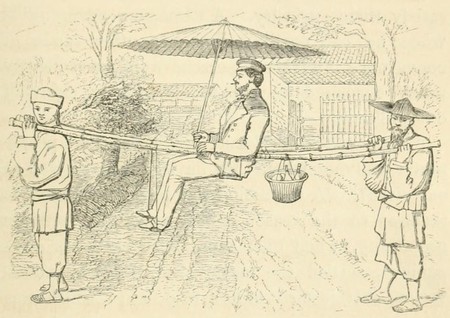
Mountain Chair.
The Chinese are quite philosophers after their own fashion. On our way to the temple, when tired with sitting so long in our boat, we several times got out and walked along the path on the sides of the canal. A great number of passage-boats going in the same direction with ourselves, and crowded with passengers, kept very near us for a considerable portion of the way, in order to satisfy their curiosity. A Chinaman never walks when he can possibly find any other mode of conveyance, and these persons were consequently much surprised to see us apparently enjoying our walk.
"Is it not strange," said one, "that these people prefer walking when they have a boat as well as ourselves?" A discussion now took place amongst them as to the reason of this apparently strange propensity, when one, more wise than his companions, settled the matter by the pithy observation, "It is their nature to do so;" which was apparently satisfactory to all parties.
It was nearly dark when we reached the temple, and as the rain had fallen in torrents during the greater part of the day, we were drenched to the skin, and in rather a pitiable condition. The priests seemed much surprised at our appearance, but at once evinced the greatest hospitality and kindness, and we soon found ourselves quite at home amongst them. They brought us fire to dry our clothes, got ready our dinner, and set apart a certain number of their best rooms for us to sleep in. We were evidently subjects of great curiosity to most of them who had never seen an Englishman before. Our clothes, features, mode of eating, and manners were all subjects of wonder to these simple people, who passed off many a good humoured joke at our expence.
Glad to get off our clothes, which were still damp, we retired early to rest. When we arose in the morning, the view which met our eyes far surpassed in beauty any scenery which I had ever witnessed before in China. The temple stands at the head of a fertile valley in the bosom of the hills. This valley is well watered by clear streams, which flow from the mountains, and produces most excellent crops of rice. The tea shrubs, with their dark green leaves, are seen dotted on the lower sides of all the more fertile hills. The temple itself is approached by a long avenue of Chinese pine trees. This avenue is at first straight, but near the temple it winds in a most picturesque manner round the edges of two artificial lakes, and then ends in a flight of stone steps, which lead up to the principal entrance. Behind, and on each side, the mountains rise, in irregular ridges, from one to two thousand feet above the level of the sea. These are not like the barren southern mountains, but are clothed nearly to their summits with a dense tropical looking mass of brushwood, shrubs, and trees. Some of the finest bamboos of China are grown in the ravines, and the sombre coloured pine attains to a large size on the sides of the hills. Here, too, I observed some very beautiful specimens of the new fir (Cryptomeria japonica), and obtained some plants and seeds of it, which may now be seen growing in the Horticultural Gardens at Chiswick.
After we had breakfasted, one of the head priests came and gave us a very pressing invitation to dine with him about mid-day; and in the meantime he accompanied us over the monastery, of which he gave the following history:—"Many hundred years ago a pious old man retired from the world, and came to dwell in these mountains, giving himself up entirely to the performance of religious duties. So earnest was he in his devotions that he neglected everything relating to his temporal wants, even to his daily food. Providence, however, would not suffer so good a man to starve. Some boys were sent in a miraculous manner, who daily supplied him with food. In the course of time the fame of the sage extended all over the adjacent country, and disciples flocked to him from all quarters. A small range of temples was built, and thus commenced the extensive buildings which now bear the name of "Tein-tung," or the "Temple of the Heavenly Boys;" Tein signifying heaven, and tung a boy. At last the old man died, but his disciples supplied his place. The fame of the temple spread far and wide, and votaries came from the most distant parts of the empire—one of the Chinese kings being amongst the number—to worship and leave their offerings at its altars. Larger temples were built in front of the original ones, and these again in their turn gave way to those spacious buildings which form the principal part of the structure of the present day.
All the temples are crowded with idols, or images of their favourite gods, such as the "three precious Buddhas," "the Queen of Heaven"—represented as sitting on the celebrated lotus or nelumbium—"the God of War," and many other deified kings and great men of former days. Many of these images are from thirty to forty feet in height, and have a very striking appearance when seen arranged in these spacious and lofty halls. The priests themselves reside in a range of low buildings, erected at right angles with the different temples and courts which divide them. Each has a little temple in his own house—a family altar crowded with small images, where he is often engaged in private devotion.
After inspecting the various temples and the belfry, which contains a noble bronze bell of large dimensions, our host conducted us back to his house, where the dinner was already on the table. The priests of the Buddhist religion are not allowed to eat animal food at any of their meals. Our dinner therefore consisted entirely of vegetables, served up in the usual Chinese style, in a number of small round basins, the contents of each—soups excepted—being cut up into small square bits, to be eaten with chopsticks. The Buddhist priests contrive to procure a number of vegetables of different kinds, which, by a peculiar mode of preparation, are rendered very palatable. In fact, so nearly do they resemble animal food in taste and in appearance, that at first we were deceived, imagining that the little bits we were able to get hold of with our chopsticks were really pieces of fowl or beef. Such, however, was not the case, as our good host was consistent on this day at least, and had nothing but vegetable productions at his table. Several other priests sat with us at table, and a large number of others of inferior rank with servants, crowded around the doors and windows outside. The whole assemblage must have been much surprised at the awkward way in which some of us handled our chopsticks, and, with all their politeness, I observed they could not refrain from laughing when, after repeated attempts, some little dainty morsel would still slip back again into the dish. I know few things more annoying, and yet laughable too, than attempting to eat with the Chinese chopsticks for the first time, more particularly if the operator has been wandering on the hills all the morning, and is ravenously hungry. The instruments should first of all be balanced between the thumb and forefinger of the right hand; the points are next to be brought carefully together, just leaving as much room as will allow the coveted morsel to go in between them; the little bit is then to be neatly seized; but alas! in the act of lifting the hand, one point of the chopstick too often slips past the other, and the object of all our hopes drops back again into the dish, or perhaps even into another dish on the table. Again and again the same operation is tried, until the poor novice loses all patience, throws down the chopsticks in despair, and seizes a porcelain spoon, with which he is more successful. In cases like these the Chinese themselves are very obliging, although scarcely in a way agreeable to an Englishman's taste. Your Chinese friend, out of kindness and politeness, when he sees the dilemma in which you are, reaches across the table and seizes, with his own chopsticks, which have just come out of his mouth, the wished-for morsel, and with them lays it on the plate before you. In common politeness you must express your gratitude and swallow the offering.
During dinner our host informed us that there were about a hundred priests connected with the monastery, but that many were always absent on missions to various parts of the country. On questioning him as to the mode by which the establishment was supported, he informed us that a considerable portion of land in the vicinity belonged to the temple, and that large sums were yearly raised from the sale of bamboos, which are here very excellent, and of the branches of trees and brushwood, which are made up in bundles for fire-wood. A number of tea and rice farms also belong to the priests, which they themselves cultivate. Besides the sums raised by the sale of these productions, a considerable revenue must be derived from the contributions of the devotees who resort to the temple for religious purposes, as well as from the sums collected by those of the order who are out on begging excursions at stated seasons of the year. The priests are of course of all grades, some of them being merely the servants of the others, both in the house and in the fields. They seem a harmless and simple race, but are dreadfully ignorant and superstitious. The typhoon of the previous year, or rather the rain which had accompanied it, had occasioned a large slip of earth on one of the hill-sides near the temple, and completely buried ten or twelve acres of excellent paddy land. On our remarking this, the priests told us with great earnestness that every one said it was a bad omen for the temple; but one of them with true Chinese politeness remarked that he had no doubt any evil influence would now be counteracted, since the temple had been honoured with a visit from us.
After inspecting the tea farms and the mode of manufacturing it, Mr. Thom, Mr. Morrison, a son of the late Dr. Morrison, and Mr. Sinclair, returned to Ningpo, leaving me to prosecute my research in natural history in this part of the country. I was generally absent from the temple the whole day, returning at dark with the collections of plants and birds which I had been lucky enough to meet with in my peregrinations. The friends of the priests came from all quarters of the adjacent country to see the foreigner; and, as in the case of a wild animal, my feeding time seemed to be the most interesting moment to them. My dinner was placed on a round table in the centre of the room, and although rather curiously concocted, being half Chinese and half English, the exercise and fresh air of the mountains gave me a keen appetite. The difficulties of the chopsticks were soon got over, and I was able to manage them nearly as well as the Chinese themselves. The priests and their friends tilled the chairs, which are always placed down the sides of a Chinese hall, each man with his pipe in his mouth and his cup of tea by his side. With all deference to my host and his friends, I was obliged to request the smoking to be stopped, as it was disagreeable to me while at dinner; in other respects, I believe I was "polite" enough. I shall never forget how inexpressibly lonely I felt the first night after the departure of my friends. The Chinese one by one dropt off to their homes or to bed, and at last my host himself gave several unequivocal yawns, which reminded me that it was time to retire for the night. My bed-room was upstairs, and to get to it I had to pass through a small temple, such as I have already noticed, dedicated to Tein-how, or the "Queen of Heaven," and crowded with other idols. Incense was burning on the altar in front of the idols; a solitary lamp shed a dim light over the objects in the room, and a kind of solemn stillness seemed to pervade the whole place. In the room below, and also in one in an adjoining house, I could hear the priests engaged in their devotional exercises, in that singing tone which is peculiar to them. Then the sounds of the gong fell upon my ears; and, at intervals, a single solemn toll of the large bronze bell in the belfry; all which showed that the priests were engaged in public as well as private devotion. Amidst scenes of this kind, in a strange country, far from friends and home, impressions are apt to be made upon the mind, which remain vivid through life; and I feel convinced I shall never forget the strange mixture of feelings which filled my mind during the first night of my stay with the priests in the temple of Tein-tung. I have visited the place often since, passed through the same little temple, slept in the same bed, and heard the same solemn sounds throughout the silent watches of the night, and yet the first impressions remain in my mind distinct and single.
The priests, from the highest to the lowest, always showed me the most marked attention and kindness. As many of them as I wished cheerfully followed me in my excursions in the vicinity of the temple; one carrying my specimen paper, another my plants, and a third my birds, and so on. The gun seemed an object of great interest to them, being so different from their own clumsy matchlocks; and percussion caps were looked upon as most magical little objects. But they were great cowards, and always kept at a most respectful distance when I was shooting.
One evening a deputation, headed by the high priest, came and informed me that the wild boars had come down from the mountains at night, and were destroying the young shoots of the bamboo, which were then just coming through the ground, and were in the state in which they are highly prized as a vegetable for the table. "Well," said I, "what do you want me to do?"
"Will you be good enough to lend us the gun?"
"Yes; there it stands in the corner of the room."
"Oh, but you must load it for us."
"Very well, I will;" and I immediately loaded the gun with ball. "There, but take care and don't shoot yourselves." There was now a long pause; none had sufficient courage to take the gun, and a long consultation was held between them. At length the spokesman came forward, with great gravity, and told me they were afraid to fire it off, but that if I would go with them, and shoot the boar, I should have it to eat. This was certainly no great sacrifice on the part of the Budhist priesthood, who do not, or at least should not, eat animal food. We now sallied forth in a body to fight the wild boars; but the night was so dark that we could see nothing in the bamboo ravines, and, perhaps, the noise made by about thirty priests and servants warned the animals to retire to the brushwood higher up the hills. Be that as it may, we could neither see nor hear any thing of them, and I confess I was rather glad, than otherwise, as I thought there was a considerable chance of my shooting, by mistake, a priest instead of a wild boar.
The priests have two modes of protecting their property from the ravages of these animals. Deep pits are dug on the hill sides, and, as there are springs in almost all these places, the pits are scarcely finished before they are half full of water. The mouth of each pit is then covered over with a quantity of sticks, rubbish, and grass, to attract the animal, and no sooner does he begin to bore into it with his snout, than the whole gives way, and he is plunged, head foremost, into the pit, from which it is quite impossible for him to extricate himself, and he is either drowned or becomes an easy prey to the Chinese. These pits are most dangerous traps to persons unacquainted with the localities in which they are placed. I had several narrow escapes, and once in particular, when coming out of a dense mass of brushwood, I stept unawares on the treacherous mouth of one of them, and felt the ground under my feet actually giving way; but managing to throw my arms forward I caught hold of a small twig which was growing near, and by this means supported myself until I was able to scramble on to firmer ground. On turning back to examine the place, I found that the loose rubbish had sunk in, and a deep pit, half full of water, was exposed to my view. The pit was made narrow at the mouth and widening inside like a great China vase, being constructed in this manner to prevent the boar from scrambling out when once fairly in it. Had I fallen in, it would have been next to impossible to have extricated myself without assistance, and as the pits are generally dug in the most retired and wild part of the mountains, my chance would have been a bad one. The fate of my predecessor, Mr. Douglas, who perished in a pit of this kind on the Sandwich Islands, must still be fresh in the recollection of many of my readers, and his melancholy end naturally coming to my mind at the time, made me doubly thankful for my escape.
The other method of protecting the young bamboos from the ravages of the wild boar, is an ingenious one. A piece of bamboo wood, about eight or ten feet long, and rather thicker than a man's arm, is split up the middle to within a fourth of its length. This is made fast to a tree in the bamboo thicket, and at an angle of about forty-five degrees, the split part being left loose, a cord, also made of bamboo, is fastened to it by one end, and the other is led to some convenient place out of the thicket, where a man is stationed. When the boars come down in the dead of night to attack the young shoots, the man pulls the rope backwards and forwards, and clank, clank, clank goes the bamboo, producing a loud and hollow sound, which on a quiet evening may be heard at a great distance. The animals are frightened and make off to their dens on the hills. The first time I heard these things beating at night, all over the country, I imagined that some religious ceremony was going on, the hollow sounds of the bamboo being not unlike those produced by an instrument used in the Budhist worship in all Chinese temples.
There are a large number of Budhist temples scattered over all this part of the country. One, named Ah-yu-wang, which I also visited, is, like Tein-tung, of great extent, and seemingly well supported. They both own large tracts of land in the vicinity of the monasteries, and have numerous small temples in different parts of the district which are under their control. All the temples, both large and small, are built in the most romantic and beautiful situations amongst the hills, and the neighbouring woods are always preserved and encouraged. What would indicate the residence of a country gentleman in England, is in China the sign of a Budhist temple, and this holds good over all the country. When the weary traveller, therefore, who has been exposed for hours to the fierce rays of an eastern sun, sees a large clean looking house showing itself amongst trees on the distant hill-side, he may be almost certain that it is one of Budha's temples, where the priests will treat him not only with courtesy, but with kindness.
Poo-to, or the Worshipping Island, as it is commonly called by foreigners, is one of the eastern islands in the Chusan Archipelago, and seems to be the capital or stronghold of Budhism in this part of China. This island is not more than five or six miles in circumference, and, although hilly, its sides and small ravines are pretty well wooded, particularly in the vicinity of the numerous temples. As it is only a few hours' sail from Chusan, it had been visited at different times by a number of our officers during the war, all of whom spoke highly of its natural beauties and richness of vegetation. I was also informed that the resident priests were fond of collecting plants, particularly Orchidaceæ, and that their collections were much increased by the itinerant habits of the begging priests, who visit the most distant provinces of the empire, as well as by the donations of the lay devotees, who come to Poo-to at stated seasons of the year, to worship and leave their offerings in the temples. I therefore determined to visit the place in order to judge for myself, and accordingly set out in July, 1844, accompanied by my friend, Dr. Maxwell, of the Madras army.
Leaving Chusan at night, with the tide in our favour, we reached the island at sun-rise on the following morning. We landed, and pursued our way over a hill and down on the other side by a road which led us into a beautiful and romantic glen. It is here that the principal group of temples is built, and when we first caught a glimpse of them, as we wended our way down the hill, they seemed like a town of considerable size. As we approached nearer, the view became highly interesting. In front there was a large artificial pond, filled with the broad green leaves and noble red and white flowers of the Nelumbium speciosum,—a plant in high favour with the Chinese. Every body who went to Poo-to admired these beautiful water-lilies. In order to reach the monastery we crossed a very ornamental bridge built over this pond, which, when viewed in a line with an old tower close by, has a pretty and striking appearance.
The temples or halls which contain the idols are extremely spacious, and resemble those which I have already described at Tein-tung and Ah-yu-Wang. These idols, many of which are thirty or forty feet in height, are generally made of wood or clay, and then richly gilt. There is one small temple, however, of a very unassuming appearance, where we met with some exquisite bronze statues, which would be considered of great value in England. These, of course, were much smaller than the others, but, viewed as works of art, they were by far the finest which I saw during my travels in China.
Having examined these temples, we pursued our way towards another assemblage of them, about two miles to the eastward and close on the sea-shore. We entered the courts through a kind of triumphal arch, which looks out upon the sea, and found that these temples were constructed upon the same plan as all the others. As we had determined to make this part of the island our home during our stay, we fixed upon the cleanest looking temple, and asked the High Priest to allow us, without farther delay, to put our beds and travelling baggage into it.
On the following day we inspected various parts of the island. Besides the large temples just noticed, there are about sixty or seventy smaller ones, built on all the hill sides, each of which contains three or four priests, who are all under the superior, or abbot, who resides near one of the large temples. Even on the top of the highest hill, probably 1500 or 1800 feet above the level of the sea, we found a temple of considerable size and in excellent repair. There are winding stone steps from the sea beach all the way up to this temple, and a small resting-place about half way up the hill, where the weary devotee may rest and drink of the refreshing stream which flows down the sides of the mountain, and in the little temple close at hand, which is also crowded with idols, he can supplicate Budha for strength to enable him to reach the end of his journey. We were surprised to find a Budhist temple in such excellent order as the one on the summit of the hill proved to be in. It is a striking fact, that almost all these places are crumbling fast into ruins. There are a few exceptions, in cases where they happen to get a good name amongst the people from the supposed kindness of the gods; but the great mass are in a state of decay.
From the upper temple on Poo-to-san the view is strikingly grand. Hugged mountains are seen rising one above another and capped with clouds. Hundreds of islands, some fertile, others rocky and barren, lay scattered over the sea. When we looked in one direction amongst the islands, the water was yellow and muddy; but, to the eastward, the deep blue ocean had resumed its usual colour, and the line between the yellow waters and the blue was distinctly and curiously marked.
The wood on the island is preserved in the same manner as it is around all the other Budhist temples. The principal species of trees and shrubs met with are Pinus sinensis, Cunningham lanceolata, yews, cypresses, the camphor tree, tallow tree, oaks, and bamboos. The Camellia japonica grows spontaneously in the woods, where we met with many specimens from twenty to thirty feet in height and with stems thick in proportion. The variety, however, was only the well-known single red. In other respects the flora of Poo-to is nearly the same as on the island of Chusan.
A few pet plants were cultivated by all the priests who were fortunate enough to have private residences at the little temples on the sides of the hills. We were much pleased with the interest these poor people took in their favourite flowers, but were disappointed in the number and variety of plants, which, from the reports of others, we expected to have found. Almost the only orchidaceous plant which they had, proved to be the common and well-known Cymbidium sinense. Daphne odorata, two or three species of Gardenia, several varieties of Rose, the common Balsam, and the favourite Nelumbium were nearly all the plants met with in the gardens of the priests.
The island of Poo-to is set apart entirely as a residence for the priests of the Budhist religion. Few other persons are allowed to live there, and these are either servants or in some way connected with the priests. No women are permitted to reside on the island, it being against the principles of the Budhists to allow their priests to marry. The number of priests are estimated at 2000, but many of them are constantly absent on begging expeditions for the support of their religion. This establishment, like Tein-tung, has also a portion of land allotted to it for its support, and the remainder of the funds are made up by the subscriptions of the devotees. On certain high days, at different periods of the year, many thousands of both sexes, but particularly females, resort to these temples, clad in their best attire, to pay their vows and engage in the other exercises of heathen worship. Little stalls are then seen in the temples or at the doorways for the sale of incense, candles, paper made up in the form of the ingots of Sycee-silver, and other holy things which are considered acceptable offerings to the gods, and are either consumed in the temples or carried home to bring a blessing upon the houses and families of those who purchase them. The profits of these sales, of course, go to the support of the establishment. When we consider that these poor deluded people sometimes travel a distance of several hundred miles to worship in the temples on Poo-to-san and other celebrated places, we cannot but admire their spirit of devotion. I was once staying in the temple of Tein-tung when it was visited for three days by devotees from all parts of the country. As they lined the roads on their way to the temple, clad in the graceful and flowing costume of the East, the mind was naturally led back to those days of scripture history when Jerusalem was in its glory, and the Jews, the chosen people of God, came from afar to worship in its temple.
Although no Christian can look upon the priests and devotees of the Budhist creed without an eye of pity, yet he must give them credit for their conduct, since he has every reason to believe them sincere, and I am inclined to believe that justice has not been done them in this respect. Mr. Gutzlaff, in describing his visit to Poo-to, is of a different opinion. He says, "We were present at the vespers of the priests, which they chanted in the Pali language, not unlike the Latin service of the Romish church. They held rosaries in their hands, which rested folded upon their breasts. One of them had a small bell, by the tinkling of which their service was regulated; and they occasionally beat the drum and large bell to rouse Budha's attention to their prayers. The same words were a hundred times repeated. None of the officiating persons showed any interest in the ceremony, for some were looking around laughing and joking, while others muttered their prayers. The few people who were present, not to attend the worship, but to gaze at us, did not seem, in the least degree, to feel the solemnity of the service. "What Mr. Gutzlaff says is doubtless true, but after residing for months in their temples, at different times, and in different parts of the country, I have no hesitation in saying that such conduct is very far from being general. In certain instances I have seen it myself, but this levity and apparent want of attention was exhibited by the servants and lookers on, who were taking no part in the ceremony, and not by the respectable portion of the priests. On the contrary, I have generally been struck with the solemnity with which their devotional exercises were conducted. I have often walked into Chinese temples when the priests were engaged in prayer, and, although there would have been some apology for them had their attention been diverted, they went on in the most solemn manner until the conclusion of the service, as if no foreigner were present. They then came politely up to me, examining my dress and every thing about me with the most earnest curiosity. Nor does this apply to priests only; the laity, and particularly the female sex, seem equally sincere when they engage in their public devotions. Whether they are what they appear to be, or how often they are in this pious frame of mind, are questions which I cannot answer. Before judging harshly of the Chinese let the reader consider what effect would be produced upon the members of a Christian church by the unexpected entrance of a small-footed Chinese lady, or a Mandarin, with the gold button and peacock feather mounted on his hat, and his long tail dangling over his shoulders. I am far from being an admirer of the Budhist priesthood; they are generally an imbecile race, and shamefully ignorant of every thing but the simple forms of their religion, but nevertheless there are many traits in their character not unworthy of imitation.
There are two other sects in China, namely, the followers of Kong-foo-tze or Confucius, and the sect of Taou or Reason. Although these three sects form the principal part of the population, it is well known that there are a great number of Mohommedans in every part of the empire, who are not only tolerated, but admitted to offices under government in the same manner as the members of the three established sects. Jews also are found in several districts, but more particularly at a place called Kae-foong-foo, in the province of Honan.
The various religious ceremonies which the Chinese are continually performing prove at least that they are very superstitions. In all the southern towns every house has its temple or altar both inside and outside. The altar in the inside is generally placed at the end of the principal hall or shop, as the case may be, raised a few feet from the ground, and having some kind of representation of the family deity placed upon it. This is surrounded with gaudy tinsel paper, and on the first of the Chinese month or other high days candles and incense are burned on the table which is placed in front of it. The altar on the outside of the door resembles a little furnace, in which the same ceremonies are regularly performed. In the vicinity of small villages, and sometimes in the most retired situations, the stranger meets with little joss-houses or temples, gaudily decorated with paintings and tinsel paper, and stuck round about with the remains of candles and sticks of incense. In almost all Chinese towns there are shops for the sale of idols of all kinds and sizes, varying in price from a few "cash" to a very large sum. Many of those exposed for sale are of great age, and have evidently changed hands several times. I am inclined to believe that the Chinese exchange those gods which do not please them for others of higher character, and which they suppose are more likely to grant an answer to their prayers, or bring prosperity to their homes or their villages.
The periodical offerings to the gods are very striking exhibitions to the stranger who looks upon them for the first time. When staying at Shanghae, in November, 1844, I witnessed a most curious spectacle in the house where I was residing. It was a family offering to the gods. Early in the morning the principal hall in the house was set in order, a large table was placed in the centre, and shortly afterwards covered with small dishes filled with the various articles commonly used as food by the Chinese. All these were of the very best description which could be procured. After a certain time had elapsed a number of candles were lighted, and columns of smoke and fragrant odours began to rise from the incense which was burning on the table. All the inmates of the house and their friends were clad in their best attire, and in turn came to Ko-tou, or bow lowly and repeatedly in front of the table and the altar. The scene, although it was an idolatrous one, seemed to me to have something very impressive about it, and whilst I pitied the delusion of our host and his friends, I could not but admire their devotion. In a short time after this ceremony was completed a large quantity of tinsel paper, made up in the form and shape of the ingots of Sycee silver common in China, was heaped on the floor in front of the tables, the burning incense was then taken from the table and placed in the midst of it, and the whole consumed together. By and by, when the gods were supposed to have finished their repast, all the articles of food were removed from the tables, cut up, and consumed by people connected with the family.
On another occasion, when at Ning-po, having been out some distance in the country, it was night and dark before I reached the cast gate of the city, near which I was lodged in the house of a Chinese merchant. The city gates were closed, but two or three loud knocks soon brought the warder, who instantly admitted me. I was now in the widest and finest street in the city, which seemed in a blaze of light and unusually lively for any part of a Chinese town after nightfall. The sounds of music fell, upon my ear, the gong, the drum, and the more plaintive and pleasing tones of several wind instruments. I was soon near enough to observe what was going on, and saw, at a glance, that it was a public offering to the gods, but far grander and more striking than I had before witnessed. The table was spread in the open street, and every thing was on a large and expensive scale. Instead of small dishes, whole animals were sacrificed on the occasion. A pig was placed on one side of the table, and a sheep on the other, the former scraped clean, in the usual way, and the latter skinned; the entrails of both were removed, and on each were placed some flowers, an onion, and a knife. The other parts of the table groaned with all the delicacies in common use amongst the respectable portion of the Chinese, such as fowls, ducks, numerous compound dishes, fruits, vegetables, and rice. Chairs were placed at one end of the table on which the gods were supposed to sit during the meal, and chopsticks were regularly laid at the sides of the different dishes. A blaze of light illuminated the whole place, and the smoke of the fragrant incense rose up into the air in wreaths. At intervals the band struck up their favourite plaintive national airs, and altogether the whole scene was one of the strangest and most curious which it has ever been my lot to witness.