Chapter I · (continued 4)
Reading edition
There is another ceremony of a religious character which I frequently observed in the northern cities—I allude to processions in honour of the gods. I saw one of them at Shanghae, which must have been at least a mile in length. The gods, or josses, were dressed up in the finest silks, and carried about in splendid sedan-chairs, preceded and succeeded by their numerous devotees, superbly dressed for the occasion, and bearing the different badges of office. The dresses of the officials were exactly the same as of those who form the train of some of the high mandarins. Some had a broad fan, made of peacock feathers, which they wore on the sides of their hats, others were clad in glaring theatrical dresses, with low caps, and two long black feathers stuck in them, and hanging over their shoulders like two horns. Then there were the ill-looking executioners with long, conical, black hats on their heads, and whips in their hands for the punishment of the refractory. Bands of music, placed in different parts of the procession, played at intervals as it proceeded. Anxious to see the end of this curious exhibition, I followed the procession until it arrived at a temple in the suburbs, where it halted. The gods were taken out of the sedan-chairs, and replaced with due honours, in the temple, from which they had been taken in the morning. Here their numerous votaries bent low before them, burned incense, and left their gifts upon the altar. Numerous groups of well-dressed ladies and their children were scattered over the ground in the vicinity of the temple, all bending their knees and seemingly engaged in earnest devotion. A large quantity of paper, in the form of the Sycee ingots, was heaped up on the grass as it was brought by the different devotees, and, when the ceremonies of the day were drawing to a close, the whole was burned in honour of, or as an offering to, the gods. The sight was interesting, but it was one which no Christian could look upon without feelings of the deepest commiseration.
In the course of my travels in China I often met with Christian missionaries, both Protestant and Roman Catholic, who have been labouring amongst the Chinese for many years. Until very lately the efforts of the Protestants had been chiefly confined to Macao and Canton. Since the war, however, they have had an opportunity of extending their operations, and some are now settled at all the new ports which have been opened for foreign trade, as well as on our Island of Hong-kong, which will now become their head-quarters.
The medical missionaries also act in conjunction with the others, and are of great use in curing many of the diseases which prevail in the country, while, at the same time, the truths of the Christian faith are presented to the minds of their patients. Dr. Lockhart of the London Missionary Society, who has established himself in the town of Shanghae, had his hospital daily crowded with patients, many of whom had come from very distant parts of the country. All were attended to in the most skilful and careful manner, "without money and without price." The Rev. Mr. Medhurst, who has laboured long and zealously as a Christian missionary in the East, was also at Shanghae. This gentleman is well known as an eminent Chinese scholar, and, besides preaching to the people in their own tongue, he has a printing establishment with Chinese type continually at work, for the dissemination of the truths of the gospel. Several other gentlemen and their families had arrived at the same port previous to my departure, and were closely engaged in the study of the language. Ning-po and Amoy were also occupied by missionaries, both from England and America, and I suppose, ere this time, some have also reached Foo-chow-foo on the River Min.
From my own experience of Chinese character, and from what I have seen of the working of the Medical Missionary Society, I am convinced that it must be a powerful auxiliary to the missionaries in the conversion of the Chinese. I regret, however, to say, that up to the present time little progress appears to have been made. One portion of the people, and a large one, is entirely indifferent to religion of any kind, and the rest are so bigoted and conceited, that it will be a most difficult task to convince them that any religion is better or purer than their own.
The Roman Catholic missionaries conduct their operations in a manner somewhat different from the Protestants. They do not restrict themselves to the out-ports of the empire, where foreigners are permitted to trade, but penetrate into the interior, and distribute themselves over all the country. One of their bishops, an Italian nobleman, resides in the province of Keang-soo, a few miles from Shanghae, where I have frequently met him. He dresses in the costume of the country, and speaks the language with the most perfect fluency. In the place where he lives he is surrounded by his converts; in fact it is a little Christian village, where he is perfectly safe, and I believe is seldom if ever annoyed in any way by the Chinese authorities. When new Roman Catholic missionaries arrive, they are met by some of their brethren or their converts at the port nearest their destination, and secretly conveyed into the interior; the Chinese dress is substituted for the European; their heads are shaved, and in this state they are conducted to the scene of their future labours, where they commence the study of the language, if they have not learned it before, and in about two years are able to speak it sufficiently well to enable them to instruct the people. These poor men submit to many privations and dangers for the cause they have espoused, and although I do not approve of the doctrines which they teach, I must give them the highest praise for enthusiasm and devotion to their faith. European customs, habits, and luxuries are all abandoned from the moment they put their feet on the shores of China; parents, friends, and home, in many instances, are heard of no more; before them lies a heathen land of strangers, cold and unconcerned about the religion for which they themselves are sacrificing everything, and they know that their graves will be far away from the land of their birth and the home of their early years. They seem to have much of the spirit and enthusiasm of the first preachers of the Christian religion, when they were sent out into the world by their Divine Master to "preach the gospel to every creature," and "to obey God rather than man."
According to the accounts of these missionaries, the number of converts to their faith is very considerable; but I fear they, as well as the Protestants, are often led away by false appearances and assertions. Many of the Chinese are unprincipled and deceitful enough to become Christians or in fact any thing else, in name, to accomplish the object they may have in view, and they would become Budhists the very next day should any inducement be offered them to do so. Judging from appearances, the day must yet be very distant when the Chinese, as a nation, will be converted to the Christian faith. Could those individuals in our time, who predict the near approach of the Millennium, see the length and breadth of this vast country, with its three hundred millions of souls, they would surely pause and reflect before they published their absurd and foolish predictions.
CHAP. XI.
THE TEA-PLANT OF CHINA.—THE SPECIES FOUND IN THE GREEN AND BLACK TEA DISTRICTS.—BEST SITUATION FOR TEA PLANTATIONS.—REMARKS ON THEIR MANAGEMENT.—SEASONS, AND METHODS, OF GATHERING THE LEAVES.—MANUFACTURE OF TEA.—COTTAGES AMONGST THE TEA HILLS.—FURNACES AND DRYING PANS.—FIRST APPLICATION OF HEAT.—ROLLING PROCESS.—EXPOSURE OF THE LEAVES TO THE AIR.—SECOND HEATING.—LENGTH OF TIME REQUIRED.—TWO KINDS OF TEA.—DIFFERENCE IN THE MANUFACTURE OF EACH.—SELECTING AND PACKING TEAS.—APPEARANCE AND COLOUR OF THE LEAF.—PECULIAR TASTE OF FOREIGNERS FOR DYED TEAS.—GOOD SENSE OF THE CHINESE.—TEA MERCHANTS.—THEIR VISITS TO THE TEA HILLS.—MODE OF BUYING FROM THE SMALL GROWERS.—BLACK TEA DISTRICT IN FOKIEN.—TEAS DIVIDED INTO TWO KINDS.—PECULIAR METHOD OF PREPARING EACH.—CAUSE OF THEIR DIFFERENCE IN COLOUR.—FLOWERS USED IN SCENTING THE FINER TEAS.—SIR JOHN FRANCIS DAVIS'S REMARKS ON DIFFERENT KINDS OF TEAS SOLD AT CANTON.
There are few subjects connected with the vegetable kingdom which have attracted such a large share of public notice as the tea-plant of China. Its cultivation on the Chinese hills, the particular species or variety which produces the black and green teas of commerce, and the method of preparing the leaves, have always been objects of peculiar interest. The jealousy of the Chinese government, in former times, prevented foreigners from visiting any of the districts where tea is cultivated, and the information derived from the Chinese merchants, even scanty as it was, was not to be depended upon. And hence we find our English authors contradicting each other, some asserting that the black and green teas are produced by the same variety, and that the difference in colour is the result of a different mode of preparation, while others say that the black teas are produced from the plant called by botanists Thea Bohea, and the green from Thea viridis, both of which we have had for many years in our gardens in England.
During my travels in China since the last war, I have had frequent opportunities of inspecting some extensive tea districts in the black and green tea countries of Canton, Fokien, and Chekiang, and the result of these observations is now laid before the reader. It will prove that even those who have had the best means of judging have been deceived, and that the greater part of the black and green teas which are brought yearly from China to Europe and America are obtained from the same species or variety, namely, from the Thea viridis. Dried specimens of this plant were prepared in the districts I have named by myself, and are now in the herbarium of the Horticultural Society of London, so that there can be no longer any doubt upon the subject.
In various parts of the Canton province, where I had an opportunity of seeing tea cultivated, the species proved to be the Thea Bohea, or what is commonly called the black tea plant. In the green tea districts of the north—I allude more particularly to the province of Chekiang—I never met with a single plant of this species, which is so common in the fields and gardens near Canton. All the plants in the green tea country near Ning-po, on the Islands of the Chusan Archipelago, and in every part of the province which I had an opportunity of visiting, proved, without exception, to be the Thea viridis. Two hundred miles further to the north-west, in the province of Kiang-nan, and only a short distance from the tea hills in that quarter, I also found in gardens this same species of tea.
Thus far my actual observation exactly verified the opinions I had formed on the subject before I left England, viz., that the black teas were prepared from the Thea Bohea, and the green from Thea viridis. When I left the north, on my way to the city of Foo-chow-foo, on the River Min, in the province of Fokien, I had no doubt that I should find the tea hills there covered with the other species, Thea Bohea, from which we generally suppose the black teas are made; and this was the more likely to be the case as this species actually derives its specific name from the Bohee hills in this province. Great was my surprise to find all the plants on the tea hills near Foo-chow exactly the same as those in the green tea districts of the north. Here were then green tea plantations on the black tea hills, and not a single plant of the Thea Bohea to be seen. Moreover, at the time of my visit, the natives were busily employed in the manufacture of black teas. Although the specific differences of the tea-plants were well known to me, I was so much surprised, and I may add amused, at this discovery, that I procured a set of specimens for the herbarium, and also dug up a living plant, which I took northward to Chekiang. On comparing it with those which grow on the green tea hills, no difference whatever was observed.
It appears, therefore, that the black and green teas of the northern districts of China (those districts in which the greater part of the teas for the foreign markets are made) are both produced from the same variety, and that that variety is the Thea viridis, or, what is commonly called the green tea plant. On the other hand, those black and green teas which are manufactured in considerable quantities in the vicinity of Canton are obtained from the Thea Bohea, or black tea. And, really, when we give the subject our unprejudiced consideration, there seems nothing surprising in this state of things. Moreover, we must bear in mind that our former opinions were formed upon statements made to us by the Chinese at Canton, who will say any thing which suits their purpose, and rarely give themselves any trouble to ascertain whether the information they communicate be true or false.
The soil of the tea districts is, of course, much richer in the northern provinces than it is in Quantung. In Fokien and Chekiang it is a rich sandy loam, very different from the sample which will be found noticed in the chapter on climate and soil. Tea shrubs will not succeed well unless they have a rich soil to grow in. The continual gathering of their leaves is very detrimental to their health, and, in fact, ultimately kills them. Hence a principal object with the grower is to keep his bushes in as robust health as possible; and this cannot be done if the soil be poor.
The tea plantations in the north of China are always situated on the lower and most fertile sides of the hills, and never on the low lands. The shrubs are planted in rows about four feet apart and about the same distance between each row, and look, at a distance, like little shrubberies of evergreens.
The farms are small, each consisting of from one to four or five acres; indeed, every cottager has his own little tea garden, the produce of which supplies the wants of his family, and the surplus brings him in a few dollars, which are spent on the other necessaries of life. The same system is practised in every thing relating to Chinese agriculture. The cotton, silk, and rice farms are generally all small and managed upon the same plan. There are few sights more pleasing than a Chinese family in the interior engaged in gathering the tea leaves, or, indeed, in any of their other agricultural pursuits. There is the old man, it may be the grand—father, or even the great-grandfather, patriarch like, directing his descendants, many of whom are in their youth and prime, while others are in their childhood, in the labours of the field. He stands in the midst of them, bowed down with age. But, to the honour of the Chinese as a nation, he is always looked up to by all with pride and affection, and his old age and grey hairs are honoured, revered, and loved. When, after the labours of the day are over, they return to their humble and happy homes, their fare consists chiefly of rice, fish, and vegetables, which they enjoy with great zest, and are happy and contented. I really believe that there is no country in the world where the agricultural population are better off than they are in the north of China. Labour with them is pleasure, for its fruits are eaten by themselves, and the rod of the oppressor is unfelt and unknown.
In the green tea districts of Chekiang near Ning-po, the first crop of leaves is generally gathered about the middle of April. This consists of the young leaf-buds just as they begin to unfold, and forms a fine and delicate kind of young hyson, which is held in high estimation by the natives, and is generally sent about in small quantities as presents to their friends. It is a scarce and expensive article, and the picking of the leaves in such a young state does considerable injury to the tea plantations. The summer rains, however, which fall copiously about this season, moisten the earth and air, and if the plants are young and vigorous they soon push out fresh leaves.
In a fortnight or three weeks from the time of the first picking, or about the beginning of May, the shrubs are again covered with fresh leaves, and are ready for the second gathering, which is, in fact, the most important of the season. The third and last gathering, which takes place as soon as new leaves are formed, produces a very inferior kind of tea, which, I believe, is rarely sent out of the district.
The mode of gathering and preparing the leaves of the tea-plants is extremely simple. We have been so long accustomed to magnify and mystify every thing relating to the Chinese, that, in all their arts and manufactures, we expect to find some peculiar and out of the way practice, when the fact is, that many operations in China are more simple in their character than in most other parts of the world. To rightly understand the process of rolling and drying the leaves, which I am about to describe, it must be borne in mind that the grand object is to expel the moisture, and at the same time to retain, as much as possible, of the aromatic and other desirable secretions of the species. The system adopted to attain this end is as simple as it is efficacious.
In the harvest seasons the natives are seen in little family groups on the side of every hill, when the weather is dry, engaged in gathering the tea leaves. They do not seem so particular, as I imagined they would have been, in this operation, but strip the leaves off rapidly and promiscuously, and throw them all into round baskets made for the purpose out of split bamboo or rattan. In the beginning of May, when the principal gathering takes place, the young seed vessels are about as large as peas. These are also stripped off and dried with the leaves; it is these seed-vessels, which we often see in our tea, and which have some slight resemblance to young capers. When a sufficient quantity of leaves are gathered, they are carried home to the cottage or barn, where the operation of drying is performed.
The Chinese cottages, amongst the tea hills, are simple and rude in their construction, and remind one of what we used to see in Scotland in former years, when the cow and pig lived and fed in the same house with the peasant. Scottish cottages, however, even in these days, were always better furnished and more comfortable than those of the Chinese are at the present time. Nevertheless, it is in these poor cottages that a large proportion of the teas, with their high-sounding names, are first prepared. Barns, sheds, and other outhouses, are also frequently used for the same purpose, particularly about the temples and monasteries.
The drying pans and furnaces in these places are very simply constructed. The pans, which are of iron, and are made as thin as possible, are round and shallow, and, in fact, are the same, or nearly the same, which the natives have in general use for cooking their rice. A row of these are built into brick work and chunam, having a flue constructed below them, with the grating, or rather fire-place, at one end, and the chimney, or, at least, some hole to allow the smoke to escape, at the other. A chimney is a secondary consideration with the Chinese, and in many instances which came under my observation, the smoke, after passing below the drying-pans, was allowed to escape, as it best could, through the doors and roofs of the houses, which, indeed, in China, is no difficult matter.
When the pans are first fixed, the brick-work and chunam are smoothed off very neatly round their edges and carried up a little higher, particularly at the back of the pans, at the same time widening gradually. When complete, the whole has the appearance of a row of large high-backed basins, each being three or four times larger than the shallow iron pan which is placed at its bottom, immediately over the flue. When the fire is applied, the upper part of these basins, which is formed of chunam, gets heated as well as the iron pan, though in a less degree. The drying pans, thus formed, being low in front, and rising very gradually at the sides and back, the person, whose duty it is to attend to the drying of the leaves, can readily manage them, and scatter them about over the back of the basin. The accompanying sketch, which was made on the spot, will render this description more clear.
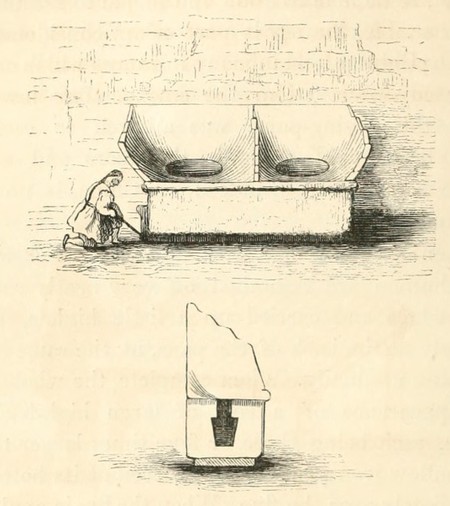
Furnaces and Drying Pans.
The leaves having been brought in from the hills are placed in the cottage or drying-house. It is now the duty of one individual to light the little fire at the mouth of the flue, and to regulate it as nicely as possible. The pans become hot very soon after the warm air has begun to circulate in the flue beneath them. A quantity of leaves, from a sieve or basket, are now thrown into the pans, and turned over, shaken up, and kept in motion by men and women stationed there for this purpose. The leaves are immediately affected by the heat. They begin to crack, and become quite moist with the vapour or sap which they give out on the application of the heat. This part of the process lasts about five minutes, in which time the leaves lose their crispness, and become soft and pliable. They are then taken out of the pans and thrown upon a table, the upper part of which is made of split pieces of bamboo as represented in the annexed sketch. Three or four persons now surround the table, and the heap of tea leaves is divided into as many parcels, each individual taking as many as he can hold in his hands, and the rolling process commences. I cannot give a better idea of this operation than by comparing it to a baker working and rolling his dough. Both hands are used in the very same way; the object being to express the sap and moisture, and at the same time to twist the leaves. Two or three times during the operation the little bundles of rolled leaves are held up and shaken out upon the table, and are then again taken up and pressed and rolled as before. This part of the process also lasts about five minutes, during which time a large portion of green juice has been expressed, and may be seen finding its way down between the interstices of the bamboos. The leaves being now pressed, twisted, and curled, do not occupy a quarter of the space which they did before the operation.
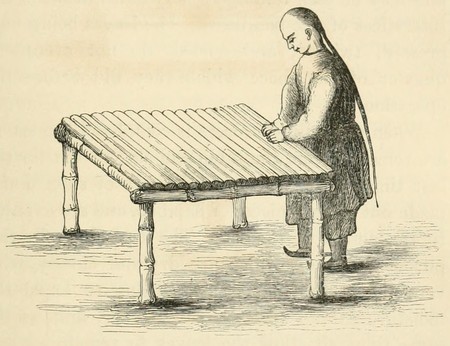
The Rolling Process.
When the rolling process is completed the leaves are removed from the table and shaken out for the last time, thinly, upon a large sort of screen, also made out of split pieces of bamboo, and are exposed to the action of the air. The best days for this purpose are those which are dry and cloudy, with very little sun. The object being to expel the moisture in the most gentle manner, and, at the same time, to allow the leaves to remain as soft and pliable as possible. When the sun is clear and powerful the moisture evaporates too rapidly, and the leaves are left crisp, coarse, and not in a proper state to undergo the remaining part of the process. There is no stated time for this exposure, as much depends upon the nature of the weather and the convenience of the work-people; sometimes I have seen them go on with the remaining part of the operation without at all exposing the leaves to the air.
Having in this manner got rid of a certain part of the superfluous moisture, the leaves, which are now soft and pliant, are again thrown into the drying-pans, and the second heating commences. Again one individual takes his post at the furnace, and keeps up a slow and steady fire. Others resume their places at the different drying-pans—one at each—and commence stirring and throwing up the leaves, so that they may all have an equal share of the fire, and none get scorched or burned. The process of drying thus goes on slowly and regularly. This part of the operation soon becomes more easy, for the leaves, as they part with their moisture, twist and curl, and consequently take up much less room than they do at first, and mix together more readily. The tea leaves being now rather too hot for the hand, a small and neat brush, made of bamboo, is used instead of the fingers for stirring them up from the bottom of the pan. By this means the leaves are scattered about on the smooth chunam-work, which forms the back of the drying-pan, and, as they roll down on this heated inclined plane they dry slowly, and twist at the same time. During this operation the men and women who are employed never leave their respective stations, one keeps slowly feeding the fire, and the others continually stir the leaves. No very exact degree of temperature is attempted to be kept up, for they do not use the thermometer, but a slow and steady fire is quite sufficient; that is, the pan is made and kept so hot, that I could not place my hand upon it for a second of time. In order to get a correct idea of the time required to complete this second part of the process, I referred to my watch on different occasions, and at different tea farms, and always found that it occupied about an hour; that is, from the time the leaves were put into the pan after exposure to the air, until they were perfectly dry.
When the operation of drying is going on largely, some of the pans in the range are used for finishing the process, while others, and the hottest ones, are heating and moistening the leaves before they are squeezed and rolled. Thus a considerable number of hands can be employed at once, and the work goes on rapidly without loss of time or heat, the latter of which is of some importance in a country so ill provided with fuel.
The tea prepared in the manner which I have just described is greenish in colour, and of a most excellent quality. It is called by the Chinese in the province of Chekiang, Tsaou-tsing, or the tea which is dried in the pan, to distinguish it from the Hong-tsing, or that kind which is dried in flat bamboo baskets over a slow fire of charcoal.
This latter kind—the Hong-tsing,—is prepared in the following manner:—The first process, up to the period of rolling and exposure to the air, is exactly the same as that which I have just described, but instead of being put into the drying-pan for the second heating like the Tsaou-tsing, the Hong-tsing is shaken out into flat baskets, which are placed over tubs containing charcoal and ashes. The charcoal, when ignited, burns slowly and sends out a mild and gentle heat. Indeed, the only difference between the two teas consists in the mode of firing, the latter being dried less and more slowly than the former. The Hong-tsing is not so green in colour as the Tsaou-tsing, and I believe has rarely been exported.
After the drying is completed the tea is picked, sifted, divided into different kinds and qualities, and prepared for packing. This is a part of the operation which requires great care, more especially when the tea is intended for the foreign market, as the value of the sample depends much upon the "smallness and evenness" of the leaf, as well as upon its other good qualities. In those districts where the teas are manufactured solely for exportation, the natives are very particular in the rolling process, and hence the teas from these districts are better divided and more even—although I should doubt their being really better in quality—than they are in the eastern parts of the province of Chekiang. When they have been duly assorted, a man puts on a pair of clean cloth or straw shoes, and treads the tea firmly into baskets or boxes, and the operation is considered complete, in so far as the grower is concerned.
I have stated that the plants grown in the district of Chekiang produce green teas, but it must not be supposed that they are the green teas which are exported to England. The leaf has a much more natural colour, and has little or none of what we call the "beautiful bloom" upon it, which is so much admired in Europe and America. There is now no doubt that all these "blooming" green teas, which are manufactured at Canton, are dyed with prussian blue and gypsum, to suit the taste of the foreign "barbarians:" indeed, the process may be seen any day, during the season, by those who will give themselves the trouble to seek after it. It is very likely that the same ingredients are also used in dying the northern green teas for the foreign market; of this, however, I am not quite certain. There is a vegetable dye obtained from Isatis indigotica much used in the northern districts, and called Tein-ching, and it is not unlikely that it may be the substance which is employed.
The Chinese never use these dyed teas themselves, and I certainly think their taste in this respect is more correct than ours. It is not to be supposed that the dye used can produce any very bad effects upon the consumer, for, had this been the case, it would have been discovered before now; but if entirely harmless or inert, its being so must be ascribed to the very small quantity which is employed in the manufacture.
When the teas are ready for sale, the large tea merchants or their servants come out from the principal towns of the district, and take up their quarters in all the little inns or eating houses, which are very numerous in every part of the country. They also bring coolies loaded with the copper coin of the country, with which they pay for their purchases. As soon as the merchants are known to have arrived in the district, the tea growers bring their produce for inspection and sale. These little farmers or their labourers may now be seen hastening along the different roads, each with two baskets or chests slung across his shoulder on his bamboo pole. When they arrive at the merchant's abiding place the baskets are opened before him, and the quality of the tea inspected. If he is pleased with its appearance and smell, and the parties agree as to the price, the tea is weighed, the money paid down, and the grower gets his strings of copper money slung over his shoulder, and returns to his farm. But should the price offered appear too low, the baskets are immediately shouldered with the greatest apparent independence, and carried away to some opposition merchant. It, however, sometimes happens that a merchant makes a contract with some of the tea growers before the season commences, in which case the price is arranged in the usual way, and generally a part paid in advance. This, I understand, is frequently the case at Canton when a foreign resident wishes to secure any particular kind of tea.
After the teas are bought up in the district where they are grown, they are conveyed to the most convenient town, where they are assorted and properly packed for the European and American markets. Such is the system of green tea culture and manufacture which came under my own observation in the province of Chekiang.
The black tea districts of Fokien, which I visited, are managed in the same way as those of Chekiang.
I have already said that the species of plant which produces the black teas near Foo-chow is the very same as that found in the green tea districts of the north. Being further south, and of course in a hotter climate, the tea plant of Fokien is generally grown at a high elevation amongst the hills. At the risk of some little repetition I will insert an account of my visit to the tea hills of Fokien.
Every cottager, or small farmer, has two or three patches of tea shrubs growing on the hill sides, which are generally planted and kept in order by the members of his own family. When the gathering season arrives, the cottage doors are locked, and all proceed to the hills with their baskets and commence plucking the leaves. This business, of course, only goes on during fine days when the leaves are dry.
The first gathering takes place just when the leaf-buds begin to unfold themselves in early spring. This tea is scarce and of a very superior quality, being, in fact, the same, or nearly the same, as that which is made from the young leaves in the green-tea district. The second gathering produces the principal crop of the season; the third crop is coarse and inferior.
When the leaves are brought home from the hills, they are first of all emptied out into large flat bamboo sieves, and, providing the day is not too bright, are exposed in the open air to dry off any superfluous moisture. When this moisture has evaporated, convenient portions of the leaves are brought in and thrown into a round flat iron pan, such as the Chinese use for boiling their rice, and are exposed to the heat of a gentle fire which is lighted below them. As soon as this heat reaches them, they give out a large quantity of moisture with a crackling noise, and they soon become soft and pliant. The person who attends to them stirs them about with his hands, and in about five minutes takes them out and puts in a fresh supply. The heated leaves are emptied out on a large round and flat bamboo sieve, which is placed upon a table at a convenient height from the ground, and the process of rolling commences. Three or four persons take a portion of the heated leaves and begin to squeeze and roll them in the manner which I have already described. This goes on for a minute or two, when each person takes his portion and examines the effects which have already been produced; it is then shaken well out upon the table, after which it is gathered up and the operation of rolling and squeezing goes on as before. This is repeated three or four times, and then the whole is shaken well out, on another large flat bamboo sieve, in such a manner as to spread it thinly upon it.
Up to this stage of the process all the leaves have been subjected to the same treatment. But the tea in this district is now divided into two classes, each of which is treated in a peculiar manner. They are called, in the language of the district, Luk-cha and Hong-cha. The former seems to be a kind of mixture of black and green, and I should imagine it is only made for the use of the natives themselves; the latter is our common black tea.
The Luk-cha is prepared in the following manner:—The leaves, after being rolled and squeezed, are shaken out thinly and exposed to the air to dry. Great care is taken not to expose them in this state to much bright sunshine, and hence a fine dry day when the sun is partially obscured by thin clouds is always preferred for this part of the operation. After being exposed for an hour or two, or even longer, as the case may be, for this depends upon a variety of circumstances, such as the dryness of the air, or the convenience of the workpeople, they are brought within doors, and the drying process commences. The flat rice pan, in which they were first heated, is so constructed, that it can be taken out at the pleasure of the cottager. It is now removed, and a bamboo sieve, exactly the same size, is put into its place, and filled with the leaves. A very slow and steady fire of wood or charcoal is now kept up, and the remains of the moisture in the leaves is thus gradually and slowly evaporated. After a few minutes the sieve is lifted out and placed in one of a larger size with a closer bottom. The leaves are then well shaken up and turned over, and any of the smaller tea which falls through the open sieve, during the operation, is thus collected in the under one and carefully saved. Both sieves are now placed over the flue, and the leaves carefully watched and turned frequently, for about an hour, when the tea is considered properly fired. Sometimes, if the day is fine, it is exposed a little while to the sun before it is packed away.
The Hong-cha, or our common black tea, is prepared rather differently. In the first place the natives seem more particular in the rolling process, especially when it is for the foreign market, although the operation is performed much in the same way. After heating and rolling, the leaves are shaken out on large screens, and subjected to the action of the open air; the natives in this, as in all other cases, taking care not to expose them to a bright and burning sun. This is a most important part of the manufacture. The black tea is left in this state sometimes for two or three days before it is fired, which, doubtless, is one cause why the colour of this tea is so much darker than those kinds which are prepared from the same plants and quickly dried.
After being exposed for a sufficient length of time to the action of the air, the leaves are taken in for the purpose of firing. Instead, however, of being heated in baskets, like the other kind, this is thrown at once into the pan. An old and experienced person takes his place at the furnace, and keeps up a slow and steady fire, while it is the duty of the younger branches of the family to keep the leaves in the pan in continual motion and prevent them from being burned. This is done by means of little hand-brushes made from the prolific bamboo, the outer flinty part being split for this purpose. The tea prepared in this manner soon becomes of a dark colour, and is quite different in appearance from the Luk-cha. After it has been sufficiently dried, it has, of course, to undergo the other operations of sifting, picking, and dividing, before it is fit to be packed up for the foreign market.
From hence it appears, that the black tea is rendered darker in colour, first by being longer exposed to the air in a soft and moist state; and secondly, by being subjected to a greater degree of fire-heat. With regard to the green teas, there can be no doubt that those used by the Chinese themselves are of the genuine colour which they acquire in the drying; and that those "blooming" kinds, prepared to suit our depraved tastes, are, one and all, dyed. Moreover, in conclusion, I may repeat, what I have already proved, that the black and green teas of the north are produced from the same species, the Thea viridis, and that the true Canton teas are manufactured from the leaves of the Thea Bohea. It therefore follows that the black teas can be, and, in fact, are made from both species; and with regard to the green, as it is the result of a dye, the Chinese, I doubt not, could substitute for that colour either red or yellow, should our tastes change and lead us to prefer more glaring tints!
There are several different kinds of scented flowers, which are grown in particular districts, for the purpose of mixing with and perfuming the tea. Amongst these I may mention the following:—Olea fragrans, Chloranthus inconspicuus, Aglaia odorata, &c. I believe these flowers are dried by themselves, and afterwards mixed with the teas.*
* In order to give the reader some idea of the different sorts of teas manufactured for the European and American markets, I cannot do better than quote some excellent remarks on this subject, by Sir John Francis Davis, in his work, "The Chinese:"—[1]
"As tea has always held so principal a place in our intercourse with China, it requires some particular consideration as an article of commerce. We have seen before, that the fineness and dearness of tea are determined by the tenderness and smallness of the leaf when picked. The various descriptions of the Black diminish in quality and value as they are gathered later in the season, until they reach the lowest kind, called by us Bohea, and by the Chinese (Ta-cha), 'large tea' on account of the maturity and size of the leaves. The early leaf-buds in spring, being covered with a white silky down, are gathered to make Pekoe, which is a corruption of the Canton name Pak-ho, 'white down.' A few days' longer growth produce what is here styled 'black-leaved pekoe.' The more fleshy and matured leaves constitute Souchong; as they grow larger and coarser they form Congou; and the last and latest picking is Bohea. The tea-farmers, who are small proprietors or cultivators, give the tea a rough preparation, and then take it to the contractors, whose business it is to adapt its farther preparation to the existing nature of the demand. The different kinds of tea may be considered in the ascending scale of their value.
"1. Bohea, which in England is the name of a quality, has been already stated to be, in China, the name of a district where various kinds of black tea are produced. The coarse leaf brought under that name to this country is distinguished by containing a larger proportion of the woody fibre than other teas; its infusion is of a darker colour, and as it has been more subjected to the action of fire, it keeps a longer time without becoming musty than the finer sorts. Two kinds of Bohea are brought from China: the lowest of these is manufactured on the spot, and therefore called 'Canton Bohea,' being a mixture of refuse Congou with a coarse tea called Woping, the growth of the province. The better kind of Bohea comes from the district of that name in Fokien, and, having been of late esteemed equally with the lower Congou teas, has been packed in the same square chests, while the old Bohea package is of an oblong shape.
"2. Congou, the next higher kind, is named from a corruption of the Chinese Koong foo, 'labour or assiduity.' It formed for many years the bulk of the East India Company's cargoes; but the quality gradually fell off, in consequence of the partial abandonment of the old system of annual contracts, by which the Chinese merchants were assured of a remunerating price for the better sorts. The consumption of Bohea in this country has of late years increased, to the diminution of Congou, and the standard of the latter has been considerably lowered. A particular variety, called Campoi, is so called from a corruption of the original name Kien-peoy, 'selection—choice;' but it has ceased to be prized in this country, from the absence of strength—a characteristic which is stated to be generally esteemed beyond delicacy of flavour.
"3. Souchong (Seaou-choong, 'small, or scarce sort') is the finest of the stronger black teas, with a leaf that is generally entire and curly, but more young than in the coarser kinds. What is called 'Padre Souchong' is packed in separate paper bundles, of about half a pound each, and is so fine as to be used almost exclusively for presents. The probability is that its use in that way by the Catholic missionaries first gave rise to the name. The finest kinds of Souchong are sometimes scented with the flowers of the Chloranthus inconspicuus, and Gardenia florida; and they cannot be obtained, even among the Chinese, except at dear prices. A highly-crisped and curled leaf called Sonchi, has lately grown into disrepute and been much disused, in consequence of being often found to contain a ferruginous dust, which was probably not intended as a fraud, but arose from the nature of the ground, where the tea had been carelessly and dirtily packed.
"4. Pekoe being composed mainly of the young spring-buds, the gathering of these must, of course, be injurious in some degree to the future produce of the shrub, and this description of tea is accordingly both dear and small in quantity. With a view to preserving the fineness of flavour, the application of heat is very limited in drying the leaves, and hence it is, that Pekoe is more liable to injury from keeping than any other sort of tea. There is a species of Pekoe made in the Green-tea country from the young buds, in like manner with the black kind; but it is so little fired that the least damp spoils it; and for this reason, as well as on account of its scarcity and high price, the Hyson-pekoe as some call it, has never been brought to England. The mandarins send it in very small canisters to each other, or to their friends, as presents, under the name of Loong-tsing, which is probably the name of the district where the tea is made.
"Green teas may generally be divided into five denominations, which are—1. Twankey; 2. Hyson-skin; 3. Hyson; 4. Gunpowder; 5. Young Hyson. Twankay tea has always formed the bulk of the green teas imported into this country, being used by the retailers to mix with the finer kinds. The leaf is older, and not so much twisted and rolled as in the dearer descriptions: there is altogether less care and trouble bestowed on its preparation. It is, in fact, the Bohea of green teas; and the quantity of it brought to England has fully equalled three-fourths of the whole importation of green. 'Hyson-skin' is so named from the original Chinese term, in which connection the skin means the refuse, or inferior portion of anything; in allusion, perhaps, to the hide of an animal, or the rind of fruit. In preparing the fine tea called Hyson, all those leaves that are of a coarser, yellower, and less twisted or rolled appearance, are set apart and sold as the refuse or 'skin-tea,' at a ranch inferior price. The whole quantity, therefore, depends on, and bears a proportion to, the whole quantity of Hyson manufactured, but seldom exceeds two or three thousand chests in all.
"The word Hyson is corrupted from the Chinese name, which signifies 'flourishing spring,' this fine sort of tea being of course gathered in the early part of the season. Every separate leaf is twisted and rolled by hand, and it is on account of the extreme care and labour required in its preparation, that the best Hyson tea is so difficult to procure, and so expensive. By way of keeping up its quality, the East India Company used to give a premium for the two best lots annually presented to them for selection; and the tea-merchants were stimulated to exertion, as much by the credit of the thing, as by the actual gain in price. Gunpowder, as it is called, is nothing but a more carefully picked Hyson, consisting of the best rolled and roundest leaves, which give it that granular appearance whence it derives its name. For a similar reason, the Chinese call it Choocha, 'pearl-tea.' Young Hyson, until it was spoiled by the large demand of the Americans, was a genuine, delicate young leaf, called in the original language Yu-tsien, 'before the rains,' because gathered in the early spring. As it could not be fairly produced in any large quantities, the call for it on the part of the Americans was answered by cutting up and sifting other green tea through sieves of a certain size; and, as the Company's inspectors detected the imposture, it formed no portion of their London importations. But the abuse became still worse of late (as we shall presently see), for the coarsest black tea-leaves have been cut up, and then coloured with a preparation resembling the hue of green teas.
"The remission of the tea duties in the United States occasioned, in the years 1832 and 1833, a demand for green teas at Canton which could not be supplied by the arrivals from the provinces. The Americans, however, were obliged to sail with cargoes of green teas within the favourable season; they were determined to have these teas; and the Chinese were determined they should be supplied. Certain rumours being afloat concerning the manufacture of green tea from old black leaves, the writer of this became curious to ascertain the truth, and with some difficulty persuaded a Hong merchant to conduct him, accompanied by one of the inspectors, to the place where the operation was carried on. Upon reaching the opposite side of the river, and entering one of these laboratories of factitious Hyson, the parties were witnesses to a strange scene.
"In the first place, large quantities of black tea, which had been damaged in consequence of the floods of the previous autumn, were drying in baskets with sieve bottoms, placed over pans of charcoal. The dried leaves were then transferred in portions of a few pounds each to a great number of cast-iron pans, imbedded in chunam or mortar, over furnaces. At each pan stood a workman stirring the tea rapidly round with his hand, having previously added a small quantity of turmeric in powder, which of course gave the leaves a yellowish or orange tinge; but they were still to be made green. For this purpose some lumps of a fine blue were produced, together with a white substance in powder, which from the names given to them by the workmen, as well as their appearance, were known at once to be prussian blue and gypsum.[2] These were triturated finely together with a small pestle, in such proportion as reduced the dark colour of the blue to a light shade; and a quantity equal to a small tea-spoonful of the powder being added to the yellowish leaves, these were stirred as before over the fire, until the tea had taken the fine bloom colour of Hyson, with very much the same scent. To prevent all possibility of error regarding the substances employed, samples of them, together with specimens of the leaves in each stage of the process were carried away from the place.
"The tea was then handed in small quantities, on broad shallow baskets, to a number of women and children, who carefully picked out the stalks, and coarse or uncurled leaves; and, when this had been done, it was passed in succession through sieves of different degrees of fineness. The first sifting produced what was sold as Hyson-skin, and the last bore the name of Young Hyson. As the party did not see the intermediate step between the picking and sifting, there is reason to believe that the size of the leaves was first reduced by chopping or cutting with shears. If the tea has not highly deleterious qualities, it can only be in consequence of the colouring matter existing in a small proportion to the leaf[3]; and the Chinese seemed quite conscious of the real character of the occupation in which they were engaged; for, on attempting to enter several other places where the same process was going on, the doors were speedily closed upon the party. Indeed, had it not been for the influence of the Hongist who conducted them, there would have been little chance of their seeing as much as they did."
CHAP. XII.
CHUSAN ARCHIPELAGO.—STORM IN A SMALL BOAT.—NEARLY UPSET.—KIN-TANG, OR SILVER ISLAND.—ITS INHABITANTS.—THEIR SURPRISE ON SEEING A FOREIGNER.—YANG-TSE-KIANG RIVER.—ITS NUMEROUS SAND BANKS.—OUR SCHOONER AGROUND.—NOVEL METHOD OF GETTING ASSISTANCE FROM THE CHINESE.—VILLAGE OF WOO-SUNG.—OPIUM STATION.—REMARKS ON THE OPIUM TRADE.—ITS EFFECTS UPON THE CHINESE.
In the summer of 1844 I was frequently engaged in exploring the islands of the Chusan Archipelago, more particularly that portion which lies between Chusan and the opposite shores of the main-land. It was of course necessary for this purpose to employ Chinese boats, which are not very trustworthy. The distance from Chusan to the town of Chinhae, at the mouth of the Ning-po river, is about thirty miles. A sail across a sea such as this is generally pleasant enough, because the water, which is hemmed in on all sides, is frequently as smooth as a mill-pond. Sometimes, however, the wind comes down in gusts from the openings amongst the hills, and then the little China boats are all laid nearly upon their beam-ends before the sail can be taken in. Once, in particular, I had a narrow escape from a watery grave amongst these islands. I had engaged a boat to take me across from the city of Ning-po to Chusan; and, as I was in a hurry at the time, I was anxious to reach my destination as soon as possible. The wind blew rather fresh as we were going down the Ning-po river, and when we reached the town of Chinhae, at its mouth, evening had set in, and the sky had a threatening and stormy appearance. The boatmen pointed this out to me, and were anxious to remain where we were until daylight. As I was afraid of being too late for a passage in an English vessel, which was then at anchor in the bay of Chusan, I would not consent to this prudent proposal, but insisted that they should proceed across without further delay. After exhausting all their arguments, they at length unwillingly got up the anchor, and we proceeded on our voyage. The land and hills on our way from Ning-po to the mouth of the river had sheltered us, and prevented me from feeling the full force of the wind; but no sooner had we passed the forts, and reached the open sea, than I found I had done a very foolish thing in urging the boatmen to take me across in such a night, and I would gladly have gone back had it been prudent or indeed possible to have done so. It was now, however, too late, for with a strong spring tide and a heavy head sea, it was impossible to get back again to Chinhae, and we therefore kept on in the direction of Chusan. "Are you not carrying too much sail in such a wind as this, and with such a heavy rolling sea?" said I to the captain of the boat, an old weather-beaten man from the province of Fokien. "No fear, no fear," he replied in his broken Chusan English, "my can manage he." "But I think there is fear, Fokei," I replied; and the words were scarcely said, when a tremendous gust came down upon us, and at the same moment a heavy sea struck the side of our boat, and laid her fairly on her beam-ends. In an instant the boat filled in all her divisions from bow to stern. "Lower the sail, lower the sail, quick, quick," cried the helmsman, "or we shall all go to the bottom." Several of the crew flew to the sail, which fortunately came down readily, and our little craft righted once more, but rolled and plunged very heavily in consequence of the great quantity of water in her hold, and seemed as if she would go down at every plunge, and leave us exposed to the fury of the waves. We again got a few feet of sail hoisted, and kept her away before the wind. It was now dark, not a star was to be seen in the heavens, the mountains, although not distinctly visible, yet loomed through the gloom, and the only objects clearly distinguished were some lights flickering on the distant shore. The crew now surrounded the helmsman, and besought him to try and get back to Chinhae, but I was sailor enough to know that if we attempted to put the helm down and bring the boat round, in all probability we should ship another sea, and had we done so we must have gone down. I immediately went and stood by the helmsman, and kept the crew from interfering, telling him to keep on our course and try to get under the lee of some island as soon as possible. The men now began to throw off their clothes as a last resource, and so completely lost all their self-possession that no remonstrances could induce them to attend to the boat and get some of the water out of her. The captain or helmsman, however, did his duty well, and to his firmness and knowledge we, doubtless, owed our lives. Providentially the wind lulled for a short time, which enabled us to hoist more sail; and soon afterwards we got to leeward of one of the numerous small islands which are scattered over this part of the coast. As soon as we had anchored all hands began baling the water out of the boat. We were in a most pitiful condition, all our clothes and beds being completely soaked with seawater; some plants, but luckily only duplicates, which I had with me, were, of course, totally destroyed; but our hearts were light, and we were thankful that our lives had been saved. Before daylight the boat was all right again, and as the weather had moderated, we were able to proceed on our course to Chusan.
Kintang, or Silver Island, as it is called by the English, is a large island in this archipelago. Although near Chusan, it was seldom visited by any of the English there; but its hills and valleys were very interesting in a botanical point of view, and on that account I was in the habit of anchoring my little boat in some of its numerous bays, and exploring its botanical productions. The surprise of the simple inhabitants, many of whom had never left the island in their lives, was often very great when I came down unexpectedly upon their little villages. The reader will easily credit this, if he will only picture to himself the surprise and astonishment with which a Chinese would be regarded were he to appear suddenly in some secluded village in the highlands of Scotland or Wales, where no such phenomenon had ever been seen before. I remember, on one occasion, that having toiled up to the top of one of the beautiful hills on the island of Kintang, I observed on the other side of the hill, a few yards below me, a Chinese youth engaged in cutting the long grass and bushes for fire-wood. As he was employed he did not observe me, and I approached the place where he was at work, and standing upon a rock a few feet above him, made some noise to attract his attention. He looked up, and never shall I forget the look he gave me. Had I been a being from another world he could not have been more astonished; indeed, I suppose he thought that I had fallen from the clouds, or come out from the bowels of the hills. For a second or two he stood in silent amazement, seemingly completely paralysed, and then throwing his grass-knife away, fled down the hill over rocks and stones with a rapidity hardly credible, nor did he ever look behind, until he had crossed the narrow valley, and reached the village on the opposite side. The news was soon communicated to the villagers, who rushed out of their houses and assembled in great numbers in front of their buildings. I walked slowly and quietly down towards them, and soon removed all their fears. My young friend the grass cutter was very shy at first, but we parted excellent friends.
The port of Shanghae is situated about 80 or 100 miles to the north-west of Chusan, the latter being in lat. 30° north, and the former in 31° 20'. On leaving the Chusan group of Islands, and sailing to the northward in the direction of Shanghae we pass the Bay of Hangchow on the left, and enter the mouth of the noble Yang-tse-kiang, the "child of the Ocean," as its name implies. The country, which, up to this degree of latitude from the south, is very mountainous, now changes, and becomes perfectly level. The shores of the river are, in many places, lower than the river itself, which is kept within its bounds by large and strong embankments. The mountainous scenery disappears entirely, and even from the top of the highest mast of a ship, no hill is seen to bound the distant horizon—all the view is a vast level plain. This is what is called the valley of the Yang-tse-kiang, and is the great northern Nanking cotton district. The land is a deep rich loam, and is without doubt the finest in China, if not in the world.
At the entrance of the river, the navigation is rather difficult, particularly in thick weather, owing partly to the numerous sand banks, which are all covered at high water, and partly to the difficulty of getting prominent land-marks. Since the opening of the trade in 1843 several ships have got entangled amongst these banks, and have been totally wrecked. When I first visited the Yang-tse-kiang, it was quite a common occurrence for vessels to get aground at low water, but as the greater part of them were small opium clippers, commanded by men who knew the region well, they generally got easily off again when the tide flowed. One evening in April, we were sailing up this river with a fair light breeze, which was sending us on at the rate of six or seven miles an hour. The man at the lead was singing out his soundings; and as it was "and a half three," and "by the mark three," the captain concluded that we were in the right channel, and went below for a minute or two. The leadsman was still singing out three fathoms, when, all at once, we felt the bottom of the vessel touch the ground, and in two seconds she was hard and fast in the mud. The tide was ebbing rapidly at the time, and as one side of the schooner was in deeper water, we were obliged to get out all the spare planking we had to prop the vessel and prevent her from falling over. The next question was, how we were to get off when the tide rose. In the course of the afternoon, we had observed a number of junks astern of us, coming up the river and bound for Shanghae. Some of these were now within a quarter of a mile, and had dropt their anchors until the commencement of the flood tide. After some consultation, the captain came to the determination of boarding one of them, and getting the people to shift their anchoring ground and come a little nearer the schooner, so that a rope might be passed from the one to the other, and our vessel hauled off when the tide was sufficiently high to float her. As I was able to speak a little Chinese, I was asked to go in the boat and explain what our object was, and likewise to tell them that they should be well paid for their trouble. The boat's crew armed themselves with cutlasses, and, in order to render the business more imposing, the captain put on an old uniform which had formerly belonged to a naval officer, and with a cocked hat on his head and a sword dangling at his side took his seat in the boat. The night was dark but fine, and we could just discern the masts of the nearest junk. In a few minutes we were alongside, and were challenged by the man who had the watch upon deck, and who at the same moment, seeing we were foreigners, ran to give the alarm, exclaiming that the Hong-mou-jins, or "red-haired men," were upon them. Without further parley we sprang into the junk, and when we looked round we found her decks deserted—the watch and every body else having hid themselves below. The captain directed our men to go down the hatchways and try to get the Chinese upon deck, but he gave them strict orders to use them kindly. It was not a little amusing to see our tars going about this part of the business, which they did with right good will and glee. They soon dragged the Chinamen out of their hiding places, and, much against their inclination, mustered them on deck. I now explained to their captain that our intentions were peaceful, but that our vessel was in very great danger, and that it was absolutely necessary they should get up their anchor immediately, and come to our assistance. At the same time, I told them that they should receive twenty dollars for their trouble. They now held a consultation amongst themselves, and at last came and informed us that they would render the required assistance on the following morning. This, however, would not answer our purpose, and besides we knew enough of the Chinese to be perfectly aware that this "to-morrow" would never come, and was only said to get rid of us altogether, and leave us to our fate. We therefore told them that this arrangement would not suit us, and again requested them to get up their anchor. Another consultation was held, and as it was quite evident to me that they were procrastinating, and that we might go on in this manner all night, I advised the master of our schooner to set his own men to work to heave up the Chinaman's anchor, and hoist her sail. The sailors, who were getting rather impatient, gladly obeyed these orders, and when the junk's crew saw what was going on, they also gave their assistance, so that in a few minutes we were under weigh. Having gone as near the schooner as we considered prudent, the anchor was dropped, and a strong rope made fast to the two vessels in order to draw ours off the mud when the tide rose high enough to float her. This was accomplished during the night, and we were safely anchored in three fathoms of water. At daylight, however, we found that our Chinese friends had made sail, and gone away without waiting to claim the promised reward.
The small village of Woosung, where one of the battles was fought during the last war, stands on the banks of another river, commonly known as the "Shanghae river" by Europeans, and at the point where it falls into the Yang-tse-Kiang. This is one of the principal stations in China for the opium merchant vessels, and I believe latterly more of the drug has been sold here than at all the other stations put together.
So much has been said about this trade and opium smoking, that a few remarks upon the subject will not be out of place here. It is well known that the greater part of the opium which is brought to the Chinese coast is grown and manufactured in our East Indian possessions. Those English or American merchants who deal largely in this production employ very fast sailing vessels for bringing it from India to China, and also keep up what are called receiving ships in many of the bays or harbours along the coast of China. These receiving ships are regularly supplied by the fast-sailing vessels which bring their cargoes from India or Hong-kong. The Chinese smugglers come out from the adjoining bays and towns, in small boats, well manned and armed, in order to protect their property, which is generally of great value. Silver, in the form of South American dollars or Sycee, is bartered for the opium at all those stations on the coast, where no other trade is carried on; at other places the foreign merchants often find it advantageous to barter the opium in exchange for raw silks and teas, which are the two chief exports of the country.
The statements which have been frequently made in England, both as regards the smuggling and the smoking of opium are very much exaggerated. When I first went to China, I expected to find those merchants who were engaged in this trade little else than armed buccaneers, indeed, if I do not mistake, they have been represented as characters of this kind on the English stage. Instead of this, the trade is conducted by men of the highest respectability, possessed of immense capital, and who are known and esteemed as merchants of the first class in every part of the civilised world. The trade in opium, although contraband, is so unlike what is generally called smuggling, that people at a distance are deceived by the term. It may be quite true that its introduction and use are prohibited by the Chinese government, but that prohibition is merely an empty sound, which, in fact, means nothing. The whole, or at least the greater part, of the mandarins use it, and it is not at all unlikely that his Celestial Majesty himself makes one of the number of its devotees. The truth is, the Chinese government, whatever it may say, has no wish to put a stop to its introduction. It is necessary, however, to publish every now and then strong threatening edicts against it, which are only consigned to oblivion in the pages of the Peking Gazette, and have no effect whatever in restraining the Emperor's loyal subjects. It is now the opinion of all intelligent foreigners, and also of many of the more enlightened amongst the Chinese themselves, that the importation of opium ought to be legalised, and that it should be admitted at a small duty, as, by this means, much of the demoralising effects of smuggling would be got rid of, and a considerable revenue would flow into the coffers of the Chinese treasury.
Many instances of the feeble kind of opposition which the Chinese government employ to stop the opium trade, occurred during my residence in the country. Sometimes an admiral, renowned for his valour, was sent with a number of war junks to a particular station, where the opium ships were anchored, for the purpose of compelling them to leave the Chinese shores. Gongs were beat, guns were fired, at a respectful distance, however, and the junks came down with all that pomp and parade which the Chinese know so well how to assume, and which seem to form a principal part of their warlike operations. In the meantime the little opium vessels were laying quietly at anchor, apparently paying but slight attention to all these threatening demonstrations. Presently a message was sent from the admiral, ordering them to get up their anchors and stand out to sea, and never more to dare to enter the waters of his celestial majesty under the penalty of being completely annihilated.
A summons like this in former days might have had some weight, but now it had none; and the only answer the messengers carried back was, "that the foreign vessels were well armed, and that they would not leave their anchorage." This was quite sufficient to cool the courage of the admiral, who was now in a dilemma; he durst not light the "barbarians," and if he did not manage to get them out of the way, his character for courage would suffer when the affair was represented at head quarters. He therefore altered his tone, and requested the captains, as a great favour, to leave the anchorage and move outside for a day or two only, after which time they might return to their old quarters. This was agreed to on the part of the captains of the opium vessels, and on the following morning they got under weigh and went out to sea. The Chinese, who were on the look-out at the time, made a great noise by beating gongs and firing guns, and followed the opium ships until they were fairly outside. The admiral now sent up a report to his government to the effect that he had fought a great battle with the "barbarians," and had driven them away from the shores; or very probably he said that he had blown some of their vessels to pieces, and sunk the rest in the depths of the sea. In the meantime, even before the report was half-way to Peking, the opium vessels had quietly taken up their old anchorage, and things were going on in the usual way! Such is a specimen of the way in which affairs are managed in China.
The opium from Bengal, which consists of two kinds—namely, Patna and Benares—is always of a good quality and pure, but the Bombay Malwa is now so much mixed up with other ingredients, that the Chinese smuggler will not buy it until he has had an opportunity of testing its quality. This is done in the following manner:—having selected the chest or number of chests which he wishes to purchase, they are opened, and he takes out three or four of the worst-looking cakes, cuts a small piece from each, and dissolves them in a copper ladle over a charcoal fire. When the opium is melted, it is poured out into a coarse paper filter. If it is not of the worst description, it readily passes through the paper into a small basin, which is placed under it. When it will not pass through the filter, the Chinese call it Man-ling, by which name they designate opium which is so bad, or so mixed with extraneous ingredients, that it will not dissolve in water or pass through the paper filter. This description of the drug is, of course, only bought at a very reduced price.
When the mixture passes through the filter, the paper is carefully examined, and if any sediment remains, such as sand or rubbish, with which the opium is frequently adulterated, it detracts considerably from its value. This filtered mixture is now put again into a clear copper pan, and boiled slowly over the charcoal fire, until the whole of the water is evaporated, and nothing remains but pure opium. The drug is then poured out into a small porcelain cup, and stirred round and examined with great care. At this stage of the process, colour forms the principal test of its quality, and as the smuggler stirs it round, and holds it up to the light, he pronounces it to be "tung-kow" if it is thick like jelly; "pak-chat," if it has a whitish colour; "hong-chat," if it is red; and "kong-see-pak," if it is opium of the first quality, or like that sent round by the East India Company.
Opium is prepared for smoking much in the same manner as I have just described, and is kept in small cups, which are made for the purpose. The smoker lays his head upon a pillow, has a lamp by his side, and with a kind of needle he lifts a small portion of the opium to the candle; and having ignited it, he puts it into the small aperture of the bowl of the pipe. The candle is applied to the bowl during the process of inhaling, and the smoke is drawn into the lungs in the same manner as an Indian or Chinese swallows tobacco. A whiff or two is all that can be drawn from a single pipe, and, therefore, those who are accustomed to the use of the drug have frequently to renew the dose.
No one who has seen any thing of the habits of the Chinese, will deny that the use of opium, particularly when taken to excess, has a most pernicious effect both upon the constitution and morals of its victims. From my own experience, however, I have no hesitation in saying that the number of persons who use it to excess has been very much exaggerated; it is quite true that a very large quantity of the drug is yearly imported from India, but then we must take into consideration the vast extent of the Chinese empire, and its population of 300,000,000 of people. I have, when travelling in different parts of the country, often been in company with opium smokers, and am consequently able to speak with some confidence with regard to their habits. I well remember the impressions I had on this subject before I left England, and my surprise when I was first in the company of an opium smoker who was enjoying his favourite stimulant. When the man lay down upon the couch, and began to inhale the fumes of the opium, I observed him attentively, expecting in a minute or two to see him in his "third heaven of bliss;" but no: after he had taken a few whiffs he quietly resigned the pipe to one of his friends, and walked away to his business. Several others of the party did exactly the same. Since then I have often seen the drug used, and I can assert that in the great majority of cases it was not immoderately indulged in. At the same time I am well aware that, like the use of ardent spirits in our own country, it is frequently carried to a most lamentable excess. Lord Jocelyn, in his "Campaign in China," gives the following account of its effects, which he witnessed upon the Chinese at Singapore. "A few days of this fearful luxury, when taken to excess, will give a pallid and haggard look to the face, and a few months, or even weeks, will change the strong and healthy man into little better than an idiot skeleton. The pain they suffer when deprived of the drug after long habit, no language can explain; and it is only when to a certain degree under its influence that their faculties are alive. In the houses devoted to their ruin, these infatuated people may be seen at nine o'clock in the evening in all the different stages; some entering half distracted to feed the craving appetite they had been obliged to subdue during the day; others laughing and talking wildly under the effects of a first pipe; whilst the couches around are filled with their different occupants, who lie languid with an idiot smile upon their countenance, too much under the influence of the drug to care for passing events, and fast merging to the wished-for consummation. The last scene in this tragic play is generally a room in the rear of the building, a species of dead-house, where lie stretched those who have passed into the state of bliss the opium smoker madly seeks—an emblem of the long sleep to which he is blindly hurrying."
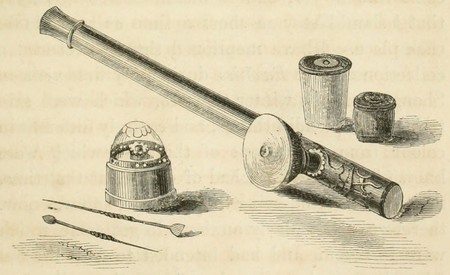
Opium Pipe.
CHAP. XIII.
SHANGHAE IN 1844.—ITS GARDENS AND PLANTS.—START FOR THE HILLS IN THE INTERIOR.—CANALS AND BRIDGES.—ADVENTURE WITH MY PONY.—THE "TEIN-CHING," OR BLUE DYE, FOUND.—HILLS AND THEIR VEGETATION DESCRIBED.—THE SURPRISE OF THE NATIVES ON SEEING A FOREIGNER.—THEIR CURIOSITY AND HONESTY!—PLANTS SENT TO ENGLAND.—ANOTHER JOURNEY INTO THE INTERIOR.—SOME LARGE NORTHERN CITIES NOTICED.—A MIDNIGHT VISIT FROM THIEVES.—THE FAR-FAMED CITY OF SOO-CHOW-FOO VISITED.—A DESCRIPTION OF IT.—NEW PLANTS FOUND.—CENTRAL POSITION OF SOO-CHOW AS A PLACE OF TRADE.—BATHS FOR THE MILLION.—RETURN TO SHANGHAE.
I again visited Shanghae on the 18th of April, 1844, and spent two or three weeks there at different times. My principal object was to see all the plants in the different northern districts as they came into flower, and it was therefore necessary that I should stay as short a time as possible in each place. I have mentioned that I purchased a collection of Tree Pæonies during my first visit to Shanghae in the winter of 1843, which were said to be very splendid things, and entirely different in colour from any plants of the kind which were known in England. I had of course, at that time, no opportunity of seeing their flowers, and was now, therefore, particularly anxious to get some which were in bloom, and had intended to send my old friend back again to Soo-chow for another collection, stipulating, however, that the plants should this time have blooms upon them. One morning, however, as I was going out into the country, a short distance from Shanghae, I was surprised at meeting a garden labourer with a load of Moutans all in full flower, which he was taking towards the city for sale. The flowers were very large and fine, and the colours were dark purples, lilacs, and deep reds, kinds of which the very existence had been always doubted in England, and which are never seen even at Canton. Two English gentlemen who were excellent Chinese scholars, being with me at the time, we soon found out the name of the Moutan district; and from the state of the roots in the man's basket, I was quite certain that the plants had not been more than an hour or two out of the ground, and that consequently the place where they were grown could not be more than six or eight miles from Shanghae, a surmise which I afterwards found to be perfectly correct. This was doubtless the place where my nursery friend had procured his plants in the previous autumn, and where he would have gone again had I not been lucky enough to find that I could easily go there myself. Indeed, I afterwards discovered that there was no Moutan country in the vicinity of Soo-chow, having met a man from that place in the Shanghae district, where he had come for the express purpose of buying Tree Pæonies. I now went into the Moutan district daily during the time the different plants were coming into bloom, and secured some most striking and beautiful kinds for the Horticultural Society.
Several very distinct and beautiful Azaleas were added to my collections at Shanghae, as well as many other plants of an ornamental character which have not yet been described. I fully expect that many of these will prove hardy enough to thrive in the open air in England, and that others will make excellent plants for the greenhouse.
Being now well acquainted with the country in the immediate vicinity of Shanghae, I was anxious to extend my researches into the interior, particularly as far as some hills which were said to be about thirty miles distant, in a westerly direction. It was extremely difficult to gain any information on this subject from the Chinese, who were particularly jealous of foreigners going any distance inland. Their suspicious feelings had also been much increased at this time, by the indiscretion of some of our own countrymen, who had hired a boat and gone a considerable distance up one of the rivers, taking soundings with bamboo poles, in the manner of the Chinese. The authorities suspected that they had some particular object in view in ascertaining the depth of the river, and immediately complained to Captain Balfour, the English consul, who was consequently obliged to notice the circumstance.
Being determined, however, to make an effort to accomplish the object I had in view, I procured a pony and a pocket compass, and started off one morning early on a voyage of discovery. The hills were said to lie westerly, and in that direction I rode for eight or ten miles without seeing anything higher than a mound of earth. The compass was my only guide both in going and also in finding my way back again; the roads were generally not more than four or six feet wide, but still the country had its highways and byways, and for a length of time I was fortunate enough to keep on the former; as long as I did so, I got easily over the numerous canals which intersect the country in all directions, because wherever these are crossed by the main road, good substantial stone bridges are erected. At last I got a glimpse of the hills in the distance, and in my anxiety to take the shortest road, I lost sight of the highway, and got entangled amongst byways and canals. I was soon in a somewhat critical position, the bridges which I was constantly crossing were old, narrow, and rotten, and the feet of my pony were every now and then getting entangled between the planks. At length we came to one much worse than the others, and although I got off and did every thing to persuade the pony to follow me over it, with great reluctance he attempted to do so, but when about the centre of the bridge, his feet got fast in the rotten planking, and in the struggle to free himself, the centre gave way; I had just time to spring to the bank, when the bridge and pony both fell into the canal. Luckily for me the poor animal swam to the side I was on, and allowed me to catch him when he got out of the water: he was completely covered with mud, and my saddle and bridle were of course in a sad condition. By the assistance of some labourers who were at work within a short distance, I was soon enabled to get out of this network of canals, and regain the main road; but this was a lesson to me, and as long as I was in China, I never afterwards went off the main road when I was on horseback.
I reached a small town in the vicinity of the hills about two o'clock in the afternoon; the pony having had nothing to eat since we left Shanghae, was much exhausted, and I was therefore anxious to procure a feed of corn for him at some of the shops. The news of the presence of a foreigner in the town spread like lightning, and I was soon surrounded and followed by some thousands of people of both sexes, young and old, who were all anxious to get a glimpse of my features and dress. Their behaviour on the whole, however, was civil and respectful, and the only inconvenience I had to complain of was the pressure of the crowd. For a few of the copper coin of the country, a boy had promised to take me to a shop where I could purchase something for the pony, and we wended our way through the crowd, which was every moment becoming more dense, towards, as I supposed, a corn or hay shop. At last, to my surprise, he came to a halt in front of an eating house, and my guide came and asked me for money to go in and buy some boiled rice. "But I want a feed for the pony," said I. "Very well, give me the money, and I will fetch you a basin of boiled rice for him." "You had better bring him a pair of chopsticks also," said I, as I put the money into his hand. The idea of a pony eating with chopsticks delighted the crowd, and put them into high good humour: during my travels in the interior, I often found the benefit of having a joke with the natives.
My pony seemed to enjoy the meal which was set before him, and I too had some rice from the same pot. I then proceeded on foot to examine the nearest hill, and soon came to the conclusion that it would be advantageous for me to be some days in the vicinity of this place. As I could not trust the natives with the pony, which belonged to the head mandarin in Shanghae, I determined to take him home again myself, and hire a boat with which I could return by any of the numerous canals which branch all over the country, and stay as long as I pleased. I reached Shanghae late on the same evening, weary enough, having ridden at least sixty miles during the day.
A few days after this, having engaged a boat, I started early one morning, and taking advantage of the tide, which ebbs and flows over all this part of the country, I reached the hills on the same evening. The country through which I passed was rich and fertile, cotton forming the staple production of the fields in the neighbourhood of Shanghae. After passing the cotton district, I came into a tract of country in which a cruciferous plant seemed to be principally cultivated. From this plant a kind of indigo or blue dye is prepared; it is called Tein-ching by the Chinese. Very large quantities of this substance are brought to Shanghae, and all the other towns in the north of China, where it is used in dyeing the blue cotton cloth, which forms the principal article of dress of the poorer classes. I brought home living specimens of the plant which produces this dye, and as these are now in flower in the gardens of the Horticultural Society, the proper scientific name of the plant will soon be ascertained.[1]
As I approached the hills the level of the country became lower, and at that time of the year (June) it was completely flooded, and rice was extensively cultivated. In general, the higher land of this vast plain is used in the cultivation of cotton and the cruciferous plant mentioned above; while the lower lands, those which are easily flooded, are converted into rice fields. Here and there on my way I met with large trees of the Salisburia adiantifolia, which are the largest and most striking trees in this part of the country. Small patches of bamboo were seen around all the villages, and groups of cypress and pine generally marked the last resting places of the Chinese, which are scattered over all the country.
The hills were very different from any which I had seen in the more southern parts of China: they are not more than 400 feet in height, and have none of that bold and rugged character which I have formerly noticed. Here and there crumbling rocks show themselves above the surface, but these are not so general as to affect the general pastoral-looking appearance of these hills. The country is also more richly wooded than any other part near Shanghae, and, of course, contains a greater number of species of plants. One curious fact, however, came under my notice: no Azaleas were met with in this part of the country, although the hills about sixty or eighty miles to the south abound in such plants; and, although the other plants, which accompany Azaleas on the Chusan and Ning-po hills, were here growing in all their native luxuriance, these, their more lovely companions, were not to be found. I can scarcely believe that the hills between Ning-po and Shanghae are the most northern limit for this class of plants; yet such from my own observations would appear to be the case.
The natives in this part of the country were vastly surprised when they saw me for the first time; at the different villages and towns, men, women, and children of all ranks lined the banks of the canals as my boat passed along, and often requested me to come out in order that they might have a better opportunity of seeing me. "When I left my boat for the purpose of ascending the hills, my boatmen used to make a good deal of money by allowing the people to go in and inspect my little cabin. A copy of the "Pictorial Times," which I happened to have with me, was greatly admired, and I was obliged to leave it amongst them. It is a remarkable fact, however, that nothing, as far as I know, was ever stolen from me at this time, although several hundred persons visited my boat in my absence. The boatmen must either have been very sharp, or the people must have had a superstitious dread of the property of a foreigner: to put it down to their honour is, I am afraid, out of the question!
Having finished my researches amongst the hills, I left this part of the country and returned to Shanghae. The "Helen Stuart," one of the first vessels which left Shanghae for England direct, was at this time ready for sea, and I availed myself of this opportunity to send some cases of plants to the Horticultural Society, which, I regret to say, arrived in very bad condition. When I had despatched these cases, I determined on another journey into the interior.
Every one who has been in China, or who is at all acquainted with Chinese history, has heard of the city of Soo-chow-foo. If a stranger enters a shop in Hong-Kong, in Canton, or in any of the other towns in the south, he is sure to be told, when he inquires the price of any curiosity out of the common way, that it has been brought from this celebrated place; let him order any thing superb, and it must be sent for from Soo-chow—fine pictures, fine carved work, fine silks, and fine ladies, all come from Soo-chow.—It is the Chinaman's earthly paradise, and it would be hard indeed to convince him that it had its equal in any town on earth. In addition to its other attractions, I was informed by the Chinese nursery gardeners at Shanghae that it contained a great number of excellent flower gardens and nurseries, from which they obtained all or nearly all the plants which they had for sale, and I was, therefore, strongly tempted to infringe the absurd laws of the Celestial Empire, and try to reach this far-famed place. My greatest difficulty was to meet with boatmen who would travel with me, as they were all frightened for the mandarins, who had issued very stringent orders to them after the circumstance happened which I have already noticed. They were told, that they might take foreigners down the river towards the sea, and up as far as a pagoda a mile or two above Shanghae, but on no account were they to go up the western branch of the river. This was a direct infringement on the right which had been secured to us by the treaty of Nanking, and her Majesty's consul at this port soon found it necessary and prudent to interfere in the matter. Some time after this period, when what are called the boundaries were fixed, the foreign residents were allowed to go a day's journey into the interior, that is, as far as they could go and come back again in twenty-four hours.