Chapter I · (continued 2)
Reading edition
The oil plant, Brassica chinensis, is in seed and ready to be taken from the ground in the beginning of May. This plant is extensively grown in this part of China, both in the province of Chekiang and also in Kiangsoo, and there is a great demand for the oil which is pressed from its seeds. For the information of readers not acquainted with botany, I may state that this plant is a species of cabbage, producing flower stems three or four feet high, with yellow flowers, and long pods of seed like all the cabbage tribe. In April, when the fields are in bloom, the whole country seems tinged with gold, and the fragrance which fills the air, particularly after an April shower, is delightful.
The small ox-plough, and the celebrated water-wheel which is here worked by hand, are the two principal implements in husbandry; the plough seems a rude thing, but it answers the purpose remarkably well, and is probably better for the Chinese in their present state, with their oxen and buffaloes, than our more improved implement. An immense quantity of water is raised with great ease by the water-wheel, and is made to flow into the different rice flats with great rapidity. I have often stood for a considerable time looking on and admiring the simplicity and utility of this contrivance.
The flora of Chusan, and all over the main land in this part of the province of Chekiang, is very different from that of the south. Almost all the species of a tropical character have entirely disappeared, and in their places we find others related to those found in temperate climates in other parts of the world. I here met, for the first time, the beautiful Glycine sinensis wild on the hills, where it climbs among the hedges and on trees, and its flowering branches hang in graceful festoons by the sides of the narrow roads which lead over the mountains. The Ficus nitida, so common around all the houses and temples in the south, is here unknown; and many of those beautiful flowering genera which are only found on the tops of the mountains in the south, have here chosen less exalted situations. I allude more particularly to the Azaleas which abound on the hill-sides of this island. Most people have seen and admired the beautiful azaleas which are brought to the Chiswick fêtes, and which, as individual specimens, surpass in most instances those which grow and bloom on their native hills: but few can form any idea of the gorgeous and striking beauty of these azalea-clad mountains, where, on every side, as far as our vision extends, the eye rests on masses of flowers of dazzling brightness and surpassing beauty. Nor is it the azalea alone which claims our admiration; clematises, wild roses, honeysuckles, the Glycine, noticed above, and a hundred others, mingle their flowers with them, and make us confess that China is indeed the "central flowery land." There are several species of myrtaceous and ericaceous plants, which are also common on the hills, but no species of heath has ever been found, and I believe the genus does not exist in this part of the country.
The tallow tree (Stillingia sebifera) is abundant in the valleys of Chusan, and large quantities of tallow and oil are yearly extracted from its seeds: tallow mills are erected in several parts of the island for this purpose. The Laurus Camphora, or camphor tree, is also abundant, but no camphor is extracted or exported from the island. The green tea shrub (Thea viridis) is cultivated every where; but, if we except a small quantity which is annually sent over to the main land—to Ningpo and the adjacent towns,—the whole is used by the inhabitants themselves. Every small farmer and cottager has a few plants on his premises, which he rears with considerable care, but seems to have no wish to enter on its cultivation on a larger scale. Indeed it is questionable if it would answer, as the soil is scarcely rich enough; and, although the shrub grows pretty well, it is far from being so luxuriant as it is in the larger tea districts on the main land. The forests of different varieties of bamboo are very striking, and give a kind of tropical character to the Chusan scenery. I do not know any thing more beautiful than the yellow bamboo with its clean and straight stem, and graceful top and branches waving in the breeze: it always reminded me of our young larch forests at home. The fir tree, found in the south, is also common in this part of China: it seems to be an exception to a general rule, being met with all over the country, and in every degree of latitude. Here the Cunninghamia sinensis, another of the pine tribe, is also found in abundance: it is more rare in the south. Besides these there are several species of cypress and juniper, which are always found growing around the tombs of the wealthy, which are scattered over the valley and hill-sides.
In fruits Chusan is meagre indeed. All the peaches, grapes, pears, plums, oranges, &c., which are brought to the markets of Tinghae in the summer season, are from the main land. There are, however, two fruits cultivated on the island, which are of considerable excellence; the one is called Yang-mai: it is a scarlet fruit, not unlike an arbutus or strawberry, but having a stone like a plum in the centre; the other is the Kum-quat, a small species of Citrus, about the size of an oval gooseberry, with a sweet rind and sharp acid pulp. This fruit is well known in a preserved state by those who have any intercourse with Canton, and a small quantity is generally sent home as presents every year. Preserved in sugar, according to the Chinese method, it is excellent. Groves of the kum-quat are common on all the hill-sides of Chusan. The bush grows from three to six feet high, and, when covered with its orange-coloured fruit, is a very pretty object.
The islands of the Chusan Archipelago having every variety of elevation and soil, and a large proportion of the hills and ravines being in a state of nature[1], I found them not only rich in plants, but had also the satisfaction of meeting with several novelties of great interest.
The natives of Chusan are a quiet and inoffensive race, and were always civil and obliging to me. Like the vegetation of their hills, they are very different from their countrymen of the south, and the change, I am happy to say, is for the better and not for the worse. Doubtless there are thieves and bad characters amongst them; but these are comparatively few, and are kept in better check by the government, the result of which is, that unprotected property is in a great measure safe, and cases of theft are almost unknown. The people may be divided into three classes:—the countrymen or agricultural farmers and labourers, the shopkeepers in the towns, and the mandarins or officers of government. The trade of Tinghae and the other towns seems to consist chiefly in articles of food and clothing, and owing to the number of British soldiers who were there from the time of our taking possession of the island until it was again handed over to the Chinese, this trade was of course in a flourishing condition. Fruits and vegetables were brought in great quantities from the main land, fish were plentiful; good sheep were sold at about three dollars each, and the Chinese even got so far over their religious prejudices as to keep the market well supplied with bullocks, which were sold at prices varying from eight to twelve dollars. It was astonishing how quickly they got accustomed to our habits, and were able to supply all our wants. Bread baked in the English mode was soon exposed for sale in the shops[2], and even ready-made clothes were to be had in any quantity. The tailors flocked from all quarters: a large proportion of the shops near the beach were occupied by them, and they doubtless reaped a rich harvest, although they made and sold every article of dress on the most reasonable terms. Then there were curiosity shops without number, containing josses or gods carved in bamboo or stone, incense burners, old bronzes, animals of strange forms which only exist in the brains of the Chinese, and countless specimens of porcelain and pictures. Silk shops, too, were not wanting, and here were to be had beautiful pieces of manufactured silk, much cheaper and better than could be purchased in Canton. The embroidery in these shops was of the most elaborate and beautiful description, which must be seen before it can be appreciated; this the Chinese were making into articles, such as scarfs and aprons, for English ladies.
The shopkeepers in Tinghae supposed an English name indispensable to the respectability of their shops and the success of their trade, and it was quite amusing to walk up the streets and read the different names which they had adopted under the advice and instruction of the soldiers and sailors to whom they had applied on the subject. There were "Stultz, tailor, from London;" "Buckmaster, tailor to the army and navy;" "Dominic Dobbs, the grocer;" "Squire Sam, porcelain merchant;" and the number of tradesmen "to Her Majesty" was very great, among whom one was "Tailor to Her Most Gracious Majesty Queen Victoria and His Royal Highness Prince Albert, by appointment," and below the name was a single word, which I could not make out for some few seconds,—Uniformsofalldescriptions. Certificates from their customers were also in great request, and many of these were most laughable performances. The poor Chinese were never quite at their ease about these certificates, as they were so often hoaxed by the donors, and consequently were continually showing them to other customers and asking "what thing that paper talkie; can do, eh?" The answer was probably in this strain—"Oh, yes, Fokei, this can do, only a little alteration, more better." Poor Fokei runs and brings a pen, the little alteration is made, and it is needless to add that the thing is ten times more ridiculous than it was before.
Almost all the natives who come in contact with the English understand a little of the language; and as they have also a smattering of Portuguese, Malay, and Bengalese, they soon mix them up all together, and draw out of the whole a new tongue, which the most accomplished linguist would have very great difficulty in analysing. And, what is most amusing, they fancy all the time that this is capital English.
The way in which the Chinese classed the foreigners on the island was somewhat droll. There were three degrees of rank which they generally bestowed upon them,—Mandarins, or, as they pronounced it, Mandalees, Sien-sangs, and A-says. In the first class they included all persons of rank holding government situations, as well as the officers of the army and navy; the higher being styled "Bulla Bulla Mandalees," and the lower "Chotta Chotta Mandalees," corruptions of Hindostan words, signifying very large and very small. The merchants were honoured with the title of "Sien-sang" and the common soldiers, sailors, and the rest of the lower orders, were all classed under the head of A-says. The word Mandarin is not Chinese, but has always been used by the Portuguese at Macao, as well as by the English, to denote a Chinese government officer; Sien-sang is a Chinese term, and signifies master or teacher, being generally used by the people as a title of respect, in the same way as we commonly use our word Sir; but A-say is quite a new appellation. "I say," or "Ay say," is a very common expression amongst our soldiers and sailors; and when the northern towns were taken by us during the war, the Chinese continually heard our men shouting it out to each other, and naturally concluded that this was the name of the class to which the lower orders belonged. It was quite common to hear them asking each other whether such a one was a Mandarin, a Sien-sang, or an A-say.
Cutaneous diseases are less common amongst the natives here than amongst those in the south of China, probably owing to the more healthy nature of the climate. They are, however, dreadfully affected with diseases of the eye and ultimate blindness. This is, doubtless, caused in a great measure by the operations of the native barber, who, whenever he shaves the heads of his customers, also tickles their eyes and probes their ears, and the result is that they become both blind and deaf. The lashes of the eye, probably also from this cause, frequently grow inwards, and the hairs rubbing on the eyeball soon causes inflammation. Many of the poor natives were cured by my friend Dr. Maxwell, who, in the kindest and most philanthropic manner, set apart a portion of every day for the purpose. They flocked to him from all parts of the island, submitting cheerfully and without a murmur to operations of a most painful nature. Many most remarkable cures resulted from his skill, and his fame spread not only all over the island, but also to the main land—to Chinhae and Ningpo,—from whence numbers came and begged to be admitted on his lists of patients. One day, when I was out with the Doctor on a botanising expedition, as we were passing a small cottage at the foot of the hills a man and his wife rushed out, and begged us to enter their humble dwelling. We did so, chairs were set for us, tea was brought, and the worthy pair thanked the Doctor in the most feeling and grateful manner for his former kindness to them. The man had been nearly blind, and unable to work for his family, when, hearing of the wonderful English doctor, he came over to Chusan, and soon received his sight.
Many of the inhabitants of Chusan and the neighbouring islands gain their living by making salt on the shores. Large heaps of clay are scraped together in winter on the flats close by the sea; and when the weather becomes warm in summer, these heaps are spread out, and regularly watered with sea water several times a day, which quickly evaporates and leaves a highly saline mixture. When by this means the soil is completely saturated, the next operation is to make a filter. This the natives do by forming a round basin of clay and mud; in the bottom of this they put a quantity of straw or grass, and some charcoal or ashes on the top; they then surround the whole with another layer of mud, and place a quantity of the saline earth in the centre. Water is then regularly poured over this earth, and the particles of salt are carried down through the filter in a liquid state. A pipe made of bamboo, which had been placed below, leads the liquid into a well dug at the side, into which it comes clear, pure, and highly saline. This mixture is now carried off to pans, where it is boiled, until the whole of the water is evaporated. I cannot say whether the Chinese have any means of purifying the salt. In Chimoo Bay, the natives evaporate sea water with the aid of the sun alone, and do not saturate the soil as they do in Chusan; but there the sea water is perfectly clear. Amongst the Chusan group of islands the water is yellow and muddy, being rendered so by the large rivers which are pouring in their waters from the main land, and more particularly by the Yang-tse-kiang.
For the following account of the Chinese method of extracting the tallow from the seeds of the Stillingia sebifera I am indebted to Dr. Rawes, of the Madras army, who was some time resident in the island of Chusan:—
"The seeds are picked at the commencement of the cold weather, in November and December, when all the leaves have fallen from the trees,—this I saw at Singkong when out shooting in the Sah-hoo valley, close by our quarters through the village. The seeds are in the first place taken to the building where the process of making the tallow is carried on, and picked and separated from the stalks. They are then put into a wooden cylinder, open at the top, but with a perforated bottom. This is placed over an iron vessel (about the same diameter or rather larger than the wooden cylinder, and about six or eight inches deep) containing water, by which means the seeds are well steamed, for the purpose of softening the tallow and causing it more readily to separate. The furnace I saw had four or five iron vessels in a row, was about three feet high, four or five feet broad, and eight or ten feet long. The fire was placed at one end and fed with the husk of the rice, dry grass, and such like cheap materials which make a great flame, and the flue was of course carried directly under the whole of the iron vessels.
"When the seeds have steamed ten minutes or a quarter of an hour, they are thrown into a large stone mortar, and are gently beaten by two men with stone mallets for the purpose of detaching the tallow from the other parts of the seed. They are then thrown upon a sieve, heated over the fire, and sifted, by which process the tallow is separated, or nearly so, although they generally undergo the process of steaming &c. a second time that nothing may be lost. The other part of the seed is ground and pressed for oil.
"The tallow now resembles coarse linseed meal, but with more white spots in it, and derives its brown colour from the thin covering over the seed (between it and the tallow) which is separated by the pounding and sifting. In this state it is put between circles of twisted straw, five or six of which are laid upon each other, and thus forming a hollow cylinder for its reception. When this straw cylinder (we may call it so) has been filled, it is carried away and placed in the press, which is a very rude and simple contrivance, but which, like every thing Chinese, answers the purpose remarkably well. The press consists of longitudinal beams of considerable thickness, placed about a foot and a half, or two feet, asunder, with a thick plank at the bottom, forming a kind of trough, and the whole is bound together with iron. The tallow is pressed out by means of wedges driven in very tightly with stone mallets, and passes through a hole in the bottom of the press into a tub, which is sunk there to receive it. It is now freed from all impurities, and is a semifluid of a beautiful white colour, but soon gets solid, and in cold weather is very brittle. The inside of the tubs which collect the tallow are sprinkled or dusted over, with a fine red earth, well dried, which prevents the tallow from adhering to their sides. It is thus easily removed in a solid state from the tubs, and in this condition the cakes are exposed for sale in the market. As the candles made from this vegetable tallow have a tendency to get soft and to melt in hot weather, they are commonly dipped in wax of various colours, as red, green, and yellow. Those which are intended for religious purposes are generally very large, and finely ornamented with golden characters."
"The cake, or refuse, which remains after the tallow has been pressed out of it, is used for fuel, or to manure the land, and so is the refuse from the other part of the seeds from which oil is extracted."
One of the greatest Lions in Chusan is an old Chinaman, who every spring hatches thousands of ducks' eggs by artificial heat. His establishment is situated in the valley on the north side of the city of Tinghae, and is much resorted to by the officers of the troops and strangers who visit the island. The first question put to a sight-seer who comes here is, whether he has seen the hatching process, and if he has not, he is always recommended to pay a visit to the old Chinaman and his ducks.
When I set out upon this excursion for the first time, it was a beautiful morning in the end of May, just such a morning as we have in the same month in England, but perhaps a little warmer. The mist and vapour were rolling lazily along the sides of the hills which surround the plain on which the city of Tinghae is built; the Chinese, who are generally early risers, were already proceeding to their daily labours, and although the greater part of the labouring population are very poor, yet they seem contented and happy. Walking through the city, and out at the north gate, I passed through some rice fields, the first crop of which had been just planted, and a five minutes' walk brought me to the poor man's cottage. He received me with Chinese politeness; asked me to sit down, and offered me tea and his pipe, two things always at hand in a Chinese house, and perfectly indispensable. Having civilly declined his offer, I asked permission to examine his hatching house, to which he immediately led the way.
The Chinese cottages generally are wretched buildings of mud and stone, with damp earthen floors, scarcely fit for cattle to sleep in, and remind one of what Scottish cottages were a few years ago, but which now, happily, are among the things that were. My new friend's cottage was no exception to the general rule: bad fitting, loose, creaking doors, paper windows, dirty and torn; ducks, geese, fowls, dogs, and pigs in the house and at the doors, and apparently having equal rights with their masters. Then there were children, grand-children, and, for aught that I know, great-grand-children, all together, forming a most motley group, which, with their shaved heads, long tails, and strange costume, would have made a capital subject for the pencil of Cruikshank.
The hatching-house was built at the side of the cottage, and was a kind of long shed, with mud walls, and thickly-thatched with straw. Along the ends and down one side of the building are a number of round straw baskets, well plastered with mud, to prevent them from taking fire. In the bottom of each basket there is a tile placed, or rather the tile forms the bottom of the basket; upon this the fire acts,—a small fire-place being below each basket. Upon the top of the basket there is a straw cover, which fits closely, and which is kept shut whilst the process is going on. In the centre of the shed are a number of large shelves placed one above another, upon which the eggs are laid at a certain stage of the process.
When the eggs are brought, they are put into the baskets, the fire is lighted below them, and an uniform heat kept up, ranging, as nearly as I could ascertain by some observations which I made with a thermometer, from 95° to 102°, but the Chinamen regulate the heat by their own feelings, and therefore it will of course vary considerably. In four or five days after the eggs have been subject to this temperature, they are taken carefully out, one by one, to a door, in which a number of holes have been bored nearly the size of the eggs; they are then held against these holes, and the Chinamen look through them, and are able to tell whether they are good or not. If good, they are taken back, and replaced in their former quarters; if bad, they are of course excluded. In nine or ten days after this, that is, about fourteen days from the commencement, the eggs are taken from the baskets, and spread out on the shelves. Here no fire-heat is applied, but they are covered over with cotton, and a kind of blanket, under which they remain about fourteen days more, when the young ducks burst their shells, and the shed teems with life. These shelves are large, and capable of holding many thousands of eggs; and when the hatching takes place, the sight is not a little curious. The natives who rear the young ducks in the surrounding country know exactly the day when they will be ready for removal, and in two days after the shell is burst, the whole of the little creatures are sold, and conveyed to their new quarters.
CHAP. VI.
FIRST VISIT TO NING-PO.—THE BRIDGE OF BOATS.—CITY AND PAGODA.—MEDICAL MISSIONARY.—TEMPERATURE.—CHINESE MODE OF KEEPING THEMSELVES WARM.—CHARCOAL STOVES.—MY LODGINGS.—CHINESE GAMBLERS.—DESCRIPTION OF SHOPS.—SILKS AND EMBROIDERY.—JADE STONE.—COTTON PRINTING.—ROPE MAKING.—CURIOSITY SHOPS AND CONTENTS.—"FURNITURE STREET" AND FURNITURE.—BANKING ESTABLISHMENT.—NO PROSPECT OF FOREIGN TRADE.—TEMPLES, AND DEVOTION OF SOME OF THE PEOPLE.—DWARFED TREES.—MODE OF DWARFING EXPLAINED.—MANDARINS' GARDENS VISITED AND DESCRIBED.—VIEW FROM NORTHERN HILLS.—AGRICULTURE.—NATIVE FLORA OF THESE HILLS.—GRAVES OF THE DEAD.—COFFINS EXPOSED.
I visited Ning-po for the first time in the autumn of 1843. It is a large town, situated on the main land, nearly west from the Chusan group of islands, on the east coast of China. It stands about twelve miles from the sea, at the junction of two fine streams, which by their union form a noble river capable of being navigated by the larger vessels and junks. One of these branches runs from the west, and the other from the south, meeting at Ning-po; and over the latter the Chinese have constructed a bridge of boats for the traffic with the suburbs on the opposite shore. This bridge is a most simple and ingenious contrivance, consisting of a number of large boats moored at equal distances across the river, forming the basis on which the upper woodwork rests, and enabling the whole to rise and fall to a certain extent with the tide. By this means there is sufficient room under the bridge to allow fishing and passage boats to pass through at all times of the tide, providing it is not running too strong. At spring tides the water rushes through these spaces between the boats with great velocity, and sometimes it is next to impossible to get through.
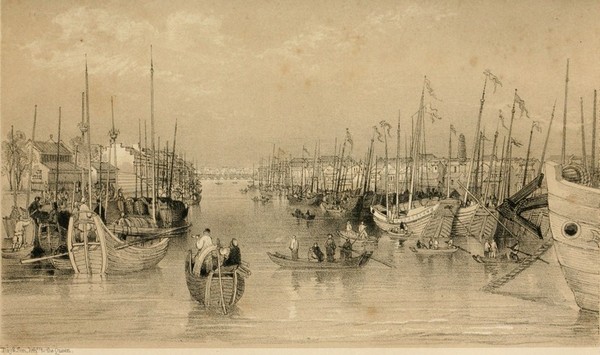
CITY OF NINGPO—BRIDGE OF BOATS. London, John Murray, Albemarle Street.
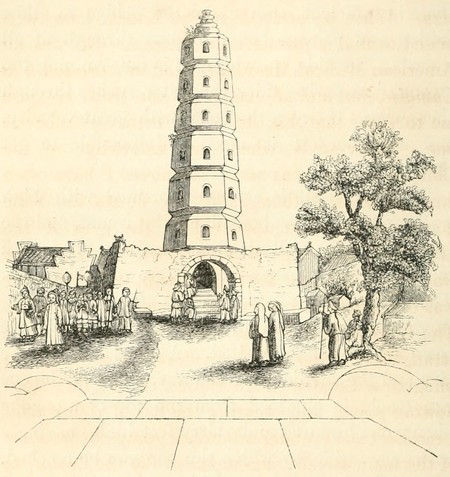
The city itself is strongly fortified with high walls and ramparts about five miles round, and the space inside the walls is almost entirely filled with houses, in most parts densely crowded together. There are two or three very fine streets; finer, indeed, and wider than those of any other Chinese town which I have visited. A good view of the city and the surrounding country, as far as the eye can reach, is obtained from the top of a pagoda about one hundred and thirty feet high, having a stair-case inside by which the top can be reached. (See following page.) This pagoda is named "Tien-foong-tah" or the "Temple of the Heavenly Winds;" it is evidently very old, and, like many others of the same kind, is in a state of decay. Whenever I visited this place, the Priests (Budhists) were always in attendance with their offerings of cake and tea, for which a small gratuity was expected.
When I first landed at Ning-po, the British consul, Mr. Thom, had not arrived, and I was quite at a loss where to go, or to whom to apply for quarters. Leaving my boat and servant on the river, I strolled away into the city to reconnoitre, thinking that something might turn up which I could use for my advantage. I was soon surrounded by crowds of the natives, and amongst them some blackguard boys who had been corrupted to a great extent by the troops during the war, but who luckily understood a little of the English language, and were able to be of essential service to me. They informed me that there was one "Hong-mou-jin"—(red-haired man)—a term which they apply to all western nations—already in the city, and immediately led the way to his quarters. When we arrived at the house, I was surprised to find a former acquaintance. He was an American Medical Missionary, and was dressed à la Chinoise, tail and all complete, but truth compels me to state that his dress was rather a ludicrous one. Afterwards when my knowledge of the Chinese costume was more complete, I have often laughed when I thought of the figure the little doctor must have appeared in the eyes of the Chinese. The large flowing gown which he wore was almost too fine for a mandarin, while the hat was one commonly worn by servants and coolies. The English reader, if he wishes to understand the strange sort of appearance the doctor presented, must imagine a London judge clothed in his fine black flowing gown, and wearing the hat of a dustman. I recollect one evening after dark going out into one of the main streets, accompanied by the doctor, to see an offering which was there presented to the Gods, and I soon found that he in his Chinese dress was a greater object of attention than I was in my English one. How the Chinese laughed and enjoyed the joke! I had obtained a room in the same house with my friend, who was visited daily by great numbers of the Chinese, and who, although not a very good Chinaman, was most zealous in the cause of medical missions.
As the winter approached the weather became extremely cold, and in December and January the ice on the ponds and canals was of considerable thickness. The most attractive shops in the city now, were the different clothing establishments, where all articles of wearing apparel were lined with skins of various kinds, many of them of the most costly description. The very poorest Chinese has always a warm jacket or cloak lined with sheep skin, or padded with cotton, for the winter; and they cannot imagine how the Europeans can exist with the thin clothing they generally go about in. When the weather was cold, I used always to wear a stout warm great coat above my other dress, and yet the Chinese were continually feeling the thickness of my clothes, and telling me that surely I must feel cold. Their mode of keeping themselves comfortable in winter, differs entirely from ours: they rarely or never think of using fires in their rooms for this purpose, but as the cold increases, they just put on another jacket or two, until they feel that the warmth of their bodies is not carried off faster than it is generated. As the raw damp cold of morning gives way to the genial rays of noon, the upper coats are one by one thrown off, until evening, when they are again put on. In the spring months, the upper garments are cast off by degrees, and when the summer arrives, the Chinese are found clad in thin dresses of cotton, or in the grass cloth manufactured in the country. In the northern towns the ladies sometimes use a small brass-stove, like a little oval basket, having the lid grated to allow the charcoal to burn and the heat to escape; this they place upon their tables or on the floor, for the purpose of warming the hands and feet. Nurses also carry these little stoves in their hands under the feet of the children. Such, however, is the thickness and warmth of their dresses, that it is only in the coldest weather they require them. Little children in winter are so covered up, that they look like bundles of clothes, nearly as broad as they are long, and when the padding is removed in warm weather, it is difficult to imagine that you see before you the same individuals.
I never felt so cold in England as I did during this winter in the north of China, and yet, as may be seen from the chapter on temperature, the thermometer did not indicate a very low degree. The house in which I lived was so open, that the wind rushed in at every crevice; the windows were large, not glazed, as with us, but papered, and in many places perfectly open. During the day I got on very well, as I was always out and moving about from morning until dark. But the long evenings, with the wind whistling through the windows, and blowing upon my candle, were dreary and cold enough.
To vary the monotony of the scene, as well as to warm myself, I used frequently to take a stroll down the main street. The Chinese, as a nation, are great gamblers; even the poorest of them cannot resist the temptation, and in this street after nightfall, there used to be numerous stalls of oranges, sweetmeats, and trifling curiosities, at each of which there were dice of some kind, and a "wheel of fortune," surrounded by the Chinese in great numbers, trying their luck with a few copper cash, and evincing, by their looks and language, the most intense interest in the stopping of the wheel, or the throwing of the dice.
Besides the shops already noticed for the sale of clothes and skins, there are many others worthy of our attention. There are a number of excellent silk shops and warehouses a little off the main street, which, like our old-established houses at home, have but little external show to attract notice. Here, too, are large quantities of that beautiful northern embroidery which is so much admired by all who have had an opportunity of seeing it. It is entirely different from that commonly procured at Canton, and much more elaborate and expensive. A considerable demand for articles of dress which would be fashionable in England, has induced the Chinese to get them made, and they are now exposed for sale in all the towns in the north frequented by the English. Ladies' aprons, scarfs, shawls, work-bags, and many other articles made up in the English style, and beautifully embroidered, are the things most in demand.
The Chinese estimate their celebrated jade stone very highly, and here there are numerous shops, both for cutting it and exposing it for sale, carved into all those curious and fantastic forms for which this people are so well known. The process of cotton printing in its most simple and original form may be seen in most of the streets here, as well as in other towns in China. Rope-making is carried on extensively in the suburbs near the river, and some strong cables and ropes for junks are made from the bracts of the palm, formerly noticed, and from the bark of the urticaceous plant, commonly called hemp by the English in the north of China. There are, of course, the usual quantity of curiosity shops, containing bamboo ornaments carved into all possible forms; specimens of ancient porcelain, which are said to "preserve flowers and fruit from decay for an unusual time," lacquered ware, and other ornaments brought by the junks from Japan, many beautifully carved rhinoceros' horns, bronzes, and other articles to which the Chinese attach great importance, purchasing them at exorbitant rates, apparently far beyond their value. But what struck me as being most unique, was a peculiar kind of furniture, made and sold in a street, generally called "Furniture Street" by foreigners who visit Ning-po. There were beds, chairs, tables, washing-stands, cabinets and presses, all peculiarly Chinese in their form, and beautifully inlaid with different kinds of wood and ivory, representing the people and customs of the country, and presenting, in fact, a series of pictures of China and the Chinese. Every one who saw these things admired them, and, what was rather strange, they seem peculiar to Ning-po, and are not met with at any of the other five ports, not even in Shanghae. As all this beautiful work is expensive, it is, of course, only used in the houses of the wealthy.
There are some large banking establishments in Ning-po, having connection with all the other towns in the north, and it is here, therefore, that the value of money is regulated, the "stocks" rising and falling exactly as they do in England. There can be little doubt that it is a place of great wealth. There are a large number of retired merchants in the city and suburbs, who have made their fortunes in early life, and who now seek to enjoy themselves amid the luxuries and retirement of Ning-po. But these circumstances, unfortunately, do not fit it for a place of active foreign trade; and hence, although it is large, rich, and populous, our merchants find the northern port of Shanghae of far greater importance as regards the sale of European and American manufactures, and the purchase of tea and silk,—the staple productions of the country. And yet, judging from appearances, one would think that a considerable foreign trade might be carried on at Ning-po, as it is in itself a large town, is in the midst of a populous country, and has excellent water communication with all parts of the empire. Time, and the perseverance of our merchants, will soon show whether this supposition is a correct one.
Many of the temples in this town have been much admired by foreigners, but I must confess that, to me, the very best of them had a childish and tinselly appearance, which I could not admire. The one called the Fokien Temple is best and most showy. The Confucian Temple was formerly a large and celebrated place, but it was nearly destroyed during the war, and up to the time when I left China, no attempt had been made to rebuild it, or put it in a state of repair: the Chinese seemed to consider that the touch of the barbarian had polluted the sacred edifice. The Budhists' temples are crowded with painted wooden images of their gods. The "three precious Budhas," the "past, present, and future," are generally enormously large, being often thirty or forty feet in height. To these, and to the numerous small images, the poor deluded natives bow the knee, burn incense, and engage in other exercises of devotion. The traveller meets with these temples, or joss-houses, as they are commonly called, in all the streets, at the gates of the city, and even on the ramparts, and cannot but admire the devotional spirit of the inhabitants, although he may wish that it was directed to a higher and purer object. I have often looked on, when these simple people,—the women more particularly,—seemed actually, like Jacob of old, "wrestling with God in prayer," and using various means to ascertain whether the mind of the Deity had softened towards them, and granted their requests. Two small pieces of wood, flat on one side and rounded on the other, are generally used to accomplish this end; these are thrown up in the air, and if they fall on the desired side, it was well; if not, some more incense was burned, and again and again they prostrated themselves before the altar, and seemed engaged in earnest prayer. Many of their religious ceremonies have a great resemblance to those of the Roman Catholic church, and I remember being much struck on a Sunday afternoon, when passing out at one of the city gates, by hearing the sounds of prayer and praise, not unlike those of the Christian churches of other lands. I immediately walked into the place from whence the sounds came, and found, to my disappointment, that it was one of the numerous temples with which the city abounds, and that the sounds of praise which fell upon my ears, were only addressed to the gods of the heathen. But many of these temples are in a most ruinous state, and are evidently not so well supported now as they have been at some former time. In fact, the town of Ning-po itself, with all its riches, and all its advantages, has been in a decaying state for years, and is one example, amongst many others, of the truth of what I formerly stated concerning the general state of this country.
My first business, when I reached Ning-po, was to make inquiries regarding the gardens of the Mandarins, which I had heard something of from the officers who were there when the city was taken by the English troops, during the war. I had the same difficulties to encounter as I had at Amoy, owing to the jealousy of the Chinese. Ultimately, however, these too were overcome, and I obtained access to several Mandarins' gardens and nurseries, out of which several new plants were procured, which proved very valuable additions to my collections. Here, as at other places, I made many inquiries after the supposed yellow camellia, and offered ten dollars to any Chinaman who would bring me one. Anything can be had in China for dollars! and it was not long before two plants were brought to me, one of which was said to be light yellow, and the other as deep a colour as the double yellow rose. Both had flower-buds upon them, but neither were in bloom. I felt quite certain that the Chinaman was deceiving me, and it seemed foolish to pay such a sum for plants which I should in all probability have to throw away afterwards; and yet I could not make up my mind to lose the chance, slight as it was, of possessing the yellow camellia. And the rogue did his business so well. He had a written label stuck in each pot, and apparently the writing and labels had been there for some years. I fancied I was as cunning as he was, and requested him to leave the plants and return on the following morning, when he should have an answer. In the meantime I asked a respectable Chinese merchant to read the writing upon the labels. All was correct; the writing agreed with what the man had told me; namely, that one of the plants produced light yellow blooms, and the other deep yellow. "Did you ever see a camellia with yellow flowers?" I inquired of my friend the merchant. "No," said he, in his broken English. "My never have seen he, my thinkie no have got" On the following morning the owner of the plant presented himself, and asked me if I had made up my mind upon the subject. I told him that I would take the plants to Hong-kong, where I was going at the time; that they would soon flower there; and that, if they proved yellow, he should have his money. This, however, he would not consent to; and at last we compromised the matter, I agreeing to pay half the money down, and the other half when the plants flowered, providing they were "true." On these conditions I got the camellias, and took them with me to Hong-kong. It is almost needless to say that when they flowered there was nothing yellow about them but the stamens, for they were both semi-double worthless kinds.
The gardens of the Mandarins in the city of Ning-po are very pretty and unique; they contain a choice selection of the ornamental trees and shrubs of China, and generally a considerable number of dwarf trees. Many of the latter are really curious, and afford another example of the patience and ingenuity of this people. Some of the specimens are only a few inches high, and yet seem hoary with age. Not only are they trained to represent old trees in miniature, but some are made to resemble the fashionable pagodas of the country, and others different kinds of animals, amongst which the deer seems to be the favourite. Junipers are generally chosen for the latter purpose, as they can be more readily bent into the desired form; the eyes and tongue are added afterwards, and the representation altogether is really good. One of the Mandarins of Ning-po, anxious, I suppose, to confer some mark of especial favour upon me, presented me with one of these animals,—plants, I should say;—but as it was of no real use to me, and as my collections of other things were large, I was obliged to decline his present, which he evidently considered of great value, and no doubt wondered at my want of taste.
Another example will show the passion which exists amongst the Chinese for things of this kind. When I was travelling on the hills of Hong-kong, a few days after my first arrival in China, I met with a most curious dwarf Lycopodium, which I dug up and carried down to Messrs. Dent's garden, where my other plants were at the time. "Hai-yah," said the old compradore, when he saw it, and was quite in raptures of delight. All the other coolies and servants gathered round the basket to admire this curious little plant. I had not seen them evince so much gratification since I showed them the "old man Cactus" (Cereus senilis), which I took out from England, and presented to a Chinese nurseryman at Canton. On asking them why they prized the Lycopodium so much, they replied, in Canton English, "Oh, he too muchia hemdsome; he grow only a leete and a leete every year; and suppose he be one hundred year oula, he only so high" holding up their hands an inch or two higher than the plant. This little plant is really very pretty, and often naturally takes the very form of a dwarf tree in miniature, which is doubtless the reason of its being such a favourite with the Chinese.
The dwarfed trees of the Chinese and Japanese have been noticed by every author who has written upon these countries, and all have attempted to give some description of the method by which the effect is produced. The process is in reality a very simple one, and is based upon one of the commonest principles of vegetable physiology. We all know that any thing which retards in any way the free circulation of the sap, also prevents to a certain extent the formation of wood and leaves. This may be done by grafting, by confining the roots, withholding water, bending the branches, or in a hundred other ways which all proceed upon the same principle. This principle is perfectly understood by the Chinese, and they make nature subservient to this particular whim of theirs. We are told that the first part of the process is to select the very smallest seeds from the smallest plants, which is not at all unlikely, but I cannot speak to the fact from my own observation. I have, however, often seen Chinese gardeners selecting suckers and plants for this purpose from the other plants which were growing in their garden. Stunted varieties were generally chosen, particularly if they had the side branches opposite or regular, for much depends upon this; a one-sided dwarf tree is of no value in the eyes of the Chinese. The main stem was then in most cases twisted in a zigzag form, which process checked the flow of the sap, and at the same time encouraged the production of side branches at those parts of the stem where they were most desired. When these suckers had formed roots in the open ground, or kind of nursery where they were planted, they were looked over and the best taken up for potting. The same principles, which I have already noticed, were still kept in view, the pots used being narrow and shallow, so that they held but a small quantity of soil compared with the wants of the plants, and no more water being given than what was barely sufficient to keep them alive. Whilst the branches were forming, they were tied down and twisted in various ways; the points of the leaders and strong growing ones were generally nipped out, and every means were taken to discourage the production of young shoots which were possessed of any degree of vigour. Nature generally struggles against this treatment for a while, until her powers seem in a great measure exhausted, when she quietly yields to the power of art. The Chinese gardener, however, must be ever on the watch, for should the roots of his plants get through the pots into the ground, or happen to be liberally supplied with moisture, or should the young shoots be allowed to grow in their natural position for a short time, the vigour of the plant which has so long been lost will be restored, and the fairest specimen of Chinese dwarfing destroyed. Sometimes, as in the case of peach and plum trees, which are often dwarfed, the plants are thrown into a flowering state, and then, as they flower freely year after year, they have little inclination to make vigorous growth. The plants generally used in dwarfing are pines, junipers, cypresses, bamboos, peach and plum trees, and a species of small-leaved elm.
Amongst the Mandarins' gardens, in the city of Ning-po, there is one in particular which is generally visited by all strangers, and is much admired. It is situated near the lake in the centre of the city. The old man to whom it belongs has long retired from trade with an independent fortune, and he now enjoys his declining years in the peaceful pursuits of gardening, and is passionately fond of flowers. Both his house and garden are unique in their way, but they are most difficult to describe, and must be seen to be appreciated. In this part of the country the building of artificial rockwork is so well understood, that the resemblance to nature is perfect, and it forms a principal feature in every garden. This old gentleman has the different parts of his house joined together by rude-looking caverns, and what at first sight appears to be a subterraneous passage, leading from room to room, through which the visitor passes to the garden, which lies behind the house. The small courts, of which a glimpse is caught in passing through, are fitted up with this rockwork; dwarf trees are planted here and there in various places, and creepers hang down naturally and gracefully until their ends touch the little ponds of water which are always placed in front of the rockwork. These small places being passed, we are again led through passages like those already noticed, when the garden, with its dwarf trees, vases, rockwork, ornamental windows, and beautiful flowering shrubs, is suddenly opened to the view.
It must be understood, however, that all which I have now described is very limited in extent, but the most is made of it by windings and glimpses through rockwork, and arches in the walls, as well as by hiding the boundary with a mass of shrubs and trees.
Here old Dr. Chang—I believe that was his name—was spending the evening of his days in peaceful retirement. When I called upon him he was extremely polite, and, after making a great many very low bows, requested me to take the seat of honour by his side. The servants were then ordered to bring tea, a beverage which is offered to every stranger, and which was of the very finest description. Messengers were sent round to all the old man's particular friends, who each hurried to see the foreigner. One by one they dropt in, until the room was nearly full. The servants, who seemed to think themselves quite as good as their masters, mixed with the company, and made their remarks upon me with the greatest freedom. Every thing about me was examined and criticised most minutely, particularly my watch, which they seemed to admire very much. I was frequently requested, as a great favour, to allow them to see the works, and to hold it to their ears, in order that they might hear the sound which it made. The old mandarin now led me round his house, and showed me all the curiosities which it contained, and of which he was a great collector. Old bronzes, carved woods, specimens of porcelain, and other articles of that kind, were arranged with great taste in several of the rooms. From the house we proceeded to the garden, but as it was winter, and the trees leafless, I could form but little idea of the rarity or beauty of the plants which it contained. I took my leave, after drinking some more tea, promising to visit the old man again whenever I returned to Ning-po.
I visited also at this time several other Mandarins who had gardens, and from all of them I received the greatest civility. Some small articles which I brought out with me as presents were of the greatest use, not only in procuring me a civil reception, but also in enabling me to get plants or cuttings of rare species which were only found in the gardens of the rich, and which, of course, were not for sale.
The level plain on which the city of Ning-po is built is at least thirty miles across, surrounded on all sides by a circle of hills, but opening on the east to the sea, where the town of Chinhae stands, and forms, as it were, the sea-port town of Ning-po. The view from the hills is very fine—the broad extensive plain forming, as it were, a vast amphitheatre, traversed by beautiful winding rivers and by canals in all directions; thus enabling the natives to convey the produce of their country and its merchandise to Ning-po, and from thence to Hang-chow-foo, and any other part of the world. Rice is the staple production of the low land in this part of the country during the summer months, and the oil plant is cultivated extensively on the same land in winter and spring, being in seed and ready to harvest by the time for sowing the first crop of rice. Large quantities of the trefoil which I have noticed before are also grown here, and for the same purposes; indeed, the agricultural productions, both of the low lands and on the sides of the hills, are really the same as those formerly described on the island of Chusan.
The native flora of the hills to the north of Ning-po is nearly the same as that found on Chusan and the neighbouring islands, but more extensive. It is a curious fact, that I always found the main land of China more productive in species of animals and plants than the neighbouring islands, although these islands were large, and only separated from the main land by a narrow extent of sea. I met here, for the first time in a wild state, the beautiful yellow Azalea sinensis. These hills are somewhat more barren than most of the others in this part of the country, and there are few trees on them of any size. They are very different from those which I have yet to describe, a few miles to the south of Ning-po.
The graves of the dead are scattered all over the plain, and give the stranger a good idea of the immense population of the country. In travelling from Ning-po to the hills, I could not account for the vast number of tombs which I met with on my way; but when I reached the summit of the hills, and looked down upon the wide-spreading plain, covered with towns and villages in all directions, densely peopled with human beings, it was easily accounted for. Here, as at Chusan and Shanghae, the traveller is continually coming upon coffins placed on the surface of the ground, and in many instances decaying, and exposing the skeleton remains of the dead. I was much struck by frequently meeting with large numbers of coffins piled one above another, in heaps of from thirty to forty, chiefly those of young children. I was told that they are buried periodically, but from their appearance many of them must have remained in the same place for years, and their tenants must long ago have mouldered into dust.
CHAP. VII.
REMARKS ON THE CHINESE LANGUAGE.—ICE-HOUSES NEAR NING-PO DESCRIBED.—THEIR SIMPLICITY AND UTILITY.—NOVEL MODES OF FISHING.—FISHING CORMORANTS MET WITH.—THEIR ACTIONS DESCRIBED.—TWO PAIRS PURCHASED.—ACCOUNT OF THEIR FOOD AND HABITS.
In sailing up the river towards Ning-po, I observed a great number of thatched houses, and desired my Chinese servant to go to the boatman and inquire what they were. He went immediately to the man at the helm, and, after a conversation of at least ten minutes' duration, came back hanging his head, and slunk away without reporting the result of his inquiries. "Well," said I, "what is the use of all these houses which we now see on the shore?" With all the gravity in the world, he replied that the boatman said they were places built to keep Chinese soldiers in during the cold winter months. "Nonsense," said I, "they cannot fill all these places with soldiers." "Well," said he, "he have talkie my so fashion." As I could not conceive this to be true, I went to the man myself, and with the little knowledge of the language which I then possessed, soon found out that the buildings in question were ice-houses, for which commodity, he informed me, there was a great demand daring the summer months. This shows that the Chinese language differs so much in different provinces, that a native of Canton and another in the north cannot understand each other: and indeed this is so much the case, that my Macao servant was almost entirely useless to me in the north, in so far as the language was concerned. In this instance the Chinese word "Ping"—or I should rather say sound—means both soldier and ice, and it immediately struck my servant, who I suppose had never seen ice in his life, that the buildings in question were soldiers' houses instead of ice-houses; rather cold barracks, I should think.
I was much struck with the simplicity of the construction of these ice-houses, and my only doubt about them was whether or not the ice would keep well in them throughout the hot summer months. The results of my investigation I sent in the following letter to Professor Lindley, who published it in the "Gardener's Chronicle" for 1845:—
"A short time before I left England, you published in the 'Gardener's Chronicle' a number of letters and plans for the construction of ice-houses, but, as far as I can remember, nothing at all resembling the Chinese one which I shall now describe to you. On the right bank of the Ning-po river, above the town and fort of Chinhae, and in various other parts of the north of China, I have met with these ice-houses. When I inspected them for the first time last winter (1843), their construction and situation differed so much from what I had been accustomed to see at home,—differing, too, in things which I used to consider as indispensable to an ice-house,—that I had great doubts regarding their efficiency; but at the present time, which is now the end of August, 1844, many of these houses are yet full of ice, and seem to answer the end most admirably. You are probably aware, from my former descriptions of the country, that the town of Ning-po stands in the midst of a level plain from twenty to thirty miles across. These ice-houses are built on the sides of the river in the centre of the plain, completely exposed to the sun—a sun, too, very different in its effects from what we experience in England,—clear, fierce, and burning, which would try the efficiency of our best English ice-houses as well as it does the constitution of an Englishman in China.
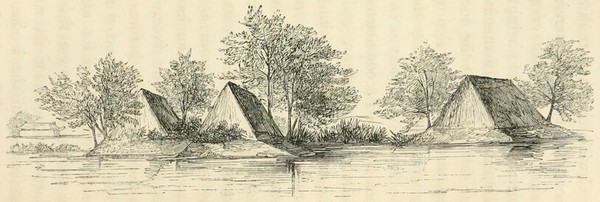
Ice-houses near Ning-Po.
"The bottom of these ice-houses is nearly on a level with the surrounding fields, and is generally about twenty yards long, by fourteen broad. The walls, which are built of mud and stone, are very thick, twelve feet in height, and are, in fact, a kind of embankment rather than walls, having a door on one side level with the floor, for the removal of the ice, and a kind of sloping terrace on the other, by which the ice can be thrown into the house. On the top of the walls or embankment a tall span roof is raised, constructed of bamboo, thickly thatched with straw, and in appearance exactly like an English haystack. And this is the simple structure which keeps ice so well during the summer months, and under the burning sun of China!
"The Chinaman, with his characteristic ingenuity, manages also to fill his ice-houses in a most simple way, and at a very trifling expense. Around the house he has a small flat level field connected with the river. This field he takes care to flood in winter before the cold weather comes on. The water then freezes and furnishes the necessary supply of ice at the very door. Again in spring these same fields are ploughed up and planted with rice, and the water which drains from the bottom of the ice-house helps to nourish the young crop. Of course here, as in England, when the house is filled the ice is carefully covered up with a thick coating of straw. Thus the Chinaman, with little expense in building his ice-house, and an economical mode of filling it, manages to secure an abundant supply for preserving his fish during the hot summer months.
"It now, I think, becomes a question whether we could not build ice-houses at less expense and more efficient, upon the Chinese plan, than upon the old under-ground system common in England. The accompanying sketch will enable you to form an idea of the appearance which these ice-houses present to the traveller, in going up the Ning-po river. Ning-po, August, 1844."
Since this letter was published I have had frequent opportunities of testing the qualities of the Chinese ice-house, both at Ning-po and also at Chusan and Shanghae, and I have found that it answers the purpose admirably. The winter of 1844–1845 was unusually mild in this part of China; little or no ice was formed on the ponds and canals, and of course the ice-houses could not be filled; but many of them contained large quantities which had been laid up the year before, and by this means the market was supplied with ice which had been in store at least a year and a half, and would probably have kept some time longer.
This ice is of great importance to the Chinese, who depend so much for their food upon the fish which is caught in their waters. They are enabled by this means to keep their fish during the hottest weather for a considerable time, and transmit them in this way to different parts of the country.
Immense quantities of fish are daily caught in the river above the town. Their mode of catching them is ingenious and amusing. One day I was going up a considerable distance in a boat, and set out a little before low water, that I might have the full benefit of the flow of the tide, and get as far up as possible before it turned. On the side of the river, a few miles above Ning-po, I observed some hundreds of small boats anchored, each containing two or three men; and the tide turning just as I passed, the whole fleet was instantly in motion, rowing and sculling up the river with the greatest rapidity. As soon as the men reached a favourable part of the stream they cast out their nets and began to make a loud noise, splashing with their oars and sculls, with the intention, I suppose, of driving the fish into the nets. After remaining in this spot for about a quarter of an hour, all the boats set off again, farther up, for the next station, when the crew commenced again in the same noisy manner, and so on, for a long way up the river, as long as the tide was flowing; they then returned with the ebb, loaded with fishes for the next morning's market.
There is another mode of catching fish, which I have frequently seen in the northern provinces, even more curious than that which I have just noticed. Every one acquainted with Chinese history knows that fish abound in all the rivers and lakes of the north; indeed, every little pond swarms with them. I was greatly surprised when I first saw the fish-catcher following his profession in these places. He is literally amphibious. He is to be seen perfectly naked, half walking, half swimming; now he raises his arms and hands above his head, and, bringing them down, strikes a sharp blow upon the water, making a loud and splashing noise. His feet are not idle: they warn him that a fish is at hand, and they are now feeling for him amongst the mud at the bottom of the pond. The next moment the fisherman has disappeared: he is now under water, and he remains so long that you think something has happened to him. There is, however, no cause of fear; a few seconds more and he appears, rubbing his face and eyes with one hand, and in the other triumphantly holding up the poor little fish which he has just captured. It is immediately placed safely in his basket, and the work goes on as before. The surface of the water is struck and splashed, as I have just described, in order to frighten the fish which are swimming amongst the feet of the Chinamen. Being frightened, they dive immediately to the bottom amongst the mud, where they are felt by the feet, and are soon taken by these expert divers.
But the most singular of all the methods of catching fish in China is that of training and employing a large species of cormorant for this purpose, generally called the fishing cormorant. These are certainly wonderful birds. I have frequently met with them on the canals and lakes in the interior, and, had I not seen with my own eyes their extraordinary docility, I should have had great difficulty in bringing my mind to believe what authors have said about them. The first time I saw them was on a canal a few miles from Ning-po. I was then on my way to a celebrated temple in that quarter, where I intended to remain for some time, in order to make collections of objects of natural history in the neighbourhood. When the birds came in sight I immediately made my boatmen take in our sail, and we remained stationary for some time to observe their proceedings. There were two small boats, containing one man and about ten or twelve birds in each. The birds were standing perched on the sides of the little boat, and apparently had just arrived at the fishing ground, and were about to commence operations. They were now ordered out of the boats by their masters; and so well trained were they, that they went on the water immediately, scattered themselves over the canal, and began to look for fish. They have a beautiful sea-green eye, and, quick as lightning, they see and dive upon the finny tribe, which, once caught in the sharp-notched bill of the bird, never by any possibility can escape. The cormorant now rises to the surface with the fish in its bill, and the moment he is seen by the Chinaman he is called back to the boat. As docile as a dog, he swims after his master, and allows himself to be pulled into the San-pan, where he disgorges his prey, and again resumes his labours. And, what is more wonderful still, if one of the cormorants gets hold of a fish of large size, so large that he would have some difficulty in taking it to the boat, some of the others, seeing his dilemma, hasten to his assistance, and with their efforts united capture the animal and haul him off to the boat. Sometimes a bird seemed to get lazy or playful, and swam about without attending to his business; and then the Chinaman, with a long bamboo, which he also used for propelling the boat, struck the water near where the bird was, without, however, hurting him, calling out to him at the same time in an angry tone. Immediately, like the truant school-boy who neglects his lessons and is found out, the cormorant gives up his play and resumes his labours. A small string is put round the neck of the bird, to prevent him from swallowing the fish which he catches; and great care is taken that this string is placed and fastened so that it will not slip farther down upon his neck and choke him, which otherwise it would be very apt to do.
Since I first saw these birds on the Ning-po canal I have had opportunities of inspecting them and their operations in many other parts of China, more particularly in the country between the towns of Hang-chow-foo and Shanghae. I also saw great numbers of them on the river Min, near Foo chow-foo. I was most anxious to get some living specimens, that I might take them home to England. Having great difficulty in inducing the Chinese to part with them, or, indeed, to speak at all on the subject, when I met them in the country, owing to our place of meeting being generally in those parts of the interior where the English are never seen, I applied to Her Majesty's Consul at Shanghae (Captain Balfour), who very kindly sent one of the Chinese connected with the Consulate into the country, and procured two pairs for me. The difficulty now was to provide food for them on the voyage from Shanghae to Hong-kong. We procured a large quantity of live eels, this being a principal part of their food, and put them into ajar of mud and fresh water. These they eat in a most voracious manner, swallowing them whole, and in many instances vomiting them afterwards. If one bird was unlucky enough to vomit his eel, he was fortunate indeed if he caught it again, for another, as voracious as himself, would instantly seize it, and swallow it in a moment. Often they would fight stoutly for the fish, and then it either became the property of one, or, as often happened, their sharp bills divided the prey, and each ran off and devoured the half which fell to his share. During the passage down we encountered a heavy gale at sea, and as the vessel was one of those small clipper schooners, she pitched and rolled very much, shipping seas from bow to stern, which set every thing on her decks swimming. I put my head out of the cabin-door when the gale was at its height, and the first thing I saw was the cormorants devouring the eels, which were floating all over the decks. I then knew that the jar must have been turned over or smashed to pieces, and that of course all the eels which escaped the bills of the cormorants were now swimming in the ocean. After this I was obliged to feed them upon any thing on board which I could find: but when I arrived at Hong-kong they were not in very good condition: two of them died soon after; and as there was no hope of taking the others home alive, I was obliged to kill them and preserve their skins.
The Chinaman from whom I bought these birds has a large establishment for fishing and breeding the birds about thirty or forty miles from Shanghae, and between that town and Chapoo. They sell at a high price even amongst the Chinese themselves—I believe from six to eight dollars per pair, that is, from 30s. to 40s. As I was anxious to learn something of their food and habits, Mr. Medhurst, jun., interpreter to the British Consulate at Shanghae, kindly undertook to put some questions to the man who brought them, and sent me the following notes connected with this subject:—
"The fish-catching birds eat small fish, yellow eels, and pulse-jelly. At 5 p. m. every day each bird will eat six taels (eight ounces) of eels or fish, and a catty of pulse-jelly. They lay eggs after three years, and in the fourth or fifth month. Hens are used to incubate the eggs. When about to lay their faces turn red, and then a good hen must be prepared. The date must be clearly written upon the shells of the eggs laid, and they will hatch in twenty-five days. When hatched, take the young and put them upon cotton, spread upon some warm water, and feed them with eel's blood for five days. After five days they can be fed with eel's flesh chopped fine, and great care must be taken in watching them.
"When fishing, a straw tie must be put upon their necks, to prevent them from swallowing the fish when they catch them. In the eighth or ninth month of the year they will daily descend into the water at ten o'clock in the morning, and catch fish until five in the afternoon, when they will come on shore. They will continue to go on in this way until the third month, after which time they cannot fish until the eighth month comes round again. The male is easily known from the female, in being generally a larger bird, and in having a darker and more glossy feather, but more particularly in the size of the head, the head of the male being large and that of the female small."
Such are the habits of this extraordinary bird. As the months named in the note just quoted refer to the Chinese calendar, it follows that these birds do not fish in the summer months, but commence in autumn, about October, and end about May—periods agreeing nearly with the eighth and third month of the Chinese year.
CHAP. VIII.
SHANGHAE VISITED AT THE END OF 1843.—MY LODGINGS.—PREJUDICES AND SUPERSTITIONS OF THE INHABITANTS.—THE CITY DESCRIBED.—SHOPS AND MERCHANDISE.—FOOD.—AN IMPORTANT STATION FOR FOREIGN TRADE.—THE EXPORTS OF THE COUNTRY; TEAS AND SILK EASILY BROUGHT TO IT.—THE ADJACENT COUNTRY DESCRIBED.—ITS CANALS.—AGRICULTURE.—TOMBS OF THE DEAD.—TREES AND SHRUBS.—GARDENS AND NURSERIES.—DIFFICULTY OF ACCESS TO THEM.—CUNNING AND DECEIT OF THE CHINESE.—A CHINESE DINNER.—THEATRICALS.
Shanghae is the most northerly of the five ports at which foreigners are now permitted to trade with the Chinese. It is situated about a hundred miles, in a north-west direction, from the island of Chusan. The city stands on the bank of a fine river, about twelve miles from the point where it joins the celebrated Yang-tse-kiang, or "Child of the Ocean." The Shanghae river, as it is generally called by foreigners, is as wide at Shanghae as the Thames at London Bridge. Its main channel is deep, and easily navigated when known, but the river abounds in long mud-banks, dangerous to large foreign vessels unless they happen to go up with a fair wind, and manage to get a good pilot on board at the entrance of the river.
I visited this place for the first time at the end of 1843, as soon as the port was opened by Her Majesty's Consul, Captain Balfour, and took up my quarters in a kind of bank or government shroff establishment, in company with two or three gentlemen who were here for purposes of trade. As none of us carried a cooking establishment with us, our meals were necessarily of the roughest description, neither exactly Chinese nor English, but something between the two. Our bed-rooms were miserably cold: often, in the mornings, we would find ourselves drenched in bed with the rain; and if snow fell, it was blown through the windows and formed "wreaths" on the floor. Nevertheless, the excitement produced on our minds by every thing around us kept us in excellent health and in good spirits, and we made light of many things which in other circumstances we might have considered as hardships. Whenever we moved out of the house hundreds of people crowded the streets, and followed in our wake, as anxious to catch a glimpse of us as the crowds in London are to see the Queen. Every door and window was crammed with men, women, and children, who gazed upon us with a kind of stupid wonder, as if we had been inhabitants of the moon, and not the ordinary sons of earth. The children more particularly looked upon us with a kind of fear and dread, doubtless implanted in their young minds by their parents, who had less or more of the same feelings themselves. The name we bore—Kwei-tsz, or devil's child—was also calculated to produce erroneous impressions, particularly on the minds of the young, and make them regard us with superstitious horror. In these times it was quite common for us to hear such expressions as the following: "The devil's children are coming," or "Come and see a devil's child;" and not infrequently "Kwei-tsz" was called out to us in derision. Several complaints were made of this conduct to the British Consul by parties who believed it to be very bad policy at the first commencement of the trade to submit to any marks of contempt, however slight; and strong remonstrances were promptly made by him to the Taoutae, or head Mandarin, of Shanghae. This policy was the very best which could have been pursued with the Chinese authorities; and the consequence was, that in a very short time the offensive appellation was rarely heard in the streets of Shanghae; and if some little urchin, remembering the lesson so early taught him, came out with it unawares, he was immediately rebuked by the respectable part of the bystanders.
The following incident shows the kind of superstitious dread in which we were held by the inhabitants. A friend and myself were asked to a dinner given on board one of the vessels in the river, and as the cabin was much more comfortable than our cheerless, fireless rooms on shore, we remained until nearly eleven o'clock. Not only are the gates of a Chinese town closed after dark, but all communication even with the streets in the suburbs is cut off by numerous gates and doors, which are fastened up about ten or eleven o'clock at night. This has doubtless been a very ancient custom, to prevent any sudden surprise by an enemy, or by the unruly populace themselves, and is still kept up in more peaceful times. When, therefore, we landed, we found all the gates in the suburbs closed and locked; and we had to pass through one at least before we could reach our quarters. Not a sound was heard; every house was closed; and all that dense multitude which thronged the street by day had sunk into repose. "How shall we get through?" said my friend. "Shake the gate," said I; "perhaps the noise will bring some one; or perchance, as it seems pretty old, it may give way." We took hold of the gate and gave it a good shake, calling out at the same time for some one to come and open it. The watchman's light was now seen coming towards us, and my friend again called out to him to make haste. At last two men with their lanterns came up, in that dreamy state which I have already noticed as a characteristic feature in the Chinese race, and muffled up with skins, as the night was very cold. They could not see distinctly who were on the other side of the door; and, as we mumbled a word or two of Chinese, they were put completely off their guard, and supposed we were benighted Chinamen. The bolts were drawn, the door opened, and behold, two of the dreaded "red-haired race" stood before them. I shall never forget their astonishment when they got their eyes upon us after the gate was opened: and whether they actually believed us to be beings of another world, or supposed we had another army at our back to take the city a second time, it is impossible to say, but quick as lightning they both turned their backs and fled, leaving us to shut the gates or admit an army, if we chose. We walked quietly home, and neither saw nor heard any thing more of the bold guardians of the night.
The city of Shanghae is surrounded with high walls and ramparts built upon the same plan as all other Chinese fortifications of this kind. The circumference of the walls is about three and a half miles, and the greater part of the inside is densely studded with houses; the suburbs, particularly all along the side of the river, are very extensive. Although the gates of the city are closed soon after dark, the people are allowed to pass through afterwards on the payment of a few "cash." When the gate is opened to one, a whole crowd are ready to rush through along with him, the first only paying the "cash." Such is the custom, so that if a poor man comes to the gate he has only to wait until one richer than himself arrives, when, the fee being paid, they pass through together. Joss-houses are met with in all directions, both in the city and suburbs; at certain parts on the ramparts, also, these temples are built and crowded with idols, where the natives come to burn incense, bow the knee, and engage in the other ceremonies of heathen idol worship. Fortune-tellers and jugglers are also in great request, and reap a rich harvest by working upon the credulity of their countrymen. You meet these characters in all the streets and public squares in Shanghae, and, what is very strange, the sing-song or theatricals, of which the Chinese are particularly fond, are frequently exhibited in the temples. This is much opposed to our ideas of religion and propriety; but, somehow or other, the customs of our Celestial friends are in many instances directly opposed to ours.
The streets are generally very narrow, and in the day time are crowded with people actively engaged in business. The merchandise, which is the most striking to a stranger walking through the streets, is the silk and embroidery, such as I formerly noticed at Ning-po, cotton and cotton goods, porcelain, ready-made clothes of all kinds beautifully lined with skins and fur, bamboo pipes six feet long and nicely arranged in the shops, pictures, bronzes, and numerous curiosity shops for the sale of carved bamboo ornaments, old pieces of porcelain, and things of that kind, to which the Chinese attach great value. But articles of food form of course the most extensive trade of all; and it is sometimes a difficult matter to get through the streets for the immense quantities of fish, pork, fruit, and vegetables which crowd the stands in front of the shops. Besides the more common kinds of vegetables, the shepherds' purse, and a kind of trefoil or clover, are extensively used amongst the natives here; and really these things, when properly cooked, more particularly the latter, are not bad. Dining-rooms, tea-houses, and bakers' shops, are met with at every step, from the poor man who carries his kitchen or bakehouse upon his back, and beats upon a piece of bamboo to apprise the neighbourhood of his presence, and whose whole establishment is not worth a dollar, to the most extensive tavern or tea-garden crowded with hundreds of customers. For a few cash (1000 or 1200 = one dollar) a Chinese can dine in a sumptuous manner upon his rice, fish, vegetables, and tea; and I fully believe, that in no country in the world is there less real misery and want than in China. The very beggars seem a kind of jolly crew, and are kindly treated by the inhabitants.
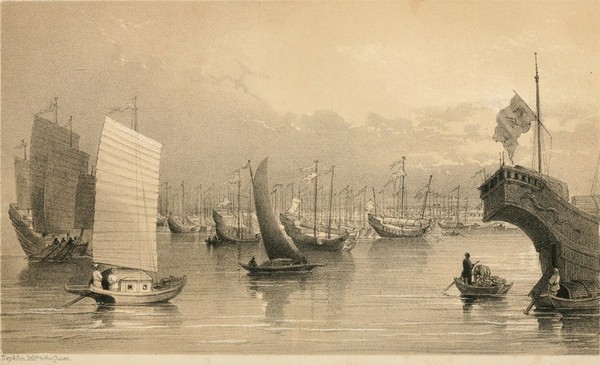
RIVER AT SHANGHAE London, John Murray, Albemarle Street.
Shanghae is by far the most important station for foreign trade on the coast of China, and is consequently attracting a large share of public attention. No other town with which I am acquainted possesses such advantages: it is the great gate—the principal entrance, in fact—to the Chinese empire. In going up the river towards the town, a forest of masts meets the eye, and shows at once that it is a place of vast native trade. Junks come here from all parts of the coast, not only from the southern provinces, but also from Shantung and Peechelee: there are also a considerable number annually from Singapore and the Malay Islands. The convenience of inland transit is also unrivalled in any part of the world. The country, being as it were the valley of the Yang-tse-kiang, is one vast plain, intersected by many beautiful rivers, and these again joined and crossed by canals, many of them nearly natural, and others stupendous works of art. Owing to the level nature of the country, the tide ebbs and flows a great distance inland, thus assisting the natives in the transmission of their exports to Shanghae, or their imports to the most distant parts of the country. The port of Shanghae swarms with boats of all sizes, employed in this inland traffic; and the traveller continually meets them, and gets a glimpse of their sails over the land, at every step of his progress in the interior. Since the port has been opened these boats bring down large quantities of tea and silk to supply the wants of our merchants who have established themselves here, and return loaded with the manufactures of Europe and America, which they have taken in exchange. Our plain cotton goods are most in demand amongst the Chinese, because they can dye them in their own peculiar style, and fit them for the tastes of the people. From what we know of the geographical nature of the country, there can be no doubt that all the green teas, and perhaps the greatest portion of the black, can be brought to Shanghae at less expense than they can be taken to Canton, or any of the other southern towns, except, perhaps, Ning-po; and as the tea-men incur less risk in taking their money home from the North, owing to the peaceable nature of the inhabitants, this will be another very great inducement to bring their teas to Shanghae. I am aware that people generally suppose the black-tea districts to be nearer the port of Foo-chow-foo than either Ning-po or Shanghae; but it must be recollected that very few of the black teas now imported to England are from the Bohee hills, as these teas are considered coarser, and much inferior in quality to other kinds, which are from a very different country, much farther to the north, and on the northern side of the great mountain range. The large silk districts of Northern China are close at hand; and there can be no doubt that a large proportion of that commodity in a raw state will be disposed of at Shanghae. Taking, therefore, all these facts into consideration—the proximity of Shanghae to the large towns of Hangchow, Soo-chow, and the ancient capital of Nanking; the large native trade, the convenience of inland transit by means of rivers and canals; the fact that teas and silks can be brought here more readily than to Canton; and, lastly, viewing this place as an immense mart for our cotton manufactures, which we already know it to be,—there can be no doubt that in a few years it will not only rival Canton, but become a place of far greater importance. And, when I add that the climate is healthy, the natives peaceable, and foreign residents respected, and allowed to walk and ride all over the country to any distance not exceeding a day's journey, it will be acknowledged that, as a place to live at, it has many advantages over its southern rival.
I have already said that this part of China is a complete net-work of rivers and canals. These were often most annoying to me in my travels over the country, when I happened to get off the Emperor's highway, a circumstance of no rare occurrence. I have often been obliged to press a boat into my service much against the will of the owners, more particularly when I visited this region for the first time, because I was then unacquainted with the localities, and the Chinese always seemed to fear I might take, or rob, their boats if I succeeded in getting into them, such were the opinions formed of foreigners at that time.
One day, in particular, I had been a considerable distance inland to the westward of Shanghae, and on my return, by some means or other, I got off the beaten track, and in pursuing my way, as I supposed in the proper direction, I was "brought up" by a large and deep canal. About two miles from where I stood, I saw a bridge, and, as it was nearly dark, I made for it as fast as I could. Unluckily, however, just as I thought my difficulties were over, being within gun-shot of the bridge, I was again stopped by another canal, which crossed the former one at right angles. I was now completely brought to a stand still, but in a few minutes I perceived a boat approaching, and a man tracking it on the same side as that on which we were. As soon as it came near, we called out to the men on board to pull the boat towards us, and allow us to get across to the other side. They seemed much frightened, and after making the man who was tracking the boat come on board, they pulled her into the middle of the canal, and then sculled away with all their might. They would soon have passed far beyond our reach, and left us to feel our way in the dark, or plunge through the deep muddy canal. Necessity, they say, has no law. "Call out to them," said I to my servant, "that if they do not immediately stop I will fire into the boat and kill the whole of them," and at the same moment I fired one of my barrels a little way ahead. This was quite sufficient. They immediately came towards us, and put us quickly over to the other side. I paid them for their trouble, and desired them to be more civil to the next traveller they might meet in the same circumstances. They went off in high spirits, and we heard them laughing and joking about the adventure long after they had passed out of our sight.
As an agricultural country, the plain of Shanghae is by far the richest which I have seen in China, and is perhaps unequalled by any district of like extent in the world. It is one vast beautiful garden. The hills nearest to Shanghae are distant about thirty miles. These have an isolated appearance in the extensive plain, and are not more than two or three hundred feet high. From their summit, on a clear day, I looked round in all directions, and was only able to see some few hills, apparently having the same isolated character, far away on the horizon, to the south; these, I have since ascertained, are near the Tartar city of Chapoo. All the rest of the country was a vast level plain, without a mountain or a hill to break the monotony of the view. The soil is a rich deep loam, and produces heavy crops of wheat, barley, rice, and cotton, besides an immense quantity of green vegetable crops, such as cabbages, turnips, yams, carrots, egg-plants, cucumbers and other articles of that kind which are grown in the vicinity of the city. The land, although level, is generally much higher than the valleys amongst the hills, or the plain round Ning-po; and, consequently, it is well adapted for the cultivation of cotton, which is, in fact, the staple production of the district. Indeed this is the great Nanking cotton country, from which large quantities of that article are generally sent in junks to the north and south of China, as well as to the neighbouring islands. Both the white kind, and that called the "yellow cotton," from which the yellow Nanking cloth is made, are produced in the district.
The soil of this district is not only remarkably fertile, but agriculture seems more advanced, and bears a greater resemblance to what it is at home, than in any part of China which I have seen. One here meets with a farm-yard containing stacks regularly built up and thatched in the same form and manner as we find them in England; the land, too, is ridged and furrowed in the same way; and were it not for plantations of bamboo, and the long tails and general costume of the natives, a man might almost imagine himself on the banks of the Thames.
A very considerable portion of the land in the vicinity of the town is occupied by the tombs of the dead.[1] In all directions large conical shaped mounds meet the eye, overgrown with long grass, and in some instances planted with shrubs and flowers. The traveller here, as well as at Ning-po and Chusan, constantly meets with coffins placed on the surface of the ground out in the fields, carefully thatched over with straw or mats to preserve them from the weather. Sometimes, though rarely, when the relatives are less careful than they generally are, I met with coffins broken or crumbling to pieces with age, exposing the remains of the dead. I was most struck with the coffins of children, which I met with every where; these are raised from the ground on a few wooden posts, and carefully thatched over to protect them from the weather—reminding the stranger that some parent, with feelings as tender and acute as his own, has been bereaved of a loved one, whom he, perhaps, expected should cheer and support him in his declining years, and whose remains he now carefully watches. Those in the higher ranks of life have, generally, a family burial-place at a little distance from the town, planted with cypress and pine trees, with a temple and altar built to hold the josses or idols, and where the various religious ceremonies are performed. A man with his family is stationed there to protect the place, and to burn candles and incense on certain high days. Others, again, are interred in what may be called public cemeteries, several of which I met with in the vicinity of Shanghae. These are large buildings, each containing a certain number of spacious halls or rooms, and having the coffins placed in rows around the sides.
A flat and highly cultivated country, such as I have just described, cannot be expected to be rich in indigenous plants. There are, however, many beautiful clumps of the bamboo growing round all the villages and small farm houses, which give a kind of tropical character to the scenery, but it is the only type of the tropics met with in this district, at least as regards trees. I have already mentioned the clumps of cypress and pine trees planted in the cemeteries of the rich, which are seen studded all over the country, and form one of its most striking features. Among these, I met for the first time with the beautiful Cryptomeria japonica, a species of pine not unlike the Araucarias of Norfolk Island and Brazil. When growing luxuriantly, it is highly ornamental, rising from the ground as straight as a larch, and sending out numerous side branches almost horizontally from the main stem, which again droop towards the ground in a graceful and "weeping" manner. The wood of the tree has a kind of twisted grain, and possesses great strength and durability. It is highly valued by the Chinese, and from its beauty and straightness is often used by the mandarins and priests for those long poles which are generally seen in front of their houses and temples. It is also well known and highly prized by the natives of Japan. My first seeds and plants of this beautiful fir were sent from Shanghae, in the autumn of 1843, and fortunately reached the garden of the Horticultural Society, at Chiswick, in excellent order. It is to be hoped that it will prove hardy, and if so, it will form a striking feature in the woods of England.