Chapter VIII
Reading edition
CIVILITAS.
Transformation in the character of Theodoric--His title--Embassies to Zeno and Anastasius--Theodoric's care for the rebuilding of cities and repair of aqueducts--Encouragement of commerce and manufactures--Revival of agriculture--Anecdotes of Theodoric.
hus far we have followed the fortunes of a Teutonic warrior of the fifth century of our era, marking his strange vacillations between friendship and enmity to the great civilised Empire under the shattered fabric whereof he and his people were dwelling, and neither concealing nor extenuating any of his lawless deeds, least of all that deed of treachery and violence by which he finally climbed to the pinnacle of supreme power in Italy. Now, for the next thirty years, we shall have to watch the career of this same man, ruling Italy with unquestioned justice and wise forethought, making the welfare of every class of his subjects the end of all his endeavours, and cherishing civilisation (or, as it was called in the language of his chosen counsellors, civilitas) with a love and devotion almost equal to that which religious zeal kindles in the hearts of its surrendered votaries.
The transformation is a marvellous one. Success and unquestioned dominion far more often deprave and distort than ennoble and purify the moral nature of man. But something like this transformation was seen when Octavian, the crafty and selfish intriguer, ripened into the wise and statesmanlike Augustus. Nor have our own days been quite ignorant of a similar phenomenon, when the stern soldier-politician of Germany, the man who once seemed to delight in war and whose favourite motto had till then been "blood and iron" having secured for his master the hegemony of Europe, strove (or seems to have striven), during twenty difficult years, to maintain peace among European nations, like one convinced in his heart that War is the supreme calamity for mankind.
It is a threadbare saying, "Happy is the nation that has no annals", and the miserable historians of the time tell us far too little about the thirty years of peace which Italy enjoyed under the wise rule of Theodoric; still we are told enough to enable us in some degree to understand both what he accomplished and how he accomplished it. And one thing which makes us accept the statements of these historians with unquestioning belief is that they have no motive for the praises which they so freely bestow on the great Ostrogoth. They are not his countrymen, nor his fellow-religionists. Our chief authorities are Roman and Orthodox, and bitterly condemn Theodoric for the persecution of the Catholics, into which, as we shall see, he was provoked in the last two years of his reign. Still, over the grave of this dead barbarian and heretic, when they have nothing to gain by speaking well of him, they cannot forbear to praise the noble impartiality and anxious care for the welfare of his people, which, for the space of one whole generation, gave happiness to Italy. It will be well to quote here one or two of these testimonies, borne by impartial witnesses.
"He was an illustrious man, and full of good-will towards all. He reigned thirty-three (really thirty-two) years, and during thirty of these years so great was the happiness of Italy that even the wayfarers were at peace. For he did nothing wrong. So did he govern the two nations, the Goths and Romans, as if they were one people, belonging himself to the Arian sect, yet he ordained that the civil administration should remain for the Romans as it had been under their Emperors. He gave presents and rations to the people, yet, though he found the Treasury ruined, he brought it round, by his own hard work, into a flourishing state. He attempted nothing (during these first thirty years) against the Catholic faith. Exhibiting games in the circus and amphitheatre, he received from the Romans the names of Trajan and Valentinian (the happy days of which most prosperous Emperors he did in truth seek to restore), and, at the same time, the Goths rendered true obedience to their valiant King, according to the Edict which he had promulgated for them.
"He gave one of his daughters in marriage to the King of the Visigoths in Gaul, another to the son of the Burgundian King; his sister to the King of the Vandals, and his niece to the King of the Thuringians. Thus he pleased all the nations round him, for he was a lover of manufactures and a great restorer of cities. He restored the aqueduct of Ravenna, which Trajan had built; and again, after a long interval, brought water into the city. He completed, but did not dedicate, the palace, and finished the porticoes round it. At Verona he erected baths and a palace, and constructed a portico from the gate to the palace. The aqueduct, which had been long destroyed, he renewed, and brought in water through it. He also surrounded the city with new walls. At Ticinum (Pavia) too he built a palace, baths, and an amphitheatre, and erected walls round the city. On many other cities also he bestowed similar benefits.
"Thus he so charmed the nations near him that they entered into a league with him, hoping that he would be their King. The merchants, too, from divers provinces, flocked to his dominions, for so great was the order which he maintained, that if any one wished to leave gold or silver on his land (in his country house) it was as safe as in a walled city. A proof of this was the fact that he never made gates for any-city of Italy, and the gates already existing were not closed. Any one who had business to transact could do it as safely by night as by day.
"In his time men bought wheat at 60 pecks for a solidus (12 shillings a quarter), and 30 amphoræ of wine for the same price (2s. 4d. a gallon)".
So far the supposed Bishop of Ravenna. Now let us hear Procopius, an official in the Imperial army which brought the Ostrogothic kingdom to ruin:
"Theodoric was an extraordinary lover of justice, and adhered rigorously to the laws. He guarded the country from barbarian invasions, and displayed the greatest intelligence and prudence. There was in his government scarcely a trace of injustice towards his subjects, nor would he permit any of those under him to attempt anything of the kind, except that the Goths divided among themselves the same proportion of the land of Italy which Odovacar had allotted to his partisans. Thus then Theodoric was in name a tyrant (that is, an irregular, because barbarian, ruler), but in deed a true King (or Emperor), not inferior to the best of his predecessors, and his popularity grew greatly, both among Goths and Italians, and this fact (that he was popular with both nations) was contrary to the ordinary fashion of human affairs. For generally, as different classes in the State want different things, the government which pleases one party has to incur the odium of those who do not belong to it.
In the year 490, probably soon after the battle of the Adda, Theodoric sent Faustus, an eminent Roman noble and "Chief of the Senate", on an embassy to Zeno, "hoping that he might receive from that Emperor permission to clothe himself with the royal mantle". It will be remembered that in the compact between Roman and Teuton, which preceded Theodoric's invasion of Italy, words had been used which implied that he was only to rule as "locum tenens" of the Emperor till he himself should arrive to claim the supremacy. Now, with that conquest apparently almost completed, and with his rival fast sealed up in Ravenna, Theodoric sends a report of his success of the enterprise undertaken "on joint account", and desires to legalise his position by a formal grant of the mantle of royalty from the Autocrat of the World.
(497) This final ratification of the Ostrogoth's sovereignty in Italy is so vaguely described to us that it is difficult to see how much it may have implied. Probably it was to a certain extent convenient to both parties that it should be left vague. The Emperor would not abandon any hope, however shadowy, of one day winning back full possession of "the Hesperian kingdom". The King might hope that, in the course of years or generations, he himself, or his descendants, might sever the last link of dependence on Constantinople, perhaps might one day establish themselves as full-blown Emperors of Rome. The claims thus left in vagueness were the seeds of future difficulties, and bore fruit forty years later in a bloody and desolating war, but meanwhile the position, as far as we can ascertain it, seems to have been something like this. Theodoric, "King of the Goths and Romans in Italy", was absolute ruler of the country de facto, except in so far as the Gothic nation, assembled under arms at its periodical parades, may have exercised some check on his full autocracy. He made peace and war, he nominated the high officers of state, even one of the two Consuls, who still kept alive the fiction of the Roman Republic; he probably regulated the admissions to the Senate; he was even in the last resort arbiter of the fortunes of the Roman Church.
On the other hand, he did not himself coin gold or silver money with his effigy; but in this he was not singular, for it was not till a generation or two had elapsed that any of the new barbarian royalties thought it worth while to claim this attribute of sovereignty. Though dressed in the purple of royalty, by assuming the title of King only, he accepted a position somewhat lower than that of the Emperor of the New Rome. He sent the names of the Consuls whom he had appointed to Constantinople, an act which might be represented as a mere piece of formal courtesy, or as a request for their ratification, according to the point of view of the narrator. With a similar show of courtesy, or submission, the accession of Theodoric's descendants to the throne was, when the occasion arose, notified to the then reigning Emperor. And there were many limitations which the good sense and statesmanlike feeling of the Ostrogothic king imposed on his exercise of the royal power, but which might be, perhaps were, represented as part of the fundamental compact between him and the Emperor of Rome. Such were the employment of men of Roman birth by preference, in all the great offices of the state; absolute impartiality between the rival creeds, Catholic and Arian (to the latter of which Theodoric himself was an adherent); and a determination to abstain as much as possible from all fresh legislation which might modify the rights and duties of the Roman inhabitants of Italy, the legislative power being chiefly exercised in order to provide for those new cases which arose out of the settlement of so large a number of new-comers of alien blood within the borders of the land.
After all the attempts which have been made to explain and to systematise the relation between the new barbarian royalties and the old and tottering Empire, much remains which is absolutely incapable of definition, but perhaps an historical parallel, though not strictly accurate, may somewhat aid our comprehension of the subject. It is well-known how for the first hundred years of the English Raj in India the power which actually resided in an association of traders, the old East India Company, and which was wielded under their orders by a Clive, a Hastings, or a Wellesley, was theoretically vested in an Emperor, the descendant of "the Great Mogul", who lived in seclusion in his palace at Delhi, and who, though nominally all-powerful, had really, as Macaulay has said, "less power to help or to hurt than the youngest civil servant of the Company". Now assuredly Anastasius and Justin, the Imperial contemporaries of Theodoric, were no mere phantoms of royalty, like the last Mogul Emperors of Delhi, but as far as actual efficacious share in the government of Italy went, the parallel holds good. Such deference as was paid to their name and authority was a mere courteous form; the whole power of the State--subject, as has been said, to the limitations still imposed by the popular institutions of the Goths--was gathered up in the hands of Theodoric.
These principles, though he may never have read the passage of Orosius which expounded them, were essentially the principles of Theodoric. So long as he remained in antagonism to the Empire, he could not reckon on the hearty co-operation of Roman officials in the task of government. The brave, through patriotism, and the cowardly, through fear of coming retribution, would decline to be known as his adherents, and would stand aloof from his work of re-organization. But when it was known that even the great Augustus at Constantinople, "Our Lord Anastasius, Father of his Country" (as the coins styled him), recognised the royalty of Theodoric, and had in some sort confided to him the government of Italy, all the great army of civil servants, who performed the functions of that highly specialised organism, the Roman State, could, without fear and without reproach, accept office under the new-comer, and could look forward again, as they had done before, to a fortunate official career, to the honours and emoluments which were the recognised reward of the successful civil servant.
I shall close this chapter with a few anecdotes--far too few have been preserved to us--which serve to show what manner of man he appeared to his contemporaries. Again I borrow from the anonymous author, the supposed Bishop of Ravenna.
Some of Theodoric's sayings passed into proverbs among the common people. One was: "He who has gold and he who has a devil can neither of them hide what he has got" Another: "The Roman when in misery imitates the Goth and the Goth in comfort imitates the Roman".
We have unfortunately no description of the great Ostrogoth's outward appearance, though the indications in his history would lead us to suppose that he was a man of stalwart form and soldierly bearing. Nor is this deficiency adequately made up to us by his coins, since, as has been already said, the gold and silver pieces which were circulated in his reign bore the impress of the Eastern Emperor, and the miserable little copper coins which bear his effigy do not pretend to portraiture.
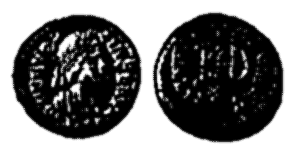
HALF-SILIQUA OF THEODORIC (SILVER) BEARING THE HEAD OF ANASTASIUS.