Chapter VI
Reading edition
ITALY UNDER ODOVACAR.
Condition of Italy--End of the line of Theodosius--Ricimer the Patrician--Struggles with the Vandals--Orestes the Patrician makes his son Emperor, who is called Augustulus--The fall of the Western Empire and elevation of Odovacar--Embassies to Constantinople.
When Attila was dead, the weak and worthless Emperor seems to have thought that he might safely dispense with the services of this too powerful subject. Inviting Aëtius to his palace, he debated with him a scheme for the marriage of their children (the son of the general was to wed the daughter of the Emperor), and when the debate grew warm, with calculated passion he snatched a sword from one of his guardsmen, and with it pierced the body of Aëtius. The bloody work was finished by the courtiers standing by, and the most eminent of the friends and counsellors of the deceased statesman were murdered at the same time.
The foul assassination of this great defender of the Roman State was requited next year by two barbarians of his train, men who no doubt cherished for Aëtius the same feelings of personal loyalty which bound the members of a Teutonic "Comitatus" to their chief, and who deemed life a dishonour while their leader's blood remained unavenged. On a day in March, while Valentinian was watching intently the games in the Campus Martius of Rome, these two barbarians rushed upon him and stabbed him, slaying at the same time the eunuch, who had been his chief confederate in the murder of Aëtius.
With Valentinian III. the line of Theodosius, which had swayed the Roman sceptre for eighty-six years, came to an end. None of the men who after him bore the great title of Augustus in Rome (I am speaking, of course, of the fifth century only) succeeded in founding a dynasty. Not only was no one of them followed by a son: scarcely one of them was suffered to end his own reign in peace. Of the nine Emperors who wore the purple in Italy after the death of Valentinian, only two ended their reigns in the course of nature, four were deposed, and three met their death by violence. Only one reigned for more than five years; several could only measure the duration of their royalty by months. Even the short period (455-476) which these nine reigns occupy is not entirely filled by them, for there were frequent interregna, one lasting for a year and eight months. And the men were as feeble as their kingly life was short and precarious. With the single exception of Majorian, (457-461), a brave and strong man, and one who, if fair play had been given him, would have assuredly done something to stay the ruin of the Empire, all of these nine men (with whose names there is no need to burden the reader's memory) are fitly named by a German historian "the Shadow Emperors".
The remembrance of this humiliating capture and the fear that it might at any moment be repeated, probably with circumstances of greater atrocity, were the dominant emotions in the hearts of the Roman Senate and people during the twenty-one years which we are now rapidly surveying. It was doubtless these feelings which induced them to submit more patiently than they would otherwise have done to the scarcely veiled autocracy of an imperfectly Romanised Teuton such as Ricimer. He was a barbarian, it was true; probably he could not even speak Latin grammatically; but he was mighty with the barbarian kings, mighty with the fœderati the rough soldiers gathered from every German tribe on the other side of the Alps, who now formed the bulk of the Imperial army; let him be as arrogant as he would to the Senate, let him set up and pull down one "Shadow Emperor" after another, if only he would keep the streets of Rome from being again profaned by the tread of the terrible Vandal.
(456-468) To a certain extent the confidence reposed in Ricimer was not misplaced. He inflicted a severe defeat on the Vandals in a naval engagement near the island of Corsica; he raised to the throne the young and valiant Majorian, who repelled a Vandal invasion of Campania; he planned, in conjunction with the Eastern Emperor, a great expedition against Carthage, which failed through no fault of his, but by the bad generalship of Basiliscus, whose brother-in-law, Leo, had appointed him to the command. But the rule of a barbarian like Ricimer exercised on the sacred soil of Italy, and the brutal arrogance with which he dashed down one of his puppet-Emperors after another when they had served his purpose, must have done much to break the spirit of the Roman nobles and the Roman commonalty, and to prepare the way for the Teutonic revolution which occurred soon after his death. Above all, we have reason to think that, during the whole time of Ricimer's ascendancy, the barbarian fœderati were becoming more absolutely dominant in the Roman army, and with waxing numbers were growing more insolent in their demeanour, and more intolerable In their demands.
Odovacar probably entered Italy about 465. He attached himself to the party of Ricimer, and before long became a conspicuous captain of fœderati After the death of Ricimer (18th August, 472), there was a series of rapid revolutions in the Roman State. Olybrius, the then reigning nonentity, died in October of the same year.
(June, 474) After five months' interregnum, a yet more shadowy shadow, Glycerius, succeeded him, and after fifteen months of rule was thrust from the throne by Julius Nepos, who had married the niece of Verina, the mischief-making Augusta of the East, and who was, therefore, supported by all the moral influence of Constantinople.
Nepos, after fourteen months of Empire, in which he distinguished himself only by the loss of some (Oct.,475) Gaulish provinces to the Visigoths, was in his turn dethroned by the Master of the Soldiery, Orestes, who had once held a subordinate situation in the court of Attila. Nepos fled to Dalmatia, which was probably his native land, and lived there for four years after his dethronement, still keeping up some at least of the state which belonged to a Roman Emperor.
We know very little of the pretexts for these rapid revolutions, or the circumstances attending them, but there cannot be much doubt that the army was the chief agent in what, to borrow a phrase from modern Spanish politics, were a series of pronunciamentos. For some reason which is dim to us, Orestes, though a full-blooded Roman citizen, did not set the diadem on his own head, but placed it on that of his son, a handsome boy of some fourteen or fifteen years, named Romulus, and nicknamed "the little Augustus". For himself, he took the dignity of "Patrician", which had been so long worn by Ricimer, and was associated in men's minds with the practical mastery of the Empire. But a ruler who has been raised to the throne by military sedition soon finds that the authors of his elevation are the most exacting of masters. The fœderati, who knew themselves now absolute arbiters of the destiny of the Empire, and who had the same craving for a settlement within its borders which we have met with more than once among the followers of Theodoric, presented themselves before the Patrician Orestes, and demanded that one-third of the lands of Italy should be assigned to them as a perpetual inheritance. This was more than Orestes dared to grant, and, on his refusal, Odovacar said to the mercenaries: "Make me king and I will obtain for you your desire".
(23d Aug., 476) The offer was accepted; Odovacar was lifted high on a shield by the arms of stalwart barbarians, and saluted as king by their unanimous acclamations.
This then was the event which stands out in the history of Europe as the "Fall of the Western Empire" The reader will perceive that it was no great and terrible invasion of a conquering host like the Fall of the Eastern Empire in 1453; no sudden overthrow of a national polity like the Norman Conquest of 1066; not even a bloody overturning of the existing order by demagogic force like the French Revolution of 1792. It was but the continuance of a process which had been going forward more or less manifestly for nearly a century,--the recognition of the fact that the fœderati, the so-called barbarian mercenaries of Rome, were really her masters. If we had to seek a parallel for the event of 476, we should find it rather in the deposition of the last Mogul Emperor at Delhi, and the public assumption by the British Queen of the "Raj" over the greater part of India, than in any of the other events to which we have alluded.
Of the details of Odovacar's rule in Italy we know very little. Of course the fœderati had their will, at any rate in some measure, with reference to the assignment of land in Italy, but no historian has told us anything as to the social disorganisation which such a redistribution of property must have produced. There are some indications that it was not thoroughly carried into effect, at any rate in the South of Italy, and that the settlements of the fœderati were chiefly in the valley of the Po, and in the districts since known as the Romagna.
The old Imperial machinery of government was taken over by the new ruler, and in all outward appearance things probably went on under King Odovacar much as they had done under Count Ricimer. No great act of cruelty or oppression stains the memory of Odovacar. He lost Provence to the Visigoths, but, on the other hand, he by judicious diplomacy recovered Sicily from the Vandals. Altogether it is probable that Italy was, at any rate, not more miserable under the sway of this barbarian king than she had been at any time since Alaric's invasion, in 408, proclaimed her helplessness to the world.
One piece of solemn comedy is worth relating, namely, the embassies despatched to Constantinople by the rival claimants to the dominion of Italy. It was probably towards the end of 477, or early in 478, that Zeno, then recently returned from exile after the usurpation of Basiliscus, received two embassies from two deposed Emperors of the West. First of all came the ambassadors of Augustulus, or rather of the Roman Senate, sent nominally by the orders of Augustulus, really by those of Odovacar. These men, great Roman nobles, represented "that they did not need an Emperor of their own. One absolute ruler was sufficient to guard both East and West; but they had, moreover, chosen Odovacar, who was well able to protect their interests, being a man wise in counsel and brave in war. They therefore prayed the Emperor to bestow on him the dignity of Patrician, and to entrust to him the administration of the affairs of Italy". At the same time (apparently) they brought the ornaments of the Imperial dignity, the diadem, the purple robe, the jewelled buskins, which had been worn by all the "Shadow Emperors" who flitted across the stage, and requested that they might be laid up in the Imperial palace at Constantinople.
Simultaneously there came ambassadors from Nepos, the Imperial refugee, the nephew by marriage of Verina. From his Dalmatian exile he congratulated his kinsman Zeno on his recent restoration to the throne, and begged him to lend men and money to bring about the like happy result for him by replacing him on the Western throne.
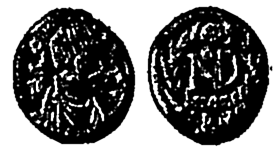
HALF-SILIQUA OF SILVER. (ODOVACAR.)