Chapter I
Reading edition
THEODORIC'S ANCESTORS.
Ostrogoths and Visigoths--Nations forming the Gothic Confederacy--Royal family of the Amals--Gothic invasion in the Second Century--Hermanric the Ostrogoth--Inroad of the Huns--Defeat of the Ostrogoths--Defeat of the Visigoths--The Visigoths within the Empire--Battle of Adrianople--Alaric in Rome.
owards the end of the second century of the Christian Era a great confederacy of Teutonic nations occupied those vast plains in the south of Russia which are now, and have been for more than a thousand years, the homes of Sclavonic peoples. These nations were the Ostrogoths, the Visigoths, and the Gepidæ. Approximately we may say that the Ostrogoths (or East Goths) dwelt from the Don to the Dnieper, the Visigoths (or West Goths) from the Dnieper to the Pruth, and the Gepidæ to the north of both, in the district which has since been known as Little Russia. These three nations were, as has been said, Teutons, and they belonged to that division of the Teutonic race which is called Low-German, man; that is to say, that they were more nearly allied to the Frisians, the Dutch, and to our own Saxon forefathers than they were to the ancestors of the modern Swabian, Bavarian, and Austrian. They worshipped Odin and Thunnor; they wrote the scanty records of their race in Runic characters; they were probably chiefly a pastoral folk, but may have begun to practise agriculture in the rich cornlands of the Ukraine. They were essentially a monarchic people, following their kings, whom they believed to be sprung from the seed of gods, loyally to the field, and shedding their blood with readiness at their command; but their monarchy was of the early Teutonic type, always more or less limited by the deliberations of the great armed assembly of the nation, which (in some tribes at least) was called the Folc-mote or the Folc-thing; and there were no strict rules of hereditary succession, the crown being elective but limited in practice to the members of one ruling and heaven-descended family.

This family, sprung from the seed of gods, but ruling by the popular will over the Ostrogothic people, was known as the family of the Amals. It is true that the divine and exclusive prerogatives of the family have been somewhat magnified by the minstrels who sang in the courts of their descendants, for there are manifest traces of kings ruling over the Ostrogothic people, who are not included in the Amal genealogy. Still, as far as we can peer through the obscurity of the early history of the people, we may safely say that there was no other family of higher position than the Amals, and that gradually all that consciousness of national life and determination to cherish national unity, which among the Germanic peoples was inseparably connected with the institution of royalty, centred round the race of the divine Amala.
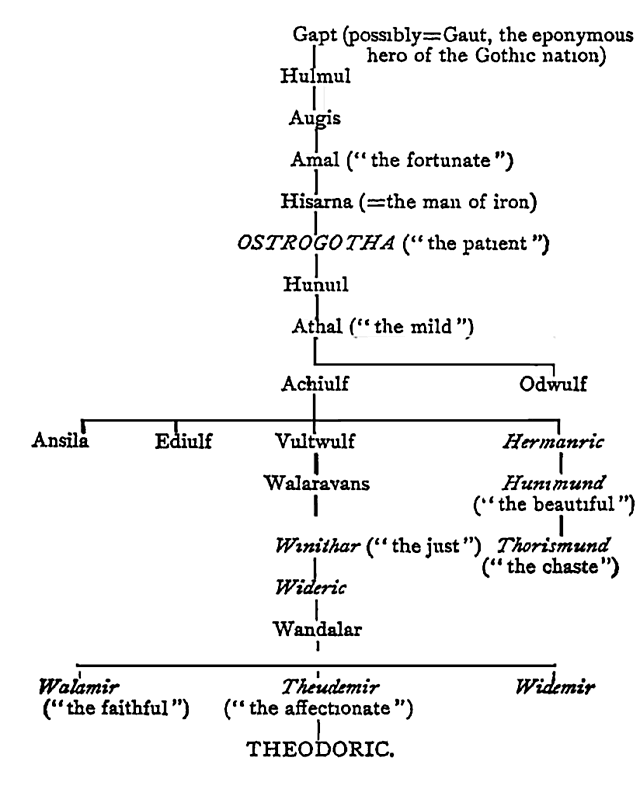
These fifteen generations, which should carry back the Amal ancestry four hundred and fifty years, or almost precisely to the Christian Era, seem to have marked the utmost limit to which the memory of the Gothic heralds, aided by the songs of the Gothic minstrels, could reach. The forms of many of the names, the initial "Wala" and "Theude", the terminal "wulf", "mir", and "mund" will be at once recognised as purely Teutonic, recalling many similar names in the royal lines of the Franks, the Visigoths and the Vandals, and the West Saxons.
In the great, loosely knit confederacy which has been described as filling the regions of Southern Russia in the third and fourth centuries of our Era, the predominant power seems to have been held by the Ostrogothic nation. In the third century, when a succession of weak ephemeral emperors ruled and all but ruined the Roman State, the Goths swarmed forth in their myriads, both by sea and land, to ravage the coast of the Euxine and the Ægean, to cross the passes of the Balkans, to make their desolating presence felt at Ephesus and at Athens. Two great Emperors of Illyrian origin, Claudius and Aurelian, succeeded, at a fearful cost of life, in repelling the invasion and driving back the human torrent. But it was impossible to recover from the barbarians Trajan's province of Dacia, which they had overrun, and the Emperors wisely compromised the dispute by abandoning to the Goths and their allies all the territory north of the Danube. This abandoned province was chiefly occupied by the Visigoths, the Western members of the confederacy, who for the century from 275 to 375 were the neighbours, generally the allies, by fitful impulses the enemies, of Rome. With Constantine the Great especially the Visigoths came powerfully in contact, first as invaders and then as allies (fœderati) bound to furnish a certain number of auxiliaries to serve under the eagles of the Empire.
Meanwhile the Ostrogoths, with their faces turned for the time northward instead of southward, were battling daily with the nations of Finnish or Sclavonic stock that dwelt by the upper waters of the Dnieper, the Don, and the Volga, and were extending their dominion over the greater part of what we now call Russia-in-Europe. The lord of this wide but most loosely compacted kingdom, in the middle of the fourth century, was a certain Hermanric, whom his flatterers, with some slight knowledge of the names held in highest repute among their Southern neighbours, likened to Alexander the Great for the magnitude of his conquests. However shadowy some of these conquests may appear in the light of modern criticism, there can be little doubt that the Visigoths owned his over-lordship, and that when Constantius and Julian were reigning in Constantinople, the greatest name over a wide extent of territory north of the Black Sea was that of Hermanric the Ostrogoth.
When this warrior was in extreme old age, a terrible disaster befell his nation and himself. It was probably about the year 374 that a horde of Asiatic savages made their appearance in the south-eastern corner of his dominions, having, so it is said, crossed the Sea of Azof in its shallowest part by a ford. These men rode upon little ponies of great speed and endurance, each of which seemed to be incorporated with its rider, so perfect was the understanding between the horseman, who spent his days and nights in the saddle, and the steed which he bestrode. Little black restless eyes gleamed beneath their low foreheads and matted hair; no beard or whisker adorned their uncouth yellow faces; the Turanian type in its ugliest form was displayed by these Mongolian sons of the wilderness. They bore a name destined to be of disastrous and yet also indirectly of most beneficent import in the history of the world; for these are the true shatterers of the Roman Empire. They were the terrible Huns.
Before the impact of this new and strange enemy the Empire of Hermanric--an Empire which rested probably rather on the reputation of warlike prowess than on any great inherent strength, military or political--went down with a terrible crash. Dissimilar as are the times and the circumstances, we are reminded of the collapse of the military systems of Austria and Prussia under the onset of the ragged Jacobins of France, shivering and shoeless, but full of demonic energy, when we read of the humiliating discomfiture of this stately Ostrogothic monarchy--doubtless possessing an ordered hierarchy of nobles, free warriors, and slaves--by the squalid, hard-faring and, so to say, democratic savages from Asia.
The huge and savage horde rolled on over the wide plains of Russia. The Ostrogothic resistance was at an end; and soon the invaders were on the banks of the Dniester threatening the kindred nation of the Visigoths. Athanaric, "Judge" (as he was called) of the Visigoths, a brave, old soldier, but not a very skilful general, was soon out-manœuvred by these wild nomads from the desert, who crossed the rivers by unexpected fords, and by rapid night-marches turned the flank of his most carefully chosen positions. The line of the Dniester was abandoned; the line of the Pruth was lost. It was plain that the Visigoths, like their Eastern brethren, if they remained in the land, must bow their heads beneath the Hunnish yoke. To avoid so degrading a necessity, and if they must lose their independence, to lose it to the stately Emperors of Rome rather than to the chief of a filthy Tartar horde, the great majority of the Visigothic nation flocked southward through the region which is now called Wallachia, and, standing on the northern shore of the Danube, prayed for admission within the province of Mœsia and the Empire of Rome. In 376 an evil hour for himself Valens, the then reigning Emperor of the East, granted this petition and received into his dominions the Visigothic fugitives, a great and warlike nation, without taking any proper precautions, on the one hand, that they should be disarmed, on the other, that they should be supplied with food for their present necessities and enabled for the future to become peaceful cultivators of the soil. The inevitable result followed. Before many months had elapsed the Visigoths were in arms against the Empire, and under the leadership of their hereditary chiefs were wandering up and down through the provinces of Mœsia and Thrace, wresting from the terror-stricken provincials not only the food which the parsimony of Valens had failed to supply them with, but the treasures which centuries of peace had stored up in villa and unwalled town. In 378 they achieved a brilliant, and perhaps unexpected, triumph, defeating a large army commanded by the Roman Emperor Valens in person, in a pitched battle near Adrianople. Valens himself perished on the field of battle, and his unburied corpse disappeared among the embers of a Thracian hut which had been set fire to by the barbarians. That fatal day (August 9, 378) was admitted to be more disastrous for Rome than any which had befallen her since the terrible defeat of Cannæ, and from it we may fitly date the beginning of that long process of dissolution, lasting, in a certain sense, more than a thousand years, which we call the Fall of the Roman Empire.
Alaric died shortly after his sack of Rome, and after a few years of aimless fighting his nation quitted Italy, disappearing over the north-western Alpine boundary to win for themselves new settlements by the banks of the Garonne and the Ebro. Their leader was that Ataulfus whose truly statesmanlike reflections on the unwisdom of destroying the Roman Empire and the necessity of incorporating the barbarians with its polity have been already quoted. There, in the south-western corner of Gaul and the northern regions of Spain, we must for the present leave the Western branch of the great Gothic nationality, while our narrative returns to its Eastern representatives.