"A Narrative of Hunting Adventures in Southern Africa" (continued 5)
Reading edition
For some time the hunters remained watching the surface of the water. They saw the frothy bubbles floating over the spot—some of them reddish with the blood of the waterbuck—but the current soon carried them away, and the river glided past smooth and silent as if no such commotion had occurred in its waters.
The hunters all returned to the wagons, and a conversation now occurred about crocodiles, in which Congo took part.
The Kaffir had hunted upon the great river Limpopo, which lay to the northeast of their present camp. He alleged that there crocodiles were very numerous, and some were seen of enormous dimensions, attaining to thirty feet in length, with bodies as thick as a rhinoceros; that such scenes, as that they had just witnessed, were of no uncommon occurrence there. He said that the larger crocodiles frequently attacked buffaloes, precisely as this one had done the waterbuck—that they lie in wait by the watering-places of these animals, and seizing them by the muzzle when they are drinking, drag them under water, and thus suffocate them.
But Congo related a still more curious habit of the crocodiles. He asserted that they never devour their prey until it becomes quite decomposed—that is, until it attains the condition of carrion. He stated that when a crocodile has killed a buffalo or any large animal, it always drags the carcass back to the shore, and, leaving it exposed to the action of the sun’s rays, watches near it until the flesh has become tainted to its taste! The young yägers had heard of this before; but were not inclined to believe it, though Congo now assured them of its truth—alleging that this habit of the crocodile was well known among the native hunters of the Limpopo.
Notwithstanding the sneers of many naturalists, the simple savage was right, as the young yägers themselves were soon enabled to prove.
I have said that when the crocodile and his victim disappeared below the surface, they were seen no more. That, however, was not strictly true. Both of them were seen again, and in a very short while after—more than seen, indeed; for the crocodile was killed by a bullet from Groot Willem’s roer; and upon venison steaks, cut from the buttocks of the waterbuck, both Congo and Swartboy—as well as the buck-dogs—made them a hearty supper.
It was thus the thing came about. Hans had entered into a dissertation about crocodiles in general. He was informing his companions of the number of new species of these creatures that had been lately discovered, and pointing out the great progress of natural science during the present half century; how the crocodiles were divided by modern naturalists into many genera, and that, including the caimans and alligators of America, and the gavials of Asia, the whole crocodile family could not number less than two dozen living species, although but a few years ago it was supposed there were but three kinds in existence; how America possessed true crocodiles as well as alligators; how the number of species in America was greater than that of Africa and Asia taken together; how there were none of these great reptiles found either in Europe or Australasia; and, among other things, Hans was pointing out the difficulty which existed in determining both the genera and species of all the Crocodilidae.
While the yägers were listening to these details, the Kaffir, who had been squatted with his eyes bent upon the river, suddenly started from his crouching attitude, and pointed down to the bank, toward a small brake of reeds that grew out of the water.
All eyes were turned in that direction, and it was perceived that some of the reeds were shaking about, as if a large creature was moving among them. The reeds were nodding about and bending downward in bunches, and breaking as if under some heavy pressure, and crackling as they broke. What could be causing such a commotion amongst them? It did not appear like the natural motion of any wild animal, for these glide about, even in their undisturbed haunts, in a stealthy and easy manner. There was something unusual going on among the reeds. What could it be?
The young yägers were determined to find out; and for this purpose they drew near the margin of the reeds. They did not approach them openly, but crawled forward under cover of the grass and bushes, observing perfect silence, so as not to fright away whatever creature was causing the movement.
Fortunately the reed-culms did not grow so thickly as to obscure the view; and when near, it was possible to see a large object moving in their midst. And a large object was seen—a large dark creature which was at once recognised as a crocodile.
It might have been another crocodile, and not that which had just drowned the waterbuck; but the hunters were not left to conjecture on this point, for, while watching its movements, they now perceived the carcass of the waterbuck itself, which the huge reptile was dragging up among the reeds, evidently with the intention of raising it out of the water! For this purpose it was using its powerful jaws, as well as its snout, and strong forearms—now pulling the body along a bit, then pushing and rolling it over towards the bank.
The boys watched these strange manoeuvres for some moments in silence; but Groot Willem had brought his gun with him, and choosing a moment when the huge saurian was resting a little, he aimed for the socket of its eyeball, and sent the big bullet of his roer crashing through its skull.
The reptile plunged back into the river, and went to the bottom leaving the wave tinged with blood. Presently it rose to the surface, struggling violently, and evidently in great agony. Now it raised the fore-part of its hideous body quite out of the water; then its head went under, and its long tail was flouted into the air; then up came its head again, and so on, till at length its struggles ceased, and it sank to the bottom like a stone. No doubt it sank to rise no more.
Congo and Swartboy rushed in among the reeds, and drawing out the waterbuck—somewhat lacerated by the teeth of its destroyer—dragged it in triumph to the camp.
Chapter Forty One.
The Guinea-Hens.
Although Swartboy and Congo supped upon the flesh of the waterbuck—which is far from being a delicate venison—the boys had something better for supper. That was roast fowl, and a very dainty kind of it, quite equal to grouse or partridge. They all supped upon “guinea-hen.”
The guinea-fowl (Numida meleagris) is a bird that has been long known, and is often mentioned in the works of ancient writers under the names Meleagris and Gallina Numidica. It is unnecessary to give a description of its appearance, as every one is acquainted with the beautiful pearly plumage of the bird, from which it has obtained the name of pearl-hen—among the Germans Perl-Huhn, and among the Spaniards “Pintado,” or spotted hen. The English name “Guinea-hen” is in allusion to the country from which it has been chiefly obtained in modern times. The guinea-fowl is truly a native of Africa—though it is now domesticated in almost every country in the world, and has become a common inhabitant of the farm-yard. In the United States of America, particularly in the Southern States, where the climate exactly suits it, the guinea-hen, or “guinea-chicken,” as the bird is there called, is a great favourite, both as a bird for the table and a layer of eggs; and certainly the flesh of the young pullet is much more delicate and savoury than that of the common fowl.
In many of the West India islands, the guinea-hen, although introduced from Africa, has become wild, and in the forests of Jamaica it is hunted and shot like other game. In these islands the species propagates very rapidly; and where the birds become numerous they do great mischief to the crops of the planters. On this account they are often hunted, not to be served up at the table, but for the purpose of exterminating them as troublesome pests.
Throughout all Africa, its native country, the guinea-fowl exists; but it is to be remarked that there is more than one species. The common guinea-fowl (Numida meleagris) is the best known, and in its wild state differs very little from the domesticated variety. The latter, however, frequently varies in colour, and some are seen with very little of the blue tint upon their feathers and almost without spots. This, however, is the usual law of wild birds when produced under domestication, as ducks, turkeys, geese, and all the other pets of the farm, fully demonstrate. Even when left to herself, nature often “sports” in this way, and we know of no bird or animal of which “albinos” may not be at some time observed.
In addition to the common guinea-fowl, a second species is well known to exist in the Southern parts of the African continent. This is the “crested guinea-fowl,” (Numida cristata). It is not quite so large as the common kind, and has other differences. It is of a darker blue colour, but spotted like its congener, each feather having from four to six spots upon it. The quills are yellowish brown, but the edges of the secondaries are of a pure white, which contrasts prettily with the dark colouring of the general plumage.
But the most conspicuous difference between the two species is in the formation of the crown and cheeks. As is well known, over the bill of the common guinea-fowl rises a singular warty membrane like a casque, while two carunculated wattles hang from the lower mandible. Both these appendages are wanting in the Numida cristata; but in place of the hard casque, the head of this species is ornamented with a crest of loose hair-like feathers of a bluish-black, which adds very much to the elegant appearance of the bird.
The guinea-hens are gregarious and sometimes immense flocks of them are seen together. They spend most of their time upon the ground, but they also take to trees when startled, and roost upon the branches. Their food consists of seeds, berries, and soft slugs.
While the boys were discussing what they should have for supper, a flock of these beautiful crested creatures came chattering across the open meadow in which was the camp. Of course the shot-guns were immediately put in requisition, and several of the party got ready to go after them.
Now it is not so very easy to get a shot at the wild guinea-hens. They are no great flyers, and do not take to the wing when pursued, unless when close pressed by a dog or some other swift animal. But a man on foot is no match for them, as they run very swiftly where the ground is even. They are shy, moreover; and it is not without difficulty that a shot can be had. There is one way, however, of approaching them successfully. A dog should be set after them, precisely in the same manner as though they were rabbits, hares, or any other small quadrupeds. The dog of course being swift enough to overtake them, soon comes up, and the guinea-fowls are then forced to take wing. But, as they are greatly disinclined to a long flight, they soon settle down again, or, what is more likely, perch upon the branches of the nearest tree. The dog then runs up to the tree; and, if well-trained, will commence barking, and continue so till the sportsman approaches within shot. The birds upon the tree have no fear of the dog below—knowing very well that he cannot climb up to them—but, while their attention is occupied with him, they pay no heed to their more dangerous enemy the gunner, who can then easily approach within range, and take aim at his leisure.
Now this mode of hunting the guinea-fowl was well known to the young yägers; and as one of their dogs had been trained to it, they took him along, and commenced the pursuit with every confidence that they would eat roast fowl for supper.
They were not disappointed. The birds were soon after sprung, and then treed; and the barking of the dog conducted the gunners to the spot where the game had taken roost, among the branches of some “cameel-doorn” trees near the bank of the river. Several shots were obtained; and three brace and a half were brought into camp—enough to serve not only for supper, but also for breakfast on the following morning.
It seemed to be quite a place for birds; for while there, many other species were observed by the young hunters. A great many curious plants grew in the neighbourhood, the seeds of which served many kinds for food; besides, from the proximity of the river many flies and other insects were produced, the prey of numerous shrikes and other birds of the family of Muscicapidae.
Hans pointed out a very singular bird that was flying about the meadow, and was every now and then uttering a note that sounded like the word “edolio.” From this note the bird derives its name, just as in England the “cuckoo” is named from its peculiar call, and in France “coucou.”
Now the edolio of South Africa is also a cuckoo; and although differing from our cuckoo in some respects, it has a great resemblance to it in others. It has the same parasite peculiarity of depositing its eggs in the nests of other birds, and leaving them to be hatched there; and its other habits are very similar to those of the common cuckoo.
But there are some very curious points in the history of the “edolio,” which it does not share with its European congener. Among the boors of South Africa it is known as the “New year’s day bird,” (Niuwe jaars vogel,) and these simple people ascribe to it some wonderful characteristics. They say that it appears only at the beginning of the year—whence the name “new year’s day bird”—and that whenever it is hungry it commences to cry out, and then all the little birds in the immediate neighbourhood fly towards it, carrying food, which they give it to eat!
Now all the young yägers, as well as Congo the Kaffir and Swartboy the Bushman, were well acquainted with this story; and all, with the exception of Hans, believed it to be true. Hans, however, knew the explanation of the marvellous matter, and proceeded to give it to his companions.
He stated that the bird known among the farmers as the Niuwe jaars vogel, was no other than the young of the “edolio” (Cuculus serratus)—though the farmers would not believe this, because, although full fledged, it differs a good deal from the parent birds both in size and colour, and is therefore taken for a distinct kind. That the mystery of its appearing always on the first day of the year, was scarce a fable after all, as it was about that time that young edolios obtained their full feathers, and commenced flying about. That the further statement, of its crying out when hungry, was perfectly true; but that all the small birds in the neighbourhood were summoned by its cry, was not correct, although some would be, viz: the step-mother and father that had brought it into life; and that these having been often seen in the act of feeding the young edolio had given origin to the fable. This was certainly a very good explanation.
Hans further stated that a similar belief existed among the natives of India, in relation to the large-billed cuckoo, (Eudynamis orientalis), and that the belief had a similar origin.
“The edolio,” continued Hans, “like the cuckoo, deposits its eggs in the nest of many species of small birds; and that it places them there with its beak, and not in the ordinary way, has been satisfactorily determined by naturalists.”
Chapter Forty Two.
Rooyebok.
As our travellers advanced up-stream, the wide level plains became narrowed into mere stripes of meadow that lay along both sides of the river. On both sides, and not a great distance off, wood-covered mountains trended parallel to the course of the stream. Sometimes their spurs approached very near to the banks—so as to divide the bottom land into a series of valleys, that rose like terraces one above the other. Each of these was a separate plain, stretching from the river’s bank to the rocky foot of the mountain.
Nearly every one of them was tenanted with game of one sort or another—such as had already been met with on the route—but beyond killing enough to keep their larder supplied with fresh meat, our party did not make any stay to hunt here. The guide had informed them, that beyond the mountain where the river took its rise lay the country of the elephant, the buffalo, and the giraffe; and in hopes of reaching this long-expected land, the sight of a herd of springboks, or gnoos, or blauw-boks, or even elands, had little more interest for the young yägers than if it had been a drove of tame oxen.
Ascending into one of the upper valleys, however, they came suddenly in view of a herd of antelopes whose forms and colours distinguished them from any our hunters had yet met with. This at once decided them to halt the wagons, and prepare for a chase.
That the animals seen were antelopes, there could be no mistake. They had all the grace and lightness of form peculiar to these creatures; besides, their horns were conspicuously characteristic. Their appearance bespoke them to be true antelopes.
They were large ones too—that is, of medium size—about as large as red deer; but of course small when compared with such species as the blauw-bok or the huge eland. Each would have measured nearly three feet and a half in height—and even a little more, over the croup—for although there are some antelopes, such as those of the acronotine group—the “hartebeest,” “sassabye,” and “bekr-el-wash”—that stand lower at the croup than the shoulders, the reverse is the case with other species; and those now before the eyes of our hunters possessed the latter characteristic. They stood high at the croup.
None of the yägers had ever seen one of the kind before; and yet, the moment they came under view, both Hendrik and Groot Willem cried out—
“Rooyebok!”
“How know you that they are rooyebok?” demanded Hans.
“From their colour, of course,” replied the others.
The colour of these antelopes was a deep fulvous red over the head, neck, and upper parts of the body; paler along the sides; and under the belly pure white. There were some black marks—such as a stripe of black down each buttock, and also along the upper part of the tail—but the general colour of the animals was bright red; hence their being taken for “rooyebok,” or “red-bucks,” by Hendrik and Groot Willem.
“The colour is not a good criterion,” remarked Hans. “They might as well have been ‘grysbok,’ or ‘steinbok,’ or ‘rooye rheebok,’ for the matter of colour. I judge by the horns, however, that you are right in your guess. They are rooyebok, or, as the Bechuanas call them, ‘pallah,’ and, as naturalists style them, Antilope melampus.”
All looked at the horns as Hans spoke, and saw that these were full twenty inches in length, and somewhat like those of the springbok, but more irregularly lyrate. The two nearly met at their tips, whereas at their middle they were full twelve inches apart. This was a characteristic by which they could easily be remembered, and it had enabled Hans at once to pronounce upon the species.
Strange to say, there was but one pair of full-grown horns in the whole herd, for there was but one old buck, and the does of the pallah are hornless. A “herd” is hardly a proper term; for this species of antelope cannot be called gregarious. What our hunters saw before them was a family of rooyeboks, consisting of the old male, his wives, and several young bucks and does—in all, only eleven in number.
Our hunters knew, from what they had heard, that the rooyebok is both a shy and swift antelope—difficult either to be approached or run down. It would be necessary, therefore, to adopt some plan of proceeding, else they would not succeed in getting one of them; and they had fixed their minds most covetously on the large knotted horns of the buck. They halted the wagons to await the result of the chase; though the oxen were not to be outspanned, unless it should prove successful. If so, they would camp upon the ground for the night—so as to enable them to dress the meat, and preserve the “trophies.” With such resolves, they made ready to hunt the pallah.
Upon first coming in sight of the rooyebok, the hunters were upon the crest of a high ridge—one of the mountain-spurs, that divided the valley they had just traversed from that in which the red antelopes were feeding. From the eminence they occupied, they commanded a view of this valley to its farthest border, and could see its whole surface, except a small strip on the nearer side, which was hidden from them by the brow of the ridge on which they stood.
Around the sides of the valley there were trees and bushes; though these did not form a continued grove, but only grew in detached clumps and patches. All the central ground, where the pallahs were feeding, was open, and quite destitute of either bush or cover of any kind. Between the bordering groves there was long grass; and, by the aid of this, a skilled hunter might have crept from one grove to another, without attracting the attention of the antelopes.
It was decided, therefore, that Hendrik and Groot Willem should steal round to the other end of the valley, keeping under cover of the thickets and grass. Then the pallahs would be between two fires, as they must either go up or down the valley in trying to escape. On the right lay the steep mountain; on the left, the deep rapid river. They would not likely attempt to move off on either hand. So this design to intercept them was good enough.
The horses were now tied to trees and left on the back of the ridge, while the hunters moved forward upon the brow that overhung the valley.
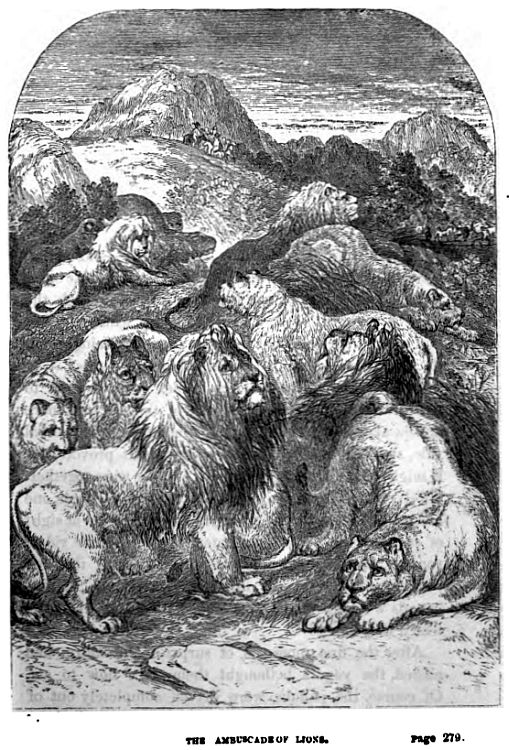
They had not advanced far before that part of the valley hitherto unseen came under their eyes, and there, to their astonishment, another herd of animals appeared; not of antelopes—although, from their colour, they might have been mistaken for such. No—the short round heads, elongated bodies, thick massive limbs, and long tufted tails, told at a glance, that it was no herd of peaceful ruminants the hunters were gazing upon, but an assemblage of dreaded carnivora—a troop of lions!
Chapter Forty Three.
Four-Footed Hunters.
There were twelve lions in the troop—old males, females, and whelps of different ages! A terrific spectacle to look upon, in any other way than through the bars of a cage, or out of a third story window. But our young yägers beheld them on an open plain, and at the dangerous proximity of three hundred yards!
It is needless to say that a sudden stop was put to their advance, and that every one of the six was more or less alarmed. Although they knew that, as a general rule, the lion will not attack man without provocation, it might be different where such a number were together. Twelve lions would have made short work of them, one and all. No wonder the young hunters trembled at sight of such a troop, and so near; for the brow of the ridge, running abruptly down to the plain, was all that lay between them and the dreaded assemblage. A few bounds would have brought the lions to the spot on which they stood!
After the first moments of surprise and alarm had passed, the yägers bethought themselves how to act. Of course, the pallahs were driven completely out of their mind, and all ideas of a hunt given up. To have descended into that valley, would have been to have encountered twice their own number of lions: older hunters than they would have shied off from such an encounter. They did not think for a moment of going farther, nor, indeed, of any thing but retreating; and it cannot be said that they thought of that, for it was the instinct of the moment.
“Back to our horses!” whispered they to one another, the moment they set their eyes on the lions; and, without staying to contemplate the fearful group, all six stole back; and, in less than two minutes’ time, were seated in their saddles.
Their presence had not been discovered by the lions. Two circumstances had favoured the boys, and prevented this. The ridge over which they were passing was covered with underwood, and the “bosch,” reaching as high as their heads, had sheltered them from view. The other circumstance in their favour was that the wind was blowing down the valley, and therefore, from the lions and towards themselves. Had it been otherwise, they would have been scented, and of course, discovered. Still another circumstance—the hunters had been advancing in silence, on account of the design they had formed of stalking the pallahs. The lions, therefore, still remained ignorant of their proximity. Once on horseback our party felt secure, and soon got over their little “flurry.” Each knew that the noble creature that carried him, could give any lion the heels. Even the ponies of Klaas and Jan could run away from the fastest lion in Africa. Once mounted, all felt that the danger was over.
The hunters, Hendrik and Groot Willem, were not satisfied to retreat in this way. They were resolved on at least, having another “peep” at the dangerous game; and, therefore, prepared to return to their former point of observation, of course this time on horseback. Hans also felt a similar inclination—from the desire to study a chapter of natural history—and Arend would go out of curiosity. It was not deemed safe to take Klaas or Jan along; so these two youngsters were unceremoniously sent back to the wagons, that had been halted in the lower valley near the bottom of the hill.
The other four rode slowly and silently forward, until they came once more in view of the valley, the herd of pallahs, and the troop of lions.
The antelopes were still feeding quietly near the centre of the open ground. The lions were as yet on the ground, where they had been first observed. That the pallahs knew nothing of the proximity of their dangerous neighbours was very evident, else they would not have been moving so sedately along the sward. They had no suspicion that an enemy was near. The lions were in the lower end of the valley, and therefore to leeward of them—for the wind was blowing fair downstream, and came right in the faces of the hunters. A thicket, moreover, screened the lions from the eyes of the herd.
It was equally evident that the beasts of prey were well aware of the presence of the rooyeboks. Their actions proved this. At short intervals one trotted to the edge of the “bosch,” in crouching attitude, looked out to the open plain, and after a moment or two returned to his companions, just as if he had been sent to “report.” The old males and the lionesses stood in a thick clump, and seemed to be holding a consultation! The boys had not a doubt but that they were doing this very thing, and that the subject of their deliberation was the rooyebok herd.
At length the “council” appeared to break up. The troop separated, each taking a different direction. Some went along the bottom of the valley, while several were seen to proceed towards the mountain foot.
When these last had reached the groves before mentioned, they turned upwards; and one after another were seen crouching from clump to clump, crawling along upon their bellies, as they passed through the long grass, and evidently trying to shelter themselves from the view of the pallahs.
Their object now became clear. They were proceeding to the upper end of the valley, with the design of driving the game upon those that had remained below—in fact, carrying out the identical plan which the hunters themselves had projected but the moment before! The boys marvelled at this singular coincidence; and as they sat in their saddles they could not help admiring the skill with which their rivals were carrying out their own plan.
Those—three there were—that had gone skulking up the edge of the valley, were soon out of sight—hidden under the “bosch” that grew at the opposite end, and which they had been seen to enter. Meanwhile, the other nine had spread themselves along the bottom of the valley, each taking station under cover of the bushes and long grass. The trap was now fairly set.
For a few minutes no movement was observed on the part either of lions or pallahs. The former lay crouched and stealthily watching the herd—the latter browsed peacefully along the sward, perfectly unconscious of the plot that was “thickening” around them.
Something at this moment seemed to render them suspicious. They appeared to suspect that there was danger threatening. The buck raised his head; looked around him; uttered a hiss, somewhat like the whistling of deer; and struck the ground a smart rap or two with his hoof. The others left off browsing, and several of them were seen to bound up into the air—after the very singular manner of springboks.
No doubt they had scented the lions, now at the upper end of the valley—as the breeze from that quarter blew directly towards the herd.
It was surely that; for after repeating his signal, the old buck himself sprang many feet into the air, and then stretched himself in full flight. The others of course followed, leaping up at intervals as they ran.
As the lions had well calculated, the antelopes came directly down the valley, breast forward, upon their line. Neither the wind nor any thing warned them of the dangerous ambuscade; and in a few short moments they were close to the patches of brushwood. Then the nine huge cats were seen to spring out as if moved by one impulse, and launch themselves into the air. Each had chosen a rooyebok, and nearly every one succeeded in bringing his victim to the earth. A single blow from the paw of their strong assailants was enough to stretch the poor antelopes on the plain, and put an end at once to their running and their lives. So sudden was the attack, and so short-lived the struggle, that in two seconds from the time the lions made their spring, each might be seen crouching over a dead pallah, with his paws and teeth buried in its flesh!
Three alone escaped, and ran back up the valley. But a new ambush awaited them there; and as they followed the path, that led through the thicket at the upper end, each became the prey of a lurking lion.
Not one of the beautiful antelopes, that but the moment before were bounding over the plain in all the pride and confidence of their speed, was able to break through the line of deadly enemies so cunningly drawn around them!
The hunters remained for some minutes gazing upon the singular spectacle. Hendrik and Groot Willem would have stolen forward, and sent a brace of bullets into a brace of lions; but Hans would not hear of such a thing. He alleged that there was no time when these animals are more dangerous to attack, than just after they have killed their game and are drinking its blood. At such a moment they are extremely ferocious, and will follow with implacable vengeance any one who may disturb them. It would be more prudent, therefore, not to provoke such a powerful band, but to retire altogether from the spot.
To these counsels of Hans—backed by Arend—the two hunters at length reluctantly yielded; and all four rode back to the wagons.
Arriving there, a consultation was held how they were to proceed. It would be a dangerous business to trek up the narrow valley guarded by such a troop. A ford was therefore sought for, and found at some distance below; and, having crossed their wagons, the travellers encamped on the opposite side—as it was too late to move farther that night.
They had done well to go across the river, for during the whole night the fierce brutes were heard roaring terrifically upon the side where they had been observed. In fact, the place appeared to be a regular den of lions.
Chapter Forty Four.
“Widow-Birds.”
They were only too glad to get off out of that neighbourhood, and at an early hour they inspanned and treked up the banks of the stream.
Just as on the other side, the road led through a succession of valleys, with groves of trees scattered over their surface; and as they proceeded, the mountain-spurs more frequently approached the banks, and at one or two places they found great difficulty in getting the wagons across the ridges. One of these was so steep, that for a while the travellers feared they would not be able to follow the stream any farther. The oxen refused to trek up the declivity, and neither whip nor jambok would force them forward.
But Congo knew of a plan by which they were at length induced to proceed; and both wagons arrived in safety at the top of the pass—not, however, until Swartboy had clicked and shouted, and Congo had screamed, till their throats were sore, and both had worn the voorslays of springbok skin from their long whips.
Congo’s mode of making the oxen move forward was a very simple one; and consisted in his going ahead of them and smearing the rocks along the path with the “mest” of the oxen themselves—thus leading the animals to believe that other oxen had gone before them, and that therefore the passage must be practicable, since some of their own kind had already made it! This mode is often adopted by the trek-boors of Southern Africa, when they wish to drive up very precipitous places, where the oxen are afraid to go of themselves.
The valley, which was reached after climbing through this difficult pass, was one of very small extent—not exceeding a couple of acres; and as the river had now become diminished to a mountain-stream, it was fordable at any point throughout the whole length of the little meadow in which the travellers encamped. At the head of this valley a ridge trended across the course of the stream through which the current had cleft a wide way; and the only road leading out above was along the channel of the river itself. Fortunately, this channel was nearly dry, else they could have gone no farther in that direction. As it was, the pebbly bed of the stream could be traversed by wagons, and they would easily get through to wider plains that stretched beyond. They had halted for the night in this little valley, because there was excellent grass for their cattle; and as wood grew along the sides of the rocky hills, and clear cool water ran down the stream, they possessed all the three necessary requisites for a traveller’s camp.
It was a curious little place where they had outspanned. As already stated, the level ground was not over a couple of acres in extent, though it was nearly of circular form. Through the very centre of it passed the stream, its bed being only a few feet below the general surface; and all around were the mountains, their precipitous sides rising like rocky walls to a height of several hundred feet, and completely enclosing the mountain within their embrace.
There were no trees upon the surface of the meadow itself, but against the rocks grew many kinds; some of them hanging with their tops downward, and some stretching horizontally outwards. A few small shrubs alone, with some reeds, grew upon the edge of the stream; but these were low, and would not have concealed a man standing erect.
In the centre of this natural amphitheatre the camp was formed—that is, the wagons were placed there. The horses and oxen were not fastened in any way, as it was supposed they would not care to stray out of the valley.
There were three good reasons why they should not wander. First, because they were wearied with a long day’s work, and one that had been particularly severe. Secondly, the paths leading out were difficult to find. And thirdly, because both the grass and water there were of as good a quality as either horse or ox could have expected to meet with elsewhere. There was no reason, therefore, why any of them should go beyond the confines of the valley where the camp was situated.
As usual, no sooner were Klaas and Jan fairly out of their saddles than they went bird’s-nesting. Several kinds of birds had been seen by them as they entered this secluded valley; and it was likely that some of their nests would be found at no great distance off.
And some were found. Upon the shrubs and reeds quite a colony of birds had made their habitations. They were small sparrow-looking birds, having nests of a kidney-shape, hollow in the inside, which was reached by little circular entrances, something like the nests of the common wren. The outside part was constructed of grass; while inside, the nests were lined with a soft substance resembling wool. This was the cottony down obtained from some plant that, no doubt, grew in that neighbourhood, but which the boys could not see anywhere around.
Now these little birds were already well known to the young yägers. They had met with them before; and all of them knew they were birds of the genus Ploceinae, or weaver-birds. They knew, moreover, that there are not only many species of weaver-birds, but that there are also many genera, or rather subgenera, of them, differing from each other in size, colour, and habits, but all possessing the curious instinct of building nests of a very ingenious kind—in other words “weaving” them; from which circumstance they derive their trivial name. The nests of all the species differ from each other. Some are constructed of a globe-shape; others like a chemist’s retort; others of kidney-form; and still another kind of nest is that of the “social weaver-birds.” These last unite in large numbers, and fill one great nest, or “hive,” which often fills the whole top of a great acacia, looking like a haystack built among the branches of the tree.
The little weavers observed by Klaas and Jan were of the genus Amadina—the Amadina squamifrons; and both the boys were glad at encountering some of their nests at that moment. Not that they were at all curious to see the eggs, for they had examined them often before. No: that was not the reason. There was another and a different one. It was this: the inside lining of the nest of the amadina makes excellent wadding for shot-guns—quite equal to tow, and even better than the softest paper; and as both Klaas and Jan were out of wadding, they expected to replenish their stock by robbing the poor amadinas of their pretty nests.
They would not have done so wantonly, for Hans would not have permitted them; but, as hunters, they stood in real need of the article, and therefore they took it without remorse.
Simple as the thing was, they were compelled to unravel the nests before they could get at the soft material with which they were lined: and this unravelling was not done without some difficulty, for the outside work was woven together like the rods in a fine piece of basket-work. The entrance which the bird had left for its own passage in and out was so small, that the boys could not thrust their hands into it; and, what was singular, this entrance, whenever the bird was absent from the nest, was so closed up that it was difficult to find it!
Having obtained as much wadding as they required out of a pair of nests, the boys did not disturb any of the others; but permitting them to hang where they had found them, returned to the wagons.
They had not been long there before their attention was attracted to another bird, and one of a rarer and more curious kind than the amadina. It did not differ much from the latter in point of size, but in the nature and colour of its plumage—which was most curious indeed. The bird which now occupied the attention, not only of Klaas and Jan, but of all the others, was about the size of a canary-bird; but its long tail-feathers, several times the length of its body, gave it the appearance of being much larger than it really was.
Its colour was of a very dark glossy brown, or nearly black, upon the head and over the upper parts of the body. Around the neck was a collar of orange rufous, which grew paler upon the breast, ending in a buff tinge over the abdomen, lower parts of the body, and thighs.
But it was in the tail-feathers that the peculiarity of this bird appeared. Of these, two were immensely long, set vertically, or “edgeways,” and curving far outward and downward. Two others, much shorter, also stood out edgeways above the first. These were broadly webbed at their bases, being at their widest rail three inches across; while their tips, for the length of three inches more, were entirely without any feathery web, and looked like a pair of stiff hairy spines projecting outward. Besides these two pairs of vertical feathers, there were four others on each side of the tail, nicely graduated one above the other, each being about a quarter of an inch shorter than the one immediately below it. All these tail-feathers were black.
But one of these birds was seen by the boys at their camp; but they noticed that it was accompanied by another bird of a rusty brown and whitish colour, and with a tail of the ordinary kind. This companion was neither more nor less than the female; while the gaudy creature with the orange colour and long tail-plumes was the male.
Hans’s knowledge was now brought into requisition, for the others had never seen this curious bird, and knew not to what species it belonged. Hans told them it also was one of the weaver-birds; known among naturalists by the name Vidua; among the French as “La veuve;” and among the English as “Widow-bird.” All of the party regarded this as a very singular name for the bird; and at once called upon the naturalist for an explanation of it. Fortunately, Hans was able to give them this; and that was more than the learned Brisson—he who baptised it Vidua and La veuve—has been able to do.
“Brisson,” said Hans, “has named the little creature ‘widow-bird,’ because he had heard that it was so called among the Portuguese; and the French naturalist assigns as a reason that it was so called on account of its colour and long tail! Such writers as Monsieur Brisson and Monsieur Buffon are never at a loss for reasons. Now it so happens that neither its colour nor tail had any thing to do with the origin of its name ‘widow-bird,’ which of itself is quite a misnomer. The Portuguese, who first drew attention to this bird, called it ‘Whidah’ bird, from the fact that it was received by them from the kingdom of Whidah in Western Africa. That is the way in which the bird has received its appellation.”
The Whidah-bird, on account of its livery habits, but more from the singularity of its tail-plumes, is a great favourite as a pet: and is often seen in cages, where it hops from perch to perch without fear of constraint, and alternately depresses and elevates its long tail with great vivacity. It is usually fed upon grain and several kinds of herbs, and is exceedingly fond of bathing itself in water. It moults twice a year; and during one period the male loses the long plumes which distinguish him from his mate, and altogether becomes so changed in colour, that the sexes are not then very easily told apart. It is only during the breeding season that the cock Whidah-bird attains his fine tail, and the orange and black colours of his plumage.
There are two species of Whidah-birds known to naturalists. The “Paradise widow-bird” (Vidua paradisea) is the one described above; and another which is called the “Red-billed widow-bird,” (Vidua erythrorhynca). The latter is a smaller species, and differs from the other in the arrangement of the tail-feathers. Its bill is of a deep red colour—whence the trivial name; and its plumage is of a bluish-black upon the upper parts of the body, with a white collar around the neck, white wing coverts, and whitish underneath.
Its habits, however, are precisely similar to those of the species Paradisea; and both are found inhabiting the same countries, viz: Western Africa. The range of neither reaches as far southward as the Cape Colony, but one of the species extends to the countries northward of the great Orange River, and is occasionally, though rarely, seen.
On account of its rarity in these parts, the young yägers, and particularly the naturalist Hans, were desirous of obtaining its skin; and for this purpose the shot-guns were levelled, and both the “widows” were ruthlessly brought down from their perch.
Chapter Forty Five.
The Pique-Boeufs.
Of course Hans, aided by the others, immediately set about skinning the widow-birds, with an eye to their being preserved. Arend was his principal assistant, for Arend was clever with his hands; and was, moreover, as good a taxidermist as Hans himself. It never troubled Arend to know the genus or species of a bird; but give him the bird itself, and he could strip off its skin and mount it without leaving a trace of a ruffled feather.
While thus engaged, a noise fell upon the ears of the young yägers that caused all of them to start—Hans and Arend dropping the skins of the widow-birds, upon which they had been operating.
The noise which produced this startling effect, was neither more nor less than the cry of a bird, and but a small bird at that. The note very much resembled the well-known call of the mistle-thrush or screech-cock, (Turdus viscivorus). It was no louder, and the bird that uttered it was no bigger than this thrush; but for all that, the note produced a somewhat terrifying effect upon the yäger camp. All of the party, both yägers and attendants, knew the cry well. Even the buck-dogs sprang to their feet, and howled as it reached their ears; and the whole camp was suddenly in a commotion.
Now, my young reader, you will wonder why the cry of a bird, not bigger than a blackbird, could create terror in the minds of such courageous boys as our yägers; and you will naturally desire to know what sort of bird this was.
I have said the boys all knew it, the attendants and the dogs. Nay, more, the horses and oxen recognised that cry; and its effect on them was not less wonderful; for the moment it was heard, the horses tossed up their heads, snorted as if in terror, and commenced stampeding over the ground. The oxen exhibited similar symptoms of affright. Yes, horses, oxen, dogs, Kaffir, Bushman, and yägers, were all affected by the screech of that bird, as it pealed along the rocks, and echoed through the glen. All recognised in it the warning cry of the Pique-Boeuf!
An account of this singular bird will explain the cause of the consternation which its note had thus suddenly produced.
The “Pique-Boeuf” is about the size of a starling, of a greyish colour over the body, with short wings, and tail somewhat of a darker hue. Its feet are formed for grasping, and its claws are hooked and compressed. The most remarkable part of the bird is its bill. This is of a quadrangular shape, the lower mandible much stronger than the upper one, and both swelling towards the tip, so as to resemble a forceps or pincers. The purpose of this formation will be seen, when we come to speak of the habits of the bird.
These are, indeed, peculiar; and, by the laws of ornithology, stamp the Pique-Boeufs as a distinct genus of birds.
A celebrated French ornithologist, and a true field naturalist as well—Le Vaillant—thus describes the habits of these birds:—
“The bill of the Pique-Boeuf is fashioned as a pair of solid pincers, to facilitate the raising out of the hides of quadrupeds the larvae of the gadflies, which are there deposited and nourished. The species, therefore, anxiously seek out the herds of oxen, of buffaloes, of antelopes—of all the quadrupeds, in short, upon which these gadflies deposit their eggs. It is while steadied, by a strong gripe of the claws in the tough and hairy hide of these animals, that, with strong blows of the bill and powerful squeezes of the skin, at the place where the bird perceives an elevation, which indicates the presence of a maggot, he extracts it with effect. The animals, accustomed to the treatment, bear with the birds complacently, and apparently perceive the service which they render them, in freeing them from these true parasites, which live at the expense of their proper substance.”
Now, there are many species of birds, as well as the Pique-Boeufs, that lead a very similar life, living principally upon the parasite insects that infest the bodies of the larger quadrupeds, both wild and tame. In America, the “cow-bunting” (Icterus pecoris) is so termed from its habit of feeding upon the parasite insects of cattle; and among other animals it is a constant attendant upon the immense herds of buffaloes that roam over the great American prairies. Other species of icterus also frequent the vast cattle-herds of the South American plains.
The red-billed weaver-bird (Textor erythrorhynchus) is equally the companion of the African buffalo; and any one who has visited an extensive sheep-pasture cannot fail to have observed the common starling perched upon the woolly backs of the sheep. The white-necked crow (Corvus albicollis) is noted for similar practices, as well as several other species of Corvidae and Sturnidae. All of these kinds, however—the white-necked crow excepted—content themselves with only taking away the parasites, which are attached to the skins of the animals, or such as live among the hair and wool—none of the aforesaid birds having in their bills the necessary strength for extracting the maggots which are lodged beneath. Now, with the Pique-Boeufs, there is no difficulty about this. Their peculiar beaks enable them to penetrate the toughest hides of the large quadrupeds; and although they also feed upon the ticks and other parasites that rest upon the surface, they prefer the larvae that lie beneath. Hence, these birds are entitled to be regarded as distinct from any of the others; and naturalists have formed them into a separate genus—the genus Buphaga, or “beef-eaters.”
It is scarcely necessary to point out the absurdity of this name, which seems to have been given from a misapprehension of the habits of the birds. The Pique-Boeuf is no beef-eater, but a “beef-picker,” if you will, as the French phrase very properly expresses it. But M. Brisson, who gave the name, seems very much to have resembled his more celebrated countryman—the great closet naturalist, Buffon—in ascribing such habit to birds and animals as suited his fancy.
Buphaga is the name given, and so let it stand.
Only two species have been yet observed. One is the Buphaga erythrorhyncha, or red-billed beef-eater—so called from the colour of its beak, which is a beautiful coral-red—while the more common species already described has a yellow beak. The latter is the Buphaga Africana. Both species are birds of Africa—the “coral bill” (Bec corail) being also a native of the island of Madagascar. The “coral bill” is smaller than the Buphaga Africana, and somewhat different from it in colour. The tint of its plumage is more sombre. The upper parts, head and throat, are of an ash-brown, glazed, as it were, with bluish; and beneath, the bird is of a yellowish rust colour. Its bill, also, is smaller and less powerful than that of its congener.
The Pique-Boeufs are generally seen in company; but they never fly in large flocks. Six or eight of them may usually be observed together. They are very wild shy birds, and it is difficult to approach within shooting distance of them.
The only chance of getting near enough is to approach behind the body of an ox, or some other animal—using the latter as a stalking-horse, and driving it gently towards those beasts on whose back the birds may be perched. The gunner, by then showing himself suddenly, may obtain a shot at them on the wing.
Such are the habits of the Pique-Boeufs. But all this does not explain why it was that the screech of one of these birds had thrown the camp of the young yägers into such a state of excitement or alarm. The reason remains to be told. It was this:—
Of all the quadrupeds to which the Pique-Boeufs attach themselves, there are none upon which they are such constant attendants as the rhinoceros. This animal is the victim of many parasitical insects—of ticks and larvae. His huge body and corrugated skin, of such vast extent, offer an ample field for such creatures, and consequently afford a supply of food to the Pique-Boeuf, which is unfailing.
The rhinoceroses, therefore, of all the four species that inhabit South Africa, are always attended by the beef-eaters, which, on this account, are known among hunters as “rhinoceros-birds.” Go where the rhinoceros will, the Pique-Boeufs follow him, perching upon his back, his head, or any other part of his body, and remaining there quite unconcernedly, as if they regarded that situation as their natural roosting-place and home. The rhinoceros himself never dreams of molesting them. On the contrary, he finds their presence extremely useful to him. Not only do they give him ease, by destroying the insects that would otherwise annoy him, but in another sense they do him an essential service. They warn him of the approach of the hunter, or any other danger. The moment such appears, the rhinoceros, who himself may have been asleep, is instantly aroused by the harsh screeching of the birds, and put upon his guard. Should their voices fail to awake him, these cunning sentinels will flutter around his head, and peck into his ears until they succeed in giving the alarm. With elephants and hippopotami they act in a similar manner; so that one of the difficulties to be encountered by the hunter in pursuit of these animals, is the vigilance of the little winged sentinel that thus keeps watch over their sleep!
It was this curious habit, then—well known to every creature in the camp—that caused all hands to start up on hearing the screech of the Pique-Boeuf. The presence of the bird announced the proximity of the dangerous “rhinoster.”
Chapter Forty Six.
Charged by “Muchochos.”
All eyes were instantly turned in the direction whence came the “skreek” of the bird, and there, sure enough, were a brace of rhinoceroses of the biggest kind. They were just entering the little glen, through the gap before mentioned; and were coming down the channel of the river, plunging through the water as they walked knee-deep.
The superior size of their bodies, as well as their colour, told they were white rhinoceroses; and the long horn upon the snout, pointing slightly backward instead of forward, showed they were of that species known among the natives as “muchocho,” and among naturalists as Rhinoceros simus.
The other species of white rhinoceros is the “kobaoba,” lately named Rhinoceros Oswellii; although in my opinion it should have been Rhinoceros Cummingii—since the great lion-hunter was not only the first to give any definite characteristics of this rare species, but more than any other man has he contributed to a knowledge of the South African fauna.
The principal distinction between the kobaoba and muchocho is observed in the set and size of the horns. In neither species is the posterior horn any thing more than a conical knob of six or seven inches in length; but in each the anterior horn is very long—far exceeding that of the black rhinoceroses. In the kobaoba, this horn sometimes reaches to the enormous length of four feet, and even exceeds that measurement; while in the muchocho, three feet is the limit. In the former the horn projects forward, standing at an angle of forty-five degrees with the line of the snout; whereas that of the muchocho is erect, with a slight curve or sweep backwards.
Both species far exceed in size the two kinds of black rhinoceros, and are fully equal to their great Asiatic congener—he with the curious shield-like skin, so well known in picture-books, museums, and zoological gardens. In other words, the white rhinoceroses of South Africa are in point of magnitude, after the elephant, the largest quadrupeds in the world. In point of habits they differ altogether from the black species. They are grass-feeders, as the shape of their muzzle testifies; while the black kinds browse upon various kinds of shrubs and acacia thorns, and are furnished with a prehensile lip for the purpose of more easily grasping the twigs and branches.
As has been elsewhere observed, in disposition the two kinds are also very different. The black rhinoceroses—both “borelé” and “keitloa”—are of an extremely vicious and malignant nature, and more dangerous even than the lion. They are swift of foot; and, but for their defective powers of vision, it would be a perilous thing to approach them. The white species, on the contrary, are slow, and less disposed to make an attack upon man. When these are wounded, or are accompanied by their young, the case is different. They then exhibit all the ferocity of their race; and many a native hunter has fallen a victim to the rage of both the kobaoba and muchocho.
The flesh of the two last-named species is excellent eating—being almost as good as fresh pork. It is not so with the flesh of the black rhinoceros, which is strong, rancid, and bitter.
Now, knowing the general disposition of the “muchochos,” and knowing also the delicate flesh which these animals afford to the hunter, our young yägers at seeing them lost all sense of alarm. They at once rushed to their guns, and commenced preparing to receive the advancing quadrupeds. Had it been borelés or keitloas, they would have acted differently; and would, perhaps, have thought only of flying to their horses, or of ensconcing themselves in the wagons. Of white rhinoceroses, however, they had no fear; and having armed themselves, they advanced boldly and openly to the conflict.
By this time the muchochos had got fairly through the pass; and, climbing out of the river-channel, stood up on the grassy sward of the meadow. Their naked bodies, thus fully exposed to view, appeared of enormous size. One, however, was much bigger than the other—in fact, quite as large as a female elephant—for it was full sixteen feet in length from the tip of its long blunt snout to the “whisk” upon the top of its short tail.
But what caused astonishment to the advancing hunters was the fact, that instead of the two of these animals which they had already seen, three now appeared upon the bank. The third, however, was not larger than an ordinary hog; and, excepting that its snout wanted the characteristic horn, it might have passed for a miniature of the other two. Small as it was, there was no mistaking it for any other animal than a rhinoceros; and its size as well as actions showed that it was the young, or “calf,” of the two old ones, that were respectively its male and female parent.
The hunters were delighted with this new discovery. The flesh of the young white rhinoceros is much more delicate and tender than that of the full-grown ones; and all of them, but particularly Swartboy and Congo, now indulged in the anticipation of a rare treat.
No one thought of the increased danger of their thus attacking the rhinoceros in company with its young. That was forgotten in the hurry and excitement of the moment. The prudent Hans alone had some misgivings; but carried away by the enthusiasm of his companions, he failed to make them known. In ten seconds afterwards a volley of reports rang through the little glen; and by that same volley a shower of bullets—varying in size from the large ounce-ball of the elephant-gun to the small pea of the rifle—was poured upon the muchochos.
The only visible effect produced upon the animals was to cause them suddenly to change their gait, from the slow waddle at which they had been advancing, to a brisk rapid gallop, which was directed precisely toward the spot where the hunters were standing! At the same time the huge animals were heard to snort and blow like porpoises; and the sparkling of their small eyes, the quick lashing of their saucy tails, and the long horns set horizontally, showed that they were charging forward in the full bent of their fury. The “calf” followed in the rear, imitating the noise and actions of its ponderous parents.
This to the hunters was a movement wholly unexpected. Had it been borelé or keitloa there would have been nothing strange in it. On the contrary, it was just as either of the black rhinoceroses would have acted. But from muchocho—usually so harmless as to be called cowardly and stupid—an attack of this nature was quite unlooked for. The report of a gun, or even the barking of a dog, will usually put the muchocho to flight.
But our yägers had not reasoned correctly when they expected these either to fall to their shots, or take to instant flight. They had forgotten the presence of the calf. That it was which caused the white rhinoceroses to act upon this occasion contrary to their usual habit—that, and perhaps the wounds they had received—for several of the bullets, although not fatal, had made painful wounds. So much the worse.
Of course, none of the young yägers stood their ground to receive this heavy charge. Their guns were now empty, and it would have been of no use. On the contrary, each and every one of them turned instanter; and no mischievous urchin ever ran faster from a parish beadle than did all six of them towards the camp. The tails of their coats made a considerable angle with the line of their backs, as they “sloped” across the level sward of that little meadow.
The short thick Bushman and the tall lank Kaffir—both of whom had gone forth to the attack—were not a bit behind in the retreat; and the whole eight were mingled together in such a helter-skelter pell-mell race, as had never before been witnessed in that silent and solitary glen.
Chapter Forty Seven.
A Ride upon a Rhinoceros.
Fortunately for all they were not distant from their wagons when thus charged upon. They had advanced only a few paces before delivering their fire, and these few paces were all they had to run back, before they sprang up into the capacious vehicles. Had it been otherwise—had the chase only lasted twenty yards farther—most undoubtedly one or more of the party would have been hoisted upon the horns of the pursuing animals, or trampled under their broad brutal hoofs.
As it was, the hindmost of them had a narrow escape of it; for they had hardly taken shelter under the cap-tents of the wagons, when the horns of the muchochos were heard rattling against the planks.
Although they had fled to the wagons for want of a better place, they were far from feeling secure. They knew that these immense brutes, should they take it into their heads, could soon demolish the vehicles, strong as these were. What was their consternation, then, at seeing the old bull suddenly lower his head, and charge forward upon one of the wagons, in which several of them had taken refuge!
The next moment was heard the terrible concussion—the horn of the muchocho struck the “buik plank,” passing clear through it—the timber split from end to end—the “achter kist” was shivered to pieces, and the huge vehicle was lifted clear from the ground, and hoisted several feet out of its place! A simultaneous cry of alarm broke forth from the occupants of the wagon—which was continued as they saw the huge quadruped preparing to repeat the charge.
At this crisis the faithful buck-dogs performed an essential service, and saved, not only the wagons, but perhaps also the lives of their masters. As the great bull was heading once more towards the wagon, several of the dogs attacked him from behind; two of them launched themselves upon his flanks, and one other springing upward, caught hold of his tail and hung on!
Now the tail of the rhinoceros is one of his tenderest bits; and this new and unexpected mode of assault quite disconcerted the old bull. Instead, therefore, of following up his charge upon the wagon, he turned round as fast as his unwieldy body would permit, blowing with agony and rage. But the stanch hound still hung on, while the others kept biting at the bull’s hind-legs; and vainly attempting to get at the dogs, the huge beast danced round and round like a kitten after its own tail—if a comparison may be allowed between two animals of such unequal magnitudes.
This scene continued for some minutes, until at length the dogs were thrown off. One of them was crushed beneath the heavy feet of the rhinoceros, while another was badly ripped by the horn of the female. But the gallant brutes had performed their part well; and by means of their barking and biting, they had drawn the muchochos altogether away from the wagons, and into a different part of the meadow.
It was not likely they would return to the attack upon the wagons, unless they chanced to be driven that way by the dogs—for the rhinoceros, partly from his low power of sight, and partly from his forgetful nature, rarely returns to assault any object once he has quitted it.
But a new fear now sprang up in the minds of the young yägers—no longer for themselves, but for their horses!
These animals, as already stated, along with the oxen, had been left grazing upon the meadow, without any fastening. When the muchochos first appeared, both oxen and horses had taken to flight. The oxen had gone toward the lower end of the meadow; and, guided by a cunning old leader, had set off upon their back trail over the ridge by which they had entered. The horses, on the contrary, had remained prancing around the wagons, until the muchochos came upon the spot; and, then dashing off together, had leaped the stream, and taken their stand trembling and cowering close by the cliffs on the opposite side. Here they had remained during the early part of the fight between the dogs and muchochos.
But in the course of this conflict both the dogs and their huge adversaries had worked up to the spot where the horses were, and once more set the latter in motion.
Seeing these, the rhinoceroses immediately started after them—perhaps deeming them antagonists more worthy of their horns; and now for some minutes a terrible mêlée of charging muchochos and galloping steeds filled the measure of the glen—the former blowing and snorting with rage, while the latter snorted with affright.
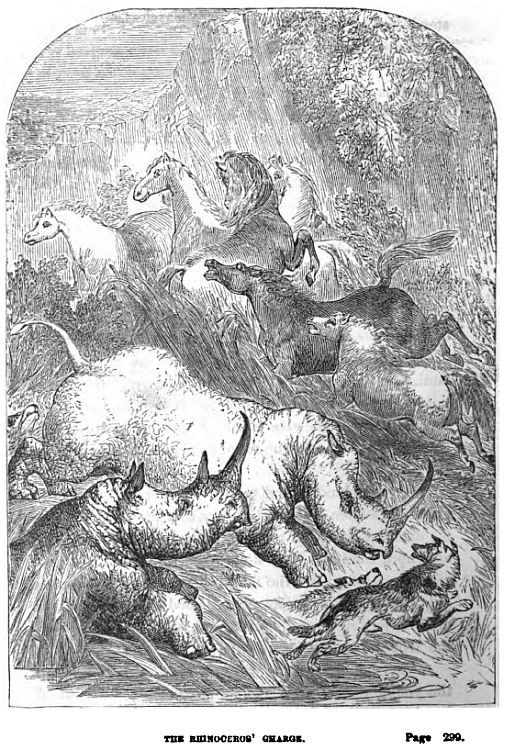
Fortunately, the small circumference within which this scene was enacted, enabled the hunters to use their pieces with effect; and whenever either of the rhinoceroses came to a stand, if but for a moment, the crack of a gun could be heard, and the thud of a bullet hitting against their thick hides. It is a mistake to suppose that a leaden bullet will not penetrate the skin of a rhinoceros. On the contrary, the hide, though thick, is comparatively soft, and yields easily to either a spear or a ball—so that every shot took effect. The hunters, par excellence, Hendrik and Groot Willem, fired most of the shots, aiming behind the fore-shoulder for the heart and lungs—for in these parts the shot proves fatal. A bullet into the brain would have a like effect; but as the brain of the rhinoceros is exceedingly small in proportion to the size of the animal, it requires a sure aim to strike it; and the more certain way is to aim for the lungs.
So aimed Hendrik and Groot Willem; and what with the large leaden balls of the roer, and the small but better directed pellets of the rifle, both the muchochos were at length made to bite the dust. The calf was shot afterwards; for after the fall of its parents, the creature did not attempt to run away, but stood by the body of its mother, jerking its little tail about, and wondering what the trouble was all about.
A very, ludicrous scene was now witnessed, that caused the young yägers to break into an uncontrollable fit of laughter. Their laughter, however, did not come until after the incident was over which gave rise to it—for there was danger in the scene, and it was somewhat painful to witness it.
It was as follows. The rhinoceros, like the American bison, when shot down by the hunter, rarely falls in the common way of other animals—upon its side—but usually sinks down upon his breast, and there remains even after death has taken place.
The two shot by Hendrik and Groot Willem had offered no exception to the rule. Both lay upon their bellies at a little distance from the wagons, their broad massive backs turned upward.
Now a practice equally common among Bushmen, whenever a rhinoceros has been killed, is to leap upon the animal’s back, thrust their spears into its flesh to try the depth, and discover whether the game be fat, and consequently valuable!
In the carrying out of this custom, no sooner had the great bull rhinoceros sunk down under the shots, than our Bushman, Swartboy, seeing that all danger was over, leaped forth from the wagon, and running up to where the dead animal lay, sprang upon its back! Shouting out a wild cry of triumph, he plunged his assegai into the flesh of the muchocho to the depth of a foot or more.
Almost at the same instant, the animal, which was not yet dead, rose to its feet again, and charged once more across the sward, with the Bushman upon its back!
The shout of triumph, which Swartboy had uttered, was suddenly interrupted, and cries of a far different import now rang through the glen; while the rhinoceros, no doubt impelled to fresh energy of life by the terrible pain he suffered from the Bushman’s spear, charged round and round, as though he had quite recovered!
Swartboy, on the other hand, dared not leap to the ground, lest he might be impaled upon the dread horns, but held fast to the spear, which, still buried in the animal’s thick flesh, served him as a point d’appui!
How Swartboy would have been delivered, had the strength of the muchocho held out, it is hard to say; but this gave way at length, and the huge quadruped once more sank to the earth, pitching the Bushman several yards over his head!
Swartboy did not lie long where he had been flung; but, sprawling up again, ran back at top speed to the wagons, where he was welcomed by yells of laughter! The oxen were soon overtaken and brought back, the calf of the muchocho regularly butchered, and that night the young yägers enjoyed a supper of “rhinoceros veal.”
Chapter Forty Eight.
Jan and the Koorhaans.
The next camp of the young yägers was fixed in a beautiful valley very similar to that in which they had seen the troop of lions, but of larger extent, and having its whole surface enamelled with bright flowers.
There were mountains all around, that seemed to shut in this fair picture and protect it from the hot dry winds of the desert. A river wound through its midst like a silvery serpent; and here and there upon the pools, where there was not much current, rested the wax-like leaves and flowers of the blue lily of South Africa, (Nympha cerulea), Upon the plain grew trees and plants of various sorts peculiar to the botany of the country. The eyes of the travellers rested upon many a fair form. Upon the banks of the stream they saw the drooping fronds of the Chaldean willow; and by the foot of the mountain the splendid Acacia eburnea, with its umbrella-shaped head, and clusters of golden flowers filling the air with their fragrance. They saw the valuable wax-berry, (Myrica cerifera), yielding its clusters of white wax-coated fruit. They saw the perfumed “bead-bush,” out of whose fragrant roots are shaped the beads held in such esteem among the savage belles of the land. They saw the “sugar-bush,” (Protea mellifera), with its large cup-shaped pink and white flowers,—the most beautiful of the tribe of Proteaceae. There, too, were scarlet geraniums, with marigolds, and starry Cape jessamines, forming a garden in the wilderness pleasant to the eye and fragrant to the sense.
The songs of numerous birds fell upon the ear, and their brilliant plumage could be seen as they fluttered among the branches. The hum of bees, too, was heard; and thousands of these busy insects could be seen fluttering from flower to flower.
It was still early when the party arrived in this delightful spot; but so pleased were all of them with the scene around that they determined to halt before the usual hour and encamp there for the night.
So, choosing a pretty grove of willow-leafed “olean-wood” trees, that stood near the bank of the river, they outspanned under their shade.
As they were wearied by their exertions in getting the oxen over some rocky ridges, all lay down to rest under the cool shadow of the olean-woods; and several of the boys went to sleep, lulled by the sweet voices of the birds, the humming of wild bees, and the rushing sound of the water as it passed over some rapids below.
Klaas and Jan, however, had not gone to sleep with the rest, for neither had laid their shoulders to the wagon-wheels, and were, therefore, no more tired than usual. Besides, there was something nigh at hand that would have kept both awake, even had they been a good deal fatigued, and that was the appearance of a pair of very odd-looking birds out upon the plain, at no great distance from the wagons, and that every now and then raised their black top-knots above the grass and uttered a cry something like the croak of a raven.
These birds were not so very large—about the size of common fowls—but they were game-birds, having flesh of excellent flavour, and this rendered them interesting at the moment. They were, also, of very elegant forms—something of the tall majestic shape of the bustards. In fact, they were of a species that forms a sort of link between the bustards and grouse families; and are known in South Africa as “koorhaans,” and in India by the name of “floricans.”
But it was nothing of all this that rendered them so interesting to Klaas and Jan. It was that the latter knew a very curious method of capturing these very birds, and he was in a perfect fever to put it in practice right before the eyes of the rival bird-boy Klaas. In fact, ever since the day that Klaas had so distinguished himself by knocking over the klipspringer, Jan had been burning for an opportunity to perform some feat of equal pretensions, but none had turned up. Now that these birds—old acquaintances of Jan’s they were—had made their appearance, he saw a fair chance of gaining some renown. He would show Klaas how to catch koorhaans in a proper manner—that he would. So said Jan.
Jan was not long in having his triumph, which he obtained in the following manner.
He first pulled some long hair from the tail of his pony, which he twisted into a large stout snare. He next proceeded to Swartboy, and borrowed from the Bushman his whip, or rather the handle of the whip—for Swartboy took off the lash to accommodate him. It must be here remembered that Jan and Swartboy were great allies, and had been so for a long time; and it was in reality Swartboy who had taught Jan the curious mode he was about to practise upon the koorhaans. It must also be remembered that the handle of Swartboy’s whip was an immense affair—a bamboo cane, full eighteen feet in length, and more like a fishing-rod than a whip-handle.
Well, upon the end of this, where the lash had been tied, Jan adjusted his snare; and then, mounting his pony, rode forth upon the plain.
Klaas stood watching him; and upon Klaas’s countenance there was a puzzled expression that Jan did not fail to notice, and that delighted him exceedingly.
Klaas knew nothing about the modus operandi—could not guess how the other was going to act—and his ignorance betrayed itself, though he did not say a word.
Was Jan going to ride up and snare the birds? Surely they would not let him come so near? They appeared shy enough, and would not let him, Klaas, come within shot, for he had tried it but the minute before. No: it could not be that way—the koorhaans wouldn’t stand it, he knew.
Jan said nothing, but rode triumphantly forth, looking askance at Klaas as he passed out from camp.
When within about one hundred yards of the koorhaans—Klaas expecting every moment to see them run off as koorhaans usually do—Jan turned the head of his pony, and commenced riding round in a circle.
This he continued until he had got quite round the first circumference; and then, drawing his pony slightly inward, he began a second circle, which he completed as the first; and then still heading more inward, he made a third, and a fourth, and a fifth—of all which circles the bustards formed the centre. Of course, it was not exactly a circle he traced, but a spiral line constantly narrowing inward upon the game.
“Oho!” muttered Klaas, “I see what he’s after now. Oho!”
Klaas said nothing more; but remained watching with great interest, while Jan continued round and round like a blind horse in a brick-mill.
But Jan was not blind. He was watching the movements of the koorhaans with the sharp eye of a bird-catcher.
And these birds were equally watching him—turning their heads now to this side and now to that; but, like stupids as they were, neglecting to use either their wings or legs to carry them out of the way of danger.
The result was that they permitted the pony, and Jan upon its back, to approach so near, that the boy was at length able to reach one of them with the top of Swartboy’s long whip-stick, and pass the noose over head, topknot, and all.
In another moment the bird was fluttering at the end of the bamboo; and Jan, without dismounting, pulled the creature in that way up to the wagons, and held it there with an air of triumph that left Klaas without a word to say for the “balance” of that evening.
Chapter Forty Nine.
Groot Willem and the Python.
Groot Willem awoke from his nap before the others. It still wanted nearly two hours of sunset, and the hunter, observing a reddish object at a distance that looked like some animal, shouldered his roer and proceeded towards it. He took with him one of the buck-dogs, a well-trained and favourite hound, that usually accompanied him—even on a stalking expedition.
The red object which he had seen was near the edge of the valley, and at the bottom of a rocky precipice that bounded it upon that side. There were some trees growing along by the foot of the cliff, and the hunter calculated on being able to get a shot at the animal, whatever it was, from behind the cover of these trees. He continued on up the valley, and at length got near enough to tell what he was stalking at.
It was a small antelope, just about the size of the klipspringer, and with little erect horns four inches in length. In colour, however, it was unlike the latter. The upper parts of its body were a deep red, and underneath white, while its snout and face were black. The little creature was higher at the croup than at the withers, and entirely without a tail, or with a tail only one inch long, that had more the appearance of a stump.
Groot Willem, when he came nigh, recognised this antelope to be the steenbok, for he had met with it before, as it is common throughout the colony, inhabiting high lying grounds where there are bushes. It is one of those classed under the genus Tragulus, of which three other species—all small antelopes—are met with in South Africa. The other three are the “grysbok,” (Tragulus melanotis), the “vlackte steenbok,” (T. rufescens), and the “bleekbok;” (T. pediotragus); though some naturalists assert that the last are only varieties of the steenbok, (T. rupestris). Groot Willem did not spend a thought upon these matters, he only thought of “stalking” the steenbok, and having its ribs for a roast at supper. He was able to approach it without any difficulty, as it was close to the bushes, and appeared not to be very shy.
There was but the creature itself—a little buck; and rarely is more than one, or at most two of these antelopes seen together—for the steenbok, and all the others of the genus Tragulus, are monogamous and solitary.
Groot Willem was at length within range, and was about to level his roer on the game, when the movements of the little animal caused him to hold his hand. Its actions were very odd, indeed. It was not browsing—it was not standing still—it was not running away from the ground,—and yet it was in constant motion!
As already stated, it was close in to the edge of the timber, where a number of small olean trees stood thinly over the ground. In front of these the little buck was dancing about in a very original manner. Now it ran to the right,—anon to the left,—now zigzag,—now it started suddenly backwards,—then ran forwards again,—all the while its eyes turning in a particular direction and shining brilliantly, as if the animal itself was in a state of unusual excitement.
Groot Willem looked to discover the cause of this odd manoeuvring on the part of the steenbok; something among the olean-wood trees seemed to attract the notice of the animal. On this something the eyes of the hunter rested with wonderment; and for some moments he was unable to make out what it was. He could perceive a large glittering mass near the bottom of one of the trees; but this mass at first sight appeared without any particular form, and lay perfectly motionless.
As Groot Willem continued to gaze upon it, however, it gradually assumed a form, or rather his eyes gradually traced one, for the mass had not yet moved.
A hideous form it was—though of smooth and regular proportions—it was the form of a reptile—a serpent!
A serpent of enormous size, for the mass of its body, gathered up in a sort of irregular coil, covered the ground over a space of several square feet, while the body itself seemed thicker than the thighs of a full-grown man! The head of the reptile rested upon the top of the coiled body, and on running his eye along the mottled and glistening outlines, Groot Willem perceived that its tail was doubled around the stem of the olean-wood, and held it with firm grasp—for the serpent belonged to a family whose tails are furnished with horny claw-like hooks, giving them a power of prehension in this member equal to that of a hand. This is the family of the Boidae, or “boas,” to which the one in question was generically related. It was a python—the Python Natalensis.
Groot Willem only knew it as the “rock-snake,” and that is its ordinary designation—given it on account of the fact of its being a dweller among rocks and stony places. It might very properly be called “rock-boa,” which would distinguish it from its cousins of America, the Anaconda, or “water-boa,” and the true boa, which is a denizen of the forest, and which would therefore merit the title of “tree-boa.”
Notwithstanding the difference of the dwelling-place of the boas and pythons, their habits are very similar. They lie in wait for their prey, capture it with their strong retractile teeth, and crushing it to death by constriction, swallow it whole—though often the animal swallowed is much larger than the diameter of their own bodies. Their elastic muscles, however, enable them to effect their purpose, aided by the slippery saliva which is copiously supplied from their glands.
When Groot Willem first saw the huge python, its head was lying over the coils of its body, and motionless. Presently, the head was raised up with the neck, and several feet of the body; and the parts, thus erected, moved gently from side to side with a sort of vibratory motion. The jaws were widely extended, so that the sharp retractile teeth were plainly visible, and the forked tongue at intervals was shot forward, and gleamed in the sun. The eyes of the reptile sparkled like fire.
It was a fearful object to look upon! And yet the steenbok did not appear to dread it. On the contrary, it kept drawing nearer and nearer, excited either by curiosity or fascination!
There are those who ridicule the idea of fascination on the part of serpents. But whether we are to believe in such a power or not, we cannot deny the fact. Certain it is, that whether it be curiosity, fear, or fascination, both birds and animals are moved to approach not only serpents, but crocodiles, until within reach of the jaws that are opened to devour them. Certain is this, and vouched for by the testimony of many a correct and reliable observer.
Groot Willem witnessed the strange phenomenon. When the buck had got within some six or eight feet of the python, the head of the latter suddenly shot out; and before the antelope, which now appeared making an effort to escape, could spring out of the way, it was seized by the teeth of the reptile, and dragged towards the tree!
A number of quick contortions followed, and when Groot Willem looked again, the red body of the little antelope was almost hidden under the thick folds of the spotted python, that writhing around it was crushing it to death!
Chapter Fifty.
Groot Willem’s Great Struggle with the Snake.
Now it chanced that the sight of that great serpent was very gratifying to the eyes of Groot Willem—far more so than any antelope. The reason was, that a friend of his, a young doctor of Graaf Reinet, who was fond of the study of herpetology, had requested him to bring home the skins of such rare snakes as he might fall in with—but especially that of the great “rock-snake,” which is not found in the colony, not even so far south as the Orange River.
Here was a chance for the skin, which, up to this time, Groot Willem had searched for in vain.
He had another reason for being gratified; and that was the splendid trophy it would be, provided he succeeded in obtaining it. To kill a snake twenty feet long, and half as thick as a man—for the python appeared to be both—would be no small triumph! Where would Hendrik be then?
All at once the steenbok was forgotten, and the snake became the object of the hunter’s skill.
Groot Willem had no skill about him. He knew of no mode to attack this new sort of enemy, except dealing with it as he would with a quadruped—that is, sending a bullet into it; and this he did the moment after.
His roer was levelled; and, glancing through his ivory sights, he fired the large ball through the thickest part of the reptile’s body.
The latter felt the shot; and, suddenly unfolding itself, dropped the steenbok—now nothing more than a mangled carcase, with scarce a whole bone in it. The rapidity with which the snake glided off showed that the wound had done it but little harm.
The hunter thought of reloading again, when he perceived the serpent fast making to the rocks that in large masses lay piled up near the bottom of the cliff. Among these was its retreat; and if it once reached them, Groot Willem saw that he should never set eyes on it again.
Without staying to reload his gun, then, he ran in among the trees, and followed the direction taken by the serpent.
Although these snakes glide along with considerable rapidity, they can by no means go so fast as a man; and in less than a dozen seconds Groot Willem had overtaken the python, and for that matter might have trodden upon its tail.
There he was close beside the fearful-looking monster, but without the knowledge how to attack it. He began by striking at its body with the butt of his gun; but although his blows were delivered fairly enough, the metal-shod heel of his roer only glanced from the slippery skin of the snake, without harming it in the least, or even retarding its progress towards the cliff. It made no attempt to retaliate, but only seemed bent on escaping to its lair.
It was almost successful; for although Groot Willem pounded away with all his might, it reached the rocks in spite of him, and had buried half of its long body within a crevice—no doubt the entrance to its den—before the hunter thought of changing his tactics.
It was now a critical moment with Groot Willem. Another instant, and the remaining half of the snake would slip out of sight, and then good-bye to it. What would he say to his medical friend? What to Hendrik and the yägers?
These thoughts inspired him with renewed energy; a new determination to succeed came over him. The snake was not a poisonous one; and, therefore, the encounter could not be very dangerous. It might bite him, but he had battled with many a biting creature before now, and conquered them, too. He would try his strength upon the snake.
He was not two seconds of time on coming to this determination; and, as soon as he had done so, he tossed his roer aside, and stooping down, seized the tail of the snake in both hands, and commenced hauling upon it!
At the first “pluck” he drew the reptile several feet outward; but, to his surprise, it then held fast; and, notwithstanding his great strength, he was unable to draw it a foot farther. The creature had, no doubt, got the fore-part of its body around an angle in the rocks; and, aided by its scaly skin, was enabled to hold fast.
Groot Willem pulled with all his might. A sailor in a storm could not have hauled harder upon the main brace; but all to no purpose, as not another foot of that part of the python that was still visible could be lengthened. About the half of it was still outside, but the other ten feet were buried within the dark recesses of the rocks.
For several minutes Groot Willem continued to exert his strength, dragging the long cylinder until he could hear its vertebrae crack, but without gaining an inch! On the contrary, he had already lost several inches. Every time that he relaxed his hold, the python was enabled to move forward a bit, and this ground it never gave up again. If Groot Willem allowed it an inch, it was sure to struggle for an ell! It had all the advantage on its side, as it pulled with the grain, while its antagonist was exerting his strength against it.
Groot Willem felt confident he could hold the python in this position, as long as he could stand upon his feet; but what good would there be in so doing? He could not kill it in that way. If he were to “let go” for but an instant, he very well knew that the next instant would show him the last inch of the tail disappearing into the crevice! No, he could not let go, and he was resolved not to let go, until he should at least try the patience of his opponent. Maybe it would tire of being thus held upon the “stretch,” and would let him pull it out again.
If there had only been some one with him to administer a few smart blows upon the creature’s body it would have been all well; but the camp was at a very long distance off, and behind the trees. His companions could neither see nor hear him.
After standing on the strain a considerable time, a bright idea entered the brain of the hunter. There grew a small tree beside him—in fact, he was close by its trunk. The thought occurred that, if by any means he could fasten the tail to the tree, he could then go to work with a sapling, and beat the snake to death at his pleasure.
He was a ready fellow, Groot Willem, and a few moments sufficed him to mature his plans. He chanced to have a strong “cord” in the ample pocket of his jacket, which would serve to effect the very purpose, if he could only manage somehow to make it fast to the tail. This he proceeded to do at once.
Straddling the snake, so as to hold it partly between his knees, he was enabled to loop the cord tightly around it, and the thing was done. In a minute more, the other end of the cord was tightly knotted around the trunk of the tree!