"A Narrative of Hunting Adventures in Southern Africa" (continued 4)
Reading edition
Hendrik’s assailant was the keitloa. Although less is known of this species than either the muchocho or borelé—because its district lies farther to the north—yet Hendrik had heard something of its character from Hans, as well as from old hunters. He had heard that it is even more fierce and dangerous than the borelé and is more dreaded by the natives. In districts where it is common, the people fear it more than any other animal—not even excepting the lion or the grim buffalo!
Hendrik had heard this about the keitloa, and no longer wondered at its having attacked him in the savage and unprovoked manner it had done. He only thanked his stars that there existed that little ledge of rock upon which he now stood, and from which he could look down and contemplate those terrible horns with a feeling of complacency which, five minutes before, he had not enjoyed. He almost laughed at the odd situation he found himself in.
“What a place for Hans!” he said in soliloquy. “Capital place for him to study the natural history of this clumsy brute!”
At this moment, as if echoing his thoughts, the keitloa began to exhibit before him one of its peculiar habits.
There stood a good-sized bush right in front, having a number of separate stems growing from one root, the whole forming a little clump of itself. Against this bush the rhinoceros commenced battling,—now charging it from one side, now from another,—dashing at it headforemost, breaking the branches with his horns, and trampling them under his thick clumsy limbs—all the while, by his menacing look and movements, appearing as if he was fighting with some enemy in earnest! Whether in earnest or not, he continued to go on in this way for more than half-an-hour, until every stem and branch were barked, broken, and crushed to mummy among his feet, and not till then did he desist from his furious attacks.
The whole thing had such a ludicrous air about it that it recalled to Hendrik’s mind the story of Don Quixote and the windmill, and set him laughing outright. His merriment, however, was not of long duration, for he now began to perceive that the fury of the keitloa was as long-lived as it was terrible. The glances that the animal from time to time cast upon the hunter told the latter that he had to deal with an implacable enemy.
As soon as the creature had finished its battle with the bush, it walked back towards the cliff, and stood with its head erect and its small lurid eyes gleaming upon the hunter. It appeared to know he was its prisoner, and had resolved upon keeping him there. Its whole manner satisfied Hendrik that such was its intention, and he began once more to feel uneasy about the result.
When another hour had passed, and still the keitloa kept watching him from below, he became more than uneasy—he became alarmed.
He had been suffering from thirst ever since they commenced hunting the blesbok—he was now almost choking. He would have given any thing for one cup of water.
The hot sun—for it was yet only noon—scorched him as he stood against that bare burning rock. He suffered torture from heat as well as thirst.
He suffered, too, from suspense. How long might his implacable sentinel keep watch upon him? Until the keitloa should leave the spot, there was not the slightest hope of his escaping. To have returned to the plain would be certain death. It would have been death but for the timely proximity of that friendly rock. No hope to escape from its broiling surface so long as the fierce brute remained below.
Would Hans and the others believe him lost, and follow upon his spoor? They might, but not till the next day. They would not think of him being lost before night came, as it was no unusual thing for one of them to be off alone from morning till night. How would he endure the terrible thirst that was raging within him? How would he suffer it until they should arrive?
Besides, it might rain during the night. His spoor would then be completely obliterated. They would not be able to follow it, and then, what might be his fate?
These and many other reflections passed through his mind as he stood upon the ledge, regarding his fierce jailer with looks of anger and impatience.
But the keitloa cared not for that. He still remained upon the ground, now pacing to and fro by the bottom of the cliff, and now standing still, with head erect, his small dark orbs scintillating with a look of untiring vengeance.
Chapter Thirty One.
A Singular Escape.
As the moments passed, Hendrik’s thirst grew fiercer, and his impatience stronger. He had already examined the cliff above him—in hopes that he might have found a way by which it could be scaled. To no purpose did he look up. There were other ledges, it is true, but they were beyond his reach. The shelf he stood upon ran along the face of the cliff for many yards, but narrowed at both ends until it could be followed no farther. He had not moved from the spot where he ascended, as that was the broadest part, and where he was most out of reach of the elastic snout and long horns of the keitloa.
He now remembered that, while battling about below, he had noticed a dark spot above the ledge, which he had conjectured to be the entrance of a cave, or a hole in the cliff. He had thought of it once again, but as creeping within a cave would not render him more secure than he was out on the rock, he had not gone towards it.
Now it occurred to him that he might examine the cave, and enter it if large enough to admit him. It would, at least, be pleasanter there, as he would be sheltered from the hot rays of the sun—an important consideration at that moment.
But there was another consideration that influenced him still more; and that was, the thought that were he once out of sight the rhinoceros might forget him. He knew that the old adage, “out of sight, out of mind,” had a good deal of meaning when applied to the borelé, the lion, and many other dangerous animals; and perhaps the proverb would also hold good of the keitloa—though what he had heard of this creature gave him very little ground to hope. At all events, he could test the thing. It would not cost much time to make the trial; and even should it prove of no service in that way, the change from his present stand upon the hot ledge for a seat within a cool cavern could not otherwise than better his condition. To the cave then!
Fixing his eye upon the keitloa, he commenced moving along the terrace, towards the point where he remembered having noticed the dark fissure in the cliff.
The keitloa followed, keeping with him step for step; and apparently roused to fresh vigilance, as if it feared that its victim was about to attempt an escape. All the way it followed him; and as the ledge grew narrower, it became necessary for Hendrik to proceed with great caution. Not that he was in danger of falling from it, but rather of being dragged—for the rhinoceros, by standing on his hind-legs, was now able to stretch his broad muzzle above the edge of the rock, and to protrude his elastic snout across the ledge within a few inches of the wall beyond. It therefore required “gingerly” stepping on the part of Hendrik. Notwithstanding all the menacing efforts of his adversary, Hendrik succeeded in reaching the entrance of the cave.
It was a cavern deep and dark, with a mouth sufficiently large to admit the body of a man in a bent position.
Hendrik was about stooping to enter it, when a loud “purr” sounded in his ears that caused him to start erect again, as if some one had run a needle into his back! The “purr” was quickly followed by a “roar,” so deep and terrible, that in his first moments of alarm, the hunter felt half inclined to leap to the ground, and risk the horns of the rhinoceros, which, at that instant, were gleaming above the ledge, within twenty inches of his feet!
There was no mystery in what caused the alarm. There was no mistaking that roar for any other earthly sound. The cave was tenanted by a lion!
The tenant did not remain much longer within his house. The roaring continued; and every moment sounded nearer and clearer. The huge claws caused a rattling among the dry pebbles that strewed the bottom of the cave. The lion was coming forth!
With the nimbleness of a klipspringer, Hendrik bounded to one side, and ran back along the ledge, looking fearfully behind him.
This time he was not followed by the keitloa. The rhinoceros, whether terrified by the roar of the lion, or whether his attention was solely taken up by it, remained standing where he had taken up his position, with his head projected over the rock, and his snout pointed towards the entrance of the cavern.
Next moment the shaggy front of the lion filled the mouth of the cave, and the king of beasts and the “king of brutes” came face to face!
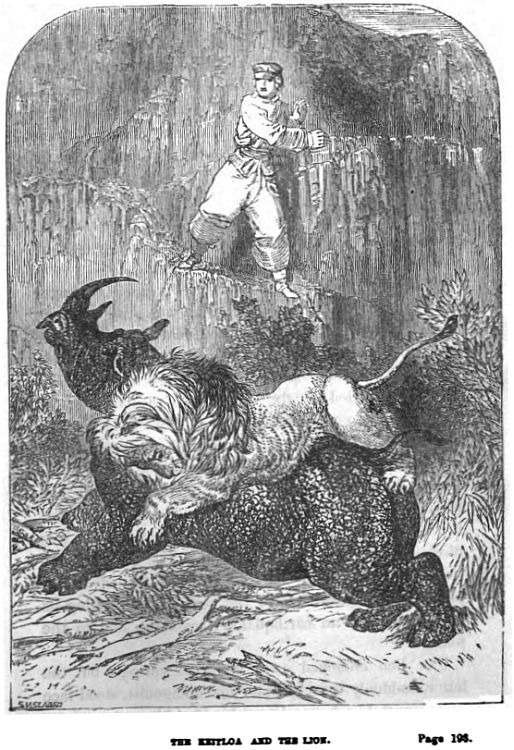
For some moments they remained gazing at each other; but the eyes of the lion seemed to intimidate the keitloa, and the latter drew his head back, and dropped on all fours to the ground. Perhaps he would have gone off from the spot without an encounter; but the ire of the dread monarch had been aroused by this intrusion upon his rest. For a moment he stood lashing his tawny sides with his tail; and then, crouching until his breast touched the rock, he launched himself out from the ledge, and came down with all the weight of his body upon the broad back of the keitloa!
But, king as he was, he had mistaken the character of that “subject,” if he thought he was going either to mangle him badly, or put him to flight. Sharp as were his claws, and strong his arms to strike, they barely scratched the thick hard hide of the pachyderm; and although he tried to “fix” himself on the shoulders of the latter, he could not manage to stick. Had it been a buffalo, or an antelope, or even the tall giraffe, he would have ridden it to death; but to ride a rhinoceros was a different affair; and he found it so. Although he used both teeth and claws to keep him in the position he had taken, neither would serve him, and he was dismounted almost in an instant. The moment the keitloa felt the fierce rider on its back, it made a desperate rush outward from the rocks, and shaking its huge body like an earthquake, it cast the lion to the plain.
The lion crouched as if again to spring; but the latter, suddenly turning upon his antagonist, stood face to face with him before he could effect his purpose.
The rhinoceros did not pause a moment, but rushed on his antagonist with his horns set like couched lances. The weight of his body, with the impetuosity of the charge, would have driven those hard sharp weapons through the toughest skin that lion ever wore, and through his ribs as well. The lion seemed to be troubled with some such idea; for, instead of awaiting the onset of his enemy, he turned tail—the cowardly brute!—and made off up the pass, the keitloa chasing him as if he had been a cat!
Hendrik, all the while, had watched the combat from the ledge; but he never knew how it ended, or whether the rhinoceros overtook the lion or not. The moment he saw the two great brutes in full run up the pass, he leaped from the ledge and ran down it, with all the speed he could take out of his legs.
On reaching the angle, he hesitated a moment which way to take—whether to follow back the spoor of the hunt, or the later tracks of his horse—but at length he decided on following back his own spoor over the open plain. He ran along it as fast as he was able, looking over his shoulders at very short intervals, and still fearful that the great black body would show itself in his rear. He was agreeably disappointed, however. No keitloa followed in pursuit; and soon another agreeable fact came under his notice—he perceived that his horse had also gone back the same way. On rounding a clump of bushes some distance farther on, he saw the horse browsing a little way off upon the plain.
The latter permitted himself to be caught; and Hendrik, once more mounting to the saddle, pursued his way towards the camp. The spoor of the hunt guided him in a direct line; for the blesboks, it will be remembered, ran all the while to windward, thus following a straight course. Hendrik had no difficulty in following the track; and, after two hours’ riding, got back to camp, having picked up most of the dogs on his way back.
Hans and Arend did laugh at him. Groot Willem did not. The latter remembered how his rival had acted after his own tumble over the burrow of the aard-wolf; and now reciprocated Hendrik’s handsome behaviour on that occasion. Groot Willem and Hendrik were likely to become great friends.
Chapter Thirty Two.
A Vast Herd of Antelopes.
Next day the young yägers were witnesses to a most extraordinary spectacle; and that was, a vast herd of blesboks,—so vast, that the plains appeared literally covered with their purple masses!
This herd was not browsing, nor at rest, but scouring up against the wind—as those hunted the day before had done—and evidently running as if some dreaded enemy in their rear had given them an alarm.
The mass of bodies was nearly half a mile in width; but it would have been difficult to estimate its length, as it continued to pass before the eyes of the yägers for more than an hour! On the animals poured, sometimes running in line, and sometimes the hindmost leaping over those that preceded them, moving like an impetuous torrent. All of them ran with necks extended forward, their noses close to the ground, like hounds running upon the scent!
Here and there they were closely packed in dense masses, while in the intervals between, the bucks were thinly interspersed; and now and then were wide breaks, like an army marching in column.
The cause of these openings was simply that the immense drove consisted of a great many separate herds, all running by one impulse; for it is a curious habit of the blesboks and bonteboks, that when one herd becomes alarmed, all the other herds that chance to be in the same plains with this one, both to windward and leeward of it, start off in succession; and as all, from their habit of running up the wind, must follow the same direction, a constant drove, or rather a continuous succession of droves is formed, and passes in open column before the spectator who may be on either flank. The wonderful spectacle of so many living creatures, running together in such countless numbers, brought to mind the accounts, which the young yägers had read, of the migrations of the buffalo on the prairies of America, and also those of the passenger-pigeon. Of course, the resemblance to the “trek-boken” of their own springboks, which all of them had witnessed, was also remembered.
On this day our hunters were more successful than upon the preceding. They had learnt by their experience of yesterday how to “jäg” the blesbok.
Instead of attempting either to “stalk” or “head” them, they found that the best plan was to ride along the flanks of the running herd, and now and again dash near enough to fire into the thick of them. The blesboks, while moving to windward, will permit the hunter to get within three or four hundred yards of their flank; and the mounted hunter, keeping his horse fresh, can now and then gallop within shooting distance before the moving mass can turn out of its course. Firing among a flock in this aimless way, the bullet is not always sure of a victim, but now and then a buck fells to the shot.
Practising this plan, the young yägers played upon the flanks of the great herd during the whole time of its flight to windward; but notwithstanding the continuous cracking of rifles, with now and then the louder detonation of Groot Willem’s great elephant-gun, the slaughter was not very great. Six only “bit the dust.” But as in the six there chanced to be an equal number of bucks and does, the hunters were quite content. They were not “jäging” for the meat, but merely to get specimens of the horns and prettily-painted skins; and three of each were as many as they wanted.
The hunt was soon over; and as their horses were pretty well “blown,” the yägers returned at an early hour to camp, taking with them only the heads, horns, and skins of their game, with just enough of the venison to give them fresh steaks for a day or two.
One peculiarity they remarked in skinning the blesboks—that the skins of these beautiful creatures exhaled a pleasant perfume—arising, no doubt, from the fragrant plants and herbage upon which the animals feed.
The afternoon was spent in dressing the skins—by removing the fatty flesh that adheres to them—and they were then spread out to dry. Under such a hot sun, a few hours was sufficient to render them dry enough to be carried on to the next camp, where they would be spread out for a longer period, and thoroughly prepared for packing in the wagons.
Hendrik and Groot Willem performed this service; but the preparing of the heads—a more scientific operation—was the work of Hans assisted by Arend. Hans had his box of chemicals, consisting of arsenical soap and several other noted “preservers,” which he had brought along for this special purpose; and by night, two pairs of heads, with the skin and horns attached, were thoroughly cleaned and mounted, and ready for nailing up to the wall.
There was a buck and doe in each pair; one, of course, for the Von Blooms, and another for the mansion of the Van Wyks.
The only difference between the horns of the blaze-buck and the blaze-doe is, that those of the latter are shorter, and more slender; while the skin of the doe is less vivid in its colouring, and smaller, as is also the body of the animal. The same remark applies to the kindred species—the bonteboks—of which brilliantly coloured creatures full sets of horns and skins were obtained the day after.
On this occasion, the “stand and drive” recommended by Groot Willem had been tried again, and with great success; each of the four—Hans, Hendrik, Arend, and Groot himself—having shot his buck as the flock dashed up to their stands. Indeed, Hans, upon this occasion, had carried off the palm. His double-barrel, loaded with ball, had enabled him to knock over a couple of the “painted goats”—as bonteboks are sometimes styled—right and left.
The explanation of their success in this hunt, and their failure when trying the same plan with the blesboks, is not found in any essential difference between the two species. Their habits are almost the same.
No. Their success lay simply in the fact, that on the day when they jäged the bontebok, there was no wind—not a breath of air stirring. On this account the game were not only unable to run against the wind, but, keen as is their scent, they were not able to tell behind which ant-hill lay their concealed enemies.
The consequence was, that Klaas and Jan were able to drive them right up to the ambushed hunters, who slew them without difficulty.
The “stalk” would not have succeeded on such a day, for these antelopes trust far more to their nose than their eyes; moreover, a correct rifle-shot is very difficult to be obtained in the plains of the “zuur-veldt,”—as the mirage is almost always upon them, and interferes with the aim. So strong is this mirage, that objects at a distance become quite distorted to the eye, and out of all proportion. A secretary bird stalking along looks as big as a man, and an ostrich attains the altitude of a church-steeple. Even the colour of objects becomes changed; and travellers have mistaken a pair of tawny lions for the white tilts of their own wagons and have gone towards them, thinking they were riding into their camp! An awkward mistake, I should fancy.
After having secured their specimens of the pied antelopes, the young yägers again broke up camp, and treked away across the plains of the “zuur-veldt.”
Chapter Thirty Three.
The Lone Mountain.
It has been observed, that upon the plains of the zuur-veldt country, mountains of singular forms meet the eye of the traveller—cones, domes, square box-like masses with table tops; sharp ridges, like the roofs of gigantic houses; and some that pierce the heavens with pointed peaks like the steeples of churches! Some, again, present a horizontal outline, like the parapet of a fortification, while square tower-like masses, rising above the general level, carry out the idea of some work of military architecture on a grand scale.
Our young yägers were very much interested in these mountain forms, so varied and fantastic. Sometimes their route led them along the base of a precipice rising a thousand feet sheer above the plain, and trending for miles without a break, so that for miles no access could be had to the mountain that rose still higher above. Sometimes they were compelled to trek along narrow ridges that sloped off on both sides, leaving scarce enough of level to run the wheels upon. Then, again, they would be compelled to pass around some spur, that, shooting for miles out into the plain, barred their direct path.
As they treked across one of the widest plains they had yet seen, a singularly formed mountain drew their attention. It could scarce be called a mountain, as its altitude above the plain could not have been more than seven or eight hundred feet; but its brown rocky surface gave it that character, and to have styled such a mass a hill would have been equally misnaming it. There were no “foothills,” or inequalities near its base. The greensward of the level plain stretched away on every side—its verdant colour strongly contrasting with the dark brown granite of the mountain.
The sides of this singular mountain sloped from base to summit as regularly as those of an Egyptian pyramid; and at a distance it looked pyramidal, but on coming nearer its rounded form could be perceived. It was, in reality, an obtuse cone, perfect in all except the apex, and it was there that the peculiarity of this mountain lay. Instead of ending at the apex, a steeple-like rock rose out of the summit some thirty feet higher, ending in a point that appeared from below as “sharp as a needle.” It was this that had drawn the attention of the young yägers more particularly, as other mountains of conical form were common enough along their route; but this one, looking, as one of them observed, like an inverted funnel, differed from any they had yet seen. It was very conspicuous, thus standing isolated in the midst of the open plain, and contrasting so much in its colour with the green table upon which it appeared to rest.
“Let us go and explore it,” proposed Arend; “it isn’t much out of our way. We can easily overtake these slow-going oxen again. What say ye all?”
“Let us go, by all means,” said Hans, who fancied that upon so odd-looking a mountain he might fall in with some new plant.
“Agreed!” cried all the others in a breath, for when Hans proposed a thing it was usually assented to by his younger comrades.
Without further ado the whole six turned their horses’ heads for the mountain, leaving the wagons to trek on across the plain, towards the point where they intended to encamp.
When the riders first faced to the mountain, it appeared to be about a mile off, and all, except Hans, believed that it was not more. Hans maintained that it was five, and was unanimously contradicted. A discussion took place, Hans standing alone—five to one against him. The idea of its being more than a mile was scouted. Hans was ridiculed—laughed at—called blind.
There was a little epitome of the world on that plain—a paraphrase upon a small scale of Galileo and his contemporaries.
And here let me counsel you, boy reader, ever to be cautious how you pronounce against ideas that may be put forth, because they chance to differ from those you already hold. Half of what you have already learnt is erroneous, and much of it has been taught you with an evil intent. I do not refer to what has been taught you by your school instructor, who imparts knowledge to you with the best of motives. But the tyrants of the earth—both priests and princes—for long centuries have had the moulding of men’s minds, and they have spared no labour to shape them to their own purposes. They have so well succeeded, that one half the very proverbs by which conduct is guided, prove upon examination to be false and wicked.
There is a peculiarity about the attainment of knowledge which assists wicked men in misleading their victims, and I would wish that all of you should know this peculiarity. I do not claim to be its discoverer, for others may have discovered it as well; but up to this hour I have met with no promulgation of it.
It is this, that every truth is overshadowed by a sophism, more like the truth than truth itself. This law holds good throughout the whole extent of the moral, intellectual, and material world.
I cannot pause here to illustrate the above statement—not even to explain it. But I hope the day is not distant, when you and I may converse upon such matters face to face.
I hope you believe that I have helped you to some knowledge; but I now affirm, and in full seriousness, that, if you examine the statement I have thus emphatically made, and study it to a full understanding, you will have gained more knowledge in that one sentence than all I have hitherto written. You will find in it the key to most of the errors and misfortunes that afflict mankind.
In that sentence you will also find a key to the difference of opinion that existed between Hans and his five companions. None of the five were thinkers—they relied entirely on the evidence of their senses. A process of ratiocination never troubled the brain of any of the five. Had they never before seen a straight rod plunged into crystal water, they would most certainly have believed that the rod was bent into an angle—ay, and have ridiculed any one who should have contradicted the evidence of their senses, just in the way they now ridiculed Hans for asserting that an object was five miles off, when they plainly saw it was only a fifth part of that distance. It certainly appeared only a mile off—that is, to one who had been in the habit of measuring distances by the eye in the ordinary atmosphere of a lowland country. But Hans knew they were now in a region elevated many thousand feet above the level of the sea. Partly from books, and partly from his own observation, he had studied the nature of the atmosphere at that altitude; and he was acquainted with the optical illusions of which it is frequently the cause. He admitted that the mountain looked near, even as near as a mile; but he held on to his original opinion.
Patient as was the young philosopher, the ridicule of his companions nettled him a little; and suddenly pulling up on the plain, he challenged them to a measurement. They all agreed to the proposal. They had no measuring chain—not even a yardstick.
But they knew that Hans could tell distances without one; and having consented that his measurement should be taken, they all rode back to the point where the discussion had commenced.
How was Hans going to manage it? By trigonometrical triangles, you will say. Not a bit of it. He could have told the distance in that way if he had wished; but he had a simpler plan. Hans did not carry a viameter, but a viameter carried him!
Yes, in the stout steady-going cob which he rode, he had as perfect a viameter as ever was set to a wheel; and Hans having once put his horse to the proper pace, could tell the distance passed over almost as correctly as if it had been traced by a chain! There was a certain rate of speed into which Hans’s horse, when left to himself, was sure to fall, and this speed was so many steps to the minute—the steps being of equal length. By either counting the steps, or noting the time, the exact distance could be obtained.
Hans had been in the habit of putting his horse to the proper pace for this very purpose, and could do so at a minute’s warning. So, taking out his watch to regulate the speed by the moment hand, he started forward in a direct line for the mountain.
All rode, after, without noise—so as not to disturb Hans in his counting. But for that, they would have continued to gibe him a little. Only for a short while, however; for, as they rode on, and the mountain did not appear to come any nearer, their faces began to look very blank indeed.
When they had ridden for a full half-hour, and the mountain still looked a mile off, Hans had five very crest-fallen boys moving along in his rear.
When they had ridden nearly another half-hour, and their horses’ snouts almost touched the rocks of the mountain, none of the five was surprised to hear Hans cry out in a loud firm voice:—
“Just five miles and a quarter!”
Not a word was spoken. Not one of the five ventured even a whisper of contradiction. Hans did not laugh in his turn, but facing round simply said—
“Every truth is overshadowed by a sophism more like the truth than truth itself!”
Chapter Thirty Four.
The Approach to the Lone Mountain.
Although from a distance the mountain had appeared of smooth outlines, now, that they gazed upward from its base, it presented quite a different aspect. Loose boulders of rock, strewed thickly upon the slope, covered its sides up to the very summit, giving it the appearance of a gigantic “cairn,” such as may be seen upon the tops of some of our own mountains. These, however, are the work of men, while that upon which our yägers gazed looked as though giants had erected it.
Among the loose stones there was yet a trace of vegetable life. Plants of the cactus kind, and rare euphorbias, grow in the spaces between the rocks; and here and there stood a small tree, with spreading top and myrtle-like foliage, casting its shadow over the side of the mountain. The arborescent aloe was also seen, its coral-red spike appearing above the sharp edge of some huge boulder, and strongly contrasting with the dull grey of the rock.
After contemplating the singular eminence for some minutes, it was proposed that they should all ascend to its summit. It appeared but a very short way. The path was not very steep. A ten minutes’ climb would suffice. What a splendid view they should have from its top! It commanded a prospect of the country they were about to traverse for the next three days’ journey at least. They might lay out their course from it, and by noting landmarks, avoid the détours of mountain-spurs and other obstacles. Should they ascend it?
Yes. All of them desired to do so—some to enjoy the view; some for the fun of climbing; and Klaas and Jan because they had seen a large bird wheeling around the summit, which might be the king of birds—an eagle; and they wished to make a nearer acquaintance with his majesty.
Hans also had an interest in going up. He wanted to examine the vegetation of the mountain—that appeared to differ essentially from that of the surrounding plain—and particularly the myrtle-leaved tree already mentioned.
So the voice for making the ascent was unanimous—nemine dissentiente.
Without further ado, they all dismounted—for it would have been impossible to have ridden up such a rock-strewed path—and secured their horses by tying their bridles together. This was their usual way when there was no tree to which they could make them fast. The mode answered well enough. The animals were well acquainted, and on friendly terms, so that they did not bite or kick one another; and with their noses all turned inward, no one of them could stray off without the consent of the other five, and this unanimity could never be obtained. Even had five of them agreed to wander a bit, there was one that would have opposed such a conspiracy, and pulled against it with all his might—one that would have remained loyal to his master; and that was Hans’s steady, sober-sided cob, that had been trained to wait wherever his rider left him. Upon many a botanical excursion had he carried his master, and often had stood with no other fastening than the bridle thrown over his withers, while the botanist climbed the rocky steep, or dived into the thick bush, to pluck some rare plant or flower.
Leaving their horses, the party commenced the ascent. Now their path lay between large masses of granite, and now passed over the tops of the rocks. It required them to use all their strength and agility; and although from below they fancied they would reach the summit in about five minutes time, they were sadly disappointed.
There are few things more deceptive than the ascent of a mountain. It is usually more difficult than it appears, and a large allowance should be made in the calculation, both for time and labour. The philosopher Hans knew this very well, and told the others that it would take them a full half-hour to get to the top. Some of them were inclined to ridicule his assertion; but they remembered their late humiliating defeat, and remained silent—although they thought five minutes would bring them to the very summit.
At the end of five minutes they began to change their opinion; and when three times five had passed over, they found they were still but half-way up the slope!
Here they halted, and five minutes were spent in “puffing and blowing.”
Hans had now an opportunity of examining the tree that so interested him, for they had stopped under the shade of one.
It was not a large tree, nor could it be called a very handsome one; but for all that it proved to be of a most interesting character. It was much branched with small leaves, of a pale green colour, and in their general effect having a resemblance to the myrtles. Its flowers, too, were small and inconspicuous. It chanced to be in flower at the time, and this enabled the botanist to determine its character. It belonged to the order Santalaceae, or “sandal-woods;” and was a species of Santalum, closely allied to the Santalum album of India, which yields the sandal-wood of commerce.
They all knew what sandal-wood was, as they had seen various “knick-knacks” manufactured out of this famous wood; but they knew not whence it came, or what sort of tree produced it. Hans, however, taking advantage of the halt, gave them this information:—
“The sandal-wood,” he said, “is produced from a tree of the same genus as the one now above us. It grows in the mountainous parts of the Malabar country, and also in the islands of the Indian Archipelago. It is a small tree, rarely growing to a foot in diameter. Its wood, as you know, is highly prized on account of its agreeable fragrant smell; and because this fragrance not only keeps it from decaying, but also preserves any material, such as clothes, silk, and other articles that may be in contact with it, from insects or rust. In consequence of this quality of the sandal-wood, it is in great demand for making boxes, cabinets, and such articles of furniture; and, on account of its agreeable odour, it is also manufactured into fans and necklaces which command high prices.
“The Brahmins use it in their sacrifices to the god Vishnu, to scent the oil employed in the ceremony.”
“Are there not two kinds of sandal-wood?” inquired Klaas. “Sister Wilhelmina has a box of it and a necklace, too. They were brought from India by Uncle, but they are very different. The box is white, and the beads of the necklace are of a beautiful yellow colour—maybe they are dyed.”
“No,” answered Hans, “they are not dyed. There are two kinds, white sandal-wood and the yellow sort, and it has been said that they were the produce of different trees. This is not the case, however. Although there is more than one species of Santalum that produces the sandal-wood of commerce, the white and yellow kinds are taken from the same tree. The reason of the difference is, that towards the heart of the tree where the wood is older, and especially down near the root, the colour is of a deep yellow; whereas the young wood that lies outwardly is nearly white. The yellow part is harder, more fragrant, and, of course, more valuable.
“When these trees are felled for their wood, the bark is at once stripped off and the trunk buried for nearly two months—which strengthens its odour, and renders it more agreeable.”
While Hans was giving these interesting details, the others took out their knives; and each cutting a branch from the sandal-tree, applied it to his nose, and then tasted it.
But, though they could perceive its fragrant smell, they found it perfectly insipid to the taste. Hans said it was so with the Santalum album or true sandal-wood of India—that, notwithstanding its sweet perfume, it is quite tasteless.
He further informed them that the name “sandal-wood” is not derived from the use to which the wood is sometimes put—that of making sandals. On the contrary, these derive their name from the wood itself. The true derivation of the word is from the Persian “sandul,” which signifies useful, in relation to the valuable qualities of the timber. The sandal-wood of the Sandwich Islands, added Hans, is procured from two species different from Santalum album.
The yägers, having now rested a sufficient time, again faced up the mountain, and in fifteen minutes after stood upon its top.
Chapter Thirty Five.
The Little Hyrax.
It is not quite correct to say that they stood upon the summit. They had reached the top of the hill, but still above them rose the steeple-like rock which they had observed from the plain, and whose odd appearance had allured them to the spot.
A singular rock it was, rising full thirty feet above the summit of the mountain. Its sides were nearly vertical, but scored and seamed as if the rain had worn its surface into furrows. It gradually narrowed upward, until it ended in a point not four inches in diameter; but along its sides from top to bottom similar points stood up; so that the whole structure—if we may call it so—bore a strong resemblance to a Gothic turret, rising in the midst of many others that stood out from its base and along its sides.
It appeared inaccessible to any other creature than a cat, a monkey, or a winged bird; and of course not one of the party thought of such a thing as climbing it. That would have been a perilous undertaking.
After they had satisfied themselves in gazing at this singular geological phenomenon, they commenced moving around its base to the opposite side. It was not so easy to get round it, as huge sharp boulders covered the whole scarp of the hill around its base, and they had either to mount over these, or push themselves through the narrow interstices between.
Before they had got quite round, however, an object came under their eyes that caused them to halt, and remain for some time in an attitude of observation.
About half-way down the hill rested a rock of vast dimensions, whose sharp angular top rose higher than those around, and commanded the view of a broad space of the mountain-side. Upon the top of this rock was perched a very large bird—full as large as a turkey-cock. Its plumage was of a deep black colour, except over the back, where there was a patch as white as snow covering the shoulders. The feathers upon the legs reached to the very toes, and were of brown colour. The toes appearing beneath were of a bright yellow.
The general outline of its form—the abrupt curving of the beak—the full-rounded tail—the strong broad wings, and the feathered legs looking as though the bird wore trowsers—were all characteristic points that told its species.
“An eagle!” exclaimed the hunters as soon as they saw it.
It was an eagle, and one of the largest of its kind. It was the great vulture-eagle of Verreaux, (Aquila Verreauxii). This bird no doubt it was that Klaas and Jan had caught a glimpse of as they approached the mountain.
It was scarce two hundred yards from the boys, and although they had been making a considerable noise while passing over the rocks, it had not heard them, and still sat without noticing their proximity. That would have been strange for a bird so shy as an eagle; but it was accounted for by the fact that its attention at the moment seemed to be taken up with something else. This was evident from the attitude in which it sat, or rather stood, with claws firmly clenched upon the edge of the rock, and neck stretched forward and downward. It was evidently eyeing some object below, in which it took a deep interest.
Its back was turned upon the hunters, and offered a fair mark; but it was far beyond point-blank range of any of their guns, except perhaps the roer. Groot Willem, however, might have reached it, but at such a distance and with so small a mark a bullet from the smooth bore would have been little better than a chance shot.
Groot Willem was about to try it, however; but Hans begged of him to hold his fire a little longer, so that they might watch the movements of the eagle—which, from its odd attitude, was evidently meditating to surprise some victim below.
It was not long before the victim was also in sight—appearing suddenly upon a little terrace, some twenty or thirty yards farther down the mountain. It was a small quadruped, of a greyish brown colour, darker above, and of lighter tint beneath. It had the look of a rabbit, though considerably larger than one, thicker in the body, and without the long ears. It stood, moreover, not so high on its legs, and these appeared much bent as it walked. Like the rabbit, its hair was of a thick woolly nature, though long scattered silky hairs rose above the general surface of its furry coat it was entirely without a tail; and the four claws of its fore feet were not claws, but nails resembling little hoofs? On the hind-feet it had but three toes; the inside one of each ending in a regular claw.
Of course, these peculiarities were not noticed by the spectators at the moment, as the little quadruped was beyond the reach of such minute observation. They were communicated afterwards by Hans, who knew the animal well.
Altogether it was by no means an interesting animal to look at externally; yet in its internal structure it was one of the most interesting upon the globe.
In that small round woolly creature, timid as a mouse—now making abrupt runs across the little platform—now stopping short in its career, to nibble a leaf of some plant, or to look suspiciously around—in that insignificant quadruped the young yägers beheld a near relative of the big brutal rhinoceros! Yes; though without any horn upon its snout, and without the naked skin—the teeth, the skull, the ribs, the hoof-like toes, the whole internal structure of the animal in question, prove it to be a rhinoceros!—a regular pachyderm! So says Frederick Cuvier.
“What a wonderful triumph,” said Hans, “the closet naturalists have had in this discovery! ‘What a triumph of anatomy,’ says M. Cuvier, ‘that proves this supposed rodent to be a rhinoceros!’ In my opinion it is rather a proof of the weakness of M. Cuvier’s anatomic theories; for here is a creature, with all the teeth of a rhinoceros, and all the manners of a rabbit!
“Instead of the bold brutal nature of the rhinoceros—rushing out without provocation, attacking and butting at whatever comes in its way—here we have a shy timid creature, that takes to flight on the slightest suspicion of danger, and seems to be frightened at its very shadow. Why, it affords the most absolute proof of the uncertainty of the teeth and bones as a guide to the mode of life of any animal. In all animated nature a better illustration could not be found of the fallacy of M. Cuvier’s arguments than this same hyrax—for so the quadruped is called—and, despite the opinion of the celebrated French savant, I still believe the little creature to be more of a rabbit than a rhinoceros.” So spoke Hans Von Bloom. It was bold language for so young a naturalist!
It is true there was much reason in his holding to the opinion that the hyrax is no pachyderm. Its habits are so unlike those of the thick-skinned brutes—its mode of life so different from that of a rhinoceros.
Its habits are very simple, and can be told in a few words. It is gregarious; dwells upon the mountains, and in the most rocky places; makes its den in the crevices and caves that are found there, steals forth to eat or bask in the sun; runs timidly and with a shy suspicious look; feeds on grass and leaves of plants, and is fond of those of aromatic properties; can escape from most carnivorous quadrupeds, but is successfully preyed upon by birds, and especially by the vulture-eagle—the species already described. Such is the history of the “daman” or “hyrax,” “dassie,” “rock-badger,” or “rock-rabbit”—by all of which names the creature has figured in books.
It is one of those anomalies that cannot be classed with other quadrupeds, and has been constituted a genus of itself. Two species are known, differing very slightly from each other. They are Hyrax Syriacus and Capensis, or the Syrian and Cape hyrax.
One of the most interesting facts in relation to this quadruped is, that the Syrian species is most probably the “coney” of the Scriptures. In fact, the description can apply to no other existing animal.
I have said that all this knowledge was obtained afterwards from the philosopher, Hans.
Just then there was no time for such observations; for the hyrax, with two or three of its companions, had scarce appeared from the platform, when the eagle shot down from the rock, and swooped right into the midst of them.
The boys heard the shrill cry of the little quadrupeds, as the shadowy wings covered them; and expected to see the eagle rise with one of them in its talons.
They were disappointed, however, as well as the bird itself. The “rock-rabbits” had been too quick for their well-known and dreaded enemy; and before the eagle was able to put a claw into their wool, they had all scattered, and rushed within the safe shelter of their dark caves.
Of course, they were not coming out any more that afternoon. The eagle seemed to have this very idea; for, rising into the air with a scream of disappointment, it flew off towards the other side of the mountain.
Chapter Thirty Six.
The Klipspringers.
In hopes of getting a shot at it on the wing, the boys crouched behind the boulders as it flew round, holding their guns in readiness. It passed them at too great a distance, and none of them fired.
They expected to see it fly off, and wing its way towards the neighbouring mountains—as it could only be a stray visitor to the hill, some hungry old eagle out upon a hunt.
It was about to do this; for it had already risen to a considerable elevation, and was heading away, when all at once it stopped suddenly in its flight, and balanced itself for some moments in the air, with neck bent downward, as if it had taken a fresh interest in some object that had just come under its eye below.
Had the rock-rabbits ventured forth again? No. It could not be they; for the eagle was hovering over a different quarter—quite the opposite side of the mountain. If rock-rabbits were in sight, they must be a different party. That was not improbable. There might be others upon the mountain. And yet the eagle would not hover above them in that way. The habit of this species is not to “swoop” from on high, but to watch from a perch upon some neighbouring rock, and dash upon the hyrax, when it comes out to feed or bask—precisely as the boys had seen it do.
So quick is the rock-rabbit in escaping to its retreat, that even an eagle, darting from a high elevation, would fail to clutch it. Had there been rock-rabbits below, they would have perceived the great black bird above, and would have secured themselves at once. It could not be they that were now occupying the attention of the vulture-eagle.
It was not they. Hans, who with his double-barrel had hoped to obtain a shot at the eagle, and had crept ahead of his companions to the other side of the tower-rock, saw that it was not rock-rabbits that had caused the eagle to pause in its flight, but some creatures of a very different character.
About half-way down the slope grew a sandal-wood tree, one of the largest upon the mountain, with a full bushy top. Directly, under this tree was a mass of tabular rock, with a smooth top, quite horizontal, and several yards in length and breadth. Over this, and nearly covering its whole extent, the sandal-wood threw its protecting shadow; so that while the hot sun baked down upon the surrounding slope, the surface of the rock was kept shaded and cool. It was just such a spot as one would have chosen to have rested upon, commanding a far view of plains and picturesque mountains, and sweetly shaded from the burning noonday beams—just such a spot as the contemplative mind would have desired, and in which, freed from care, it could have delivered itself up to pleasant meditations.
One cannot help fancying that many of God’s wild creatures, in selecting their haunts and homes, have an eye to the picturesque. I can tell at a glance the cliff in which an eagle will make its eyrie, the glade that will be haunted by the stag or the fallow-deer, the tree under which he will repose, and oft times it has appeared to me that these favourite haunts are chosen by animals less for the security they afford, than for the picturesque beauty that surrounds them.
One could hardly have fancied that lone wild mountain—that smooth table-rock—that fragrant sandal-wood tree—without some living thing placed there by Nature to enjoy the scene, and give life to the picture—which would otherwise have been incomplete.
It was not incomplete. It was crowned and perfect. The shade of the sandal-wood fell not in vain. Upon the surface of the table-rock was a group of living creatures born to enjoy that wild and lovely scene—created, as it were, to give a finish to the picture.
There were three individuals in this group—three quadrupeds of a kind that had not been seen by the young yägers since the setting out of their expedition. Though these animals wore a similar coat of hair, and were of the same yellowish olive colour, all three were of different sizes. The largest was scarce so tall as a pointer-dog, while the smallest was still less than a tiny young kid. The second was not half-way between the two, but nearly equal in size to the largest. The principal difference between the latter two lay in the fact that the large one had a pair of horns upon its head, which the other wanted. There were no horns neither upon their tiny little companion. For all this difference, the three were evidently of the same genus and species, nay, nearer relations still—of the same family. They were a family of klipspringers.
Hans knew at once it was the klipspringer, (Oreotragus saltatrix), and so did all the others—for this interesting antelope is still found within the settled districts of the Cape Colony—wherever high inaccessible cliffs and rock-covered mountains afford it a secure retreat from dog, hunter, and hyena.
Among the many interesting forms of the antelope tribe, that present themselves in South Africa, the klipspringer is not the least interesting. Though a very small creature, and of no great value to the hunter, it differs so much in its haunts and habits from others of the antelope race, as to make it an object of curiosity, even where it is common and often seen. Unlike the oryx, the gnoo, the hartebeest, the blesbok, the eland, and a host of others, the klipspringer never appears upon the plain. It is purely a mountain-dwelling animal, and the crag and cliff are its favourite haunts. There it is safe from the carnivorous beasts—the lion, the hyena, the wild-hounds, and the jackal—none of which can reach its secure retreat upon the ledges of the beetling precipice. Even the leopard cannot follow it there—notwithstanding his recurved claws that enable him to climb like a cat. On the steep cliffs, and along the dizzy heights, the klipspringer has no equal in South Africa; he can scale them as no other quadruped; he fears no four-footed beast of prey. Three birds alone are his dangerous enemies—and these are the eagle of Verreaux, the Kaffir eagle, and the lammergeyer.
The klipspringer stands about twenty inches in height is strongly and compactly built, with stouter limbs than the small antelopes of the plain. His horns are but four inches in length, rise vertically up from his head, and incline slightly forward. They are wrinkled at the base, and ringed in the middle. The hair that covers his body is long, wiry, and thickly placed upon the skin; and standing out upon end, gives the animal somewhat of a porcupine appearance. The colour is a nearly uniform yellowish olive, caused by the individual hairs being ash-coloured at the base, brown in the middle, and yellow at the tips. One of the most characteristic points about the klipspringer is the formation of its hoofs. These, instead of being long and pointed—as is the case with most antelopes—are cylindrical in form, and rest vertically upon their bases. They are jagged at the edges—so as to give the animal the power of adhering to the smoothest rock, without danger of slipping. Like every piece of Nature’s handiwork, they are perfectly adapted to the use for which they are intended.
The klipspringer is not gregarious; but is seen in pairs, or families, as they now appeared under the eyes of the young yägers.
When Hans first noticed them, they were in different attitudes. The buck was standing upon the rock looking out over the plain below, but had not as yet perceived the eagle—as the thick leafy top of the sandal-wood interposed between him and it.
The doe was lying down; while, kneeling beside her, and drawing nourishment from her teats, was the little kidling.
Presently, the black shadow of the soaring bird passed over the greensward of the plain. It moved under the eyes of the buck, who, perceiving it, started suddenly, uttered a kind of hissing snort, and struck the rock with his hoof. This movement on his part brought the doe at once to her feet, as well as the little fawn; and all three stood in an attitude of observation, turning their eyes now upon the shadow below, and now glancing suspiciously above. After a moment they all commenced leaping about, though they still kept upon the rock. They saw the eagle, for it had now moved out some distance over the plain, so that the foliage of the tree was no longer interposed between it and them.
It was just at this moment that the eagle had paused in its flight, and hung poised in the air. It had for the first time placed its eyes upon the klipspringers.
In a moment the rapacious creature perceived the little fawn, cowering close behind the body of its mother; and without more ado, the bird directed its flight downward; and, when nearer, swooped straight at the group upon the rock.
Sudden as was the dash of the bird, it was a fruitless effort, and it rose again without having made a victim.
But when the spectators looked for the antelopes, not one of the three remained upon the table, where they had stood the moment before! As quick as the flight of the bird, all three had sprung off from the rock, and thus escaped from its dreaded claws.
One would have supposed that the klipspringers would have hid themselves in crevices, as the conies had done. Not so. All three were seen—each standing conspicuously upon the top of a rock, and seeming to await the further action of the bird. With heads erect, and eyes turned upward, they stood, evidently expecting a renewal of the attack. The eagle, after hovering around and calculating its distance, swooped again.
In this fresh attempt of the tyrant the little fawn alone was aimed at. Had it been the others, they would have sprung out of reach as before; and so, too, did the fawn repeatedly, bounding from rock to rock, with the elasticity of an india-rubber ball. But the wily bird continued the attack, turning each time in shorter circles, until the tiny limbs of the youthful antelope trembled with weariness. During all this time the old ones leaped about, bounding high in the air, and descending upon the sharpest edges of the rocks, as if they had alighted from a flight with wings. The object of their movements evidently was to draw the attack of the eagle upon themselves, and thus save their offspring.
It was to no purpose, however. The cunning ravisher preferred making a victim of the kid, and paid no attention to the manoeuvres of the old ones. No doubt, there were eaglets on the neighbouring mountain, and the tenderest venison was wanted for their dinner.
At all events, the eagle continued to assail the poor little fawn, until the latter had no longer strength left to leap from the rock upon which it had taken its last stand.
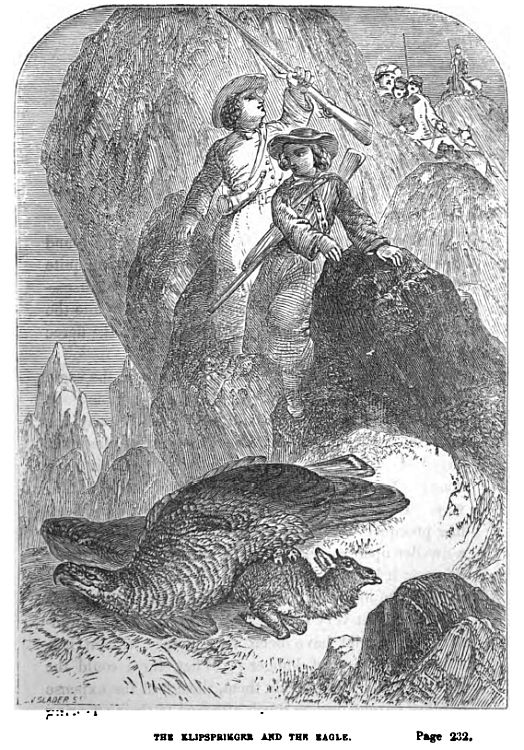
Another dash made the eagle—a last and final swoop. Its talons closed like a cramp upon the vertebrae of the tiny quadruped, which the next moment was borne aloft into the air!
A shrill sad bleating was heard from below—drowned for an instant by the discharge of several guns, whose reports echoed like thunder from the rocks; and then the winged robber, with his victim still clutched in his talons, was seen falling with fluttering wings to the earth!
Chapter Thirty Seven.
Hunting the Klipspringer.
The eagle dropped not far from the summit; and the boys, running down to the spot, found it lying quite dead, with the little klipspringer—also dead of course—still fast in its claws. The talons sunk deeply into the flesh, embraced the spine, and even in death the fierce bird had not relaxed its hold!
Some would have considered the death of the eagle a just punishment; but, then, what was its crime? It is true, it had killed, and would have carried away, the little fawn of an innocent antelope—one of the most harmless of creatures. But what else could it have done? Nature had taught it to sustain itself in this way. Perhaps it had a nest on the brow of some beetling precipice—for this vulture-eagle of South Africa is a dweller upon rocks, and not a tree-eagle—perhaps in this nest it had a pair of downy little eaglets, each with an appetite like that of an ostrich—perhaps they were expecting that very kid, or some similar dish, for dinner; and would have been very hungry without it—might have died of hunger? What, then, could the parent bird do but provide them, though at the expense of other parents just as much attached to their offspring as an eagle could be? How can it be regarded as a crime? The eagle did not wantonly destroy the antelope, but to satisfy the cravings of hunger. It only obeyed one of the laws of Nature.
Cruel laws they do seem; yet, if they be crimes, Nature herself is answerable. Alas! we cannot comprehend, and, I fear, in this life never will comprehend, why we, the creatures of the earth, are born to prey upon one another. A puzzle to the humane heart is that “chain of destruction.”
Wanton killing of animals is a crime; and our hunters, at first sight, might be thought chargeable with this in having wantonly shot down the eagle. Such was not the case, however. They did not do so out of any feeling of wantonness. They had a proper object in shooting the bird. It was the representative of a rare and little-known species, and the possession of its skin for scientific purposes had something to do with the fatal aim that brought it down—for it was from the double-barrel of the naturalist the shot was sent that destroyed it.
By the act the klipspringers had been avenged, though there was little idea of giving them vengeance in the minds of the young hunters. Quite the contrary; for in five minutes after, the whole six—buck-dogs and all—were in full chase after these creatures, as ready to rob them of their lives as they had been to take away that of their winged enemy.
Nor was it out of wantonness either, or the mere love of hunting, though that might have been the principal motive with one or two of the party. But there was a curiosity about these little antelopes, and a desire to examine them more closely, that urged the young yägers to attempt their destruction. They desired to possess their trophies.
You may wonder why they should care about the horns of a klipspringer, since it is not one of the rare antelopes within the boundaries of the settlements! True, the animal itself is not rare; but it is a rare occurrence, when one falls before the bullet of the hunter—as the klipspringer is as shy and wary as the chamois itself—and, dwelling in the most inaccessible places, it is difficult game to capture. Hence, the killing of a klipspringer is regarded in the light of a feat, and its little horns are by no means an ordinary trophy.
The young yägers, therefore, wanted the pair belonging to the buck that was now leaping over the rocks below.
Some minutes were spent in deliberating as to what would be the best mode of getting possession of them.
At the report of the guns both the klipspringers had gone farther down the mountains, and were now standing upon a large boulder near its base.
Hendrik proposed that the party should dash right down after them—dogs and all—and force them out into the plain, where, it was well known, they could make but a poor run, and would be easily overtaken by the buck-dogs.
This plan seemed feasible. The antelopes were very near the base of the mountain. The hunters coming on them from above could easily drive them into the plain; and then there would be a run between them and the dogs, of which a fine view would be obtained.
Off started the whole party, directing their course straight down the mountain to the point where the klipspringers were seen. The dogs were set free, and sprang forward in advance.
The hunters moved on as fast as the nature of the ground would permit them; and in ten minutes would have been near enough to the klipspringers to have fired, had the latter favoured them by remaining in their place. But they did not do so. Of course, they had a full view of their enemies as they advanced; and before the hunters had got half-way down, the nimble game set off round the bottom of the hill, flitting from rock to rock like a brace of birds.
What seemed odd in their mode of progressing was, that instead of running along the open spaces between the fragments of rock, they chose the rocks themselves for their path, and of these also the most prominent ones; so that their flight was a succession of bounds, some of them of enormous length! Many of the boulders, on which they rested a moment, and from which they sprang again, were so narrow at the top, that the little creatures hardly obtained room for their feet; and, with their four hoofs touching each other, they would spring off as though moved, not by muscular power, but under the influence of some elastic force!
At first the hunters believed their task to be an easy one. The mountain surface was of so limited an extent, they would soon surround the game, or force it out upon the plain. The first attempt to do so, however, had ended in a failure. The klipspringers had escaped without difficulty to the other side, and were now farther off than ever!
The hunters called up the dogs, recrossed the summit, and once more set their eyes upon the game, perched as before upon prominent points.
A second time the party advanced, spreading as they went down, and holding their guns in readiness; but long before they were within range, the klipspringers took to flight again; and, just as they had done before, passed around the base to the other side of the mountain. Of course, the dogs, scrambling clumsily among the rocks, were, no match for such game as they; and even had the klipspringers been near enough for the guns, the most accomplished riflemen could not have “sighted” them, so quick were their motions. The only chance of the yägers lay in their shot-guns, and to have hit them, even with these, would have been a feat equal to the bringing down a snipe or woodcock.
Once more the boys attempted to drive them into the open plain; but with the same result as before. Although the hunters had spread themselves across the mountain, the nimble game dashed past them, and escaped to the other side.
Groot Willem now proposed a new plan. That was for all to descend the mountain to its base, and there make a complete surround of it. Then each to march straight up, and, by hemming the game on all sides, force them to the summit.
“In this way,” added Groot Willem, “we’ll at least have a crack at them; for if they try to get back through our line, they must pass near some of us.”
Groot Willem’s suggestion was adopted. The yägers now descended to the base of the mountain; and, separating, spread around it at equal distances from one another. The buck-dogs were also distributed; one going with each hunter, except Klaas, who had no dog to accompany him. Since the affair with the blauw-bok, there had been only five in the pack.
Thus placed, the boys recommenced the ascent. They proceeded with proper caution, keeping each other in view, and shouting from time to time words of instruction as to the position of the game. These were seen bounding before them, from rock to rock—now crossing the mountain to the opposite side, with the intention of escaping in that way—now zigzagging along the sides, or bounding upward toward the summit.
When the hunters had advanced about half-way up, the klipspringers became frightened in earnest. They saw that they were encompassed on every side; and sprang to and fro like a pair of grasshoppers.
At length they seemed determined to run the gauntlet through the circle of hunters, and made a bold dash in the direction of Hans. The naturalist, although not professing to be much of a hunter, was a capital shot; and, raising his double-barrel, he fired.
The doe fell to the crack; and the buck, suddenly turning as on a pivot, once more bounded up the slope. The dogs had already gained a distance ahead of their masters, and now advanced upon the buck from all sides. There seemed no chance left him of avoiding their onset.
He had mounted a boulder near the base of the tower-rock; and the five were rushing upon him with open jaws, and shining teeth, when, all at once, as if impelled by a spring, he shot upward to a narrow ledge of the vertical rock, far beyond their reach. The ledge was scarcely wide enough to have given footing to a weasel, and yet the klipspringer seemed to feel quite secure upon it. But he did not rest there. The shouts of the hunters, as they hurried up the mountain, impelled him farther; and springing to a still higher ledge, and to another still higher, he stood at length upon the pinnacle of the rock!
A shout of surprise broke from the hunters as they witnessed this wonderful feat. And a singular spectacle it was. As already stated, the tower-rock ended in a point scarce four inches in diameter; and upon this stood the klipspringer, his hoofs pressed closely together, his neck drawn in, his body gathered into a ball, with the stiff wiry hair radiating on all sides outward, like the spines of a hedgehog—a curious object to look upon!
Although the hunters were now within shot, so odd did the creature appear thus placed that not one of them thought of drawing trigger upon it. They knew that they had the buck in their power—the dogs were all around him—and at such a height, full thirty feet from the ground, it could not escape. All therefore held their fire, and ran forward to the bottom of the tower.
They had made a sad mistake about the powers of that klipspringer. As they were congratulating themselves on having trapped the buck in so odd a manner, he was seen to shoot out into the air, and, with a whizzing noise like that made by some great bird, he passed close to their ears, and lit upon the boulder from which he had bounded up! Scarce an instant did he rest there, but sprang to another, and another, and in a few seconds was far down the side of the mountain!
So sudden had been this movement on the part of the game, and so unexpected, that both dogs and hunters were taken by surprise, and not a shot was fired until the klipspringer was beyond reach! Just at that moment, as they stood watching his retreat, a puff of smoke was noticed far down the mountain—a gun cracked at the same instant—and the buck was seen to tumble headlong from a rock!
With fresh surprise the hunters turned to one another. “Who?” exclaimed all simultaneously. Ha! there were only five of them. One was missing!
“It’s Klaas!”
It was Klaas beyond a doubt—Klaas who had killed the klipspringer.
Klaas had given an illustration that the “race is not always to the swift.” He was rather a heavy boy, was Klaas; and feeling fatigued at so much climbing, had seated himself on a stone, and was taking a bit of a rest, when he observed the klipspringer, standing upon a rock right before his face. Having his light fowling-piece loaded with buckshot, he had taken aim, and dropped the buck from his perch.
Jan was not a little jealous, and insinuated that it was a bit of “luck” not very well deserved; but whether it was luck or not, Klaas had certainly killed the klipspringer, and was not a little elated at his performance.
Having collected the game, the young yägers proceeded to where they had left their horses; and, mounting, galloped off after the wagons that were moving slowly across the distant plain.
Chapter Thirty Eight.
Bold Birds.
On the third day after entering the plains of the “zuur-veldt,” the yägers treked to the banks of a large river, and followed its course up-stream. The scenery was altogether new and of a different character to that of the plains. The river was fringed with reeds and willows, and beyond these stretched a wide bottom land of meadow-like character, studded with groves and copses of green trees whose foliage was grateful to the eye after the journey over the dry plains. Here the deceitful mirage no longer tantalised them with prospects of verdant groves and smooth limpid lakes. Both existed in reality; and a succession of lovely landscapes met the eyes of the travellers as they advanced.
The grass upon the banks of this river was excellent, and in order that their cattle should have the opportunity of a good feed, the party formed camp at an early hour. They outspanned in a little meadow, directly by the edge of the water, and made a fire out of the stems of the willows that grew near.
Jan and Klaas noticed a large flock of birds hovering above the water, and swooping about, something in the same manner as swallows on a summer evening over the surface of an English lake.
They were birds of a moderate size, scarcely so big as a common pigeon—nor was there any thing in their colour to make them attractive. They were rather a dull-coloured set of birds for Africa, being reddish-brown, with a mixture of white and grey; but had they been near enough for the boys to have observed their feet and legs, these with the “cire” around their eyes, would have appeared of a beautiful orange-yellow colour.
There was one peculiarity about these birds, which could be observed at a great distance, and that was their “forked” tails. In this respect they might also be said to resemble swallows, but the forking was far less acute than in the tails of the latter. There was enough of it to give the birds a character; and that, with their general form and the colour of their plumage, made it easy enough to tell to what genus the birds belonged. They were birds of the genus Falco, (hawks,) belonging to that section of it distinguished as Milvus, (the kites.)
Of the kites there are several species, but the particular one to which these before the eyes of Klaas and Jan belonged, was the “parasite kite,” (Milvus ater), an inhabitant of all parts of the continent of Africa, and a bird somewhat smaller than the royal kite of Europe.
Both these bird-boys knew that the birds were hawks of some kind, but they could not tell what sort. When Hans told them that they were “kites,” they both became doubly interested; and, guns in hand, stood near the water’s edge watching the manoeuvres of the long-winged fork-tailed creatures.
To a superficial observer it might have appeared that these kites were merely playing themselves; now poised and hovering in the air, now floating softly along, and at intervals shooting down until they “dipped” themselves in the water of the stream. Any one, however, who had closely watched them for a time would soon have perceived, that they were not going through these manoeuvres for simple amusement. Each time that one of them made a plunge into the water, it might be observed that in rising again, it carried a shining object in its talons, which object was neither more nor less than a tiny little fish. Fishing, then, was what the “parasites” were after; and not for amusement, as anglers do, but following it as a regular calling—in fact, following it for food.
Not that fish forms the only food of this species of lute. No; it will eat almost any thing,—little quadrupeds, birds, reptiles, and even carrion, upon a pinch. It is, however, very fond of fish; and, when it chances to reside in a country of waters, where fish are plenteous and easily procured, it follows the calling of a fisher pretty regularly.
Klaas and Jan stood for some time expecting to get a shot; but as none of the birds came near enough, they at length gave up all hope, and laid aside their guns.
Shortly after, dinner was ready, and all the boys sat down upon the wagon-chests, and commenced eating. Their dinner that day consisted of a very nice dish—that is, the flesh of the great South African bustard (Otis tarda) or wild peacock, (wilde pauw,) as they themselves termed the bird. Groot Willem had that morning shot this fine game, at very long range, with his “roer;” and but for the far “carry” of his gun they would not have procured the bird—for the wild peacock is one of the shyest kinds of game-birds, and scarcely ever rests within shooting distance of any cover by which it may be approached. Large as it is, it is esteemed the most delicate eating of South African birds, and almost equal to the wild turkey of America.
Now the young yägers had roasted this precious morceau, had carved it, and each was sitting with a piece in hand—one with a wing, another having the “drumstick,” a third the “merrythought,” a fourth the “pope’s nose,” and so on. Of course they were in a high state of enjoyment over such “titbits.”
While engaged in this pleasant way, they were astonished to see the whole flock of kites come suddenly swooping over the camp. Klaas and Jan were the more astonished, since they had been for some half-hour vainly endeavouring to get within shot of these very birds. Now there would have been no difficulty about that, for the parasites not only came within shooting distance, but, actually and literally, flew in the very faces of the boys! Yes; they would swoop right up until within a few feet of the diners, then poise themselves upon their wings, spread out their tails, turn over on their backs, and execute sundry other eccentric manoeuvres that put the six yägers into fits of laughter. Of course Swartboy joined in the chorus, and even the grave Kaffir grinned at the ludicrous spectacle.
But it did not end here. After a while the birds grew bolder and bolder; at each swoop they came nearer; until at length several of them actually snatched pieces of the bustard’s flesh out of the very hands of those that were eating it! Verily did they illustrate the old adage of “many a slip between cup and lip.”
Even the dogs were made victims of these bold little robbers, who swooped forward to their very muzzles, and snatched at the bones they were crunching.
This curious scene continued for some time. It would have ended sooner, had the business been in the hands of Klaas and Jan. Both these boys, at the first approach of the birds, had started up to get their guns, but they were withheld from using them by the others, and especially by Hans—who was desirous of observing these curious little hawks with the eye of a naturalist.
After a while the bird-boys were allowed to “blaze away;” and, what is still more singular, their repeated shots did not completely frighten off the parasites, though several were killed! Even some that must have been wounded—since the feathers had been knocked out of them—returned again and again to hover above the camp, with eyes fixed eagerly upon the scraps of meat that had been left lying upon the chests!
A little incident was yet to occur of a still more ludicrous character.
Hans had that day shot a pigeon of very beautiful plumage, which is peculiar to the interior of South Africa, and whose wings and body are of a deep green colour. This species is somewhat rare, and Hans was desirous of preserving the skin and having it mounted. After dinner, therefore, he had skinned it; and having thrown its flesh to the dogs, he was still at work upon the skin, taking out the brains.
Klaas and Jan, satiated with sport, had desisted, and laid aside their guns—the consequence of which was that the parasites had returned in great numbers, and now exhibited as much effrontery as ever.
All at once, one of them seeing Hans engaged with the pigeon, and thinking no doubt that the body of the bird was still in its skin, made a sudden dash, drove its claw through the feathery mass, and carried off the skin in triumph! Hans, whose eyes had been closely bent upon his work, saw nothing of the approach of the little winged robber; and for some moments believed that one of the boys, out of a “lark,” had snatched the pigeon from his fingers. It was not until he looked around, and then up into the air, that he was aware of the real culprit; and although all rushed to their guns, the pigeon-skin could not be recovered—as the kite, on seizing it, rose high into the air, and then carried it off to the other side of the river!
As not a bit of flesh remained in the skin, and as Hans had succeeded in extracting even the brains, no doubt the parasite soon discovered that his pigeon was no better than a “decoy!”
Chapter Thirty Nine.
The Waterbuck.
The bank upon which the yägers had encamped was about five or six feet above the surface of the water, as it now stood. The bank on the opposite side also rose above the water level; but on both sides there was a break or declivity that sloped down into the channel. These breaks corresponded with each other. They were not natural gorges, but had evidently been made by heavy animals, such as rhinoceroses and others, that were in the habit of coming either to drink or ford the river at this point. The tracks of many kinds of animals could be distinguished leading down to the water or up into the meadow—so that the place was evidently a “drift,” or crossing-place for the wild beasts of the country around.
Perhaps at night many would cross here, and Hendrik and Groot Willem had resolved to watch that night and have a little moonlight sport. A moon—and a very fine moon—was expected; for the queen of the heavens was nearly in the full at the time, and the sky all that day had been without a cloud.
But they were destined to enjoy a little sport before the moon arose—even before the sun had gone down.
While engaged around the wagons, their attention was attracted by a movement among the reeds on the opposite side of the river. There was also an open space on that side corresponding to the meadow in which they were encamped. Around the opening grew a thick brake of tall reeds, interspersed with willows and other low trees. It was among these reeds that the movement was observed.
Presently a large animal came out of the covert, and stepped boldly forward into the open ground, where the short sward enabled them to see it from horn to hoof—for it was a creature with hoofs and horns—without doubt an antelope.
It was a species, however, which none of the party had ever seen before—an antelope of majestic form and elegant proportions.
It stood nearly five feet in height by full nine in length, and its general colour was a greyish sepia brown. Its face, however, was of a deeper brown around the bases of the horns and over the frontlet tinged with rufous. The lips and muzzle were white; a white patch marked the throat; a white streak was before each of the eyes; and a curious oval band of white encircled the tail. The hair over all the body was harsh, more resembling split whalebone than hair; but that which covered the neck was longer than the rest, and stood out all around like a mane on end. The horns were nearly three feet in length, and curved first upwards and then slightly inwards. They were closely ringed to within six inches of their tips, and of a whitish green colour. The tail of the animal was about eighteen inches in length with a tuft at its tip.
The shape and set of the horns, the rigid hair that grew all around the throat and neck, and the elegant upright bearing of this antelope, enabled the naturalist Hans to tell his companions to what species it belonged. It was the famed “waterbuck,” (Aigocerus ellipsiprymnus).
I have said “famed” antelope, because the waterbuck is in reality one of the finest and most famous animals of the whole tribe.
Its name would seem to imply that it was a dweller in the water. Such, however, is not the case. It is called waterbuck because it is never found far from the banks of a river or other water, in which it delights to plunge, and bathe itself during the hot sunshiny hours of the day. Of course it is an excellent swimmer, and, indeed, such confidence has it in its powers of swimming, that when hunted or pursued by whatever enemy, it makes directly for the river and plunges in, no matter what depth may be the water. It is the habit of many species of deer to make for water when hunted, but with them the object is to throw the hounds off the scent, and having once crossed a river, they continue on through the woods. Now the waterbuck does not leave the river for any great distance. It either swims downstream, or, having gone out on the opposite bank, returns to it, after making a short détour through the woods. It seems to regard the water as its haven of safety, and when overtaken usually stands at bay in the very middle of the stream.
It loves to dwell along rivers where there are marshy banks covered with tall sedge and reeds; and at certain seasons of the year, when these are partially inundated, the waterbuck is rarely seen—as it then makes its haunt in the very heart of morasses which are impenetrable to the hunter. Its long spreading hoofs enable it to pass with safety over marshy grounds, where other species of antelopes would be “mired” and destroyed.
The waterbuck has been classed by naturalists with antelopes of the aigocerine, or goat-horned group; but it differs greatly, both in horns and habits, from any of these, and deserves to be ranked as an antelope sui generis. If it were established as a separate genus, it would not stand alone, since another “waterbuck”—evidently a second species—has been discovered by late explorers a little farther to the north, upon the shores of the Lake Ngami. The latter is termed by the natives the “leche,” and in the shape of its horns, and most of its habits, it bears a decided generic resemblance to the Aigocerus ellipsiprymnus.
Still a third species of waterbuck has turned up during the recent explorations to the afore-mentioned lake; but this, though in habit very similar to the others, differs widely in regard to its physical characteristics. Its horns are of the spiral form, greatly resembling those of the koodoo, (Strepsiceros koodoo), and naturalists are disposed to class it in the genus Tragelaphus. Its name among the natives is “nakong.”
The reason why none of our young hunters were personally acquainted with the waterbuck was, that none of them had ever seen it before; and the reason why none of them had seen it was, because it is not found in any part of the country through which they had hitherto travelled. It is altogether a tropical or sub-tropical species, loves a warm climate, and does not range so far south as the Cape settlements. It is possible that there may be other species by the rivers that run through the unknown interior of Africa; for between that southern territory, which has been yet explored, and the Great Säara, there lie many strange countries, and many strange creatures, of which the geographer and the naturalist yet know nothing.
So, my boy reader, if you should be desirous at any period of your life to achieve the reputation of a Bruce, a Park, a Denham, a Clapperton, or a Lander, you need not fear the want of an opportunity. There is still enough of “unexplored Africa” to employ adventurous spirits for perhaps a century to come. At all events the ardent naturalist will find plenty of new ground up to the new year’s day of 2000! That I can safely guarantee.
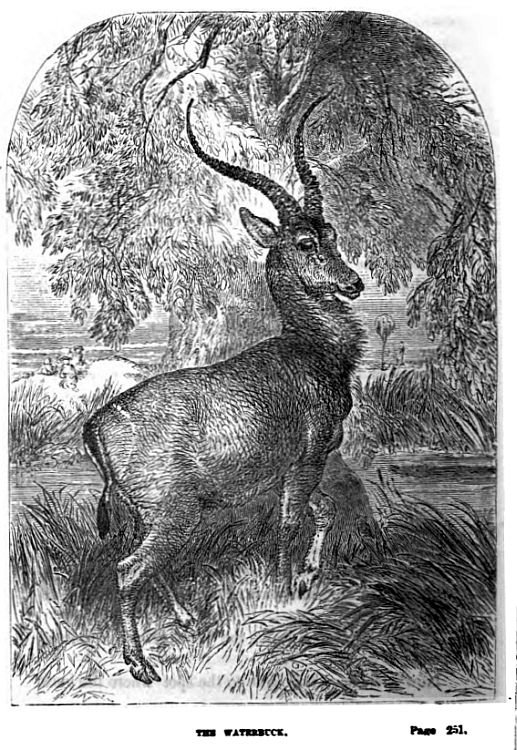
Chapter Forty.
The Ravenous Reptile.
All eyes were fixed upon the beautiful animal as it approached the river. With light majestic step it advanced to the bank, and without pausing walked down the slope. It had no fear of the water, and stepped into it without hesitation.
The boys were in hopes that it intended to cross the river. On the opposite bank it was too distant for the a carry of their guns—even the elephant roer could not have sent a bullet to that side with any chance of hitting. Should the antelope cross, however, the case would be different. It might then come within range of their pieces; and, to make sure, Hendrik and Groot Willem had stolen under the cover of the reeds, and advanced nearer the crossing-place.
They were doomed to disappointment, however. The waterbuck had no intention of crossing. It had come to drink; and having waded in knee-deep, it stopped, and dipped its muzzle into the water for that purpose.
With disappointed looks the boys remained gazing upon it as it drank.
Now it chanced that close to the spot where the buck had entered the water there was a black log. It lay along the water in a direction parallel to the bank, and seemed to be floating—though only a small portion of it appeared above the surface. Saturated with the water, as it must have been, its weight perhaps had thus partially immersed it. The boys had given no heed to this log. It was the half-decayed trunk of some tree—perhaps the black-barked acacia—that had been carried downstream during flood-time, and had made a lodgment in the little bay, where the path entered the water. Of course to such an ordinary circumstance the boys gave no heed. Neither did the waterbuck. Ah! false security! Better for the antelope had it heeded that log! Better for it had it “looked before leaping,” and carefully scrutinised that black-barked thing—for black though it was, it was not the log of any acacia. That log was alive!
To the astonishment of all the boys, and no doubt to the far greater astonishment of the waterbuck, the dark object suddenly became endowed with motive power, and was seen to dart forward with the velocity of an arrow towards the spot where the animal was drinking. It was no longer a log, but a hideous reptile—a crocodile of gigantic dimensions!
The boys expected to see the waterbuck rear back, and attempt to escape. No doubt so it would have done, had the crocodile missed its aim, but the latter had not missed. On the contrary, it had seized the muzzle of the antelope in its long gaunt jaws, and was proceeding to drag its victim under the water.
There was a struggle not of long duration, but it was terrible while it lasted. The buck pranced, and plunged and spread his legs, and endeavoured to shake off his reptile assailant. Several times he was brought to his knees; but being a powerful animal he recovered his legs again, and once nearly succeeded in drawing the crocodile out upon the bank. All the while, too, he kept striking forward with his sharp fore-hoofs; but desperate as were the hits he made, they produced no impression upon the harsh scaly coat of his amphibious antagonist. Had the latter held him by any other part, he might have had some chance of escape; but seized as he had been by the very tip of his snout, his head was all the time kept close down to the water, and the awkward position rendered it impossible for him to make use of his horns—his principal weapons of defence.
The crocodile was by no means one of the largest of his kind—else the struggle would have ended sooner. A very large one—that is, one of sixteen to twenty feet in length—can drag a buffalo bull under water, and a buffalo bull possesses four times the strength of a waterbuck. The one now seen was not over ten feet long; and the strong waterbuck might have been a full match for it, had it not been for the unfair hold which it had taken. In that, however, lay the advantage of the reptile, and it seemed to be aware of it, for from the first moment it never relaxed the “clutch” it had taken, but held on with its terrible teeth and strong jaws, closed like a clamp on the snout of its victim!
Now the crocodile was raised some feet out of the river, and the boys could see its ugly breast, and spread hand-like claws; now using its powerful tail as a fulcrum it would strike against the water, and then the head of the buck would be plunged below the surface, and held down for minutes at a time. Of course during all this while the water was kept in commotion; and, what with the struggles of the quadruped and the lashing of the reptile’s tail, a constant spray of froth and bubbles marked the scene of the strife.
The conflict at length came to an end. The water-tyrant triumphed. The buck was dragged into the river beyond his depth; and although few quadrupeds could swim as well as he, once off his legs he was no longer a match for the amphibious saurian. His head and horns both disappeared beneath the surface—now and then the tail of the crocodile flapped upward, as it exerted itself to keep its victim under—and then both reptile and quadruped sank to the bottom of the river, and were seen no more!