"A Narrative of Hunting Adventures in Southern Africa" (continued 2)
Reading edition
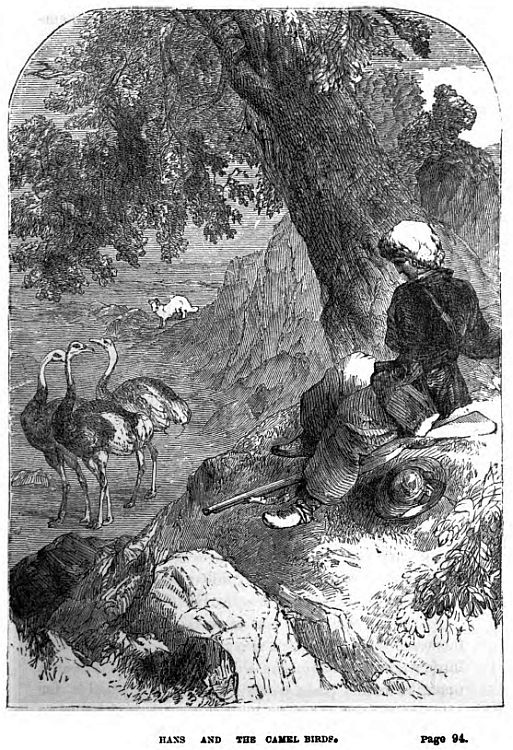
A cock and two hens they were, that presented themselves before the eyes of the young naturalist.
They were marching slowly along. They were not affrighted. They evidently had seen nothing of the camp. How could they, as it was behind the trees in the centre of the grove? They occasionally bent their long necks to one side or the other, and cropped a leaf, or picked up a seed, but then continued their course. From their following a straight line Hans concluded they were not feeding in the regular way, but bent towards some point, perhaps to their night resting-place.
When first observed, they were coming in a side direction, that is, transversely to the direction in which Hans himself was facing. In a short time they had passed before him, and were now widening the distance, and getting farther off into the desert.
Hans at first thought of calling to the others, who were all busy about the wagons, and had not seen the ostriches. He was thinking also of some plan by which the birds might be captured or killed.
After a moment’s consideration, he gave up the idea of either one thing or the other. The sight of an ostrich was nothing new to any of the party. Jan and Klaas might have cared for it, but both were tired after their long hot ride, and had already fallen asleep on the grass. Better not disturb them, thought Hans.
As to the killing or capturing the ostriches, after a moment’s reflection, Hans also gave up that design. The birds were already passing—to have stalked within shot upon the naked plain would have been impossible, for Hans well knew the wary nature of the ostrich; and to have attempted a chase with their tired horses would have been equally idle.
Hans, therefore, held his peace, and sat still; following with his eyes the retreating forms of the three great camel-birds.
Their long strides soon carried them far off, but before they had receded half-a-mile, the eyes of the naturalist were removed from them, and turned on a different object.
Chapter Eleven.
The Smallest of Foxes.
The object which now fixed the attention of the naturalist was a quadruped,—a very small one, not bigger than a medium-sized cat, but altogether different in form and proportions. Unlike the cats, it had a long sharp snout, and a thick bushy tail. It stood higher upon its legs, too, than do animals of the cat kind, but the most remarkable feature about it was its ears. These were remarkable for their length, which was out of all proportion to the size of the creature. Its whole body was barely one foot long, and yet the ears stood full six inches above the crown of its head! They stood quite erect, broad, stiff, and pointed, and ending in an acute angle at the tips.
Its colour was a beautiful Isabella above, and cream-white underneath. No; the creature was not like a cat, nor a dog neither, though it was more like the latter than the former. But there is an animal related to the canine family to which it bore a very strong resemblance, and that is the fox, for it was a fox, the very smallest in the world, the “caama” of Southern Africa. And yet, correctly speaking, it was not a fox neither, but a fennec.
What is a “fennec?”
That is an interesting question, and one about which naturalists have bothered their brains a good deal. It is an animal of which there are several species existing throughout Africa; and of which the celebrated traveller Bruce,—who, everybody thought, lied so largely, but about whom conceited ignorance has since changed its opinion,—first gave an account.
It differs from the foxes in several respects, but the most remarkable difference is found in the form of the eye. In the true foxes the pupil is linear or elliptical, while that of the fennec is round, thus showing the difference of habit—for the foxes are in reality nocturnal animals, while the fennecs are diurnal. Some species of foxes, however, are twilight prowlers, and one or two of the fennecs are also crepuscular.
It is, therefore, scarce possible to draw a line of demarcation between the two. The fennecs, however, have been formed into a separate genus, termed Megalotis, from the extreme size of their ears. It is to be hoped that the question is thus settled that has so much bothered the closet-naturalists; who, taking their ideas from the anatomy of the fennec, have classed it according to their several fancies; one making it a dog, another a cat, a third a fox, a fourth a civet, a fifth a hyena, and a sixth placing it among the galagos!
Let us call it a “fennec,” or diurnal fox, and say farther that although there are several species of true foxes in Africa, and several of jackal-foxes, there are also several of fennecs. Three are well known. The fennec of Bruce, (Megalotis zerda), first described by that traveller as seen by him in Abyssinia, but also indigenous to South Africa; the “zabora,” (Megalotis famelicus), a native of Nubia and Kordofan, and supposed to be the animal represented on Egyptian temples, which has been taken for the figure of the jackal; and the “caama fennec,” (Megalotis caama).
A fourth species, “Lalande’s zerda,” (Megalotis Lalandii), has been “hooked out” of this genus, and made to form one of itself, (Agriodus), not because its habits in anywise differ from the Megalotides, but because it chances to differ slightly from them in the form and arrangement of its “ivories.”
Now of all these fennecs the one which was passing before the eyes of Hans was the “caama,” the smallest of the whole tribe either of fennecs or foxes.
Crouching just like a fox, now trotting nimbly a few paces, now halting and squatting close to the ground, as though fearful of being observed, the little creature passed on.
What was it after? What prey was it in pursuit of?
On watching it for a few moments, Hans saw to his great surprise that it was after the ostriches!
It was going the same way they had gone, its sharp snout set towards, and its eyes evidently bent upon, them. Whenever they stopped it did the same, squatting down as it did so, as if to avoid their observation; and when they moved on, it also trotted forward, halting at intervals behind stones and bushes and earnestly regarding the birds in advance. Beyond a doubt it was trailing them! But what could this little creature want with the ostriches? Certainly not to attack them, though it was following after them just as a fox would a covey of partridges.
It could not be that, however; as a kick from the mighty leg of one of these birds would have hoisted the fennec fifty yards over the plain, like a ball from a cricket-bat.
No; it could not be following them with hostile intentions,—puny pigmy that it appeared beside the big camel-birds!
For what, then, was it trailing them? Of course it was not running on the scent, but the view. On their track it certainly was, and as certainly was it “dogging” them. For what purpose?
This was just what the naturalist Hans wished to know; and he remained closely observing the movements of this miniature “microscopic” fox.
Talking of a microscope reminds me that Hans at that moment took out of his pocket a telescope,—a small one, which he habitually carried. This he did, because, in a few minutes, the ostriches were very distant over the plain, and their pursuer the fennec was no longer visible to the naked eye. With the glass, however, Hans could still make it out, and could see that it was manoeuvring just as when it passed him. All at once the ostriches came to a stop; and, after an apparent consultation among themselves, the cock squatted down, and his long legs were no longer seen. He was flat down upon his breast, and even through his small pocket-glass Hans could tell that his body looked more spread and bulky than before. Was he covering eggs? Was there a nest? The appearance of the ground about the sitting bird favoured that belief. There was a slight prominence around the body of the bird having the semblance of a bird’s nest; but Hans knew that the nest of the ostrich is of very simple construction,—a mere cavity scratched out in the sand, and scarce to be recognised from any great distance. Several white objects lying around the spot led Hans to the conclusion that there was a nest. These objects did not seem larger than “jack-stones,” but Hans, calculating well the distance that separated them from his eye, believed them to be ostrich-eggs, and therefore as large as paving-stones. Hans knew that around the nest of the ostrich scattered eggs are usually found—said by some to be there laid as a deposit for the food of the expected progeny during their early days of chickhood!
The two hens, after moving about awhile also squatted down, but they appeared only to kneel with their great legs doubled under them; whereas the cock sat low and flat upon his breast. This only more convinced Hans that there was a nest, and that the cock ostrich was taking his turn of duty, while the hens were simply gone to roost in the usual manner.
That the cock covered the eggs was nothing surprising to the young naturalist, who knew that it is the habit of the male of these birds to do so, and that he usually takes his turn during the night, when it is colder, and his greater size and strength are required to keep the eggs warm, as well as to protect the nest from prowling beasts of prey. One or other of the hens would very likely relieve him about daybreak. Of course both the hens were mothers in prospective of the future brood, as the cock ostrich is a terrible “Mormon;” and frequently does the polygamous on a large scale, having sometimes as many as a dozen wives. Our old fellow was rather a moderate Mormon, as he appeared to be satisfied with two—though bigamy, no doubt, is quite as sinful as polygamy.
Hans concluded that there was a nest, and full of eggs in process of being hatched. It was no evidence against this, that the birds had been away from it together. The day had been a very warm one, and during the middle part of the day—particularly in hot weather—the ostrich wanders away from its eggs, leaving the sun to do its work for it. The hotter the country, the less does the ostrich require to “set;” and in parts of Africa within the torrid zone where the heat reaches a very high degree, the ostrich has very little to do with the hatching of its eggs, but buries them in the burning sand, and makes the sun its “incubator!”
But what had become of our fennec—poor little fellow?
So asked Hans of himself, as he swept the plain with his telescope. While watching the late movements of the birds, he had altogether forgotten the beast.
After a time he was just able to make out its small whitish body stretched upon the ground, under the lee of a little bush, and apparently resolved upon passing the night there. Had there been any hole near, it would have preferred lodging in that—for the fennec is an animal that makes its home in a “burrow.”
Night had suddenly come on, and the darkness prevented Hans from observing farther the movements of either beast or bird; so putting up his glass, he rejoined his companions in the camp.
Chapter Twelve.
The Wingless Birds.
Hans, on returning to the camp, gave an account of what he had seen. All were interested in the relation, but particularly the boys Klaas and Jan, who were not over satisfied that they had not themselves been witnesses of the affair. Hans might very well have told them of it. They wouldn’t have minded being waked up to see the ostriches, especially as they passed so near. It wasn’t every day one could get such a view of these fine birds—they were so shy no one could get near them, and Hans might very well have come into camp and told them, or called them, Klaas and Jan, to the spot. Hans didn’t care whether they ever saw any thing worth seeing—he didn’t.
So grumbled Klaas and Jan, because Hans had not waked them out of their sweet siesta, to see three ostriches stalking over the plain, and not doing any thing in particular.
But boys are boys, and so long as they are boys, they will feel a wonderful interest in birds—especially when these birds stand nearly ten feet high, and weigh three hundred pounds, as ostriches do.
Had it been a buffalo, or a giraffe, or even an elephant, neither Klaas nor Jan would have so much cared. Beasts are all very well in their way, and may interest full-grown hunters, like Hendrik and Groot Willem, but for “boy hunters,” with light fowling-pieces and Number 5 shot, birds are the game—though their Number 5 shot would hardly have tickled an ostrich.
No matter for that. They wanted to see the great camel-bird. Hans ought to have apprised them. It was “right mean” of him not to do so,—right mean, said Jan, and Klaas backed the opinion.
How long they might have grumbled, and given vent to their reproaches, can only be guessed at; but the conversation turning upon ostriches assumed a very pleasing character; and Klaas and Jan, becoming deeply interested in it, soon got over their little “miff” with Hans—especially as it was he who was now interesting them. Upon the subject of ostriches. Hans had read a good deal, and was well acquainted with the character and habits of these most interesting birds.
Swartboy stood next in his knowledge of the ostrich, for Swartboy in early life had been a “dweller of the desert,”—the home of the Bushman as well as the great camel-bird. Swartboy was only too happy at the opportunity thus offered of showing off his knowledge, for the late wonderful performances of his Kaffir rival had quite thrown him into the shade.
So what with Hans’s book-knowledge and Swartboy’s practical experience, the young yägers became pretty well acquainted with the whole “history” of the bird.
“The ostrich,” said Hans, “is an African bird, though also found in the adjacent countries of Asia. Several species of birds somewhat like it, belonging to South America, Australia and the islands of the Indian Archipelago, have been called ‘ostriches’ in the language of travellers. I shall have a word about these presently.
“All over the African continent, as well as Arabia, Syria, and Persia, dwells the ostrich, wherever there are desert plains—for this bird is peculiarly a denizen of the desert, and never makes its home in wooded, marshy, or even fertile districts.
“It has been known from the earliest times, and must have been more numerous in the days of Heliogabalus than now, since that tyrant had the brains of six hundred ostriches served up at a single feast!”
“Oh, the glutton!” exclaimed Jan.
“What a gourmand!” echoed Klaas.
“I should think after the feast he had more brains in his stomach than in his head,” quietly remarked Arend.
“No doubt of it,” added Hendrik.
Hans continued:—
“The ancients knew the ostrich as the ‘camel-bird,’ (Struthio camelus). This name was given to it on account of its fancied resemblance to the camel; and in its hoof-like two-toed feet, its long naked thighs and neck, and the pad or cushion on its chest, corresponding to the callosity on the breast of the camel, it does bear a resemblance to this animal. Like it, too, the ostrich is formed for the desert. Aristotle and Pliny described the ostrich as half bird, half quadruped.”
As soon as Hans had given the more scientific part of the natural history of the ostrich, Swartboy’s knowledge of the habits of the bird was produced, and from both were collected the details that follow.
Ostriches are gregarious—flocks of fifty may be seen upon the plains, peacefully associating with zebras, quaggas, wildebeests, blue wildebeests, and several other plain-frequenting antelopes.
The males are polygamous, and usually have from two to six wives. These lay twelve to sixteen eggs each, in a nest which is only a hole scooped out in the sand about six feet in diameter. Not more than half the eggs are deposited in the nest. The others lie scattered around, and are never hatched.
Swartboy alleged that these were intended to feed the young when they came out of the shell: but Hans dissented from this opinion. The naturalist believed that those scattered about were superfluous eggs, which were not deposited in the nest because one bird could not cover all that the whole family of hens would lay; and that once the “setting” was complete, the superfluous eggs were dropped about anywhere.
There is a good deal of probability in this conjecture of the young naturalist.
It is certain that the scattered eggs are those last laid, and that the birds continue to drop them after the incubation has commenced, but whether they form the food of the young is a disputed point. One bird can cover from thirty to forty, placed as they usually are upon their ends, and Swartboy said that he had often found this number in a nest, but more frequently thirty was the “setting.”
The male takes part in the incubation, sitting during the night; when his greater size and strength enable him the better to protect the eggs from cold. The “hens” relieve one another during the day, but when the sun is hot all leave the nest to itself, for hours at a time.
Hans stated, that in the more tropical regions the eggs are forsaken for long spells, and the hot sand and sun do the work of the parent birds; and that on this account the period of incubation is not fixed, but ranges from thirty to forty days.
The young when hatched are well developed, and in a day or two become as large as guinea-hens, leaving the nest and running about in charge of the parent birds.
At this period the old ones are very careful of their offspring. When an enemy approaches, the hen that has charge of the flock will endeavour to attract the intruder upon herself, making a feint of being wounded, spreading and drooping her wings, and tumbling from side to side along the ground, while the cock draws off the chicks in an opposite direction! Partridges, wild ducks, and many other birds, do the same.
The eggs of the ostrich are of a dull white colour. They are not all of equal size, nor are the birds either. A medium-sized ostrich-egg is six inches long, and weighs about three pounds. It is excellent eating when broiled among hot cinders, and is a meal for a man,—some say two, some three, while others allege that it is not enough for one. But “a meal for a man” is a very uncertain standard, and depends a good deal on the capacity of the man’s stomach and the state of his appetite. A better standard is found in the estimate that one ostrich-egg is equal in quantity to twenty-four of the common domestic fowl.
The shells of the ostrich-eggs are very strong, and used by the Bushmen and other natives of the desert as water-vessels—the only vessels that some of them have.
A full-grown cock ostrich stands over nine feet in height, and weighs three hundred pounds. The legs of such a bird are immensely thick and muscular, and the thigh-joint equals in size the largest leg of mutton.
The ostrich is thought to be the swiftest runner in creation, but there are doubts about this. Certain it is that it cannot be overtaken by a horse in a fair tail-on-end chase; but the bird makes “doubles” in running, and by observing these, the mounted hunter sometimes gets near it by making a cut upon it, and delivers his fire as it passes. To run an ostrich down, however, is considered an impossibility, even by the Arab on his fleet steed. Its bottom is equal to its speed, as it can keep up the pace for hours together.
The muscular strength of its great long legs is well adapted for running fast and far; and while on the run, its hoofs make a clatter like those of a trotting horse, while large stones are flung violently to the rear! When at full speed it spreads its white wing-plumes, raising them over its back, but this is only done to balance it, as it could not fly a single yard.
Its principal weapon of defence is the leg with its hoof-like foot. With this it can kick like a mule, and the blow will break a man’s leg, or send the breath out of his body, as would the kick of a horse!
But the principal security of the ostrich lies in its splendid power of vision, combined with its peculiar habitat. It is always on the naked plain, with nothing to interrupt the view, and its keen eye enables it to perceive an enemy long before the latter can get near enough to do it an injury. So sharp is its sight, it can see even farther than it can be seen, large as it is!
A most difficult matter it is to get within shooting distance of these wary birds. Sometimes a shot is obtained by lying in wait for them at vleys, or springs, where they come to drink. Many people deny that they ever drink, as they are met with at great distances from water; but it should be remembered that what may appear a great distance to a tired traveller may be nothing to a fleet ostrich, who can fling the miles behind like a race-horse.
Others have observed the ostrich come to drink at a particular place once every day; and it is well known that in captivity they swallow large quantities of water. After drinking they do not run so well, and hunters take advantage of this and run them down after leaving the pool.
There are hunters residing upon the desert karoos, who hunt the ostrich as a profession. The feathers are of considerable value, as well as the skin, which is tough and strong, and tans into a fine species of leather, out of which jackets and other garments are made. A skin without the feathers is worth about one pound sterling; and the long white plumes of the wings and tail,—of which there are five-and-forty (the finest are from the wings,)—are often sold for a shilling apiece on the spot.
Groot Willem observed that the ostrich may be easily domesticated, and he had frequently seen tame ones about the kraals of the frontier boors. They are a useless pet, however; and, although quite harmless as far as man is concerned, they become troublesome in the farm-yard, where they trample the poultry to death, and sometimes gobble up chicks and young ducks, not from any carnivorous propensity, but on account of their extreme voracity: an old rag would be swallowed in the same way.
The proper food of the ostrich is tops of shrubby plants, with grain and seeds, though they “bolt” many odd and indigestible substances. They are fond of salt, like most wild animals, and are often seen in large flocks around the salt-pans, or “salines,” many of which exist upon the desert plains of Africa.
The flesh of the young ostrich is very palatable, but that of an old bird is rather tough and rank. Their eggs, however, are esteemed a delicacy, though some think them heavy.
The voice of the ostrich under ordinary circumstances is a deep sonorous chuckle, though at times it gives out a roar resembling that of the lion. When wounded or brought to bay, it hisses like an enraged gander.
So much for the ostrich; and now Hans proceeded, as he had promised, to say a word or two about its relatives.
The “rhea” is its South American representative, but it has been lately discovered that there are two distinct species in South America, the “nandu,” (Rhea Americana), and the “petise,” or Darwin’s rhea, (Rhea Darwinii). They resemble each other in form, colour, and general habits, but differ in size and geographical range. The nandu is the larger, and dwells upon the wide plains of La Plata, whereas the petise is confined to the southern part of Patagonia.
The nandu resembles the African bird in form, and its dingy brown colour is not far from that of the hen ostrich. Its size, however, is much less, being only five feet in height. The plumes of its wings are less beautiful and valuable than those of its African cousin, though they are also a marketable article, being used for fly-brushes and other household implements.
The habits of the rhea show a great similarity to those of the Struthio, and it is quite a folly to make separate genera of them.
The rhea is gregarious, polygamous, scoops a slovenly nest in the ground, hatches from twenty to thirty eggs, scatters many others around, runs swiftly when pursued, hisses and kicks violently when assailed, and is shy and wary. All these are habits of the ostrich. The rhea, however, has some peculiarities. It feeds upon small fish cast up on the mud banks of rivers, and on roots and grass. It also takes freely to the water, and can cross rapid streams by swimming. The gauchos hunt it with both lazo and bolas.
Darwin’s rhea is less in size, but very similar in colour, form, and habits. It also swims well, and frequents plains near the coast. It is beyond doubt a very closely allied species to Rhea Americana, but a bird of a colder habitat.
The nandu is not found in North America, nor any species of bird allied to the ostrich. In this respect Nature has neglected the vast desert plains of prairie-land.
Even in South America the range of the rhea is limited, and does not extend to the equator, though it comes much farther within the tropics than is generally imagined. It has lately been seen on the savannahs of the Madeira River, far to the north of the La Plata plains.
Another cousin of the ostrich is the “emeu,” (Dromanis Novae Hollandiae). I give the clumsy title of the closet-naturalists, though there is no reason in the world why this bird should be separated from the genus of either ostrich or rhea, except to confuse the student of natural history.
In form and habits it resembles both, and in colour it is quite like the rhea. It is, however, a much taller bird—standing seven feet—and a full-grown male approaches the standard of a hen ostrich.
It has all the characteristics of the ostrich—is gregarious, polygamous, nestles on the ground, shy, wary, runs swiftly, swims well, kicks so as to kill a dog or break the leg of a man, utters an odd drumming note, and lays eggs nearly as large as those of the ostrich, but of deep green colour. The eggs of the rhea are of a bluish cast.
It is supposed that, like the rhea, there are two species of emeu—another and smaller one having been reported as existing in the northern parts of the great island of Australia.
In the peninsula of Malacca and the islands of the Asiatic Archipelago, the ostrich has a representative that differs from it more than either rhea or emeu. This is the cassowary, (Cassuarius cassoar). Its body is covered with a thick coat of feathers of a deep black colour, and so disposed as to present a hairy appearance, while its head and neck are naked, the skin of these parts being of the loveliest blue-purple and scarlet blended together.
The cassowary differs from the ostriches in many respects. It is not a bird of the desert, but dwells in fertile districts and feeds upon soft succulent herbage. It resembles the ostriches, however, in most of its habits. Like them it defends itself by kicking, deposits its eggs on the ground, and leaves them to be hatched by the sun; is bold when assailed, is fleet and strong, and altogether may be regarded as one of the most interesting of the tribe, or of birds in general.
Hans mentioned the “apteryx,” or kiwi-kiwi, only to say that there were two species of it very much alike, both natives of New Zealand, both nocturnal and burrowing in their habits; and Hans added that he did not regard them as belonging to the ostrich family at all, any more than the “auks” or “penguins.” Thus ended the talk about the wingless birds.
Chapter Thirteen.
The Fennec and the Ostrich-Eggs.
Before retiring to rest, the young yägers had resolved upon a pleasant performance for the morrow—that was, a “surround” of the ostriches. They had planned it that Hendrik and Groot Willem should go first, and ride a large circuit around, so as to get far beyond the nest. Arend and Hans would start shortly after taking different sides, while Klaas and Jan should cover the direction towards the camp. In this way the six, widely separated from each other, would enclose the birds in a circle; and when the latter became alarmed and started to run, they were to be “headed” by whoever was nearest, and turned back to the opposite side. This is the mode practised by the South African hunters, and is the only way by which the ostrich can be tired out and run down, for on such occasions, if the “surround” be well managed, the bird becomes confused, runs from one side to the other, and at length suffers itself to be captured or shot. It is a dangerous matter, however, to approach too near the game even when “blown” or wounded. A wounded ostrich has been known to send the hunter sprawling, and break a leg or an arm, or a pair of ribs, by one fling of its muscular limb! Hans, in his usual prudent way, had cautioned his companions to beware of this danger.
They all went to rest with feelings of pleasant anticipation for the morrow. They had high hopes they would either kill or capture the old cock, and pluck his snow-white plumes to add to their “trophies.”
The only drawback upon their plans appeared to be their number. They had doubts whether six could surround the ostriches, so as to head and turn them—especially as of the six two were little boys mounted on small ponies, for the chargers ridden by Klaas and Jan were of this character.
It was resolved, however, that Congo and Swartboy should help to form the circle. They had no horses, but both were active afoot, and either could run quite as fast as the ponies. The one armed with his assegais, and the other with his tiny bow and poisoned arrows, they would be well worth a place in the ring; and the ostriches would thus have eight, instead of six, points in the compass closed up against them. Add to this, that there were the six buck-dogs to assist them, and it will be acknowledged that their prospect of capturing the ostriches was not so bad.
Sad to say, their hopes of a brilliant day’s sport ended in complete disappointment. All their fine plans were frustrated by a singular occurrence.
A hyena during the night had stolen into camp, and had eaten up the girth and part of the flaps of Hendriks saddle; and before the damage could be repaired the ostriches had gone off from the nest.
They were still around it when the hunters arose, but the delay in mending the saddle was fatal to the plan of a “surround.” The morning was a hot sultry one, and the birds leaving their business to the sun, went early away. Just as the boys were mounting, they saw them move off in long strides towards the opposite side of the plain.
They were soon out of sight of the naked eye; but Hans followed them with his glass, until that also failed to keep them in view.
It was a great disappointment to everybody, just as it would be to a field of fox-hunters, who, after getting into the saddle, had found themselves driven back to their stables by frost and snow. Hendrik was particularly out of temper, on account of the ill luck that had befallen his saddle; and if a hyena had shown itself at that moment, it would have stood a fair chance of getting a bullet into its body. All the others, though in a less degree, shared Hendrik’s uncomfortable reflections.
All six sat chafing in their saddles, not knowing what to do.
“Let us ride out to the nest,” proposed Arend. “At all events, the eggs have not ‘stole away.’ We’ll get them, and, by the way, I shouldn’t object to an omelette for breakfast,” (they had not yet breakfasted:) “I’m tired enough of venison and dry biltong. What say you?”
“By all means,” rejoined Groot Willem; “let us bring in the eggs, and breakfast on them—that is, if they’re not too far gone. I should like an egg for breakfast myself. Come on then!”
“Stop!” cried Hans; “stop a moment, yägers! Perhaps we’ll not be disappointed—we may have a chase yet.”
Hans had the glass to his eye as he spoke.
“What!” inquired several; “are they coming back?”
Hans made no reply for a moment. He could not be looking after the ostriches. His telescope was pointed in the direction of the nest. The birds were not there!
“It is it!—it is! the very creature itself!” exclaimed Hans, in a half-soliloquy.
“What is it? what creature?” demanded the boys.
“The fox!” replied Hans.
“What fox!”
“Why, the fennec—the same I saw last night—yonder it is, though you can’t see it with the naked eye. I can barely make it out with the glass. It is up close by the nest of the ostriches, and appears busy about something.”
“The eggs, I warrant,” suggested Groot Willem.
“A fox-chase! a fox-chase!” exclaimed Hendrik, partially recovering temper.
“A fox-chase!” echoed Klaas and Jan.
“A fox-chase be it then,” assented Hans; and all six set their horses in motion, whistling to the buck-dogs to follow.
They headed directly for the ostriches’ nest. They were not going to make a circuit for such an insignificant creature as the little fennec. They knew that it could only escape them by getting to a hole, as they had dogs that could trail and run it down go where it would. It was probable that its burrow was not very near. It had evidently strayed away from home, and “dogged” the ostriches to their nest, so as to get at their eggs. Swartboy alleged that such was its habit—that it was fonder of eggs than any other food—and that the eggs of the great bird were its particular favourites. That it was constantly roving about in search of ostrich-nests; and as these are very difficult, even for a fox to find, the fennec, when it suspects that the ostriches are laying, will follow them for miles to discover the nest—just as Hans had seen this one do.
Swartboy had given all this information on the preceding night, which, of course, explained the mystery of such a small creature running upon the trail of the great ostriches. It was not them, but their eggs, it wanted.
Now there was still a mystery Swartboy had not explained; and that was, how this animal, when it found the eggs, was able to get at their contents? The shell of the ostrich-egg is thick and strong. It requires a considerable blow with some hard weapon to break it, and how a puny creature, like the little fennec, could effect a breach was a mystery to all, but especially to the naturalist Hans. The fennec was no stranger to him. He had seen many of them in captivity. He knew something of their anatomy. He knew that their skulls were destitute of the ridge in which the temporal muscles are inserted, and that consequently they were weak-jawed animals—much more so than the common fox. It was not possible for them to have broken the shell of an ostrich-egg with their jaws. He knew that it was equally impossible for them to effect that purpose with the claws of their feet—the soles of which are covered with soft wool, as in the Arctic fox—a peculiarity considering that the fennec is an inhabitant of the hottest climes, and one quite unexplained by naturalists!
From the strength and structure of the animal, Hans believed it could no more have got at the contents of an ostrich-egg than it could have eaten its way into the heart of a bomb-shell.
Swartboy was here at fault. He only knew that it did get at the contents, white and yolk; but how he had never observed. He could not tell. He could not solve the mystery.
They had not long to wait in doubt about this matter. In less than ten minutes after, the fennec himself presented the solution before the astonished eyes of the young yägers.
When they had ridden up within some three hundred yards of the nest the little animal came under the view of all, and they pulled up to watch his manoeuvres. He was so busy about his own affairs, that he had not perceived their approach. The ground was covered with soft sand, so that the hoofs made no noise, and with all his keen sense of hearing—for he possesses that in proportion to his large ears—he had not caught a sound. He was hard at work, and never looked towards them. In fact, he was seen to raise his head at intervals, and look towards the point whither the ostriches had gone, and all his gazing was in that direction. The party had, therefore, a good view of the animal without being observed by him; and they watched his manoeuvres with interest.
Swartboy and the Kaffir held the dogs in their leashes, and all remained silent as statues.
Now what was the little fennec doing?
At first the spectators were puzzled to make out, but presently all was explained.
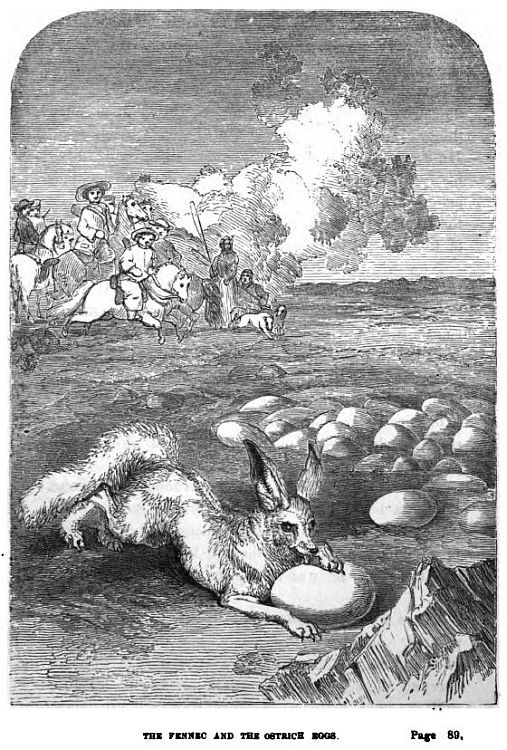
When they first saw him he was at a distance of several yards from the nest, and going farther from it, on the opposite side to that where the hunters had halted. His tail was towards them, and the fore-part of his body appeared to be raised as if his paws rested upon something. This something was seen to be an ostrich’s egg. He was pushing it before him along the ground, using his feet alternately, and forcing the egg to turn. This action was similar to that of some unfortunate fellow on the tread-mill, except that it was voluntary on the part of the fennec.
Now why was he rolling the egg? Did he mean to transport it in that way to his burrow? It would have been an arduous task, as it was not likely his subterranean dwelling was anywhere in that neighbourhood.
But he had no such design. His intention was to eat his breakfast on that very spot, or at all events very near it; and the spectators soon saw where his table was to be spread, for some of them now remembered an odd story they had heard of the caama, and already suspected his design.
About three or four yards from his snout lay a stone. It was a boulder of small dimensions, some twelve inches in height, but quite large enough for the fennec’s purpose. It was evident that he had a purpose with this stone, for he was rolling the egg directly towards it. Those who had guessed his design were not disappointed. When his snout was within about three feet of the stone, the fennec made a sudden rush forward, carrying the egg along by a rapid motion of his feet, until the hard shell came in contact with the harder rock.
A “crash” reached the ears of the hunters, and, looking attentively, they saw that the egg was broken into “smithereens!”
The breakfast of the fennec was now before him, and he at once set about eating it, but the hunters were hungry too, their patience could hold out no longer, and spurring their horses and letting slip the dogs, they galloped forward.
It was a short run for a fox to give. The creature had hardly made good a couple of hundred yards, before the buck-dogs threw him; and it was just as much as Swartboy could do, aided by his jambok of hippopotamus-hide, to save his beautiful skin from their jaws.
The eggs were soon collected. Those in the nest had “gone too far,” as Groot Willem had feared: some contained chicks, and others were addled. But of the ones scattered about several turned out quite fresh, so that the hunters had omelette for breakfast, as they had wished.
Swartboy showed them how to cook the eggs to perfection. This mode was to set one end in the ashes, break a hole in the other, and then with a little stick keep stirring the contents until they were sufficiently broiled. That is an omelette of ostrich-eggs.
Chapter Fourteen.
The Blauw-Boks.
After all, the young yägers were not to be disappointed in a chase. If the fox of South Africa gives but poor sport, there are plenty of other animals, neither so weak-limbed nor short-winded; and one of this kind it was their fortune to fall in with on that same day, and almost within the hour.
On the other side of the mokhala grove from that on which the ostriches had been observed, lay a wide open plain. It was not a desert, although it approached so near to one,—separated from it only by a belt of timber. It was a prairie or natural meadow, the grass—perhaps from contrast with the broad brown expanse on the other side—having an extremely fresh green look.
It was a large plain, though not limitless to the view. In the distance could be seen a wood of the giraffe-acacia, or “cameel-doorns,” bounding the horizon; and several clumps of these trees, with their umbrella-like heads and feathery fronds of pale green, stood isolated upon the plain, giving the scene altogether an interesting aspect. A very park appeared this plain, with wide open pastures between its groves and coppices, many of which were of such regular forms that one would have fancied they had been planted to adorn it.
So lordly a park, such rich pastures, could not be untenanted; nor were they. There was no mansion, no house, not a trace of a human being to be seen, but for all that the plain had its denizens. Many forms could be distinguished upon or around it, both of winged and wingless creatures. Birds and quadrupeds of rare and beautiful kinds made this fair scene their home.
Over its greensward stalks the “secretary,” the true serpent-eater, hunting among the grass for his glittering prey. Even without using his wings, he need not fear any of the crouching carnivora, as his long legs suffice to carry him far beyond reach of either hyena, jackal, wild dog, guepard, or leopard. Swift is he, almost as the great ostrich itself,—so swift as to have earned from the Arabs the singular sobriquet of the “Devil’s horse.”
Not far off another tall bird stands erect upon the plain, but of very different character and habits. This is the “pauw” or “wild peacock,”—a peacock only in the phraseology of the boors, for the bird is a bustard, and the largest of his tribe—the Otis kori.
Running from copse to copse, or feeding over the plain, may be seen flocks of the pearly guinea-fowl, (Numida meleagris), whose constant chattering grates harshly on the ear, resembling the metallic clanking of machinery, or the sharpening of a hundred saws.
From tree to tree flutter gaudy parrots, green pigeons, and soft cooing doves, and over flowery shrubs flit numerous species of tiny “honey-suckers,”—the African representatives of the humming-birds. Some trees carry the pensile nests of the weaver-bird, (Ploceus), hanging from their branches like large fruits, while many of the cameel-doorns are loaded with the vast thatch-like republican dwellings of the sociable grosbeak, (Loxia socia).
But birds are not the only tenants of this fair scene. Quadrupeds, as bright and beautiful as they, haunt its verdant glades, or repose under the grateful shadow of its acacia-groves.
In a few hours’ ride one might see graceful antelopes of many species. The nimble springbok—the gazelle of South Africa—might be observed trooping over the sward, or bounding high in air either in sport or alarm—the orange “hartebeest,” and the purple “sassybe,” might be seen—the shaggy-maned eccentric gnoo, scouring the plain in circles—droves of quaggas, or of the still more beautiful “zebra of the plains,” (Equus Burchellii), might be seen too, crouching around the copses, the leopard, fair but fearful to look upon; and still more fearful to behold the tawny tyrant of the scene—the lion.
All these creatures, and many more of equal interest, might come under the eye of the traveller or hunter during a single day’s ride through that wild domain.
Thus full of life, what a contrast did this beautiful meadow present to the monotonous waste of wilderness, that stretched away from the opposite side of the grove to the far horizon!
Baulked in their projected “surround” of the ostriches—disappointed by the “poor sport” which the fox had afforded, the hunter-boys were determined not to be “choused” out of a chase. Some sort of one they would have, if it were only a brush after springboks, for these, they knew, they could find at any time. They were aware of the existence of the fine plain—the edge of which came up within a few hundred yards of their camp. They had pastured their cattle there on the evening before; and conjectured that it must be the haunt of many kinds of game. For this reason they now resolved upon making an excursion to that quarter, to hunt whatever might turn up.
They came to this determination, only after their return from the ostriches’ nest; but as they had made up their minds to it before eating breakfast, they did not off-saddle, but kept their horses ready for being mounted.
As soon as the meal was over, they took once more to their saddles and rode off, the buck-dogs following at the heels of their horses. Congo and Swartboy stayed by the camp.
They had not far to go, before coming in view of their game; and rare game that was.
They were scarce yet a hundred paces from the camp, and just about to ride out from the timber, when Hendrik, in the advance, suddenly reined up his horse, making a sign for the others to do the same. All pulled up in a breath, and sat in their saddles, gazing out through the leaves. Though still within the shadow of the grove, all had a good view of the open plain; and before them was a sight that would have warmed the hearts of older hunters than they.
Out upon the plain, and directly in front of them, was a herd of noble antelopes. They were neither gnoos, nor springboks, nor hartebeests, nor any of the common kinds that the party had already met with, and had hunted to their satisfaction. Indeed, they were of a species that none of the six had ever seen before, and they only knew them to be antelopes from the make of their bodies, the shape of their horns, and other points characteristic of these animals.
They were antelopes of large size, standing nearly four feet high, having sabre-shaped horns curving gently backward and ringed to within six inches of their tips. Their general colour was ashy grey, tinged with raven-blue—the blue tint being caused by the deep black colour of the skin shining through the hair.
Although none of the party had ever seen such antelopes before, Hans, and also the hunters Hendrik and Groot Willem, guessed what kind they were. They were of a kind that once ranged the Graaf Reinet, and even as far south as the Cape itself, though there they were never common. That was long before any of the young yägers had ever fired a gun or mounted a horse, but as these remembered having heard their fathers talking of this animal—of its blue colour, of its long curving horns, of its fine outline of form, as well as bold fierce character—they recognised those before them by the descriptions they had heard. They could be no other than blue-bucks, or blauw-boks in the language of the boors.
Hans, after eyeing them a moment, gave this as his opinion. The species was the blauw-bok, the Aigocerus leucophea of modern systematists.
Now of the group of antelopes to which the general name Aigocerus has been given there are five species—all large noble animals, and all inhabitants of South Africa, and particularly the countries adjacent to the Great Orange River.
First, there is the “waterbuck,” (Aigocerus ellipsiprymnus), which stands nearly four feet in height, is of bluish grey colour, frequents the banks of rivers, takes the water freely—whence its trivial name—swims well, is bold, fierce, strong, and dangerous, when bayed or wounded.
Secondly, there is the “takhaitze,” (Aigocerus barbatus), nearly as large as the waterbuck, but distinguished by a long beard and mane. The character of the waterbuck for fierceness and daring also belongs to the takhaitze, and both are swift runners. The latter, however, is less attached to the water, and frequents a hilly region, browsing goat-like upon the leaves of the acacia.
The third of this genus is the “roan antelope,” (Aigocerus equinus), a strong fierce animal, with horns curving backwards as in the blue-buck, but thicker, and more rapid in the curve. It is an antelope not of the plains, but a dweller in the hilly region.
The “sable antelope” (Aigocerus niger) is by far the most beautiful animal of the group. It is not many years since this antelope was made known to science, having been discovered in South Africa by a keen British sportsman. It is one of the largest of the race, standing four feet six inches in height, and carrying a pair of scimitar-shaped horns over three feet in length. Its colour is a deep glossy black or sable—whence its specific appellation—though it is white underneath with white markings about the head and neck. None of the antelopes of this group are of common occurrence even in their native haunts. None of the species can be called gregarious—that is, they do not appear in large herds, like the springboks, gnoos, hartebeests, or bonteboks—though small troops of less than a dozen—families, in fact—may be seen together. Oftener they are met with in pairs, or single individuals, and they are all scarce in the regions they inhabit when compared with the vast herds of the more social kinds.
The blue-buck is now one of the very rarest of the group, so much so that some naturalists believe it to be extinct. That is not likely. Africa is a large country.
Now all this information was furnished by philosopher Hans. He did not offer it just then—that is when they came in sight of the herd of blue-bucks; though he would, likely enough, had the others been inclined to listen to him.
But they were not. The hunters Hendrik and Groot Willem were gazing with eyes wide open, admiring the beautiful proportions of the blauw-boks, which promised them a glorious run.
Chapter Fifteen.
A Brush after the Blue-Bucks.
As already stated, there were seven antelopes in the herd. One, an old buck, larger than any of the rest, and having horns over three feet long, was in the advance acting as leader. When first observed, they were approaching the grove of mokhalas—perhaps to reach the water by the spring. So thought the yägers, and held a hurried consultation about it, as they watched the advance of the animals. Hurried it was, and abruptly terminated, for before they could come to any definite plan of action, one of the buck-dogs, a young and half-trained animal, sprang forward out of cover, and opened his bay right in the faces of the antelopes.
The whole seven wheeled round in their tracks, and obedient to a snorting signal of the leader, started back in the direction they had come, going at top speed.
Of course all idea of stratagem was foiled by the unexpected behaviour of the dog. A straight tail-on-end chase was the only course left the hunters to follow; and, plying the spur, all the six shot out of the timber, and rode “view halloo” over the open plain.
A splendid chase it was for several minutes—the seven blue-bucks in advance, the dogs in the middle, and the “field” following in the rear. A splendid chase, indeed!
But only for a few minutes did dogs, hunters, and game, maintain these relative positions. The horsemen spread first. The ponies of Klaas and Jan fell to the rear, and were soon distanced. Then lagged the philosopher Hans, whose cob, though steady under fire, and a good roadster, was no hunter; and, next, the handsome Arend,—who might have taken a better place, for his steed was a good one. But Arend cared but little for hunting, and less for hard riding under a hot sun; and having permitted himself to get so far behind that the view of the chase was no longer interesting, he reined up under the shade of a cameel-doorn, and commenced fanning himself with the gauntlet of his military glove!
There were two, however, who still rode to the dogs with the keen ardour of sportsmen—Hendrik and Groot Willem; and from a feeling of rivalry, as already hinted at, each was determined to be in at the death.
Both were well mounted, though very dissimilarly. The horse that Hendrik rode was a beautiful coal-black, of medium size, with a dash of the Arab in him—just enough to make of him what is termed a “hunter,”—a breed the finest in the world, and for all purposes, except race-course gambling, finer even than the Arabian itself.
Groot Willem’s horse differed widely from this kind; and the same description that has been given of Groot Willem, or one very similar, would answer for his steed.
In size, he bore the same proportion to Hendrik’s hunter that his rider bore to Hendrik—that is, he was a full half bigger; but his own members were out of all proportion with each other.
His body was flat and gaunt, and his limbs long and bony. His neck also was of an immense length, without the slightest semblance of a curve; and his head was angular and “bumpy,” like that of a giraffe. He had other points of similarity to this singular quadruped, in his rough awkward gait, and long-stumped thin-haired tail; and the young yägers, in view of these resemblances, had jocosely christened him “Groot-Kameel,” (Great Camel). He was about as ugly a horse as could have been found in all the land of the boors; and yet his owner, Groot Willem, would not have exchanged him for the handsomest horse in Africa.
Notwithstanding his ugliness, he was a good horse. In jockey phrase, “a bad ’un to look at, a good ’un to go.” Groot Willem was no man for appearances. He liked performance better than promise; and the “Great Camel” was the type of that idea—he promised nothing, but performed amazingly. Many a quagga, and wildebeest and sassybe, had he ridden down; many a stanch buck-dog had he tired out and passed in the chase with the heavy weight of Groot Willem on his back. No wonder the latter felt a high regard for his well-trained hunting horse.
Hendrik had an equal affection for his beautiful black; and as no opportunity had yet offered of a fair trial between the two steeds, a good deal of talk had passed about their respective merits as regarded speed and “bottom.” On the question of beauty nothing could be said. Hendrik had the advantage there; and even Groot Willem acknowledged it, at the same time that he sneered at that being considered a “merit” in a horse.
The chase of the blauw-boks seemed to offer the chance of a fair trial. The animals had taken across the open plain, which would lead the hunters several miles at least, as the game was not one to be run down in a hurry. In a ride like that before them, it would be seen which backed the best steed.
Both riders were determined to make the most of their horses. Both were wary hunters, and, instead of dashing forward at break-neck speed, it could be seen that each was “going cunning,” and saving their steeds for the final burst. Hendrik felt that in speed for a mile or two he could have headed the “Camel” easily enough. But the bucks had got a good start, and it was not likely he could overtake them within that distance. He held up, therefore, riding gently, lest in the end the great horse of his rival might come out too strong for him.
For some distance the two galloped “cheek by jowl,” the dogs far in the advance, and the bucks still running together before them. The latter did not seek to escape into the bushes, though they passed near several large copses. They kept in the open plain, in a course nearly direct. Stag-like they were running for some water—as antelopes of the aigocerine group habitually do.
But the dogs did not husband their speed, some of them were young and foolish, although very swift; and before the bucks had passed over a mile of ground, two or three of their canine pursuers pushed them so closely that the herd broke, and the antelopes, in their terror, forsook each other, and ran wildly in various directions.
The character of the hunt was now quite altered. The pack split up just as the game had done, each dog following the antelope that seemed nearest him, and in a few moments the chase was scattered all over the plain.
The two hunters had now a choice, whether each should pursue a separate game, or both take after the same. But neither thought for a moment of separating from the other, except by heading him. The spirit of rivalry, though silent, was strongly felt by both. Even the very horses seemed to be actuated by a similar feeling, eyeing each other askance, as they galloped side by side!
The antelope that both were determined to follow was easily selected from the rest. The old buck that hitherto led the herd had now gone off by himself, followed by a pair of the stanchest dogs. His horns were the meteors that gleamed in the eyes of our hunters, and beckoned them on.
Without exchanging a word with each other, both rode after the buck.
Chapter Sixteen.
Groot Willem gets a Tumble.
The chase was now one of exceeding interest, and had become a simple trial of speed between horses, dogs, and antelope. The buck had kept on in a direct line, when the others broke away from him. He had been foremost at the time, and had no need to turn out of his course. Besides he knew where he was running to. Terror had driven the others out of their senses, and they had fled without design, while the old buck, not losing his “presence of mind,” kept on for the water.
A dark belt seen ahead was a forest fringing some stream or river. That was the point he was making for, but a wide plain must be crossed before he could wet his hoof in any water. Over this plain now swept the chase.
Oddly enough, the two dogs that had chosen the buck for their game were rival dogs—that is, each hunter was owner of one of them, and regarded him as a favourite; and all three kinds, dogs, horses, and riders, seemed to be on their mettle, and were doing their very best.
Do not fancy there was any ill-feeling between Groot Willem and Hendrik. Nothing of the sort. Each loved his horse and his dog, and wished them to excel—each had his hunter reputation at stake in the result—and each had resolved upon carrying the head and horns of that blue-buck in triumph to the camp!
Notwithstanding all this, there was no “bad blood” between the boys. Nothing of the sort.
Beautifully the buck ran. Lightly he leaped over the turf, his limbs at each spring stretching to an almost horizontal line, with head high in air and horns curving backward to his flanks. Well and beautifully he ran!
Sometimes he gained on his pursuers, as the nature of the ground favoured his hoofs; but again the strong buck-dogs howled upon his heels, and the hunters galloped but a hundred yards behind him. The blue of his back soon changed to a deeper tint, as the sweat poured through his sable skin, and the froth in large flakes clouted his neck and shoulders. His red tongue hung dripping from his jaws, and the hunters might have heard his hard breathing but for the panting of their own steeds.
Five miles did they go in that wild gallop—five miles without drawing rein or changing pace!
The woods were near—perhaps the water! The buck would gain them if not hard pressed—there might be a deep reach of some large river—the blauw-bok can swim like a duck—he would plunge in—they could not follow—they would lose him!
With such fears the hunters spurred their horses for a final burst. Their speed had proved nearly equal. Now was the time to try their “bottom.”
Both shot forward at the fresh touch of the steel; but at the second or third spring the ground under the “Great Camel” gave way, and the huge horse with his heavy rider rolled headlong to the earth!
He had broken through the burrow of the aard-wolf!
Hendrik, who had shot a little ahead, heard the confused noise behind, and, looking over his shoulder, saw Groot Willem and the “Camel” struggling together over the turf. A more attractive object, however, was in front of him—the panting buck—and without making halt, or staying to inquire whether his fellow-hunter was hurt—a pardonable neglect among sportsmen—he pressed his wearied horse still forward and onward.
In five minutes after, the buck stood to bay by the edge of the timber, and the dogs rushed up and sprang at him. It was a fatal spring for one of them—the favourite of Groot Willem. The luck was against him, as it had gone against his master. A single “gowl” came from his throat, as he was flung back off the sharp horns of the antelope. It was the last note he ever uttered, for in a moment more he had kicked his last kick, and lay lifeless upon the plain!
And very likely Hendrik’s favourite would have shared the same fate; but his master at this moment riding near, caused the blue-buck a fresh alarm, and he broke bay, and dashed into the bushes followed by the dog.
Hendrik now lost sight of the chase, though he could hear the breaking branches, as the strong antelope made his way through the thicket, and the baying of the dog still told him the direction in which the game was going.
Putting his horse to a more moderate pace, he followed through the bosch, as well as he could. He expected every moment to hear the hound bark, the signal that the buck had again stood to bay, but he was doomed to disappointment. No such sound reached his ears.
He began to think that the buck was lost, and that, after all the chances in his favour, he would return to camp with no better story to tell than his rival. He was becoming exceedingly chagrined with the turn things had taken, when, to his further chagrin, he heard a loud plunge, as of some heavy object falling into deep water. He knew it was the buck. Another plunge!—that was the dog.
There was a river ahead—the antelope had taken to it, and would now escape to a certainty. The water seemed near—there was an open tract that led in that direction. Perhaps he might be in time. Perhaps he might get to the bank before the buck could reach the opposite shore. A bullet from his rifle might yet secure the game.
Without hesitating a moment he again spurred his horse, and galloped down the hill in the direction of the water.
There was a river, and in a few seconds’ time Hendrik was on its bank. He had arrived at a place where the water was deep and the current still, but the rippling wave on the surface guided him. Two objects were seen above the surface moving rapidly across. They were the horns of the buck and the head of the buck-dog!
Hendrik had no time to alight. Before he could steady his horse, the blauw-bok had got out of the water, and was climbing up the opposite bank. There was just time for a hurried shot. The broad back of the antelope offered a fair mark, and the next moment a tuft of the hair near the spine, was seen to fly up like a spark, while a red stream spouted from the spot. The crack of a rifle explained this phenomenon; and before its echoes had died away, the antelope came tumbling down the slope, and lay motionless by the edge of the water.
The horns were Hendrik’s!
Chapter Seventeen.
A Tough Struggle.
The horns were Hendrik’s!
So thought Hendrik, when, at the crack of his rifle, he saw the buck roll backward down the bank into the very jaws of the buck-dog.
He was mistaken, however—as he had reason to think the moment after—when the antelope, instead of lying still where it had fallen, rose to its feet again, beat off the dog with its horns, and springing over him, once more plunged into the river! The dog bounded after, and, swimming faster than the antelope, overtook it near the middle of the stream, seizing it by the quarters as he got within reach. The strong buck soon shook him off, and turning short upon his persecutor, struck at him in the water. Two or three times the hound was under its horns, but the water yielding saved Hendrik’s favourite from destruction, although more than once he was forced under the surface.
This struggle was kept up for some moments. The river ran red, blood pouring from the wound of the bullet, as well as from the flanks of the antelope, lacerated by the tusks of his canine assailant. The blood of the hound also helped to colour the current—for the sharp horns of the buck had been used to some purpose, and several gashes appeared in the hide of the dog, from which the crimson flood streamed copiously.
After delivering his fire, Hendrik had alighted, not with the intention of reloading, but merely to secure his prize, which, as he supposed, had been finished by the shot. He was about tying his bridle to a branch; but, before he had succeeded in making a knot, the renewed struggle on the opposite bank, followed by the plunge, caused him suddenly to drop the reins and again lay hold of his rifle.
He loaded with all haste, and ran forward to the bank.
There was a fringing of willow-bushes along the edge of the river. In the saddle Hendrik had been able to look over them, and at that elevation commanded a view of the water. Afoot he could not see it, except obscurely through the tops of the willows. He could only see that the water was waving with eddies and covered with frothy bubbles. He could hear that a struggle was going on between buck and buck-dog, but the combatants had got close in to the willows, and the leaves prevented Hendrik from seeing either of them.
At one place there was a break in the willows, where the bank sloped downward to the water’s edge. It was a mere pathway, made by wild animals in going to drink. On both sides of it the bushes grew thick, forming a narrow lane or alley.
Hendrik’s eye fell upon this path, and the next moment he was hastening down it. The antelope from the river had also noted the path. It was the place easiest of access from the water, as there the bank was more shelving than at any other point; and just at the time the hunter rushed into it from the woods, the buck was entering its opposite end from the water!
Both were going at full speed, and in five seconds’ time they met face to face in the narrow pathway!
There was no chance for either to make way for the other. The close thicket on each side prevented that. There was no chance for either to retreat; the impetuosity with which they were running rendered it impossible for either to give back or even halt. They must meet with a fearful collision!
Such a meeting would be entirely to the advantage of the buck, and, perhaps, to the total destruction of the hunter.
Hendrik saw this, and would have aimed at the buck and fired had time been allowed him. But so sudden and unexpected was the encounter that he had not even time to get his rifle to the level, before the animal was too near to admit of such delay.
He fired wildly without taking aim. The bullet scored the back of the antelope, only to add to its fury; and with head lowered and scimitars set, it rushed onward upon the hunter.
It was a moment of peril for Hendrik. Another moment, and he would have been impaled upon the sharp horns; but at that instant, as if guided by an impulse of instinct, he dropped his rifle, and ran forward towards the buck, as if to fling himself upon its horns!
That was far from being his intention, however. When within about three feet of these horns, he gave a sudden bound and rose like a springbok into the air!
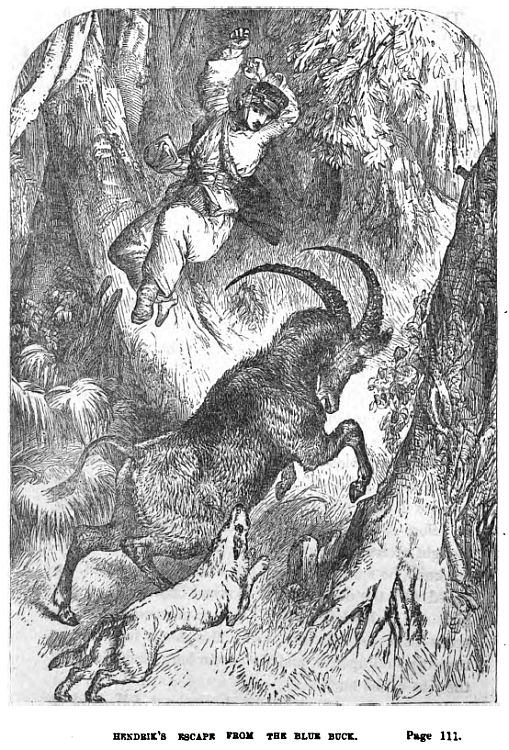
That spring saved him. Before he came down again the horns had passed under him, and he fell heavily across the back of the buck.
The hind-quarters of the antelope sank under his weight, and Hendrik slipped off; but before he could recover his feet, the furious animal had turned, and was again springing upon him where he lay.
It would have been all up with Hendrik, had he been left to himself at that moment. But succour was nigh.
The buck-dog had reached the spot; and just as the antelope was making his rush, the dog sprang forward, and, seizing it by the throat, hung fast.
Hendrik received the blow, but the weight of the dog hanging to the throat of the antelope prevented the latter from giving it with effect, and the hunter was but slightly injured.
In an instant the buck kicked the dog off with its hoofs, and flung him to the ground. In another instant it would have finished him with its horns; but Hendrik, from the sharp blow he had received, was now as angry as the antelope itself, and was not going to see his favourite hound killed before his eyes without making an effort to save him. Warmed to the conflict, he thought no longer of retreating; and, drawing his hunting-knife, he sprang forward upon the antelope, that, engaged with the dog, chanced to stand broadside towards him. With his left hand the hunter grasped one of the horns near its tip; and, using this as a fulcrum, he turned round upon it, and thrust the long blade between the ribs of the buck!
It was a home-thrust—for the animal fell dead at Hendrik’s feet before he could let go his hold upon the horn. The blade had passed through its heart.
As soon as Hendrik had cooled a little from the conflict, he thought of Groot Willem, who had not yet come up. He began to fear that the latter might have received some serious injury, and he determined to ride back to the spot, letting the buck lie where it had fallen. He could return for it afterwards. Fortunately his own well-trained horse had not run off—though left with trailing bridle—and Hendrik was soon mounted and riding back on the spoor of the chase.
There was one thing that mystified Hendrik not a little. While battling with the buck he had heard the loud report of Groot Willem’s roer. What could he have fired at? Had any of the other antelopes come in his way? or was it a signal of distress? Hendrik was mystified and felt some apprehension.
He had not far to go to satisfy himself. On reaching the edge of the timber, he saw Groot Willem mounted and about starting forward to rejoin him. This was a joyful sight to Hendrik, as the fact that Groot Willem was once more in the saddle and the “Camel” upon his legs again, was good primâ facie evidence that neither had sustained any very serious damage.
Nor had they, as Hendrik ascertained by riding up to the spot. Groot Willem was not so badly hurt as Hendrik himself, for the latter had one of his arms well scored by the horns of the buck. Groot Willem’s temper, however, was severely ruffled; and though Hendrik was very much inclined to laugh at the accident, he forbore doing so, out of regard for his friend’s feelings.
Hendrik now inquired about the report he had heard.
Was it the roer? Groot Willem answered his question in the affirmative, by a simple nod, at the same time pointing to an odd-looking animal that lay dead upon the ground, with all the appearance of having been freshly killed.
Hendrik rode forward, and, bending down in his saddle, for some moments regarded the animal.
A rare and singular creature it was. It was about the size of a large terrier, but shaped very differently. It had the drooping hind-quarters that distinguish the hyenas, and altogether the look of these animals; but its muzzle was much more slender and pointed, its back more rounded, and its limbs not so stout as those of the hyena’s. It was a more agreeable creature to look upon, and although its hair was long, it had a soft woolly appearance. The general colour of the hair was grey with a reddish tinge, and with black bands running transversely to the body of the animal. This as much as anything else caused it to resemble the hyena—that is, the species known as the “striped hyena,” (Hyena striata).
It was not a hyena, however, but one of those odd animals that seem to belong to no class of creatures, but form a connecting link between several. South Africa is especially prolific in such eccentric forms, both among its birds and quadrupeds. As an illustration of this, we might mention the wild-hound, the hyrax, the zerda, the fennec, the gnoo, and the aard-vark; and among birds, the serpent-eater, the bateleur eagle, and several other kinds. Most of these odd animals are only represented by a single species, and that only to be found in South Africa.
Now the creature that lay stretched out before the eyes of Hendrik was just one of these zoological puzzles, that has occupied the attention of the systematists for a long while. Some have classed it among dogs, others with hyenas, some make a civet of it, and others a fox. With all these animals it has affinities, both in habits and anatomical structure, but it is not near enough to any to be regarded either as dog, fox, civet, or hyena; and hence a genus has been created for itself—the genus Proteles. It was a proteles that lay upon the ground—Proteles Delalandii,—so called from its first describer, the traveller De Lalande.
Hendrik and Groot Willem knew the animal by the name of “aard-wolf,” or earth-wolf, so called because it lives underground in a burrow of its own making. They knew it well enough, for it is common through all South Africa—even in the settled districts, though on account of its nocturnal and burrowing habits it is not often seen. It makes itself known to the boor by its evil propensities; and although he may rarely get his eyes upon it, as it is never abroad by day, he is often called upon to witness the dire effects of its midnight marauding.
The sheep of South Africa are of a singular breed—singular on account of their large fleshy tails, consisting of a mass of almost pure fat which often weighs several pounds, and is used by the colonial housewives in many operations of cookery. Now these tails, hanging to the ground are the favourite bonne-bouche of the aard-wolf, whose jaws, not strong like those of the hyena, compel him to feed upon soft substances. It is, therefore, no uncommon thing for the vee-boor to get up in the morning, and find several of his best sheep divested of their valuable tails, and all through the voracity of the aard-vark.
It was not likely that either Groot Willem or Hendrik was ignorant of the aard-vark. Neither were they. Hendrik did not ride up to examine the animal out of curiosity. He had seen such before, and killed them too. His object in bending over it was to see where Groot Willem’s bullet had hit.
“Where had the creature come from?” he inquired.
Groot Willem replied that it had issued from its burrow—the hole that had caused the “Camel” to stumble. That it had come out, just as he, Groot Willem, recovered his feet; and that, provoked at it for having been the cause of his misfortune, he had sent a bullet through it, otherwise he would not have reckoned it worth his powder and lead.
This explained the report of the roer.
Hendrik and Groot Willem were now about to return for the buck, with the intention of carrying as much of the meat to camp as they could manage upon their horses; when Hans and Arend came up, and the four rode off together.
They quartered the antelope, and each having packed a quarter upon his croup, they set out for the camp.
All of them were in good spirits, except perhaps Groot Willem, who had two reasons for feeling out of sorts,—the loss of his dog, and the loss of a little of his hunter-fame. And he was not permitted to forget his accident so easily, for although Hendrik had forborne to give him further chagrin, yet Hans and Arend did not deal so delicately with him, but both laughed heartily at his unfortunate tumble.
Chapter Eighteen.
The Arrow-Poison.
Klaas and Jan had long since ridden their ponies back to camp, and having off-saddled, remained by the wagons.
For all that they were not idle—that is, they were not without something to interest and amuse them. Swartboy was the genius worshipped by Klaas and Jan, for there was no bird in all Africa that Swartboy could not either snare or trap; and in his hours of leisure, when the oxen were kraaled and off his hands, he was in the habit of showing the two young “mynheers” how to construct many a sort of decoy and trap for the fowls of the air.
Upon this day in particular, however, they were more than usually interested in the Bushman’s proceedings, as his attention was turned to capturing,—not a fowl of the air, but of the earth,—an ostrich.
Swartboy had resolved to pluck the plumes out of the old cock that had been seen, and whose dwelling had been so rudely approached and plundered in the morning.
But how was Swartboy to capture the cock?
It was not his intention to take him alive. That is a difficult matter, and can only be managed by men mounted upon fleet horses, and then after a very long and troublesome chase.
Swartboy had no wish to take the ostrich alive. The bird would be of no use to him in that way, as the skin and plume-feathers were the spoils upon which the Bushman’s thoughts were bent, or rather the rix-dollars which these would yield on Swartboy’s return to Graaf Reinet. Therefore he did not intend to catch the old cock, but kill him, if he could.
But how was the Bushman to accomplish this? Would he borrow the rifle from Hendrik, or the great elephant-gun—the “roer”—from Groot Willem, and shoot the ostrich? Not likely. Swartboy was no shot, that is, with fire-arms. He knew nothing about them; and with either rifle or roer he could scarcely have hit an elephant, much less an ostrich!
But if Swartboy knew not how to manage a gun, he had a weapon of his own that he did know how to manage,—his bow. With that tiny bow,—scarce a yard in length,—and those small slender arrows, the Bushman could send a missile as deadly as the leaden bullet of either rifle or roer.
Looking at the light reed, with its little barbed head and feathered shaft, you would scarcely believe it possible that such a weapon could bring down the big strong ostrich; and yet with a similar shaft had Swartboy often levelled the great camelopard in the dust. A deadly and dangerous weapon was the Bushman’s arrow.
But what rendered it so? Not its size, and surely not the force with which it could be projected from that tiny bow? Neither. There was something besides the strength of the bow and the weight of the arrow to make it a “deadly and dangerous weapon.” There was poison.
Swartboy’s arrows were true Bushman weapons,—they were poisoned. No wonder they were deadly.
The use of the bow among savage nations all over the earth, and the great similarity of its form and construction everywhere, may be regarded as one of the most curious facts in the history of our race. Tribes and nations that appear to have been isolated beyond all possible communication with the rest of the world, are found in possession of this universal weapon, constructed on the same principle, and only differing slightly in details—these details usually having reference to surrounding circumstances. When all else between two tribes or nations of savages may differ, both will be found carrying a common instrument of destruction,—the bow and arrows.
Can it be mere coincidence, like necessities in different parts of the world producing like results, or is this possession of a similar weapon among distant and remote peoples a proof of unity or communication between them in early times?
These inquiries would lead to a long train of reflections, which, however interesting, would here be out of place.
But an equally or still more curious fact is that of poisoned arrows. We find here and there, in almost every quarter of the globe, tribes of savages who poison their arrows; and the mode of preparing and using this poison is almost exactly the same among all of them. Where there is a difference, it arises from the different circumstances by which the tribe may be surrounded.
Now the knowledge of arrow-poison, as well as the mode of preparing it and the habit of using it, belong to tribes of savages so completely isolated, that it is not probable—hardly possible, in fact—that either they or their ancestors could ever have communicated it to one another. We cannot believe that there ever existed intercourse between the Bushman of Africa and the Chuncho of the Amazon, much less between the former and the forest tribes of North America; yet all these use the arrow-poison and prepare it in a similar manner! All make it by a mixture of vegetable poison with the subtle fluid extracted from the fang-glands of venomous serpents. In North America, the rattlesnake and moccason, with several species of roots, furnish the material; in South America, the “wourali,” or “curare,” as it is indifferently called, is a mixture of a vegetable juice with the poison extracted from the glands of the coral-snake, (Echidna ocellata), the “boiquira” or “diamond rattlesnake,” (Crotalus horridus), the lance-headed “viper,” (Trigonocephalus lanceolate) the formidable “bushmaster,” (Lachesis rhombeata), and several other species. In South Africa, a similar result is obtained by mixing the fluid from the poison-glands of the puff-adder, or that of various species of naja, the “cobras” of that country, with the juice from the root of an Amaryllis, called gift-bol (poison-bulb) in the phraseology of the colonial Dutch. It is out of such elements that the Bushman mixes his dangerous compound.
Now our Bushman, Swartboy, understood the process as well as any of his race; and it was in watching him mixing the ingredients and poisoning his arrows that Klaas and Jan spent the early portion of that day.
All the ingredients he carried with him; for whenever a “geel coppel,” (Naja haje), or a “spuugh-slang,” (Naja nigra), or the “puff-adder,” (Vipera arretans), or the horned viper, (Cerastes caudalis,)—whenever any of these was killed on the route—and many were—Swartboy took care to open the poison-gland, situated behind their fangs, and take therefrom the drop of venom, which he carefully preserved in a small phial. He also carried another ingredient, a species of bitumen obtained from certain caverns, where it exudes from the rocks. The object of this is not, as supposed by some travellers, to render the charm “more potent,” but simply to make it glutinous, so that it would stick securely to the barb of the arrow, and not brush off too easily. A similar result is obtained by the South American Indians from a vegetable gum.
The gift-bol, or poison-bulb, was easily obtained, as the species of Amaryllis that yields it grew plentifully near. But Swartboy had not trusted to this chance, as during past days he had plucked several of the roots, and put them away in one of the side-chests of the wagon, where many other little knick-knacks of his lay snugly stowed.
Klaas and Jan, therefore, had the rare chance of witnessing the manufacture of the celebrated arrow-poison.
They saw Swartboy bruise the gift-bol, and simmer it over the fire in a small tin pan which he had; they saw him drop in the precious snake-venom; they saw him stir it round, until it became of a very dark colour, and then, to their great astonishment, they saw him try its strength by tasting!
This seemed odd to both, and so may it to you, boy reader,—that a drop of poison, the smallest portion of which would have killed Swartboy as dead as a herring, could be thus swallowed by him with impunity! But you are to remember that poisons, both vegetable and mineral, are very different in their nature. A small quantity of arsenic taken into the stomach will produce death, and yet you might swallow the head of a rattlesnake, fangs, poison-gland, and all, without the slightest danger.
On the contrary, if a single grain of the latter were to enter your blood, even if it were only scratched in with a pin, its effects would be fatal, while other poisons may be introduced into the blood without any fatal result.
Swartboy knew there was no arsenic or any species of “stomach-poison,” if I am allowed to use such a phrase, in his mixture. It was only “blood-poison,” which he might taste with impunity.
The bitumen was the last thing put into the pan; and when Swartboy had stirred it a while longer, and sufficiently thickened it, so that it would adhere to the barbs, he took down a quiver of arrows already made, and dipped each of them into the poison. As soon as the barbs had cooled, and the poison became well dried, the arrows were ready for use, and Swartboy intended that some of them should be used on that very day. Before the sun should set, he designed sending one or more of them through the skin of an ostrich.
Chapter Nineteen.
Decoying the Old Cock.
It was not the process of mixing the arrow-poison, so much as the use to be made of it, that interested Klaas and Jan. They knew that the Bushman intended to try its effect on an ostrich that afternoon. More than that, Swartboy had promised they should actually see how he managed matters, and witness the death of the ostrich. With such a prospect before them, the boys were in high spirits all the fore-part of the day.
It was to be late in the afternoon, near sunset, in fact, before the sport should come off. Of course not till the return of the ostriches to their nest—for it was there the drama was to be enacted. The nest and its environs were to be the scene of the tragedy—the time a little before sunset. Such was Swartboy’s “programme.”
Of course Swartboy had leave from the older boys to go upon almost whatever expedition he pleased, but certainly upon this one, since Klaas and Jan were so interested about it. Indeed, some of the others would have liked to take part in the affair, but for certain reasons that could not be.
Some of the hunters had doubts as to the result. They knew the poisoned arrow would kill any ostrich. They did not doubt that. But how was Swartboy to get near enough to discharge one of his tiny shafts into the bird’s body? That was the question that puzzled them. He proposed doing so in broad daylight. Indeed there was no other time for him. All knew that before night the ostriches would return to their nest—as soon as the sun was low, and it became cooler,—but they knew also that the birds having found out what had happened in their absence would start off in alarm, and abandon the nest altogether.
Swartboy, therefore, would have no darkness to shelter him from their gaze. How was he to approach them within the range required for his small bow—that is, within less than fifty yards?
Did he intend to place himself in ambush and wait for their return? If he did, it must be near the nest, else he would have but a poor chance. There was no knowing in what direction the birds might come back, or which way they would scamper off again.
Now for Swartboy to conceal himself near the nest, all believed to be an impossibility. There was not a bit of cover within five hundred yards of the spot—neither bush nor stone big enough to conceal the body of a man from creatures less wary than ostriches, but from these a cat could not have hidden her carcass within a circle of a thousand yards diameter. As to Swartboy’s sinking a “shooting-hole” and lying await in that, the boys never thought of such a thing. A shooting-hole surrounded by bushes might do for a lion, or a rhinoceros, or an elephant, but no ostrich could be bamboozled by any such ruse; for these birds—that on account of their appearance have been called stupid by some superficial observers—are in reality the very reverse. The slightest alteration in the form of the ground, either around their nests or near it, would be noted by them, and would prevent them from approaching it, except after such a reconnoissance as would defeat all Swartboy’s plans. But he had no thought of a shooting-hole—nothing of the sort.
What plan, then, had he in his mind? The boys could not guess; and Swartboy, like all cunning hunters, did not care to tell his plans to everybody. He preferred letting them discover them by his acts; and as all of them were hunters themselves and boys of good breeding, they did not persecute him with idle questions, but watched his preparations in silence.
Now one of his preparations, made before starting, was to take the little fennec that had been killed in the morning, and “truss” it with a number of skewers, in such a way that it stood upright upon its legs, and at a short distance looked as if it was “alive and well!”
This was Swartboy’s last act, before setting out for the ostriches’ nest.
When it was finished, Swartboy observed that the sun was low enough, and taking the fennec under his army and his bow in his hand, he struck off over the plain.
The boys were to be spectators of the affair, but that was rather in a figurative sense. There were two pocket telescopes, and when Swartboy promised that Klaas and Jan should be witnesses of the thing, he had these telescopes in his mind. For certain reasons he could not take any of the boys along with him, and from the wary character of the game they could not go near enough to observe it with the naked eye. To have done so would have driven the ostriches out of Swartboy’s reach, for it has been already stated that these far-seeing birds can sight an enemy farther off than they can themselves be seen.
The telescopes, therefore, must be brought into play, and as Klaas and Jan begged to have the use of them, it was arranged that the two boys should climb into a tree, and describe what they saw to the rest, who stood below. That would be witnessing a spectacle by a sort of second sight, as Arend jocosely remarked.
Klaas and Jan were therefore hoisted up into a camel-thorn acacia; and, seating themselves on its branches, prepared their telescopes for use.
The elevation enabled them not only to see the nest, for that was visible from the ground, but the surface of the plain to a considerable distance beyond. They would thus be enabled to note every movement either Swartboy or the ostriches should make.
Now it has been stated that within a circle of five hundred yards radius from the nest, there was no cover that would have concealed a cat. With the exception of a stone here and there—none of them larger than a quartern loaf—the sandy surface was perfectly smooth and level as a table.
The boys had noticed this in the morning. Hendrik and Groot Willem had taken good notice of it, for they, as well as Swartboy, had thought of “waylaying” the ostriches on their return, but had given up the idea, from the fact of there being no cover to conceal them from the eyes of the wary birds.
But just outside the circumference mentioned, there was a chance of cover—a bush that by tight squeezing might have sheltered the body of a man. Both Hendrik and Groot Willem had seen this bush, but on account of its great distance from the nest they had never thought of its being used as a cover. Five hundred yards off,—it might as well have been five miles. Even had it been on the side by which the ostriches had gone off, and by which they, the hunters, conjectured they would return, the bush might have served. A shot might have been obtained as the birds came back to the nest. But it was not on that side,—on the very opposite—and in the direction of the camp. Neither Hendrik nor Groot Willem had entertained the idea of lying behind it.