"A Narrative of Hunting Adventures in Southern Africa" (continued 3)
Reading edition
Swartboy had; and to this bush now repaired Swartboy as straight as he could go. For what purpose? To conceal himself behind it, and wait for the ostriches. That was his design.
But what would his arrows avail—poisoned as they were—at the distance of five hundred yards? Ah! Swartboy knew what he was about. Let us record his movements in the words of Klaas and Jan, who watched them narrowly.
“Swartboy has reached the bush,” reported Jan; “he lays down his bow and arrows beside it. Now he has gone away from it. He is proceeding in a straight line towards the nest. He has the fox with him. See! he stops again,—a little beyond the bush he has halted—between it and the nest, but nearer the bush.”
“Very near the bush,” said Klaas; “not twenty yards from it, I’m sure.”
“Well, what does he do there?” demanded Hendrik. “He appears to be stooping?”
“He is stooping,” replied Jan. “Let me see! He’s got the fox in his hands, he is placing it on the ground! He has left it! I declare, it is standing by itself, as if it were alive!”
“It’s very clear what he intends by that,” said Hans; “I can understand now how he means to get the birds within range.”
“And I!” rejoined Hendrik.
“And I!” echoed Groot Willem.
“Now,” continued Jan, “he’s going on to the nest—he has reached it, and is walking round and round, and stooping and kicking with his feet. I can’t tell what he’s about—can you, Klaas?”
“I think,” replied Klaas, “he’s trying to cover up the broken shells we left there.”
“Oh! that’s exactly it!” said Jan. “See! he’s stooping over the nest, he has lifted an egg in his hand!”
It is to be remembered that only the fresh eggs were brought away in the morning. Those in the nest that had undergone hatching were of course let alone—all except one or two, that had been broken to “try” them.
“He’s coming back this way,” said Jan. “He has the egg in his hand! Now he has put it down right under the snout of the fox!”
“Ha!” ejaculated Hans, Groot Willem, and Hendrik, “how cunning of old Swart!”
“Now,” continued Jan, “he’s back to the bush: and now he’s squatted down behind it.”
After a little while both Klaas and Jan announced that Swartboy was making no further movements, but continued to lie quietly.
Now the secret of Swartboy’s strategy lay in his knowledge of a fact in natural history,—a knowledge of the antipathy that exists between the ostrich and the egg-eating fox. Swartboy’s experience had taught him the habits of the fennec, and also the hostile feeling of the ostrich towards this enemy. So strong is this feeling on the part of the bird, that whenever it sets its eye upon one of these creatures it will run directly towards it, for the purpose of destroying it. On such occasions the speed of the quadruped will not save it. Unless its burrow be nigh, or some thick bush or cleft among the rocks offer it a shelter, a single kick from the legs of the mighty bird at once puts an end to its prowling existence.
Swartboy knew all this, and for that reason had he set his decoy. Conspicuously placed, the birds would be sure to see it; and with their nest half plundered, and one of the eggs still under its very nose, they would not be slow in coming up to take revenge upon the poor fennec, the supposed robber, and to them well-known burglar.
“The ostriches are coming!” cried the sharp-sighted Jan, after a long pause.
“Where?” asked Klaas. “I don’t see them yet;—where, Jan?”
“Yonder,” replied Jan. “Beyond the nest,—far off.”
“Oh, now I see!” said Klaas; “just the way they went off in the morning; three of them,—a cock and two hens,—they are the same, I suppose.”
“Now they are getting up near the nest,” reported Jan; “now they are up to it. See them! What are they doing? they are running about in a terrible way. See! their heads move up and down,—they are striking with their legs. What are they about?”
“I think,” rejoined Klaas,—“I declare I think they are breaking the eggs.”
“Not a doubt of it,” remarked Hans. “That is always their way when they return and find the nest disturbed either by a human being or an animal. No doubt that is what they are at.”
Hendrik and Groot Willem confirmed this statement by their assent.
“Oh!” exclaimed Jan, “they have left the nest,—they are coming this way,—they are coming towards Swartboy,—how fast they run! Hey—they are upon the fennec! Ho! they have kicked it over! See, they are pecking it with their bills and knocking it about like a foot-ball. Hurrah! such a jolly game as is going on yonder!”
“What is old Swart doing, anyhow? They’re near enough for a shot.”
“He’s doing something,” answered Klaas. “I’m sure I saw him move. Did he not draw his bow yonder?”
“He did,” replied Jan; “he has let off an arrow. I saw his arms move suddenly. See, the ostriches are off again. Ho! they are quite gone!”
It was not so, however; for, although the three ran off on hearing the twang of the Bushman’s bow, they did not run far. After going some quarter of a mile or so, the cock began to droop his wings and run round in circles, the hens all the while following. His movements now became of a very eccentric kind, and it was plain that Swartboy’s arrow had pierced him, and the poison was doing its work. The bird reeled like a drunken man, once or twice fell to its knees, rose again, ran on a piece farther, flapping its wings, and vibrating its long neck from side to side; and then, staggering forward, fell upon the plain!
For several minutes it continued to flutter, kicking out with its strong limbs, and raising the dust as if it had been a buffalo. At length its struggles ceased, and it lay motionless upon the sand.
The two hens still continued near, and from their actions were evidently both surprised and alarmed. They did not, however, attempt to run off, until Swartboy, knowing they were far beyond the reach of his bow, rose up from his ambush, and walked towards them. Then both took to their heels, and scouring off over the plain, were soon out of sight. Klaas and Jan now reported that Swartboy was stooping over the dead cock, and, as they believed, skinning him.
That was exactly what Swartboy was doing, for, about an hour after, he came into camp carrying the skin upon his shoulders, and with an air of triumph, that plainly said—
“Congo, could you do that?”
Chapter Twenty.
A Brush with the Brindled Gnoo.
The young yägers resolved to stay a couple of days longer by the fountain in the mokhala grove. Their object was to wait until the flesh of the blue-buck—which is excellent eating—should be reduced to biltong. They did not know what chance of game there might be upon their route for the next five or six days. The way was new to all of them—even to the guide Congo, who had only a general knowledge of that part of the country. They were heading for the Molopo River, and Congo knew how to find that well enough; but their route through the interlying country he knew nothing about. There might be plenty of game—there might be a great scarcity of it—he could not tell.
Of course neither could Swartboy. The hunters were now out of the Bushman country and into a territory inhabited by poor tribes of the great Bechuana family. Swartboy’s native district lay to the southwest, in the direction of Namaqualand. He had never been so far east in his life, and of course was quite a stranger to the route they were pursuing.
Under these circumstances Hans, who from his age and superior wisdom was looked upon as a sort of leader, recommended that they should not go forward until they had properly jerked the flesh of the blue-buck.
That, with what remained of the gemsbok, would secure them against falling short of provision, should game prove scarce. They would only have to tarry a couple of days longer. That would be sufficient under such a strong sun to dry the biltong properly, whereas if packed without being well cured, the hot weather would spoil it directly, and they might be left in the lurch without a morsel of meat.
Their stay at their present camp was, therefore, prolonged for two days, during which time the flesh of the blue-buck, with the remaining parts of that of the oryx, hanging in red festoons from the branches of the acacias, became dark, stiff, and hard to the touch, and was then in a condition to keep for several weeks if required.
But the young yägers did not remain constantly by the camp during all the intervening time. The biltong required no watching. It had been hung upon branches, sufficiently high to place it beyond the reach of prowling jackals and hyenas at night, and during the day there was always some one by the camp to keep off the vultures.
On the first of these two days the young yägers mounted, all six, and rode off to the grassy plains, where they had hunted the blue-buck, in hopes of falling in either with this or some other species of antelope.
They were not disappointed. On arriving at the plain, they perceived that it was occupied—not by one, but by several kinds of creatures. Three species of animals were seen upon it. Far out was a herd of small creatures, whose lyre-shaped horns, and yellow dun bodies, told that they were springboks,—a fact made plain by their strange behaviour,—by individuals of the herd now and then bounding up into the air, and throwing open the marsupial folding of skin over their croups, and displaying the long snow-white hair that lines that singular pouch.
Not far from these, and occasionally mixing among them, was a drove of larger animals, whose singular colour and markings could not be mistaken. They were dauws, or, in the clumsy language of the closet naturalists, “Burchell’s zebras,” (Equus Burchellii). It has been already stated that this species differs from the true zebra in several respects. Its ground colour is light sienna, while that of the zebra is nearly white. The stripes upon the former are dark brown, while those of the latter are pure black; but the most characteristic difference in the markings is, that in the true zebra the stripes continue in rings down the legs to the very hoofs, while in the dauw the legs are white. The ears and tail of the zebra are more asinine than those of the dauw, while the tail of the latter is much the longer, as indeed is the body of the animal.
Both are beautiful creatures—perhaps the most beautiful quadrupeds in the world—a fine horse always excepted. But in point of beauty the true zebra certainly excels the “Burchell.” They are very different in their habits—the zebra being a mountain-dwelling animal, while the dauw is strictly a denizen of the open plains, in places similar to those frequented by the quagga. Although it never herds with the latter, in habits it resembles their species more than it does the zebra. Observation of this fact by the boor hunters has led to the name among these people of “bonte quagga,” (painted quagga.)
The third kind of animals upon the plain was a very remarkable species; so odd in form and movements were they, that no one who had once seen either them, or a picture of them, could afterwards fail to recognise them. The young yägers had never set eyes upon them before, but they had all seen a kindred species, which, except in colour and a few minor details, is very like them. They had all seen the “wildebeest” or “gnoo,” and this enabled them at once to recognise the “blauw-wildebeest,” or “brindled gnoo,” for such they were.
They differ from the common wildebeest in being larger, somewhat heavier in form, scarcely so well shaped about the head and neck—the latter not curving as in the common species—more shaggy in the mane, the nose-tuft, and the long hair on the throat and breast. In colour they are quite different, being of a dirty bluish tint, variegated with irregular stripes, or “brindles.” Hence their trivial names of “blauw” wildebeest and “brindled” gnoo.
The two kinds, “gnoo” and “brindled gnoo,” are never found on the same plains; but give place to each other. The range of the latter species extends farthest to the north. They are scarcely ever found alone, but generally accompanied by droves of the dauw; (Burchell’s zebra or bonte quagga); and, what is a singular fact, the common species is rarely seen, except in company with the common quagga. Although neither of these keep company with their own congeners they yet live socially with one another, both also herding at times with springboks, hartebeests, and ostriches. A singular and interesting sight it is to see the gnoos, antelopes, and wild asses, curveting and galloping over the plain, now wheeling in circles, now halting in line, anon charging from point to point, like troops of cavalry in a review, while the ostriches stalk about or stand motionless, their tall forms rising high above the rest, as if they were the officers and generals-in-chief of the spectacle! Such a picture is often presented upon the karoo plains of Southern Africa.
As soon as the young yägers came in sight of the plain, they pulled up their horses, and sat for some moments regarding the lively scene that was exhibited upon its surface. The springboks were browsing, though some individuals were constantly in the air bounding up as if for their own amusement. The dauws were trooping about, sometimes halting, and sometimes galloping from point to point, as if in play or alarmed by some intruder. The brindled gnoos, that is the cows, were browsing in a herd of thirty or forty in number, while the bulls stood around in small groups of three or four individuals, not moving, but apparently keeping a solemn watch over the others, every now and then snorting loudly, and uttering a sharp and peculiar cry, as if intended for some voice of warning or instruction. For hours the old bulls will hold this position, keeping apart from the rest, each little knot of them apparently conversing among themselves, while acting as sentries to the general herd of dauws, antelopes, and their own wives.
After a few minutes’ deliberation, the hunters agreed to make their attack upon the herd of gnoos. They formed no plan. Stalking would be of little use, as they believed they would be able to ride down the wildebeest, and get a running shot; and it was to these they designed to give all their attention. The dauws—beautiful creatures as they were—were of no use as game, and it was game the party wanted. The springboks did not interest them; but the flesh of the wildebeest would have been a treat to all. It is excellent eating, resembling beef rather than venison—for the gnoo is in reality more of an ox than an antelope.
“Roast beef for dinner!” was the word given by Hendrik, and all the rest echoing this, they charged down upon the wildebeest herd.
They made no attempt at concealing their approach, but dashed directly forward upon the game, the buck-dogs—now only five in number—in the advance, with Hendrik’s favourite heading.
In an instant the herds upon the plain were in motion—each species going its own way. The dauws galloped off in a clump, holding a straight course over the plain; the springboks scattering in every direction, as is their wont; while the gnoos, first uniting into an irregular drove, ran forward some distance in a straight line, and then some broke to right and left, wheeled round, and came scouring back to the rear of the hunters!
In a few minutes the whole appearance of the plain was changed. The zebras had gone out of sight, so, too, the springboks. The gnoos alone remained under the view of the hunters. These were not to be seen in any particular direction. They were everywhere around—some running off before the dogs—some wheeling around to the rear—some galloping past within two or three hundred yards, and then charging forward so near to the horses, that some of the riders thought they meant to attack them. With their fierce little eyes, their sharp curving horns, and black shaggy frontlets, they appeared most formidable enemies, and indeed they are so when disposed to make an attack.
When wounded they are dangerous even to a mounted hunter, but one afoot would stand little chance of escape from their frenzied and impetuous charge. One of the oddest circumstances observed by the young yägers was, that the bulls, instead of galloping right away, lingered in the rear of the retreating herd,—now wheeling round to gaze upon the hunters, snorting as they stood—now making a dash forward out of their way, and sometimes two of them facing each other, and engaging in combat! And these combats did not appear to be “shams.” On the contrary, the old bulls seemed to butt each other in good earnest, rushing at one another from a distance, dropping upon their knees, and bringing their heads together, till their horns, and the thick bony helmet-like plates that covered their fronts, cracked loudly against each other.
These battles appeared to be real; but, notwithstanding the earnestness of the combatants, they always gave up, and parted from the ground before the hunters could get within range.
Notwithstanding their carelessness about running away altogether, it was not so easy a matter to get a fair shot at one; and our yägers might have returned to camp empty-handed had it not been for their buck-dogs. These, however, chanced to stick together, and having selected an old bull, soon separated him from the rest, and drove him at full speed across the plain. Hendrik and Groot Willem spurred after, and all the others followed, though falling to the rear as the chase continued.
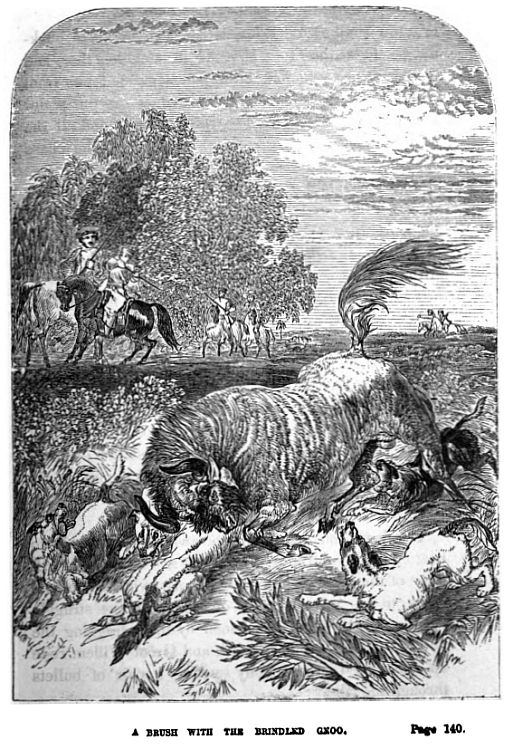
Before the bull had gone two miles, the dogs began to pester him, and finding his heels failing he turned suddenly upon his canine pursuers, rushing at one and then another, as they came up, and knocking them over with his horns.
It is possible he would have bayed all five successfully; but the approach of the hunters caused him fresh alarm, and he broke bay, and once more stretched himself at full speed across the plain. Another mile would have brought him into some low timber, and he appeared to make for that. He kept ahead of the dogs for awhile longer, but when within about a hundred yards of the thicket, his wind again failed him; and as the buck-dogs were taking an occasional pull at his flanks, he became desperate and once more stood to bay.
The dogs soon ran in, but for awhile he was able to beat off all five, striking then right and left. At length some of them seized him by the throat, while the others clung to his tail and hind-quarters, and the struggle would no doubt have ended soon by their dragging the bull to the earth; but Hendrik and Groot Willem rode up and ended it sooner by sending a pair of bullets through his ribs.
Chapter Twenty One.
A Battle with a Borelé.
Hans and Arend on this occasion had followed the chase, and were almost “in at the death;” and Klaas and Jan, who from the openness of the ground had had a view of the whole run, shortly after came up, spurring their panting ponies to the very top of their speed.
All six now dismounted to rest both themselves and horses after their sharp gallop, and also to skin the bull. Though Arend was habitually chef-de-cuisine, Hendrik and Groot Willem were the butchers; Hans, “the botanist of the expedition,” might also be termed its “green-grocer,” as his knowledge of botany enabled him to keep the camp-table supplied with many species of esculent roots and vegetables to be found growing wild upon the plains of Southern Africa.
While Hendrik and Groot Willem were flaying off the skin, Hans and Arend were busy with the head and horns, preparing them for preservation. It was nearly as much on account of these as for his meat that they had hunted the gnoo. They would also be trophies in the halls of the Graaf Reinet; for although the horns of the common gnoo are easily had, those of the brindled species are more precious, for the reason that the latter animal inhabits a more remote part of the country.
Klaas and Jan acted as assistants to the other four—now handing a knife, now holding a limb or flap of skin, and making themselves “generally useful.” All six, therefore, were engaged.
While thus employed, all of them bending and stooping one way or another, over the dead bull, and none of them keeping a look-out, a queer sound fell upon their ears that caused them to start all together into an erect attitude. The sound they had heard was a loud snort, followed by a blowing noise, somewhat similar to that made by terrified swine, but much fuller and louder. There was, also, the noise of snapping twigs and breaking branches.
These sounds caused all six to start, and some of them to tremble with fear; and the sight that came under their eyes as they looked up confirmed them in that emotion. In truth, it was a sight that would have inspired with alarm older hearts than theirs.
Breaking through the bushes, and causing the branches to bend and crackle, came a large animal. The tall upright horn upon its snout, its huge heavy body, and strong massive limbs, left them no room to doubt what sort of animal it was. It was a rhinoceros!
There are four species of these in South Africa; but the dark colour of its skin and the double horn proclaimed the one now seen to be the black rhinoceros, or “borelé”—the fiercest and most dangerous of the four.
When the boys first heard it, it was crashing through the bushes close to the edge of the thicket, but they had scarce turned their eyes in that direction before it shot out of the timber, head towards them, and came on at full gallop. Its head was raised high in air, its ears were in motion, and its small but saucy-looking tail was flirted about in a confident manner. Its black eyes gleamed with a malicious expression, and its air was one of anger and menace. The terror inspired by its look was not lessened by the loud snorting and blowing that issued from its fiery nostrils.
The boys saw at once, and to their alarm, that it was charging upon them! There could be no doubt about the matter. Its whole appearance denoted that it was bent upon attacking them, for it was heading directly for the spot where they stood. They knew, moreover, that there was nothing odd in that,—they knew that the black rhinoceros will charge upon any creature, whether man, quadruped, bird, or bush, without the slightest provocation!
It is needless to say that the boys were in a dilemma, and were aware of it as well. There were they, all six afoot upon the plain, with a fierce borelé rushing up to them, and at less than a hundred yards distance!
Fortunately for them the steeds were all well-trained, and fortunately the riders had had the precaution to fasten them in such a manner that it required but little time to get them free. But for these two circumstances some one of the six must certainly have been lifted upon the death-dealing horn of the borelé.
As it was the horses had been tied all around a tree that stood near. Each had his bridle looped to a small branch, so small that it could be wrenched off in a second of time, but large enough to keep a horse steady for awhile, unless something should alarm and startle him. This was a precaution the hunters had been taught by their fathers, and the knowledge now stood them in stead.
Of course the moment the borelé “hove” in sight, there was an end to the skinning of the gnoo. There was a chorus of cries expressing terror, a flinging away of knives, a sudden rush to the horses, a seizing of bridles, a snapping off of branches, and a simultaneous leaping into six saddles. All these acts did not take ten seconds of time to accomplish, and the last of them was not accomplished one second too soon; for the riders had just time to turn the heads of their horses to the plain as the borelé came up. In fact, so close to them had he got his hideous snout that several of the horses shied and plunged as they took to flight, nearly dismounting one or two of the riders. To have been unhorsed at that moment would have been a perilous business.
All kept their seats, however, and in a moment more were flying over the plain in a close clump, the borelé snorting at their heels.
Now that they were in their saddles, and galloped freely off, some of the yägers were disposed to laugh. Hendrik and Groot Willem were among the number. They knew that the speed of a rhinoceros is no match for that of a horse, and they would soon get out of his way. They were disposed to regard the chase as a bit of fun rather than otherwise. All at once, however, a thought came into their minds that turned their merry mood into a feeling of new and painful apprehension.
The young yägers were riding in pairs. Hendrik and Groot Willem, mounted on their swift horses, had forged some distance ahead of the others. On turning their faces backward they perceived that the two boys, Klaas and Jan, had fallen considerably to the rear, and that the borelé was pushing them closely. He was not twenty yards behind either, for they rode side by side, as if in a racing gallop. Hans and Arend were further in advance, and these also looking back at the same instant perceived the perilous situation of their younger brothers.
To all four the idea seemed to occur at the same moment, that though a horse can outrun the rhinoceros, a pony cannot, and the thought drew from them a simultaneous expression of alarm. Beyond a doubt Klaas and Jan were in danger. Should the borelé overtake them, their ponies would not save them. The huge brute would gore these animals to death, or impale them at the first stroke of his stout sharp horn. Beyond a doubt the boys were in danger!
So thought their four brothers as they glanced back; and, as they continued to gaze, they became the more convinced of this fearful truth. They saw that the distance between them and the rhinoceros, instead of widening, was gradually growing less—the borelé was gaining upon them!
It was a moment of painful apprehension with all four; but at this moment Hendrik performed one of the neatest manoeuvres that had occurred during the whole expedition. With a wrench upon his bridle he turned suddenly out of his course, and then wheeling round rode backward, calling on Groot Willem to act similarly, but with his head turned to the opposite side.
Groot Willem, as if by instinct, obeyed, and, diverging suddenly from each other, the two wheeled right and left at the same instant. Their horses’ heads were now turned to the rear, and after going a pace or two they halted, and got their guns in readiness.
First Hans and Arend swept past between the two halted hunters,—then passed Klaas and Jan upon the frightened ponies, and then came “borelé.”
Before the last had got fairly on a line, Hendrik and Groot Willem covered his huge body, fired, and then, galloping round to his rear, commenced reloading.
Both balls took effect, and, though neither brought the brute to the ground, they made a decided alteration in his pace, and in a moment it was perceived that he was running slower, while the blood flowed freely from his wounds. He still, however, kept on after the ponies; and it is hard to say how far he might have followed them, had it not been that Hans and Arend, exactly imitating the manoeuvre of Hendrik and Groot Willem, now also wheeled right and left, came back a pace or two, halted, and delivered their pieces in the face of the rhinoceros.
Again the bullets took effect, and again did not prove fatal. But the danger, as far as Klaas and Jan were concerned, was over; for the borelé, instead of pursuing the ponies further, turned short on his nearer antagonists, and rushed first upon one, then the other, with all the strength and fury that was left in his body.
Several charges were made by him without effect, as the riders, now faced towards him, were able to spring to one side and gallop out of his way.
For nearly a quarter of an hour the battle was kept up, the four loading and firing as fast as they could under the circumstances.
At length the day was decided by a bullet from the big elephant-gun of Groot Willem, which, penetrating the skull of the huge borelé, sent him rolling over in the dust.
A loud “hurrah!” proclaimed the victory, and the six yägers now rode up and alighted by the huge body of the borelé, that, prostrate and lifeless, no longer caused them alarm.
An axe was obtained from the wagon, and his long anterior horn—a splendid trophy—was hacked off from his snout, and carried away; while another journey was made for the meat and horns of the blauw-wildebeest, which were packed behind the hunters upon the croups of their horses, and brought safely into camp.
Chapter Twenty Two.
The Interrupted Breakfast.
Next morning the young yägers slept late—because they had nothing particular to do. They did not purpose continuing their journey before the following morning; and on that day they intended to lie up, so that their horses, might rest and be fresh for the road.
They rose, therefore, a little later than usual, and breakfasted on the tongue of the brindled gnoo, with hot coffee and hard bread; a stock of which they had brought along in their wagons, and which still held out. It would not have been as great a deprivation to the young yägers to have gone without bread, as it would to you, boy reader. There live many people in South Africa to whom bread is a luxury almost unknown. Many tribes of the native people never eat such a thing, and there are thousands of the frontier Dutch colonists, that do without it altogether. The people of South Africa, both native and colonial, are not an agricultural but a pastoral people, and therefore pay but little attention to the cultivation of the soil. Their herds of horned cattle, their horses, their flocks of big-tailed sheep and goats, engross all their time, and agricultural farming is not to their taste. Although the wealthier among the boors plant a few acres of Kaffir corn—a variety of the “Indian corn,” or maize—and sow some bushels of “buckwheat,” yet this is principally for their own use. This class also cultivate many kinds of vegetables in their gardens, and have large orchards containing apples, peaches, pomegranates, pears, and quinces, with vineyards for the grape, and enclosures for melons, cucumbers, and pumpkins. But among the poorer classes, and particularly on the remote frontier, such things are hardly thought of; and their cattle kraals are the only enclosures around the dwelling of the “vee-boor,” or stock-farmer. Among these people, bread is a rarity, and their staple food is “biltong,” and fresh beef or mutton cooked in a variety of ways, and so as to be quite palatable—for the cuisine of the boor is by no means to be despised.
In many parts the staple food of the frontier boor is venison—that is, in districts where the ordinary game has not yet been exterminated. Within the frontier districts, springboks are plenty, as also the common wildebeests; and piles of the horns of these may be seen lying around the kraals of every vee-boor. The flesh of the wildebeests, as already stated, is more like beef than venison, and when fat, or cooked in the delicious fat of the great sheep’s tails, is excellent eating.
The quagga, which is also common in these parts, is killed for its flesh; but this is rank and oily, and only eaten by the Hottentot servants.
Our young yägers were the children of wealthy parents, and had therefore learnt to eat bread, though on a pinch they could have got along without it. But they had brought several sacks of biscuit with them, and with these and coffee, and the tongue of the blauw-wildebeest, they were making a hearty breakfast.
They were all right merry, chatting over their adventure with the borelé, and laughing at the danger now that it was past.
They were taking their time with their breakfast, eating it leisurely and in no hurry, as they meant to spend the day in a sort of dolce far niente manner—loitering about the camp, or perhaps putting in a stitch wherever there should be a weak place in either saddle or bridle, so as to make themselves thoroughly ready for the route. Every precaution would be required to ensure their safety against the wide stretch of desert they would have to cross.
While in this mood, and about half through with their meal, an announcement was made that was likely to upset all their plans for the day. The announcement came from Congo, who had been loitering out on the desert side of the mokhala grove, and who came running into camp, in breathless haste, to report that a large flock of ostriches were out upon the plain!
The yägers, but particularly Klaas and Jan, bristled up at the news, uttering various exclamations of joy. A sudden change took place in their manner. Their jaws wagged more rapidly; the gnoo-tongue disappeared in larger slices; the coffee was quaffed in big hurried gulps; and the second half of their meal did not occupy the tenth part of the time that had been taken up with the first.
In less than two minutes from the time Congo made his report the breakfast was finished; and in five minutes more the horses were all saddled, bridled, and mounted. Resting the animals was no longer thought of. Everything had gone out of the heads of their riders except an ostrich “surround.”
Where was Swartboy to take part in the affair, and to give his advice? All acknowledged that the Bushman knew more about hunting the ostrich than any of them—Congo not excepted. Indeed, this was true in regard to most kinds of desert animals, as also of the smaller mammalia and birds. Congo had lived all his life among a people who keep cattle—for the Kaffir nations are not mere hunters, but a pastoral people—and although he knew how to destroy the lion, the leopard, the hyena, and other carnivorous creatures, he was less accustomed to the killing or capturing of game, since the vast herds of cattle bred and reared in his country render such knowledge but of secondary importance. Not so with Swartboy. The Bushmen have no cattle, except those which at times they steal from their neighbours, the Griquas, Bastaards, and trek-boors; and these are never kept, but killed and devoured as soon as they are driven to the Bushmen haunts. The want of domestic animals, therefore, with the necessity of having something to eat, compels the Bushman to use all his ingenuity in the capturing or killing of wild game, which among Bushmen includes every living creature from the locust and lizard to the camelopard and elephant!
The natural consequence of such a life must be the arriving at a perfect knowledge of the haunts, habits, and mode of hunting the wild creatures that people their country; and in this very knowledge Swartboy was believed to excel even among his countrymen, for it was known that in his own land he had been considered a “mighty hunter.”
Where was Swartboy at that moment? He had not been seen for an hour or more. Congo said that he had driven off the oxen to pasture upon the grass plain to the rear of the camp, and no doubt he was there herding them.
It was proposed that some one should go for him, but this was objected to on account of the loss of time. Congo said that the oxen were a good way off. It would take half-an-hour to bring Swartboy into camp, and before the end of that period the ostriches might be ten miles off.
No; they could not wait for Swartboy. They must proceed without him; and, mounting their horses, the yägers rode off towards the desert plain.
Chapter Twenty Three.
The Ostrich “Surround.”
On reaching the edge of the grove they halted to reconnoitre, still keeping under cover of the timber. Congo had reported truly. There was a flock of ostriches, sure enough. There were seven of these great birds in one “clump,” and an eighth at no great distance from the rest. Of the seven, five appeared to be hens and two of them cocks. The one apart was also a cock. I say appeared to be. You will imagine there could be no doubt, since the male and female of these birds are so very unlike in the colour of their plumage. That is true when they have attained to a certain age; but the young males, even when full-grown, do not get the beautiful white feathers all at once, and for a long time can hardly at a distance be distinguished from the females.
That, however, was not the reason why the young yägers were in doubt about their sex. It was because the birds were in a position nearly due east from the point of observation, and the sun being yet only a few degrees above the horizon, his rays fell in such a manner as to prevent them from having a clear view. To use a common phrase, the sun was “in their eyes.”
For all that, they could count the ostriches, and believed that of the eight three were cocks and the rest hens.
The seven in the “clump” were stationary; that is, they were not moving away from the spot. Some were stalking leisurely about, occasionally taking a “peck;” and it must have been sand or pebbles they were eating, as there was not the semblance of vegetation near the spot. Some sat squatted upon their “hams,” their long legs doubled underneath; and one or two were lying along the ground, and fluttering in the sand, just as common hens and turkeys do in warm weather. The dust raised by these formed a little cloud that floated around them, and added to the difficulty of distinguishing either their sex or their movements. The seven were at no great distance from the edge of the mokhala grove, and the one that was separate was still nearer. He was going towards them, stooping his head at intervals, and feeding as he went. From this circumstance, the boys conjectured that he had been much nearer, which conjecture was strengthened by Congo, who said, that when he had first observed them, this old cock was not two hundred yards from the edge of the timber, and was then going out, just as now.
Perhaps he had been within shot of the cover. What a pity, thought Klaas and Jan, they had not been earlier on the look-out!
The hunters did not waste many moments in watching the manoeuvres of the birds. Their attention was entirely given to their purpose of surrounding them, and discussing a plan to effect that object. Now these ostriches were not near the nest which had been plundered, and was now deserted; nor was it likely that the were of the family to whom that nest belonged—not even relatives in fact—else they would have heard of the calamity, and would have been comporting themselves in a very different manner from the easy style in which they were taking it. None of the five hens could be they that, but two days before, had witnessed the fall of their plumed lord by the Bushman’s arrow, for it was not likely that these would return to that part of the country. The flock now seen had no connection whatever with the nest. The place they were in was at a good distance from the scene of the late tragedy.
The young yägers were glad of this; not that they cared about the matter of relationship, but because the place where the birds were now seen offered superior advantages for a “surround.” It was a sort of large bay, where a spur of the desert plain ran into the timber, and was more than half encircled by low woods and thickets of acacia. Only one side—that toward the wide desert—was open. On all other sides there was cover for the hunters.
On this account the latter had very little difficulty in deciding how to act, and in a few minutes their plan was arranged.
Hendrik and Groot Willem, being the best mounted, were to ride to the two most distant points, one of them taking the right side of the great bay, the other the left. They were to keep under cover of the thicket all the way round; and when either arrived at the point where the timber stretched farthest out upon the plain, he was to stop awhile, until the other showed himself on the opposite side. Both were then to gallop towards each other, but not to meet. They were to halt at such a distance from one another as would best enable them to cut off the retreat of the ostriches from the outer plain.
Hans and Arend were respectively to follow in the tracks of Hendrik and Groot Willem; but they were to halt within the edge of the timber when half round, and wait until they should see the others out upon the plain. Then they were to show themselves, and turn the ostriches, should they run their way.
Klaas and little Jan were also to separate and ride some distance from the spot; but the disposal of these boys in their places was taken in hand by the others; and so the whole party started at the same time, three filing off to the right, and three to the left. Congo’s instructions were, not to show himself until he should perceive Hendrik and Groot Willem galloping towards each other. He was then to act just as the others, except that “shanks’-mare” was to be his horse.
Should the ostriches allow time for Hendrik and Groot Willem to get to their stations, the surround would be complete; and it was highly probable that they would have good sport, and either capture or kill some of the giant birds. When thus assailed upon all sides, the ostrich gets confused, and acts in the most stupid manner, being easily turned, and driven about from “post to pillar.”
It was a question of time, therefore, and it would take a good while for the surround to be made, as the plain on which the birds were was full three miles wide. Both Hendrik and Groot Willem would have twice that length to ride; and their path lying through bushes, they would be unable to move faster than a walk.
For some time the only one that watched the movements of the ostriches was the Kaffir. The others were making their way through the thicket, and only had a peep now and then, as they passed some place where an opening in the leaves allowed them. They were too anxious, however, to get to their different stands to stop at any place between. All felt that time was precious; for should the game take alarm, and start off to the open plain, the trouble they were taking would be all in vain. None of them, therefore, thought of looking at the birds—only to satisfy themselves that they were still there—until they had reached their respective places.
Chapter Twenty Four.
The Odd Cock.
During all this time Congo watched the movement of the flock as well as the sun in his eyes would allow him.
He noticed that the cock that had been feeding apart from the rest had now got close up to them,—within a few yards; but that the others had arisen at his approach, and, stretching out their long necks, appeared to regard him as a stranger. After a moment all seven turned, as if alarmed at something, and ran away—the odd cock running after, though falling a little in the rear.
The flock only went for twenty yards or so, and then halted, as if they had got over their slight alarm.
The old cock again stalked slowly up, now and then dropping his head to the ground, and pecking up a grain or two of something on his way.
When he got close to the flock a second time, they seemed to take fresh alarm, ran twenty yards farther, and again stopped.
It appeared as if the old cock was a stranger to the rest, and that they considered his presence an intrusion!
Again he approached them, and again they made a short run; this time not in a direct line, but in a circle around him, so that they came back nearly to their original ground. This time, however, only the five hens ran off. Both the cocks remained near the spot; but the movements of these now puzzled Congo not a little.
One of them had squatted down, just as they had been first observed, while the other ran about in very small circles, occasionally fluttering his white plumes, and acting altogether like a drunken man!
After a few minutes the manoeuvres of all appeared to change. The one that had seated himself appeared to lie down and remain quiet, while he that had the “staggers” squatted down not far off; and presently a hen came running up and sat down beside him; so that now there remained upon their feet only one cock and four of the hens.
The whole scene puzzled Congo, who was not from an ostrich country, and was but indifferently acquainted with the habits of these birds. No doubt, thought he, the creatures were about some game of their own, such as he had often seen with the “kooran” and partridges.
There were others than Congo puzzled at what was passing among the ostriches.
Klaas and Jan, who had reached their stations sooner than the rest, and who had been observing the odd actions of the birds, were both puzzled as to what they were about; and a little later Hans and Arend had a surprise, and were equally at a loss what to think of the game of “fits and starts” that was going on upon the plain.
But Hans and Arend had not much time to observe. They had both gone far round, and they expected soon to see Hendrik and Groot Willem gallop out from the timber, so they kept their eyes in that direction.
They were not disappointed. A few minutes after both were seen to shoot forth at full speed, and ride in diverging lines, so as to approach each other, and at the same time get nearer to the ostriches.
As soon as the others saw them, the whole five, Congo included, showed themselves on the open ground, all making towards a common centre—the spot where the ostriches were.
The hunters were now more surprised than ever. As they rode forward, they perceived that several of the great birds were seated, or lying upon the ground. They were basking, no doubt; but, for birds so wary, why did they not spring up and take to flight? They must already have perceived the approach of the horses or heard the sound of their trampling hoofs? Only two of the hens appeared at all alarmed; and these ran in the direction of the outer plain, but turned when they saw Hendrik and Groot Willem. Only one other was upon its feet; and that was the old cock that had kept apart? He was still standing erect, but did not attempt to fly! It was very odd.
This old cock chanced to be nearest to Hendrik and Groot Willem; and going, as they were, at race-horse speed, they were scarce a minute in riding down upon him.
They had got within less than five hundred yards; and, with guns ready, were resolved to give him a tail-on-end chase, and try a flying shot, when, to their tremendous surprise, a loud and terrified yell came from the bird, and the next moment his skin flew from his shoulders, discovering, not a naked ostrich, but a naked Bushman, with his legs chalked white to the very hips! That Bushman was Swartboy!
It was, indeed, old Swart dressed up in the skin of the old cock he had lately shot with his poisoned arrow; and it was that same arrow, or half-a-dozen like it, that had been causing the mysterious movements among the ostriches. Five of them already lay around dead or dying; while the two hens, that had not yet received their billet, during the surprise consequent on Swartboy revealing himself, had managed to escape.
Fortunately for Swartboy he “sung out” at the moment he did. Another half minute, and he would have fared no better than his own victims the ostriches. He acknowledged that he had been badly “scared.” In looking after the ostriches, he had never thought of looking for any thing else; and from the manner in which his eyes were placed under the feathers, he could not see very well around. His ears, too, “muffled” up as they were within the skin of the old cock, were of little service to him; so that it was by mere accident he saw the horsemen galloping down upon him. Even then it cost an effort to “cast” his skin, and appear in propria persona!
Now, when the young yägers thought of the curious incident that had just taken place, and then looked at the naked body of Swartboy, chalked white from hip to heel, the whole six sat in their saddles and laughed till their very sides ached.
Swartboy, proud of his achievement, looked round him like a conqueror, and then fixing his eyes upon his rival, put the simple but equivocal interrogatory—
“Eh! Congo! ole Kaffir boy! dat you?”
The carapace was eclipsed!
Chapter Twenty Five.
Blesboks and Bonteboks.
Next morning our party inspanned and treked over the desert plain in a north-easterly direction. They were two days in crossing it, and their oxen suffered much from thirst, as during the two days they did not taste water. For themselves they had water enough. Part of the contents of each wagon was a good water-cask, that held eighteen gallons; and these, of course, they had filled before leaving the spring. One of these casks they divided among their horses, allowing them a little over two gallons apiece; but that was nothing for two days’ march over such a country. Even the yägers themselves required as much. This statement would not surprise you, if you had ever travelled in a tropical clime and over an arid waterless plain under a hot glaring sun. There thirst is provoked in a short while, and water will quench it only for a few minutes at a time. The appetite constantly returns, and calls for copious draughts; so that a traveller will often consume not glasses, but gallons, of water, in a single day!
Having crossed the desert plain, the hunters now entered upon a country that differed entirely from that they had left behind.
They had arrived in a country of vast extent, upon which stood hills of strange and varied forms. Some were of a rounded, hemispherical shape; others were cones; others had flat-table tops; and still others pierced the sky with sharp needle-like pinnacles. These hills were of various sizes—some approaching the dimension of mountains; but most of them rose directly from the plains, without any piedmont or “foothills” intervening between the level surface and their sloping or precipitous sides. The country bore a very strong resemblance to the plateaux that lie among the Cordilleras of the Andes; and the geological formation of this part of Africa is very similar to the table-lands of Mexico.
Many of the mountains of conical and pyramid form stood isolated upon the plain, some of them bare of vegetation from base to summit. Others, again, carried a dark mantle of forest, that covered only their lower half, above which rose bare peaks of white quartz that under the sun glittered like snow.
The plains between were some of them of vast extent—so wide that at times the mountains that bordered them could be but dimly seen. But there were plains of every size and form. Their surface was covered with a species of grass quite different from that of the region our hunters had hitherto been passing over. It formed a short sward like a meadow lately mown, or a well-browsed pasture-ground, for such in reality it was—well-browsed and closely cropped, and trodden to a hard turf, by the countless herds of wild ruminant animals, of which it was the favourite range. Unlike the long flowing sweet grass upon the plains south of the Orange River, these were covered with a short crisp curly herbage of saltish taste; and in many spots an effervescence of that mineral covered the ground, whitening the blades of grass like a hoar-frost. Salt deposits, or salt-pans as they are termed, were also common, some of them extending for miles over the plain.
The yägers had reached a peculiar country, indeed. They had arrived in the “zuur-veldt,” the country of the sour grass—the favourite home of the blesbok and bontebok.
What are these?
They are two antelopes, whose gracefulness of form, swiftness of foot, but, above all, the lively and striking colour of their bodies, have rendered remarkable.
They belong to the genus Gazella, but in many of their habits they differ considerably from the gazelles, though differing so slightly from each other that by both travellers and naturalists they have been regarded identical.
This is not so. They are distinct species, though inhabiting the same country, and following the same mode of life. The blesbok (Gazella albifrons) is neither so large nor so brilliantly marked as the bontebok, (Gazella pygarga). His horns are of a light colour, nearly white, while those of the bontebok are black. In the colour of the legs there is also a marked difference. The legs of the bontebok are white from the knee down, while those of his congener are only white on the insides—the outsides being brown.
The bontebok is not only one of the loveliest antelopes in Africa, but one of the swiftest. Indeed, there are those who hold that he is the swiftest. In size he equals the European stag, and his form is light and graceful. His horns are fifteen inches in length, black, robust at the base, semi-annulated and diverging. They rise erect from the top of his head, bending slightly backward, and then forward at the tips.
But it is the beautiful colouring of his skin which is the principal characteristic of this antelope. In this respect both he and the blesbok bear some resemblance to the antelopes of the acronotine group—the hartebeest and sassabye.
The colours of the bontebok are purple violet and brown of every shade—not mingling together, but marking the body as if laid on by the brush of a sign-painter. Hence the name “bontebok,” or “painted buck,” as given by the Dutch colonists to this species. First, the neck and head are of a deep brown, with a tinge of the colour of arterial blood. Between the horns a white stripe commences, and after reaching the line of the eyes widens out so as to cover the face to the very muzzle. This mark, or “blaze,” is common to both the species, and to one of them has given the trivial name “blesbok,” (blaze-buck.)
The back is of a blue lilac colour, as if glazed; and this extends along the sides, so as to remind one of a saddle. Bordering this, and running along the flanks, is a broad band of deep purple brown. The belly and insides of the thighs are of pure white colour; the legs are white from the knees down, and there is a large white patch on the croup. The tail reaches to the hocks, and is tufted with black hair. Such is the colour of the bontebok, and that of the blesbok differs from it only in the points already mentioned, and in its colours being somewhat less marked and brilliant. Both are beautiful creatures, and their skins are much prized by the native savages for making the “kaross,”—a garment that serves them both as a cloak by day and a bed and blankets at night.
The habits of both species are quite similar. They dwell upon the plains of the “zuur-veldt,” congregating in vast herds of many thousands that cover the ground with their purple masses.
In this respect they resemble the springboks and other gazelles; but they have habits peculiar to themselves. The springboks, when alarmed, take to flight and scatter off in any direction, whereas the bonteboks and blesboks invariably run against the wind, bearing their noses close along the ground, like hounds upon a trail!
They are fleeter than springboks, and also more shy and wary, as though they knew that their spoils are more valuable to the hunter, and therefore required greater skill and speed to preserve them.
Both species were once common in what are now the settled districts of South Africa, their range extending to the Cape itself. That is now restricted to the “zuur-veldt” districts, north of the Great Orange River.
A few bonteboks are still found within the colonial borders in the district of Swellendam; but their existence there is accounted for by an act of the Government, which places a fine of six hundred rix-dollars upon any one who may destroy them without licence.
Our young yägers had now arrived in the land of the blesbok and bontebok.
Chapter Twenty Six.
Stalking the Blesboks.
When they had got fairly within the boundaries of the blesbok country, the young yägers resolved to make halt for a day or two, and hunt these beautiful antelopes. Not that they desired their flesh, but they wished to strip one or two of them of their bright, parti-coloured robes, to be hung up along with their horns in the halls of Graaf Reinet.
After treking some miles across the plains, they outspanned by a vley, and formed their camp.
The following morning they mounted their horses, and proceeded over the plain in search of the purple antelopes.
They were not long in finding them. That is by no means a difficult thing with an animal that herds together in thousands, provided you chance to be in the district it inhabits; and the yägers were not slow in coming within view of a herd of blesboks.
But how to hunt them was a knowledge which none of the party possessed—whether to let slip the buck-dogs and gallop right into the thick of the herd, or to get within shot by stalking—which of these was the proper manner neither the young yägers nor their drivers knew. In Swartboy’s country neither blesboks nor bonteboks are known. They do not range to the western half of South Africa, and the young yägers only knew them by tradition. Their fathers had hunted them years before; but both species had been long since exterminated south of the Orange River.
As for Congo, although their range extended into a part of the Kaffir country, he had never chanced to hunt in that particular district. Of course neither Bushman nor Kaffir were on the ground with the hunters. They had been left in charge of the camp; but the advice of both had been asked at setting out, and it was ascertained that they had none to give.
The hunters were at a loss how to proceed, and held a discussion upon it. Groot Willem thought they should be hunted like springboks,—that is, the hunters should take stand and conceal themselves, while one or two rode round and drove the game upon these—a mode practised with the fallow-deer in the forests of North America, and there termed “driving.”
Hendrik believed that they could be “ridden into,” and run down by the dogs.
Hans recommended “stalking,” with which, plan Arend agreed. Of course no opinion was either asked from or given by the lads Klaas and Jan. Had they been birds, they would have insisted upon their “say” as well as their elder brothers.
But blesboks are not birds, although in less than an hour after they proved themselves to be almost as swift.
Now, as stalking was the mode least likely to give the herd the alarm and seed them off, it could be tried first. Should no one succeed in getting within shot, then Groot Willem’s plan might be adopted; and should it also fail to be successful, it would still not be too late to follow Hendrik’s advice, and ride right at them.
First, then, for a “stalk.”
They were not going to stalk them upon horseback. That would never do, though there are some animals that will suffer a mounted man to approach hearer than one afoot. But blesboks are not of that kind.
All dismounted, therefore, and proceeded on foot in the direction of the herd. Not all, exactly. Klaas and Jan remained on the spot in charge of the dogs and horses. Klaas and Jan were to have no share in the stalk.
The herd was in the middle of a vast open plain—so wide that the mountains on its opposite side were scarcely visible. Upon all that plain not a bush or rock appeared. The grass, as already stated, was short cropped, and smooth as a meadow—not a break in the surface to offer a chance of concealment to the hunter! How, then, could they talk of “stalking” on such ground? They knew that no wild animal, however stupid or negligent, would permit them to walk up within point-blank range and fire at them. How, then, were they going to approach the blesboks, that they had heard were any thing but stupid—on the contrary, were exceedingly shy and watchful of danger? How? That is a peculiar point, and requires explanation.
Although there were neither rocks, nor trees, nor bushes of any kind, nor long grass, nor inequalities in the ground, there was still a species of “cover.” Not the best, it is true, but such as would serve a skilful hunter who knew how to take advantage of it. Enough to give hopes to the yägers, else they would not have dreamt of such a thing as an attempt to stalk the blesboks.
Scattered over the plain, and standing at irregular distances of from one to three hundred yards of each other, were numerous singular structures. They were of the form of obtuse cones, or hemispherical, and all of a light grey colour—the colour of sun-dried mud. On the sides of most of them at their bases could be seen a hole of irregular outlines, and evidently not made by the neat workmen who had built the mounds. Quite the contrary. These entrances to the hollow domes within were not for them. Theirs were underground. These had been made by their enemies—the burglars who had plundered their houses. I am sure I need hardly tell you that the structures thus described were ant-hills, and that the big holes in this side were the work of the long-tongued “aard-vark,” or the scaly “pangolin.”
The hills in question were dome-shaped, and of moderate size—varying from one to three feet in height. This is by no means as large as many ant-hills found in Southern Africa. Some are four times that height, or still higher; but I have told you elsewhere of these high hills, and that there are different species of ants who construct such curious nests—each species choosing its own style of architecture,—some the cone, or pyramidal form,—some a complete cluster of cones,—some build them of cylindrical shape, and others nearly half-spherical, like inverted tea-basins.
Of these last were the ant-hills now under the eyes of the young yägers. They were the nests of the Termes mordax—a species that inhabits all the plains of the “zuur-veldt” country.
The hunters proceeded to stalk forward, their eyes bent upon the antelopes, and their hopes fixed upon the ant-hills.
Of course they did not commence crouching, until they had tried how near the blesboks would allow them to come without cover. This they soon discovered to be about four hundred yards; and although the animals did not seem to mind their presence at that distance, but continued browsing, yet the moment any one of the four endeavoured to get nearer, the herd, as if mechanically, moved off, and still kept a width of four hundred yards between themselves and the stalkers.
The hunters now began to stalk in earnest, crouching from hill to hill. It was to no purpose. None of the four could get within shot. They separated and took different sides. The same result followed—a failure. Although the herd kept on, and always in the same general direction, they seemed instinctively to avoid whatever ant-heap a hunter had chosen, giving it a “wide berth” which carried them beyond the reach even of Groot Willem’s roer! After two hours spent in this fruitless kind of hunting, the plan was abandoned.
The “stalk” would not do; and Hans and Arend were now sneered and laughed at by Hendrik and Groot Willem.
“What could they know about hunting? Ha! ha! ha!”
Chapter Twenty Seven.
Driving the Blesboks.
All now returned to their horses. Groot Willem’s plan was next to be tried.
They mounted. Klaas and Jan were permitted to take part in this affair. They would do well enough to “drive” the antelopes, while the other four would take stand, and receive them as they came up.
All six rode off towards the herd, which, during the stalk, had moved several miles across the plain.
When as near as they might safely go, without causing the animals to take the alarm, Klaas and Jan were sent to one side, while the stand-men took the other, going to their places by a wide circuit. Of course their horses enabled them to get to their positions in a very little time. It was not necessary that these should be near the herd. As soon as they should conceal themselves behind the hills, Klaas and Jan were to drive the game up; and they were instructed to do so gently, and without causing the bucks to break into flight. The lads were hunters enough to manage that point.
The four having got round to that side of the herd opposite to where the drivers had been sent, tied their bridles together, and, leaving their horses, walked towards the herd. They deployed from each other as they went, so as to cover a good stretch of the plain, and then each choosing an ant-hill, knelt down behind it.
There could be no mistake now. The antelopes, driven by Klaas and Jan, would come their way; springboks certainly would; and then, “crack! crack!” would go the rifles, and “bang!” Groot Willem’s roer.
This gentleman was in particularly high glee. He had recommended this mode in opposition to Hans and Arend; but he did not mind that, for he had rather a contemptuous opinion of the hunter-craft of these two “yägers;” but what he thought of was, that Hendrik had opposed it, and should it prove successful after that opposition, it would be a feather in Groot Willem’s hat.
That it would succeed he had little doubt. They were all nicely placed. The two boys had got round to the opposite side of the herd, and once these showed themselves a little nearer, the antelopes would face round—they were browsing towards the side to which the boys had been sent—and feed in the direction of the concealed hunters. Springboks would do so, said Groot Willem to himself.
But springboks are not blesboks. They differ not only in size and colour, but in many of their habits; and just by a difference in one of these last was Groot Willem destined to disappointment. A curious habit they have—and one which is shared by a few other animals, both of the antelope and deer species—knocked all Groot Willem’s fine calculations into “pie.”
Instead of turning when Klaas and Jan approached them from the opposite side, as all expected they would do, the stubborn creatures would not be turned, but kept on most determinedly in their original course. It is true that they swerved a little to get past the boys; but as soon as they were fairly beyond them, they headed once more in the same direction as before.
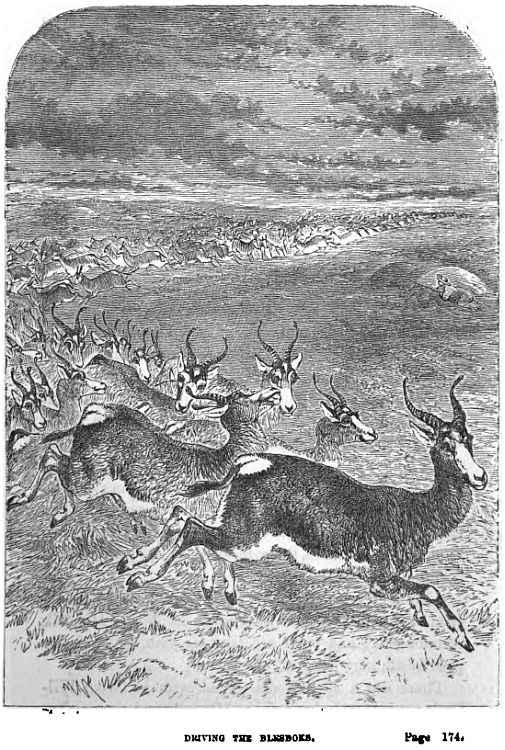
Klaas and Jan were at some distance from each other, so as to make a wider front to the drive; but for all that, the blesboks swept past both at such a distance as to give no chance for a bullet, even though sent from the long roer. Neither of the boys fired, as they had been told not to do; and as both behaved discreetly and quietly, the antelopes, after galloping some distance to their rear, slackened their pace, and again commenced browsing.
Groot Willem felt considerably chagrined at the result, and got well laughed at by both Hans and Arend; but what annoyed him still more was a word or two uttered by the rival hunter.
“I knew,” said Hendrik emphatically—“I knew it wouldn’t do. Do you take blesboks for sheep, to be driven about by a pair of boys mounted on ponies? Bah!”
This was a terrible cut for Groot Willem; but he replied to it by alleging that his plan had not had a fair trial. It was now plain to all that the blesboks fed up wind; and, therefore, the stand-men should have headed them instead of the drivers.
“Let us try it that way. I’ll warrant you we’ll succeed. If we don’t, then we can do as Master Hendrik recommends; and we’ll see how his plan, which is no plan at all, may answer.”
There was a slight touch of sarcasm in Groot Willem’s tone when he referred to Hendrik, and the emphasis on the “Master,” partook strongly of the character of a sneer counter to his which Hendrik had given.
There could be no objection to try the thing over again, according to the mode suggested by Groot Willem; and they all assented to his proposal. It was plain that the blesboks ran in the “wind’s eye,” else they never would have “run the gauntlet” against Klaas and Jan, as they had done. Such being the case, the hunters, by laying in wait to windward, would have a decided advantage, and, properly placed, could not fail to reach some of the advancing herd.
Should the scheme turn out differently, then they could follow Hendrik’s advice, and ride tail-on-end upon the blesboks.
With these ideas, the four galloped away to one side, and, making a wide détour, headed the game. Klaas and Jan were left in the rear to follow it up, and force it gently forward.
In good time the stand-men were again placed, and watched the advancing antelopes with interest. The “blaze” upon their faces appeared larger and larger, and their broad, white muzzles gleamed in the eyes of the hunters, almost within range of their guns. But at this moment, the animals raised their graceful necks, uttered a strange, snorting cry, and then, instead of turning to fly back, bounded right forward!
Surely they were coming within range, thought every one, as he knelt with ready firelock behind his sheltering mound. “Good!” muttered Groot Willem to himself. “I’ll turn the laugh upon the whole of them—that I shall.”
But Groot Willem was destined once more to a humiliating disappointment. As the blesboks came under the lee of each hill that covered a hunter, they suddenly swerved, and swept round him at such a distance as to render shooting at them a perfectly ridiculous thing. Groot Willem had levelled his roer for a chance shot, when he thought of the unpleasant consequences of a “miss;” and reluctantly bringing down his piece he permitted the blesboks to sweep past.
In a few seconds the herd was far beyond the place where they had passed the hunters; but as no assault had been made upon them, and no gun fired, they quieted down after a while, and once more commenced browsing.
Hendrik was now the proud man of the hour. He would show them how the slow creatures could be galloped into. He would run half-a-dozen of them down before they could clear out of the plain.
“Come on!”
All once again mounted their horses, and rode briskly towards the herd. When near, they moved more slowly and quietly, so as not to startle them.
As soon as they had got within the usual distance of four hundred yards, the bucks moved forward; and then came the “view hilloa!” The dogs were let slip, the horses sprang forward, and the chase swept wildly over the plain.
They had not galloped a mile, before Hendrik discovered his mistake. Both dogs and horses were distanced by the swift antelopes, and both lagged far behind.
One by one the hunters fell into the rear, and drew up their foaming steeds; and in less than twenty minutes time, Hendrik alone, and one or two of the best dogs, held on.
Hans and Arend, believing that it was a hopeless chase for their horses, gave it up; and Groot Willem did not wish to succeed! Of course, Klaas and Jan were with the hindmost; and they all sat in their saddles, watching first the purple backs of the bucks, and then the head and shoulders of Hendrik disappearing among the distant ant-hills!
Chapter Twenty Eight.
Hendrik’s Hard Gallop.
On swept the blesboks over the level sward and on galloped Hendrik after them—his horse and dogs running at their utmost speed. For all that, not a yard could either hunter or hounds gain upon the swift antelopes. There was no chance for either to “run cunning.” There was no taking “a cut” upon the game. The blesboks made not the slightest double—swerved not a point from their course, but ran in a straight line, dead in the wind’s eye. No advantage, therefore, was given by the pursued, or could be taken by the pursuers. It was a simple question of speed between horse, dogs, and game.
The dogs gave up first. They broke down one after another, until only Hendrik’s favourite hound kept near. Another mile’s running, and he too was used up, and fell to the rear; and now Hendrik galloped alone.
For nearly ten miles he galloped, until the sweat streamed from his horse’s flanks, and the froth from his lips, and still the blesboks scoured on before him at too great a distance to be reached by his rifle. On a fresh horse he could easily have overtaken them now, for they ran but slowly. Perhaps he could have closed upon them as it was, but, with all his desire to do so, he was compelled to ride with caution. The burrows of the ant-eater lay in his path, and once or twice, as he was closing upon the game with good prospect of getting near, his horse had stumbled, and lost ground again. This gave the antelopes a decided advantage, as with light hoof they skimmed over these impediments without fear.
And still Hendrik was reluctant to pull up. He thought of the empty boasting he had made. He thought of the scornful laugh that would greet him on his return. He thought of Groot Willem!
If he could only take back one hide—one pair of horns—all would be well. The laugh would be his. With such thoughts he had been urged forward, in this long and desperate ride.
He began to despair of success. The blesboks seemed to run lightly as ever, while his horse sprang heavily under him. The noble brute must soon give up.
Hendrik at length felt for him, and would have drawn bridle; but while half-resolved to do so, he noticed a range of mountains directly in front of him. They appeared to extend across the plain transversely to his course, or rather two chains met in a sort of angle, quite closing up the plain in that direction. Towards this angle the blesboks were directing their course!
Did they propose taking to the mountain? was the question put by Hendrik to himself. If so, he might find an advantage there. They might come to a stop, and under cover of the rocks and bushes that grew upon the mountain-side, he might be able yet to stalk them.
As Hendrik reflected thus, his eyes wandered along the base of both ranges from the angle where they met to a good distance on each side. To his surprise he perceived that the bases of both ended in a precipitous cliff, with no apparent pass leading up! He was now close enough to see the cliff. Not a break appeared along its whole line!
Hendrik was gratified with this discovery. He was driving the game into an angle, a very trap. They would be compelled to turn upon him, and out of such a thick mass, he could not fail to knock over one. One was all he wanted.
His hopes returned, inspiring him with new vigour; and, uttering a word of encouragement to his horse, he pushed forward.
His ride did not last much longer. Another mile, and it was over.
He had got within five hundred yards of the mountain foot, and less than half that distance from the bucks that still continued to run straight toward the angle of the cliffs. He was now quite sure of a shot. In less than a minute, the herd would be compelled either to stop, or turn back, and meet him in the teeth.
It was time to get his rifle in readiness; and as he intended to fire into the thick mass, he took several small bullets from his pouch, and hastily dropped them into the barrel. He then looked to his percussion-cap, to make sure that all was right. It was so. The copper was properly adjusted on the nipple.
He cocked his gun, and once more looked forward to the game. Not an antelope was in sight!
Where were they? Had they sprung up the mountain? Impossible! The precipice could not be scaled? Impossible! Even had they done so, they would still have been seen upon the mountain face. They were not in sight, not one of them! The hunter reined up, his gun dropped back to the withers of his horse, his jaws fell, and for some moments he sat with parted lips, and eyes glaring in wonderment.
Had he been of a superstitious nature, he might have been troubled with some painful feelings at that moment. But he was not superstitious. Although for a moment or two he could not feel otherwise than astonished at it, he knew there was some natural cause for the “sudden and mysterious disappearance” of the bucks.
He did not pause long in doubt, but proceeded at once to the proper quarter for an explanation. The tracks of the herd guided him to that, and after riding three hundred yards further, the mystery was explained to his full and complete satisfaction.
The angle, after all, was not an angle, for the apex was wanting. There was a “thoroughfare” without the slightest obstruction. Although at a short distance the converging cliffs appeared to impinge upon each other, there was an opening between them—a narrow pass that like an isthmus connected the plain over which the chase had gone, with another and very similar one that stretched away on the other side of the mountains. The blesboks must have known it well enough, else they would not have run so direct for the false angle in the cliffs. Hendrik trotted up the pass to convince himself that it was no cul-de-sac. After going a few hundred yards, the isthmus widened again, and he saw to his chagrin the violet backs of the bucks far off upon the plain that stretched beyond.
Overcome with disappointment and chagrin, he flung himself from his saddle, and staggering a few paces, sat down upon a boulder of rock. He did not even stop to fasten his horse, but, dropping the bridle over his neck, left the froth-covered and panting steed to himself.
Chapter Twenty Nine.
Hendrik Chased by the Keitloa.
Hendrik’s feelings at that moment were not to be envied. His reflections were sharply bitter. He felt mortified and humiliated. He wished he had never set eyes upon a blesbok. A sorry figure would he cut on his return to camp. He had laughed heartily at Hans and Arend. They would reciprocate that laugh, and add interest. He had ridiculed the idea of Groot Willem. Groot would not fail to pay back his scorn.
Besides, he had done his horse no good; perhaps had injured the animal. There stood he, with steaming nostrils and heaving flanks, quite used up. They were nearly twelve miles from camp. He would scarce be able to carry his rider back, and Hendrik even began to entertain doubts about his way.
The thought that he might have lost himself was just entering his mind, when his reflections were interrupted by a sound that caused him to start up from that rock, as nimbly as he had ever risen from a seat in his life.
The same sound seemed to produce a very similar effect upon his horse; for the latter, on hearing it, suddenly jerked up his drooping head, pricked his ears, snorted loudly, and, after dancing about a moment on two, shot off down the pass at full gallop!
Hendrik’s eyes did not follow him, nor his thought neither. Both were too busy with an animal that came from the opposite side, and which had uttered the sound that caused such a sudden alarm. The deep bass snort and the bellows-like blowing that followed, were no strangers to the ear of the young hunter. He knew that, on looking round, he would behold the black rhinoceros;—and he did so. That fierce creature was coming down the pass!
At first sight Hendrik was not so terribly alarmed. He had hunted the rhinoceros more than once, and did not deem it such dangerous sport. He had always been able to avoid the charges of the clumsy quadruped, and to escape out of its way when he desired.
But Hendrik for the moment had forgotten that on such occasions he was seated, not on a boulder of rock, but in the saddle, and it was to his horse that he owed his immunity from danger.
Now that his horse had run off, and he found himself afoot upon the plain, with nothing between him and the rhinoceros but twenty yards of smooth level turf, he became truly alarmed. And no wonder at it—his life was in danger.
His first thought was to run up the rocks, thinking by so doing to get out of the animal’s reach. But, on looking towards these, he perceived that they formed a precipice on both sides of the pass, with a wall-like face, that could only have been scaled by a cat! Hendrik could not climb up on either side!
In the pass itself there was no shelter for him. Its bottom was a smooth sward, sloping but slightly. It was but the continuation of the outer plains, that were nearly on the same level. Here and there stood a tree, but they were small ones—mere “brush,” and a rhinoceros could have levelled any of them to the ground with his powerful horn. They offered no hope, either for concealment or retreat.
There appeared no chance of escape in any way. To attempt it by running off would be perfectly useless; for Hendrik knew that a rhinoceros could overtake the swiftest runner, as every South African hunter could testify. Hendrik did not think of it. To add to his ill-fortune, he had left his gun strapped to the saddle, and that was now gone off with the horse; so that his chance of saving himself by the destruction of the rhinoceros was gone also. The only weapon left him was his hunting-knife; but what was a knife against the hide of a rhinoceros? It might as well have been a needle.
There was but one hope of safety; and that was, that the animal might not see him. The rhinoceros possesses the sense of sight only in a moderate degree. His eyes are small; and though sharp enough when an object is directly in front of him, they are so placed in his head, that, on account of his stiff neck and huge form, he can see nothing either behind or even at either side of him.
Hendrik had hopes the fierce brute would pass without observing him. From his movements it was evident he had not noticed him as yet, else he would already have charged upon him. The black rhinoceros does not wait to be provoked. His own fierce nature furnishes him with sufficient stimulus, and his fury is habitually directed against creatures the most innocent and unoffending.
To get as far out of his way as possible, Hendrik glided silently up to the cliff, and stood close against the rock.
But if the rhinoceros is not a sharp-sighted animal he is one of the sharpest-scented that lives. With the wind in his favour, he can smell even a “rat” at an almost incredible distance. He is also gifted with a most acute sense of hearing; and the slightest sound, such as the rustling of a leaf or the falling of a footstep, will enable him to guide himself directly to his enemy or his victim. Were the rhinoceros endowed with the power of vision to the same degree as he is with that of smell and hearing, he would be the most dangerous animal in the world. As it is, he is any thing but a safe neighbour, and many of the poor natives of the country he inhabits, fall victims to his ungovernable temper and brutal strength. Fortunately his eyes are no bigger than they are.
They were big enough, however, to see Hendrik as he stood, his dark form outlined against the cliff, and sharp enough to distinguish him from the rock. The breeze, indeed, blowing in his spread nostrils, had warned him of the hunter’s presence, and that had directed his eyes.
As these rested upon the form of the boy, he stopped short in his track, uttered a snorting noise, vibrated his ears, and flirted his saucy little tail over his huge hips. Then placing himself in a menacing attitude, and giving utterance to an angry blowing, he dashed forward upon Hendrik as if the latter had been his enemy for life!
Hendrik’s presence of mind was called for at this moment; and it came to his aid. Had he kept his ground five seconds longer, he would have been crushed against the rock, or impaled upon the strong horn of the rhinoceros. But the moment the latter charged, the boy sprang out from the cliff.
He did not attempt to run—that would not have saved him; and fortunately he knew it. He merely stepped out to the more open ground in the middle of the pass, and there stood fronting his assailant. The latter having seen the movement, swerved in his course, so as again to head direct for his intended victim; and without stopping, rushed forward as before.
Hendrik stood still, until the sharp black horn almost touched him. Then bounding to one side, he glided past the rhinoceros, and ran in an opposite direction.
He looked back as he ran; and seeing that the fierce brute had turned suddenly on the failure of his charge, and was close at his heels, he again made stand, confronting the animal as before. Again he waited until the rhinoceros was close up, and repeated the manoeuvre of springing to one side and running behind. This Hendrik had heard was the only way to escape the rhinoceros in open ground. Had he sprung aside a moment too soon, that is, before the sudden bound enabled him to clear the field of the animal’s vision, he would certainly have been followed and overtaken; for, unwieldy as the rhinoceros appears, it is nevertheless far more active than it looks, and the horse can barely get out of the way of its sudden and impetuous rush.
Hendrik had got two hundred yards down the pass before it turned again, but the distance was not enough. He was compelled to make stand for the third time, and await the terrible onset of his huge enemy.
As before, he succeeded in getting to his rear, but the rhinoceros seemed to grow wiser, and now wheeled his body at shorter intervals, so that Hendrik’s chances of escape were growing less and less after each successive charge. In fact, he was kept dodging and leaping continuously from side to side. To have lost his footings or relaxed his vigilance for a moment, would have been certain and immediate destruction.
Hendrik began to despair. He was already panting for breath, with the perspiration flowing from every pore. His body ached with fatigue. His limbs began to fail him. He could not hold out much longer. There was no reason to believe the powerful brute would desist. It was child’s play to him; and he had worked himself into a fearful rage at not being able to strike his victim after so many charges.
Hendrik began to think he was lost for ever. The thoughts of home, of father, of sister, and brothers, of Wilhelmina—rushed across his mind; he would never see them more; he would be killed in that pass, and by the fierce dark monster that was pursuing him. They would never know what had become—Ha! An ejaculation escaped from Hendrik’s lips as these sad thoughts coursed through his brain. It was an exclamation of joy.
The struggle between him and the fierce animal had continued for more than a quarter of an hour, and had changed from place to place until they were now about the middle of the pass. Hendrik’s sudden exclamation had been caused, by his observing upon the cliffs a sort of ledge or platform about six feet from the ground. It was scarce that width, but it ran along the front of the cliff for a distance of several yards; and, as Hendrik thought, at one end there was a sort of cave or cleft in the rocks. He scarce glanced at this, however; the platform itself was what interested him, and without another thought or look he grasped the edge of the rock and dragged himself up.
The next moment he stood upon the shelf, and looked safely down upon the ferocious brute that was snorting in vain fury below!
Chapter Thirty.
Hendrik in a State of Siege.
Hendrik breathed freely, though he puffed and panted a long time after getting upon his perch. His mind was at ease, however, for he saw at once that the rhinoceros could not reach him. The most it could do was to get its ugly snout over the edge of the rock, and that only by raising itself upon its hind-legs. This it actually did, blowing with rage, and projecting its broad muzzle as close as it could to the feet of the hunter, as if to seize him with its elongated and prehensile lips.
It did so only once. Hendrik was as angry as the rhinoceros, and with juster cause; and now, feeling confident of the security of his position, he bent forward, and with all his might repeatedly kicked the thick lips of the brute with the heels of his heavy boots.
The rhinoceros danced about, uttering cries of rage and pain; but, despite the brutal impetuosity of its nature, it no longer attempted to scale the cliff, but contented itself with rushing to and fro at its base, evidently determined to lay siege to the hunter.
Hendrik had now time to contemplate this singular animal. To his surprise he perceived that it was a new species—that is, one he had never seen before, although he had heard of it.
Hendrik knew—for Hans had told him long ago—that there were at least four species of the rhinoceros inhabiting the countries of South Africa between the Tropic and the Cape, and that probably a fifth existed to the north of this line. Of the four, two were white rhinoceroses, and two black. The white ones were called respectively “kobaoba” and “muchocho,” the black ones “borelé” and “keitloa.” The white species were both larger than the black ones, but of milder disposition. Their food was principally grass, while the borelé and keitloa browse upon the tender shoots and leaves of bushes. The white ones are “unicorns,” that is, their anterior horn is largely developed—in the muchocho being sometimes three feet in length, and in the kobaoba still longer—while the posterior horn is simply a knob or bony protuberance. There are many other points of distinction between the white and black species, both in form, colour, and habits.
Now, as the one that had attacked Hendrik was a black rhinoceros, and was not the borelé—for this was the kind they had encountered while hunting the gnoo—it must be the keitloa. That it was not the borelé Hendrik saw by its horns. In the latter the front horn only is developed to any considerable length—never so long as in the white ones—whereas, like with them, the posterior horn is little more than a pointed knob, though longer or shorter in different individuals. Now, the rhinoceros before Hendrik’s eyes had two thick strong horns upon its snout, each one being full fifteen inches in length, and of course nearly equal. The neck, too, was longer, and the lip more pointed and prehensile than in the borelé for Hendrik knew the latter well, as it is one of the most common animals upon the frontier.