POEMS OF TRAGEDY. (continued 3)
Reading edition
REVELRY OF THE DYING.
[Supposed to be written in India, while the plague was raging, and playing havoc among the British residents and troops stationed there.]
We meet 'neath the sounding rafter, And the walls around are bare; As they shout to our peals of laughter, It seems that the dead are there. But stand to your glasses, steady! We drink to our comrades' eyes; Quaff a cup to the dead already— And hurrah for the next that dies! Not here are the goblets glowing, Not here is the vintage sweet; 'T is cold, as our hearts are growing, And dark as the doom we meet. But stand to your glasses, steady! And soon shall our pulses rise; A cup to the dead already— Hurrah for the next that dies! Not a sigh for the lot that darkles, Not a tear for the friends that sink; We'll fall, midst the wine-cup's sparkles, As mute as the wine we drink. So stand to your glasses, steady! 'T is this that the respite buys; One cup to the dead already— Hurrah for the next that dies! Time was when we frowned at others; We thought we were wiser then; Ha! ha! let those think of their mothers, Who hope to see them again. No! stand to your glasses, steady! The thoughtless are here the wise; A cup to the dead already— Hurrah for the next that dies! There's many a hand that's shaking, There's many a cheek that's sunk; But soon, though our hearts are breaking, They'll burn with the wine we've drunk. So stand to your glasses, steady! 'T is here the revival lies; A cup to the dead already— Hurrah for the next that dies! There's a mist on the glass congealing, 'T is the hurricane's fiery breath; And thus does the warmth of feeling Turn ice in the grasp of Death. Ho! stand to your glasses, steady! For a moment the vapor flies; A cup to the dead already— Hurrah for the next that dies! Who dreads to the dust returning? Who shrinks from the sable shore, Where the high and haughty yearning Of the soul shall sting no more! Ho! stand to your glasses, steady! The world is a world of lies; A cup to the dead already— Hurrah for the next that dies! Cut off from the land that bore us, Betrayed by the land we find, Where the brightest have gone before us, And the dullest remain behind— Stand, stand to your glasses, steady! 'T is all we have left to prize; A cup to the dead already— And hurrah for the next that dies! BARTHOLOMEW DOWLING.
THE DRUMMER-BOY'S BURIAL. ALL day long the storm of battle through the startled valley swept; All night long the stars in heaven o'er the slain sad vigils kept. O, the ghastly upturned faces gleaming whitely through the night! O, the heaps of mangled corses in that dim sepulchral light! One by one the pale stars faded, and at length the morning broke; But not one of all the sleepers on that field of death awoke. Slowly passed the golden hours of that long bright summer day, And upon that field of carnage still the dead unburied lay. Lay there stark and cold, but pleading with a dumb, unceasing prayer, For a little dust to hide them from the staring sun and air. But the foeman held possession of that hard-won battle-plain, In unholy wrath denying even burial to our slain. Once again the night dropped round them,—night so holy and so calm That the moonbeams hushed the spirit, like the sound of prayer or psalm. On a couch of trampled grasses, just apart from all the rest, Lay a fair young boy, with small hands meekly folded on his breast. Death had touched him very gently, and he lay as if in sleep; Even his mother scarce had shuddered at that slumber calm and deep. For a smile of wondrous sweetness lent a radiance to the face, And the hand of cunning sculptor could have added naught of grace To the marble limbs so perfect in their passionless repose, Robbed of all save matchless purity by hard, unpitying foes. And the broken drum beside him all his life's short story told: How he did his duty bravely till the death-tide o'er him rolled. Midnight came with ebon garments and a diadem of stars, While right upward in the zenith hung the fiery planet Mars. Hark! a sound of stealthy footsteps and of voices whispering low, Was it nothing but the young leaves, or the brooklet's murmuring flow? Clinging closely to each other, striving never to look round As they passed with silent shudder the pale corses on the ground, Came two little maidens,—sisters, with a light and hasty tread, And a look upon their faces, half of sorrow, half of dread. And they did not pause nor falter till, with throbbing hearts, they stood Where the drummer-boy was lying in that partial solitude. They had brought some simple garments from their wardrobe's scanty store, And two heavy iron shovels in their slender hands they bore. Then they quickly knelt beside him, crushing back the pitying tears, For they had no time for weeping, nor for any girlish fears. And they robed the icy body, while no glow of maiden shame Changed the pallor of their foreheads to a flush of lambent flame. For their saintly hearts yearned o'er it in that hour of sorest need, And they felt that Death was holy, and it sanctified the deed. But they smiled and kissed each other when their new strange task was o'er, And the form that lay before them its unwonted garments wore. Then with slow and weary labor a small grave they hollowed out, And they lined it with the withered grass and leaves that lay about. But the day was slowly breaking ere their holy work was done, And in crimson pomp the morning heralded again the sun. Gently then those little maidens—they were children of our foes— Laid the body of our drummer-boy to undisturbed repose. ANONYMOUS.
RAMON. REFUGIO MINE, NORTHERN MEXICO Drunk and senseless in his place, Prone and sprawling on his face, More like brute than any man Alive or dead,— By his great pump out of gear, Lay the peon engineer, Waking only just to hear, Overhead, Angry tones that called his name, Oaths and cries of bitter blame,— Woke to hear all this, and waking, turned and fled! "To the man who'll bring to me," Cried Intendant Harry Lee,— Harry Lee, the English foreman of the mine,— "Bring the sot alive or dead, I will give to him," he said, "Fifteen hundred pesos down, Just to set the rascal's crown Underneath this heel of mine: Since but death Deserves the man whose deed, Be it vice or want of heed, Stops the pumps that give us breath,— Stops the pumps that suck the death From the poisoned lower level of the mine!" No one answered, for a cry From the shaft rose up on high; And shuffling, scrambling, tumbling from below, Came the miners each, the bolder Mounting on the weaker's shoulder, Grappling, clinging to their hold or Letting go, As the weaker gasped and fell From the ladder to the well,— To the poisoned pit of hell Down below! "To the man who sets them free," Cried the foreman, Harry Lee,— Harry Lee, the English foreman of the mine,— "Brings them out and sets them free, I will give that man," said he, "Twice that sum, who with a rope Face to face with death shall cope: Let him come who dares to hope!" "Hold your peace!" some one replied, Standing by the foreman's side; "There has one already gone, whoe'er he be!" Then they held their breath with awe, Pulling on the rope, and saw Fainting figures reappear, On the black ropes swinging clear, Fastened by some skilful hand from below; Till a score the level gained, And but one alone remained,— He the hero and the last, He whose skilful hand made fast The long line that brought them back to hope and cheer! Haggard, gasping, down dropped he At the feet of Harry Lee,— Harry Lee, the English foreman of the mine; "I have come," he gasped, "to claim Both rewards, Señior,—my name Is Ramon! I'm the drunken engineer,— I'm the coward, Señior—" Here He fell over, by that sign Dead as stone! BRET HARTE.
AT THE CEDARS. You had two girls—Baptiste— One is Virginie— Hold hard—Baptiste! Listen to me. The whole drive was jammed, In that bend at the Cedars; The rapids were dammed With the logs tight rammed And crammed; you might know The devil had clinched them below. We worked three days—not a budge! "She's as tight as a wedge On the ledge," Says our foreman: "Mon Dieu! boys, look here, We must get this thing clear." He cursed at the men, And we went for it then; With our cant-dogs arow, We just gave he-yo-ho, When she gave a big shove From above. The gang yelled, and tore For the shore; The logs gave a grind, Like a wolf's jaws behind, And as quick as a flash, With a shove and a crash, They were down in a mash. But I and ten more, All but Isaàc Dufour, Were ashore. He leaped on a log in the front of the rush, And shot out from the bind While the jam roared behind; As he floated along He balanced his pole And tossed us a song. But, just as we cheered, Up darted a log from the bottom, Leaped thirty feet fair and square, And came down on his own. He went up like a block With the shock; And when he was there, In the air, Kissed his hand To the land. When he dropped My heart stopped, For the first log had caught him And crushed him; When he rose in his place There was blood on his face. There were some girls, Baptiste, Picking berries on the hillside, Where the river curls, Baptiste, You know,—on the still side. One was down by the water, She saw Isaàc Fall back. She did not scream, Baptiste, She launched her canoe; It did seem, Baptiste, That she wanted to die too, For before you could think The birch cracked like a shell In the rush of hell, And I saw them both sink— Baptiste! He had two girls, One is Virginie; What God calls the other Is not known to me. DUNCAN CAMPBELL SCOTT.
THE SANDS O' DEE. "O Mary, go and call the cattle home, And call the cattle home, And call the cattle home, Across the sands o' Dee!" The western wind was wild and dank wi' foam, And all alone went she. The creeping tide came up along the sand, And o'er and o'er the sand, And round and round the sand, As far as eye could see; The blinding mist came down and hid the land: And never home came she. "O, is it weed, or fish, or floating hair,— A tress o' golden hair, O' drownèd maiden's hair,— Above the nets at sea? Was never salmon yet that shone so fair, Among the stakes on Dee." They rowed her in across the rolling foam,— The cruel, crawling foam, The cruel, hungry foam,— To her grave beside the sea; But still the boatmen hear her call the cattle home Across the sands o' Dee. CHARLES KINGSLEY.
ON THE LOSS OF THE ROYAL GEORGE. WRITTEN WHEN THE NEWS ARRIVED; 1782. Toll for the brave,— The brave that are no more! All sunk beneath the wave, Fast by their native shore. Eight hundred of the brave, Whose courage well was tried, Had made the vessel heel, And laid her on her side. A land-breeze shook the shrouds, And she was overset; Down went the Royal George, With all her crew complete. Toll for the brave! Brave Kempenfelt is gone; His last sea-fight is fought, His work of glory done. It was not in the battle; No tempest gave the shock; She sprang no fatal leak; She ran upon no rock. His sword was in its sheath, His fingers held the pen, When Kempenfelt went down With twice four hundred men. Weigh the vessel up, Once dreaded by our foes! And mingle with our cup The tear that England owes. Her timbers yet are sound, And she may float again, Full charged with England's thunder, And plough the distant main. But Kempenfelt is gone; His victories are o'er; And he and his eight hundred Shall plough the wave no more. WILLIAM COWPER.
THE THREE FISHERS. Three fishers went sailing out into the west,— Out into the west as the sun went down; Each thought of the woman who loved him the best, And the children stood watching them out of the town; For men must work, and women must weep; And there's little to earn, and many to keep, Though the harbor bar be moaning. Three wives sat up in the light-house tower, And trimmed the lamps as the sun went down; And they looked at the squall, and they looked at the shower, And the rack it came rolling up, ragged and brown; But men must work, and women must weep, Though storms be sudden, and waters deep, And the harbor bar be moaning. Three corpses lay out on the shining sands In the morning gleam as the tide went down, And the women are watching and wringing their hands. For those who will never come back to the town; For men must work, and women must weep,— And the sooner it's over, the sooner to sleep,— And good-bye to the bar and its moaning. CHARLES KINGSLEY.
CASABIANCA.
[Young Casabianca, a boy about thirteen years old, son of the Admiral of the Orient, remained at his post (in the Battle of the Nile) after the ship had taken fire and all the guns had been abandoned, and perished in the explosion of the vessel, when the flames had reached the powder.]
The boy stood on the burning deck, Whence all but him had fled; The flame that lit the battle's wreck Shone round him o'er the dead. Yet beautiful and bright he stood, As born to rule the storm; A creature of heroic blood, A proud though childlike form.
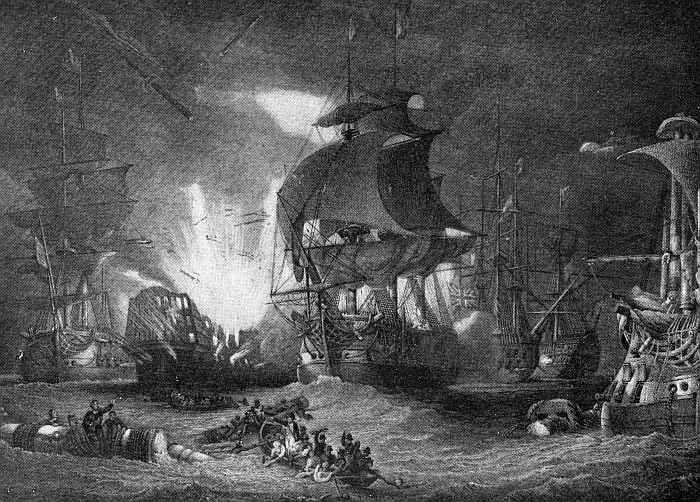
THE BATTLE OF THE NILE "There came a burst of thunder-sound; The boy—Oh! where was he? Ask of the winds that far around With fragments strewed the sea." Felicia Hemans. From an engraving after the painting by George Arnald, A. R. A.
———— The flames rolled on; he would not go Without his father's word; That father, faint in death below, His voice no longer heard. He called aloud, "Say, father, say, If yet my task be done!" He knew not that the chieftain lay Unconscious of his son. "Speak, father!" once again he cried, "If I may yet be gone!" And but the booming shots replied, And fast the flames rolled on. Upon his brow he felt their breath, And in his waving hair, And looked from that lone post of death In still yet brave despair; And shouted but once more aloud, "My father! must I stay?" While o'er him fast, through sail and shroud, The wreathing fires made way. They wrapt the ship in splendor wild, They caught the flag on high, And streamed above the gallant child, Like banners in the sky. There came a burst of thunder sound; The boy,—Oh! where was he? Ask of the winds, that far around With fragments strewed the sea,— With shroud and mast and pennon fair, That well had borne their part,— But the noblest thing that perished there Was that young, faithful heart. FELICIA HEMANS.
THE WRECK OF THE HESPERUS. It was the schooner Hesperus That sailed the wintry sea; And the skipper had taken his little daughter, To bear him company. Blue were her eyes as the fairy flax, Her cheeks like the dawn of day, And her bosom white as the hawthorn buds, That ope in the month of May. The skipper he stood beside the helm; His pipe was in his mouth; And he watched how the veering flaw did blow The smoke, now west, now south. Then up and spake an old sailor, Had sailed the Spanish main: "I pray thee, put into yonder port, For I fear a hurricane. "Last night the moon had a golden ring, And to-night no moon we see!" The skipper he blew a whiff from his pipe, And a scornful laugh laughed he. Colder and louder blew the wind, A gale from the northeast; The snow fell hissing in the brine, And the billows frothed like yeast. Down came the storm, and smote amain The vessel in its strength; She shuddered and paused like a frighted steed, Then leaped her cable's length. "Come hither! come hither my little daughter, And do not tremble so; For I can weather the roughest gale That ever wind did blow." He wrapped her warm in his seaman's coat Against the stinging blast; He cut a rope from a broken spar, And bound her to the mast. "O father! I hear the church-bells ring; Oh say, what may it be?" "'T is a fog-bell on a rock-bound coast!" And he steered for the open sea. "O father! I hear the sound of guns; Oh say, what may it be?" "Some ship in distress, that cannot live In such an angry sea!" "O father! I see a gleaming light! Oh say, what may it be?" But the father answered never a word— A frozen corpse was he. Lashed to the helm, all stiff and stark, With his face turned to the skies, The lantern gleamed through the gleaming snow On his fixed and glassy eyes. Then the maiden clasped her hands and prayed That savèd she might be! And she thought of Christ, who stilled the wave On the Lake of Galilee. And fast through the midnight dark and drear, Through the whistling sleet and snow, Like a sheeted ghost, the vessel swept Towards the reef of Norman's Woe. And ever, the fitful gusts between, A sound came from the land; It was the sound of the trampling surf On the rocks and the hard sea-sand. The breakers were right beneath her bows; She drifted a dreary wreck; And a whooping billow swept the crew, Like icicles, from her deck. She struck where the white and fleecy waves Looked soft as carded wool; But the cruel rocks they gored her side Like the horns of an angry bull. Her rattling shrouds, all sheathed in ice, With the mast went by the board; Like a vessel of glass, she stove and sank— Ho! ho! the breakers roared! At daybreak, on the bleak sea-beach, A fisherman stood aghast, To see the form of a maiden fair, Lashed close to a drifting mast. The salt sea was frozen on her breast, The salt tears in her eyes; And he saw her hair, like the brown sea-weed, On the billows fall and rise. Such was the wreck of the Hesperus, In the midnight and the snow; Christ save us all from a death like this, On the reef of Norman's Woe! HENRY WADSWORTH LONGFELLOW.
THE SECOND MATE. "Ho, there! Fisherman, hold your hand! Tell me, what is that far away,— There, where over the isle of sand Hangs the mist-cloud sullen and gray? See! it rocks with a ghastly life, Rising and rolling through clouds of spray, Right in the midst of the breakers' strife,— Tell me what is it, Fisherman, pray?" "That, good sir, was a steamer stout As ever paddled around Cape Race; And many's the wild and stormy bout She had with the winds, in that self-same place; But her time was come; and at ten o'clock Last night she struck on that lonesome shore; And her sides were gnawed by the hidden rock, And at dawn this morning she was no more." "Come, as you seem to know, good man, The terrible fate of this gallant ship, Tell me about her all that you can; And here's my flask to moisten your lip. Tell me how many she had aboard,— Wives, and husbands, and lovers true,— How did it fare with her human hoard? Lost she many, or lost she few?" "Master, I may not drink of your flask, Already too moist I feel my lip; But I'm ready to do what else you ask, And spin you my yarn about the ship. 'Twas ten o'clock, as I said, last night, When she struck the breakers and went ashore; And scarce had broken the morning's light When she sank in twelve feet of water or more. "But long ere this they knew her doom, And the captain called all hands to prayer; And solemnly over the ocean's boom Their orisons wailed on the troublous air. And round about the vessel there rose Tall plumes of spray as white as snow, Like angels in their ascension clothes, Waiting for those who prayed below. "So these three hundred people clung As well as they could, to spar and rope; With a word of prayer upon every tongue, Nor on any face a glimmer of hope. But there was no blubbering weak and wild,— Of tearful faces I saw but one, A rough old salt, who cried like a child, And not for himself, but the captain's son. "The captain stood on the quarter-deck, Firm but pale with trumpet in hand; Sometimes he looked at the breaking wreck, Sometimes he sadly looked to land; And often he smiled to cheer the crew— But, Lord! the smile was terrible grim— Till over the quarter a huge sea flew; And that was the last they saw of him. "I saw one young fellow with his bride, Standing amidships upon the wreck; His face was white as the boiling tide, And she was clinging about his neck. And I saw them try to say good-bye, But neither could hear the other speak; So they floated away through the sea to die— Shoulder to shoulder and cheek to cheek. "And there was a child, but eight at best, Who went his way in a sea she shipped, All the while holding upon his breast A little pet parrot whose wings were clipped. And, as the boy and the bird went by, Swinging away on a tall wave's crest, They were gripped by a man, with a drowning cry, And together the three went down to rest. "And so the crew went one by one, Some with gladness, and few with fear,— Cold and hardship such work had done That few seemed frightened when death was near. Thus every soul on board went down,— Sailor and passenger, little and great; The last that sank was a man of my town, A capital swimmer,—the second mate." "Now, lonely fisherman, who are you That say you saw this terrible wreck? How do I know what you say is true, When every mortal was swept from the deck? Where were you in that hour of death? How did you learn what you relate?" His answer came in an under-breath "Master, I was the second mate!" FITZ-JAMES O'BRIEN.
A SEA STORY Silence. A while ago Shrieks went up piercingly; But now is the ship gone down; Good ship, well manned, was she. There's a raft that's a chance of life for one, This day upon the sea. A chance for one of two Young, strong, are he and he, Just in the manhood prime, The comelier, verily, For the wrestle with wind and weather and wave, In the life upon the sea.
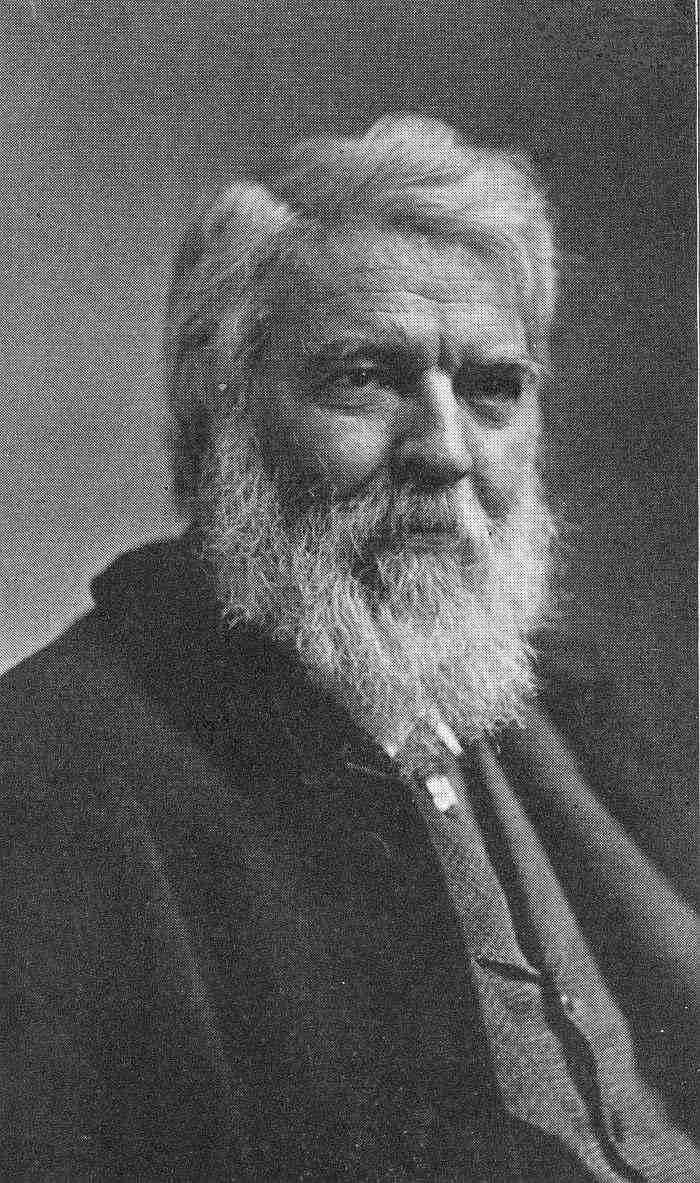
RICHARD HENRY STODDARD.
After a life-photograph by Sarony, New York. ————
One of them has a wife And little children three; Two that can toddle and lisp, And a suckling on the knee: Naked they'll go, and hunger sore, If he be lost at sea. One has a dream of home, A dream that well may be: He never has breathed it yet; She never has known it, she. But some one will be sick at heart If he be lost at sea. "Wife and kids at home!— Wife, kids, nor home has he!— Give us a chance, Bill!" Then, "All right, Jem!" Quietly A man gives up his life for a man, This day upon the sea. EMILY HENRIETTA HICKEY.