HUMOROUS POEMS.
Reading edition
I. WOMAN. ———— WOMAN.
When Eve brought woe to all mankind Old Adam called her wo-man; But when she wooed with love so kind, He then pronounced her woo-man. But now, with folly and with pride, Their husbands' pockets trimming, The women are so full of whims That men pronounce them wimmen! ANONYMOUS.
THE WOMEN FO'K. [2] O, sairly may I rue the day I fancied first the womenkind; For aye sinsyne I ne'er can hae Ae quiet thought or peace o' mind! They hae plagued my heart an' pleased my e'e, An' teased an' flattered me at will, But aye for a' their witcherye, The pawky things I lo'e them still. O the women fo'k! O the women fo'k! But they hae been the wreck o' me; O weary fa' the women fo'k, For they winna let a body be! I hae thought an' thought, but darena tell, I've studied them wi' a' my skill, I've lo'd them better than mysell, I've tried again to like them ill. Wha sairest strives, will sairest rue, To comprehend what nae man can; When he has done what man can do, He'll end at last where he began. O the women fo'k, etc. That they hae gentle forms an' meet, A man wi' half a look may see; An gracefu' airs, an' faces sweet, An' waving curls aboon the bree; An' smiles as soft as the young rosebud, And een sae pawky, bright, an' rare, Wad lure the laverock frae the cludd,— But, laddie, seek to ken nae mair! O the women fo'k, etc. Even but this night nae farther gane, The date is neither lost nor lang, I tak ye witness ilka ane, How fell they fought, and fairly dang. Their point they've carried right or wrang, Without a reason, rhyme, or law, An' forced a man to sing a sang, That ne'er could sing a verse ava. O the women fo'k! O the women fo'k! But they hae been the wreck o' me; O weary fa' the women fo'k, For they winna let a body be! JAMES HOGG.
OF A CERTAINE MAN. There was (not certaine when) a certaine preacher, That never learned, and yet became a teacher, Who having read in Latine thus a text Of erat quidam homo, much perplext, He seemed the same with studie great to scan, In English thus, There was a certaine man. But now (quoth he), good people, note you this, He saith there was, he doth not say there is; For in these daies of ours it is most plaine Of promise, oath, word, deed, no man's certaine; Yet by my text you see it comes to passe That surely once a certaine man there was: But yet, I think, in all your Bible no man Can finde this text, There was a certaine woman. SIR JOHN HARRINGTON.
WOMEN'S CHORUS. They're always abusing the women, As a terrible plague to men: They say we're the root of all evil, And repeat it again and again; Of war, and quarrels, and bloodshed, All mischief, be what it may! And pray, then, why do you marry us, If we're all the plagues you say? And why do you take such care of us, And keep us so safe at home, And are never easy a moment If ever we chance to roam? When you ought to be thanking heaven That your Plague is out of the way, You all keep fussing and fretting— "Where is my Plague to-day?" If a Plague peeps out of the window, Up go the eyes of men; If she hides, then they all keep staring Until she looks out again. From the Greek of ARISTOPHANES. Translation of WILLIAM COLLINS.
THE WIVES OF WEINSBERG. Which way to Weinsberg? neighbor, say! 'Tis sure a famous city: It must have cradled, in its day, Full many a maid of noble clay, And matrons wise and witty; And if ever marriage should happen to me, A Weinsberg dame my wife shall be. King Conrad once, historians say, Fell out with this good city; So down he came, one luckless day,— Horse, foot, dragoons,—in stern array,— And cannon,—more's the pity! Around the walls the artillery roared, And bursting bombs their fury poured. But naught the little town could scare; Then, red with indignation, He bade the herald straight repair Up to the gates, and thunder there The following proclamation:— "Rascals! when I your town do take, No living thing shall save its neck!" Now, when the herald's trumpet sent These tidings through the city, To every house a death knell went; Such murder-cries the hot air rent Might move the stones to pity. Then bread grew dear, but good advice Could not be had for any price. Then, "Woe is me!" "O misery!" What shrieks of lamentation! And "Kyrie Eleison!" cried The pastors, and the flock replied, "Lord! save us from starvation!" "Oh, woe is me, poor Corydon— My neck,—my neck! I'm gone,—I'm gone!" Yet oft, when counsel, deed, and prayer Had all proved unavailing, When hope hung trembling on a hair, How oft has woman's wit been there!— A refuge never failing; For woman's wit and Papal fraud, Of olden time, were famed abroad. A youthful dame, praised be her name!— Last night had seen her plighted,— Whether in waking hour or dream, Conceived a rare and novel scheme, Which all the town delighted; Which you, if you think otherwise, Have leave to laugh at and despise. At midnight hour, when culverin And gun and bomb were sleeping, Before the camp with mournful mien, The loveliest embassy were seen, All kneeling low and weeping. So sweetly, plaintively they prayed, But no reply save this was made:— "The women have free leave to go, Each with her choicest treasure; But let the knaves their husbands know That unto them the King will show The weight of his displeasure." With these sad terms the lovely train Stole weeping from the camp again. But when the morning gilt the sky, What happened? Give attention:— The city gates wide open fly, And all the wives come trudging by, Each bearing—need I mention?— Her own dear husband on her back, All snugly seated in a sack! Full many a sprig of court, the joke Not relishing, protested, And urged the King; but Conrad spoke:— "A monarch's word must not be broke!" And here the matter rested. "Bravo!" he cried, "Ha, ha! Bravo! Our lady guessed it would be so." He pardoned all, and gave a ball That night at royal quarters. The fiddles squeaked, the trumpets blew, And up and down the dancers flew, Court sprigs with city daughters. The mayor's wife—O rarest sight!— Danced with the shoemaker that night! Ah, where is Weinsberg, sir, I pray? 'Tis sure a famous city: It must have cradled in its day Full many a maid of noble clay, And matrons wise and witty; And if ever marriage should happen to me, A Weinsberg dame my wife shall be. From the German of GOTTFRIED AUGÜST BÜRGER. Translation of CHARLES TIMOTHY BROOKS.
SORROWS OF WERTHER. Werther had a love for Charlotte Such as words could never utter; Would you know how first he met her? She was cutting bread and butter. Charlotte was a married lady, And a moral man was Werther, And for all the wealth of Indies Would do nothing for to hurt her. So he sighed and pined and ogled, And his passion boiled and bubbled, Till he blew his silly brains out, And no more was by it troubled. Charlotte, having seen his body Borne before her on a shutter, Like a well-conducted person, Went on cutting bread and butter. WILLIAM MAKEPEACE THACKERAY.
THE WELL OF ST. KEYNE.
"In the parish of St. Neots, Cornwall, is a well arched over with the robes of four kinds of trees,—withy, oak, elm, and ash,—and dedicated to St. Keyne. The reported virtue of the water is this, that, whether husband or wife first drink thereof, they get the mastery thereby." —FULLER.
A well there is in the West country, And a clearer one never was seen; There is not a wife in the West country But has heard of the Well of St. Keyne. An oak and an elm tree stand beside, And behind does an ash-tree grow, And a willow from the bank above Droops to the water below. A traveller came to the Well of St. Keyne; Pleasant it was to his eye, For from cock-crow he had been travelling, And there was not a cloud in the sky. He drank of the water so cool and clear, For thirsty and hot was he, And he sat down upon the bank, Under the willow-tree. There came a man from the neighboring town At the well to fill his pail, On the well-side he rested it, And bade the stranger hail. "Now art thou a bachelor, stranger?" quoth he, "For an if thou hast a wife, The happiest draught thou hast drank this day That ever thou didst in thy life. "Or has your good woman, if one you have, In Cornwall ever been? For an if she have, I'll venture my life She has drunk of the Well of St. Keyne." "I have left a good woman who never was here," The stranger he made reply; "But that my draught should be better for that, I pray you answer me why." "St. Keyne," quoth the countryman, "many a time Drank of this crystal well, And before the angel summoned her She laid on the water a spell. "If the husband of this gifted well Shall drink before his wife, A happy man thenceforth is he, For he shall be master for life. "But if the wife should drink of it first, Heaven help the husband then!" The stranger stooped to the Well of St. Keyne, And drank of the waters again. "You drank of the well, I warrant, betimes?" He to the countryman said. But the countryman smiled as the stranger spake, And sheepishly shook his head. "I hastened, as soon as the wedding was done, And left my wife in the porch. But i' faith, she had been wiser than me, For she took a bottle to church." ROBERT SOUTHEY.
BELLE OF THE BALL. Years, years ago, ere yet my dreams Had been of being wise or witty, Ere I had done with writing themes, Or yawned o'er this infernal Chitty,— Years, years ago, while all my joys Were in my fowling-piece and filly; In short, while I was yet a boy, I fell in love with Laura Lilly. I saw her at the county ball; There, when the sounds of flute and fiddle Gave signal sweet in that old hall Of hands across and down the middle, Hers was the subtlest spell by far Of all that sets young hearts romancing: She was our queen, our rose, our star; And then she danced,—O Heaven! her dancing. Dark was her hair; her hand was white; Her voice was exquisitely tender; Her eyes were full of liquid light; I never saw a waist so slender; Her every look, her every smile, Shot right and left a score of arrows: I thought 'twas Venus from her isle, And wondered where she'd left her sparrows. She talked of politics or prayers, Of Southey's prose or Wordsworth's sonnets, Of danglers or of dancing bears, Of battles or the last new bonnets; By candle-light, at twelve o'clock,— To me it mattered not a tittle,— If those bright lips had quoted Locke, I might have thought they murmured Little. Through sunny May, through sultry June, I loved her with a love eternal; I spoke her praises to the moon, I wrote them to the Sunday Journal. My mother laughed; I soon found out That ancient ladies have no feeling: My father frowned; but how should gout See any happiness in kneeling? She was the daughter of a dean,— Rich, fat, and rather apoplectic; She had one brother just thirteen, Whose color was extremely hectic; Her grandmother for many a year Had fed the parish with her bounty; Her second cousin was a peer, And lord-lieutenant of the county. But titles and the three-per-cents, And mortgages, and great relations, And India bonds, and tithes and rents, O, what are they to love's sensations? Black eyes, fair forehead, clustering locks,— Such wealth, such honors Cupid chooses; He cares as little for the stocks As Baron Rothschild for the muses. She sketched; the vale, the wood, the beach, Grew lovelier from her pencil's shading: She botanized; I envied each Young blossom in her boudoir fading: She warbled Handel; it was grand,— She made the Catilina jealous: She touched the organ; I could stand For hours and hours to blow the bellows. She kept an album too, at home, Well filled with all an album's glories,— Paintings of butterflies and Rome, Patterns for trimmings, Persian stories, Soft songs to Julia's cockatoo, Fierce odes to famine and to slaughter, And autographs of Prince Leeboo, And recipes for elder-water. And she was flattered, worshipped, bored; Her steps were watched, her dress was noted; Her poodle-dog was quite adored; Her sayings were extremely quoted. She laughed,—and every heart was glad, As if the taxes were abolished; She frowned,—and every look was sad, As if the opera were demolished. She smiled on many just for fun,— I knew that there was nothing in it; I was the first, the only one, Her heart had thought of for a minute. I knew it, for she told me so, In phrase which was divinely moulded; She wrote a charming hand,—and O, How sweetly all her notes were folded! Our love was most like other loves,— A little glow, a little shiver, A rosebud and a pair of gloves, And "Fly Not Yet," upon the river; Some jealousy of some one's heir, Some hopes of dying broken-hearted; A miniature, a lock of hair, The usual vows,—and then we parted. We parted: months and years rolled by; We met again four summers after. Our parting was all sob and sigh, Our meeting was all mirth and laughter! For in my heart's most secret cell There had been many other lodgers; And she was not the ball-room's belle, But only Mrs.—Something—Rogers! WINTHROP MACKWORTH PRAED.
ECHO AND THE LOVER. Lover. Echo! mysterious nymph, declare Of what you're made, and what you are. Echo. Air! Lover. Mid airy cliffs and places high, Sweet Echo! listening love, you lie. Echo. You lie! Lover. Thou dost resuscitate dead sounds,— Hark! how my voice revives, resounds! Echo. Zounds! Lover. I'll question thee before I go,— Come, answer me more apropos! Echo. Poh! poh! Lover. Tell me, fair nymph, if e'er you saw So sweet a girl as Phœbe Shaw. Echo. Pshaw! Lover. Say, what will turn that frisking coney Into the toils of matrimony? Echo. Money! Lover. Has Phœbe not a heavenly brow? Is not her bosom white as snow? Echo. Ass! No! Lover. Her eyes! was ever such a pair? Are the stars brighter than they are? Echo. They are! Lover. Echo, thou liest, but can't deceive me. Echo. Leave me! Lover. But come, thou saucy, pert romancer, Who is as fair as Phœbe? Answer! Echo. Ann, sir. ANONYMOUS.
ECHO. I asked of Echo, t' other day, (Whose words are few and often funny,) What to a novice she could say Of courtship, love, and matrimony. Quoth Echo, plainly,—"Matter-o'-money!" Whom should I marry?—should it be A dashing damsel, gay and pert, A pattern of inconstancy; Or selfish, mercenary flirt? Quoth Echo, sharply,—"Nary flirt!" What if, aweary of the strife That long has lured the dear deceiver, She promise to amend her life, And sin no more; can I believe her? Quoth Echo, very promptly,—"Leave her!" But if some maiden with a heart On me should venture to bestow it, Pray, should I act the wiser part To take the treasure or forego it? Quoth Echo, with decision,—"Go it!" But what if, seemingly afraid To bind her fate in Hymen's fetter, She vow she means to die a maid, In answer to my loving letter? Quoth Echo, rather coolly,—"Let her!" What if, in spite of her disdain, I find my heart intwined about With Cupid's dear delicious chain So closely that I can't get out? Quoth Echo, laughingly,—"Get out!" But if some maid with beauty blest, As pure and fair as Heaven can make her, Will share my labor and my rest Till envious Death shall overtake her? Quoth Echo (sotto voce),—"Take her!" JOHN GODFREY SAXE.
"NOTHING TO WEAR." Miss Flora McFlimsey, of Madison Square, Has made three separate journeys to Paris, And her father assures me, each time she was there, That she and her friend Mrs. Harris (Not the lady whose name is so famous in history, But plain Mrs. H., without romance or mystery) Spent six consecutive weeks without stopping In one continuous round of shopping,— Shopping alone, and shopping together, At all hours of the day, and in all sorts of weather, For all manner of things that a woman can put On the crown of her head or the sole of her foot, Or wrap round her shoulders, or fit round her waist, Or that can be sewed on, or pinned on, or laced, Or tied on with a string, or stitched on with a bow, In front or behind, above or below; For bonnets, mantillas, capes, collars, and shawls; Dresses for breakfasts and dinners and balls; Dresses to sit in and stand in and walk in; Dresses to dance in and flirt in and talk in; Dresses in which to do nothing at all; Dresses for Winter, Spring, Summer, and Fall; All of them different in color and shape, Silk, muslin, and lace, velvet, satin, and crape, Brocade, and broadcloth, and other material, Quite as expensive and much more ethereal; In short, for all things that could ever be thought of, Or milliner, modiste, or tradesman be bought of, From ten-thousand-francs robe to twenty-sous frills; In all quarters of Paris, and to every store, While McFlimsey in vain stormed, scolded, and swore, They footed the streets, and he footed the bills! The last trip, their goods shipped by the steamer Arago, Formed, McFlimsey declares, the bulk of her cargo, Not to mention a quantity kept from the rest, Sufficient to fill the largest-sized chest, Which did not appear on the ship's manifest, But for which the ladies themselves manifested Such particular interest, that they invested Their own proper persons in layers and rows Of muslins, embroideries, worked under-clothes, Gloves, handkerchiefs, scarfs, and such trifles as those; Then, wrapped in great shawls, like Circassian beauties, Gave good-bye to the ship, and go-by to the duties. Her relations at home all marvelled, no doubt, Miss Flora had grown so enormously stout For an actual belle and a possible bride; But the miracle ceased when she turned inside out, And the truth came to light, and the dry-goods beside, Which, in spite of Collector and Custom-House sentry, Had entered the port without any entry, And yet, though scarce three months have passed since the day This merchandise went, on twelve carts, up Broadway, This same Miss McFlimsey, of Madison Square, The last time we met was in utter despair, Because she had nothing whatever to wear! Nothing to wear! Now, as this is a true ditty, I do not assert—this, you know, is between us— That she's in a state of absolute nudity, Like Powers' Greek Slave, or the Medici Venus; But I do mean to say, I have heard her declare, When, at the same moment, she had on a dress Which cost five hundred dollars, and not a cent less, And jewelry worth ten times more, I should guess, That she had not a thing in the wide world to wear! I should mention just here, that out of Miss Flora's Two hundred and fifty or sixty adorers, I had just been selected as he who should throw all The rest in the shade, by the gracious bestowal On myself after twenty or thirty rejections, Of those fossil remains which she called her "affections," And that rather decayed, but well-known work of art, Which Miss Flora persisted in styling her "heart." So we were engaged. Our troth had been plighted, Not by moonbeam or starbeam, by fountain or grove, But in a front parlor, most brilliantly lighted, Beneath the gas-fixtures we whispered our love, Without any romance or raptures or sighs, Without any tears in Miss Flora's blue eyes, Or blushes, or transports, or such silly actions, It was one of the quietest business transactions, With a very small sprinkling of sentiment, if any, And a very large diamond imported by Tiffany. On her virginal lips while I printed a kiss, She exclaimed, as a sort of parenthesis, And by way of putting me quite at my ease, "You know, I'm to polka as much as I please, And flirt when I like,—now, stop, don't you speak,— And you must not come here more than twice in the week, Or talk to me either at party or ball, But always be ready to come when I call; So don't prose to me about duty and stuff, If we don't break this off, there will be time enough For that sort of thing; but the bargain must be That, as long as I choose, I am perfectly free, For this is a kind of engagement, you see, Which is binding on you but not binding on me." Well, having thus wooed Miss McFlimsey and gained her, With the silks, crinolines, and hoops that contained her, I had, as I thought, a contingent remainder At least in the property, and the best right To appear as its escort by day and by night; And it being the week of the Stuckups' grand ball,— Their cards had been out a fortnight or so, And set all the Avenue on the tiptoe,— I considered it only my duty to call, And see if Miss Flora intended to go. I found her,—as ladies are apt to be found, When the time intervening between the first sound Of the bell and the visitor's entry is shorter Than usual,—I found; I won't say—I caught her, Intent on the pier-glass, undoubtedly meaning To see if perhaps it didn't need cleaning. She turned as I entered,—"Why, Harry, you sinner, I thought that you went to the Flashers' to dinner!" "So I did," I replied; "but the dinner is swallowed And digested, I trust, for 'tis now nine and more, So being relieved from that duty, I followed Inclination, which led me, you see, to your door; And now will your ladyship so condescend As just to inform me if you intend Your beauty and graces and presence to lend (All of which, when I own, I hope no one will borrow) To the Stuckups, whose party, you know, is to-morrow?" The fair Flora looked up with a pitiful air, And answered quite promptly, "Why, Harry, mon cher, I should like above all things to go with you there, But really and truly—I've nothing to wear." "Nothing to wear! go just as you are; Wear the dress you have on, and you'll be by far, I engage, the most bright and particular star On the Stuckup horizon—" I stopped—for her eye, Notwithstanding this delicate onset of flattery, Opened on me at once a most terrible battery Of scorn and amazement. She made no reply, But gave a slight turn to the end of her nose— That pure Grecian feature—as much as to say, "How absurd that any sane man should suppose That a lady would go to a ball in the clothes, No matter how fine, that she wears every day!" So I ventured again: "Wear your crimson brocade" (Second turn-up of nose)—"That's too dark by a shade." "Your blue silk"—"That's too heavy." "Your pink"— "That's too light." "Wear tulle over satin"—"I can't endure white." "Your rose-colored, then, the best of the batch"— "I haven't a thread of point-lace to match." "Your brown moire antique"—"Yes, and look like a Quaker." "The pearl-colored"—"I would, but that plaguey dressmaker Has had it a week." "Then that exquisite lilac In which you would melt the heart of a Shylock" (Here the nose took again the same elevation)— "I wouldn't wear that for the whole of creation." "Why not? It's my fancy, there's nothing could strike it As more comme il faut"—"Yes, but, dear me! that lean Sophronia Stuckup has got one just like it, And I won't appear dressed like a chit of sixteen." "Then that splendid purple, that sweet Mazarine, That superb point d'aiguille, that imperial green, That zephyr-like tarlatan, that rich grenadine"— "Not one of all which is fit to be seen," Said the lady, becoming excited and flushed. "Then wear," I exclaimed, in a tone which quite crushed Opposition, "that gorgeous toilette which you sported In Paris last spring, at the grand presentation, When you quite turned the head of the head of the nation; And by all the grand court were so very much courted." The end of the nose was portentously tipped up, And both the bright eyes shot forth indignation, As she burst upon me with the fierce exclamation, "I have worn it three times at the least calculation, And that and most of my dresses are ripped up!" Here I ripped out something, perhaps rather rash, Quite innocent, though; but, to use an expression More striking than classic, it "settled my hash," And proved very soon the last act of our session. "Fiddlesticks, is it, sir? I wonder the ceiling Doesn't fall down and crush you—you men have no feeling; You selfish, unnatural, illiberal creatures, Who set yourselves up as patterns and preachers, Your silly pretence—why, what a mere guess it is! Pray, what do you know of a woman's necessities? I have told you and showed you I've nothing to wear, And it's perfectly plain you not only don't care, But you do not believe me"—(here the nose went still higher)— I suppose, if you dared, you would call me a liar. Our engagement is ended, sir—yes, on the spot; You're a brute, and a monster, and—I don't know what." I mildly suggested the words—Hottentot, Pickpocket, and cannibal, Tartar, and thief, As gentle expletives which might give relief; But this only proved as a spark to the powder, And the storm I had raised came faster and louder; It blew and it rained, thundered, lightened, and hailed Interjections, verbs, pronouns, till language quite failed To express the abusive, and then its arrears Were brought up all at once by a torrent of tears, And my last faint, despairing attempt at an obs- Ervation was lost in a tempest of sobs. Well, I felt for the lady, and felt for my hat, too, Improvised on the crown of the latter a tattoo, In lieu of expressing the feelings which lay Quite too deep for words, as Wordsworth would say; Then, without going through the form of a bow, Found myself in the entry—I hardly knew how,— On doorstep and sidewalk, past lamp-post and square, At home and up-stairs, in my own easy-chair; Poked my feet into slippers, my fire into blaze, And said to myself, as I lit my cigar, "Supposing a man had the wealth of the Czar Of the Russias to boot, for the rest of his days, On the whole, do you think he would have much to spare, If he married a woman with nothing to wear?" Since that night, taking pains that it should not be bruited Abroad in society, I've instituted A course of inquiry, extensive and thorough, On this vital subject, and find, to my horror, That the fair Flora's case is by no means surprising, But that there exists the greatest distress In our female community, solely arising From this unsupplied destitution of dress, Whose unfortunate victims are filling the air With the pitiful wail of "Nothing to wear." Researches in some of the "Upper Ten" districts Reveal the most painful and startling statistics, Of which let me mention only a few: In one single house, on the Fifth Avenue, Three young ladies were found, all below twenty-two, Who have been three whole weeks without anything new In the way of flounced silks, and thus left in the lurch Are unable to go to ball, concert, or church. In another large mansion, near the same place, Was found a deplorable, heart-rending case Of entire destitution of Brussels point-lace. In a neighboring block there was found, in three calls, Total want, long continued, of camel's-hair shawls; And a suffering family, whose case exhibits The most pressing need of real ermine tippets; One deserving young lady almost unable To survive for the want of a new Russian sable; Still another, whose tortures have been most terrific Ever since the sad loss of the steamer Pacific, In which were engulfed, not friend or relation (For whose fate she perhaps might have found consolation, Or borne it, at least, with serene resignation), But the choicest assortment of French sleeves and collars Ever sent out from Paris, worth thousands of dollars, And all as to style most recherché and rare, The want of which leaves her with nothing to wear, And renders her life so drear and dyspeptic That she's quite a recluse, and almost a sceptic; For she touchingly says that this sort of grief Cannot find in Religion the slightest relief, And Philosophy has not a maxim to spare For the victim of such overwhelming despair. But the saddest by far of all these sad features Is the cruelty practised upon the poor creatures By husbands and fathers, real Bluebeards and Timons, Who resist the most touching appeals made for diamonds By their wives and their daughters, and leave them for days Unsupplied with new jewelry, fans, or bouquets, Even laugh at their miseries whenever they have a chance, And deride their demands as useless extravagance. One case of a bride was brought to my view, Too sad for belief, but, alas! 't was too true, Whose husband refused, as savage as Charon, To permit her to take more than ten trunks to Sharon. The consequence was, that when she got there, At the end of three weeks she had nothing to wear, And when she proposed to finish the season At Newport, the monster refused out and out, For his infamous conduct alleging no reason, Except that the waters were good for his gout; Such treatment as this was too shocking, of course, And proceedings are now going on for divorce. But why harrow the feelings by lifting the curtain From these scenes of woe? Enough, it is certain Has here been disclosed to stir up the pity Of every benevolent heart in the city, And spur up Humanity into a canter To rush and relieve these sad cases instanter. Won't somebody, moved by this touching description, Come forward to-morrow and head a subscription? Won't some kind philanthropist, seeing that aid is So needed at once by these indigent ladies, Take charge of the matter? Or won't Peter Cooper The corner-stone lay of some new splendid super- Structure, like that which to-day links his name In the Union unending of Honor and Fame; And found a new charity just for the care Of these unhappy women with nothing to wear, Which, in view of the cash which would daily be claimed, The Laying-out Hospital well might be named? Won't Stewart, or some of our dry-goods importers, Take a contract for clothing our wives and our daughters? Or, to furnish the cash to supply these distresses, And life's pathway strew with shawls, collars, and dresses, For poor womankind, won't some venturesome lover A new California somewhere discover? O ladies, dear ladies, the next sunny day Please trundle your hoops just out of Broadway, From its whirl and its bustle, its fashion and pride, And temples of Trade which tower on each side, To the alleys and lanes, where Misfortune and Guilt Their children have gathered, their city have built; Where Hunger and Vice, like twin beasts of prey, Have hunted their victims to gloom and despair; Raise the rich, dainty dress, and the fine broidered skirt, Pick your delicate way through the dampness and dirt, Grope through the dark dens, climb the rickety stair To the garret, where wretches, the young and the old, Half starved and half naked, lie crouched from the cold. See those skeleton limbs, those frost-bitten feet, All bleeding and bruised by the stones of the street; Hear the sharp cry of childhood, the deep groans that swell From the poor dying creature who writhes on the floor; Hear the curses that sound like the echoes of Hell, As you sicken and shudder and fly from the door; Then home to your wardrobes, and say, if you dare— Spoiled children of Fashion—you've nothing to wear! And O, if perchance there should be a sphere Where all is made right which so puzzles us here, Where the glare and the glitter and tinsel of Time Fade and die in the light of that region sublime, Where the soul, disenchanted of flesh and of sense, Unscreened by its trappings and shows and pretence, Must be clothed for the life and the service above, With purity, truth, faith, meekness, and love; O daughters of Earth! foolish virgins, beware! Lest in that upper realm you have nothing to wear! WILLIAM ALLEN BUTLER.
THE SEA. She was rich and of high degree; A poor and unknown artist he. "Paint me," she said, "a view of the sea." So he painted the sea as it looked the day That Aphroditè arose from its spray; And it broke, as she gazed on its face the while, Into its countless-dimpled smile. "What a poky, stupid picture!" said she: "I don't believe he can paint the sea!" Then he painted a raging, tossing sea, Storming, with fierce and sudden shock, A towering, mighty fastness-rock;— In its sides, above those leaping crests, The thronging sea-birds built their nests. "What a disagreeable daub!" said she: "Why, it isn't anything like the sea!" Then he painted a stretch of hot brown sand, With a big hotel on either hand, And a handsome pavilion for the band;— Not a sign of water to be seen, Except one faint little streak of green. "What a perfectly exquisite picture!" said she: "It's the very image of the sea!" EVA L. OGDEN.
THE PROUD MISS MACBRIDE. A LEGEND OF GOTHAM. O, terribly proud was Miss MacBride, The very personification of pride, As she minced along in fashion's tide, Adown Broadway—on the proper side— When the golden sun was setting; There was pride in the head she carried so high, Pride in her lip, and pride in her eye, And a world of pride in the very sigh That her stately bosom was fretting! O, terribly proud was Miss MacBride, Proud of her beauty, and proud of her pride, And proud of fifty matters beside— That wouldn't have borne dissection; Proud of her wit, and proud of her walk, Proud of her teeth, and proud of her talk, Proud of "knowing cheese from chalk," On a very slight inspection! Proud abroad, and proud at home, Proud wherever she chanced to come— When she was glad, and when she was glum; Proud as the head of a Saracen Over the door of a tippling-shop!— Proud as a duchess, proud as a fop, "Proud as a boy with a brand-new top," Proud beyond comparison! It seems a singular thing to say, But her very senses led her astray Respecting all humility; In sooth, her dull auricular drum Could find in humble only a "hum," And heard no sound of "gentle" come, In talking about gentility. What lowly meant she didn't know, For she always avoided "everything low," With care the most punctilious; And, queerer still, the audible sound Of "super-silly" she never had found In the adjective supercilious! The meaning of meek she never knew, But imagined the phrase had something to do With "Moses," a peddling German Jew, Who, like all hawkers, the country through, Was "a person of no position;" And it seemed to her exceedingly plain, If the word was really known to pertain To a vulgar German, it wasn't germane To a lady of high condition! Even her graces—not her grace— For that was in the "vocative case"— Chilled with the touch of her icy face, Sat very stiffly upon her! She never confessed a favor aloud, Like one of the simple, common crowd— But coldly smiled, and faintly bowed, As who should say, "You do me proud, And do yourself an honor!" And yet the pride of Miss MacBride, Although it had fifty hobbies to ride, Had really no foundation; But, like the fabrics that gossips devise— Those single stories that often arise And grow till they reach a four-story size— Was merely a fancy creation! Her birth, indeed, was uncommonly high— For Miss MacBride first opened her eye Through a skylight dim, on the light of the sky; But pride is a curious passion— And in talking about her wealth and worth, She always forgot to mention her birth To people of rank and fashion! Of all the notable things on earth, The queerest one is pride of birth Among our "fierce democracie"! A bridge across a hundred years, Without a prop to save it from sneers,— Not even a couple of rotten peers,— A thing for laughter, fleers, and jeers, Is American aristocracy! English and Irish, French and Spanish, German, Italian, Dutch and Danish, Crossing their veins until they vanish In one conglomeration! So subtle a tangle of blood, indeed, No Heraldry Harvey will ever succeed In finding the circulation. Depend upon it, my snobbish friend, Your family thread you can't ascend, Without good reason to apprehend You may find it waxed, at the farther end, By some plebeian vocation! Or, worse than that, your boasted line May end in a loop of stronger twine, That plagued some worthy relation! But Miss MacBride had something beside Her lofty birth to nourish her pride— For rich was the old paternal MacBride, According to public rumor; And he lived "up town," in a splendid square, And kept his daughter on dainty fare, And gave her gems that were rich and rare, And the finest rings and things to wear, And feathers enough to plume her. A thriving tailor begged her hand, But she gave "the fellow" to understand, By a violent manual action, She perfectly scorned the best of his clan, And reckoned the ninth of any man An exceedingly vulgar fraction! Another, whose sign was a golden boot, Was mortified with a bootless suit, In a way that was quite appalling; For, though a regular sutor by trade, He wasn't a suitor to suit the maid, Who cut him off with a saw—and bade "The cobbler keep to his calling!" A rich tobacconist comes and sues, And, thinking the lady would scarce refuse A man of his wealth, and liberal views, Began, at once, with "If you choose— And could you really love him—" But the lady spoiled his speech in a huff, With an answer rough and ready enough, To let him know she was up to snuff, And altogether above him! A young attorney, of winning grace, Was scarce allowed to "open his face," Ere Miss MacBride had closed his case With true judicial celerity; For the lawyer was poor, and "seedy" to boot, And to say the lady discarded his suit, Is merely a double verity! The last of those who came to court, Was a lively beau, of the dapper sort, "Without any visible means of support," A crime by no means flagrant In one who wears an elegant coat, But the very point on which they vote A ragged fellow "a vagrant!" Now dapper Jim his courtship plied (I wish the fact could be denied) With an eye to the purse of the old MacBride, And really "nothing shorter!" For he said to himself, in his greedy lust, "Whenever he dies—as die he must— And yields to Heaven his vital trust, He's very sure to 'come down with his dust,' In behalf of his only daughter." And the very magnificent Miss MacBride, Half in love, and half in pride, Quite graciously relented; And, tossing her head, and turning her back, No token of proper pride to lack— To be a bride, without the "Mac," With much disdain, consented! Old John MacBride, one fatal day, Became the unresisting prey Of fortune's undertakers; And staking all on a single die, His foundered bark went high and dry Among the brokers and breakers! But, alas, for the haughty Miss MacBride, 'T was such a shock to her precious pride! She couldn't recover, although she tried Her jaded spirits to rally; 'T was a dreadful change in human affairs, From a place "up town" to a nook "up stairs," From an avenue down to an alley! 'T was little condolence she had, God wot, From her "troops of friends," who hadn't forgot The airs she used to borrow! They had civil phrases enough, but yet 'T was plain to see that their "deepest regret" Was a different thing from sorrow! And one of those chaps who make a pun, As if it were quite legitimate fun To be blazing away at every one With a regular, double-loaded gun— Remarked that moral transgression Always brings retributive stings To candle-makers as well as kings; For "making light of cereous things" Was a very wick-ed profession! And vulgar people—the saucy churls— Inquired about "the price of pearls," And mocked at her situation: "She wasn't ruined—they ventured to hope— Because she was poor, she needn't mope; Few people were better off for soap, And that was a consolation!" And to make her cup of woe run over, Her elegant, ardent plighted lover Was the very first to forsake her; "He quite regretted the step, 't was true— The lady had pride enough 'for two,' But that alone would never do To quiet the butcher and baker!" And now the unhappy Miss MacBride— The merest ghost of her early pride— Bewails her lonely position; Cramped in the very narrowest niche, Above the poor, and below the rich— Was ever a worse condition! MORAL. Because you flourish in worldly affairs, Don't be haughty, and put on airs, With insolent pride of station! Don't be proud, and turn up your nose At poorer people in plainer clothes, But learn, for the sake of your mind's repose, That wealth 's a bubble that comes—and goes! And that all proud flesh, wherever it grows, Is subject to irritation! JOHN GODFREY SAXE.
ON AN OLD MUFF. Time has a magic wand! What is this meets my hand, Moth-eaten, mouldy, and Covered with fluff, Faded and stiff and scant? Can it be? no, it can't,— Yes,—I declare 't is Aunt Prudence's Muff! Years ago—twenty-three! Old Uncle Barnaby Gave it to Aunty P., Laughing and teasing,— "Pru. of the breezy curls, Whisper these solemn churls, What holds a pretty girl's Hand without squeezing?" Uncle was then a lad, Gay, but, I grieve to add, Gone to what's called "the bad,"— Smoking,—and worse! Sleek sable then was this Muff, lined with pinkiness,— Bloom to which beauty is Seldom averse. I see in retrospect Aunt, in her best bedecked, Gliding, with mien erect, Gravely to meeting: Psalm-book, and kerchief new, Peeped from the Muff of Pru., Young men—and pious, too— Giving her greeting. Pure was the life she led Then: from her Muff, 't is said, Tracts she distributed;— Scapegraces many, Seeing the grace they lacked, Followed her; one attacked Prudence, and got his tract, Oftener than any! Love has a potent spell! Soon this bold ne'er-do-well, Aunt's sweet susceptible Heart undermining, Slipped, so the scandal runs, Notes in the pretty nun's Muff,—triple-cornered ones,— Pink as its lining! Worse, even, soon the jade Fled (to oblige her blade!) Whilst her friends thought that they 'd Locked her up tightly: After such shocking games, Aunt is of wedded dames Gayest,—and now her name's Mrs. Golightly. In female conduct flaw Sadder I never saw, Still I've faith in the law Of compensation. Once uncle went astray,— Smoked, joked, and swore away; Sworn by, he 's now, by a Large congregation! Changed is the child of sin; Now he 's (he once was thin) Grave, with a double chin,— Blest be his fat form! Changed is the garb he wore: Preacher was never more Prized than is uncle for Pulpit or platform. If all's as best befits Mortals of slender wits, Then beg this Muff, and its Fair owner pardon; All's for the best,—indeed, Such is my simple creed; Still I must go and weed Hard in my garden. FREDERICK LOCKER-LAMPSON.
HOW PADDY GOT "UNDER GOVERNMENT." A place under Government Was all that Paddy wanted. He married soon a scolding wife, And thus his wish was granted. ANONYMOUS.
II. MISCELLANEOUS. ————
SAINT ANTHONY'S SERMON TO THE FISHES. Saint Anthony at church Was left in the lurch, So he went to the ditches And preached to the fishes; They wriggled their tails, In the sun glanced their scales. The carps, with their spawn, Are all hither drawn; Have opened their jaws, Eager for each clause. No sermon beside Had the carps so edified. Sharp-snouted pikes, Who keep fighting like tikes, Now swam up harmonious To hear Saint Antonius. No sermon beside Had the pikes so edified. And that very odd fish, Who loves fast-days, the cod-fish,— The stock-fish, I mean,— At the sermon was seen. No sermon beside Had the cods so edified. Good eels and sturgeon, Which aldermen gorge on, Went out of their way To hear preaching that day. No sermon beside Had the eels so edified. Crabs and turtles also, Who always move slow, Made haste from the bottom, As if the Devil had got 'em. No sermon beside Had the crabs so edified. Fish great and fish small, Lords, lackeys, and all, Each looked at the preacher Like a reasonable creature: At God's word, They Anthony heard. The sermon now ended, Each turned and descended; The pikes went on stealing, The eels went on eeling: Much delighted were they, But preferred the old way. The crabs are backsliders, The stock-fish thick-siders, The carps are sharp-set; All the sermon forget: Much delighted were they, But preferred the old way. ANONYMOUS.
KING JOHN AND THE ABBOT OF CANTERBURY. FROM "PERCY'S RELIQUES." An ancient story I'll tell you anon Of a notable prince that was called King John; And he ruled England with main and with might, For he did great wrong, and maintained little right. And I'll tell you a story, a story so merry, Concerning the Abbot of Canterbury; How for his house-keeping and high renowne, They rode poste for him to fair London towne. An hundred men the king did heare say, The abbot kept in his house every day; And fifty golde chaynes without any doubt, In velvet coates waited the abbot about. "How now, father abbot, I hear it of thee, Thou keepest a farre better house than mee; And for thy house-keeping and high renowne, I feare thou work'st treason against my crowne." "My liege," quo' the abbot, "I would it were knowne I never spend nothing, but what is my owne; And I trust your grace will doe me no deere, For spending of my owne true-gotten geere." "Yes, yes, father abbot, thy fault it is highe, And now for the same thou needest must dye; For except thou canst answer me questions three, Thy head shall be smitten from thy bodie. "And first," quo' the king, "when I'm in this stead, With my crowne of golde so faire on my head, Among all my liege-men so noble of birthe, Thou must tell me to one penny what I am worthe. "Secondly, tell me, without any doubt, How soone I may ride the whole world about; And at the third question thou must not shrink, But tell me here truly what I do think." "O these are hard questions for my shallow witt. Nor I cannot answer your grace as yet: But if you will give me but three weeks' space, Ile do my endeavor to answer your grace." "Now three weeks' space to thee will I give, And that is the longest time thou hast to live; For if thou dost not answer my questions three, Thy lands and the livings are forfeit to mee." Away rode the abbot all sad at that word, And he rode to Cambridge, and Oxenford; But never a doctor there was so wise, That could with his learning an answer devise. Then home rode the abbot of comfort so cold, And he met his shepheard a-going to fold: "How now, my lord abbot, you are welcome home; What news do you bring us from good King John?" "Sad news, sad news, shepheard, I must give, That I have but three days more to live; For if I do not answer him questions three, My head will be smitten from my bodie. "The first is to tell him, there in that stead, With his crowne of golde so fair on his head, Among all his liege-men so noble of birth, To within one penny of what he is worth. "The seconde, to tell him without any doubt, How soone he may ride this whole world about; And at the third question I must not shrinke, But tell him there truly what he does thinke." "Now cheare up, sire abbot, did you never hear yet, That a fool he may learne a wise man witt? Lend me horse, and serving-men, and your apparel, And He ride to London to answere youre quarrel. "Nay, frowne not, if it hath bin told unto me, I am like your lordship, as ever may be; And if you will but lend me your gowne, There is none shall know us at fair London towne." "Now horses and serving-men thou shalt have. With sumptuous array most gallant and brave, With crozier, and mitre, and rochet, and cope, Fit to appear 'fore our fader the pope." "Now welcome, sire abbot," the king he did say, "'T is well thou'rt come back to keepe thy day: For and if thou canst answer my questions three, Thy life and thy living both saved shall be. "And first, when thou seest me here in this stead, With my crowne of golde so fair on my head, Among all my liege-men so noble of birthe, Tell me to one penny what I am worthe." "For thirty pence our Saviour was sold Among the false Jews, as I have bin told, And twenty-nine is the worth of thee, For I thinke thou art one penny worser than he." The king he laughed, and swore by Saint Bittel, "I did not think I had been worth so littel! —Now secondly tell me, without any doubt, How soone I may ride this whole world about." "You must rise with the sun, and ride with the same Until the next morning he riseth againe; And then your grace need not make any doubt But in twenty-four hours you'll ride it about." The king he laughed, and swore by Saint Jone, "I did not think it could be gone so soone! —Now from the third question thou must not shrinke, But tell me here truly what I do thinke." "Yea, that shall I do, and make your grace merry; You thinke I'm the Abbot of Canterbury; But I'm his poor shepheard, as plain you may see, That am come to beg pardon for him and for me." The king he laughed, and swore by the Masse, "Ile make thee lord abbot this day in his place!" "Now naye, my liege, be not in such speede, For alacke I can neither write ne reade." "Four nobles a week then I will give thee, For this merry jest thou hast showne unto me; And tell the old abbot when thou comest home, Thou hast brought him a pardon from good King John." ANONYMOUS.
GLUGGITY GLUG. FROM "THE MYRTLE AND THE VINE." A jolly fat friar loved liquor good store, And he had drunk stoutly at supper; He mounted his horse in the night at the door, And sat with his face to the crupper: "Some rogue," quoth the friar, "quite dead to remorse, Some thief, whom a halter will throttle, Some scoundrel has cut off the head of my horse, While I was engaged at the bottle, Which went gluggity, gluggity—glug—glug—glug." The tail of the steed pointed south on the dale, 'Twas the friar's road home, straight and level; But, when spurred, a horse follows his nose, not his tail, So he scampered due north, like a devil: "This new mode of docking," the friar then said, "I perceive doesn't make a horse trot ill; And 't is cheap,—for he never can eat off his head While I am engaged at the bottle, Which goes gluggity, gluggity—glug—glug—glug." The steed made a stop,—in a pond he had got, He was rather for drinking than grazing; Quoth the friar, "'Tis strange headless horses should trot, But to drink with their tails is amazing!" Turning round to see whence this phenomenon rose, In the pond fell this son of a pottle; Quoth he, "The head's found, for I'm under his nose,— I wish I were over a bottle, Which goes gluggity, gluggity—glug—glug—glug!" GEORGE COLMAN THE YOUNGER.
I AM A FRIAR OF ORDERS GRAY. FROM THE OPERA OF "ROBIN HOOD." I am a friar of orders gray, And down in the valleys I take my way; I pull not blackberry, haw, or hip,— Good store of venison fills my scrip; My long bead-roll I merrily chant; Where'er I walk no money I want; And why I'm so plump the reason I tell,— Who leads a good life is sure to live well. What baron or squire, Or knight of the shire, Lives half so well as a holy friar? After supper of heaven I dream, But that is a pullet and clouted cream; Myself, by denial, I mortify— With a dainty bit of a warden-pie; I'm clothed in sackcloth for my sin,— With old sack wine I'm lined within; A chirping cup is my matin song, And the vesper's bell is my bowl, ding dong. What baron or squire, Or knight of the shire, Lives half so well as a holy friar? JOHN O'KEEFFE.
GOOD ALE. I cannot eat but little meat,— My stomach is not good; But, sure, I think that I can drink With him that wears a hood. Though I go bare, take ye no care; I nothing am a-cold,— I stuff my skin so full within Of jolly good ale and old. Back and side go bare, go bare; Both foot and hand go cold; But, belly, God send thee good ale enough, Whether it be new or old! I love no roast but a nut-brown toast, And a crab laid in the fire; A little bread shall do me stead,— Much bread I not desire. No frost, nor snow, nor wind, I trow, Can hurt me if I wold,— I am so wrapt, and thorowly lapt Of jolly good ale and old. Back and side, etc. And Tyb, my wife, that as her life Loveth well good ale to seek, Full oft drinks she, till you may see The tears run down her cheek; Then doth she trowl to me the bowl, Even as a malt-worm should; And saith, "Sweetheart, I took my part Of this jolly good ale and old." Back and side, etc. Now let them drink till they nod and wink, Even as good fellows should do; They shall not miss to have the bliss Good ale doth bring men to; And all poor souls that have scoured bowls, Or have them lustily trowled, God save the lives of them and their wives, Whether they be young or old! Back and side go bare, go bare; Both foot and hand go cold; But, belly, God send thee good ale enough, Whether it be new or old! JOHN STILL.
THE PILGRIMS AND THE PEAS. A brace of sinners, for no good, Were ordered to the Virgin Mary's shrine, Who at Loretto dwelt, in wax, stone, wood, And in a fair white wig looked wondrous fine. Fifty long miles had those sad rogues to travel, With something in their shoes much worse than gravel; In short, their toes so gentle to amuse, The priest had ordered peas into their shoes: A nostrum famous in old popish times For purifying souls that stunk of crimes: A sort of apostolic salt, Which popish parsons for its powers exalt, For keeping souls of sinners sweet, Just as our kitchen salt keeps meat. The knaves set off on the same day, Peas in their shoes, to go and pray; But very different was their speed, I wot: One of the sinners galloped on, Swift as a bullet from a gun; The other limped, as if he had been shot. One saw the Virgin soon, Peccavi cried, Had his soul whitewashed all so clever; Then home again he nimbly hied, Made fit with saints above to live forever. In coming back, however, let me say, He met his brother rogue about half-way,— Hobbling, with outstretched arms and bended knees, Cursing the souls and bodies of the peas; His eyes in tears, his cheeks and brow in sweat, Deep sympathizing with his groaning feet. "How now," the light-toed, whitewashed pilgrim broke, "You lazy lubber!" "Ods curse it!" cried the other, "'t is no joke; My feet, once hard as any rock, Are now as soft as blubber. "Excuse me, Virgin Mary, that I swear, As for Loretto, I shall not get there; No, to the devil my sinful soul must go, For damme if I ha'n't lost every toe. But, brother sinner, pray explain How 't is that you are not in pain. What power hath worked a wonder for your toes, Whilst I just like a snail am crawling, Now swearing, now on saints devoutly bawling, Whilst not a rascal comes to ease my woes? "How is 't that you can like a greyhound go, Merry as if that naught had happened, burn ye!" "Why," cried the other, grinning, "you must know, That just before I ventured on my journey, To walk a little more at ease, I took the liberty to boil my peas." DR. JOHN WOLCOTT. (Peter Pindar).
THE VICAR OF BRAY [3] In good King Charles's golden days, When loyalty no harm meant, A zealous high-churchman was I, And so I got preferment. To teach my flock I never missed: Kings were by God appointed, And lost are those that dare resist Or touch the Lord's anointed. And this is law that I 'll maintain Until my dying day, sir, That whatsoever king shall reign, Still I 'll be the Vicar of Bray, sir. When royal James possessed the crown, And popery came in fashion, The penal laws I hooted down, And read the Declaration; The Church of Rome I found would fit Full well my constitution; And I had been a Jesuit But for the Revolution. And this is law, etc. When William was our king declared, To ease the nation's grievance; With this new wind about I steered, And swore to him allegiance; Old principles I did revoke, Set conscience at a distance; Passive obedience was a joke, A jest was non-resistance. And this is law, etc. When royal Anne became our queen, The Church of England's glory, Another face of things was seen, And I became a Tory; Occasional conformists base, I blamed their moderation; And thought the Church in danger was, By such prevarication. And this is law, etc. When George in pudding-time came o'er, And moderate men looked big, sir, My principles I changed once more, And so became a Whig, sir; And thus preferment I procured From our new faith's-defender, And almost every day adjured The Pope and the Pretender. And this is law, etc. The illustrious house of Hanover, And Protestant succession, To these I do allegiance swear— While they can keep possession: For in my faith and loyalty I nevermore will falter, And George my lawful king shall be— Until the times do alter. And this is law that I 'll maintain Until my dying day, sir, That whatsoever king shall reign, Still I 'll be the Vicar of Bray, sir. ANONYMOUS.
HUDIBRAS' SWORD AND DAGGER. FROM "HUDIBRAS," PART I. His puissant sword unto his side Near his undaunted heart was tied, With basket hilt that would hold broth, And serve for fight and dinner both. In it he melted lead for bullets To shoot at foes, and sometimes pullets, To whom he bore so fell a grutch He ne'er gave quarter to any such. The trenchant blade, Toledo trusty, For want of fighting was grown rusty, And ate into itself, for lack Of somebody to hew and hack. The peaceful scabbard, where it dwelt, The rancor of its edge had felt; For of the lower end two handful It had devoured, it was so manful; And so much scorned to lurk in case, As if it durst not show its face. ————
This sword a dagger had, his page, That was but little for his age, And therefore waited on him so As dwarfs unto knight-errants do. It was a serviceable dudgeon, Either for fighting or for drudging. When it had stabbed or broke a head, It would scrape trenchers or chip bread, Toast cheese or bacon, though it were To bait a mouse-trap 't would not care; 'T would make clean shoes, and in the earth Set leeks and onions, and so forth: It had been 'prentice to a brewer, Where this and more it did endure; But left the trade, as many more Have lately done on the same score. DR. SAMUEL BUTLER.
THE FINE OLD ENGLISH GENTLEMAN. [4] I'll sing you a good old song, Made by a good old pate, Of a fine old English gentleman Who had an old estate, And who kept up his old mansion At a bountiful old rate; With a good old porter to relieve The old poor at his gate, Like a fine old English gentleman All of the olden time. His hall so old was hung around With pikes and guns and bows, And swords, and good old bucklers, That had stood some tough old blows; 'T was there "his worship" held his state In doublet and trunk hose, And quaffed his cup of good old sack, To warm his good old nose, Like a fine, etc. When winter's cold brought frost and snow, He opened house to all; And though threescore and ten his years, He featly led the ball; Nor was the houseless wanderer E'er driven from his hall; For while he feasted all the great, He ne'er forgot the small; Like a fine, etc. But time, though old, is strong in flight, And years rolled swiftly by; And Autumn's falling leaves proclaimed This good old man must die! He laid him down right tranquilly, Gave up life's latest sigh; And mournful stillness reigned around, And tears bedewed each eye, For this good, etc. Now surely this is better far Than all the new parade Of theatres and fancy balls, "At home" and masquerade: And much more economical, For all his bills were paid. Then leave your new vagaries quite, And take up the old trade Of a fine old English gentleman, All of the olden time. ANONYMOUS.
TOBY TOSSPOT. Alas! what pity 't is that regularity, Like Isaac Shove's, is such a rarity! But there are swilling wights in London town, Termed jolly dogs, choice spirits, alias swine, Who pour, in midnight revel, bumpers down, Making their throats a thoroughfare for wine. These spendthrifts, who life's pleasures thus run on, Dozing with headaches till the afternoon, Lose half men's regular estate of sun, By borrowing too largely of the moon. One of this kidney—Toby Tosspot hight— Was coming from the Bedford late at night; And being Bacchi plenus, full of wine, Although he had a tolerable notion Of aiming at progressive motion, 'T wasn't direct,—'t was serpentine. He worked with sinuosities, along, Like Monsieur Corkscrew, worming through a cork, Not straight, like Corkscrew's proxy, stiff Don Prong,—a fork. At length, with near four bottles in his pate, He saw the moon shining on Shove's brass plate, When reading, "Please to ring the bell," And being civil beyond measure, "Ring it!" says Toby,—"very well; I'll ring it with a deal of pleasure." Toby, the kindest soul in all the town, Gave it a jerk that almost jerked it down. He waited full two minutes,—no one came; He waited full two minutes more;—and then Says Toby, "If he's deaf, I'm not to blame; I'll pull it for the gentleman again." But the first peal woke Isaac in a fright, Who, quick as lightning, popping up his head, Sat on his head's antipodes, in bed, Pale as a parsnip,—bolt upright. At length he wisely to himself doth say, calming his fears.— "Tush! 't is some fool has rung and run away;" When peal the second rattled in his ears. Shove jumped into the middle of the floor; And, trembling at each breath of air that stirred, He groped down stairs, and opened the street door, While Toby was performing peal the third. Isaac eyed Toby, fearfully askant, And saw he was a strapper, stout and tall; Then put this question, "Pray, sir, what d'ye want?" Says Toby, "I want nothing sir, at all." "Want nothing! Sir, you've pulled my bell, I vow, As if you'd jerk it off the wire." Quoth Toby, gravely making him a bow, "I pulled it, sir, at your desire." "At mine?" "Yes, yours; I hope I've done it well. High time for bed, sir; I was hastening to it; But if you write up, 'Please to ring the bell,' Common politeness makes me stop and do it." GEORGE COLMAN THE YOUNGER.
THE MILKMAID. A milkmaid, who poised a full pail on her head, Thus mused on her prospects in life, it is said: "Let me see,—I should think that this milk will procure One hundred good eggs, or fourscore, to be sure. "Well then,—stop a bit,—it must not be forgotten, Some of these may be broken, and some may be rotten; But if twenty for accident should be detached, It will leave me just sixty sound eggs to be hatched. "Well, sixty sound eggs,—no, sound chickens, I mean: Of these some may die,—we'll suppose seventeen, Seventeen! not so many—say ten at the most, Which will leave fifty chickens to boil or to roast. "But then there's their barley: how much will they need? Why, they take but one grain at a time when they feed,— So that's a mere trifle; now then, let us see, At a fair market price how much money there'll be. "Six shillings a pair—five—four—three-and-six. To prevent all mistakes, that low price I will fix; Now what will that make? fifty chickens, I said,— Fifty times three-and-sixpence—I'll ask Brother Ned. "O, but stop,—three-and-sixpence a pair I must sell 'em; Well, a pair is a couple,—now then let us tell 'em; A couple in fifty will go (my poor brain!) Why, just a score times and five pair will remain. "Twenty-five pair of fowls—now how tiresome it is That I can't reckon up so much money as this! Well, there's no use in trying, so let's give a guess,— I'll say twenty pounds, and it can't be no less. "Twenty pounds, I am certain, will buy me a cow, Thirty geese and two turkeys,—eight pigs and a sow; Now if these turn out well, at the end of a year, I shall fill both my pockets with guineas, 't is clear." Forgetting her burden, when this she had said, The maid superciliously tossed up her head; When, alas for her prospects! her milk-pail descended, And so all her schemes for the future were ended. This moral, I think, may be safely attached,— "Reckon not on your chickens before they are hatched." JEFFREYS TAYLOR.
MORNING MEDITATIONS. Let Taylor preach, upon a morning breezy, How well to rise while nights and larks are flying,— For my part, getting up seems not so easy By half as lying. What if the lark does carol in the sky, Soaring beyond the sight to find him out,— Wherefore am I to rise at such a fly? I'm not a trout. Talk not to me of bees and such-like hums, The smell of sweet herbs at the morning prime,— Only lie long enough, and bed becomes A bed of time. To me Dan Phœbus and his car are naught, His steeds that paw impatiently about,— Let them enjoy, say I, as horses ought, The first turn-out! Right beautiful the dewy meads appear Besprinkled by the rosy-fingered girl; What then,—if I prefer my pillow-beer To early pearl? My stomach is not ruled by other men's, And, grumbling for a reason, quaintly begs Wherefore should master rise before the hens Have laid their eggs? Why from a comfortable pillow start To see faint flushes in the east awaken? A fig, say I, for any streaky part, Excepting bacon. An early riser Mr. Gray has drawn, Who used to haste the dewy grass among, "To meet the sun upon the upland lawn,"— Well,—he died young. With charwomen such early hours agree, And sweeps that earn betimes their bit and sup; But I'm no climbing boy, and need not be All up,—all up! So here I lie, my morning calls deferring, Till something nearer to the stroke of noon;— A man that's fond precociously of stirring Must be a spoon. THOMAS HOOD..
ELEGY ON THE DEATH OF A MAD DOG. Good people all, of every sort, Give ear unto my song; And if you find it wondrous short, It cannot hold you long. In Islington there was a man Of whom the world might say, That still a godly race he ran— Whene'er he went to pray. A kind and gentle heart he had, To comfort friends and foes: The naked every day he clad— When he put on his clothes. And in that town a dog was found, As many dogs there be, Both mongrel, puppy, whelp, and hound, And curs of low degree. This dog and man at first were friends; But when a pique began, The dog to gain his private ends, Went mad, and bit the man. Around from all the neighboring streets The wondering neighbors ran, And swore the dog had lost his wits, To bite so good a man! The wound it seemed both sore and sad To every Christian eye: And while they swore the dog was mad, They swore the man would die. But soon a wonder came to light, That showed the rogues they lied:— The man recovered of the bite. The dog it was that died! OLIVER GOLDSMITH.
OLD GRIMES. Old Grimes is dead, that good old man,— We ne'er shall see him more; He used to wear a long black coat, All buttoned down before. His heart was open as the day, His feelings all were true; His hair was some inclined to gray,— He wore it in a queue. Whene'er he heard the voice of pain, His breast with pity burned; The large round head upon his cane From ivory was turned. Kind words he ever had for all; He knew no base design; His eyes were dark and rather small, His nose was aquiline. He lived at peace with all mankind, In friendship he was true; His coat had pocket-holes behind, His pantaloons were blue. Unharmed, the sin which earth pollutes He passed securely o'er,— And never wore a pair of boots For thirty years or more. But good Old Grimes is now at rest, Nor fears misfortune's frown; He wore a double-breasted vest,— The stripes ran up and down. He modest merit sought to find, And pay it its desert; He had no malice in his mind, No ruffles on his shirt. His neighbors he did not abuse,— Was sociable and gay; He wore large buckles on his shoes, And changed them every day. His knowledge, hid from public gaze, He did not bring to view, Nor make a noise, town-meeting days, As many people do. His worldly goods he never threw In trust to fortune's chances, But lived (as all his brothers do) In easy circumstances. Thus undisturbed by anxious cares His peaceful moments ran; And everybody said he was A fine old gentleman. ALBERT G. GREENE.
ELEGY ON MADAM BLAIZE. Good people all, with one accord, Lament for Madam Blaize; Who never wanted a good word— From those who spoke her praise. The needy seldom passed her door, And always found her kind; She freely lent to all the poor— Who left a pledge behind. She strove the neighborhood to please, With manner wondrous winning; She never followed wicked ways— Unless when she was sinning. At church, in silk and satins new, With hoop of monstrous size, She never slumbered in her pew— But when she shut her eyes. Her love was sought, I do aver, By twenty beaux, or more; The king himself has followed her— When she has walked before. But now her wealth and finery fled, Her hangers-on cut short all, Her doctors found, when she was dead— Her last disorder mortal. Let us lament, in sorrow sore; For Kent Street well may say, That, had she lived a twelvemonth more— She had not died to-day. OLIVER GOLDSMITH.
THE GRAVE-YARD. FROM "A FABLE FOR CRITICS." Let us glance for a moment, 't is well worth the pains, And note what an average grave-yard contains; There lie levellers levelled, duns done up themselves, There are booksellers finally laid on their shelves, Horizontally there lie upright politicians, Dose-a-dose with their patients sleep faultless physicians, There are slave-drivers quietly whipt under-ground, There bookbinders, done up in boards, are fast bound, There card-players wait till the last trump be played, There all the choice spirits get finally laid, There the babe that's unborn is supplied with a berth, There men without legs get their six feet of earth, There lawyers repose, each wrapt up in his case, There seekers of office are sure of a place, There defendant and plaintiff get equally cast, There shoemakers quietly stick to the last, There brokers at length become silent as stocks, There stage-drivers sleep without quitting their box, And so forth and so forth and so forth and so on, With this kind of stuff one might endlessly go on; To come to the point, I may safely assert you Will find in each yard every cardinal virtue; (And at this just conclusion will surely arrive, That the goodness of earth is more dead than alive). JAMES RUSSELL LOWELL.
FAITHLESS NELLY GRAY. A PATHETIC BALLAD. Ben Battle was a soldier bold, And used to war's alarms; But a cannon-ball took off his legs, So he laid down his arms. Now as they bore him off the field, Said he, "Let others shoot; For here I leave my second leg, And the Forty-second Foot." The army-surgeons made him limbs: Said he, "They're only pegs; But there's as wooden members quite As represent my legs." Now Ben he loved a pretty maid,— Her name was Nelly Gray; So he went to pay her his devours, When he devoured his pay. But when he called on Nelly Gray, She made him quite a scoff; And when she saw his wooden legs, Began to take them off. "O Nelly Gray! O Nelly Gray! Is this your love so warm? The love that loves a scarlet coat Should be more uniform." Said she, "I loved a soldier once, For he was blithe and brave; But I will never have a man With both legs in the grave. "Before you had those timber toes Your love I did allow; But then, you know, you stand upon Another footing now." "O Nelly Gray! O Nelly Gray! For all your jeering speeches, At duty's call I left my legs In Badajos's breaches." "Why, then," said she, "you've lost the feet Of legs in war's alarms, And now you cannot wear your shoes Upon your feats of arms!" "O false and fickle Nelly Gray! I know why you refuse: Though I've no feet, some other man Is standing in my shoes. "I wish I ne'er had seen your face; But, now a long farewell! For you will be my death;—alas! You will not be my Nell!" Now when he went from Nelly Gray His heart so heavy got, And life was such a burden grown, It made him take a knot. So round his melancholy neck A rope he did intwine, And, for his second time in life, Enlisted in the Line. One end he tied around a beam, And then removed his pegs; And as his legs were off,—of course He soon was off his legs. And there he hung till he was dead As any nail in town; For, though distress had cut him up, It could not cut him down. A dozen men sat on his corpse, To find out why he died,— And they buried Ben in four cross-roads, With a stake in his inside. THOMAS HOOD.
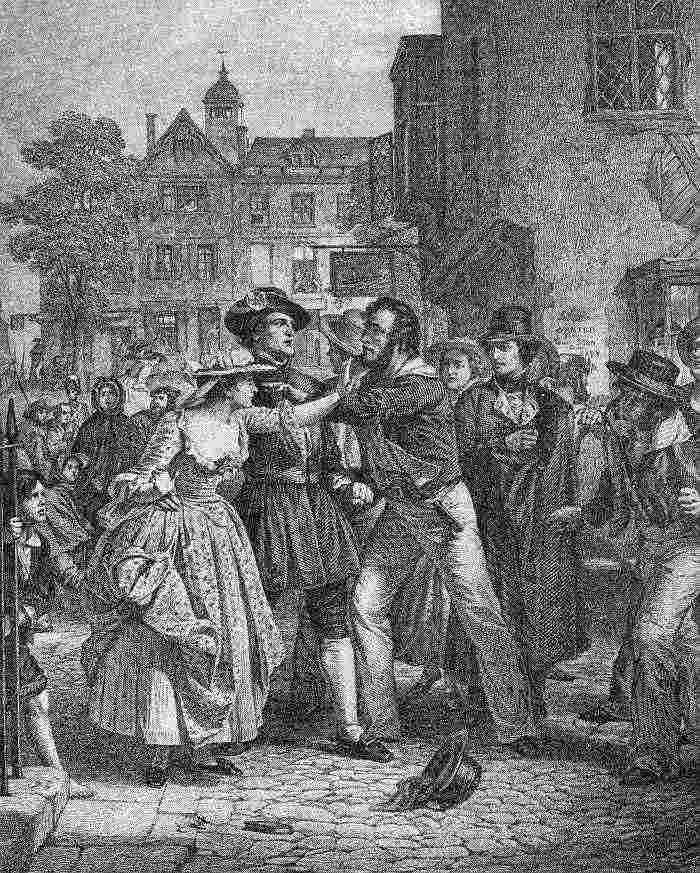
THE PRESS-GANG.
"But as they fetched a walk one day, They met a press-gang crew; And Sally she did faint away, Whilst Ben he was brought to." —THOMAS HOOD.
From an engraving after painting by Alexander Johnston.
FAITHLESS SALLY BROWN. Young Ben he was a nice young man, A carpenter by trade; And he fell in love with Sally Brown, That was a lady's maid. But as they fetched a walk one day, They met a press-gang crew; And Sally she did faint away, Whilst Ben he was brought to. The boatswain swore with wicked words Enough to shock a saint, That, though she did seem in a fit, 'T was nothing but a feint. "Come, girl," said he, "hold up your head, He'll be as good as me; For when your swain is in our boat A boatswain he will be." So when they'd made their game of her, And taken off her elf, She roused, and found she only was A coming to herself. "And is he gone, and is he gone?" She cried and wept outright; "Then I will to the water-side, And see him out of sight." A waterman came up to her; "Now, young woman," said he, "If you weep on so, you will make Eye-water in the sea." "Alas! they've taken my beau, Ben, To sail with old Benbow;" And her woe began to run afresh, As if she'd said, Gee woe! Says he, "They've only taken him To the tender-ship, you see." "The tender-ship," cried Sally Brown,— "What a hard-ship that must be!" "O, would I were a mermaid now, For then I'd follow him! But O, I'm not a fish-woman, And so I cannot swim. "Alas! I was not born beneath The Virgin and the Scales, So I must curse my cruel stars, And walk about in Wales." Now Ben had sailed to many a place That's underneath the world; But in two years the ship came home, And all her sails were furled. But when he called on Sally Brown, To see how she got on, He found she'd got another Ben, Whose Christian-name was John. "O Sally Brown! O Sally Brown! How could you serve me so? I've met with many a breeze before, But never such a blow!" Then, reading on his 'bacco box, He heaved a heavy sigh, And then began to eye his pipe, And then to pipe his eye. And then he tried to sing, "All's Well!" But could not, though he tried; His head was turned,—and so he chewed His pigtail till he died. His death, which happened in his berth, At forty-odd befell; They went and told the sexton, and The sexton tolled the bell. THOMAS HOOD..
ORATOR PUFF. Mr. Orator Puff had two tones in his voice, The one squeaking thus, and the other down so; In each sentence he uttered he gave you your choice, For one half was B alt, and the rest G below. O! O! Orator Puff, One voice for an orator's surely enough. But he still talked away, spite of coughs and of frowns, So distracting all ears with his ups and his downs, That a wag once, on hearing the orator say, "My voice is for war!" asked, "Which of them, pray?" O! O! Orator Puff, etc. Reeling homeward one evening, top-heavy with gin, And rehearsing his speech on the weight of the crown, He tripped near a saw-pit, and tumbled right in, "Sinking fund" the last words as his noddle came down. O! O! Orator Puff, etc. "Good Lord!" he exclaimed, in his he-and-she tones, "Help me out! Help me out! I have broken my bones!" "Help you out?" said a Paddy who passed, "what a bother! Why, there's two of you there—can't you help one another?" O! O! Orator Puff, One voice for an orator's surely enough. THOMAS MOORE.
THE GOUTY MERCHANT AND THE STRANGER. In Broad Street building (on a winter night), Snug by his parlor-fire, a gouty wight Sat all alone, with one hand rubbing His feet rolled up in fleecy hose: With t' other he'd beneath his nose The Public Ledger, in whose columns grubbing, He noted all the sales of hops, Ships, shops, and slops; Gum, galls, and groceries; ginger, gin, Tar, tallow, turmeric, turpentine, and tin; When lo! a decent personage in black Entered and most politely said,— "Your footman, sir, has gone his nightly track To the King's Head, And left your door ajar; which I Observed in passing by, And thought it neighborly to give you notice." "Ten thousand thanks; how very few get, In time of danger, Such kind attention from a stranger! Assuredly, that fellow's throat is Doomed to a final drop at Newgate: He knows, too, (the unconscionable elf!) That there's no soul at home except myself." "Indeed," replied the stranger (looking grave), "Then he's a double knave; He knows that rogues and thieves by scores Nightly beset unguarded doors: And see, how easily might one Of these domestic foes, Even beneath your very nose, Perform his knavish tricks; Enter your room, as I have done, Blow out your candles—thus—and thus— Pocket your silver candlesticks, And—walk off—thus"— So said, so done; he made no more remark Nor waited for replies, But marched off with his prize, Leaving the gouty merchant in the dark. HORACE SMITH.
THE DIVERTING HISTORY OF JOHN GILPIN. SHOWING HOW HE WENT FARTHER THAN HE INTENDED, AND CAME SAFE HOME AGAIN. John Gilpin was a citizen Of credit and renown, A trainband captain eke was he Of famous London town. John Gilpin's spouse said to her dear— "Though wedded we have been These twice ten tedious years, yet we No holiday have seen. "To morrow is our wedding-day, And we will then repair Unto the Bell at Edmonton All in a chaise and pair. "My sister and my sister's child, Myself and children three, Will fill the chaise; so you must ride On horseback after we." He soon replied, "I do admire Of womankind but one, And you are she, my dearest dear: Therefore it shall be done. "I am a linendraper bold, As all the world doth know, And my good friend the calender Will lend his horse to go." Quoth Mrs. Gilpin, "That's well said; And for that wine is dear, We will be furnished with our own, Which is both bright and clear." John Gilpin kissed his loving wife; O'erjoyed was he to find, That, though on pleasure she was bent, She had a frugal mind. The morning came, the chaise was brought, But yet was not allowed To drive up to the door, lest all Should say that she was proud. So three doors off the chaise was stayed, Where they did all get in; Six precious souls, and all agog To dash through thick and thin. Smack went the whip, round went the wheels. Were never folks so glad; The stones did rattle underneath, As if Cheapside were mad. John Gilpin at his horse's side Seized fast the flowing mane, And up he got in haste to ride. But soon came down again; For saddle-tree scarce reached had he, His journey to begin, When, turning round his head, he saw Three customers come in. So down he came; for loss of time, Although it grieved him sore, Yet loss of pence, full well he knew, Would trouble him much more. 'T was long before the customers Were suited to their mind, When Betty screaming came down stairs, "The wine is left behind!" "Good lack!" quoth he, "yet bring it me, My leathern belt likewise, In which I bear my trusty sword When I do exercise." Now Mistress Gilpin (careful soul!) Had two stone bottles found, To hold the liquor that she loved, And keep it safe and sound. Each bottle had a curling ear, Through which the belt he drew, And hung a bottle on each side, To make his balance true. Then over all, that he might be Equipped from top to toe, His long red cloak, well brushed and neat, He manfully did throw. Now see him mounted once again Upon his nimble steed, Full slowly pacing o'er the stones, With caution and good heed. But finding soon a smoother road Beneath his well-shod feet, The snorting beast began to trot, Which galled him in his seat. "So, fair and softly," John he cried, But John he cried in vain; That trot became a gallop soon, In spite of curb and rein. So stooping down, as needs he must Who cannot sit upright, He grasped the mane with both his hands, And eke with all his might. His horse, who never in that sort Had handled been before. What thing upon his back had got Did wonder more and more. Away went Gilpin, neck or naught; Away went hat and wig; He little dreamt, when he set out, Of running such a rig. The wind did blow, the cloak did fly, Like streamer long and gay, Till, loop and button failing both, At last it flew away. Then might all people well discern The bottles he had slung; A bottle swinging at each side, As hath been said or sung. The dogs did bark, the children screamed, Up flew the windows all; And every soul cried out, "Well done!" As loud as he could bawl. Away went Gilpin,—who but he? His fame soon spread around, "He carries weight! he rides a race! 'T is for a thousand pound!" And still as fast as he drew near, 'T was wonderful to view, How in a trice the turnpike men Their gates wide open threw. And now, as he went bowing down His reeking head full low, The bottles twain behind his back Were shattered at a blow. Down ran the wine into the road, Most piteous to be seen, Which made his horse's flanks to smoke As they had basted been. But still he seemed to carry weight, With leathern girdle braced; For all might see the bottle necks Still dangling at his waist. Thus all through merry Islington These gambols did he play, Until he came unto the Wash Of Edmonton so gay; And there he threw the wash about On both sides of the way, Just like unto a trundling mop, Or a wild goose at play. At Edmonton his loving wife From the balcony spied Her tender husband, wondering much To see how he did ride. "Stop, stop, John Gilpin!—Here's the house," They all at once did cry; "The dinner waits, and we are tired." Said Gilpin, "So am I!" But yet his horse was not a whit Inclined to tarry there; For why?—his owner had a house Pull ten miles off, at Ware. So like an arrow swift he flew, Shot by an archer strong; So did he fly—which brings me to The middle of my song. Away went Gilpin out of breath, And sore against his will. Till at his friend the calender's His horse at last stood still. The calender, amazed to see His neighbor in such trim, Laid down his pipe, flew to the gate, And thus accosted him: "What news? what news? your tidings tell; Tell me you must and shall,— Say why bareheaded you are come, Or why you come at all?" Now Gilpin had a pleasant wit, And loved a timely joke; And thus unto the calender In merry guise he spoke: "I came because your horse would come; And, if I well forebode, My hat and wig will soon be here, They are upon the road." The calender, right glad to find His friend in merry pin, Returned him not a single word, But to the house went in; Whence straight he came with hat and wig; A wig that flowed behind, A hat not much the worse for wear, Each comely in its kind. He held them up, and in his turn Thus showed his ready wit, "My head is twice as big as yours, They therefore needs must fit. "But let me scrape the dirt away That hangs upon your face; And stop and eat, for well you may Be in a hungry case." Said John, "It is my wedding-day, And all the world would stare, If wife should dine at Edmonton, And I should dine at Ware." So turning to his horse, he said, "I am in haste to dine; 'T was for your pleasure you came here, You shall go back for mine." Ah, luckless speech, and bootless boast! For which he paid full dear; For, while he spake, a braying ass Did sing most loud and clear; Whereat his horse did snort, as he Had heard a lion roar, And galloped off with all his might, As he had done before. Away went Gilpin, and away Went Gilpin's hat and wig: He lost them sooner than at first, For why?—they were too big. Now Mistress Gilpin, when she saw Her husband posting down Into the country far away, She pulled out half a crown; And thus unto the youth she said, That drove them to the Bell, "This shall be yours when you bring back My husband safe and well." The youth did ride, and soon did meet John coming back amain; Whom in a trice he tried to stop By catching at his rein; But not performing what he meant, And gladly would have done, The frightened steed he frightened more, And made him faster run. Away went Gilpin, and away Went postboy at his heels, The postboy's horse right glad to miss The lumbering of the wheels. Six gentlemen upon the road, Thus seeing Gilpin fly, With postboy scampering in the rear, They raised the hue and cry:— "Stop thief! stop thief!—a highwayman!" Not one of them was mute; And all and each that passed that way Did join in the pursuit. And now the turnpike-gates again Flew open in short space; The toll-man thinking, as before, That Gilpin rode a race. And so he did, and won it too, For he got first to town; Nor stopped till where he had got up He did again get down. Now let us sing, "Long live the king, And Gilpin, long live he; And when he next doth ride abroad, May I be there to see!" WILLIAM COWPER.
EPIGRAMS BY S. T. COLERIDGE. COLOGNE. In Köln, a town of monks and bones, And pavements fanged with murderous stones, And rags, and hags, and hideous wenches,— I counted two-and-seventy stenches, All well-defined and several stinks! Ye nymphs that reign o'er sewers and sinks, The river Rhine, it is well known, Doth wash your city of Cologne; But tell me, nymphs! what power divine Shall henceforth wash the river Rhine? ————
Sly Beelzebub took all occasions To try Job's constancy and patience. He took his honor, took his health; He took his children, took his wealth, His servants, oxen, horses, cows— But cunning Satan did not take his spouse. But Heaven, that brings out good from evil, And loves to disappoint the devil, Had predetermined to restore Twofold all he had before; His servants, horses, oxen, cows— Short-sighted devil, not to take his spouse! ————
Hoarse Mævius reads his hobbling verse To all, and at all times, And finds them both divinely smooth, His voice as well as rhymes. Yet folks say Mævius is no ass; But Mævius makes it clear That he's a monster of an ass,— An ass without an ear! ————
Swans sing before they die,—'t were no bad thing Did certain persons die before they sing. ————
THE RAZOR-SELLER. A fellow in a market-town, Most musical, cried razors up and down, And offered twelve for eighteen pence; Which certainly seemed wondrous cheap, And, for the money, quite a heap, As every man would buy, with cash and sense. A country bumpkin the great offer heard,— Poor Hodge, who suffered by a broad black beard, That seemed a shoe-brush stuck beneath his nose: With cheerfulness the eighteen pence he paid, And proudly to himself in whispers said, "This rascal stole the razors, I suppose. "No matter if the fellow be a knave. Provided that the razors shave; It certainly will be a monstrous prize." So home the clown, with his good fortune, went, Smiling in heart and soul content, And quickly soaped himself to ears and eyes. Being well lathered from a dish or tub, Hodge now began with grinning pain to grub, Just like a hedger cutting furze; 'T was a vile razor!—then the rest he tried,— All were impostors. "Ah!" Hodge sighed, "I wish my eighteen pence within my purse." In vain to chase his beard, and bring the graces, He cut, and dug, and winced, and stamped, and swore; Brought blood, and danced, blasphemed, and made wry faces, And cursed each razor's body o'er and o'er: His muzzle formed of opposition stuff, Firm as a Foxite, would not lose its ruff; So kept it,—laughing at the steel and suds. Hodge, in a passion, stretched his angry jaws, Vowing the direst vengeance with clenched claws, On the vile cheat that sold the goods. "Razors! a mean, confounded dog, Not fit to scrape a hog!" Hodge sought the fellow,—found him,—and begun: "P'rhaps, Master Razor-rogue, to you 't is fun, That people flay themselves out of their lives. You rascal; for an hour have I been grubbing, Giving my crying whiskers here a scrubbing, With razors just like oyster-knives. Sirrah! I tell you you're a knave, To cry up razors that can't shave!" "Friend," quoth the razor-man, "I'm not a knave; As for the razors you have bought, Upon my soul, I never thought That they would shave." "Not think they'd shave!" quoth Hodge, with wondering eyes, And voice not much unlike an Indian yell; "What were they made for, then, you dog?" he cries. "Made," quoth the fellow with a smile,—"to sell." DR. JOHN WOLCOTT. (Peter Pindar)
PAPER. A CONVERSATIONAL PLEASANTRY. Some wit of old—such wits of old there were, Whose hints showed meaning, whose allusions care— By one brave stroke to mark all human kind, Called clear, blank paper every infant mind: Where still, as opening sense her dictates wrote, Fair virtue put a seal, or vice a blot. The thought was happy, pertinent, and true; Methinks a genius might the plan pursue. I (can you pardon my presumption?)—I, No wit, no genius, yet for once will try. Various the paper various wants produce,— The wants of fashion, elegance, and use. Men are as various; and, if right I scan, Each sort of paper represents some man. Pray note the fop, half powder and half lace; Nice, as a bandbox were his dwelling-place; He's the gilt-paper, which apart you store, And lock from vulgar hands in the 'scrutoire. Mechanics, servants, farmers, and so forth Are copy-paper of inferior worth; Less prized, more useful, for your desk decreed; Free to all pens, and prompt at every need. The wretch whom avarice bids to pinch and spare, Starve, cheat, and pilfer, to enrich an heir, Is coarse brown paper, such as pedlers choose To wrap up wares, which better men will use. Take next the miser's contrast, who destroys Health, fame, and fortune in a round of joys; Will any paper match him? Yes, throughout; He's a true sinking-paper, past all doubt. The retail politician's anxious thought Deems this side always right, and that stark naught; He foams with censure; with applause he raves; A dupe to rumors and a tool of knaves; He'll want no type, his weakness to proclaim, While such a thing as foolscap has a name. The hasty gentleman, whose blood runs high, Who picks a quarrel, if you step awry, Who can't a jest, a hint, or look endure,— What is he?—what? Touch-paper, to be sure. What are our poets, take them as they fall, Good, bad, rich, poor, much read, not read at all? They and their works in the same class you'll find; They are the mere waste-paper of mankind. Observe the maiden, innocently sweet! She's fair, white paper, an unsullied sheet; On which the happy man whom fate ordains May write his name, and take her for his pains. One instance more, and only one I'll bring; 'T is the great man who scorns a little thing; Whose thoughts, whose deeds, whose maxims, are his own, Formed on the feelings of his heart alone, True, genuine, royal paper is his breast; Of all the kinds most precious, purest, best. BENJAMIN FRANKLIN.