POEMS OF TRAGEDY. (continued 2)
Reading edition
GINEVRA. If thou shouldst ever come by choice or chance To Modena, where still religiously Among her ancient trophies is preserved Bologna's bucket (in its chain it hangs Within that reverend tower, the Guirlandina), Stop at a palace near the Reggio gate, Dwelt in of old by one of the Orsini. Its noble gardens, terrace above terrace, And rich in fountains, statues, cypresses, Will long detain thee; through their archèd walks, Dim at noonday, discovering many a glimpse Of knights and dames, such as in old romance, And lovers, such as in heroic song, Perhaps the two, for groves were their delight, That in the springtime, as alone they sat, Venturing together on a tale of love, Read only part that day.—A summer sun Sets ere one half is seen; but ere thou go, Enter the house—prythee, forget it not— And look awhile upon a picture there. 'T is of a Lady in her earliest youth, The last of that illustrious race; Done by Zampieri—but I care not whom. He who observes it, ere he passes on, Gazes his fill, and comes and comes again, That he may call it up when far away. She sits inclining forward as to speak, Her lips half open, and her finger up, As though she said "Beware!" her vest of gold Broidered with flowers, and clasped from head to foot, An emerald stone in every golden clasp; And on her brow, fairer than alabaster, A coronet of pearls. But then her face, So lovely, yet so arch, so full of mirth, The overflowings of an innocent heart,— It haunts me still, though many a year has fled, Like some wild melody! Alone it hangs Over a moldering heirloom, its companion, An oaken chest, half eaten by the worm, But richly carved by Antony of Trent With Scripture stories from the life of Christ; A chest that came from Venice, and had held The ducal robes of some old Ancestor, That, by the way—it may be true or false— But don't forget the picture; and thou wilt not When thou hast heard the tale they told me there. She was an only child; from infancy The joy, the pride, of an indulgent Sire; Her Mother dying of the gift she gave, That precious gift, what else remained to him? The young Ginevra was his all in life, Still as she grew, for ever in his sight; And in her fifteenth year became a bride, Marrying an only son, Francesco Doria, Her playmate from her birth, and her first love. Just as she looks there in her bridal dress, She was all gentleness, all gayety, Her pranks the favorite theme of every tongue. But now the day was come, the day, the hour; Now, frowning, smiling, for the hundredth time, The nurse, that ancient lady, preached decorum; And, in the lustre of her youth, she gave Her hand, with her heart in it, to Francesco. Great was the joy; but at the Bridal-feast, When all sate down, the bride was wanting there, Nor was she to be found! Her Father cried, "'T is but to make a trial of our love!" And filled his glass to all; but his hand shook, And soon from guest to guest the panic spread. 'T was but that instant she had left Francesco, Laughing and looking back, and flying still, Her ivory tooth imprinted on his finger. But now, alas, she was not to be found; Nor from that hour could anything be guessed, But that she was not! Weary of his life, Francesco flew to Venice, and, forthwith, Flung it away in battle with the Turk. Orsini lived,—and long mightst thou have seen An old man wandering as in quest of something, Something he could not find, he knew not what. When he was gone, the house remained awhile Silent and tenantless,—then went to strangers. Full fifty years were past, and all forgot, When, on an idle day, a day of search Mid the old lumber in the Gallery, That moldering chest was noticed; and 't was said By one as young, as thoughtless as Ginevra, "Why not remove it from its lurking-place?" 'T was done as soon as said; but on the way It burst, it fell; and lo, a skeleton, With here and there a pearl, an emerald stone, A golden clasp, clasping a shred of gold! All else had perished,—save a nuptial-ring, And a small seal, her mother's legacy, Engraven with a name, the name of both, "Ginevra." There then had she found a grave! Within that chest had she concealed herself, Fluttering with joy, the happiest of the happy; When a spring-lock, that lay in ambush there, Fastened her down for ever! SAMUEL ROGERS.
BERNARDO DEL CARPIO. The warrior bowed his crested head, and tamed his heart of fire, And sued the haughty king to free his long-imprisoned sire; "I bring thee here my fortress keys, I bring my captive train, I pledge thee faith, my liege, my lord!—oh, break my father's chain!" "Rise, rise! even now thy father comes, a ransomed man this day; Mount thy good horse, and thou and I will meet him on his way." Then lightly rose that loyal son, and bounded on his steed, And urged, as if with lance in rest, the charger's foamy speed. And lo! from far, as on they pressed, there came a glittering band, With one that 'midst them stately rode, as a leader in the land; "Now haste, Bernardo, haste! for there, in very truth, is he, The father whom thy faithful heart hath yearned so long to see." His dark eye flashed, his proud breast heaved, his cheek's blood came and went; He reached that gray-haired chieftain's side, and there, dismounting, bent; A lowly knee to earth he bent, his father's hand he took,— What was there in its touch that all his fiery spirit shook? That hand was cold,—a frozen thing,—it dropped from his like lead,— He looked up to the face above,—the face was of the dead! A plume waved o'er the noble brow,—the brow was fixed and white;— He met at last his father's eyes,—but in them was no sight! Up from the ground he sprung, and gazed, but who could paint that gaze? They hushed their very hearts, that saw its horror and amaze; They might have chained him, as before that stony form he stood, For the power was stricken from his arm, and from his lip the blood. "Father!" at length he murmured low, and wept like childhood then: Talk not of grief till thou hast seen the tears of warlike men! He thought on all his glorious hopes, and all his young renown; He flung the falchion from his side, and in the dust sate down. Then covering with his steel-gloved hands his darkly mournful brow,— "No more, there is no more," he said, "to lift the sword for now; My king is false, my hope betrayed; my father—oh! the worth, The glory, and the loveliness, are passed away from earth! "I thought to stand where banners waved, my sire! beside thee yet, I would that there our kindred blood on Spain's free soil had met! Thou wouldst have known my spirit then; for thee my fields were won; And thou hast perished in thy chains, as though thou hadst no son!" Then, starting from the ground once more, he seized the monarch's rein, Amidst the pale and wildered looks of all the courtier train; And with a fierce o'ermastering grasp, the raging war-horse led, And sternly set them face to face,—the king before the dead! "Came I not forth upon thy pledge, my father's hand to kiss? Be still, and gaze thou on, false king, and tell me what is this? The voice, the glance, the heart I sought—give answer, where are they? If thou wouldst clear thy perjured soul, send life through this cold clay! "Into these glassy eyes put light;—be still! keep down thine ire! Bid these white lips a blessing speak,—this earth is not my sire! Give me back him for whom I strove, for whom my blood was shed, Thou canst not?—and a king!—his dust be mountains on thy head!" He loosed the steed; his slack hand fell; upon the silent face He cast one long, deep, troubled look,—then turned from that sad place. His hope was crushed, his after-fate untold in martial strain: His banner led the spears no more amidst the hills of Spain. FELICIA HEMANS.
THE PRISONER OF CHILLON. Eternal spirit of the chainless mind! Brightest in dungeons, Liberty! thou art, For there thy habitation is the heart,— The heart which love of thee alone can bind; And when thy sons to fetters are consigned,— To fetters, and the damp vault's dayless gloom,— Their country conquers with their martyrdom, And Freedom's fame finds wings on every wind. Chillon! thy prison is a holy place, And thy sad floor an altar,—for 't was trod, Until his very steps have left a trace Worn, as if thy cold pavement were a sod, By Bonnivard!—May none those marks efface! For they appeal from tyranny to God. ————
My hair is gray, but not with years, Nor grew it white In a single night, As men's have grown from sudden fears: My limbs are bowed, though not with toil, But rusted with a vile repose, For they have been a dungeon spoil, And mine has been the fate of those To whom the goodly earth and air Are banned, and barred,—forbidden fare; But this was for my father's faith I suffered chains and courted death; That father perished at the stake For tenets he would not forsake; And for the same his lineal race In darkness found a dwelling-place; We were seven,—who now are one, Six in youth, and one in age, Finished as they had begun, Proud of Persecution's rage; One in fire, and two in field, Their belief with blood have sealed! Dying as their father died, For the God their foes denied; Three were in a dungeon cast, Of whom this wreck is left the last. There are seven pillars of Gothic mould In Chillon's dungeons deep and old, There are seven columns, massy and gray, Dim with a dull imprisoned ray,— A sunbeam which hath lost its way, And through the crevice and the cleft Of the thick wall is fallen and left, Creeping o'er the floor so damp, Like a marsh's meteor lamp,— And in each pillar there is a ring, And in each ring there is a chain; That iron is a cankering thing; For in these limbs its teeth remain With marks that will not wear away, Till I have done with this new day, Which now is painful to these eyes, Which have not seen the sun to rise For years,—I cannot count them o'er, I lost their long and heavy score When my last brother drooped and died, And I lay living by his side. They chained us each to a column stone, And we were three, yet each alone; We could not move a single pace, We could not see each other's face, But with that pale and livid light That made us strangers in our sight; And thus together, yet apart, Fettered in hand, but pined in heart; 'T was still some solace, in the dearth Of the pure elements of earth, To hearken to each other's speech, And each turn comforter to each With some new hope, or legend old, Or song heroically bold; But even these at length grew cold. Our voices took a dreary tone, An echo of the dungeon-stone, A grating sound,-not full and free As they of yore were wont to be; It might be fancy,—but to me They never sounded like our own. I was the eldest of the three, And to uphold and cheer the rest I ought to do—and did—my best, And each did well in his degree. The youngest, whom my father loved, Because our mother's brow was given To him, with eyes as blue as heaven,— For him my soul was sorely moved; And truly might it be distrest To see such bird in such a nest; For he was beautiful as day (When day was beautiful to me As to young eagles, being free),— A polar day, which will not see A sunset till its summer's gone, Its sleepless summer of long light, The snow-clad offspring of the sun; And thus he was as pure and bright, And in his natural spirit gay, With tears for naught but others' ills, And then they flowed like mountain rills, Unless he could assuage the woe Which he abhorred to view below. The other was as pure of mind, But formed to combat with his kind; Strong in his frame, and of a mood Which 'gainst the world in war had stood, And perished in the foremost rank With joy;—but not in chains to pine; His spirit withered with their clank, I saw it silently decline,— And so perchance in sooth did mine; But yet I forced it on to cheer Those relics of a home so dear. He was a hunter of the hills, Had followed there the deer and wolf; To him this dungeon was a gulf And fettered feet the worst of ills. Lake Leman lies by Chillon's walls: A thousand feet in depth below Its massy waters meet and flow; Thus much the fathom-line was sent From Chillon's snow-white battlement, Which round about the wave inthralls; And double dungeon wall and wave Have made,—and like a living grave. Below the surface of the lake The dark vault lies wherein we lay, We heard it ripple night and day; Sounding o'er our heads it knocked; And I have felt the winter's spray Wash through the bars when winds were high And wanton in the happy sky; And then the very rock hath rocked, And I have felt it shake, unshocked, Because I could have smiled to see The death that would have set me free. I said my nearer brother pined, I said his mighty heart declined, He loathed and put away his food; It was not that 't was coarse and rude, For we were used to hunter's fare, And for the like had little care; The milk drawn from the mountain goat Was changed for water from the moat. Our bread was such as captives' tears Have moistened many a thousand years, Since man first pent his fellow-men Like brutes within an iron den; But what were these to us or him? These wasted not his heart or limb; My brother's soul was of that mould Which in a palace had grown cold, Had his free breathing been denied The range of the steep mountain's side; But why delay the truth?—he died. I saw, and could not hold his head, Nor reach his dying hand—nor dead— Though hard I strove, but strove in vain, To rend and gnash my bonds in twain. He died,—and they unlocked his chain, And scooped for him a shallow grave Even from the cold earth of our cave. I begged them, as a boon, to lay His corse in dust whereon the day Might shine,—it was a foolish thought, But then within my brain it wrought, That even in death his free-born breast In such a dungeon could not rest. I might have spared my idle prayer,— They coldly laughed, and laid him there. The flat and turfless earth above The being we so much did love; His empty chain above it leant, Such murder's fitting monument! But he, the favorite and the flower, Most cherished since his natal hour, His mother's image in fair face, The infant love of all his race, His martyred father's dearest thought, My latest care, for whom I sought To hoard my life, that his might be Less wretched now, and one day free; He, too, who yet had held untired A spirit natural or inspired,— He, too, was struck, and day by day Was withered on the stalk away. O God! it is a fearful thing To see the human soul take wing In any shape, in any mood:— I've seen it rushing forth in blood, I've seen it on the breaking ocean Strive with a swoln convulsive motion, I've seen the sick and ghastly bed Of Sin delirious with its dread: But these were horrors,—this was woe Unmixed with such,—but sure and slow: He faded, and so calm and meek, So softly worn, so sweetly weak, So tearless, yet so tender—kind, And grieved for those he left behind; With all the while a cheek whose bloom Was as a mockery of the tomb, Whose tints as gently sunk away As a departing rainbow's ray,— An eye of most transparent light, That almost made the dungeon bright, And not a word of murmur,—not A groan o'er his untimely lot,— A little talk of better days, A little hope my own to raise, For I was sunk in silence,—lost In this last loss, of all the most; And then the sighs he would suppress Of fainting nature's feebleness, More slowly drawn, grew less and less: I listened, but I could not hear,— I called, for I was wild with fear; I knew 't was hopeless, but my dread Would not be thus admonishèd; I called, and thought I heard a sound,— I burst my chain with one strong bound, And rushed to him:—I found him not, I only stirred in this black spot, I only lived,—I only drew The accursed breath of dungeon-dew; The last—the sole—the dearest link Between me and the eternal brink, Which bound me to my failing race, Was broken in this fatal place. One on the earth, and one beneath— My brothers—both had ceased to breathe. I took that hand which lay so still, Alas! my own was full as chill; I had not strength to stir or strive, But felt that I was still alive,— A frantic feeling when we know That what we love shall ne'er be so. I know not why I could not die, I had no earthly hope—but faith, And that forbade a selfish death. What next befell me then and there I know not well—I never knew. First came the loss of light and air, And then of darkness too; I had no thought, no feeling—none: Among the stones I stood a stone, And was, scarce conscious what I wist, As shrubless crags within the mist; For all was blank and bleak and gray; It was not night,—it was not day; It was not even the dungeon-light, So hateful to my heavy sight; But vacancy absorbing space, And fixedness, without a place: There were no stars—no earth—no time— No check—no change—no good—no crime: But silence, and a stirless breath Which neither was of life nor death:— A sea of stagnant idleness, Blind, boundless, mute, and motionless! A light broke in upon my brain,— It was the carol of a bird; It ceased, and then it came again,— The sweetest song ear ever heard, And mine was thankful till my eyes Ran over with the glad surprise, And they that moment could not see I was the mate of misery; But then by dull degrees came back My senses to their wonted track, I saw the dungeon walls and floor Close slowly round me as before, I saw the glimmer of the sun Creeping as it before had done, But through the crevice where it came That bird was perched, as fond and tame, And tamer than upon the tree; A lovely bird, with azure wings, And song that said a thousand things, And seemed to say them all for me! I never saw its like before, I ne'er shall see its likeness more. It seemed, like me, to want a mate, But was not half so desolate, And it was come to love me when None lived to love me so again, And cheering from my dungeon's brink, Had brought me back to feel and think. I know not if it late were free, Or broke its cage to perch on mine, But knowing well captivity, Sweet bird! I could not wish for thine! Or if it were, in wingèd guise, A visitant from Paradise: For—Heaven forgive that thought! the while Which made me both to weep and smile— I sometimes deemed that it might be My brother's soul come down to me; But then at last away it flew, And then 't was mortal,—well I knew, For he would never thus have flown, And left me twice so doubly lone,— Lone—as the corse within its shroud, Lone—as a solitary cloud, A single cloud on a sunny day, While all the rest of heaven is clear, A frown upon the atmosphere That hath no business to appear When skies are blue and earth is gay. A kind of change came in my fate, My keepers grew compassionate; I know not what had made them so, They were inured to sights of woe, But so it was:—my broken chain With links unfastened did remain, And it was liberty to stride Along my cell from side to side, And up and down, and then athwart, And tread it over every part; And round the pillars one by one, Returning where my walk begun, Avoiding only, as I trod, My brothers' graves without a sod; For if I thought with heedless tread My step profaned their lowly bed, My breath came gaspingly and thick, And my crushed heart fell blind and sick. I made a footing in the wall, It was not therefrom to escape, For I had buried one and all Who loved me in a human shape: And the whole earth would henceforth be A wider prison unto me: No child,—no sire,—no kin had I, No partner in my misery; I thought of this and I was glad, For thought of them had made me mad; But I was curious to ascend To my barred windows, and to bend Once more, upon the mountains high, The quiet of a loving eye. I saw them,—and they were the same, They were not changed like me in frame; I saw their thousand years of snow On high,—their wide long lake below, And the blue Rhone in fullest flow; I heard the torrents leap and gush O'er channelled rock and broken bush; I saw the white-walled distant town, And whiter sails go skimming down; And then there was a little isle, Which in my very face did smile, The only one in view; A small green isle, it seemed no more, Scarce broader than my dungeon floor, But in it there were three tall trees, And o'er it blew the mountain breeze, And by it there were waters flowing, And on it there were young flowers growing, Of gentle breath and hue. The fish swam by the castle wall, And they seemed joyous each and all; The eagle rode the rising blast,— Methought he never flew so fast As then to me he seemed to fly, And then new tears came in my eye, And I felt troubled,—and would fain I had not left my recent chain; And when I did descend again, The darkness of my dim abode Fell on me as a heavy load; It was as in a new-dug grave Closing o'er one we sought to save, And yet my glance, too much oppressed, Had almost need of such a rest. It might be months, or years, or days, I kept no count,—I took no note, I had no hope my eyes to raise, And clear them of their dreary mote; At last men came to set me free, I asked not why and recked not where, It was at length the same to me, Fettered or fetterless to be, I learned to love despair. And thus when they appeared at last, And all my bonds aside were cast, These heavy walls to me had grown A hermitage, and all my own! And half I felt as they were come To tear me from a second home; With spiders I had friendship made, And watched them in their sullen trade, Had seen the mice by moonlight play, And why should I feel less than they? We were all inmates of one place, And I, the monarch of each race, Had power to kill,—yet, strange to tell; In quiet we had learned to dwell,— My very chains and I grew friends, So much a long communion tends To make us what we are:—even I Regained my freedom with a sigh. LORD BYRON.
BEFORE SEDAN. "The dead hand clasped a letter." —Special Correspondent. Here in this leafy place, Quiet he lies, Cold, with his sightless face Turned to the skies; 'T is but another dead;— All you can say is said. Carry his body hence,— Kings must have slaves; Kings climb to eminence Over men's graves. So this man's eye is dim;— Throw the earth over him. What was the white you touched, There at his side? Paper his hand had clutched Tight ere he died; Message or wish, may be:— Smooth out the folds and see. Hardly the worst of us Here could have smiled!— Only the tremulous Words of a child:— Prattle, that had for stops Just a few ruddy drops. Look. She is sad to miss, Morning and night, His—her dead father's—kiss, Tries to be bright, Good to mamma, and sweet. That is all. "Marguerite." Ah, if beside the dead Slumbered the pain! Ah, if the hearts that bled Slept with the slain! If the grief died!—But no:— Death will not have it so. AUSTIN DOBSON.
IVÀN IVÀNOVITCH. Early one winter morn, in such a village as this, Snow-whitened everywhere except the middle road Ice-roughed by track of sledge, there worked by his abode Ivàn Ivànovitch, the carpenter, employed On a huge shipmast trunk; his axe now trimmed and toyed With branch and twig, and now some chop athwart the bole
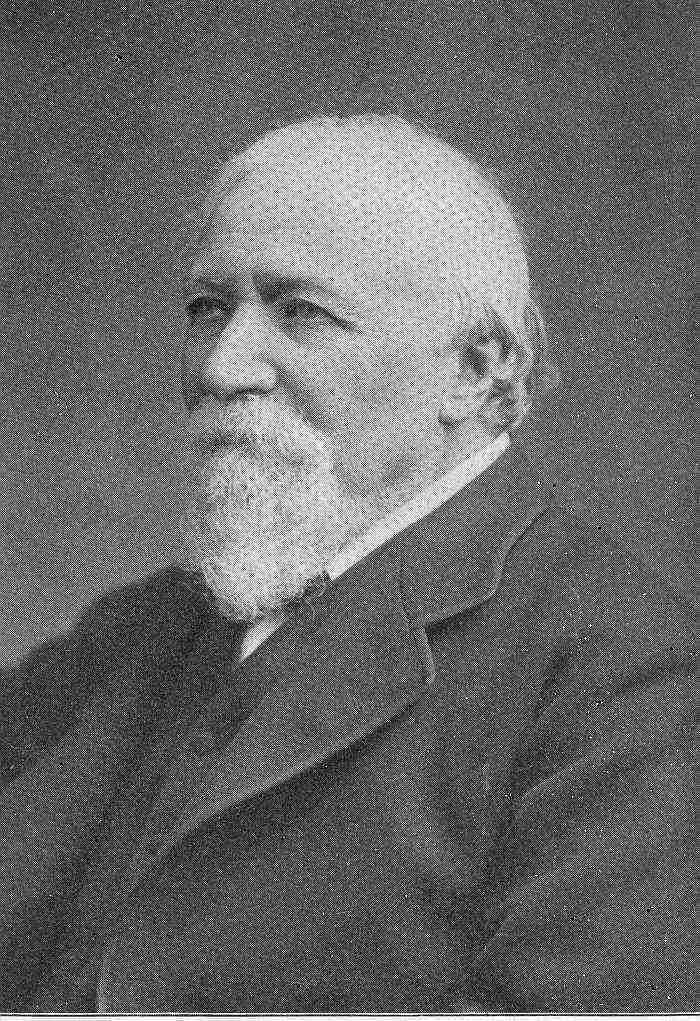
ROBERT BROWNING.
After a life-photograph by Elliott & Fry, London
Changed bole to billets, bared at once the sap and soul. About him, watched the work his neighbors sheep-skin-clad; Each bearded mouth puffed steam, each gray eye twinkled glad To see the sturdy arm which, never stopping play, Proved strong man's blood still boils, freeze winter as he may. Sudden, a burst of bells. Out of the road, on edge Of the hamlet—horse's hoofs galloping. "How, a sledge? What 's here?" cried all as—in, up to the open space, Workyard and market-ground, folk's common meeting-place,— Stumbled on, till he fell, in one last bound for life, A horse; and, at his heels, a sledge held—"Dmìtri's wife! Back without Dmìtri too! and children—where are they? Only a frozen corpse!" They drew it forth: then—"Nay, Not dead, though like to die! Gone hence a month ago: Home again, this rough jaunt—alone through night and snow— What can the cause be? Hark—Droug, old horse, how he groans: His day 's done! Chafe away, keep chafing, for she moans: She's coming to! Give here: see, motherkin, your friends! Cheer up, all safe at home! Warm inside makes amends For outside cold,—sup quick! Don't look as we were bears! What is it startles you? What strange adventure stares Up at us in your face? You know friends—which is which? I'm Vàssili, he's Sergeì, Ivàn Ivànovitch"— At the word, the woman's eyes, slow-wandering till they neared The blue eyes o'er the bush of honey-colored beard, Took in full light and sense and—torn to rags, some dream Which hid the naked truth—O loud and long the scream She gave, as if all power of voice within her throat Poured itself wild away to waste in one dread note! Then followed gasps and sobs, and then the steady flow Of kindly tears: the brain was saved, a man might know. Down fell her face upon the good friend's propping knee; His broad hands smoothed her head, as fain to brush it free From fancies, swarms that stung like bees unhived. He soothed— "Loukèria, Loùscha!"—still he, fondling, smoothed and smoothed. At last her lips formed speech. "Ivàn, dear—you indeed? You, just the same dear you! While I ... Oh, intercede, Sweet Mother, with thy Son Almighty—let his might Bring yesterday once more, undo all done last night! But this time yesterday, Ivàn, I sat like you, A child on either knee, and, dearer than the two, A babe inside my arms, close to my heart—that 's lost In morsels o'er the snow! Father, Son, Holy Ghost, Cannot you bring again my blessèd yesterday?" When no more tears would flow, she told her tale: this way. "Maybe, a month ago,—was it not?—news came here, They wanted, deeper down, good workmen fit to rear A church and roof it in. 'We'll go,' my husband said: 'None understands like me to melt and mould their lead.' So, friends here helped us off—Ivàn, dear, you the first! How gay we jingled forth, all five—(my heart will burst)— While Dmìtri shook the reins, urged Droug upon his track! "Well, soon the month ran out, we just were coming back, When yesterday—behold, the village was on fire! Fire ran from house to house. What help, as, nigh and nigher, The flames came furious? 'Haste,' cried Dmìtri, 'men must do The little good man may: to sledge and in with you, You and our three! We check the fire by laying flat Each building in its path,—I needs must stay for that,— But you ... no time for talk! Wrap round you every rug, Cover the couple close,—you'll have the babe to hug. No care to guide old Droug, he knows his way, by guess, Once start him on the road: but chirrup, none the less! The snow lies glib as glass and hard as steel, and soon You'll have rise, fine and full, a marvel of a moon. Hold straight up, all the same, this lighted twist of pitch! Once home and with our friend Ivàn Ivànovitch, All 's safe: I have my pay in pouch, all 's right with me, So I but find as safe you and our precious three! Off, Droug!'—because the flames had reached us, and the men Shouted, 'But lend a hand, Dmìtri—as good as ten!' "So, in we bundled—I and those God gave me once; Old Droug, that 's stiff at first, seemed youthful for the nonce: He understood the case, galloping straight ahead. Out came the moon: my twist soon dwindled, feebly red In that unnatural day—yes, daylight bred between Moonlight and snow-light, lamped those grotto-depths which screen Such devils from God's eye. Ah, pines, how straight you grow, Nor bend one pitying branch, true breed of brutal snow! Some undergrowth had served to keep the devils blind While we escaped outside their border! "Was that—wind? Anyhow, Droug starts, stops, back go his ears, he snuffs, Snorts,—never such a snort! then plunges, knows the sough 's Only the wind: yet, no—our breath goes up too straight! Still the low sound,—less low, loud, louder, at a rate There 's no mistaking more! Shall I lean out—look—learn The truth whatever it be? Pad, pad! At last, I turn— "'T is the regular pad of the wolves in pursuit of the life in the sledge! An army they are: close-packed they press like the thrust of a wedge: They increase as they hunt: for I see, through the pine-trunks ranged each side, Slip forth new fiend and fiend, make wider and still more wide The four-footed steady advance. The foremost—none may pass: They are the elders and lead the line, eye and eye —green-glowing brass! But a long way distant still. Droug, save us! He does his best: Yet they gain on us, gain, till they reach,—one reaches ... How utter the rest? O that Satan-faced first of the band! How he lolls out the length of his tongue, How he laughs and lets gleam his white teeth! He is on me, his paws pry among The wraps and the rugs! O my pair, my twin-pigeons, lie still and seem dead! Stepàn, he shall never have you for a meal,— here's your mother instead! No, he will not be counselled—must cry, poor Stiòpka, so foolish! though first Of my boy-brood, he was not the best: nay, neighbors called him the worst: He was puny, an undersized slip,—a darling to me, all the same! But little there was to be praised in the boy, and a plenty to blame. I loved him with heart and soul, yes—but, deal him a blow for a fault, He would sulk for whole days. 'Foolish boy! lie still or the villain will vault, Will snatch you from over my head!' No use! he cries, he screams,—who can hold Fast a boy in frenzy of fear! It follows—as I foretold! The Satan-face snatched and snapped: I tugged, I tore, and then His brother too needs must shriek! If one must go, 't is men The Tsar needs, so we hear, not ailing boys! Perhaps My hands relaxed their grasp, got tangled in the wraps: God, he was gone! I looked: there tumbled the cursed crew, Each fighting for a share: too busy to pursue! That's so far gain at least: Droug, gallop another verst Or two, or three—God sends we beat them, arrive the first! A mother who boasts two boys was ever accounted rich: Some have not a boy: some have, but lose him,—God knows which Is worse: how pitiful to see your weakling pine And pale and pass away! Strong brats, this pair of mine! "O misery! for while I settle to what near seems Content, I am 'ware again of the tramp, and again there gleams— Point and point—the line, eyes, levelled green brassy fire! So soon is resumed your chase? Will nothing appease, naught tire The furies? And yet I think—I am certain the race is slack, And the numbers are nothing like. Not a quarter of the pack! Feasters and those full-fed are staying behind ... Ah, why? We 'll sorrow for that too soon! Now,—gallop, reach home and die, Nor ever again leave house, to trust our life in the trap For life—we call a sledge! Teriòscha, in my lap! Yes, I 'll lie down upon you, tight-tie you with the strings Here—of my heart! No fear, this time, your mother flings ... Flings? I flung? Never! But think!—a woman, after all, Contending with a wolf! Save you I must and shall, Terentiì! "How now? What, you still head the race, Your eyes and tongue and teeth crave fresh food, Satan-face? Flash again? There and there! Plain I struck green fire out! All a poor fist can do to damage eyes proves vain! My fist—why not crunch that? He is wanton for ... O God, Why give this wolf his taste? Common wolves scrape and prod The earth till out they scratch some corpse—mere putrid flesh! Why must this glutton leave the faded, choose the fresh? Terentiì—God, feel!—his neck keeps fast thy bag Of holy things, saints' bones, this Satan-face will drag Forth, and devour along with him, our Pope declared The relics were to save from danger! "Spurned, not spared! 'T was through my arms, crossed arms, he—nuzzling now with snout, Now ripping, tooth and claw—plucked, pulled Terentiì out, A prize indeed! I saw—how could I else but see?— My precious one—I bit to hold back—pulled from me! Up came the others, fell to dancing—did the imps!— Skipped as they scampered round. There 's one is gray, and limps: Who knows but old bad Màrpha—she always owed me spite And envied me my births—skulks out of doors at night And turns into a wolf, and joins the sisterhood, And laps the youthful life, then slinks from out the wood, Squats down at the door by dawn, spins there demure as erst —No strength, old crone—not she!—to crawl forth half a verst! "Well, I escaped with one: 'twixt one and none there lies The space 'twixt heaven and hell. And see, a rose-light dyes The endmost snow: 't is dawn, 't is day, 't is safe at home! We have outwitted you! Ay, monsters, snarl and foam, Fight each the other fiend, disputing for a share,— Forgetful in your greed, our finest off we bear, Tough Droug and I,—my babe, my boy that shall be man, My man that shall be more, do all a hunter can To trace and follow and find and catch and crucify Wolves, wolfkins, all your crew! A thousand deaths shall die The whimperingest cub that ever squeezed the teat! 'Take that!' we 'll stab you with,—'the tenderness we met When, wretches, you danced round,—not this, thank God—not this! Hellhounds, we balk you!' "But—Ah, God above!—Bliss, bliss,— Not the band, no! And yet—yes, for Droug knows him! One— This only of them all has said 'She saves a son!' His fellows disbelieve such luck: but he believes, He lets them pick the bones, laugh at him in their sleeves: He's off and after us,—one speck, one spot, one ball Grows bigger, bound on bound,—one wolf as good as all! Oh, but I know the trick! Have at the snaky tongue! That 's the right way with wolves! Go, tell your mates I wrung The panting morsel out, left you to howl your worst! Now for it—now! Ah me, I know him—thrice-accurst Satan-face,—him to the end my foe! "All fight's in vain: This time the green brass points pierce to my very brain. I fall—fall as I ought—quite on the babe I guard: I overspread with flesh the whole of him. Too hard To die this way, torn piecemeal? Move hence? Not I—one inch! Gnaw through me, through and through: flat thus I lie nor flinch! O God, the feel of the fang furrowing my shoulder!—see! It grinds—it grates the bone. O Kìrill under me, Could I do more? Besides he knew the wolf's way to win: I clung, closed round like wax: yet in he wedged and in, Past my neck, past my breasts, my heart, until ... how feels The onion-bulb your knife parts, pushing through its peels, Till out you scoop its clove wherein lie stalk and leaf And bloom and seed unborn? "That slew me: yes, in brief, I died then, dead I lay doubtlessly till Droug stopped Here, I suppose. I come to life, I find me propped Thus,—how or when or why—I know not. Tell me, friends, All was a dream: laugh quick and say the nightmare ends! Soon I shall find my house: 't is over there: in proof, Save for that chimney heaped with snow, you'd see the roof Which holds my three—my two—my one—not one? "Life 's mixed With misery, yet we live—must live. The Satan fixed His face on mine so fast, I took its print as pitch Takes what it cools beneath. Ivàn Ivànovitch, 'T is you unharden me, you thaw, disperse the thing! Only keep looking kind, the horror will not cling, Your face smooths fast away each print of Satan. Tears —What good they do! Life's sweet, and all its after-years, Ivàn Ivànovitch, I owe you! Yours am I! May God reward you, dear!" Down she sank. Solemnly Ivàn rose, raised his axe,—for fitly as she knelt, Her head lay: well apart, each side, her arms hung,—dealt Lightning-swift thunder-strong one blow—no need of more! Headless she knelt on still: that pine was sound of core (Neighbors used to say)—cast-iron-kernelled—which Taxed for a second stroke Ivàn Ivànovitch. The man was scant of words as strokes. "It had to be: I could no other: God it was, bade 'Act for me!'" Then stooping, peering round—what is it now he lacks? A proper strip of bark wherewith to wipe his axe, Which done, he turns, goes in, closes the door behind. The others mute remain, watching the blood-snake wind Into a hiding-place among the splinter-heaps. At length, still mute, all move: one lifts—from where it steeps Redder each ruddy rag of pine—the head: two more Take up the dripping body: then, mute still as before, Move in a sort of march, march on till marching ends Opposite to the church; where halting,—who suspends, By its long hair, the thing, deposits in its place The piteous head: once more the body shows no trace Of harm done: there lies whole the Loùscha, maid and wife And mother, loved until this latest of her life. Then all sit on the bank of snow which bounds a space Kept free before the porch of judgment: just the place! Presently all the souls, man, woman, child which make The village up, are found assembling for the sake Of what is to be done. The very Jews are there: A Gypsy-troop, though bound with horses for the Fair, Squats with the rest. Each heart with its conception seethes And simmers, but no tongue speaks: one may say,—none breathes. Anon from out the church totters the Pope—the priest— Hardly alive, so old, a hundred years at least. With him, the Commune's head, a hoary senior too, Stàrosta, that's his style,—like Equity Judge with you,— Natural Jurisconsult: then, fenced about with furs, Pomeschik—Lord of the Land, who wields—and none demurs— A power of life and death. They stoop, survey the corpse. Then, straightened on his staff, the Stàrosta—the thorpe's Sagaciousest old man—hears what you just have heard, From Droug's first inrush, all, up to Ivàn's last word— "God bade me act for him: I dared not disobey!" Silence—the Pomeschik broke with "A wild wrong way Of righting wrong—if wrong there were, such wrath to rouse! Why was not law observed? ————
Ivàn Ivànovitch has done a deed that's named Murder by law and me: who doubts, may speak unblamed!" All turned to the old Pope. "Ay, children, I am old— How old, myself have got to know no longer. Rolled Quite round, my orb of life, from infancy to age, Seems passing back again to youth. A certain stage At least I reach, or dream I reach, where I discern Truer truths, laws behold more lawlike than we learn When first we set our foot to tread the course I trod With man to guide my steps: who leads me now is God. 'Your young men shall see visions:' and in my youth I saw And paid obedience to man's visionary law: 'Your old men shall dream dreams.' And, in my age, a hand Conducts me through the cloud round law to where I stand Firm on its base,—know cause, who, before, knew effect. ————
I hold he saw The unexampled sin, ordained the novel law, Whereof first instrument was first intelligence Found loyal here. I hold that, failing human sense, The very earth had oped, sky fallen, to efface Humanity's new wrong, motherhood's first disgrace. Earth oped not, neither fell the sky, for prompt was found A man and man enough, head-sober and heart-sound Ready to hear God's voice, resolute to obey. Ivàn Ivànovitch, I hold, has done, this day, No otherwise than did, in ages long ago, Moses when he made known the purport of that flow Of fire athwart the law's twain-tables! I proclaim Ivàn Ivànovitch God's servant!" ————
When the Amen grew dull And died away and left acquittal plain adjudged, "Amen!" last sighed the lord. "There's none shall say I grudged Escape from punishment in such a novel case. Deferring to old age and holy life,—be grace Granted! say I. No less, scruples might shake a sense Firmer than I boast mine. Law's law, and evidence Of breach therein lies plain,—blood-red-bright—all may see! Yet all absolve the deed: absolved the deed must be!" ————
So, while the youngers raised the corpse, the elders trooped Silently to the house: where halting, some one stooped, Listened beside the door; all there was silent too. Then they held counsel; then pushed door and, passing through, Stood in the murderer's presence. Ivàn Ivànovitch Knelt, building on the floor that Kremlin rare and rich He deftly cut and carved on lazy winter nights. Some five young faces watched, breathlessly, as, to rights, Piece upon piece, he reared the fabric nigh complete. Stèscha, Ivàn's old mother, sat spinning by the heat Of the oven where his wife Kàtia stood baking bread. Ivàn's self, as he turned his honey-colored head, Was just in the act to drop, 'twixt fir-cones,—each a dome, The scooped-out yellow gourd presumably the home Of Kolokol the Big: the bell, therein to hitch, —An acorn-cup—was ready: Ivàn Ivànovitch Turned with it in his mouth. They told him he was free As air to walk abroad. "How otherwise?" asked he. ROBERT BROWNING.
A DAGGER OF THE MIND FROM "MACBETH," ACT II. SC. 1.
[Macbeth, before the murder of Duncan, meditating alone, sees the image of a dagger in the air, and thus soliloquizes:]
Is this a dagger which I see before me, The handle toward my hand? Come, let me clutch thee:— I have thee not, and yet I see thee still. Art thou not, fatal vision, sensible To feeling as to sight? or art thou but A dagger of the mind, a false creation, Proceeding from the heat-oppressèd brain? I see thee yet, in form as palpable As this which now I draw. Thou marshal'st me the way that I was going; And such an instrument I was to use. Mine eyes are made the fools o' the other senses, Or else worth all the rest: I see thee still; And on thy blade and dudgeon gouts of blood, Which was not so before.—There's no such thing: It is the bloody business, which informs Thus to mine eyes.—Now o'er the one half world Nature seems dead, and wicked dreams abuse The curtained sleep; witchcraft celebrates Pale Hecate's offerings; and withered murder, Alarumed by his sentinel, the wolf, Whose howl's his watch, thus with his stealthy pace, With Tarquin's ravishing strides, towards his design Moves like a ghost.—Thou sure and firm-set earth, Hear not my steps, which way they walk, for fear The very stones prate of my whereabout, And take the present horror from the time, Which now suits with it.—Whiles I threat, he lives: Words to the heat of deeds too cold breath gives. (A bell rings.) I go, and it is done; the bell invites me. Hear it not, Duncan; for it is a knell That summons thee to heaven or to hell. SHAKESPEARE.
THE MURDER. FROM "MACBETH," ACT II. SC. 2.
Scene in the Castle. Enter Lady Macbeth. Lady Macbeth.—That which hath made them drunk hath made me bold, What hath quenched them hath given me fire. Hark!—Peace! It was the owl that shrieked, the fatal bellman, Which gives the stern'st good night. He is about it: The doors are open; and the surfeited grooms Do mark their charge with snores: I have drugged their possets, That death and nature do contend about them, Whether they live or die. Macbeth (within).—Who's there? What, ho! Lady Macbeth.—Alack, I am afraid they have awaked And 't is not done:—the attempt and not the deed Confounds us.—Hark!—I laid their daggers ready; He could not miss them.—Had he not resembled My father, as he slept, I had done 't.—My husband! (Enter Macbeth.) Macbeth.—I have done the deed. Didst thou not hear a noise? Lady Macbeth.—I heard the owl scream, and the crickets cry. Did not you speak? Macbeth.—When? Lady Macbeth.—Now. Macbeth.—As I descended? Lady Macbeth.—Ay. Macbeth.—Hark!— Who lies i' the second chamber? Lady Macbeth.—Donalbain. Macbeth (looking on his hands).—This is a sorry sight. Lady Macbeth.—A foolish thought, to say a sorry sight. Macbeth.—There's one did laugh in 's sleep, and one cried, "Murder!" That they did wake each other: I stood and heard them: But they did say their prayers, and addressed them Again to sleep. Lady Macbeth.—There are two lodged together. Macbeth.—One cried, "God bless us!" and, "Amen," the other; As they had seen me with these hangman's hands. Listening their fear, I could not say, "Amen," When they did say, "God bless us." Lady Macbeth.—Consider it not so deeply. Macbeth.—But wherefore could not I pronounce "Amen"? I had most need of blessing, and "Amen" Stuck in my throat. Lady Macbeth.—These deeds must not be thought After these ways; so, it will make us mad. Macbeth.—Methought I heard a voice cry, "Sleep no more! Macbeth does murder sleep,"—the innocent sleep, Sleep that knits up the ravelled sleave of care, The death of each day's life, sore labor's bath, Balm of hurt minds, great nature's second course, Chief nourisher in life's feast,— Lady Macbeth.—What do you mean? Macbeth.—Still it cried, "Sleep no more!" to all the house: "Glamis hath murdered sleep; and therefore Cawdor Shall sleep no more,—Macbeth shall sleep no more!" Lady Macbeth.—Who was it that thus cried? Why, worthy thane, You do unbend your noble strength, to think So brainsickly of things.—Go, get some water, And wash this filthy witness from your hand. Why did you bring these daggers from the place? They must lie there: go carry them; and smear The sleepy grooms with blood. Macbeth.—I'll go no more! I am afraid to think what I have done; Look on 't again, I dare not. Lady Macbeth.—Infirm of purpose! Give me the daggers: the sleeping, and the dead, Are but as pictures: 't is the eye of childhood That fears a painted devil. If he do bleed, I'll gild the faces of the grooms withal; For it must seem their guilt. [Exit. Knocking within. Macbeth.—Whence is that knocking? How is 't with me, when every noise appalls me? What hands are here! Ha! they pluck out mine eyes! Will all great Neptune's ocean wash this blood Clean from my hand? No; this my hand will rather The multitudinous seas incarnadine, Making the green—one red. (Re-enter Lady Macbeth.) Lady Macbeth.—My hands are of your color; but I shame To wear a heart so white. (Knocking.) I hear a knocking At the south entry:—retire we to our chamber: A little water clears us of this deed: How easy is it then! Your constancy Hath left you unattended. (Knocking.) Hark, more knocking. Get on your nightgown, lest occasion call us, And show us to be watchers:—be not lost So poorly in your thoughts. Macbeth.—To know my deed, 't were best not know myself. (Knocking.) Wake Duncan with thy knocking! I would thou couldst. SHAKESPEARE.
THE TWA CORBIES. As I was walking all alane, I heard two corbies making a mane; The tane unto the t'other say, "Where sall we gang and dine to-day?" "In behint yon auld fail dyke, I wot there lies a new-slain knight; And nae body kens that he lies there, But his hawk, his hound, and lady fair. "His hound is to the hunting gane, His hawk to fetch the wild-fowl hame, His lady's ta'en another mate, So we may make our dinner sweet. "Ye 'll sit on his white hause bane, And I'll pike out his bonny blue een: Wi' ae lock o' his gowden hair, We 'll theek our nest when it grows bare. "Mony a one for him makes mane, But nane sall ken whare he is gane; O'er his white banes, when they are bare, The wind sall blaw for evermair." ANONYMOUS.
THE SACK OF BALTIMORE.
[Baltimore is a small seaport in the barony of Carbery, in South Munster. It grew up around a castle of O'Driscoll's, and was, after his ruin, colonized by the English. On the 20th of June, 1631, the crews of two Algerine galleys landed in the dead of the night, sacked the town, and bore off into slavery all who were not too old, or too young, or too fierce, for their purpose. The pirates were steered up the intricate channel by one Hackett, a Dungarvan fisherman, whom they had taken at sea for the purpose. Two years later, he was convicted of the crime and executed. Baltimore never recovered from this.]
The summer sun is falling soft on Carbery's hundred isles, The summer sun is gleaming still through Gabriel's rough defiles,— Old Inisherkin's crumbled fane looks like a moulting bird; And in a calm and sleepy swell the ocean tide is heard: The hookers lie upon the beach; the children cease their play; The gossips leave the little inn; the households kneel to pray; And full of love and peace and rest,—its daily labor o'er,— Upon that cosy creek there lay the town of Baltimore. A deeper rest, a starry trance, has come with midnight there; No sound, except that throbbing wave, in earth or sea or air. The massive capes and ruined towers seem conscious of the calm; The fibrous sod and stunted trees are breathing heavy balm. So still the night, these two long barks round Dunashad that glide Must trust their oars—methinks not few—against the ebbing tide. O, some sweet mission of true love must urge them to the shore,— They bring some lover to his bride, who sighs in Baltimore! All, all asleep within each roof along that rocky street, And these must be the lover's friends, with gently gliding feet. A stifled gasp! a dreamy noise! The roof is in a flame! From out their beds, and to their doors, rush maid and sire and dame, And meet upon the threshold stone, the gleaming sabre's fall, And o'er each black and bearded face the white or crimson shawl. The yell of "Allah!" breaks above the prayer and shriek and roar— O blessèd God! the Algerine is lord of Baltimore! Then flung the youth his naked hand against the shearing sword; Then sprung the mother on the brand with which her son was gored; Then sunk the grandsire on the floor, his grand-babes clutching wild; Then fled the maiden moaning faint, and nestled with the child. But see, yon pirate strangling lies, and crushed with splashing heel, While o'er him in an Irish hand there sweeps his Syrian steel; Though virtue sink, and courage fail, and misers yield their store, There 's one hearth well avenged in the sack of Baltimore! Midsummer morn, in woodland nigh, the birds begin to sing; They see not now the milking-maids, deserted is the spring! Midsummer day, this gallant rides from the distant Bandon's town, These hookers crossed from stormy Skull, that skiff from Affadown. They only found the smoking walls with neighbors' blood besprent, And on the strewed and trampled beach awhile they wildly went, Then dashed to sea, and passed Cape Clear, and saw, five leagues before, The pirate-galleys vanishing that ravaged Baltimore. O, some must tug the galley's oar, and some must tend the steed,— This boy will bear a Scheik's chibouk, and that a Bey's jerreed. O, some are for the arsenals by beauteous Dardanelles, And some are in the caravan to Mecca's sandy dells. The maid that Bandon gallant sought is chosen for the Dey, She 's safe,—she 's dead,—she stabbed him in the midst of his Serai; And when to die a death of fire that noble maid they bore, She only smiled,—O'Driscoll's child,—she thought of Baltimore. 'T is two long years since sunk the town beneath that bloody band, And all around its trampled hearth a larger concourse stand, Where high upon a gallows-tree a yelling wretch is seen,— 'T is Hackett of Dungarvan,—he who steered the Algerine! He fell amid a sullen shout, with scarce a passing prayer, For he had slain the kith and kin of many a hundred there: Some muttered of MacMorrogh, who had brought the Norman o'er, Some cursed him with Iscariot, that day in Baltimore. THOMAS OSBORNE DAVIS.
THE ROSE AND THE GAUNTLET. Low spake the knight to the peasant-girl: "I tell thee sooth, I am belted earl; Fly with me from this garden small And thou shalt sit in my castle's hall; "Thou shalt have pomp, and wealth, and pleasure, Joys beyond thy fancy's measure; Here with my sword and horse I stand, To bear thee away to my distant land. "Take, thou fairest! this full-blown rose, A token of love that as ripely blows." With his glove of steel he plucked the token, But it fell from his gauntlet crushed and broken. The maiden exclaimed, "Thou seest, sir knight, Thy fingers of iron can only smite; And, like the rose thou hast torn and scattered, I in thy grasp should be wrecked and shattered." She trembled and blushed, and her glances fell; But she turned from the knight, and said, "Farewell!" "Not so," he cried, "will I lose my prize; I heed not thy words, but I read thine eyes." He lifted her up in his grasp of steel, And he mounted and spurred with furious heel; But her cry drew forth her hoary sire, Who snatched his bow from above the fire. Swift from the valley the warrior fled, Swifter the bolt of the crossbow sped; And the weight that pressed on the fleet-foot horse Was the living man, and the woman's corse. That morning the rose was bright of hue; That morning the maiden was fair to view; But the evening sun its beauty shed On the withered leaves, and the maiden dead. JOHN STERLING.
THE YOUNG GRAY HEAD. Grief hath been known to turn the young head gray,— To silver over in a single day The bright locks of the beautiful, their prime Scarcely o'erpast; as in the fearful time Of Gallia's madness, that discrownèd head Serene, that on the accursèd altar bled Miscalled of Liberty. O martyred Queen! What must the sufferings of that night have been— That one—that sprinkled thy fair tresses o'er With time's untimely snow! But now no more, Lovely, august, unhappy one! of thee— I have to tell a humbler history; A village tale, whose only charm, in sooth (If any), will be sad and simple truth. "Mother," quoth Ambrose to his thrifty dame,— So oft our peasant's use his wife to name, "Father" and "Master" to himself applied, As life's grave duties matronize the bride,— "Mother," quoth Ambrose, as he faced the north With hard-set teeth, before he issued forth To his day labor, from the cottage door,— "I'm thinking that, to-night, if not before, There 'll be wild work. Dost hear old Chewton [1] roar? It's brewing up, down westward; and look there, One of those sea-gulls! ay, there goes a pair; And such a sudden thaw! If rain comes on, As threats, the waters will be out anon. That path by the ford 's a nasty bit of way,— Best let the young ones bide from school to-day." "Do, mother, do!" the quick-eared urchins cried; Two little lasses to the father's side Close clinging, as they looked from him, to spy The answering language of the mother's eye. There was denial, and she shook her head: "Nay, nay,—no harm will come to them," she said, "The mistress lets them off these short dark days An hour the earlier; and our Liz, she says, May quite be trusted—and I know 't is true— To take care of herself and Jenny too. And so she ought,—she's seven come first of May,— Two years the oldest; and they give away The Christmas bounty at the school to-day." The mother's will was law (alas, for her That hapless day, poor soul!)—she could not err, Thought Ambrose; and his little fair-haired Jane (Her namesake) to his heart he hugged again. When each had had her turn; she clinging so As if that day she could not let him go. But Labor's sons must snatch a hasty bliss In nature's tenderest mood. One last fond kiss, "God bless my little maids!" the father said, And cheerily went his way to win their bread. Then might be seen, the playmate parent gone, What looks demure the sister pair put on,— Not of the mother as afraid, or shy, Or questioning the love that could deny; But simply, as their simple training taught, In quiet, plain straightforwardness of thought (Submissively resigned the hope of play) Towards the serious business of the day. To me there 's something touching, I confess, In the grave look of early thoughtfulness, Seen often in some little childish face Among the poor. Not that wherein we trace (Shame to our land, our rulers, and our race!) The unnatural sufferings of the factory child. But a staid quietness, reflective, mild, Betokening, in the depths of those young eyes, Sense of life's cares, without its miseries. So to the mother's charge, with thoughtful brow, The docile Lizzy stood attentive now. Proud of her years and of the imputed sense, And prudence justifying confidence,— And little Jenny, more demurely still, Beside her waited the maternal will. So standing hand in hand, a lovelier twain Gainsborough ne'er painted: no—nor he of Spain, Glorious Murillo!—and by contrast shown More beautiful. The younger little one, With large blue eyes and silken ringlets fair, By nut-brown Lizzy, with smooth parted hair, Sable and glossy as the raven's wing, And lustrous eyes as dark. "Now, mind and bring Jenny safe home," the mother said,—"don't stay To pull a bough or berry by the way: And when you come to cross the ford, hold fast Your little sister's hand, till you 're quite past,— That plank's so crazy, and so slippery (If not o'erflowed) the stepping-stones will be. But you're good children—steady as old folk— I'd trust ye anywhere." Then Lizzy's cloak, A good gray duffle, lovingly she tied, And ample little Jenny's lack supplied With her own warmest shawl. "Be sure," said she, "To wrap it round and knot it carefully (Like this), when you come home, just leaving free One hand to hold by. Now, make haste away— Good will to school, and then good right to play." Was there no sinking at the mother's heart When, all equipt, they turned them to depart? When down the lane she watched them as they went Till out of sight, was no forefeeling sent Of coming ill? In truth I cannot tell: Such warnings have been sent, we know full well And must believe—believing that they are— In mercy then—to rouse, restrain, prepare. And now I mind me, something of the kind Did surely haunt that day the mother's mind, Making it irksome to bide all alone By her own quiet hearth. Though never known For idle gossipry was Jenny Gray, Yet so it was, that morn she could not stay At home with her own thoughts, but took her way To her next neighbor's, half a loaf to borrow,— Yet might her store have lasted out the morrow,— And with the loan obtained, she lingered still. Said she, "My master, if he 'd had his will, Would have kept back our little ones from school This dreadful morning; and I'm such a fool, Since they 've been gone, I 've wished them back. But then It won't do in such things to humor men,— Our Ambrose specially. If let alone He 'd spoil those wenches. But it 's coming on, That storm he said was brewing, sure enough,— Well! what of that? To think what idle stuff Will come into one's head! And here with you I stop, as if I 'd nothing else to do— And they 'll come home, drowned rats. I must be gone To get dry things, and set the kettle on." His day's work done, three mortal miles and more, Lay between Ambrose and his cottage-door. A weary way, God wot, for weary wight! But yet far off the curling smoke in sight From his own chimney, and his heart felt light. How pleasantly the humble homestead stood, Down the green lane, by sheltering Shirley wood! How sweet the wafting of the evening breeze, In spring-time, from his two old cherry-trees, Sheeted with blossom! And in hot July, From the brown moor-track, shadowless and dry, How grateful the cool covert to regain Of his own avenue,—that shady lane, With the white cottage, in the slanting glow Of sunset glory, gleaming bright below, And Jasmine porch, his rustic portico! With what a thankful gladness in his face, (Silent heart-homage,—plant of special grace!) At the lane's entrance, slackening oft his pace, Would Ambrose send a loving look before, Conceiting the caged blackbird at the door; The very blackbird strained its little throat, In welcome, with a more rejoicing note; And honest Tinker, dog of doubtful breed, All bristle, back, and tail, but "good at need," Pleasant his greeting to the accustomed ear; But of all welcomes pleasantest, most dear, The ringing voices, like sweet silver bells, Of his two little ones. How fondly swells The father's heart, as, dancing up the lane, Each clasps a hand in her small hand again, And each must tell her tale and "say her say," Impeding as she leads with sweet delay (Childhood's blest thoughtlessness!) his onward way. And when the winter day closed in so fast; Scarce for his task would dreary daylight last; And in all weathers—driving sleet and snow— Home by that bare, bleak moor-track must he go, Darkling and lonely. O, the blessèd sight (His polestar) of that little twinkling light From one small window, through the leafless trees,— Glimmering so fitfully; no eye but his Had spied it so far off. And sure was he, Entering the lane, a steadier beam to see, Ruddy and broad as peat-fed hearth could pour, Streaming to meet him from the open door. Then, though the blackbird's welcome was unheard,— Silenced by winter,—note of summer bird Still hailed him from no mortal fowl alive, But from the cuckoo clock just striking five. And Tinker's ear and Tinker's nose were keen,— Off started he, and then a form was seen Darkening the doorway: and a smaller sprite, And then another, peered into the night, Ready to follow free on Tinker's track, But for the mother's hand that held her back: And yet a moment—a few steps—and there, Pulled o'er the threshold by that eager pair, He sits by his own hearth, in his own chair; Tinker takes post beside with eyes that say, "Master, we've done our business for the day." The kettle sings, the cat in chorus purrs, The busy housewife with her tea-things stirs; The door's made fast, the old stuff curtain drawn; How the hail clatters! Let it clatter on! How the wind raves and rattles! What cares he? Safe housed and warm beneath his own roof-tree, With a wee lassie prattling on each knee. Such was the hour—hour sacred and apart— Warmed in expectancy the poor man's heart. Summer and winter, as his toil he plied, To him and his the literal doom applied, Pronounced on Adam. But the bread was sweet So earned, for such dear mouths. The weary feet, Hope-shod, stept lightly on the homeward way; So specially it fared with Ambrose Gray That time I tell of. He had worked all day At a great clearing; vigorous stroke on stroke Striking, till, when he stopt, his back seemed broke, And the strong arms dropt nerveless. What of that? There was a treasure hidden in his hat,— A plaything for the young ones. He had found A dormouse nest; the living ball coiled round For its long winter sleep; and all his thought, As he trudged stoutly homeward, was of naught But the glad wonderment in Jenny's eyes, And graver Lizzy's quieter surprise, When he should yield, by guess and kiss and prayer Hard won, the frozen captive to their care. 'T was a wild evening,—wild and rough. "I knew," Thought Ambrose, "those unlucky gulls spoke true,— And Gaffer Chewton never growls for naught,— I should be mortal 'mazed now if I thought My little maids were not safe housed before That blinding hail-storm,—ay, this hour and more,— Unless by that old crazy bit of board, They 've not passed dry-foot over Shallow ford, That I 'll be bound for,—swollen as it must be— Well! if my mistress had been ruled by me—" But, checking the half-thought as heresy, He looked out for the Home Star. There it shone, And with a gladdened heart he hastened on. He 's in the lane again,—and there below, Streams from the open doorway that red glow, Which warms him but to look at. For his prize Cautious he feels,—all safe and snug it lies,— "Down, Tinker! down, old boy!—not quite so free,— The thing thou sniffest is no game for thee.— But what 's the meaning? no lookout to-night! No living soul astir! Pray God, all 's right! Who 's flittering round the peat-stack in such weather? Mother!" you might have felled him with a feather, When the short answer to his loud "Hillo!" And hurried question, "Are they come?" was "No." To throw his tools down, hastily unhook The old cracked lantern from its dusty nook, And, while he lit it, speak a cheering word, That almost choked him, and was scarcely heard, Was but a moment's act, and he was gone To where a fearful foresight led him on. Passing a neighbor's cottage in his way,— Mark Fenton's,—him he took with short delay To bear him company,—for who could say What need might be? They struck into the track The children should have taken coming back From school that day; and many a call and shout Into the pitchy darkness they sent out, And, by the lantern light, peered all about, In every roadside thicket, hole, nook, Till suddenly—as nearing now the brook— Something brushed past them. That was Tinker's bark,— Unheeded, he had followed in the dark, Close at his master's heels; but, swift as light, Darted before them now. "Be sure he 's right,— He 's on the track," cried Ambrose. "Hold the light Low down,—he 's making for the water. Hark! I know that whine,—the old dog 's found them, Mark." So speaking, breathlessly he hurried on Toward the old crazy foot-bridge. It was gone! And all his dull contracted light could show Was the black void and dark swollen stream below. "Yet there 's life somewhere,—more than Tinker's whine,— That 's sure," said Mark. "So, let the lantern shine Down yonder. There's the dog,—and, hark!" "O dear!" And a low sob came faintly on the ear, Mocked by the sobbing gust. Down, quick as thought, Into the stream leapt Ambrose, where he caught Fast hold of something,—a dark huddled heap,— Half in the water, where 't was scarce knee-deep For a tall man, and half above it, propped By some old ragged side-piles, that had stopt Endways the broken plank, when it gave way With the two little ones that luckless day! "My babes!—my lambkins!" was the father's cry. One little voice made answer, "Here am I!" 'T was Lizzy's. There she crouched with face as white, More ghastly by the flickering lantern-light Than sheeted corpse. The pale blue lips drawn tight, Wide parted, showing all the pearly teeth, And eyes on some dark object underneath, Washed by the turbid water, fixed as stone,— One arm and hand stretched out, and rigid grown, Grasping, as in the death-gripe, Jenny's frock. There she lay drowned. Could he sustain that shock, The doting father? Where 's the unriven rock Can bide such blasting in its flintiest part As that soft sentient thing,—the human heart? They lifted her from out her watery bed,— Its covering gone, the lovely little head Hung like a broken snowdrop all aside; And one small hand,—the mother's shawl was tied, Leaving that free, about the child's small form, As was her last injunction—"fast and warm"— Too well obeyed,—too fast! A fatal hold Affording to the scrag by a thick fold That caught and pinned her in the river's bed, While through the reckless water overhead Her life-breath bubbled up. "She might have lived, Struggling like Lizzy," was the thought that rived The wretched mother's heart, when she knew all, "But for my foolishness about that shawl! And Master would have kept them back the day; But I was wilful,—driving them away In such wild weather!" Thus the tortured heart Unnaturally against itself takes part, Driving the sharp edge deeper of a woe Too deep already. They had raised her now, And parting the wet ringlets from her brow, To that, and the cold cheek, and lips as cold, The father glued his warm ones, ere they rolled Once more the fatal shawl—her winding-sheet— About the precious clay. One heart still beat, Warmed by his heart's blood. To his only child He turned him, but her piteous moaning mild Pierced him afresh,—and now she knew him not. "Mother!" she murmured, "who says I forgot? Mother! indeed, indeed, I kept fast hold, And tied the shawl quite close—she can't be cold— But she won't move—we slipt—I don't know how— But I held on—and I'm so weary now— And it's so dark and cold! O dear! O dear!— And she won't move;—if daddy was but here!" ————
Poor lamb! she wandered in her mind, 't was clear; But soon the piteous murmur died away, And quiet in her father's arms she lay,— They their dead burden had resigned, to take The living, so near lost. For her dear sake, And one at home, he armed himself to bear His misery like a man,—with tender care Doffing his coat her shivering form to fold (His neighbor bearing that which felt no cold), He clasped her close, and so, with little said, Homeward they bore the living and the dead. From Ambrose Gray's poor cottage all that night Shone fitfully a little shifting light, Above, below,—for all were watchers there, Save one sound sleeper. Her, parental care, Parental watchfulness, availed not now. But in the young survivor's throbbing brow, And wandering eyes, delirious fever burned; And all night long from side to side she turned, Piteously plaining like a wounded dove, With now and then the murmur, "She won't move." And lo! when morning, as in mockery, bright Shone on that pillow, passing strange the sight,— That young head's raven hair was streaked with white! No idle fiction this. Such things have been, We know. And now I tell what I have seen. Life struggled long with death in that small frame, But it was strong, and conquered. All became As it had been with the poor family,— All, saving that which nevermore might be: There was an empty place,—they were but three. CAROLINE BOWLES SOUTHEY.
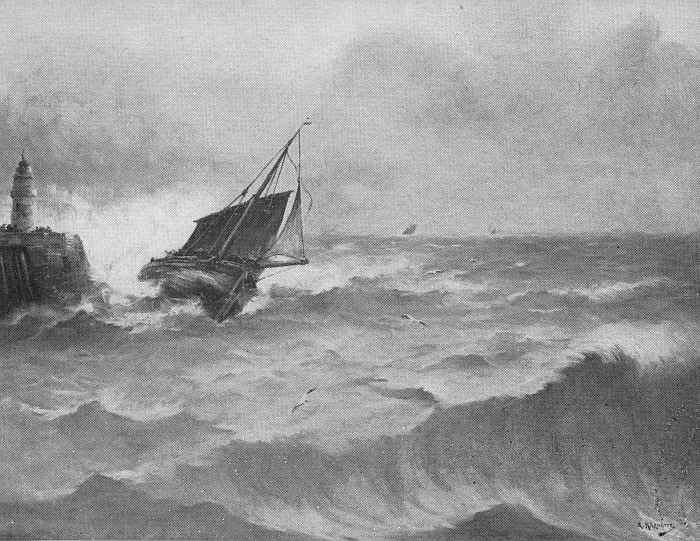
"The old sea-wall (he cryed) is downe! The rising tide comes on apace." —Jean Ingelow.— From a photogravure by Braun, Clement & Co., after painting by G. Haquette.
HIGH-TIDE ON THE COAST OF LINCOLNSHIRE. [TIME, 1571.] THE old mayor climbed the belfry tower, The ringers rang by two, by three; "Pull! if ye never pulled before; Good ringers, pull your best," quoth he. "Play uppe, play uppe, O Boston bells! Ply all your changes, all your swells! Play uppe The Brides of Enderby!" Men say it was a "stolen tyde,"— The Lord that sent it, he knows all, But in myne ears doth still abide The message that the bells let fall; And there was naught of strange, beside The flights of mews and peewits pied, By millions crouched on the old sea-wall. I sat and spun within the doore; My thread brake off, I raised myne eyes: The level sun, like ruddy ore, Lay sinking in the barren skies; And dark against day's golden death She moved where Lindis wandereth,— My sonne's faire wife, Elizabeth. "Cusha! Cusha! Cusha!" calling, Ere the early dews were falling, Farre away I heard her song. "Cusha! Cusha!" all along; Where the reedy Lindis floweth, Floweth, floweth, From the meads where melick groweth, Faintly came her milking-song. "Cusha! Cusha! Cusha!" calling, "For the dews will soone be falling; Leave your meadow grasses mellow, Mellow, mellow! Quit your cowslips, cowslips yellow! Come uppe, Whitefoot! come uppe, Lightfoot! Quit the stalks of parsley hollow, Hollow, hollow! Come uppe, Jetty! rise and follow; From the clovers lift your head! Come uppe, Whitefoot! come uppe, Lightfoot! Come uppe, Jetty! rise and follow, Jetty, to the milking-shed." If it be long—ay, long ago— When I beginne to think howe long, Againe I hear the Lindis flow, Swift as an arrowe, sharpe and strong; And all the aire, it seemeth mee, Bin full of floating bells (sayth shee), That ring the tune of Enderby. Alle fresh the level pasture lay, And not a shadowe mote be seene, Save where, full fyve good miles away, The steeple towered from out the greene. And lo! the great bell farre and wide Was heard in all the country side That Saturday at eventide. The swannerds, where their sedges are, Moved on in sunset's golden breath; The shepherde lads I heard afarre, And my sonne's wife, Elizabeth; Till, floating o'er the grassy sea, Came downe that kyndly message free, The Brides of Mavis Enderby. Then some looked uppe into the sky, And all along where Lindis flows To where the goodly vessels lie, And where the lordly steeple shows. They sayde, "And why should this thing be, What danger lowers by land or sea? They ring the tune of Enderby. "For evil news from Mablethorpe, Of pyrate galleys, warping down,— For shippes ashore beyond the scorpe, They have not spared to wake the towne; But while the west bin red to see, And storms be none, and pyrates flee, Why ring The Brides of Enderby?" I looked without, and lo! my sonne Came riding downe with might and main; He raised a shout as he drew on, Till all the welkin rang again: "Elizabeth! Elizabeth!" (A sweeter woman ne'er drew breath Than my sonne's wife, Elizabeth.) "The olde sea-wall (he cryed) is downe! The rising tide comes on apace; And boats adrift in yonder towne Go sailing uppe the market-place!" He shook as one that looks on death: "God save you, mother!" straight he sayth; "Where is my wife, Elizabeth?" "Good sonne, where Lindis winds away With her two bairns I marked her long; And ere yon tells beganne to play, Afar I heard her milking-song." He looked across the grassy sea, To right, to left, Ho, Enderby! They rang The Brides of Enderby. With that he cried and beat his breast; For lo! along the river's bed A mighty eygre reared his crest, And uppe the Lindis raging sped. It swept with thunderous noises loud,— Shaped like a curling snow-white cloud, Or like a demon in a shroud. And rearing Lindis, backward pressed, Shook all her trembling bankes amaine; Then madly at the eygre's breast Flung uppe her weltering walls again. Then bankes came downe with ruin and rout,— Then beaten foam flew round about,— Then all the mighty floods were out. So farre, so fast, the eygre drave, The heart had hardly time to beat Before a shallow seething wave Sobbed in the grasses at oure feet: The feet had hardly time to flee Before it brake against the knee,— And all the world was in the sea. Upon the roofe we sate that night; The noise of bells went sweeping by; I marked the lofty beacon light Stream from the church-tower, red and high,— A lurid mark, and dread to see; And awsome bells they were to mee, That in the dark rang Enderby. They rang the sailor lads to guide, From roofe to roofe who fearless rowed; And I,—my sonne was at my side, And yet the ruddy beacon glowed; And yet he moaned beneath his breath, "O, come in life, or come in death! O lost! my love, Elizabeth!" And didst thou visit him no more? Thou didst, thou didst, my daughter deare? The waters laid thee at his doore Ere yet the early dawn was clear: Thy pretty bairns in fast embrace, The lifted sun shone on thy face, Downe drifted to thy dwelling-place. That flow strewed wrecks about the grass, That ebbe swept out the flocks to sea,— fatal ebbe and flow, alas! To manye more than myne and mee; But each will mourne his own (she sayth) And sweeter woman ne'er drew breath Than my sonne's wife, Elizabeth. I shall never hear her more By the reedy Lindis shore, "Cusha! Cusha! Cusha!" calling, Ere the early dews be falling; I shall never hear her song, "Cusha! Cusha!" all along, Where the sunny Lindis floweth, Goeth, floweth, From the meads where melick groweth, Where the water, winding down, Onward floweth to the town. I shall never see her more, Where the reeds and rushes quiver, Shiver, quiver, Stand beside the sobbing river,— Sobbing, throbbing, in its falling, To the sandy, lonesome shore; I shall never hear her calling, "Leave your meadow grasses mellow, Mellow, mellow! Quit your cowslips, cowslips yellow! Come uppe, Whitefoot! come uppe, Lightfoot! Quit your pipes of parsley hollow, Hollow, hollow! Come uppe, Lightfoot! rise and follow; Lightfoot! Whitefoot! From your clovers lift the head; Come uppe, Jetty! follow, follow, Jetty, to the milking-shed!" JEAN INGELOW.
RIZPAH. 17—. I. Wailing, wailing, wailing, the wind over land and sea— And Willy's voice in the wind, "O mother, come out to me." Why should he call me to-night, when he knows that I cannot go? For the downs are as bright as day, and the full moon stares at the snow. II. We should be seen, my dear; they would spy us out of the town. The loud black nights for us, and the storm rushing over the down, When I cannot see my own hand, but am led by the creak of the chain, And grovel and grope for my son till I find myself drenched with the rain. III. Anything fallen again? nay—what was there left to fall? I have taken them home, I have numbered the bones, I have hidden them all. What am I saying? and what are you? do you come as a spy? Falls? what falls? who knows? As the tree falls so must it lie. IV. Who let her in? how long has she been? you—what have you heard? Why did you sit so quiet? you never have spoken a word. O—to pray with me—yes—a lady—none of their spies— But the night has crept into my heart, and begun to darken my eyes. V. Ah—you, that have lived so soft, what should you know of the night, The blast and the burning shame and the bitter frost and the fright? I have done it, while you were asleep—you were only made for the day. I have gathered my baby together—and now you may go your way. VI. Nay—for it's kind of you, Madam, to sit by an old dying wife. But say nothing hard of my boy, I have only an hour of life. I kissed my boy in the prison, before he went out to die. "They dared me to do it," he said, and he never has told me a lie. I whipt him for robbing an orchard once when he was but a child— "The farmer dared me to do it," he said; he was always so wild— And idle—and couldn't be idle—my Willy—he never could rest. The King should have made him a soldier, he would have been one of his best. VII. But he lived with a lot of wild mates, and they never would let him be good; They swore that he dare not rob the mail, and he swore that he would: And he took no life, but he took one purse, and when all was done He flung it among his fellows—I'll none of it, said my son. VIII. I came into court to the Judge and the lawyers. I told them my tale, God's own truth—but they killed him, they killed him for robbing the mail. They hanged him in chains for a show—we had always borne a good name— To be hanged for a thief—and then put away—isn't that enough shame? Dust to dust—low down—let us hide! but they set him so high That all the ships of the world could stare at him, passing by. God 'ill pardon the hell-black raven and horrible fowls of the air, But not the black heart of the lawyer who killed him and hanged him there. IX. And the jailer forced me away. I had bid him my last good-bye; They had fastened the door of his cell. "O mother!" I heard him cry. I couldn't get back tho' I tried, he had something further to say, And now I never shall know it. The jailer forced me away. X. Then since I couldn't but hear that cry of my boy that was dead, They seized me and shut me up: they fastened me down on my bed. "Mother, O mother!"—he called in the dark to me year after year— They beat me for that, they beat me—you know that I couldn't but hear; And then at the last they found I had grown so stupid and still They let me abroad again—but the creatures had worked their will. XI. Flesh of my flesh was gone, but bone of my bone was left— I stole them all from the lawyers—and you, will you call it a theft?— My baby, the bones that had sucked me, the bones that had laughed and had cried— Theirs? O no! they are mine—not theirs—they had moved in my side. XII. Do you think I was scared by the bones? I kissed 'em, I buried 'em all— I can't dig deep, I am old—in the night by the churchyard wall. My Willy 'ill rise up whole when the trumpet of judgment 'ill sound, But I charge you never to say that I laid him in holy ground. XIII. They would scratch him up—they would hang him again on the cursèd tree. Sin? O yes—we are sinners, I know—let all that be, And read me a Bible verse of the Lord's good will toward men— "Full of compassion and mercy, the Lord"—let me hear it again; "Full of compassion and mercy—long-suffering." Yes, O yes! For the lawyer is born but to murder—the Saviour lives but to bless. He'll never put on the black cap except for the worst of the worst, And the first may be last—I have heard it in church—and the last may be first. Suffering—O long-suffering—yes, as the Lord must know, Year after year in the mist and the wind and the shower and the snow. XIV. Heard, have you? what? they have told you he never repented his sin. How do they know it? are they his mother? are you of his kin? Heard! have you ever heard, when the storm on the downs began, The wind that 'ill wail like a child and the sea that 'ill moan like a man? XV. Election, Election and Reprobation—it's all very well. But I go to-night to my boy, and I shall not find him in Hell. For I cared so much for my boy that the Lord has looked into my care, And He means me I'm sure to be happy with Willy, I know not where. XVI. And if he be lost—but to save my soul, that is all your desire: Do you think that I care for my soul if my boy be gone to the fire? I have been with God in the dark—go, go, you may leave me alone— You never have borne a child—you are just as hard as a stone. XVII. Madam, I beg your pardon! I think that you mean to be kind, But I cannot hear what you say for my Willy's voice in the wind— The snow and the sky so bright—he used but to call in the dark, And he calls to me now from the church and not from the gibbet—for hark! Nay—you can hear it yourself—it is coming—shaking the walls— Willy—the moon's in a cloud—Good night. I am going. He calls. ALFRED, LORD TENNYSON.
THE DREAM OF EUGENE ARAM. 'T was in the prime of summer time, An evening calm and cool, And four-and-twenty happy boys Came bounding out of school; There were some that ran, and some that leapt Like troutlets in a pool. Away they sped with gamesome minds And souls untouched by sin; To a level mead they came, and there They drave the wickets in: Pleasantly shone the setting sun Over the town of Lynn. Like sportive deer they coursed about, And shouted as they ran. Turning to mirth all things of earth As only boyhood can; But the usher sat remote from all, A melancholy man! His hat was off, his vest apart, To catch heaven's blessèd breeze; For a burning thought was in his brow, And his bosom ill at ease; So he leaned his head on his hands, and read The book between his knees. Leaf after leaf he turned it o'er, Nor ever glanced aside,— For the peace of his soul he read that book In the golden eventide; Much study had made him very lean, And pale, and leaden-eyed. At last he shut the ponderous tome; With a fast and fervent grasp He strained the dusky covers close, And fixed the brazen hasp: "O God! could I so close my mind, And clasp it with a clasp!" Then leaping on his feet upright, Some moody turns he took,— Now up the mead, then down the mead, And past a shady nook,— And, lo! he saw a little boy That pored upon a book. "My gentle lad, what is 't you read,— Romance or fairy fable? Or is it some historic page, Of kings and crowns unstable?" The young boy gave an upward glance,— "It is 'The Death of Abel.'" The usher took six hasty strides, As smit with sudden pain,— Six hasty strides beyond the place, Then slowly back again; And down he sat beside the lad, And talked with him of Cain; And, long since then, of bloody men, Whose deeds tradition saves; And lonely folk cut off unseen, And hid in sudden graves; And horrid stabs, in groves forlorn; And murders done in caves; And how the sprites of injured men Shriek upward from the sod; Ay, how the ghostly hand will point To show the burial clod; And unknown facts of guilty acts Are seen in dreams from God. He told how murderers walk the earth Beneath the curse of Cain,— With crimson clouds before their eyes, And flames about their brain; For blood has left upon their souls Its everlasting stain! "And well," quoth he, "I know for truth Their pangs must be extreme— Woe, woe, unutterable woe!— Who spill life's sacred stream. For why? Methought, last night I wrought A murder, in a dream! "One that had never done me wrong,— A feeble man and old; I led him to a lonely field,— The moon shone clear and cold: Now here, said I, this man shall die, And I will have his gold! "Two sudden blows with a raggèd stick, And one with a heavy stone, One hurried gash with a hasty knife,— And then the deed was done: There was nothing lying at my feet But lifeless flesh and bone! "Nothing but lifeless flesh and bone, That could not do me ill; And yet I feared him all the more For lying there so still: There was a manhood in his look That murder could not kill! "And, lo! the universal air Seemed lit with ghastly flame,— Ten thousand thousand dreadful eyes Were looking down in blame; I took the dead man by his hand, And called upon his name. "O God! it made me quake to see Such sense within the slain; But, when I touched the lifeless clay, The blood gushed out amain! For every clot a burning spot Was scorching in my brain! "My head was like an ardent coal, My heart as solid ice; My wretched, wretched soul, I knew, Was at the Devil's price. A dozen times I groaned,—the dead Had never groaned but twice. "And now, from forth the frowning sky, From heaven's topmost height, I heard a voice,—the awful voice Of the blood-avenging sprite: 'Thou guilty man! take up thy dead, And hide it from my sight!' "And I took the dreary body up, And cast it in a stream,— The sluggish water black as ink, The depth was so extreme:— My gentle boy, remember, this Is nothing but a dream! "Down went the corse with a hollow plunge, And vanished in the pool; Anon I cleansed my bloody hands, And washed my forehead cool, And sat among the urchins young, That evening, in the school. "O Heaven! to think of their white souls, And mine so black and grim! I could not share in childish prayer, Nor join in evening hymn; Like a devil of the pit I seemed, Mid holy cherubim! "And peace went with them, one and all, And each calm pillow spread; But Guilt was my grim chamberlain, That lighted me to bed, And drew my midnight curtains round With fingers bloody red! "All night I lay in agony, In anguish dark and deep; My fevered eyes I dared not close, But stared aghast at Sleep; For Sin had rendered unto her The keys of hell to keep! "All night I lay in agony, From weary chime to chime; With one besetting horrid hint That racked me all the time,— A mighty yearning, like the first Fierce impulse unto crime,— "One stern tyrannic thought, that made All other thoughts its slave! Stronger and stronger every pulse Did that temptation crave,— Still urging me to go and see The dead man in his grave! "Heavily I rose up, as soon As light was in the sky, And sought the black accursèd pool With a wild, misgiving eye; And I saw the dead in the river-bed, For the faithless stream was dry. "Merrily rose the lark, and shook The dew-drop from its wing; But I never marked its morning flight, I never heard it sing, For I was stooping once again Under the horrid thing. "With breathless speed, like a soul in chase, I took him up and ran; There was no time to dig a grave Before the day began,— In a lonesome wood with heaps of leaves, I hid the murdered man! "And all that day I read in school, But my thought was otherwhere; As soon as the midday task was done, In secret I was there,— And a mighty wind had swept the leaves, And still the corse was bare! "Then down I cast me on my face, And first began to weep, For I knew my secret then was one That earth refused to keep,— Or land or sea, though he should be Ten thousand fathoms deep. "So wills the fierce avenging sprite, Till blood for blood atones! Ay, though he's buried in a cave, And trodden down with stones, And years have rotted off his flesh,— The world shall see his bones! "O God! that horrid, horrid dream Besets me now awake! Again—again, with dizzy brain, The human life I take; And my red right hand grows raging hot, Like Cranmer's at the stake. "And still no peace for the restless clay Will wave or mold allow; The horrid thing pursues my soul,— It stands before me now!" The fearful boy looked up, and saw Huge drops upon his brow. That very night, while gentle sleep The urchin's eyelids kissed, Two stern-faced men set out from Lynn Through the cold and heavy mist; And Eugene Aram walked between, With gyves upon his wrist. THOMAS HOOD.
IN THE ENGINE-SHED. Through air made heavy with vapors murk, O'er slack and cinders in heaps and holes, The engine-driver came to his work, Burly and bluff as a bag of coals; With a thick gold chain where he bulged the most, And a beard like a brush, and a face like a toast, And a hat half-eaten by fire and frost; And a diamond pin in the folded dirt Of the shawl that served him for collar and shirt. Whenever he harnessed his steed of mettle:— The shovel-fed monster that could not tire, With limbs of steel and entrails of fire; Above us it sang like a tea-time kettle. He came to his salamander toils In what seemed a devil's cast-off suit, All charred, and discolored with rain and oils, And smeared and sooted from muffler to boot. Some wiping—it struck him—his paws might suffer With a wisp of thread he found on the buffer (The improvement effected was not very great); Then he spat, and passed his pipe to his mate. And his whole face laughed with an honest mirth, As any extant on this grimy earth, Welcoming me to his murky region; And had you known him, I tell you this— Though your bright hair shiver and sink at its roots, O piano-fingering fellow-collegian— You would have returned no cold salutes To the cheery greeting of old Chris, But locked your hand in the vise of his. For at night when the sleet-storm shatters and scatters, And clangs on the pane like a pile of fetters, He flies through it all with the world's love-letters: The master of mighty leviathan motions, That make for him storm when the nights are fair, And cook him with fire and carve him with air, While we sleep soft on the carriage cushions, And he looks sharp for the signals, blear-eyed. Often had Chris over England rolled me; You shall hear a story he told me— A dream of his rugged watch unwearied. THE STORY. We were driving the down express; Will at the steam, and I at the coal; Over the valleys and villages, Over the marshes and coppices, Over the river, deep and broad; Through the mountain, under the road, Flying along, Tearing along. Thunderbolt engine, swift and strong, Fifty tons she was, whole and sole! I had been promoted to the express: I warrant I was proud and gay. It was the evening that ended May, And the sky was a glory of tenderness. We were thundering down to a midland town,— It doesn't matter about the name, For we didn't stop there, or anywhere For a dozen miles on either side. Well, as I say, just there you slide, With your steam shut off and your brakes in hand, Down the steepest and longest grade in the land, At a pace that, I promise you, is grand. We were just there with the express, When I caught sight of a girl's white dress On the bank ahead; and as we passed— You have no notion how fast— She sank back scared from our baleful blast. We were going—a mile and a quarter a minute— With vans and carriages—down the incline! But I saw her face, and the sunshine in it; I looked in her eyes, and she looked in mine As the train went by, like a shot from a mortar: A roaring hell-breath of dust and smoke. And it was a minute before I woke, When she lay behind us—a mile and a quarter. And the years went on, and the express Leaped in her black resistlessness, Evening by evening, England through.— Will—God rest him!—was found—a mash Of bleeding rags, in a fearful smash He made of Christmas train at Crewe. It chanced I was ill the night of the mess, Or I shouldn't now be here alive; But thereafter, the five o'clock out express, Evening by evening, I used to drive. And often I saw her: that lady, I mean, That I spoke of before. She often stood Atop of the bank;—it was pretty high, Say, twenty feet, and backed by a wood.— She would pick daisies out of the green To fling down at us as we went by. We had grown to be friends, too, she and I. Though I was a stalwart, grimy chap, And she a lady! I'd wave my cap Evening by evening, when I'd spy That she was there, in the summer air, Watching the sun sink out of the sky. Oh, I didn't see her every night: Bless you! no; just now and then, And not at all for a twelvemonth quite. Then, one evening, I saw her again, Alone, as ever—but wild and pale— Climbing down on the line, on the very rail, While a light as of hell from our wild wheels broke, Tearing down the slope with their devilish clamors And deafening din, as of giant hammers That smote in a whirlwind of dust and smoke All the instant or so that we sped to meet her. Never, O never, had she seemed sweeter!— I let yell the whistle, reversing the stroke, Down that awful incline; and signalled the guard To put on his brakes at once, and HARD! — Though we couldn't have stopped. We tattered the rail Into splinters and sparks, but without avail. We couldn't stop; and she wouldn't stir, Saving to turn us her eyes, and stretch Her arms to us:—and the desperate wretch I pitied, comprehending her. So the brakes let off, and the steam full again, Sprang down on the lady the terrible train.— She never flinched. We beat her down, And ran on through the lighted length of the town Before we could stop to see what was done. Yes, I've run over more than one! Full a dozen, I should say; but none That I pitied as I pitied her. If I could have stopped—with all the spur Of the train's weight on, and cannily— But it never would do with a lad like me And she a lady,—or had been.—Sir?— We won't say any more of her; The world is hard. But I'm her friend, Right through—down to the world's end. It is a curl of her sunny hair Set in this locket that I wear; I picked it off the big wheel there.— Time's up, Jack—Stand clear, sir. Yes, We're going out with the express. WILLIAM WILKINS.