SECONDARY EPOCH.
Reading edition
During the Primary Epoch our globe would appear to have been chiefly appropriated to beings which lived in the waters—above all, to the Crustaceans and Fishes; during the Secondary Epoch Reptiles seem to have been its prevailing inhabitants. Animals of this class assumed astonishing dimensions, and would seem to have multiplied in a most singular manner; they were, apparently, the kings of the earth. At the same time, however, that the animal kingdom thus developed itself, the vegetation lost much of its importance.
Geologists have agreed among themselves to divide the Secondary epoch into three periods: 1, the Cretaceous; 2, the Jurassic; 3, the Triassic—a division which it is convenient to adopt.
The Triassic, or New Red Period.
This period has received the name of Triassic because the rocks of which it is composed, which are more fully developed in Germany than either in England or France, were called the Trias (or Triple Group), by German writers, from its division into three groups, as follows, in descending order:—
England. France. Germany.
Saliferous and gypseous shales and sandstone – Marnes irisées – Keuper. 1,000 feet.
Wanting – Muschelkalk or Calcaire coquillier – Muschelkalk. 600 feet.
Sandstone and quartzose conglomerate – Grès bigarré – Bunter-Sandstein. 1,500 ft.
The following has been shown by Mr. Ed. Hull to be the general succession of the Triassic formation in the midland and north-western counties of England, where it attains its greatest vertical development, thinning away in the direction of the mouth of the Thames:—
Foreign Equivalents.
TRIASSIC SERIES. – New Red Marl. Red and grey shales and marls, sometimes micaceous, with beds of rock-salt and gypsum, containing Estheria and Foraminifera (Chellaston). Keuper. Marnes irisées.
Lower Keuper Sandstone. Thinly-laminated micaceous sandstones and marls (waterstones); passing downwards into white, brown, or reddish sandstone, with a base of calcareous conglomerate or breccia. Letten Kohle (?) „
Wanting in England. ... Muschelkalk. Calcaire coquillier.
Upper Mottled Sandstone. Soft, bright-red and variegated sandstone (without pebbles). – Bunter Sandstein. Grès bigarré, or Grès des Vosges (in part).
Pebble Beds. Harder reddish-brown sandstones with quartzose pebbles, passing into conglomerate; with a base of calcareous breccia.
Lower Mottled Sandstone. Soft bright-red and variegated sandstone (without pebbles).
PERMIAN SERIES. – Upper Permian. Red marls, with thin-bedded fossiliferous limestones (Manchester). Zechstein.
Lower – Red and variegated sandstone (Collyhurst, Manchester) represented by [...]. – Rothe-todte-liegende. Grès des Vosges (in part).
Reddish-brown and purple sandstones and marls, with calcareous conglomerates and trappoid breccia. (Central counties).
New Red Sandstone.
In this new phase of the revolutions of the globe, the animated beings on its surface differ much from those which belonged to the Primary epoch. The curious Crustaceans which we have described under the name of Trilobites have disappeared; the molluscous Cephalopods and Brachiopods are here few in number, as are the Ganoid and Placoid Fishes, whose existence also seems to have terminated during this period, and vegetation has undergone analogous changes. The cryptogamic plants, which reached their maximum in the Primary epoch, become now less numerous, while the Conifers experienced a certain extension. Some kinds of terrestrial animals have disappeared, but they are replaced by genera as numerous as new. For the first time the Turtle appears in the bosom of the sea, and on the borders of lakes. The Saurian reptiles acquire a great development; they prepare the way for those enormous Saurians, which appear in the following period, whose skeletons present such vast proportions, and such a strange aspect, as to strike with astonishment all who contemplate their gigantic, and, so to speak, awe-inspiring remains.
The Variegated Sandstone, or Bunter, contains many vegetable, but few animal, remains, although we constantly find imprints of the footsteps of the Labyrinthodon.
The lowest Bunter formation shows itself in France, in the Pyrenees, around the central plateau in the Var, and upon both flanks of the Vosges mountains. It is represented in south-western and central Germany, in Belgium, in Switzerland, in Sardinia, in Spain, in Poland, in the Tyrol, in Bohemia, in Moravia, and in Russia. M. D’Orbigny states, from his own observation, that it covers vast surfaces in the mountainous regions of Bolivia, in South America. It is recognised in the United States, in Columbia, in the Great Antilles, and in Mexico.
The Bunter in France is reduced to the variegated sandstone, except around the Vosges, in the Var, and the Black Forest, where it is accompanied by the Muschelkalk. In Germany it furnishes building-stone of excellent quality; many great edifices, in particular the cathedrals, so much admired on the Rhine—such, for example, as those of Strasbourg and Fribourg—are constructed of this stone, the sombre tints of which singularly relieve the grandeur and majesty of the Gothic architecture. Whole cities in Germany are built of the brownish-red stones drawn from its mottled sandstone quarries. In England, in Scotland, and in Ireland this formation extends from north to south through the whole length of the country. “This old land,” says Professor Ramsay,[54] “consisted in great part of what we now know as Wales, and the adjacent counties of Hereford, Monmouth, and Shropshire; of part of Devon and Cornwall, Cumberland, the Pennine chain, and all the mountainous parts of Scotland. Around old Wales, and part of Cumberland, and probably all round and over great part of Devon and Cornwall, the New Red Sandstone was deposited. Part, at least, of this oldest of the Secondary rocks was formed of the material of the older Palæozoic strata, that had then risen above the surface of the water. The New Red Sandstone series consists in its lower members of beds of red sandstone and conglomerate, more than 1,000 feet thick, and above them are placed red and green marls, chiefly red, which in Germany are called the Keuper strata, and in England the New Red Marl. These formations range from the mouth of the Mersey, round the borders of Wales, to the estuary of the Severn, eastwards into Warwickshire, and thence northwards into Yorkshire and Northumberland, along the eastern border of the Magnesian Limestone. They also form the bottom of the valley of the Eden, and skirt Cumberland on the west; in the centre of England the unequal hardness of its sub-divisions sometimes giving rise to minor escarpments, overlooking plains and undulating grounds of softer strata.”
“Different members of the group rest in England, in some region or other,” says Lyell, “on almost every principal member of the Palæozoic series, on Cambrian, Silurian, Devonian, Carboniferous, and Permian rocks; and there is evidence everywhere of disturbance, contortion, partial upheaval into land, and vast denudations which the older rocks underwent before and during the deposition of the successive strata of the New Red Sandstone group.” (“Elements of Geology,” p. 439.)
The Muschelkalk consists of beds of compact limestone, often greyish, sometimes black, alternating with marl and clay, and commonly containing such numbers of shells that the name of shelly limestone (Muschelkalk) has been given to the formation by the Germans. The beds are sometimes magnesian, especially in the lower strata, which contain deposits of gypsum and rock-salt.
The seas of this sub-period, which is named after the innumerable masses of shells inclosed in the rocks which it represents, included, besides great numbers of Mollusca, Saurian Reptiles of twelve different genera, some Turtles, and six new genera of Fishes clothed with a cuirass. Let us pause at the Mollusca which peopled the Triassic seas.
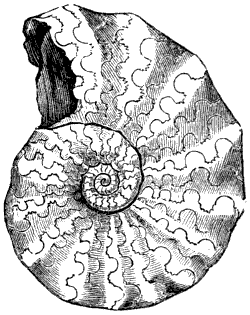
Fig. 81.—Ceratites nodosus. (Muschelkalk.)
Among the shells characteristic of the Muschelkalk period, we mention Natica Gaillardoti, Rostellaria antiqua, Lima striata, Avicula socialis, Terebratula vulgaris, Turbonilla dubia, Myophoria vulgaris, Nautilus hexagonalis, and Ceratites nodosus. The Ceratites, of which a species is here represented (Fig. 81), form a genus closely allied to the Ammonites, which seem to have played such an important part in the ancient seas, but which have no existence in those of our era, either in species or even in genus. This Ceratite is found in the Muschelkalk of Germany, a formation which has no equivalent in England, but which is a compact greyish limestone underlying the saliferous rocks in Germany, and including beds of dolomite with gypsum and rock-salt.
The Mytilus or Mussel, which properly belonged to this age, are acephalous (or headless) Molluscs with elongated triangular shells, of which there are many species found in our existing seas. Lima, Myophoria, Posidonia, and Avicula, are acephalous Molluscs of the same period. The two genera Natica and Rostellaria belong to the Gasteropoda, and are abundant in the Muschelkalk in France, Germany, and Poland.
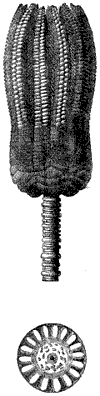
Fig. 82.—Encrinus liliiformis.
Among the Echinoderms belonging to this period may be mentioned Encrinus moniliformis and E. liliiformis, or lily encrinite (Fig. 82), whose remains, constituting in some localities whole beds of rock, show the slow progress with which this zoophyte formed beds of limestone in the clear seas of the period. To these may be added, among the Mollusca, Avicula subcostata and Myophoria vulgaris.
In the Muschelkalk are found the skull and teeth of Placodus gigas, a reptile which was originally placed by Agassiz among the class of Fishes; but more perfect specimens have satisfied Professor Owen that it was a Saurian Reptile.
It may be added, that the presence of a few genera, peculiar to the Primary epoch, which entirely disappeared during the sub-period, and the appearance for the first time of some other animals peculiar to the Jurassic period, give to the Muschelkalk fauna the appearance of being one of passage from one period to the other.
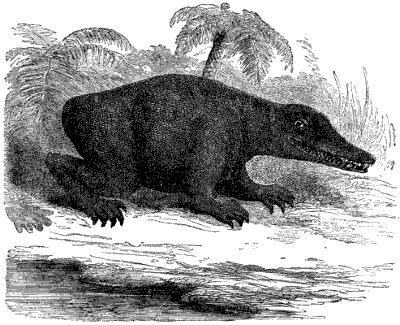
Fig. 83.—Labyrinthodon restored. One-twentieth natural size.
The seas, then, contained a few Reptiles, probably inhabitants of the banks of rivers, as Phytosaurus, Capitosaurus, &c., and sundry Fishes, as Sphœrodus and Pycnodus. In this sub-period we shall say nothing of the Land-Turtles, which for the first time now appear; but, we should note, that at the Bunter period a gigantic Reptile appears, on which the opinions of geologists were for a long while at variance. In the argillaceous rocks of the Muschelkalk period imprints of the foot of some animal were discovered in the sandstones of Storeton Hill, in Cheshire, and in the New Red Sandstone of parts of Warwickshire, as well as in Thuringia, and Hesseburg in Saxony, which very much resembled the impression that might be made in soft clay by the outstretched fingers and thumb of a human hand. These traces were made by a species of Reptile furnished with four feet, the two fore-feet being much broader than the hinder two. The head, pelvis, and scapula only of this strange-looking animal have been found, but these are considered to have belonged to a gigantic air-breathing reptile closely connected with the Batrachians. It is thought that the head was not naked, but protected by a bony cushion; that its jaws were armed with conical teeth, of great strength and of a complicated structure. This curious and uncouth-looking creature, of which the woodcut Fig. 83 is a restoration, has been named the Cheirotherium, or Labyrinthodon, from the complicated arrangement of the cementing layer of the teeth. (See also Fig. 1, p. 12.)
Another Reptile of great dimensions—which would seem to have been intended to prepare the way for the appearance of the enormous Saurians which present themselves in the Jurassic period—was the Nothosaurus, a species of marine Crocodile, of which a restoration has been attempted in Plate XIII. opposite.
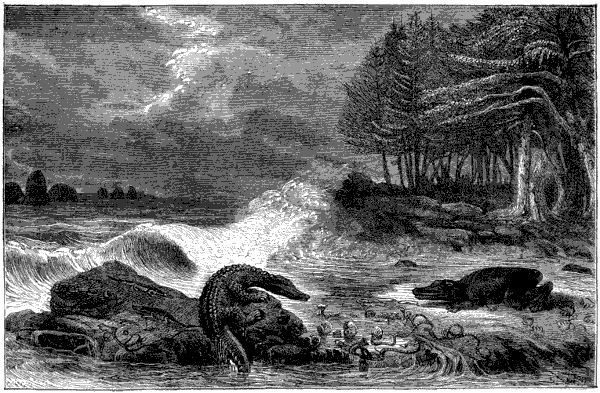
XIII.—Ideal Landscape of the Muschelkalk Sub-period.
It has been supposed, from certain impressions which appear in the Keuper sandstones of the Connecticut river in North America, that Birds made their appearance in the period which now occupies us; the flags on which these occur by thousands show the tracks of an animal of great size (some 20 inches long and 41⁄2 feet apart), presenting the impression of three toes, like some of the Struthionidæ or Ostriches, accompanied by raindrops. No remains of the skeletons of birds have been met with in rocks of this period, and the footprints in question are all that can be alleged in support of the hypothesis.
M. Ad. Brongniart places the commencement of dicotyledonous gymnosperm plants in this age. The characteristics of this Flora consist in numerous Ferns, constituting genera now extinct, such as Anomopteris and Crematopteris. The true Equiseta are rare in it. The Calamites, or, rather, the Calamodendra, abound. The gymnosperms are represented by the genera Conifer, Voltzia, and Haidingera, of which both species and individuals are very numerous in the formation of this period.
Among the species of plants which characterise this formation, we may mention Neuropteris elegans, Calamites arenaceus, Voltzia heterophylla, Haidingera speciosa. The Haidingera, belonging to the tribe of Abietinæ, were plants with large leaves, analogous to those of our Damara, growing close together, and nearly imbricated, as in the Araucaria. Their fruit, which are cones with rounded scales, are imbricated, and have only a single seed, thus bearing out the strong resemblance which has been traced between these fossil plants, and the Damara.
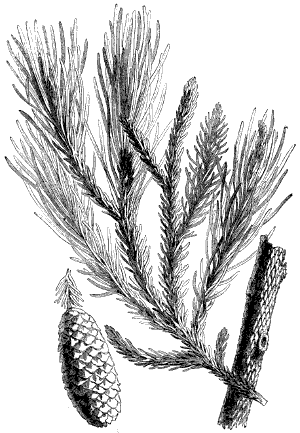
Fig. 84.—Branch and cone of Voltzia restored.
The Voltzias (Fig. 84), which seem to have formed the greater part of the forests were a genus of Cupressinaceæ, now extinct, which are well characterised among the fossil Conifers of the period. The alternate spiral leaves, forming five to eight rows sessile, that is, sitting close to the branch and drooping, have much in them analogous to the Cryptomerias. Their fruit was an oblong cone with scales, loosely imbricated, cuneiform or wedge-shaped, and, commonly, composed of from three to five obtuse lobes. In Fig. 84 we have a part of the stem, a branch with leaves and cone. In his “Botanic Geography,” M. Lecoq thus describes the vegetation of the ancient world in the first period of the Triassic age: “While the variegated sandstone and mottled clays were being slowly deposited in regular beds by the waters, magnificent Ferns still exhibited their light and elegantly-carved leaves. Divers Protopteris and majestic Neuropteris associated themselves in extensive forests, where vegetated also the Crematopteris typica of Schimper, the Anomopteris Mongeotii of Brongniart, and the pretty Trichomanites myriophyllum (Göppert). The Conifers of this epoch attain a very considerable development, and would form graceful forests of green trees. Elegant monocotyledons, representing the forms of tropical countries, seem to show themselves for the first time, the Yuccites Vogesiacus of Schimper constituted groups at once thickly serried and of great extent.
“A family, hitherto doubtful, appears under the elegant form of Nilssonia Hogardi, Schimp.; Ctenis Hogardi, Brongn. It is still seen in the Zamites Vogesiacus, Schimp.; and the group of the Cycads sharing at once in the organisation of the Conifers and the elegance of the Palms, now decorate the earth, which reveals in these new forms its vast fecundity. (See Fig. 72, p. 168.)
“Of the herbaceous plants which formed the undergrowth of the forests, or which luxuriated in its cool marshes, the most remarkable is the Ætheophyllum speciosum, Schimp. Their organisation approximates to the Lycopodiaceæ and Thyphaceæ, the Ætheophyllum stipulare, Brongn., and the curious Schizoneura paradoxa, Schimp. Thus we can trace the commencement of the reign of the Dicotyledons with naked seeds, which afterwards become so widely disseminated, in a few Angiosperms, composed principally of two families, the Conifers and Cycadeaceæ, still represented in the existing vegetation. The former, very abundant at first, associated themselves with the cellular Cryptogams, which still abound, although they are decreasing, then with the Cycadeaceæ, which present themselves slowly, but will soon be observed to take a large part in the brilliant harmonies of the vegetable kingdom.”
The engraving at page 191 (Plate XIII.) gives an idealised picture of the plants and animals of the period. The reader must imagine himself transported to the shores of the Muschelkalk sea at a moment when its waves are agitated by a violent but passing storm. The reflux of the tide exposes some of the aquatic animals of the period. Some fine Encrinites are seen, with their long flexible stems, and a few Mytili and Terebratulæ. The Reptile which occupies the rocks, and prepares to throw itself on its prey, is the Nothosaurus. Not far from it are other reptiles, its congeners, but of a smaller species. Upon the dune on the shore is a fine group of the trees of the period, that is, of Haidingeras, with large trunks, with drooping branches and foliage, of which the cedars of our own age give some idea. The elegant Voltzias are seen in the second plane of this curtain of verdure. The Reptiles which lived in these primitive forests, and which would give to it so strange a character, are represented by the Labyrinthodon, which descends towards the sea on the right, leaving upon the sandy shore those curious tracks which have been so wonderfully preserved to our days.
The footprints of the reptilian animals of this period prove that they walked over moist surfaces; and, if these surfaces had been simply left by a retiring tide, they would generally have been obliterated by the returning flood, in the same manner that is seen every day on our own sandy shores. It seems more likely that the surfaces, on which fossil footprints are now found, were left bare by the summer evaporation of a lake; that these surfaces were afterwards dried by the sun, and the footprints hardened, so as to ensure their preservation, before the rising waters brought by flooded muddy rivers again submerged the low flat shores and deposited new layers of salt, just as they do at the present day round the Dead Sea and the Salt Lake of Utah.
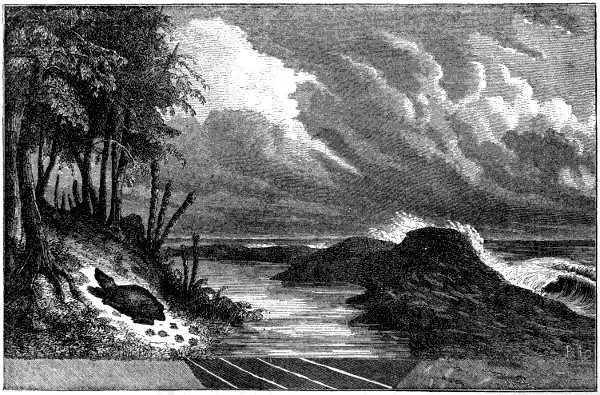
XIV.—Ideal Landscape of the Keuper Sub-period.
Keuper Sub-period.
The formation which characterises the Keuper, or saliferous period, is of moderate extent, and derives the latter name from the salt deposits it contains.
These rocks consist of a vast number of argillaceous and marly beds, variously coloured, but chiefly red, with tints of yellow and green. These are the colours which gave the name of variegatea (Poikilitic) to the series. The beds of red marl often alternate with sandstones, which are also variegated in colour. As subordinate rocks, we find in this formation some deposits of a poor pyritic coal and of gypsum. But what especially characterises the formation are the important deposits of rock-salt which are included in it. The saliferous beds, often twenty-five to forty feet thick, alternate with beds of clay, the whole attaining a thickness of 160 yards. In Germany in Würtemberg, in France at Vic, at Dieuze, and at Château-Salins, the rock-salt of the saliferous formation has become an important branch of industry. In the Jura, salt is extracted from the water charged with chlorides, which issues from this formation.
Some of these deposits are situated at great depths, and cannot be reached without very considerable labour. The salt-mines of Wieliczka, in Poland, for example, can be procured on the surface, or by galleries of little depth, because the deposit belongs to the Tertiary period; but the deposits of salt, in the Triassic age, lie so much deeper, as to be only approachable by a regular process of mining by galleries, and the ordinary mode of reaching the salt is by digging pits, which are afterwards filled with water. This water, charged with the salt, is then pumped up into troughs, where it is evaporated, and the crystallised mineral obtained.
What is the origin of the great deposits of marine salt which occur in this formation, and which always alternate with thin beds of clay or marl? We can only attribute them to the evaporation of vast quantities of sea-water introduced into depressions, cavities, or gulfs, which the sandy dunes afterwards separated from the great open sea. In Plate XIV. an attempt is made to represent the natural fact, which must have been of frequent recurrence during the saliferous period, to form the considerable masses of rock-salt which are now found in the rocks of the period. On the right is the sea, with a dune of considerable extent, separating it from a tranquil basin of smooth water. At intervals, and from various causes, the sea, clearing the dune, enters and fills the basin. We may even suppose that a gulf exists here which, at one time, communicated with the sea; the winds having raised this sandy dune, the gulf becomes transformed, by degrees, into a basin or back-water, closed on all sides. However that may be, it is pretty certain that if the waters of the sea were once shut up in this basin, with an argillaceous bottom and without any opening, evaporation from the effects of solar heat would take place, and a bed of salt would be the result of this evaporation, mixed with other mineral salts which accompany chloride of sodium in sea-water, such as sulphate of magnesia, chloride of potassium, &c. This bed of salt, left by the evaporation of the water, would soon receive an argillaceous covering from the clay and silt suspended in the muddy water of the basin, thus forming a first alternation of salt and of clay or marl. The sea making fresh breaches across the barriers, the same process took place with a similar result, until the basin was filled up. By the regular and tranquil repetition of this phenomenon, continued during a long succession of ages, this abundant deposit of rock-salt has been formed, which occupies so important a position in the Secondary rocks.
There is in the delta of the Indus a singular region, called the Runn of Cutch, which extends over an area of 7,000 square miles, which is neither land nor sea, but is under water during the monsoons, and in the dry season is incrusted, here and there, with salt about an inch thick, the result of evaporation. Dry land has been largely increased here, during the present century, by subsidence of the waters and upheavals by earthquakes. “That successive layers of salt may have been thrown down one upon the other on many thousand square miles, in such a region, is undeniable,” says Lyell. “The supply of brine from the ocean is as inexhaustible as the supply of heat from the sun. The only assumption required to enable us to explain the great thickness of salt in such an area, is the continuance for an indefinite period of a subsidence, the country preserving all the time a general approach to horizontally.” The observations of Mr. Darwin on the atolls of the Pacific, prove that such a continuous subsidence is probable. Hugh Miller, after ably discussing various spots of earth where, as in the Runn of Cutch, evaporation and deposit take place, adds: “If we suppose that, instead of a barrier of lava, sand-bars were raised by the surf on a flat arenaceous coast, during a slow and equable sinking of the surface, the waters of the outer gulf might occasionally topple over the bar and supply a fresh brine when the first stock had been exhausted by evaporation.”
Professor Ramsay has pointed out that both the sandstones and marls of the Triassic epoch were formed in lakes. In the latter part of this epoch, he is of opinion, that the Keuper marls of the British Isles were deposited in a large lake, or lakes, which were fresh or brackish at first, but afterwards salt and without outlets to the sea; and that the same was occasionally the case with regard to other portions of northern Europe and its adjoining seas.
By the silting up of such lakes with sediment, and the gradual evaporation of their waters under favourable conditions, such as increased heat and diminished rainfall—where the lakes might cease to have an outflow into the sea and the loss of water by evaporation would exceed the amount flowing into them—the salt or salts contained in solution would, by degrees, become concentrated and finally precipitated. In this way the great deposits of rock-salt and gypsum, common in the Keuper formation, may be accounted for.
Subsequently, by increase of rainfall or decrease of heat, and sinking of the district, the waters became comparatively less salt again; and a recurrence of such conditions lasted until the close of the Keuper period, when a partial influx of the sea took place, and the Rhætic beds of England were deposited.
The red colour of the New Red Sandstones and marls is caused by peroxide of iron, which may also have been carried into the lakes in solution, as a carbonate, and afterwards converted into peroxide by contact with air, and precipitated as a thin pellicle upon the sedimentary grains of sandy mud, of which the Triassic beds more or less consist. Professor Ramsay further considers that all the red-coloured strata of England, including the Permian, Old Red Sandstone, and even the Old Cambrian formation, were deposited in lakes or inland waters.[55]
There is little to be said of the animals which belong to the Saliferous period. They are nearly the same as those of the Muschelkalk, &c.
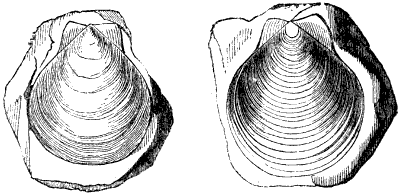
Fig. 85.—Pecten orbicularis.
Among the most abundant of the shells belonging to the upper Trias, in all the countries where it has been examined, are the Avicula, Cardium, and Pecten, one of which is given in Fig. 85. Foraminifera are numerous in the Keuper marls. The remains of land-plants, and the peculiarities of some of the reptiles of the Keuper period, tend to confirm the opinion of Professor Ramsay, that the strata were deposited in inland salt-lakes.
In the Keuper period the islands and continents presented few mountains; they were intersected here and there by large lakes, with flat and uniform banks. The vegetation on their shores was very abundant, and we possess its remains in great numbers. The Keuper Flora was very analogous to those of the Lias and Oolite, and consisted of Ferns, Equisetaceæ, Cycads, Conifers, and a few plants, which M. Ad. Brongniart classes among the dubious monocotyledons. Among the Ferns may be quoted many species of Sphenopteris or Pecopteris. Among them, Pecopteris Stuttgartiensis, a tree with channelled trunk, which rises to a considerable height without throwing out branches, and terminates in a crown of leaves finely cut and with long petioles; the Equisetites columnaris, a great Equisetum analogous to the horse-tails of our age, but of infinitely larger dimensions, its long fluted trunk, surmounted by an elongated fructification, towering over all the other trees of the marshy soil.
The Pterophyllum Jägeri and P. Münsteri represented the Cycads, the Taxodites Münsterianus represented the Conifers, and, finally, the trunk of the Calamites was covered with a creeping plant, having elliptical leaves, with a re-curving nervature borne upon its long petioles, and the fruit disposed in bunches; this is the Preissleria antiqua, a doubtful monocotyledon, according to Brongniart, but M. Unger places it in the family of Smilax, of which it will thus be the earliest representative. The same botanist classes with the canes a marsh-plant very common in this period, the Palæoxyris Münsteri, which Brongniart classes with the Preissleria among his doubtful Monocotyledons.
The vegetation of the latter part of the Triassic period is thus characterised by Lecoq, in his “Botanical Geography”: “The cellular Cryptogameæ predominate in this as they do in the Carboniferous epoch, but the species have changed, and many of the genera also are different; the Cladephlebis, the Sphenopteris, the Coniopteris, and Pecopteris predominate over the others in the number of species. The Equisetaceæ are more developed than in any other formation. One of the finest species, the Calamites arenaceus of Brongniart, must have formed great forests. The fluted trunks resemble immense columns, terminating at the summit in leafy branches, disposed in graceful verticillated tufts, foreshadowing the elegant forms of Equisetum sylvaticum. Growing alongside of these were a curious Equisetum and singular Equisetites, a species of which last, E. columnaris, raised its herbaceous stem, with its sterile articulations, to a great height.
“What a singular aspect these ancient rocks would present, if we add to them the forest-trees Pterophyllum and the Zamites of the fine family of Cycadeaceæ, and the Conifers, which seem to have made their appearance in the humid soil at the same time!
“It is during this epoch, while yet under the reign of the dicotyledonous angiosperms, that we discover the first true monocotyledons. The Preissleria antiqua, with its long petals, drooping and creeping round the old trunks, its bunches of bright-coloured berries like the Smilax of our own age, to which family it appears to have belonged. Besides, the Triassic marshes gave birth to tufts of Palæoxyris Münsteri, a cane-like species of the Gramineæ, which, in all probability, cheered the otherwise gloomy shore.
“During this long period the earth preserved its primitive vegetation; new forms are slowly introduced, and they multiply slowly. But if our present types of vegetation are deficient in these distant epochs, we ought to recognise also that the plants which in our days represent the vegetation of the primitive world are often shorn of their grandeur. Our Equisetaceæ and Lycopodiaceæ are but poor representatives of the Lepidodendrons; the Calamites and Asterophyllites had already run their race before the epoch of which we write.”
The principal features of Triassic vegetation are represented in Plate XIV., page 198. On the cliff, on the left of the ideal landscape, the graceful stems and lofty trees are groups of Calamites arenaceus; below are the great “horse-tails” of the epoch, Equisetum columnare, a slender tapering species, of soft and pulpy consistence, which, rising erect, would give a peculiar physiognomy to the solitary shore.
The Keuper formation presents itself in Europe at many points, and it is not difficult to trace its course. In France it appears in the department of the Indre, of the Cher, of the Allier, of the Nièvre, of the Saône-et-Loire; upon the western slopes of the Jura its outliers crop out near Poligny and Salins, upon the western slopes of the Vosges; in the Doubs it shows itself; then it skirts the Muschelkalk area in the Haute-Marne; in the Vosges it assumes large proportions in the Meurthe at Luneville and Dieuze; in the Moselle it extends northward to Bouzonville; and on the Rhine to the east of Luxembourg as far as Dockendorf. Some traces of it show themselves upon the eastern slopes of the Vosges, on the lower Rhine.
It appears again in Switzerland and in Germany, in the canton of Basle, in Argovia, in the Grand Duchy of Würtemberg, in the Tyrol, and in Austria, where it gives its name to the city of Salzburg.
In the British Islands the Keuper formation commences in the eastern parts of Devonshire, and a band, more or less regular, extends into Somersetshire, through Gloucestershire, Worcestershire, Warwick, Leicestershire, Nottinghamshire, to the banks of the Tees, in Yorkshire, with a bed, independent of all the others in Cheshire, which extends into Lancashire. “At Nantwich, in the upper Trias of Cheshire,” Sir Charles Lyell states, “two beds of salt, in great part unmixed with earthy matter, attain the thickness of 90 or 100 feet. The upper surface of the highest bed is very uneven, forming cones and irregular figures. Between the two masses there intervenes a bed of indurated clay traversed by veins of salt. The highest bed thins off towards the south-west, losing fifteen feet of its thickness in the course of a mile, according to Mr. Ormerod. The horizontal extent of these beds is not exactly known, but the area containing saliferous clay and sandstones is supposed to exceed 150 miles in diameter, while the total thickness of the Trias in the same region is estimated by Mr. Ormerod at 1,700 feet. Ripple-marked sandstones and the footprints of animals are observed at so many levels, that we may safely assume the whole area to have undergone a slow and gradual depression during the formation of the New Red Sandstone.”
Not to mention the importance of salt as a source of health, it is in Great Britain, and, indeed, all over the world where the saliferous rocks exist, a most important branch of industry. The quantity of the mineral produced in England, from all sources, is between 5,000 and 6,000 tons annually, and the population engaged in producing the mineral, from sources supposed to be inexhaustible, is upwards of 12,000.
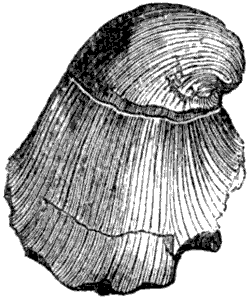
Fig. 86.—Productus Martini.
The lower Keuper sandstones, which lie at the base of the series of red marls, frequently give rise to springs, and are in consequence called “water-stones,” in Lancashire and Cheshire.
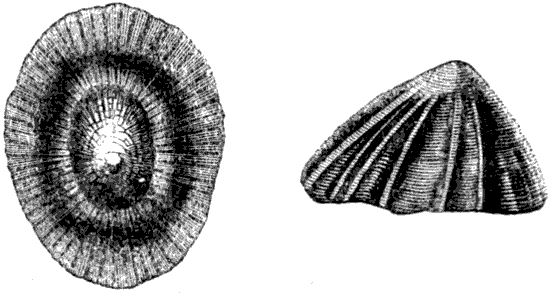
Fig. 87.—Patella vulgata. (Living.)
If the Keuper formation is poor in organic remains in France, it is by no means so on the other side of the Alps. In the Tyrol, and in the remarkable beds of Saint Cassian, Aussec, and Hallstadt, the rocks are made up of an immense number of marine fossils, among them Cephalopods, Ceratites, and Ammonites of peculiar form. The Orthoceras, which we have seen abounding in the Silurian period, and continued during the deposit of the Devonian and Carboniferous periods, appears here for the last time. We still find here a great number of Gasteropods and of Lamellibranchs of the most varied form. Sea Urchins—corals of elegant form—appear to have occupied, on the other side of the Alps, the same seas which in France and Germany seem to have been nearly destitute of animals. Some beds are literally formed of accumulated shells belonging to the genus Avicula; but these last-mentioned deposits are to be considered as more properly belonging to the Rhætic or Penarth strata, into which the New Red or Keuper Marl gradually passes upwards, and which are more fully described at page 207.
In following the grand mountainous slopes of the Alps and Carpathians we discover the saliferous rocks by this remarkable accumulation of Aviculæ. The same facies presents itself under identical conditions in Syria, in India, in New Caledonia, in New Zealand, and in Australia. It is not the least curious part of this period, that it presents, on one side of the site of the Alps, which were not yet raised, an immense accumulation of sediment, charged with gypsum, rock-salt, &c., without organic remains; while beyond, a region presents itself equally remarkable for the extraordinary accumulation of the remains of marine Mollusca. Among these were Myophoria lineata, which is often confounded with Trigonia, and Stellispongia variabilis.
France at this period was still the skeleton of what it has since become. A map of that country represents the metamorphic rocks occupying the site of the Alps, the Cévennes, and the Puy-de-Dôme, the country round Nantes, and the Islands of Brittany. The Primary rocks reach the foot of the Pyrenees, the Cotentin, the Vosges, and the Eifel Mountains. Some bands of coal stretch away from Valenciennes to the Rhine, and on the north of the Vosges, these mountains themselves being chiefly composed of Triassic rocks.
RHÆTIC, OR PENARTH SUB-PERIOD.
The attention of geologists has been directed within the last few years, more especially, to a series of deposits which intervene between the New Red Marl of the Trias, and the blue argillaceous limestones and shales of the Lower Lias. The first-mentioned beds, although they attain no great thickness in this country, nevertheless form a well-defined and persistent zone of strata between the unfossiliferous Triassic marls and the lower Liassic limestone with Ostrea Liassica and Ammonites planorbis, A. angulatus and A. Bucklandi; being everywhere characterised by the presence of the same groups of organic remains, and the same general lithological character of the beds. These last may be described as consisting of three sub-divisions, the lowermost composed of alternations of marls, clays, and marly limestones in the lower part, forming a gradual passage downwards into the New Red Marls upon which they repose. 2. A middle group of black, thinly laminated or paper-like shales, with thin layers of indurated limestone, and crowded in places with Pecten Valoniensis, Cardium Rhæticum, Avicula contorta, and other characteristic shells, as well as by the presence, nearly always, of a remarkable bed, which is commonly known as the “Bone-bed.” This thin band of stone, which is so well known at Aust, Axmouth, Westbury-on-Severn, and elsewhere, is a brecciated or conglomerated band of variable thickness which, sometimes a sandstone and sometimes a limestone, is always more or less composed of the teeth, scales, and bones of numerous genera of Fishes and Saurians, together with their fossilised excrement, which will be more fully and subsequently described under the name of Coprolites, under the Liassic period.
The molar tooth of a small predaceous fossil mammal of the Microlestes family (μικρος, little; ληστης, beast), whose nearest living representative appears to be some of the Hypsiprymnidæ or Kangaroo Rats, has been found by Mr. Dawkins in some grey marls underlying the bone-bed on the sea-shore at Watchett, in Somersetshire; affording the earliest known trace of a fossil mammal in the Secondary rocks. Several small teeth belonging to the genus Microlestes have also been discovered by Mr. Charles Moore in a breccia of Rhætic age, filling a fissure traversing Carboniferous Limestone near Frome; and in addition to the discovery of the remains of Microlestes, those of a mammal more closely allied to the Marsupials than any other order, have been met with at Diegerloch, south-east of Stuttgart, in a remarkable bone-breccia, which also yielded coprolites and numerous traces of fishes and reptiles.
The uppermost sub-division includes certain beds of white and cream-coloured limestone, resembling in appearance the smooth fracture and closeness of texture of the lithographic limestone of Solenhofen, and which, known to geologists and quarrymen under the name “white lias,” given to it by Dr. William Smith, was formerly always considered to belong to, and was included in, the Lias proper. The most remarkable bed in this zone is one of only a few inches in thickness, but it has long been known to collectors, and sought after under the name of Cotham Marble or Landscape Stone, the latter name having reference to the curious dendritic markings which make their appearance on breaking the stone at right angles to its bedding, bearing a singular resemblance to a landscape with trees, water, &c.; while the first name is that derived from its occurrence abundantly at Cotham, in the suburbs of Bristol, where the stone was originally found and noticed.
This band of stone is interesting in another respect, because it sometimes shows by its uneven, eroded, and water-worn upper surface, that an interval took place soon after it had been deposited, when the newly-formed stone became partially dissolved, eroded, or worn away by water, before the stratum next in succession was deposited upon it. The same phenomenon is displayed, in a more marked degree, in the uppermost limestone or “white lias” bed of the series, which not only shows an eroded surface, but the holes made by boring Molluscs, exactly as is produced at the present day by the same class of animals, which excavate holes in the rocks between high and low-water marks, to serve for their dwelling-places, and as a protection from the waves to their somewhat delicate shells.
The “White Lias” of Smith is the equivalent of the Koessen beds which immediately underlie the Lower Lias of the Swabian Jura, and have been traced for a hundred miles, from Geneva to the environs of Vienna; and, also, of the Upper St. Cassian beds, which are so called from their occurrence at St. Cassian in the Austrian Alps.
The general character of the series of strata just described, is that of a deposit formed in tolerably shallow water. In the Alps of Lombardy and the Tyrol, in Luxembourg, in France, and, in fact, throughout nearly the whole of Europe, they form a sort of fringe in the margin of the Triassic sea; and, although of comparatively inconsiderable thickness in England, they become highly developed in Lombardy, &c., to an enormous thickness, and constitute the great mass of the Rhætian Alps and a considerable part of the well-known beds of St. Cassian, and Hallstadt in the Austrian Alps. (See page 205.)
The Rhætic beds of Europe were, as a whole, formed under very different conditions in different areas. The thickness of the strata and the large and well-developed fauna (chiefly Mollusca) indicate that the Rhætic strata of Lombardy, and other parts of the south and east of Europe, were deposited in a broad open ocean. On the other hand, the comparatively thin beds of this age in England and north-western Europe, the fauna of which, besides being poor in genera and species, consists of small and dwarfed forms, point to the conclusion that they were in great part deposited in shallow seas and in estuaries, or in lagoons, or in occasional salt lakes, under conditions which lasted for a long period.[56]
In consequence of the importance they assume in Lombardy (the ancient Rhætia), the name “Rhætic Beds” has been given to these strata by Mr. Charles Moore; Dr. Thomas Wright has proposed the designation “Avicula Contorta Zone,” from the plentiful occurrence of that shell in the black shales forming the well-marked middle zone, and which is everywhere present where this group of beds is found; Jules Martin and others have proposed the term “Infra-lias,” or “Infra-liassic strata;” while the name “Penarth Beds” has been assigned to these deposits in this country by Mr. H. W. Bristow, at the suggestion of Sir Roderick Murchison, in consequence of their conspicuous appearance and well-exposed sections in the bold headlands and cliffs of that locality, in the British Channel, west of Cardiff.
A fuller description of these beds will be found in the Reports of the Bath Meeting of the British Association (1864), by Mr. Bristow; also in communications to the Geological Magazine, for 1864, by MM. Bristow and Dawkins;[57] in papers read before the Geological Society by Dr. Thomas Wright,[58] Mr. Charles Moore,[59] and Mr. Ralph Tate,[60] as printed in their Quarterly Journal; and by Mr. Etheridge, in the Transactions of the Cotteswold Natural History Club for 1865-66. The limits of the Penarth Beds have also been lately accurately laid down by Mr. Bristow in the map of the Geological Survey over the district comprised between Bath, Bristol, and the Severn; and elaborately detailed typical sections of most of the localities in England, where these beds occur, have been constructed by MM. Bristow, Etheridge, and Woodward, of the Geological Survey of Great Britain, which, when published, will greatly add to our knowledge of this remarkable and interesting series of deposits.
JURASSIC PERIOD.
This period, one of the most important in the physical history of the globe, has received its name from the Jura mountains in France, the Jura range being composed of the rocks deposited in the seas of the period. In the term Jurassic, the formations designated as the “Oolite” and “Lias” are included, both being found in the Jura mountains. The Jurassic period presents a very striking assemblage of characteristics, both in its vegetation and in the animal remains which belong to it; many genera of animals existing in the preceding age have disappeared, new genera have replaced them, comprising a very specially organised group, containing not less than 4,000 species.
The Jurassic period is sub-divided into two sub-periods: those of the Lias and the Oolite.
The Lias
is an English provincial name given to an argillaceous limestone, which, with marl and clay, forms the base of the Jurassic formation, and passes almost imperceptibly into the Lower Oolite in some places, where the Marlstone of the Lias partakes of the mineral character, as well as the fossil remains of the Lower Oolite; and it is sometimes treated of as belonging to that formation. “Nevertheless, the Lias may be traced throughout a great part of Europe as a separate and independent group, of considerable thickness, varying from 500 to 1,000 feet, containing many peculiar fossils, and having a very uniform lithological aspect.”[61] The rocks which represent the Liassic period form the base of the Jurassic system, and have a mean thickness of about 1,200 feet. In the inferior part we find argillaceous sandstones, which are called the sandstones of the Lias, and comprehend the greater part of the Quadersandstein, or building-stone of the Germans, above which comes compact limestone, argillaceous, bluish, and yellowish; finally, the formation terminates in the marlstones which are sometimes sandy, and occasionally bituminous.
The Lias, in England, is generally in three groups: 1, the upper, clays and shales, underlying sands; 2, the middle, lias or marlstone; and 3, the lower, clays and limestone; but these have been again sub-divided—the last into six zones, each marked by its own peculiar species of Ammonites; the second into three zones; the third consists of clay, shale, and argillaceous limestone. For the purposes of description we shall, therefore, divide the Lias into these three groups:—
1. Upper Lias Clay, consists of blue clay, or shale, containing nodular bands of claystones at the base, crowded with Ammonites serpentinus, A. bifrons, Belemnites, &c.
2. The Middle Lias, commonly known as the Marlstone, is surmounted by a bed of oolitic ironstone, largely worked in Leicestershire and in the north of England as a valuable ore of iron. The underlying marls and sands, the latter of which become somewhat argillaceous below, form beds from 200 to 300 feet thick in Dorsetshire and Gloucestershire; the fossils are Ammonites margaritaceus, A. spinatus, Belemnites tripartitus. The upper rock-beds, especially the bed of ironstone on the top, is generally remarkably rich in fossils.
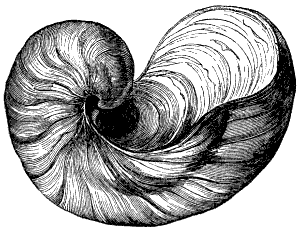
Fig. 88.—Gryphæa incurva.
3. Lower Lias (averaging from 600 to 900 feet in thickness) consists, in the lower part, of thin layers of bluish argillaceous limestone, alternating with shales and clays; the whole overlaid by the blue clay of which the lower member of the Liassic group usually consists. This member of the series is well developed in Yorkshire, at Lyme Regis and Charmouth in Dorsetshire, and generally over the South-West and Midland Counties of England. Gryphæa incurva (Fig. 88), with sandy bands, occurs at the base, in addition to which we find Ammonites planorbis Bucklandi, A. Ostrea liassica, Lima gigantea, Ammonites Bucklandi, &c., in the lower limestones and shales.
Above the clay are yellow sands from 100 to 200 feet thick, underlying the limestone of the Inferior Oolite. These sands were, until lately, considered to belong to the latter formation—as they undoubtedly do physically—until they were shown, by Dr. Thomas Wright, of Cheltenham, to be more nearly allied, by their fossils, to the Lias below than to the Inferior Oolite above, into which they form the passage-beds.
In France the Lias abounds in the Calvados, in Burgundy, Lorraine, Normandy, and the Lyonnais. In the Vosges and Luxembourg, M. Elie de Beaumont states that the Lias containing Gryphæa incurva and Lima gigantea, and some other marine fossils, becomes arenaceous; and around the Harz mountains, in Westphalia and Bavaria, in its lower parts the formation is sandy, and is sometimes a good building-stone.
“In England the Lias constitutes,” says Professor Ramsay, “a well-defined belt of strata, running continuously from Lyme Regis, on the south-west, through the whole of England, to Yorkshire on the north-east, and is an extensive series of alternating beds of clay, shale, and limestone, with occasional layers of jet in the upper part. The unequal hardness of the clays and limestones of the Liassic strata causes some of its members to stand out in the distinct minor escarpments, often facing the west and north-west. The Marlstone forms the most prominent of these, and overlooks the broad meadows of the lower Lias-clay, that form much of the centre of England.” In Scotland there are few traces of the Lias. Zoophytes, Mollusca, and Fishes of a peculiar organisation, but, above all, Reptiles of extraordinary size and structure gave to the sea of the Liassic period an interest and features quite peculiar. Well might Cuvier exclaim, when the drawings of the Plesiosaurus were sent to him: “Truly this is altogether the most monstrous animal that has yet been dug out of the ruins of a former world!” In the whole of the English Lias there are about 243 genera, and 467 species of fossils. The whole series has been divided into zones characterised by particular Ammonites, which are found to be limited to them, at least locally.
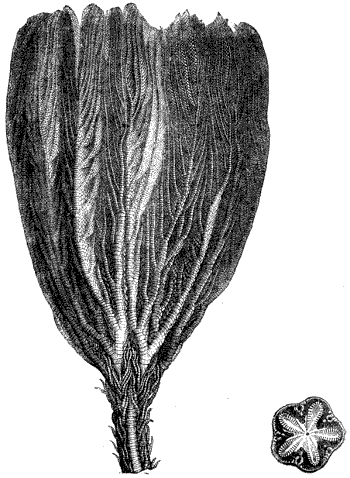
Fig. 89.—Pentacrinites Briareus. Half natural size.
Among the Echinodermata belonging to the Lias we may cite Asterias lumbricalis and Palæocoma Furstembergii, which constitutes a genus not dissimilar to the star-fishes, of which its radiated form reminds us. The Pentacrinites, of which Pentacrinites Briareus is a type, ornaments many collections by its elegant form, and is represented in Figs. 79 and 89. It belongs to the order of Crinoidea, which is represented at the present time by a single living species, Pentacrinus caput-Medusæ, one of the rare and delicate Zoophytes of the Caribbean sea.
Oysters (Ostrea) made their appearance in the Muschelkalk of the last period, but only in a small number of species; they increased greatly in importance in the Liassic seas.
The Ammonites, a curious genus of Cephalopoda, which made their first appearance in small numbers towards the close of the preceding Triassic period, become quite special in the Secondary epoch, with the close of which they disappear altogether. They were very abundant in the Jurassic period, and, as we have already said, each zone is characterised by its peculiar species. The name is taken from the resemblance of the shell to the ram’s-horn ornaments which decorated the front of the temple of Jupiter Ammon and the bas-reliefs and statues of that pagan deity. They were Cephalopodous Mollusca with circular shells, rolled upon themselves symmetrically in the same plane, and divided into a series of chambers. The animal only occupied the outer chamber of the shell; all the others were empty. A siphon or tube issuing from the first chamber traversed all the others in succession, as is seen in all the Ammonites and Nautili. This tube enabled the animal to rise to the surface, or to sink to the bottom, for the Ammonite could fill the chambers with water at pleasure, or empty them, thus rendering itself lighter or heavier as occasion required. The Nautilus of our seas is provided with the same curious organisation, and reminds us forcibly of the Ammonites of geological times.
Shells are the only traces which remain of the Ammonites. We have no exact knowledge of the animal which occupied and built them. The attempt at restoration, as exhibited in Fig. 91, will probably convey a fair idea of the Ammonite when living. We assume that it resembled the Nautilus of modern times. What a curious aspect these early seas must have presented, covered by myriads of these Molluscs of all sizes, swimming about in eager pursuit of their prey!
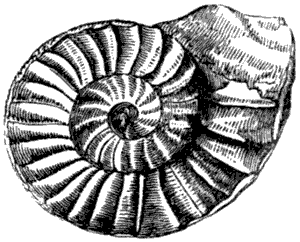
Fig. 90.—Ammonites Turneri, from the Lower Lias.
The Ammonites of the Jurassic age present themselves in a great variety of forms and sizes; some of them of great beauty. Ammonites bifrons, A. Noditianus, A. bisulcatus, A. Turneri (Fig. 90), and A. margaritatus, are forms characteristic of the Lias.
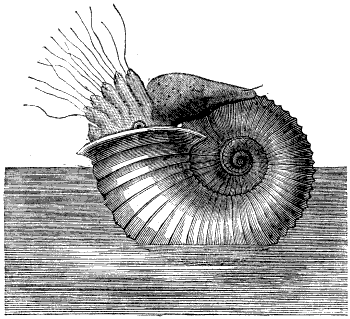
Fig. 91.—Ammonite restored.
The Belemnites, molluscous Cephalopods of a very curious organisation, appeared in great numbers, and for the first time, in the Jurassic seas. Of this Mollusc we only possess the fossilised internal “bone,” analogous to that of the modern cuttle-fish and the calamary of the present seas. This simple relic is very far from giving us an exact idea of what the animal was to which the name of Belemnite has been given (from Βελεμνον, a dart) from their supposed resemblance to the head of a javelin. The slender cylindrical bone, the only vestige remaining to us, was merely the internal skeleton of the animal. When first discovered they were called, by the vulgar, “Thunder-stones” and “Ladies’ fingers.” They were, at last, inferred to be the shelly processes of some sort of ancient cuttle-fish. Unlike the Ammonite, which floated on the surface and sunk to the bottom at pleasure, the Belemnite, it has been thought, swam nearer the bottom of the sea, and seized its prey from below.
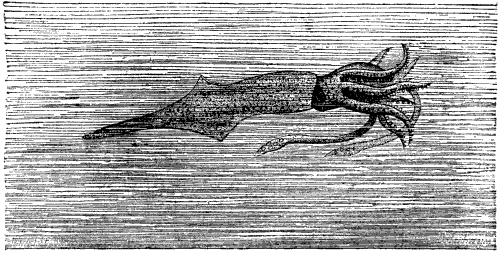
Fig. 92.—Belemnite restored.
In Fig. 92 is given a restoration of the living Belemnite, by Dr. Buckland and Professor Owen, in which the terminal part of the animal is marked in a slightly darker tint, to indicate the place of the bone which alone represents in our days this fossilised being. A sufficiently exact idea of this Mollusc may be arrived at from the existing cuttle-fish. Like the cuttle-fish, the Belemnite secreted a black liquid, a sort of ink or sepia; and the bag containing the ink has frequently been found in a fossilised state, with the ink dried up, and elaborate drawings have been made with this fossil pigment.
The beaks, or horny mandibles of the mouth, which the Belemnite possessed in common with the other naked Cephalopoda, are represented in Fig. 78, p. 181.
As Sir H. De la Beche has pointed out, the destruction of the animals whose remains are known to us by the name of Belemnites was exceedingly great when the upper part of the Lias of Lyme Regis was deposited. Multitudes seem to have perished almost simultaneously, and millions are entombed in a bed beneath Golden Cap, a lofty cliff between Lyme Regis and Bridport Harbour, as well as in the upper Lias generally.[62]
Among the Belemnites characteristic of the Liassic period may be cited B. acutus (Fig. 93), B. pistiliformis, and B. sulcatus.
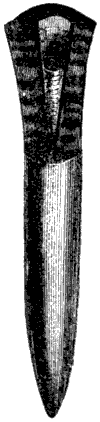
Fig. 93.—Belemnites acutus.
The seas of the period contained a great number of the fishes called Ganoids; which are so called from the splendour of the hard and enamelled scales, which formed a sort of defensive armour to protect their bodies. Lepidotus gigas was a fish of great size belonging to this age. A smaller fish was the Tetragonolepis, or Æchmodus Buchii. The Acrodus nobilis, of which the teeth are still preserved, and popularly known by the name of fossil leeches, was a fish of which an entire skeleton has never been met with. Neither are we better informed as to the Hybodus reticulatus. The bony spines, which form the anterior part of the dorsal fin of this fish, had long been an object of curiosity to geologists, under the general name of Ichthyodorulites, before they were known to be fragments of the fin of the Hybodus. The Ichthyodorulites were supposed by some naturalists to be the jaw of some animal—by others, weapons like those of the living Balistes or Silurus; but Agassiz has shown them to be neither the one nor the other, but bony spines on the fin, like those of the living genera of Cestracions and Chimæras, in both of which the concave face is armed with small spines like those of the Hybodus. The spines were simply imbedded in the flesh, and attached to it by strong muscles. “They served,” says Dr. Buckland, “as in the Chimæra, to raise and depress the fin, their action resembling that of a movable mast lowering backward.”
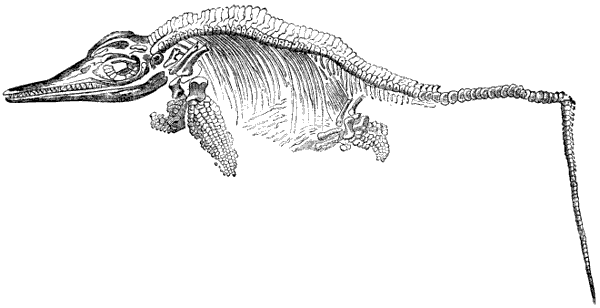
Fig. 94.—Ichthyosaurus communis.
Let us hasten to say, however, that these are not the beings that characterised the age, and were the salient features of the generation of animals which existed during the Jurassic period. These distinguishing features are found in the enormous reptiles with lizard’s head, crocodile’s conical teeth, the trunk and tail of a quadruped, whale-like paddles, and the double-concave vertebræ of fishes; and this strange form, on such a gigantic scale that even their inanimate remains are examined with a curiosity not unmixed with awe. The country round Lyme Regis, in Dorsetshire, has long been celebrated for the curious fossils discovered in its quarries, and preserved in the muddy accumulations of the sea of the Liassic period. The country is hilly—“up one hill and down another,” is a pretty correct provincial description of the walk from Bridport to Lyme Regis—where some of the most frightful creatures the living world has probably ever beheld, sleep the sleep of stones. The quarries of Lyme Regis form the cemetery of the Ichthyosauri; the sepulchre where lie interred these dragons of the ancient seas.
In 1811 a country girl, who made her precarious living by picking up fossils for which the neighbourhood was famous, was pursuing her avocation, hammer in hand, when she perceived some bones projecting a little out of the cliff. Finding, on examination, that it was part of a large skeleton, she cleared away the rubbish, and laid bare the whole creature imbedded in the block of stone. She hired workmen to dig out the block of Lias in which it was buried. In this manner was the first of these monsters brought to light: “a monster some thirty feet long, with jaws nearly a fathom in length, and huge saucer-eyes; which have since been found so perfect, that the petrified lenses have been split off and used as magnifiers,” as a writer in All the Year Round assures us.
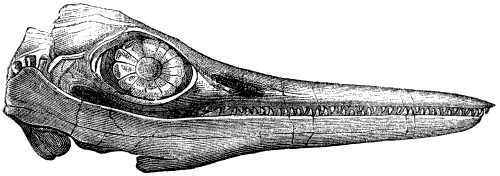
Fig. 95.—Head of Ichthyosaurus platydon.
In Fig. 95 the head of I. platydon is represented. As in the Saurians, the openings of the nostrils are situated near the anterior angle of the orbits of the eyes, while those of the Crocodile are near the snout; but, on the other hand, in its osteology and its mode of dentition it nearly resembles the Crocodile; the teeth are pointed and conical—not, however, set in deep or separate sockets, but only implanted in a long and deep continuous groove hollowed in the bones of the jaw. These strong jaws have an enormous opening; for, in some instances, they have been found eight feet in length and armed with 160 teeth. Let us add that teeth lost through the voracity of the animal, or in contests with other animals, could be renewed many times; for, at the inner side of the base of every old tooth, there is always the bony germ of a new one.
The eyes of this marine monster were much larger than those of any animal now living; in volume they frequently exceed the human head, and their structure was one of their most remarkable peculiarities. In front of the sclerotic coat or capsule of the eye there is an annular series of thin bony plates, surrounding the pupil. This structure, which is now only met with in the eyes of certain turtles, tortoises, and lizards, and in those of many birds, could be used so as to increase or diminish the curvature of the transparent cornea, and thus increase or diminish the magnifying power, according to the requirements of the animal—performing the office, in short, of a telescope or microscope at pleasure. The eyes of the Ichthyosaurus were, then, an optical apparatus of wonderful power and of singular perfection, enabling the animal, by their power of adaptation and intensity of vision, to see its prey far and near, and to pursue it in the darkness and in the depths of the sea. The curious arrangement of bony plates we have described furnished, besides, to its globular eye, the power necessary to bear the pressure of a considerable weight of water, as well as the violence of the waves, when the animal came to the surface to breathe, and raised its head above the waves. This magnificent specimen of the fish-lizard, or Ichthyosaurus, as it was named by Dr. Ure, now forms part of the treasures of the British Museum.
At no period in the earth’s history have Reptiles occupied so important a place as they did in the Jurassic period. Nature seems to have wished to bring this class of animals to the highest state of development. The great Reptiles of the Lias are as complicated in their structure as the Mammals which appeared at a later period. They probably lived, for the most part, by fishing in shallow creeks and bays defended from heavy breakers, or in the open sea; but they seem to have sought the shore from time to time; they crawled along the beach, covered with a soft skin, perhaps not unlike some of our Cetaceæ. The Ichthyosaurus, from its form and strength, may have braved the waves of the sea as the porpoise does now. Its destructiveness and voracity must have been prodigious, for Dr. Buckland describes a specimen which had between its ribs, in the place where the stomach might be supposed to have been placed, the skeleton of a smaller one—a proof that this monster, not content with preying on its weaker neighbours, was in the habit of devouring its own kind. In the same waters lived the Plesiosaurus, with long neck and form more strange than that of the Ichthyosaurus; and these potentates of the seas were warmed by the same sun and tenanted the same banks, in the midst of a vegetation not unlike that which the climate of Africa now produces.
The great Saurians in the Lias of Lyme Regis seem to have suffered a somewhat sudden death, partly in consequence of a series of small catastrophes suddenly destroying the animals then existing in particular spots. “In general the bones are not scattered about, and in a detached state, as would happen if the dead animal had descended to the bottom of the sea, to be decomposed, or devoured piecemeal, as, indeed, might also happen if the creature floated for a time on the surface, one animal devouring one part, and another carrying off a different portion; on the contrary, the bones of the skeleton, though frequently compressed, as must arise from the enormous pressure to which they have so long been subjected, are tolerably connected, frequently in perfect, or nearly perfect, order, as if prepared by the anatomist. The skin, moreover, may sometimes be traced, and the compressed contents of the intestines may at times be also observed—all tending to show that the animals were suddenly destroyed, and as suddenly preserved.”[63]
These strange and gigantic Saurians seem almost to disappear during the succeeding geological periods; for, although they have been discovered as low down as the Trias in Germany, and as high up as the Chalk in England, they only appear as stragglers in these epochs; so, too, the Reptiles, the existing Saurians are, as it were, only the shadowy, feeble representatives of these powerful races of the ancient world.
Confining ourselves to well-established facts, we shall consider in some detail the best known of these fossil reptiles—the Ichthyosaurus, Plesiosaurus, and Pterodactyle.
The extraordinary creature which bears the name of Ichthyosaurus (from the Greek words Ιχθυς σαυρος, signifying fish-lizard), presents certain dispositions and organic arrangements which are met with dispersed in certain classes of animals now living, but they never seem to be again reunited in any single individual. It possesses, as Cuvier says, the snout of a dolphin, the head of a lizard, the jaws and teeth of a crocodile, the vertebræ of a fish, the head and sternum of a lizard, the paddles like those of a whale, and the trunk and tail of a quadruped.
Bayle appears to have furnished the best idea of the Ichthyosaurus by describing it as the Whale of the Saurians—the Cetacean of the primitive seas. It was, in fact, an animal exclusively marine; which, on shore, would rest motionless like an inert mass. Its whale-like paddles, and fish-like vertebræ, the length of the tail and other parts of its structure, prove that its habits were aquatic; as the remains of fishes and reptiles, and the form of its teeth, show that it was carnivorous. Like the Whale, also, the Ichthyosaurus breathed atmospheric air; so that it was under the necessity of coming frequently to the surface of the water, like that inhabitant of the deep. We can even believe, with Bayle, that it was provided, like the Whale, with vents or blowers, through which it ejected, in columns into the air, the water it had swallowed.
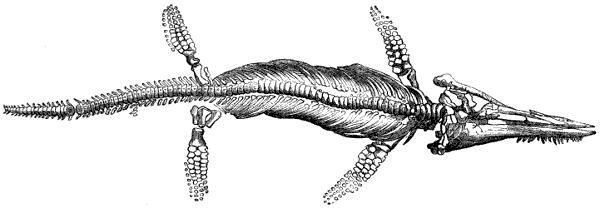
Fig. 96.—Ichthyosaurus platydon.
The dimensions of the Ichthyosaurus varied with the species, of which five are known and described. These are Ichthyosaurus communis, I. platydon, I. intermedius, I. tenuirostris, and I. Cuvierii, the largest being more than thirty feet in length.
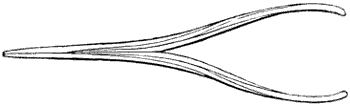
Fig. 97.—Lower jaw of Ichthyosaurus. (Dr. Buckland.)
The short, thick neck of the Ichthyosaurus supported a capacious head, and was continued backwards, from behind the eyes, in a column composed of more than a hundred vertebræ. The animal being adapted, like the whale, for rapid movement through the water, its vertebræ had none of the invariable solidity of those of the Lizard or Crocodile, but rather the structure and lightness of those of Fishes. The section of these vertebræ presents two hollow cones, connected only by their summits to the centre of the vertebræ, which would permit of the utmost flexibility of movement. The ribs extended along the entire length of the vertebral column, from the head to the pelvis. The bones of the sternum, or that part of the frame which supported the paddles, present the same combinations with those of the sternum in the Ornithorhynchus, or Duck-billed Platypus, of New Holland, an animal which presents the singular combination of a mammalian furred quadruped having the bill of a duck and webbed feet; which dived to the bottom of the water in search of its food, and returned to the surface to breathe the air. In this phenomenon of living Nature the Creator seems to have repeated, in our days, the organic arrangements which he had originally provided for the Ichthyosaurus.
In order that the animal should be able to move with rapidity in the water, both its anterior and posterior members were converted into fins or paddles. The anterior fins were half as large again as the posterior. In some species each paddle was made up of nearly a hundred bones, of polygonal form, and disposed in series representing the phalanges of the fingers. This hand, jointed at the arm, bears resemblance, in osteological construction, to the paddles, without distinct fingers, of the Porpoise and the Whale. A specimen of the posterior fin of I. communis, discovered at Barrow-on-Soar, in Leicestershire, in 1840, by Sir Philip Egerton, exhibited on its posterior margin the remains of cartilaginous rays, which bifurcated as they approached the edge, like those in the fins of a fish. “It had previously been supposed,” says Professor Owen, “that the locomotive organs were enveloped, while living, in a smooth integument, like that of the turtle and porpoise, which has no other support than is afforded by the bones and ligaments within; but it now appears that the fin was much larger, expanding far beyond the osseous frame-work, and deviating widely in its fish-like rays from the ordinary reptilian type.” The Professor believes that, besides the fore-paddles, these stiff-necked Saurians were furnished at the end of the tail with a fin to assist them in turning, not placed horizontally, as in the whale, but vertically, forming a powerful instrument of progression and motion. It is obvious that the Ichthyosaurus was an animal powerfully armed for offence and defence. We cannot say, with certainty, whether the skin was smooth, like that of the whale or lizard, or covered with scales, like the great reptiles of our own age. Nevertheless, as the scales of the Fishes and the cuirass and horny armour of other Reptiles of the Lias are preserved, and as no such defensive scales have been found belonging to the Ichthyosaurus, it is probable that the skin was naked and smooth. The tail, composed of from eighty to eighty-five vertebræ, was provided with large and long paddles, arranged vertically as in the Whale.
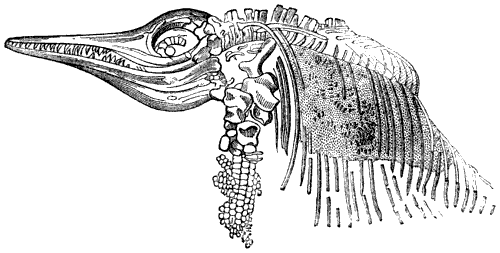
Fig. 98.—Skeleton of Ichthyosaurus. Containing teeth and bones of Fishes in a coprolitic form. One-fifteenth natural size.
It is curious to see to what a degree of perfection has been carried, in our days, the knowledge of the antediluvian animals, their habits, and their economy. Fig. 98 represents the skeleton of an Ichthyosaurus found in the Lias of Lyme Regis, which still retains in its abdominal cavity coprolites, that is to say, the residue of digestion. The soft parts of the intestinal canal have disappeared, but the fæces themselves are preserved, and their examination informs us as to the alimentary regimen of this animal which has perished from the earth many thousands, perhaps millions, of years. Mary Anning, to whom we owe many of the discoveries made in the neighbourhood of Lyme Regis, her native place, had in her collection an enormous coprolite of the Ichthyosaurus. This coprolite (Fig. 99) contained some bones and scales of Fishes, and of divers Reptiles, well enough preserved to have their species identified. It only remains to be added that, among the bones, those of the Ichthyosaurus were often found, especially those of young individuals. The presence of the undigested remains of vertebræ and other bones of animals of its own species in the coprolites of the Ichthyosaurus proves, as we have already had occasion to remark, that this great Saurian must have been a most voracious monster, since it habitually devoured not only fish, but individuals of its own race—the smaller becoming the prey of the larger. The structure of the jaw of the Ichthyosaurus leads us to believe that the animal swallowed its prey without dividing it. Its stomach and intestines must, then, have formed a sort of pouch of great volume, filling entirely the abdominal cavity, and corresponding in extent to the great development of the teeth and jaws.
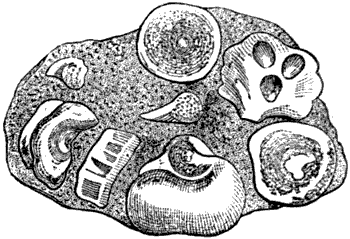
Fig. 99.—Coprolite, enclosing bones of small Ichthyosaurus.
The perfection with which its contents have been preserved in the fossilised coprolites, furnishes indirect proofs that the intestinal canal of the Ichthyosaurus resembled closely that of the shark and the dog-fish—fishes essentially voracious and destructive, which have the intestinal canal spirally convoluted, an arrangement which is exactly that indicated in some of the coprolites of the Ichthyosaurus, as is evident from the impressions which the folds of the intestine have left on the coprolite, of which Fig. 100 is a representation. In the cliffs near Lyme Regis coprolites are abundant in the Liassic formation, and have been found disseminated through the shales and limestones along many miles of that coast.
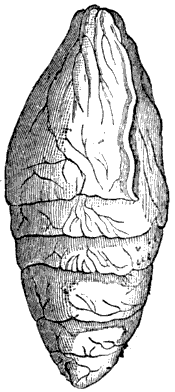
Fig. 100.—Coprolite of Ichthyosaurus.
What an admirable privilege of science, which is able, by an examination of the simplest parts in the organisation of beings which lived ages ago, to give to our minds such solid teachings and such true enjoyments! “When we discover,” says Dr. Buckland, “in the body of an Ichthyosaurus the food which it has engulfed an instant before its death, when the intervals between its sides present themselves still filled with the remains of fishes which it had swallowed some ten thousand years ago, or a time even twice as great, all these immense intervals vanish, time disappears, and we find ourselves, so to speak, thrown into immediate contact with events which took place in epochs immeasurably distant, as if we occupied ourselves with the affairs of the previous day.”
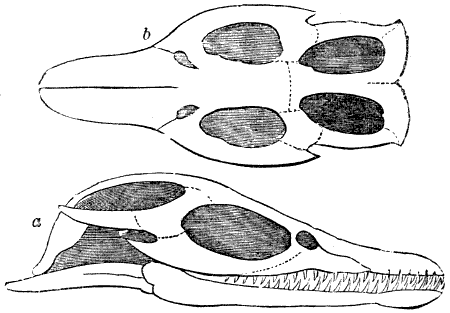
Fig. 101.—Skull of Plesiosaurus restored. (Conybeare.) a, profile; b, seen from above.
The name of Plesiosaurus (from the Greek words πλησιος, near, and σαυρος, lizard) reminds us that this animal, though presenting many peculiarities of general structure, is allied by its organisation to the Saurian or Lizard family, and, consequently, to the Ichthyosaurus.
The Plesiosaurus presents, in its organic structure, the most curious assemblage we have met with among the organic vestiges of the ancient world. The Plesiosaurus was a marine, air-breathing, carnivorous reptile, combining the characters of the head of a Lizard, the teeth of a Crocodile, a neck of excessive length resembling that of a Swan, the ribs of a Chameleon, a body of moderate size, and a very short tail, and, finally, four paddles resembling those of a Whale. Let us bestow a glance upon the remains of this strange animal which the earth has revealed, and which science has restored to us.
The head of the Plesiosaurus presents a combination of the characters belonging to the Ichthyosaurus, the Crocodile, and the Lizard. Its enormously long neck comprises a greater number of vertebræ than the neck of either the Camel, the Giraffe, or even the Swan, which of all the feathered race has the longest neck in comparison to the rest of the body. And it is to be remarked, that, contrary to what obtains in the Mammals, where the vertebræ of the neck are always seven, the vertebræ in birds increase in number with the length of the neck.
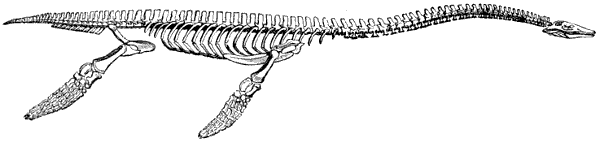
Fig. 102.—Skeleton of Plesiosaurus dolichodeirus restored. (Conybeare principally.)
The body is cylindrical and rounded, like that of the great marine Turtles. It was, doubtless, naked, i.e., not protected with the scales or carapace with which some authors have invested it; for no traces of such coverings have been found near any of the skeletons which have been hitherto discovered. The dorsal vertebræ are attached to each other by nearly plane surfaces like those of terrestrial quadrupeds, a mode of arrangement which must have deprived the whole of its vertebral column of much of its flexibility. Each pair of ribs surrounded the body with a complete girdle, formed of five pieces, as in the Chameleon and Iguana; whence, no doubt, as with the Chameleon, great facilities existed for the contraction and dilatation of the lungs.
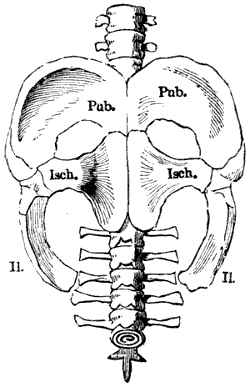
Fig. 103.—Sternum and pelvis of Plesiosaurus. Pub., pubis; Isch., ischium; Il., ilium.
The breast, the pelvis, and the bones of the anterior and posterior extremities furnished an apparatus which permitted the Plesiosaurus, like the Ichthyosaurus and existing Cetaceans, to sink in the water and return to the surface at pleasure (Fig. 103). Prof. Owen, in his “Report on British Reptiles,” characterises them as air-breathing and cold-blooded animals; the proof that they respired atmospheric air immediately, being found in the position and structure of the nasal passages, and the bony mechanism of the thoracic duct and abdominal cavity. In the first, the size and position of the external nostrils (Fig. 102), combined with the structure of the paddles, indicate a striking analogy between the extinct Saurians and the Cetaceans, offering, as the Professor observes, “a beautiful example of the adaptation of structure to the peculiar exigencies of species.” While the evidence that they were cold-blooded animals is found in the flexible or unanchylosed condition of the osseous pieces of the occiput and other cranial bones of the lower jaw, and of the vertebral column; from which the Professor draws the conclusion that the heart was adapted for transmitting a part only of the blood through the respiratory organs; the absence of the ball-and-socket articulations of the bones of the vertebræ, the position of the nostrils near the summit of the head, the numerous short and flat digital bones, which must have been enveloped in a simple undivided integumentary sheath, forming in both fore and hind extremities a paddle closely resembling that of the living Cetacea. The paddles are larger and more powerful than those of the Ichthyosaurus, to compensate for the slight assistance the animal derived from the tail. The latter—shorter, as compared with the length of the rest of the body, than in the Ichthyosaurus—was more calculated to act the part of a rudder, in directing the course of the animal through the water, than as a powerful organ of propulsion.
Such were the strange combinations of form and structure in the Plesiosaurus and Ichthyosaurus—genera of animals whose remains have, after an interment extending to unknown thousands of years, been revealed to light and submitted to examination; nay, rebuilt, bone by bone, until we have the complete skeletons before us, and the habits of the animals described, as if they had been observed in life. Conybeare thus speaks of the supposed habits of these extinct forms, which he had built up from scanty materials: “That the Plesiosaurus was aquatic is evident from the form of its paddles; that it was marine is equally so, from the remains with which it is universally associated; that it may have occasionally visited the shore, the resemblance of its extremities to the turtle may lead us to conjecture; its motion, however, must have been very awkward on land; its long neck must have impeded its progress through the water, presenting a striking contrast to the organisation which so admirably fits the Ichthyosaurus for cutting through the waves. May it not, therefore, be concluded that it swam on or near the surface, arching back its long neck like the swan, and occasionally darting it down at the fish which happened to float within its reach? It may, perhaps, have lurked in shallow water along the coasts, concealed among the sea-weeds, and, raising its nostrils to the surface from a considerable depth, may have found a secure retreat from the assaults of dangerous enemies, while the length and flexibility of its neck may have compensated for the want of strength in its jaws, and incapacity for swift motion through the water, by the suddenness and agility of the attack they enabled it to make on every animal fitted to become its prey.”
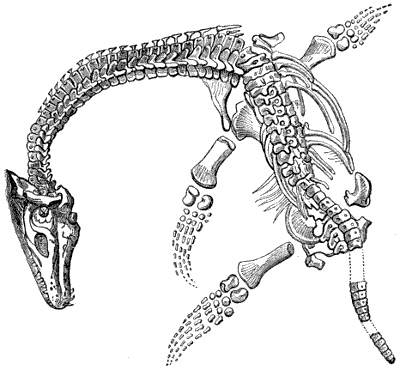
Fig. 104.—Remains of Plesiosaurus macrocephalus. One-twelfth natural size.
The Plesiosaurus was first described by the Rev. W. D. Conybeare and Sir Henry De la Beche, in the “Geological Society’s Transactions” for 1821, and a restoration of P. dolichodeirus, the most common of these fossils, appeared in the same work for 1824. The first specimen was discovered, as the Ichthyosaurus had been previously, in the Lias of Lyme Regis; since then other individuals and species have been found in the same geological formation in various parts of England, Ireland, France, and Germany, and with such variations of structure that Professor Owen has felt himself justified in recording sixteen distinct species, of which we have represented P. dolichodeirus (Fig. 102), as restored by Conybeare, and P. macrocephalus (Fig. 104), with its skeleton, as moulded from the limestone of Lyme Regis, which has been placed in the Palæontological Gallery of the British Museum.
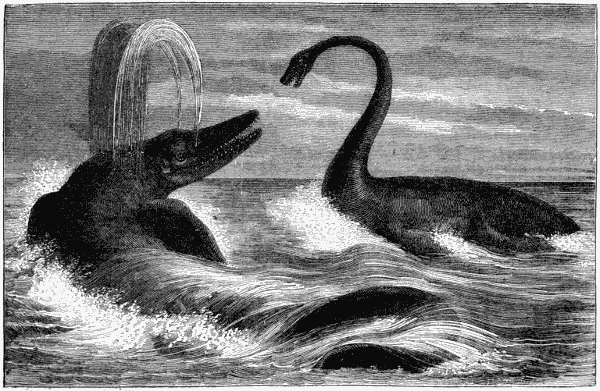
XV.—Ideal scene of the Lias with Ichthyosaurus and Plesiosaurus.
The Plesiosaurus was scarcely so large as the Ichthyosaurus. The specimen of I. platydon in the British Museum probably belonged to an animal four-and-twenty feet long, and some are said to indicate thirty feet, while there are species of Plesiosauri measuring eighteen and twenty, the largest known specimen of Plesiosaurus Cramptoni found in the lias of Yorkshire, and now in the Museum of the Royal Society of Dublin, being twenty-two feet four inches in length. On the opposite page (Plate XV.) an attempt is made to represent these grand reptiles of the Lias in their native element, and as they lived.
Cuvier says of the Plesiosaurus, “that it presents the most monstrous assemblage of characteristics that has been met with among the races of the ancient world.” This expression should not be understood in a literal sense; there are no monsters in Nature; in no living creature are the laws of organisation ever positively infringed; and it is more in accordance with the general perfection of creation to see in an organisation so special, in a structure which differs so notably from that of the animals of our own days, the simple development of a type, and sometimes also the introduction of beings, and successive changes in their structure. We shall see, in examining the curious series of animals of the ancient world, that the organisation and physiological functions go on improving unceasingly, and that each of the extinct genera which preceded the appearance of man, present, for each organ, modifications which always tend towards greater perfection. The fins of the fishes of Devonian seas become the paddles of the Ichthyosauri and of the Plesiosauri; these, in their turn, become the membranous foot of the Pterodactyle, and, finally, the wing of the bird. Afterwards comes the articulated fore-foot of the terrestrial mammalia, which, after attaining remarkable perfection in the hand of the ape, becomes, finally, the arm and hand of man, an instrument of wonderful delicacy and power, belonging to an enlightened being gifted with the divine attribute of reason! Let us, then, dismiss any idea of monstrosity with regard to these antediluvian animals; let us learn, on the contrary, to recognise, with admiration, the divine proofs of design which they display, and in their organisation to see only the handiwork of the Creator.
Another strange inhabitant of the ancient world, the Pterodactylus (from πτερον, a wing, and δακτυλος, a finger), discovered in 1828, made Cuvier pronounce it to be incontestably the most extraordinary of all the extinct animals which had come under his consideration; and such as, if we saw them restored to life, would appear most strange and dissimilar to anything that now exists. In size and general form, and in the disposition and character of its wings, this fossil genus, according to Cuvier, somewhat resembled our modern bats and vampyres, but had its beak elongated like the bill of a woodcock, and armed with teeth like the snout of a crocodile; its vertebræ, ribs, pelvis, legs, and feet resembled those of a lizard; its three anterior fingers terminated in long hooked claws like that on the fore-finger of the bat; and over its body was a covering, neither composed of feathers as in the bird, nor of hair as in the bat, but probably a naked skin; in short, it was a monster resembling nothing that has ever been heard of upon earth, except the dragons of romance and heraldry. Moreover, it was probably noctivagous and insectivorous, and in both these points resembled the bat; but differed from it in having the most important bones in its body constructed after the manner of those of reptiles.
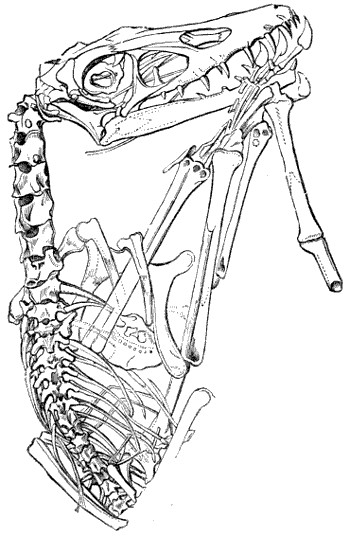
Fig. 105.—Pterodactylus crassirostris.
“Thus, like Milton’s fiend, all-qualified for all services and all elements, the creature was a fit companion for the kindred reptiles that swarmed in the seas, or crawled on the shores, of a turbulent planet:
“The Fiend, O’er bog, or steep, through strait, rough, dense, or rare, With head, hands, wings, or feet, pursues his way, And sinks, or swims, or wades, or creeps, or flies.
Paradise Lost, Book II., line 947.
“With flocks of such-like creatures flying in the air, and shoals of Ichthyosauri and Plesiosauri swarming in the ocean, and gigantic Crocodiles and Tortoises crawling on the shores of primæval lakes and rivers—air, sea, and land must have been strangely tenanted in these early periods of our infant world.”[64]
The strange structure of this animal gave rise to most contradictory opinions from the earlier naturalists. One supposed it to be a bird, another a bat, and others a flying reptile. Cuvier was the first to detect the truth, and to prove, from its organisation, that the animal was a Saurian. “Behold,” he says, “an animal which in its osteology, from its teeth to the end of its claws, presents all the characters of the Saurians; nor can we doubt that their characteristics existed in its integuments and softer parts, in its scales, its circulation, its generative organs: it was at the same time provided with the means of flight; but when stationary it could not have made much use of its anterior extremities, even if it did not keep them always folded as birds fold their wings. It might, it is true, use its small anterior fingers to suspend itself from the branches of trees; but when at rest it must have been generally on its hind feet, like the birds again, and like them it must have carried its neck half-erect and curved backwards, so that its enormous head should not disturb its equilibrium.” This diversity of opinion need not very much surprise us after all, for, with the body and tail of an ordinary mammal, it had the form of a bird in its head and the length of its neck, of the bat in the structure and proportion of its wings, and of a reptile in the smallness of its head and in its beak, armed with at least sixty equal sharp-pointed teeth, differing little in form and size.
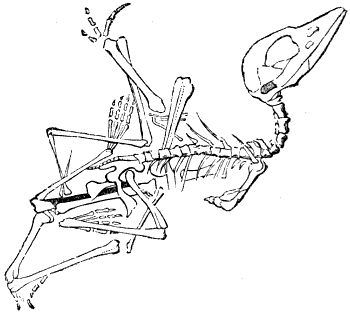
Fig. 106.—Pterodactylus brevirostris.
Dr. Buckland describes eight distinct species, varying in size from a snipe to a cormorant. Of these, P. crassirostris (Fig. 105) and P. brevirostris (Fig. 106), were both discovered in the Lias of Solenhofen. P. macronyx belongs to the Lias of Lyme Regis.
The Pterodactyle was, then, a reptile provided with wings somewhat resembling those of Bats, and formed, as in that Mammal, of a membrane which connected the body with the excessively elongated phalanges of the fourth finger, which served to expand the membrane that answered the purposes of a wing. The Pterodactyle of the Liassic period was, as we have seen, an animal of small size; the largest species in the older Lias beds did not exceed ten or twelve inches in length, or the size of a raven, while the later forms found fossil in the Greensand and Wealden beds must have measured more than sixteen feet between the tips of the expanded wings. On the other hand, its head was of enormous dimensions compared with the rest of the body. We cannot admit, therefore, that this animal could really fly, and, like a bird, beat the air. The membranous appendage which connected its long finger with its body was rather a parachute than a wing. It served to moderate the velocity of its descent when it dropped on its prey from a height. Essentially a climber, it could only raise itself by climbing up tall trees or rocks, after the manner of lizards, and throw itself thence to the ground, or upon the lower branches, by making use of its natural parachute.
The ordinary position of the Pterodactyle was probably upon its two hind feet, the lower extremities being adapted for standing and moving on the ground, after the manner of birds. Habitually, perhaps, it perched on trees; it could creep, or climb along rocks and cliffs, or suspend itself from trees, with the assistance of its claws and feet, after the manner of existing Bats. It is even probable, Dr. Buckland thought, that it had the power of swimming and diving, so common to reptiles, and possessed by the Vampyre Bat of the island of Bonin. It is believed that the smaller species lived upon insects, and the larger preyed upon fishes, upon which it could throw itself like the sea-gull.
The most startling feature in the organisation of this animal is the strange combination of two powerful wings attached to the body of a reptile. The imagination of the poets long dwelt on such a combination; the Dragon was a creation of their fancy, and it played a great part in fable and in pagan mythology. The Dragon, or flying reptile, breathing fire and poisoning the air with his fiery breath, had, according to the fable, disputed with man the possession of the earth. Gods and demigods claimed, among their most famous exploits, the glory of having vanquished this powerful and redoubtable monster.
Among the animals of our epoch, only a single reptile is found provided with wings, or digital appendages analogous to the membranous wings of the bats, and which can be compared to the Pterodactyle. This is called the Dragon, one of the Draconidæ, a family of Saurians, which has been described by Daudin, as distinguished by the first six ribs, instead of hooping round the abdomen, extending in nearly a straight line, and sustaining a prolongation of skin which forms a sort of wing analogous to that of the Pterodactyle. Independent of the four feet, this wing sustains the animal, like a parachute, as it leaps from branch to branch; but the creature has no power to beat the air with it as birds do when flying. This reptile lives in the forests of the hottest parts of Africa, and in some isles of the Indian Ocean, especially in Sumatra and Java. The only known species is that figured at page 238 (Fig. 107), which comes from the East Indies.
What a strange population was that which occupied the earth at this stage of its history, when the waters were filled with creatures so extraordinary as those whose history we have traced! Plesiosauri and Ichthyosauri filled the seas, upon the surface of which floated innumerable Ammonites in light skiffs, some of them as large as a good-sized cart-wheel, while gigantic Turtles and Crocodiles crawled on the banks of the rivers and lakes. Only one genus of Mammals had yet appeared, but no birds; nothing broke the silence of the air, if we except the breathing of the terrestrial reptiles and the flight of winged insects.
The earth cooled progressively up to the Jurassic period, the rains lost their continuity and abundance, and the pressure of the atmosphere sensibly diminished. All these circumstances favoured the appearance and the multiplication of innumerable species of animals, whose singular forms then showed themselves on the earth. We can scarcely imagine the prodigious quantity of Molluscs and Zoophytes whose remains lie buried in the Jurassic rocks, forming entire strata of immense thickness and extent.
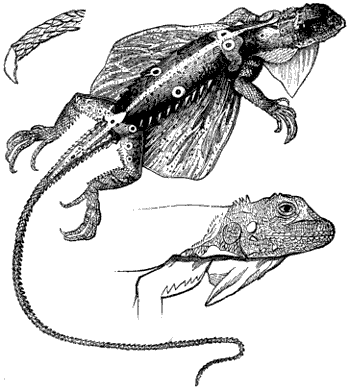
Fig. 107.—Draco volans.
The same circumstances concurred to favour the production of plants. If the shores and seas of the period received such a terrible aspect from the formidable animals we have described, the vegetation which covered the land had also its peculiar character and appearance. Nothing that we know of in the existing scenery of the globe surpasses the rich vegetation which decorated the continents of the Jurassic period. A temperature still of great elevation, a humid atmosphere, and, we have no reason to doubt, a brilliant sun, promoted the growth of a luxuriant vegetation, such as some of the tropical islands, with their burning temperature and maritime climate, can only give us an idea of, while it recalls some of the Jurassic types of vegetation. The elegant Voltzias of the Trias had disappeared, but the Horse-tails (Equiseta) remained, whose slender and delicate stems rose erect in the air with their graceful panicles; the gigantic rushes also remained; and though the tree-ferns had lost their enormous dimensions of the Carboniferous age, they still preserved their fine and delicately-cut leaves.
Alongside these vegetable families, which passed upwards from the preceding age, an entire family—the Cycads (Fig. 72, p. 168)—appear for the first time. They soon became numerous in genera, such as Zamites, Pterophyllum (Williamsonia), and Nilssonia. Among the species which characterise this age, we may cite the following, arranging them in families:—
FERNS. CYCADS. CONIFERS.
Odontopteris cycadea. Zamites distans. Taxodites.
Taumopteris Munsteri. Zamites heterophyllus. Pinites.
Camptopteris crenata. Zamites gracilis.
Pterophyllum dubium.
Nilssonia contigua.
Nilssonia elegantissima.
Nilssonia Sternbergii.
The Zamites seem to be forerunners of the Palms, which make their appearance in the following epoch; they were trees of elegant appearance, closely resembling the existing Zamias, which are trees of tropical America, and especially of the West India Islands; they were so numerous in species and in individuals that they seem to have formed, of themselves alone, one half of the forests during the period which engages our attention. The number of their fossilised species exceeds that of the living species. The trunk of the Zamites, simple and covered with scars left by the old leaves, supports a thick crown of leaves more than six feet in length, disposed in fan-like shape, arising from a common centre.
The Pterophyllum (Williamsonia), formed great trees, of considerable elevation, and covered with large pinnated leaves from top to bottom. Their leaves, thin and membranous, were furnished with leaflets truncated at the summit and traversed by fine nervures, not convergent, but abutting on the terminal truncated edge.
The Nilssonia, finally, were Cycadeaceæ resembling the Pterophyllum, but with thick and coriaceous leaves, and short leaflets contiguous to, and in part attached to the base; they were obtuse or nearly truncated at the summit, and would present nervures arched or confluent towards that summit.
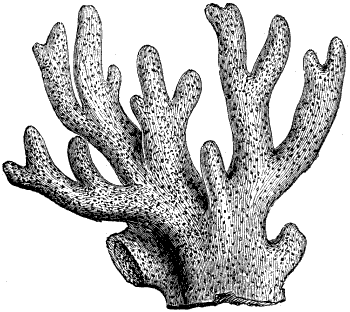
Fig. 108.—Millepora alcicornis. (Recent Coral.)
The essential characters of the vegetation during the Liassic sub-period were:—1. The great predominance of the Cycadeaceæ, thus continuing the development which commenced in the previous period, expanding into numerous genera belonging both to this family and that of the Zamites and Nilssonia; 2. The existence among the Ferns of many genera with reticulated veins or nervures, and under forms of little variation, which scarcely show themselves in the more ancient formations.
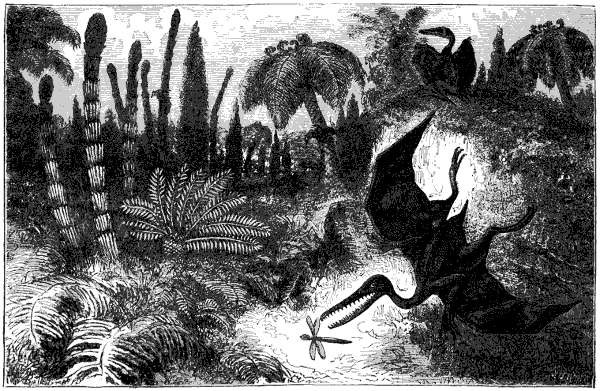
XVI.—Ideal Landscape of the Liassic Period.
On the opposite page (Plate XVI.) is an ideal landscape of the Liassic period; the trees and shrubs characteristic of the age are the elegant Pterophyllum, which appears in the extreme left of the picture, and the Zamites, which are recognisable by their thick and low trunk and fan-like tuft of foliage. The large horsetail, or Equisetum of this epoch, mingles with the great Tree-ferns and the Cypress, a Conifer allied to those of our own age. Among animals, we see the Pterodactyle specially represented. One of these reptiles is seen in a state of repose, resting on its hind feet. The other is represented, not flying, after the manner of a bird, but throwing itself from a rock in order to seize upon a winged insect, the dragon-fly (Libellula), the remains of which have been discovered, associated with the bones of the Pterodactyle, in the lithographic limestone of Pappenheim and Solenhofen.
Oolitic Sub-period.
This period is so named because many of the limestones entering into the composition of the formations it comprises, consist almost entirely of an aggregation of rounded concretionary grains resembling, in outward appearance, the roe or eggs of fishes, and each of which contains a nucleus of sand, around which concentric layers of calcareous matter have accumulated; whence the name, from ωον, egg, and λιθος, stone.
The Oolite series is usually subdivided into three sections, the Lower, Middle, and Upper Oolite. These rocks form in England a band some thirty miles broad, ranging across the country from Yorkshire, in the north-east, to Dorset, in the south-west, but with a great diversity of mineral character, which has led to a further subdivision of the series, founded on the existence of particular strata in the central and south-western counties:—
Upper. Middle. Lower.
1. Purbeck Beds. 1. Coral Rag. 1. Cornbrash.
2. Portland Stone and Sand. 2. Oxford Clay. 2. Great Oolite & Forest Marble.
3. Kimeridge Clay. 3. Stonesfield Slate.
4. Fuller’s Earth.
5. Inferior Oolite.
The alternations of clay and masses of limestone in the Liassic and Oolite formations impart some marked features to the outline of the scenery both of France and England: forming broad valleys, separated from each other by ranges of limestone hills of more or less elevation. In France, the Jura mountains are composed of the latter; in England, the slopes of this formation are more gentle—the valleys are intersected by brooks, and clothed with a rich vegetation; it forms what is called a tame landscape, as compared with the wilder grandeur of the Primary rocks—it pleases more than it surprises. It yields materials also, more useful than some of the older formations, numerous quarries being met with which furnish excellent building-materials, especially around Bath, where the stone, when first quarried, is soft and easily worked, but becomes harder on exposure to the air.
The annexed section (Fig. 109) will give some idea of the configuration which the stratification assumes, such as may be observed in proceeding from the north-west to the south-east, from Caermarthenshire to the banks of the Ouse.

Fig. 109.—General view of the succession of British strata, with the elevations they reach above the level of the sea. G, Granitic rocks; a, Gneiss; b, Mica-schist; c, Skiddaw or Cumbrian Slates; d, Snowdon rocks; e, Plynlymmon rocks; f, Silurian rocks; g, Old Red Sandstone; h, Carboniferous Limestone; i, Millstone Grit; k, Coal-measures; l, Magnesian Limestone; m, New Red Sandstone; n, Lias; o, Lower, Middle, and Upper Oolites; p, Greensand; q, Chalk; r, Tertiary strata.