SECONDARY EPOCH. (continued 3)
Reading edition
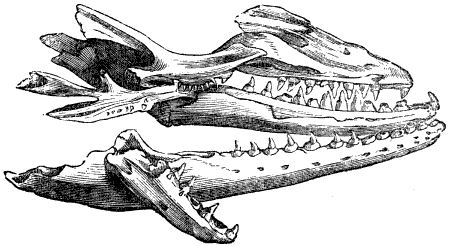
Fig. 146.—Head of Mosasaurus Camperi.
The dimensions of this aquatic lizard, estimated at twenty-four feet, are calculated to excite surprise. But, as we have already seen, the Ichthyosauri and Teleosauri were of great dimensions, as were also the Iguanodon and Megalosaurus, which were ten times the size of living Iguanas. In all these colossal forms we can only see a difference of dimensions, the aggrandisement of a type; the laws which affected the organisation of all these beings remain unchanged, they were not errors of Nature—monstrosities, as we are sometimes tempted to call them—but simply types, uniform in their structure, and adapted by their dimensions to the physical conditions with which God had surrounded them.
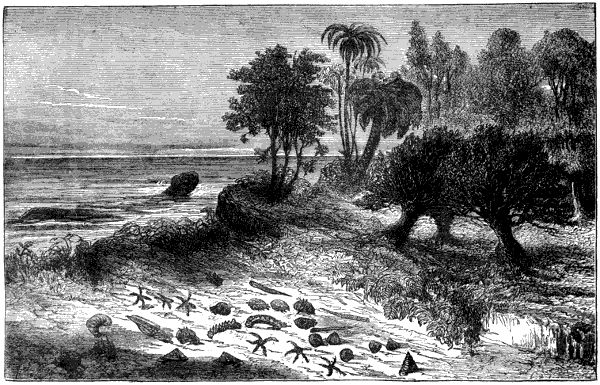
XXII.—Ideal Landscape of the Cretaceous Period.
In Plate XXII. is represented an ideal view of the earth during the Upper Cretaceous period. In the sea swims the Mosasaurus; Molluscs, Zoophytes, and other animals peculiar to the period are seen on the shore. The vegetation seems to approach that of our days; it consists of Ferns and Cycadeæ (Pterophyllums), mingled with Palms, Willows, and some dicotyledons of species analogous to those of our present epoch. Algæ, then very abundant, composed the vegetation of the sea-shore.
We have said that the terrestrial flora of the Upper Cretaceous period was nearly identical with that of the Lower. The marine flora of these two epochs included some Algæ, Confervæ, and Naïadæ, among which may be noted the following species: Confervites fasciculatus, Chondrites Mantelli, Sargassites Hynghianus. Among the Naïadæ, Zosterites Orbigniana, Z. lineata, and several others.
The Confervæ are fossils which may be referred, but with some doubt, to the filamentous Algæ, which comprehend the great group of the Confervæ. These plants were formed of simple or branching filaments, diversely crossing each other; or subdivided, and presenting traces of transverse partitions.
The Chondrites are, perhaps, fossil Algæ, with thick, smooth branching fronds, pinnatifid, or divided into pairs, with smooth cylindrical divisions, and resembling Chondrus, Dumontia, and Halymenia among living genera.
The Sargassites, finally, have been vaguely referred to the genus Sargassum, so abundant in tropical seas. These Algæ are distinguished by a filiform, branched, or ramose stem, bearing foliaceous appendages, regular, often petiolate, and altogether like leaves, and globular vesicles, supported by a small stalk.
The rocks which actually represent the Upper Cretaceous period divide themselves naturally into six series; but British and French geologists make some distinction: the former dividing them into 1, Maestricht and Faxoe beds, said not to occur in England; 2, White Chalk, with flints; 3, White Chalk, without flints; 4, Chalk Marl; 5, Upper Greensand; and 6, Gault. The latter four are divided by foreign geologists into 1, Turonian; 2, Senonian; 3, Danian.
The Gault is the lowest member of the Upper Cretaceous group. It consists of a bluish-black clay mixed with greensand, which underlies the Upper Greensand. Near Cambridge, where the Gault is about 200 feet thick, a layer of shells, bones, and nodules, called the “Coprolite Bed,” from nine inches to a foot thick, represents the Upper Greensand, and rests on the top of the Gault Clay. These nodules and fossils are extensively worked on account of the phosphatic matter they contain, and when ground and converted into superphosphate of lime they furnish a very valuable agricultural manure. The Gault attains a thickness of about 100 feet on the south-east coast of England. It extends into Devonshire, Mr. Sharpe considering the Black Down beds of that country as its equivalents. It shows itself in the Departments of the Pas-de-Calais, the Ardennes, the Meuse, the Aube, the Yonne, the Ain, the Calvados, and the Seine-Inférieure. It presents very many distinct mineral forms, among which two predominate: green sandstone and blackish or grey clays. It is important to know this formation, for it is at this level that the Artesian waters flow in the wells of Passy and Grenelle, near Paris.
The glaucous chalk, or Upper Greensand, which is represented typically in the departments of the Sarthe, of the Charente-Inférieure, of the Yonne and the Var, is composed of quartzose sand, clay, sandstone, and limestone. In this formation, at the mouth of the Charente, we find a remarkable bed, which has been described as a submarine forest. It consists of large trees with their branches imbedded horizontally in vegetable matter, containing kidney-shaped nodules of amber, or fossilised resin.
The Turonian beds are so named because the province of Touraine, between Saumur and Montrichard, possesses the best-developed type of this strata. The mineralogical composition of the beds is a fine and grey marly chalk, as at Vitry-le-François; of a pure white chalk, with a very fine grain, slightly argillaceous, and poor in fossils, in the Departments of the Yonne, the Aube, and the Seine-Inférieure; granular tufaceous chalk, white or yellowish, mixed with spangles of mica, and containing Ammonites, in Touraine and a part of the Department of the Sarthe; white, grey, yellow, or bluish limestone, inclosing Hippurites and Radiolites. In England the Lower Chalk passes also into Chalk Marl, with Ammonites, and then into beds known as the Upper Greensand, containing green particles of glauconite, mixed, in Hampshire and Surrey, with much calcareous matter. In the Isle of Wight this formation attains a thickness of 100 feet. The Senonian beds take their name from the ancient Senones. The city of Sens is in the centre of the best-characterised portion of this formation; Epernay, Meudon, Sens, Vendôme, Royau, Cognac, Saintes, are the typical regions of the formation in France. In the Paris basin, inclusive of the Tours beds, it attains a thickness of upwards of 1,500 feet, as was proved by the samples brought up, during the sinking of the Artesian well, at Grenelle, by the borings.
In its geographical distribution the Chalk has an immense range; fine Chalk of nearly similar aspect and composition being met with in all directions over hundreds of miles, alternating in its lower beds with layers of flints. In England the higher beds usually consist of a pure-white calcareous mass, generally too soft for building-stone, but sometimes passing into a solid rock.
The Danian beds, which occupy the summit of the scale in the Cretaceous formation, are finely developed at Maestricht, on the Meuse; and in the Island of Zeeland, belonging to Denmark; where they are represented by a slightly yellowish, compact limestone, quarried for the construction of the city of Faxoe. It is slightly represented in the Paris basin at Meudon, and Laversines, in the Department of the Oise, by a white and often rubbly limestone known as pisolitic limestone. In this formation Ammonites Danicus is found. The yellowish sandy limestone of Maestricht is referred to the Danian type. Besides Molluscs, Polyps, and Polyzoa (Bryozoa), this limestone contains remains of Fishes, Turtles, and Crocodiles. But what has rendered this rock so celebrated was that it contained the remains of the great animal of Mæstricht, the Mæsasaurus.
At the close of the geological period, whose natural physiognomy we have thus traced, Europe was still far from displaying the configuration which it now presents. A map of the period would represent the great basin of Paris (with the exception of a zone of Chalk), the whole of Switzerland, the greater part of Spain and Italy, the whole of Belgium, Holland, Prussia, Hungary, Wallachia, and Northern Russia, as one vast sheet of water. A band of Jurassic rocks still connected France and England at Cherbourg—which disappeared at a later period, and caused the separation of the British Islands from what is now France.
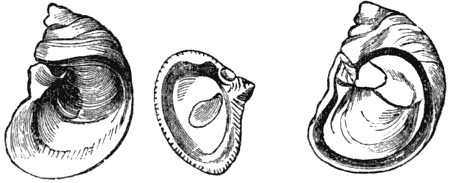
Fig. 147.—Exogym conica. Upper Greensand and Gault, from Blackdown Hill.