PRIMARY EPOCH. (continued 2)
Reading edition
The heat emanating from the interior of the globe would, also, exercise a great influence upon the final result. It is to these two causes—that is to say, to pressure and to the central heat—that we may attribute the differences which exist in the mineral characters of various kinds of coal. The inferior beds are drier and more compact than the upper ones; or less bituminous, because their mineralisation has been completed under the influence of a higher temperature, and at the same time under a greater pressure.
An experiment, attempted for the first time in 1833, at Sain-Bel, afterwards repeated by M. Cagniard de la Tour, and completed at Saint-Etienne by M. Baroulier in 1858, fully demonstrates the process by which coal was formed. These gentlemen succeeded in producing a very compact coal artificially, by subjecting wood and other vegetable substances to the double influence of heat and pressure combined.
The apparatus employed for this experiment by M. Baroulier, at Saint-Etienne, allowed the exposure of the strongly compressed vegetable matter enveloped in moist clay, to the influence of a long-continued temperature of from 200° to 300° Centigrade. This apparatus, without being absolutely closed, offered obstacles to the escape of gases or vapours in such a manner that the decomposition of the organic matters took place in the medium saturated with moisture, and under a pressure which prevented the escape of the elements of which it was composed. By placing in these conditions the sawdust of various kinds of wood, products were obtained which resembled in many respects, sometimes brilliant shining coal, and at others a dull coal. These differences, moreover, varied with the conditions of the experiment and the nature of the wood employed; thus explaining the striped appearance of coal when composed alternately of shining and dull veins.
When the stems and leaves of ferns are compressed between beds of clay or pozzuolana, they are decomposed by the pressure only, and form on these blocks a carbonaceous layer, and impressions bearing a close resemblance to those which blocks of coal frequently exhibit. These last-mentioned experiments, which were first made by Dr. Tyndall, leave no room for doubt that coal has been formed from the plants of the ancient world.
Passing from these speculations to the Coal-measures:—
This formation is composed of a succession of beds, of various thicknesses, consisting of sandstones or gritstones, of clays and shales, sometimes so bituminous as to be inflammable—and passing, in short, into an imperfect kind of coal. These rocks are interstratified with each other in such a manner that they may consist of many alterations. Carbonate of protoxide of iron (clay-ironstone) may also be considered a constituent of this formation; its extensive dissemination in connection with coal in some parts of Great Britain has been of immense advantage to the ironworks of this country, in many parts of which blast-furnaces for the manufacture of iron rise by hundreds alongside of the coal-pits from which they are fed. In France, as is frequently the case in England, this argillaceous iron-ore only occurs in nodules or lenticular masses, much interrupted; so that it becomes necessary in that country, as in this, to find other ores of iron to supply the wants of the foundries. Fig. 70 gives an idea of the ordinary arrangement of the coal-beds, one of which is seen interstratified between two parallel and nearly horizontal beds of argillaceous shale, containing nodules of clay iron-ore—a disposition very common in English collieries. The coal-basin of Aveyron, in France, presents an analogous mode of occurrence.
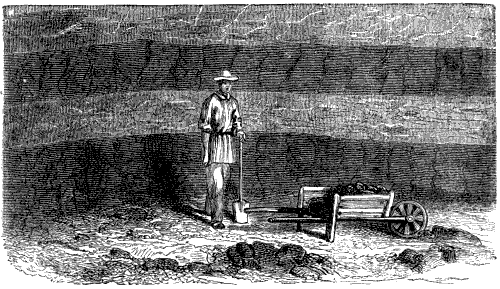
Fig. 70.—Stratification of coal-beds.
The frequent presence of carbonate of iron in the coal-measures is a most fortunate circumstance for mining industry. When the miner finds, in the same spot, the ore of iron and the fuel required for smelting it, arrangements for working them can be established under the most favourable conditions. Such is the case in the coal-fields of Great Britain, and also in France to a less extent—that is to say, only at Saint-Etienne and Alais.
The extent of the Coal-measures, in various parts of the world, may be briefly and approximately stated as follows:—
ESTIMATED AREA OF THE COAL-MEASURES OF THE WORLD.
Square Miles.
United States 220,166 – 420,166
„ Lignites and inferior Coals 200,000
British Possessions in North America 2,200
Great Britain 3,000
France 2,000
Belgium 468
Rhenish Prussia and Saarbrück 1,550
Westphalia 400
Bohemia 620
Saxony 66
The Asturias, in Spain 310
Russia 11,000
Islands of the Pacific and Indian Ocean Unknown.
The American continent, then, contains much more extensive coal-fields than Europe; it possesses very nearly two square miles of coal-fields for every five miles of its surface; but it must be added that these immense fields of coal have not, hitherto, been productive in proportion to their extent. The following Table represents the annual produce of the collieries of America and Europe:—
Tons.
British Islands (in 1870) 110,431,192
United States 14,593,659
Belgium (in 1870) 13,697,118
France (in 1864) 10,000,000
„ (in 1866) 11,807,142
Prussia (in 1864) 21,197,266
Nassau (in 1864) 2,345,459
Netherlands (in 1864) 24,815
Austria (in 1864) 4,589,014
Spain 500,000
We thus see that the United States holds a secondary place as a coal-producing country; raising one-eleventh part of the out-put of the whole of Europe, and about one-eighth part of the quantity produced by Great Britain.
The Coal-measures of England and Scotland cover a large area; and attempts have been made to estimate the quantity of fuel they contain. The estimate made by the Royal Commission on the coal in the United Kingdom may be considered as the nearest; and, in this Report, lately published, it is stated that in the ascertained coal-fields of the United Kingdom there is an aggregate quantity of 146,480,000,000 tons of coal, which may be reasonably expected to be available for use. In the coal-field of South Wales, ascertained by actual measurement to attain the extraordinary thickness of 11,000 feet of Coal-measures, there are 100 different seams of coal, affording an aggregate thickness of 120 feet, mostly in thin beds, but varying from six inches to more than ten feet. Professor J. Phillips estimates the thickness of the coal-bearing strata of the north of England at 3,000 feet; but these, in common with all other coal-fields, contain, along with many beds of the mineral in a more or less pure state, interstratified beds of sandstones, shales, and limestone; the real coal-seams, to the number of twenty or thirty, not exceeding sixty feet in thickness in the aggregate. The Scottish Coal-measures have a thickness of 3,000 feet, with similar intercalations of other carboniferous rocks.
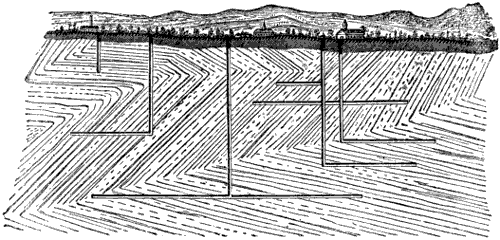
Fig. 71.—Contortions of Coal-beds.
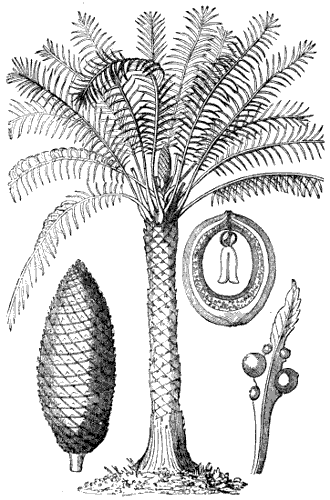
Fig. 72.—Cycas circinalis (living form).
The coal-basin of Belgium and of the north of France forms a nearly continuous zone from Liége, Namur, Charleroi, and Mons, to Valenciennes, Douai, and Béthune. The beds of coal there are from fifty to one hundred and ten in number, and their thickness varies from ten inches to six feet. Some coal-fields which are situated beneath the Secondary formations of the centre and south of France possess beds fewer in number, but individually thicker and less regularly stratified. The two basins of the Saône-et-Loire, the principal mines of which are at Creuzot, Blanzy, Montchanin, and Epinac, only contain ten beds; but some of these (as at Montchanin) attain 30, 100, and even 130 feet in thickness. The coal-basin of the Loire is that which contains the greatest total thickness of coal-beds: the seams there are twenty-five in number. After those of the North—of the Saône-et-Loire and of the Loire—the principal basins in France are those of the Allier, where very important beds are worked at Commentry and Bezenet; the basin of Brassac, which commences at the confluence of the Allier and the Alagnon; the basin of the Aveyron, known by the collieries of Decazeville and Aubin; the basin of the Gard, and of Grand’-Combe. Besides these principal basins, there are a great many others of scarcely less importance, which yield annually to France from six to seven million tons of coal.
The seams of coal are rarely found in the horizontal position in which their original formation took place. They have been since much crumpled and distorted, forced into basin-shaped cavities, with minor undulations, and affected by numerous flexures and other disturbances. They are frequently found broken up and distorted by faults, and even folded back on themselves into zigzag forms, as represented in the engraving (Fig. 71, p. 167), which is a mode of occurrence common in all the Coal-measures of Somersetshire and in the basins of Belgium and the north of France. Vertical pits, sunk on coal which has been subjected to this kind of contortion and disturbance, sometimes traverse the same beds many times.
PERMIAN PERIOD.
The name “Permian” was proposed by Sir Roderick I. Murchison, in the year 1841, for certain deposits which are now known to terminate upwards the great primeval or Palæozoic Series.[50]
This natural group consists, in descending order, in Germany, of the Zechstein, the Kupfer-schiefer, Roth-liegende, &c. In England it is usually divided into Magnesian Limestone or Zechstein, with subordinate Marl-slate or Kupfer-schiefer, and Rothliegende. The chief calcareous member of this group of strata is termed in Germany the “Zechstein,” in England the “Magnesian Limestone;” but, as magnesian limestones have been produced at many geological periods, and as the German Zechstein is only a part of a group, the other members of which are known as “Kupfer-schiefer” (“copper-slate”), “Roth-todt-liegende” (the “Lower New Red” of English geologists), &c., it was manifest that a single name for the whole was much needed. Finding, in his examination of Russia in Europe, that this group was a great and united physical series of marls, limestones, sandstones, and conglomerates, occupying a region much larger than France, and of which the Government of Perm formed a central part, Sir Roderick proposed that the name of Permian, now in general use, should be thereto applied.
Extended researches have shown, from the character of its embedded organic remains, that it is closely allied to, but distinct from, the carboniferous strata below it, and is entirely distinct from the overlying Trias, or New Red Sandstone, which forms the base of the great series of the Secondary rocks.
Geology is, however, not only indebted to Sir Roderick Murchison for this classification and nomenclature, but also to him, in conjunction with Professor Sedgwick, for the name “Devonian,” as an equivalent to “Old Red Sandstone;” whilst every geologist knows that Sir R. Murchison is the sole author of the Silurian System.
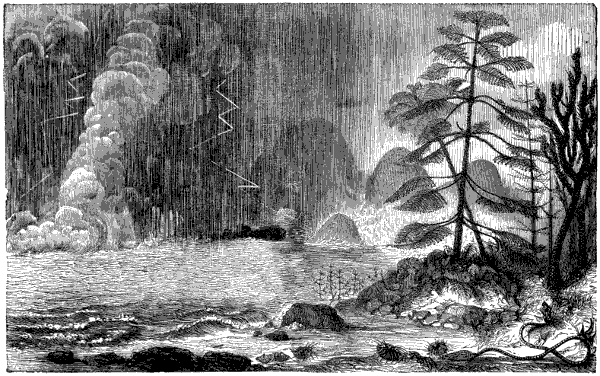
XII.—Ideal landscape of the Permian Period.
The Permian rocks have of late years assumed great interest, particularly in England, in consequence of the evidence their correct determination affords with regard to the probable extent, beneath them, of the coal-bearing strata which they overlie and conceal; thus tending to throw a light upon the duration of our coal-fields, one of the most important questions of the day in connection with our industrial resources and national prosperity.
On the opposite page an ideal view of the earth during the Permian period is represented (Pl. XII.). In the background, on the right, is seen a series of syenitic and porphyritic domes, recently thrown up; while a mass of steam and vapour rises in columns from the midst of the sea, resulting from the heat given out by the porphyries and syenites. Having attained a certain height in the cooler atmosphere, the columns of steam become condensed and fall in torrents of rain. The evaporation of water in such vast masses being necessarily accompanied by an enormous disengagement of electricity, this imposing scene of the primitive world is illuminated by brilliant flashes of lightning, accompanied by reverberating peals of thunder. In the foreground, on the right, rise groups of Tree-ferns, Lepidodendra, and Walchias, of the preceding period. On the sea-shore, and left exposed by the retiring tide, are Molluscs and Zoophytes peculiar to the period, such as Producta, Spirifera, and Encrinites; pretty plants—the Asterophyllites—which we have noticed in our description of the Carboniferous age, are growing at the water’s edge, not far from the shore.
During the Permian period the species of plants and animals were nearly the same as those already described as belonging to the Carboniferous period. Footprints of reptilian animals have been found in the Permian beds near Kenilworth, in the red sandstones of that age in the Vale of Eden, and in the sandstones of Corncockle Moor, and other parts of Dumfriesshire. These footprints, together with the occurrence of current-markings or ripplings, sun-cracks, and the pittings of rain-drops impressed on the surfaces of the beds, indicate that they were made upon damp surfaces, which afterwards became dried by the sun before the flooded waters covered them with fresh deposits of sediment, in the way that now happens during variations of the seasons in many salt lakes.[51] M. Ad. Brongniart has described the forms of the Permian flora as being intermediate between those of the Carboniferous period and of that which succeeds it.
Although the Permian flora indicates a climate similar to that which prevailed during the Carboniferous period, it has been pointed out by Professor Ramsay, as long ago as 1855, that the Permian breccia of Shropshire, Worcestershire, &c., affords strong proofs of being the result of direct glacial action, and of the consequent existence at the period of glaciers and icebergs.
That such a state of things is not inconsistent with the prevalence of a moist, equable, and temperate climate, necessary for the preservation of a luxuriant flora like that of the period in question, is shown in New Zealand; where, with a climate and vegetation approximating to those of the Carboniferous period, there are also glaciers at the present day in the southern island.
Professor King has published a valuable memoir on the Permian fossils of England, in the Proceedings of the Palæontographical Society, in which the following Table is given (in descending order) of the Permian system of the North of England, as compared with that of Thuringia:—
North of England. Thuringia. Mineral Character.
1. Crystalline, earthy, compact, and oolitic limestones – 1. Stinkstein – 1. Oolitic limestones.
2. Brecciated and pseudo-brecciated limestones – 2. Rauchwacke – 2. Conglomerates.
3. Fossiliferous limestone – 3. Upper Zechstein, or Dolomit-Zechstein – 3. Marlstones.
4. Compact limestone – 4. Lower Zechstein – 4. Magnesian limestones.
5. Marl-slate – 5. Mergel-Schiefer or Kupferschiefer – 5. Red and green grits with copper-ore.
6. Lower sandstones, and sands of various colours – 6. Todteliegende – 6. White limestone with gypsum and white salt.
At the base of the system lies a band of lower sandstone (No. 6) of various colours, separating the Magnesian Limestone from the coal in Yorkshire and Durham; sometimes associated with red marl and gypsum, but with the same obscure relations in all these beds which usually attend the close of one series and the commencement of another; the imbedded plants being, in some cases, stated to be identical with those of the Carboniferous series. In Thuringia the Rothliegende, or red-lyer, a great deposit of red sandstone and conglomerate, associated with porphyry, basaltic trap, and amygdaloid, lies at the base of the system. Among the fossils of this age are the silicified trunks of Tree-ferns (Psaronius), the bark of which is surrounded by dense masses of air-roots, which often double or quadruple the diameter of the original stem; in this respect bearing a strong resemblance to the living arborescent ferns of New Zealand.
The marl-slate (No. 5) consists of hard calcareous shales, marl-slates, and thin-bedded limestone, the whole nearly thirty feet thick in Durham, and yielding many fine specimens of Ganoid and Placoid fishes—Palæoniscus, Pygopterus, Cœlacanthus, and Platysomus—genera which all belong to the Carboniferous system, and which Professor King thinks probably lived at no great distance from the shore; but the Permian species of the marl-slate of England are identical with those of the copper-slate of Thuringia. Agassiz was the first to point out a remarkable peculiarity in the forms of the fishes which lived before and after this period. In most living fishes the trunk seems to terminate in the middle of the root of the tail, whose free margin is “homocercal” (even-tail), that is, either rounded, or, if forked, divided into two equal lobes. In Palæoniscus, and most Palæozoic fishes, the axis of the body is continued into the upper lobe of the tail, which is thus rendered unsymmetrical, as in the living sharks and sturgeons. The latter form, which Agassiz termed “heterocercal” (unequal-tail) is only in a very general way distinctive of Palæozoic fishes, since this asymmetry exists, though in a minor degree, in many living genera besides those just mentioned. The compact limestone (No. 4) is rich in Polyzoa. The fossiliferous limestone (No. 3), Mr. King considers, is a deep-water formation, from the numerous Polyzoa which it contains. One of these, Fenestella retiformis, found in the Permian rocks of England and Germany, sometimes measures eight inches in width.
Many species of Mollusca, and especially Brachiopoda, appear in the Permian seas of this age, Spirifera and Producta being the most characteristic.
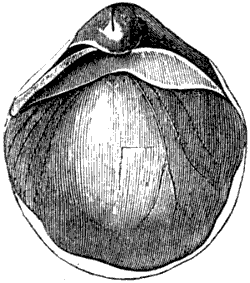
Fig. 73.—Strophalosia Morrisiana.
Other shells now occur, which have not been observed in strata newer than the Permian. Strophalosia (Fig. 73) is abundantly represented in the Permian rocks of Germany, Russia, and England, and much more sparingly in the yellow magnesian limestone, accompanied by Spirifera undulata, &c. S. Schlotheimii is widely disseminated both in England, Germany, and Russia, with Lingula Credneri, and other Palæozoic Brachiopoda. Here also we note the first appearance of the Oyster, but still in small numbers. Fenestella represents the Polyzoa. Schizodus has been found by Mr. Binney in the Upper Red Permian Marls of Manchester; but no shells of any kind have hitherto been met with in the Rothliegende of Lancashire, or in the Vale of Eden.
The brecciated limestone (No. 2) and the concretionary masses (No. 1) overlying it (although Professor King has attempted to separate them) are considered by Professor Sedgwick as different forms of the same rock. They contain no foreign elements, but seem to be composed of fragments of the underlying limestone, No. 3. Some of the angular masses at Tynemouth cliff are two feet in diameter, and none of them are water-worn.
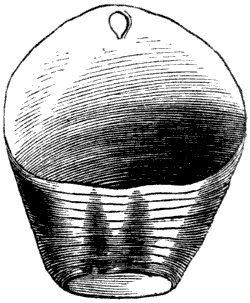
Fig. 74.—Cyrtoceras depressum.
The crystalline or concretionary limestone (No. 1) formation is seen upon the coast of Durham and Yorkshire, between the Wear and the Tees; and Mr. King thinks that the character of the shells and the absence of corals indicate a deposit formed in shallow water.
The plants also found in some of the Permian strata indicate the neighbourhood of land. These are land species, and chiefly of genera common in the Coal-measures. Fragments of supposed coniferous wood (generally silicified) are occasionally met with in the Permian red beds of many parts of England.
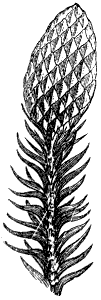
Fig. 75.—Walchia Schlotheimii.
Among the Ferns characteristic of the period may be mentioned Sphenopteris dichotoma and S. Artemisiæfolia; Pecopteris lonchitica and Neuropteris gigantea, figured on pp. 143, 144. “If we are,” says Lyell, “to draw a line between the Secondary and Primary fossiliferous strata, it must be run through the middle of what was once called the ‘New Red.’ The inferior half of this group will rank as Primary or Palæozoic, while its upper member will form the base of the Secondary or Mesozoic series.”[52] Among the Equiseta of the Permian formation of Saxony, Colonel Von Gutbier found Calamites gigas and sixty species of fossil plants, most of them Ferns, forty of which have not been found elsewhere. Among these are several species of Walchia, a genus of Conifers, of which an example is given in Fig. 75.
In their stems, leaves, and cones, they bear some resemblance to the Araucarias, which have been introduced from North America into our pleasure-grounds during the last half-century.
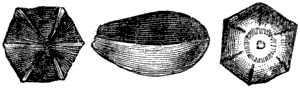
Fig. 76.—Trigonocarpum Nöggerathii.
Among the genera enumerated by Colonel Von Gutbier are some fruits called Cardiocarpon, and Asterophyllites and Annularia, so characteristic of the Carboniferous age. The Lepidodendron is also common to the Permian rocks of Saxony, Russia, and Thuringia; also the Nöggerathia, a family of large trees, intermediate between Cycads (Fig. 72) and the Conifers. The fruit of one of these is represented in Fig 76.
Permian Rocks.—We now give a sketch of the physiognomy of the earth in Permian times. Of what do the beds consist? What is the extent, and what is the mineralogical constitution of the rocks deposited in the seas of the period? The Permian formation consists of three members, which are in descending order—
1. Upper Permian sandstone, or Grès des Vosges; 2. Magnesian Limestone, or Zechstein; 3. Lower Red Sandstone, Marl-slate or Kupferschiefer, and Rothliegende.
The grès des Vosges, usually of a red colour, and from 300 to 450 feet thick, composes all the southern part of the Vosges Mountains, where it forms frequent level summits, which are evidences of an ancient plain that has been acted on by running water. It only contains a few vegetable remains.
The Magnesian Limestone, Pierre de mine, or Zechstein, so called in consequence of the numerous metalliferous deposits met with in its diverse beds, presents in France only a few insignificant fragments; but in Germany and England it attains the thickness of 450 feet. It is composed of a diversified mass of Magnesian Limestone, generally of a yellow colour, but sometimes red and brown, and bituminous clay, the last black and fetid. The subordinate rocks consist of marl, gypsum, and inflammable bituminous schists. The beds of marl slate are remarkable for the numbers of peculiar fossil fishes which they contain; and from the occurrence of small proportions of argentiferous grey copper-ore, met with in the bituminous shales which are worked in the district of Mansfeld, in Thuringia—the latter are called Kupferschiefer in Germany.
The Lower Red Sandstone, which attains a thickness of from 300 to 600 feet, is found over great part of Germany, in the Vosges, and in England. Its fossil remains are few and rare; they include silicified trunks of Conifers, some impressions of Ferns, and Calamites.
In England the Permian strata, to a great extent, consist of red sandstones and marls; and the Magnesian Limestone of the northern counties is also, though to a less degree, associated with red marls.
In Lancashire thin beds of Magnesian Limestone are interstratified with red marls in the upper Permian strata, beneath which there are soft Red Sandstones, estimated by Mr. Hull to be about 1,500 feet thick. These are supposed to represent the Rothliegende, and no shells of any kind have been found in them. The upper Permian beds, however, contain a few Magnesian Limestone species, such as Gervillia antiqua, Pleurophorus costatus, Schizodus obscurus, and some others, but all small and dwarfed.
The coal-fields of North and South Staffordshire, Tamworth, Coalbrook Dale, and of the Forest of Wyre, are partly bordered by Permian rocks, which lie unconformably on the Coal-measures; as is the case, also, in the immediate neighbourhood of Manchester, where they skirt the borders of the main coal-field, and consist of the Lower Red Sandstone, resting unconformably on different parts of the Coal-measures, and overlaid by the pebble-beds of the Trias.
At Stockport the Permian strata are stated by Mr. Hull to be more than 1,500 feet thick.
In Yorkshire, Nottinghamshire, and Derbyshire, the Permian strata are stated by Mr. Aveline to be divided into two chief groups: the Roth-liegende, of no great thickness, and the Magnesian Limestone series; the latter being the largest and most important member of the Permian series in the northern counties of England. The Magnesian Limestone consists there of two great bands, separated by marls and sandstone, and quarried for building and for lime. In Derbyshire and Yorkshire the magnesian limestone, under the name of Dolomite, forms an excellent building-stone, which has been used in the construction of the Houses of Parliament.
In the midland counties and on the borders of Wales, the Permian section is different from that of Nottinghamshire and the North of England. The Magnesian Limestones are absent, and the rocks consist principally of dark-red marl, brown and red sandstones, and calcareous conglomerates and breccias, which are almost entirely unfossiliferous. In Warwickshire, where they rest conformably on the Coal-measures, they occupy a very considerable tract of country, and are of very great thickness, being estimated by Mr. Howell to be 2,000 feet thick.
In the east of England the Magnesian Limestone contains a numerous marine fauna, but much restricted when compared with that of the Carboniferous period. The shells of the former are all small and dwarfed in size when compared with their congeners of Carboniferous times, when such there are, and in this respect, and the small number of genera, they resemble the living mollusca of the still less numerous fauna of the Caspian Sea.
Besides the poverty and small size of the mollusca, the later strata of the true Magnesian Limestone seem to afford strong indications that they may have been deposited in a great inland salt-lake subject to evaporation.
The absence of fossils in much of the formation may be partly accounted for by its deposition in great measure from solution, and the uncongenial nature of the waters of a salt-lake may account for the poverty-stricken character of the whole molluscan fauna.
The red colouring-matter of the Permian sandstones and marls is considered, by Professor Ramsay, to be due to carbonate of iron introduced into the waters, and afterwards precipitated as peroxide through the oxidising action of the air and the escape of the carbonic acid which held it in solution. This circumstance of the red colour of the Permian beds affords an indication that the red Permian strata were deposited in inland waters unconnected with the main ocean, which waters may have been salt or fresh as the case may be.
“The Magnesian Limestone series of the east of England may, possibly, have been connected directly with an open sea at the commencement of the deposition of these strata, whatever its subsequent history may have been; for the fish of the marl strata have generically strong affinities with those of Carboniferous age, some of which were truly marine, while others certainly penetrated shallow lagoons bordered by peaty flats.”[53]
There is indisputable evidence that the Permian ocean covered an immense area of the globe. In the Permian period this ocean extended from Ireland to the Ural mountains, and probably to Spitzbergen, with its northern boundary defined by the Carboniferous, Devonian, Silurian, and Igneous regions of Scotland, Scandinavia, and Northern Russia; and its southern boundaries apparently stretching far into the south of Europe (King). The chain of the Vosges, stretching across Rhenish Bavaria, the Grand Duchy of Baden, as far as Saxony and Silesia, would be under water. They would communicate with the ocean, which covered all the midland and western counties of England and part of Russia. In other parts of Europe the continent has varied very little since the preceding Devonian and Carboniferous ages. In France the central plateaux would form a great island, which extended towards the south, probably as far as the foot of the Pyrenees; another island would consist of the mass of Brittany. In Russia the continent would have extended itself considerably towards the east; finally, it is probable that, at the end of the Carboniferous period, the Belgian continent would stretch from the Departments of the Pas-de-Calais and Du Nord, in France, and would extend up to and beyond the Rhine.
In England, the Silurian archipelago, now filled up and occupied by deposits of the Devonian and Carboniferous systems, would be covered with carboniferous vegetation; dry land would now extend, almost without interruption, from Cape Wrath to the Land’s End; but, on its eastern shore, the great mass of the region now lying less than three degrees west of Greenwich would, in a general sense, be under water, or form islands rising out of the sea. Alphonse Esquiros thus eloquently closes the chapter of his work in which he treats of this formation in England: “We have seen seas, vast watery deserts, become populated; we have seen the birth of the first land and its increase; ages succeeding each other, and Nature in its progress advancing among ruins; the ancient inhabitants of the sea, or at least their spoils, have been raised to the summit of lofty mountains. In the midst of these vast cemeteries of the primitive world we have met with the remains of millions of beings; entire species sacrificed to the development of life. Here terminates the first mass of facts constituting the infancy of the British Islands. But great changes are still to produce themselves on this portion of the earth’s surface.”
Having thus described the Primary Epoch, it may be useful, before entering on what is termed by geologists the Secondary Epoch, to glance backwards at the facts which we have had under consideration.
In this Primary period plants and animals appear for the first time upon the surface of the cooling globe. We have said that the seas of the epoch were then dominated by the fishes known as Ganoids (from γανος, glitter), from the brilliant polish of the enamelled scales which covered their bodies, sometimes in a very complicated and fantastic manner; the Trilobites are curious Crustaceans, which appear and altogether disappear in the Primary epoch; an immense quantity of Mollusca, Cephalopoda, and Brachiopoda; the Encrinites, animals of curious organisation, which form some of the most graceful ornaments of our Palæontological collections.
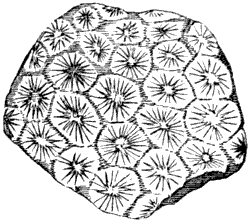
Fig. 77.—Lithostrotion. (Fossil Coral.)
But, among all these beings, those which prevailed—those which were truly the kings of the organic world—were the Fishes, and, above all, the Ganoids, which have left no animated being behind them of similar organisation. Furnished with a sort of defensive armour, they seem to have received from Nature this means of protection to ensure their existence, and permit them to triumph over all the influences which threatened them with destruction in the seas of the ancient world.
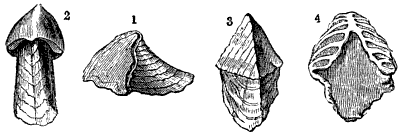
Fig. 78.—Rhyncholites, upper, side, and internal views. 1, Side view (Muschelkalk of Luneville); 2, Upper view (same locality); 3, Upper view (Lias of Lyme Regis); 4, Calcareous point of an under mandible, internal view, from Luneville. (Buckland.)
In the Primary epoch the living creation was in its infancy. No Mammals then roamed the forests; no bird had yet displayed its wings. Without Mammals, therefore, there was no maternal instinct; none of the soft affections which are, with animals, as it were, the precursors of intelligence. Without birds, also, there could be no songs in the air. Fishes, Mollusca, and Crustacea silently ploughed their way in the depths of the sea, and the immovable Crinoid lived there. On the land we only find a few marsh-frequenting Reptiles, of small size—forerunners of those monstrous Saurians which make their appearance in the Secondary epoch.
The vegetation of the Primary epoch is chiefly of inferior organisation. With a few plants of a higher order, that is to say, Dicotyledons, Calamites, Sigillarias, it was the Cryptogamia (also several species of Ferns, the Lepidodendra, Lycopodiaceæ, and the Equisetaceæ, and some doubtfully allied forms, termed Nöggerathia), then at their maximum of development, which formed the great mass of the vegetation.
Let us also consider, in this short analysis, that during the epoch under consideration, what we call climate may not have existed. The same animals and the same plants then lived in the polar regions as at the equator. Since we find, in the Primary formations of the icy regions of Spitzbergen and Melville Islands, nearly the same fossils which we meet with in these same rocks in the torrid zone, we must conclude that the temperature at this epoch was uniform all over the globe, and that the heat of the earth itself was sufficiently high to render inappreciable the calorific influence of the sun.
During this same period the progressive cooling of the earth occasioned frequent ruptures and dislocations of the ground; the terrestrial crust, in opening, afforded a passage for the rocks called igneous, such as granite, afterwards to the porphyries and syenites, which poured slowly through these immense fissures, and formed mountains of granite and porphyry, or simple clefts, which subsequently became filled with oxides and metallic sulphides, forming what are now designated metallic veins. The great mountain-range of Ben Nevis offers a striking example of the first of these phenomena; through the granite base a distinct natural section can be traced of porphyry ejected through the granite, and of syenite through the porphyry. These geological commotions (which occasioned, not over the whole extent of the earth, but only in certain places, great movements of the surface) would appear to have been more frequent at the close of the Primary epoch; during the interval which forms the passage between the Primary and Secondary epochs; that is to say, between the Permian and the Triassic periods. The phenomena of eruptions, and the character of the rocks called eruptive, are treated of in a former chapter.
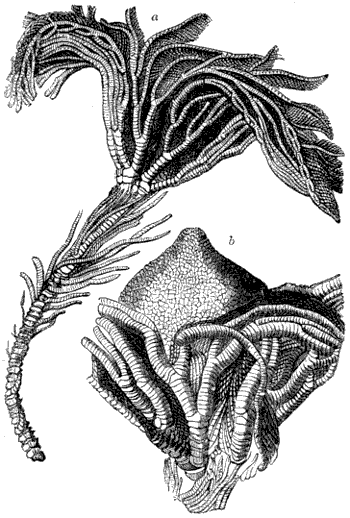
Fig. 79. a, Pentacrinites Briareus, reduced; b, the same from the Lias of Lyme Regis; natural size.
The convulsions and disturbances by which the surface of the earth was agitated did not extend, let it be noted, over the whole of its circumference; the effects were partial and local. It would, then, be wrong to affirm, as is asserted by many modern geologists, that the dislocations of the crust and the agitations of the surface of the globe extended to both hemispheres, resulting in the destruction of all living creatures. The Fauna and Flora of the Permian period did not differ essentially from the Fauna and Flora of the Coal-measures, which shows that no general revolution occurred to disturb the entire globe between these two epochs. Here, then, as in all analogous cases, it is unnecessary to recur to any general cataclysm to explain the passage from one epoch to another. Have we not, almost in our our own day, seen certain species of animals die out and disappear, without the least geological revolution? Without speaking of the Beaver, which abounded two centuries ago on the banks of the Rhône, and in the Cévennes, which still lived at Paris in the little river Bièvre in the middle ages, its existence being now unknown in these latitudes, although it is still found in America and other countries, we could cite many examples of animals which have become extinct in times by no means remote from our own. Such are the Dinornis and the Epyornis, colossal birds of New Zealand and Madagascar, and the Dodo, which lived in the Isle of France in 1626. Ursus spelæus, Cervus Megaceros, Bos primigenius, are species of Bear, Deer, and Ox which were contemporary with man, but have now become extinct. In France we no longer know the gigantic wood-stag, figured by the Romans on their monuments, and which they had brought from England for the fine quality of its flesh. The Erymanthean boar, so widely dispersed during the ancient historical period, no longer exists among our living races, any more than the Crocodiles lacunosus and laciniatus found by Geoffroy St.-Hilaire in the catacombs of ancient Egypt. Many races of animals figured in the mosaics of Palestrina, engraved and painted along with species now actually existing, are no longer found living in our days any more than are the Lions with curly manes, which formerly existed in Syria, and perhaps even in Thessaly and the northern parts of Greece. From what happens in our own time, we may infer what has taken place in times antecedent to the appearance of man; and the idea of successive cataclysms of the globe, must be restrained within bounds. Must we imagine a series of geological revolutions to account for the disappearance of animals which have evidently become extinct in a natural way? What has come to pass in our days, it is reasonable to conclude, may have taken place in the times anterior to the appearance of man.
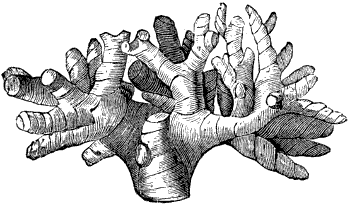
Fig. 80.—Terebellaria ramosissima. (Recent Coral.)