PRIMARY EPOCH.
Reading edition
After the terrible tempests of the primitive period—after these great disturbances of the mineral kingdom—Nature would seem to have gathered herself together, in sublime silence, in order to proceed to the grand mystery of the creation of living beings.
During the primitive epoch the temperature of the earth was too high to admit the appearance of life on its surface. The darkness of thickest night shrouded this cradle of the world; the atmosphere probably was so charged with vapours of various kinds, that the sun’s rays were powerless to pierce its opacity. Upon this heated surface, and in this perpetual night, organic life could not manifest itself. No plant, no animal, then, could exist upon the silent earth. In the seas of this epoch, therefore, only unfossiliferous strata were deposited.
Nevertheless, our planet continued to be subjected to a gradual refrigeration on the one hand, and, on the other, continuous rains were purifying its atmosphere. From this time, then, the sun’s rays, being less obscured, could reach its surface, and, under their beneficent influence, life was not slow in disclosing itself. “Without light,” said the illustrious Lavoisier, “Nature was without life; it was dead and inanimate. A benevolent God, in bestowing light, has spread on the surface of the earth organisation, sentiment, and thought.” We begin, accordingly, to see upon the earth—the temperature of which was nearly that of our equatorial zone—a few plants and a few animals make their appearance. These first generations of life will be replaced by others of a higher organisation, until at the last stage of the creation, man, endowed with the supreme attribute which we call intelligence, will appear upon the earth. “The word progress, which we think peculiar to humanity, and even to modern times,” said Albert Gaudry, in a lecture on the animals of the ancient world, delivered in 1863, “was pronounced by the Deity on the day when he created the first living organism.”
Did plants precede animals? We know not; but such would appear to have been the order of creation. It is certain that in the sediment of the oldest seas, and in the vestiges which remain to us of the earliest ages of organic life on the globe, that is to say, in the argillaceous schists, we find both plants and animals of advanced organisation. But, on the other hand, during the greater part of the primary epoch—especially during the Carboniferous age—the plants are particularly numerous, and terrestrial animals scarcely show themselves; this would lead us to the conclusion that plants preceded animals. It may be remarked, besides, that from their cellular nature, and their looser tissues composed of elements readily affected by the air, the first plants could be easily destroyed without leaving any material vestiges; from which it may be concluded, that, in those primitive times, an immense number of plants existed, no traces of which now remain to us.
We have stated that, during the earlier ages of our globe, the waters covered a great part of its surface; and it is in them that we find the first appearance of life. When the waters had become sufficiently cool to allow of the existence of organised beings, creation was developed, and advanced with great energy; for it manifested itself by the appearance of numerous and very different species of animals and plants.
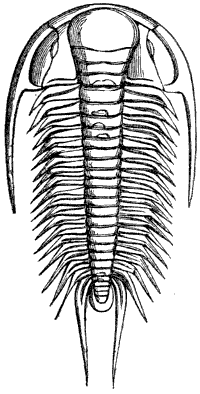
Fig. 17.—Paradoxides Bohemicus—Bohemia.
One of the most ancient groups of organic remains are the Brachiopoda, a group of Mollusca, particularly typified by the genus Lingula, a species of which still exist in the present seas; the Trilobites (Fig. 17), a family of Crustaceans, especially characteristic of this period; then come Productas, Terebratulæ, and Orthoceratites—other genera of Mollusca. The Corals, which appeared at an early period, seem to have lived in all ages, and survive to the present day.
Contemporaneously with these animals, plants of inferior organisation have left their impressions upon the schists; these are Algæ (aquatic plants, Fig. 28). As the continents enlarged, plants of a higher type made their appearance—the Equisetaceæ, herbaceous Ferns, and other plants. These we shall have occasion to specify when noticing the periods which constitute the Primary Epoch, and which consists of the following periods: the Carboniferous, the Old Red Sandstone, and Devonian, the Silurian, and the Cambrian.
Cambrian Period.
The researches of geologists have discovered but scanty traces of organic remains in the rocks which form the base of this system in England. Arenicolites, or worm-tracks and burrows, have been found in Shropshire, by Mr. Salter, to occur in countless numbers through a mile of thickness in the Longmynd rocks; and others were discovered by the late Dr. Kinahan in Wicklow. In Ireland, in the picturesque tract of Bray Head, on the south and east coasts of Dublin, we find, in slaty beds of the same age as the Longmynd rocks, a peculiar zoophyte, which has been named by Edward Forbes Oldhamia, after its discoverer, Dr. Oldham, Superintendent of the Geological Survey of India. This fossil represents one of the earliest inhabitants of the ocean, which then covered the greater part of the British Isles. “In the hard, purplish, and schistose rocks of Bray Head,” says Dr. Kinahan,[34] “as well as other parts of Ireland which are recognised as Cambrian rocks, markings of a very peculiar character are found. They occur in masses, and are recognised as hydrozoic animal assemblages. They have regularity of form, abundant, but not universal, occurrence in beds, and permanence of character even when the beds are at a distance from each other, and dissimilar in chemical and physical character.” In the course of his investigations, Dr. Kinahan discovered at least four species of Oldhamia, which he has described and figured.
The Cambrian rocks consist of the Llanberis slates of Llanberis and Penrhyn in North Wales, which, with their associated sandy strata, attain a thickness of about 3,000 feet, and the Barmouth and Harlech Sandstones. In the Longmynd hills of Shropshire these last beds attain a thickness of 6,000 feet; and in some parts of Merionethshire they are of still greater thickness.
Neither in North Wales, nor in the Longmynd, do the Cambrian rocks afford any indications of life, except annelide-tracks and burrows. From this circumstance, together with general absence of Mollusca in these strata, and the sudden appearance of numerous shells and trilobites in the succeeding Lingula Flags, a change of conditions seems to have ensued at the close of the Cambrian period.
Believing that the red colour of rocks is frequently connected with their deposition in inland waters, Professor Ramsay conceives it to be possible, that the absence of marine mollusca in the Cambrian rocks may be due to the same cause that produced their absence in the Old Red Sandstone, and that the presence of sun-cracks and rain-pittings in the Longmynd beds is a corroboration of this suggestion.[35]
The Silurian Period.
The next period of the Primary Epoch is the Silurian, a system of rocks universal in extent, overspreading the whole earth more or less completely, and covering up the rocks of older age. The term “Silurian” was given by the illustrious Murchison to the epoch which now occupies our attention, because the system of rocks formed by the marine sediments, during the period in question, form large tracts of country in Shropshire and Wales, a region formerly peopled by the Silures, a Celtic race who fought gloriously against the Romans, under Caractacus or Caradoc, the British king of those tracts. The reader may find the nomenclature strange, as applied to the vast range of rocks which it represents in all parts of the Old and New World, but it indicates, with sufficient exactness, the particular region in our own country in which the system typically prevails—reasons which led to the term being adopted, even at a time when its vast geographical extent was not suspected.
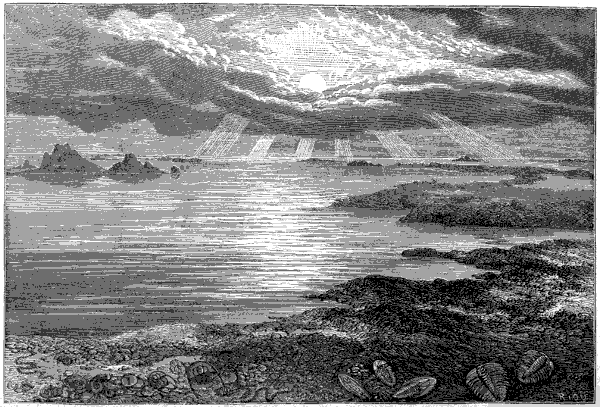
VIII.—Ideal Landscape of the Silurian Period.
On this subject, and on the principles which have guided geologists in their classification of rocks, Professor Sedgwick remarks in one of his papers in the Quarterly Journal of the Geological Society: “In every country,” he says,[36] “which is not made out by reference to a pre-existing type, our first labour is that of determining the physical groups, and establishing their relations by natural sections. The labour next in order is the determination of the fossils found in the successive physical groups; and, as a matter of fact, the natural groups of fossils are generally found to be nearly co-ordinate with the physical groups—each successive group resulting from certain conditions which have modified the distribution of organic types. In the third place comes the collective arrangement of the groups into systems, or groups of a higher order. The establishment of the Silurian system is an admirable example of this whole process. The groups called Caradoc, Wenlock, Ludlow, &c., were physical groups determined by good natural sections. The successive groups of fossils were determined by the sections; and the sections, as the representatives of physical groups, were hardly at all modified by any consideration of the fossils, for these two distinct views of the natural history of such groups led to co-ordinate results. Then followed the collective view of the whole series, and the establishment of a nomenclature. Not only the whole series (considered as a distinct system), but every subordinate group was defined by a geographical name, referring us to a local type within the limits of Siluria; in this respect adopting the principle of grouping and nomenclature applied by W. Smith to our secondary rocks. At the same time, the older slate rocks of Wales (inferior to the system of Siluria), were called Cambrian, and soon afterwards the next great collective group of rocks (superior to the system of Siluria) was called Devonian. In this way was established a perfect congruity of language. It was geographical in principle, and it represented the actual development of all our older rocks, which gave to it its true value and meaning.” The period, then, for the purposes of scientific description, may be divided into three sub-periods—the Upper and Lower Silurian, and the Cambrian.
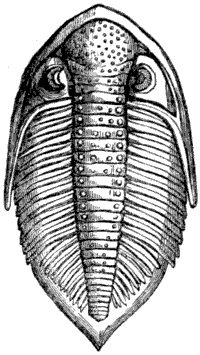
Fig. 18.—Back of Asaphus caudatus (Dudley, Mus. Stokes), with the eyes well preserved. (Buckland.)
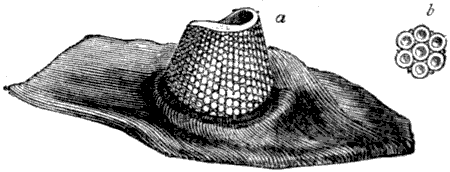
Fig. 19.—a, Side view of the left eye of the above, magnified, (Buckland.) b, Magnified view of a portion of the eye of Calymene macrophthalmus. (Hœninghaus.)
The characteristics of the Silurian period, of which we give an ideal view opposite (Plate VIII.), are supposed to have been shallow seas of great extent, with barren submarine reefs and isolated rocks rising here and there out of the water, covered with Algæ, and frequented by various Mollusca and articulated animals. The earliest traces of vegetation belong to the Thallogens, flowerless plants of the class Algæ (Fig. 28), without leaves or stems, which are found among the Lower Silurian rocks. To these succeed other plants, according to Dr. Hooker, belonging to the Lycopodiaceæ (Fig. 28), the seeds of which are found sparingly in the Upper Ludlow beds. Among animals, the Orthoceratites led a predacious life in the Silurian seas. Their organisation indicates that they preyed upon other animals, pursuing them into the deepest abysses, and strangling them in the embrace of their long arms. The Trilobites, a remarkable group of Crustacea, possessing simple and reticulated compound eyes, also highly characterise this period (Figs. 17 to 20); presenting at one period or other of their existence 1,677 species, 224 of which are met with in Great Britain and Ireland, as we are taught by the “Thesaurus Siluricus.”[37] Add to this a sun, struggling to penetrate the dense atmosphere of the primitive world, and yielding a dim and imperfect light to the first created beings as they left the hand of the Creator, organisms often rudimentary, but at other times sufficiently advanced to indicate a progress towards more perfect creations. Such is the picture which the artist has attempted to portray.
The elaborate and highly valuable “Thesaurus Siluricus” contains the names of 8,997 species of fossil remains, but it probably does not tell us of one-tenth part of the Silurian life still lying buried in rocks of that age in various parts of the world. A rich field is here offered to the geological explorer.[38]
Lower Silurian.
The Silurian rocks have been estimated by Sir Roderick Murchison to occupy, altogether, an area of about 7,600 square miles in England and Wales, 18,420 square miles in Scotland, and nearly 7,000 square miles in Ireland. Thus, as regards the British Isles, the Silurian rocks rise to the surface over nearly 33,000 square miles.
The Silurian rocks have been traced from Cumberland to the Land’s End, at the southern extremity of England. They lie at the base of the southern Highlands of Scotland, from the North Channel to the North Sea, and they range along the entire western coast of that country. In a westerly direction they extended to the sea, where the mountains of Wales—the Alps of the great chain—would stand out in bold relief, some of them facing the sea, others in detached groups; some clothed with a stunted vegetation, others naked and desolate; all of them wild and picturesque. But an interest surpassing all others belongs to these mountains. They are amongst the most ancient sedimentary rocks which exist on our globe, a page of the book in which is written the history of the antiquities of Great Britain—in fine, of the world.
In Shropshire and Wales three zones of Silurian life have been established. In rocks of three different ages Graptolites have left the trace of their existence. Another fossil characteristic of these ancient rocks is the Lingula. This shell is horny or slightly calcareous, which has probably been one cause of its preservation. The family to which the Lingula belongs is so abundant in the rocks of the Welsh mountains, that Sir R. Murchison has used it to designate a geological era. These Lingula-flags mark the beginning of the first Silurian strata.
In the Lower Llandovery beds, which mark the close of the period, other fossils present themselves, thus greatly augmenting the forms of life in the Lower Silurian rocks. These are cœlenterata, articulata, and mollusca. They mark, however, only a very ephemeral passage over the globe, and soon disappear altogether.
The vertebrated animals are only represented by rare Fishes, and it is only on reaching the Upper Ludlow rocks, and specially in those beds which pass upward into the Old Red Sandstone, that the remains have been found of fishes—the most ancient beings of their class.
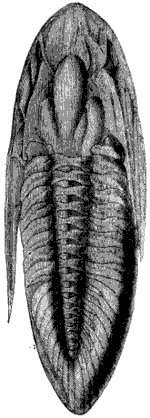
Fig. 20.—Ogygia Guettardi. Natural size.
The class of Crustaceans, of which the lobster, shrimp, and the crab of our days are the representatives, was that which predominated in this epoch of animal life. Their forms were most singular, and different from those of all existing Crustaceans. They consisted mainly of the Trilobites, a family which became entirely extinct at the close of the Carboniferous epoch, but in whose nicely-jointed shell the armourer of the middle ages might have found all his contrivances anticipated, with not a few besides which he has failed to discover. The head presents, in general, the form of an oval buckler; the body is composed of a series of articulations, or rings, as represented in Fig. 20; the anterior portion carrying the eyes, which in some are reticulated, like those of many insects (Figs. 18 and 19); the mouth was placed forward and beneath the head. Many of these Crustaceans could roll themselves into balls, like the wood-louse (Figs. 23 and 25). They swam on their backs.
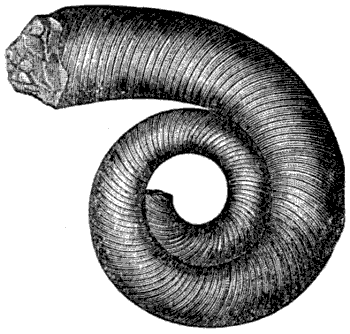
Fig. 21.—Lituites cornu-arietis. One-third natural size.
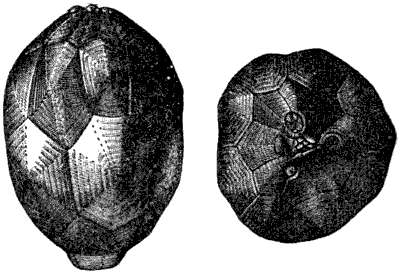
Fig. 22.—Hemicosmites pyriformis. One-third natural size.
During the middle and later Silurian ages, whole rocks were formed almost exclusively of their remains; during the Devonian period they seem to have gradually died out, almost disappearing in the Carboniferous age, and being only represented by one doubtful species in the Permian rocks of North America. The Trilobites are unique as a family, marking with certainty the rocks in which they occur; “and yet,” says Hugh Miller, “how admirably do they exhibit the articulated type of being, and illustrate that unity of design which pervades all Nature, amid its endless diversity!” Among other beings which have left their traces in the Silurian strata is Nereites Cambriensis, a species of annelide, whose articulations are very distinctly marked in the ancient rocks.
Besides the Trilobites, many orders of Mollusca were numerously represented in the Silurian seas. As Sir R. Murchison has observed, no zoological feature in the Upper Silurian rocks is more striking than the great increase and profusion of Cephalopods, many of them of great size, which appear in strata of the age immediately antecedent to the dawn of vertebrated life. Among the Cephalopods we have Gyroceras and Lituites cornu-arietis (Fig. 21), whose living representatives are the Nautilus and Cuttlefish of every sea. The genus Bellerophon (Figs. 54 and 56), with many others, represented the Gasteropods, and like the living carinaria sailed freely over the sea by means of its fleshy parts. The Gasteropods, with the Lamellibranchs, of which the Oyster is a living type, and the Brachiopods, whose congeners may still be detected in the Terebratula of our Highland lochs and bays, and the Lingulæ of the southern hemisphere, were all then represented. The Lamellibranchiata are without a head, and almost entirely destitute of power of locomotion. Among the Echinodermata we may cite the Hemiscosmites, of which H. pyriformis (Fig. 22) may be considered an example.
The rocks of the Lower Silurian age in France are found in Languedoc, in the environs of Neffiez and of Bédarrieux. They occupy, also, great part of Brittany. They occur in Bohemia, also in Spain, Russia, and in the New World. Limestones, sandstones, and schists (slates of Angers) form the chief part of this series. The Cambrian slates are largely represented in Canada and the United States.
Lower Silurian Group.
Formation. Prevailing Rocks. Thickness. Fossils.
Lower Llandovery – Hard sandstones, conglomerates, and flaggy shaly beds – 600 to 1,000 – Pentamerus lens.
Caradoc or Bala – Shelly sandstones, shales, and slaty beds, with grits, conglomerates, and occasional calcareous bands (Bala limestone) – 12,000 – Brachiopods; Lamellibranchs; Pteropods; Cystideans; Graptolites; Trilobites.
Llandeilo Flags – Dark-grey flagstones, occasionally calcareous sandstones, with black slates, containing Graptolites – 1,000 to 1,500 – Trilobites (Fig. 36); Graptolites; Heteropods; large Cephalopods.
Lower Llandeilo Tremadoc Slates – Dark-grey and ferruginous slates, sandy shales, and bluish flags, with occasional beds of pisolitic iron-ore
Lingula Flags – Black and dark shaly, grey and brown slaty flagstones and sandstones, with siliceous grits and quartzites – 6,000 – Trilobites (Olenus, Conocoryphe, Paradoxides, Fig. 17); Brachiopods; Cystideans.
Cambrian Group.
Cambrian – Llanberis slates, with sandy strata – 3,000 – Annelides.
Harlech grits – 6,000 – Oldhamia.
Laurentian Group.
Upper Laurentian – Stratified, highly-crystalline, and felspathic rocks – 12,060 – Eozoon.
Lower Laurentian – Gneiss, quartzite, hornblende and mica-schists – 18,000 – None.
Upper Silurian Period.
Upper Silurian Group.
Lithological Characters. Thickness. Fossils.
Ludlow Rocks – Passage Beds, Tile-stones, and Downton sandstones, at the base of the bone-bed – 80 – Sea-weeds, Lingulæ, Mollusca.
Micaceous, yellowish and grey, sandy mudstone – 700 – Crustacea and Fish-remains.
Argillaceous (Aymestry) limestone – 50 – Crinoids.
Argillaceous Shale with impure limestones – 1000 – Mollusca of many genera.
Wenlock Rocks – Argillaceous or semi-crystalline limestone – 3000 – Mollusca of many genera.
Argillaceous shales, in places slaty Echinodermata; Actinozoa; Trilobites.
Woolhope Limestone and occasional bands of argillaceous nodules Graptolites.
Upper Llandovery Rocks – Grey and yellowish sandstones (occasionally conglomerates) with bands of limestone – 800 – Pentamerus oblongus, Rhynchonella, Orthides, &c.
Among the fossils of this period may be remarked a number of Trilobites, which then attained their greatest development. Among others, Calymene Blumenbachii (Fig. 23), some Cephalopoda, and Brachiopoda, among which last may be named Pentamerus Knightii, Orthis, &c., and some Corals, as Halysites catenularius (Fig. 26), or the chain coral.
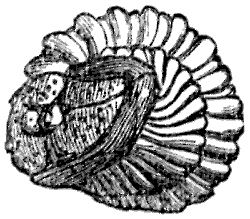
Fig. 23.—Calymene Blumenbachii partially rolled up.
The Trilobites, we have already said, were able to coil themselves into a ball, like the wood-louse, doubtless as a means of defence. In Fig. 23, one of these creatures, Calymene Blumenbachii, is represented in that form, coiled upon itself. (See also Illænus Barriensis, Fig. 25.)
Crustaceans of a very strange form, and in no respects resembling the Trilobites, have been met with in the Silurian rocks of England and America—the Pterygotus (Fig. 27) and the Eurypterus, (Fig. 24). They are supposed to have been the inhabitants of fresh water. They were called “Seraphim” by the Scotch quarrymen, from the winged form and feather-like ornamentation upon the thoracic appendage, the part most usually met with. Agassiz figured them in his work on the ‘Fossil Fishes of the Old Red Sandstone,’ but, subsequently recognising their crustacean character, removed them from the Class of Fishes, and placed them with the Pœcilipod Crustacea. The Eurypteridæ and Pterygoti in England almost exclusively belong to the passage beds—the Downton sandstone and the Upper Ludlow rocks.
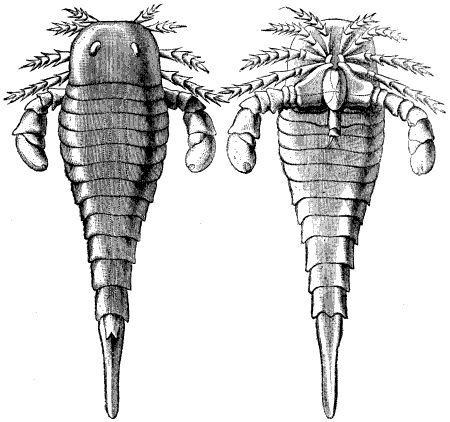
Fig. 24.—Eurypterus remipes. Natural size.
Among the marine plants which have been found in the rocks corresponding with this sub-period are some species of Algæ, and others belonging to the Lycopodiaceæ, which become still more abundant in the Old Red Sandstone and Carboniferous Periods. Fig. 28 represents some examples of the impressions they have left.
The seas were, evidently, abundantly inhabited at the end of the Upper Silurian period, for naturalists have examined nearly 1,500 species belonging to these beds, and the number of British species, classified and arranged for public inspection in our museums cannot be much short of that number.
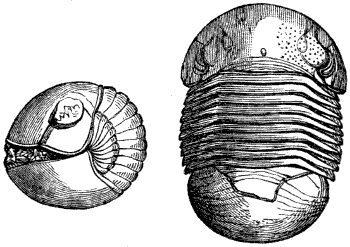
Fig. 25.—Illænus Barriensis.—Dudley, Walsall.
Towards the close of the Upper Silurian sub-period, the argillaceous beds pass upwards into more sandy and shore-like deposits, in which the most ancient known fossil Fishes occur, and then usher us into the first great ichthyic period of the Old Red Sandstone, or Devonian, so well marked by its fossil fishes in Britain, Russia, and North America. The so-called fish-bones have been the subject of considerable doubt. Between the Upper Ludlow rocks opposite Downton Castle and the next overlying stratum, there occurs a thin bed of soft earthy shale, and fine, soft, yellowish greenstone, immediately overlying the Ludlow rock: just below this a remarkable fish-deposit occurs, called the Ludlow bone-bed, because the bones of animals are found in this stratum in great quantities. Old Drayton treats these bones as a great marvel:—
“With strange and sundry tales Of all their wondrous things; and not the least in Wales, Of that prodigious spring (him neighbouring as he past), That little fishes’ bones continually doth cast.”
Polyolbion.
Above the yellow beds, or Downton sandstone, as they are called, organic remains are extensively diffused through the argillaceous strata, which have yielded fragments of fishes’ bones (being the earliest trace yet found of vertebrate life), with seeds and land-plants, the latter clearly indicating the neighbourhood of land, and the poverty of numbers and the small size of the shells, a change of condition in the nature of the waters in which they lived. “It was the central part only,” says Sir R. Murchison, “of this band, or a ginger-bread-coloured layer of a thickness of three or four inches, and dwindling away to a quarter of an inch, exhibiting, when my attention was first directed to it, a matted mass of bony fragments, for the most part of small size and of very peculiar character. Some of the fragments of fish are of a mahogany hue, but others of so brilliant a black that when first discovered they conveyed the impression that the bed was a heap of broken beetles.”[39]
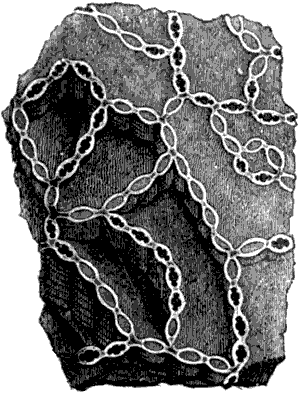
Fig. 26.—Halysites catenularius.
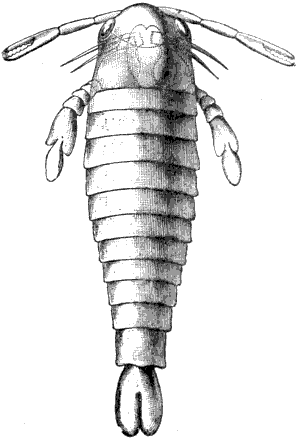
Fig. 27.—Pterygotus bilobatus.
The fragments thus discovered were, after examination on the spot, supposed to be those of fishes, but, upon further investigation, many of them were found to belong to Crustaceans. The ichthyic nature of some of them is, however, now well established.
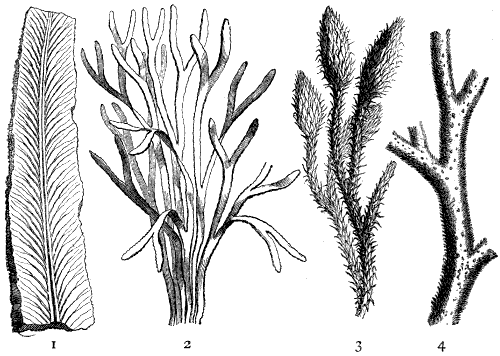
Fig. 28.—Plants of the Palæozoic Epoch.—1 and 2, Algæ; 3 and 4, Lycopods.
Silurian Rocks are found in France in the departments of La Manche, Calvados, and of the Sarthe, and in Languedoc the Silurian formation has occupied the attention of Messrs. Graff and Fournet, who have traced along the base of the Espinouse, the green, primordial chlorite-schists, surmounted by clay-slates, which become more and more pure as the distance from the masses of granite and gneiss increases, and the valley of the Jour is approached. Upon these last the Silurian system rests, sinking towards the plain under Secondary and Tertiary formations. In Great Britain, Silurian strata are found enormously developed in the West and South Highlands of Scotland, on the western slopes of the Pennine chain and the mountains of Wales, and in the adjoining counties of Shropshire—their most typical region—and Worcestershire. In Spain; in Germany (on the banks of the Rhine); in Bohemia—where, also, they are largely developed, especially in the neighbourhood of Prague—in Sweden, where they compose the entire island of Gothland; in Norway; in Russia, especially in the Ural Mountains; and in America, in the neighbourhood of New York, and half way across the continent—in all these countries they are more or less developed.
We may add, as a general characteristic of the Silurian system as a whole, that of all formations it is the most disturbed. In the countries where it prevails, it only appears as fragments which have escaped destruction amid the numerous changes that have affected it during the earlier ages of the world. The beds, originally horizontal, are turned up, contorted, folded over, and sometimes become even vertical, as in the slates of Angers, Llanberis, and Ireleth. D’Orbigny found the Silurian beds with their fossils in the American Andes, at the height of 16,000 feet above the level of the sea. What vast upheavals must have been necessary to elevate these fossils to such a height!
In the Silurian period the sea still occupied the earth almost entirely; it covered the greater part of Europe: all the area comprised between Spain and the Ural was under water. In France only two islands had emerged from the primordial ocean. One of them was formed of the granitic rocks of what are now Brittany and La Vendée; the other constituted the great central plateau, and consisted of the same rocks. The northern parts of Norway, Sweden, and of Russian Lapland formed a vast continental surface. In America the emerged lands were more extensive. In North America an island extended over eighteen degrees of latitude, in the part now called New Britain. In South America, in the Pacific, Chili formed one elongated island. Upon the Atlantic, a portion of Brazil, to the extent of twenty degrees of latitude, was raised above water. Finally, in the equatorial regions, Guiana formed a later island in the vast ocean which still covered most other parts of the New World.
There is, perhaps, no scene of greater geological confusion than that presented by the western flanks of the Pennine chain. A line drawn longitudinally from about three degrees west of Greenwich, would include on its western side Cross Fell, in Cumberland, and the greater part of the Silurian rocks belonging to the Cambrian system, in which the Cambrian and Lower Silurian rocks are now well determined; while the upper series are so metamorphosed by eruptive granite and the effects of denudation, as to be scarcely recognisable. “With the rare exception of a seaweed and a zoophyte,” says the author of ‘Siluria,’ “not a trace of a fossil has been detected in the thousands of feet of strata, with interpolated igneous matter, which intervene between the slates of Skiddaw and the Coniston limestone, with its overlying flags; at that zone only do we begin to find anything like a fauna: here, judging from its fossils, we find representations of the Caradoc and Bala rocks.” This much-disturbed district Professor Sedgwick, after several years devoted to its study, has attempted to reconstruct, the following being a brief summary of his arguments. The region consists of:—
I. Beds of mudstone and sandstone, deposited in an ancient sea, apparently without the calcareous matter necessary to the existence of shells and corals, and with numerous traces of organic forms of Silurian age—these were the elements of the Skiddaw slates.
II. Plutonic rocks were, for many ages, poured out among the aqueous sedimentary deposits; the beds were broken up and re-cemented—plutonic silt and other finely comminuted matter were deposited along with the igneous rocks: the process was again and again repeated, till a deep sea was filled up with a formation many thousands of feet thick by the materials forming the middle Cambrian rocks.
III. A period of comparative repose followed. Beds of shells and bands of coral were formed upon the more ancient rocks, interrupted with beds of sand and mud; processes many times repeated: and thus, in a long succession of ages, were the deposits of the upper series completed.
IV. Towards the end of the period, mountain-masses and eruptive rocks were pushed up through the older deposits. After many revolutions, all the divisions of the slate-series were upheaved and contorted by movements which did not affect the newer formations.
V. The conglomerates of the Old Red Sandstone were now spread out by the beating of an ancient surf, continued through many ages, against the upheaved and broken slates.
VI. Another period of comparative repose followed: the coral-reefs of the mountain limestone, and the whole carboniferous series, were formed, but not without any oscillations between the land and sea-levels.
VII. An age of disruption and violence succeeded, marked by the discordant position of the rocks, and by the conglomerate of the New Red Sandstone. At the beginning of this period the great north and south “Craven fault,” which rent off the eastern calcareous mountains from the old slates, was formed. Soon afterwards the disruption of the great “Pennine fault,” which ranges from the foot of Stanmore to the coast of North Cumberland, occurred, lifting up the terrace of Cross Fell above the plain of the Eden. About the same time some of the north and south fissures, which now form the valleys leading into Morecambe Bay, may have been formed.
VIII. The more tranquil period of the New Red Sandstone now dawns, but here our facts fail us on the skirts of the Lake Mountains.
IX. Thousands of ages rolled away during the Secondary and Tertiary periods, in which we can trace no movement. But the powers of Nature are never still: during this age of apparent repose many a fissure may have started into an open chasm, many a valley been scooped out upon the lines of “fault.”
X. Close to the historic times we have evidence of new disruptions and violence, and of vast changes of level between land and sea. Ancient valleys probably opened out anew or extended, and fresh ones formed in the changes of the oceanic level. Cracks among the strata may now have become open fissures, vertical escarpments formed by unequal elevations along the lines of fault; and subsidence may have given rise to many of the tarns and lakes of the district.
Such is the picture which one of our most eminent geologists gives as the probable process by which this region has attained its present appearance, after he had devoted years of study and observation to its peculiarities; and his description of one spot applies in its general scope to the whole district. At the close of the Silurian period our island was probably an archipelago, ranging over ten degrees of latitude, like many of the island groups now found in the great Pacific Ocean; the old gneissic hills of the western coast of Scotland, culminating in the granite range of Ben Nevis, and stretching to the southern Grampians, forming the nucleus of one island group; the south Highlands of Scotland, ranging from the Lammermoor hills, another; the Pennine chain and the Malvern hills, the third, and most easterly group; the Shropshire and Welsh mountains, a fourth; and Devon and Cornwall stretching far to the south and west. The basis of the calculation being, that every spot of this island lying now at a lower elevation than 800 feet above the sea, was under water at the close of the Silurian period, except in those instances where depression by subsidence has since occurred.
There is, however, another element to be considered, which cannot be better stated than in the picturesque language of M. Esquiros, an eminent French writer, who has given much attention to British geology. “The Silurian mountains,” he says, “ruins in themselves, contain other ruins. In the bosom of the Longmynd rocks, geologists discover conglomerates of rounded stones which bear no resemblance to any rocks now near them. These stones consequently prove the existence of rocks more ancient still; they are fragments of other mountains, of other shores, perhaps even of continents, broken up, destroyed, and crumbled by earlier seas. There is, then, little hope of one discovering the origin of life on the globe, since this page of the Genesis of the facts has been torn. For some years geologists loved to rest their eyes, in this long night of ages, upon an ideal limit beyond which plants and animals would begin to appear. Now, this line of demarcation between the rocks which are without vestiges of organised beings, and those which contain fossils, is nearly effaced among the surrounding ruins. On the horizon of the primitive world we see vaguely indicated a series of other worlds which have altogether disappeared; perhaps it is necessary to resign ourselves to the fact that the dawn of life is lost in this silent epoch, where age succeeds age, till they are clothed in the garb of eternity. The river of creation is like the Nile, which, as Bossuet says, hides its head—a figure of speech which time has falsified—but the endless speculations opened up by these and similar considerations led Lyell to say, ‘Here I am almost prepared to believe in the ancient existence of the Atlantis of Plato.’”
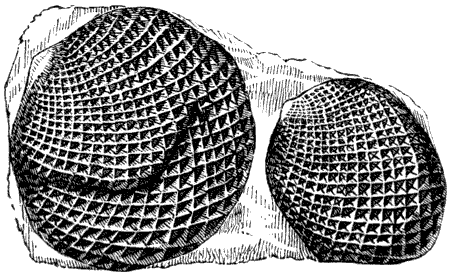
Fig. 29.—Ischadites Kœnigii. Upper Ludlow Rocks.
Note.—For accurate representations of the typical fossils of the Palæozoic strata of Britain, the reader may consult, with advantage, the carefully executed “Figures of Characteristic British Fossils,” by W. H. Baily, F.G.S. (Van Voorst).
OLD RED SANDSTONE AND DEVONIAN PERIOD.
Another great period in the Earth’s history opens on us—the Devonian or “Old Red Sandstone,” so called, because the formation is very clearly displayed over a great extent of country in the county of Devon. The name was first proposed by Murchison and Sedgwick, in 1837, for these strata, which had previously been referred to the “transition” or Silurian series.
The circumstances which marked the passage of the uppermost Silurian rocks into Old Red Sandstone seem to have been:—First, a shallowing of the sea, followed by a gradual alteration in the physical geography of the district, so that the area became changed into a series of mingled fresh and brackish lagoons, which, finally, by continued terrestrial changes, were converted into a great fresh-water lake; or, if we take the whole of Britain and lands beyond, into a series of lakes.[40]
Mr. Godwin Austen has, also, stated his opinion that the Old Red Sandstone, as distinct from the Devonian rocks, was of lacustrine origin.
The absence of marine shells helps to this conclusion, and the nearest living analogues of some of the fishes are found in the fresh water of Africa and North America. Even the occurrence in the Devonian rocks of Devonshire and Russia of some Old Red Sandstone fishes along with marine shells, merely proves that some of them were fitted to live in either fresh or salt water, like various existing fishes. At the present day animals that are commonly supposed to be essentially marine, are occasionally found inhabiting fresh water, as is the case in some of the lakes of Sweden, where it is said marine crustacea are found. Mr. Alexander Murray also states that in the inland fresh-water lakes of Newfoundland seals are common, living there without even visiting the sea. And the same is the case in Lake Baikal, in Central Asia.
The red colour of the Old Red Sandstone of England and Scotland, and the total absence of fossils, except in the very uppermost beds, are considered by Professor Ramsay to indicate that the strata were deposited in inland waters. These fossils are terrestrial ferns, Adiantites (Pecopteris) Hibernicus, and a fresh-water shell, Anodon Jukesii, together with the fish Glyptolepis.[41]
The rocks deposited during the Devonian period exhibit some species of animals and plants of a much more complex organisation than those which had previously made their appearance. We have seen, during the Silurian epoch, organisms appearing of very simple type; namely, zoophytes, articulated and molluscous animals, with algæ and lycopods, among plants. We shall see, as the globe grows older, that organisation becomes more complex. Vertebrated animals, represented by numerous Fishes, succeed Zoophytes, Trilobites, and Molluscs. Soon afterwards Reptiles appear, then Birds and Mammals; until the time comes when man, His supreme and last work, issues from the hands of the Creator, to be king of all the earth—man, who has for the sign of his superiority, intelligence—that celestial gift, the emanation from God.
Vast inland seas, or lakes covered with a few islets, form the ideal of the Old Red Sandstone period. Upon the rocks of these islets the mollusca and articulata of the period exhibit themselves, as represented on the opposite page (Plate IX.). Stranded on the shore we see armour-coated Fishes of strange forms. A group of plants (Asterophyllites) covers one of the islets, associated with plants nearly herbaceous, resembling mosses, though the true mosses did not appear till a much later period. Encrinites and Lituites occupy the rocks in the foreground of the left hand.
The vegetation is still simple in its development, for forest-trees seem altogether wanting. The Asterophyllites, with tall and slender stems, rise singly to a considerable height. Cryptogams, of which our mushrooms convey some idea, would form the chief part of this primitive vegetation; but in consequence of the softness of their tissues, their want of consistence, and the absence of much woody fibre, these earlier plants have come down to us only in a fragmentary state.
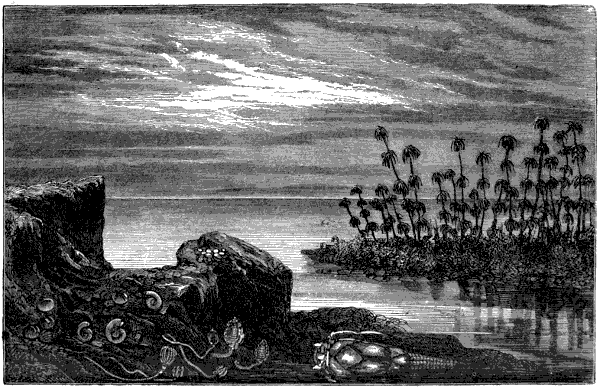
IX.—Ideal Landscape of the Devonian Period.
The plants belonging to the Devonian period differ much from the vegetation of the present day. They resembled both mosses and lycopods, which are flowerless cryptogamic plants of a low organisation. The Lycopods are herbaceous plants, playing only a secondary part in the vegetation of the globe; but in the earlier ages of organic creation they were the predominant forms in the vegetable kingdom, both as to individual size and the number and variety of their species.
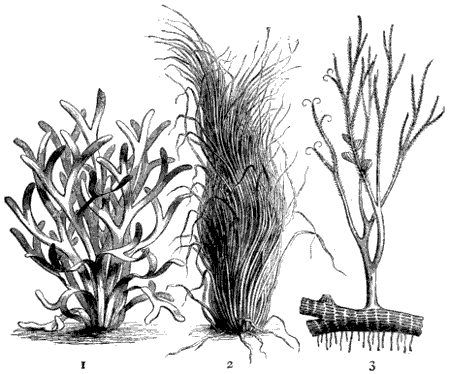
Fig. 30.—Plants of the Devonian Epoch. 1. Algæ. 2. Zostera. 3. Psilophyton, natural size.
In the woodcut (Fig. 30) we have represented three species of aquatic plants belonging to the Devonian period; they are—1, Fucoids (or Algæ); 2, Zostera; 3, Psilophyton. The Fucoid closely resembles its modern ally; but with the first indications of terrestrial vegetation we pass from the Thallogens, to which the Algæ belong (plants of simple organisation, without flower or stem), to the Acrogens, which throw out their leaves and branches at the extremity, and bear in the axils of their leaves minute circular cases, which form the receptacles of their spore-like seeds. “If we stand,” says Hugh Miller, “on the outer edge of one of those iron-bound shores of the Western Highlands, where rock and skerries are crowned with sea-weeds; the long cylindrical lines of chorda-filum, many feet in length, lying aslant in the tideway; long shaggy bunches of Fucus serratus and F. nodosus drooping from the sides of the rock; the flat ledges bristling with the stiff cartilaginous many-cleft fronds of at least two species of Chondrus; now, in the thickly-spread Fucoids of this Highland scene we have a not very improbable representation of the Thallogenous vegetation. If we add to this rocky tract, so rich in Fucoids, a submarine meadow of pale shelly sand, covered by a deep-green swathe of Zosteræ, with jointed root and slim flowers, unfurnished with petals, it would be more representative still.”
Let us now take a glance at the animals belonging to this period.
The class of Fishes seem to have held the first rank and importance in the Old Red Sandstone fauna; but their structure was very different from that of existing fishes: they were provided with a sort of cuirass, and from the nature of the scales were called Ganoid fishes. Numerous fragments of these curious fishes are now found in geological collections; they are of strange forms, some being completely covered with a cuirass of many pieces, and others furnished with wing-like pectoral fins, as in Pterichthys.
Let any one picture to himself the surprise he would feel should he, on taking his first lesson in geology, and on first breaking a stone—a pebble, for instance, exhibiting every external sign of a water-worn surface—find, to appropriate Archdeacon Paley’s illustration, a watch, or any other delicate piece of mechanism, in its centre. Now, this, thirty years ago, is exactly the kind of surprise that Hugh Miller experienced in the sandstone quarry opened in a lofty wall of cliff overhanging the northern shore of the Moray Frith. He had picked up a nodular mass of blue Lias-limestone, which he laid open by a stroke of the hammer, when, behold! an exquisitely shaped Ammonite was displayed before him. It is not surprising that henceforth the half-mason, half-sailor, and poet, became a geologist. He sought for information, and found it; he found that the rocks among which he laboured swarmed with the relics of a former age. He pursued his investigations, and found, while working in this zone of strata all around the coast, that a certain class of fossils abounded; but that in a higher zone these familiar forms disappeared, and others made their appearance.
He read and learned that in other lands—lands of more recent formation—strange forms of animal life had been discovered; forms which in their turn had disappeared, to be succeeded by others, more in accordance with beings now living. He came to know that he was surrounded, in his native mountains, by the sedimentary deposits of other ages; he became alive to the fact that these grand mountain ranges had been built up grain by grain in the bed of the ocean, and the mountains had been subsequently raised to their present level by the upheaval of one part of its bed, or by the subsidence of another. The young geologist now ceased to wonder that each bed, or series of beds, should contain in its bosom records of its own epoch; it seemed to him as if it had been the object of the Creator to furnish the inquirer with records of His wisdom and power, which could not be misinterpreted.
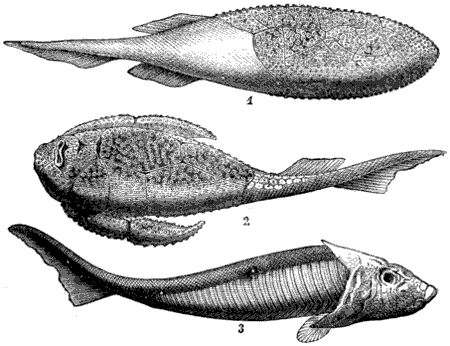
Fig. 31.—Fishes of the Devonian Epoch. 1. Coccosteus, one-third natural size. 2. Pterichthys, one-fourth natural size. 3. Cephalaspis, one-fourth natural size.
Among the Fishes of Old Red Sandstone, the Coccosteus (Fig. 31, No. 1) was only partially cased in a defensive armour; the upper part of the body down to the fins was defended by scales. Pterichthys (No. 2), a strange form, with a very small head, furnished with two powerful paddles, or arms, like wings, and a mouth placed far behind the nose, was entirely covered with scales. The Cephalaspis (No. 3), which has a considerable outward resemblance to some fishes of the present time, was nevertheless mail-clad, only on the anterior part of the body.
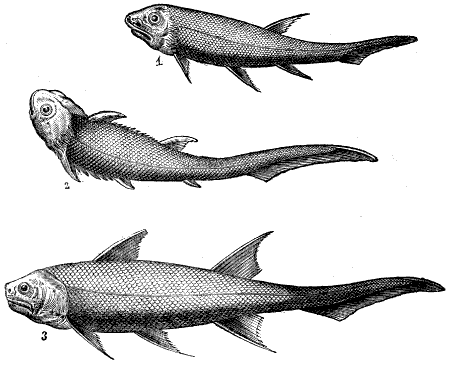
Fig. 32.—Fishes of the Devonian epoch. 1. Acanthodes. 2. Climatius. 3. Diplacanthus.
Other fishes were provided with no such cuirass, properly so called, but were protected by strong resisting scales, enveloping the whole body. Such were the Acanthodes (1), the Climatius (2), and the Diplacanthus (3), represented in Fig. 32.
Among the organic beings of the Devonian rocks we find worm-like animals, such as the Annelides, protected by an external shell, and which at the present day are probably represented by the Serpulæ. Among Crustaceans the Trilobites are still somewhat numerous, especially in the middle rocks of the period. We also find there many different groups of Mollusca, of which the Brachiopoda form more than one-half. We may say of this period that it is the reign of Brachiopoda; in it they assumed extraordinary forms, and the number of their species was very great. Among the most curious we may instance the enormous Stringocephalus Burtini, Davidsonia Verneuilli, Uncites gryphus, and Calceola Sandalina, shells of singular and fantastic shape, differing entirely from all known forms. Amongst the most characteristic of these Mollusca, Atrypa reticularis (Fig. 33) holds the first rank, with Spirifera concentrica, Leptæna Murchisoni, and Productus subaculeatus. Among the Cephalopoda we have Clymenia Sedgwickii (Fig. 34), including the Goniatites, illustrating the Ammonites, which so distinctly characterise the Secondary epoch, but which were only foreshadowed in the Devonian period.
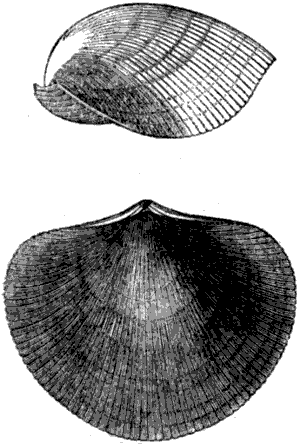
Fig. 33.—Atrypa reticularis.
Among the Radiata of this epoch, the order Crinoidea are abundantly represented. We give as an example Cupressocrinus crassus (Fig. 35). The Encrinites, under which name the whole of these animals are sometimes included, lived attached to rocky places and in deep water, as they now do in the Caribbean sea.
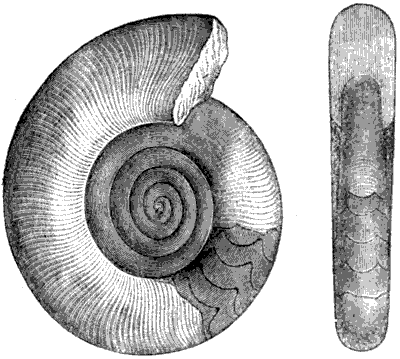
Fig. 34.—Clymenia Sedgwickii.
The Encrinites, as we have seen, were represented during the Silurian period in a simple genus, Hemicosmites, but they greatly increased in numbers in the seas of the Devonian period. They diminish in numbers, as we retire from that geological age; until those forms, which were so numerous and varied in the earliest seas, are now only represented by two genera.
The Old Red Sandstone rocks are composed of schists, sandstone, and limestones. The line of demarcation between the Silurian rocks and those which succeed them may be followed, in many places, by the eye; but, on a closer examination, the exact limits of the two systems become more difficult to fix. The beds of the one system pass into the other by a gradual passage, for Nature rarely admits of violent contrasts, and shows few sudden transitions. By-and-by, however, the change becomes very decided, and the contrast between the dark grey masses at the base and the superincumbent yellow and red rocks become sufficiently striking. In fact, the uppermost beds of the Silurian rocks are the passage-beds of the overlying system, consisting of flagstones, occasionally reddish, and called in some districts “tile-stones.” Over these lie the Old Red Sandstone conglomerate, the Caithness flags, and the great superincumbent mass which forms the upper portion of the system. Though less abrupt than the eruptive and Silurian mountains, the Old Red Sandstone scenery is, nevertheless, distinguished by its imposing outline, assuming bold and lofty escarpments in the Vans of Brecon, in Grongar Hill, near Caermarthen, and in the Black Mountain of Monmouthshire, in the centre of a landscape which, wood, rock, and river combine to render perfect. But it is in the north of Scotland where this rock assumes its grandest aspect, wrapping its mantle round the loftiest mountains, and rising out of the sea in rugged and fantastic masses, as far north as the Orkneys. In Devon and Cornwall, where the rocks are of a calcareous, and sometimes schistose or slaty character, they are sufficiently extensive to have given a name to the series, which is recognised all over the world.
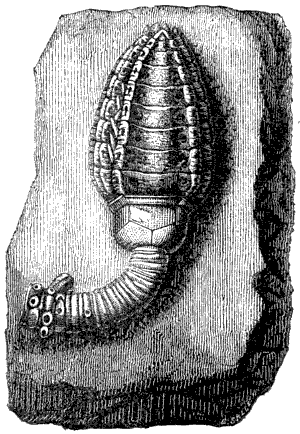
Fig. 35.—Cupressocrinus crassus.
In Herefordshire, Worcestershire, Shropshire, Gloucestershire, and South Wales, the Old Red Sandstone is largely developed, and sometimes attains the thickness of from 8,000 to 10,000 feet, divided into: 1. Conglomerate; 2. Brown stone, with Eurypterus; 3. Marl and cornstones, with irregular courses of concrete limestone, in which are spines of Fishes and remains of Cephalaspis and Pteraspis; 4. Thin olive-coloured shales and sandstone, intercalated with beds of red marl, containing Cephalaspis and Auchenaspis. In Scotland, south of the Grampians, a yellow sandstone occupies the base of the system; conglomerate, red shales, sandstone and cornstones, containing Holoptychius and Cephalaspis, and the Arbroath paving-stone, containing what Agassiz recognised as a huge Crustacean.
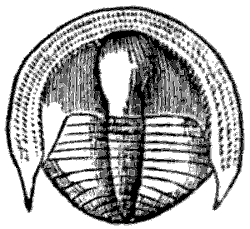
Fig. 36.—Trinucleus Lloydii. (Llandeilo Flags.)
Some of the phenomena connected with the older rocks of Devonshire are difficult to unravel. The Devonian, it is now understood, is the equivalent, in another area, of the Old Red Sandstone, and in Cornwall and Devonshire lie directly on the Silurian strata, while elsewhere the fossils of the Upper Silurian are almost identical with those in the Devonian beds. The late Professor Jukes, with some other geologists, was of opinion that the Devonian rocks of Devonshire only represented the Old Red Sandstone of Scotland and South Wales in part; the Upper Devonian rocks lying between the acknowledged Old Red Sandstone and the Culm-measures being the representatives of the lower carboniferous rocks of Ireland.
Mr. Etheridge, on the other hand, in an elaborate memoir upon the same subject, has endeavoured to prove that the Devonian and Old Red Sandstone, though contemporaneous in point of time, were deposited in different areas and under widely different conditions—the one strictly marine, the other altogether fresh-water—or, perhaps, partly fresh-water and partly estuarine. This supposition is strongly supported by his researches into the mollusca of the Devonian system, and also by the fish-remains of the Devonian and Old Red Sandstone of Scotland and the West of England and Wales.[42] The difficulty of drawing a sharply-defined line of demarcation between different systems is sufficient to dispel the idea which has sometimes been entertained that special faunæ were created and annihilated in the mass at the close of each epoch. There was no close: each epoch disappears or merges into that which succeeds it, and with it the animals belonging to it, much as we have seen them disappear from our own fauna almost within recent times.
CARBONIFEROUS PERIOD.
In the history of our globe the Carboniferous period succeeds to the Devonian. It is in the formations of this latter epoch that we find the fossil fuel which has done so much to enrich and civilise the world in our own age. This period divides itself into two great sub-periods: 1. The Coal-measures; and 2. The Carboniferous Limestone. The first, a period which gave rise to the great deposits of coal; the second, to most important marine deposits, most frequently underlying the coal-fields in England, Belgium, France, and America.
The limestone-mountains which form the base of the whole system, attain in places, according to Professor Phillips, a thickness of 2,500 feet. They are of marine origin, as is apparent by the multitude of fossils they contain of Zoophytes, Radiata, Cephalopoda, and Fishes. But the chief characteristic of this epoch is its strictly terrestrial flora—remains of plants now become as common as they were rare in all previous formations, announcing a great increase of dry land. In older geological times the present site of our island was covered by a sea of unlimited extent; we now approach a time when it was a forest, or, rather, an innumerable group of islands, and marshes covered with forests, which spread over the surface of the clusters of islands which thickly studded the sea of the period.
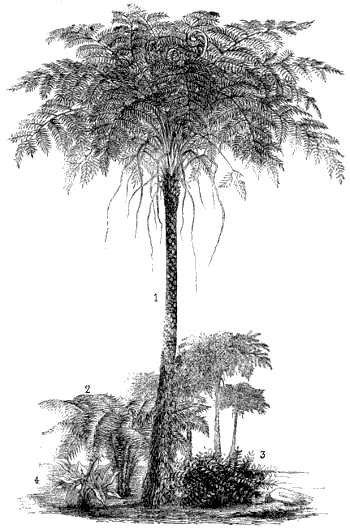
Fig. 37.—Ferns restored. 1 and 2. Arborescent Ferns. 3 and 4. Herbaceous Ferns.
The monuments of this era of profuse vegetation reveal themselves in the precious Coal-measures of England and Scotland. These give us some idea of the rich verdure which covered the surface of the earth, newly risen from the bosom of its parent waves. It was the paradise of terrestrial vegetation. The grand Sigillaria, the Stigmaria, and other fern-like plants, were especially typical of this age, and formed the woods, which were left to grow undisturbed; for as yet no living Mammals seem to have appeared; everything indicates a uniformly warm, humid temperature, the only climate in which the gigantic ferns of the Coal-measures could have attained their magnitude. In Fig. 37 the reader has a restoration of the arborescent and herbaceous Ferns of the period. Conifers have been found of this period with concentric rings, but these rings are more slightly marked than in existing trees of the same family, from which it is reasonable to assume that the seasonal changes were less marked than they are with us.
Everything announces that the time occupied in the deposition of the Carboniferous Limestone was one of vast duration. Professor Phillips calculates that, at the ordinary rate of progress, it would require 122,400 years to produce only sixty feet of coal. Geologists believe, moreover, that the upper coal-measures, where bed has been deposited upon bed, for ages upon ages, were accumulated under conditions of comparative tranquillity, but that the end of this period was marked by violent convulsions—by ruptures of the terrestrial crust, when the carboniferous rocks were upturned, contorted, dislocated by faults, and subsequently partially denuded, and thus appear now in depressions or basin-shaped concavities; and that upon this deranged and disturbed foundation a fourth geological system, called Permian, was constructed.
The fundamental character of the period we are about to study is the immense development of a vegetation which then covered much of the globe. The great thickness of the rocks which now represent the period in question, the variety of changes which are observed in these rocks wherever they are met with, lead to the conclusion that this phase in the Earth’s history involved a long succession of time.
Coal, as we shall find, is composed of the mineralised remains of the vegetation which flourished in remote ages of the world. Buried under an enormous thickness of rocks, it has been preserved to our days, after being modified in its inward nature and external aspect. Having lost a portion of its elementary constituents, it has become transformed into a species of carbon, impregnated with those bituminous substances which are the ordinary products of the slow decomposition of vegetable matter.
Thus, coal, which supplies our manufactures and our furnaces, which is the fundamental agent of our productive and economic industry—the coal which warms our houses and furnishes the gas which lights our streets and dwellings—is the substance of the plants which formed the forests, the vegetation, and the marshes of the ancient world, at a period too distant for human chronology to calculate with anything like precision. We shall not say—with some persons, who believe that all in Nature was made with reference to man, and who thus form a very imperfect idea of the vast immensity of creation—that the vegetables of the ancient world have lived and multiplied only, some day, to prepare for man the agents of his economic and industrial occupations. We shall rather direct the attention of our young readers to the powers of modern science, which can thus, after such a prodigious interval of time, trace the precise origin, and state with the utmost exactness, the genera and species of plants, of which there are now no identical representatives existing on the face of the earth.
Let us pause for a moment, and consider the general characters which belonged to our planet during the Carboniferous period. Heat—though not necessarily excessive heat—and extreme humidity were then the attributes of its atmosphere. The modern allies of the species which formed its vegetation are now only found under the burning latitudes of the tropics; and the enormous dimensions in which we find them in the fossil state prove, on the other hand, that the atmosphere was saturated with moisture. Dr. Livingstone tells us that continual rains, added to intense heat, are the climatic characteristic of Equatorial Africa, where the vigorous and tufted vegetation flourishes which is so delightful to the eye.
It is a remarkable circumstance that conditions of equable and warm climate, combined with humidity, do not seem to have been limited to any one part of the globe, but the temperature of the whole globe seems to have been nearly the same in very different latitudes. From the Equatorial regions up to Melville Island, in the Arctic Ocean, where in our days eternal frost prevails—from Spitzbergen to the centre of Africa, the carboniferous flora is identically the same. When nearly the same plants are found in Greenland and Guinea; when the same species, now extinct, are met with of equal development at the equator as at the pole, we cannot but admit that at this epoch the temperature of the globe was nearly alike everywhere. What we now call climate was unknown in these geological times. There seems to have been then only one climate over the whole globe. It was at a subsequent period, that is, in later Tertiary times, that the cold began to make itself felt at the terrestrial poles. Whence, then, proceeded this general superficial warmth, which we now regard with so much surprise? It was a consequence of the greater or nearer influence of the interior heat of the globe. The earth was still so hot in itself, that the heat which reached it from the sun may have been inappreciable.
Another hypothesis, which has been advanced with much less certainty than the preceding, relates to the chemical composition of the air during the Carboniferous period. Seeing the enormous mass of vegetation which then covered the globe, and extended from one pole to the other; considering, also, the great proportion of carbon and hydrogen which exists in the bituminous matter of coal, it has been thought, and not without reason, that the atmosphere of the period might be richer in carbonic acid than the atmosphere of the present day. It has even been thought that the small number of (especially air-breathing) animals, which then lived, might be accounted for by the presence of a greater proportion of carbonic acid gas in the atmosphere than is the case in our own times. This, however, is pure assumption, totally deficient in proof. Nothing proves that the atmosphere of the period in question was richer in carbonic acid than is the case now. Since we are only able, then, to offer vague conjectures on this subject, we cannot profess with any confidence to entertain the opinion that the atmospheric air of the Carboniferous period contained more carbonic acid gas than that which we now breathe. What we can remark, with certainty, as a striking characteristic of the vegetation of the globe during this phase of its history, was the prodigious development which it assumed. The Ferns, which in our days and in our climate, are most commonly only small perennial plants, in the Carboniferous age sometimes presented themselves under lofty and even magnificent forms.
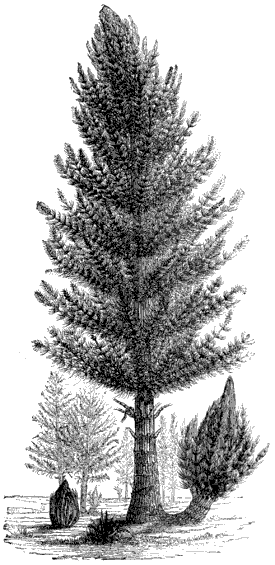
Fig. 38.—Calamite restored. Thirty to forty feet high.
Every one knows those marsh-plants with hollow, channelled, and articulated cylindrical stems; whose joints are furnished with a membranous, denticulated sheath, and which bear the vulgar name of “mare’s-tail;” their fructification forming a sort of catkin composed of many rings of scales, carrying on their lower surface sacs full of spores or seeds. These humble Equiseta were represented during the Coal-period by herbaceous trees from twenty to thirty feet high and four to six inches in diameter. Their trunks, channelled longitudinally, and divided transversely by lines of articulation, have been preserved to us: they bear the name of Calamites. The engraving (Fig. 38) represents one of these gigantic mare’s-tails, or Calamites, of the Coal-period, restored under the directions of M. Eugene Deslongchamps. It is represented with its fronds of leaves, and its organs of fructification. They seem to have grown by means of an underground stem, while new buds issued from the ground at intervals, as represented in the engraving.
The Lycopods of our age are humble plants, scarcely a yard in height, and most commonly creepers; but the Lycopodiaceæ of the ancient world were trees of eighty or ninety feet in height. It was the Lepidodendrons which filled the forests. Their leaves were sometimes twenty inches long, and their trunks a yard in diameter. Such are the dimensions of some specimens of Lepidodendron carinatum which have been found. Another Lycopod of this period, the Lomatophloyos crassicaule, attained dimensions still more colossal. The Sigillarias sometimes exceeded 100 feet in height. Herbaceous Ferns were also exceedingly abundant, and grew beneath the shade of these gigantic trees. It was the combination of these lofty trees with such shrubs (if we may so call them), which formed the forests of the Carboniferous period. The trunks of two of the gigantic trees, which flourished in the forests of the Carboniferous period, are represented in Figs. 39 and 40, reduced respectively to one-fifth and one-tenth the natural size.
What could be more surprising than the aspect of this exuberant vegetation!—these immense Sigillarias, which reigned over the forest! these Lepidodendrons, with flexible and slender stems! these Lomatophloyos, which present themselves as herbaceous trees of gigantic height, furnished with verdant leaflets! these Calamites, forty feet high! these elegant arborescent Ferns, with airy foliage, as finely cut as the most delicate lace! Nothing at the present day can convey to us an idea of the prodigious and immense extent of never-changing verdure which clothed the earth, from pole to pole, under the high temperature which everywhere prevailed over the whole terrestrial globe. In the depths of these inextricable forests parasitic plants were suspended from the trunks of the great trees, in tufts or garlands, like the wild vines of our tropical forests. They were nearly all pretty, fern-like plants—Sphenopteris, Hymenophyllites, &c.; they attached themselves to the stems of the great trees, like the orchids and Bromeliaceæ of our times.
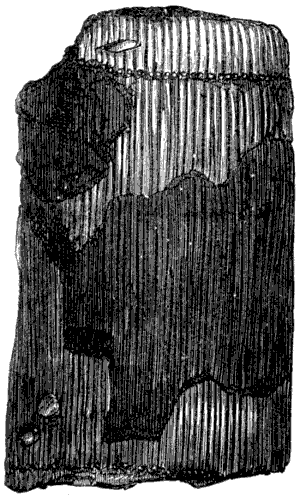
Fig. 39.—Trunk of Calamites. One-fifth natural size.
The margin of the waters would also be covered with various plants with light and whorled leaves, belonging, perhaps, to the Dicotyledons; Annularia fertilis, Sphenophyllites, and Asterophyllites.
How this vegetation, so imposing, both on account of the dimensions of the individual trees and the immense space which they occupied, so splendid in its aspect, and yet so simple in its organisation, must have differed from that which now embellishes the earth and charms our eyes! It certainly possessed the advantage of size and rapid growth; but how poor it was in species—how uniform in appearance! No flowers yet adorned the foliage or varied the tints of the forests. Eternal verdure clothed the branches of the Ferns, the Lycopods, and Equiseta, which composed to a great extent the vegetation of the age. The forests presented an innumerable collection of individuals, but very few species, and all belonging to the lower types of vegetation. No fruit appeared fit for nourishment; none would seem to have been on the branches. Suffice it to say that few terrestrial animals seem to have existed yet; animal life was apparently almost wholly confined to the sea, while the vegetable kingdom occupied the land, which at a later period was more thickly inhabited by air-breathing animals. Probably a few winged insects (some coleoptera, orthoptera, and neuroptera) gave animation to the air while exhibiting their variegated colours; and it was not impossible but that many pulmoniferous mollusca (such as land-snails) lived at the same time.
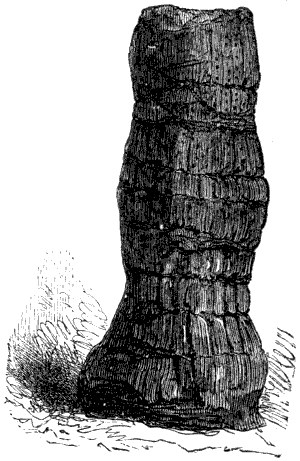
Fig. 40.—Trunk of Sigillaria. One-tenth natural size.
But, we might ask, for what eyes, for whose thoughts, for whose wants, did the solitary forests grow? For whom these majestic and extensive shades? For whom these sublime sights? What mysterious beings contemplated these marvels? A question which cannot be solved, and one before which we are overwhelmed, and our powerless reason is silent; its solution rests with Him who said, “Before the world was, I am!”
The vegetation which covered the numerous islands of the Carboniferous sea consisted, then, of Ferns, of Equisetaceæ, of Lycopodiaceæ, and dicotyledonous Gymnosperms. The Annularia and Sigillariæ belong to families of the last-named class, which are now completely extinct.
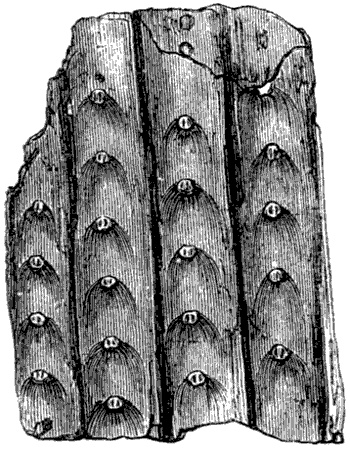
Fig. 41.—Sigillaria lævigata. One-third natural size.
The Annulariæ were small plants which floated on the surface of fresh-water lakes and ponds; their leaves were verticillate, that is, arranged in a great number of whorls, at each articulation of the stem with the branches. The Sigillariæ were, on the contrary, great trees, consisting of a simple trunk, surmounted with a bunch or panicle of slender drooping leaves, with the bark often channelled, and displaying impressions or scars of the old leaves, which, from their resemblance to a seal, sigillum, gave origin to their name. Fig. 41 represents the bark of one of these Sigillariæ, which is often met with in coal-mines.
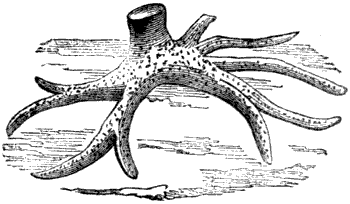
Fig. 42.—Stigmaria. One-tenth natural size.
The Stigmariæ (Fig. 42), according to palæontologists, were roots of Sigillariæ, with a subterranean fructification; all that is known of them is the long roots which carry the reproductive organs, and in some cases are as much as sixteen feet long. These were suspected by Brongniart, on botanical grounds, to be the roots of Sigillaria, and recent discoveries have confirmed this impression. Sir Charles Lyell, in company with Dr. Dawson, examined several erect Sigillariæ in the sea-cliffs of the South Joggins in Nova Scotia, and found that from the lower extremities of the trunk they sent out Stigmariæ as roots, which divided into four parts, and these again threw out eight continuations, each of which again divided into pairs. Twenty-one specimens of Sigillaria have been described by Dr. Dawson from the Coal-measures of Nova Scotia; but the differences in the markings in different parts of the same tree are so great, that Dr. Dawson regards the greater part of the recognised species of Sigillariæ as merely provisional.[43]
Two other gigantic trees grew in the forests of this period: these were Lepidodendron carinatum and Lomatophloyos crassicaule, both belonging to the family of Lycopodiaceæ, which now includes only very small species. The trunk of the Lomatophloyos threw out numerous branches, which terminated in thick tufts of linear and fleshy leaves.
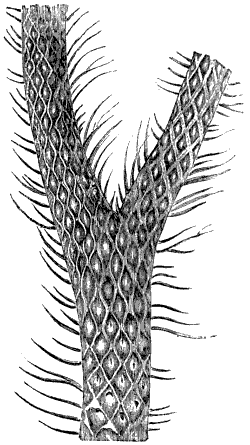
Fig. 43.—Lepidodendron Sternbergii.
The Lepidodendrons, of which there are about forty known species, have cylindrical bifurcated branches; that is, the branches were evolved in pairs, or were dichotomous to the top. The extremities of the branches were terminated by a fructification in the form of a cone, formed of linear scales, to which the name of Lepidostrobus (Fig. 45) has been given. Nevertheless, many of these branches were sterile, and terminated simply in fronds (elongated leaves). In many of the coal-fields fossil cones have been found, to which this name has been given by earlier palæontologists. They sometimes form the nucleus of nodular, concretionary balls of clay-ironstone, and are well preserved, having a conical axis, surrounded by scales compactly imbricated. The opinion of Brongniart is now generally adopted, that they are the fruit of the Lepidodendron. At Coalbrookdale, and elsewhere, these have been found as terminal tips of a branch of a well-characterised Lepidodendron. Both Hooker and Brongniart place them with the Lycopods, having cones with similar spores and sporangia, like that family. Most of them were large trees. One tree of L. Sternbergii, nearly fifty feet long, was found in the Jarrow Colliery, near Newcastle, lying in the shale parallel to the plane of stratification. Fragments of others found in the same shale indicated, by the size of the rhomboidal scars which covered them, a still greater size. Lepidodendron Sternbergii (Fig. 43) is represented as it is found beneath the shales in the collieries of Swina, in Bohemia. Fig. 46 represents a portion of a branch of L. elegans furnished with leaves. M. Eugene Deslongchamps has drawn the restoration of the Lepidodendron Sternbergii, represented in Fig. 47, which is shown entire in Fig. 44, with its stem, its branches, fronds, and organs of fructification. The Ferns composed a great part of the vegetation of the Coal-measure period.
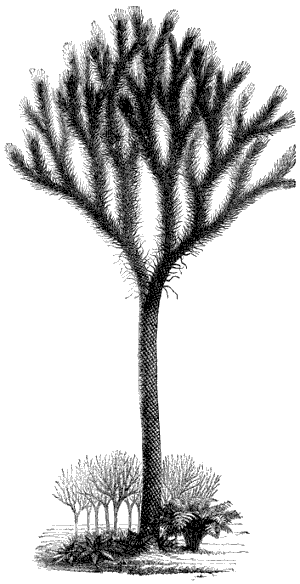
Fig. 44.—Lepidodendron Sternbergii restored. Forty feet high.
The Ferns differ chiefly in some of the details of the leaf. Pecopteris, for instance (Fig. 48), have the leaves once, twice, or thrice pinnatifid with the leaflets adhering either by their whole base or by the centre only; the midrib running through to the point. Neuropteris (Fig. 49) has leaves divided like Pecopteris, but the midrib does not reach the apex of the leaflets, but divides right and left into veins. Odontopteris (Fig. 51) has pinnatifid leaves, like the last, but its leaflets adhere by their whole base to the stalk. Lonchopteris (Fig. 50) has the leaves several times pinnatifid, the leaflets more or less united to one another, and the veins reticulated. Among the most numerous species of forms of the Coal-measure period was Sphenopteris artemisiæfolia (Fig. 52), of which a magnified leaf is represented. Sphenopteris has twice or thrice pinnatifid leaves, the leaflets narrow at the base, and the veins generally arranged as if they radiated from the base; the leaflets are frequently wedge-shaped.
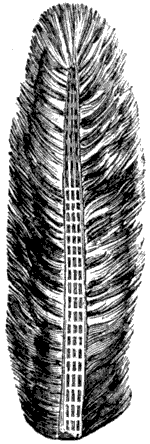
Fig. 45.—Lepidostrobus variabilis.
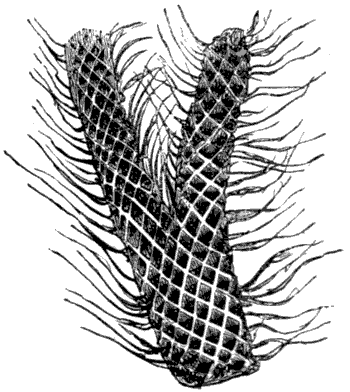
Fig. 46.—Lepidodendron elegans.
Carboniferous Limestone. (Sub-period.)
The seas of this epoch included an immense number of Zoophytes, nearly 400 species of Mollusca, and a few Crustaceans and Fishes. Among the Fishes, Psammodus and Coccosteus, whose massive teeth inserted in the palate were suitable for grinding; and the Holoptychius and Megalichthys, are the most important. The Mollusca are chiefly Brachiopods of great size. The Productæ attained here exceptional development, Producta Martini (Fig. 53), P. semi-reticulata and P. gigantea, being the most remarkable. Spirifers, also, were equally abundant, as Spirifera trigonalis and S. glabra. In Terebratula hastata the coloured bands, which adorned the shell of the living animal, have been preserved to us. The Bellerophon, whose convoluted shell in some respects resembles the Nautilus of our present seas, but without its chambered shell, were then represented by many species, among others by Bellerophon costatus (Fig. 54), and B. hiulcus (Fig. 56). Again, among the Cephalopods, we find the Orthoceras (Fig. 57), which resembled a straight Nautilus; and Goniatites (Goniatites evolutus, Fig. 55), a chambered shell allied to the Ammonite, which appeared in great numbers during the Secondary epoch.
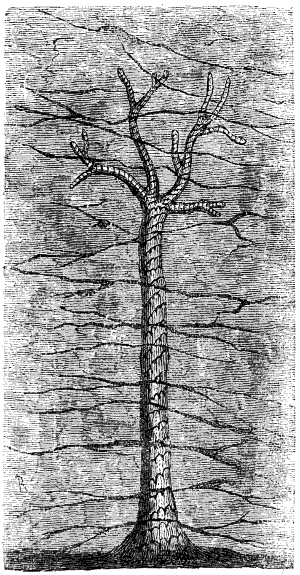
Fig. 47.—Lepidodendron Sternbergii.
Crustaceans are rare in the Carboniferous Limestone strata; the genus Phillipsia is the last of the Trilobites, all of which became extinct at the close of this period. As to the Zoophytes, they consist chiefly of Crinoids and Corals. The Crinoids were represented by the genera Platycrinus and Cyathocrinus. We also have in these rocks many Polyzoa.
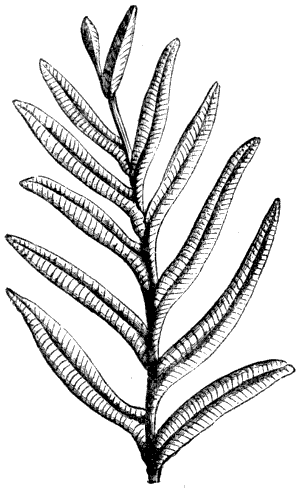
Fig. 48.—Pecopteris lonchitica, a little magnified.
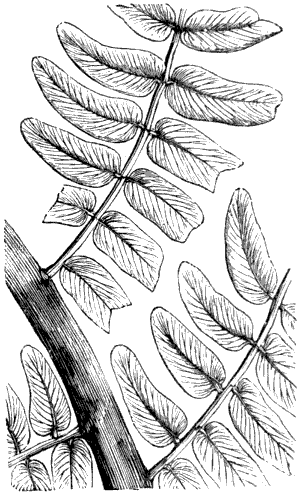
Fig. 49.—Neuropteris gigantea.
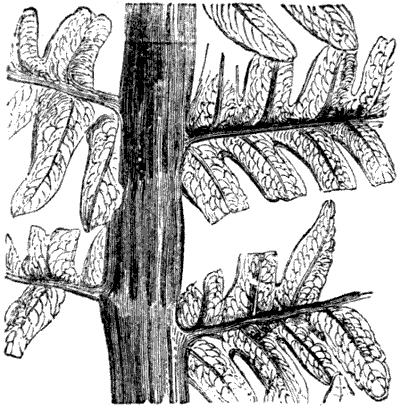
Fig. 50.—Lonchopteris Bricii.
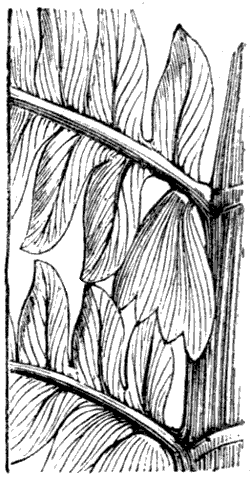
Fig. 51.—Odontopteris Brardii.
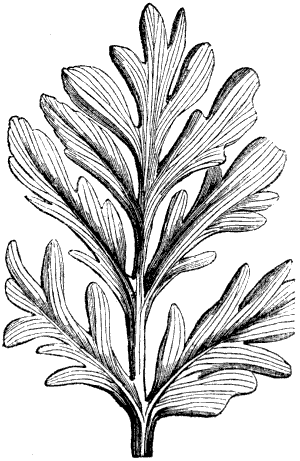
Fig. 52.—Sphenopteris artemisiæfolia, magnified.
Among the corals of the period, we may include the genera Lithostrotion and Lonsdalea, of which Lithostrotion basaltiforme (Fig. 58), and Lonsdalea floriformis (Fig. 59), are respectively the representatives, with Amplexus coralloïdes. Among the Polyzoa are the genera Fenestrella and Polypora. Lastly, to these we may add a group of animals which will play a very important part and become abundantly represented in the beds of later geological periods, but which already abounded in the seas of the Carboniferous period. We speak of the Foraminifera (Fig. 60), microscopic animals, which clustered either in one body, or divided into segments, and covered with a calcareous, many-chambered shell, as in Fig. 60, Fusulina cylindrica. These little creatures, which, during the Jurassic and Cretaceous periods, formed enormous banks and entire masses of rock, began to make their appearance in the period which now engages our attention.
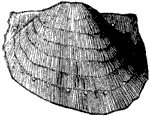
Fig. 53.—Producta Martini. One-third nat. size.
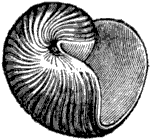
Fig. 54.—Bellerophon costatus. Half nat. size.
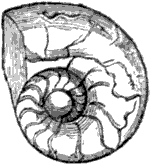
Fig. 55.—Goniatites evolutus. Nat. size.
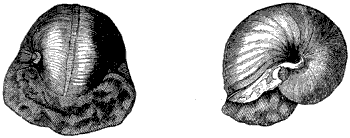
Fig. 56.—Bellerophon hiulcus.
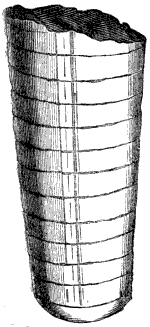
Fig. 57.—Orthoceras laterale.
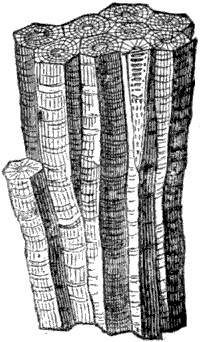
Fig. 58.—Lithostrotion basaltiforme.
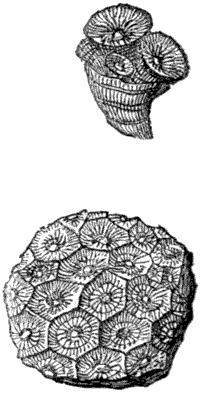
Fig. 59.—Lonsdalea floriformis.
The plate opposite (Plate X.) is a representation of an ideal aquarium, in which some of the more prominent species, which inhabited the seas during the period of the Carboniferous Limestone, are represented. On the right is a tribe of corals, with reflections of dazzling white: the species represented are, nearest the edge, the Lasmocyathus, the Chætetes, and the Ptylopora. The Mollusc which occupies the extremity of the elongated and conical tube in the shape of a sabre is an Aploceras. It seems to prepare the way for the Ammonite; for if this elongated shell were coiled round itself it would resemble the Ammonite and Nautilus. In the centre of the foreground we have Bellerophon hiulcus (Fig. 56), the Nautilus Koninckii, and a Producta, with the numerous spines which surround the shell. (See Fig. 62.)
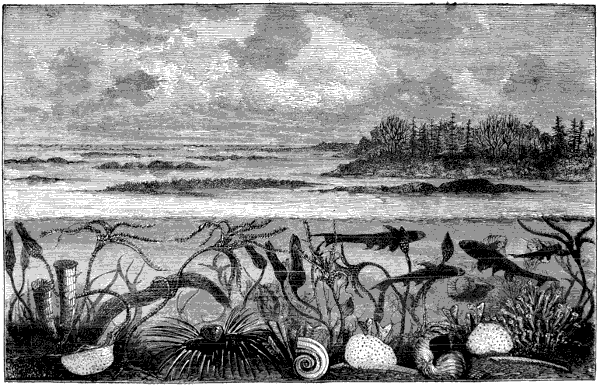
X.—Ideal view of marine life in the Carboniferous Period.
On the left are other corals: the Cyathophyllum with straight cylindrical stems; some Encrinites (Cyathocrinus and Platycrinus) wound round the trunk of a tree, or with their flexible stem floating in the water. Some Fishes, Amblypterus, move about amongst these creatures, the greater number of which are immovably attached, like plants, to the rock on which they grow.
In addition, this engraving shows us a series of islets, rising out of a tranquil sea. One of these is occupied by a forest, in which a distant view is presented of the general forms of the grand vegetation of the period.
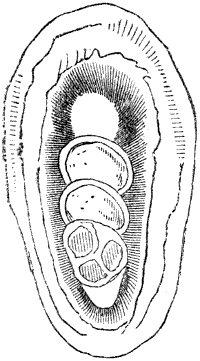
Fig. 60.—Foraminifera of the Mountain Limestone, forming the centre of an oolitic grain. Power 120.
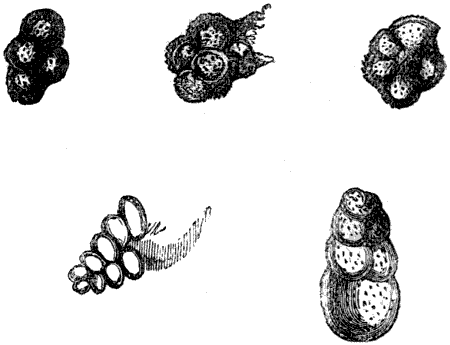
Fig. 61.—Foraminifera of the Chalk, obtained by brushing it in water. Power 120.
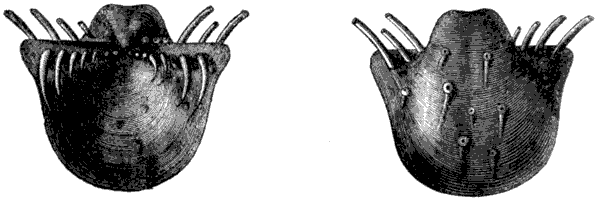
Fig. 62.—Producta horrida. Half natural size.
It is of importance to know the rocks formed by marine deposits during the era of the Carboniferous Limestone, inasmuch as they include coal, though in much smaller quantities than in the succeeding sub-period of the true coal-deposit. They consist essentially of a compact limestone, of a greyish-blue, and even black colour. The blow of the hammer causes them to exhale a somewhat fetid odour, which is owing to decomposed organic matter—the modified substance of the molluscs and zoophytes—of which it is to so great an extent composed, and whose remains are still easily recognised.
In the north of England, and many other parts of the British Islands, the Carboniferous Limestone forms, as we have seen, lofty mountain-masses, to which the term Mountain Limestone is sometimes applied.
In Derbyshire the formation constitutes rugged, lofty, and fantastically-shaped mountains, whose summits mingle with the clouds, while its picturesque character appears here, as well as farther north, in the dales or valleys, where rich meadows, through which the mountain streams force their way, seem to be closed abruptly by masses of rock, rising above them like the grey ruins of some ancient tower; while the mountain bases are pierced with caverns, and their sides covered with mosses and ferns, for the growth of which the limestone is particularly favourable.
The formation is metalliferous, and yields rich veins of lead-ore in Derbyshire, Cumberland, and other counties of Great Britain. The rock is found in Russia, in the north of France, and in Belgium, where it furnishes the common marbles, known as Flanders marble (Marbre de Flandres and M. de petit granit). These marbles are also quarried in other localities, such as Regneville (La Manche), either for the manufacture of lime or for ornamental stonework; one of the varieties quarried at Regneville, being black, with large yellow veins, is very pretty.
In France, the Carboniferous Limestone, with its sandstones and conglomerates, schists and limestones, is largely developed in the Vosges, in the Lyonnais, and in Languedoc, often in contact with syenites and porphyries, and other igneous rocks, by which it has been penetrated and disturbed, and even metamorphosed in many ways, by reason of the various kinds of rocks of which it is composed. In the United States the Carboniferous Limestone formation occupies a somewhat grand position in the rear of the Alleghanies. It is also found forming considerable ranges in our Australian colonies.
In consequence of their age, as compared with the Secondary and Tertiary limestones, the Carboniferous rocks are generally more marked and varied in character. The valley of the Meuse, from Namur to Chockier, above Liège, is cut out of this formation; and many of our readers will remember with delight the picturesque character of the scenery, especially that of the left bank of the celebrated river in question.
Coal Measures. (Sub-period.)
This terrestrial period is characterised, in a remarkable manner, by the abundance and strangeness of the vegetation which then covered the islands and continents of the whole globe. Upon all points of the earth, as we have said, this flora presented a striking uniformity. In comparing it with the vegetation of the present day, the learned French botanist, M. Brongniart, who has given particular attention to the flora of the Coal-measures, has arrived at the conclusion that it presented considerable analogy with that of the islands of the equatorial and torrid zone, in which a maritime climate and elevated temperature exist in the highest degree. It is believed that islands were very numerous at this period; that, in short, the dry land formed a sort of vast archipelago upon the general ocean, of no great depth, the islands being connected together and formed into continents as they gradually emerged from the ocean.
This flora, then, consists of great trees, and also of many smaller plants, which would form a close, thick turf, or sod, when partially buried in marshes of almost unlimited extent. M. Brongniart indicates, as characterising the period, 500 species of plants belonging to families which we have already seen making their first appearance in the Devonian period, but which now attain a prodigious development. The ordinary dicotyledons and monocotyledons—that is, plants having seeds with two lobes in germinating, and plants having one seed-lobe—are almost entirely absent; the cryptogamic, or flowerless plants, predominate; especially Ferns, Lycopodiaceæ and Equisetaceæ—but of forms insulated and actually extinct in these same families. A few dicotyledonous gymnosperms, or naked-seed plants forming genera of Conifers, have completely disappeared, not only from the present flora, but since the close of the period under consideration, there being no trace of them in the succeeding Permian flora. Such is a general view of the features most characteristic of the Coal period, and of the Primary epoch in general. It differs, altogether and absolutely, from that of the present day; the climatic condition of these remote ages of the globe, however, enables us to comprehend the characteristics which distinguish its vegetation. A damp atmosphere, of an equable rather than an intense heat like that of the tropics, a soft light veiled by permanent fogs, were favourable to the growth of this peculiar vegetation, of which we search in vain for anything strictly analogous in our own days. The nearest approach to the climate and vegetation proper to the geological period which now occupies our attention, would probably be found in certain islands, or on the littoral of the Pacific Ocean—the island of Chloë, for example, where it rains during 300 days in the year, and where the light of the sun is shut out by perpetual fogs; where arborescent Ferns form forests, beneath whose shade grow herbaceous Ferns, which rise three feet and upwards above a marshy soil; which gives shelter also to a mass of cryptogamic plants, greatly resembling, in its main features, the flora of the Coal-measures. This flora was, as we have said, uniform and poor in its botanic genera, compared to the abundance and variety of the flora of the present time; but the few families of plants, which existed then, included many more species than are now produced in the same countries. The fossil Ferns of the coal-series in Europe, for instance, comprehend about 300 species, while all Europe now only produces fifty. The gymnosperms, which now muster only twenty-five species in Europe, then numbered more than 120.
It will simplify the classification of the flora of the Carboniferous epoch if we give a tabular arrangement adopted by the best authorities:—
Dr. Lindley. Brongniart.
I. Thallogens – Cryptogamous Amphigens, or Cellular Cryptogams – Lichens, Sea-weeds, Fungi.
II. Acrogens – Cryptogamous Acrogens – Club-mosses, Equiseta, Ferns, Lycopods, Lepidodendra.
III. Gymnogens – Dicotyledonous Gymnosperms – Conifers and Cycads.
IV. Exogens – Dicotyledonous Angiosperms – Compositæ, Leguminosæ, Umbelliferæ, Cruciferæ, Heaths. All European except Conifers.
V. Endogens – Monocotyledons – Palms, Lilies, Aloes, Rushes, Grasses.
Calamites are among the most abundant fossil plants of the Carboniferous period, and occur also in the Devonian. They are preserved as striated, jointed, cylindrical, or compressed stems, with fluted channels or furrows at their sides, and sometimes surrounded by a bituminous coating, the remains of a cortical integument. They were originally hollow, but the cavity is usually filled up with a substance into which they themselves have been converted. They were divided into joints or segments, and when broken across at their articulations they show a number of striæ, originating in the furrows of the sides, and turning inwards towards the centre of the stem. It is not known whether this structure was connected with an imperfect diaphragm stretched across the hollow of the stem at each joint, or merely represented the ends of woody plates of which the solid part of the stem is composed. Their extremities have been discovered to taper gradually to a point, as represented in C. cannæformis (Fig. 64), or to end abruptly, the intervals becoming shorter and smaller. The obtuse point is now found to be the root. Calamites are regarded as Equisetaceous plants; later botanists consider that they belong to an extinct family of plants. Sigillariæ are the most abundant of all plants in the coal formation, and were those principally concerned in the accumulation of the mineral fuel of the Coal-measures. Not a mine is opened, nor a heap of shale thrown out, but there occur fragments of its stem, marked externally with small rounded impressions, and in the centre slight tubercles, with a quincuncial arrangement. From the tubercles arise long ribbon-shaped bodies, which have been traced in some instances to the length of twenty feet.
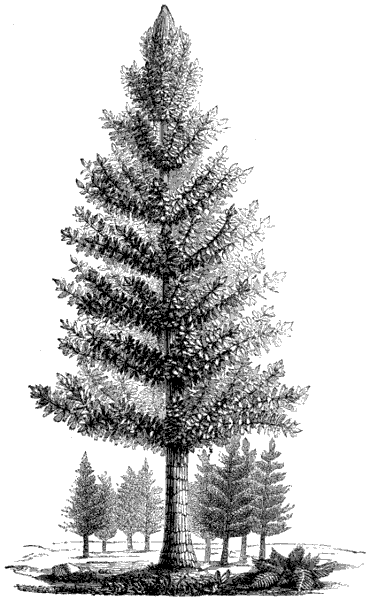
Fig. 63.—Sphenophyllum restored.
In the family of the Sigillarias we have already presented the bark of S. lævigata, at page 138; on page 157 we give a drawing of the bark of S. reniformis, one-third the natural size (Fig. 65).
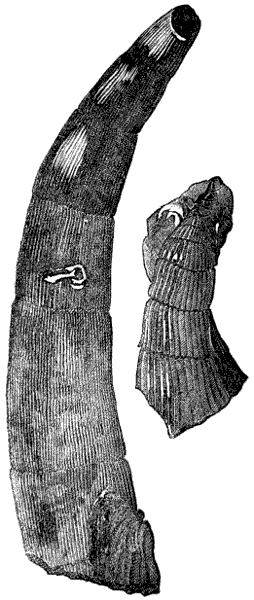
Fig. 64.—Calamites cannæformis. One-third natural size.
In the family of the Asterophyllites, the leaf of A. foliosa (Fig. 66); and the foliage of Annularia orifolia (Fig. 67) are remarkable. In addition to these, we present, in Fig. 63, a restoration of one of these Asterophyllites, the Sphenophyllum, after M. Eugene Deslongchamps. This herbaceous tree, like the Calamites, would present the appearance of an immense asparagus, twenty-five to thirty feet high. It is represented here with its branches and fronds, which bear some resemblance to the leaves of the ginkgo. The bud, as represented in the figure, is terminal, and not axillary, as in some of the Calamites.
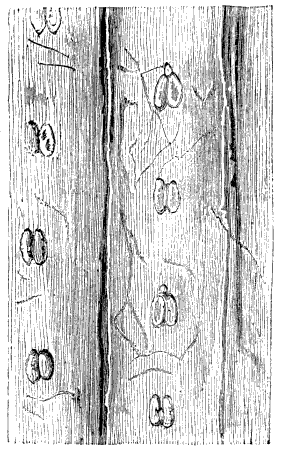
Fig. 65.—Sigillaria reniformis.
If, during the Coal-period, the vegetable kingdom had reached its maximum, the animal kingdom, on the contrary, was poorly represented. Some remains have been found, both in America and Germany, consisting of portions of the skeleton and the impressions of the footsteps of a Reptile, which has received the name of Archegosaurus. In Fig. 68 is represented the head and neck of Archegosaurus minor, found in 1847 in the coal-basin of Saarbruck between Strasbourg and Trèves. Among the animals of this period we find a few Fishes, analogous to those of the Devonian formation. These are the Holoptychius and Megalichthys, having jaw-bones armed with enormous teeth. Scales of Pygopterus have been found in the Northumberland Coal-shale at Newsham Colliery, and also in the Staffordshire Coal-shale. Some winged insects would probably join this slender group of living beings. It may then be said with truth that the immense forests and marshy plains, crowded with trees, shrubs, and herbaceous plants, which formed on the innumerable isles of the period a thick and tufted sward, were almost destitute of animals.
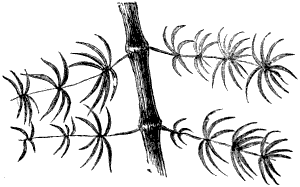
Fig. 66.—Asterophyllites foliosa.
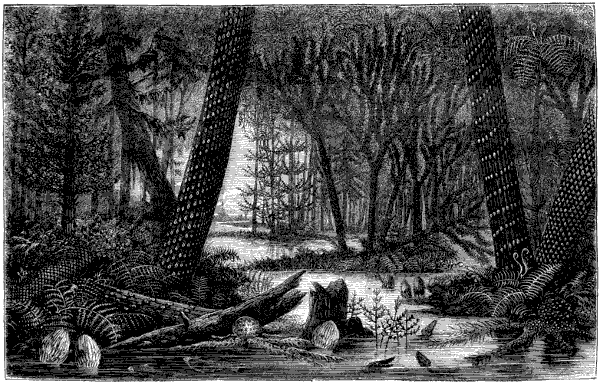
XI.—Ideal view of a marshy forest of the Coal Period.
On the opposite page (Pl. XI.) M. Riou has attempted, under the directions of M. Deslongchamps, to reproduce the aspect of Nature during the period. A marsh and forest of the Coal-period are here represented, with a short and thick vegetation, a sort of grass composed of herbaceous Fern and mare’s-tail. Several trees of forest-height raise their heads above this lacustrine vegetation.
On the left are seen the naked trunk of a Lepidodendron and a Sigillaria, an arborescent Fern rising between the two trunks. At the foot of these great trees an herbaceous Fern and a Stigmaria appear, whose long ramification of roots, provided with reproductive spores, extend to the water. On the right is the naked trunk of another Sigillaria, a tree whose foliage is altogether unknown, a Sphenophyllum, and a Conifer. It is difficult to describe with precision the species of this last family, the impressions of which are, nevertheless, very abundant in the Coal-measures.
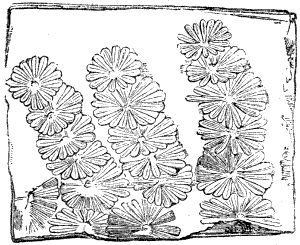
Fig. 67.—Annularia orifolia.
In front of this group we see two trunks broken and overthrown. These are a Lepidodendron and Sigillaria, mingling with a heap of vegetable débris in course of decomposition, from which a rich humus will be formed, upon which new generations of plants will soon develop themselves. Some herbaceous Ferns and buds of Calamites rise out of the waters of the marsh.
A few Fishes belonging to the period swim on the surface of the water, and the aquatic reptile Archegosaurus shows its long and pointed head—the only part of the animal which has hitherto been discovered (Fig. 68). A Stigmaria extends its roots into the water, and the pretty Asterophyllites, with its finely-cut stems, rises above it in the foreground.
A forest, composed of Lepidodendra and Calamites, forms the background to the picture.
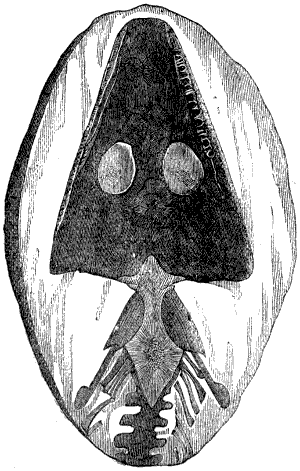
Fig. 68.—Head and neck of Archegosaurus minor.
Formation of Beds of Coal.
Coal, as we have said, is only the result of a partial decomposition of the plants which covered the earth during a geological period of immense duration. No one, now, has any doubt that this is its origin. In coal-mines it is not unusual to find fragments of the very plants whose trunks and leaves characterise the Coal-measures, or Carboniferous era. Immense trunks of trees have also been met with in the middle of a seam of coal. In the coal-mines of Treuil,[44] at St. Etienne, for instance, vertical trunks of fossil trees, resembling bamboos or large Equiseta, are not only mixed with the coal, but stand erect, traversing the overlying beds of micaceous sandstone in the manner represented in the engraving, which has been reproduced from a drawing by M. Ad. Brongniart (Fig. 69).
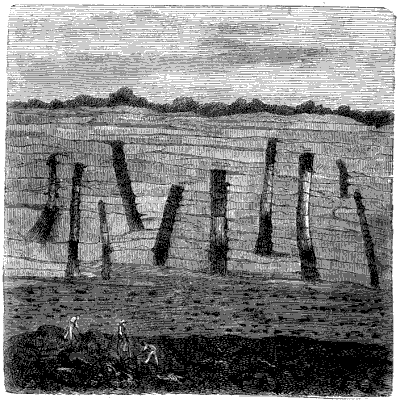
Fig. 69.—Treuil coal-mine, at St. Etienne.
In England it is the same; entire trees are found lying across the coal-beds. Sir Charles Lyell tells us[45] that in Parkfield Colliery, South Staffordshire, there was discovered in 1854, upon a surface of about a quarter of an acre, a bed of coal which has furnished as many as seventy-three stumps of trees with their roots attached, some of the former measuring more than eight feet in circumference; their roots formed part of a seam of coal ten inches thick, resting on a layer of clay two inches thick, under which was a second forest resting on a band of coal from two to five feet thick. Underneath this, again, was a third forest, with large stumps of Lepidodendra, Calamites, and other trees.[46]
In the lofty cliffs of the South Joggins, in the Bay of Fundy, in Nova Scotia, Sir Charles Lyell found in one portion of the coal-field 1,500 feet thick, as many as sixty-eight different surfaces, presenting evident traces of as many old soils of forests, where the trunks of the trees were still furnished with roots.[47]
We will endeavour to establish here the true geological origin of coal, in order that no doubt may exist in the minds of our readers on a subject of such importance. In order to explain the presence of coal in the depths of the earth, there are only two possible hypotheses. This vegetable débris may either result from the burying of plants brought from afar and transported by river or maritime currents, forming immense rafts, which may have grounded in different places and been covered subsequently by sedimentary deposits; or the trees may have grown on the spot where they perished, and where they are now found. Let us examine each of these theories.
Can the coal-beds result from the transport by water, and burial underground, of immense rafts formed of the trunks of trees? The hypothesis has against it the enormous height which must be conceded to the raft, in order to form coal-seams as thick as some of those which are worked in our collieries. If we take into consideration the specific gravity of wood, and the amount of carbon it contains, we find that the coal-deposits can only be about seven-hundredths of the volume of the original wood and other vegetable materials from which they are formed. If we take into account, besides, the numerous voids necessarily arising from the loose packing of the materials forming the supposed raft, as compared with the compactness of coal, this may fairly be reduced to five-hundredths. A bed of coal, for instance, sixteen feet thick, would have required a raft 310 feet high for its formation. These accumulations of wood could never have arranged themselves with sufficient regularity to form those well-stratified coal-beds, maintaining a uniform thickness over many miles, and that are seen in most coal-fields to lie one above another in succession, separated by beds of sandstone or shale. And even admitting the possibility of a slow and gradual accumulation of vegetable débris, like that which reaches the mouth of a river, would not the plants in that case be buried in great quantities of mud and earth? Now, in most of our coal-beds the proportion of earthy matter does not exceed fifteen per cent. of the entire mass. If we bear in mind, finally, the remarkable parallelism existing in the stratification of the coal-formation, and the state of preservation in which the impressions of the most delicate vegetable forms are discovered, it will, we think, be proved to demonstration, that those coal-seams have been formed in perfect tranquillity. We are, then, forced to the conclusion that coal results from the mineralisation of plants which has taken place on the spot; that is to say, in the very place where the plants lived and died.
It was suggested long ago by Bakewell, from the occurrence of the same peculiar kind of fireclay under each bed of coal, that it was the soil proper for the production of those plants from which coal has been formed.[48]
It has, also, been pointed out by Sir William Logan, as the result of his observations in the South Wales coal-field, and afterwards by Sir Henry De la Beche, and subsequently confirmed by the observations of Sir Charles Lyell in America, that not only in this country, but in the coal-fields of Nova Scotia, the United States, &c., every layer of true coal is co-extensive with and invariably underlaid by a marked stratum of arenaceous clay of greater or less thickness, which, from its position relatively to the coal has been long known to coal-miners, among other terms, by the name of under-clay.
The clay-beds, “which vary in thickness from a few inches to more than ten feet, are penetrated in all directions by a confused and tangled collection of the roots and leaves, as they may be, of the Stigmaria ficoides, these being frequently traceable to the main stem (Sigillaria), which varies in diameter from about two inches to half a foot. The main stems are noticed as occurring nearer the top than the bottom of the bed, as usually of considerable length, the leaves or roots radiating from them in a tortuous irregular course to considerable distances, and as so mingled with the under-clay that it is not possible to cut out a cubic foot of it which does not contain portions of the plant.” (Logan “On the Characters of the Beds of Clay immediately below the Coal-seams of South Wales,” Geol. Transactions, Second Series, vol. vi., pp. 491-2. An account of these beds had previously been published by Mr. Logan in the Annual Report of the Royal Institution of South Wales for 1839.)
From the circumstance of the main stem of the Sigillaria, of which the Stigmaria ficoides have been traced to be merely a continuation, it was inferred by the above-mentioned authors, and has subsequently been generally recognised as probably the truth, that the roots found in the underclay are merely those of the plant (Sigillaria), the stem of which is met with in the overlying coal-beds—in fact, that the Stigmaria ficoides is only the root of the Sigillaria, and not a distinct plant, as was once supposed to be the case.
This being granted, it is a natural inference to suppose that the present indurated under-clay is only another condition of that soft, silty soil, or of that finely levigated muddy sediment—most likely of still and shallow water—in which the vegetation grew, the remains of which were afterwards carbonised and converted into coal.[49]
In order thoroughly to comprehend the phenomena of the transformation into coal of the forests and of the herbaceous plants which filled the marshes and swamps of the ancient world, there is another consideration to be presented. During the coal-period, the terrestrial crust was subjected to alternate movements of elevation and depression of the internal liquid mass, under the impulse of the solar and lunar attractions to which they would be subject, as our seas are now, giving rise to a sort of subterranean tide, operating at intervals, more or less widely apart, upon the weaker parts of the crust, and producing considerable subsidences of the ground. It might, perhaps, happen that, in consequence of a subsidence produced in such a manner, the vegetation of the coal-period would be submerged, and the shrubs and plants which covered the surface of the earth would finally become buried under water. After this submergence new forests sprung up in the same place. Owing to another submergence, the second forests were depressed in their turn, and again covered by water. It is probably by a series of repetitions of this double phenomenon—this submergence of whole regions of forest, and the development upon the same site of new growths of vegetation—that the enormous accumulations of semi-decomposed plants, which constitute the Coal-measures, have been formed in a long series of ages.
But, has coal been produced from the larger plants only—for example, from the great forest-trees of the period, such as the Lepidodendra, Sigillariæ, Calamites, and Sphenophylla? That is scarcely probable, for many coal-deposits contain no vestiges of the great trees of the period, but only of Ferns and other herbaceous plants of small size. It is, therefore, presumable that the larger vegetation has been almost unconnected with the formation of coal, or, at least, that it has played a minor part in its production. In all probability there existed in the coal-period, as at the present time, two distinct kinds of vegetation: one formed of lofty forest-trees, growing on the higher grounds; the other, herbaceous and aquatic plants, growing on marshy plains. It is the latter kind of vegetation, probably, which has mostly furnished the material for the coal; in the same way that marsh-plants have, during historic times and up to the present day, supplied our existing peat, which may be regarded as a sort of contemporaneous incipient coal.
To what modification has the vegetation of the ancient world been subjected to attain that carbonised state, which constitutes coal? The submerged plants would, at first, be a light, spongy mass, in all respects resembling the peat-moss of our moors and marshes. While under water, and afterwards, when covered with sediment, these vegetable masses underwent a partial decomposition—a moist, putrefactive fermentation, accompanied by the production of much carburetted hydrogen and carbonic acid gas. In this way, the hydrogen escaping in the form of carburetted hydrogen, and the oxygen in the form of carbonic acid gas, the carbon became more concentrated, and coal was ultimately formed. This emission of carburetted hydrogen gas would, probably, continue after the peat-beds were buried beneath the strata which were deposited and accumulated upon them. The mere weight and pressure of the superincumbent mass, continued at an increasing ratio during a long series of ages, have given to the coal its density and compact state.