Chapter VI · WOMEN’S SHIFTS. (continued 4)
Reading edition
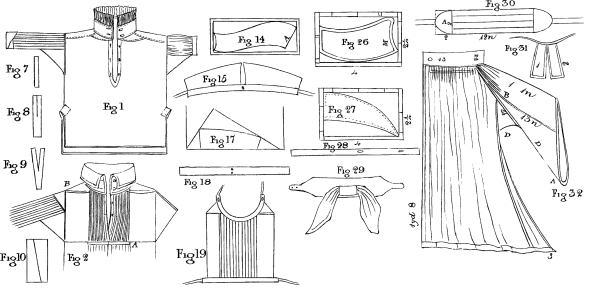
PLATE 17. FIG. 8,
Represents the best plan of cutting six shirts, similar in size to Fig. 7.
Cut twelve sleeves, S S, seven nails and a half wide, seven
nails long, twelve lengths.
In the remainder of the breadth, two binders in the width, of
Eleven nails long, six lengths.
Twelve sleeve-gussets, G G, three nails square, six lengths.
After which, cut as follows:—
Four collars, C C, three nails wide and eight nails long,
leaving a strip one nail and a half wide for little
gussets, one length.
Two collars and six wristbands, W W, eight nails long,
one length.
Three wristbands, and six neck-gussets, N N, four nails long,
two lengths.
Twelve shoulder-straps, S S, four nails long, one length.
A PLAN FOR CUTTING SIX SHIRTS OF THE SAME SIZE AS FIG. 9.
PLATE 17. FIG. 10.
Measure off the whole length for sleeves, eight nails square, twelve lengths.
From the remainder of the breadth cut
Two linings, B B, in the width, of twelve nails long, six lengths.
Two collars, C C, in the width, of eight nails long, three lengths.
The strip is thus exactly made up;—
Cut six wristbands, W W, in the width, four nails long, two lengths.
Four gussets, of three nails square and two nails over, three lengths.
From the piece over, cut two shoulder-straps, four nails long,
and a piece over.
Six neck-gussets, two nails square in the breadth, one length.
Ten shoulder-straps in the width, four nails long, one length.
Fourteen gussets in the breadth, one nail square, one length.
A PLAN FOR CUTTING SIX SHIRTS SIMILAR IN SIZE TO FIG. 11.
PLATE 17. FIG. 12.
Measure off the twelve sleeves, eight nails wide, and ten long, twelve lengths.
Two binders in the width, twelve nails long, six lengths.
Two collars in the width, eight nails long, three lengths.
Two wristbands in the width, four nails long, six lengths.
The strip is thus exactly used up, after which,
Cut four sleeve-gussets in the width, three lengths.
Six shoulder-straps, five nails long, two lengths.
Six neck-gussets in the width, one length.
Twelve flap-gussets in the width, two lengths.
EXPLANATION OF MAKING UP SHIRTS.
Double the long piece for the skirt in two, making the front breadth one nail shorter than the back breadth.
Measure the proper distance from the top for the arm-holes, and the proper distance from the bottom for flaps, and put in pins for marks.
The skirt is usually simply sewed up, but it is preferable, especially with gentlemen’s shirts, to make a hem the whole length of the skirt, on each side, and then sew up between the arm-holes and flaps, firmly, with thick even stitches.
Proceed next to stitch the collar and wristbands. Let the stitching be made about six threads from the edge, and carried all round both the wristbands and collar; taking care not to pass the stitches through both folds of them, at the opening or part, in which the fulness of the sleeve or shirt is to be gathered.
Next prepare the straps by turning them in, and drawing the threads; do the same with the neck and other gussets.
Now sew up the sleeves, putting in the large gussets, the little wrist-gussets and gathering them into the wristbands, to prepare them for putting into the shirts. Then put in the side-gussets, and hem the flaps and bottom of the shirt. These gussets are fixed by sewing them on at the wrong side of the shirt to within a quarter of an inch less than the square, and felling the other side nearly over. The neck gussets are next managed in the same manner, taking care to put the stitched part on the right side.
The shoulder-strap is then doubled in half, and slightly tacked on the middle of the shoulder in the inside; then place each side flat on the shirt, and stitch it in the lines that have been prepared for it.
The bosom is then stitched; and the button-holes made, or if, as in gentlemen’s shirts, a piece is let into the front, it must be arranged according to the taste of the wearer.
The lining is now neatly felled on, and the neck gathered, and set into the collar, after which the sleeves are gathered and put in. The bosom-bit may then be sewed in, and when the buttons are put on the whole is completed.
The shirt is marked about an inch below the left hip or gusset.
GENTLEMEN’S SHIRTS.
PLATE 18.
Gentlemen’s shirts are usually made of fine Irish linen or lawn, and sometimes of long cloth. Some gentlemen wear striped calico, but seldom, unless engaged in sporting, boating, or fishing. Gentlemen’s sons, up to ten or eleven years of age, or persons going into hot climates, wear strong calico, it being considered more healthful than linen, the latter is, however, the best wearing of the two, but more expensive. Care should be taken to procure the proper width, according to the size wanted; and the proper quantity, according to the number required. The Suffolk hemp is considered the best for shirting.
Gentlemen’s shirts are cut much on the same principle, but upon a more liberal plan than those mentioned for the labouring classes, with a few exceptions: such as some varieties in the pattern and size of binders, collars, shoulder-straps, &c. In most of them also, a piece of the linen is cut out in the front or bosom, and two pieces of cambric, or fine lawn, either plaited, or fulled in the place, to form the two sides or half fronts to the shirt. A scale is first given of different sizes, and then the best of the various patterns will be explained.
SCALE.
—————————— 6 Years. 8 Years. 10 Years. 12 Years. 16 Years. Men’s small. Men’s large.
Yds. nls. Yds. nls. Yds. nls. Yds. nls. Yds. nls. Yds. nls. Yds. nls.
Quantity of cloth required for 1, about 2 7 2 15 3 3 2 14 3 5 3 9½ 3 15
Quantity required for six, about 14 10 16 4 20 10 18 9 18 9 20 11 22 7½
Proper width of cloth 9 9 10 12 14 14½ 16
Whole length of shirt 1 8 1 9 1 12 1 13 2 0 2 2 2 4
Space to leave for shoulders 2 2¼ 3 3¼ 3½ 3½ 3½
Length of arm-holes 3 3¼ 3¾ 4½ 4½ 5 5
Slit at the bottom for flaps 3 4 4 4½ 4½ 4½ 4½
Width of sleeve 4½ 6½ or 7 nls 6 6½ or 7 nls 7 7¼ 8
Length of sleeve down the selvage 6½ 7 8 9 9 9 11
Width of binders or linings 1½ 1½ 1½ 2 2 3½ 4
Length of ditto down the selvage 6½ 8 8 12 9 11 11
Width of collar 4 or 5 nls 2 5 or 6 nls 2 or 2½ nls 2½ 2 or 3 nls 4
Length down the selvage 6 6 7 8 8 8 8
Width of wristband 1½ 2 2 3 3 4 4
Length down the selvage 2½ 3 or 3½ nls 3½ 4 4 4 4
Width of shoulder-straps 1 1 2 2 1¼ 1½
Length down the selvage 3 3 4 6 4½ 4½ 5
Size of sleeve-gussets 2 2 3 3 3¼ 3½ 3½
Size of neck-gusset 1½ 1½ 1¾ 1¾ 1¾ 2 2
Length of piece to cut for bosom 5 5 6 6 6 6
Width of ditto 3 3½ 4 5 5 5
Width of cambric to put in each side 4 4 4 6 6 6
|Width of shoulder-strap, if gored 1½ 2 2 2¼ 2½ 2½ 2½
Widest width to be gored to 1 1½ 1½ 1¾ 2 2 2
Width of frills if used ½ ½ ¾ 1 1 1¼
|Bosom flap and wrist-gussets ½ ½ ½ ½ ½ ½ ½
Slit for bosom 4 5 5 6 6 6 6
PLATE 18.
GENTLEMEN’S SHIRT FRONTS.
PLATE 18.
There are various modes of making up fronts, dependant on the age and taste of the wearer, as well as upon the changes of fashion. The material of which the front is made, should be of a width as to allow of the two half fronts being cut in the breadth; the length is measured from the top of the shoulder to the bottom of the opening prepared for it, allowing plenty to turn in at each end. The two halves having been made up according to fancy, are put into the front, making them overlap each other a full nail, exactly in the middle (see Fig. 2), which prevents the slit opening and exposing the skin. The most approved fronts, and those in general use, are the following:—
A YOUNG CHILD’S FRONT.
PLATE 18. FIG. 1.
Is generally quite plain, with a broad hem and small pearl buttons; it should overlap half a nail.
A BOY’S FRONT.
PLATE 18. FIG. 2.
This is neatly gathered in, and at the end marked A, the fulling is set into a band of calico or linen, according to the material of the shirt, into which the shirt itself is also gathered.
AN OLDER BOY’S FRONT.
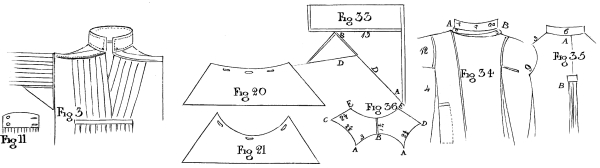
PLATE 18. FIG. 3.
These are usually secured in broad or narrow plaits, according to taste, at both ends, but not stitched down the whole way. The advantage of this is to permit of the first being pulled over when washed and ironed, at the same time that it naturally arranges itself in regular plaits whilst worn. The hem is sometimes made to project from the collar to half its depth at the top, where a little corner is left, attached to which is a button-hole which buttons it over to the other side of the collar.
ANOTHER BOY’S FRONT.
PLATE 18. FIG. 4.
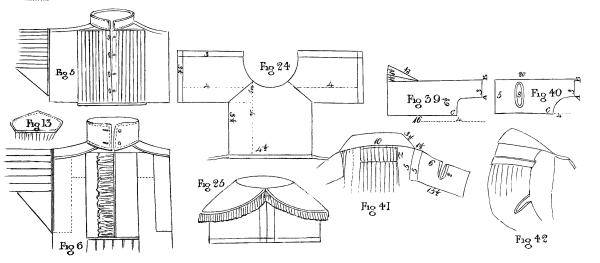
This is arranged in small neat tucks, and is more adapted to young boys than the last. The make of this shirt differs from the others in most particulars. The front is entire, but with false buttons, and it opens behind, where there is a slit for the purpose in both shirt and collar. Many boys have their shirts made in this manner, but the washerwomen complain much of the trouble of ironing these closed fronts.
A GENTLEMAN’S SHIRT.
PLATE 18. FIG. 5.
This front is stitched down with the greatest neatness, in the most perfectly regular plaits, either broad or narrow, according to the fashion. The distance of the spaces between the plaits also varies much; sometimes an equal distance with the width of the plait is observed, at others only a half or a quarter, and sometimes the plaits are made to overlap one another: this last mode looks heavy and common. Either buttons or two sets of button-holes are put, to admit of shirt studs, in which case, the buttons of one side are straight down the hem, and the corresponding button-holes on the other side are cut width-wise.
ANOTHER GENTLEMAN’S FRONT.
PLATE 18. FIG. 6.
This is fulled evenly at the top and bottom, and a frill of the finest cambric, sewed on to both sides. Sometimes the front is sewed in plain, and two frills sewed on one side, without any on the other, but this is rather an old fashioned shirt.
SHOULDER-STRAPS.
The shoulder-straps to gentlemen’s shirts vary also a little, but the plain long strap, Fig. 1 and 7, is the one most usually approved of, nevertheless the few following shapes will be explained, for the benefit of those who may like to adopt them.
A CHILD’S SHOULDER-STRAP.
PLATE 18. FIG. 2.
The skirt of this shirt is carried straight up to the neck-gusset, which alone forms the strap, while an extra neck-gusset, the same size, is sewed on to the skirt at B, to lengthen the shoulder; this gusset must be cut in two parts, to admit of the fulling of the sleeve between the pieces. All the sleeve is fulled into this gusset, and the sleeve-gusset below, forms the rest of the arm-holes.
A SHOULDER-STRAP FOR ANY SIZED SHIRT.
PLATE 18. FIG. 3, 8, 9.
Some straps, instead of being continued over the neck-gusset, are divided, or split into two parts, for about half their length, and are made to be laid along, the one on each side of the neck-gusset. The piece is cut in a straight length, and merely slit far enough to admit of the neck-gusset between.
ANOTHER SHOULDER-STRAP.
PLATE 18. FIG. 4, 10.
This forms shoulder-strap and neck-gusset at once, and has a neat appearance. The strip of cloth must be of the proper length and width for straps when gored, as mentioned in the Scale: after being gored, this piece of cloth is set on the shoulder, with, of course, the wide end towards the collar.
SLEEVES FOR LITTLE SHIRTS.
Young boys often have short sleeves confined into a band, as in the right hand sleeve of the shirt marked Fig. 1.
ANOTHER SLEEVE.
PLATE 18. FIG. 2.
This is often worn by children of the working classes, and is merely a large gusset doubled, and sewed on double (see the right hand sleeve of Fig. 2).
AN OLDER BOY’S SLEEVE.
PLATE 18. FIG. 3.
This is made similar to those of a regular shirt, excepting that sometimes half a gusset only is sewed on to the sleeve instead of a square. This is less clumsy, and with a thin arm is more comfortable, though, generally speaking, the square gusset is the best, both for wear and for appearance.
VARIOUS WAYS OF PLAITING THE SKIRT IN FRONT.
When the part is cut out in front, a piece of cambric that is not so wide is put in for the front, so that the skirt below the slit is full and requires confining; this is done in various ways:—
Sometimes in regular fulling, as in Fig. 2.
Sometimes in regular plaits, as in Fig. 3.
Sometimes in gathers, brought much in front, as Fig. 4.
Sometimes in double plaits.
Sometimes in plaits, stitched down, as in Fig 5.
VARIOUS SHAPES OF WRISTBANDS.
The most common shaped wristband, and one of the neatest, is that which is perfectly straight, and stitched neatly all round.
ANOTHER SHAPE.
PLATE 18. FIG. 1, 13.
Fig. 13 is a favourite shape, especially for boys. It is pointed; care must be taken in stitching it, to make the right side lie on the outside, when turned back, as in Fig. 1 (see the wristband attached to the sleeve).
ANOTHER SHAPE.
PLATE 18. FIG. 11.
This is a very neat shape, and accords with the collar of the shirt, Fig. 6. It is stitched all round, neat button-holes made, and buttons sewed on.
ANOTHER SHAPE.
PLATE 18. FIG. 12.
This is remarkably pretty, and is much worn. The wristband when unturned is nearly as wide again as its proper width, not including the stitched hems.
BINDERS AND LININGS.
Shirts should always have binders or linings, and these vary in a few particulars. The binder is intended to strengthen that part of the shirt brought most into play by the movement of the arms, especially at the back, and also prevent the wear and tear of the braces.
Gentlemen’s shirts have usually the binders very narrow, so as to leave a pretty wide space between each binder and the front, as in Fig. 4. It is however thought preferable by prudent wives, either to increase the width of the binder, so as to join the front, as in Fig. 5, or else to have a second binder or lining smaller than the first, between the regular lining and the front (see A, Fig. 6).
GENTLEMEN’S AND BOYS’ COLLARS.
These vary so very much, according to the make of the neck and chin, as also the taste of the wearer, that only a few general patterns will be introduced as guides.
Many gentlemen prefer having a narrow band sewed on to the shirt, as in Fig. 5, about three-quarters of a nail deep, on which they fasten the collar, by letting the shirt button slip through a button-hole made in the middle of the collar.
Collars are always of double lawn or linen.
A LITTLE BOY’S COLLAR.
PLATE 18. FIG. 1,
is a neat finish to a shirt, being a simple broad band back-stitched, and a fine cambric or lawn frill crimped and sewed at the top. The band should be one nail deep, when made up.
AN OLDER BOY’S COLLAR.
PLATE 18. FIG. 2.
This is a very pretty collar also for the children of friends, being particularly simple. It is, when made up, about two nails and a half deep. As it falls over the jacket, observe to stitch it properly. It would suit the wristbands in Fig. 12.
OTHER COLLARS FOR OLDER BOYS.
PLATE 18. FIG. 3,
Is merely a straight band about one nail deep, and Fig. 4 is the same a little curved, so as to be deeper and more pointed in front than at the back, which gives a light appearance.
A MAN’S COLLAR.
PLATE 18. FIG. 6.
See Fig. 6. This is a very neat collar, for an elderly gentleman especially, and when made up, is about two nails and a quarter deep. The front is curved, and rather deeper than the back (say half a nail): to this collar should be worn wristbands, Fig. 11.
ANOTHER COLLAR.
PLATE 18. FIG. 14.
This is a neat shape, but, as it is doubtful whether it would suit every one, it should be cut in paper, and tried on. The Plate only represents one half, the letter A being the centre. It should be sewed into a band.
A NEAT GENTLEMAN’S COLLAR.
PLATE 18. FIG. 15.
This is the most approved sort, and may be sewed to the shirt, or to a loose band. The half or gills, are cut crosswise of the cloth, and four of them make one collar, as they are double; in sewing them on the band, two places are left to form a kind of long button-hole, through which the strings are put when tying it on. A button-hole in the middle of the collar, enables it to be firmly fastened to the shirt, as also do the two strings sewed to the band. Fig. 17 is one gill, and Fig. 18, the band.
ANOTHER GENTLEMAN’S COLLAR.
PLATE 18. FIG. 27.
This is also sewed upon a band, and is a remarkably pretty shape, if cut according to the plan of the drawing, on which the measurements of the nails are marked. The band, Fig. 28, has in it two button-holes; it is about one nail deep, and eight nails long. The collar is cut all in one length, and slit down in the middle to within half a nail of the bottom, thus making the slit one nail deep.
A LITTLE BOY’S COLLAR.
PLATE 18. FIG. 20, 21.
These are particularly pretty collars for little boys of from six to eight or nine. They are made of double Irish linen stitched round, and made to fall over the dress. Frills are sometimes attached to them, and suit young children very well; two or three button-holes are made in them, to attach them to the shirt. A broad black ribbon is generally worn with them round the neck.
A MAN’S FRONT.
PLATE 18. FIG. 19.
These are worn by men and boys, to put on over a soiled or tumbled shirt, to give a neat appearance; they are, however, seldom used, it being much better to put on a clean shirt at once. It has two sides of fine lawn, with a front of cambric, which is plaited or gathered, according to pleasure, with a false hem down the middle, and buttons, so as to appear to open. This is hollowed under the neck, to the depth of a nail; two neck-gussets are attached, of one nail and a half square.
The gussets and front are sewed to a band or collar eight nails long, and about one nail and a half in depth before it is made up.
A BOY’S CHEAT OR FRONT.
PLATE 18. FIG. 23, 24, 25.
This is a kind of habit-shirt, to which a collar with a frill is attached. Fig. 23 is the collar, which should be neatly stitched, and a frill of fine lawn or cambric, half a nail in the whole depth, set on round it. Fig. 24 is the habit-shirt of the dimensions marked on the Plate, and Fig. 5 is the cheat completed, when sewed together.
A GENTLEMAN’S STOCK.
PLATE 18. FIG. 26.
Gentlemen’s stocks are worn round the neck over the collar, and are made of stuff, muslin, horse-hair or buckram: the Figure is the shape of half of one. The halves are sewed firmly together up the centre (see M); they are bound round the edge with leather, and covered with satin, mode, or rich twilled silk. They are sometimes made, as in Fig. 29, with a fold of silk in the middle, through which two ends are passed; these are of one piece of silk, cut the cross way, and are four nails broad, and seven nails long, rounded a little at the ends.
CRAVATS.
They are generally made of fine muslin, and are the shape of a half handkerchief, being cut from a square of eighteen nails.
CLERGYMAN’S DRESS.
The cassock, the gown, the surplice, the badge or sash, the scarf or hood, and the bands, constitute the chief.
THE CASSOCK.
PLATE 18. FIG. 34, 35.
It is made sometimes of stuff, sometimes of rich black silk, in the following manner:—Cut four breadths of silk, one yard and a half long each. Two breadths form the front, and are sewed together; after which, a gore is cut from each outer side, the width of half the breadth at the top, sloped to a point at the bottom, by which means, when reversed and the seams are sown, the front is increased at the bottom to three breadths, while at the top it is reduced to one.
The other two breadths form the back; they are gored in the same manner, excepting that the gore is only a quarter of a breadth wide at the bottom.
The shoulder is hollowed down two nails.
The shoulder is two and a half or three nails long.
The arm-hole is three nails deep.
The arm-hole is cut into the stuff one nail.
The collar is six nails long, four nails wide behind,
and two nails wide in front.
The sleeve is shaped like a coat sleeve, with two seams down it, three-quarters of a yard long, and the whole width of the silk, which just admits of its being shaped off in the width. The wristband is four nails long, and about two nails wide. The pocket is six nails long, and just the width of the breadth of silk, which, when doubled, forms it.
In making up, run and fell the seams very neatly, making the two gores fall together between the front and back breadths.
The hem down the opening in front, is half a nail broad.
The back has a piece of sufficient width cut out from the top, A, to the waist, B (Fig. 35), to admit of its setting plain to the figure, and from the waist the skirt is left open; the extra fulness may be confined in two large plaits behind.
The top of the front is cut on each side to a point, and on each point is a little loop or button-hole; one loop fastens to a button inside near the collar, see A (Fig. 34), and the other outside, to a button at the opposite side of the neck (see B).
The collar is sewed on to the back of the cassock, so as to leave off on each side, just at the turn in front, thus allowing plenty of space for the bands. The pocket is put in straight, under the right arm, about four nails below the arm-hole (see the dotted line, Fig. 34).
The sleeves are lined with black twilled cotton, the wristbands are also lined and turned up.
A cross-way piece of silk is laid on at the bottom of the collar of the cassock inside, and also in front at A B (Fig. 34).
THE GOWN.
PLATE 18. FIG. 36, 37, 38, 39, 40.
This is made of fine bombazine, and contains four breadths, of nineteen nails long, and four gores of the same length, and three nails and a half wide at the bottom, sloped to a point at the top.
Two of these breadths fall behind, next are sewed the two gores, one on each side, and then the one breadth to hang in front on each side.
The sleeves are one yard long, and, when open, thirteen nails wide. At the end they are shaped according to Fig. 39, 40: the end, A B, being but three nails wide, and a piece cut out at C, at four nails from A. At five nails from the shoulder, a slit is made in front (see S), through which the arms appear, whilst the remainder of the sleeve is sewed up all round. At the back of the sleeve, two gores of one nail and a half wide, and two nails and a half long, are put in.
The shoulder-piece is cut according to Fig. 36.
The distance from A to B being three nails, and the depth of the sides, C to E, D to E two nails and a half, while that in the middle is only one nail and a quarter.
In making up, after sewing the seams, &c. together, and making a hem of about one nail broad all round, the two back breadths of the skirt should be fulled into the middle of the shoulder-piece. This fulling is biassed down at about the distance of one nail and a half below the first gathering. The two gores are set in on each side into the sleeve, which is set into the shoulder-piece, and also biassed; the other breadth comes in front.
The shoulder-piece is lined with buckram and silk, or black glazed calico, to make it more durable.
THE SURPLICE.
PLATE 18. FIG. 32, 33.
This is made of fine Irish linen, one yard wide, and has in it four breadths of one yard and a half long; two breadths being behind, and one on each side of the opening in front. Besides these four breadths, a gore, three nails wide and carried up to a point, is put between the front and back breadths, up to below the arm.
The straight part of the gore comes in front.
The sleeve, Fig. 33, is one yard and one nail long, and the whole
width of the linen in the breadth.
The sleeve has two gussets in it; that in front of the sleeve, or
nearest the wrist, is thirteen nails square; the other gusset,
which also forms part of the arm-hole, is five nails and
a half square.
The collar is thirteen nails long, and five nails and a half in its whole width.
In making up, run and fell the seams, letting in the gores, observing to put the straight part in front. Hem down the fronts half a nail deep, and at the bottom one nail. The sleeve is very peculiar, and requires attention in making up (see Fig. 32, 33). The large gusset is put into the sleeve towards the wrist, so as to hang down very low below the arms. This gusset is rounded off at the corner, A; and forms the other corner of the gusset, B, along the doubled part, B A, cut open a piece large enough to admit of the small gusset being sewed into it; D is the doubled part of each gusset. The whole of the top of the sleeve is gathered up into the neck at the collar, while part of the side of the sleeve and the small gusset form the part that fits into the arm-hole of the surplice; the skirt is all fulled into the collar, together with the top of the two sleeves, and then nicely biassed down in two rows below the collar.
The collar is stitched all round like that of a shirt.
THE SASH OR BADGE.
PLATE 18. FIG. 30.
It is made of rich black silk or satin.
It is the whole breadth of the silk in depth, and three-quarters of a yard long. It is folded in three or four regular plaits until it is about two nails broad; these plaits are confined at the ends by sewing them to double pieces of silk (see A), which are cut out two nails square, and rounded off at the outer ends, to a half circular form. Strings of ribbon of 3d. width, are sewed to these ends, which tie round the waist.
THE SCARF OR HOOD.
This is made of silk, but of such various forms, depending on the degree of the wearer, and the college where he has been educated, that it is needless to enter upon the subject in detail.
THE BANDS.
PLATE 18. FIG. 31.
They are made of the finest cambric, and are about two nails deep, and one nail wide when hemmed. The hem being a quarter of a nail deep. They should be a little hollowed at the top, to fit the neck. The two bands are sewed to a tape in the inside, which ties round the neck.
THE CLERK’S GOWN.
PLATE 18. FIG. 41, 42.
The clerk’s gown is made of black stuff or calimanco.
Cut four breadths of about one yard and a half long; these breadths when sewed together, leaving one open for the front, are biassed behind, from the middle of the second to the middle of the third breadth; this biassing is in three rows from the collar, the first row being one quarter of a nail below it, and the two others at one nail distant from each other.
The shoulders are next sloped from the remainder, like those of a pinafore, being three nails and a half long, and sewed up. The arm-hole is cut into the front breadth at the distance of one nail beyond the first seam, and is five nails long. The shoulder-flaps are one nail and a half deep, by five long.
The sleeve is the whole width of the breadth, about six nails wide when doubled, and is fifteen or sixteen nails long; at six nails from the top, the slit is cut in the sleeves of two nails deep on each side of the top of the arm. The bottom of the sleeve is sewed up together, and when done, instead of sewing them as the sleeve would naturally lie, the stuff at the bottom is differently folded, so as to make the two creases lie together, and thus distorts or twists the sleeve.
Strings are put to the collar, which is cut like Fig. 13, Plate 16. A broad hem is made in front, and at the bottom.
CHILDREN’S BONNETS.
PLATE 19.
The first bonnet for infants after the hood (see Chap. 4, in baby-linen), should be soft and warm, and till they are two or three years old, children should wear them of cloth, merino, silk, satin, print, or calico, in preference to straw, or pasteboard. Bonnets should be light but warm, and for young children especially, should have little trimming or ornament. A few pretty and simple shapes for both the upper and lower classes are here given and explained.
SOFT BONNET FOR A CHILD SIX YEARS OLD.
PLATE 19. FIG. 1, 2, 3.
This may be made of cloth, merino, chintz, or nankeen, with cotton runners. It is in three parts, the brim, front or poke, the crown, and the round patch.
Cut first a paper pattern the whole size of each part of the bonnet, the Plate represents but half, therefore double the paper and cut it by the figure. Your paper must be five nails wide by four long, for the poke, Fig. 2.
Measure along the top, A B, two and three-quarter nails, the point, C, is exactly half way down the side, two nails from the top and bottom; the point, G, is two nails from the side, and one and a half nails from the top; curve along B G C. E is two and a half nails from the corner; from C to E, must be gradually sloped or rounded: go on, sloping it easily, up to F, which is one and a half nails from the top; from F to A, is quite straight.
The crown comes next; your paper must be four nails square, when doubled at D. From the corner to H, is half a nail, from H to I, two nails, slope gradually to K, which is two and a quarter nails from the top: cut in a straight line from K to L, which is situated two nails from the corner, and again in a straight line from L to M, one and a quarter nail from the bottom. From M to H, is slightly curved. The patch is made to fit the crown.
PLATE 19.
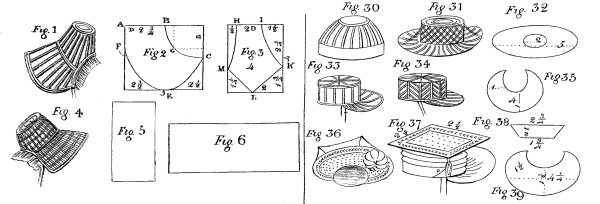
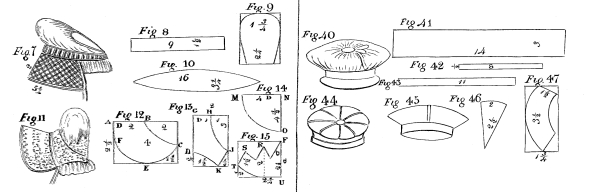
In making up, a lining is cut out exactly the size of the outside, run the two together on the wrong side, at the edge of the brim, and turn them; then run cotton cords between the lining and the outside, as in the Plate, and two or three are put round the edge to give it firmness: runners are also made in the crown and the patch, the latter having a cord all round it, and they are then sewed strongly together, the part, H M, fitting into B G C, and the patch into I K. A curtain, one nail and a half in depth, is put on rather full behind, and strings of the chintz, or calico neatly hemmed, or of ribbon will complete it.
The size here given is for a child five years old, but it is a useful kind of bonnet for those much younger.
CHILD’S DRAWN BONNET.
PLATE 19. FIG. 4, 5, 6.
This is usually made of silk, satin, or glazed calico.
The poke or front (Fig. 5), is an oblong, which is cut two or more nails down the selvage, according to the depth desired, and of such a length (cut width-way of the material), as will be two and a half times the length from ear to ear. This oblong is hemmed at each side, and bobbins put in to draw it up: two runners are made at equal distances between to draw up. The crown or head-piece, Fig. 6, is in one piece, and is also an oblong, about one nail deeper than the poke, and a fourth longer. Make runners down each side, and three or four equal distances between.
In making up the bonnet, the poke is drawn up to the proper size, and a double piping laid round it. The crown is then formed by drawing up the first runner as close as possible, and the second sufficiently so to make it flat and circular. The remainder is drawn to the proper shape to form the head-piece, being less drawn at each succeeding runner to make it wider at the bottom. Lay on a band of silk piped at each end, and sew it firmly round, and then attach the poke to it. Next make a soft lining to the head-piece, and a circular piece of wool in muslin may be attached to the crown, to keep it in shape. A curtain and strings complete the bonnet. A quilling of ribbon round the edge, and a rosette at the side, give a greater finish.
SOFT BONNET FOR A CHILD SEVEN OR EIGHT YEARS OLD.
PLATE 19. FIG. 7, 8, 9, 10.
This is a remarkably neat little bonnet; it is in four parts. The poke is a plain piece two nails and a half deep, by ten nails and a half long, sloped off at the outer edge one nail and a half at each end, it is ornamented with cotton runners, quilted or braided; cut a strip, Fig. 8, nine nails long by one nail and a half wide, which must have a runner at each edge, and the same in rows across, to give it firmness, if it is not quilted or braided; the third part is another strip sixteen nails long, and three nails and a quarter wide at the widest part, sloped off nearly to a point at each end, Fig. 10; the horse-shoe, two nails and a quarter long, and one nail and three quarters broad at the top, is lined and has a cord run all round the edge. The curtain is one nail and a half deep, put on rather full.
In making up, sew the quilted poke or front strongly to the straight strip, Fig. 8; gather the sloped strip, Fig. 10, at each edge, set it on one side into the straight piece, and on the other into the horse-shoe, fulling it more in front than at the sides. Put on the curtain, and the bonnet is finished. It draws up behind to the side of the head; here it is represented as undrawn.
SOFT BONNET FOR A CHILD TWO YEARS OLD.
PLATE 19. FIG. 11, 12, 13, 14, 15.
This is well adapted for a child’s first or second bonnet, and looks well, made of coloured kerseymere or Indiana braided or worked in chain-stitch.
To cut out the poke, take a piece of paper, which when doubled is four nails long by two and a half nails wide (see Fig. 12), the doubled part from D to B, is two nails long; slope off gradually from A to E, beginning the greatest sloping at F, which is about half way down the side; the point E is one nail and a half from the corner, continue sloping to C, which is about one nail above the bottom of your paper; the curve, B C, is parallel to, or even with the curve, A F E. The head-piece, Fig. 13, is cut from a paper, which when folded is three nails long and two broad; from G to H, the doubled part, is one nail, from G to L, two nails and a quarter; cut a slightly curved line from L to K, the point K, being half a nail from the corner, next cut quite straight to J, being three-quarters of a nail above the angle or corner, sweep gradually from J to H. Fig. 14 represents half the crown; D is the doubled part, and is four nails long from M to N; the part from N to O is four and a half nails, the rest from O to M, is cut like a quarter of a circle. Fig. 15 is the part that supports or holds up the crown behind, the doubled part, U P, is two nails and a half long, from U to T is two nails and a quarter, curve it gently about half a nail; from the corner to T is half a nail; from T to S is one nail and a half, S being half a nail from the side of the square; the top of R, the next vandyke is two nails in a straight line from the bottom. These vandykes are about one nail deep.
The Plate shows sufficiently clearly how this bonnet is made up, to dispense with any further description, except to say that the crown, Fig. 14, is evenly gathered into the head-piece, Fig. 13, and the back-piece, Fig. 15. The curtain is put on, strings and a small bow may be added behind.
SOFT BONNET FOR A CHILD THREE YEARS OLD.
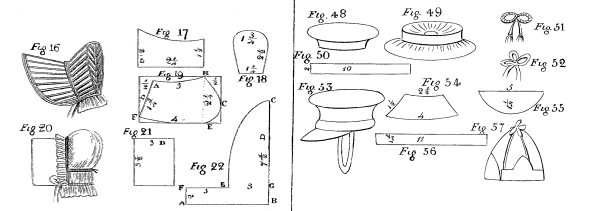
PLATE 19. FIG. 16, 17, 18, 19.
This bonnet is very generally worn; the one represented in the Plate is for a little girl about three years old, though older and younger children would find it both suitable and comfortable; it is made of cloth, print, or nankeen, lined, and with runners in every part. It is in three pieces; to cut out the poke, Fig. 19, take a piece of paper, which, when folded in two, is four nails long and two nails and a quarter broad. D is the doubled part; from A to B is three nails, it is slightly curved; A being about one quarter of a nail from the top and half a nail from the side, next cut in nearly a straight line to C, and continue the curving to E, which is half a nail from the corner; from B to E, in a straight line, is two nails and a quarter; cut in a straight direction from E to F, the latter being one quarter of a nail above the corner; from A to F is one nail and three-quarters.
The head-piece, Fig. 17, when doubled (D being the folded part), is two nails and a half long, and two nails at the deepest part, which is to go in the front, sloped off to one nail and a half for the back. The crown is merely a horse-shoe; Fig. 18 is two nails and a half long, one nail and three-quarters at the top, and sloped off one quarter of a nail on each side, so as to make it only one nail and a quarter at the bottom.
In making up, the runners may be put in simply as in the Plate, or arranged in a pattern, or the bonnet may be quilted, but there must be two or three runners round the edge, and inner part of the poke, at the top and bottom of the head-piece, and all round the horse-shoe.
Put on a full curtain of one nail and a half deep.
BONNET FOR A CHILD FOUR YEARS OLD.
PLATE 19. FIG. 20, 21, 22.
This is a neat little bonnet with a stiff front, and is cut out as follows:—
For the pattern of the front, Fig. 20, let your paper, when folded in two, be three nails and a half long, by three nails broad, it may be rounded or left square at the ends, according to fancy, D being the doubled part; this front or poke is made of stiff pasteboard.
The crown, Fig. 22, is seven nails long at the doubled part, D, and six nails long at the bottom, A B, cut in a straight line, A F, for two nails, and again straight, F E, for three nails, then round it gradually up to C.
Before making up, cut out two pieces of calico, print, silk, or other material, the size of the poke, Fig. 21, then run them neatly together at the edge, and up the ends, and slip the pasteboard in; hem the bottom of the crown, Fig. 22, A B, and up the ends, A F, for the curtain. Hem from F to E, and make a runner about half a nail within the edge up to C, through which a bobbin must be passed, and drawn up to the width of the poke; it must be sewed strongly to the outside of the front, letting the little frill lie over it, as in the Plate, forming a sort of trimming; the lining of the poke must be only turned in, and slightly tacked down, so that the pasteboard may be easily taken out when the bonnet is washed. A runner is made across the back of the crown, about two nails above F E G, through which tapes are passed: the ends of the lower ones are sewed a little way along the poke, and when the bonnet is fitted to the head, these runners are drawn to the proper size. Put on hemmed strings of the same material.
SOFT BONNET FOR A CHILD, THREE, FOUR, OR FIVE YEARS OLD.
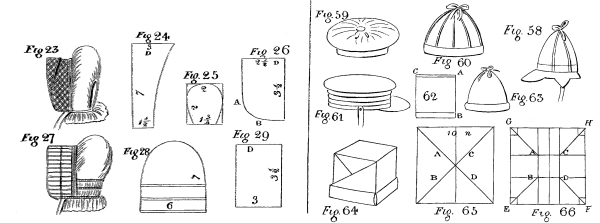
PLATE 19. FIG. 23, 24, 25, 26.
This is a school child’s common bonnet, it may be made of print, gingham, or nankeen, and is in three parts. The head-piece, Fig. 24, when folded in two, is seven nails long, and three nails wide at the doubled and widest part, D, sloped off to one nail and a half at the bottom. The poke, Fig. 26, when doubled, is two nails and a half broad, by three nails and a half long, and a little rounded from A to B. Fig. 25 is the horse-shoe, two nails long, and two nails broad at the top, sloped off to one nail and three-quarters at the bottom.
In making up, the front is wadded or quilted, with a cotton runner at the outer edge, and two or three at the inner edge, to give it firmness; a runner is also put in round the horse-shoe. The front of the crown is gathered evenly to the poke, the horse-shoe set in, and a curtain set on behind.
When worn, the front of the bonnet is turned up, as in the Plate.
ANOTHER SOFT BONNET FOR A YOUNG CHILD.
PLATE 19. FIG. 27, 28, 29.
This is also a school child’s bonnet, and may be made of any soft or washing material.
Fig. 29 represents the poke, which, when doubled at D, is three nails and a half long, by three nails wide. The crown, Fig. 28, is six nails wide at the bottom, and seven nails at its longest part, rounded off on each side; three runners are made at the bottom of it, about a nail apart.
The poke is quilted, wadded, or run with cotton, and the crown sewed to it, rather fuller in the centre in front, than at the sides; the runners are drawn up, and tied at the proper size, and upon the lower one a curtain, one nail and a half or two nails deep, is set, and extends a little on each side upon the ends of the front or brim.
HATS AND CAPS.
PLATE 19.
Hats and caps for young boys should be made of soft materials, similar to bonnets for little girls; as they become older, their hats must of course be stronger and stiffer; some of both sorts will here be described, as well as travelling and other caps for grown-up persons.
PORRINGER CLOTH CAP.
PLATE 19. FIG. 30.
This is an extremely simple cap for young boys; it is made of cloth or merino, and consists of three pieces. The band, which is merely a piece of cloth half a nail deep, and sufficiently long to go round the child’s head, say, eight nails and a half, or nine nails long; the head-piece, which is also about nine nails long, before being joined up, and one nail and a half deep, is made with runners in an upright direction or across the cloth at regular distances, which give a degree of firmness to the cap; the round patch or crown is about one nail and a half across, with a runner made round the edge of it. When made up, it should be lined with demet or flannel and soft calico.
SOFT HAT FOR A YOUNG CHILD.
PLATE 19. FIG. 31, 32.
This little hat looks very pretty made of glazed cambric muslin or of calico, either white or coloured; if wanted for winter wear, it may be made of merino, cloth, or kerseymere, plain or braided.
For the brim, Fig. 32, cut a circle five nails across, with a hole in the centre of it two nails across, for the head, a little may be sloped off from the back, or not, according to pleasure; the crown is one nail and a quarter deep, and nine nails long before it is joined up, and the circle or patch is made to fit exactly. When the hat is made of glazed calico, it is lined with the same, and runners of cotton put in, either simply or in a pattern. A strap or ribbon is attached on each side, from about half way up the crown to about half the breadth of the brim, to keep it up and in its place. Strings are sewed at the inside.
SOFT CAP FOR A YOUNG BOY.
PLATE 19. FIG. 33.
This cap is made of glazed calico, white or coloured, or of any other soft light material, with runners in it; the brim is cut in the shape of Fig. 39, it is four nails and a quarter long, one nail and a half broad at the deepest part, sloped off as in the Plate; the crown is one nail and a quarter deep, and from eight to nine nails long before being sewed up; the circle of course is made to fit it.
ANOTHER CAP.
PLATE 19. FIG. 34.
This is only a variety of the preceding cap; the brim is cut like Fig. 35, and is four nails long, and one nail deep, at the broadest part in front, sloped off at the ends; the Plate shews the way in which the runners are put in.
CAP FOR AN INFANT BOY.
PLATE 19. FIG. 36, 37, 38, 39.
This is a remarkably pretty cap for an infant, after he has left off his hood; it is made of white or coloured satin, kerseymere, or merino.
The brim, Fig. 39, is four nails and a quarter long, one nail and a half deep, and sloped as in the Plate, the head-piece is a full nail deep when folded in small plaits, and eight nails and three-quarters long before it is sewed up; the little flap or piece behind, Fig. 38, is about one nail deep; the longest part of it, or that to be turned up, is two nails and three-quarters long; that fastened to the hat is one nail and three-quarters; it is sloped at each end. The square or top of the hat, is two nails and a half every way; four other pieces must be cut one nail deep, and two nails and three-quarters wide at the top, sloped at each side down to two nails at the bottom.
In making up, take a piece of buckram of the size of the head-piece, lay it upon a demet or thin wadding, and flute the kerseymere upon it, putting a fine silk cord, or a piece of coarse stay or netting silk between the flutes.
The crown must next be prepared; ornament the square according to fancy, working the pattern in spots, either in braid, or in stay or netting silk; line this also with buckram, demet, and silk, to each side of the square, sew the widest side of each of the four pieces above described, these pieces having previously been lined, as before mentioned, sew the corners of the four firmly together, inlaying a piping; the head-piece is then put on, next set on the back-piece, Fig. 38, this is lined with silk or satin, in the following manner:—After the buckram is put in, the lining is sewed to it, and not being sloped at the narrow end of the kerseymere, it allows of being fulled or plaited at the part nearest the hat. The brim is finished in the same manner, the satin lining being plain at the edge, and gathered to the head-piece; it has also demet and buckram within the lining, and is worked in a similar manner to the square, upon the front or turned up part, which is of kerseymere. Put a silk, calico, or muslin lining into the head, and a silk tassel at the left corner of the square; a satin rosette in front, and strings complete the cap.
BOY’S CAP OF FIVE OR SIX YEARS OLD.
PLATE 19. FIG. 40, 41, 42, 43.
This cap is made of cloth or Holland; the crown, Fig. 41, is fourteen nails long, and three nails deep; the band, Fig. 42, is eight nails long, and half a nail broad; the brim or edge, Fig. 43, is eleven nails long, and one nail deep.
In making up, the crown, Fig. 41, is wadded and lined, it is then gathered evenly into the band on one side, and into the small circular patch or button on the other; the band, Fig. 42, is lined with flannel as well as calico; the brim, which is wadded and lined, has a piece of buckram put within the lining, it is sewed on so as to turn up and set rather round. A tassel or bow of ribbon may or may not be added at the top, according to pleasure.
CAP FOR A BOY SEVEN OR EIGHT YEARS OLD.
PLATE 19. FIG. 44, 45, 46, 47.
This looks neat made of Holland, with a piping of dark blue, green, or the same colour.
The top of the crown is in eight pieces, cut out of a circle, five nails across; this will make each division two nails and a half long, and two nails at the broadest part, sloped to a point, and the shape of Fig. 46. The side of the crown is in four pieces, Fig. 47; to cut these, make another circle the same size as the top, and in the centre of it cut a smaller one, two nails across, then divide the circle into four parts. The band is about one nail broad, when made up, and nine nails long, before it is joined at the ends.
In making up, sew the eight pieces together, laying a coloured piping between them, and putting a button at the top; the four sides, Fig. 47, being previously lined with buckram, demet, and glazed calico, are then each sewed to the circle thus formed, one of the sides fitting to two of the smaller pieces at the top; they must be sewed on the wrong side very firmly, and turned down, so that the stitches are not seen on the outside, the ends of these four pieces being piped, are then sewed together. The cap is now ready for the band, which, after being wadded, is stitched on, and the whole is finished.
CAP FOR A BOY, SIX OR EIGHT YEARS OLD.
PLATE 19. FIG. 48, 49, 50.
This is a simple cap and easily made; it consists merely of two pieces.
The crown is a circle of eight nails across, lined and wadded, which is equally gathered all round, and set into a band, which is one nail and a half deep, and nine or ten nails long before it is joined up, Fig. 50: this band is also wadded, and a bow of ribbon may be put on one side.
CAP FOR AN OLDER BOY.
PLATE 19. FIG. 53, 54, 55, 56.
This is a remarkably neat cap, and may be worn by either a boy or a man; it is generally made of cloth.
The circle at the top is five nails across, the side part is cut out of a circle in the same manner as that of Fig. 45, the outer circle being five nails across, and the inner one two nails; this circle is divided into four pieces; the band, Fig. 56, is one nail and a quarter broad, and eleven nails long before it is sewed up; the peak, Fig 55, is generally made of patent leather; it is part of a circle, five nails across, and is one nail and a quarter deep at the broadest part.
In making up, the circle is first lined with flannel and then with silk; it is stretched over a strong but not very thick wire at the edge, to keep it in shape, and a piping of cloth put on all round: the sides, Fig. 54, are then lined with soft leather, and sewed to the circle on the wrong side, before being joined together; the seams are next sewed up, and a thin hoop of whalebone put at the bottom of these sides, just where the band is to be joined on, round the head; the band is firmly stitched to it, which band is also lined with thin, but not very pliable leather: the peak is then put on; a lining of leather one nail and a quarter deep is sewed in the inside, to the inner part of which, a piece of silk is attached, with a string-case and cord to draw it up to the size of the head. Sometimes a band of black velvet, or of silver or gold lace is laid upon the cloth one, sometimes it is left quite plain. The strap under the chin is of patent leather, fastened at the side with a small buckle.
GENTLEMEN’S TRAVELLING CAP.
PLATE 19. FIG. 57, 58.
This is a particularly comfortable cap, and is easily made. It is composed of fine cloth of any dark colour, trimmed with fur.
Make a circle, seven nails across, and cut it into six parts; the brim is made either of patent leather, or of cloth, it must be three nails and a half long at the straight part or bottom of it, one and three-quarters of a nail deep at the broadest part, and rounded off at each end: the flaps or pieces for the ears are also one and three-quarters of a nail deep at the broadest part; they are cut in one length with the band, which goes behind the cap, and is one nail deep; the whole length, including the ear-flaps, is seven nails.
In making up, first join with a piping of the same, all the six divisions of the crown, fastening them at the top with a round button, and put in a lining of wadding, stiffened muslin, and any dark coloured silk; sew all these round the edge, and then put on the brim or peak: this, when of cloth, is made of two pieces the same size and shape; run them together at the edge on the wrong side, with a piping between them, turn them to the right side, put in a piece of stiff muslin, and a thin wadding, sew it on to the front of the cap at the edge, and again half a nail above, so that, though it can be pulled down over the eyes, it usually remains turned up, as in Fig. 57: the band behind, with the ear-flaps, is then sewed on; this is a piece of cloth, with a strip of dark fur or velvet laid on it, so that when the strings of the ear-flaps are tied under the chin, the fur lies against the throat and ears, and when not required, the strings are tied on the top of the head, the velvet or fur forming a kind of trimming to the cap.
A LADY’S RIDING CAP.
PLATE 19. FIG. 59.
This is made of velvet, and is simply a straight piece, a yard long and about eight nails deep, lined with flannel or wadding, buckram and silk, which is joined up at the two ends, and gathered on the one side, under a small flat silk or gold button, and on the other, into a velvet band, one nail deep, and made to fit the head. A silk bow and tassel (see Fig. 51) are put on at the top, and ribbon strings fasten under the chin, or not, according to pleasure.
A TRAVELLING CAP.
PLATE 19. FIG. 60.
This is a soft cap, and is generally made of cloth. It is formed of a circle, eight nails across, cut in eight parts, which are joined with pipings of the same, and fastened at the top with a knot or tassel. The crown is lined in a similar manner to Fig. 58, and the band, which must have buckram within the lining of silk or soft leather, is firmly stitched to it.
A NEAT BOY’S CAP.
PLATE 19. FIG. 61.
This is made of cloth or Holland. The top is a circle of five nails across, the head-piece is nine nails long, and one nail and a half deep when made up, it is plaited in very small exact folds, and therefore before it is made up, it must be four nails and a half broad: the brim or peak is of patent leather, and the strap under the chin of the same.
In making up, the top or crown must be wadded, stiffened with buckram, and lined: the head-piece is then prepared, by being folded, and the folds stitched upon a piece of stiff buckram, the proper length: the crown is sewed to it, the peak and strap put on, as in the Plate.
A TRAVELLING CAP FOR GENTLEMEN OR LADIES.
PLATE 19. FIG. 62, 63.
This is a very simple, and at the same time, a very good looking cap: it is made either of velvet, or of fine cloth, and when doubled, as in Fig. 62, forms nearly a square.
To make it, put in a wadding and lining, join it up behind, A B, make a string-case, A C, through which a silk cord must be run, which draws it up to the shape of a cap, and trim it round the edge or brim with some rich fur. The advantage of the string-case at the top is, that when not in use, it will pack quite flatly and take up little room.
THE WORKING MAN’S CAP.
PLATE 19. FIG. 64, 65, 66.
Fold a sheet of common brown paper to make a workman’s cap, as follows:—
Let it be a square of ten nails, double it across like a half-handkerchief, and crease it well; open it and cross it again the other way, open it again, double down the middle one way, and crease it well; on spreading it out, it will be marked according to the lines in Fig. 65. Measure from the centre on the cross lines, about one nail and three-quarters (see A B C D), next crease the paper from side to side through these points, thus:—one line through A B, another through C D, and again C A, and D B; this will form a square in the middle. Cut out a nail square at every corner, as in Fig. 66.
In folding it up, the square, A B C D, in the centre, forms the top of the cap, and the points, E F, are doubled according to the crosswise plait, and crossed in front towards each other, the other points, G H, are likewise crossed behind towards their opposite ends. The cap is then formed by merely turning up a piece all round to make it stand firmly. (Fig. 64.)
WOMEN’S BONNETS.
PLATE 20.
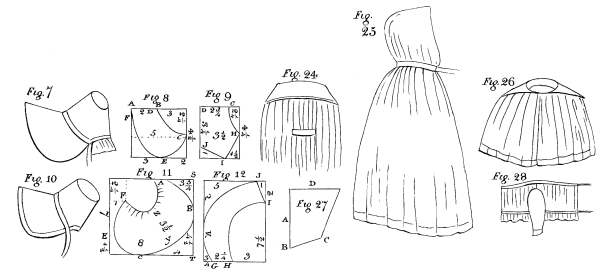
Bonnets being, like gowns, dependent in a great measure on the fancy and whim of the day, will only be treated of as to the general modes of making them up, and a few of the very plainest shapes given.
Bonnets are made of velvet, plush, satin, silk, crape, book-muslin, chip, gingham, and glazed calico.
The foundations are either pasteboard, buckram, stiff muslin, or willow.
Bonnets are kept in shape by means of wire, chip, or whalebone.
They are lined either with the material of which the bonnet is made, or with some other, lighter or warmer, according to taste, and the time of the year; but care must be taken that the colours either harmonize or decidedly contrast. When the lining is white, a sheet of tissue paper is put between it and the bonnet, whether it be of silk, or only of straw; this makes the white material, whatever it may be, look a much purer colour than it otherwise would do. A piece of demet or of thin wadding should always be laid between the foundation and the silk, or other material of which it is made, unless that material is very thick.
Bonnets may be lined with ribbon in the following manner:—
Take a piece similar to the trimming, and long enough to be run plainly to the outer edge of the bonnet all round, the other side of the ribbon is finely gathered, and being drawn up to the size of the inside of the bonnet, it is neatly sewed to it, forming a kind of border or trimming.
When a bonnet is lined plainly, or the cross-way, it takes half a yard cut crosswise. If a curtain is required in addition, three-quarters of a yard, cut the straight way, must be purchased.
In fitting your lining, lay it across the bonnet, so that as little as possible is wasted or cut off at the corner; put small pins all round the edge, and the inside also, so as to keep it in its place, cutting off the superfluous quantity and then sew it, concealing your stitches as much as possible between the lining and the bonnet.
To line a bonnet the straight way, so that, though plain at the edge, it is a little fulled or plaited into the crown, about three-quarters of a yard is required, influenced of course in some degree, both by the depth of the poke and its width. This lining is very easily put in; sew it round the edge on the wrong side as far as the ears or rounded part of the bonnet, by which means the stitches are quite concealed, then turn it, and sew the rest as neatly as you can; the lining looks the best plaited into the crown; to do this equally, begin in the middle, making a perfectly straight fold, the rest on each side should incline a little to the centre, and be very small and regular.
Bonnets may be trimmed in a great variety of ways with the material of which they are made, cut crosswise and either hemmed or lined, so as to form a kind of ribbon, with velvet, plush, satin, silk, crape, gauze, muslin, or ribbon.
PLATE 20.
Bows to be worn in front, or at the side, are generally made up and sewed upon a piece of wire ribbon, which gives them firmness, and makes them keep in their place and shape.
Velvet or plush trimmings are generally lined with satin or silk of the same shade. The colour of the ribbon, if not an exact match with that of the bonnet, should be darker.
Curtains may be made either of the material that lines the bonnet or ribbon. For the former, the silk or satin is cut the cross-way, and is from one nail and a half to two nails deep; it is hemmed at the edge, and sometimes a straw plait or silk cord is laid on above the hem; they may be either plaited on to the bonnet in large full plaits, or hemmed, and a piece of ribbon, exactly the length that the curtain is to be, run in; this looks better than the plaiting, and does not so soon become flattened.
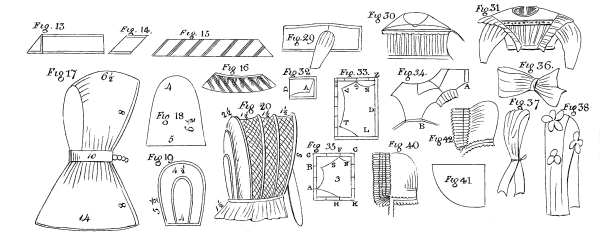
Ribbon curtains are made in two ways, the one by merely plaiting or gathering a straight piece of ribbon, and hemming the ends; the other, and much the prettiest method, is also the most complicated. Fold the end of your ribbon down like a half-handkerchief, Fig. 13, and cut it off, thus leaving a cross-way end; fold it again, straight down the ribbon, measuring it so as to be doubled the same depth top and bottom, thus forming a piece like Fig. 14: cut off a number of these pieces, which must then be run very flatly together, so that the cross-way parts of the ribbon are at the top and bottom, and the border or edge lies in oblique or slanting lines across the curtain, Fig. 15, 16; one end will be pointed or sloped outwards, in order to make the other like it, the half square cut off at first, must be joined to it. The number of pieces of course must depend on the breadth of the ribbon, the whole curtain should be about three-quarters of a yard long; when the parts are joined together, hem your curtain top and bottom, running a ribbon in at the top, in order to full it properly to the bonnet.
OLD WOMAN’S BONNET.
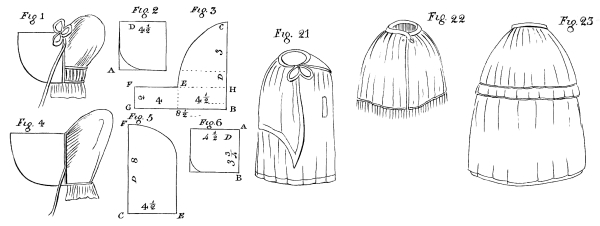
PLATE 20. FIG. 1, 2, 3.
This is a comfortable shape for an old woman, and is very easily made. It is in two pieces, the front or poke is made of pasteboard, covered with silk or any dark coloured material. To cut the pattern of it, take a piece of paper, four nails and a half square when folded (see Fig. 2), let D be the doubled part, and round it off gradually at the corner, A. The crown is cut out according to Fig. 3.
SCALE.
Nails.
From B to C the doubled part 8
From B to G 8½
From G to F 2
From F to E 4
Then slope gradually to C from E
In making up, having previously cut out two pieces the proper size to cover the poke, one for the outside, and one for the lining, run them together on the wrong side, round that part which is to form the edge of the bonnet, leaving open that which is to be sewed to the crown, and slip the pasteboard into it: then begin the crown, Fig. 3, hem it at the bottom and make a runner from F E to H, and another, one nail or one nail and half above it, and put in a string; set the front of the crown, C E, on to the poke, either in gathers or small plaits, draw up the runners behind to the proper size to fit the head, and fasten them; sew each end of the curtain a little way on the ends of the poke as in the Plate; put a ribbon on across the front, and strings, with a bow at the top; one may be added behind, at pleasure.
BONNET FOR A MEMBER OF THE SOCIETY OF FRIENDS.
PLATE 20. FIG. 4, 5, 6.
These bonnets are made of black, white, grey, or fawn coloured silk. They are cut out as follows:—
For the pattern of the poke, Fig. 6, let your paper be doubled at D, which part must be four nails and a half long; from A to B is three nails and three-quarters; slope off the front at the corner. For the crown, Fig. 5, let the doubled part, D, be eight nails long, and from C to E is four nails and a half; it is gradually sloped from F, as in the Plate.
In making up, run the pieces cut for the outside and lining together at the edge, on the wrong side, and having turned them, slip in the pasteboard; plait the front of the crown into the poke in very small exact folds, leaving it quite plain for some distance above the ears; make a narrow runner behind of one nail and a half in depth, to form a curtain, and put on ribbon strings the same colour as the bonnet.
A NEAT BONNET FOR A SERVANT.
PLATE 20. FIG. 7, 8, 9.
To cut out the poke of this bonnet, Fig. 8, which is of pasteboard, take a doubled piece of paper, five nails wide, by four nails and a half long, letting D be the doubled part.
SCALE.
Nails.
From A to B 2
From A to F 1
From the corner to E 3
Above the corner to C 2¼
Curve from B to C, slope from C to E, round from E to F.
The foundation of the crown, Fig. 9, is of buckram, or willow; let your doubled paper be three nails and a half wide, by four nails and a quarter long; D is the doubled part.
SCALE.
Nails.
From the corner to C 2¾
From the corner to H 2¼
From the corner to I 1½
J above the corner 1
Curve from G to H, cut from H to I, and from I to J.
The circular top or patch, is cut to fit the bonnet.
In making up, cover each part with silk, laying a thin piece of wadding between the silk and the foundation, then sew them very firmly together, with strong silk or waxed thread, and put a Persian or muslin lining in the crown. Silk cut the cross-way and laid in moderate sized plaits may be folded round the crown of the bonnet, which has a very neat appearance. The more simply it is trimmed, the better it looks; a ribbon across, to form strings, and one bow behind or at the side, is quite sufficient.
A SCHOOL GIRL’S BONNET.
PLATE 20. FIG. 10, 11, 12.
To cut out the poke, Fig. 11, when laid open, let your paper be eight nails wide, by seven long.
SCALE.
Nails.
From A to S is 3¾
From S to B 2½
From T to C 4
Above the corner to E 1½
From the side to F 1
From the top to F 2¼
From Z to Y 3½
Cut from F to E, round from F to C, and from C, through Y, and B, to A, curve A Z F.
The crown or head-piece, Fig. 12, is thus formed; let your paper be six nails wide, by seven nails and a half long.
SCALE.
Nails.
From H to G 2¼
From the corner to G ¾
From the corner to K 2½
J is from the corner 1
From the corner to I 2
Slope G to K, shape according to the Plate from K to J, cut from J to I, curve from I to H.
The top or circle is cut exactly to fit this crown.
This bonnet is made of glazed calico; the poke is of pasteboard. If many of them are required, it is the best economy to cut out all the pokes at once, and then all the crowns, as they will fit into each other. Make it up as follows:—
After joining the two ends of the head-piece, wire and sew the circle into it, then tack the calico on the crown or circle; then tack a piece of calico outside the head-piece, piping it up the joinings; run on the lining of the poke, after which the outside cover is put on and tacked strongly at the edge; the trimming will conceal the stitches; sew the trimming, which is merely a cross-way hem one nail deep and piped to the inside of the edge of the poke with small stitches, then turn it over on the outside and sew it neatly down to the upper calico, taking care not to go through the pasteboard. Fasten the poke to the crown, and then put in the lining, making it to draw, and sewing it on the inside. The trimming, piping and bow, are all cut the cross-way; the strings are half a yard long, cut straight. One bonnet takes one sheet of 3d. pasteboard, and about one yard and a half of 4d. glazed calico, including the trimming; with the wire it comes to 9d. prime cost.
For winter wear, it is desirable to line both poke and crown with wadding or flannel.
A neat simple trimming for children’s bonnets, is made as follows:—
Cut strips of glazed calico, one nail wide, fold them so that the raw edges shall lie at the back; making each strip somewhat less than half a nail broad, and then with a long needleful of coloured thread, run on the right side of it, up and down in vandykes; when done, draw it up, and it forms a pretty sort of edging.
OILED SILK HOODS.
PLATE 20. FIG. 17, 18.
These hoods are convenient for persons who travel much, or go excursions in open carriages, as a protection against rain; they are made of oiled silk, either black, or light coloured, the former looks best.
The shape is very simple, the hood consisting of four parts: the front is a straight piece, one yard long, and six nails and a half broad. The horse-shoe, Fig. 18, which is rather a different shape to the usual one, is six nails and a half long, four nails wide at the top, and five nails at the bottom; the curtain or tippet is half a yard deep, and one yard and three-quarters long; the band is one nail broad, ten nails long.
In making up, the head-piece is run to the horse-shoe quite plainly, and the front, or part round the face is hemmed or bound; it is then set into the band, the horse-shoe being plainly put in, and the rest plaited in small folds; the curtain is sewed on in small plaits all round, the band lined with silk or ribbon, and a large hook and eye or chain is put on. The curtain is either hemmed or bound all round.
CALÈCHE.
PLATE 20. FIG. 19, 20.
These are worn by ladies who walk short distances to evening parties, and are better than a bonnet as they do not crush or disturb the cap or head dress.
A calèche is best made of dark silk or satin, and lined with the same colour; it is in three parts. The front, or head-piece, is seven nails and a half wide, and one yard long; the horse-shoe, Fig. 19, is five nails and a half long by four nails and a half broad, at the widest part, sloped down to four nails at the bottom; the curtain is one yard and a quarter long, and one nail and a half deep. A lining is cut out exactly similar to the outside; and it is made up as follows:—
Run the edges of the head-piece and lining together on the wrong side, and turn them, put in a piece of whalebone the whole length of the front, viz:—one yard, about half a quarter of a nail broad, and run on the other side of it, to secure it, leave a space of one nail and a half broad, and make a runner the proper width to receive a second whalebone, and then, leaving the same distances, make runners for two more; the spaces between are quilted, as in the Plate, to give a little firmness to the whole.
Between the fourth whalebone and the outer edge is an interval of two nails and a half, and this is not quilted like the rest. The horse-shoe is then made, the outside and lining being run together, a whalebone is put in, (see Fig. 19), at the edge, and again another, one nail within. The head-piece is then gathered (the rough edges of both the satin and lining being turned within, so as to make it perfectly neat at the inside), and sewed to the horse-shoe, the fulness being chiefly towards the top. It is then gathered at the neck, and bound with ribbon, or a piece of the same material, which form a string-case; and the curtain is set on, lined or not, according to pleasure. A ribbon, about one yard long, is sewn on the front of the calèche, three nails from the bottom on each side, forming a kind of loop, by which to hold it forward when it is worn.
CLOAKS.
PLATE 20.
Cloaks may be made of satin, silk, cloth, merino, shawling, both the real and the imitation, Scotch-plaid, Orleans or common stuff. The choice of materials is of course influenced by the purpose for which the cloak is intended to be used; for instance, carriage or travelling cloaks are plain of a thicker substance, and have less work in them than those used for walking in.
Satin cloaks have frequently a velvet cape or collar, sometimes they are trimmed with broad velvet hems, laid on all round, or with fur, and occasionally lined with fur also. Silk and merino cloaks may likewise be trimmed with velvet, cut or uncut, plush or fur, and lined with the same, or they may be made perfectly plain. As a silk cloak is at all times a costly article of dress, and, with care, will last a long time, it is worth while to have the silk a very good one; it should be soft and rich, not liable to crease: levantine, satinette, or satin silk, are the best; and the colour should be one that will not easily fly, change, or spot; dark shades generally look the best, as black, violet, myrtle-green, or deep marone.
Satin, silk, and fine merino cloaks should be lined with sarsenet, either the same colour, or some well chosen contrast: but as these sarsenet linings cost a good deal for a full sized cloak, two old silk gowns, nicely picked to pieces, and either washed or dyed, would be a good substitute, where economy is an object: when this is done, it is a good plan to turn a deep hem of the outside silk over the edge, on each side in front, or it is better still to let the two front breadths of the lining be of new silk.
Cloaks may either be simply lined with a piece of flannel between the silk and the lining, which makes them light and suitable for walking in the autumn and the spring, or they may be lined and wadded; this is done by laying breadths either of thin flannel or lining muslin, cut the same size as the breadths of silk on a table, and placing upon them sheets of wadding, so as to cover them entirely; then with a long needleful of thread, the wadding should be tacked or basted in wide stitches backwards and forwards in sort of vandykes upon the muslin or flannel, in order that it may always keep in its place, which otherwise it would not do. The flannel with the wadding thus sewed to it, is then put between the two silks and the seams run up.
LADY’S SILK CLOAK.
PLATE 20. FIG. 21.
It consists of six breadths of silk, the proper length to fit the person for whom it is made, i. e. from the collar-bone to the top of the shoe. Cut a shoulder-piece the shape of Fig. 1, or 4, Plate 13, making it to fit, with flannel and silk lining to suit; next cut a collar, Fig. 7, Plate 13, with a stiff muslin and silk lining; then cut the cape, Fig. 15 and 16, Plate 13, with only a silk lining.
In making up, having laid the lining and wadding together as described above, run up the seams; cut the arm-holes one nail and a half from the seam between the first and second breadths, and two nails and a quarter below the shoulder-piece; each arm-hole is three nails and a quarter long.
The shoulder-piece is next made, by running the silk and lining together, with the wadding and flannel between them on the wrong side, and then turning it to the other; the three back breadths of the skirt are then hollowed out to fit the shoulder-piece, next full the whole into the shoulder-piece, letting the two front breadths, reach to the shoulder only, while the rest is sewed to the back. A hem one nail and three-quarters deep of cross-way velvet, cut or uncut, or an edging of fur may be put on, up the fronts according to pleasure. The back is then plaited in behind, at a proper distance below the shoulder-piece, to suit the waist, say four nails, and a band long enough to go round the waist is laid upon these folds, and drawn through two large button-holes, one at each end of the plaiting; this band hooks or buttons in front, inside the cloak. Another way of confining it at the waist, is, by laying a ribbon along the inside of the back breadth, at the proper distance from the top, thus forming a kind of string-case, through which two ribbons are passed, fastened at one end, and drawn out at the other, of the runner; these ribbons tie round the waist at the inside. The collar having previously been lined, is then set on, and small pieces, three nails and a quarter long and half a nail broad, are lined, piped all round, and sewed on one side of each arm-hole, so as to lay over and cover it when the arms are not in. The cloak is fastened at the throat either by long silk cords the same colour, with tassels at the ends, or by a gilt or bronze chain.
The capes of these cloaks are frequently made loose from them, in which case they may be worn separately as mantles or short cloaks; when they are fastened on, they are sewed to the shoulder-piece.
LADY’S MANTELET OR SHORT CLOAK.
PLATE 20. FIG. 22.
These are made of velvet, satin, silk, cloth, merino or shawling; they are lined with silk, muslin, or glazed calico, and trimmed with lace, fringe, velvet, satin or fur; they are very convenient and light for walking, or going out in an evening. A mantelet reaches to a little above the knee, and fastens in the front with hooks and eyes; it is made exactly like the cape of a large cloak, with five breadths in it, a little hollowed round the neck, and set into a band, or a collar turned over.
LARGE CARRIAGE CLOAK OR ROQUELAURE.
PLATE 20. FIG. 23.
Used by ladies in an open carriage, to put on in case of rain. It is made of plaid or some woollen material, and consists of five breadths of eleven nails wide, and one yard and a half long; two arm-holes are made five nails from the top of the cloak, and five nails long, to these arm-holes are sewed loose sleeves, eight nails long, and four nails wide, when sewed up; they are merely attached to the cloak by being sewed to the top of the arm-hole, so that they may be put on, or left to hang down at pleasure. The cloak is lined with flannel and glazed calico, or calimanco, it is set into a band at the neck, of about ten nails long, and a collar and one or more deep capes put on. It fastens at the throat with a gilt or bronze chain.
LADY’S NEAT GARDEN OR SERVANT’S CLOAK.
PLATE 20. FIG. 24.
This may be made either of merino or Scotch-plaid; if the former, it has three breadths in it, of seventeen nails wide; if the latter, it requires five breadths, eleven nails wide.
The shoulder-piece is like Fig. 3 or 4, Plate 13; it is lined and wadded, as are also two capes the same shape as the shoulder-piece cut larger; the collar is like Fig. 7, Plate 13. The whole cloak is lined with black or coloured glazed calico; arm-holes are left between the first and second breadths; they are four nails long, and three nails and a half from the bottom of the shoulder-piece; a small piece of the material, four nails long and three-quarters of a nail wide, lined and piped all round, is set on along each slit or arm-hole.
These cloaks can be purchased ready-made at the mercer’s shop, and are from 9s. to 18s. each.
OLD WOMAN’S CLOAK AND HOOD.
PLATE 20. FIG. 25, 27.
These are generally made of scarlet cloth, or grey duffel, and have only one breadth in them. The cloth is about three yards wide, and it is cut as follows:—
The width of the cloak is made in that of the material, therefore, when the proper length for the cloak is cut off the piece (say one yard and eight nails), it is doubled exactly in half the width, and then the selvages being laid together, they are sloped off at the top, perhaps from four to five nails gradually to about four nails above the bottom; the two corners in front are also rounded off at the bottom, so that a great part of it, as well as the two fronts are slightly on the cross, which renders binding or hemming not absolutely necessary, though the cloak looks much better when finished with a neat binding of scarlet or black ribbon; the top is set into a band the proper length to go round the neck, and a few plaits are made.
When two cloaks are cut out together, which is the most economical plan, the hoods will come out of the sloping at the neck, but this cannot be, if there is only one.
The hood is very simple, and is thus formed. Cut a paper pattern of half the hood, exactly like Fig. 27, and lay it on the cloth, taking care that D is upon the doubled part of it. In making it up, it is gathered or plaited from the top, or doubled part to A; the rest to B, is simply sewed up; B to C, is the part attached to the cloak, and the front, or what goes round the face, is neatly bound with ribbon. These hoods may be lined or not, at pleasure.
SCHOOL GIRL’S CAPE OR CLOAK.
PLATE 20. FIG. 26.
These are made of plaid or other stuff, lined with flannel and calico, and are good things for school girls to wear at church and elsewhere.
SCALE.
—————————— 1st. size. 2nd. size. 3rd. size. 4th. size.
Nails. Nails. Nails. Nails.
Usual width of plaid 11 12
Number of breadths 2½ 3 3½ 4
Depth to be cut down the selvage 8 10 12 13
Collar like Fig. 7, Plate 13, cut according to size
The skirt of the cloak having been lined with coarse flannel and glazed calico, and the shoulder-piece being piped all round with a pretty thick piping, the skirt is plaited evenly to the shoulder-piece in handsome plaits, and the flannel being laid against it, the calico linings are neatly felled down over the plaits, so as to hide the rough edges; the collar, lined also with flannel and calico, is sewed on, and a piece of tape or strong calico laid upon the part where it joins the shoulder-piece at the top. A button is put on at the throat, on the right hand side, and another, four nails below, and small squares of plaid doubled, with each a button-hole made in them, put to correspond on the other side.
By lengthening the skirt, this would make a very suitable cloak for a woman.
A more economical cloak, of this pattern, may be made of green baize; without a collar, it costs very little, but of course it does not wear nearly so well as the plaid ones.
BOY’S CLOAK.
A cloak or deep cape for a boy, may be made very simply as follows:—
Cut a large circle of cloth or plaid, the size you wish the cloak to be, and in the centre of it, make a smaller circle for the neck; cut from this small circle to the edge in a straight line, which will form the opening in front. Gather or plait the neck into a broad band, and it is completed. A cloak thus made will hang in full handsome folds, and be very warm.
SHAWLS.
Shawls may be made of various materials, velvet, plush, silk, cloth, duffel, plaid, or printed flannel, and they may either be square or in the form of a half-handkerchief; they are variously lined and trimmed, according to taste and circumstances.
CARRIAGE OR DRESS SHAWL.
This is either velvet, plush, or satin, and is half a square of one yard, twelve nails, or less, to suit the figure of the person, and the width of the material. It is lined with white or coloured sarsenet, and trimmed at the edge of the two straight sides, with a satin or silk hem, from one to one nail and a half deep, cut crosswise, lace, fringe, or fur.
LADY’S WALKING SHAWL.
Silk, cloth, or merino, are equally appropriate for this purpose. It may either be a square of one yard, twelve nails, or half of it, and is lined with silk. When the whole square is preferred, and when a hem of velvet, satin, or silk is laid on, care must be taken to arrange it so that when the shawl is doubled handkerchief-wise, the hems of both folds shall be seen at the same time, one lying nearly over the other, for which purpose, after laying the border on two successive sides of the square, turn your shawl over before sewing the border of the remaining two sides on. Thus half the trimming is on one, and half on the other side of the shawl.
These shawls, like the one mentioned above, may be trimmed in various ways.
SHAWL FOR A MEMBER OF THE SOCIETY OF FRIENDS.
This is a square of about one yard, twelve nails, and is made either of fine white, or very pale drab, grey, or other quiet coloured cloth, with a satin ribbon, the same shade and one nail broad, laid on all round it. It may be lined or not, according to pleasure.
QUILTED SHAWL.
This is half a square of silk of about one yard, twelve nails, and has a very neat appearance, besides being both light and warm. It is thus made:—
Lay wadding, demet, or flannel between the outside silk and the lining, which should be either white or some pretty suitable colour: it must then be run in three or four rows round the edge, and the middle quilted in diamonds, or any other pattern, according to taste.
CASHMERE SHAWL.
Purchase a piece of coloured Cashmere or Indiana, one yard, six nails square, to form the centre of the shawl, and make a very narrow hem all round it; then take shawl bordering, or four strips of Cashmere of some other colour, which will harmonize, or contrast well with the centre; these should be from two to three nails broad, and one yard, twelve nails long; they are likewise hemmed on both sides, and then sewed to the square; the corners are joined obliquely, or from point to point. A fringe should be set on all round. This coloured border must be put on, so that when the shawl is worn, the two corners shall fall properly over each other, as described in the “Lady’s Walking Shawl.” Coloured gimp is sometimes laid on over the joinings.
MOURNING SHAWLS.
These may be made in two ways, according to the depth of the mourning. The first and deepest kind is half a square of black silk, entirely covered with black crape, and lined with black sarsenet.
The other is also a half square of rich, but not very bright black silk, with a hem of crape from one to two nails deep, laid on the two straight sides.
PLAIN WALKING SHAWL.
This may be made of plaid, printed flannel, or duffel, and is suitable for ladies, children, and servants.
Cut half a square of the proper size, line it with silk, or calico, and run it at about one nail from the edge, on the two straight sides, so as to keep it flat, and make a sort of hem: this shawl is made to fit the neck, for this end, instead of hollowing it out, run on the cross-way part in the centre, a little string-case, in a semi-circular form, and by passing a ribbon through, it is drawn up to fit the neck, making a sort of frill or standing up collar. This shawl is plaited in at the bottom of the waist, and strings, or a band sewed on at the inside.