Chapter VI · WOMEN’S SHIFTS. (continued 3)
Reading edition
The loose cross-way folds are very similar. The piece of silk, or other material, must be six nails and a half or seven nails long, and nine nails wide. It is secured, both at the top and bottom, in the proper folds, as in this instance no advantage can accrue from the piece being left unconfined at the bottom, as in the washing gowns. The top is sewed on the shoulder, and, when worn, the folds are pinned under the waist ribbon, as in the kind described above.
Other modes of ornamenting plain bodies are so various, it would be endless to have plates to illustrate each—suffice it to say that bands or rouleaux of satin, silk, gauze, &c., are often laid in various forms. For white gowns, straps, with a neat piping at one or both sides, are generally made; also puffings, frillings, and flouncings. For silks, merinos, &c., satin, silk, or velvet pipings, to straps of the same material as the gown, look well. Sometimes gaufiered or quilled ribbon or lace is employed. For children, braid, bobbin, or coarse netting silk is laid or worked on, in every variety of pattern.
A FRENCH FULL LOW BODY.
PLATE 14. FIG. 22, 23.
This dress is composed of a kind of plain shoulder-piece round the top, to which the body is fulled all round. This piece is cut as follows:—
Lay the material with the selvage-way or stripe down the middle of the top, in front (see A, Fig. 22), to the extreme point of the shoulder, B, and pin it firmly down. Begin to cut at E, which is at a little distance within B, and slope it along to the middle, A, making it a little on the cross. Cut again, according to taste, either in a peak or slope, from B to D. The backs, which are made to accord with the fronts, are quite straight at the bottom, but a little sloped or hollowed at the top. The fulling for the body is cut variously, according to the texture of the dress. Cotton, muslin, or other thin dresses should have the fulness set in with the selvage-way up the middle; but silk, merino, and other thick dresses are made otherwise. This body is sometimes set in plaits, and is exceedingly pretty. In this case, the width-way of the material lies up the middle.
A GRECIAN LOW BODY.
PLATE 14. FIG. 24, 25.
This is a remarkably pretty shape, but requires great nicety in arranging it, to make it fit well.
Turn up the corner of your material half-handkerchief way until sufficiently wide, A to B, to reach amply from the middle of the top of the body in front, across the bosom, to the shoulder. The folded part, A C, must next be laid down the middle of the front. Pin A to the top of the middle, and B to the shoulder, and begin to make four or five plaits to lie in the same direction, making them swell more in the middle than at the ends. In arranging these plaits fold in plenty of the material, or they will not set well. Smooth the remainder to the figure, and hollow out under the arm. As the material is double, both sides are thus cut at once. The plaits should be secured twice or three times on the shoulder. The backs, as usual, selvage-wise down the middle, and a few plaits may or may not be added along the top.
A SIMPLE FULL BODY.
Let the width-way of the material lie up the middle in front, and plait it in straight regular folds from top to bottom, letting the last fold be rather deeper, in order to throw the plain part of the body more on the cross. These plaits or fullings should slant a little towards the middle in a fan-like shape.
FULL LOW BODY.
PLATE 14. FIG. 26, 27, 28, 29.
This is only worn by very young persons and children. It is made nearly like a full petticoat body. The front is in one piece, and may be either the straight or the cross-way, according to pleasure. That in the Plate is a good average size for a girl of ten years old.
The pattern should be cut first in paper. Fig. 27 is the front, D being the doubled part. The measurements need not be repeated, as they are quite accurately given in the Plate. The reason why the front is so much sloped at the lower part, is to make it set better than it would do if left straight; and it is considered preferable to slope the bottom rather than the top of the body: of course it is gathered and sewed to the band in the usual manner. Fig. 28 is one back, and Fig. 29 a side-piece. In making up, if the top of the body is set into a narrow band, instead of having a string-case, the fulness should be pretty equal all round, only making it a little plainer towards the shoulders, but at the bottom of the waist the gathers should be drawn towards the centre, both in front and at the back, which gives a becoming fan-like appearance to it.
VELVET DRESSES.
PLATE 14. FIG. 30.
Velvet dresses have frequently a breadth of satin put in behind, as velvet injures by being sat upon. The great object is to put in the satin so that it shall not be seen when the person who wears it is standing or walking. There are various methods of doing this. The following is one of the best.
The piece of satin is sewed in at the back, in addition to the full number of breadths of velvet. After joining the breadths together, and lining the whole skirt, the two back breadths of velvet are sewed together at the bottom for the depth of about half a yard, the satin being plaited up within them, and not seen at all.
At the top the opening or pocket-hole behind is made in the satin, but not in the velvet, as the two back breadths of velvet are left open all the way up from the half-yard at the bottom, previously mentioned, having the satin between them. The gathers of velvet are sewed in the usual manner into the band, but the satin is sewed back on each side within it, so that when the gown is unfastened the pocket-hole gapes open, and the dress has the appearance given in Fig. 30. S, in the Plate, means the satin, and the V, velvet breadths of the skirt. Instead of putting in a satin breadth, some persons have the back breadth of velvet wadded, which is said to answer well.
NURSING GOWNS.
These must vary according to the pattern of the gown. In a body with folds laid on, the openings must be made in the bosom-gore on each side, which button up, having a fold or flap of silk behind, to prevent any danger of taking cold.
Sometimes a tight body may be made cut in a point from the shoulders to one nail above the waist: over this, full loose folds, confined at the shoulder, may be pinned over at the waist.
A third may be made like a pelisse body, open in the middle of the front.
CHILDREN’S FROCKS AND TUNICS.
PLATE 14.
These should be made of strong and washing materials, as children should be allowed to have full exercise, and not be restrained from running and rolling about, both in doors and out: for this purpose (unless from its extreme delicacy a child requires much additional warmth) cloth, merino, and stuffs are not good or suitable for them; neither are silk, velvet, or gauze, as they soon become dirty and look tumbled, and the child cannot play with ease or comfort.
Jeans, twills, prints, Holland, and nankeen are most proper for the morning dress, and white or coloured muslin, or fine twill, and sometimes washing silks, for an evening.
For children’s simple frocks, refer to the Scales belonging to the description of baby’s frocks.
CHILDREN’S SIMPLE PLAIN FROCKS.
PLATE 14. FIG. 31, 32, 33, 34.
This is the most simple body that can be made, and equally suited to boys and girls.
The body is in three parts—namely, two backs and one front.
The front is cut along the width of the material, and joins the backs on the top of the shoulders and below the arms, so as to require neither side-pieces nor shoulder-straps. This front lies quite plain to the figure, but the backs are made to have two plaits and a broad hem. This body can be ornamented in various ways, either with braid sewed on, or by capes. A very pretty cape is made by cutting a diamond (see Fig. 33), and hollowing it out on the inside exactly to correspond with the neck of the frock.
Fig. 31 represents half the body in front.
Fig. 32 represents half the body behind, when cut out.
Fig. 33 represents the diamond for the cape.
Fig. 34 represents the front, when made up.
The sleeves may be plain, like petticoat sleeves, having three frills laid upon them, and braided at the edge. The skirt to a frock of this size would be about nine nails, including the deep hem of two nails, and about two and a half-breadths wide, each breadth being thirteen nails wide. If there are pockets in front, the slits may be braided round, and are two nails and a half deep. In making up, the body and cape are sewed firmly together to a band at the top, which is ornamented by two lines of braid. The skirt is evenly gathered behind, the gathers lying close together. The remainder is laid in regular plaits all round.
The band round the neck is ten nails long, cut crosswise, and the waistband ten nails long, cut selvage-wise.
A CHILD’S FULL FROCK.
PLATE 14. FIG. 35, 36.
This body is also in three parts, the front and two backs. They are very much fulled, and are both cut the width-way of the material, so that the selvage-way goes up the middle, both before and behind.
For a child of three, four, or five years old, cut the body as follows:—
Cut for each back a piece of six nails along the width-way, and two nails and three-quarters down the selvage-way of the material. Cut for the front a piece of thirteen nails along the width-way, and two nails and three-quarters down the selvage-way of the material. Fold the front in two, very evenly, and lay the two backs upon the two ends of the double front, and pin the four thicknesses together, so as to lie quite firmly and evenly one upon the other, as in Fig. 35. Then with the scissors, after sloping one nail for below the arm, A B, begin to cut, B D, for the arm-hole, cutting into the cloth about half a nail at C. Slope from D, which is half a nail from the top, to E, for the shoulder, letting the part, D E, be three-quarters of a nail. Hollow down from E to F one nail, letting F to G be quite straight, for the bosoms and backs; from G to the bottom is one nail and three-quarters deep.
In making up, after sewing the backs to the front and putting in the sleeves, begin to full in the body to the band round the neck, leaving it plain both before and behind, for about one nail and a quarter from the sleeve.
This band is about eleven nails long, and should be cut on the cross; being doubled in quarters, mark the points for the middle behind and before, and for the two shoulders.
The waistband is also eleven nails selvage-way, and one nail and a quarter wide. The body is gathered at the waist, exactly to correspond with the top.
The skirt of two and a half-breadths, of thirteen nails width, is gathered (not plaited) all round quite evenly. The sleeves are the usual shape (see Plate 12, Fig. 27 or 32). A braid may be laid along the top and band, round the sleeves and the broad hem, and the whole is completed.
CHILD’S SIMPLE THREE-QUARTERS DRESS.
PLATE 14. FIG. 37.
The body has one front and two backs.
For the front, cut a piece of thirteen nails width-way, and two nails and three-quarters selvage-way of the material; and the back pieces each six nails width-way, and two nails and three-quarters selvage-way of the material.
In cutting the arm-holes, leave one nail and three-quarters under the arm, and cut into the cloth three-quarters of a nail. Leave nearly three-quarters of a nail for the shoulders. In making up the frock, prepare a piping of ten nails and a half long, and a waistband of eleven nails and a half. Divide the piping into four parts, and then begin laying the plaits to go from the shoulders rather towards the middle of the waist, as in Fig. 10, sewing them firmly with piping at the top. The back is similar to the front. The skirt is laid in regular plaits all round. The sleeves are fulled or plaited evenly at the shoulder, and confined by a strap a little below it. A frill may be put round the sleeve.
A CHILD’S PLAIN DRESS.
PLATE 14. FIG. 38, 39, 40.
This frock has two backs, two side front-pieces, and one centre front-piece.
The backs, Fig. 38, are cut with the selvage-way up the middle; they are first fitted on the figure to set plainly, afterwards, allowing two extra nails in width for the fulness, they are hollowed out for the arm-hole, leaving one nail and a half under the arm. The side fronts, Fig. 39, are cut a little on the cross, so that the selvage-way or stripe leans in the same direction with the strap or piping which joins the centre-piece. The centre-piece, Fig. 40, is cut quite on the cross, for which purpose, turn up a piece of material half-handkerchief way, and lay it in fourteen or fifteen regular plaits. This centre-piece, when plaited up, should form a triangular piece of two nails deep, three nails and a half at its greatest width, and half a nail at its narrowest. Put a band from each side of the triangle to the back, to confine the gathers. The front requires no band.
A CHILD’S FULL FROCK.
PLATE 14. FIG. 41.
This frock has body and skirt all cut in one piece.
For a child’s frock, of two, four, or five years old, cut two breadths and a half of the proper length, from the shoulder to the bottom of the skirt. Double it in four, like a pinafore, slope for the shoulder, and hollow it out for the arm-holes. Cut a band crosswise of the proper length, from ten to twelve nails, and pipe it on each side; after which, confine the top into it in regular gathers. After marking a proper depth for the body, gather the skirt again in two rows, upon which lay a waistband piped on each side. To this dress may be worn long sleeves, which are piped round the arm-hole, and plaited evenly with a strap a little below, to confine the plaits. This dress is very pretty, when made in spotted or figured muslins or prints. The piping should be matched with the darkest shade on the dress. Sometimes three buttons, covered with the same as the piping, are worn on the shoulders.
CHILD’S MORNING DRESS.
PLATE 14. FIG. 42.
This looks very neat when made of Holland, and is a useful dress to put on, for keeping the under clothes clean; it also looks well in any other material. The skirt and body, all in one, is doubled in four, and the arm-holes cut from the top, without sloping any for the shoulders. A shoulder-piece is made of the proper size (see Plate 13), to which the skirt is fulled, with a piping, in regular plaits. Set on the sleeves also to the shoulder-piece, and full the skirt again in two rows, on which lay the waistband, also piped. A collar or neck-band is put on, to finish it at the neck. The sleeves are strongly biassed, or confined by a strap, laid on regular plaits, a little below the shoulder.
DRESS FOR A BOY OF FOUR YEARS OLD.
PLATE 14. FIG. 43.
This little frock may be worn with or without trowsers.
The width must be regulated of course by that of the material; if nankeen is preferred, it being only six nails wide, six breadths must be put in. Divide it into four, cut the arm-holes and a slit behind, put in the sleeves, and then set it in double plaits all round, behind, and before, to a band the proper width to fit the child’s neck. On the edge of each plait, lay a piece of silk braid, which reaches to the waist and then turns and is brought up at the other side (see the Plate). A runner or string-case is made inside, at the bottom of the waist, for strings to draw, and a deep hem at the bottom of the frock.
A BOY’S JEAN TUNIC.
PLATE 14. FIG. 46, 47.
This is worn by boys of five and six years old, with trowsers of white or some material to match the dress, which is of coloured jean or gingham cloth.
Cut a shoulder-piece similar to Fig. 5, Plate 13.
The skirt is in three breadths, and when they are sewed together, it is doubled like a pinafore, to cut out the arm-holes. It is then gathered before and behind to the shoulder-piece, which has previously been piped all round. The sleeves are also fulled into the shoulder-piece, leaving sufficient plain of them to sew into the arm-hole of the skirt, which is about one nail and a half deep. A robing is put on in the front. The dress is braided in front, and round the shoulder-piece and collar. The bottom of the skirt is turned up two nails and a half, and braided above the hem. The dress is open behind. A belt is cut out, as in Fig. 47, which is braided round each square, and fastens behind with hooks and eyes, or buttons. The sleeve is finished with braiding.
SURTOUT FOR A BOY OF FIVE OR SIX YEARS OLD.
PLATE 14. FIG. 44, 48, 49, 50, 51, 52.
This is made of cloth, lined with silk or net, according to pleasure, and trimmed with flat black braid.
The body is separate from the skirt. The former is in five parts; viz. the back, two side-pieces, and two fronts.
For the back, Fig. 50, let your paper be four nails long, and five nails and a half wide. Fold it in half its width, letting D be the doubled part or middle of the back. Mark as follows:—
SCALE.
Nails.
From A to B 2¼
From B to C ¾
From C to E 1
From E to F 1¼
From F to G 1½
From A to H 1½
Cut from H to B, and from C to F.
For the front, Fig. 51, cut your paper three nails and three-quarters wide and five nails and a quarter long.
SCALE.
Nails.
From the bottom to J 1¾
From K to the side 1
From K to the top ½
From L to M 2¾
From M to N 1¼
From N to O 2¼
From P to the side ¼
Slope from J to K for the arm-hole. Cut from K to M for the shoulder. From M to O for the neck. Slope from O to P.
For the side-piece, Fig. 52, cut your paper one nail and a half wide and three nails long.
SCALE.
Nails.
From Q to R 1¼
From the side to S ¾
From the top to S ⅛
From T to U ¼
Cut from V to R, and again from R to S. Curve from S to T. The small collar, or band, is attached to O M, Fig. 51, and F G, Fig. 50. Of course the other side of the body is made up in a similar manner.
The skirt must be next put together, and the back-piece, Fig. 48, being opened, the two fronts, Fig. 49, being also opened out, C F, Fig. 48, is sewed to G H, Fig. 49, it is then set on to the body in regular plaits, and left open in the front.
The body should be lined entirely with tailors’ twilled silk, and part of the front breadths with the same, each with half a breadth of silk. The parts should all be strongly and neatly back-stitched together, and braid laid on all the seams of the body. The hooks and eyes are put on between the lining and the cloth. The skirt is hemmed and braided in front.
The dress is worn with a broad black band. Trowsers made to button at the side, and an under waistcoat, are worn with this surtout.
CHILD’S FIRST PELISSE
PLATE 17. FIG. 45, 53, 54, 55.
These are made of gingham, jean, cloth, merino, or silk. The former are the best for the summer, and cloth for the winter.
For the skirt, take three breadths of about eleven nails wide and nine nails long. Sew up the seams, make a deep hem of one nail and a half, on which is sewed a broad flat braid. The opening behind or pocket-hole, should be made in one of the seams.
The body is in three parts, besides the collar; viz. one front and two back pieces. For the front-piece, Fig. 53, cut your paper seven nails wide and three nails and a half long. Fold it in half its width, making it a perfect square, and letting D be the doubled part, as in Fig. 53.
SCALE.
Nails.
From A to B ¼
From the corner, B, to C 1¼
From the side to E ¾
From the top to E ½
From the lower corner to F 1¼
From the corner to G 2
Curve from A to C. Cut straight from C to E. Curve, for the arm-hole, from E to F. Cut in a line from F to G.
For the back, Fig. 54, cut your paper three nails and a half square.
SCALE.
Nails.
From A to B ¾
From B to the top 2½
From the top to O ¾
From the side to O ¾
From the corner to F 1¾
From the corner to H ½
From A to J ½
Cut from J to B. Curve from B to O. Cut in a straight line from O to F. Curve gently from F to H.
The collar is in two parts. For each part let your paper pattern be three nails wide and two nails and a half long.
SCALE.
Nails.
From N to the bottom 1½
From O to the corner 1
From J to the top ¼
From J to K ½
Leaving from K to L 1¾
From the corner to M 1
Slope from O to N, and from O to J. Curve from K to M.
In making up, sew O F, Fig. 54, to E C, Fig. 53, for the shoulder. F G, Fig. 53, is placed against B J, Fig. 54.
The skirt is fulled on evenly all round. The collar, cuffs, and top of the hem may have a bordering of braid or work, and a trimming of the same may be put down the front of the skirt.
A cape, or tippet, is added to it, which is made separate.
CARE OF THE LADY’S WARDROBE.
“Order is the best economy of time.”
It is of great consequence that dresses should be carefully and neatly put away, as their preservation depends much on the attention paid to this: a gown smoothly folded, and laid by directly it is taken off, will last half as long again as one that is thrown about upon dirty chairs, or tumbled and creased in the wrapping up. The dresses that are in constant use may be hung up in a closet; but those that are only occasionally worn, should be folded up and wrapped either in a linen cloth, or covered with the coarsest brown paper; the latter is particularly good for white silk or satin dresses, as the turpentine in it excludes the air, and thus preserves the colour more effectually than any thing else.
The best way to fold up a dress, either when put away or packed up, is as follows:—
Place your gown upon a bed, so that the front and back breadths, lay one upon the other quite flatly, the back breadth being uppermost, and the slit behind in the centre, then fold the two outer sides over, so as to make them meet down the middle of the back; take hold at the bottom of the skirt, and double it underneath the gown for about a quarter of a yard deep, then fold the upper part of the skirt forwards, to lie above it, turn back the body and arrange it and the sleeves neatly, so as not to crush them or the trimming, turning the sleeves in towards the middle; then take hold of the upper two folds of the gown, and by lifting them up, the tail falls down again without displacing the upper part of the dress: this tail or bottom of the gown is then turned up over the sleeves and body: a pin is put in at each end, and thus the dress may be carried about, or packed up, without tumbling it in the least. It may be well to mention that the reason the bottom of the skirt is turned up in the first instance, is to determine the size to which the body is to be folded, and the reason why it is let down in the second, is, that it may preserve the body, &c., from being crushed. The dress may be folded to fit any drawer or trunk by wrapping the sides more or less over each other in the middle. This is called the French method of folding; it may appear rather complicated at first, but by exactly following the directions here given, and a little practice, it will soon become easy.
To wrap up a child’s frock, place it on a bed, so that the front and back breadths lie one upon the other quite flatly, the back being uppermost; fold the skirt once or twice, according to the length, letting the body lie upon the skirt, and turn the two ends over the centre.
After travelling, dresses are apt to be creased, they should therefore be hung up, either in a closet, or on hooks fixed in the wall; they should never be pinned to bed or window curtains, as this very bad practice is apt to tear the chintz.
Care should be taken to separate mourning from coloured dresses, winter clothing from that worn in the summer, perfectly white articles from those of a dark colour, as they are liable to be soiled and injured by coming in contact with each other.
Stains, grease spots, &c., &c., should always be taken out as soon as possible, or they may become fixed in the silk or other material (see Receipts). After walking in dusty or dirty weather, the dress should be carefully wiped with a clean towel or handkerchief: if splashed with mire, it should be dried first, and then rubbed clean with the hand and a cloth.
Caps or bonnets should be put on cap poles when they are laid by, but as these take a great deal of room, it is a good plan to have hooks or branches fixed in the wardrobe for the purpose.
After being out in the damp, wadding or tissue paper should be put in the bows of a bonnet, until they are quite dry, and then removed, lest from its weight it should pull the ribbon out of shape.
Veils should be stretched out on a bed to dry after having been worn in the damp: if this be not done, they will dry tumbled and creased.
Shawls should never be put away whilst they are at all damp, nor left folded as worn, but wrapped up properly.
For those persons who have not ample space for the number of drawers, &c., requisite to contain their clothes, it is a good plan to have a long narrow ottoman, settee, or sofa, without backs or ends, which is made hollow, and to open: it might be the proper length to stand at the foot of a bed, in a window, &c., &c. These are useful to contain bonnets, furs, or for putting away winter or summer clothing. Plate 21, Fig. 2, 4.
A dressing stool might also be contrived hollow, which would hold soiled linen, &c. Plate 21, Fig. 2.
An exact inventory of the linen should be kept in the wardrobe or drawers.
Plate 21, Fig. 1, represents a very convenient wardrobe for ladies’ dresses, heavy linen, bonnets, caps, furs, sleeves, &c., and is contrived as follows. The centre is divided into two compartments, the upper is enclosed with doors, and contains sliding shelves or trays for dresses, collars, &c., the rest, consisting of drawers, contains the heavy linen. The left hand wing has one door from top to bottom, in which a mirror is fixed. This closet is intended for dresses to be hung in, and the drawers below to put away furs, &c. The closet on the other side holds bonnets in the upper part, and shoes in the lower, each part having a door to itself.
GENERAL OBSERVATIONS ON PACKING.
Arrange so that your heavy linen, books, &c., shall go in strong trunks, whilst the lighter articles may be put in boxes.
Every leather trunk or portmanteau, should have the name and residence of the owner engraved on a brass plate, in the middle, at the top: these trunks should have leather or sacking cases (for the latter, see Plate 24), to fit them: the cases are made to have an opening just above the plate, so that if going home the person needs no other direction, but in case he is travelling elsewhere, holes are made in the cover all round the edge of the aperture, to which a card may be fixed, with the address.
The keys should each be labelled with the name of the trunk, or box, as Imperial Portmanteau, No. 1., &c.
No trunk should be filled so as to strain the hinges.
Every trunk or portmanteau should have straps fixed in the inside half way up, in order to strap down when the linen is packed over the three flat sticks joined together with webbing, which it is usual to lay at the top of trunks. These sticks are of great use in keeping the linen flat and in its place. Tapes should be nailed across the top of the trunk in the inside, for inventories, &c., to be slipped into.
Carpet bags should be purchased with large gores at the sides, as when thus made, they contain many more articles, and more conveniently than when they are only two plain pieces of carpet. They should also have a brass plate.
When gentlemen travel much between two places, it is well to have the brass plate moveable, and engraved with one address on each side, so that nothing is necessary but to turn it, thereby preventing the necessity of constantly renewing the written directions: this plate is fastened at one end by a pivot, which is secured between the two locks (every bag should have two locks), at the mouth of the bag, and at the other end of the plate is a brass loop, which is fastened to the lock at either side.
In packing for a large family it is a good plan to keep the linen separate by putting a towel between the layers of linen, letting each layer consist only of the clothes of one person, so that on unpacking, the towel containing the linen of each individual is simply lifted out, without the trouble of looking at the marks.
When the party sleep several nights on the road, it is advisable to have a large carpet bag containing the night-dress of each individual packed up in night-gown bags, dressing tidies (see plate 24), marked with the initials of the person; by this means much trouble is saved.
It is a good plan to sew a camphor bag to the night-gown to prevent the attack of fleas and bugs.
In packing, observe the following general rules:—
First, divide the light things from the heavy ones; lay drawings, portfolios, books, desks, boxes, shoes, and all hard flat things at the bottom of your trunk, taking great care to fit them together, so as to be perfectly even at the top, putting paper, or any small soft things in the crevices; then put in a packing cloth, and on this lay flannels, linen, &c., &c.: these things should be opened to their full extent, and laid quite flat; in the corners, stockings, rolls of ribbon, &c., may be put; silk or any thick dresses, folded as described above, may be laid at the top, and the whole carefully covered with the packing sheet tightly pinned down, and strong brown paper to prevent the possibility of rain getting in.
Bonnets, caps, muslin, or gauze dresses, and collars, should be put in a box by themselves: tapes may be nailed across the box and the bonnets or caps pinned to them to keep them steady.
In packing a carpet bag, it is well to roll every thing possible in small compact parcels, and to put them in, very close together, especially at the corners and ends, keeping the bag as flat as it can be, and stretched out to its full extent, width-wise at the same time.
CARE OF THE GENTLEMAN’S WARDROBE.
Above all things in a gentleman’s wardrobe, it is necessary that the linen should be kept perfectly separate from the cloth clothes, because the dark colour of coats, &c. comes off slightly, and would soil the linen.
The following is the best method of folding a coat for travelling, or for putting away in a wardrobe, where there is not much room:—
Lay the coat at its full length upon a table, with the collar towards the left hand; pull out the collar, so as to make it lie quite straight; turn up the coat towards the collar, letting the crease be just at the elbow; let the lapel or breast on one side, be turned smoothly back on the arm and sleeves. Turn the skirt over the lapel, so that the end of the skirt will reach to the collar, and the crease or folding will be just where the skirts part at the bottom of the waist; when you have done one side, do the same with the other. Turn the collar towards the right hand, fold one skirt over the other, observing to let the fold be in the middle of the collar.
It is advisable to have about a yard and a half of brown Holland in which to wrap the coat, trowsers, and waistcoat; this will keep them clean and free from dust.
If a coat is new, sponge it the way the nap lies; a silk handkerchief is a good thing to wipe cloth with, when spotted with drops of wet.
When a hat gets wet, it should be gently brushed till dry, so as not to crack the felt.
Boot-stands should always be made so that the legs of the boots hang downwards.
When boots are packed up, they should always be put into cases (see Plate 24), which cases should be marked in pairs.
An exact inventory should be kept, and pasted on one of the doors of the wardrobe.
MOURNING.
It shows the best taste to make mourning as plain and as little fanciful as possible.
The deepest mourning is bombazine trimmed with crape; and entirely crape, or silk and crape bonnet.
The next is black silk trimmed with crape: silk and crape bonnet. There is a peculiar kind of very rich silk worn only by widows, and called “Widow’s silk.”
A third or slighter mourning, is a plain silk dress, with either black or white silk, or even a straw bonnet.
Half-mourning is grey or lavender silk in a morning, and the same or white with black ornaments in an evening: bonnet either white or lavender silk, or straw.
Bombazine and black silk dresses have broad hems at the bottom, or are turned up with crape from five to eight nails deep; this is cut the cross-way, and is put on with a crape piping at the top. The crape should be put on double, or if economy is an object, should be lined with black book-muslin, which makes it wear much better, than it would do if put on single.
The cape or collar of the dress should be either of silk covered with crape, or of plain silk, edged with hemmed or gaufiered crape, and the cuffs to suit.
In very deep mourning, the collar and cuffs are made of white muslin, covered with crape.
Frills and caps, either for the bonnet or to wear in the morning, should have the borders of white crape lisse, tulle, or net, with broad hems.
The peculiar kind of ribbon worn in mourning is called love ribbon, and may be had either white or black; it is very plain gauze ribbon, without any pattern on it but stripes.
Young persons, or those who are in mourning for young persons, frequently wear a good deal of white, as for instance, white ribbons, handkerchiefs, and white gloves sewed with black: very young children, only wear white frocks and black ribbons.
For caps, collars, veils, see under their respective heads.
It is the wisest economy in the end to buy the best or jet black crape, it is more highly curled or craped than the blue-black, which makes it more expensive, but it wears well to the last, whereas the other, even when new, does not look handsome.
The following observations may be found useful in some cases, though they should be received with allowance, according to the circumstances in which the individuals are placed.
Mourning is worn for a husband or wife, from one to two years.
For a parent, six months or a year.
For children, if above ten years old, from six months to a year; below that age, from three to six months; for an infant, six weeks and upwards.
For brothers and sisters, six to eight months.
For uncles and aunts, three to six months.
For cousins, or uncles and aunts, related by marriage, from six weeks to three months.
For more distant relations or friends, from three weeks upwards.
It is usual for persons of large fortune to put their servants in mourning on the following occasions:—
At the death of the heads of the family, their parents or children, the deepest mourning is given, as follows:—
For women servants, one stuff or bombazine gown for best, and two black print or working gowns, a bonnet made of silk and trimmed with crape, muslin for collars and caps, a black silk handkerchief, black stockings and gloves.
For men servants, a complete suit of dress and common livery, with hat-bands and shoulder-knots, gloves and stockings.
For the brothers and sisters of the master and mistress of the family, the mourning is slighter, consisting of one best and one common gown, and no crape on the bonnet: collar, caps, handkerchief, stockings and gloves, as above.
In less affluent families, of course, a difference is made, as it is a great expense to put a whole establishment into mourning, and frequently only one suit is given.
For infants or very young children, the nurse or immediate attendant alone receives mourning.
Hat-bands, scarfs, and gloves, are given to those who attend a funeral, including servants; and also, in some counties, are sent, as well as cake and gloves, to the intimate acquaintance and friends.
HAT-BANDS.
PLATE 20. FIG. 36.
Are worn of black or white silk by all those who attend a funeral; the latter only, if the deceased is a young girl. They are made of the whole width of the silk, and two yards and a quarter long; they are laid in plaits, and then doubled in half the length, and tied together with ribbon, so as to fit the hat, leaving long ends: these silk are replaced by crape during the rest of the mourning. Crape hat-bands are generally put on the best, at the mercer’s shop: they are the whole width of the crape, which goes round the hat, and are sometimes put on plainly, and sometimes folded in several folds. When made up, a hat-band is from one nail and a half to three nails deep, according to the relationship of the person to the deceased.
Scarfs are made the whole width of the silk, and three yards long, tied under the arm with a piece of narrow love ribbon. A scarf is worn over the right shoulder, so that the bow comes below the left arm. Plate 20, Fig. 37.
Military men merely wear a piece of crape, two or three nails deep, folded round the left arm, below the elbow.
HOODS.
PLATE 20. FIG. 38.
The hood which is worn by female mourners at a funeral, is composed of black or white silk, book-muslin, or cambric; it is the whole width of the silk, and is three yards long; it is made as follows:—
Double the silk in half, making three folds in the front or part near the face, all the way down; the back is plaited or gathered up, and the two sides sewed together for half a yard from the top, so as to form a kind of cap with long lappets; a bow is put on at the gathered part, another in the middle in front, and a third on one side near the ear. These hoods are made in pairs, because those who wear them walk two and two; that is, the bow above the ear is put on the right side of one, and the left side of the other.
A SHROUD,
PLATE 20. FIG. 39,
Is composed of a peculiar kind of flannel, woven on purpose, and called shrouding flannel; it is made of a breadth and a half, full length, so as to cover the feet; one seam is sewed up, leaving the other open behind, like a pinafore; slits are cut for arm-holes, and plain long sleeves, without gussets set in; the front is gathered at the waist, and drawn up into a narrow piece; this is twice repeated, at intervals of three nails down the skirt, upon each of these gatherings, round the neck and at the wrists, a kind of border of the same flannel, punched at the edge in a pattern, is plaited, and an edging of the same is made at the bottom.
For men, the shroud is made exactly the same as the above for women, excepting that there is no gathering in the front.
CAP.
If the usual cap is not put on, the following is made for a man:—it is of flannel, cut exactly like an infant’s foundling cap (see Fig. 40). A quilling of the punched flannel is put round the face, and a band of it laid on behind, and across the top of the head, strings of the same, are also sewed on.
CAP FOR A WOMAN.
This is of flannel, cut in the shape of Fig. 41: the round part is plaited up to form the front, and a quilling of the bordering put on, a band of the same laid on at the back, and strings (see Fig. 42).
DAY CAPS.
PLATE 15.
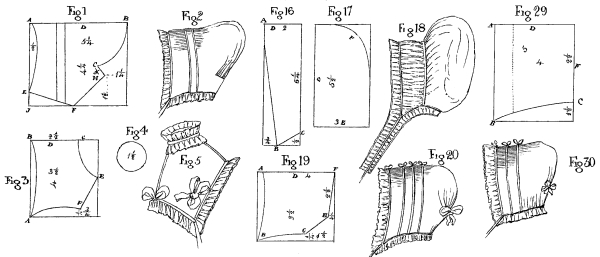
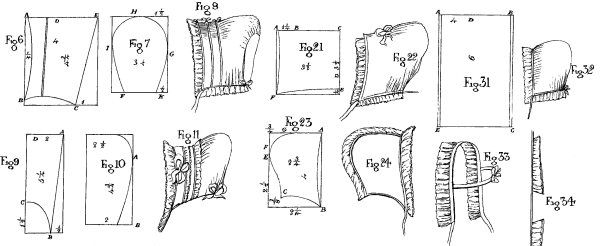
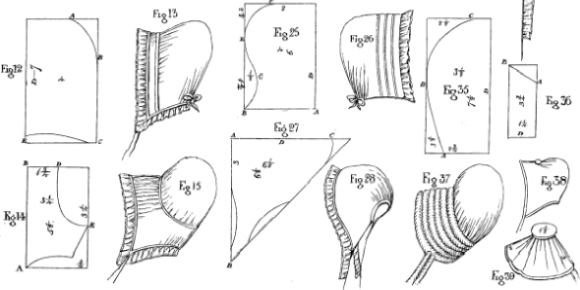
Caps are made of worked muslin, lace, tulle, or blonde, and are usually formed upon chip or wire ribbon, either silk or cotton, which gives a firmness, and causes the cap to set better to the head. A few of the simplest shapes are given in the Plate, and a separate description of each is annexed; in the mean while, a few words on the general manner of making up caps, equally applicable to all, may be found useful by the inexperienced.
After collecting your materials, and spreading a clean cloth upon the table, begin to make your cap, by sewing wire ribbon on such parts as require it, generally all round the head-piece; the crown is then put in; if a round one, it may be either gathered or plaited—the latter looks the best; the fulness is usually put quite in the front, letting the part at the side of the face be plain: horse-shoe crowns are sometimes fulled a little at the top. The joinings of caps are covered or concealed by a narrow piping or rouleau of satin.
When you buy stiff satin ribbon, before trimming your cap, pull it obliquely across all the length, first one way and then the other, to take out the dressing.
Bonnet or other caps, made of a washing material, should have white lambs’ wool run in the string cases, when they are sent to the laundress, it does not take the starch so much as the net itself, and thus the ribbons are easily run in again, on drawing the lambs’ wool out.
PLATE 15.
CAP FOR A YOUNG LADY.
PLATE 15. FIG. 1, 2.
This is a pretty simple cap for a young lady or invalid, as it is not liable to be crushed by lying on a sofa.
Take a piece of paper, four nails and a quarter long, and five nails and a quarter wide, curve out nearly half a nail from the top, A, to within half a nail of the bottom, E, to form the part that is to set round the face; from the corner, J to F, is two nails and a half, cut in a straight line from E to F, and from F to H, in a slanting direction, the point H being one nail and a half from the bottom, and one nail and a quarter from the side; cut into the cap from H to C, also sloping a quarter of a nail, and then round it gradually up to B. When you cut out your cap, be careful that the net is doubled at D.
In making up this cap, join it neatly from F to H, and then gather the crown, B C, into the small piece, H C. Hem it from E to F, and run a coloured ribbon into the string-case: hem or bind it in the front, and make one broad runner, to contain a ribbon, which sets it off. A small bow may be put at H: and any simple trimming of loops or bows between the borders.
A MORNING CAP.
PLATE 15. FIG. 3, 4, 5.
This is easily made, takes very little material, and has a pretty effect. The head-piece is cut all in one.
For the pattern, take a piece of paper four nails long by three nails and a half broad. The front, A B, is four nails; from B to C two nails and a half. Curve from C to E, E being two nails from the top. Cut in a straight line from E to F, at a quarter of a nail from the bottom, and curve from F to A. The net must be doubled at D. The small circular crown is one nail and a half across.
This cap is made up as follows:—Wire the head-piece all round, and put a wire also from B to C, up the front, and from E to F, up the back, to keep it in shape. The round crown is put in quite plainly, the part into which it fits having been previously wired. The border may then be sewed on, and a double quilling of blonde or tulle put round the crown at the top. Lay a piece of ribbon in the middle of the quilling, and cover the wires up the back and front; bind it with the same behind, and put a ribbon, which forms the strings, across the border in front. A bow at the side, and two behind, at the top and bottom, will be found sufficient trimming.
A SIMPLE UNDRESS, OR BONNET CAP.
PLATE 15. FIG. 6, 7, 8.
This cap is in two parts, a head-piece and a horse-shoe. To cut the pattern of the former, Fig. 6, let your paper be four nails broad by four nails and three-quarters long. A to B is the front of the cap. Curve it slightly about a quarter of a nail to B, which is a quarter of a nail from the bottom; then curve to E one nail from the side, and from C to E is a gradual slope, D being the doubled part. For the horse-shoe, let your paper be three nails broad by four nails long. F and K are each half a nail from the side. Slope from F to I, which is two nails and a half from the bottom, and then round to H, which is in the centre.
In making up, hem or bind the front, and put one or more runners, according to fancy. The size here given is only measured for one. Whip from E to C, and sew it to the horse-shoe, keeping the fulness at the top of the cap. Hem or bind it behind, and put on the border.
DRESS MORNING CAP.
PLATE 15. FIG. 9, 10, 11.
This cap is in two parts. For half the front-piece, Fig. 9, cut a piece of paper five nails and a quarter long and two nails wide. D is the doubled part of the net, cut in a straight line from A to B, which is half a nail from the side. Slope from B to C, which is one nail and a half from the bottom.
For half the crown, cut a piece four nails and three-quarters long and two nails and a half wide. Slope off from the top, A to B, cutting off half a nail. D is the doubled, or middle part of the crown.
In making up, the head-piece is wired all round, and the crown then set in quite plainly for two nails above the ear, and the rest plaited in small neat plaits quite in the front: then take two pieces of wire, rather shorter than the front of the cap, and quill upon them tulle, blonde, or lace, similar to that of which the border is made. This quilling should be narrower than the border, and only moderately full. A ribbon must be laid upon the edge to conceal the stitches and the wire. When these bands are put upon the cap, one of them is laid on close to the crown, and the other between it and the front. The cap is plaited a little behind to make it fit, and a small bow is put on in the middle of the back. A ribbon, forming also the strings, is passed over the front, and a small bow put on one side, close to the border.
In making up this cap more simply, or as a bonnet cap, the two trimmed bands may be omitted, and a satin or gauze ribbon merely put across the crown and in front, with two or three loops between the borders.
PLAIN CAP FOR AN ELDERLY LADY.
PLATE 15. FIG. 12, 13.
Cut your pattern four nails wide by seven nails long. Slope off at the top from A to B, D being the back or doubled part of the cap, and hollow it a little at the bottom.
In making up, run two string cases, to admit ribbon in the front, hem it behind and pass a ribbon through, sew on the border, put a small bow at one side, close to the front, and with strings it is complete.
CAP FOR A YOUNG MEMBER OF THE SOCIETY OF FRIENDS.
PLATE 15. FIG. 14, 15.
This cap is in two pieces. For the pattern of the head-piece, let your paper be five nails and a half long, and three nails and a quarter wide. A B is the front of the cap. From B to D is one nail and three-quarters, and is the top or doubled part of it. Curve from D to E, the point, E, being three nails and a half from the top. F is three-quarters of a nail from the side and half a nail from the bottom. Cut in a straight line from E to F, and curve from F to A.
For the crown, cut a circle of six nails across.
In making up, join the head-piece behind, and hem it all round with a narrow hem, so as only to admit a bobbin, which draws it to the proper size. The front is quite plain for one nail and a half above the ear, on each side, and then drawn equally in the middle. The crown is gathered regularly all round, and set in. The single border, about one nail broad, is of the same material as the cap. A narrow hem is made at the edge, and it is set on rather scantily. White ribbon strings are sewed on at the ears.
CAP FOR AN ELDERLY MEMBER OF THE SOCIETY OF FRIENDS.
PLATE 15. FIG. 16, 17, 18.
This cap is also in two pieces. The paper pattern should be six nails and a quarter long and two nails wide. Slope from A to B, B being three-quarters of a nail from the corner. Slope again from B to C, cutting off half a nail.
For the crown, D, which is the doubled part, is five nails and a half long. E, or the bottom of the cap, is three nails wide. Round off the corner at the top, F.
The front border of this cap is in one with the head-piece. The first thing to be done in making it up, is to join a piece of the same material, six nails long, and double the width of the border, say one nail and a half, to the corner or ear of the cap. This is neatly hemmed on both sides, together with the front edge of the head-piece, which is to form the border. A frill the same breadth is sewed to each end of the head-piece, and is joined to the long chin-pieces at one end, and at the other end to the lower part of the crown, which is to be the border behind. A narrow string-case is made in front, one nail and a half from the edge, and a bobbin run in along the front to the ends of the chin-piece. A similar string-case is also made at the lower part of the crown, and two bobbins run in, fastened at one end, and brought out at the opposite one, so that when drawn up they make the cap set to the head. The crown is set in equally full along the head-piece, the straight part being behind.
A BONNET CAP.
PLATE 15. FIG. 19, 20.
This cap is in one piece. Let your paper be four nails wide by three nails and a half long. The front, A B, is a little hollowed, say a quarter of a nail. D is the doubled part. E is two nails and a half from the top, and a quarter of a nail from the side. Slope from F to E, and from E to C, which is one nail and a half from the side, and a quarter of a nail from the bottom. Curve a little to B.
In making up, hem it in the front, and make three or four runners to admit a coloured ribbon, the number and breadth of these depending on fancy. They must be allowed for in cutting out, as the pattern here given is not measured for any at all. Join it from E to C, either plainly or with a piece of insertion-lace, and at the back, C B, make another string-case. The upper part, from F to E, is gathered and drawn together, and a bow put on to conceal the gathering.
A BONNET CAP.
PLATE 15. FIG. 21, 22.
The pattern of this cap is a square of three nails and a half. D is the doubled part at the back. It is slightly hollowed, as in the Plate.
In making up, hem the front, A F, and the back, F E; join it up neatly from A to B, either with a piece of insertion-lace, with a satin rouleau, or with a ribbon, and gather the rest, B C, up to the point, B, where a bow of ribbon finishes it. Sometimes, as in the Plate, the border is not carried on in the front, but, leaving about one nail from the top of the cap, is earned back again to the ear, forming a second frilling.
HELMET CAP.
PLATE 15. FIG. 23, 24.
This is a remarkably pretty little morning or bonnet cap, and is generally made of tulle or lisse, as the shape is not so suitable to a washing material. It is in three parts, the two sides and a piece let in between them.
To cut the pattern of the sides, Fig. 23, let your paper be four nails long by two nails and three-quarters broad. A B is the front, which is a little sloped.
SCALE.
Nails.
From B to C 2¼
From C to the bottom ⅝
From E to the bottom 2½
From F to the top 1
From G to the corner ¾
Curve from B to C. Slope upwards from C to E, and round from F to G.
The piece let in between these two sides is about three-quarters of a yard long, two nails broad in the front, and one nail and a quarter behind, gradually sloped.
In making up, the long narrow strip is gathered on both sides and sewed to the other pieces, Fig. 23, at A, G, F, E, C, equally full all the way. The stitches are concealed by a small satin rouleau laid on. The front and back are then wired and bound with ribbon. The border and any simple trimming complete it.
BONNET CAP.
PLATE 15. FIG. 25, 26.
To cut the pattern of half this neat and simple bonnet cap, let your paper be six nails long and four nails broad. A B is the front. Curve from B, past C to E, C being one nail and three-quarters from the bottom and half a nail from the side, and E being two nails and a half from the top. D is the part where the net is to be doubled.
In making up, plait it behind in the centre, or rather large folds, seven on each side of the middle, and wrapping the folds over each other, so as to keep them all quite behind. Ribbon is laid on in two or three rows in front, either simply upon the cap, or covered with net. Bind it behind, and put on a border and some light trimming.
HANDKERCHIEF BONNET CAP.
PLATE 15. FIG. 27, 28.
This cap is formed of a half-handkerchief, cut from a square of six nails and a half. D is the doubled part. The front is from A to B. Shape it a little, beginning about three nails from the top, to make it set better to the face. The extreme point, C, is rounded off.
In making up, hem it all round, and run in a tape or ribbon behind.
BONNET CAP.
PLATE 15. FIG. 29, 30.
The pattern of half this cap is cut from a paper five nails long by four nails broad. A B is the front, D the doubled part of the net. Slope from B to C, cutting off one nail and a half. Allow for runners, according to your taste.
In making up, hem the front and back, run the string-case, join it up the back from C to F, and hem the rest from F to the top. Run a ribbon in this hem, which draws it up into a crown, and ties with a bow behind at F. This cap looks very like Fig. 20, but the chief advantage of it is, that it can be very easily ironed, as, when the ribbon is drawn out of the crown, it is a flat piece.
BONNET CAP FOR A CHILD.
PLATE 15. FIG. 31, 32.
This is an oblong, six nails long by four nails wide. Hem it all round. A E is the front. A ribbon is run through the hems, both in front and at the back, B C, which draws up the cap as much as is necessary to make it fit.
A CAPETTE.
PLATE 15. FIG. 33.
A capette is a sort of half-cap worn by young ladies, as a preservation from cold; it is also useful as a pretty kind of evening head dress; they are not expensive and are easily made.
Take a piece of silk or satin ribbon, the proper length for the front of a cap, and about two-thirds of a nail broad, along each edge hem in a wire ribbon so as to reduce the width to half a nail, putting three ribs or stays of wire across, to keep the ribbon its full breadth; one should be in the middle, and one at each end: then take another piece of wire ribbon, which is to go at the back of the head, and which is covered with ribbon similar to the front; the length of this must be regulated by the size of the wearer’s head, and it should be very accurately fitted, as all the comfort, and much of the neat appearance of the capette depends upon it setting well and closely to the shape of the head; this back-piece should be sewed very firmly to the front, a little above the ears. A border of net, tulle, or blonde is then plaited on to the front, and a gauze or satin ribbon folded, and laid upon the edge of it, so as to cover the stitches, and the foundation; this ribbon is long enough to form strings. On the back-strap is also laid a similar piece of ribbon, and sometimes a small bow is put in the centre of it. The front is trimmed according to fancy, the most simple mode generally looking the best.
Some persons wear capettes under their bonnets, and then they are usually made without wire, and merely bound with ribbon.
LAPPETS.
PLATE 15. FIG. 34.
Lappets are merely a double border of net, tulle, or blonde, three nails on each side, leaving a space in the middle; sometimes they are plaited all round, or made with a plain piece of blonde over the forehead. The edge is bound with ribbon, the ends of which form the strings.
WIDOW’S CAP.
PLATE 15. FIG. 35, 36, 37.
A widow’s cap is a very difficult thing to make well, and looks particularly slovenly when ill put together; it is, therefore, often the best economy to buy one ready-made, as there are persons who do little or nothing else; however, as there may be some cases in which this plan is not advisable, a pattern is given of a full sized one, and a few words on the manner of making it up.
These caps should be of book-muslin (not of the thinnest kind) or of white crape.
In the Plate, half of the crown, Fig. 35, and half of the head-piece, Fig. 36, are represented. To cut out the former, let your paper be seven nails and a half long, and three nails and a half wide; from the side to A is two nails and three-quarters, from the bottom to B is three nails and three-quarters, and from the corner to C, two nails and a half. The doubled part of the muslin is to be laid upon D.
For the head-piece, Fig. 36, your paper must be three nails and three-quarters long, by one nail and a quarter broad. From A to the corner is three-quarters of a nail, slope gradually to B. D is the doubled part.
In making up, after setting the crown into the head-piece, with the fulness chiefly in the front, and hemming it behind and all round the face, sew on the borders: these are made of the same muslin, about a quarter of a nail deep, they are double in front, and put on very full: after the muslin is hemmed, a short round stick is run through, which gives a crimped appearance, and makes the hem hollow; to keep the border in its place, a fine tape is passed through each hem, which is tied up to the proper size; a sort of binder is then laid upon the head-piece and meets behind; it is thus made:—take a piece of muslin, one nail and a half broad and two yards long, make a hem at each edge and a tuck in the middle, the same width as the hem of the borders, pass the stick through all these hems, and run in a fine tape or bobbin, to draw it up to the proper size. A piece is then prepared to fasten under the chin which is three-quarters of a yard long, and broad enough to admit of a hem, one quarter of a nail deep at each edge, no plain muslin being left between; the stick is passed through these hems, and a tape run in. When worn, the ends are pinned on each side at the ears of the cap.
VELVET OR WADDED SILK CAP.
PLATE 15. FIG. 38.
This cap is very useful to wear under a bonnet, especially in travelling. It is four nails long in the front, when folded in two, and three nails and a half wide, it is sloped behind one nail, and rounded about half a nail at the top.
In making up, a lining is put into it, and a piece of wadding laid between it and the cap: they are neatly run together down the front and behind: a string-case is made at the back, for about half a nail on each side of the middle, and a ribbon run in to draw it up to the proper size. It is neatly joined for one nail and a half, and the rest is gathered up, the stitches being concealed by a large button, covered with the same silk.
SILK CAP.
PLATE 15. FIG. 39.
These are often worn by elderly or invalid ladies, under their caps and bonnets. Fig. 39 is an approved shape, to wear under a cap; it is made of silk that approaches the nearest in colour to the shade of the hair. It is in two pieces, the one a strip ten nails long, three nails deep, and sloped off at the ends to two nails; and the other a round cushion, one nail and a half across, and half a nail high: the strip is joined up at the ends, which part fits to the front of the head, hemmed all round, and strings run in to draw it up to the proper size. The cushion is made and filled with light sheep’s wool, and the strip or head-piece gathered regularly to it. The use of it is to make the crown of the cap stand up.
PINAFORES, SACCARINES, &c.
PLATE 16.
Pinafores and saccarines are worn chiefly by children of both sexes, and of every age, also by house-maids, while making beds, or persons engaged in particularly dusty or dirty employments. For children’s pinafores during their earliest years, look in Plate 3, where two or three patterns are entered, among other articles of baby linen, and where scales are affixed for children of various ages. The following are the other shapes most in use.
CHILD’S SURTOUT PINAFORE.
PLATE 16. FIG. 1.
This is a neat and simple pinafore for a young child, and is made of diaper, Holland or print.
PLATE 16.
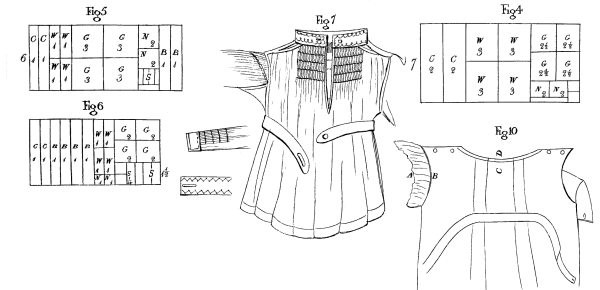
SCALE.
Child of 1 yr. Child of 3 yrs.
Nails. Nails.
Width of cloth 12 14
Length of cloth 6 8
Depth of shoulder 1 1¼
Slope of shoulder ½ ½
Length of arm-hole 2½ 2½
Depth of lappet or shoulder 1 1¼
Length of lappet or shoulder 8 10
Depth of neck-band when open ¾ 1
Length of neck-band when open 5 6
Depth of band round the waist 1 1
The pinafore is folded in half, and again in two, to find the situation of the arm-holes at the quarters: after sloping the shoulders, hollow out the neck about a quarter of a nail; the shoulders must then be sewed up, and the pinafore set into the neck-band, which is first doubled exactly in half; this neck-band buttons behind. The sleeve lappets are gathered near the edge, and neatly set on to the arm-hole before it is hemmed, so that when the hem is turned down, no stitches are seen on the right side; the lappet is then fulled at the edge a second time, which being also firmly sewed down, makes it lie flat upon the hem. The other edge of the lappet is hemmed, and silk washing braid put on, to hide the stitches. The lappet should be set on to within half a nail of the bottom of the slit of the arm-hole on each side; little gussets may be put in at the bottom of the slit, to make it stronger. A band is sewed on in front, of the proper length to button behind, its proper situation is in the centre in front, and a little below the level of the bottom of the arm-hole. Boys often wear a band of patent leather instead, with a buckle. This pinafore is quite open behind, being only fastened by the neck-button and the band.
A CHILD’S SMOCK-FROCK, OR CLOSE PINAFORE.
PLATE 16. FIG. 2, 3.
If for gentlemen’s children, they are made of Holland, either black or brown, or diaper, but for the lower classes, of blue check, dark blue linen, brown and black linen, or coloured prints. These close pinafores are very suitable for children playing in a garden, or for going to school in, and preserve clean frocks, or hide soiled ones effectually. It would be well if at most large charity schools, children attended with these kind of pinafores, which at once give them a neat respectable appearance.
The number of breadths is not mentioned in the scale, as the widths of the material differ so much; but it is advisable, if possible, to obtain it of such a width as will agree with the width of the pinafore, to admit of their being but one, one and a half, or exactly two breadths in it. The sleeves, collar, bands, and gussets, may be made to cut to little or no waste, by fitting them well, one with another, especially if the band be made in two pieces, instead of one length. The pinafore is easily made up; after putting in the neck gussets, the collar is set on, the skirt being regularly fulled into it. The sleeves, &c., are all put on as in a shirt, excepting that the wristbands are sewed up so as to form cuffs.
Metal or bone buttons are those in general use to fasten them. The two nails by one and a half that are over (see K), serve for covering buttons, or make a small gusset for the slit behind, and also for the bottom of the sleeves, if the wristband is made open.
SCALE.
—————————— First size. Second size. Third size.
Nails. Nails. Nails.
Width of skirt when sewed up 9 10 12
Length of skirt 9 11 13
Length of shoulder 1¼ 1½ 1¾
Slope of shoulder to ¼ ⅓ ½
Length of arm-hole 2½ 3 3½
Size of neck-gusset 1 1½ 1¾
Size of sleeve-gusset 2 2¼ 2½
Length of collar 6 6½ 7
Depth of collar before doubled 1 2 2
Depth of slit behind 3 3½ 4
Length of sleeve down the selvage 4½ 5¼ 6
Width of sleeve 4 5½ 6½
Depth of wristband 1 1¼ 1½
Length of wristband down selvage 3 3½ 3¾
Depth of band 1 1½ 1½
Length of band down selvage 11 12 13
LARGE SIZED PINAFORE.
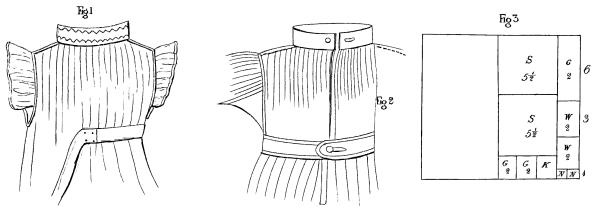
PLATE 16. FIG. 4.
To prevent waste, it would be advisable to cut out two at once, as the collars, &c., will cut for both pinafores in one width. Cut two breadths for each pinafore, and from one breadth of each, cut the sleeves. For the collars, &c., cut off a piece of Holland, seven nails long, and divide it according to the Figure in the Plate, first taking off the two collars, C C, the whole length selvage-wise, and each two nails wide; next, the four wristbands, W W, of which two cut in the length, of three and a half nails long, and three nails wide; afterwards the four gussets, G G, two and a half nails square, leaving a strip, two nails long, and five nails wide, out of which cut the two neck-gussets, each two nails square, to be afterwards cut crosswise in half; also little gussets for the slit behind, and the sleeves, if the wristbands are made open.
These pinafores are made up like those before mentioned.
PINAFORES FOR BOYS, OF STRONG BLACK GLAZED CALICO, OR HOLLAND, AT 1s. PER YARD.
PLATE 16. FIG. 2, 3,
Represents the width of the cloth on which the pieces composing the pinafore of the smallest size are marked.
Cut two breadths and divide one in half, from the half cut all the et cetera according to the figure.
S S are the two sleeves, five and a half nails square.
C is the collar, two nails by six long.
W W are the two wristbands, two nails by three long.
G G are the two sleeve-gussets, two nails square.
N N are the two neck-gussets, one nail square.
SCALE.
—————————— Boy of 8 years. Boy of 10 years.
Yds. nls. Yds. nls.
Width of material 15 15
Quantity for one 1 10 2 0
Number of breadths in each pinafore 2 bdths. 2 bdths.
Length of breadths 13 15
Length of sleeve down selvage 5½ 7
Width of sleeve 5½ 6
Length of wristband down selvage 3 3½
Width of wristband 2 2
Neck-gusset cut in half 1 1½
Sleeve-gusset 2 3
Length of collar 6 7
Width of collar 2 2
CHILDREN’S SACCARINES.
PLATE 16. FIG. 7.
These are exceedingly pretty, if finished neatly with braid or silk, and are generally made of Holland, either brown, or the light grey called French Holland. They answer well as morning dresses, in which children can run about, and work in the garden, with less danger of tearing or dirtying their under clothes, than with frocks of lighter materials.
SCALE.
—————————— Child from 2 to 4 yrs. Child from 4 to 6 yrs.
Yds. nls. Yds. nls.
Quantity for one 1 14 2 2½
Width of material 12 14
Number of breadths 2 bdths. 2 bdths.
Length of skirt 9 11
Length of shoulder 1½ 1½
Slope of shoulder ½ ½
Length of arm-hole 2¾ 3
Length of slit behind 4 4½
Length of sleeve down the selvage 6 6½
Width of sleeve 6 6
Length of collar down the selvage 6 6
Width of collar 1 1
Length of shoulder-strap 1½ 1¾
Width of shoulder-strap ½ ½
Sleeve-gussets 2 3
Neck-gussets ¾ ¾
Length of wristband down the selvage 2½ 3
Width of wristband 1 1½
Length of band down the selvage 11 12
Depth of band 1 1
In making up these saccarines, the work must be very good and strong. The hem at the bottom should be about one nail and a half deep. The shoulder-straps and neck-gussets being put on, the slit hemmed, and everything ready for biassing the pinafore, prepare some strong netting silk of a colour that will wash well—black, purple, or white are the best—and then bias the front and back in four rows below the collar. Small spots worked on the gathers, between the rows of biassing, in the same coloured silk, have a finished and neat effect. The sleeve is also biassed at about a quarter of a nail below the shoulder, and at the wrist. For a description of biassing, see Part I., Chapter I. Some persons put coloured worsted braid over the biassing, and, if chosen of a colour that washes well, and sewed on with crewel, it looks pretty, and stands washing better than most kinds of netting silk. Little pockets of Holland should be put in front, being particularly useful to children for their handkerchiefs, &c. The wristbands, collar, and band should have some little ornamental work, either in silk or braid, to correspond with the rest.
FIG. 5
Represents the width of the Holland on which the pieces are marked for the largest saccarine, supposing two of them cut out together, which is by far the most economical way.
After cutting out the skirts, mark off and cut in one piece the two breadths for the two pairs of sleeves, and, before dividing the breadths, cut selvage-wise the whole length a strip two nails wide, which will be twelve long, and form one of the bands. The two sleeves exactly fit in the remainder of the width. Cut next another breadth of the cloth of six nails long, and from it take, according to the Plate:—
Two collars, C C, the whole length, and one nail wide each.
Four wristbands, W W, two in the length, and one nail wide each.
Four gussets, G G, three nails square, two in the length.
Two half bands, B B, to be sewed together to make one, each
one nail wide, and the whole length.
(The other band is already cut off.)
Two neck-gussets, N N, of two nails square, to be afterwards
cut crosswise to form the pair.
Four shoulder-straps, S S S S, of half a nail wide and one
nail and three-quarters long, and one piece over, which will
form a slit-gusset.
FIG. 6
Represents the smaller saccarine on cloth of the proper width. In this case, also, it is necessary to cut two at once, to prevent waste.
After cutting the two skirts and two pairs of sleeves, of which two sleeves exactly fit in the width, cut off a breadth six nails down the selvage, and divide it as follows, according to the Plate:—
Two collars, C C, one nail wide each, and the whole depth.
Four half bands, B B B B, one nail wide each, of the whole
length of two nails and a half, leaving one nail over.
Four sleeve-gussets, G G G G, of two nails square,
underneath which lie
Four shoulder-straps, S S, of three-quarters of a nail wide
and one nail and a half long, and two other gussets.
A strip of Holland, half a nail by three nails, remains to
bind round the slit behind, which makes it firm and durable.
HOUSEMAID’S PINAFORE.
PLATE 16. FIG. 8.
House-maids have, or ought to have, a calico pinafore to put on when making beds, as, after cleaning grates and emptying slops, their clothes should not come in contact with clean bed-linen and counterpanes, lest they should soil them.
SCALE.
Yds. nls.
Quantity for one 3 5½
Number of breadths 2 bdths.
Width of calico 1 0
Length of pinafore 1¼ 0
Length of shoulder 2½
Shoulder sloped to ½
Length of arm-hole 5½
Length of sleeve down selvage 9½
Width of sleeve 9
Size of sleeve-gusset 4
The sleeves should be left large and loose, so as to admit of the pinafore being easily put on and off, over the gown. It is more economical to cut out two pinafores than one, as otherwise two gussets are wasted.
SCHOOL GIRL’S PINAFORE.
PLATE 16. FIG. 9.
Pinafores for the national and other schools are generally made of strong blue linen check, with one or two pockets at the front and sides, in which their knitting and needle-work are put. These pinafores, after buttoning up the pockets, are carefully taken off when school hours are over, folded, and locked up at the school-house. In front, near the top of the pinafore, is sewed a square patch of the linen, on which is marked, in red or other tape, the number of the child to whom it belongs. The child is generally called by her companions by the number of the pinafore, instead of being addressed by her name, which is, in many ways, a great saving of memory, time, and trouble.
SCALE.
———————— Girl from 6 to 8 yrs. Girl from 8 to 10 yrs. Girl from 10 to 13 yrs. Girl from 13 to 18 yrs.
Nails. Nails. Yds. nls. Yds. nls.
Width of material 12 14 1 0 1 0
Length of pinafore 10 12 14 1 0
Piece for shoulder 1¼ 1½ 1¾ 2
Sloped to ½ ½ ¾ 1
Slit for arm-hole 2¾ 3 3½ 4
Hollowed in front ¼ ¼ ½ ½
Length of pocket 3¾ 3¾ 4 4
Width of pocket 4 4 4½ 4½
A CHILD’S PINAFORE.
PLATE 16. FIG. 10.
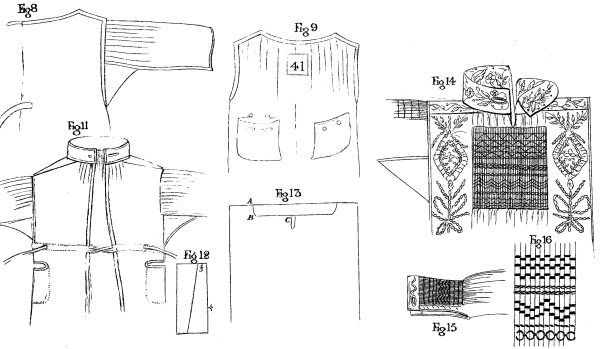
This is made of brown Holland, or any other neat material, and trimmed with braid or an edging, or simply piped, to give a sort of finish to it. Take two breadths of the proper length (say twelve nails), and sew them together up the seams, leaving two nails and a half from the top for the arm-holes. When thus sewed, fold the skirt in half the width, and hollow out the arm-holes, cutting into the cloth, from A to B, half a nail. The neck is also hollowed to about one nail, from C to D, leaving one nail and a quarter for the shoulders, which are not sewed up, but neatly hemmed and made to button together.
There is no slit behind, but the back is made exactly like the front, either with large plaits, as in the figure, biassed, or gathered. A band, sewed on in front, buttons round the waist. When the pinafore is taken off, the shoulders are merely unbuttoned, and it falls down, as seen on the right hand side of the figure. Lappets or frills may be added with advantage round the arm-holes, taking care to divide them at top, to allow of the shoulders separating.
A SURGEON’S DISSECTING PINAFORE.
PLATE 16. FIG. 11.
These pinafores are worn by surgeons over the coat, and are made high up to the neck and down to the waist, to prevent anything soiling the dress while dissecting and performing operations. The pinafores are generally of black, but sometimes of grey Holland. They have two pockets, in which to put the instruments, cloths, &c. &c.
SCALE.
Yds. nls.
Width of material 1 0
Number of breadths 1½ bdth.
Length of pinafore 1 6
Length of sleeve down the selvage 10
Width of sleeve, or two in the breadth 8
Length of collar down the selvage 9
Width of collar 2¼
Length of wristband down the selvage 4
Width of wristband 1
Length of shoulder-strap down the selvage 4
Width of the two together before being cut 2
Size of sleeve-gusset 3
Length of arm-hole 5½
Size of square pocket 5
Distance from under the arm to the pocket-hole 3½
Slit width-way for the pocket-hole 3
The breadth and half are sewed together, the pinafore doubled as usual, and the slits for the arms cut; after which the shoulder-straps are sewed between, and not upon the parts forming the shoulder, taking care to put the wide end of the shoulder-straps (which are sloped as seen below), towards the neck. Put in the sleeves, and set the neck into the collar. Find the situation of the pocket-hole, letting the middle of it fall in a straight line, exactly under the arm. The slit is cut width-way, and a piece of narrow tape is sewed round it at the edge, and hemmed down. The pocket is sewed on (but not hemmed) at the inside with small stitches, and, when done, well flattened with the finger and thumb.
The piece for the shoulder-straps is crossed, making the narrow end about one-third of a nail, as in Fig. 12.
A strong case is sewed round the pinafore inside, made of 2d. or 3d. tape. Two large oylet-holes are made at the sides, and a very long piece of tape is first drawn all round the string-case coming out behind, and secured in front. These strings cross behind, and are carried through the opposite string-case, as far as the oylet-holes, at which they are brought out. The pinafore is generally put on over the head. The strings draw round and tie in front.
PLATE 17.
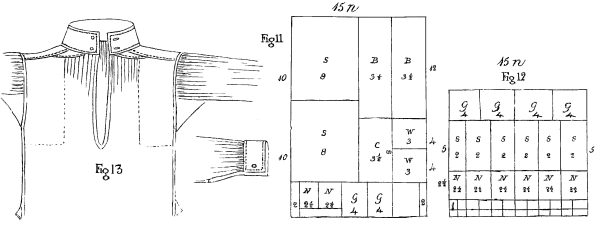
WAGGONER’S SMOCK-FROCK.
PLATE 16. FIG. 13, 14, 15, 16.
It is made of strong linen, similar to that used for sheeting, and the biassing upon it is worked with the strongest glazed thread or cotton that can be procured. This work must be firmly and regularly done, as the price of these frocks depends on the quantity and quality of work in them.
SCALE.
Yds. nls.
Width of the material 1 0
Length of the body, both breadths being cut in one piece 2 14
Length of each half collar down the selvage 6
Width of each half collar 4
Length of shoulder-binding 3
Width of shoulder-binding 1¼
Length of sleeve down the selvage 10
Width of sleeve 8
Length of wristband down the selvage 5½
Size of gusset 1
Length of slit behind and before 1¼
Length of worked part in front 5
Wrist biassed up to about 1¾
The two breadths are cut in one piece, and hollowed out at the neck to the depth of one nail, making the hollowing, Fig. 13, from A to B, as abruptly as possible, so that from B to C is quite straight by a thread. After the body is gathered to the proper size, so as to correspond with the two half collars, set them on so that the divisions shall come behind and in front, at which places the frock itself is cut down one nail and a quarter deep.
The shoulders and wrists, as well as the front and back, are biassed with strong glazed thread, in various patterns, and stitched as in Fig. 16. The plain part, between the biassing and arm-hole, is worked in chain-stitch, as also the collar, in various patterns.
These frocks are to be met with at clothing warehouses, and cost from 9s. to 18s. each, the price depending upon the quantity and quality of work put on.
SHIRTS FOR THE LABOURING CLASSES.
PLATE 17.
Shirts for labouring men are generally made of the stout linen called shirting-linen, at from 9d. to 1s. per yard. Shirts for men of lighter occupations are sometimes of calico, with linen collars and wristbands. Blue checks, unbleached, and striped calicoes, or prints, are used for that purpose.
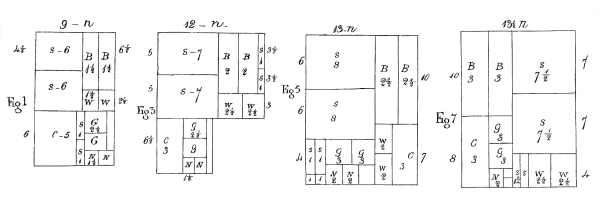
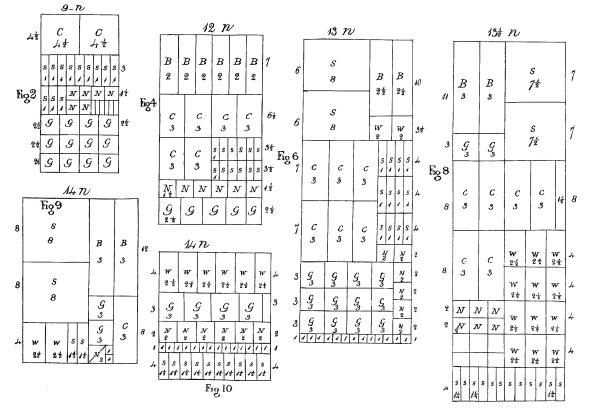
Linen for shirts should be chosen of exactly the proper width, according to the size wanted; and as it is an expensive article, especially when cut to waste, six Scales are drawn upon the Plate for six different sizes of shirts, by which the most economical plan for cutting the shirt is seen.
Each Scale is drawn upon the width of cloth suitable to the sized shirt. Scales are also affixed for cutting out a set of six of the same sized shirts, as, by a little management, and occasionally reducing or enlarging a sleeve a quarter of a nail, or making some such immaterial difference, the various parts of a set, take much less cloth by being cut together.
If shirts are made of linen, they should always be cut by a thread; but if they are of calico, they may be torn: still, however, the smaller parts, as gussets, straps, &c., should be cut, in preference to tearing, as they are apt to pull out of shape. In preparing a set of shirts, time is saved by cutting out all the pieces of the same size together, instead of cutting first a sleeve, then a wristband, &c. It also saves cloth to cut strips all in one length, and then sub-divide it: for instance, when binders and sleeves are cut in the breadth, as one is longer than the other, it is necessary to mark off the width of the sleeve, and then cut down the whole length of the set of sleeves, leaving the strip in one length, to be sub-divided afterwards. The bodies should be cut each in one piece, and not in two separate breadths. The neck-gussets are generally single, therefore, one gusset, cut crosswise in half, forms the pair.
Before cutting the bosom, slit, &c., of the body, observe that the shirt should be folded in two, so as to let the front breadth be one nail shorter than the back breadth. When thus folded, crease it by a thread, and, after leaving the proper distance for the shoulders, proceed to cut the slit for the neck, and down for the bosom. Next measure the length of opening for the flaps, and for the arm-holes, and put in pins as marks.
A FEW GENERAL OBSERVATIONS ON SHIRTS.
There are nineteen useful parts to a shirt, which are cut out pretty nearly by the following rough proportions; but as the figures of men differ materially, no exact rule can be laid down.
1st The SKIRT or BODY, which is cut, with the two
breadths in one piece, and should be long enough
to reach from the shoulder to the knee of the wearer.
2nd and 3rd. The SLEEVES, which are generally about
half the length of the skirt when sewed up, and the
breadth the same.
4th The COLLAR, which is the same length as the
sleeve.
5th and 6th. The WRISTBANDS, each of which is half
the length of the collar.
7th and 8th. The BINDERS, the length of a sleeve
and a quarter.
9th and 10th. The SHOULDER-STRAPS, the same length
as the wristbands.
11th and 12th. Two SLEEVE-GUSSETS.
13th and 14th. Two NECK-GUSSETS.
15th and 16th. Two HIP, or SIDE-GUSSETS.
17th and 18th. Two WRIST-GUSSETS.
19th One BOSOM-GUSSET.
PLATE 17.
SCALE OF SHIRTS OF VARIOUS SIZES.
—————————— Fig. 1, 2. Fig. 3, 4. Fig. 5, 6. Fig. 7, 8. Fig. 9, 10. Fig. 11, 12.
Child from 8 to 10 yrs. Child from 11 to 14 yrs. Child from 15 to 18 yrs. Man’s small size. Man’s larger size. Man’s largest size.
Yds. nls. Yds. nls. Yds. nls. Yds. nls. Yds. nls. Yds. nls.
Quantity required for one 2 8 2 11½ 3 1 3 4 3 8 3 14
Quantity required for six 13 14 14 8 18 0 19 12 21 1 23 0
Proper width of cloth 9 12 13 13½ 14 15
Whole length of skirt 1 9 1 11 2 0 2 2 2 4 2 5
Space to leave for shoulders 2 2 2½ 2½ 2½ 3
The space for the neck will then be 5 8 8 8½ 9 9
Slit downwards for bosom 3½ 3¾ 4 4½ 5 5½
Length of arm-holes 3 3½ 4 5 5¼ 5½
Slit at the bottom for flaps 3 3½ 4 5 5 5
Width of sleeve 6 7 8 7½ 8 8
Length down the selvage 4½ 5 6 7 8 10
Width of binders or linings 1½ 2 2½ 3 3 3½
Length down the selvage 6½ 7 10 11 12 12
Width of collar 5 3 3 3 3 3½
Length down the selvage 6 6½ 7 8 8 8
Width of wristband 1½ 2½ 2 2½ 2½ 3
Length down the selvage 2½ 3 3½ 4 4 4
Width of shoulder-strap 1 1 1 1¼ 1½ 2
Length down the selvage 3 3½ 4 4 4 5
Size of sleeve-gussets 2½ 2½ 3 3 3 4
Size of neck-gussets 1½ 1½ 2 2 2 2½
|Size of bosom-gussets ½ ½ ½ ½ ½ ½
Size of flap-gussets ½ ½ 1 1 1 1
PLATE 17. FIG. 2
Represents the best mode of cutting out six shirts of the same size as Fig. 1.
Cut off the bodies or skirts.
Cut off from the breadth the strip for the twelve sleeves, being in all three yards six nails in length, and six nails in width.
Cut from the remainder of the breadth the twelve linings, two in the breadth, six nails and a half long, and the twelve wristbands, two in the breadth, of two nails and a half long, thus using up all the strip.
Cut the other pieces as follows:—
Two collars in the breadth, C C, six nails long, three breadths.
Nine shoulder-straps, S S, three nails long, one breadth.
Three shoulder-straps and six neck-gussets, N N, three nails
long, one breadth.
Four sleeve-gussets, G G, two nails and a half long,
three breadths.
The collar is very wide, and intended to turn over.
PLATE 17. FIG. 4.
The most economical plan of cutting six shirts, the size of Fig. 3:—
Two sleeves in the breadth, five nails long, six breadths.
Six linings, B B, seven nails long, two breadths.
Four collars, C C, six nails and a half long, one breadth.
Two collars and twelve straps, S S, six nails and a half long,
one breadth.
Six sleeve-gussets, G G, two nails long, two breadths.
Four wristbands (leaving two nails over), three nails long,
three breadths.
The remainder, two nails wide, and nine nails long, to be cut up into six neck-gussets, N N, one nail and a half square, leaving a piece, half a nail wide and nine long, to form the remainder of the gussets.
PLATE 17. FIG. 6,
Is the most economical plan of cutting six shirts of the same size,
as Fig. 5.
Take off twelve sleeves, eight nails wide, and six long, twelve
lengths.
From the long strip cut two binders, in width eight nails and a
half, six lengths.
And two wristbands in the width, W W, three nails and a quarter
long, six lengths.
The whole strip is thus exactly used up.
Three collars, C C, to be three nails wide and a piece over,
seven nails long, two lengths.
The piece left over of the breadth to be cut into
Twelve shoulder-straps, S S, four in the width, four nails long,
three breadths.
Also two neck-gussets, N N, two nails square.
Four sleeve-gussets, G, three nails square, and one neck-gusset,
N, in the width, three nails square, three breadths.
Thirteen flap and bosom-gussets, one nail square, one breadth.