Book 6 — TIROCINIUM; OR, A REVIEW OF SCHOOLS. (continued 3)
Reading edition
1791.
TO THE NIGHTINGALE,
WHICH THE AUTHOR HEARD SING ON NEW YEAR'S DAY.
Whence is it that, amazed, I hear From yonder wither'd spray, This foremost morn of all the year, The melody of May? And why, since thousands would be proud Of such a favour shown, Am I selected from the crowd To witness it alone? Sing'st thou, sweet Philomel, to me, For that I also long Have practised in the groves like thee, Though not like thee in song? Or sing'st thou, rather, under force Of some divine command, Commission'd to presage a course Of happier days at hand! Thrice welcome then! for many a long And joyless year have I, As thou to-day, put forth my song Beneath a wintry sky. But thee no wintry skies can harm, Who only need'st to sing To make e'en January charm, And every season spring.
1792.
LINES WRITTEN IN AN ALBUM
OF MISS PATTY MORE'S, SISTER OF HANNAH MORE.
In vain to live from age to age While modern bards endeavour, I write my name in Patty's page, And gain my point for ever.
W. COWPER. March 6, 1792.
SONNET
TO WILLIAM WILBERFORCE, ESQ.
Thy country, Wilberforce, with just disdain, Hears thee by cruel men and impious call'd Fanatic, for thy zeal to loose the enthrall'd From exile, public sale, and slavery's chain. Friend of the poor, the wrong'd, the fetter-gall'd, Fear not lest labour such as thine be vain. Thou hast achieved a part; hast gain'd the ear Of Britain's senate to thy glorious cause; [pause Hope smiles, joy springs, and, though cold caution And weave delay, the better hour is near That shall remunerate thy toils severe, By peace for Afric, fenced with British laws. Enjoy what thou hast won, esteem and love From all the just on earth and all the blest above.
April 16, 1792.
EPIGRAM
PRINTED IN THE NORTHAMPTON MERCURY.
To purify their wine, some people bleed A lamb into the barrel, and succeed; No nostrum, planters say, is half so good To make fine sugar as a negro's blood. Now lambs and negroes both are harmless things, And thence perhaps this wondrous virtue springs, 'Tis in the blood of innocence alone— Good cause why planters never try their own.
TO DR. AUSTIN,
OF CECIL STREET, LONDON.
Austin! accept a grateful verse from me, The poet's treasure, no inglorious fee. Loved by the muses, thy ingenuous mind Pleasing requital in my verse may find; Verse oft has dash'd the scythe of Time aside, Immortalizing names which else had died: And O! could I command the glittering wealth With which sick kings are glad to purchase health! Yet, if extensive fame, and sure to live, Were in the power of verse like mine to give, I would not recompense his arts with less, Who, giving Mary health, heals my distress. Friend of my friend![834] I love thee, though unknown, And boldly call thee, being his, my own.
May 26, 1792.
CATHARINA:
THE SECOND PART: ON HER MARRIAGE TO GEORGE COURTENAY, ESQ.
Believe it or not, as you choose, The doctrine is certainly true, That the future is known to the muse, And poets are oracles too. I did but express a desire To see Catharina at home, At the side of my friend George's fire, And lo—she is actually come! Such prophecy some may despise, But the wish of a poet and friend Perhaps is approved in the skies, And therefore attains to its end. 'Twas a wish that flew ardently forth From a bosom effectually warm'd With the talents, the graces, and worth Of the person for whom it was form'd. Maria[835] would leave us, I knew, To the grief and regret of us all, But less to our grief, could we view Catharina the Queen of the Hall. And therefore I wish'd as I did, And therefore this union of hands: Not a whisper was heard to forbid, But all cry—Amen—to the bans. Since, therefore, I seem to incur No danger of wishing in vain When making good wishes for her, I will e'en to my wishes again— With one I have made her a wife, And now I will try with another, Which I cannot suppress for my life— How soon I can make her a mother.
June, 1792.
EPITAPH ON FOP,
A DOG BELONGING TO LADY THROCKMORTON.
Though once a puppy, and though Fop by name, Here moulders one whose bones some honour claim. No sycophant, although of spaniel race, And though no hound, a martyr to the chace— Ye squirrels, rabbits, leverets, rejoice, Your haunts no longer echo to his voice; This record of his fate exulting view, He died worn out with vain pursuit of you. "Yes,"—the indignant shade of Fop replies— "And worn with vain pursuit, man also dies."
August, 1792.
SONNET TO GEORGE ROMNEY, ESQ.
ON HIS PICTURE OF ME IN CRAYONS,
Drawn at Eartham in the 61st year of my age, and in the months of August and September, 1792.
Romney, expert infallibly to trace On chart or canvass, not the form alone And semblance, but however faintly shown, The mind's impression too on every face— With strokes that time ought never to erase, Thou hast so pencill'd mine, that though I own The subject worthless, I have never known The artist shining with superior grace. But this I mark—that symptoms none of woe In thy incomparable work appear. Well—I am satisfied it should be so, Since, on maturer thought, the cause is clear; For in my looks what sorrow couldst thou see When I was Hayley's guest, and sat to thee?
October, 1792.
MARY AND JOHN.
If John marries Mary, and Mary alone, 'Tis a very good match between Mary and John. Should John wed a score, oh, the claws and the scratches! It can't be a match—'tis a bundle of matches.
EPITAPH ON MR. CHESTER,
OF CHICHELEY.
Tears flow, and cease not, where the good man lies, Till all who knew him follow to the skies. Tears therefore fall where Chester's ashes sleep; Him wife, friends, brothers, children, servants weep— And justly—few shall ever him transcend As husband, parent, brother, master, friend.
April, 1793.
TO MY COUSIN, ANNE BODHAM,
On receiving from her a network purse made by herself.
My gentle Anne, whom heretofore, When I was young, and thou no more Than plaything for a nurse, I danced and fondled on my knee, A kitten both in size and glee, I thank thee for my purse. Gold pays the worth of all things here; But not of love;—that gem's too dear For richest rogues to win it; I, therefore, as a proof of love, Esteem thy present far above The best things kept within it.
May 4, 1793.
INSCRIPTION FOR A HERMITAGE IN THE AUTHOR'S GARDEN.
This cabin, Mary, in my sight appears, Built as it has been in our waning years, A rest afforded to our weary feet, Preliminary to—the last retreat.
May, 1793.
TO MRS. UNWIN.
Mary! I want a lyre with other strings, Such aid from heaven as some have feign'd they drew, An eloquence scarce given to mortals, new And undebased by praise of meaner things, That, ere through age or woe I shed my wings, I may record thy worth with honour due, In verse as musical as thou art true, And that immortalizes whom it sings. But thou hast little need. There is a book By seraphs writ with beams of heavenly light, On which the eyes of God not rarely look, A chronicle of actions just and bright; There all thy deeds, my faithful Mary, shine, And, since thou own'st that praise, I spare thee mine.
May, 1793.
TO JOHN JOHNSON, ESQ.
On his presenting me with an antique bust of Homer.
Kinsman beloved, and as a son, by me! When I behold the fruit of thy regard, The sculptured form of my old favourite bard, I reverence feel for him, and love for thee: Joy too and grief—much joy that there should be, Wise men and learn'd, who grudge not to reward With some applause my bold attempt and hard, Which others scorn; critics by courtesy. The grief is this, that, sunk in Homer's mine, I lose my precious years, now soon to fail, Handling his gold, which, howsoe'er it shine, Proves dross when balanced in the Christian scale. Be wiser thou—like our forefather Donne, Seek heavenly wealth, and work for God alone.
May, 1793.
TO A YOUNG FRIEND,
On his arriving at Cambridge wet when no rain had fallen there.
If Gideon's fleece, which drench'd with dew he found While moisture none refresh'd the herbs around, Might fitly represent the church, endow'd With heavenly gifts to heathens not allow'd; In pledge, perhaps, of favours from on high, Thy locks were wet when others' locks were dry: Heaven grant us half the omen—may we see Not drought on others, but much dew on thee!
May, 1793.
ON A SPANIEL, CALLED BEAU, KILLING A YOUNG BIRD.
A spaniel, Beau, that fares like you, Well fed, and at his ease, Should wiser be than to pursue Each trifle that he sees. But you have kill'd a tiny bird, Which flew not till to-day, Against my orders, whom you heard Forbidding you the prey. Nor did you kill that you might eat And ease a doggish pain, For him, though chased with furious heat, You left where he was slain. Nor was he of the thievish sort, Or one whom blood allures, But innocent was all his sport Whom you have torn for yours. My dog! what remedy remains, Since teach you all I can, I see you, after all my pains, So much resemble man?
July 15, 1793.
BEAU'S REPLY.
Sir, when I flew to seize the bird In spite of your command, A louder voice than yours I heard, And harder to withstand. You cried—Forbear!—but in my breast A mightier cried—Proceed!— 'Twas nature, Sir, whose strong behest Impell'd me to the deed. Yet, much as nature I respect, I ventured once to break (As you perhaps may recollect) Her precept for your sake; And when your linnet on a day, Passing his prison door, Had flutter'd all his strength away, And panting press'd the floor. Well knowing him a sacred thing, Not destined to my tooth, I only kiss'd his ruffled wing, And lick'd the feathers smooth. Let my obedience then excuse My disobedience now, Nor some reproof yourself refuse From your aggrieved bow-wow: If killing birds be such a crime, (Which I can hardly see,) What think you, Sir, of killing time With verse address'd to me!
TO WILLIAM HAYLEY, ESQ.
Dear architect of fine chateaux in air, Worthier to stand for ever, if they could, Than any built of stone or yet of wood, For back of royal elephant to bear! O for permission from the skies to share, Much to my own, though little to thy good, With thee (not subject to the jealous mood!) A partnership of literary ware! But I am bankrupt now; and doom'd henceforth To drudge, in descant dry, on others' lays; Bards, I acknowledge, of unequall'd birth! But what his commentator's happiest praise? That he has furnish'd lights for other eyes, Which they who need them use, and then despise.
June 29, 1793.
ANSWER
To Stanzas addressed to Lady Hesketh, by Miss Catharine Fanshawe, in returning a Poem of Mr. Cowper's, lent to her, on condition she should neither show it, nor take a copy.
To be remember'd thus is fame, And in the first degree; And did the few like her the same, The press might sleep for me. So Homer in the memory stored Of many a Grecian belle, Was once preserved—a richer hoard, But never lodged so well.
1793.
ON FLAXMAN'S PENELOPE.
The suitors sinn'd, but with a fair excuse, Whom all this elegance might well seduce; Nor can our censure on the husband fall, Who, for a wife so lovely, slew them all.
September, 1793.
TO THE SPANISH ADMIRAL COUNT GRAVINA,
On his translating the Author's Song on a Rose into Italian Verse.
My rose, Gravina, blooms anew, And steep'd not now in rain, But in Castilian streams by you, Will never fade again.
1793.
INSCRIPTION
FOR THE TOMB OF MR. HAMILTON.
Pause here, and think: a monitory rhyme Demands one moment of thy fleeting time. Consult life's silent clock, thy bounding vein; Seems it to say—"Health here has long to reign?" Hast thou the vigour of thy youth? an eye That beams delight? a heart untaught to sigh? Yet fear. Youth, ofttimes healthful and at ease, Anticipates a day it never sees; And many a tomb, like Hamilton's, aloud Exclaims "Prepare thee for an early shroud."
EPITAPH ON A HARE.
Here lies, whom hound did ne'er pursue, Nor swifter greyhound follow, Whose foot ne'er tainted morning dew, Nor ear heard huntsman's halloo; Old Tiney, surliest of his kind, Who, nursed with tender care, And to domestic bounds confined, Was still a wild Jack hare. Though duly from my hand he took His pittance every night, He did it with a jealous look, And, when he could, would bite. His diet was of wheaten bread And milk, and oats, and straw; Thistles, or lettuces instead, With sand to scour his maw. On twigs of hawthorn he regaled, On pippins' russet peel, And, when his juicy salads fail'd, Sliced carrot pleased him well. A Turkey carpet was his lawn, Whereon he loved to bound, To skip and gambol like a fawn, And swing his rump around. His frisking was at evening hours, For then he lost his fear, But most before approaching showers, Or when a storm drew near. Eight years and five round rolling moons He thus saw steal away, Dozing out all his idle noons, And every night at play. I kept him for his humour's sake, For he would oft beguile My heart of thoughts that made it ache, And force me to a smile. But now beneath this walnut shade He finds his long last home, And waits, in snug concealment laid, Till gentler Puss shall come. He, still more aged, feels the shocks, From which no care can save, And, partner once of Tiney's box, Must soon partake his grave.
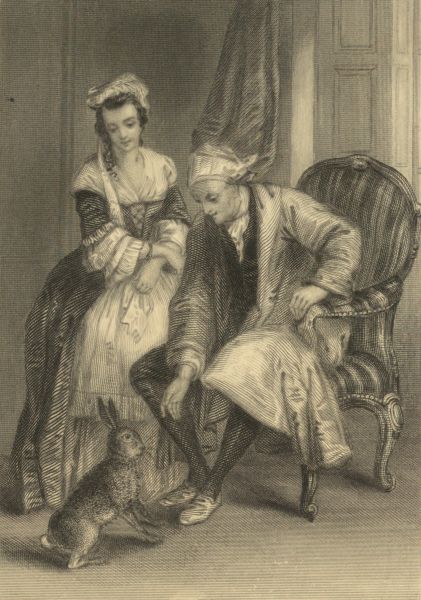
J. Gilbert fecit. W. Greatbach sculp.
THE TAME HARE.
"THOUGH DULY FROM MY HAND HE TOOK, HIS PITTANCE EVERY NIGHT, HE DID IT WITH A JEALOUS LOOK, AND WHEN HE COULD WOULD BITE."
EPITAPHIUM ALTERUM.
Hic etiam jacet, Qui totum novennium vixit, Puss. Siste paulisper, Qui præteriturus es, Et tecum sic reputa— Hunc neque canis venaticus, Nec plumbum missile, Nec laqueus, Nec imbres nimii, Confecêre: Tamen mortuus est— Et moriar ego.
The following account of the treatment of his hares was inserted by Cowper in the Gentleman's Magazine.
In the year 1774, being much indisposed both in mind and body, incapable of diverting myself either with company or books, and yet in a condition that made some diversion necessary, I was glad of any thing that would engage my attention, without fatiguing it. The children of a neighbour of mine had a leveret given them for a plaything; it was at that time about three months old. Understanding better how to tease the poor creature than to feed it, and soon becoming weary of their charge, they readily consented that their father, who saw it pining and growing leaner every day, should offer it to my acceptance. I was willing enough to take the prisoner under my protection, perceiving that, in the management of such an animal, and in the attempt to tame it, I should find just that sort of employment which my case required. It was soon known among the neighbours that I was pleased with the present, and the consequence was, that in a short time I had as many leverets offered to me as would have stocked a paddock. I undertook the care of three, which it is necessary that I should here distinguish by the names I gave them—Puss, Tiney, and Bess. Notwithstanding the two feminine appellatives, I must inform you, that they were all males. Immediately commencing carpenter, I built them houses to sleep in; each had a separate apartment, so contrived that their ordure would pass through the bottom of it; an earthen pan placed under each received whatsoever fell, which being duly emptied and washed, they were thus kept perfectly sweet and clean. In the day time they had the range of a hall, and at night retired each to his own bed, never intruding into that of another.
Puss grew presently familiar, would leap into my lap, raise himself upon his hinder feet, and bite the hair from my temples. He would suffer me to take him up, and to carry him about in my arms, and has more than once fallen fast asleep upon my knee. He was ill three days, during which time I nursed him, kept him apart from his fellows, that they might not molest him (for, like many other wild animals, they persecute one of their own species that is sick,) and by constant care, and trying him with a variety of herbs, restored him to perfect health. No creature could be more grateful than my patient after his recovery; a sentiment which he most significantly expressed by licking my hand, first the back of it, then the palm, then every finger separately, then between all the fingers, as if anxious to leave no part of it unsaluted; a ceremony which he never performed but once again upon a similar occasion. Finding him extremely tractable, I made it my custom to carry him always after breakfast into the garden, where he hid himself generally under the leaves of a cucumber vine, sleeping or chewing the cud till evening; in the leaves also of that vine he found a favourite repast. I had not long habituated him to this taste of liberty, before he began to be impatient for the return of the time when he might enjoy it. He would invite me to the garden by drumming upon my knee, and by a look of such expression as it was not possible to misinterpret. If this rhetoric did not immediately succeed, he would take the skirt of my coat between his teeth, and pull it with all his force. Thus Puss might be said to be perfectly tamed; the shyness of his nature was done away, and on the whole it was visible by many symptoms, which I have not room to enumerate, that he was happier in human society than, when shut up with his natural companions.
Not so Tiney; upon him the kindest treatment had not the least effect. He too was sick, and in his sickness had an equal share of my attention; but if, after his recovery, I took the liberty to stroke him, he would grunt, strike with his fore feet, spring forward, and bite. He was however very entertaining in his way; even his surliness was matter of mirth, and in his play he preserved such an air of gravity, and performed his feats with such a solemnity of manner, that in him too I had an agreeable companion.
Bess, who died soon after he was full grown, and whose death was occasioned by his being turned into his box, which had been washed, while it was yet damp, was a hare of great humour and drollery. Puss was tamed by gentle usage; Tiney was not to be tamed at all; and Bess had a courage and confidence that made him tame from the beginning. I always admitted them into the parlour after supper, when, the carpet affording their feet a firm hold, they would frisk, and bound, and play a thousand gambols, in which Bess, being remarkably strong and fearless, was always superior to the rest, and proved himself the Vestris of the party. One evening, the cat being in the room, had the hardiness to pat Bess upon the cheek, an indignity which he resented by drumming upon her back with such violence that the cat was happy to escape from under his paws, and hide herself.
I describe these animals as having each a character of his own. Such they were in fact, and their countenances were so expressive of that character, that, when I looked only on the face of either, I immediately knew which it was. It is said that a shepherd, however numerous his flock, soon becomes so familiar with their features, that he can, by that indication only, distinguish each from all the rest; and yet, to a common observer, the difference is hardly perceptible. I doubt not that the same discrimination in the cast of countenances would be discoverable in hares, and am persuaded that among a thousand of them no two could be found exactly similar: a circumstance little suspected by those who have not had opportunity to observe it. These creatures have a singular sagacity in discovering the minutest alteration that is made in the place to which they are accustomed, and instantly apply their nose to the examination of a new object. A small hole being burnt in the carpet, it was mended with a patch, and that patch in a moment underwent the strictest scrutiny. They seem too to be very much directed by the smell in the choice of their favourites: to some persons, though they saw them daily, they could never be reconciled, and would even scream when they attempted to touch them; but a miller coming in engaged their affections at once; his powdered coat had charms that were irresistible. It is no wonder that my intimate acquaintance with these specimens of the kind has taught me to hold the sportman's amusement in abhorrence; he little knows what amiable creatures he persecutes, of what gratitude they are capable, how cheerful they are in their spirits, what enjoyment they have of life, and that, impressed as they seem with a peculiar dread of man, it is only because man gives them peculiar cause for it.
That I may not be tedious, I will just give a short summary of those articles of diet that suit them best.
I take it to be a general opinion, that they graze, but it is an erroneous one, at least grass is not their staple; they seem rather to use it medicinally, soon quitting it for leaves of almost any kind. Sowthistle, dandelion, and lettuce, are their favourite vegetables, especially the last. I discovered by accident that fine white sand is in great estimation with them; I suppose as a digestive. It happened, that I was cleaning a birdcage when the hares were with me; I placed a pot filled with such sand upon the floor, which, being at once directed to it by a strong instinct, they devoured voraciously; since that time I have generally taken care to see them well supplied with it. They account green corn a delicacy, both blade and stalk, but the ear they seldom eat: straw of any kind, especially wheat-straw, is another of their dainties: they will feed greedily upon oats, but if furnished with clean straw never want them; it serves them also for a bed, and, if shaken up daily, will be kept sweet and dry for a considerable time. They do not indeed require aromatic herbs, but will eat a small quantity of them with great relish, and are particularly fond of the plant called musk; they seem to resemble sheep in this, that, if their pasture be too succulent, they are very subject to the rot; to prevent which, I always made bread their principal nourishment, and, filling a pan with it cut into small squares, placed it every evening in their chambers, for they feed only at evening and in the night; during the winter, when vegetables were not to be got, I mingled this mess of bread with shreds of carrot, adding to it the rind of apples cut extremely thin; for, though they are fond of the paring, the apple itself disgusts them. These however not being a sufficient substitute for the juice of summer herbs, they must at this time be supplied with water; but so placed, that they cannot overset it into their beds. I must not omit, that occasionally they are much pleased with twigs of hawthorn, and of the common brier, eating even the very wood when it is of considerable thickness.
Bess, I have said, died young; Tiney lived to be nine years old, and died at last, I have reason to think, of some hurt in his loins by a fall; Puss is still living, and has just completed his tenth year, discovering no signs of decay, nor even of age, except that he is grown more discreet and less frolicsome than he was. I cannot conclude without observing, that I have lately introduced a dog to his acquaintance, a spaniel that had never seen a hare to a hare that had never seen a spaniel. I did it with great caution, but there was no real need of it. Puss discovered no token of fear, nor Marquis the least symptom of hostility. There is therefore, it should seem, no natural antipathy between dog and hare, but the pursuit of the one occasions the flight of the other, and the dog pursues because he is trained to it; they eat bread at the same time out of the same hand, and are in all respects sociable and friendly.
I should not do complete justice to my subject, did I not add, that they have no ill scent belonging to them, that they are indefatigably nice in keeping themselves clean, for which purpose nature has furnished them with a brush under each foot; and that they are never infested by any vermin.
May 28, 1784.
MEMORANDUM FOUND AMONG MR. COWPER'S PAPERS.
Tuesday, March 9, 1786.
This day died poor Puss, aged eleven years eleven months. He died between twelve and one at noon, of mere old age, and apparently without pain.
A TALE[836]
In Scotland's realms, where trees are few, Nor even shrubs abound; But where, however bleak the view, Some better things are found; For husband there and wife may boast Their union undefiled, And false ones are as rare almost As hedgerows in the wild— In Scotland's realm forlorn and bare The history chanced of late— The history of a wedded pair, A chaffinch and his mate. The spring drew near, each felt a breast With genial instinct fill'd; They pair'd, and would have built a nest, But found not where to build. The heaths uncover'd and the moors Except with snow and sleet, Sea-beaten rocks and naked shores Could yield them no retreat. Long time a breeding-place they sought, Till both grew vex'd and tired; At length a ship arriving brought The good so long desired. A ship!—could such a restless thing Afford them place of rest? Or was the merchant charged to bring The homeless birds a nest? Hush—silent hearers profit most— This racer of the sea Proved kinder to them than the coast, It served them with a tree. But such a tree! 'twas shaven deal, The tree they call a mast, And had a hollow with a wheel Through which the tackle pass'd. Within that cavity aloft Their roofless home they fix'd, Form'd with materials neat and soft, Bents, wool, and feathers mix'd. Four ivory eggs soon pave its floor With russet specks bedight— The vessel weighs, forsakes the shore, And lessens to the sight. The mother-bird is gone to sea, As she had changed her kind; But goes the male? Far wiser, he Is doubtless left behind. No—soon as from ashore he saw The winged mansion move, He flew to reach it, by a law Of never-failing love; Then, perching at his consort's side, Was briskly borne along, The billows and the blast defied, And cheer'd her with a song. The seaman with sincere delight His feather'd shipmates eyes, Scarce less exulting in the sight Than when he tows a prize. For seamen much believe in signs, And from a chance so new Each some approaching good divines, And may his hopes be true! Hail, honour'd land! a desert where Not even birds can hide, Yet parent of this loving pair Whom nothing could divide. And ye who, rather than resign Your matrimonial plan, Were not afraid to plough the brine In company with man; For whose lean country much disdain We English often show, Yet from a richer nothing gain But wantonness and woe— Be it your fortune, year by year The same resource to prove, And may ye, sometimes landing here, Instruct us how to love!
June, 1793.
TO MARY.
The twentieth year is well nigh past Since first our sky was overcast; Ah! would that this might be the last! My Mary! Thy spirits have a fainter flo I see thee daily weaker gro 'Twas my distress that brought thee low, My Mary! Thy needles, once a shining store, For my sake restless heretofore, Now rust disused, and shine no more; My Mary! For, though thou gladly wouldst fulfil The same kind office for me still, Thy sight now seconds not thy will, My Mary! But well thou play'dst the housewife's part, And all thy threads with magic art Have wound themselves about this heart, My Mary! Thy indistinct expressions seem Like language utter'd in a dream: Yet me they charm, whate'er the theme, My Mary! Thy silver locks, once auburn bright, Are still more lovely in my sight Than golden beams of orient light, My Mary! For, could I view nor them nor thee, What sight worth seeing could I see? The sun would rise in vain for me, My Mary! Partakers of thy sad decline, Thy hands their little force resign; Yet gently press'd, press gently mine, My Mary! Such feebleness of limbs thou provest, That now at every step thou movest Upheld by two; yet still thou lovest, My Mary! And still to love, though press'd with ill, In wintry age to feel no chill, With me is to be lovely still, My Mary! But ah! by constant heed I know, How oft the sadness that I show Transforms thy smiles to looks of woe, My Mary! And should my future lot be cast With much resemblance of the past, Thy worn-out heart will break at last, My Mary!
Autumn of 1793.
THE CASTAWAY.
Obscurest night involved the sky, The Atlantic billows roar'd, When such a destined wretch as I, Wash'd headlong from on board, Of friends, of hope, of all bereft, His floating home for ever left. No braver chief could Albion boast Than he with whom he went, Nor ever ship left Albion's coast With warmer wishes sent. He loved them both, but both in vain, Nor him beheld, nor her again. Not long beneath the whelming brine, Expert to swim, he lay; Nor soon he felt his strength decline, Or courage die away: But waged with death a lasting strife, Supported by despair of life. He shouted; nor his friends had fail'd To check the vessel's course, But so the furious blast prevail'd, That, pitiless perforce, They left their outcast mate behind, And scudded still before the wind. Some succour yet they could afford; And, such as storms allow, The cask, the coop, the floated cord, Delay'd not to bestow: But he, they knew, nor ship nor shore, Whate'er they gave, should visit more. Nor, cruel as it seem'd, could he Their haste himself condemn, Aware that flight, in such a sea, Alone could rescue them; Yet bitter felt it still to die Deserted, and his friends so nigh. He long survives, who lives an hour In ocean, self-upheld: And so long he, with unspent power, His destiny repell'd: And ever, as the minutes flew, Entreated help, or cried—"Adieu!" At length, his transient respite past, His comrades, who before Had heard his voice in every blast, Could catch the sound no more: For then, by toil subdued, he drank The stifling wave, and then he sank. No poet wept him; but the page Of narrative sincere, That tells his name, his worth, his age, Is wet with Anson's tear; And tears by bards or heroes shed Alike immortalize the dead. I therefore purpose not, or dream, Descanting on his fate, To give the melancholy theme A more enduring date: But misery still delights to trace Its semblance in another's case. No voice divine the storm allay'd, No light propitious shone; When, snatch'd from all effectual aid, We perish'd, each alone: But I beneath a rougher sea, And whelm'd in deeper gulfs than he.
March 20, 1799.
TO SIR JOSHUA REYNOLDS.
DEAR President, whose art sublime Gives perpetuity to time, And bids transactions of a day, That fleeting hours would waft away To dark futurity, survive, And in unfading beauty live,— You cannot with a grace decline A special mandate of the Nine— Yourself, whatever task you choose, So much indebted to the Muse. Thus say the sisterhood:—We come— Fix well your pallet on your thumb, Prepare the pencil and the tints— We come to furnish you with hints. French disappointment, British glory, Must be the subject of the story. First strike a curve, a graceful bow, Then slope it to a point below; Your outline easy, airy, light, Fill'd up, becomes a paper kite. Let independence, sanguine, horrid, Blaze like a meteor in the forehead: Beneath (but lay aside your graces) Draw six-and-twenty rueful faces, Each with a staring, stedfast eye, Fix'd on his great and good ally. France flies the kite—'tis on the wing— Britannia's lightning cuts the string. The wind that raised it, ere it ceases, Just rends it into thirteen pieces, Takes charge of every fluttering sheet, And lays them all at George's feet. Iberia, trembling from afar, Renounces the confederate war. Her efforts and her arts o'ercome, France calls her shatter'd navies home. Repenting Holland learns to mourn The sacred treaties she has torn; Astonishment and awe profound Are stamp'd upon the nations round: Without one friend, above all foes, Britannia gives the world repose.
ON THE AUTHOR OF LETTERS ON LITERATURE.[837]
The Genius of the Augustan age His head among Rome's ruins rear'd, And, bursting with heroic rage, When literary Heron appear'd; Thou hast, he cried, like him of old Who set the Ephesian dome on fire, By being scandalously bold, Attain'd the mark of thy desire. And for traducing Virgil's name Shalt share his merited reward; A perpetuity of fame, That rots, and stinks, and is abhorr'd.
THE DISTRESSED TRAVELLERS;
OR, LABOUR IN VAIN.
A New Song, to a Tune never sung before.
I sing of a journey to Clifton,[838] We would have performed, if we could; Without cart or barrow, to lift on Poor Mary[839] and me through the mud. Slee, sla, slud, Stuck in the mud; Oh it is pretty to wade through a flood! So away we went, slipping and sliding; Hop, hop, à la mode de deux frogs; 'Tis near as good walking as riding, When ladies are dressed in their clogs. Wheels, no doubt, Go briskly about, But they clatter, and rattle, and make such a rout.
DIALOGUE.
SHE.
"Well! now, I protest it is charming; How finely the weather improves! That cloud, though 'tis rather alarming, How slowly and stately it moves."
HE.
"Pshaw! never mind, 'Tis not in the wind, We are travelling south, and shall leave it behind."
SHE.
"I am glad we are come for an airing, For folks may be pounded, and penn'd, Until they grow rusty, not caring To stir half a mile to an end."
HE.
"The longer we stay, The longer we may; It's a folly to think about weather or way."
SHE.
"But now I begin to be frighted, If I fall, what a way I should roll! I am glad that the bridge was indicted, Stay! stop! I am sunk in a hole!"
HE.
"Nay never care, 'Tis a common affair; You'll not be the last, that will set a foot there."
SHE.
"Let me breathe now a little, and ponder On what it were better to do; That terrible lane I see yonder, I think we shall never get through."
HE.
"So think I:— But, by the bye, We never shall know, if we never should try."
SHE.
"But should we get there, how shall we get home? What a terrible deal of bad road we have past! Slipping, and sliding, and if we should come To a difficult stile, I am ruined at last! Oh this lane! Now it is plain That struggling and striving is labour in vain."
HE.
"Stick fast there while I go and look;"
SHE.
"Don't go away, for fear I should fall:"
HE.
"I have examined it, every nook, And what you see here is a sample of all. Come, wheel round, The dirt we have found Would be an estate, at a farthing a pound." Now, sister Anne,[840] the guitar you must take, Set it, and sing it, and make it a song: I have varied the verse, for variety's sake, And cut it off short—because it was long. 'Tis hobbling and lame, Which critics won't blame, For the sense and the sound, they say, should be the same.
STANZAS
ON THE LATE INDECENT LIBERTIES TAKEN WITH THE REMAINS OF MILTON.[841] ANNO 1790.
"Me too, perchance, in future days, The sculptured stone shall show, With Paphian myrtle or with bays Parnassian on my brow. "But I, or ere that season come, Escaped from every care, Shall reach my refuge in the tomb, And sleep securely there."[842] So sang, in Roman tone and style, The youthful bard, ere long Ordain'd to grace his native isle With her sublimest song. Who then but must conceive disdain, Hearing the deed unblest Of wretches who have dared profane His dread sepulchral rest? Ill fare the hands that heaved the stones[843] Where Milton's ashes lay, That trembled not to grasp his bones And steal his dust away! O ill requited bard! neglect Thy living worth repaid, And blind idolatrous respect As much affronts thee dead.
August, 1790.
TO THE REV. WILLIAM BULL.
June 22, 1782.
My dear Friend,
If reading verse be your delight, 'Tis mine as much, or more, to write; But what we would, so weak is man, Lies oft remote from what we can. For instance, at this very time I feel a wish by cheerful rhyme To soothe my friend, and, had I power, To cheat him of an anxious hour; Not meaning (for I must confess, It were but folly to suppress) His pleasure, or his good alone, But squinting partly at my own. But though the sun is flaming high In the centre of yon arch, the sky, And he had once (and who but he?) The name for setting genius free, Yet whether poets of past days Yielded him undeserved praise. And he by no uncommon lot Was famed for virtues he had not; Or whether, which is like enough, His Highness may have taken huff, So seldom sought with invocation, Since it has been the reigning fashion To disregard his inspiration, I seem no brighter in my wits, For all the radiance he emits, Than if I saw, through midnight vapour, The glimmering of a farthing taper. Oh for a succedaneum, then, To accelerate a creeping pen! Oh for a ready succedaneum, Quod caput, cerebrum, et cranium Pondere liberet exoso, Et morbo jam caliginoso! 'Tis here; this oval box well fill'd With best tobacco, finely mill'd, Beats all Anticyra's pretences To disengage the encumber'd senses. Oh Nymph of transatlantic fame, Where'er thine haunt, whate'er thy name, Whether reposing on the side Of Oroonoquo's spacious tide, Or listening with delight not small To Niagara's distant fall, 'Tis thine to cherish and to feed The pungent nose-refreshing weed Which, whether pulverized it gain A speedy passage to the brain, Or whether, touch'd with fire, it rise In circling eddies to the skies, Does thought more quicken and refine Than all the breath of all the Nine— Forgive the bard, if bard he be, Who once too wantonly made free, To touch with a satiric wipe That symbol of thy power, the pipe; So may no blight infest thy plains, And no unseasonable rains; And so may smiling peace once more Visit America's sad shore; And thou, secure from all alarms, Of thundering drums and glittering arms, Rove unconfined beneath the shade Thy wide expanded leaves have made; So may thy votaries increase, And fumigation never cease. May Newton with renew'd delights Perform thine odoriferous rites, While clouds of incense half divine Involve thy disappearing shrine; And so may smoke-inhaling Bull Be always filling, never full.
EPITAPH ON MRS. M. HIGGINS,
OF WESTON.
Laurels may flourish round the conqueror's tomb, But happiest they who win the world to come: Believers have a silent field to fight, And their exploits are veil'd from human sight. They in some nook, where little known they dwell, Kneel, pray in faith, and rout the hosts of hell; Eternal triumphs crown their toils divine, And all those triumphs, Mary, now are thine.
1791.
SONNET TO A YOUNG LADY ON HER BIRTH-DAY.
Deem not, sweet rose, that bloom'st 'midst many a thorn, Thy friend, tho' to a cloister's shade consign'd, Can e'er forget the charms he left behind, Or pass unheeded this auspicious morn! In happier days to brighter prospects born, O tell thy thoughtless sex, the virtuous mind, Like thee, content in every state may find, And look on Folly's pageantry with scorn. To steer with nicest art betwixt th' extreme Of idle mirth, and affectation coy; To blend good sense with elegance and ease; To bid Affliction's eye no longer stream; Is thine; best gift, the unfailing source of joy, The guide to pleasures which can never cease!
ON A MISTAKE IN HIS TRANSLATION OF HOMER.
Cowper had sinn'd with some excuse, If, bound in rhyming tethers, He had committed this abuse Of changing ewes for wethers;[844] But, male for female is a trope, Or rather bold misnomer, That would have startled even Pope, When he translated Homer.
ON THE BENEFIT RECEIVED BY HIS MAJESTY, FROM SEA-BATHING IN THE YEAR 1789.
O sovereign of an isle renown'd For undisputed sway, Wherever o'er yon gulf profound Her navies wing their way, With juster claims she builds at length Her empire on the sea, And well may boast the waves her strength, Which strength restored to thee.
ADDRESSED TO MISS —— ON READING THE PRAYER FOR INDIFFERENCE.[845]
And dwells there in a female heart, By bounteous Heaven design'd, The choicest raptures to impart, To feel the most refined— Dwells there a wish in such a breast Its nature to forego, To smother in ignoble rest At once both bliss and woe! Far be the thought, and far the strain, Which breathes the low desire, How sweet soe'er the verse complain, Though Phœbus string the lyre. Come, then, fair maid, (in nature wise,) Who, knowing them, can tell From generous sympathy what joys The glowing bosom swell: In justice to the various powers Of pleasing, which you share, Join me, amid your silent hours, To form the better prayer. With lenient balm may Oberon hence To fairy land be driven, With every herb that blunts the sense Mankind received from heaven. "Oh! if my sovereign Author please, Far be it from my fate To live unbless'd in torpid ease, And slumber on in state; "Each tender tie of life defied, Whence social pleasures spring, Unmoved with all the world beside, A solitary thing—" Some Alpine mountain, wrapt in snow, Thus braves the whirling blast, Eternal winter doom'd to know, No genial spring to taste. In vain warm suns their influence shed, The zephyrs sport in vain, He rears unchanged his barren head, Whilst beauty decks the plain. What though in scaly armour dress'd, Indifference may repel The shafts of woe—in such a breast No joy can ever dwell. 'Tis woven in the world's great plan, And fix'd by Heaven's decree, That all the true delights of man Should spring from sympathy. 'Tis nature bids, and whilst the laws Of nature we retain, Our self-approving bosom draws A pleasure from its pain. Thus grief itself has comforts dear The sordid never know; And ecstasy attends the tear When virtue bids it flow. For, when it streams from that pure source, No bribes the heart can win To check, or alter from its course, The luxury within. Peace to the phlegm of sullen elves, Who, if from labour eased, Extend no care beyond themselves, Unpleasing and unpleased. Let no low thought suggest the prayer, Oh! grant, kind Heaven, to me, Long as I draw ethereal air, Sweet Sensibility! Where'er the heavenly nymph is seen, With lustre-beaming eye, A train, attendant on their queen, (Her rosy chorus) fly; The jocund loves in Hymen's band, With torches ever bright, And generous friendship, hand in hand With pity's wat'ry sight. The gentler virtues too are join'd In youth immortal warm; The soft relations, which, combined, Give life her every charm. The arts come smiling in the close, And lend celestial fire; The marble breathes, the canvas glows, The muses sweep the lyre. "Still may my melting bosom cleave To sufferings not my own, And still the sigh responsive heave Where'er is heard a groan. "So pity shall take virtue's part. Her natural ally, And fashioning my soften'd heart, Prepare it for the sky." This artless vow may Heaven receive, And you, fond maid, approve: So may your guiding angel give Whate'er you wish or love! So may the rosy-finger'd hours Lead on the various year, And every joy, which now is yours, Extend a larger sphere! And suns to come, as round they wheel, Your golden moments bless With all a tender heart can feel, Or lively fancy guess!
1762.
FROM A LETTER TO THE REV. MR. NEWTON,
LATE RECTOR OF ST. MARY WOOLNOTH.
Says the pipe to the snuff-box, I can't understand What the ladies and gentlemen see in your face, That you are in fashion all over the land, And I am so much fallen into disgrace. Do but see what a pretty contemplative air I give to the company—pray do but note 'em— You would think that the wise men of Greece were all there, Or at least would suppose them the wise men of Gotham. My breath is as sweet as the breath of blown roses, While you are a nuisance where'er you appear; There is nothing but snivelling and blowing of noses, Such a noise as turns any man's stomach to hear. Then, lifting his lid in a delicate way, And opening his mouth with a smile quite engaging, The box in reply was heard plainly to say, What a silly dispute is this we are waging! If you have a little of merit to claim, You may thank the sweet-smelling Virginian weed, And I, if I seem to deserve any blame, The before-mention'd drug in apology plead. Thus neither the praise nor the blame is our own, No room for a sneer, much less a cachinnus, We are vehicles, not of tobacco alone, But of any thing else they may choose to put in us.
THE FLATTING MILL.
AN ILLUSTRATION.
When a bar of pure silver or ingot of gold Is sent to be flatted or wrought into length, It is pass'd between cylinders often, and roll'd In an engine of utmost mechanical strength. Thus tortured and squeezed, at last it appears Like a loose heap of ribbon, a glittering show, Like music it tinkles and rings in your ears, And, warm'd by the pressure, is all in a glow. This process achieved, it is doom'd to sustain The thump after thump of a gold-beater's mallet, And at last is of service in sickness or pain To cover a pill for a delicate palate. Alas for the poet! who dares undertake To urge reformation of national ill— His head and his heart are both likely to ache With the double employment of mallet and mill. If he wish to instruct, he must learn to delight, Smooth, ductile, and even his fancy must flow, Must tinkle and glitter like gold to the sight, And catch in its progress a sensible glow. After all he must beat it as thin and as fine As the leaf that enfolds what an invalid swallows; For truth is unwelcome, however divine, And unless you adorn it, a nausea follows.
EPITAPH ON A FREE BUT TAME REDBREAST,
A FAVOURITE OF MISS SALLY HURDIS.
These are not dewdrops, these are tears, And tears by Sally shed For absent Robin, who she fears, With too much cause, is dead. One morn he came not to her hand As he was wont to come, And, on her finger perch'd, to stand Picking his breakfast-crumb. Alarm'd, she call'd him, and perplex'd She sought him, but in vain— That day he came not, nor the next, Nor ever came again. She therefore raised him here a tomb, Though where he fell, or how, None knows, so secret was his doom, Nor where he moulders now. Had half a score of coxcombs died In social Robin's stead, Poor Sally's tears had soon been dried, Or haply never shed. But Bob was neither rudely bold Nor spiritlessly tame; Nor was, like theirs, his bosom cold, But always in a flame.
March, 1792.
SONNET,
ADDRESSED TO WILLIAM HAYLEY, ESQ.
Hayley—thy tenderness fraternal shown In our first interview, delightful guest! To Mary, and me for her dear sake distress'd, Such as it is, has made my heart thy own, Though heedless now of new engagements grown; For threescore winters make a wintry breast, And I had purposed ne'er to go in quest Of friendship more, except with God alone. But thou hast won me; nor is God my foe, Who, ere this last afflictive scene began, Sent thee to mitigate the dreadful blow, My brother, by whose sympathy I know Thy true deserts infallibly to scan, Not more to admire the bard than love the man.
June 2, 1792.
AN EPITAPH.
Here lies one who never drew Blood himself, yet many slew; Gave the gun its aim, and figure Made in field, yet ne'er pull'd trigger. Armed men have gladly made Him their guide, and him obey'd; At his signified desire Would advance, present, and fire— Stout he was, and large of limb, Scores have fled at sight of him! And to all this fame he rose Only following his nose. Neptune was he call'd, not he Who controls the boisterous sea, But of happier command, Neptune of the furrow'd land; And, your wonder vain to shorten, Pointer to Sir John Throckmorton.
1792.
ON RECEIVING HAYLEY'S PICTURE.
In language warm as could be breathed or penn'd Thy picture speaks the original, my friend, Not by those looks that indicate thy mind— They only speak thee friend of all mankind; Expression here more soothing still I see, That friend of all a partial friend to me.
January, 1793.
ON A PLANT OF VIRGIN'S BOWER.
DESIGNED TO COVER A GARDEN-SEAT.
Thrive, gentle plant! and weave a bower For Mary and for me, And deck with many a splendid flower, Thy foliage large and free. Thou camest from Eartham, and wilt shade (If truly I divine) Some future day the illustrious head Of him who made thee mine. Should Daphne show a jealous frown, And envy seize the bay, Affirming none so fit to crown Such honour'd brows as they, Thy cause with zeal we shall defend, And with convincing power; For why should not the virgin's friend Be crown'd with virgin's bower?
Spring of 1793.
ON RECEIVING HEYNE'S VIRGIL
FROM MR. HAYLEY.
I should have deem'd it once an effort vain To sweeten more sweet Maro's matchless strain, But from that error now behold me free, Since I received him as a gift from thee.
STANZAS,
ADDRESSED TO LADY HESKETH, BY A LADY,
In returning a Poem, of Mr. Cowper's, lent to the Writer, on condition she should neither show it nor take a copy.
What wonder! if my wavering hand Had dared to disobey, When Hesketh gave a harsh command, And Cowper led astray. Then take this tempting gift of thine, By pen uncopied yet! But canst thou Memory confine, Or teach me to forget? More lasting than the touch of art, Her characters remain; When written by a feeling heart On tablets of the brain.
COWPER'S REPLY.
To be remember'd thus is fame, And in the first degree; And did the few, like her, the same, The press might rest for me. So Homer, in the mem'ry stor'd Of many a Grecian belle, Was once preserved—a richer hoard, But never lodged so well.
LINES ADDRESSED TO MISS THEODORA JANE COWPER.
William was once a bashful youth, His modesty was such, That one might say, to say the truth, He rather had too much. Some said that it was want of sense, And others, want of spirit, (So blest a thing is impudence,) While others could not bear it. But some a different notion had, And at each other winking, Observed, that though he little said, He paid it off with thinking. Howe'er, it happened, by degrees, He mended, and grew perter, In company was more at ease, And dress'd a little smarter; Nay, now and then, could look quite gay, As other people do; And sometimes said, or tried to say, A witty thing or so. He eyed the women, and made free To comment on their shapes, So that there was, or seem'd to be, No fear of a relapse. The women said, who thought him rough, But now no longer foolish, "The creature may do well enough, But wants a deal of polish." At length improved from head to heel, 'Twere scarce too much to say, No dancing beau was so genteel, Or half so dégagé. Now that a miracle so strange May not in vain be shown, Let the dear maid who wrought the change E'en claim him for her own!
TO THE SAME.
How quick the change from joy to wo, How chequer'd is our lot below! Seldom we view the prospect fair; Dark clouds of sorrow, pain, and care, (Some pleasing intervals between,) Scowl over more than half the scene. Last week with Delia, gentle maid! Far hence in happier fields I stray'd. Five suns successive rose and set, And saw no monarch in his state, Wrapt in the blaze of majesty, So free from every care as I. Next day the scene was overcast— Such day till then I never pass'd,— For on that day, relentless fate! Delia and I must separate. Yet ere we look'd our last farewell, From her dear lips this comfort fell,— "Fear not that time, where'er we rove, Or absence, shall abate my love."
LINES ON A SLEEPING INFANT.
Sweet babe! whose image here express'd Does thy peaceful slumbers show; Guilt or fear, to break thy rest, Never did thy spirit know. Soothing slumbers! soft repose, Such as mock the painter's skill, Such as innocence bestows, Harmless infant! lull thee still.
LINES.
Oh! to some distant scene, a willing exile From the wild roar of this busy world, Were it my fate with Delia to retire, With her to wander through the sylvan shade, Each morn, or o'er the moss-embrowned turf, Where, blest as the prime parents of mankind In their own Eden, we would envy none, But, greatly pitying whom the world calls happy, Gently spin out the silken thread of life!
INSCRIPTION FOR A MOSS-HOUSE IN THE SHRUBBERY AT WESTON.
Here, free from riot's hated noise, Be mine, ye calmer, purer joys, A book or friend bestows; Far from the storms that shake the great, Contentment's gale shall fan my seat, And sweeten my repose.
LINES ON THE DEATH OF SIR WILLIAM RUSSEL.
Doom'd, as I am, in solitude to waste The present moments, and regret the past; Deprived of every joy I valued most, My friend torn from me, and my mistress lost; Call not this gloom I wear, this anxious mien, The dull effect of humour, or of spleen! Still, still, I mourn, with each returning day, Him[846] snatch'd by fate in early youth away; And her—thro' tedious years of doubt and pain, Fix'd in her choice, and faithful—but in vain! O prone to pity, generous, and sincere, Whose eye ne'er yet refus'd the wretch a tear; Whose heart the real claim of friendship knows Nor thinks a lover's are but fancied woes; See me—ere yet my destin'd course half done, Cast forth a wand'rer on a world unknown! See me neglected on the world's rude coast, Each dear companion of my voyage lost! Nor ask why clouds of sorrow shade my brow, And ready tears wait only leave to flow! Why all that soothes a heart from anguish free, All that delights the happy—palls with me!
ON THE HIGH PRICE OF FISH.
Cocoa-nut naught, Fish too dear, None must be bought For us that are here: No lobster on earth, That ever I saw, To me would be worth Sixpence a claw. So, dear madam, wait Till fish can be got At a reas'nable rate, Whether lobster or not; Till the French and the Dutch Have quitted the seas, And then send as much And as oft as you please.
TO MRS. NEWTON.
A noble theme demands a noble verse, In such I thank you for your fine oysters. The barrel was magnificently large, But, being sent to Olney at free charge, Was not inserted in the driver's list, And therefore overlook'd, forgot, or miss'd; For, when the messenger whom we despatch'd Inquir'd for oysters, Hob his noddle scratch'd; Denying that his wagon or his wain Did any such commodity contain. In consequence of which, your welcome boon Did not arrive till yesterday at noon; In consequence of which some chanc'd to die, And some, though very sweet, were very dry. Now Madam says, (and what she says must still Deserve attention, say she what she will,) That what we call the diligence, be-case It goes to London with a swifter pace, Would better suit the carriage of your gift, Returning downward with a pace as swift; And therefore recommends it with this aim— To save at least three days,—the price the same; For though it will not carry or convey For less than twelve pence, send whate'er you may, For oysters bred upon the salt sea-shore, Pack'd in a barrel, they will charge no more. News have I none that I can deign to write, Save that it rain'd prodigiously last night; And that ourselves were, at the seventh hour, Caught in the first beginning of the show'r; But walking, running, and with much ado, Got home—just time enough to be wet through, Yet both are well, and, wond'rous to be told, Soused as we were, we yet have caught no cold; And wishing just the same good hap to you, We say, good Madam, and good Sir, adieu!
VERSES PRINTED BY HIMSELF ON A FLOOD AT OLNEY.
To watch the storms, and hear the sky Give all our almanacks the lie; To shake with cold, and see the plains In autumn drown'd with wintry rains; 'Tis thus I spend my moments here, And wish myself a Dutch mynheer; I then should have no need of wit; For lumpish Hollander unfit! Nor should I then repine at mud, Or meadows deluged with a flood; But in a bog live well content, And find it just my element; Should be a clod, and not a man; Nor wish in vain for Sister Ann, With charitable aid to drag My mind out of its proper quag; Should have the genius of a boor, And no ambition to have more.
EXTRACT FROM A SUNDAY-SCHOOL HYMN.
Hear, Lord, the song of praise and pray'r, In heaven, thy dwelling-place, From infants, made the public care, And taught to seek thy face! Thanks for thy word, and for thy day, And grant us, we implore, Never to waste in sinful play Thy holy sabbaths more. Thanks that we hear—but, oh! impart To each desires sincere, That we may listen with our heart, And learn, as well as hear.
ON THE RECEIPT OF A HAMPER.
(IN THE MANNER OF HOMER.)
The straw-stuff'd hamper with his ruthless steel He open'd, cutting sheer th' inserted cords Which bound the lid and lip secure. Forth came The rustling package first, bright straw of wheat, Or oats, or barley; next a bottle green Throat-full, clear spirits the contents, distill'd Drop after drop odorous, by the art Of the fair mother of his friend—the Rose.
ON THE NEGLECT OF HOMER.
Could Homer come himself, distress'd and poor, And tune his harp at Rhedicina's door, The rich old vixen would exclaim, (I fear,) "Begone! no tramper gets a farthing here."