Book 1 — THE TASK. BOOK I.
Reading edition
THE SOFA.
ADVERTISEMENT.
The history of the following production is briefly this: A lady, fond of blank verse, demanded a poem of that kind from the author, and gave him the Sofa for a subject. He obeyed; and having much leisure, connected another subject with it; and, pursuing the train of thought to which his situation and turn of mind led him, brought forth at length, instead of the trifle which he at first intended, a serious affair—a volume.
In the poem on the subject of Education he would be very sorry to stand suspected of having aimed his censure at any particular school. His objections are such as naturally apply themselves to schools in general. If there were not, as for the most part there is, wilful neglect in those who manage them, and an omission even of such discipline as they are susceptible of, the objects are yet too numerous for minute attention; and the aching hearts of ten thousand parents, mourning under the bitterest of all disappointments, attest the truth of the allegation. His quarrel therefore is with the mischief at large, and not with any particular instance of it.
THE ARGUMENT.
Historical deduction of seats, from the stool to the sofa—A schoolboy's ramble—A walk in the country—The scene described—Rural sounds as well as sights delightful—Another walk—Mistake concerning the charms of solitude corrected—Colonnades commended—Alcove, and the view from it—The wilderness—The Grove—The Thresher—The necessity and the benefits of exercise—The works of nature superior to, and in some instances inimitable by, art—The wearisomeness of what is commonly called a life of pleasure—Change of scene sometimes expedient—A common described, and the character of crazy Kate introduced—Gipsies—The blessings of civilized life—That state most favourable to virtue—The South Sea islanders compassionated, but chiefly Omai—His present state of mind supposed—Civilized life friendly to virtue, but not great cities—Great cities, and London in particular, allowed their due praise, but censured—Fête champêtre—The book concludes with a reflection on the effects of dissipation and effeminacy upon our public measures.
I Sing the Sofa. I who lately sang Truth, Hope, and Charity,[805] and touch'd with awe The solemn chords, and with a trembling hand, Escaped with pain from that adventurous flight, Now seek repose upon an humbler theme; The theme though humble, yet august and proud The occasion—for the Fair commands the song. Time was, when clothing sumptuous or for use, Save their own painted skins, our sires had none. As yet black breeches were not; satin smooth, Or velvet soft, or plush with shaggy pile: The hardy chief upon the rugged rock, Wash'd by the sea, or on the gravelly bank Thrown up by wintry torrents roaring loud, Fearless of wrong, reposed his weary strength. Those barbarous ages past, succeeded next The birthday of Invention; weak at first, Dull in design, and clumsy to perform. Joint-stools were then created; on three legs Upborne they stood. Three legs upholding firm A massy slab, in fashion square or round. On such a stool immortal Alfred sat, And sway'd the sceptre of his infant realms: And such in ancient halls and mansions drear May still be seen; but perforated sore, And drill'd in holes, the solid oak is found, By worms voracious eating through and through. At length a generation more refined Improv'd the simple plan; made three legs four, Gave them a twisted form vermicular, And o'er the seat, with plenteous wadding stuff'd, Induced a splendid cover, green and blue, Yellow and red, of tapestry richly wrought And woven close, or needlework sublime. There might ye see the piony spread wide, The full blown rose, the shepherd and his lass, Lapdog and lambkin with black staring eyes, And parrots with twin cherries in their beak. Now came the cane from India, smooth and bright With Nature's varnish, sever'd into stripes That interlaced each other, these supplied Of texture firm a lattice work, that braced The new machine, and it became a chair. But restless was the chair; the back erect Distress'd the weary loins, that felt no ease; The slippery seat betray'd the sliding part That press'd it, and the feet hung dangling down, Anxious in vain to find the distant floor. These for the rich; the rest, whom Fate had placed In modest mediocrity, content With base materials, sat on well tann'd hides, Obdurate and unyielding, glassy smooth, With here and there a tuft of crimson yarn, Or scarlet crewel, in the cushion fix'd, If cushion might be call'd, what harder seem'd Than the firm oak of which the frame was form'd. No want of timber then was felt or fear'd In Albion's happy isle. The lumber stood Ponderous and fix'd by its own massy weight. But elbows still were wanting; these, some say, An alderman of Cripplegate contrived; And some inscribe the invention to a priest, Burly and big, and studious of his ease. But, rude at first, and not with easy slope Receding wide, they pressed against the ribs, And bruised the side; and, elevated high, Taught the raised shoulders to invade the ears. Long time elapsed or e'er our rugged sires Complain'd, though incommodiously pent in, And ill at ease behind. The ladies first 'Gan murmur, as became the softer sex. Ingenious Fancy, never better pleased Than when employed to accommodate the fair, Heard the sweet moan with pity, and devised The soft settee; one elbow at each end, And in the midst an elbow it received, United yet divided, twain at once. So sit two kings of Brentford on one throne; And so two citizens, who take the air, Close pack'd, and smiling, in a chaise and one. But relaxation of the languid frame, By soft recumbency of outstretch'd limbs, Was bliss reserved for happier days. So slow The growth of what is excellent; so hard To attain perfection in this nether world. Thus first Necessity invented stools, Convenience next suggested elbow-chairs, And Luxury the accomplish'd Sofa last. The nurse sleeps sweetly, hired to watch the sick, Whom snoring she disturbs. As sweetly he Who quits the coach-box at the midnight hour, To sleep within the carriage more secure, His legs depending at the open door. Sweet sleep enjoys the curate in his desk, The tedious rector drawling o'er his head; And sweet the clerk below. But neither sleep Of lazy nurse, who snores the sick man dead, Nor his who quits the box at midnight hour, To slumber in the carriage more secure, Nor sleep enjoyed by curate in his desk, Nor yet the dozings of the clerk, are sweet, Compared with the repose the Sofa yields. Oh may I live exempted (while I live Guiltless of pampered appetite obscene) From pangs arthritic, that infest the toe Of libertine Excess! The Sofa suits The gouty limb, 'tis true; but gouty limb, Though on a Sofa, may I never feel: For I have loved the rural walk through lanes Of grassy swarth, close cropp'd by nibbling sheep, And skirted thick with intertexture firm Of thorny boughs; have loved the rural walk O'er hills, through valleys, and by rivers' brink, E'er since a truant boy I pass'd my bounds To enjoy a ramble on the banks of Thames; And still remember, nor without regret Of hours that sorrow since has much endear'd, How oft, my slice of pocket store consumed, Still hungering, pennyless, and far from home, I fed on scarlet hips and stony haws, Or blushing crabs, or berries, that emboss The bramble, black as jet, or sloes austere. Hard fare! but such as boyish appetite Disdains not; nor the palate, undepraved By culinary arts, unsavoury deems. No Sofa then awaited my return; Nor Sofa then I needed. Youth repairs His wasted spirits quickly, by long toil Incurring short fatigue; and though our years, As life declines, speed rapidly away, And not a year but pilfers as he goes Some youthful grace, that age would gladly keep; A tooth or auburn lock, and by degrees Their length and colour from the locks they spare; The elastic spring of an unwearied foot, That mounts the stile with ease, or leaps the fence, That play of lungs, inhaling and again Respiring freely the fresh air, that makes Swift pace or steep ascent no toil to me, Mine have not pilfer'd yet; nor yet impair'd My relish of fair prospect; scenes that soothed Or charm'd me young, no longer young, I find Still soothing, and of power to charm me still. And witness, dear companion of my walks, Whose arm this twentieth winter I perceive Fast lock'd in mine, with pleasure such as love, Confirm'd by long experience of thy worth, And well-tried virtues, could alone inspire— Witness a joy that thou hast doubled long. Thou know'st my praise of nature most sincere, And that my raptures are not conjured up To serve occasions of poetic pomp, But genuine, and art partner of them all. How oft upon yon eminence our pace Has slacken'd to a pause, and we have borne The ruffling wind, scarce conscious that it blew, While Admiration, feeding at the eye, And still unsated, dwelt upon the scene. Thence with what pleasure have we just discern'd The distant plough slow moving, and beside His labouring team, that swerv'd not from the track, The sturdy swain diminish'd to a boy! Here Ouse, slow winding through a level plain Of spacious meads, with cattle sprinkled o'er, Conducts the eye along his sinuous course Delighted. There, fast rooted in their bank, Stand, never overlook'd, our favourite elms, That screen the herdsman's solitary hut; While far beyond, and overthwart the stream, That, as with molten glass, inlays the vale, The sloping land recedes into the clouds; Displaying on its varied side the grace Of hedge-row beauties numberless, square tower, Tall spire, from which the sound of cheerful bells Just undulates upon the listening ear, Groves, heaths, and smoking villages, remote. Scenes must be beautiful which, daily view'd, Please daily, and whose novelty survives Long knowledge and the scrutiny of years— Praise justly due to those that I describe. Nor rural sights alone, but rural sounds, Exhilarate the spirit, and restore The tone of languid Nature. Mighty winds, That sweep the skirt of some far-spreading wood Of ancient growth, make music not unlike The dash of Ocean on his winding shore, And lull the spirit while they fill the mind; Unnumber'd branches waving in the blast, And all their leaves fast fluttering, all at once. Nor less composure waits upon the roar Of distant floods, or on the softer voice Of neighbouring fountain, or of rills that slip Through the cleft rock, and, chiming as they fall Upon loose pebbles, lose themselves at length In matted grass, that with a livelier green Betrays the secret of their silent course. Nature inanimate employs sweet sounds, But animated nature sweeter still, To soothe and satisfy the human ear. Ten thousand warblers cheer the day, and one The livelong night: nor these alone, whose notes Nice-finger'd Art must emulate in vain, But cawing rooks, and kites that swim sublime In still-repeated circles, screaming loud, The jay, the pie, and e'en the boding owl, That hails the rising moon, have charms for me. Sounds inharmonious in themselves and harsh, Yet heard in scenes where peace for ever reigns, And only there, please highly for their sake. Peace to the artist, whose ingenious thought Devised the weather-house, that useful toy! Fearless of humid air and gathering rains, Forth steps the man—an emblem of myself! More delicate his timorous mate retires. When Winter soaks the fields, and female feet, Too weak to struggle with tenacious clay, Or ford the rivulets, are best at home, The task of new discoveries falls on me. At such a season, and with such a charge, Once went I forth; and found, till then unknown, A cottage, whither oft we since repair: 'Tis perched upon the green hill top, but close Environ'd with a ring of branching elms, That overhang the thatch, itself unseen Peeps at the vale below; so thick beset With foliage of such dark redundant growth, I call'd the low-roof'd lodge the peasant's nest. And, hidden as it is, and far remote From such unpleasing sounds as haunt the ear In village or in town, the bay of curs Incessant, clinking hammers, grinding wheels, And infants clamorous whether pleased or pain'd, Oft have I wish'd the peaceful covert mine. Here, I have said, at least I should possess The poet's treasure, silence, and indulge The dreams of fancy, tranquil and secure. Vain thought! the dweller in that still retreat Dearly obtains the refuge it affords. Its elevated site forbids the wretch To drink sweet waters of the crystal well; He dips his bowl into the weedy ditch, And, heavy laden, brings his beverage home, Far fetch'd and little worth; nor seldom waits, Dependent on the baker's punctual call, To hear his creaking panniers at the door, Angry and sad, and his last crust consumed. So farewell envy of the peasant's nest! If solitude make scant the means of life, Society for me!—thou seeming sweet, Be still a pleasing object in my view; My visit still, but never mine abode. Not distant far, a length of colonnade Invites us. Monument of ancient taste, Now scorn'd, but worthy of a better fate. Our fathers knew the value of a screen From sultry suns; and, in their shaded walks And long protracted bowers, enjoyed at noon The gloom and coolness of declining day. We bear our shades about us; self-deprived Of other screen, the thin umbrella spread, And range an Indian waste without a tree. Thanks to Benevolus,[806] he spares me yet These chestnuts ranged in corresponding lines; And, though himself so polished, still reprieves The obsolete prolixity of shade. Descending now,—but cautious, lest too fast,— A sudden steep upon a rustic bridge, We pass a gulf, in which the willows dip Their pendent boughs, stooping as if to drink. Hence, ankle-deep in moss and flowery thyme, We mount again, and feel at every step Our foot half sunk in hillocks green and soft, Raised by the mole, the miner of the soil. He, not unlike the great ones of mankind, Disfigures earth: and, plotting in the dark, Toils much to earn a monumental pile, That may record the mischiefs he has done. The summit gain'd, behold the proud alcove That crowns it! yet not all its pride secures The grand retreat from injuries impress'd By rural carvers, who with knives deface The panels, leaving an obscure, rude name, In characters uncouth, and spelt amiss. So strong the zeal to immortalize himself Beats in the breast of man, that e'en a few, Few transient years, won from the abyss abhorr'd Of blank oblivion, seem a glorious prize, And even to a clown. Now roves the eye; And, posted on this speculative height, Exults in its command. The sheepfold here Pours out its fleecy tenants o'er the glebe. At first, progressive as a stream, they seek The middle field; but, scatter'd by degrees, Each to his choice, soon whiten all the land. There from the sun-burnt hay-field homeward creeps The loaded wain; while, lighten'd of its charge, The wain that meets it passes swiftly by; The boorish driver leaning o'er his team Vociferous and impatient of delay. Nor less attractive is the woodland scene, Diversified with trees of every growth, Alike, yet various. Here the grey smooth trunks Of ash, or lime, or beech, distinctly shine, Within the twilight of their distant shades; There, lost behind a rising ground, the wood Seems sunk, and shorten'd to its topmost boughs. No tree in all the grove but has its charms, Though each its hue peculiar; paler some, And of a wannish grey; the willow such, And poplar, that with silver lines his leaf, And ash far stretching his umbrageous arm; Of deeper green the elm; and deeper still, Lord of the woods, the long surviving oak. Some glossy-leaved, and shining in the sun, The maple, and the beech of oily nuts Prolific, and the lime at dewy eve Diffusing odours: nor unnoted pass The sycamore, capricious in attire, Now green, now tawny, and, ere autumn yet Have changed the woods, in scarlet honours bright. O'er these, but far beyond (a spacious map Of hill and valley interposed between), The Ouse, dividing the well water'd land, Now glitters in the sun, and now retires, As bashful, yet impatient to be seen. Hence the declivity is sharp and short, And such the re-ascent; between them weeps A little naiad her impoverish'd urn All summer long, which winter fills again. The folded gates would bar my progress now, But that the lord[806] enclosed demesne, Communicative of the good he owns, Admits me to a share: the guiltless eye Commits no wrong, nor wastes what it enjoys. Refreshing change! where now the blazing sun? By short transition we have lost his glare, And stepp'd at once into a cooler clime. Ye fallen avenues! once more I mourn Your fate unmerited, once more rejoice That yet a remnant of your race survives. How airy and how light the graceful arch, Yet awful as the consecrated roof Re-echoing pious anthems! while beneath The chequer'd earth seems restless as a flood Brush'd by the wind. So sportive is the light Shot through the boughs, it dances as they dance, Shadow and sunshine intermingling quick, And darkening and enlightening, as the leaves Play wanton, every moment, every spot. And now, with nerves new braced and spirits cheer'd, We tread the wilderness, whose well roll'd walks, With curvature of slow and easy sweep— Deception innocent—give ample space To narrow bounds. The grove receives us next; Between the upright shafts of whose tall elms We may discern the thresher at his task. Thump after thump resounds the constant flail, That seems to swing uncertain, and yet falls Full on the destined ear. Wide flies the chaff; The rustling straw sends up a frequent mist Of atoms, sparkling in the noonday beam. Come hither, ye that press your beds of down And sleep not; see him sweating o'er his bread Before he eats it.—'Tis the primal curse, But soften'd into mercy; made the pledge Of cheerful days, and nights without a groan. By ceaseless action all that is subsists. Constant rotation of the unwearied wheel That Nature rides upon maintains her health, Her beauty, her fertility. She dreads An instant's pause, and lives but while she moves. Its own revolvency upholds the world. Winds from all quarters agitate the air, And fit the limpid element for use, Else noxious: oceans, rivers, lakes, and streams, All feel the freshening impulse, and are cleansed By restless undulation: e'en the oak Thrives by the rude concussion of the storm: He seems indeed indignant, and to feel The impression of the blast with proud disdain, Frowning, as if in his unconscious arm He held the thunder: but the monarch owes His firm stability to what he scorns— More fix'd below, the more disturb'd above. The law, by which all creatures else are bound, Binds man, the lord of all. Himself derives No mean advantage from a kindred cause, From strenuous toil his hours of sweetest ease. The sedentary stretch their lazy length When custom bids, but no refreshment find, For none they need: the languid eye, the cheek Deserted of its bloom, the flaccid, shrunk, And wither'd muscle, and the vapid soul, Reproach their owner with that love of rest To which he forfeits e'en the rest he loves. Not such the alert and active. Measure life By its true worth, the comforts it affords, And theirs alone seems worthy of the name. Good health, and, its associate in the most, Good temper: spirits prompt to undertake, And not soon spent, though in an arduous task; The powers of fancy and strong thought are theirs; E'en age itself seems privileged in them, With clear exemption from its own defects. A sparkling eye beneath a wrinkled front The veteran shows, and, gracing a grey beard With youthful smiles, descends toward the grave Sprightly, and old almost without decay. Like a coy maiden, Ease, when courted most, Farthest retires—an idol, at whose shrine Who oftenest sacrifice are favour'd least. The love of Nature and the scenes she draws Is Nature's dictate. Strange! there should be found, Who, self-imprison'd in their proud saloons, Renounce the odours of the open field For the unscented fictions of the loom; Who, satisfied with only pencil'd scenes, Prefer to the performance of a God The inferior wonders of an artist's hand! Lovely indeed the mimic works of Art; But Nature's works far lovelier. I admire, None more admires, the painter's magic skill, Who shows me that which I shall never see, Conveys a distant country into mine, And throws Italian light on English walls. But imitative strokes can do no more Than please the eye—sweet Nature every sense. The air salubrious of her lofty hills, The cheering fragrance of her dewy vales, And music of her woods—no works of man May rival these; these all bespeak a power Peculiar, and exclusively her own. Beneath the open sky she spreads the feast; 'Tis free to all—'tis every day renew'd; Who scorns it starves deservedly at home. He does not scorn it, who, imprison'd long In some unwholesome dungeon, and a prey To sallow sickness, which the vapours, dank And clammy, of his dark abode have bred, Escapes at last to liberty and light: His cheek recovers soon its healthful hue; His eye relumines its extinguish'd fires; He walks, he leaps, he runs—is wing'd with joy, And riots in the sweets of every breeze. He does not scorn it, who has long endured A fever's agonies, and fed on drugs. Nor yet the mariner, his blood inflamed With acrid salts; his very heart athirst To gaze at Nature in her green array, Upon the ship's tall side he stands, possess'd With visions prompted by intense desire: Fair fields appear below, such as he left Far distant, such as he would die to find— He seeks them headlong, and is seen no more. The spleen is seldom felt where Flora reigns; The lowering eye, the petulance, the frown, And sullen sadness, that o'ershade, distort, And mar the face of beauty, when no cause For such immeasurable woe appears, These Flora banishes, and gives the fair Sweet smiles, and bloom less transient than her own. It is the constant revolution, stale And tasteless, of the same repeated joys, That palls and satiates, and makes languid life A pedlar's pack, that bows the bearer down. Health suffers, and the spirits ebb; the heart Recoils from its own choice—at the full feast Is famish'd—finds no music in the song, No smartness in the jest; and wonders why. Yet thousands still desire to journey on, Though halt, and weary of the path they tread. The paralytic, who can hold her cards, But cannot play them, borrows a friend's hand To deal and shuffle, to divide and sort Her mingled suits and sequences; and sits, Spectatress both and spectacle, a sad And silent cipher, while her proxy plays. Others are dragg'd into the crowded room Between supporters; and, once seated, sits, Through downright inability to rise, Till the stout bearers lift the corpse again. These speak a loud memento. Yet e'en these Themselves love life, and cling to it, as he That overhangs a torrent to a twig. They love it, and yet loathe it; fear to die, Yet scorn the purposes for which they live. Then wherefore not renounce them? No—the dread, The slavish dread of solitude, that breeds Reflection and remorse, the fear of shame, And their inveterate habits, all forbid. Whom call we gay? That honour has been long The boast of mere pretenders to the name. The innocent are gay—the lark is gay, That dries his feathers, saturate with dew, Beneath the rosy cloud, while yet the beams Of dayspring overshoot his humble nest. The peasant too, a witness of his song, Himself a songster, is as gay as he. But save me from the gaiety of those Whose headaches nail them to a noon-day bed; And save me too from theirs whose haggard eyes Flash desperation, and betray their pangs For property stripp'd off by cruel chance; From gaiety, that fills the bones with pain, The mouth with blasphemy, the heart with woe. The earth was made so various, that the mind Of desultory man, studious of change, And pleased with novelty, might be indulged. Prospects, however lovely, may be seen Till half their beauties fade; the weary sight, Too well acquainted with their smiles, slides off Fastidious, seeking less familiar scenes. Then snug enclosures in the shelter'd vale, Where frequent hedges intercept the eye, Delight us; happy to renounce awhile, Not senseless of its charms, what still we love, That such short absence may endear it more. Then forests, or the savage rock, may please, That hides the sea-mew in his hollow clefts Above the reach of man. His hoary head, Conspicuous many a league, the mariner, Bound homeward, and in hope already there, Greets with three cheers exulting. At his waist A girdle of half-wither'd shrubs he shows, And at his feet the baffled billows die. The common, overgrown with fern, and rough With prickly gorse, that, shapeless and deform'd, And dangerous to the touch, has yet its bloom, And decks itself with ornaments of gold, Yields no unpleasing ramble; there the turf Smells fresh, and, rich in odoriferous herbs And fungous fruits of earth, regales the sense With luxury of unexpected sweets. There often wanders one, whom better days Saw better clad, in cloak of satin trimm'd With lace, and hat with splendid riband bound. A serving maid was she, and fell in love With one who left her, went to sea, and died. Her fancy follow'd him through foaming waves To distant shores; and she would sit and weep At what a sailor suffers; fancy too, Delusive most where warmest wishes are, Would oft anticipate his glad return, And dream of transports she was not to know. She heard the doleful tidings of his death— And never smiled again! and now she roams The dreary waste; there spends the livelong day, And there, unless when charity forbids, The livelong night. A tatter'd apron hides, Worn as a cloak, and hardly hides, a gown More tatter'd still; and both but ill conceal A bosom heaved with never-ceasing sighs. She begs an idle pin of all she meets, And hoards them in her sleeve; but needful food, Though press'd with hunger oft, or comelier clothes, Though pinch'd with cold, asks never.—Kate is crazed! I see a column of slow-rising smoke O'ertop the lofty wood that skirts the wild. A vagabond and useless tribe there eat Their miserable meal. A kettle, slung Between two poles upon a stick transverse, Receives the morsel—flesh obscene of dog, Or vermin, or at best of cock purloin'd From his accustom'd perch. Hard-faring race! They pick their fuel out of every hedge, Which, kindled with dry leaves, just saves unquench'd The spark of life. The sportive wind blows wide Their fluttering rags, and shows a tawny skin, The vellum of the pedigree they claim. Great skill have they in palmistry, and more To conjure clean away the gold they touch, Conveying worthless dross into its place; Loud when they beg, dumb only when they steal. Strange! that a creature rational, and cast In human mould, should brutalize by choice His nature; and, though capable of arts, By which the world might profit, and himself, Self-banish'd from society, prefer Such squalid sloth to honourable toil! Yet even these, though, feigning sickness oft, They swathe the forehead, drag the limping limb, And vex their flesh with artificial sores, Can change their whine into a mirthful note When safe occasion offers; and with dance, And music of the bladder and the bag, Beguile their woes, and make the woods resound. Such health and gaiety of heart enjoy The houseless rovers of the sylvan world; And, breathing wholesome air, and wandering much, Need other physic none to heal the effects Of loathsome diet, penury, and cold. Blest he, though undistinguish'd from the crowd By wealth or dignity, who dwells secure, Where man, by nature fierce, has laid aside His fierceness, having learnt, though slow to learn, The manners and the arts of civil life. His wants indeed are many; but supply Is obvious, placed within the easy reach Of temperate wishes and industrious hands. Here virtue thrives as in her proper soil; Not rude and surly, and beset with thorns, And terrible to sight, as when she springs (If e'er she spring spontaneous) in remote And barbarous climes, where violence prevails, And strength is lord of all; but gentle, kind, By culture tamed, by liberty refresh'd, And all her fruits by radiant truth matured. War and the chase engross the savage whole, War follow'd for revenge, or to supplant The envied tenants of some happier spot: The chase for sustenance, precarious trust! His hard condition with severe constraint Binds all his faculties, forbids all growth Of wisdom, proves a school, in which he learns Sly circumvention, unrelenting hate, Mean self-attachment, and scarce aught beside. Thus fare the shivering natives of the north, And thus the rangers of the western world, Where it advances far into the deep, Towards the antarctic. E'en the favour'd isles, So lately found, although the constant sun Cheer all their seasons with a grateful smile, Can boast but little virtue; and, inert Through plenty, lose in morals what they gain In manners—victims of luxurious ease. These therefore I can pity, placed remote From all that science traces, art invents, Or inspiration teaches; and enclosed In boundless oceans, never to be pass'd By navigators uninform'd as they, Or plough'd perhaps by British bark again: But, far beyond the rest, and with most cause, Thee, gentle savage![807] whom no love of thee Or thine, but curiosity, perhaps, Or else vain-glory, prompted us to draw Forth from thy native bowers, to show thee here With what superior skill we can abuse The gifts of Providence, and squander life. The dream is past; and thou hast found again Thy cocoas and bananas, palms and yams, And homestall thatch'd with leaves. But hast thou found Their former charms? And, having seen our state, Our palaces, our ladies, and our pomp Of equipage, our gardens and our sports, And heard our music; are thy simple friends, Thy simple fare, and all thy plain delights As dear to thee as once? And have thy joys Lost nothing by comparison with ours? Rude as thou art (for we return'd thee rude And ignorant, except of outward show), I cannot think thee yet so dull of heart And spiritless as never to regret Sweets tasted here, and left as soon as known. Methinks I see thee straying on the beach, And asking of the surge that bathes thy foot, If ever it has wash'd our distant shore. I see thee weep, and thine are honest tears, A patriot's for his country: thou art sad At thought of her forlorn and abject state, From which no power of thine can raise her up. Thus fancy paints thee, and though apt to err, Perhaps errs little when she paints thee thus. She tells me, too, that duly every morn Thou climb'st the mountain top, with eager eye Exploring far and wide the watery waste For sight of ship from England. Every speck Seen in the dim horizon turns thee pale With conflict of contending hopes and fears. But comes at last the dull and dusky eve, And sends thee to thy cabin, well prepared To dream all night of what the day denied. Alas! expect it not. We found no bait To tempt us in thy country. Doing good, Disinterested good, is not our trade. We travel far, 'tis true, but not for nought; And must be bribed to compass earth again By other hopes and richer fruits than yours. But though true worth and virtue in the mild And genial soil of cultivated life Thrive most, and may perhaps thrive only there, Yet not in cities oft: in proud, and gay, And gain-devoted cities. Thither flow, As to a common and most noisome sewer, The dregs and feculence of every land. In cities foul example on most minds Begets its likeness. Rank abundance breeds, In gross and pamper'd cities, sloth, and lust, And wantonness, and gluttonous excess. In cities vice is hidden with most ease, Or seen with least reproach; and virtue, taught By frequent lapse, can hope no triumph there Beyond the achievement of successful flight. I do confess them nurseries of the arts, In which they flourish most; where, in the beams Of warm encouragement, and in the eye Of public note, they reach their perfect size. Such London is, by taste and wealth proclaim'd The fairest capital of all the world: By riot and incontinence the worst. There touch'd by Reynolds, a dull blank becomes A lucid mirror, in which Nature sees All her reflected features. Bacon there Gives more than female beauty to a stone, And Chatham's eloquence to marble lips. Nor does the chisel occupy alone The powers of sculpture, but the style as much; Each province of her art her equal care. With nice incision of her guided steel She ploughs a brazen field, and clothes a soil So sterile with what charms soe'er she will, The richest scenery and the loveliest forms. Where finds Philosophy her eagle eye, With which she gazes at yon burning disk Undazzled, and detects and counts his spots? In London: where her implements exact, With which she calculates, computes, and scans All distance, motion, magnitude, and now Measures an atom, and now girds a world? In London. Where has commerce such a mart, So rich, so throng'd, so drain'd, and so supplied, As London—opulent, enlarged, and still Increasing London? Babylon of old Not more the glory of the earth than she, A more accomplish'd world's chief glory now. She has her praise. Now mark a spot or two, That so much beauty would do well to purge; And show this queen of cities, that so fair May yet be foul; so witty, yet not wise. It is not seemly, nor of good report, That she is slack in discipline; more prompt To avenge than to prevent the breach of law: That she is rigid in denouncing death On petty robbers, and indulges life And liberty, and ofttimes honour too, To peculators of the public gold: That thieves at home must hang; but he, that puts Into his over-gorged and bloated purse The wealth of Indian provinces, escapes. Nor is it well, nor can it come to good, That, through profane and infidel contempt Of holy writ, she has presumed to annul And abrogate, as roundly as she may, The total ordinance and will of God; Advancing Fashion to the post of Truth, And centring all authority in modes And customs of her own, till sabbath rites Have dwindled into unrespected forms, And knees and hassocks are well-nigh divorced. God made the country, and man made the town, What wonder then that health and virtue, gifts That can alone make sweet the bitter draught That life holds out to all, should most abound And least be threaten'd in the fields and groves? Possess ye, therefore, ye who, borne about In chariots and sedans, know no fatigue But that of idleness, and taste no scenes But such as art contrives, possess ye still Your element; there only can ye shine; There only minds like yours can do no harm. Our groves were planted to console at noon The pensive wanderer in their shades. At eve The moonbeam, sliding softly in between The sleeping leaves, is all the light they wish, Birds warbling all the music. We can spare The splendour of your lamps; they but eclipse Our softer satellite. Your songs confound Our more harmonious notes; the thrush departs Scared, and the offended nightingale is mute. There is a public mischief in your mirth; It plagues your country. Folly such as yours, Graced with a sword, and worthier of a fan, Has made, what enemies could ne'er have done, Our arch of empire, stedfast but for you, A mutilated structure, soon to fall.
THE TIME PIECE.
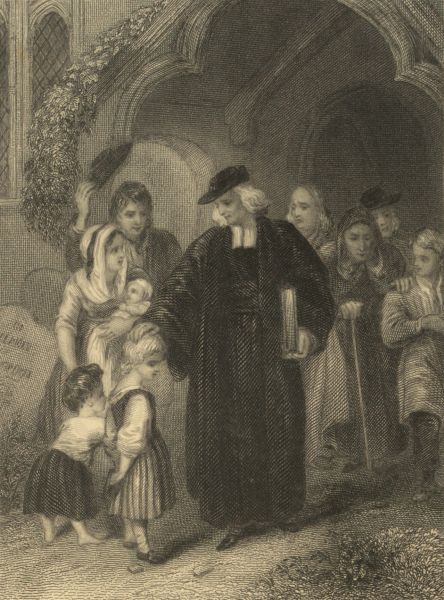
"HE STABLISHES THE STRONG, RESTORES THE WEAK, RECLAIMS THE WANDERER, BINDS THE BROKEN HEART"