THE WHITE PROPHET, VOLUME I (continued 6)
Reading edition
After a while he was brought back to himself by another burst of raucous laughter—the laughter of the servants inside the house—and at the next moment he saw a light running along the ground in the dark market-place below—the light of the trackers who were going off on the wrong scent, with a company of mounted police, in the direction taken by Hafiz.
CHAPTER XVI
Gordon left the Citadel unchallenged and unobserved, and in less than half-an-hour he was climbing the yellow road—white now in the moonlight—that goes up to the Mokattam Hills. By this time he was beginning to see the meaning of that night's experience. Unconsciously he had been putting Providence to the proof. Unwittingly he had been asking the fates to say if the path he had marked out for himself had been the right one when he had decided to follow Ishmael Ameer to Khartoum, to work by his side, and to come back at last when his sin had been forgiven and his redemption won.
Providence had decided in his favour. If destiny had determined that he should not leave Cairo he might have been taken a hundred times. Because he had not been taken it was clear to him that it was intended that he should go.
He had tried to see his mother, and if he could have done so he must have stayed with her at all hazards, since she was so ill and perhaps so near to death. He had tried to see Helena also, and if she had not gone to England already he must have clung to her at all costs and in spite of all consequences. On the other hand he had seen his father, and heard from his very lips that nothing—not even the liberty nor yet the life of his own son—could stand between him and his duty to the law.
What did it mean that he should be so cut off, so stripped naked, so deprived of his place as son and lover and soldier and man, that all that had hitherto stood to him as himself, as Gordon Lord, was gone? It meant that another existence was before him—another work, another mission. Destiny was carrying him away from his former life, and he had only to go forward without fear.
Thus once again on the heights of his great resolve he pushed on with a quick step, not daring to look back lest the sense of seeing things for the last time should be more than he could bear, lest the thought of leaving the city he loved, the people who loved him, his men and his brother officers, his mother and the memory of his happiness with Helena, his father and the consciousness of having wrecked the hopes of a lifetime, should drag him back at the last moment.
In the midst of these emotions he was startled by a loud, sharp voice that was without and not within him.
"Enta meen?" (Who are you?)
Then he realised that he had reached the fort on the top of the hill, and that the Egyptian sentry at the gate was challenging him. For a moment he stood speechless, trying in vain to remember the name by which he was henceforward to be known.
"Who are you?" cried the sentry again, and then Gordon answered—
"Omar."
"Omar—what?" cried the sentry.
Again Gordon was speechless for a moment.
"Answer!" cried the sentry, and he raised his rifle to his shoulder.
"Omar Benani the Bedouin," said Gordon at last, and then the sentry lowered his gun.
"Pass, Omar Benani. All's well!"
But Gordon had a still greater surprise awaiting him. As he was going on, he became aware that the Egyptian soldier was walking by his side and speaking in a low tone.
"Have they taken him?" he was saying.
"Taken whom?" asked Gordon.
"Our English brother—the Colonel—Colonel Lord. Have they arrested him?"
It was not at first that Gordon could command his voice to reply, but at length he said—
"Not yet—not when I came out of Cairo."
"El Hamdullillah!" (Praise be to God!) said the sentry, and then in a louder voice he cried—
"Peace to you, O brother!" Whereupon Gordon answered as well as he could for the thickening of his throat which seemed to stifle him—
"And to you!"
More sure than ever now that God's hand was leading him, he walked on with a quicker step than before, and presently he saw in the distance a dark group which he recognised as Osman and the camels.
"Allah be praised, you've come at last," whispered Osman.
He was a bright and intelligent young Egyptian, and for the last hour he had lived in a fever of alarm, thinking Gordon must have fallen into the hands of the police.
"They got wind that you were hiding at the Coptic Patriarch's house," he said, "and were only waiting for the permission of the Agency to raid it at eleven o'clock."
"I left it at ten," said Gordon.
"Thank God for that, sir," said Osman. "The Prophet must have taken a love for you to carry you off so soon. We must start away now, though," he whispered. "It's past twelve, and the village is fast asleep!"
"Is everything ready?" asked Gordon.
"Everything—water, biscuits, dates, durah, rifles——"
"Rifles?"
"Why not, sir? Two good Bedouin flintlocks. Even if we never have occasion to use them they'll help us to divert suspicion."
"Let us be off, then," said Gordon.
"Good," said Osman. "If we can only get away quietly our journey will be as white as milk."
In the shadow of a high wall the camels sat munching their food under their saddles covered with green cloth and decorated with fringes of cowries, and with their sahharahs (square boxes for provisions) hanging on either side. They were restive when they had to rise, and it was as much as Osman could do to keep them from grunting, being so fresh and so full of corn. But he held their mouths closed until they were on their feet, and then mounted his own camel by climbing on its neck. A moment afterwards the good creatures were gliding swiftly away into the obscurity of the night, with their upturned, steadfast faces, their noiseless tread, and swinging motion.
Both men were accustomed to camel-riding, and both knew the track before them, therefore they lost no time in getting under weigh. The first village was soon left behind, and as they came near to other hamlets the howling of dogs warned them of their danger, and they skirted round and quickened their pace.
A little beyond Helwan they came upon a Bedouin camp with its long, irregular, dark tents and an open fire around which a company of men sat talking, but Gordon pushed forward with his flintlock swung across his saddle-bow, while Osman, thinking to avoid suspicion, hung back for a moment to exchange news and greetings.
Then on and on they went, up and down the yellow hills, across sandy plains that were still warm with the heat of the day, and over rocky gorges that seemed to echo a hundred times to the softest footfall.
In less than three hours they were out on the open desert, lonely and grand, without a soul or yet a sound, save the faint thud of the camels' tread on the sand and the dice-like rattle of the cowries that hung from the saddles.
"Allah khalasna!" (God has delivered us!) said Osman at last, as he wiped the cold sweat of fear from his forehead.
But never for a moment had Gordon felt afraid. No more now than before did he know what fate was before him, but if a pillar of fire had appeared in the dark blue sky he could not have been more sure that—sinful man as he was—God's light was leading him.
He had fallen in the dark, but he was about to rise again. God's wrath had burnt against him, but he was soon to be forgiven. After the emotions and experiences of that night he knew of a certainty that the path he had chosen was the path which it was intended that he should take. Somewhere—he knew not where—and somehow—he knew not how—Heaven had uses for him still.
As he rode over the sandy waste it became fixed in his mind that, being rejected by all the world now, and stripped of everything that man holds dear, it was meant by God that he should offer his life in some great cause. That thought did not terrify him at all. It delighted and inspired him, and stirred every passion of the soldier in his soul.
To be, perhaps, a link between East and West, to carry the white man's burden into the black man's country for higher ends than greed of wealth or lust of empire, he would die, if need be, a thousand deaths.
How did he come to think of this as the fate before him? Who can know? Who can say? There are moments when man feels the influence of invisible powers which it is equally impossible to explain and to control. Such a moment was this to Gordon. He was flying away as a homeless fugitive, yet he was going with a full heart and a high resolve. Somewhere his great hour waited for him—he could only follow and obey.
But meanwhile there was nothing before him except the rolling waves of the desert, nothing about him except the silence of immensity, and nothing above him but the unclouded glory of the moon.
CHAPTER XVII
As midnight had struck on the soft cathedral-bell of the clock in Lady Nuneham's room the old lady had raised herself in bed and looked round with bright and joyful eyes.
"Fatimah!"
"Yes, my heart," said Fatimah, rising hurriedly from the chair in which she had been knitting and stopping up to the bedside.
"Has he gone, Fatimah?"
"Has who gone, O my lady?"
The bright eyes looked at the Egyptian woman with a reproving smile.
"Why, you know quite well, Fatimah. You saw him yourself, didn't you?"
"You mean his lordship?"
"No, no, but——"
The old lady paused, looked round again, and said—
"Can it be possible that you didn't see him, Fatimah?"
"See whom, my lady?"
"Why, Gordon."
Fatimah made an upward gesture with her hand.
"When, my heart?"
"Just now—not a moment ago."
Fatimah raised both hands and seemed for a moment unable to speak.
"He knocked at the door—I knew his knock immediately. Then he said outside, 'Don't be afraid'—I knew his voice too. And then he opened the door and came in, and I thought at first it was a Bedouin, for he wore Eastern clothes, but he whispered, 'Mother,' and it was Gordon himself."
"O my dear eyes, you have been dreaming," said Fatimah, whereupon the old lady looked reproachfully at her and said—
"How can you say that, Fatimah? I clasped my arms around his neck, and he put his arms about me and kissed me, and then——"
"Well?"
The old lady thought for a moment. "I think I must have fainted," she said. "I cannot remember what happened then."
"O my lady, O my heart, you have been sleeping for nearly an hour," said Fatimah.
"Sleeping?"
"Yes, but a little after eleven o'clock you were restless and threw out your arms and I covered them up again."
The joyful gleam had now gone from the old lady's eyes, and a troubled look had taken the place of it.
"Do you say that Gordon has not been here, Fatimah?"
"Alas, no, my lady."
"Has nobody been?"
"Nobody at all, my lady, since his lordship was up last."
"But I could have been sure that——"
She stopped; a smile crossed her bewildered face, and she said in a soft, indulgent voice—
"My poor Fatimah! I wear you out. I wear out everybody. You must have dozed off at that moment, and so——"
"Oh no, my lady, no! Wallahi! I've not closed my eyes since yesterday."
"How strange!"
"But Ibrahim ought to know if anybody has come upstairs. Should I call him, my lady?"
"Yes ... no ... that is to say ... wait!"
There was silence for a moment, and then, all the sweet illusion being gone, the old lady said in a sadder tone—
"Perhaps you are right, Fatimah. But it was so dear to think that ... Hush!"
She had heard her husband's footsteps on the stairs, and she began to straighten her lace cap with her delicate white fingers.
The Consul-General had gone through a heavy and trying day. In the morning he had received from the Secretary of State for Foreign Affairs a despatch which was couched in terms more caustic than had been addressed to him from London at any time during his forty years in Egypt. He had spent the night in dictating an answer to this Despatch, and his reply, though framed in diplomatic form, had been no less biting and severe.
Having finished his work in some warmth, he was now on his way to bed, and thinking of the humiliation to which he had been exposed in England by the late disturbance in Cairo, he was blaming his son for the worst of it. Every step of his heavy foot as he went upstairs was like a word or a blow against Gordon. It was Gordon who had encouraged the people to rebel; it was Gordon's name that was being used (because it was his own name also) by pestilent prattlers in Parliament to support the accusation that he had outraged (contrary to the best traditions of British rule) the religious instincts of an Eastern people; therefore it was Gordon who had poisoned the source of his authority in Egypt and the fount of his influence at home.
In this mood he entered his wife's room, and there Fatimah, who had been frightened for all her brave show of unbelief, fell at once to telling him of her mistress's delusion.
"But this is wrong of you, Janet—very, very wrong," said the Consul-General with a frown. "These visions and dreams are doing more than anything else to destroy your health, and they will kill you if you continue to encourage them. Gordon is gone. You must make up your mind to it."
"Is it quite certain that he is gone, dear?" said the old lady, who was now nervously plucking at the counterpane. "For instance, Fatimah told me to-day that there was a story in town——"
"Fatimah has no business to repeat such idle rumours," said the Consul-General sharply. He was walking to and fro in the room with a face that was hard and furrowed.
"As for the story you speak of, they sent it up to me as late as ten o'clock to-night, saying Gordon was being sheltered in a certain place, and asking what steps they were to take with respect to him."
The old lady fixed her frightened eyes on her husband's face and began to ask in a whisper—
"And what did you——"
"The rumour was groundless," said the Consul-General. "I've just heard so from the Commandant of Police. Gordon was not there. There was no sign that he ever had been."
The old lady wept silently, and the Consul-General continued to walk to and fro at the foot of her bed as if he were trying to avoid her face.
"You still think he left Cairo on the night of the riot, dear?"
"I trust he did. I trust, too, that he is far from here by this time—on his way to America, India, Australia, anywhere. And as he has broken the law, and his career is at an end, I think the kindest thing we can do is to hope that he may never come back again."
The old lady tried to speak but her voice failed her.
"More than that," continued the Consul-General, "as he deliberately took sides against us, I also think it is our duty—our strict and bounden duty—to dismiss all further thought of him."
Saying this with heat and emphasis, he caught sight of his wife's wet eyes and his conscience began to accuse him.
"I don't say it is easy to do," he said, taking a chair by the side of the bed. "Perhaps it is the reverse of easy—especially for you—for his mother."
At that the sweet old woman wished to take the part of her absent son—to say that if he had taken the wrong course, and allowed himself to be led away by some one, he could not have counted on any gain in doing so, and must have been moved by the most unselfish motives—but her tears prevented her, and still she could not speak.
"Why should we continue to think of him if he never thinks of us—of either of us?" asked the Consul-General.
He was calmer now, and was speaking with less anger.
"Was he thinking of you when he took the step which broke up your health like this? Was he thinking of me when he took the side of my enemies—of one of my enemies, at all events—perhaps the worst of them—and left me to the mercy of ... in my old age, too—a childless man?"
There was a moment in which nothing was spoken, and then in a voice that quivered perceptibly the Consul-General said—
"Let us trifle with ourselves no longer, Janet. Our son has gone. He has abandoned us. We have to think no more about him."
After that there was a long silence, during which the Consul-General sat with his head down and his eyes tightly closed. Then a voice came softly from the bed.
"John!"
"Well?"
"It is harder for you, dear."
The old man turned his head aside.
"You wanted a son so much, you know."
Fatimah, who had been sitting out of sight, now stepped into the boys' room and closed the door noiselessly behind her, leaving the two old people alone together with the sanctities of their married life, on which no other eye should look.
"I thought at first that God was not going to give me any children, but when my child came, and it was a boy, how happy we both were!"
The old man closed his eyes still more tightly and stiffened his iron lip.
"Foolish people used to think in those days that you didn't love our little one because you couldn't pay much heed to him. But Fatimah was telling me only to-night that you never went to bed without going into her room to see if it was well with our child."
The tears were now forcing themselves through the old man's eyelids.
"And when our dear boy had the fever, and he was so ill that we had to shave his little head, you never went to bed at all—not until the crisis came, and then—don't you remember?—just when we thought the wings of death were over us, he opened his beautiful blue eyes and smiled. I think that was the happiest moment of all our lives, dear."
She was on her husband's side at last—thinking for him—seeing everything from his point of view.
"Then all the years afterwards you worked so hard, and won such high honours and such a great name, only to leave them behind to our son, and now ... now——"
The Consul-General laid one of his wrinkled hands on the counterpane, and in a moment the old lady had put her delicate white hand over it.
"Yes, it's harder for you, dear."
"No, Janet, no! ... But it's hard for both of us."
There was another moment of silence, and then, pressing the hand that lay under her hand, the old lady said—
"I think I know now what people feel when they are old and their children die before them. They feel that they ought to be more to each other than they have ever been before, and keep together as long as they can."
The Consul-General drew his hand away and covered his face with it. He was asking himself why, through so many years, he had buried his love for his wife so deep in his heart and sealed it as with a seal. Presently a more cheerful voice came from the bed.
"John!"
"Yes!"
"I'm going to get up to-morrow."
"No, no!"
"But I must! Mohammed" (the cook) "is so forgetful when there's no mistress about—I must see that he gives you good food, you know. Besides, it must be lonely to eat your meals by yourself—I must make it a rule to go down to lunch at all events."
"That is nothing, Janet. You are weak and ill—the doctor will not permit you to disturb yourself."
There was a sigh, and then in a faltering voice the old lady said—
"You must forgive me, dear—I've not been what I ought to have been to you."
"No, Janet, no, it is I——"
He could not utter another word, but he rose to his feet, and, clasping his wife in his arms, he kissed her on her wrinkled forehead and her whitened hair more fervently than he had ever done in their youth.
At the next moment the old lady was speaking about Helena. The Consul-General would see her off in the morning, and he was to give all her motherly love to her. He was also to warn her to take good care of herself on the voyage, and not to be anxious or to repine.
"Tell her to remember what I said, dear. She is going back to England, but that doesn't matter in the least. God keeps all His promises, and He will keep His promise in this case too—I'm sure He will. Tell her that, dear."
The Consul-General answered "Yes" and "Yes" to all her messages, but he did not hear them. Bent almost double, with the light of his wearied eyes almost extinct, he stumbled out of the room. He was no longer angry with Gordon, but he was choking with hatred and scorn, and above all, with jealousy of the man who had robbed him of his son, the man who had robbed his wife of her only pride and joy, and left them, hopeless and old and lone.
At the door of his bedroom one of his secretaries was waiting for him with a paper in his hand.
"Well, well, what is it now?" he asked.
"An important telegram from, the Soudan, sir," said the secretary. "Ishmael Ameer has turned up in Khartoum."
Then the austere calm of the stern old man deserted him for a moment, and the pent-up agony of the broken and bankrupt hopes of a lifetime broke into a shout.
"Damn him! Damn him! Tell the Sirdar to kill him like a dog," he cried, and his secretary fled in a fright.
CHAPTER XVIII
Hours passed before the Consul-General slept. He was telling himself that there were now two reasons why he should suppress and destroy the man Ishmael Ameer.
First because "this madman, this fanatic, this false prophet," under the cloak of religion and the mantle of prophecy, was a cover for the corruption and the self-seeking which in the name and the guise of Nationalism were trying to drive England out of the valley of the Nile; because he was the rallying-point of the retrograde forces which were doing their best to destroy whatever seeds of civilisation had been implanted in the country during forty sleepless years; because he was trying to turn prosperity back to bankruptcy, order back to anarchy, and the helpless millions of the unmoving and the uncomplaining peasantry back to slavery and barbarity; because, in a word, he was the head centre of the schools and nurseries of sedition which were undoing the hard labour of his lifetime and striving to wipe his name out of Egypt as utterly as if he had never been.
This was the first of the Consul-General's two reasons why he should suppress and destroy Ishmael Ameer, and the second was still more personal and more intimate.
His second reason was because "this madman, this fanatic, this false prophet" had stepped in between him and the one hope of his life—the hope of founding a family. That hope had been a secret which he believed he had never betrayed to any one, not even to his wife, but all the more on that account it had been sweet and sacred. Born in a moment of fierce anger and in a spirit of revenge, it had grown to be his master passion. It had cheered his darkest hours, brightened his heaviest labour, exalted his drudgery into duty, given joy to his success, and wings to his patriotism itself.
That, at the end of his life of hard work, and as the reward and the crown of it, he should see the name he had made for himself among the great names of the British nation, and that his son should succeed to it, and his son's son, and his son's son's son, being all peers of the realm and all Nunehams—this had been the cherished aspiration of his soul.
But now his high-built hope was in the dust. By robbing him of his son—his only son—"this madman, this fanatic, this false prophet" had turned his one aim to ashes. When he was old, too, and his best powers were spent, and his life was behind him, and there was nothing before him but a few short years of failing strength and then—the end.
"Damn him! Damn him!" he cried again in the darkness as he rolled about in his bed.
But when he tried to think out some means, some swift and secret tribunal, perhaps, by which he could suppress and destroy the man Ishmael, who had laid waste his life and was joining with the worst elements in Egypt to make the government of the country impossible, he had to tell himself how powerless after all was the machinery of Western civilisation against the hypocritical machinations of Eastern fanaticism.
On the one side the clogs and impediments of representative government, and on the other the subtlety, secrecy, duplicity, and deceit of men like Ishmael Ameer. If he could only scotch these troubles once for all by a short and sharp military struggle—how different the results would be!
But with every act of his life watched from Whitehall, and with operations of frightful urgency kept back by cable; dogged by foreign diplomats who, professing to be England's friends, were yet waiting to find their opportunity in the hour of England's need; vilified by boobies in Parliament who did not know the difference between the East and the West, between the Mousky and the Mile End Road, and were constantly sending the echo of their parrot-like prattle down the Mediterranean to add to the difficulties of his position in Cairo; scolded by Secretaries of State who were appointed to their places for no better reason than their power to command votes; gibed at by journalists at home who could not see that a free press and a foreign occupation were things that could never exist together; and preached at by religious milksops in the pulpit who were so simple as to suppose that the black man and the white man were one flesh, that all men were born free and equal, and that it was possible to govern great nations according to the precepts of the Sermon on the Mount—what could he do against the religious delirium of an ignorant Eastern populace, who were capable of mistaking a manifest impostor, practising his spiritual legerdemain, for a Prophet, a Redeemer, a Mahdi, a Messiah, a Christ? Nothing!
He had found that out to his bitter disappointment during the past few days, when, working with Western machinery, he had tried in vain to catch the man Ishmael in some seditious expression that would enable the Government to lay him openly by the heels.
"Fools! Fools! Fools!"
Why could not people see that all this vapouring unrest in Eastern dominions was a religious question from first to last; that it was Islamism against Christianity, slavery against liberty, corruption against purity, the backwash of retrogression against the flowing tide of progress; and that to fight the secret methods of the mosque and the insidious crimes of a vicious superstition with any weapons less swift and sure than the rifle and the rope was to be weak and wicked.
"If I could only permit myself to meet Eastern needs by Eastern means," he thought, "intrigue by intrigue, subtlety by subtlety, secrecy by secrecy, duplicity by duplicity, treachery by treachery, deceit by deceit!"
"And why not?" he asked himself suddenly. "In a desperate case like this, why not? In the face of anarchical conspiracy and menace to public safety, why not? Before the catastrophe comes, why not?" he asked himself again and again during the long hours in which he lay awake.
"It is a case of civilisation on the one side and a return to barbarism on the other. Why not? Why not?"
And this, with the cruel memory of his wasted hopes, was the last thought present to his mind before he slept.
It was late when he awoke in the morning, and then, remembering that he had promised to call on Helena before her departure, he rang the bell that he might order his carriage to take him up to the Citadel. Ibrahim answered it, and brought him a number of letters. The first of them to come to hand was a letter from Helena herself. It was written with many signs of haste, and some of emotion, and it ran—
"DEAR LORD NUNEHAM,—Do not come up to see me off to-morrow morning, and please forgive me for all the unnecessary trouble I have given you. I cannot go back to England—I really cannot—it is impossible. There is nothing for me there but a useless and lonely life—oh, how lonely and how full of bitter and cruel memories!
"On the other hand there seems to be something I can do in Egypt, and though it is not the kind of work a woman would choose for herself I cannot and I will not shrink from it.
"To tell you the truth at once, I am on the point of taking the night train en route for Khartoum, but that is a secret which I am revealing to nobody else, so I beseech you to say nothing about it. I also beseech you not to follow me nor to send after me nor to inquire about me in any way, and lest the Sirdar and his officers should recognise me on my arrival in the Soudan (though I shall try to make it difficult for them to do so) I beg of you to ask them to forget that they have ever seen me before and to leave me entirely alone."
The Consul-General dropped the hand that held the letter and thought, "What on earth does the girl intend to do, I wonder?"
"You may ask me why I am going to Khartoum, and I find it hard to answer you, but you will remember that another person is reported to have gone there already, and perhaps you will put the two facts together. That person is neither your friend nor mine. He has wrecked my life and darkened your happiness. He has also been an evil influence in the country, and, thus far, you have tried in vain to punish him. Let me help you to do so. I can—I am sure I can—and before I have finished with the man who has injured both of us I shall have done some service to England and to Egypt as well.
"Don't think I am mad or that I am idly boasting, and please don't despise my help because I am only a woman. In the history of the world women have saved nations even when kings and armies have failed. And if that has happened in the past may it not happen in the future also? It can, and it shall."
Again the Consul-General dropped the hand that held the letter and he looked fixedly before him for a moment.
"Dear Lord Nuneham, I know what you are thinking. You are thinking that, if I am not mad and if I am not boasting, I am cruel and revengeful and vindictive. I am sorry if you are thinking that, sir, but if so I cannot help it. I have lost my father and I have lost Gordon, and I am alone and my heart is torn. Oh, if you knew how much this means to me you would not judge me too harshly. When I think of my father in his grave and of Gordon in disgrace—at the ends of the earth, perhaps—never to be seen or heard of any more—I feel that anything is justified—anything—that will punish the man who has brought things to this pass."
The Consul-General removed his spectacles, wiped away the moisture that had gathered on them, put them back, and resumed the reading of the letter.
"Sometimes I tell myself I might have saved Gordon if I had been less proud and hard—if I had told him more, and allowed him to feel that I could see things from his side also. But it is too late to think of that. I can think of nothing now but how to degrade and destroy the man who deceived and misled him, and is deceiving and misleading these poor Egyptian people also, and will end, as such men always end, in sowing the sand of their deserts with blood.
"But don't be afraid that I shall permit myself to do anything unwomanly, or that I shall ever be false for a moment to the love—the wronged and outraged love—which prompts me. Gordon is gone, I have lost him, but I can never do that—never!
"I know exactly how far I intend to go, and I shall go no farther. I also know exactly what I intend to do, and I shall do it without fear or remorse.
"Good-bye, or rather au revoir! You will hear from me or perhaps see me again before long, I think, and then—then your enemy and mine and Gordon's as well as England's and Egypt's will be in your hands.
"HELENA GRAVES.
"Please don't speak about this to Lady Nuneham. Give her my fondest, truest love, and let her believe that I have gone home to England. It would only make her unhappy to be told what I intend to do, and she might even think me a wicked woman. You will not think that, I hope—will you?"
The letter dropped on to the counterpane out of the Consul-General's hand, and again he looked fixedly before him. After a moment his wearied old eyes began to gleam with light and fire.
"What did I say when I saw her first?" he thought. "This girl has the blood of the great women of the Bible—the Deborahs who were mothers in Israel; aye, and the Jaels who avenged her."
END OF SECOND BOOK
THIRD BOOK
THE LIGHT OF THE WORLD
CHAPTER I
A mixed Eastern and Western city lying in the midst of a wide waste of grim desert, with a fierce sun blazing down on it by day and a rain of stars over it by night; a strip of verdure with slender palms and red and yellow blossoms, stretching for some three miles along the banks of the Nile, where the great river is cleft in twain as by the sweep of a giant's hand, and one branch goes up through the brown and yellow wilderness to the Abyssinian hills and the other to the lakes of the Equator—such is Khartoum.
The city had changed since Ishmael Ameer spent his youth there. Lifeless and vacant then, it had risen out of the dust of its own decay. On the river's front a line of Western buildings, a college, a barrack, and a palace over which the white crescent and the Union Jack crackled in the breeze together; at the back of these a great open market, with rows of booths and shanties, a native quarter with lines of mud-brick houses, and a handsome mosque; and behind all these an encampment of the tribes in tents, fronting an horizon of sand, empty and silent as the sea.
When Ishmael returned to the city of his boyhood British officials of the Anglo-Egyptian Government, wearing the Crescent on their pith helmets, were walking in the wide streets with Soudanese blacksmiths, Arab carpenters, and women of many races, some veiled in white, others in black, and yet others nearly naked of body as well as face. Two battalions of British soldiers, a British Sirdar, a British Inspector-General, and British Governors of provinces were there as signs and symbols of the change that had been wrought since Khartoum was shrivelled up in a blast of fire.
Ishmael's fame had gone before him, from Alexandria and from Cairo, and both the British and the native population of Khartoum looked for his coming with a keen curiosity. The British saw a man taller and more powerful than the common, with the fiery, flashing black eyes that they associated with their fears of the fanatic; but the natives, to their disappointment, recognised a face they knew, and they said among themselves, "Is not this Ishmael Ameer, the nephew of old Mahmud and the son of the boat-builder?" And that was a discovery which for a while dispelled some of the marvel as well as the mystery which had hitherto surrounded the new prophet's identity.
Ishmael made his home in his uncle's house on the fringe of the native quarter, a large Arab dwelling with one face to the desert and another to the white river and the forts of Omdurman. Besides the old uncle himself, now more than fourscore years, a God-fearing man devoted to his nephew, the household consisted of Ishmael's little daughter, Ayesha, a sweet child of ten, who sang quaint little Soudanese songs all day long, and had the animal grace of the gazelle; an Arab woman, Ayesha's nurse, Zenoba, a voluptuous person, with cheeks marked by three tribal slits, wearing massive gold ear-rings and hair twisted into innumerable thin ringlets; and Abdullah, a Soudanese servant, formerly a slave.
Before Ishmael had been long in Khartoum most of the British officials had made up their minds about his personal character. He was one of those complex beings whom they recognised as essentially Eastern—that mixture of hypocrisy and spirituality, of sincerity and quackery, which they believed to be most dangerous of all in its effects upon a fanatical populace. The natives, on the other hand, began to see that though a spontaneous and passionate man, outspoken and vehement in his dealings with the strong and the rich, he was very tender to the old and to the erring, that he was beloved of children, and trusted by the outcast and the poor.
Before many days had passed the Moslems of Khartoum asked him to lecture to them, and in the evenings he would sit on an angerib which Abdullah brought out of the house, with a palm net spread over it, and speak to the people who squatted on the ground about him. Clad in his white caftan and Mecca skull cap, with its white muslin turban bound round it, the British Inspectors would see him there, on the edge of the desert, surrounded by a multitude of Soudanese, brown and black, and of Arabs, olive and walnut, and holding his learners by the breathless intensity with which he uttered himself.
Yet he did not flatter them. On the contrary, no man had ever so condemned the evils which they had come to regard as part and parcel of their faith. All the Arab soul and blood of the man seemed to be afire, and his wonderful voice, throbbing over their heads far away to the silent desert beyond, carried such denunciations of the corruptions of Islam as the people had never heard before.
"Beware of slavery," he said. "What says the Koran? 'Righteousness is to him who freeth the slave.' Beware of sorcery, of spells, of magic, of divinations—they are of the devil."
Teaching like this might drive away the dominant races but it drew the subject ones, and among others that attached themselves to Ishmael was a half-witted Nubian (an Ethiopian of the Bible), known as Black Zogal, who from that time forward followed him about by day and lay like a dog at the door of his house by night, crying the confession of faith at the end of every hour.
After condemning slavery and sorcery Ishmael came to closer quarters—he denounced polygamy and divorce.
"Beware of polygamy," he said. "It pulls down the pillars of the house. No man would permit another man to join with him in love for his wife. Why, therefore, ask a woman to allow another woman to join with her in love for her husband?
"Beware of divorce, for it brings sorrow and shame. What says the Prophet (to him be prayer and peace)? 'Of all lawful things hated of God, divorce is the most hateful.'
"Brothers," he cried, "I see a house that is full of light. There is a new wife there. She is very happy. But in the upper rooms I hear children weeping. They are weeping for their mother who has been put away. She has done no wrong, she has committed no crime, but while the guests feast and the new wife counts her jewels, the mother's heart is bleeding for the children she may see no more.
"O men," he cried again in his throbbing voice, "night is for sleep, and your children slumber, but in their dreams their mother comes to them. She embraces them and they dry their tears. But they awake in the morning and she is gone. Where is your father's heart, O ye men of righteousness? Has all justice died out of you? Shame on you! May Heaven punish you as you deserve! Divorce shakes the throne of Islam! Wipe it out, that your faces may be whitened before the world!"
After condemning polygamy and divorce, Ishmael came to closer quarters still—he denounced the seclusion and the degradation of women.
"Remove the veil from your women," he said. "At the beginning it was the badge of shame. What says the Koran? 'O Prophet, speak to thy wives and thy daughters that they let their wrappers fall so that they may not be affronted.'
"Dismiss the madness of a bygone age that woman is inferior to man. We are all children of one mother. What says the Prophet? 'Paradise lies under the feet of mothers.' The proverb of our people says, 'The threshold weeps for forty days when a girl is born,' but I tell you the stars sing for joy and the dry wells of the desert spring afresh. Man's dominion over woman is the product of darkness—put it away. O my brothers, woman's suffering in the world is so great that if she does not cry aloud the mountains themselves will groan."
If Ishmael's teaching offended certain of the men, it attracted great multitudes of the women, many of whom laid aside their veils to come to him, and among others that came were a number of black girls from Omdurman who were known to have been the paramours of British and Egyptian soldiers at Khartoum. His bearing towards these girls had that shy tenderness which is peculiar to the pure-minded man in his dealings with erring women, and when some of his followers grumbled at his intercourse with such notorious sinners he told them a story of the Lord Isa (Jesus).
It was the story of His visit to the rich man's house, and of the sinful woman who did not cease to wash His feet with her tears and to dry them with the hair of her head.
"Shall I be less charitable than the Lord of the Christians?" he asked, and the choking pathos of his story silenced everybody.
In his preaching he turned for ever to the prophets—the prophet Abraham, the prophet Moses, the prophet Mohammed, and above all, the prophet Isa. He called Jesus the divine teacher of Judæa, one of the great brother souls.
"Only a poor Jewish man," he said, with a memory of his own that none might share, "only a poor carpenter, but perhaps the greatest and noblest spirit save one that ever lived in the world."
Thus, evening after evening, when the blazing sun had gone down, Ishmael sat on the angerib in front of his uncle's house and taught the ever-increasing crowds that squatted before him on the brown and yellow sand. The heat and flame of his teaching burnt itself into the wild Arab souls of the great body of his hearers, but there were some among his own people who asked—
"Is not this the Ishmael Ameer who denounced the Christians as the corrupters of our faith?"
And there were others who answered—
"Yes, the same Ishmael Ameer that married the Coptic woman who lies buried on the edge of the desert."
And meantime the British Inspectors, suspecting some hidden quackery and fatuity, some fanatical intrigue masquerading as religious liberalism, were whispering among themselves—
"This is a new kind of religious game—what the deuce does it mean, I wonder?"
CHAPTER II
Within a month an immense concourse of people had gathered about Ishmael at Khartoum. They came first from Omdurman and the little shipbuilding village of Khogali, on the other side of the Blue Nile, which sent daily through the desert air a ceaseless noise of the hammering of rivets; then they came from Kordofan and still farther south, and from Berber and yet farther north.
A few who had means lodged in the houses of the native quarter, but the larger number encamped in tents on the desert side of old Mahmud's house. Men, women, and children, they flocked in thousands to see the holy man of Khartoum and to drink of the river of his words. They began to see in him a man sent from God, to call him "Master," and to speak of him as the "White Prophet."
At that the Governor of the city, a British Colonel, began to be alarmed, and with certain of his Inspectors he went over to see Ishmael.
"What can these people want here?" he asked. "What bread is there for them in this wilderness?"
"The bread of life," Ishmael answered, and the Christian Governor went away silenced though unsatisfied.
During Ishmael's first weeks in Khartoum his house was open, and anybody might come and go in it; but somewhat later it was observed that he was daily receiving messengers, agents, emissaries, and missionaries of some sort in secret. They came and went by camel, by boat, and by train, and rumour had it that they communicated with every quarter of Egypt and the Soudan. Ishmael appeared to spend the morning of every day in his house receiving and dispatching these people. What did it mean? The British Inspectors suspected the existence of a vast network of fanatical conspiracy, but only the members of Ishmael's own household knew what was going on.
Meantime at noon every day Ishmael, exercising his right as an Alim, lectured in the mosque. What he said in that sealed chamber no Christian might know, and never an echo of his message there was permitted to escape from its hushed and guarded vaults. But still after sunset he sat on the angerib in front of his uncle's house and taught the excited crowds that were eager to catch a word of his inspired doctrine.
His lectures took a new subject. They denounced the spirit of the age. It was irreligious, for it put a premium on selfishness. It was idolatrous, for it provoked to the worship of wealth.
"O my brothers," cried Ishmael, "when Mohammed (to him be prayer and peace) arose in Mecca, men worshipped the black wooden idols of the Koreish. To his earnest soul this was a darkness, a mockery, an abomination. There was only one god, and that was God. God was great, and there was nothing else great. Therefore he went out from Mecca that he might gather strength to assail the black wooden idols of the Koreish, and when he returned he broke them in pieces.
"That was thirteen centuries ago, O my brothers, and behold, darkness covers the earth again. Men are now worshipping the yellow idols of a corrupt civilisation. Moslems and Christians alike are bending the knee to the golden calf. It is idolatry as rank as the Prophet destroyed, and tenfold more damnable because it is done in the name of God."
With that, he called on his people to renounce the things of this world. Its prizes were not the prizes that could enrich them. Time and its shows rested on eternity. The things of the other world were the only true realities. Why struggle for the semblance and form of things and neglect the substance and essence? This poor earth of ours was the threshold of heaven—let them forget the affairs of this life and fix their minds on the life to come.
The people listened to Ishmael with bated breath. Ignorant, unlettered, wild creatures as they were, sons and daughters of the desert, they knew what application of his words they were intended to make.
But the authorities were perplexed. Just as sure as ever of the presence of a far-reaching fanatical conspiracy, and that Ishmael's teaching meant opposition to the Government, some of them said—
"This is the doctrine of the Mahdi, and it will end as it ended before, in destruction and desolation—let us put it down before the storm breaks."
But others said—
"It is the Gospel of Christ—what the dickens are we to do with it?"
Meantime Ishmael's own people had begun to see him not as a poet, a dreamer, but as a prophet with a mighty mission. In moments of rapture he told them of a new order that was coming, a great day when all the religions of the world would be united, when all faiths would be one faith, all races one race, all nations one nation, when East and West would be one world, and there would be only one God in it, one King and one Law.
They saw him with tears in his eyes looking over the desert as he foretold the conquest of the world for God, and listening eagerly to his predictions of a better and happier day, they began to see something God-like in himself, to regard him as a God-inspired man, a man sent down from the skies with a message.
"Our souls lie beneath his sheepskin," they would say, and then they would tell each other stories of supernatural appearances that surrounded the new prophet—how while he preached celestial lights floated about his head, and when he rode on his milk-white camel into the desert of an afternoon, as it was his habit to do, flights of angels were seen to descend and attend him.
The creation of this kind of myth led to trouble, for among Ishmael's secret enemies were certain of the Ulema of Khartoum, who, jealous of his great influence with the people, and suspecting him of an attempt to change the immutable law of Islam, conceived the trick of getting him to avow himself as a re-incarnation of the Mahdi in order that they might betray him to the Government. So three of the meanest of them came one morning to old Mahmud's house, and sitting in the guest-room, under its thatch of corn-stalks, began to flatter Ishmael and say—
"From the moment we beheld thee we knew that thou wert the messenger of God—the Expected One."
"Yes, indeed, Mohammed Ahmed is dead but Ishmael Ameer is alive!"
Ishmael listened to them for a moment in silence, and then with a flash of fire out of his big eyes he clapped his hands and cried—
"Zogal! Abdullah! Turn these men out of the house," and in another moment his two black giants had swept out the spies like rats.
But the crowds continued to come to Khartoum from north, south, east and west, and at length, in fear that many might die of want, the Governor of the city went up to Ishmael and said—
"Send these people back to their homes or they'll die of starvation."
Whereupon Ishmael looked at him and answered—
"Colonel, you are a Christian, and when your Divine Master was on earth a great multitude came to Him in a desert place, and His disciples said, 'Send these people away that they may return to their villages and buy themselves food.' And then your Master answered them, 'They need not depart. Give ye them to eat.'"
Thus Ishmael was irresistible. There was nothing and nobody that seemed to have the power to touch him.
CHAPTER III
"To every sun its moon—to every man a woman." Wise and powerful as Ishmael was, people began to whisper that there was a woman who ruled him. He submitted everything to her judgment, and was guided and even governed by her counsel.
Who was this woman? A Soudanese? No! An Egyptian? No! Rumour had it that she was a stranger, totally unknown to Ishmael down to the moment of his coming back to the Soudan—a Muslemah (Mohammedan lady) from India, the sister of a reigning prince of the Punjab, who having been educated under British rule, and therefore Western influences, had revolted against the captivity of the zenana, and broken away from her own people.
Attracted by the fame of the new prophet as an emancipator of women and a reformer of bad Mohammedan customs, this woman had, according to report, followed him from Alexandria and Cairo to Khartoum, where she had settled herself, with a black boy as her servant, at the house of the Greek widow—the same who had formerly been the mistress of Ishmael's first wife, Adila.
The black boy called his mistress "the Lady," and most of the people about her knew her by the same name, but some called her the Sitt-el-beda, the Khatoun (the White Lady), and others the Emirah, and the Rani (the Princess, the Queen), in recognition of what they believed to be her rank and wealth.
It was in the early days of Ishmael's return to Khartoum, when women of all classes were coming to him unveiled, that he met with "the Princess" first. Sitting alone in the late afternoon on the bank of a broad stretch of land which was flooded by the high Nile, and looking across its glistening waters to where the sky was red behind the shattered dome of the Mahdi's tomb in Omdurman, he saw a young and beautiful woman approaching him.
She seemed to him to be a splendid creature under those southern skies—tall, well developed, with shining coal-black hair, long black lashes and brilliant eyes, and a mouth that was full of fire and movement. Her dress was such as is worn by Parsee ladies both in the East and in the West, having nothing more noticeably Oriental than a silken scarf which was bound about her head as a turban and a light, silver-edged muslin veil that fell back on her shoulders.
She came up to him with a certain air of timidity, as of one who might be afraid to be thought immodest or perhaps of being recognised, yet with the proud bearing of a woman who had passed through life with a high step and would not shrink from any consequences.
He rose to receive her, and she looked at him for a moment without speaking—almost as if she had for an instant lost the power of speech, being at last face to face with a man whom she had long thought of and long sought.
On his side, too, there was a momentary silence and a look of enthusiastic admiration which he tried in vain to control. The lady seemed to see this in an instant, and an expression of joy which she could not restrain shone in her face.
Then, gathering confidence, she began to tell him the object of her visit to Khartoum—how, hearing so much about him, she had wished to see him for herself, and now begged to be allowed to serve him in any way whatever that lay within her power.
He listened to her with the same expression of enthusiastic admiration in his face, and it would have been obvious to an observer that the lady was congratulating herself upon the power of the impression she had made. But at the next moment he set her a very humble task, namely that of seeing to the welfare of the women who were employed at sixpence a day by the Government to draw and carry water for the public streets.
The lady looked surprised and a little chagrined, but finding it impossible to recede from the unconditional offer she had made she went away to the work that had been given to her.
It was ugly and thankless work enough, for the water-women of Khartoum were among the coarsest and most degraded of their sex, being chiefly of the black tribes from south of Kordofan, going about bare from the waist upwards and herding like animals in the brown huts that were beyond the barracks outside the town.
After a little while "the Princess" came to Ishmael again, and this time he was sitting with old Mahmud, his uncle, in the guest-room which divided the women's side from the men's side in their house.
She was dressed still more attractively than before, in a gold-embroidered bodice and a clinging diaphanous gown, and was attended by her black boy. Ishmael salaamed and the old man struggled to his feet as, with a certain air of embarrassment, she stepped forward and begged to be pardoned if what she came to ask should displease the Master.
Ishmael looked at her with the same expression of enthusiastic ecstasy which she had observed before, and said—
"No, no, my sister cannot displease me. What is the request she wishes to make?"
Then she told him that the work he had given her was good and necessary, but was there nothing she could do for himself? She had been educated in India by English governesses and could read English, French, and German—could she act as his translator or interpreter? Having lived so long among Arabs of the higher classes she had also taught herself to write as well as speak Arabic—could she not serve him as his secretary?
Ishmael remembered his busy mornings with the messengers, agents, emissaries, and missionaries who came to him from all corners of Egypt and the Soudan, bringing many letters and foreign newspapers; and before he had time to reflect on what he was doing, he had answered—
"Yes, such help is exactly what I need."
If any eyes less dim than old Mahmud's had been there at that moment they would have seen a look of triumph in the lady's face which she vainly struggled to conceal. But at the next moment it was full of humility and gratitude as she bowed herself out and promised to come again the following day.
Hardly had the lady gone when Ishmael's simple nature began to recover itself from the spell of her sex and beauty, but the old uncle's admiration was quite ungovernable, and he began to hint at the possibility of yet more intimate relations between his nephew and the devoted young Muslemah.
"I have always told you that you ought to marry again, a good woman and a believer," he said; whereupon Ishmael, with the ecstasy created by "the Princess's" loveliness still shining in his eyes, answered—
"No! I have always said, 'No, no, by Allah! One wife I had, and though she was a Christian and had been a slave I loved her, and never, never shall another woman take her place.'"
"Ah, well, God knows best what to do with us," said the old man. "But life is a passing shadow and youth a departing guest."
Next morning the white lady came according to appointment, and Ishmael set her to read some European newspapers containing accounts of recent doings in Cairo.
She was translating these newspapers aloud when Ishmael's little daughter Ayesha came bounding into the house, followed by her nurse, the Arab woman Zenoba—the child barefoot as her mother used to be, and with her mother's beautiful, erect confidence as she moved about, lightly clad, with her middle small-girt by a scarlet sash over her pure white shirt—the woman in her blue habarah and with a silver ring in her nose.
Ishmael presented both of them to the lady, whereupon the child, by an instinctive impulse, ran over to her and kissed her hand and held it, but the Arab woman only bowed with a look of suspicion, and, as long as she remained in the guest-room, continued to watch out of the sidelong slits of her eyes.
The Arab woman's obvious mistrust made more impression upon Ishmael than his daughter's spontaneous liking, for as soon as he was alone with the lady again he began to talk to her of the gravity of the task he had undertaken, and of the need for caution and even secrecy with respect to all his doings.
The lady's brilliant eyes glistened under their long black lashes as she listened to him, and she answered his warnings with assuring words, until, coming to closer quarters, he proposed that for his people's sake rather than his own she should take an oath of fidelity to him and to his cause.
At that she looked startled, and could with difficulty conceal her agitation. And when he went on to recite the terms of the oath to her—solemn terms, taking God and His prophet to witness that she would never reveal anything which came to her knowledge within the walls of that house—she seemed to be stifling with a sense of fear or shame.
Not as such, however, did Ishmael's unsuspecting nature recognise the lady's embarrassment, but setting it down to the heat of the day, for the khamseen, the hot wind, was blowing, he clapped his hands for water.
The Arab woman brought it in, although it was Abdullah's task to do so, and she lingered long in the room, and looked searchingly at the lady while Ishmael again recited his oath.
The lady did not at first respond, but continued to look out at the open door on to the slow waters of the White Nile, and there was silence in the air both within and without, save for the far-off hammering from the dockyards across the river.
At length she asked in a tremulous voice—
"Master, is this necessary?"
Ishmael reflected for a moment and then said—
"No, it is not necessary, and we shall do without it. What says the Lord of the Christians? 'Swear not at all; neither by heaven, for it is God's throne; nor by the earth, for it is His footstool.'"
The lady drew a long breath of relief and went on with her foreign newspapers.
CHAPTER IV
Hardly had "the Princess" gone for the day when the Arab woman, Zenoba, with all her dusky face contracted into lines of jealousy, came to Ishmael to warn him.
"Forgive me, O Master," she said, "if the thing I say displeases you."
"What is it, O Zenoba?" asked Ishmael.
"Is it well to trust the secrets of God and of His people to two tongues and four eyes?"
Ishmael's face darkened visibly, but he held himself in check and answered with dignity—
"Zenoba, ask pardon of God for a suspicious mind. The least of all noble traits is to keep a secret, the greatest is to forget that you have confided it."
The Arab woman was stung by the rebuke, but assuming the meekest expression of face she changed her course entirely.
"Master, I beg of you to listen to me until I have done," she said, and then she began to talk of the visits of the white lady.
The lady was young and beautiful. Evil minds were many. If she were to come to Ishmael's house every day and to be closeted alone with him, what would people say?
"Forgive me, O Master; it is nothing to me, and I have no right to speak," said the Arab woman, with the agony of a jealous spirit imprinted on every feature of her face. "I only wish to put you on your guard against the slanderous tongues that would love to injure you."
Ishmael listened to her with the look of a man who had never once reflected on the interpretation that might be put upon his conduct, and then he said—
"You are right, O Zenoba, and I thank you for reminding me of something I had permitted myself to forget."
When the white lady came next day, Ishmael began to speak to her about her position in his house.
"My sister," he said, "I have been thinking this is not good. The thoughts of the world are evil, and if you continue to come here according to the agreement we made together your pure name will be tarnished."
The lady's brows contracted slightly, for it flashed upon her that Ishmael was about to send her away. But that was not his intention, and in the winding way of Eastern explanations he proceeded to propound his plan.
"When the Prophet (to him be prayer and peace) lost his first wife, Khadija, the mother of Islam, and took a second wife, it was a widow, well stricken in years and without wealth or beauty. Why did the Prophet marry her? That he might care for her and protect her and shield her from every ill."
The lady looked on the ground and listened. A strange sensation of joy mingled with fear took possession of her, for she saw what Ishmael was going to say.
"If the Prophet did this for her who was so far removed from the slanders of evil tongues, shall not his servant do as much for one who is young and beautiful?"
The lady's head began to swim, and the ground to sway under her feet as if she were at sea on a rolling ship, but Ishmael saw nothing in her agitation but modesty, and he went on in a soft voice to tell her what he wished to do.
He wished to marry her, that is to say, to betroth himself to her, to make her his wife, his spiritual wife, his wife in name only—never to be claimed of him as a husband, for, besides his consecration to the great task he had undertaken for God, there was a vow he had made to the memory of one who was dead, and both forbade him ever to think again of the joys of the life of a man.
The lady was now totally unable to conceal her agitation, and taking out her handkerchief she kept running her trembling fingers along the hem. She was asking herself what she could do, how she could reply, for she could plainly see that the Oriental in Ishmael had never for one instant allowed him to think that if he were willing to give her the protection of his name she could have any possible objection.
It was the still hour of noon, and, pale with fear, she sat silent for a moment looking into the palpitating air that floated over the glistening waters of the Nile. Then assuming, as well as she could, an expression of humility and confusion, she said, while her heart was beating violently—
"Master, it is too much honour—I can hardly think of it."
He could see by her face how hard she fought with herself, but still taking her agitation for maidenly modesty, he dropped his voice and whispered—
"Do not decide at once. Wait a little. Go away now, and think of what I have said."
He held out his hand to help her to her feet, and she went off with an unsteady step, first stopping, then going quickly, as if she had an impulse to speak again and could not do so, because of the feeling, akin to terror, which seemed to stifle her.
If any one, following the white lady to her lodging in the Greek widow's house, had been able to look into the depths of her soul, he would have found a tragic struggle going on there. A score of conflicting voices were clamouring to be heard at once. "What am I doing?" "Where am I?" "Am I myself or some one else?" "Don't take on this fearful responsibility to such a man." "But I must do so, or I can do nothing." "I must go on or else go back." "But isn't this going too far?" "Nonsense, this is no marriage; it is merely a nominal union—a betrothal. I shall only be his wife pro forma. According to an alien faith, too, a faith that does not bind my conscience." "It must be done—it shall!"
When the white lady returned to Ishmael's house on the following day it was with a firm, decided step, as if she were lifted up and sustained by some invisible power. With a strange light in her eyes and an expression in her face that he had never seen there before, she told him that she agreed to his proposal.
He received her consent with a glad cry, and clapping his hands to summon his household he announced the good news to them with a bright look and a happy voice.
The old uncle was overjoyed, and little Ayesha leapt into the lady's arms and kissed her, but Zenoba, with a face full of confusion, drew Ishmael aside and began to stammer out objections and difficulties. The house was small, there was no separate room for the white lady. Then, her black boy—there was not even a corner that could be occupied by him.
"Put the Rani in the room with the child, and let the boy sleep on the mat at her door," said Ishmael, and without more ado he went on to make arrangements for the wedding.
The arrangements were few, for Ishmael determined that the marriage should be concluded immediately and conducted without any kind of pomp. But in order that all his world might know what he was doing he invited the Cadi of Khartoum to make the contract, and then, having sent the lady to her lodging, he set out to fetch her back on the milk-white camel he usually rode himself.
It was Sunday, and the sun had gone down in a blaze of red as he walked by the camel's side through the native quarter of the town with the white lady, the Rani, the Princess, wearing a gold-edged muslin shawl over her head and descending to her shoulders, riding on the crimson saddle fringed with cowries.
By the time they reached old Mahmud's house it was full of guests in wedding garments, and gorgeous with crimson curtains hanging over all the walls, and illuminated by countless lamps both large and small.
But the ceremony was of the simplest.
First, the Fatihah (the first chapter of the Koran) recited by the whole company standing, and then the bride and bridegroom sitting on the ground, face to face, grasping each other's hands.
Down to this moment the white lady had been sustained by the same invisible power, as if clad in an impenetrable armour of defiance which no emotion could pierce; but when the Cadi stepped forward and placed a handkerchief over the clasped hands and began to say some words of prayer, she felt faint and could scarcely breathe.
With a struggle, nevertheless, she recovered herself when the Cadi, leaning over her, told her in a low voice to repeat after him the words that he should speak.
"I betroth myself to thee—to serve thee and to submit to thee——"
"I betroth myself to thee ... to serve ... to serve thee ... and to ... to submit to thee——"
With an effort she got the words spoken, feeling numb at her heart and with a sense of darkness coming over her, but being spurred at last by sight of the Arab woman's glittering eyes watching her intently.
But when the Cadi turned from her to Ishmael, and the bridegroom, in his throbbing voice, said loudly—
"And I accept thy betrothal and take thee under my care, and bind myself to afford thee my protection, as ye who are here bear witness," she felt as if the tempest of darkness had overwhelmed her and she were falling, falling, falling into a bottomless abyss.
When the lady came to herself again the Arab woman was holding a dish of water to her mouth, and her own black boy, with big tears like beads dropping out of his eyes, was fanning her with a fan of ostrich feathers.
But now the people, who had been saying among themselves, in astonishment at such maimed rites, "Is this a widow or a divorced woman?" being determined not to be done out of such marriage fêtes as they considered only decent, had begun to gather in front of the house, the men in their brown skull-caps and blue galabeahs, the married women in their black silk habarahs with silver rings in their noses, and the unmarried girls in their white scarves with coins in their hair and with big silver anklets.
And while the Sheikhs and Notables within, sitting on the dikkahs around the guest-room, listened to a blind man's chanting of the Koran, the peasant people, squatting on the sand, under the stars, employed themselves after their own fashion with the beating of drums, big and little, the playing of pipes, and the singing of love-songs. And through and among them as they huddled together, with their faces to the illuminated house of joy, and both the bride and the bridegroom before them, a water-carrier, a sakka, went about with his water-skin and a brass cup, distributing drinks of water; a girl, with jingling jewels, squirted scent; and Abdullah and Black Zogal, showing their shining white teeth in their happiness and pride, handed round sweetmeats and cups of thick coffee.
Meantime the white lady sat, with her flushed face uncovered and her gold-edged veil thrown back, where Ishmael had placed her, near to the threshold, in order that, contrary to bad custom, the people might see her, and the child, with its sweet olive-brown face, sat by her side, almost on her lap, amusing herself by holding her hand and drawing off and putting on a beautiful diamond ring which she wore on the third finger of her left hand.
This innocent action of the sweet child seemed to torture the lady at certain moments, and never more than when one of the male singers, sitting close beneath her, sang a camel-boy's song of love. He was far away on the desert, but the soft eyes of the gazelle recalled the timid looks of his beloved. And when he reached the oasis in the midst of the wilderness the song of the bird in the date-tree brought back the voice of his darling.
As soon as the singer finished, the women on the ground made their shrill, quavering cry of joy, the zaghareet, and then the white lady drew her hand away from the child with an abrupt and almost angry gesture.
After that, she sat for a long hour without stirring, merely gazing out on the people in front of the house as if she saw and comprehended nothing. A taste of bitterness was in her mouth, and as often as she was recalled to herself by some question addressed to her she looked as if she wished to disappear from sight altogether.
At length she thought her torture was at an end, for the Cadi rose and said in a loud voice—
"If your friend is sweet do not eat him up," whereupon the tom-toms were silenced and with a laugh everybody rose, and then, all standing, the whole company chanted the Fatihah—
"Praise be to God, the Lord of all creatures, the most merciful, the King of the Day of Judgment. Thee do we worship and of Thee do we beg assistance. Direct us in the right way, in the way of those to whom Thou hast been gracious; not of those against whom Thou art incensed, nor of those who go astray."
The solemn words died away like a receding wave on the outskirts of the crowd, and then the people broke up and went back to their houses and tents, leaving Ishmael and his household together. A little later the household also separated for the night, the child, now very sleepy, being carried to bed by her nurse, and old Mahmud shuffling off to his room after saying to the white lady—
"An old man's blessing can do you no harm, my daughter, therefore God bless you and bring you joyful increase."
The white lady was now alone with Ishmael, and her agitation increased tenfold.
"Let us sit again for a while," he said in a soft voice, and leading her to one of the wooden benches, covered with carpet, which faced the open front of the house, he placed himself beside her.
There the moon was on their faces, and from time to time there was a silvery rain of southern stars. They sat for a while in silence, she with a sense of shame, he with a momentary thrill of passion that came up from the place where he was no longer a prophet but a man.
She felt that he was trying to look into her face with his lustrous black eyes, and she wished to turn away from him. This brought the hot colour of blood into her cheeks, and only made her the more beautiful.
A sense of physical fear began to take possession of her, and a storm of thoughts and memories came in rapid succession. She could not express even to her own mind the intricacies of her emotions. This man was an Oriental, and she believed him to be capable of treachery and guilty of violence. Yet she was his wife, according to his own view, and what at this moment, when they were alone, was the worth of the pledge whereby she (for her own purposes) had consented to be his wife in name only, his betrothed!
Her nervousness increased every moment. When he touched her arm she recoiled slightly and felt her skin creep. He seemed to be conscious of this, for he sat by her side a little longer without speaking.
The silence of night was on the desert and along the moon-track across the river, as far as to the ruined dome of the Mahdi's tomb, which seemed so threatening and so near.
At length in a soft voice he said, "Come," and held out his hand to help her to rise.
She rose, trembling all over with fright and a sort of physical humiliation—she who had always been so proud, so strong, so brave.
He led her to the women's side of the house, without speaking a word until they got there, and then, almost in a whisper, he said—
"You sleep here with little Ayesha. May your night be happy and your morning good!"
She looked up at him as he recommended her to God, and was amazed at the calm, luminous face that now met her own. At the next moment he was gone.
It was an immense relief to find herself in her bedroom, where a little open lamp was burning, and there was no sound but the soft and measured breathing of the child, who was asleep in bed.
At the first moment the sleeping child was like a great protector, but when she became calmer, and began to think of this, she felt the more ashamed.
"What impossible, terrible thing has happened?" she thought, and then she asked herself again, "Am I really myself or some one else?"
"Oh, what have I done?" she thought, and a sense of sin took possession of her, which was almost like that which a good woman feels when she has committed adultery.
"It is terrible, but it is inevitable," she thought, and then she fought against the sentiment of shame which oppressed her, by telling herself that Ishmael was a crafty hypocrite, whose soft words were a sham, whose religion was a lie, whose wicked deeds deserved punishment at any price whatever.
"But no, I cannot think of that now," she thought, and after a while she turned the light bedclothes aside, and putting out the lamp, got into bed by the side of the child, who was smelling sweet with the soft odours of sleep.
She lay a long time motionless, with her eyes open, and still the horror of what she had done weighed on her like a nightmare. Then she covered her eyes with her hands, and the image of another filled her with emotions that were at once sweet and bitter. With a woman's sense of injustice she was blaming the absent one for the position of shame in which she found herself.
"Why did he choose this man instead of me?" she thought, and then, at last, in the fiercest fire of jealousy and hatred, weeping bitter tears in the darkness, she reconciled her tormented conscience to everything she had done, everything she intended to do, by saying to herself with quivering lips—
"He killed my father!"
At that moment she was startled by a voice outside that broke sharp and harsh upon the silence of the night—
"There is no god but God! There is no god but God!"
It was Black Zogal, the half-witted Nubian, crying the confession of faith at the door of Ishmael's house.
The Lady, the White Lady, the Rani, the Princess, was Helena Graves.
CHAPTER V
While Ishmael's followers had been squatting on the sands to celebrate his betrothal the Sirdar had been having a dinner-party in the Palace, composed of the chief officers of his military government and the cream of the British society at Khartoum.
Towards ten o'clock the large after-dinner group of ladies in low-cut corsage, showing white arms and shoulders, and officers in full-dress uniform, had come out on the terrace with its open arches and its handsome steps sweeping down to the silent garden.
Below were the broad lawns, the mimosa trees filling the night air with perfume, the trembling sycamores and the tall dates, sleeping under the great deep heaven with its stars. Behind was the lamp-lit palace, from which native servants in gold-embroidered crimson were carrying silver trays laden with decanters and glasses and small cups and saucers.
It was almost the spot on which "the martyr of the Soudan" fell under the lances of the dervishes, yet one of the Sirdar's servants, Abdullahi, with three cross-cuts on his cheeks, his tribal mark as a son of the bloodthirsty Baggara, and with the pleasantest of smiles on his walnut-coloured face, was drawing corks, pouring out whisky and soda-water, and striking matches to light the men's cigarettes.
The company was full of the gaiety and animation which comes after a pleasant dinner, with a little of the excitement which follows when people have partaken of wine. The eyes of the ladies sparkled and the faces of the men smiled, and both talked freely and laughed a good deal.
The conversation was made up of trifles until one of the ladies—it was the wife of the Governor of the city, clad in the lightest of lace-chiffon gowns and wearing yellow satin slippers—inquired the meaning of the sounds of rejoicing, the blowing of pipes and the beating of tom-toms, which had come through the wide-open windows of the Palace from the direction of the native quarter.
To this question the Inspector-General of the Soudan—an English Pasha, whose gold-laced tunic was half covered with medals—replied that the new prophet who had lately arrived in Khartoum had that day taken to himself a wife.
"How interesting!" cried the ladies in chorus, with a note of laughter that was intended to belie the word, and then the lady in the yellow slippers turned to the Inspector-General and said—
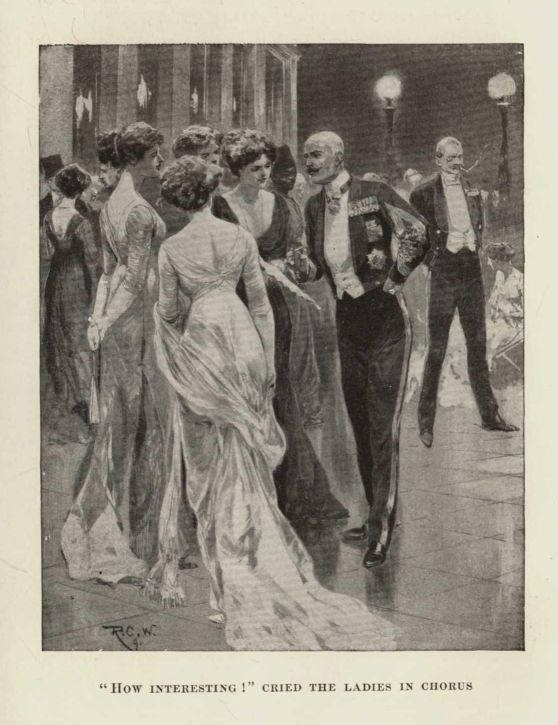
"How interesting!" cried the ladies in chorus
"Of course he has as many as the Mahdi already—but who is the new one, I wonder?"
"No, he has only one wife at present—runs 'em tandem, I hear—and the new bride is the beautiful person in Parsee costume who arrived here about the same time as himself."
"The Mohammedan Rani, you mean? My husband tells me she is perfectly lovely. But they say she will never let a European get a glimpse of her face—puts down her Parsee veil, I suppose—so goodness knows how he knows, you know."
"Perhaps your husband is a privileged person, my dear," said one of the other ladies, whereupon there was a trill of laughter and the little feet in satin slippers were beaten upon the floor.
"But a Rani! Think of that! Who can she be, I wonder?" said another of the ladies, and then the mistress of the Palace, Lady Mannering, hinted that she believed the Sirdar knew something about her.
"Oh, tell us! tell us!" cried a dozen female voices at once; but the Sirdar, a shrewd and kindly autocrat who had been smoking a cigarette in silence, merely answered—
"Time will tell you, perhaps." Then turning to the Inspector-General he said—
"She has married the man, you say?"
"That's so, your Excellency."
"There must be some mistake about that, surely."
The company broke up late, and the ladies went on in light wraps and the men bare-headed through the soft, reverberant air of the southern night. But the Sirdar had asked certain of his officers to remain for a few moments, and among them were the Inspector-General, the Financial Secretary, and the Governor of the town. To the latter came his Zabit, a police officer, whose duty it was to report to his chief early and late, and as soon as the men had seated themselves the Sirdar said—
"Any further news about this man, Ishmael Ameer?"
"None, your Excellency," said the Governor.
"You've discovered nothing about his object in coming here?"
"Nothing at all."
"He is not sowing dissension between Moslems and Christians?"
"No! On the contrary, he professes to be opposed to all that, sir."
"Then you see no reason to think that he is likely to be a danger to the public peace?"
"Unfortunately no, sir, no!"
The Sirdar laughed. "He hasn't yet given 'divine' sanction for your removal, Colonel?"
"Not that I know of, at all events."
"Then you and your wife may sleep in peace for the present, I suppose."
There was a little general laughter, and then the Inspector-General, a sceptic with a contempt for holy men of all kinds, said—
"All the same, your Excellency, I should make short work of this pseudo-Messiah."
"Without plain cause we cannot," said the Sirdar, who was the friend of all faiths and the enemy of none. "Indeed, a broad-minded Mohammedan such as this man is said to be might possibly be of service in directing the religion of the Soudan."
"Yes, sir, but too many of these religious celebrities are contaminated by Mahdism."
"Surely Mahdism is dead, my dear fellow."
"Not yet, sir! Only yesterday I saw a man kneeling by the Mahdi's tomb—so hard do religions die! As for this man, Ishmael, he may be preaching peace while he is gathering his followers, but wait till they're numerous enough to fight and you'll see what he will do. Besides, isn't there evidence enough already that the tranquillity of the Soudan has been disturbed?"
"What evidence do you mean?"
"I mean ... my informers all over the country tell me the people are no longer pleading poverty as an excuse for remission of taxation—they are boldly refusing to pay."
The Financial Secretary corroborated this statement, saying that the taxes due on the land and the date-trees had not yet been collected, and that he had heard from Cairo that the same difficulty was being met with in Egypt in respect of the taxes on berseem and wheat.
"You mean," said the Sirdar, "that a conspiracy of passive resistance against the Government has been set afoot?"
"It looks like it, sir," said the Inspector-General. "A pretty insidious kind of conspiracy it is, too, and I think all the signs are that Ishmael Ameer is at the head of it."
There was silence, for some minutes, during which the Sirdar was telling himself that, if this was so, the rule of England in Egypt was face to face with a most subtle enemy—subtler far than the Mahdi and immeasurably more dangerous.
"Well, the first thing we've got to do is to find out the truth," he said, and thereupon he gave the Zabit an order to summon the Ulema of Khartoum, the Cadi, the Notables, and Sheikhs to a meeting in the Palace.
"Let it be soon," he said.
"Yes, sir."
"And secret."
"Certainly, your Excellency."
The Governor and the Financial Secretary went off with the police officer, but for some minutes longer the Inspector-General remained with the Sirdar.
"If the man were likely to cause a disturbance," said the Sirdar, "it would be easy to deal with him, but he's not. Public security is in no present danger. On the contrary, everything I hear of the man's teaching is calculated to promote peace."
"As to that, sir, if you believe all he says, he is the prince of peace himself, and his Islam isn't Islam at all as we know it, but something quite different."
"If he were claiming 'divine' authority, and telling people to resist the Government——"
"Oh, he is far too clever for that, sir, and his conspiracy is the deep-laid plan of a subtle impostor, not the unpremeditated action of a lunatic."
"All I hear about his personal character is good," said the Sirdar. "He is tender to children, charitable to the poor, and weeps like a woman at a story of distress."
The Inspector-General laughed. "Pepper in his finger-nails—the hoary old trick, sir! Good-night, Sirdar!"
"Good-night, Colonel!" And the Inspector-General descended the steps.
Being left alone, the Sirdar walked for a long hour to and fro on the terrace, trying to see what course he ought to take in dealing with a religious leader who differed so dangerously from the holy men that were more troublesome, but hardly more deadly, than the sand-flies of the desert.
At midnight he found himself standing on the very spot on which General Gordon met his death, and in an instant, as by a flash of mental lightning, he saw the scene that had been enacted there only a few years before—the grey dawn, the mad rush of the howling dervishes in their lust of blood, up from the dim garden to the top of these steps, on which stood, calmly waiting for them, the fearless soul that had waited for his own countrymen in vain. "Where is your Master, the Mahdi?" he cried. Then a barbarous shriek, the flash of a score of lances, and the martyr of the Soudan fell.
Was this to be another such revolt, more subtle if not more bloody, turning England out of the valley of the Nile by making it impossible for her to meet the expense of governing the country, and thereby destroying the seeds of civilisation that had been sown in the Soudan through so many toilsome years?
On the other hand, was it the beginning of a great spiritual revolution that was intended by God to pass over the whole face of the world? It might even be that, though the Soudan was only a brown and barren wilderness, for had not all great faiths and all great prophets sprung out of the desert—Moses, Mohammed, Christ!
This brought the Sirdar back to a memory that had troubled him deeply for many weeks—the memory of the disgrace that had fallen in Cairo on his comrade of long ago, the son of his old friend Nuneham, young Gordon Lord.
Then it dawned upon him for the first time that, however serious his offence as a soldier, the son of his friend had done no more and no less than his great namesake did before him when he resisted authority because authority was in the wrong!
Good God! could it be possible that young Gordon was in the right after all, and that this movement of the man Ishmael was the beginning of a world-wide revolt against the materialism, the selfishness, the venality, and the oppression of a corrupt civilisation that mocked religion by taking the name of Him who came to earth to destroy such evils?
If that were so, could any Christian country in these days dare to repeat the appalling error of the Roman Empire in Palestine two thousand years ago—the error of trying to put down moral forces by physical ones?
The Sirdar laughed when he thought of that, so grotesque seemed the mysterious law of the mind by which he had coupled an olive-faced Arab like Ishmael Ameer with Christ!
The southern night was silent. Not a sound came up from the moonlit garden except the croaking of frogs in the pond. Presently a voice that was like a wave of wind came sweeping through the breathless air—
"There is no god but God! There is no god but God!"
The Sirdar shuddered and turned into the house.
CHAPTER VI
Being betrothed to Ishmael, and therefore in effect his wife, Helena had now no difficulty in reading the secret he had so carefully hidden from British eyes. Every morning she sat with him in the guest-room while he received his messengers and agents, and if they demurred at her presence, being distrustful of her because she was a woman, he would say—
"Have no fear. My wife is myself. Think of her as you think of me."
Thus little by little she realised what the plan of his opposition to the Government had been, when, in Cairo, after the closing of El Azhar, he had sent out his hundred emissaries. It was to tell the people in every village of Egypt and the Soudan to pay no taxes until their faith was free and the Government took its hand off the central seat of their religion.
She also realised that the people had obeyed Ishmael and had suffered as the consequence. Agents were coming every day with secret letters and messages concealed in their turbans, telling of the pains and penalties already endured by those who had boldly refused to pay the taxes due at that season of the year.
At first these lamentations were couched after Eastern manner in the language of metaphor. Pharaoh was laying intolerable burdens upon the people—what were they to do? God had once sent Moses, a man of prayer, to plead with Pharaoh to loosen his hand—would He not do so again?