THE WHITE PROPHET, VOLUME I (continued 4)
Reading edition
He had turned again to the door leading to Helena's room when another blow from an invisible hand seemed to fall upon him. He saw Helena's eyes fixed on his face in the intensity of her hate, and he heard her voice driving him away. "Go, let me never see you again!" That was more than he could bear, and staggering to the sofa he sat down.
Some minutes passed. The red glow in the room deepened to a dull brown, and at one moment there was a groan in the gathering gloom. He heard it and looked up, but there was nobody there and then he realised that it was he who had groaned. At another moment his mind occupied itself with lesser things. He saw that one finger of his left hand was badly wounded, and he bound it up in his handkerchief. Then he looked at himself in a mirror that hung on the wall in front of the sofa, but he could not see his face distinctly—eyes, nose, and mouth being blurred. He did not attempt to escape. Never for an instant did it occur to him to run away.
The sun went down behind the black Pyramids across the Nile, and after a while the dead silence of the evening of the Eastern day was broken by the multitudinous cries of the muezzin, which came up from the city below like a deep ground-swell on a rugged coast.
After that Gordon knelt again by the General's body, trying to believe he was not dead. The eyes were still open, but all the light had gone out of them, and seeing their stony stare the thought came to him that the General's soul was with him in the room. The stupor of his senses had suddenly given way to a supernatural acuteness, and at one moment he imagined he felt the touch of a hand on his shoulder.
At the next instant he was plainly conscious of a door opening and closing in the inner part of the house, and of light and rapid footsteps approaching. He knew what had occurred—Helena had been out on the terrace or in the parade ground and had just come back.
She was now in the next room, breathing hard as if she had been running. He could hear the rustling of her skirt and her soft step as she walked towards the door of the General's office.
At the next moment there came a knock, but Gordon, held his breath and made no answer.
Then "Father!" in a tremulous voice, full of fear, as if Helena knew what had happened.
Still Gordon made no reply, and the frightened voice came again.
"Are you alone now? May I come in?"
Then Gordon felt an impulse to throw the door open and confess everything, saying, "I did it, Helena, but I didn't intend to do it. He threw himself upon me, and I flung him off and he fell, and that is the truth, as God is my witness."
But he could not do this, because he was afraid. He who had never before known fear, he who had stood in the firing line when hordes of savage men had galloped down with fanatical cries—he was trembling now at the thought of meeting a woman's face.
So, treading softly, he stole out of the room by the outer door, the door leading to the gate, and as he closed it behind him he felt that the door of hope also was now for ever closed between Helena and him.
But going through the garden he had to pass the arbour, and at sight of that loved spot a wave of tender memories swept over him, and in pity of Helena's position he wanted to return. She would be in her father's room by this time, standing over his dead body and alone in her great grief.
"I will go back," he thought. "She has no one else. She may curse me, but I cannot leave her alone. I will go back—I will—I must!"
That was what his soul was saying to itself, but at the same time his body was carrying him away—through the open gate and across the deserted square, swiftly, stealthily, like a criminal leaving the scene of his crime.
The day was now gone, the twilight was deep, and as he passed under the outer port of the Citadel in the dead silence of the unquickened air, a voice like that of an accusing angel, telling of judgment to come, fell upon his ear. It was the voice of the last of the muezzin on the minaret of the Mohammed Mosque calling to evening prayer—"God is Most Great! God is Most Great!"
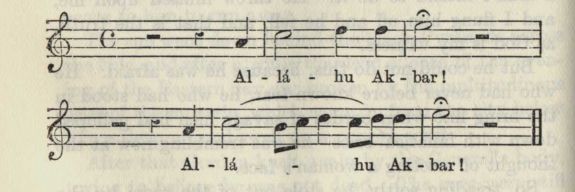
Music fragment
END OF FIRST BOOK
SECOND BOOK
THE SHADOW OF THE SWORD
CHAPTER I
When Helena had left the General and Ishmael Ameer together, the signs she knew so well of illness in her father's face suggested that she should run at once for the Medical Officer. One moment she stood in the room adjoining the General's office, listening to the muffled rumble that came from the other side of the wall, the short snap of her father's impatient voice and the deep boom of the Egyptian's, and then she hurried into the outer passages to pin on her hat. There she met the General's Aide-de-camp, who, seeing her excitement, asked if there was anything he could do for her, but she answered "No," and then—
"Yes, I think you might go over to the Colonel" (meaning the Colonel commanding the Citadel) "and tell him this man is here with a crowd of his followers."
"He must know it already, but I'll go with pleasure," said the young Lieutenant. At the next moment there were three hasty beats on the General's bell, followed by a summons from the General's soldier servant, but the Aide-de-camp had disappeared.
Helena went out by the back of the house, and seeing her cook and the black boy as she passed the kitchen quarters an impulse came to her to send somebody else on her errand, lest anything should happen in her absence; but telling herself that nobody but herself and the Doctor must know the secret of her father's condition, she hurried along.
Her way was through the unoccupied courts of the old palace, down a flight of long steps, through an old gateway whereof the iron-clamped door always stood open, across a disused drawbridge, and so on to the open parade-ground. The Army Surgeon's quarters were on the farther side of it, and never before had it seemed so broad.
When she reached her destination the Surgeon was out on his evening round of the hospital, so she wrote a hurried note asking him to come to the General's house immediately, sent his assistant in search of him, and then turned back.
Returning hurriedly by the "married quarters," she was detained for some moments by a soldier's wife, a young thing, almost a child, who stood at the door of her house with a red woollen shawl about her shoulders, a baby in long clothes in her arms, and a look of radiant happiness in her round face.
"Ye've not seen 'im yet, have ye, Miss?" said the little mother, holding out her baby to be admired. "Only six weeks old and 'e weighs ten pounds. Colonel says as 'ow 'e's a credit to the reg'ment, and I'm agoin' to shorten 'im soon. To-morrow I'm 'avin' 'im photoed to send to mother. She lives in Clerkenwell, Miss, and she ain't likely to show 'is photo to nobody in our court. Oh no!"
Helena did her best to play up to the pride of the little Cockney mother, and was turning to go when the girl said—
"But my Harry tells me as how you're to be married yourself soon, so I wish ye joy, and many of 'em."
"Good-bye, Mrs. Dimmock," said Helena, but the young thing was not yet done. With a look of wondrous wisdom she said—
"They're a deal of trouble, Miss, but there ain't no love in the house without 'em. As mother says, they keeps the pot a-boilin'," and she was ducking down her head to kiss the child as Helena hurried away.
In the bright light of the young mother's life and the breadth of shadow that lay upon her own, Helena thought of Gordon and her anger rose against him again, but at the next moment she saw him in her mind's eye as she had seen him last, going out of the garden, a broken, bankrupt man, and then her eyes filled and it was as much as she could do to see her way.
In the quickening flow of her emotion this riot in her heart between anger with Gordon and with herself only led to deeper hatred of the Egyptian, and even the memory of his dignity and largeness in the single moment in which she had looked upon him made her wrath the more intense.
A vague fear, an indefinite forewarning, hardly able yet to assume a shape, was beginning to take possession of her. She recalled the scene she had left behind her in the General's office, the two men face to face, as if in the act of personal quarrel, and told herself that if anything happened to her father as the result of the excitement caused by the meeting, the Egyptian would be the cause of it.
In her impatience to be back she began to run. How broad the parade ground was! The air, too, was so close and lifeless. The sun had nearly set, the arms of night were closing round the day, but still the sky was a hot, dark red like the inside of a transparent shell that had a smouldering fire outside of it.
At one moment she heard hoarse and jarring voices that seemed to come from the square of the mosque in front of the house. Perhaps the Egyptian and his people were going off with their usual monotonous chanting of "Allah! Allah!" She was glad to reach the cool shade and silence of the empty courts of the old palace, but coming to the gateway she found it closed.
A footstep was dying away within, so she knocked and called, and after a moment an old soldier, a kind of caretaker of the Citadel, opened the gate to her.
"Beg pardon, Miss! Lieutenant Robson told me to shut up everything immediately," he said, but Helena did not wait for further explanation.
There was nobody in sight when she passed the kitchen quarters, and when she entered the house a chill silence seemed to strike to the very centre of her life.
Then followed one of those mystic impulses of the human heart which nobody can understand. In her creeping fear of what might have happened during her absence she was at first afraid to go into her father's room. If she had done so, there and then, and without an instant's hesitation, she must have found Gordon kneeling over her father's body. But in dread of learning the truth she tried to keep back the moment of certainty, and in a blind agony of doubt she stood and tried to think.
The voices of the men were no longer to be heard through the wall, and the deep rumble of the crowd outside had died away, therefore the Egyptian must have gone. Had her father gone too? She remembered that he was in uniform, and took a step back into the hall to see if his cap hung on the hat-rail. The cap was there. Had he gone into his bedroom? She crossed to the door. The door was open and the room was empty.
Hardly able to analyse her unlinked ideas, but with a gathering dread of the unknown, she found herself stepping on tiptoe towards the General's office. Then she thought she heard a faint cry within, a feeble, interrupted moan, and in an unsteady voice she called.
There was no answer. She called again, and still there was no reply. Then girding up her heart to conquer a vague fear, which hardly knew itself yet for what it was, she opened the door.
The room was almost dark. She took one step into the gloom, breathing rapidly, then stopped and said—
"Father! Are you here, father?"
There was no sound, so she took another step into the room, thinking to switch on the light over the desk and at the same time to reach the sofa. As she did so she stumbled against something, and her breath was struck out of her in an instant.
She stooped in the darkness to feel what it was that lay at her feet, and at the next moment she needed no light to tell her.
"Father! Father!" she cried, and in the dead silence that followed, the voice of the muezzin came from without.
She was lying prostrate over her father's body when the door was burst open as by a gust of wind and the Army Surgeon came into the room. Without a word he knelt and laid his hand over the heart of the fallen man, while Helena, who rose at the same instant, watched him in the awful thraldom of fear.
Then young Lieutenant Robson came in hurriedly, switching on the light and saying something, but the Surgeon silenced him with the lifting of his left hand. There was one of those blank moments in which time itself seems to stand still, while the Surgeon was on his knees and Helena stood aside with whitening lips and with eyes that had a wild stare in them. Then, lifting his face, which was stamped with the heaviness of horror and told before he spoke what he was going to say, the Surgeon rose, and turning to Helena, said in a nervous voice—
"I regret—I deeply regret to tell you..."
"Gone?" asked Helena, and the Surgeon bowed his head.
She did not cry or utter a sound. Only the trembling of her white lips showed what she felt, but all the cheer of life had died out of her face, and in a moment it had become hard and stony.
There was an instant of silence, and then the Surgeon and the young Lieutenant, casting sidelong looks at Helena, began to whisper together. At sight of her tearless eyes a certain fear had fallen on them which the presence of death could not create.
"Take her away," whispered the Surgeon, and then the Lieutenant, whose throat was hard and whose eyes were dim, approached her and said with the sadness of sympathy—
"May I help you to your room, please?"
Helena shook her head and stood immovable a moment longer, and then, with a firm step, she walked away.
CHAPTER II
All the moral cowardice that had paralysed Gordon Lord was gone the moment he left the Citadel, and as soon as he reached the streets of the city the power of life came back to him. There, in tumultuous swarms, the native people were swinging along in one direction, uttering the monotonous cries of the Moslems when they are deeply moved. Into this maelstrom of emotion Gordon was swept before he knew it, and hardly conscious of where he was going he followed where he was led.
He felt, without knowing why, the lust of violence which comes to the soldier in battle who wants to run away until the moment when the first shot has been fired, and then—all fear and moral conscience gone in an instant—forges his path with shouts and oaths to where danger is greatest and death most sure.
In the thickening darkness he saw a great glow coming from a spot in front of him, as of many lanterns and torches burning together. Towards this spot he pushed his way, calling to the people in their own tongue to let him pass, or sweeping them aside and ploughing through. In his delirious excitement his strength seemed to be supernatural, and men were flung away as if they had been children.
At length he reached a place where a narrow lane, opening on to a square, was blocked by a line of soldiers, who were coming and going with the glare of the torch-light on their faces. Here the monotonous noises of the crowd behind him were pierced by sharp cries, mingled with screams. Perspiration was pouring down Gordon's neck by this time, and he stopped to see where he was. He was at the big gate of El Azhar.
On leaving the Citadel, Colonel Macdonald had taken two squadrons with him, telling the Lieutenant-Colonel commanding the regiment to follow with the rest.
"Half of these will be enough for this job, and we'll clear the rascals out like rats," he said.
The Governor of the city, a small man in European dress, acting on the order of the Minister of the Interior as Regent in the absence of the Khedive, had met him at the University. They found the gate shut and barred against them, and when the Governor called for it to be opened there was no reply. Then the Colonel said—
"Omar Bey, have I your permission to force an entrance?"
Whereupon the Governor, in whom the wine of life was chiefly vinegar, answered promptly—
"Colonel, I request you to do so."
A few minutes afterwards a stout wooden beam was brought up from somewhere, and six or eight of the soldiers laid hold of it and began to use it on the closed gate as a battering ram. The gate was a strong one clamped with iron, but it was being crunched by the blows that fell on it when some of the students within clambered on to the top of the walls and hurled down stones on the heads of the soldiers.
One of them was a young boy of not more than fourteen years, and while others protected themselves by hiding behind the coping stones, he exposed his whole body to the troops by standing on the very crest of the parapet. The windows of the houses around were full of faces, and from one that was nearly opposite to the gate came the shrill cry of a woman, calling on the boy to go back. But in the clamour of noises he heard nothing, or in the fire of his spirit he did not heed, for he continued to hurl down everything that came to his hand, until Colonel Macdonald commanded the troop to dismount with rifles and said—
"Stop that young devil up there!"
At the next moment there was the crack of a dozen rifles, and the boy on the parapet swayed aside, lurched forward, and fell into the street. The Colonel was giving orders that he should be taken up and carried away when the woman's cry was heard again, this time in a frenzied shriek, and at the next instant the soldiers had to make way for the mightiest thing on earth, an outraged mother in the presence of her dead.
The woman, who had torn the black veil from her face, lifted the boy's head to her breast and cried, "My God! My good God! My boy! Ali! Ali!" But just then the gate gave way with a crash, and the Colonel ordered one of the squadrons to ride into the courtyard of the mosque, where five thousand of the students and their professors could be seen squirming in dense masses like ants on an upturned ant-hill.
The soldiers were forcing their horses through the crowds and beating with the flat of their swords when two or three shots were fired from within, and it became certain that some of the students were using firearms. At that the bulldog in the British Colonel got the better of the man, and he wanted to shout a command to his men to use the edge of their weapons and clear the place at any cost, but the shrill cry of the mother over her dead boy drowned his thick voice.
"He is dead! They have killed him! My only child! His father died last week. God took him, and now I have nobody. Ali, come back to me! Ali! Ali!"
"Take that yelping b—— away!" shouted the Colonel, ripping out an oath of impatience, and that was the moment when Gordon Lord came up.
What he did then he could never afterwards remember, but what others saw was that with the spring of a tiger he leapt up to Macdonald, laid hold of him by the collar of his khaki jacket, dragged him from the saddle, flung him headlong on the ground, and stamped on him as if he had been a poisonous snake.
In another moment there would have been no more Macdonald, but just then, while the soldiers, recognising their First Staff Officer, stood dismayed, not knowing what it was their duty to do, there came over the sibilant hiss of the crowd the loud clangour of the hoofs of galloping horses, and the native people laid hold of Gordon and carried him away.
His great strength was now gone, and he felt himself being dragged out of the hard glare of the light into the shadow of a side street, where he was thrust into a carriage and held down in it by somebody who was saying—
"Lie still, my brother! Lie still! Lie still!"
For one instant longer he heard deafening shouts through the carriage glass, over the rumble of the moving wheels, and then a blank darkness fell on him for a time and he knew no more.
When he recovered consciousness his mind had swung back, with no memory of anything between, to the moment when he was leaving the General's house, and he was saying to himself again, "I must go back. She may curse me, but I cannot leave her alone. I cannot—I will not."
Then he was aware of a voice—it was the quavering voice of an old man, and seemed to come out of a toothless mouth—saying—
"Be careful, Michael! His poor hand is injured. We must send for the surgeon."
He opened his eyes and saw that he was being carried through a quiet courtyard where he could hear the footsteps of the men who bore him and see by the light of a smoking lantern the façade of a church. Then he heard the same quavering voice say—
"Take him up to the salamlik, my brother," and then there was a jerk and a jolt and he lost consciousness again.
He was lying on a bed in a dimly lighted room when memory returned and the events of the day unrolled themselves before him. He made an effort to raise himself on his elbows, but in his weakness he fell back, and after a while he dropped into a delirious sleep. In this sleep he saw first his mother and then Helena, and then Helena and again his mother—everything and everybody else being quite blotted out.
CHAPTER III
Soon after sunset Lady Nuneham had taken her last dose of medicine, and had got into bed, when the Consul-General came into her room. He had the worn and jaded look by which she knew that the day had gone heavily with him, and she waited for him to tell her how and why. With a face full of the majesty of suffering he told her what had happened, describing the scene in the General's office, and all the circumstances whereby matters had been brought to such a tragic pass.
"It was pitiful," he said. "The General went too far—much too far—and the sight of Gordon's white face and trembling lips was more than I could bear."
His voice thickened as he spoke, and it seemed to the mother at that moment as if the pride of the father in his son, which he had hidden so many years in the sealed chamber of his iron soul, had only come up at length that she might see it die.
"It's all over with him now, I suppose, and we must make the best of it. He promised so well, though! Always did—ever since he was a boy. If one's children could only remain children! The pity of it! Good-night! Good-night, Janet!"
She had listened to him without speaking and without a tear coming into her eyes, and she answered his "Good-night" in a low but steady voice. Soon afterwards the gong sounded in the hall, and, as she lay in her bed, she knew that he would be dining alone—one of the great men of the world, and one of the loneliest.
Meantime Fatimah, tidying up the room for the night and sniffling audibly, was talking as much to herself as to her mistress. At one moment she was excusing the Consul-General, at the next she was excusing Gordon. Lady Nuneham let her talk on, and gave no sign until darkness fell and the moment came for the Egyptian woman also to get into bed. Then the old lady said—
"Open the door of this room, Fatimah," pointing to a room on her right.
Fatimah did so, without saying a word, and then she lay down, blowing her nose demonstratively as if trying to drown other noises.
From her place on the pillow the old lady could now see into the adjoining chamber, and through its two windows on to the Nile. A bright moon had risen, and she lay a long time looking into the silvery night.
Somewhere in the dead waste of early morning the Egyptian woman thought she heard somebody calling her, and, rising in alarm, she found that her mistress had left her bed and was speaking in a toneless voice in the next room.
"Fatimah! Are you awake? Isn't the boy very restless to-night? He throws his arms out in his sleep and uncovers little Hafiz too."
She was standing in her nightdress and lace nightcap, with the moon shining in her face, by the side of one of the two beds the room contained, tugging at its eiderdown coverlet. Her eyes had the look of eyes that did not see, but she stood up firmly, and seemed to have become younger and stronger—so swiftly had her spirit carried her back in sleep to the woman she used to be.
"Oh my heart, no," said Fatimah. "Gordon hasn't slept in this room for nearly twenty years—nor Hafiz neither."
At the sound of Fatimah's husky voice and the touch of her moist fingers the old lady awoke.
"Oh yes, of course," she said, and after a moment, in a sadder tone, "Yes, yes."
"Come, my heart, come," said Fatimah, and taking her cold and nerveless hand, she led her, a weak old woman once more, back to her bed, for the years had rolled up like a tidal wave and the spell of her sweet dream was broken.
On a little table by the side of her bed stood a portrait of Helena in a silver frame, and she took it up and looked at it for a moment, and then the light which Fatimah had switched on was put out again. After a little while there was a sigh in the darkness, and after a little while longer a soft, tremulous—
"Ah, well!"
CHAPTER IV
Helena was still in her room when the Consul-General, who had been telephoned for, held an inquiry into the circumstances of the General's death. She was sitting with her hands clasped in her lap and her eyes looking fixedly before her, hardly listening, hardly hearing, while the black boy darted in and out with broken and breathless messages which contained the substance of what was said.
The household servants could say nothing except that, following in the wake of the new prophet when he left the Citadel, they had left the house by the side gate of the garden without being aware of anything that had happened in the General's office. The Surgeon testified to the finding of the General's body, and the Aide-de-camp explained that the last time he saw his chief alive was when he was ordered to call Colonel Macdonald.
"Who was with him at that moment?" asked the Consul-General.
"The Egyptian, Ishmael Ameer."
"Was there anything noticeable in their appearance and demeanour?"
"The General looked hot and indignant."
"Did you think there had been angry words between them?"
"I certainly thought so, my lord."
Other witnesses there were, such as the soldier servant at the door, who made a lame excuse for leaving his post for a few minutes while the Egyptian was in the General's office, and the sentry at the gate of the Citadel, who said no one had come in after Colonel Macdonald and the cavalry had passed out. Then, some question of calling Helena herself was promptly quashed by the Consul-General, and the inquiry closed.
Hardly had the black boy delivered the last of his messages when there was a timid knock at Helena's door, and the Army Surgeon came into the room. He was a small man with an uneasy manner: married, and with a family of grown-up girls who were understood to be a cause of anxiety to him.
"I regret—I deeply regret to tell you, Miss Graves, that your father's death has been due to heart-failure, the result of undue excitement. You will do me the justice—I'm sure you will do me the justice to remember that I repeatedly warned the General of the dangers of over-exciting himself, but unfortunately his temperament was such——"
The Consul-General's deep voice in the adjoining room seemed to interrupt the Surgeon, and making a visible call on his resolution he came closer to Helena and said—
"I have not mentioned my previous knowledge of organic trouble. Lord Nuneham asked some searching questions, but the promise I made to your father——"
Again the Consul General's voice interrupted him, and with a flicker of fear on his face, he said—
"Now that things have turned out so unhappily it might perhaps be awkward for me if ... In short, my dear Miss Graves, I think I may rely on you not to ... Oh, thank you, thank you!" he said, as Helena, understanding his anxiety, bowed her head.
"I thought it would relieve you to receive my assurance that death was due to natural causes only—purely natural. It's true I thought for a moment that perhaps there had also been violence——"
"Violence?" said Helena.
"Don't let me alarm you. It was only a passing impression, and I should be sorry, very sorry——"
But just at that moment, when a new thought was passing through the stormy night of Helena's mind like a shaft of deadly lightning, the Chaplain of the Forces came into the room, and the Surgeon left it.
The Chaplain was a well-nurtured person, who talked comfort out of a full stomach with the expansiveness which sometimes comes to clergy who live long amongst soldiers.
"I have come to say, my dear young lady, that I place myself entirely at your service. With your permission I will charge myself with all the sad and necessary duties. So sudden! So unexpected! How true that in the midst of life we are in death!"
There was more coin from the same mint, and then, the shaft of deadly lightning as before.
"It is perhaps the saddest fact of death in this Eastern climate that burial follows so closely after it. As there seems to be no sufficient reason to believe that the General's death has been due to any but natural causes, it will probably be to-morrow—I say it will probably——"
"Sufficient!" said Helena, and, with a new poison at her heart, she hurried away to her father's room.
She found the General where they had placed him, on his own bed and in his uniform. His eyes were now closed, his features were composed, and everything about him was suggestive of a peaceful end.
While she was standing in the gloomy, echoless chamber, the Consul-General came in and stood beside her. Though he faintly simulated his natural composure he was deeply shaken. For a moment he looked down at his dead friend in silence, while his eyelids blinked and his lips trembled. Then he took Helena's hand, and drawing her aside, he said—
"This is a blow to all of us, my child, but to you it is a great and terrible one."
She did not reply, but stood with her dry eyes looking straight before her.
"I have made strict inquiry, and I am satisfied—entirely satisfied—that your father died by the visitation of God."
Still she did not speak, and after a moment he spoke again.
"It is true that the man Ishmael Ameer was the last to be with him, but what happened at their interview it would be useless to ask—dangerous, perhaps, in the present state of public feeling."
She listened with complete self-possession and strong hold of her feelings, though her bosom heaved and her breathing was audible.
"So let us put away painful thoughts, Helena. After all, your father's end was an enviable one, and harder for us than for him, you know."
He looked steadily for a moment at her averted face and then said, in a husky voice—
"I'm sorry Lady Nuneham is so much of an invalid that she cannot come to see you. This is the moment when a mother——"
He stopped without finishing what he had intended to say, and then he said—
"I'm still more sorry that one who——"
Again he stopped, and then in a low, smothered, scarcely audible voice, he said hurriedly—
"But that is all over now. Good-night, my child! God help you!"
Helena was standing where the Consul-General had left her, fighting hard against a fearful thought which had only vaguely taken shape in her mind, when the black boy came back with his mouth full of news.
The bell of the telephone had rung furiously for the English lord, and he had gone away hurriedly, his horses galloping through the gate; there had been a riot at El Azhar; a boy had been shot; a hundred students had been killed with swords; the cavalry were clearing the streets, and the people were trooping in thousands into the great mosque of the Sultan Hakim, where the new prophet was preaching to them.
Helena listened to the terrible story as to some far-off event which in the tempest of her own trouble did not concern her, and then she sent the boy away. Gordon had been right, plainly right, from the first, but what did it matter now?
Some hours passed, and again and again the black boy came back to the room with fresh news and messages, first, to say that her supper was served, next, that her bedroom was ready, and finally, with shame-faced looks and a face blubbered over with tears, to explain the cause of his absence from the house when the tragic incident happened. He had followed the crowd out of the Citadel, and only when he found himself at the foot of the hill had he thought, "Who is to take care of lady while Mosie is away?" Then he had run back fast, very fast, but he was too late, it was all over.
"Will lady ever forgive Mosie? Will lady like Mosie any more?"
Helena comforted the little twisted and tortured soul with some words of cheer, and then sent him to bed. But with a sad longing in his big eyes, and the look of a dumb creature that wanted to lick her hand, he came back to say he could not sleep in his own room because death was in the house, and might he sit on the floor where lady was and keep her company.
Touched by the tender bit of human nature that was tearing the big, little soul of the black boy who worshipped her, Helena went back to her own bedroom, and then a grin of delight passed over Mosie's ugly face and he said—
"Never mind! It's no thing! Lady will forget all about it to-morrow. Now lady will lie down and sleep."
Helena put out the light in her room, and sitting by the open window she looked long into the moonlight that lay over the city. At one moment she heard the clatter of horses' hoofs—Macdonald's cavalry were returning to the Citadel after their efforts in the interests of peace and order. At intervals she heard the ghafirs (watchmen) who cried Wahhed! (God is One) in the silent streets below. Constantly she looked across to the barracks that stood at the edge of the glistening Nile, and at every moment the cruel core in her heart grew yet more hard.
Why had not Gordon come to her? He must know of her father's death by this time—why was he not there? Why had he not written to her at all events? It was true they had parted in anger, but what of that? He had never loved her or he would be with her now. She had done well to drive him away from her, and, thank God, she would never see him again!
The moon died out, a cold breath passed through the air, the city seemed to yawn in its sleep, the dawn came with its pale, pink streamers and with its joyous birds—the happy, heart-breaking children of the air—twittering in the eaves, and then the pride and hatred of her wounded heart broke down utterly.
She wanted Gordon now as she had never wanted him before. She wanted the sound of his voice, she wanted the touch of his hand, she wanted to lay her head on his breast like a child, and hear him tell her that it would all be well.
She found a hundred excuses for him in as many minutes. He was a prisoner—how could he leave his quarters? They might be keeping him under close arrest—how could he get away? Perhaps they had never even told him of her father's death—how could he write to her about it?
In the fever of her fresh thought, she decided that she herself would tell him, and in the tumult of her confused brain she never doubted that he would come to her. Regulations? They would count for nothing. He was brave, he was fearless, he would find a way. Already she could see him flinging open the door of her room and she could feel herself flying into his arms.
Thus with a yearning and choking heart, in the vacant stillness of the early dawn, she sat down to write to Gordon. This is what she wrote:—
"Six o'clock, Sunday morning.
"DEAREST,—The greatest sorrow I have ever known—God, our good God, has taken my beloved father.
"He loved you and was always so proud of you. He thought there was nobody like you. I try to think how it all happened at the end, and I cannot.
"Forgive me for what I said yesterday. It seems you were right about everything, and everybody else was wrong. But that doesn't matter now—nothing matters.
"I want you. I have nobody else. I am quite alone. God help me! Come to me soon——"
Unconsciously she was speaking the words aloud as she wrote them and sobbing as she spoke. Suddenly she became aware of another voice in the adjoining room. She thought it might be Gordon's voice, and catching her breath she rose to listen. Then in a muffled, broken, tear-laden tone, these words came to her through the wall—
"O Allah, most High, most Merciful, make lady sleep. Make lady sleep, O Allah, most High, most Merciful!"
Her black boy had been lying all night like a dog on the mat behind her door.
CHAPTER V
Before Gordon opened his eyes that morning he heard the tinkling of cymbals and the sweet sound of the voices of boys singing in a choir, and he felt for a moment as if he were carried back to his school at Eton, where the morning dawned on green fields to the joyous carolling of birds.
Then he looked and saw that he was lying in a little yellow-curtained room which was full of the gentle rays of the early sun, and opened on to a garden in a quiet courtyard, with one date tree in the middle and the façade of a Christian church at the opposite side. In the disarray of his senses he could not at first remember what had happened to him, and he said aloud—
"Where am I?"
Then a cheery voice by his side said, "Ah, you are awake?" and an elderly man with a good, simple, homely face looked down at him and smiled.
"What place is this?" asked Gordon.
"This?" said the good man. "This is the house of the Coptic Patriarch. And I am Michael, the Patriarch's servant. He brought you home in his carriage last night. Out of the riots in the streets, you know. But I must tell him you are awake. 'Tell me the moment he opens his eyes, Michael,' he said. No time to lose, though. Listen! They're at matins. He'll be going into church soon. Lie still! I'll be back presently."
Then Gordon remembered everything. The events of the night before rose before him in a moment, and he drank of memory's very dregs. He had closed his eyes again with a groan when he heard shuffling footsteps coming into the room, and a husky, kindly voice, interrupted by gusty breathing, saying cheerfully—
"God be praised! Michael tells me you are awake and well."
The Coptic Patriarch was a little man in a black turban and a kind of black cassock, very old, nearly ninety years of age, and with a saintly face in which the fires of life had kindled no evil passions.
"Don't speak yet, my son. Don't exhaust yourself. The surgeon said you were to have rest—rest and sleep above all things. He came last night to dress your poor hand. It was wounded in the cruel fight at El Azhar. I was passing at the moment and the people put you into my carriage. 'Save him for the love of God,' they said. 'He is our brother and he will be taken.' So I brought you home, seeing you were hurt and not knowing what else to do with you. But now I am glad and thankful, having read the newspapers this morning and learned that you were in great peril.... No, no, my son, lie still."
Gordon had made an effort to raise himself on his elbow, but resting his weight on his left hand and finding it was closely bandaged and gave him pain, he was easily pushed back to his pillow.
"Lie still until the surgeon comes. Michael has gone for him. He will be here immediately. A good man—make yourself sure about that. He will be secret. He will say nothing."
Then there came through the open window the sound of footsteps on the gravel path of the garden, and the old Patriarch, leaning over Gordon, said in the same husky, kindly whisper—
"They are coming, and I must go into church. But don't be afraid. You did bravely and nobly, and no harm shall come to you while you are here."
Hardly knowing what to understand, but choking with confusion and shame, Gordon heard the old man's shuffling step going out of the room, and, a moment afterwards, the firm tread of the surgeon coming into it. The surgeon, who was a middle-aged man, a Copt, with a bright face and a hearty manner, took Gordon's right arm to feel his pulse, and said—
"Better! Much better! Last night the condition was so serious that I found it necessary to inject morphia. There was the hand too, you know. The third finger had been badly hurt, and I was compelled to take the injured part away. This morning, however——"
But Gordon's impatience could restrain itself no longer. "Doctor," he said, clutching at the surgeon's sleeve, "close the door and tell me what has happened."
The surgeon repeated the reports which appeared in the English newspapers—about the clearing out of El Azhar, the shooting of the boy, the killing of a hundred students by the sword, and the imprisonment of nearly four hundred others. And then, thinking that the drug he had administered was still beclouding his patient's brain, he spoke of Gordon's own share in the bad work of the night before—how he had refused to obey instructions and been ordered under open arrest to return to his own quarters; how he had defied authority, and, making his way to the University, had perpetrated a violent personal attack on the officer commanding the troops there.
"I know nothing about it, you know, but what Colonel Macdonald has communicated to the press—contrary, I should think, to Army Regulations and all sense of honour and decency—but he says you have been guilty of a threefold offence; first, mutiny, next desertion, and finally gross assault on an officer while in the execution of his duty."
Gordon had hardly listened to this part of the surgeon's story, but his face betrayed a feverish eagerness when the surgeon said—
"There is something else, but I hardly know whether I ought to tell you."
"What is it?" asked Gordon, though he knew full well what the surgeon was about to say.
"It occurred last night, too, but the Consul-General has managed to keep it out of the morning newspapers. I feel I ought to tell you, though, and if I could be sure you would take it calmly——"
"Tell me."
"General Graves is dead. He was found dead on the floor of his office. His daughter found him."
Gordon covered his face and asked, in a voice which he tried in vain to render natural, "What do they say he died of?"
"God!" said the surgeon. "That's what the Mohammedans call it, and I don't know that science can find a better name."
Suffocating with the sickness of fear, Gordon said, "What about his daughter?"
"Bearing herself with a strange stoicism, they say. Not a tear on her face, they tell me. But if I know anything of human nature she is suffering all the more for that, poor girl!"
Gordon threw off the counterpane and rose in bed. "I'm better now," he said. "Let me get up. I must go out."
"Impossible!" said the surgeon. "You are far too weak to go into the streets. Besides, you would never reach your destination. Macdonald would take care of that. Haven't I told you? He has given it out that the penalty of military law for the least of your offences is—well, death."
Gordon dropped back in bed, and the surgeon continued, "But if you have a message to send to any one why not write it? Michael will see that it reaches safe hands. I'll send him in. He's cooking some food for you, and I'll tell him to bring paper and pens."
With that the surgeon left him, and a moment later the serving-man's cheery face came into the room behind a smoking basin of savoury broth.
"Here it is! You're to drink it at once," he said, and then taking a writing-pad from under his armpit, he laid it with pens and ink on a table by the bed, saying the doctor had told him he was to deliver a letter.
Gordon replied that he would ring when he was ready, whereupon Michael said, "Good! You'll take your broth first. It will put some strength into you," and he smiled and nodded his simple face out of the room.
In vain Gordon tried to write to Helena. His first impulse was to tell her all, to make a clean breast of everything. "Dearest Helena, I am in the deepest sorrow and shame, but I cannot live another hour without letting you know that your dear father——"
But that was impossible. At a moment when one great blow had fallen on her it was impossible to inflict another. If she suffered now when she thought her father had died by the hand of God, how much more would she suffer if she heard that his death had been due to violence, to foul play, to the hand of the man who said he loved her?
Destroying his first attempt, Gordon began again. "My poor dear Helena, I am inexpressibly shocked and grieved by the news of——"
But that was impossible also. Its hypocrisy of concealment seemed to blister his very soul. He tried again and yet again, but not a word would come that was not cruel or false. Then a great trembling came over him as he realised that being what he was to Helena, and she being what she was to her father, he was struck dumb before her as by the hand of Heaven.
Hours passed, and though the day was bright a deep, impenetrable darkness seemed to close around him. At certain moments he was vaguely conscious of noises in the streets outside, a great scuttling and scurrying of feet, a loud clamour of tongues chopping and ripping the air, the barking and bleating of a mob in full flight, and then the clattering of horses' hoofs and the whistling and shouting of soldiers.
Michael came back at last, having waited in vain to be summoned, and he was full of news. All business in Cairo had been suspended, the Notables had met in the Opera Square to condemn the action of the British Army, a vast multitude of Egyptians had joined them, and they had gone up to the house of the Grand Cadi to ask him to call on the Sultan to protest to England.
"Well, well?" said Gordon.
"The Cadi was afraid, and hearing the crowd were coming he barricaded his doors and windows."
"And then?"
"They wrecked his house, shouting 'Down with the Turks!' 'Long live Egypt!' But the Cadi himself was inside, sir, speaking on the telephone to the officer commanding on the Citadel, and the soldiers came galloping up and took a hundred and fifty prisoners."
In spite of his better feelings Gordon felt a certain joy in the bad news Michael brought him. He had been right! Everybody would see that he had been right! What, then, was his duty? His duty was to deliver himself up and say, "Here I am! Court-martial me now if you will—if you dare!"
Plain, practical sense seemed to tell him that he ought to go to the Agency, where his father (the highest British authority in Egypt, even though a civil one), seeing the turn events had taken, the chaos into which affairs had fallen, and the ruin which Macdonald's brutality threatened, and having witnessed the utterly illegal circumstances which had attended his arrest, would place him in command, pending instructions from the War Office, and trust to his influence with the populace to restore peace. He could do it, too. Why not?
But the General? A sickening pang of hope shot through him as he told himself that no one knew he had killed the General, that even if he had done so it had only been in self-defence, that the veriest poltroon would have done what he did, and that the mind that counted such an act as crime was morbid and diseased.
Helena? She thought her father had died by the visitation of God—why could he not leave her at that? She was suffering, though, and it was for him to comfort her. He would fly to her side. All their differences would be over now. She, too, would see that he had been right and that her jealousy had been mistaken, and then death with its mighty wing would sweep away everything else.
Thus in the blind labouring of hope he threw off the counterpane again and got out of bed, whereupon Michael, whose garrulous tongue had been going ever since he came into the room, first asking for the letter which the surgeon had told him to deliver, then protesting in plaintive tones that the broth was untouched and now it was cold, laid hold of him and said—
"No, brother, no! You cannot get up to-day. Doctor says you must not, and if you attempt to do so I am to tell the Patriarch."
But Michael's voice only whistled by Gordon's ear like the wind in a desert sand-storm, and seeing that Gordon was determined to dress, the good fellow fled off to fetch his master.
Hardly had Michael gone when the barrenness of his hope was borne down on Gordon's mind, and he was asking himself by what title he could go out as a champion of the right, being so deeply in the wrong. Even if everything happened as he expected; if his threefold offence against the letter of military law could be overlooked in the light of his obedience to its spirit; if the Consul-General were able to place him in command, pending instructions from the War Office; and if he were capable of restoring order in Cairo by virtue of his influence with the inhabitants—what then?
What of his conscience, which had clamoured so loudly, in relation to his own conduct? Could he continue to plead extenuation of his own offence on the ground of the General's unjustifiable and unsoldierly conduct? or to tell himself that what he had done in the General's house had been in self-defence? Had it been in self-defence that he had returned to the Citadel after he was ordered to his own quarters? or that he had hurled hot and insulting words at the General, such as no man could listen to without loss of pride or even self-respect?
"No, no; my God, no!" he thought.
And then Helena? With what conscience could he comfort her in her sufferings, being himself the cause of them? With what sincerity could his tongue speak if his pen refused to write? And if he juggled himself into deceiving her, could he go on, as his affections would tempt him to do—now more than ever since her father was gone and she was quite alone—to carry out the plans he had made for them before these fearful events befell?
"Impossible! utterly impossible!" he told himself.
A grim vision rose before him of a shameful life, corrupted by hypocrisy and damned by deceit, in which he was married to Helena, having succeeded to her father's rank and occupying his house, his room, his office, with one sight standing before his eyes always—the sight of the General's body lying on the floor where he had flung it.
"O God, save me from that!" he thought.
Gordon dropped back to the bed and sat on the edge of it, doubled up and with his hands covering his face. How long he sat there he never knew, for his mind was deadened to all sense of time, and only at intervals of lucidity was he partly conscious of what was going on outside the little pulseless place in which he was hidden away while the world went on without him.
At one moment he heard the bells of the Coptic Cathedral ringing for evensong; then the light pattering as of rain when the people passed over the pavement into the church; and then suddenly there came a sound that seemed to beat on his very soul.
It was the firing of the guns at the Citadel, and as a soldier he knew what they were—they were the minute guns for the General's funeral. Boom—boom! He could see what was taking place as plainly as if his eyes beheld it; the square of the mosque lined up with troops—two battalions of Infantry, one regiment of Cavalry, and two batteries of Artillery. Boom—boom! The coffin on the gun-carriage covered with the silken Union Jack and with the General's sword and his plumed white helmet on the top of all. Boom—boom! The General's charger immediately behind the body, with his spurred boots in the stirrups reversed. Boom—boom—boom! The officers of the Army of Occupation drawn up by the door of the General's house, every one of them that could be spared from duty except himself, who ought, above all others, to be there. Then the carriages of the Consul-General and of the Egyptian Prime Minister, and then boom—boom—boom—boom, as the cortège moved away to the slow squirling of the funeral march, through the square of the mosque and under the gate of the old fortress.
The firing ceased, and in the dumb emptiness of the air Gordon saw another sight that tore at his heart still more terribly. It was a room in the General's house, dark and blind, with curtains drawn, and Helena sitting there, alone for the first time, and no one to comfort her. Seeing this, and thinking of the barrier that was between them, of the blood that was dividing them, and that they could never again come together, all his manhood went down at last, and he burst into tears like a boy.
"Forgive me, Helena! I am alone too! Forgive me, forgive me!"
Then over the sound of his own voice he heard the innocent voices of the choir-boys singing their evening hymn—"Remove my sin from before Thy sight, O God!"—and at the next moment he was conscious of an old and wrinkled hand being laid on his bare arm and of somebody by his side who was saying huskily—
"Peace, my son! God is merciful!"
Then the sharp rattle of three volleys of musketry coming from far away.
The body of the General had been committed to the grave.
CHAPTER VI
Helena had been in the act of sending out her letter when the General's Aide-de-camp came in with news of the doings of the night before—the riot at El Azhar, Gordon's assault on Colonel Macdonald, and then his disappearance, before the troops could recover from their surprise, as suddenly and unaccountably as if he had been swallowed up by the earth.
"Of course Macdonald acted like a brute," said the young Lieutenant, "and the Colonel did exactly what might have been expected of him under the circumstances. He would have done the same if the offender had been the Commander-in-Chief himself. But now he has to pay the penalty, and it cannot be a light one. Macdonald is scouring the city to find him—every nook and corner of the Mohammedan quarter. He has two motives for doing so, too—ambition and revenge."
As Helena tore up her letter and dropped it bit by bit into the waste-paper basket she felt as if the last of her hopes dropped with it. But they rose again with the thought that though Gordon might be in danger he could not be afraid, and that his love for her was so great, so unconquerable, that it would bring him back to her now, in her time of trouble, in the teeth of death itself.
"He'll come—I'm sure he'll come," she thought.
In this confidence she sat in the semi-darkness of her room during the preparations for the military funeral, hearing all that was being done outside with that supernatural acuteness which comes to the bereaved—the marching of troops, the rolling of the gun-carriage and the arrival of friends, as well as the soul-crushing booming of the minute gun. She was waiting to be told that Gordon was there, and was listening for his name as her black boy darted in and out with whispered news of Egyptian Ministers, English Advisers, Inspectors, and Judges, and finally the Consul-General himself.
When the last moment came, and the band of the Guards had begun to play "Toll for the Brave," and it was certain that Gordon had not come, her heart sank low; but then she told herself that if he ran the risk of arrest, that was reason enough why he should not show himself at the fortress.
"He will be at the chapel instead," she thought, and though she had not intended to be present at the funeral she determined now that she would go.
She was put into a carriage with the Consul-General and sat by his side without speaking, merely looking through the windows at the crowds that stood in the streets, quietly, silently, but without much grief on their faces, and listening to the slow squirling of the "Dead March" and the roll of the muffled drums over the dull rumbling of the closed coach.
When they reached the cemetery in the desolate quarter of Old Cairo, and the band stopped and the drumming ceased and she stepped out of the carriage, and the breathing silence of the open air was broken by the tremendous words, "I am the Resurrection and the Life," she was sure, as she took the arm of the Consul-General and walked with him over the crackling gravel to the door of the chapel, that the moment she crossed its threshold the first person she would see would be Gordon.
Her heart sank lower than ever when she realised that he was not there, and after she had taken her seat and the chill chapel had filled up behind her, and the service began, she tried in vain, save at moments of poignant memory, to fix her mind on the awful errand that had brought her.
"He will be at the graveside," she thought. No one would arrest him at a place like that. English soldiers were English gentlemen, and if the Arab nobleman in the desert could allow the enemy who had stumbled into his tent at night to get clear away in the morning. Gordon would be allowed to stand by the grave of his friend and General, and no one would know he was there.
When the short service was over and the Consul-General drew her hand through his arm again, and they walked together over the gravel and through the grass to the open grave behind the rose-bushes that grew near to the wall, she thought she knew she had only to raise her eyes from the ground and she would see Gordon standing there, shaken with sobs.
She knew, too, that the moment she saw him she would break down altogether, so she kept her head low as long as she could. But when the troops had formed in a rectangle, and the Chaplain had taken his place and the last words had been spoken, and through a deeper hush the bugle had led the voices of the soldiers with—
"Father, in Thy gracious keeping
Leave we now Thy servant sleeping,"
and she looked up at last and saw that Gordon had not come at all, she felt as if something that had been soft and tender within her had broken, and something that was hard and bitter had taken its place.
While the volleys were being fired over the grave the officers of the army came up to her one by one—brave men all of them, but many of them hardly able at that moment to speak or see. Still she did not weep, and when the Consul-General, with twitching lips, said, "Let us go," she gave him her hand again, though it was limp and nerveless now, and, under her long black glove, as cold as snow.
The blinds were drawn up in her room when she returned to the Citadel, and with eyes that did not see she was staring out on its far view of the city, the Nile, the Pyramids, and the rolling waves of desert beyond, when a knock came to the door and the Consul-General entered. He was clearly much affected. His firm mouth, which often looked as if it had been cast in bronze, seemed now to be blown in foam.
"Helena," he said, "the time has come to speak plainly. I am sorry. It is quite unavoidable."
After the first salutation she continued to stand by a chair and to stare out of the window.
"Gordon has gone. I can no longer have any doubt about that. Others, with other motives, have been trying to find him and have failed. I have been trying, too, with better purposes perhaps, but no better results."
His voice was hoarse; he was struggling to control it.
"I am now satisfied that when he left this house after the scene ... the painful, perhaps unsoldierly, scene of his ... his degradation, he took the advice your father gave him—to fly from Egypt and hide his shame in some other country."
He paused for a moment and then said—
"It was scarcely proper advice, perhaps; but who can be hot and cold, wise and angry, in a moment? Whatever the merits of your father's counsel, I think Gordon made up his mind to follow it. Only as the conduct of a despairing man who knew that all was over can I explain his last appearance at El Azhar."
Again he paused for a moment, and then, after clearing his throat, he said—
"I do not think we shall see him again. I do not think I wish to see him. A military court would probably hold him responsible for the blood that has been shed during the past twenty-four hours, thinking the encouragement he gave the populace had led them to rebel. Therefore its judgment upon his offences as a soldier could hardly be less than ... than the most severe."
His voice was scarcely audible as he added—
"That would be harder for me to bear than to think of him as dead. Therefore, whatever others may be doing, his mother or ... or yourself, I am cherishing no illusions. My son is gone. His career is at an end. Let us ... please let us say no more on the subject."
Helena did not reply. Her bosom was stirred by her rapid breathing, but she continued to stare out of the window. After a moment the Consul-General said more calmly—
"Have you any plans for the future?"
Helena shook her head.
"No desire to remain in Egypt?"
"Any relatives or friends in England?"
"All the same I think it will be best for you to return home."
Helena bowed without speaking.
"The sooner the better, perhaps."
"This is Sunday. There is a steamship from Alexandria on Saturday—will it suit you to sail by that?"
"One of my secretaries shall make arrangements and see you safely aboard. Meantime have no anxieties. England will take care of your father's daughter."
Then he rose, and taking her ice-cold hand, he said—
"I think that is all. I'll come up on Saturday morning to see you off. Good-bye for the present." And then, in the same hoarse voice as before, looking steadfastly into her face for a moment, "God bless you, my girl!"
For some minutes Helena did not move from the spot on which Lord Nuneham left her. A sense of double bereavement had fallen on her for the first time with a crushing blow. That some day she would lose her father was an idea to which her mind had long been accustomed, but never for one moment until then—not even in the bitter hour in which they had parted at the door—had she allowed herself to believe that a time would come when she would have to live on without Gordon. It was here now. The past and the future alike were closed to her. A black curtain had fallen about her life. If Gordon could not return without the risk of arrest, what right had she to expect him to come back to her at all? He was gone. He was lost to her. She was alone.
The city, which had been lying hot in the quivering sun, began to grow red and hazy, and in the gathering twilight Helena became conscious of criers in the streets below. The black boy, who was always bustling about her, interpreted their cries. They were crying the funeral of the students who had fallen at El Azhar. It was to take place that night. Ishmael Ameer called on the people to gather in the great market-place of Mohammed Ali and walk up by torchlight to the Arab cemetery outside the town.
"Would lady like Mosie go and see? Then Mosie come back and tell lady everything," said the black boy, and in the hope of being alone Helena allowed him to go.
But hardly had the boy gone when a timid knock came to her door and the Army surgeon entered the room. The man's thin lips were twitching, and he was clearly ill at ease.
"Excuse me," he said, "but hearing you were soon to leave for home ... I thought it only fair to myself ... In fact, I have come to make an explanation."
"What is it?" asked Helena, without a trace of interest in her tone.
The surgeon gnawed the ends of his moustache for an instant, and then, looking uneasily at Helena, he said—
"When you come to turn things over in your mind you may perhaps think I was to blame in keeping your dear father's secret. His condition, however, was not so serious but that under ordinary circumstances ... I say ordinary circumstances ... he might have lived five years, ten years, even fifteen. The truth is, though——"
"Well?"
"I want to prove the sincerity of my friendship, Miss Graves. I am sure you prefer that I should speak plainly."
"The truth is—what!" asked Helena, who was now listening with strained attention.
"That ... that your dear father's death ... I am now fully convinced of it ... was due—partly due at all events ... to circumstances that ... that were not ordinary."
Helena's pale face turned white, but she made no answer, and after a moment the surgeon said—
"It would have been cruel to tell you this last night immediately after the shock of your bereavement but ... but now that you are going away ... Besides, I spoke to Lord Nuneham. I mentioned my surmises. But you know what he is ... a great man, undoubtedly a great man, but incapable of taking counsel. Always has been, always will be, we all of us find it so."
Helena, seized with an indefinable fear, was speechless, but the surgeon's blundering tongue went on—
"'Better not speak of it,' said Lord Nuneham. 'Drop it! Don't let us weaken our case against the man and rouse popular fury by an accusation we cannot possibly bring home. Wait! We'll get hold of him to better purpose by-and-by.'"
Helena's heart was beating violently, but she only said, with laboured breathing—
"Can't we dispense with all this? You have come to tell me that my father did not die from natural causes—isn't that it?"
"Yes ... that is to say ... pardon me ... we are alone?"
Helena assented impatiently.
"Then, to tell you the truth ... I am satisfied that violence ... as a contributing cause, at all events ... I looked at him again this morning, when ... at the last moment, in fact ... and the marks were even plainer than before."
"Marks?"
"Marks of a man's hand about the throat."
"A man's hand?" said Helena, with her lips rather than with her voice.
"I thought at first it might have been the General's own hand, but there was one peculiarity which forbade that inference."
"Tell me."
"It was the left hand, and while the thumb and the first, second, and fourth fingers were plainly indicated, there was no impression made by the third."
"So?"
"So I concluded that the marks about the throat must have been made by somebody who had lost the third finger of his left hand."
Helena gazed a long time blankly into the surgeon's face, until at length, frozen by fear, having said all, he tried to convey the impression that he had said nothing.
"Miss Graves, I have given you pain—I feel I have. And mind, I do not say certainly that the hand at your father's throat was the cause of his death. It may have been used merely to push him off. But if the person seen last in the General's company was apparently quarrelling with him ... please understand, I make no accusations. I have never met Ishmael Ameer. And even if it should be found that he had this peculiarity ... of the third finger, I mean ... In any case, the Consul-General will not hear of an indictment, so I'm sure ... I'm sure I can rely on your discretion. But hearing you were going home, I felt I could not allow you to think that I had permitted your dear father——"
The surgeon went stammering on for some time longer, but Helena did not listen, and when at last the man backed himself out of her room, hugging his shallow soul with the flattering thought that in following his selfish impulse he had done well, she did not hear him go.
She was now sure of that which she had hitherto only half suspected. The Egyptian had killed her father! Killed him! there was no other word for it; not merely by the excitement his presence engendered but by actual violence. The authorities knew it, too, they knew it perfectly, but they were afraid—afraid in the absence of conclusive evidence—to risk the breakdown of a charge against one whom the people in their blindness worshipped.
The sky had grown blue and luminous by this time, the stars had come out in the distant depths of the heavens, and from the market-place below the ramparts of the Citadel there came up into the clear air the thick murmuring of the vast multitude that had gathered there, with ten thousand smoking torches, to follow the new prophet to the Arab cemetery beyond the town.
When Helena thought of the Egyptian again it was with an intensity of hatred she had never felt before. He had not only killed her father but he had been the first cause of the devilish entanglement which had led to Gordon's disgrace. Yet he was to escape punishment for these offences; he was to go on until some sin against the State had brought him into the meshes of its Ministers, while her father was in his grave and Gordon was in banishment and she ... she was sent home in her womanish helplessness and shame!
"O God, is there to be no one to punish this man?" she thought, in the dark searching of her soul, while her finger-nails were digging trenches in her palms and from the hard clenching of her teeth her lips were bleeding.
Then suddenly, in the delirium of her hatred of the Egyptian and the tragic tangle of her error, while she was standing alone in her desolate room, with the "Allah! Allah!" of Ishmael's followers surging up from below, a new feeling—a feeling she had never felt before—stirred in the depths of her abased and outraged soul.
"Shall I go back to England?" she asked herself. "Shall I?"
CHAPTER VII
As soon as Lord Nuneham reached the Agency he went up to his wife's room. The sweet old lady was sitting in her dressing-gown with her face to the windows on the west, while the Egyptian woman was combing out her thin, white hair and binding it up for the night. The sun was gone, but the river and the sky were shining like molten gold, and a faint reflected glow was on her soft, pale cheeks.
"Ah, is it you, John?" she said in a nervous voice, and while he was taking a seat she looked at him with her deep, slow, weary eyes as if waiting for an answer to a question she was afraid to ask.
"Helena is going home, Janet," said the old man after a moment.
"Poor girl!"
"There is a steamship on Saturday. I thought it better she should sail by that."
"Poor thing! Poor darling!"
"Her will seems to be quite gone—she agrees to everything."
"Poor Helena!"
"I don't think she has shed a tear since her father died. It is extraordinary. She startles me, almost frightens me. Either she is a girl of astonishing character, or else——"
"She has had a great shock, poor child. Only yesterday at this hour her father was with her, and now——"
"True—quite true!"
A hush fell upon all. Even Fatimah's comb was quiet. It was almost as if a spirit were passing through the room. At length the old lady said—
"Any news of——"
"None."
"Would you tell me if there were?"
"If you asked me—yes."
"My poor boy!"
"Hafiz has inquired everywhere. Nobody knows anything about him."
"He will come back, though, I am sure he will," said Lady Nuneham with a nervous trill, and then a strange contraction passed over the Consul-General's face, and he rose to go.
"We'll not speak about that again, Janet," he said; but, full of the sweetest and bitterest emotion that comes to the human soul—the emotion of a mother when she thinks of the son that is lost to her—the old lady did not hear.
"I remember that his grandfather ... it was in the early days of the Civil War, I think ... he had done something against his General, I suppose——"
She had been speaking for some moments when Fatimah, who was standing behind, reached round to her ear and said—
"His lordship has gone, my lady," and then there was a sudden and deep silence.
The molten gold died out of the river and the sky, and in the luminous blue twilight the old lady got into bed.
"Fatimah," she said, "do you think Doctor would allow me to go up to the Citadel one day this week?"
"Why not, if the carriage was closed and the blinds down?"
"And, Fatimah?"
"What is it, O my heart?"
"What do you think the Consul-General meant when he said Helena frightened him?"
"I think he meant that she's one of the girls who do things when they're in trouble—drown themselves, take poison, or something."
"My poor Helena! My poor Gordon!"
There was the rustling whisper of a prayer at the pillow, and then, for the weary and careworn old lady another day slid into night.
CHAPTER VIII
Meantime Gordon, with a heart filled with darkness, sat huddled up on his bed in the little guest-room of the Coptic Cathedral. On a table at his left a small green-shaded lamp was burning, and on a chair at his right sat the saintly old Patriarch, gently patting his bare arm and trying in vain to comfort him.
"Yes, God is merciful, my son, and it is just because we are such guilty creatures that our Lord came to deliver us."
"But you don't know, Father, you don't know," said Gordon.
"Know—what, my son?"
"You don't know what reason I have to reproach myself," said Gordon, and then, catching by the sure instinct of a pure heart some vague sense of Gordon's position, the old man began to talk of confession, wherein the soul of man lays down its sins before God and begins to feel as if it had wings.
"On receiving the penitent's confession," he said, "it is the duty of the Coptic priest to take his sin upon himself just as if it were his own, and if I, my son——"
"But you can't! It's impossible! God forbid it," said Gordon; and then the saintly old soul, allowing that there were sacred places in the heart of man which only God's eye should see, spoke of atonement, whereby he that is guilty of any sin may begin his journey towards repentance, and be numbered at last, if his penitence be true, among the living who live in God's peace.
"Why should any of us, my son, no matter how foul the stain of sin we have contracted, live in the dread of miscarrying for ever while we have energy to atone?" said the good old man in his worn and husky voice; and then the tides of Gordon's troubled mind, which had ebbed and flowed like the sea on a desolate shore under the blank darkness of a starless night, seemed to be suddenly brightened by a light from the morning.
"Father," he said, "could you send for somebody?"
"Indeed I could—who is it?" asked the Patriarch.
"Captain Hafiz Ahmed of the Egyptian Army. He can be found at headquarters. Say that some one he knows well wishes to see him at once."
"I'll tell Michael to take the message immediately," said the Patriarch, and his shuffling old feet went off on his errand.
The new light that had dawned on Gordon's mind was the same as he had seen before, and yet it was now quite different. He would deliver himself up, as he had first intended to do, but in humility, not in pride, in submission to the will of God, not in defiance of the power of man. A reclaiming voice seemed to say to him, "Atone for your crime! Confess everything! Die—on the gallows if need be! Better suffer the pains of death than the furies of remorse! Give your own life for the life you have taken, no matter by what impulse of self-defence or devilish accident of fate!"
Hafiz would carry his message to headquarters, or perhaps help him to go there, and the good old Patriarch would explain why he had not gone before.
"It is the only way now, the only hope," he thought.
Within half-an-hour Hafiz arrived hot and breathless as if he had been running. One moment he stood near the door, while his lip lagged low and his cheerful face darkened at sight of Gordon's white cheeks, and then he gushed out into words which tried their best to be brave but were tragic with tears.
"I knew it," he said, "I've said so all day long. 'He's lying ill somewhere, or he would show up now, whatever the consequences.' You're wounded, aren't you? Let me see."
"It's nothing," said Gordon. "Nothing at all. Sit down, old fellow."
And then Hafiz sat on the right of the bed, holding Gordon's hand in his hand, and told him what had happened during the day—how Macdonald and his bloodhounds had been out in pursuit of him, expecting to arrest and court-martial him, and how he also had been searching for him since yesterday, but with the hope of helping him to escape.
"High and low we've looked, everywhere—everywhere except here—and who would have thought of a place like this?" said Hafiz. "So much the better, though! You'll stay here until you are well and I can get you safely away. I will, too! You'll see I will!"
It was hard to listen to the good fellow's schemes for his escape and tell him at once of his intention to give himself up, so Gordon asked one by one the questions that were uppermost in his mind, little thinking that Hafiz's answers would break up his purpose and stifle for ever the cry of his tortured heart.
"The General is buried, isn't he?" he said, turning his face away as he spoke, and when Hafiz answered Yes, that he had died by the hand of God and been buried that afternoon, and that everybody was saying that he had been a good man and a great soldier and Egypt would never again see his equal, Gordon asked himself what, after all, would be the worth of an atonement which offered as an equivalent for a life like the General's a life such as his own, which was no longer of any use to him or to any one.
And again, when he asked in a low voice that was breathless with fear, how his father was, and Hafiz answered that the iron man whose name had been a terror in Egypt for so many years, though calm on the outside still, was breaking up like a frozen lake from below; that he had been calling him over the telephone all day long, and entreating him to find his son that he might tell him to deliver himself up immediately, in spite of everything, lest he should be charged with desertion and be liable to death, Gordon sickened with a sense of the shame into which he was about to plunge his father in his last days by the confession he intended to make and the fate he meant to meet.
And again, when with deepening emotion he asked about his mother—was she worse for the disgrace that had overtaken himself?—and Hafiz told him No, that though sitting in a sort of bewilderment, waiting for God's light in the darkness that had fallen on her life, she was yet living in a beautiful blind hope that he would come back to justify himself, and meantime sending messages to him saying, "Tell him his mother is sure he only did what he believed to be right, because her boy could not do what was wrong," Gordon's heart knocked hard at his breast with the thought that the brave atonement to which he had set his face would surely kill his mother before it had time to kill him.
And when, last of all, in the sore pain of a wounded tenderness, he asked about Helena—was she well and was she asking after him?—and Hafiz again answered, No, but that he had seen her at the General's funeral (where he could not trust himself to speak to her for pity of the dumb trouble in her pale face), and that, leaning on the arm of the Consul-General, she had lifted her tearless eyes as if looking for somebody she could not see, and that she was to go back to England soon, very soon—on Saturday—without any one for company, being alone in the world now, then Gordon broke down altogether, for he saw himself following her on her lonely journey home with a cruel and needless blow that would ruin the little that was left of her peace.
"On Saturday, you say?"
"Yes, by the English steamer from Alexandria," said Hafiz, and then, eagerly, as if by a sudden thought, "Gordon!"
"Well?"
"Why shouldn't you go with her?"
Gordon shook his head.
"Why not? You'll be better by that time, and even if you're not ... You can't stay here for ever, and if you should fall into Macdonald's hands ... Besides, it's better in any case to let the War Office deal with you. They'll know everything before you reach London, and they'll see you've been in the right. You'll get justice there. Gordon, whereas here ... Then there's Helena, too—she's expecting you to join her—I'm sure she is—why shouldn't she, being friendless in Egypt now, and without anybody to go to even at home? And if the worst comes to the worst, and you have to leave the army, which God forbid, you'll be together at all events; she'll be with you anyway——"
"No, no, my boy, no!" cried Gordon; but Hafiz, full of his new hope, was not to be denied.
"You think it's impossible, but it isn't. Wallahi! Leave it to me. I'll arrange everything. Trust me!" he said, and in the warmth of his new resolve and the urgency of another errand, he got up to go.
The hundred and fifty Notables who had been arrested that morning before the Grand Cadi's house had been tried in the afternoon by a Special Tribunal, and despatched in the evening as dangerous rebels to the penal settlement in the Soudan. In protest against this injustice, as well as in lamentation for the loss of the students who had fallen at El Azhar, Ishmael Ameer had called upon the people of Cairo to follow him in procession to the Arabic cemetery outside the city, that there, without violence or offence, they might appeal from the barbarity of man to the judgment seat of God.
"They've gone with him, too," said Hafiz, "tens of thousands of them, so that the streets are deserted and half the shops shut up. Oh, they've not done with Ishmael yet—you'll see they have not! I must find out what he's doing, though, and come back and tell you what's going on. Meantime I'll say nothing about you—about knowing where you are, I mean—nothing to the Consul-General, nothing to my mother, nothing to anybody. Good-bye, old fellow! Leave yourself to me. I'll see you through."
When Hafiz went off with a rush of spirits, Gordon, being left alone, sank to a still deeper depression than before. He felt as if he were thrown back again on that desolate shore where the tides of his mind ebbed and flowed under the blank darkness of a starless sky.
The proud atonement whereby he had expected to wipe out his crime had fallen utterly to ashes. It looked like nothing better now than a selfish impulse to escape from a life that had become a burden to him by killing his father's honour, his mother's trust, and the last hope of Helena's happiness.
"No, I cannot deliver myself up. It is impossible," he thought.
But if death itself was denied to him, what was there left to him in life? His career as a soldier was clearly at an end, his father's house was for ever closed to him, and his days with Helena were over.
"Then what can I do? Where can I go?" he asked himself.
Suddenly he remembered what the General had said in that delirious moment when with bitter taunts he had told him to fly to some foreign country where men would know nothing of his disgrace. Cruel and unjust as that sentence had seemed to him then, it appeared to be all that was left to him now, when work and home and love alike were gone from him.
"Yes, I'll go away," he thought, with a choking sob. "I'll bury myself as far from humanity as possible."
Yet at the next moment the hand of iron was on his heart again, and he told himself that though he might fly from the sight of man he could not escape from the eye of God, and to be alone with that was more than a guilty man could bear, and live.
"But why can't I go to America?" he asked himself.
It was his mother's home, and a country to which something in his blood had always been calling him. But no! That refuge also was denied to him, for though he might hide in New York, or Boston, or Philadelphia, or Chicago, or San Francisco, better than in the trackless desert itself, yet in the very pulse of life he would still be alone, with a mind that must always be rambling through the ways of the past, seeing nothing in the happiness of other men but cruel visions of what might have come to him also but for one blind moment of headstrong passion.
"Is life, then, to be utterly closed to me?" he thought.
Was he neither to die for his crime nor live for his repentance? Had God Almighty set His face against both?
He thought of Helena as she would be in England, alone like himself, cut off for the rest of her life from every happiness except the bitter one of her memory of their few short days together, thinking ill of him, as she needs must for leaving her in her sore need, while all the time his heart was yearning for love of her and he would have given his soul to be by her side, but for the barrier of blood which now seemed to separate them forever.
And then in the bitterness of his remorse and the depths of his abased penitence, thinking the Almighty Himself must be against him, he began to pray—never having prayed since the days when his mother held him to her knee.
"O God, have pity upon me," he cried, as he sat huddled up on his bed. "I only intended to do what was right, yet I have plunged everybody I love into trouble. What can I do? Where can I go? Let it be anything and anywhere! O Lord, speak to me, lead me, deliver me, tell me what I ought to do; tell me, tell me!"
The green-shaded lamp on the table had gone out by this time, the darkness of the night had gone, and a dim gleam of saffron-tinted light from the dawn had begun to filter through the yellow window curtains of the room.
Then suddenly the silence of the little, pulseless place was broken by the sound of eager footsteps running over the gravel path of the courtyard and leaping up the stone staircase of the house.
It was Hafiz returning from the cemetery.
CHAPTER IX
The Mohammedan cemetery of Cairo lies to the north-east of the city, outside the Bab-en-Nasr (the Gate of Victory), on the fringe of the desert, and down a dusty road that leads to a group of tomb-mosques of the Caliphs, now old and falling into decay.
No more forlorn and desolate spot ever lay under the zealous blue of the sky. Not a tree, not a blade of grass, not a rill of water, not a bird singing in the empty air. Only an arid waste, dotted over by an irregular encampment of the narrow mansions of the dead, the round hummocks of blistered clay, each with its upright stone, its shahed, capped with turban or tarboosh. The barren nakedness and savage aridity of the place make it a melancholy spectacle by day, but in the silence of night, under the moon's quiet eye, or with the darkness flushed by the white light of the stars, the wild desolation of the city of the dead is an awesome sight. Such was the spot in which the people of Cairo had concluded to pass their Night of Lamentation—such was their Gethsemane.
When tidings of their intention passed through the town there were rumblings of thunder in the ever-lowering diplomatic atmosphere. The Consul-General heard it, and sent for the Commandant of Police.
"This gathering of great numbers of natives outside the walls," he said, "looks like a ruse for an organised attack on the European inhabitants. Therefore let your plans for their protection be put into operation without delay. As the ostensible object of the demonstration is a funeral, you cannot stop it, but see that a sufficient body of police goes with it and that your entire force is in readiness."
After that he called up the officer who was now in command of the Army of Occupation, and advised that the troops at Kasr-el-Nil, at the Citadel, and particularly at the barracks of Abbassiah, should be strictly confined and kept in readiness for all emergencies.
"If all goes well to-night," he said, "give your men an airing in the streets in the morning. Let their bands go with them, so that when the turbulent gentlemen who are organising all this hubbub take their walks abroad they may meet one of your companies coming along. If they turn aside to avoid it, let them meet another and another ... And wait!" said the old man, while his brow contracted and his lip stiffened. "The man Ishmael Ameer has escaped us thus far. He has been lying low and allowing others to get into trouble. But he seems to be putting his head into the noose this time. Follow him, watch him—don't be afraid."