THE WHITE PROPHET, VOLUME I (continued 3)
Reading edition
"Well? Well?"
"That the man who imagines that the soul of a nation can be governed by the sword—whoever he is, King, Kaiser, or—or Czar—is the worst of tyrants."
The old autocrat flinched visibly. The scene was becoming tragic to him. For forty years he had been fighting his enemies, and he had beaten them, and now suddenly his own son was standing up as his foe. After a moment of silence he rose and said, with stony gravity—
"Very well! Having heard your views on Ishmael Ameer, and incidentally on myself and all I have hitherto attempted to do in Egypt, it only remains to me to tell you what I intend to do now. You know that this man is coming on to Cairo?"
Gordon bowed.
"You are probably aware that it is intended that he shall preach at El Azhar?"
"I didn't know that, sir, but I'm not surprised to hear it."
"Well, El Azhar has to be closed before he arrives."
"Closed?"
"That is what I said—closed, shut up, and its students and professors turned into the streets."
"But there are sixteen thousand of them—from all parts of the Mohammedan world, sir."
"That's why! The press as a medium of disaffection was bad enough, but El Azhar is worse. It is a hotbed of rebellion, and a word spoken there goes, as by wireless telegraphy, all over Egypt. It is a secret society, and as such it must be stopped."
"But have you reflected——"
"Do I do anything without reflection?"
"Closed, you say? The University? The mosque of mosques? It is impossible! You are trifling with me."
"Have you taken leave of your senses, sir?"
"I beg your pardon, Father. I only wish to prevent you from doing something you will never cease to regret. It's dangerous work to touch the religious beliefs of an Eastern people—you know that, sir, better than I do. And if you shut up their University, their holy of holies, you shake the foundations of their society. It's like shutting up St. Peter's in Rome or St. Paul's in London."
"Both events have happened," said the old man, resuming his seat.
"Father, I beg of you to beware. Trust me, I know these people. No Christian nation nowadays believes in Christianity as these Moslems believe in Islam. We don't care enough for our faith to fight for it. But these dusky millions will die for their religion. And then there's Ishmael Ameer—you must see for yourself what manner of man he is—careless alike of comfort or fame; a fanatic if you like, but he has only to call to the people and they'll follow him. All the wealth and well-being you have bestowed on them will go to the winds, and they'll follow him to a man."
The Consul-General's lip curled again and he said quietly—
"You ask me to believe that at the word of this man without a penny, and with his head full of worthless noise, the blue-shirted fellaheen will leave their comfortable homes and their lands——"
"Aye, and their wives and children too—everything they have or ever hope to have! And if he promises them nothing but danger and death all the more they'll go to him."
"Then we must deal with him also."
"You can't—you can't do anything with a man like that—a man who wants nothing and is afraid of nothing—except kill him, and you can't do that either."
The Consul-General did not reply immediately, and, coming closer, Gordon began to plead with him.
"Father, believe me, I know what I'm saying. Don't be blind to the storm that is brewing, and so undo all the good you have ever done. For Egypt's sake, England's, your own, don't let damnable scoundrels like the Grand Cadi and the Prime Minister play on you like a pipe."
It was Gordon who had blundered now, and the consequences were cruel. The ruthless, saturnine old man rose again, and on his square-hewn face there was an icy smile.
"That brings me," he said, speaking very slowly, "from what I have done to what you must do. The Ulema of El Azhar have received an order to close the University. It went to them this morning through the President of the Council, who is acting as Regent in the absence of the Khedive. If they refuse to go it will be your duty to turn them out."
"Mine?"
"Yours! The Governor of the City and the Commandant of Police will go with you, but where sixteen thousand students and a disaffected population have to be dealt with the military will be required. If you had brought Ishmael Ameer back from Alexandria this step might have been unnecessary, but now instead of one man you may have to arrest hundreds."
"But if they resist—and they will—I know they will——"
"In that case they will be tried by Special Tribunal as persons assaulting members of the British Army of Occupation, and be dispatched without delay to the Soudan."
"But surely——"
"The Ulema are required to signify their assent by to-morrow morning, and we are to meet at the Citadel at four in the afternoon. You will probably be required to be there."
"But, Father——"
"We left something to your discretion before, hoping to give you an opportunity of distinguishing yourself in the eyes of England, but in this case your orders will be definite, and your only duty will be to obey."
"But will you not permit me to——"
"That will do for the present. I'm busy. Good-day!"
Gordon went out dazed and dumbfounded. He saw nothing of Ibrahim who handed him his linen-covered cap in the hall, or of the page-boy at the porch who gave him his reins and held down his stirrup. When he came back to consciousness he was riding by the side of the Nile where the bridge was open, and a number of boats with white sails, like a flight of great sea-gulls, were sweeping through.
At the next moment he was at the entrance to his own quarters, and found a white motor-car standing there. It was Helena's car, and leaping from the saddle, he went bounding up the stairs.
CHAPTER XVIII
Helena, with an anxious and perplexed face, was at his door, talking to his soldier-servant. At the next instant they were in each other's arms, and their troubles were gone. Her smile seemed to light up his room more than all its wealth of sunlight, and nothing else was of the smallest consequence. But after a moment she drew out a letter and said—
"I told Father you were back, and he dictated a message to you. He was going to send it by his A.D.C., but I asked to be allowed to bring it myself and he consented. Here it is, dear."
Gordon opened and read the General's letter. It was a formal request that he should be in attendance at the Citadel at four the following day to receive urgent and important instructions.
"You know what it refers to, Helena?"
"Yes, I know," she answered.
The look of perplexity had returned to her face, and for some minutes they stood arm-in-arm by the open window, looking down at the Nile in a dazed and dreamy way.
"What are you going to do, Gordon?"
"I don't know—yet."
"It will be an order now, and as an officer you can do nothing but obey."
"I suppose not, dear."
"There are so many things calling for your obedience, too—honour, ambition, everything a soldier can want, you know."
"I know! I know!"
She crept closer and said, "Then there's something else, dear."
"What else, Helena?"
"Haven't I always told you that sooner or later that man would come between us?"
"Ishmael?"
"Yes. Last night my father said ... but I hate to mention it."
"Tell me, dear, tell me."
"He said, 'You couldn't marry a man who had disobeyed and been degraded.'"
"Meaning that if I refused to obey orders, you and I perhaps ... by arrangement between your father and mine, maybe——"
"That is what I understood him to mean, dear, and therefore I came to see you."
He flushed crimson for a moment and then began to laugh.
"No, no! I'll never believe that of them. It would be monstrous—impossible!"
But the questioning look in Helena's eyes remained, and he tried to reassure her. So many things might happen to remove the difficulty altogether. The Ulema might take the order of the Government as a protest against the visit of Ishmael Ameer, and send him instructions not to come to Cairo.
"He's here already, dear," said Helena.
As she drove down from the Citadel she had passed through a crowd of natives coming from the direction of the railway station, and some one had said it was a procession in honour of the new prophet who had just arrived from Alexandria.
"Then you've seen him yourself, Helena?"
"I saw a man in a white dress on a white camel, but I didn't look at him.—I had somebody else to think about."
He was carried away by the singleness of her love, and with a score of passionate expressions he kissed her beautiful white hands and did his best to comfort her.
"Never mind, dear! Don't be afraid! The Governors of El Azhar may agree to close their doors—temporarily, at all events. Anyhow, we'll muddle through somehow."
She made him promise not to go near the "new Mahdi," and then began to draw on her long yellow driving gloves.
"I suppose the gossips of Cairo would be shocked if they knew I had come to see you," she said.
"It's not the first time you've been here, though. You're here always—see!" he said, and with his arm about her waist he took her round his room to look at her portraits that hung on the walls. It was Helena here, Helena there, Helena everywhere, but since that was the first time the real Helena had visited his quarters she must drink his health there.
She would only drink it in water, and when she had done so, she had to slip off her glove again and dip her finger into the same glass that he might drink her own health as well. In spite of the shadow of trouble which hung over them they were very happy. A world of warm impulses coursed through their veins, and they could hardly permit themselves to part. It was sweet to stand by the window again and look down at the dazzling Nile. For them the old river flowed, for them it sang its sleepy song. They looked into each other's eyes and smiled without speaking. It was just as if their hearts saw each other and were satisfied.
At length she clasped her arms about his neck, and he felt the warm glow of her body.
"You think that still, Gordon?"
"What, dearest?"
"That love is above everything?"
"Everything in the world," he whispered, and then she kissed him of herself and nothing else mattered—nothing on earth or in heaven.
CHAPTER XIX
When Helena had gone the air of his room seemed to be more dumb and empty than it had ever been before; but the bell of the telephone rang immediately, and Hafiz spoke to him.
Hafiz had just heard from his uncle that the Ulema were to meet at eight o'clock to consider what course they ought to adopt. The Chancellor was in favour of submission to superior force, but some of his colleagues of the reactionary party—the old stick-in-the-muds made in Mecca—not being able to believe the Government could be in earnest, were advocating revolt, even resistance.
"Hadn't you better go up to El Azhar to-night, Gordon, and tell them the Government means business? They'll believe you, you know, and it may save riot, perhaps bloodshed."
"I hadn't intended to go there again, Hafiz, but if you think I can do any good——"
"You can—I'm sure you can. Let me call for you at eight and we'll go up together."
"Can't see why we shouldn't.... But wait! Ishmael Ameer is in Cairo—will he be there, think you?"
"Don't know—should think it very likely."
"Well, it can't be helped. Eight o'clock, then! By-bye!" said Gordon, and with that he rang off and wrote to Helena, telling her what he was going to do. He was going to break his word to her again, but it was only in the interests of peace, and with the hope of preventing trouble.
"Don't suppose these people can influence me a hair's-breadth, dearest," he wrote, "and above all don't be angry."
At eight o'clock Hafiz came for him, and, dressed in mufti, they walked up to the University. With more than usual ceremony they were taken to the Chancellor's room in the roof, and there in a tense, electrical atmosphere, the Ulema were already assembled—a group of eight or nine rugged and unkempt creatures in their farageeyahs (a loose grey robe like that of a monk), squatting on the divans about the walls. All the members of the Board of El Azhar were present, and the only stranger there, except themselves, was Ishmael Ameer, who sat, in his spotless white dress and with his solemn face, on a chair beside the door.
In silence, and with many sweeping salaams from floor to forehead, Gordon was received by the company, and at the request of the Chancellor he explained the object of his visit. It was not official, and it was scarcely proper, but it was intended to do good. There were moments when, passion being excited, there was a serious risk of collision between governors and governed. This was one of them. Rightly or wrongly the Consul-General was convinced that the University of Cairo was likely to become a centre of sedition—could they not agree to close it for a time at all events?
At that the electrical atmosphere of the room broke into rumblings of thunder. The order of the Government was an outrage on the Mohammedan religion, which England had pledged herself to respect. El Azhar was one of the three holy places of the Islamic world, and to close it was to take the bread of life from the Moslems. "The Government might as well cut our throats at once and have done with it," said some one.
From denouncing the order of the Government the Ulema went on to denounce the Government itself. It was eating the people! It was like wolves trying to devour them! "Are we to be body and soul under the heel of the infidel!" they asked themselves.
After that they denounced Lord Nuneham. He was the slave of power! He was drunk with the strong drink of authority! The University was their voice—he had deprived them of every other—and now he was trying to strike them dumb! When somebody, remembering that they were speaking before the Consul-General's son, suggested that if he were doing a bad act it might be with a good conscience, an Alim with an injured eye and a malignant face cried, "No, by Allah! The man who usurps the place of God becomes a devil, and that's what Nuneham is and long has been."
Listening to their violence, Gordon had found himself taking his father's part, and at this moment his anger had risen so high that he was struggling against an impulse to take the unkempt creature by the throat and fling him out of the room, when the soft voice of the Chancellor began to plead for peace—
"Mohammed (to him be prayer and peace!) always yielded to superior force, and who are we that we should be too proud to follow his example?"
But at that the reactionary party became louder and fiercer than before. "Our Prophet," cried one, "has commanded us not to seek war and not to begin it. But he has also told us that if war is waged against Islam we are to resist it under penalty of being ourselves as unbelievers, and to follow up those who assail us without pity and without remorse. Therefore, if the English close our holy El Azhar, they will be waging war on our religion, and by the Most High God, we win fight them to the last man, woman, and child."
At that instant Hafiz, who had been trembling in an obscure seat by the door, rose to his feet and said in a nervous voice, addressing his uncle—
"Eminence, may I say something?"
"Speak, son of my sister," said the Chancellor.
"It is about Colonel Lord," said Hafiz. "If you refuse to close El Azhar, an order to force you to do so will be issued to the military, and Colonel Lord will be required to carry it into effect."
"Well?"
"He is the friend of the Muslemeen, your Eminence, but if you resist him he will be compelled to kill you."
"Wouldn't it be well to say 'With God's permission'?" said the man with the injured eye, whereupon Hafiz wheeled round on him and answered hotly—
"He has the bayonets and he has the courage, and if you fight him there won't be so much as a rat among you that will be left alive."
There was a moment of tense and breathless silence, and then Hafiz, now as nervous as before, said quietly—
"On the other hand, if he refuses to obey his orders he will lose his place and rank as a soldier. Which of these do you wish to see, your Eminence?"
There was another moment of breathless silence, and then Ishmael Ameer, who had not spoken before, said in his quivering voice—
"Let us call on God to guide us, my brothers—in tears and in fervent prayer, all night long in the mosque, until His light shines on us and a door of hope has opened."
CHAPTER XX
As Gordon returned to barracks the air of the native section of the city seemed to tingle with excitement. The dirty, unpaved streets with their overhanging tenements were thronged. Framed portraits of Ishmael Ameer, with candles burning in front of them, were standing on the counters of nearly all the cafés, and the men squatting on the benches about were chanting the Koran. One man, generally a blind man, with his right hand before his ear, would be reciting the text, and at the close of every Surah the others would cry "Allah! Allah!"
In the densest quarter, where the streets were narrowest and most full of ruts, the houses most wretched, and the windows most covered with cobwebs, a company of dervishes were walking in procession, bearing their ragged banners, and singing their weird Arab music to the accompaniment of pipes and drums, while boys parading beside them were carrying tin lamps and open flares. Before certain of the houses they stopped, and for some minutes they swayed their bodies to an increasing chorus of "Allah! Allah! Allah!"
Gordon saw what had happened. With the coming of the new teacher a wave of religious feeling had swept over the city. Dam it up suddenly, and what scenes of fanatical frenzy might not occur!
Back in his room, with the window down to shut out the noises from the river and the bridge, he tried to come to a conclusion as to what he ought to do the following day if the Ulema decided to resist. They would resist, he had no doubt about that, for where men were under the influence of gusts of religious passion, they might call on God, but God's answer was always the same.
If the Ulema were to decide not to close their sacred place they would intend to die in defence of it, and, seeing the issue from the Moslem point of view, that El Azhar was the centre of their spiritual life, Gordon concluded that they would be justified in resisting. If they were justified the order to evict them would be wicked, and the act of eviction would be a crime. "I can't do it," he told himself. "I can't and I won't!"
This firm resolve relieved him for a moment, and then he began to ask himself what would happen if he refused to obey. The bad work would be done all the same, for somebody else would do it. "What, then, will be the result?" he thought.
The first result would be that he himself would suffer. He would be tried for insubordination, and of course degraded and punished. As a man he might be in the right, but as a soldier he would be in the wrong. He thought of his hard-fought fights and of the honours he had won, and his head went round in a whirl.
The next result would be that he would bring disgrace upon his father as well. His refusal to obey orders would become known, and if the consequences he expected should come to pass he would seem to stand up as the first of his father's accusers. He, his father's only son, would be the means of condemning him in the eyes of England, of Europe, of the world! In his old age, too, and after all he had done for Egypt!
Then above all there was Helena! The General would side with the Consul-General, and Helena would be required to cast in her lot with her father or with him. If she sided with him she would have to break with her father; if she sided with her father she would have to part from him. In either case the happiness of her life would be wasted—he would have wasted it, and he would have wasted his own happiness as well.
This thought seemed to take him by the throat and stifle him. He leapt from the bed on which he had been lying in restless pain and threw open the window. The river and the bridge were quiet by that time, but through the breathless night air there came the music of a waltz. It was the last dance of the visiting season at an hotel near by—a number of British officers were dancing on the edge of the volcano.
Gordon shut the window and again threw himself on the bed. At length the problem that tormented him seemed to resolve itself into one issue. His father did not realise that the Moslems would die rather than give up possession of their holy place, and that, in order to turn them out of it, he would have to destroy them—slaughter them. A man could not outrage the most sacred of human feelings without being morally blind to what he was doing. His father was a great man—a thousand times greater than he himself could ever hope to be—but in this case he was blind, and somebody had to open his eyes.
"I'll go and bring him to reason," he thought. "He may insult me if he likes, but no matter!"
The last cab had rattled home and the streets were silent when Gordon reached the entrance to the Agency. Then he saw that it was late, for the house was in darkness and not even the window of the library showed a light. The moon was full and he looked at his watch. Good heavens! It was two o'clock!
The house-dog heard his footsteps on the gravel path and barked and bounded towards him; then, recognising him, it began to snuffle and to lick his hands. At the same moment a light appeared in an upper window. It was the window of his mother's room, and at sight of it his resolution began to ebb away and he was once more seized with uncertainty.
Strife between himself and his father would extinguish the last rays of his mother's flickering life. He could see her looking at him with her pleading, frightened eyes.
"Am I really going to kill my mother—that too?" he thought.
He was as far as ever from knowing what course he ought to take, but the light in his mother's window, filtering through the lace curtains that were drawn across it, was like a tear-dimmed, accusing eye, and with a new emotion he was compelled to turn away.
CHAPTER XXI
As two o'clock struck on the soft cathedral bell of a little clock by the side of her bed Fatimah rose with a yawn, switched on the electric light, and filled a small glass from a bottle on the mantel-piece.
"Time to take your medicine, my lady," she said in a sleepy voice.
Her mistress did not reply immediately, and she asked—
"Are you asleep?"
But her lady, who was wide awake, whispered, "Hush! do you hear Rover? Isn't that somebody on the path?"
Fatimah listened as well as she could through the drums of sleep that were beating in her ears, and then she answered—
"No, I hear nothing."
"I thought it was Gordon's footstep," said the old lady, raising herself in bed to take the medicine that Fatimah was holding out to her.
"It's strange! Gordon's step is exactly like his grandfather's."
"Don't spill it, my lady," said Fatimah, and with a trembling hand the old lady drank off her dose.
"He's like his grandfather in other things, too. I remember when I was a girl there was a story of how he struck one of his soldiers in the Civil War, thinking the man was guilty of some offence. But afterwards he found the poor fellow was innocent, and had taken the blow for his brother without saying a word. Father never forgave himself for that—never!"
"Shall I put on the eider-down? The nights are cold if the days are hot, you know."
"Yes—no—just as you think best, nurse.... I'm sure Gordon will do what is right, whatever happens. I'm sorry for his father, though. Did you hear what he said when he came to bid me good-night?—'They think they've caught me now that they've caught my son, but let them wait—we'll see.'"
"Hush!" said Fatimah, and she pointed to the wall of the adjoining room. From the other side of it came the faint sound of measured footsteps.
"He's walking again—can't sleep, I suppose," said Fatimah in a drowsy whisper.
"Ah, well!" said the old lady, after listening for a moment. And then Fatimah put out the light and went back to her bed.
"God bless my boy!" said a tremulous voice in the darkness.
After that there was a sigh, and then silence—save for the hollow thud of footsteps in the adjoining room.
CHAPTER XXII
Before Gordon was out of bed next morning Hafiz rang him up on the telephone. He had just heard from his uncle, the Chancellor, that as a result of their night-long deliberation and prayer, the Ulema had decided to ask the Consul-General to receive Ishmael Ameer and listen to a suggestion.
"What will it be?" asked Gordon.
"That the Government should leave El Azhar alone on condition that the Ulema consent to open it, and all the mosques connected with it, to public and police inspection, so as to dissipate the suspicion that they are centres of sedition."
"Splendid! To make the mosques as free as Christian churches is a splendid thought—an inspiration! But if the Government will not agree—what then?"
"Then the order to close El Azhar will be resisted. 'Only over our dead bodies,' they say, 'shall the soldiers enter it.'"
Gordon went about his work that morning like a man dazed and dumb, but after lunch he dressed himself carefully in his full staff uniform, with his aiguilettes hanging from his left shoulder, his gold and crimson sash, his sword, and his white, be-spiked helmet. He put on all his medals and decorations—his Distinguished Service Order: his King's and South African War medal with four clasps: his British Soudan medal: his Medjidieh: and his Khedive's medal with four clasps. It was not for nothing that he did this, nor merely because he was going to an official conference, but with a certain pride as of a man who had won the right to consideration.
Taking a cab by the gate of the barracks he drove through the native quarters of the city, and saw crowds surging through the streets in the direction of El Azhar. The atmosphere seemed to tingle with the spirit of revolution, and seeing the operation of the sublime instinct of humanity which leads people in defence of their faith to the place where danger is greatest, he felt glad and proud that what was best in him was about to conquer.
Arriving at the Citadel he found Helena's black boy waiting for him at the door of the General's house with a message from his mistress, saying the gentlemen had not arrived and she wished to see him. The city below lay bright under the warm soolham of the afternoon sun, and the swallows were swirling past the windows of Helena's sitting-room, but Helena herself was under a cloud.
"I see what it is—you are angry with me for going to El Azhar last night," said Gordon.
"No, it isn't that, though I think you might have kept faith with me," she answered. "But we have no time to lose, and I have something to say to you. In the first place I want you to know that Colonel Macdonald, your Deputy Assistant Adjutant, has been ordered to stand by. He will be only too happy to take your place if necessary."
"He's welcome!" said Gordon.
Her brows were contracted, her lips set. She fastened her eyes on him and said—
"Then there is something else I wish to tell you."
"What is it, Helena?"
"When my father asked me if I could marry a man who had disobeyed and been degraded, I said ... But it doesn't matter what I said. My father has hardly spoken to me since. It is the first cloud that has come between us—the very first. But when I answered him as I did, there was something I had forgotten."
"What was it, dearest?"
"I cannot tell you what it was—I can only tell you what it comes to."
"What does it come to, Helena?"
"That whatever happens to-day I can never leave my father—never as long as he lives."
"God forbid that you should be tempted to do so—but why?"
"That is what I cannot tell you. It is a secret."
"I can think of no secret that I could not share with you, Helena."
"Nor I with you—if it were my own—but this isn't."
"I cannot understand you, dear."
"Say it is somebody else's secret, and that his life, his career, depends upon it. Say it couldn't be told to you without putting you in a false position—involving you in responsibilities which you have no right to bear."
"You puzzle me, bewilder me, Helena."
"Then trust me, dear—trust me for the present at all events, and some day you shall know everything," she said; whereupon Gordon, who had not taken his eyes off her, said—
"So what it really comes to is this—that whatever course your father takes to-day I must take it also, under pain of a violent separation from you! Isn't that it, Helena? Isn't it? And if so, isn't it like sending a man into battle with his hands tied and his eyes blindfolded?"
She dropped her head but made no reply.
"That is not what I expected of you, Helena. The Helena who has been living in my mind is a girl who would say to me at a moment like this, 'Do what you believe to be right, Gordon, and whether you are degraded to the lowest rank or raised to the highest honour, I will be with you—I will stand by your side.'"
Her eyes flashed and she drew herself up.
"So you think I couldn't say that—that I didn't say anything like it when my father spoke to me? But if you have been thinking of me as a girl like that, I have been thinking of you as a man who would say, 'I love you, and do you know what my love means? It means that my love for you is above everything and everybody in the world.'"
"And it is, Helena, it is."
"Then why," she said, with her eyes fixed on his, "why do you let this Egyptian and his interests come between us? If you take his part after what I have just told you, will it not be the same thing in the end as choosing him against me?"
"Don't vex me, Helena. I've told you before that your jealousy of this man is nonsense."
The word cut her to the quick, and she drew herself up again.
"Very well," she said, with a new force; "if it's jealousy and if it's nonsense you must make your account with it. I said I couldn't tell you why I cannot leave my father—now I won't. You must choose between us. It is either that man or me."
"You mean that if the General decides against Ishmael Ameer you will follow your father, and that I—whatever my conscience may say—I must follow you?"
Her eyes blazed and she answered, "Yes."
"Good God, Helena! What is it you want me to be? Is it a man or a manikin?"
At that moment the young Lieutenant who was the General's Aide-de-camp came in to say that the Consul-General and the Prime Minister had arrived, and required Colonel Lord's attendance.
"Presently," said Gordon, and as soon as the Lieutenant had gone he turned to Helena again.
"Helena," he said, "there is not a moment to lose. Remember, this is the last time I can see you before I am required to act one way or the other. God knows what may happen before I come out of that room. Will you send me into it without any choice?"
She was breathing hard and biting her under lip.
"Your happiness is dearer to me than anything else in life, dear, but I am a man, not a child, and if I am to follow your father in order not to lose you, I must know why. Will you tell me?"
Without raising her eyes Helena answered, "No!"
"Very well!" he said. "In that case it must be as the fates determine," and straightening his sword-belt, he stepped to the door.
Helena looked up at him and in a fluttering voice called "Gordon!"
He turned, with his hand on the handle. "What is it?"
For one instant she had an impulse to break her promise and tell him of her father's infirmity, but at the next moment she thought of the Egyptian, and her pride and jealousy conquered.
"What is it, Helena?"
"Nothing," she said, and fled into her bedroom.
Gordon looked after her until she had disappeared, and then—hot, angry, nervous, less able than before to meet the ordeal before him—he turned the handle of the door and entered the General's office.
CHAPTER XXIII
The Consul-General, the General, and the Egyptian Pasha in his tarboosh were sitting in a half-circle; the General's Military Secretary, Captain Graham, was writing at the desk, and his Aide-de-camp, Lieutenant Robson, was standing beside it. Nobody was speaking as Gordon entered, and the air of the room had the dumb emptiness which goes before a storm. The General signalled to Gordon to sit, and requested his Aide-de-camp to step out and wait in his own office, and then said, speaking in a jerky, nervous way—
"Gordon, I have an order of the utmost importance to give you, but before I do so your father has something to say."
With that he took a seat by the side of the desk, while the Consul-General, without changing the direction of his eyes, said slowly and deliberately—
"I need hardly tell you, Gordon, that the explanation I am about to make would be quite unnecessary in the case of an ordinary officer receiving an ordinary command, but I have decided to make it to you out of regard to the fact of who you are and what your relation to the General is to be."
Gordon bowed without speaking. He was struggling to compose himself, and something was whispering to him, "Above all things, be calm!"
"I regret to say the Ulema have ignored the order which his Excellency sent to them," said the Consul-General, indicating the Pasha.
"Ignored?"
"That's what it comes to, though it's true they asked me to receive the man Ishmael Ameer and to consider a suggestion."
"You did, sir?"
"I did. The man came, I saw him, and heard what he had to say—and now I am more than ever convinced that he is a public peril."
"A peril?"
"First, because he advises officers and men to abstain from military service on the ground that war is incompatible with religion. That is opposed to the existing. order of society, and therefore harmful to good government."
"I agree," said the General, swinging restlessly in his revolving chair.
"Next, because he tells the Egyptian people that where the authority of the law is opposed to what he is pleased to consider the commandments of God they are to obey God and not the Government. That is to make every man a law to himself, and to cause the rule of the Government to be defied."
The Pasha smiled and bowed his thin face over his hands, which were clasped at his breast.
"Finally, because he says openly that in the time to come Egypt will be a separate state with a peculiar mission, and that means Nationalism and the end of the rule of England in the valley of the Nile."
Gordon made an effort to speak, but his father waved him aside.
"I am not here to argue with you about the man's teaching, but merely to define it. He is one of the mischievous people who, taking no account of the religious principles which lie at the root of civilisation, would use religion to turn the world back to barbarism. What is true in his doctrines is not new, and what is new is not true. As for his reforms of polygamy, divorce, seclusion of women, and so forth, I have no use for the people who, in Cairo or in London, are for ever correcting the proof-sheets of the Almighty by reading their holy book as they please, whether it is the Koran or the Bible. And as for his prophecies, there are such things as mental strong drinks, and a man like this is providing them."
"You spoke of a suggestion, sir," said Gordon, who was still struggling to keep calm.
"His suggestion," said the Consul-General with icy composure, "his suggestion was an aggravation of his offence. He proposed that we should leave El Azhar unmolested on condition that the Ulema opened it to the public. That meant that the Government must either countenance his sedition or suppress it by the stupid means of discussing his principles in courts of law."
The Pasha smiled and the General laughed, and then in a last word the Consul-General said quietly—
"General Graves will now tell you what we require you to do."
The General, still jerky and nervous, then said—
"All the necessary preparations have been made, Gordon. The—the Governor of the City will call you up at your quarters, and on—on receiving his message you will take a regiment of cavalry which is ready here in the Citadel and one battalion of infantry which is under arms at Kasr-el-Nil and accompany him to El Azhar. There—as—as commander of the troops you—at the request of the Governor—you will take such military steps as in your opinion will be required to enter the University—and—and clear out its students and professors. You will cause ten rounds of ammunition to be served out to the men, and you will have absolute discretion as to the way you go to work, and as to the amount of force necessary to be used—but you—of course you will be responsible for everything that is done—or not done—in carrying out your order. I—I ask you to attend to this matter at once, and to report to me to-night if possible."
When the General's flurried words were spoken there was silence for a moment, and then Gordon, trying in vain to control his voice, said haltingly—
"You know I don't want to do this work, General, and if it must be done I beg of you to order some one else to do it."
"That is impossible," replied the General. "You are the proper person for this duty, and to give it to another officer would be to—to strengthen the party of rebellion by saying in so many words that there is disaffection in our own ranks."
"Then permit me to resign my appointment on your staff, sir. I don't want to do so—God knows I don't. My rank as a soldier is the one thing in the world I'm proudest of, but I would rather resign it——"
"Resign it if you please—if you are so foolish. Send in your papers, but until they are accepted you are my officer, and I must ask you to obey my order."
Gordon struggled hard with himself, and then said boldly—
"General, you must pardon me if I tell you that you don't know what you are asking me to do."
The three old men looked sharply round at him, but he was now keyed up and did not care.
"No, sir—none of you! You think you are merely asking me to drive out of El Azhar a number of rebellious students and their teachers. But you are really asking me to kill hundreds, perhaps thousands of them."
"Fudge! Fiddlesticks!" cried the General, and then, forgetting the presence of the Pasha, he said, "These people are Egyptians—miserable, pigeon-livered Egyptians! Before you fire a shot they'll fly away to a man. But even if they stay the responsibility will be their own—so what the dev——"
"That's just where we join issue, General," said Gordon. "There isn't a worm that hasn't a right to resent a wrong, and this will be a wrong, and the people will be justified in resenting it."
The General, who was breathing hard, turned to the Consul-General and said, "I'm sorry, my lord, very sorry, but you see——"
There was a short silence, and then the Consul-General, still calm on the outside as a frozen lake, said, "Gordon, I presume you know what you will be doing if you refuse to obey your General's order?"
Gordon did not answer, and his father, in a biting note, continued—-
"I dare say you suppose you are following the dictates of conscience, and I don't question your sincerity. I'm beginning to see that this empire of ours is destined to be destroyed in the end by its humanitarians, its philanthropists, its foolish people who are bewitched by good intentions."
The sarcasm was cutting Gordon to the bone, but he did not reply, and presently the old man's voice softened.
"I presume you know that if you refuse to obey your General's order you will be dealing a blow at your father—dishonouring him, accusing him. Your refusal will go far. There will be no hushing it up. England as well as Egypt will hear of it."
A deep flush overspread the Proconsul's face.
"For forty years I've been doing the work of civilisation in this country. I think progress has received a certain impetus. And now when I am old, and my strength is not what it once was, my son—my only son—is pulling the lever that is to bring my house down over my head."
The old man's voice trembled and almost broke.
"You've not thought of that, I suppose?"
Gordon's emotions almost mastered him. "Yes, sir," he said, "I have thought of it, and it's a great grief to me to oppose you. But it would be a still greater grief to help you—to help you to undo all the great work you have ever done in Egypt. Father, believe me, I know what I am saying. There will be bloodshed, and as sure as that happens there will be an outcry all over the Mohammedan world. The prestige of England will suffer—in India—in Europe—America—everywhere. And you, father, you alone will be blamed."
At that the General rose in great wrath, but the Consul-General interposed.
"One moment, please! I am anxious to make allowances for fanaticism, and at a moment of tension I could wish to avoid any act that might create a conflagration. Therefore," he said, turning to Gordon, "if you are so sure that there will be bloodshed I am willing to hold my hand on one condition—that the man Ishmael, the mouthpiece of the sedition we wish to suppress, should leave Egypt without delay."
Gordon did not reply immediately, and his father continued, "Why not? It is surely better that one man should go than that the whole nation should suffer. Send him out, drive him out, walk him over the frontier, and for the present I am satisfied."
"Father," said Gordon, "what you ask me to do is impossible. The Egyptians believe Ishmael to be one of the prophets who are sent into the world to keep the souls of men alive. He is like the Mahdi to them, and—who knows?—they may come to think of him as the Redeemer, the Christ, who is to pacify the world. Rightly or wrongly, they think of him already as a living protest against that part of Western civilisation which is the result of force and fraud. Therefore to drive him out of the country would be the same thing to them as to drive out religion. In their view, it would be a sin against humanity—a sin against God."
But the General could bear no more. Rising from the desk, he said contemptuously—
"All that's very fine, very exalted, I dare say, but we are plain soldiers, you and I, and we cannot follow the flights of great minds like these Mohammedan Sheikhs. So without further argument I ask you if you are willing to carry out the order I have given you."
"It would be a crime, sir."
"Crime or no crime, it would be no concern of yours. Do you refuse to obey my order?"
"Recall your order, sir, and I shall have no reason to refuse to obey it."
"Do you refuse to obey my order?"
"It would be against my conscience, General."
"Your conscience is not in question. Your only duty is to carry out the will of your superior."
"When I accepted my commission in the army did I lose my rights as a human being, sir?"
"Don't talk to me about losing your rights. In the face of duty an officer loses father and mother, wife and child. According to the King's regulations, you are a soldier first, remember."
"No, sir; according to the King's regulations I am first of all a man."
The General bridled his gathering anger and answered—
"Of course you can ask for a written order—if you wish to avoid the danger of blame."
"I wish to avoid the danger of doing wrong, sir," said Gordon, and then, glancing towards his father, he added, "Let me feel that I'm fighting for the right. An English soldier cannot fight without that."
"Then I ask you as an English soldier if you refuse to obey my order?" repeated the General. But Gordon, still with his face towards his father, said—
"Wherever the English flag flies men say, 'Here is justice.' That's something to be proud of. Don't let us lose it, sir."
"I ask you again," said the General, "if you refuse to obey my order?"
"I have done wrong things without knowing them," said Gordon, "but when you ask me to——"
"England asks you to obey your General—will you do it?" said General Graves, and then Gordon faced back to him, and in a voice that rang through the room he said—
"No, not for England will I do what I know to be wrong."
At that the Consul-General waved his hand and said, "Let us have done," whereupon General Graves, who was now violently agitated, touched a hand-bell on the desk, and when his servant appeared, he said—
"Tell my daughter to come to me."
Not a word more was spoken until light footsteps were heard approaching and Helena came into the room, with a handkerchief in her hand, pale as if she had been crying and breathless as if she had been running hard. The three old gentlemen rose and bowed to her as she entered, but Gordon, whose face had frowned when he heard the General's command, rose and sat down again without turning in her direction.
"Sit down, Helena," said the General, and Helena sat.
"Helena, you will remember that I asked you if you could marry an officer who for disobedience to his General—and that General your father—had been court-martialled and perhaps degraded?"
In a scarcely audible voice Helena answered, "Yes."
"Then tell Colonel Lord what course you will take if by his own deliberate act that misfortune should befall him."
A hot blush mounted to Helena's cheeks, and looking at the hem of her handkerchief she said—
"Gordon knows already what I would say, father. There is no need to tell him."
Then the General turned back to Gordon. "You hear?" he said. "I presume you understand Helena's answer. For the sake of our mutual peace and happiness I wished to give you one more chance. The issue is now plain. Either you obey your General's order or you renounce all hope of his daughter—which is it to be?"
The young man swallowed his anger and answered—
"Is it fair, sir—fair to Helena, I mean—to put her to a test like that—either violent separation from her father or from me? But as you have spoken to Helena I ask you to allow me to do so also."
"No, I forbid it!" said the General.
"Don't be afraid, sir. I'm not going to appeal over your head to any love for me in Helena's heart. That must speak for itself now—if it's to speak at all. But"—his voice was so soft and low that it could hardly be heard—"I wish to ask her a question. Helena——"
"I forbid it, I tell you," said the General hotly.
There was a moment of tense silence and then Gordon, who had suddenly become hoarse, said—
"You spoke about a written order, General—give it to me."
"With pleasure!" said the General, and turning to his Military Secretary at the desk he requested him to make out an order in the Order Book according to the terms of his verbal command.
Nothing was heard in the silence of the next moment but the spasmodic scratching of Captain Graham's quill pen. The Consul-General sat motionless, and the Pasha merely smoothed one white hand over the other. Gordon tried to glance into Helena's face, but she looked fixedly before her out of her large, wide-open, swollen eyes.
Only one idea shaped itself clearly through the storm that raged in Gordon's brain—to secure his happiness with Helena he must make himself unhappy in every other relation of life—to save himself from degradation as a soldier he must degrade himself as a man.
Presently through the whirling mist of his half-consciousness he was aware that the Military Secretary had ceased writing, and that the General was offering him a paper.
"Here it is," the General was saying, with a certain bitterness. "Now you may set your mind at ease. If there are any bad consequences, you can preserve your reputation as an officer. And if there are any complaints from the War Office or anywhere else, you can lay the blame on me. You can go on with your duty without fear for your honour, and when——"
But Gordon, whose gorge had risen at every word, suddenly lost control of himself, and getting up with the paper in his hand he said—
"No, I will not go on. Do you suppose I have been thinking of myself? Take back your order. There is no obedience due to a sinful command, and this command is sinful. It is wicked, it is mad, it is abominable. You are asking me to commit murder—that's it—murder—and I will not commit it. There's your order—take it back and damn it!"
So saying, he crushed the paper in his hands and flung it on the desk.
At the next instant everybody in the room had risen. There was consternation on every face, and the General, who was choking with anger, was saying in a half-stifled voice—
"You are no fool—you know what you have done now. You have not only refused to obey orders—you have insulted your General and been guilty of deliberate insubordination. Therefore you are unworthy of bearing arms—give me your sword."
Gordon hesitated for a moment, and the General said—
"Give it me—give it me."
Then with a rapid gesture Gordon unbuckled his sword from the belt and handed it to the General.
The General held it in both his hands, which were vibrating like the parts of an engine from the moving power within, while he said, in the same half-stifled voice as before—
"You have had the greatest opportunity that ever came to an English soldier and—thrown it away. You have humiliated your father, outraged the love of your intended wife, and insulted England. Therefore you are a traitor!"
Gordon quivered visibly at that word, and seeing this, the General hurled it at him again.
"A traitor, I say. A traitor who has consorted with the enemies of his country." With that he drew the sword from its scabbard, broke it across his knee, and flung the fragments at Gordon's feet.
Helena turned and fled from the room in agony at the harrowing scene, and the Consul-General, unable to bear the sight of it, rose and walked to the window, his face broken up with pain as no one had ever seen it before.
Then the General, who had been worked up to a towering rage by his own words and acts, lost himself utterly, and saying—
"You are unfit to wear the decorations of an English soldier. Take them off, take them off!" he laid hold of Gordon's medals—the Distinguished Service Order, the South African Medal with its four clasps, the British Soudan Medal, the Medjidieh, and the Khedive's star—and tore them from his tunic, ripping pieces of the cloth away with them, and threw them on the ground.
Then in a voice like the scream of a wild bird, he cried—
"Now go! Go back to your quarters and consider yourself under arrest. Or take my advice and be off altogether. Quit the army you have dishonoured and the friends you have disgraced and hide your infamous conduct in some foreign land. Leave the room at once!"
Gordon had stood through this gross indignity bolt upright and without speaking. His face had become deadly white and his colourless lower lip had trembled. At the end, while the old General was taking gusts of breath, he tried to say something, but his tongue refused to speak. At length he staggered rather than walked to the door, and with his hand on the handle he turned and said quietly, but in a voice which his father never forgot—
"General, the time may come when it will be even more painful to you to remember all this than it has been to me to bear it."
Then he stumbled out of the room.
CHAPTER XXIV
Out in the hall he had an impulse to turn towards Helena's room on the right, but through his half-blind eyes he saw Helena herself on the left, standing by the open entrance to the garden, with her handkerchief at her mouth.
"Helena!"
She made a little nervous cry, but stifling it in her throat she turned hotly round on him.
"You told me that love was above everything," she said, "and this is how you love me!"
Torn as he was to his heart's core, outraged as he believed himself to be, he made a feeble effort to excuse himself.
"I couldn't help it, Helena,—it was impossible for me to act otherwise."
"Oh, I know! I know!" she said. "You were doing what you thought to be right. But I am no match for you. You have duties that are higher than your duty to me."
Her tone cut him to the quick, and he tried to speak but could not. Like a drowning man he stretched out his hand to her, but she made no response.
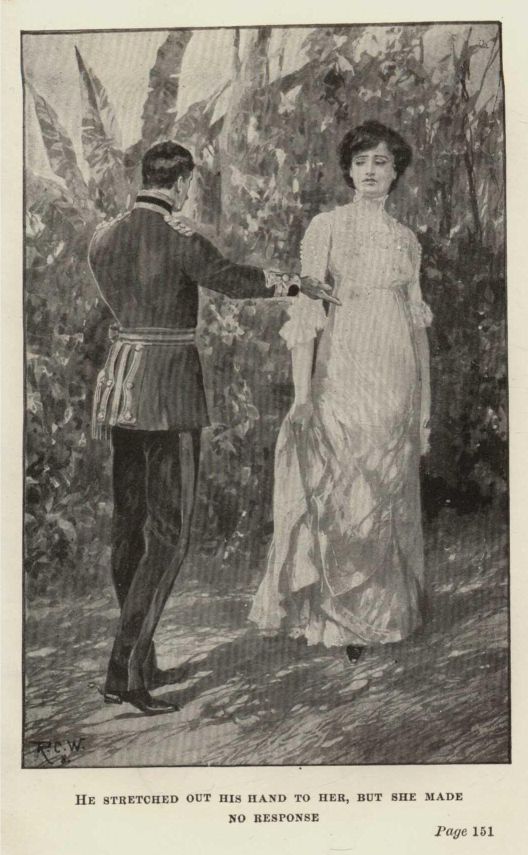
He stretched out his hand to her, but she made no response
"It was not to be, I see that now," she said, while her eyes filled and her bosom heaved. "I am not worthy of you. But I loved you and I thought you loved me, and I believed you when you told me that nothing could come between us."
Again he tried to speak, to explain, to protest, but his tongue would not utter a sound.
"If you had really loved me you would have been ready to ... even to.... But I was mistaken and I am punished, and this is how it is to end!"
"Helena, for God's sake—" he began, but he could bear no more. He did not see that the girl's love was fighting with her pride. The hideous injustice of it all was working like madness in his brain, and after a moment he turned to go.
As he walked across the garden the ground under his feet sounded hollow in his ears like the ground above a new-covered grave. When he reached the gate he thought he heard Helena calling in a pleading, sobbing voice—
"Gordon!"
But when he turned to look back she had disappeared. Then bareheaded, without helmet or sword, with every badge of rank and honour gone, he pulled the gate open and staggered into the square.
CHAPTER XXV
Helena returned to her father's room, and found the two old men getting ready to go. In the Pasha's face there were traces of that impulse to smile which comes to shallow natures in the presence of another person's troubles. But the face of the Consul-General was a tragic sight. The square-set jaw hung low, and the eyes were heavy as with unshed tears. It was easy to see that the iron man was deeply moved—that the depths of his ice-bound soul were utterly broken up.
Only in short, disjointed sentences did he speak at all. It was about his enemies—the corrupt, cruel, and hypocritical upholders of the old dark ways. They had bided their time; they had taken their revenge; they had hit him at last where he could least bear a blow; they had struck him in the face with the hand of his only son.
"There is no shame left in them," he said, and then he turned to Helena as if intending to say some word of sympathy. He wanted to tell her that he had hoped for other things, and would have been happy if they had come to pass. But when he saw the girl standing before him with her red eyes and pale cheeks, he hesitated, grasped her hand, held it for a moment, and then walked away without a word.
The Military Secretary accompanied the Consul-General and the Pasha to their carriages, and so father and daughter were left together. The General, labouring under the most painful of all senses, the sense of having done an unworthy thing, walked for some minutes about the room, and talked excitedly, while Helena sat on the sofa in silence, and, resting her chin on her hand, looked fixedly before her.
"Well, well, it's all over, thank God! It couldn't be helped, either! It had to be! Better as it is, too, than if it had come later on.... How hot I am! My throat is like fire. Get me a drink of water, girl."
"Let me give you your medicine, father. It's here on the desk," said Helena.
"No, no! Water, girl, water! That's right! There! ... He has gone, I suppose? Has he gone? Yes? Good thing too! Hope I'll never see him again! I never will—never! ... How my head aches! No wonder either!"
"You're ill, father—let me run for the doctor."
"Certainly not. I'm all right. Sit down, girl. Sit down and don't worry.... You mustn't mind me. I'm a bit put out—naturally! It's hard for you, I know, but don't cry, Helena!"
"I'm not crying, father—you see I'm not."
"That's right! That's right, dear! It's hard for you, I say, but then it isn't easy for me either. I liked him. I did, I confess it. I really liked him, and to ... to do that was like cutting off one's own son. But ... give me another drink of water, Helena ... or perhaps if you think you ought to run ... no, give me the medicine and I'll be better presently."
She poured out a dose and he drank it off.
"Now I'll lie down and close my eyes. I soon get better when I lie down and close my eyes, you know. And don't fret, dear. Think what an escape you've had! Merciful heavens! A traitor! Think if you had married a traitor! A man who had sold himself to the enemies of England! I was proud of you when you showed him that—come what would—you must stand by your country. Splendid! Just what I expected of you, Helena! Splendid!"
After a while his excited speech and gusty breathing softened down to silence and to something like sleep, and then Helena sat on a stool beside the sofa and covered her face with her hands. A hot flush mounted to her pale cheeks when she remembered that it had not been for England that she had acted as she had, but first for her father and next for herself.
Perhaps she ought to have told Gordon why she could not leave her father. If she had done so he might have acted otherwise. But the real author of the whole trouble had been the Egyptian. How she hated that man! With all the bitterness of her tortured heart she hated him!
As for Gordon, traitor or no traitor, he had been above them all! Far, far above everybody! Even the Consul-General, now she came to think of it, had been a little man compared with his son.
With her face buried in both hands and the tears at last trickling through her fingers, she saw everything over again, and one thing above all—Gordon standing in silence while her father insulted and degraded him.
The General opened his eyes, and seeing Helena at his feet he tried to comfort her, but every word he spoke went like iron into her soul.
"I'm sorry for you, Helena—very sorry! We must bear this trouble together, dear. Only ourselves again now, you know, just as it was five years ago at home. Your dark hour, this time, darling, but I'll make it up to you. Come, kiss me, Helena," and, drying her weary eyes, she kissed him.
The afternoon sun was then reddening the alabaster walls of the mosque outside, and they heard a surging sound as of a crowd approaching. A moment later little black Mosie ran in to say that the new Mahdi was coming, and almost before the General and Helena could rise to their feet a tall man in white Oriental costume entered the room. He came in slowly, solemnly, and with head bent, saying—
"Excuse me, sir, if I come without ceremony."
"Ishmael Ameer?" asked the General.
"My name is Ishmael—you are the Commander of the British forces. May I speak with you alone?"
The General stood still for a moment, measuring his man from head to foot, and then said—
"Leave us, Helena."
Helena hesitated, and the General said, "I'm better now—leave us."
With that she went out reluctantly, turning at the door to look at her enemy, who stood in his great height in the middle of the floor and never so much as glanced in her direction.
CHAPTER XXVI
Both men continued to stand during the interview that followed—the one in his white robes by the end of the sofa, resting two tapering fingers upon it, the other in his General's uniform by the side of the desk, except when in the heat of his anger he strode with heavy step and the jingling of spurs across the space between.
"Now, sir, now," said the General. "I have urgent work to do, and not much time to give you. What is it?"
"I come," said Ishmael, who was outwardly very calm, though his large black eyes were full of fire and light, "I come to speak to you about the order to close El Azhar."
"Then you come to the wrong place," said the General sharply. "You should go to the Agency—the British Agency."
"I have seen the English lord already. He refuses to withdraw his order. Therefore I am here to ask you—forgive me—I am here to ask you not to obey it."
The General tried to laugh. "Wonderful!" he said. "Your Eastern ideas of discipline are wonderful! Please understand, sir, I am here as the instrument of authority—that and that only."
"An instrument has its responsibility," said Ishmael. "If there were no instruments to do evil deeds would evil deeds be done? It is not your fault, sir, that the order has been issued, but it will be your fault if it is carried into effect."
"Really!" said the General, again trying to laugh. "Permit me to tell you, sir, that in this case there will be no fault in question, neither of mine nor anybody else's. El Azhar is a hotbed of sedition, and it is high time the Government cleared it out."
"El Azhar," said Ishmael, "is the heart of the Moslem faith. Take their religion away from them and the Moslems have nothing left. You are a Christian, and when your great Master was on earth He fed the souls of the people first."
"Yes, and He whipped the rascals out of the temple, and that's what the Government is going to do now—to drive out the pretentious impostors who are putting a lying spirit into the mouth of the people and making it impossible to govern them."
The Egyptian showed no anger. "I am here only to plead for the people, sir. Do not harden your heart against them. Do not send armed men among an unarmed populace. It will be slaughter."
"Tell them to submit to the Government and there will be no harm done to any one. It's their duty, isn't it? Whatever the Government may be, isn't it their duty to submit to it?"
"Yes," said Ishmael. "We who are Moslems are taught by the Prophet (blessed be his name!) that even if a negro slave is appointed to rule over us we ought to obey him."
"Deuce take it, sir, what do you mean by that?" said the General.
"But Government is a trust from God," said the Egyptian, "and at the Day of Resurrection the Most High will ask you what you have done to His children."
"Damn it, sir, have you come here to preach me a sermon?"
"I have come to plead with you for justice—the justice you look for from your Saviour. 'Be merciful to the weak,' He taught, and it is for the weak I appeal to you. He was meek and lowly—will you forget His precepts? 'Love one another'—will you make strife between man and man? He is dead—shall it be said that His spirit has died out among those who call Him their Redeemer?"
The General brought his fist heavily down on the desk as if to command silence.
"Listen here, sir," he said. "If you imagine for one moment that this tall talk will have any effect upon me, let me advise you to drop it. Being a plain soldier who has received a plain command, I shall take whatever military steps are necessary to see it faithfully carried out, and if the precious leaders of the people, playing on their credulity and fanaticism, should instigate rebellion, I shall have the honour—understand me plainly—I shall have the honour to lodge them in safe quarters, whosoever they are and whatsoever their pretensions may be."
The Egyptian's eyes showed at that moment that he was a man capable of wild frenzy, but he controlled himself and answered—
"I am not here to defend myself, sir. You can take me now if you choose to do so. But if I cannot plead with you for the people let me plead with you for yourself—your family."
The General, who had turned away from Ishmael, swung round on him.
"My family?"
"He that troubleth his own house, saith the Koran, shall inherit the wind. Will you, my brother, allow your daughter to be separated from the brave man who loves her? A woman is tender and sweet; all she wants is love; and love is a sacred thing, sir. Your daughter is your flesh and blood—will you make her unhappy? I see a day when you are dead—will it comfort you in the grave that two who should be together are apart?"
"They're apart already, so that's over and done with," said the General. "But listen to me again, sir. My girl needs none of your pity. She has done her duty as a soldier's daughter, and cut off the traitor whom you, and men like you, appear to have corrupted. Look here—and here," he cried, pointing to the broken sword and the medals which were still lying where he had flung them on the floor. "The man has gone—gone in disgrace and shame. That's what you've done for him, if it's any satisfaction to you to know it. As for my daughter," he said, raising his voice in his gathering wrath and striding up to Ishmael with heavy steps and the jingling of his spurs, "As for my daughter, Helena, I will ask you to be so good as to keep her name out of it—do you hear? Keep her name out of it, or else——"
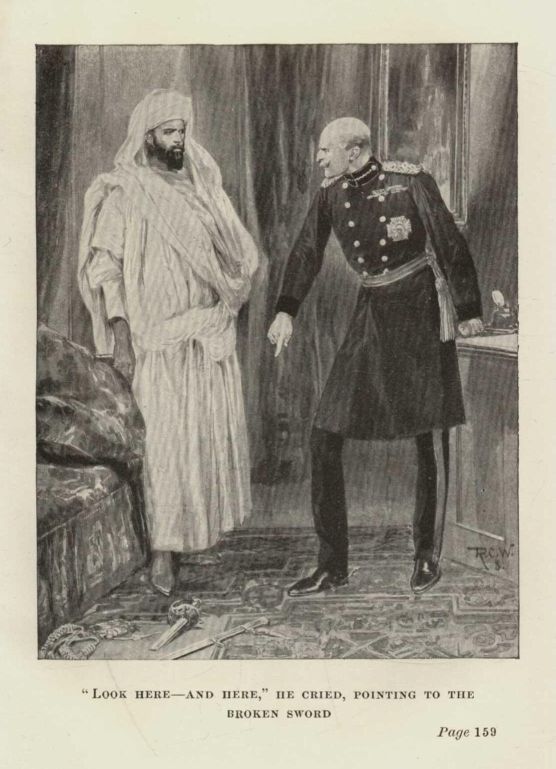
"Look here—and here," he cried, pointing to the broken sword
At that moment the men heard the door open and a woman's light footsteps behind them. It was Helena coming into the room.
"Did you call me, father?" she asked.
"No; go back immediately."
She looked doubtfully at the two men, who were now face to face as if in the act of personal quarrel, hesitated, seemed about to speak, and then, went out slowly.
There was silence for a moment after she was gone, and then Ishmael said—
"Do I understand you to say, sir, that Colonel Lord has gone in disgrace?"
"Yes, for consorting with the enemies of his country and refusing to obey the order of his General."
"Lost his place and rank as a soldier?"
"Soon will, and then he will be alone and have you to thank for it."
The Egyptian drew himself up to his full height and answered, "You are wrong, sir. He who has no one has God, and if that brave man has suffered rather than do an evil act, will God forget him? No!"
"God will do as He thinks best without considering either you or me, sir," said the General. "But I have something to do and I will ask you to leave me.... Or wait one moment! Lest you should carry away the impression that because Colonel Lord has refused to obey his General's order the order will not be obeyed—wait and see."
He touched the bell and called for his Aide-de-camp.
"Tell Colonel Macdonald to come to me immediately," said the General, and when the Aide-de-camp had gone he turned to his desk for papers.
The Egyptian, who had never moved from his place by the sofa, now took one step forward and said in a low, quivering voice—
"General, I have appealed to you on behalf of my people and on your own behalf, but there is one thing more."
"What is it?"
"Your country."
The General made an impatient gesture, and the Egyptian said, "Hear me, I beg, I pray! Real as life, real as death, real as wells of water in a desert place, is their religion to the Muslemeen, and if you lay so much as your finger upon it your Government will die."
He raised his hand and with one trembling finger pointed upwards. "Do you think your swords will govern them? What can your swords do to their souls? By the Most High God I swear to you that I have only to speak the word and the rule of England in Egypt will end."
At that moment Colonel Macdonald, a large man in khaki, a Highlander, with a ruddy face and a glass in his left eye, opened the door and stood by it, while the General, whose own face was scarlet with anger, said—
"So! So that's how you talked to Colonel Lord, I presume—how you darkened the poor devil's understanding! Now see—see what effect your threats have upon me. Step forward, Colonel Macdonald."
The Colonel saluted and stepped up to the General, who repeated to him word for word the order he had given to Gordon, and then said—
"You will arrest all who resist you, and if any resist with violence you will compel obedience—you understand?"
"Perfectly," said the Colonel, and saluting again he left the room.
"Now, sir, you can go," said the General to Ishmael, whereupon the Egyptian, whose face had taken on an extreme pallor, replied—
"Very well! I have warned you and you will not hear me. But I tell you that at this moment Israfil has the trumpet to his mouth and is only waiting for God's order to blow it! I tell you, too, that I see you—you—on the Day of Judgment, and there are black marks on your face."
"Silence, sir!" said the General, bringing his clenched fist heavily down on the desk. Then he struck the bell, and in a choking voice called first for his servant and afterwards for his Aide-de-camp. "Robson! See this man out of the Citadel! This damnable, presumptuous braggart! Robson! Where are you?" But the servant did not appear and the Aide-de-camp did not answer.
"No matter," said the Egyptian. "I will go of myself. I will try to forget the hard words you have said of me. I will not retort them upon you. You are a Christian, and it was a Christian who said 'Resist not evil.' That is a commandment as binding upon us as upon you. God's will be done."
With that Ishmael went out as he had entered, slowly, solemnly, with head bent and eyes on the ground.
CHAPTER XXVII
The General was now utterly exhausted. Being left alone he leaned against the desk, intending to wait until his breathing had become more regular and he could reach the sofa. Standing there, he heard the surging noise of the crowd that had been waiting outside for their Arab prophet and were now going away with him. He wanted to call Helena, but restrained himself, remembering how often she had warned him.
"Robson!" he called again but again the Aide-de-camp did not answer—he must have gone off on some errand for Colonel Macdonald.
The General took up his medicine and gulped down a large dose, drinking from the neck of the bottle, and then sank on to the sofa.
Some minutes passed and he began to feel better. The sunset was deflected into his face from the alabaster walls of the mosque outside, but he could not get up to pull down the blind of his window. So he closed his eyes and thought of what had happened.
It seemed to him that Gordon had been to blame for everything. But for Gordon's monstrous conduct they would have been spared all this trouble—Lord Nuneham's crushing blow, his own humiliating action, so wickedly forced upon him, and above all, Helena's sorrow.
In the delirium of his anger against Gordon he felt as if he would choke. Thinking of Helena and her ruined happiness, he wondered why he had let Gordon off so lightly, and he wanted to follow and punish him.
Then he heard the door open, and thinking Helena was coming into the room, he rose to his feet and faced around, when before him, with a haggard face, stood Gordon himself.
CHAPTER XXVIII
When Gordon Lord, after parting with Helena, had left the Citadel, his mental anguish had been so intense as to deaden all his faculties. His reason was clogged, his ideas were obscure, he could not see or hear properly. Passing the sentry in his lodge by the gate, he did not notice the man's bewildered stare or acknowledge his abbreviated salute. The whole event of the last hour had overwhelmed him as with a terrible darkness, and in this darkness he plodded on, until he came into the streets, dense with people and clamorous with all the noises of an Eastern city—the clapping of water-carriers, the crying of lemonade-sellers, the braying of donkeys, and the ruckling of camels.
"Where am I going?" he asked himself at one moment, and when he remembered that he was going back to his quarters—for that was what he had been ordered to do, that he might be under arrest and in due course tried by court-martial—he told himself that he had been tried and condemned and punished already. At that thought, though clouded and obscure, he bit his lip until it bled, and muttered, "No, I cannot go back to quarters—I will not!"
At the next moment a certain helplessness came over him, and up from the deep place where the strongest man is as a child, by the pathetic instinct that keeps the boy alive in him to the last dark day of his life and in the hour of death, came a desire to go home—to his mother. But when he thought of his mother's pleading voice as she begged him to keep peace with his father, and then, by some juggling twist of torturing memory, of the first evening after his return to Egypt, when he wore his medals and she fingered them on his breast with a pride that no queen ever had in the jewels in her crown, he said to himself, "No, I can never go home again."
His mind was oscillating among these agonising thoughts when he became aware that he was walking in the Esbekiah district, the European quarter of Cairo, where the ooze of the gutter of the city is flung up under the public eye; and there under the open piazza, containing a line of drinking places, in an atmosphere that was thick with tobacco smoke, the reek of alcohol, the babel of many tongues, the striking of matches, and the popping of corks, he sat down at a table and called for a glass of brandy.
The brandy seemed to clear his faculties for a moment, and his aimless and wandering thoughts began to concentrate themselves. Then the scene in the General's office came back to him—the drawing of his sword from its scabbard, the breaking of it across the knee, the throwing of the wretched fragments at his feet, the ripping away of his medals and the trampling of them under foot. The hideous memory of it all, so illegal, so un-English, made his blood to boil, and when his beaten brain swung back to the scenes in which he had won his honours at the risk of his life—Omdurman, Ladysmith, Pretoria—the rank injustice he had suffered almost stifled him with rage, and he swore and struck the table.
All his anger was against the General, not against his father, of whom he had hardly thought at all, but the cruellest agony he passed through came at the moment when his wrath rose against Helena. As he thought of her he became dizzy; his brain reeled with a dance of ideas, in which no picture lasted longer than an instant, and no emotion would stay. At one moment he was seeing her as he saw her first, with her big eyes, black as a sloe, the joyous smile that was one of her greatest charms, the arched brow, the silken lashes, the gleam of celestial fire, the "Don't go yet" that came into her look, and then his quickening pulse, the thrill that passed through him, and the mysterious voice that whispered, "It is She!"
Without knowing it he groaned aloud as he thought of the ruin all this had come to, and at the next moment he was in the midst of another memory—a memory of the future as he had imagined it would be. They were to be married soon, and then, realising one of the dreams of his life, they were to visit America, for his mother's blood called to him to go there, to see the great new world—yes, but above all to stand, with Helena's quivering hand in his, on that rock at Plymouth, where a handful of fearless men and women had landed on a bleak and hungry coast, afraid of no fate, for God was with them, and in two short centuries had peopled a vast continent and created one of the mightiest empires of the earth. Remembering this as a vanished dream, his wretched soul was on the edge of a vortex of madness, and he laughed outright with a laugh that shivered the air around him.
Then he was conscious that somebody was speaking to him. It was a young girl in a gaudy silk dress, with a pasty face, lips painted very red, eyebrows darkened, a flower in her full bosom which was covered with transparent lace, and a little satchel swinging on her wrist.
"Overdoing it a bit, haven't you, dear?" she said in French, and she smiled at him, a poor sidelong smile, out of her crushed and crumpled soul.
At the same moment he became aware that three men at a table behind him were winking at the girl and joking at his expense. One of them, a little fat American Jew with puffy cheeks, chewing the end of a cigar, was saying—
"Guess a man don't have no use for a hat in a climate like this—sun so soft, and only ninety-nine in the shade."
Whereupon an Englishman with a ripped and ragged mouth and a miscellaneous nose, half pug and half Roman, answered—
"Been hanging himself up on a nail by the breast of his coat, too, you bet."
Putting his hand to his hair and looking down at the torn cloth of his tunic, Gordon realised for the first time that he was bareheaded, having left his helmet at the Citadel, and that to the unclean consciousness of the people about him he was drunk.
At that moment he started up suddenly, and coming into collision with the American, who was swinging on the back legs of his chair, he sent him sprawling on the ground, where he yelled—
"Here, I say, you blazing——"
But the third man at the table, a dragoman in a fez, whispered—
"Hush! I know that gentleman. Leave him alone, sirs, please. Let him go."
With heart and soul aflame, Gordon walked away, intending to take the first cab that came along and then forgetting to do so. One wild thought now took possession of him and expelled all other thoughts. He must go back to the Citadel and accuse the General of his gross injustice. He must say what he meant to say when he stood by the door as he was going out.
The General should hear it—he should, and by —— he must!
The brandy was working in his brain by this time, and in the blind leading of passion everything that happened on the way seemed to fortify his resolve. The streets of the native city were now surging with people, as a submerged mine surges with the water that runs through it. He knew where they were going—they were going to El Azhar—and when he came to the great mosque he had to fight his way through a crowd that was coming from the opposite direction, with the turbaned head of a very tall man showing conspicuously in the midst of the multitude, who were chanting verses from the Koran and crying in chorus, "La ilaha illa-llah."
At sight of this procession, knowing what it meant—that the Moslems were going to the doomed place, to defend it or to die—a thousand confused forms danced before Gordon's eyes. His impatience to reach the Citadel became feverish, and he began to run, but again at the foot of the hill on which the fortress stands he was kept back. This time it was by a troop of cavalry who were trotting hard towards El Azhar. He saw his deputy, Macdonald, with his blotchy face and his monocle, but he was himself seen by no one, and in the crush he was almost ridden down.
The Citadel, when he reached it, seemed to be deserted, even the sentry standing with his back to him in the sentry-box as he hurried through. There was nobody in the square of the mosque or yet at the gate to the General's garden, which was open, and the door of the house, when he came to it, was open too. With the hot blood in his head, his teeth compressed, and his nostrils quivering, he burst into the General's office and came face to face with the old soldier as he was rising from the sofa. Thus in the blind swirl of circumstance the two men met at the moment when the heart of each was full of hatred for the other.
They were brave men both of them, and never for one instant had either of them known what it was to feel afraid. They were not afraid now, but they had loved each other once, and up from what deep place in their souls God alone can say, there came a wave of feeling that fought with their hate. The General no longer wanted to punish Gordon, but only that Gordon should go away, while Gordon's rage, which was to have thundered at the General, broke into an agonising cry.
"What are you doing here? Didn't I order you to your quarters? Do you wish me to put you under close arrest? Get off!"
"Not yet. You and I have to settle accounts first. You have behaved like a tyrant. A tyrant—that's the only word for it! If I was guilty of insubordination, you were guilty of outrage. You had a right to arrest me, and to order that I should be court-martialled, but what right had you to condemn me before I was tried and punish me before I was sentenced? Before or after, what right had you to break my sword and tear off my medals? Degradation is obsolete in the British Army—what right had you to degrade me? Before my father, too, and before Helena—what right had you?"
"Leave my house instantly; leave it, leave it!" said the General, his voice coming thick and hoarse.
"Not till you hear what I've come to tell you," said Gordon, and then he repeated the threat—who knows on what inherited cell of his brain imprinted—which his father had made forty years before.
"I've come to tell you that I'll go back to my quarters and you shall court-martial me to-morrow if you dare. Before that, England may know by what is done to-night that I refused to obey your order because I'm a soldier, not a murderer. But if she never knows," he cried, in his breaking voice, "and you try me and condemn me and degrade me even to the ranks, I'll get up again—do you hear me?—I'll get up again, and win back all I've lost and more—until I'm your own master and you'll have to obey me."
The General's face became scarlet, and lifting his hand as if to strike Gordon, he cried, in a choking voice—
"Go, before I do something——"
But Gordon in the delirium of his rage heard nothing except the sound of his own quivering voice.
"More than that," he said, "I'll win back Helena. She was mine, and you have separated her from me and broken her heart as well as my own. Was that the act of a father, or of a robber and a tyrant? But she will come back to me, and when you are dead and in your grave we shall be together, because ... Stop that! Stop it, I say!"
The General, unable to command himself any longer, had snatched up the broken sword from the floor and was making for Gordon as if to smite him.
"Stand away! You are an old man and I am not a coward. Drop that, or by God you——"
But the General, losing himself utterly, flung himself on Gordon with the broken sword, his voice gone in a husky growl and his breath coming in hoarse gusts.
The struggle was short but terrible. Gordon in the strength of his young manhood first laid hold of the General by the upper part of the breast to keep him off, and then, feeling that his hand was wounded, he gripped at the old man's throat with fingers that clung like claws. At the next moment he snatched the sword from the General, and at the same instant, with a delirious laugh, he flung the man himself away.
The General fell heavily with a deep groan and a gurgling cry. Gordon, with a contemptuous gesture, threw the broken sword on the floor, and then with the growl of a wild creature he turned to go.
"Fight me—would you, eh! Kill me, perhaps! We've settled accounts at last—haven't we?"
But hearing no answer he turned at the door to look back and saw the General lying where he had fallen, outstretched and still. At that sight the breath seemed to go out of his body at one gasp. His head turned giddy, and the red gleams of the sunset which were deflected into the room appeared to his half-blind eyes to cover everything with blood.
CHAPTER XXIX
Gordon stood with his mouth open, the brute sense struck out of him by the dead silence. Then he said—
"Get up! Why don't you get up?" hardly knowing what he was saying.
He got no answer, and a horrible idea began to take shape in his mind. Though so hot a moment ago, he shivered and his teeth began to chatter. He looked around him for a moment in the dazed way of a man awakening from a nightmare, and then stepped up on tiptoe to where the General lay.
Raising his head he looked at him, and found it hard to believe that what he vaguely feared had happened. There was no sign of injury anywhere. The eyes were open, and they looked fixedly at him with so fierce a stare that they seemed to jump out of their sockets.
"Stunned—that's all—stunned by the fall," he thought, and seeing a bottle of brandy on the shelf of the desk he got up and poured a little into the medicine glass, and then, kneeling and lifting the General's head again, he forced the liquor through the tightly compressed lips.
It ran out as it went in, and, with gathering fear and fumbling fingers, Gordon unbuttoned the General's frock coat and laid a trembling hand over his heart. At one moment he thought he felt a beat, but at the next he knew it was only the throb of his own pulse.
At that the world seemed for a moment to be blotted out, and when he came to himself again he was holding the General in his arms and calling to him—
"General! General! Speak to me! For God's sake speak to me."
In the torrent of his remorse he was kissing the General's forehead, and crying over his face, but there was no response.
Then a great trembling shook his whole body, and dropping the head gently back to the floor he rose to his feet. The General was dead, and he knew it.
He had seen death a hundred times before, but only on the battlefield, amid the boom of cannon, the wail of shell, the snap of rifles, and the oaths of men, but now it filled him with terror.
The silence was awful. A minute ago the General had been a living man, face to face with him, and the room had been ringing with the clashing of their voices; but now this breathless hush, this paralysing stillness, in which the very air seemed to be dead, for something was gone as by the stroke of an almighty hand, and there was nothing left but the motionless figure at his feet.
"What have I done?" he asked, and when he told himself that in his headstrong wrath he had killed a man, his head spun round and round. He, who had refused to obey orders because he would not commit murder was guilty of murder himself! What devil out of hell had ordered things so that as the very consequence of refusing to commit a crime he had become a criminal?
"God have pity upon me and tell me it is not true," he thought.
But he knew it was true, and when he told himself that the man he had killed was his General his pain increased tenfold. The General had loved him and favoured him, been proud of him and upheld him, and never, down to the coming of this trouble, had their friendship been darkened by a cloud.
"Oh, forgive me! God forgive me!" he thought.
In his blind misery, which hardly saw itself yet for what it was, the impulse came to him to carry the burden of his sin, too heavy for himself, to Helena, that she might help him to bear it; and he had taken some steps towards the door leading to her room when it struck him as a blow on the brain that she was the daughter of the dead man, and he was going to her for comfort after killing her father.
At that thought he stopped and laid hold of the desk for support, being so weak that he could scarcely keep on his legs. He remembered Helena's love for the General, how much of her young life she had given to him, and how the quarrel that had divided himself from her had come of her determination not to leave her father as long as he lived. And now he had killed him!
Beads of sweat started from his forehead, but after a moment he told himself that if he could not expect comfort from Helena it was his duty to comfort her—to break the news to her. He saw himself doing so. "Helena, listen, dear; be brave." "What is it?" "Your father—is—is dead." "Dead?" "Worse, a thousandfold worse—he is murdered." "Murdered?" "It was all in the heat of blood—the man didn't know what he was doing." "Who was it—who was it?" "Don't you see, Helena—it was I."