THE WHITE PROPHET, VOLUME I (continued 2)
Reading edition
"All this is true, too true," said Gordon, "yet under all that ... Doesn't Ishmael Ameer see that under all that——"
"Ishmael Ameer sees," said the Chancellor, "that what is known to the world as Christian civilisation is little better than an organised hypocrisy, a lust of empire in nations and a greed of gold in men, destroying liberty, morality, and truth. Therefore he warns his followers against a civilisation which comes to the East with religion in one hand and violence and avarice in the other."
"But surely he sees," said Gordon, "what Christian civilisation has done for the world, what science has done for progress; what England, for example, has done for Egypt?"
"Ishmael Ameer thinks," replied the Chancellor in the same slow, soft voice, "that the essential qualities of national greatness are moral, not material; that man does not live by bread alone; that it is of little value to Egypt that her barns are full if the hearts of her children are empty; that Egypt can afford to be patient, for she is old and eternal; that many are the events which have passed before the eyes of the crouching Sphinx; that the life of man is threescore and ten years, but when Egypt reviews her past she looks back on threescore and ten centuries."
There was silence for a moment, during which the muezzin's voice was heard again, calling the first hour of night, and then Gordon, visibly agitated, said—
"You think Ishmael Ameer a regenerator, a reformer, a redeemer of Islam; and if his preaching prevailed it would send the Grand Cadi back to his Sultan—isn't that so?" But the Chancellor made no reply.
"It would also send England out of Egypt—wouldn't it?" said Gordon, but still the Chancellor gave no sign.
"It would go farther than that perhaps—it would drive Western civilisation out of the East—wouldn't that be the end of it?" said Gordon, and then the Chancellor replied—
"It would drive a corrupt and ungodly civilisation out of the world, my son."
"I see!" said Gordon. "You think the mission of Ishmael Ameer transcends Egypt, transcends even Europe, and says to humanity in general, 'What you call civilisation is killing religion, because the nations—Christian and Moslem alike—have sold themselves to the lust of empire and the greed of gold'—isn't that what you mean?"
The Chancellor bowed his grave head, and in a scarcely audible voice said, "Yes."
"You think, too," said Gordon, whose breathing was now quick and loud, "that Ishmael Ameer is an apostle of the soul of Islam—perhaps of the soul of religion itself without respect of creed—one of the great men who come once in a hundred years to call the world back from a squalid and sordid materialism, and are ready to live, aye, and to die for their faith—the Savonarolas, the Luthers, the Gamal-ed-Deens—perhaps the Mohammeds and" (dropping his voice) "in a sense the Christs?"
But the Egyptian soul, like the mirage of the Egyptian desert, recedes as it is approached, and again the Chancellor made no reply.
"Tell me, O Sheikh," said Gordon, rising to go, "if Ishmael Ameer came to Cairo, would you permit him to preach in El Azhar?"
"He is an Alim" (a doctor of the Koran); "I could not prevent him."
"But would you lodge him in your own house?"
"Yes."
"That is enough for me. Now I must go to Alexandria and see him for myself."
"May God guide you, O my son," said the Chancellor, and a moment afterwards his soft voice was saying farewell to the two young soldiers at the door.
"Let us walk back to barracks, Hafiz," said Gordon. "My head aches a little, somehow."
CHAPTER VIII
It was night by this time; the courts and corridors of El Azhar were empty, and even the tangled streets outside were less loud than before with the guttural cries of a swarming population, but a rumbling murmur came from the mosque of the University, and the young soldiers stood a moment at the door to look in. There, under a multitude of tiny lanterns, stood long rows of men in stockinged feet and Eastern costume, rising and kneeling in unison, at one moment erect and at the next with foreheads to the floor, while the voice of the Imam echoed in the arches of the mosque and the voices of the people answered him.
Then through narrow alleys, full of life, lit only by the faint gleam of uncovered candles, with native women, black-robed and veiled, passing like shadows through a moving crowd of men, the young soldiers came to the quarter of Cairo that is nick-named the "Fish Market," where the streets are brilliantly lighted up, where the names over the shops are English and French, Greek, and Italian, and where girls with painted faces wave their hands from barred windows and call to men who sit at tables in front of the cafés opposite, drinking wine, smoking cigarettes, and playing dominoes. The sound of music and dancing came from the open windows behind the girls who glittered with gold brocade and diamonds; and among the men were young Egyptians in the tarboosh and British soldiers in khaki, who looked across at the women in the flare of the coarse light and laughed.
At the gate of the Kasr-el-Nil barracks the young men parted.
"Tell me, Hafiz," said Gordon, "if a soldier is ordered to act in a way he believes to be wrong, what is he to do?"
"His duty, I suppose," said Hafiz.
"His duty to what—his Commander or his conscience?"
"If a soldier is under orders I suppose he has no conscience?"
"I wonder!" said Gordon, and promising to write to Hafiz in the morning, he went up to his quarters.
The room was in darkness, save for the moonlight with its gleam of mellow gold, which seemed to vibrate from the river outside, and Gordon stood by the window, with a dull sense of headache, looking at the old Nile that had seen so many acts in the drama of humanity and still flowed so silently, until he became conscious of a perfume he knew, and then, switching on the light, he found a letter in a scented envelope lying on his desk. It was from Helena, and it was written in her bold, upright hand, with the gay raillery, the passionate tenderness, and the fierce earnestness which he recognised as her chief characteristics:—
"MISTER, most glorious and respected, the illustrious Colonel Lord, owner of Serenity and Virtue, otherwise dear old Gordon—
"It was wrong of you not to come to dinner, for though Father over-excited himself at Ghezirah to-day and I have had to pack him off to bed, I made every preparation to receive you, and here I am in my best bib and tucker, wearing the crown of pink blossom which my own particular Sultan says suits my gipsy hair, and nobody to admire it but my poor little black boy Mosie—who is falling in love with me, I may tell you, and is looking at me now with his scrubby face all blubbered up like a sentimental hippopotamus.
"I am not surprised that the Consul-General talked about the new 'holy man,' and I do not wonder that he ordered you to arrest him, but I am at a loss to know why you should take counsel with that old fossil at El Azhar, and you can tell Master Hafiz I mean to dust his jacket for suggesting it, knowing your silly old heart is like wax, and they have only to recite something out of the 'noble Koran' and you'll be as weak as—well, as a woman.
"As for holy men generally, I agree with the Princess that they are holy humbugs, which is the title I would give to a good many of the genus at home as well as here, so I say with your namesake of glorious memory (who wasn't an ogre, goodness knows!), Smash the Mahdi!
"A thousand to one he is some ugly, cross-eyed old fanatic, who would destroy every germ of civilisation in Egypt and carry the country back to barbarity and ruin, so I say again, Smash the Mahdi!
"As for your 'conscience,' I cry 'Marry-come-up!' by what right does it push its nose where it isn't wanted, seeing it is the conscience of the Consul-General that will be damned if the work is wrong and wicked and there won't be so much as a plum of Paradise for yours if it is right and good, so once again I say, Smash the Mahdi!
"Moreover, and furthermore, and by these presents, I rede ye beware of resisting the will of your father, for if you do, as sure as I'm a 'witch' and 'know things without learning them,' I have a 'mystic sense' there will be trouble, and nobody can say where it will end or how many of us may be involved in it, so again and yet again I say, Smash the Mahdi!
"The Consul-General's letter has come, but I shall not read it to Father until morning, and meantime, if I ever pass through your imagination, think of me as poor Ruth sitting on the threshing-floor with Boaz, and dreaming of Zion—that is to say, of stuffy old El Azhar, where somebody who ought to know better is now talking to an old frump in petticoats instead of to me.
"Inshallah! The slave of your Virtues.—HELENA.
"P.S.—Dying for to-morrow afternoon, dear.
"P.P.S.—IMPORTANT—Smash the Mahdi!"
CHAPTER IX
Helena Graves was everything to her father, for the General's marriage had been unhappy, and it had come to a tragic end. His wife, the daughter of a Jewish merchant in Madras, had been a woman of strong character and great beauty but of little principle, and they had been married while he was serving as senior Major with a battalion of his regiment in India, and there, Helena, their only child, had been born.
Things had gone tolerably between them until the Major returned to England as Lieutenant-Colonel commanding the battalion of his regiment at home, and then, in their little military town, they had met and become intimate with the Lord-Lieutenant of the county, a nobleman, a bachelor, a sportsman, a breeder of racehorses, and a member of the Government.
The end of that intimacy had been a violent scene, in which the husband, in his ungovernable rage, had flung the nobleman on the ground and trampled on him, torn the jewels out of his wife's breast and crushed them under his heel, and then, realising the bankruptcy his life had come to, had gone home and had brain fever.
Helena, like her father, was passionate and impetuous, and her mother had neglected and never really loved her. With the keen eyes of a child who is supposed to see nothing, she had observed from the first what was going on at home, and all her soul had risen against her mother and her mother's lover with a hatred which no presents could appease. Being now a girl of eighteen, well grown and developed, and seeing with what treachery and cruelty her father had been stricken down, her heart went out to him, and she became a woman in one day.
When the brain fever was gone, the General, weak both in body and mind, was ordered rest and change. Somebody suggested the Lake Country, as his native air, so Helena, who did everything for him, took him to a furnished cottage in Grasmere, a sweet place bowered in roses, with its face to the sedgy lake, and with the beautiful river, the Rotha, laughing and babbling by the garden at the back.
There he recovered bodily strength, but it was long before his mind returned to him, and meantime he had strange delusions. Something, perhaps, in the place of their retreat brought ghosts of the past out of a world of shadows, for he thought he was a boy again and Helena was his mother, who was thirty years dead and buried in the little churchyard lower down the stream, where the Rotha was deep and flowed with a solemn hush.
Helena played up to his pathetic delusion, took the tender endearments that were meant for the grandmother she had never known, and as his young days came to the surface with the beautiful persistence of old memories ha the human mind, she fell in with them as if they had been her own. Thus on Sunday morning, when the bells rang, she would walk with him to church, holding his hand in her hand as if she were the mother and he the child.
It was very sweet to look upon, for, in the sleep of the General's brain, he was very happy, and only to those who saw that the brave girl, with her eyes of light and her lips of dew, was giving away her youth to her old father, was it charged with feeling too deep for tears.
But at length the stricken man came out of the twilight land, and his dream faded away. Helena had to play their little American organ every evening that he might sing a hymn to it, for that was what his mother had always done, when she was putting her boy to bed and thinking, like a soldier's wife, of his father who was away at the wars. It was always the same hymn, and one breathless evening, when the sun had gone down and the vale was still, they had come to—
"Hide me, O my Saviour, hide,
Till the storms of life be past"—
and then his voice stopped suddenly, and he shaded his eyes as if something were blinding them.
At that moment the past, which had been dead so long, seemed to rise from its grave, with all its mournful incidents—his wife and his shattered home—and Helena was not his mother but his daughter, and he was not a happy boy but an old soldier, with a broken life behind him.
Seeing by the look in his eyes that he was coming to himself, Helena tried to comfort him, and when he gasped, "Who is it?" she answered in a voice she tried to render cheerful, "It is I. It is Helena. Don't you know me, Father?" And then the years rolled back upon him like a flood, and he sobbed on her shoulder.
The awakening had been painful, but it was not all pain. If he had lost a wife he had gained a daughter, and she was the strongest, staunchest creature in the world. For her sake he must begin again. Having had so much shadow in her young life, she must now have sunshine. Thus Helena became her father's idol, the one thing on earth to him, and he was more to her than a father usually is to a daughter, because she had seen him in his weakness and mothered him back to strength.
Two years after the breakdown they were in London, and there Helena met Lord Nuneham on one of his few visits to England. The great Proconsul, who had heard what she had done, was most favourably impressed by her, and as she talked to him, he said to himself, "This girl has the blood of the great women of the Bible, the Deborahs who were mothers in Israel, aye, and the Jaels who avenged her." At that time the post of Major-General to the British Army in Egypt was shortly to become vacant, and by Lord Nuneham's influence it was offered to Graves. Six months later father and daughter arrived in Cairo.
It had been an exciting time, but Helena had managed everything, and the General had borne up manfully until they took possession of the house assigned to them, a renovated old palace on the edge of the Citadel. Then in a moment he had collapsed, and fallen from his chair to the floor. Helena had lifted him in her strong arms, laid him on the couch, and sent his Aide-de-camp for the Medical Officer in charge.
Consciousness came back quickly, and Helena laughed through the tears that had gathered in her great eyes, but the surgeon continued to look grave.
"Has the General ever had attacks like this before?" he asked.
"Never that I know of," said Helena.
"He must be kept quiet. I'll see him in the morning."
Next day the Medical Officer had no doubts of his diagnosis—heart-disease, quite unmistakably. The news had to be broken to the General, and he bore it bravely, but thinking of Helena he made one request—that nothing should be said on the subject. If the fact were known at the War Office he might be retired, and there could be no necessity for that until the army was put on active service.
"But isn't the army always on active service in Egypt, sir?" said the surgeon.
"Technically perhaps, not really," said the General. "In any case I'm not afraid, and I ask you to keep the matter quiet."
"As you please, sir."
"You and I and Helena must be the only ones to know anything about it."
"Very well, but you must promise to take care. Any undue excitement, any over-exertion, any outburst of anger even——"
"It shall not occur—I give you my word for it," said the General.
But it had occurred, not once but frequently during the twelve months following. It occurred after Gordon asked for Helena, and again last night, the moment the General reached his bedroom on his return from the Khedivial Club.
He was better next morning, and then Helena took up the letter from Lord Nuneham. "Read it," said the General, and Helena read—
"DEAR GENERAL,—Gordon is here, and I will send him up to tell you what I think it necessary to do in order to put an end to the riots at Alexandria and make an example of the ringleaders.
"The chief of them is the Arab preacher, Ishmael Ameer, and I propose that we bring him up to Cairo immediately, try him by Special Tribunal, and despatch him without delay to our new penal settlement in the Soudan.
"For that purpose (as the local police are chiefly native and therefore scarcely reliable, and your Colonel on the spot might hesitate to act on his own initiative in the possible event of a rising of the man's Moslem followers), I propose that you send some one from Cairo to take command, and therefore suggest Gordon, your first staff officer, and the most proper person (always excepting yourself) to deal with a situation of such gravity.—Yours in haste, NUNEHAM."
While Helena was reading the letter the General could hardly restrain his excitement.
"Just as I thought!" he said. "I knew the Consul-General would put down that new Mahdi. Wonderful man, Nuneham! And what a chance for Gordon! By Gad, he'll have all Europe talking about him. He deserves it, though. Ask the staff. Ask the officers. Ask the men. I see what Nuneham's aiming at—making Gordon his successor! Well, why not? Why not Gordon Lord the Consul-General? I ask, why not? Good for Egypt and good for England too. Am I wrong?"
Then, remembering to whom he was addressing these imperative challenges, he laughed and said, "Ah, of course! I congratulate you, my child! I'll live to see you proud and happy yet, Helena. Now go—I'm going to get up."
And when Helena warned him that he was over-exciting himself again, he said, "Not a bit of it. I'm all right now. But I must write to Alexandria immediately and see Gordon at once.... Coming up this afternoon, you say? That will do. Splendid fellow! Fine as his father! Father and son—both splendid!"
CHAPTER X
When Gordon reached the General's house at five o'clock that day there was for a while a clash of opposing wills. Thinking of Helena's peremptory advice, Smash the Mahdi, he was determined to tell her what the Chancellor of El Azhar had said of Ishmael Ameer, and she was resolved that he should say nothing about him. So while Gordon stood by the shaded window, looking down on the city below, which still lay hot under the sun's fierce eye, Helena talked of his mother, her father, and of the Princess Nazimah, who had invited her, in a funny letter, to join the ladies' council for the emancipation of Egyptian women and the abolition of polygamy, saying among other things, "The needle carries but one thread, my dear, and the heart cannot carry two." But at length she said—
"When do you leave for Alexandria?"
"To-night at half-past six. My servant is to take my bag to the railway station, and Hafiz and two other Moslems are to meet me there."
"Good gracious! No time to lose, then. Mosie!" she cried, and a small black boy with large limpid eyes, wearing a scarlet caftan and blue waistband, came into the room.
"Tea, Mosie, quick! Tell the cook the Colonel has to catch a train."
The black boy kissed her hand and went bounding out, whereupon she talked again to prevent Gordon from talking.
"Didn't I tell you that boy was falling in love with me? I found him fighting in the market-place. That was a week ago, since when he has adopted me, and now he is always kissing my hand or the hem of my gown, as who would say, 'I have none but her, and I love her like my eyes.' A most dear little human dog, and I do believe—yes, I really do believe—if I wished it he would go to his death for me."
Gordon, who was gloomy and dejected, and had been drumming on the window-pane without listening, then said—
"Helena, can you imagine what it is to a soldier to feel that he is on the wrong side in battle? If he is to fight well he ought to feel that he is fighting for his country, his flag, and—justice. But when the position is the reverse of that; when, for example——"
But at that moment the General came into the room and welcomed Gordon with a shout.
"Just been writing to Alexandria, telling Jenkinson to keep a force in readiness for you night and day," he said. "Only way, my boy! Force is the one thing the Easterns understand. Of course we don't want bloodshed, but if these rascals are telling the people that the power is not in our hands, or that England will not allow us to use it—we must let them see—we can't help it. Glorious commission, Gordon! I congratulate you! My job, though, and there's only one man I could give it up to—only one man in the world."
And then Gordon, who had been biting his underlip, said, "I almost wish you could do it yourself, General."
"Why, what the deuce——"
"Gordon has been taking counsel with the Chancellor of El Azhar," said Helena, "and the old silly seems to have given him 'the eye' or talked nonsense out of the noble Koran."
"Not nonsense, Helena, and not out of the Koran, but out of the book of life itself," said Gordon, and after the black boy had brought in the tea, he told them what the Chancellor had said.
"So you see," he said, "the preaching of this new prophet has nothing to do with England in Egypt—nothing more, at least, than with England in India, or South Africa, or even Canada itself. It transcends all that, and is teaching for the world, for humanity. Isn't it true, too? Take what he says about the lust of empire, and look at the conduct of the Christian countries. They are praying in their churches 'that it may please Thee to give to all nations unity, peace, and concord,' yet they are increasing their armaments every day. What for—defence? Certainly! But what does that mean?—fear of aggression. So, while in our King's speeches and our President's messages, in our newspapers and even in our pulpits we keep up the pretence that we are at peace with the world, we are always, according to the devil's code of honour, preparing for the time when two high-spirited nations may find it convenient to fly at each other's throats. Peace with the world! Lies, sir, all lies, and barefaced hypocrisy! The nations never are at peace with the world, never have been, never want to be."
The General tried to protest, but Gordon, who was now excited, said—
"Oh, I know—I'm a soldier too, sir, and I don't want to see my country walked upon. It may be all right, all necessary to the game of empire, but for Heaven's sake let us call it by its right name—conquest, not Christianity—and put away the cant and quackery of being Christian countries."
Again the General tried to protest, but Gordon did not hear.
"Think of it! Kaisers and Kings and Presidents asking God's blessing on their Ministries of War! Bishops and Archbishops praying for more battleships! Christians? Followers of Christ? Why, in the name of God, do they not tear the scales from their eyes and stand revealed to themselves as good, upright, honest, honourable Pagans, bent on the re-paganisation of the world and the destruction of Christian civilisation? I'm a soldier, yes, but I hope to Heaven I'm not a hypocrite, and show me the soldier worth his salt who is not at heart a man of peace."
The General's face was growing scarlet, but Gordon saw nothing of that.
"Then take what this new preacher says about the greed of wealth—isn't that true, too? We pretend to believe that 'it is easier for a camel to go through the eye of a needle than for a rich man to enter into the kingdom of God,' yet we are nearly all trying, struggling, fighting, scrambling to be rich."
He laughed out loud and then said—-
"Look at America—I'm half an American myself, sir, so I've a right to say it—where a man may become a millionaire by crushing out everybody else and appropriating the gifts of nature which God meant for humanity! But America is a Christian country, too, and its richest men build, of their abundance, churches in which to glorify the giving of the widow's mite! Is the man to be silenced who warns the world that such sordid and squalid materialism is swallowing up religion, morality, and truth? Such a man may be the very soul of a country, yet what do we do with him? We hang him or stone him or crucify him—that's what we do with him, sir."
Gordon, who had been walking up and down the room and talking in an intense and poignant voice, stopped suddenly and said—
"General, did you ever reflect upon the way in which Jesus Christ was brought to His death?"
"Good gracious, man, what has that subject to do with this?" said the General.
"A good deal, I think, sir. Did you ever ask yourself who it was that betrayed Jesus?"
"Judas Iscariot, I suppose."
"No, sir, Judas was only the catspaw—scorned through all the ages and burnt in a million effigies, but nearly as innocent of the death of his Master as you or I. The real betrayer was the High Priest of the Jews. He was the head of the bad system which Christ came to wipe out, and he saw that if he did not destroy Jesus, Jesus would destroy him. What did he do? He went to the Governor, the Consul-General of the Roman Occupation, and said, 'This man is setting himself up against Cæsar. If you let him go you are not Cæsar's friend.'"
"Well?"
"That's what the High Priest of Islam is doing in Egypt now. As I was going into the Agency yesterday I met the Grand Cadi coming out. You know what he is, sir—the most fanatical supporter of the old dark ways—slavery, divorce, polygamy, all the refuse of bad Mohammedanism."
"Well, well?"
"Well, my father told me the Grand Cadi had said, 'If you let Ishmael Ameer go on it will be death to the rule of England in Egypt.'"
"And what does it all come to?"
"It comes to this, sir—that if the Chancellor of El Azhar has told me the truth—if, I say if—when we take Ishmael Ameer and shut him up in prison for life with nothing but a desert around him, we shall be doing something that bears an ugly resemblance to what the Romans did in Palestine."
Then the General, who had not once taken his eyes off Gordon, rose in visible agitation and said—
"Gordon Lord, you astonish me! If what you say means anything it means that this man Ishmael is not only preaching sedition but is justified in doing so. That's what you mean! Am I wrong?"
In his excitement he spoke so rapidly that he stammered, and Helena cried, "Father!"
"Leave me alone, Helena. I'm calm, but when a man talks of ... When you talk of conquest you mean England in Egypt—yes, you do—and you refuse to see that we have to hold high the honour of our country and to protect our dominions in the East."
His voice sounded choked, but he went on—
"More than that, when you compare our Lord's trial and death with that of this—this half-educated Arab out of the desert—this religious Don Quixote who is a menace not only to Government but to the very structure of civilised society—it's shocking, it's blasphemous, and I will not listen to it."
The General was going out in white anger when he stopped at the door and said—
"Gordon Lord, I take leave to think this man an impostor, and if you want my view of how to deal with him and with the credulous simpletons who are turning sedition into crime and crime into bloody anarchy, I give it to you—'Martial law, sir, and no damned nonsense!'"
Save for one word Helena had not yet spoken, but now with tightly-compressed lips, and such an expression on her face as Gordon had never before seen there, she said—
"I hate that man! I hate him! I hate him!"
Her eyes blazed, and she looked straight into Gordon's face, as she said, "I hate him because you are allowing yourself to be influenced in his favour against your own father, and your own country. An Englishman's duty is to stand by England, whatever she is and whatever she does. And the duty of an English soldier is to fight for her and ask no questions. She is his mother, and to inquire of himself whether she is right or wrong, when her enemies are upon her, is not worthy of a son."
The colour rushed to Gordon's face and he dropped his head.
"As for this man's teaching, it may transcend Egypt but it includes it, and these people will take out of it only what they want, and what they want is an excuse to resist authority and turn their best friends out of the country. As for you," she said, with new force, "your duty is to go to Alexandria and bring this man back to Cairo. It begins and ends there, and has nothing to do with anything else."
Then Gordon raised his head and answered, "You are right, Helena. You are always right. A son is not the judge of his father. And where would England be to-day if her soldiers had always asked themselves whether she was in the right or the wrong? I thought England would be sinning against the light if she sent Ishmael Ameer to the Soudan and so stifled a voice that might be the soul of the East, but I know nothing about him except what his friends have told me.... After all, grapes don't grow on pine trees, and the only fruit we see is ... I'll see the man for myself, Helena, and if I find he is encouraging the rioters ... if even in his sermons in the mosques ... Hafiz and the Moslems are to tell me what he says in them.... They must tell me the truth, though ... Whatever the consequences ... they must tell me the truth. They shall—my God, they must."
CHAPTER XI
The clock struck six, and Gordon rose to go. Helena helped him to belt up the sword he had taken off and to put on his military greatcoat. Then she threw a lace scarf over her head and went out with him into the garden that they might bid good-bye at the gate.
The sun was going down by this time, the odourless air of the desert was cooler and fresher than before, and all nature was full of a soothing and blissful peace.
"Don't go yet; you have a few minutes to spare still. Come," said Helena, and taking his hand she drew him to a blossom-thatched arbour which stood on the edge of the ramparts.
There, with the red glow on their faces, as on the face of the great mosque which stood in conscious grandeur by their side, they looked out in silence for some moments on the glittering city, the gleaming Nile, the yellow desert, and all the glory of the sky.
It was just that mysterious moment between day and night when the earth seems to sing a silent song which only the human heart can hear, and, stirred by an emotion she could scarcely understand, Helena, who had been so brave until now, began to tremble and break down, and the woman in her to appear.
"Don't think me foolish," she said, "but I feel—I feel as if—as if this were the last time you and I were to be together."
"Don't unman me, Helena," said Gordon. "The work I have to do in Alexandria may be dangerous, but don't tell me you are afraid——"
"It isn't that. I shouldn't be fit to be a soldier's daughter or to become—to become a soldier's wife if I were afraid of that. No, I'm not afraid of that, Gordon. I shall never allow myself to be afraid of that. But——"
"But what, Helena?"
"I feel as if something has broken between you and me, and we shall never be the same to each other after to-night. It frightens me. You are so near, yet you seem so far away. Coming out of the house a moment ago, I felt as if I had to take farewell of you, here and now."
Without more ado Gordon took her firmly in his arms, and with one hand on her forehead that he might look full in her face, he said—
"You are not angry with me, Helena—for what I said to your father just now?"
"No, oh no! you were speaking out of your heart, and perhaps it was partly that——"
"You didn't agree with me, I know that quite well, but you love me still, Helena?"
"Don't ask me that, dear."
"I must. I am going away, so speak out, I entreat you. You love me still, Helena?"
"I am here. Isn't that enough?" she said, putting her arms about his neck and laying her head on his breast.
He kissed her, and there was silence for some moments more. Then in a sharp, agitated whisper she said—
"Gordon, that man is coming between us."
"Ishmael Ameer?"
"Yes."
"What utter absurdity, Helena!"
"No, I'm telling you the truth. That man is coming between us. I know it—I feel it—something is speaking to me—warning me. Listen! Last night I saw it in a dream. I cannot remember what happened but he was there, and you and I, and your father and mine, and then——"
"My dear Nell, how foolish! But I see what has happened. When did you receive the Princess Nazimah's letter?"
"Last night—just before going to bed."
"Exactly! And you were brooding over what she said of the needle carrying only one thread?"
"I was thinking of it—yes."
"You were also thinking of what you had said yourself in your letter to me—that if I resisted my father's will the results might be serious for all of us?"
"That too, perhaps."
"There you are, then—there's the stuff of your dream, dear. But don't you see that whatever a man's opinions and sympathies may be, his affections are a different matter altogether—that love is above everything else in a man's life—yes, everything—and that even if this Ishmael Ameer were to divide me from my father or from your father—which God forbid!—he could not possibly separate me from you?"
She looked up into his eyes and said—there was a smile on her lips now—"Could nothing separate you and me?"
"Nothing in this world," he answered.
Her trembling lips fluttered up to his, and again there was a moment of silence. The sun had gone down, the stars had begun to appear, and, under the mellow gold of mingled night and day, the city below, lying in the midst of the desert, looked like a great jewel on the soft bosom of the world.
"You must go now, dear," she whispered.
"And you will promise me never to think these ugly thoughts again?"
"'Love is above everything'—I shall only think of that. Good-bye!"
"Good-bye!" he said, and he embraced her passionately. At the next moment he was gone.
Shadows from the wing of night had gathered over the city by this time, and there came up from the heart of it a surge of indistinguishable voices, some faint and far away, some near and loud, the voices of the muezzins calling from a thousand minarets to evening prayers—and then came another voice from the glistening crest of the great mosque on the ramparts, clear as a clarion and winging its way through the upper air over the darkening mass below—
"God is Most Great! God is Most Great!"
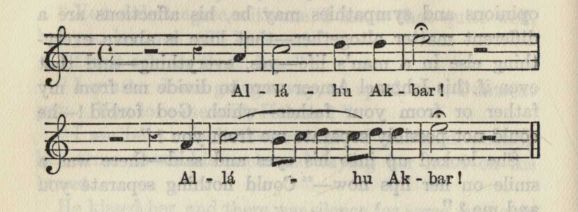
Music fragment
CHAPTER XII
At half-past six Gordon was at the railway-station. He found his soldier servant half-way down the platform, on which blue-shirted porters bustled to and fro, holding open the door of a compartment labelled "Reserved." He found Hafiz also, and with him were two pale-faced Egyptians, in the dress of Sheikhs, who touched their foreheads as Gordon approached.
"These are the men you asked for," said Hafiz.
Gordon shook hands with the Egyptians, and then standing between them, with one firm hand on the shoulder of each and the light of an electric arc lamp in their faces, he said—
"You know what you've got to do, brothers?"
"We know," the men answered.
"The future of Egypt, perhaps of the East, may depend upon what you tell me—you will tell me the truth?"
"We will tell you the truth, Colonel."
"If the man we are going to see should be condemned on your report and on my denunciation you may suffer at the hands of his followers. Protect you as I please, you may be discovered, followed, tracked down—you have no fear of the consequences?"
"We have no fear, sir."
"You are prepared to follow me into any danger?"
"Into any danger."
"To death if need be?"
"To death if need be, brother."
"Step in, then," said Gordon.
At the next moment there was the whistle of the locomotive, and then slowly, rhythmically, with its heavy volcanic throb shaking the platform and rumbling in the glass roof, the train moved out of the station on its way to Alexandria.
CHAPTER XIII
Ishmael Ameer was the son of a Libyan carpenter and boat-builder who, shortly before the days of the Mahdi, had removed with his family to Khartoum. His earliest memory was of the solitary figure of the great white Pasha, on the roof of the palace, looking up the Nile for the relief army that never arrived, and of the same white-headed Englishman, with the pale face, who, walking to and fro on the sands outside the palace garden, patted his head and smiled.
His next memory was of the morning after the fall of the desert city, when, awakened by the melancholy moan of the great ombeya, the elephant-horn that was the trumpet of death, he heard the hellish shrieks of the massacre that was going on in the streets, and saw his mother lying dead in front of the door of the inner closet in which she had hidden him, and found his father's body on the outer threshold.
He was seven years of age at this time, and being adopted by an uncle, a merchant in the town who had been rich enough to buy his own life, he was sent in due course first to the little school of the mosque in Khartoum, and afterwards, at eighteen, to El Azhar in Cairo, where, with other poor students, he slept in the stifling rooms under the flat roof and lived on the hard bread and the jars of cheese and butter which were sent to him from home.
Within four years he had passed the highest examination at the Arabic University, taking the rank of Alim (doctor of Koranic divinity), which entitled him to teach and preach in any quarter of the Mohammedan world, and then, by reason of his rich voice and his devout mind, he was made Reader in the mosque of El Azhar.
Morality was low among the governing classes at that period, and when it occurred that the Grand Cadi, who was a compound of the Eastern voluptuary and the libertine of the Parisian boulevards, marrying for the fourth time, made a feast that went on for a week, in which the days were spent in eating and drinking and the nights in carousing of an unsaintly character, the orgy so shocked the young Alim from the desert that he went down to the great man's house to protest.
"How is this, your Eminence?" he said stoutly. "The Koran teaches temperance, chastity, and contempt of the things of the world, yet you, who are a tower and a light in Islam, have darkened our faces before the infidel."
So daring an outrage on the authority of the Cadi had never been committed before, and Ishmael was promptly flung into the streets, but the matter made some noise, and led in the end to the expulsion of all the Governors (the Ulema) of the University except the one man who, being the first cause of the scandal, was also the representative of the Sultan, and therefore could not be charged.
Meantime Ishmael, returning no more to El Azhar, had settled himself on an island far up the river, and there practising extreme austerities, he gathered a great reputation for holiness, and attracted attention throughout the valley of the Nile by breathing out threatening and slaughter, not so much against the leaders of his own people who were degrading Islam as against the Christians, under whose hated bondage, as he believed, the whole Mohammedan world was going mad.
So wide was the appeal of Ishmael's impeachment and so vast became his following that the Government (now Anglo-Egyptian), always sure that, after sand-storms and sand-flies, holy men of all sorts were the most pernicious products of the Soudan, thought it necessary to put him down, and for this purpose they sent two companies of Arab camel police, promising a reward to the one that should capture the new prophet.
The two camel corps set out on different tracks, but each resolving to take Ishmael by night, they entered his village at the same time from opposite ends, met in the darkness, and fought and destroyed one another, so that when morning dawned they saw their leaders on both sides lying dead in the crimsoning light.
The gruesome incident had the effect of the supernatural on the Arab intellect, and when Ishmael and his followers, with nothing but a stick in one hand and the Koran in the other, came down with a roar of voices and the sand whirling in the wind, the native remnant turned tail and fled before the young prophet's face.
Then the Governor-General, an agnostic with a contempt for "mystic senses" of all kinds, sent a ruckling, swearing, unbelieving company of British infantry, and they took Ishmael without further trouble, brought him up to Khartoum, put him on trial for plotting against the Christian Governor of his province, and imprisoned him in a compound outside the town.
But soon the Government began to see that though they had crushed Ishmael they could not crush Ishmaelism, and they lent an ear to certain of the leaders of his own faith, judges of the Mohammedan law courts, who, having put their heads together, had devised a scheme to wean him from his asceticism, and so destroy the movement by destroying the man. The scheme was an old one, the vales of a woman, and they knew the very woman for the purpose.
This was a girl named Adila, a Copt, only twenty years of age, and by no means a voluptuous creature, but a little winsome thing, very sweet and feminine, always freshly clad, and walking barefoot on the hot sand with an erect confidence that was beautiful to see.
Adila had been the daughter of a Christian merchant at Assouan, and there, six years before, she had been kidnapped by a Bisharin tribe, who, answering her tears with rough comfort, promised to make her a queen.
In their own way they did so, for those being the dark days of Mahdism, they brought her to Omdurman and put her up to auction in the open slave-market, where the black eunuch of the Caliph, after thrusting his yellow fingers into her mouth to examine her teeth, bought her, among other girls, for his master's harem.
There, with forty women of varying ages, gathered by concupiscence from all quarters of the Soudan, she was mewed up in the close atmosphere of two sealed chambers in the Caliph's crudely gorgeous palace, seeing no more of her owner than his coffee-coloured countenance as he passed once a day through the curtained rooms and signalled to one or other of their bedecked and be-ringleted occupants to follow him down a hidden stairway to his private quarters. At such moments of inspection Adila would sit trembling and breathless, in dread of being seen, and she found her companions only too happy to help her to hide herself from the attentions they were seeking for themselves.
This lasted nearly a year, and then came a day when the howling in the streets outside, the wailing of shells overhead, and the crashing of cannon-ball in the dome of the Mahdi's tomb, told the imprisoned women, who were creeping together in corners and clinging to each other in terror, that the English had come at last, and that the Caliph had fallen and fled.
When Adila was set at liberty by the English Sirdar she learned that, in grief at the loss of their daughter, her parents had died, and so, ashamed to return to Assouan, after being a slave girl in Omdurman, she took service with a Greek widow who kept a bakery in Khartoum.
It was there the Sheikhs of the law-courts found her, and they proceeded to coax and flatter her, telling her she had been a good girl who had seen much sorrow, and therefore ought to know some happiness now, to which end they had found a husband to marry her, and he was a fine handsome man, young and learned and rich.
At this Adila, remembering the Caliph, and thinking that such a person as they pictured could only want her as the slave of his bed, turned sharply upon them and said, "When did I ask you to find me a man?" and the Sheikhs had to go back discomfited.
Meanwhile Ishmael, raving against the Christians who were corrupting Mohammedans while he was lying helpless in his prison, fell into a fever, and the Greek mistress of Adila, hearing who had been meant for her handmaiden, and fearing the girl might think too much of herself, began to taunt and mock her.
"They told you he was rich, didn't they?" said the widow. "Well, he has no bread but what the Government gives him, and he is in chains and he is dying, and you would only have had to nurse him and bury him. That's all the husband you would have got, my girl, so perhaps you are better off where you are."
But the widow's taunting went wide, for as soon as Adila had heard her out she went across to the Mohammedan court-house and said—
"Why didn't you tell me it was Ishmael Ameer you meant?"
The Sheikhs answered with a show of shame that they had intended to do so eventually, and if they had not done so at first it was only out of fear of frightening her.
"He's sick and in chains, isn't he?" said Adila.
They admitted that it was true.
"He may never come out of prison alive—isn't that so?"
They could not deny it.
"Then I want to marry him," said Adila.
"What a strange girl you are!" said the Sheikhs, but without more ado the contract was made while Ishmael was so sick that he knew little about it, the marriage document was drawn up in his name, Adila signed it, half her dowry was paid to her, and she promptly gave the money to the poor.
Next day Ishmael was tossing on his angerib in the mud hut which served for his cell when he saw his Soudanese guard come in, followed by four women, and the first of them was Adila, carrying a basket full of cakes such as are made in that country for a marriage festival. One moment she stood over him as he lay on his bed with what seemed to be the dews of death on his forehead, and then putting her basket on the ground she slipped to her knees by his side and said—
"I am Adila. I belong to you now, and have come to take care of you."
"Why do you come to me?" he answered. "Go away. I don't want you."
"But we are married, and I am your wife, and I am here to nurse you until you are well," she said.
"I shall never be well," he replied. "I am dying and will soon be dead. Why should you waste your life on me, my girl? Go away, and God bless you. Praise to His name!"
With that she kissed his hand and her tears fell over it, but after a moment she wiped her eyes, rose to her feet, and turning briskly to the other women she said—
"Take your cakes and be off with you—I'm going to stay."
CHAPTER XIV
Three weeks longer Ishmael lay in the grip of his fever, and day and night Adila tended him, moistening his parched lips and cooling his hot forehead, while he raged against his enemies in his strong delirium, crying, "Down with the Christians! Drive them away! Kill them!" Then the thunging and roaring in his poor brain ceased, and his body was like a boat that had slid in an instant out of a stormy sea into a quiet harbour. Opening his eyes, with his face to the red wall, in the cool light of a breathless morning, he heard behind him the soft and mellow voice of a woman who seemed to be whispering to herself or to Heaven, and she was saying—
"Forgive us our trespasses as we forgive them that trespass against us; and lead us not into temptation, but deliver us from evil; for Thine is the kingdom, the power, and the glory. Amen."
"What is that?" he asked, closing his eyes again, and at the next moment the mellow voice came from somewhere above his face—
"So you are better? Oh, how good that is! I am Adila. Don't you remember me?"
"What was that you were saying, my girl?"
"That? Oh, that was the prayer of the Lord Isa (Jesus)."
"The Lord Isa?"
"Don't you know? Long ago my father told me about Him, and I've not forgotten it even yet. He was only a poor man, a poor Jewish man, a carpenter, but He was so good that He loved all the world, especially sinful women when they were sorry, and little helpless children. He never did harm to His enemies either, but people were cruel and they crucified Him. And now He is in heaven, sitting at God's right hand, with Mary His mother beside Him."
There was silence for a moment, and then—
"Say His prayer again, Adila."
So Adila, with more constraint than before, but still softly and sweetly, began afresh—
"Our Father who art in heaven, hallowed be Thy name; Thy kingdom come; Thy will be done on earth as it is in heaven; give us this day our daily bread; and forgive us our trespasses as we forgive them that trespass against us; and lead us not into temptation, but deliver us from evil; for Thine is the kingdom, the power, and the glory. Amen."
Thus the little Coptic woman, in her soft and mellow voice, said her Lord's prayer in that mud hut on the edge of the desert, with only the sick man to hear her, and he was a prisoner and in chains; but long before she had finished, Ishmael's face was hidden in his bed-clothes and he was crying like a child.
There were three weeks more of a painless and dreamy convalescence, in which Adila repeated other stories her father had told her, and Ishmael saw Christianity for the first time as it used to be, and wondered to find it a faith so sweet and so true, and above all, save for the character of Jesus, so like his own.
Then a new set of emotions took possession of him, and with returning strength he began to see Adila with fresh eyes. He loved to look at her soft, round form, and he found the air of his gloomy prison full of perfume and light as she walked with her beautiful erect bearing and smiling blue eyes about his bed. Hitherto she had slept on a mattress which she had laid out on the ground by the side of his angerib, but now he wished to change places, and when nothing would avail with her to do so, he would stretch out his arm at night until their hands met and clasped and thus linked together they would fall asleep.
But often he would awake in the darkness, not being able to sleep for thinking of her, and, finding one night that she was awake too, he said in a tremulous voice—
"Will you not come on to the angerib, Adila?"
"Should I?" she whispered, and she did.
Next day the black Soudanese guard that had been set to watch him reported to the Mohammedan Sheikhs that the devotee had been swallowed up in the man, whereupon the Sheikhs, with a chuckle, reported the same to the Government, and then Ishmael, with certain formalities, was set free.
At the expense of his uncle a house was found for him outside the town, for in contempt of his weakness in being tricked, as his people believed, by a Coptic slave girl, his following had gone, and he and Adila were to be left alone. Little they recked of that, though, for in the first sweet joys of husband and wife they were very happy, talking in delicious whispers, and with the frank candour of the East, of the child that was to come. He was sure it would be a girl, so they agreed to call it Ayesha (Mary), she for the sake of the sinful soul who had washed her Master's feet with her tears and wiped them with the hair of her head, and he in memory of the poor Jewish woman, the mother of Isa, whose heart had been torn with grief for the sorrows of her son.
But when at length came their day of days, at the height of their happiness a bolt fell out of a cloudless sky, for though God gave them a child, and it was a girl, He took the mother in place of it.
She made a bravo end, the sweet Coptic woman, only thinking of Ishmael and holding his hand to cheer him. It was noon, the sun was hot outside, and in the cool shade of the courtyard three Moslems chanted the "Islamee la Illaha," for so much they could do even for the infidel, while Ishmael sat within on one side of his wife's angerib, with his uncle, seventy years of age now, on the other. She was too weak to speak to her husband, but she held up her mouth to him like a child to be kissed.
A moment later the old man closed her eyes and said—
"Be comforted, my son—death is a black camel that kneels at the gate of all."
There were no women to wail outside the house that night, and next day, when Adila had to be buried, it was neither in the Mohammedan cemetery with those who had "received direction," nor in the Christian one with English soldiers who had fallen in fight, that the slave-wife of a prisoner could be laid, but out in the open desert, where there was nothing save the sand and the sky.
They laid her with her face to Jerusalem, wrapped in a cocoa-nut mat, and put a few thorns over her to keep off the eagles, and when this was done they would have left her, saying she would sleep cool in her soft bed, for a warm wind was blowing and the sun was beginning to set; but Ishmael would not go.
In his sorrow and misery, his doubt and darkness, he was asking himself whether, if his poor Coptic wife was doomed to hell as an unbeliever, he could ever be happy in heaven. The moon had risen when at length they drew him away, and even then in the stillness of the lonely desert he looked back again and again at the dark patch on the white waste of the wilderness in which he was leaving her behind him.
Next morning he took the child from the midwife's arms and, carrying it across to his uncle, he asked him to take care of it and bring it up, for he was leaving Khartoum and did not know how long he might be away. Where was he going to? He could not say. Had he any money? None, but God would provide for him.
"Better stay in the Soudan and marry another woman, a believer," said his uncle; and then Ishmael answered in a quivering voice—
"No, no, by Allah! One wife I had, and if she was a Christian and was once a slave, I loved her, and never—never—shall another woman take her place."
He was ten years away, and only at long intervals did anybody hear of him, and it was sometimes from Mecca, sometimes from Jerusalem, sometimes from Rome and finally from the depths of the Libyan desert. Then he reappeared at Alexandria, and entering a little mosque he exercised his right as Alim and went up into the pulpit to preach.
His teaching was like fire, and men were like fuel before it. Day by day the crowds increased that came to hear him, until Alexandria seemed to be aflame, and he had to remove to the large mosque of Abou Abbas in the square of the same name.
Such was the man whom Gordon Lord was sent to arrest.
CHAPTER XV
"HEADQUARTERS, CARACOL ATTARIN,
"ALEXANDRIA.
"MY DEAREST HELENA,—I have seen my man and it is all a mistake! I can have no hesitation in saying so—a mistake! Wallahi! Ishmael Ameer is not the cause of the riots which are taking place here—never has been, never can be. And if his preaching should ever lead by any indirect means to sporadic outbursts of fanaticism the fault will be ours—ours, and nobody else's.
"Colonel Jenkinson and the Commandant of Police met me on my arrival. It seems my coming had somehow got wind, but the only effect of the rumour had been to increase the panic, for even the conservative elements among the Europeans had made a run on the gunsmiths' shops for firearms and—could you believe it?—on the chemists' for prussic acid to be used by their women in case of the worst.
"Next morning I saw my man for the first time. It was outside Abou Abbas on the toe of the East port, where the native population, with quiet Eastern greeting, of hands to the lips and forehead, were following him from his lodging to the mosque.
"My dear girl, he is not a bit like the man you imagined. Young—as young as I am, at all events—tall, very tall (his head showing above others in a crowd) with clean-cut face, brown complexion, skin soft and clear, hands like a woman's, and large, beaming black eyes as frank as a child's. His dress is purely Oriental, being white throughout save for the red slippers under the caftan and the tip of the tarboosh above the turban. No mealy-mouthed person, though, but a spontaneous, passionate man, careless alike of the frowns of men and the smiles of women, a real type of the Arab out of the desert, uncorrupted by the cities, a man of peace perhaps, but full of deadly fire and dauntless energy.
"My dear Helena, I liked my first sight of Ishmael Ameer, and thinking I saw in him some of the barbarous virtues we have civilised away, some of the fine old stuff of the Arab nobleman who would light his beacon to guide you to his tent even if you were his worst enemy, I could not help but say to myself, 'By —, here's a man I want to fight!'
"As soon as he had gone into the mosque I sent Hafiz and the two Egyptians after him by different doors with strict injunctions against collusion of any kind, and then went off to the police headquarters in the Governorat to await their report. Hafiz himself was the first to come to me, and he brought a circumstantial story. Not a word of sedition, not a syllable about the Christians, good, bad, or indifferent! Did the man flatter the Moslems? Exactly the reverse! Never had Hafiz heard such a rating of a congregation even from a Mohammedan preacher.
"The sermon had been on the degradation of woman in the East, which the preacher had denounced as a disgrace to their humanity. Christians believed it to be due to their faith, but what had degraded woman in Mohammedan countries was not the Mohammedan religion but the people's own degradation.
"'I dreamt last night,' he said, 'that in punishment of your offences against woman God lifted the passion of love out of the heart of man. What a chaos! A cockpit of selfishness and sin! Woman is meant to sweeten life, to bind its parts together—will you continue to degrade her? Fools! are you wiser than God, trying to undo what He has done?'
"Such was Ishmael's sermon as Hafiz reported it, and when the Egyptians came their account was essentially the same, but just at the moment when I was asking myself what there could be in teaching like this to set Moslem against Christian, tinkle-tinkle went the bell of the telephone, and the Commandant of Police, who had been listening with a supercilious smile, seemed to take a certain joy in telling me that his inspector in the quarter of Abou Abbas was calling for reinforcements because a fresh disturbance had broken out there.
"In three minutes I was on the spot, and the first thing I saw was the white figure of Ishmael Ameer lashing his way through a turbulent crowd, whereupon the Commandant, who was riding by my side, said, 'See that! Are you satisfied now, sir?' to which I answered, 'Don't be a fool,' with a stronger word to drive it home, and then made for the middle of the throng.
"It was all over before I got there, for Christians and Moslems alike were flying before Ishmael's face, and without waiting for a word of thanks he was gone too, and in another moment the square was clear, save for a dozen men, native and European, whom the police had put under arrest.
"With these rascals I returned to the Governorat and investigated the riot, which turned out to be a very petty affair, originating in an effort on the part of a couple of low-class Greeks to attend to the scriptural injunction to spoil the Egyptians by robbing a shop (covered only by a net) while its native owner was in the mosque.
"Next morning came a letter from Ishmael Ameer beginning, 'In the name of God, the Compassionate, the Merciful,' but otherwise written without preamble or circumlocution, saying he was aware that certain incidents in connection with his services had assumed an anti-Christian aspect, and begging to be permitted in the interests of peace, and in order to give a feeling of security to Europeans, to preach openly at noon the next day in the Square of Mohammed Ali.
"I need not tell you, my dear Helena, that everybody at the Governorat thought the letter a piece of appalling effrontery, and of course the Commandant, who is one of the good Christians with a rooted contempt for anything in a turban (forgetting that Jesus Christ probably wore one) made himself big with phrases out of Blue Books about the only way to suppress disorder being to refuse to let sedition show its head. But I have never been afraid of a mob, and thinking the situation justified the experiment I advised the Governor to let the man come.
"One thing I did, though, my dear Helena, and that was to dictate a pretty stiff reply saying I should be present myself with a battalion of soldiers, and if instead of pacifying the people he aggravated their hostility, I should make it my personal business to see that he would be the first to suffer.
"That night all the world and his wife declared that I was fishing in troubled waters, and I hear that some brave souls fled panic-stricken by the last train to Cairo, where they are now, I presume, preferring their petitions at the Agency, but next morning (that is to say, this morning) the air was calmer, and the great square, when I reached it, was as quiet as an inland sea.
"It was a wonderful sight, however, with the First Suffolk lining the east walls and the Second Berkshire lining the west, and the overflowing Egyptian and European populace between, standing together yet apart, like the hosts of Pharaoh and of Israel with the Red Sea dividing them.
"I rode up with Jenkinson a little before twelve, and I think the people saw that though we had permitted this unusual experiment in the interests of peace we meant business. A space had been kept clear for Ishmael at the foot of the statue of the great Khedive, and hardly had the last notes of the midday call to prayers died away when our man arrived. He was afoot, quite unattended, walking with an active step and that assured nobility of bearing which belongs to the Arab blood alone. He bowed to me, with a simple dignity that had not a particle either of fear or defiance, and again, Heaven knows why, I said to myself, 'By —, I want to fight that man!'
"Then he stepped on to the angerib that had been placed for him as a platform and began to speak. His first words were a surprise, being in English and faultlessly spoken.
"'The earth and the sky are full of trouble—God has afflicted us, praise to His name,' he began, and then, pointing to the warships that were just visible in the bay, he cried—
"'Men who are watching the heavens and who speak with authority tell us that great conflicts are coming among the nations of the world. Why is it so? What is dividing us? Is it race? We are the sons of one Father. Is it faith? It is the work of religion not only to set men free but to bind them together. Our Prophet says, 'Thou shalt love thy brother as thyself, and never act towards him but as thou wouldst that he should act towards thee.' The Gospel of Jesus Christ and the law of Moses say the same. The true Christian is the true Moslem—the true Moslem is the true Jew. All that is right in religion is included in one commandment—Love one another! Then why warfare between brethren so near akin?'
"His voice, my dear Helena, was such as I had never in my life heard before. It throbbed with the throb that is peculiar to the voice of the Arab singer, and seems to go through you like an electric current. His sermon, too, which was sometimes in English, sometimes in Arabic, the two languages so intermingled that the whole vast congregation of the cosmopolitan seaport seemed to follow him at once, was not like preaching at all, but vehement, enthusiastic, extempore prayer.
"I have sent a long account of it to the Consul-General, so I dare say you will see what it contained. It was the only preaching I ever heard that seemed to me to deserve the name of inspiration. Sedition! In one passage alone did it seem so much as to skirt the problem of England in Egypt, and then there was a spirit in the man's fiery words that was above the finest patriotism. Speaking of the universal hope of all religions, the hope of a time to come when the Almighty will make all the faiths of the world one faith, and all the peoples of the world one people, he said—
"'In visions of the night I see that promised day, and what is our Egypt then? She, the oldest of the nations, who has seen so many centuries of persecution and shame, trodden under the heel of hard task-masters, and buried in the sands of her deserts, what is she? She is the meeting-place of nations, the hand-clasp of two worlds, the interpreter and the peace-maker between East and West. We can never be a great nation—let us be a good one. Is it not enough? Look around! We stand amid ruins half as old as the earth itself—is it not worth waiting for?'
"Then in his last word, speaking first in Arabic, and afterwards in English, he cried—
"'Oh, men of many races, be brothers one to another. God is Most Great! God is Most Great! Take hands, O sons of one Father, believers in one God! Pray to Him who changes all things but Himself changeth not! God is Most Great! God is Most Great! Let Allahu-Akbar sound for ever through your souls!'
"The effect was overwhelming. Even some of the low-class Greeks and Italians were sobbing aloud, and our poor Egyptian children were like people possessed. Hungry, out of work, many of them wearing a single garment and that a ragged one, yet a new magnificence seemed to be given to their lives. Something radiant and glorious seemed to glimmer in the distance, making their present sufferings look small and mean.
"And I? I don't know, my dear Helena, how I can better tell you what I felt than by telling you what I did. I was looking down from the saddle at my First Suffolk and my Second Berkshire, standing in line with their poor little rifles, when something gripped me by the throat and I signed to the officers, shouted 'Back to your quarters!' and rode off, without waiting to see what would happen, because I knew.
"I have written both to the General and to my father, telling them I have not arrested Ishmael Ameer and don't intend to do so. If this is quackery and spiritual legerdemain to cover sedition and conspiracy I throw up the sponge and count myself among the fools. But Ishmael Ameer is one of the flame-bearers of the world. Let who will put him down—I will not.
"My dearest Helena, I've written all this about the new prophet and not a word about yourself, though I've been feeling the quivering grip of your hand in mine every moment of the time. The memory of that delicious quarter of an hour in the garden has sweetened the sulphurous air of Alexandria for me, and I'm in a fever to get back. Smash the Mahdi, you said, thinking if I didn't obey my father and yours I should offend both, and so lead to trouble between you and me. But the Consul-General is a just man if he is a hard one, and I should not deserve to be his son if I did not dare to warn him when he was going to do wrong. Neither should I deserve to be loved by the bravest girl alive if I hadn't the pluck to stand up for the right.
"Good-night, sweetheart! It's two in the morning, the town is as quiet as a desert village, and I'm going to turn in. GORDON.
"P.S.—Forgot to say Ishmael Ameer is to go up to Cairo shortly, so you'll soon see him for yourself. But Heaven help me! what is to become of Gordon Lord when you've once looked on this son of the wilderness?
"P.P.S.—Not an arrest since yesterday!"
CHAPTER XVI
"GENERAL'S HOUSE,
"CITADEL, CAIRO.
"MY DEAR GORDON,—You're in for it! In that whispering gallery which people call the East, where everything is known before it happens to happen, rumours without end were coming to Cairo of what you were doing in Alexandria, but nobody in authority believed the half of it until your letters arrived at noon to-day, and now—heigho, for the wind and the rain!
"My dear Dad is going about like an old Tom with his tail up, and as for the Consul-General ... whew! (a whistle, your Excellency).
"Let me take things in their order, though, so that you may see what has come to pass. I was reading your letter for the third (or was it the thirtieth?) time this afternoon when who should come in but the Princess Nazimah, so I couldn't resist an impulse to tell her what your son of Hagar had to say on the position of Eastern women, thinking it would gratify her and she would agree. But no, not a bit of it; off she went on the other side, with talk straight out of the harem, showing that the woman of the East isn't worthy of emancipation and shouldn't get it—yet.
"It seems that if the men of the East are 'beasts' the women are 'creatures.' Love? They never heard of such a thing. Husband? The word doesn't exist for them. Not 'my Master' even! Just 'Master'! Living together like school-girls and loving each other like sisters—think of that, my dear!
"And when I urged that we were all taught to love one another—all Christians, at all events—she cried, 'What! and share one man between four of you?' In short, the condition was only possible to cocks and hens, and that Eastern women could put up with it showed they were creatures—simple creatures, content and happy if their husbands (beg pardon, their Masters) gave them equal presents of dresses and jewels and Turkish delight. No, let the woman of the East keep a little longer to her harem window, her closed carriage, and the wisp of mousseline de soie she calls her veil, or she'll misuse her liberty. 'Oh, I know! I say what I think! I don't care!'
"As for your Ishmael, the Princess wouldn't have him at any price. He's just another Mahdi, and if he's championing the cause of women, the son of a duck knows how to swim. His predecessor began by denouncing slavery and ended by being the biggest slave-dealer in the Soudan. Ergo, your Ishmael, who cares neither for 'the frowns of men nor the smiles of women,' is going to finish up like Solomon or Samson either as the tyrant of a hundred women or the victim of one of them whose heart is snares and nets. 'Oh, I know! Every man is a Sultan to himself, and the tail of a dog is never straight!'
"But as for you it seems you are 'a brother of girls,' which being interpreted means you are a man to whom God has given a clean heart to love all women as his sisters, and courage and strength to fight for their protection. 'Didn't I tell you that you had the best of the bunch, my child?' (She did, Serenity!) 'But though he is a soldier and as brave as a lion he has too much of the woman in him.' In this respect you resemble, it seems, one of the Princess's own husbands, but having had a variety of them, both right- and left-handed, she found a difficulty in fixing your prototype. 'My first husband was like that—or no, it was my second—or perhaps it was one of the other ones.'
"But this being so, O virtuous one, it became my duty to get you back from Alexandria as speedily as possible. 'Love like the sparrows comes and goes! Oh, I know! I've seen it myself, my child!'
"'And listen, my moon! Don't allow your Gordon' (she calls you Gourdan) 'to go against his father. Nuneham is the greatest man in the world, but let anybody cross him—mon Dieu! If you go out as the wind you meet the whirlwind, and serve you right, too!'
"In complete agreement on this point, the Princess and I were parting in much kindness when Father came dashing into my drawing-room like a gust of the Khamseen, having just had a telephone message from the Consul-General requiring him to go down to the Agency without delay. Whereupon, with a word or two of apology to the Princess and a rumbling subterranean growl of 'Don't know what the d— that young man...' he picked up your letter to himself and was gone in a moment.
"It is now 10 P.M. and he hasn't come back yet. Another telephone message told me he wouldn't be home to dinner, so I dined alone, with only Mosie Gobs for company, but he waits on me like my shadow, and gives me good advice on all occasions.
"It seems his heart is still on fire with love for me, and having caught him examining his face in my toilet-glass this morning I was amused, and a little touched, when he asked me to-night if the Army Surgeon had any medicine to make people white.
"Apparently his former love was a small black maiden who works in the laundry, and he shares your view (as revealed in happier hours, your Highness) that there's nothing in the world so nice as a little girl except a big one. But I find he hasn't the best opinion of you, for when I was trying to while away an hour after dinner by playing the piano I overheard the monkey telling the cook that to see her hands (i.e. mine) run over the teeth of the music-box amazes the mind—therefore why should her husband (id est, you) spend so much time in the coffee-shop?
"Since then I've been out in the arbour trying to live over again the delicious quarter of an hour you speak of, but though the wing of night is over the city and the air is as soft as somebody's kiss is (except sometimes) it was a dreadful failure, for when I closed my eyes, thinking hearts see each other, I could feel nothing but the sting of a mosquito, and could only hear the watchman crying Wahhed! and what that was like you've only to open your mouth wide and then say it and you'll know.
"So here I am at my desk talking against time until Father comes and there's something to say. And if you would know how I am myself, I would tell you, most glorious and respected, that I'm as tranquil as can be expected considering what a fever you've put me in, for, falling on my knees before your unsullied hands, O Serenity, it seems to me you're a dunce after all, and have gone and done exactly what your great namesake did before you, in spite of his tragic fate to warn you.
"The trouble in Gordon Major's case was that the Government gave him a discretionary power and he used it, and it seems as if something similar has happened to Gordon Minor, with the same results. I hope to goodness they may send you a definite order as the consequence of their colloguing to-night, and then you can have no choice and there will be no further trouble.
"This is not to say that I think you are wrong in your view of this new Mahdi, but merely that I don't want to know anything about him. His protests against the spirit of the world may be good and beneficial, but peace and quiet are better. His predictions about the millennium may be right too, and if he likes to live on that dinner of herbs, let him. Can't you leave such people to boil their own pot without your providing them with sticks? I'm a woman, of course, and my Moslem sisters may be suffering this, that, or the other injustice, but when it comes to letting these things get in between your happiness and mine, what the dickens and the deuce and the divil do I care—which is proof of what Mosie says to the cook about the sweetness of my tongue.
"As for your 'Arab nobleman' taking me by storm, no thank you! I dare say he has red finger-nails, and if one touched the tip of his nose it would be as soft as Mosie's. I hate him anyway, and if you are ever again tempted to fight him, take my advice and fall! But look here, Mr. Charlie Gordon Lord! If you're so very keen for a fight come here and fight me—I'm game for you!
"Soberly, my dear-dear, don't think I'm not proud of you that you are the only man in all Egypt, aye, or the world, who dares stand up to your father. When God made you he made you without fear—I know that. He made you with a heart that would die rather than do a wrong—I know that too. I don't believe you are taking advantage of your position as a son, either, and when people blame your parents for bringing you up as an Arab I know it all comes from deeper down than that. I suppose it is the Plymouth rock in you, the soul and blood of the men of the Mayflower. You cannot help it, and you would fight your own father for what you believed to be the right.
"But, oh dear, that's just what makes me tremble. Your father and you on opposite sides is a thing too terrible to think about. English gentlemen? Yes, I'm not saying anything to the contrary, but British bulldogs too, and as if that were not enough you've got the American eagle in you as well. You'll destroy each other—that will be the end of it. And if you ask me what reason I have for saying so, I answer—simply a woman's, I know! I know!
* * * * *
"Father just back—dreadfully excited and exhausted—had to get him off to bed. Something fresh brewing—cannot tell what.
"I gather that your friend the Grand Cadi was at the Agency to-night—but I'll hear more in the morning.
"It's very late, and the city seems to be tossing in its sleep—a kind of somnambulant moan coming up from it. They say the Nile is beginning to rise, and by the light of the moon (it has just risen) I can faintly see a streak of red water down the middle of the river. Ugh! It's like blood, and makes me shiver, so I must go to bed.
* * * * *
"Father much better this morning. But oh! oh! oh! ... It seems you are to be telegraphed for to return immediately. Something you have to do in Cairo—I don't know what. I'm glad you are to come back, though, for I hate to think of you in the same city as that man Ishmael. Let me hear from you the minute you arrive, for I may have something to say by that time, and meantime I send this letter by hand to your quarters at Kasr-el-Nil.
"That red streak in the Nile is plain enough this morning. I suppose it's only the first water that comes pouring down from the clay soil of Abyssinia, but I hate to look at it.
"Take care of yourself, Gordon, dear—I'm really a shocking coward, you know. HELENA.
"P.S.—Another dream last night! Same as before exactly—that man coming between you and me."
CHAPTER XVII
Returning to Cairo by the first train the following morning, Gordon received Helena's letter and replied to it—
"Just arrived in obedience to their telegram. But don't be afraid, dearest. Nothing can happen that will injure either of us. My father cannot have wished me to arrest an innocent man. Therefore set your mind at ease and be happy. Going over to the Agency now, but hope to see you in the course of the day. Greetings to the General and all my love to his daughter.
"GORDON."
But in spite of the brave tone of this letter he was not without a certain uneasiness as he rode across to his father's house. "I couldn't have acted otherwise," he thought. And then, recalling Helena's hint of something else which it was intended he should do, he told himself that his father was being deceived and did not know what he was doing. "First of all I must tell him the truth—at all costs, the truth," he thought.
This firm resolution was a little shaken the moment he entered the garden and the home atmosphere began to creep upon him. And when Ibrahim, his father's Egyptian servant, told him that his mother, who had been less well since he went away, was keeping her bed that morning, the shadow of domestic trouble seemed to banish his stalwart purpose.
Bounding upstairs three steps at a time he called in a cheery voice at his mother's door, but almost before the faint, half-frightened answer came back to him, he was in the room, and the pale-faced old lady in her nightdress was in his arms.
"I knew it was you," she said, and then, with her thin, moist hands clasped about his neck and her head against his breast she began in a plaintive, hesitating voice, as if she were afraid of her own son, to warn and reprove him.
"I don't understand what is happening, dear, but you must never let anybody poison your mind against your father. He may be a little hard sometimes—I'm not denying that; but then he is not to be judged like other men—he is really not, you know. He would cut off his right hand if he thought it had done him a wrong, but he is very tender to those he loves, and he loves you, dear, and wants to do so much for you. It was pitiful to hear him last night, Gordon. 'I feel as if my enemy has stolen my own son,' he said. 'My own son, my own son,' he kept saying, until I could have cried, and I couldn't sleep for thinking of it. You won't let anybody poison your mind against your father—promise me you won't, dear."
Gordon comforted and kissed her, and rallied her and laughed, but he felt for a moment as if he had come back as a traitor to destroy the happiness of home.
Fatimah followed him out of the room, and winking to keep back her tears, she whispered some disconnected story of what had happened on the day on which his father received his letter.
"Oh, my eye, my soul, it was sad! We could hear his footsteps in his bedroom all night long. Sometimes he was speaking to himself. 'The scoundrels!' 'They don't know what shame is!' 'Haven't I had enough? And now he too! My son, my son!'"
Gordon went downstairs with a slow and heavy step. He felt as if everything were conspiring to make him abandon his purpose. "Why can't I leave things alone?" he thought. But just as he reached the hall the Egyptian Prime Minister, who was going out of the house, passed in front of him without seeing him, and a certain sinister look in the man's sallow face wiped out in an instant all the softening effect of the scenes upstairs. "Take care!" he thought. "Tell him the truth whatever happens."
When he entered the library he expected his father to fly out at him, but the old man was very quiet.
"Sit down—I shall be ready in a moment," he said, and he continued to write without raising his eyes.
Gordon saw that his father's face was more than usually furrowed and severe, and a voice seemed to say to him, "Don't be afraid!" So he walked over to the window and tried to look at the glistening waters of the Nile and the red wedges of Pyramids across the river.
"Well, I received your letter," said the old man after a moment. "But what was the nonsensical reason you gave me for not doing your duty?"
It was the brusque tone he had always taken with his secretaries when they were in the wrong, but it was a blunder to adopt it with Gordon, who flushed up to the forehead, wheeled round from the window, walked up to the desk, and said, beginning a little hesitatingly but gathering strength as he went on—
"My reason, Father ... for not doing my ... what I was sent to do ... was merely that I found I could not do it without being either a rascal or a fool."
The old man flinched and his glasses fell. "Explain yourself," he said.
"I came to the conclusion, sir, that you were mistaken in this matter."
"Really!"
"Possibly misinformed——"
"Indeed!"
"By British officials who don't know what they are talking about or by native scoundrels who do."
Not for forty years had anybody in Egypt spoken to the Consul-General like that, but he only said—
"Don't stand there like a parson in a pulpit. Sit down and tell me all about it," whereupon Gordon took a seat by the desk.
"The only riot I witnessed in Alexandria, sir, was due simply to the bad feeling which always exists between the lowest elements of the European and Egyptian inhabitants. Ishmael Ameer had nothing to do with it. On the contrary he helped to put it down."
"You heard what he had said in the mosques?"
"I had one of his sermons reported to me, sir, and it was teaching such as would have had your own sympathy, being in line with what you have always said yourself about the corruptions of Islam, and the necessity of uplifting the Egyptian woman as a means of raising the Egyptian man."
"So you decided, it seems——"
"I decided, Father, that to arrest Ishmael Ameer as one who was promulgating sedition, and inciting the people to rebellion, would be an act of injustice which you could not wish me to perpetrate in your name."
The Consul-General put up his glasses, looked for a letter which lay on the desk, glanced at it, and said—
"I see you say that before you arrived in Alexandria it was known that you were to come."
"That is so, sir."
"And that after the riot you counselled the Governor to consent to the man's request that he should preach in public."
"I did, sir—I thought it would be a good experiment to try the effect of a little moral influence."
"Of course the experiment was justified?"
"Perfectly justified—the people dispersed quietly, and there has not been a single arrest since."
"But you had a battalion of soldiers on the spot?"
"I had—it was only right to be ready for emergencies."
The old man laughed bitterly. "I'm surprised at you. Don't you see how you've been hoodwinked? The man was warned of your coming—warned from Cairo, from El Azhar, which I find you were so foolish as to visit before you left for Alexandria. Everything was prepared for you. A trick, an Eastern trick, and you were so simple as to be taken in. I'm ashamed of you—ashamed of you before my servants, my secretaries."
Gordon coloured up to his flickering steel-blue eyes and said—
"Father, I must ask you to begin by remembering that I am no longer a child and not quite a simpleton. I know the Egyptians. I know them better than all your people put together."
"Better than your father himself, perhaps?"
"Yes, sir, better than my father himself because—because I love them, whereas you—you have hated them from the first. They've never deceived me yet, sir, and, with your permission, I'm not going to deceive them."
The passionate words were hotly, almost aggressively spoken, but in some unfathomable depth of the father's heart the old man was proud of his son at that moment—strong, fearless, and right.
"And the sermon in public—was that also on the corruptions of Islam?"
"No, sir, it was about the spirit of the world—the greed of wealth which is making people forget in these days that the true welfare of a nation is moral, not material."
"Anything else?"
"Yes—the hope of a time when the world will have so far progressed towards peace that arms will be laid down and a Redeemer will come to proclaim a universal brotherhood."
"That didn't strike you as ridiculous—to see one unlettered man trying to efface the laws of civilised society—asking sensible people to turn their backs on the facts of life in order to live in a spiritual hothouse of dreams?"
"No, Father, that did not strike me as ridiculous, because——"
"Because—what—what now?"
"Because John the Baptist and Jesus Christ did precisely the same thing."
There was silence for a moment, and then the old. man said-
"In this golden age that is to come, he predicts, I am told, a peculiar place for Egypt—is that so?"
"Yes, sir. He holds that in the commonwealth of the world, Egypt, by reason of her geographical position, will become the interpreter and peacemaker between the East and the West—that that's what she has lived so long for."
"Yet it didn't occur to you that this was sedition in its most seductive form, and that the man who promulgated it was probably the most dangerous of the demagogues—the worst of the Egyptians who prate about the natives governing themselves and the English being usurping foreigners?"
"No, sir, that didn't occur to me at all, because I felt that a Moslem people had a right to their own ideals, and also because I thought——"