Front matter (continued 5)
Reading edition
"Oh, I had forgotten!" said Rupert. "All's in the losing, if they take overlong. I should have remembered, though, that the garrison needed one night's sleep at least."
While they talked, Ezra Wood returned with the trooper sent to give him safe-conduct through the lines and back again. He did not salute—simply regarded Rupert with dour self-confidence. "General Cromwell sends this word to Prince Rupert—that, if his stomach is for fighting, he shall have it filled."
Rupert was silent. Cromwell, it seemed, had missed all the meaning of the challenge sent him; war had not taught him yet the nicer issues that wait on bloodshed. He stooped to pat Boye's head with the carelessness that had angered many a council of war at Oxford. Then he glanced at Ezra Wood.
"There is no General Cromwell. The King approves all commissions of that kind. Go tell Mr. Cromwell that we are waiting for him here."
Cromwell, when Ezra Wood returned and found him, was standing in the knee-deep rye, apart from his company. His eyes were lifted to the sky, but he saw none of the signs of brewing storm. He was looking into the heaven that he had pictured day by day and year by year when he rode in the peaceful times about his snug estate in Rutland. Then, as now, he was cursed by that half glimpse of the mystic gleam which hinders a man at times more than outright savagery. Always he was asking more than the bread and meat of life; always he was seeking some antidote to the poisonous self-love, the ambition to be king himself, which was his hidden sore. And now he was praying, with all the simplicity his tricky mind permitted, for guidance in his hour of need.
As one coming out of a trance, he listened to Ezra Wood, repeating his message for the fourth time. The light—half false because it was half mystic only—left his face. Its borrowed comeliness passed by. He showed features of surprising plainness—eyes heavy-lidded, thick nostrils, and a jaw broad with misplaced obstinacy.
"So he is waiting?" he said grimly. "Well, princes must wait these days. We shall seek him by and by."
In that queer mood of his—half prayer and half keen calculation—which went before his battles, Cromwell had found a plan of action. He crossed the field with quick, unwieldy steps, found the other leaders, and stated his own view of the attack. As usual, his ruggedness of mind and purpose carried the day; and Rupert, down below, was left to wonder why the enemy did not take advantage of his rash challenge and attack before the main body of his reinforcements came.
It was an eerie day—clouds that came packing up, livid and swollen with rain that would not fall—a wind that was cold and scorching hot by turns—a frightened rustle of the leafage in Wilstrop Wood—a rustle that sounded across the flat waste of Marston Moor like the sound of surf beating on a distant shore. Boye kept close to Rupert's side, and whined and growled by turns. He knew his master's restlessness, as four of the afternoon came and still Lord Newcastle had not reached the field.
At half-past four the pick of Newcastle's men rode in, and were marshalled into their appointed place between the left wing and the right. Rupert galloped down to give them the good cheer he lacked himself.
"Welcome, Whitecoats. You look tired and maimed; but they tell me you have sworn to dye those coats of yours a good, deep crimson—your own blood or the Roundheads'."
The sound of his voice, his strong simplicity of purpose that burned outward like a fire, lifted their jaded spirits. York was forgotten, and its hardships.
"For God and the King!" they answered lustily.
"I need you, gentlemen," said Rupert, and passed on to where Lord Newcastle's coach was standing at the roadside.
He was shocked to see the change in Newcastle—the weariness of mind and body palpable, now that an end had come to his guardianship of York.
"My lord, you have served the King too well," he said, putting a hand on the other's shoulder with instinctive deference to age and great infirmity.
"Oh, nothing to boast of—a little here and there, to keep our walls secure. Tell me, is there to be a battle to-day? I'm good for a gallop yet, if the battle does not last too long."
"There's no chance of it at this late hour. They saw our weakness from the hill, and yet would not attack. They're tired out, I think, as we are."
"Good," said Newcastle, with his gentle laugh. "For my part, I shall claim an old man's privilege—to step into my coach and smoke a pipe or two, and then get off to sleep. I shall be ready when you need me."
"Would my hound, Boye, disturb you?" asked Rupert, turning after he had said good-night. "I like to have him out of harm's way at these times."
"Is he a good sleeper?" demanded Newcastle whimsically.
"With a friend, the staunchest sleeper that I know."
Boye demurred when he was bidden to get inside the coach; but, like Rupert's cavalry, he knew the tone of must-be-obeyed, and scrambled in with no good grace.
Near seven of the evening a strange thing happened on Marston Moor. On the hill above there was the spectacle of Parliament men standing with bowed heads as Cromwell sent up fervent prayers. On the moor below, the chaplain of the King's men was reading evensong. Over both armies was a sky of sullen wrath.
As the service closed, Lord Eythin protested, with an oath, that now this child's play was over, he proposed to go in search of food.
"My lord," said Rupert sharply, "wise men do not mock at prayer, in face of what is waiting for us all to-morrow."
Eythin, nettled by the hum of approbation, lost his temper. "I was never wise, your Highness, as you know, but wise enough to advise you that this escapade is madness."
"We shared another battle, long ago when you were General King." Rupert's voice was icy. "Do you remember it?"
The Riding Metcalfs, this once again, were dismayed by the private quarrels, the jealousies, that were threaded through the skein of war. Eythin's insolence of bearing, his subtle incitement to distrust of his commander, asked no less from Rupert; but the pity of it, to bluff Squire Metcalf, single of heart, owing none a grudge except the King's enemies, was hard to bear.
From the extreme left of the camp, just as the Royalists were settling down for a brief night's slumber, there came a running yelp, a baying, and a splutter of wild feet. Lord Newcastle had left the window of his coach open when he had smoked his third pipe and found the sleep he needed; and Boye, his patience ended, had leaped out into the freedom that spelt Rupert to him. When he found him, he got to his hind legs, all but knocked down his master in his tender fury, and licked his face with a red and frothy tongue.
"Boye!" said Rupert. "Oh, down, Boye—you smother me. I was to have a lonely supper, I fancied, and you come. There's all in the world I care for, come to sup with me."
From over the hill, where the Parliament men had scarcely finished their devotions, there came a clap of thunder and a light spit of rain.
"We shall be wet to the skin to-night, Boye, you and I," laughed Rupert. "We've proved my tent, and it is not weather-sound."
He had scarcely finished some beef collops, ready for him in his tent, and was cajoling Boye to perform a newly-taught trick of begging for a morsel, when the flap was pulled aside. Michael Metcalf, framed by the red light out of doors, showed bigger even than his wont.
"They are coming down from the rye-fields," he said, with a reckless laugh. "Let it go how it will, sir, so long as we drive Cromwell out of bounds."
"I have promised him as much," said Rupert gravely.
CHAPTER XVIII.
MARSTON MOOR.
Rupert got to horse, and rode through the press and uproar of the camp. Confusion was abroad. To the Cavaliers, though some of them might regard evensong lightly, it meant at least a truce until the next day's dawn; and now they were attacked by an enemy who did not scruple to combine prayer with craftiness. Down from the rye-fields they saw the horsemen and the footmen come, and only Rupert could have steadied them in this black hour.
"We meet Cromwell's horse," he cried, getting his own men into line this side the little ditch, "and, gentlemen, we owe Cromwell many debts."
Stiff and stour it was, that fight at the ditch. The old, stark battles were recalled—Crecy, and Agincourt, and Flodden—for it was all at pitiless close quarters. First they exchanged pistol-shots; then, throwing their pistols in each other's faces with a fury already at white heat, they fell to with sword and pike. Overhead the storm broke in earnest. The intermittent crackle of gunshots, from the sharpshooters lining the hedges, mingled with the bellow of the thunder and that clamour of hard-fighting men which has the wild beast note.
Newcastle, asleep in his coach at the far side of the Moor, was roused by the uproar. He did not know what had chanced, but the waking was of a piece with the nightmares that had haunted his brief slumber. His limbs ached, the weariness of York's long siege was on him, but he ran forward, sword in hand, and asked the first man he met what was in the doing. Then he sought for his company and could not find them, except a handful of the gallant Leightons; so he pressed forward, unmounted, crying his name aloud, and asking all who heard him to make up a troop. He gathered drift and flotsam of the running battle—he whose dream had been of a mounted charge, with picked cavalry behind him—and they fought on the left wing with a wild and cheery gallantry.
On the right, the Ironsides still faced Rupert's men, and neither would give way. Once, in a lull of the berserk struggle, when either side had withdrawn a little to take breath, a great hound pressed his way through the Royalists and came yelping forward in search of Rupert. He came into the empty space between the King's men and Cromwell's, and a gunshot flashed; and Boye struggled on the sodden ground, turned his head in dying search for Rupert, the well-beloved, and so lay still.
From the Ironsides a storm of plaudits crossed a sudden thunder-clap. "There goes the arch-Papist of them all," came a voice drunk with battle.
And something broke at Rupert's heart. It was as if he stood alone entirely—as if the world were ended, somehow. "Ah, Boye," he murmured. And then he led a charge so furious that the Ironsides all but broke. It was Cromwell rallied them, and for an hour the fight went forward. The hedge was levelled now, and the ditch filled in by the bodies of the slain. Time after time Rupert found himself almost within striking distance of Cromwell. They were seeking each other with a settled, fervent purpose. And the fight eddied to and fro; and the rain came down in wild, unending torrents.
The chance sought by Rupert came to Michael Metcalf, as it chanced. Pushed to one side of the press, he found himself facing a rough-hewn Parliament man in like case, and parried a fierce sword-cut with his pike. Then he drew back the pike, felt it quiver like a live thing in his hands, and drove it through the other's fleshy neck. It was only when the man wavered in saddle, and he had leisure for a moment's thought, that he knew his adversary. A trooper of the Parliament snatched the wounded rider's bridle, dragged his horse safely to the rear, and Michael raised a wild, impulsive shout:
"Cromwell is down! A Mecca for the King."
Rupert heard the cry, and drew his men a little away, to get speed for the gallop. His crashing charge drove back the Roundheads twenty paces, and no more. They were of good and stubborn fibre, and the loss of Cromwell bade them fight with sullen hardihood. At the end of, it might be, fifteen minutes they had regained a foot or two of their lost ground, and Cromwell, getting his wound bandaged at the thatched cottage up above, asked another wounded Roundhead, who came for the like succour, how it fared.
"As may be," growled the other. "If so thou'rt not dead, as we fancied, get down and hearten them."
"I've a thick throat, and the pike took the fleshy part," said Cromwell, with a deep, unhumorous laugh. "I'll get down."
He mounted with some difficulty. Pluck cannot always conquer in a moment great loss of blood and weakness of the body. Once in the saddle, his strength returned to him; but he rode down too late. Rupert's men had followed their old tactics, had retreated again to gain speed for the onslaught, and were driving the enemy before them in hot pursuit.
Cromwell, after narrow escape of being ridden down by his own folk, after vain efforts to rally them again, found himself alone. The wound in his throat was throbbing at its bandages. The rain ran down him in rivulets, and the world seemed filled with thunder and the cries of men. Word reached him that Eythin, too, had broken through, and that all Parliament men were bidden to save themselves as best they might. And so he left the field; and the sickness of defeat, more powerful than body-sickness, caught him as he neared the smithy, this side of Tockwith village. A farm-lad, returning from selling a cow at Boroughbridge, found him in the roadway, fallen from his horse, and carried him into the smithy-house. They tended his wound. Within an hour his lusty strength of purpose came to his aid. He asked for meat and ale, and said he must get ready for the road. He was known by this time; but even the blacksmith, Royalist to the core of his big body, would not hinder his going. A man of this breed must be given his chance, he felt.
"After all," he muttered, watching Cromwell ride unsteadily down the moonlit road, "they say Marston Moor has lost Yorkshire to the Parliament for good and all. Some call him Old Noll, and othersome Old Nick—but he'll do little harm i' these parts now, I reckon."
"A soft heart and a big body—they go always fools in company," said his goodwife. "I'd not have let him go so easy, I."
"Ay, but ye wod, if I'd been for keeping him. Ye're like a weather-cock, daft wife. When I point south, thou'st always for veering round to north—or t'other way about, just as it chances."
Cromwell rode back toward Marston, to find his men. He was kin to Rupert in this—disaster or triumph, he must find those who needed him. At the end of a half-mile he met a rider cantering up the rise. The moonlight was clear and vivid, after the late storm, and the rider pulled his horse up sharply.
"The battle is ours, General, and I've my Lord Fairfax's orders for you."
"The battle is ours?" demanded Cromwell gruffly. "I do not understand."
"None of us understand. Fairfax was three miles away, sleeping in a farmstead bed-chamber, when we roused him with the news. It was Leslie's men who broke their centre and drove round Rupert's flank. The thunder was in all our brains, I fancy."
Cromwell laughed. All his austerity, his self-pride warring against the humility he coveted, were broken down, as Rupert's cavalry had been. "Then it's for the siege of York again?" he asked.
"Fairfax says the risk is too great. The Moor is full of our dead, and we're not strong enough. He bids you get your men together and hold Ripley, going wide of Knaresborough—which is a hornet's nest—until further orders reach you. That is my message, General."
"Good," said Cromwell, tightening the bandage round his throat. "Where are my men?"
He found them—those who were left—in scattered companies. And a lusty roar went up as they saw him ride through the moonlight, swaying on the thick farm-cob that carried him.
"It's fourteen miles to Ripley, lads, but we'll cover it."
On Marston Moor the Royalists had pursued their advantage to the full. Rupert's men and Eythin's had run wild on the ridge-fields up above. And Leslie saw his chance. With his Scots he charged down on the White Coats, weakened by siege before the fight began. They kept their pledge; their coats were dyed with crimson martyrdom—and so they died to a man, resisting Leslie's charge.
Leslie himself paused when the work was done. "They were mettled thoroughbreds," he said huskily. "And now, friends, for the ditch that Rupert leaves unguarded."
It was so, in this incredible turmoil of storm and fight and havoc, that the battle of Long Marston was lost to the King. Rupert, getting his men in hand at long last, returned to face another hand-to-hand encounter. With the middlewing past sharing any battle of this world, the affair was hopeless. Rupert would not admit as much. The Metcalfs, a clan lessened since they joined in evensong an hour ago, would not admit it. To the last of their strength they fought, till all were scattered save a few of them.
Down the rough lane past Wilstrop Wood—a lane pitted deep with ruts—the Royalists fled headlong. And at the far side of the wood, where the lane bent round to a trim farmstead, there was a piteous happening. A child, standing at the gate in wonderment at all the uproar and the shouting, saw a press of gentry come riding hard, and began to open the gate for them, bobbing a curtsey as the first horseman passed. He did not see her. Those behind did not see her, but, pressing forward roughly—pressed in turn by those behind—the weight of them was thrust forward and broke down the gate.
After their passing a woman came from the farmsteading, eager to go out and see how it had fared with her husband, a volunteer for Rupert. Under the broken gate she found a little, trampled body; and all her heart grew stony.
"Lord God," she said, "Thou knows't men make the battles, but the women pay for them."
On Marston Moor the Squire of Nappa had found his coolness return when it was needed most. The Prince, and he, and Christopher, their horses killed under them long since, had just won free of a hot skirmish at the rear of their retreating friends, and were left in a quiet backwater of the pursuit.
"Best get away," he said. "You're needed to see to the aftermath of this red harvest."
His sturdy common sense had struck the true note. Rupert had had in mind to die fighting, since all else was lost. And now the little, fluting note of trust came to him through the havoc. He was needed.
They came, these three, to the clayey lands—wet and sticky to the feet—that bordered Wilstrop Wood. The storm, tired of its fury, had rent the clouds apart with a last soaking deluge, and the moon shone high, tender as a Madonna yearning to bring peace on earth.
A fresh pursuit came near them, and they turned into a field of flowering beans on their left. They heard the pursuit go by. Then they heard a litany of pain come out from Wilstrop Wood, where wounded Cavaliers had taken refuge. And from Marston Moor there was the ceaseless crying—not good to hear—of horses that would never again, in this world, at least, find the stride of a gallop over open fields.
To these three, hidden in the bean-field, came an odd detachment from the pity and the uproar of it all. Nothing seemed to matter, except sleep. The heat, and rain, and burden of that bitter hour just ended were no more than nightmares, ended by this ease of mind and body that was stealing over them. It was good to be alive, if only to enjoy this pleasant languor.
The Squire of Nappa laughed sharply as he got to his feet. "At my age, to go sleeping in a field of flowering beans! As well lie bed-fellow with poppies. D'ye guess what I dreamed just now? Why, that I was crowned King in London, with Noll Cromwell, dressed as Venus, doing homage to me."
"Ah, don't rouse me, father," grumbled Kit. "I'm smelling a Yoredale byre again, and hear the snod kine rattling at their chains."
But Rupert, when at last he, too, was roused, said nothing of his dream. It had been built of moons and Stardust—made up of all the matters he had lost in this queer life of prose—and he would share it with no man.
When they got to the pastures again—blundering as men in drink might do—the free, light air that follows thunder blew about their wits. It was Rupert who first spoke. He remembered that men in flight were trusting him, were needing a leader.
"Friends," he said, "I'm for York. Do you go with me?"
The noise from Wilstrop Wood, the cries from the Moor, grew small in the hearing as they made their way to a speck of light that showed a half-mile or so in front. Two farm-dogs sprang out on them when they reached the farmstead; but the fugitives knew the way of such, and passed unhindered.
"Are ye fro' Marston, gentles?" asked the farmer, limping out to learn what the uproar was about. "Ay? Then how has the King sped?"
"We are broken," said Rupert simply.
"Well, I'm sorry. Step in and shelter. Ye'd be the better for a meal, by the look o' ye. 'Tis the least I can do for His Majesty, seeing my two rheumy legs kept me fro' riding to his help."
"Have you three horses we can borrow, friend?"
"Nay, I've but two. You're welcome to them; and they're sound-footed, which is more than their master can say of himself."
While they snatched a meal of beef and bread, Christopher glanced at the Prince. "I know my way on foot to Ripley, and they may need me there," he said.
"The fields will be packed with danger, lad. Run at my stirrup, till by good luck we find a third horse on the road to York."
"Let him be," growled the old Squire. "There's a lady lives at Ripley. Lovers and drunkards seldom come to harm, they say."
"Ah, so!" For a moment there was a glow of tenderness in Rupert's sombre eyes. "It is good to hear the name of lady after the late happenings. Get forward, sir, and guard her."
Christopher saw them get to horse and take the track that led to York. Then he fared out into the moonlit pastures, took his bearings, and headed straight for Ripley. The distance was less than twelve miles by the field-tracks; but, by the route he took, it was slow to follow. The clay-lands were waterlogged by the late storm; the hedges to be broken through were high and thorny; but these were not the greatest of his troubles. It had been no velvet warfare, that hour's fight on the Moor. Constantly, as Kit went forward, he heard a groan from the right hand or the left, and stayed to tend a wounded comrade. There was peril, too, from horses roaming, maddened and riderless, in search of the masters they had lost.
The first two miles were purgatory, because Kit's heart was young, and fiery, and tender, because he felt the sufferings of the wounded as his own. The flight, on this side of the Moor, went no further; and for the rest of the journey he had only trouble of the going to encounter. He came late to Ripley Castle; and the sentry who answered to his knocking on the gate opened guardedly.
"Who goes?" he asked.
"Christopher Metcalf, sick with thirst and hunger."
The door was thrown open suddenly. In the ill-lighted hall he saw Ben Waddilove, the old manservant of the Grants, who had ridden—long since, when last year's corn was yellowing to harvest—in charge of Mistress Joan.
Marston Moor was forgotten. The troubles of the day and night were forgotten, as sunlight dries the rain. Kit was a lover. "How is the mistress, Ben?" he asked.
"Oh, her temper's keen and trim. Mistress Grant ails naught. I suppose Marston's lost and won? Well, it had to be, I reckon. Who brought the news to Ripley, think ye?"
"I couldn't guess, you old fool."
"Oh, may be old—but not so much of a fool, maybe. He's in yonder, closeted wi' Lady Ingilby in the parlour. I kenned him at first sight by the lap of his ugly jaw. Come hitherto on the tips of your toes, Master Christopher."
The parlour door stood open, and within Kit saw a scene of such amazing oddity that he did not know whether he watched tragedy or comedy in the doing. The hearth was red with crackling logs. At the far end of the table sat Lady Ingilby, a cocked pistol lying close to her right hand; seated opposite her was a thick bulk of a man, with a rusty bandage tied round his neck; between them were four candles, burning with a tranquil flame.
"So you come, Mr. Cromwell, to quarter yourself here?" Lady Ingilby was saving.
"I do, madam."
"You come alone, knowing we are a house of women and of wounded men? Oh, the courage of you! And even our wounded have left us—not one of them so crippled but the news of Rupert's coming spurred him on to Marston."
"The news of Rupert's going will comfort them, maybe," growled Cromwell.
"He thrashed you handsomely. Oh, we have the news! First, a runner came, telling how Lord Fairfax and the leader of the Ironsides had left the field."
Cromwell's quick temper took fire. "You claim a woman's privilege——
"No, my pistol's. We talk as man to man. I say that we have the news. And then a second runner came and told us Leslie's Scots had won the battle. And we sorrowed, but not as if it had been you who claimed the victory."
The man was dead weary; but her scorn, quiet and assured, roused him. "Am I so hated, then, by your side of this quarrel?"
"Hated? That is a little word."
"Good! Any wayside fool can be loved—it takes a man to earn hatred."
"A man of sorts—granted. You will tell me, Mr. Cromwell, what your purpose was in coming to this house. My husband may be lying dead on Marston Field. Perhaps you came, in courtesy, to distract my grief."
"I came because Lord Fairfax bade me," said Cromwell bluntly. "We have no courtesy in Rutland, as you know. Mere folly must have bidden me leave my men outside, lest they intruded on you over-roughly."
"How many of them did Rupert leave you for a guard?" She was aware of an unexpected courtesy in the man's voice. It seemed no more than smooth hypocrisy.
"A few within call. They are not gentle."
"Nor I. As man to man—I stand for the husband who may return or may not—we are here, we two. You have a body of surprising strength, but it is I who hold the pistol. Believe me, Mr. Cromwell, I have learned your proverb well; I trust in Providence and keep my powder dry."
Christopher, watching them from the dusk of the passage, turned away. It did not seem that Lady Ingilby needed him. Yet he turned for a last glance—saw Cromwell's head fall prone on his hands. Weariness had captured him at length. The mistress of Ripley sat with upright carriage, seeing dream-pictures in the glowing fire of logs; and some were nightmares, but a silver thread ran through them—the knowledge that, whether he lived or lay dead, she had her husband's love.
"She bested him, and proper," chuckled Ben Waddilove. "When he came in, he looked like a man who might well go to sleep for good and all. We'll hope as much—and I was ever a prayerful man, as men go."
At the turn of the passage, where a lamp was smoking evilly, Kit saw a ghost come with unsteady step to meet him—a comely ghost, in white, fleecy draperies, a ghost that carried a sputtering candle. After Marston, and the carnage, and the desolate, long journey from the Moor to Ripley here, Christopher was ripe to fancy all beauty an illusion. It was only when he saw the red-brown hair, falling disordered about the whiteness of her gown, that his eyes grew clear.
"So you have come?" asked Joan Grant. "I did not summon you."
"Is that true, Joan?"
She would not meet his glance. "Why should I summon you?"
"Oh, that's for you to know. As we lay in the bean-field—the Prince, and father and I—you came and whispered."
"I travelled far, then, and must have galloped home at speed."
Old Waddilove, who knew his world, moved down the passage noisily. "For my part," he said, talking to himself, and thinking he only murmured, "I allus said like mun wed like, choose what pranks come between. They're fratching already, and that's a good sign. A varry good sign. There was niver two folks fit for wedlock till they've learned how to fratch. It clears their heads o' whimsies."
The draughty passage seemed full of Ben's philosophy. They could hear nothing else, except the steady swish of thunder-rain outside. And Joan laughed, because she could not help it.
There was no concealment then. Laughter opens more doors than the high gravity that lover-folk affect.
"My dear, you know that you came," said Kit.
"I know that I lay awake, sick with terror for you. I saw you fighting—oh, so gallantly—saw Rupert steal, a broken man, into a field of flowering beans, with only the Squire and you to guard him. And then I fell asleep—as if the bean-scent had stifled me, too—and I dreamed——"
"Well, Joan?"
"That you were hindered, somehow. That you came to great honour and forgot me."
"And that troubled you?" said Kit adroitly.
"Oh, till I woke! Then it seemed to matter little. My heart sits on the top of a high tree, Master Christopher, as I told you long ago."
All that he had fancied in the gaining seemed lost, all that the suffering and long anxiety of war had taught him. She was dainty, elusive, provocative, just as she had been in Yoredale, before her baptism of fire.
"Then why were you sick with terror for me?" he asked, as if downrightness served as well with women as with men.
"Why? Because, perhaps, it is rather cold in the tree-tops, and a heart comes down now and then for a little warmth. I shall bid you good-night, sir. You're in need of rest, I think."
"Joan," he said, "I love you very well."
She halted a moment. The light from her candle showed Kit a face made up of spring-time in a northern lane. Long battle, long abstention from a glimpse of her, brought the old love racing back at flood. And yet it was a new love, deepened and widened by the knowledge gained between the riding out from Yoredale and the stark misery of Marston Moor.
"You will let me go," she said at last. "Is it a time for ease of heart, when our men are dead, or dying, or in flight? They have told me how it sped at Marston—and, Kit, what of the King, when the news goes spurring south to him?"
What of the King? Their own needs—for one caress, one taste of happiness amid the rout—went by. Their loyalty was not a thing of yesterday; its roots lay thick and thrifty in soil centuries old.
"God forgive me," said Christopher. "I had forgotten the King."
CHAPTER XIX.
WILSTROP WOOD.
At four of the next morning Lady Ingilby's vigil was ended. There came a Parliament man to the gate of Ripley, asking urgently for General Cromwell. When he was admitted to the dining-chamber, he saw Cromwell with his head still prone upon the table—saw, too, the grim figure of a lady, who turned to level a pistol at his head.
"Your errand?" asked Lady Ingilby.
"With General Cromwell. He is needed at Long Marston."
"They are welcome to him. He's not needed here."
Cromwell shook himself out of sleep. "Who asks for me?" he said, getting to his feet.
For the moment he thought he was tenting in the open, with only one eye and ear closed in sleep before the next day's march began. Then he glanced round the parlour, saw Lady Ingilby's grim, contemptuous face. When the Parliament man had whispered his message, word for word, Cromwell, with grim irony, thanked his hostess for the night's hospitality, and asked if he were free to take the road.
"None more free. On the road, sir, you will meet the democracy whom you befriend—will meet your equals."
Humour had some hiding place in Cromwell's soul, after all. As they passed out, the messenger and he, he laughed quietly. "She's of Rupert's breed. They'd make good Parliament men, the two of them, if we could persuade them to our side of the battle."
Lady Ingilby opened the parlour window, listened till Cromwell's sharp command had brought his troopers into line, and heard them go on weary horses down the street. Then she went to the hall, in search of cloak and hood, and encountered Christopher.
"Good morrow, Mr. Metcalf," she said, after the first start of surprise. "One of your clan always comes when I'm most in need of you. My husband—does he lie dead on Marston Moor?"
"He was alive when we broke Cromwell's Ironsides, for I heard his cheery shout. After that Leslie routed us, and—I do not know."
"He may be alive, you think?"
"Why not? I shared the trouble with him, and I'm here."
Impetuous, strong for the deed, and strong for yielding to emotion afterwards, she came and touched him on the shoulder. "My thanks—oh, indeed, my thanks. Only to fancy him alive is peace to me. I need you," she added briskly. "You will take charge of my women-folk here, until I return from—from an errand of mercy."
"Let me take the errand."
"Ah, but you could not. Only I can do it. Sir, is it no welcome change for you to tend helpless women? You have had your holiday at Marston."
"It was a queer merry-making."
"But your wounds show to the public eye—wounds of honour. You carry the red badge of knighthood, sir, while I have only a few more grey hairs to show for all these months of waiting."
"You cannot go alone," he protested. "The roads will be full of raffish men."
"The roads must be as they will. For my part, I have to take a journey. Come, saddle me a horse, sir, by your leave. My grooms were all out with the King's party yesterday."
When they crossed to the stables, a shrill cry of welcome greeted them; and, for all the gravity of what was past, Kit could not check a sudden laugh. "Why, 'tis Elizabeth, the good ass that helped Michael into York! We thought to have lost her somewhere between this and Lathom House."
Elizabeth came and licked Kit's face; even if he were not Michael, the master well-beloved, he was at least near the rose. And then Kit pushed her aside; it was no time for blandishment.
There were two horses only, left behind because unfit for battle. They looked oddly lonesome, with the six empty stalls beside them stretching out into the lights and shadows thrown by the lantern.
"A man's saddle," said Lady Ingilby briskly. "You'll find it in the harness chamber yonder."
Kit, when the livelier of the two horses was ready, understood why she had chosen a man's saddle. It carried a holster; and into this, after looking at the priming and uncocking it with masculine precision, she slipped the pistol that had over-watched Cromwell's slumbers not long ago. And his wonder grew; for, during months of intimacy with Ripley's household, he had learned that Lady Ingilby, at usual times, was motherly, unwarlike, afraid of powder and the touch of sharpened steel.
As he led her horse to the mounting-steps at the far side of the stable-yard, the lilt of tired hoofs came up the roadway. Young dawn was busy up the hills, and into the grey and rosy light rode Michael. He was not dressed for a banquet. His clothes were yellow with the clay of Marston Moor, his face disordered by wounds lately dried by the night's east wind. But the soul of him was Michael's—wayward and unalterable.
"At your service, Lady Ingilby," he said. "I heard a donkey bray just now, and fancied it was Elizabeth, crying over milk spilled at Marston."
"It was no white milk, Mr. Metcalf, by the look of you."
"The thunder-rain was red in the ditches. It was a good fight, and it's ended. So, baby Kit, we're first to the tryst, we two. I've been wondering, all from Marston hitherto, whether you were dead or living."
Christopher found one heartache stanched. The sense that Michael was here, instead of on the wet ground of the Moor out yonder, was vivid happiness. "Elizabeth will be glad," he said indifferently. "She was crying for you not long ago."
Then he was urgent that Michael should be left here on guard, and he had his way. He borrowed the other's horse; and, after all, Lady Ingilby was glad to have an escort through the roads.
"You have news of my husband?" she asked Michael, without hope of any answer that sufficed.
"None," said Michael, "save that we were in the thick of it—Kit, and he, and I—and I heard a man near me say that Ingilby was fighting as if three men's strength were in his body."
"That is no news," said the other drily. "He was ever that sort of man."
When they had ridden out, she and Kit, and had come to the hollow where dog-roses and honeysuckle were blooming spendthrift to the warmer air of dawn; she turned in saddle. "Your brother spoke of coming to a tryst. What tryst?"
"It was this way. Before the relief of York, it was agreed among the Riding Metcalfs that, if the battle sped, Ripley could look to its own needs. If the fight was lost, we were to come soon or syne—those left of us—to guard you."
Lady Ingilby reined in—an easy matter with the pensioner that carried her. "In these evil modern times, are there still so many of the elder breed? One here and there I could understand, but not six-score of you."
"There are fewer now. We lost a few at Bolton, and Marston Moor was worse. Those who are left will come in. Their word is pledged."
The spaciousness of summer on the hills returned to Lady Ingilby. Siege, and hardship, and the red fight at Marston went by. Here was a man who had fought, lost blood and kindred to the cause—a man simple, exact to the promise made.
"I am glad of your escort, after all," she said. "You were breeked in the olden time, I think."
"What is our route?" asked Christopher by and by.
"To Marston. If my husband is abroad, well. If he's dead or dying, he may need me."
It seemed to Kit, through all the perils of the road, through the instant dangers that beset them from the thievish folk who hang upon the skirts of war, that a little, silver light went on ahead, guarding their passage. But he was country-born and fanciful. At Ripley, Michael the careless went indoors and found the old man-servant fidgeting about the hall.
"Well, Waddilove," he said, throwing himself on the long-settle, and holding his hands to the fire-blaze, "it seems long since I knew you as body-servant to Sir Peter Grant in Yoredale. I've fought and marched, and had my moments—ay, Ben, moments of sheer rapture when we charged—and now I come from Marston, and all's ended, save a thirst that will drink your cellars dry before I slake it."
Waddilove did not know "Maister Michael" in this mood of weariness. "Ye used to be allus so light-hearted, come shine or storm," he muttered.
"That is the worst of a high reputation. One falls to earth, old sinner. I've no jest, no hope, nothing but this amazing thirst. If there's wine left in the Castle, bring it."
Ben was literal in interpretation of an order. When he returned, he brought two bottles of Madeira and a rummer-glass.
"Oh, good!" said Michael, with something of his old laugh. "Fire and wine—I need them." He kicked the logs into a blaze. "It seems odd to need warmth, with midsummer scarce past, but I've brought a great coldness from the Moor. Gentlemen of the King's—men who should be living for him—are lying where they fell. There was no room for a horse's hoofs; one had to trample the loyal dead. Wine, Ben! Pour me a brimmer for forgetfulness."
And now Waddilove understood that this gay wastrel of the Metcalfs was on the edge of sickness—not of the body only, or the mind, but of the two. In his eyes there was a fever and a dread. Not knowing what to do—whether wine were friend or adversary—he obeyed the order. Michael drained the glass in one long, satisfying gulp. "One can buy peace so easily—at a price," he said. "Fill again for me, Daniel, and we'll drink confusion to Noll Cromwell."
While the wine was between the bottle and the glass, a little lady came into the hall. She had a carrot in her hand, and trouble was lurking in her young, patrician face.
"Who is this, Ben?" she asked, withdrawing a step or two, as she saw the patched and mud-stained figure on the settle.
"Michael Metcalf, at your service. No need to ask your servant vouch for me."
He had risen. From his great height, shivering and unsteady, he looked down at her.
"But, sir, you are unlike yourself. Your eyes are wild."
"So would your pretty eyes be, Mistress Joan, if you'd shared Marston Fight with me. I've seen a King lose his cause—his head may follow."
Joan was aware of some new strength behind the man's present disarray. "Does your love for the King go so deep, then? We thought you light of heart."
"Always the same gibe. I have talked with the King, and I know. Our lives were slight in the losing, if we had given him the battle. But we lost it. What matters now, Joan?"
"This, sir—that the King still needs his gentlemen."
Michael stood to attention. She had always bettered his outlook on life, even in his careless days. Now, with every nerve at strain, she showed him a glad, narrow track that went upward, climbing by the ladder of adversity.
"As for that," he said, with an odd smile, "I thank you for a word in season. It will keep Sir William's cellars from a period of drought."
Waddilove, watching the man, could only wonder at his sharp return to self-control. He did not know that, so far as Michael was concerned, Joan Grant brought always the gift of healing.
"Heartsease, that's for remembrance," said Michael, after a troubled silence, "and carrots, they're for Elizabeth the well-beloved."
She caught the sudden hope, the challenge in his glance. Clearly as if he had put the thought into speech, she knew that he clung to the old love, told more than once in Yoredale. He hoped—so wild a lover's fancy can be—that, because she fed his ass with dainties, she did it for the master's sake.
"Ah, no," she said sharply. "It is not good to play at make-believe. There is trouble at our doors—the King's cause drowning, and men lying dead out yonder. I go to feed Elizabeth, and you, sir, will stay here to guard the house."
Michael kicked the logs into a blaze, and watched the flames go up with a steady, thrifty roar. He turned presently, to find Waddilove asking whether he did not need a second brimmer of Madeira.
"To-morrow, you old fool! For to-night, I've the house to guard. Meanwhile, I've lit a lively fire—all my hopes, Ben, and most of my prayers, have gone scummering up the chimney-stack. I trust they find good weather out o' doors."
Christopher and Lady Ingilby, about this time, were nearing Marston Moor. As they reached Tockwith village, and were passing the farmstead where Cromwell had dressed the wound in his neck not long ago, five men rode out at them through the rosy light of dawn. Christopher, with battle still in his blood, shot the first at close quarters—a red and messy business. Then he reined about, with the instinct taught him by Rupert's cavalry, turned again, and charged the four remaining.
He found himself in the stour of it; for they were thick-set rogues, and had little to lose in this world or the next. It seemed that they must bear him down, after he had accounted for another of their number with his sword. Then a second pistol-shot rang out, and the man nearest Kit dropped from saddle as a fat, red plum falls from an autumn branch. His horse stampeded, and the two riders left galloped headlong for the woods.
Kit returned to find Lady Ingilby with a smoking pistol in her hand. Her voice was tremulous.
"Sir, if this is to feel as men do—ah, thank the good God I was born a woman. I aimed truly, and—and I have no pride in it."
Through the sunrise and the hot, moist scent of flowering hedgerows they made their way down the narrow farm-track which was henceforth to be known as Rupert's Lane. At the ditch and the battered hedgerow where Cromwell's horse had been driven back, a man on foot asked sharply who went there.
"Lady Ingilby, come to see whether her husband lives or is dead for the King."
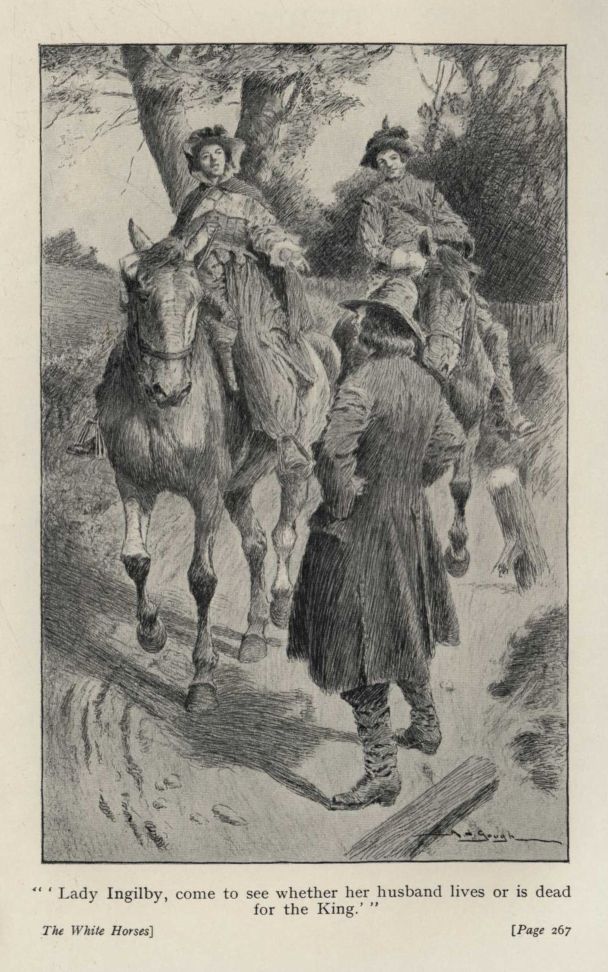
"'Lady Ingilby, come to see whether her husband lives or is dead for the King.'"
"I cannot tell you, madam. There are so many dead, on both sides of the battle."
"But I must know. Give us free conduct through the lines, my friend here and myself; it is a little thing to ask."
The Parliament man was muffled in a great-coat, an unwieldy hat drawn over his eyes. But Christopher knew him, though Ingilby's wife, her heart set on one errand only, saw beyond and through him, scarce knowing he was there save as an obstacle to progress down the lane.
"It is granted," said the Roundhead, "if you permit me to bandage your eyes until we come to the place where Sir William fought. I know the place, because our men brought in high tales of his strength and courage."
"But why the bandage?" she asked peremptorily.
"Because, between here and where he fought, there are sights not good for any woman's eyes."
"Ah, tut! I've nursed men at Ripley who were not good to see. Their wounds were taken for the King, and so were pleasant."
They went through what had been the centre of the King's army—went through all that was left of the Whitecoats, thick-huddled with their faces to the sky. For a moment even Ingilby's wife was dizzy and appalled. There was no scent of summer hedgerows now. Then she took hold again of her unalterable courage.
"Oh, they died well. Lead on."
They came to the place where Sir William's company had fought; and the sun, gaining strength already to drive through the mists of last night's thunderstorm, showed her the faces of many folk remembered, but not her husband's.
"I thank God," she said simply. Then, as she turned to retrace her steps, the inbred courtesy of the woman surmounted the pain that had gone before, the passionate thanksgiving that followed. "I thank you, too, for conduct through the lines. What is your name, that I may remember it in my prayers?"
"At Ripley they would name me Noll Cromwell. I ask no thanks, and need none."
It was all muddled and astounding, as the battle of last night had been. The man she had scolded not long ago at Ripley—the man whose soul she had whipped raw, though she did not guess it—had offered courtesy. For this hour, at any rate, Cromwell was a mystic, seeing with the clearer vision and knowing the kind lash of penance. Since this wild campaign began, drawing him from his quiet estate in Rutland, he had known no happiness till now. This woman had flouted him; yet he was glad, with an amazing gladness, to succour her in need.
A man came running, and said that General Cromwell was needed in Tockwith village, where some trouble had broken out among his men. The mystic disappeared. The Cromwell of sheer flesh and blood showed himself. "Trouble, is there?" he snapped. "I've a short way with trouble of that sort. As for you, Lady Ingilby, the password is Endeavour, and I would recommend you to secure your retreat at once."
With a half-defiant salute he was gone, and, as they came again to the place where the Whitecoats lay, a party of Roundhead horsemen, riding by, halted suddenly.
"You are on the King's side," said the leader, with a sharp glance at Christopher. "I am Captain Murray, at your service, of Leslie's horse. I know you because you all but killed me in that last rally Rupert made. What, in the de'il's name, are you doing here—and with a lady?"
"We are under safe-conduct through the lines. Cromwell gave us the word Endeavour not five minutes since."
"Well, I need you, as it happens. There are many of your dead in Wilstrop Wood, and General Leslie has a soft heart—after the fight is done—like most Scotsmen. He sends me to find a King's man who can name the dead. 'They have wives and bairns, nae doot,' said Leslie in his dry way, 'and ill news is better than no news at a', for those who bide at hame.'"
Lady Ingilby was not sorry when her request to go with Kit was refused. After all, she had breakfasted on horrors and could take no further meal as yet.
"If he is there, Christopher," she whispered, "you will take me. If you do not find him, well. Either way, there is the God above us."
When they came to Wilstrop Wood—Lady Ingilby staying on the outskirts with three dour Scotsmen as a guard of honour—the wind was rustling through the trees. And from the ground there was a harsher rustle—the stir and unrest of men who could not die just yet, however they longed for the prison-gate of flesh to open.
The red-gold sunlight filtered through the cobwebs spun from tree to tree of Wilstrop Wood. And even Murray, who counted himself hard-bitten, stood aghast at what he saw. The underwood was white with bodies of the slain.
A great wrath and pity brought Kit's temper to a sudden heat. "Captain Murray," he said, "these dead have been robbed of all that hides their nakedness. I say it is a foul deed. Better have lost the fight than—than this."
"You will tell it to the world?" stammered Murray.
"Yes, if I win free of this. It shall be blazoned through the North, till there's none but knows of it."
Murray halted irresolute. If the Scotsman had been of grosser make, Kit would have joined the company of King's men who slept in Wilstrop Wood. It was easy, with the men he had at call, to silence this hot-headed youngster.
"That is your resolve?" he asked slowly.
"D'ye doubt it? Captain Murray, it is a loathsome business enough to pick the pockets of the dead, but to take clothes and all——"
"The Scots had no hand in it, I tell ye. Our lads hae over-muckle care for the dead of either side. But I aye mistrusted those Psalm-singing rogues. Will ye take it at that?"
"There's a sickness in the middle of me," said Christopher, with tired simplicity. "What is your business with me here in Wilstrop Wood?"
Murray conquered his first impulse to put Kit's tongue out of harm's way once for all. "As I told you, sir, General Leslie's heart is tender as a maudlin woman's—now the battle is won, and his own wounds patched up—and needs must that you identify the dead."
Christopher, who seemed to wear his heart on his sleeve, was a true Dalesman. By letting the world see the froth and bubble of the upper waters, he hid the deeper pools. As they went through the wood, the sunlight filtering through on ground for ever to be haunted, he knew, by the whiteness of their skins, that the greater part of the fallen were gentry of the King's. Instinct, quick to help a man, told him it was unwise to admit the loss of so many officers to the cause, though he knew many faces there—faces of men who had shared fight or bivouac with him somewhere between this and Oxford.
"They must rest where they lie, for all the help I can give you," he said impassively, "and may God have mercy on their souls."
"Sir, I wonder at your calm," snapped Murray; "but now I understand. All you Papists have that quiet air of ease."
"Up in Yoredale we heard nothing of the Pope, but much of prayers for those who crossed the fighting-line ahead of us."
Murray thought he made nothing of this lad; yet at heart he knew that, through all the moil and stench of Marston, he, too, was going back along the years—going back to the knees of his mother, whose prayers for him he thought forgotten long since.
As they were making their way through the wood again, a slim youngster, stark naked, lifted himself on an elbow and babbled in his weakness. "Have we won, friend?" he asked, looking at Kit and Murray with starry, fevered eyes.
"Aye," said Murray, Scottish pity warring with regard for truth. "We've won, my laddie."
"Then unfasten this bracelet from my wrist. Oh, quick, you fools—the time's short! Take it to Miss Bingham, out at Knaresborough yonder, and tell her I died as well as might be. Tell her Marston Moor is won for the King."
And with that there came a rattle in his throat. And he crossed himself with a feeble forefinger.
"Dear God," said Murray, "the light about his face! You simple gallants have the laugh of us when it comes to the high affair of dying."
Christopher said nothing, after closing the eyes of a gentleman the King could ill afford to lose. And so they came out of Wilstrop Wood, and found Lady Ingilby again.
"Does he lie there?" she asked sharply.
"I did not see him," answered Kit.
"I am almost—almost happy. You did not find him? Come; they'll be needing us at Ripley."
CHAPTER XX.
THE HOMELESS DAYS.
Marston Moor was fought and ended. A mortal blow had been struck at the King's cause in the North; and yet the Metcalfs, rallying round Lady Ingilby at Ripley, would not admit as much. The King must come to his own, they held, and Marston was just an unlucky skirmish that mattered little either way.
York capitulated, and Squire Metcalf, when the news was brought at supper-time, shrugged his shoulders.
"It's a pity," he said. "We must get on without the good town of York—that is all."
Lady Ingilby glanced across at him. For the first time since Marston Moor she smiled. "And if all is lost, will you still believe that the world goes very well?"
A great sob broke from the Squire, against his will or knowledge. "Lady Ingilby, there are fewer Metcalfs than there were," he explained shame-facedly. "I went through Marston Fight, moreover. It is not my faith that weakens—it is just that I am human, and my courage fails."
None spoke for a while. The mistress of Ripley, on her knees in the chapelry, or busying herself about her men's needs, had learned what the Squire had learned. Those who had gone through the stress and anguish of the late battle, and the women who had waited here between closed walls for news to come, all caught the wonder of this moment. It was as if some Presence were among them, interpreting the rough strife of sword and pike.
"If there were two Metcalfs left of us all," said the Squire, his big voice humorous in its gentleness, "we should still believe that all was well with King Charles. And, if one fell, t'other would be glad to be the last to die for His Majesty."
The moment passed. It was too intimate, too filled with knowledge of the over-world, for long continuance. Metcalf filled his glass afresh. The men were glad to follow his good example.
"Your health, Lady Ingilby—your good health," said the Squire.
While they were drinking the toast, the outer door was opened hurriedly, and a little, wiry man came in. His face was tired, and his clothes were stained with rain and mud.
"Gad, here's Blake!" laughed Kit Metcalf. "Blake, the rider—I saw him bring the Metcalfs into Oxford."
Blake nodded cheerily. "Life has its compensations. I shall remember that ride down Oxford High Street until I die, I think. Lady Ingilby, I've a message from your husband, for your private ear."
A great stillness had come to Lady Ingilby, a certainty of herself and of the men about her. "He was always a good lover. You can give his message to the public ear."
"He escaped from Marston with twenty men, and hid in Wilstrop Wood. There was carnage there, but your lord escaped. And afterwards he fell in with Prince Rupert, returning with volunteers from the garrison at York. He bids me tell you he is safe."
"Was that all his message, Mr. Blake?"
"No, it was not all, but—but the rest is for your private ear, believe me."
"I—am very tired. My courage needs some open praise. What was my lord's message?"
Blake stooped to whisper in her ear, and Lady Ingilby laughed. Keen youth was in her face. "Gentlemen, it was a vastly tender message. I am proud, and—and a woman again, I think, after all this discipline of war. My husband bids me hold Ripley Castle for as long as may be, if the Metcalfs come."
"There never was much 'if' about a Metcalf," said the old Squire. "Our word was pledged before ever Marston Fight began."
"Oh, he knew as much, but you forget, sir, that many hindrances might have come between your pledged word and yourselves. You might have died to a man, as the Whitecoats did—God rest them."
The Squire's bluntness softened. The tenderness that is in the heart of every Yorkshireman showed plainly in his face. "True. We might all have died. As it is, there are many gaps that will have to be explained to the goodwife up in Yoredale."
And again there was a wonder and a stillness in the hall, none knowing why, till Lady Ingilby broke silence. "Such gaps need no explaining. They are filled by a golden light, and in the midst of it a rude wooden cross, and over it the words 'For Valour.' There, gentlemen, I weary you with dreams. Lest you think me fanciful, let me fill your glasses for you. It will do you no harm to drink deep to-night, and the sentries are ready at their posts."
They could make nothing of her. Gay, alert, she went about the board, the wine-jug in her hands. The message from her lord that Blake had whispered seemed to have taken a score years from her life, as strong sun eats up a rimy frost. When she bade them good-night and passed out, it was as if a spirit of great charm and well-being had gone and left them dull.
On the morrow there was work enough to keep them busy. The fall of York had sent Cromwell's men like a swarm of bees about the land. Dour and unimaginative in battle, they ran wild when victory was theirs. Men who had been plough-boys and farm-hinds a year since were filled with heady glee that they had helped to bring the great ones low. Some of their officers could not believe—honestly, each man to his conscience—that there was any good or usefulness in gentlemen of the King's who wore love-locks because it was the habit of their class, and who chanced to carry a fine courage under frivolous wearing-gear.
The Squire of Nappa was roused, somewhere about five of the clock, by a din and shouting from the courtyard underneath his bed-chamber. At first he fancied he was back on Marston Field again, and raised a sleepy challenge. Then, as the uproar increased, he got out of bed, stretched himself with one big, satisfying yawn, and threw the casement open.
The summer's dawn was moist and fragrant. His eyes, by instinct, sought the sky-line where, in Yoredale, hills would be. Here he saw only rolling country that billowed into misty spaces, with a blurred and ruddy sun above it all. The fragrance of wet earth and field flowers came in with the warm morning breeze. He was a countryman again, glad to be alive on a June day.
Then he returned to soldiery, looked down on the press of men below, and his face hardened. "Give you good-morrow, Cropheads," he said gently.
"And who may you be?" asked the leader of the troop.
"A Mecca for the King. Ah, you've heard that rally-call before, I fancy. Your own name, sir?"
"Elihu Give-the-Praise."
"Be pleased to be serious. That is a nickname, surely."
A storm of protest came from the soldiery, and Elihu took heart of grace again.
"Idolaters and wine-bibbers, all of you," he said, vindictiveness and martyrdom struggling for the mastery. "Since I forswore brown ale and kept the narrow track, men know me as Elihu Give-the-Praise."
"Then, as one who relishes brown ale, I ask you what your business is, disturbing a Riding Metcalf when he needs his sleep?"
"Our business is short and sharp—to bid you surrender, or we sack the Castle."
"Your business is like to be long and tedious," laughed the Squire, and shut the casement.
He crossed to the landing and lifted a hale cry of "Rouse yourself, Meccas! What lads you are for sleeping!" And there was a sudden tumult within doors louder than the din of Puritans outside. It was then, for the first time, that Lady Ingilby, running from her chamber with a loose wrap thrown about her disarray, understood the full meaning of clan discipline.
The men who answered the rally-call were heavy with sleep and in no good temper; but they stood waiting for their orders without protest. When the Squire told them what was in the doing, their faces cleared. Sleep went by them like a dream forgotten. The Roundheads underneath fired some random shots, as a token of what would follow if there were no surrender; and, in reply, spits of flame ran out from every loophole of the Castle front. They were not idle shots. Elihu Give-the-Praise, with a stiff courage of his own, tried to rally his men, in spite of a splintered arm; but a second flight of bullets rained about them, and panic followed.
"A thrifty dawn," said the Squire of Nappa, as if he danced at a wedding.
For that day, and for three days thereafter, there was little sleep within the Ripley walls. Parliament men, in scattered companies, marched to replace the slain and wounded. There were sorties from the Castle, and ready fire from the loopholes overhead; and in the courtyard space lay many bodies that neither side could snatch for decent burial. There was not only famine sitting on the Ripley threshold now, but pestilence; for the moist heat of the summer was not good for dead or living men.
In the middle watch of the fourth night, Squire Metcalf heard a company of horsemen clatter up to the main gate. He thrust his head through a casement of the tower—the loopholes had been widened in these modern days—and asked gruffly the strangers' errand.
"Surrender while you can, Nappa men," said the foremost horseman.
"It is not our habit."
"There's a company of Fairfax's men—a thousand of them, more or less—within call."
"Ay, so are a thousand cuckoos, if you could whistle them to hand. Who are you, to come jesting at the gates?"
"Nephew to Lord Fairfax, by your leave."
"That alters matters. I'm Metcalf of Nappa, and aye had a liking for the Fairfaxes, though the devil knows how they came into t'other camp. Their word is their bargain, anyhow."
Fairfax laughed. The sturdy bluntness of the man was in keeping with all he had heard of him. "That is true. Will you surrender—leaving all arms behind you?"
"No," said the Squire of Nappa. "Bring your thousand cuckoos in, and I promise 'em a welcome."
He shut the casement, called for his son Christopher to take his sentry-place, and sought Lady Ingilby.
"There's a good deal to be done in five minutes," he said, by way of breaking the news to her.
"Oh, you think only of speed these days, and I—believe me, I am tired."
"'Tiredness butters no haver-bread,' as we say in Yoredale. There are two ways open to us—one to surrender by and by, the other to ride out to-night."
"But my husband—-oh, he left me here to hold the Castle."
"For as long as might be. He'll not grumble when he learns the way of our riding out. Better leave Ripley now, with honour, than wait till they starve us into surrender."
He had his way. In silence they made their preparations. Then Metcalf lifted a noisy rally-cry as he led his men into the courtyard. And the fight was grim and troublesome. When it was done, the Metcalfs turned—those who were left—and came back for the womenfolk; and some of the white horses, saddled hastily, fidgeted when for the first time they found women's hands on the bridle.
Michael was one of those who gave his horse, lest a woman should go on foot; and at the courtyard gate, while the press of folk went through, he halted suddenly.
"Kit," he said, "there's li'le Elizabeth braying as if all her world were lost. 'Twould be a shame to forget her, after what she did for me at York."
Christopher was young to defeat. "It's no time to think of donkeys, Michael," he snapped, humour and good temper deserting him in need.
"I defend my own, lad, whether Marston Moor is lost or won. I'm fond of Elizabeth, if only for her skew-tempered blandishments."
When he returned from the humble pent-house where they had lodged the ass, the Squire had got his company ready for the march, and was demanding roughly where Michael was.
"Here, sir," said Michael, with the laugh that came in season or out.
"Making friends with your kind, lad," snapped the other. "Well, it's a thrifty sort of common sense."
The odd cavalcade went out into the dewy, fragrant dawn. About the land was one insistent litany of birds—merle and mavis, sleepy cawing of the rooks, and shrill cry of the curlews and the plover. A warm sun was drinking up lush odours from the rain-washed fields and hedgerows.
"Eh, but to see my growing corn in Yoredale!" sighed Squire Metcalf. "As 'tis, lads, we're heading straight for Knaresborough, to learn how they are faring there."
Joan Grant had been content, till now, to sit Christopher's horse and to find him at her stirrup.
"I do not like the Knaresborough country," she said, with gusty petulance.
"Not like it? Their garrison has kept the Cropheads busy."
"Oh, ay, Master Christopher! There's nothing in the world save sorties and hard gallops. To be sure, we poor women are thrust aside these days."
"What is it?"
"What is it, the boy asks. I thought you grown since Yoredale days; and now, Kit, you're rough and clumsy as when you came a-wooing and I bade you climb a high tree—if, that is, you had need to find my heart."
They rode in silence for a while. Christopher thought that he had learned one thing at least—to keep a still tongue when a woman's temper ran away with her. But here, again, his wisdom was derided.
"I loathe the tongue-tied folk! Battle, and audience with the King, and wayfaring from Yoredale down to Oxford—have they left you mute?"
"Less talkative," he agreed; "I've seen men die."
For a moment she lost her petulance. "You are older, graver, more likeable. And yet I—I like you less. There was no need—surely there was no need to—to let others tell me of the ferry-steps at Knaresborough."
"The ferry-steps?"
"So you've forgotten that poor maid as well. I pity Miss Bingham now. Why do women hate each other so? Instead, they should go into some Sisterhood of Pity, hidden away from men."
"They should," assented Christopher; "but few of them do, 'twould seem."
"And now you laugh at me. Oh, I have heard it all! How pleasantly Nidd River runs past the ferry-steps. She is beautiful, they tell me."
"I have no judgment in these matters. Ask Michael—he was there with me in Knaresborough."
Michael had chanced to overtake them at the moment, Elizabeth following him like a dog. "Nidd River—yes, she is beautiful."
"It was Miss Bingham we talked of. I—oh! I have heard such wonderful tales of her. She glamours men, they say."
Michael, for a breathing-space or two, was silent. Then he recaptured the easy-going air that had served as a mask in harder times than this. "She glamoured me, Miss Grant—on my faith, she did—whenever Kit would leave her side. The kindest eyes that ever peeped from behind a lattice."
"Miss Bingham seems to be prodigal of the gifts that heaven has given her."
"True charity, believe me—to spend what one has, and spend it royally."
"She seems, indeed, to be a very perfect hoyden. Oh, I am weary! Marston Moor is lost. Ripley is lost. Are we going to ride for ever along dreary roads?"
"Three of us go on foot—Kit the baby, Elizabeth and I. We have no grumbles."
She turned on him like a whirlwind. "If the end of the world came—here and now—you would make a jest of it."
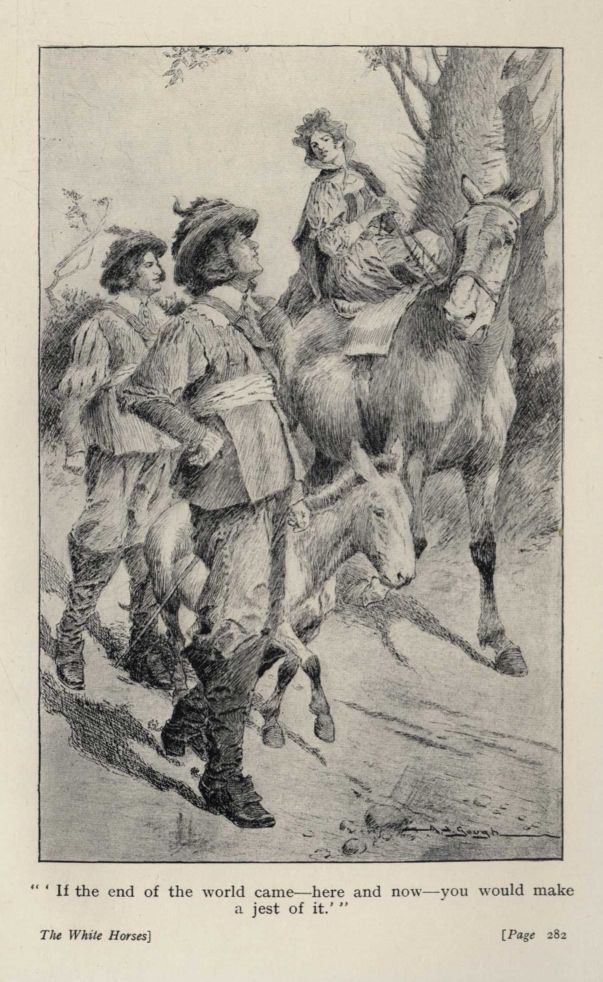
"'If the end of the world came—here and now—you would make a jest of it.'"
"'Twould sweeten the end, at any rate. There's Irish blood in me, I tell you."
From ahead there sounded a sharp cry of command. "Hi, Meccas, all! The enemy's in front."
War had lessened the ranks of the Metcalfs, but not their discipline. Michael and his brother clutched each a horse's bridle, after helping the women to alight, and sprang to the saddle. Even Elizabeth shambled forward to take her share of hazard, and Joan found herself alone. And the gist of her thoughts was that she hated Kit, and was afraid that he would die.
She watched the Metcalfs spur forward, then slacken pace as they neared the big company coming round the bend of the road. The old Squire's voice rang down-wind to her.
"King's men, like ourselves? Ay, I see the fashion of you. And where may you be from, gentles?"
"I'm the late Governor of Knaresborough, at your service."
"And I'm the Squire of Nappa, with all that the Cropheads have left of my Riding Metcalfs."
The Governor saluted with extreme precision. "This almost reconciles me to the loss of Knaresborough, sir. We have heard of you—give you good-day," he broke off, catching sight of Michael and Christopher. "We have met in happier circumstances, I think."
CHAPTER XXI.
SIR REGINALD'S WIDOW.
There is nothing so astounding, so muddled by cross-issues and unexpected happenings, as civil war. Not long ago Marston Moor had heard the groans of Cavaliers as they lay naked to the night-wind, and prayed for death in Wilstrop Wood. York had surrendered. The garrisons of Knaresborough and Ripley, met together on the dusty highroad here, were weak with famine and privation. Yet they stood chatting—the ladies of both garrisons passing laughter and light badinage with the men—as if they were gathered for a hunting-party or falconry. The intolerable pressure of the past months was ended for a while, if only by disaster; and from sheer relief they jested.
Joan Grant, in the middle of the chatter, edged her mare near to a sprightly horse-woman who had just dismissed Michael with a playful tap of her whip across his cheek.
"You are Miss Bingham? Ah, I guessed it."
"By what token?"
"By your beauty, shall we say? Gossip has so much to tell about it, and about the Vicarage garden, with Nidd River swirling past the ferry-steps."
They eyed each other with the wariness of duellists. "The good Vicar is fortunate in his garden," assented Miss Bingham, with the most charming courtesy.
"And in his water-nymphs, 'twould seem. I think you would be like some comely dream—on an April evening, say, with the young leafage of the trees for halo."
"Oh, it is pleasant to be flattered! But why this praise of me? We were strangers not an hour ago."
"I have heard so much of you. You were so kind to the men who sortied from Knaresborough and returned with wounds. You sat by the ferry-steps—all like a good angel—and bound their hurts afresh when they smarted. Oh, indeed, we have heard of your pleasant skill in healing."
While they faced each other, there came the thud and racket of horse-hoofs down the road. The rider drew rein amid a swirl of dust, cleared his eyes with a hand that trembled, and looked from one face to another. His tired face lit up when at last he saw the Governor of Knaresborough.
"Give you good-day, sir. I was riding to seek aid from you."
"The devil you were," growled the other. "The man sups lean who trusts to my help, Graham. Knaresborough's in other hands since—since Marston."
"It would be. I had forgotten that. But you're here."
"What is your need, lad?"
"A few men to help me, over at Norton Conyers. I rode to ask if you could lend them me."
"All of us, if we're needed. We were jesting on the road here, for lack of other occupation. What is it? But, first, is your uncle safe—tough Reginald Graham? I love him as I love the steep rock-face of Knaresborough."
"It was this way. My uncle would have me near him at Marston. We were with Rupert on the right wing, and were close behind one of the Riding Metcalfs—I know not which, for they're all big men and as like as two peas in a pod—and saw him cut Cromwell through the throat. We were together when we broke the Roundheads and pursued too far. It was when we came to the ditch again, and found Leslie there with his Scots, that I lost Sir Reginald. I took a wound or two in the stampede that followed, and was laid by in a little farmstead near Wilstrop Wood. The good-wife was kind to me—said she had lost a bairn of her own not long since, trampled down by flying horsemen at the gate."
"Ay, lad; but why d'ye not get forward with your news of Sir Reginald?"
"Because I cannot trust myself to speak of him without some folly in my throat. Give me time, sir—give me time. I got about again in a day or two, and stumbled home somehow to Norton Conyers. And I—I met a black procession—all like a nightmare, it was—journeying to the kirkyard. So I joined them; and one man nudged another, and asked who this was coming in his tatters to the burial without mourning-gear. And I pointed to my wounds and laughed. 'Mourning-gear enough,' said I. 'Mourners go in blood and tatters since Marston.' And then, they tell me, I fell, and lay where I fell. That was all I knew, till I got up next day with all my limbs on fire."
There was silence among those looking on—a deep and reverent silence. This youngster, out of battle and great pain, had captured some right-of-way to the attention of strong men.
"When I was about again, they told me how it chanced. Sir Reginald took a mortal hurt at Marston, but rode with the best of his strength to Norton Conyers. He found Lady Graham at the gate, waiting for news of him; and he stooped from saddle, so they say, and kissed her. 'I could not die away from you, wife,' he said."
"Ay," growled the Governor, "he was like that—a hard fighter, and a lover so devout that his wife had reason to be proud."
"She tried to help him get from horse; but he shook his head. 'The stairs are wide enough,' was all his explanation. Then he rode in at the main door and up the stair, and bent his head low to enter the big bed-chamber. He got from the saddle to the bed, lay with his eyes on fire with happiness, and so died."
"A good ending," said the Squire of Nappa roughly, because he dared not give his feelings play. "What I should call a gentleman's ending—leal to King and wife. Oh, you young fool, no need to make a tragedy about it!"
Graham answered gamely to the taunt that braced him. "As for that, sir, tragedy is in the making, if no help comes to Norton Conyers. We had word this morning that a company of Roundheads was marching on the Hall—the worst of the whole brood—those who robbed the dead and dying in Wilstrop Wood."
It was not the Governor of Knaresborough who took command. Without pause for thought of precedence, Squire Metcalf lifted his voice.
"A Mecca for the King, and bustle about the business, lads!"
The road no longer showed like a meeting-place where idle gentry foregathered to pass the time of day. The Governor, with some envy underlying all his admiration, saw the Metcalfs swing into line behind their leader.
"Our horses are fresh," explained the Squire over shoulder, with a twinge of punctilio. "Do you follow, sir, and guard the women-folk."
"I shall guard them," said the Governor, laughing quietly.
Miss Bingham saw Joan watching the dust swirl and eddy in the wake of the Riding Metcalfs, saw that the girl's face was petulant and wistful. "He did not pause to say good-bye," she said, with gentlest sympathy.
"I did not ask him to."
"But, indeed, men are fashioned in that mould. I am older than you, child."
"So much is granted," said Joan sharply.
"And women are fashioned in their mould, too, with feet of velvet and the hidden claws. Yes, I am older. You drew blood there."
"Miss Bingham, I am in no mood for petty warfare of our sort. Our men have done enough, and they are riding out again. We women should keep still tongues, I think, and pray for better guidance."
"How does one pray? You're country-bred and I am not." The voice was gentle, but the sideways glance had venom in it. "It comes so easily to you, no doubt—scent of hay, and church bells ringing you across the fields, and perhaps he will meet you at the stile, to share the self-same book—is that what prayer means?"
"No," said the Governor, interposing bluntly. "Ask Lady Derby what prayer means—she who has made Lathom House a beacon for all time. Ask Ingilby's wife, who held Ripley for the King's wounded—ask Rupert——"
"The Prince—is he, too, among the listeners to church bells?" asked Miss Bingham airily.
"To be precise, he is. I talked yesterday with one who was at York when Rupert came to raise the siege. The Prince was spent with forced marches, dead-weary, soul and body. He had earned his praise, you would have thought; but, when they cheered him like folk gone mad, he just waited till the uproar ceased, and bared his head. 'The faith that is in me did it, friends, not I,' he said, and the next moment he laughed, asking for a stoup of wine."
"He cared for his body, too, 'twould seem," murmured Miss Bingham.
"A soldier does, unless by birth and habit he's an incorrigible fool. I've even less acquaintance than you with prayer; but I've seen the fruits of it too often, child, to sneer at it."
"To be named child—believe me, sir, it's incense to me. Miss Grant here was persuading me that I was old enough to be her mother. I was prepared to kneel at the next wayside pool and search there for grey hairs."
"Search in twenty years or so—time enough for that. Meanwhile, we have to follow these hot-headed Metcalfs, and discipline begins, Miss Bingham."
"Oh, discipline—it is as tedious as prayer."
The Governor cut short her whimsies. "The tedium begins. This is no ballroom, I would have you understand."
Miss Bingham sighed as their company got into order. "Why are not all men of that fashion?" she asked languidly. "It is so simple to obey when one hears the whip, instead of flattery, singing round one's ears."
Joan glanced at her in simple wonderment. She had no key that unlocked the tired, wayward meaning of this woman who had played many games of chess with the thing she named her heart.
The Metcalfs, meanwhile, had gone forward at a heady pace. As of old, one purpose guided them, and one rough master-mind had leadership of their hot zeal. They encountered many piteous sights by the wayside—stragglers from Marston, Knaresborough, York—but the old Squire checked his pity.
"It's forrard, lads, forrard!" he would roar from time to time, as they were tempted to halt for succour of the fallen.
His instinct guided him aright. When they came through the dust of thirsty roads and the dead heat of a thunderstorm that was brewing overhead, to the high lands overlooking Norton Conyers, they caught a glint below them of keen sunlight shining on keen steel.
"It's always my luck to be just in time, with little to spare," said Blake, the messenger, who was riding at the Squire's bridle-hand. "D'ye see them yonder?"
Metcalf saw a gently-falling slope of pasture between the Roundheads and themselves, with low hedges separating one field from another. "Tally-ho, my lads!" he laughed. "I'll give you a lead at the fences—a Yoredale sort of lead."
The Parliament men checked their horses, gaped up at the sudden uproar, and had scarce braced themselves for the encounter when the Metcalfs were down and into them. The weight of horseflesh, backed by speed, crashed through their bulk, lessening the odds a little. Then it was hack, and counter, and thrust, till the storm broke overhead, as it had done at Marston, but with a livelier fury. They did not heed it. Time and again the yell of "A Mecca for the King!" was met by the roar of "God and the Parliament!" And Squire Metcalf, in a lull of the eddying battle, found the tart humour that was his help in need.
"Nay, I'd leave half of it out, if I were ye, after what chanced in Wilstrop Wood. Fight for Parliament alone, and all its devilries."
That brought another swinging fight to a head; and the issue shifted constantly. The lightning danced about the men's armour. The thunder never ceased, and the rain lashed them as if every sluice-gate of the clouds were opened.
Very stubborn it was, and the din of oaths and battle-cries leaped out across the thunder-roar, stifling it at times.
"The last shock, Meccas!" cried the Squire. "Remember Wilstrop Wood."
In the harsh middle of the conflict, the Squire aimed a blow at the foremost of the Roundheads who rode at him. His pike dinted the man's body-armour, and the haft snapped in two. Little Blake rode forward to his aid, knowing it was useless; and, with a brutish laugh, the Roundhead swung his sword up.
And then, out of the yellow murk of the sky, a friend rode down to the Squire's aid—rode faster than even Blake had done on the maddest of his escapades. Kit, unpressed for the moment after killing his immediate adversary, saw a blue fork of flame touch the uplifted sword and run down its length. The Roundhead's arm fell like a stone dropped from a great height, and lightning played about horse and rider till both seemed on fire. They dropped where they stood, and lay there; and for a moment no man stirred. It was as if God's hand was heavy on them all.
The Squire was the first to recover. "D'ye need any further battle, ye robbers of the dead?" he asked.
Without further parley they broke and fled. Panic was among them, and many who had been honest once in the grim faith they held saw wrath and judgment in this intervention.
The Metcalfs were hot for pursuit, but their leader checked them. "Nay, lads. Leave the devil to follow his own. For our part, we're pledged to get to Norton Conyers as soon as may be."
His kinsmen grumbled at the moment; but afterwards they recalled how Rupert, by the same kind of pursuit, had lost Marston Field, and they began to understand how wise their headstrong leader was.
The sun was setting in a red mist—of rain to come—when they reached Norton Conyers; and an hour later the Governor of Knaresborough rode in with the mixed company he guarded. The men of his own garrison, the women-folk of Knaresborough and Ripley, odds and ends of camp followers, made up a band of Royalists tattered enough for the dourest Puritan's approval.
"Where is li'le Elizabeth?" asked Michael plaintively. "For my sins, I forgot her when the Squire told us we were hunting the foxes who raided Wilstrop Wood."
"Who is Elizabeth?" snapped the Governor, in no good temper.
"Oh, a lady to her hoof-tips, sir—loyal, debonair, a bairn in your hands when she loves you, and a devil to intruders." He turned, with the smile that brimmed out and over his Irish mouth. "Meccas all, the Governor asks who Elizabeth is. They knew in Oxford, and praised her grace of bearing."
A lusty braying sounded through the lessening thunder-claps, and a roar of laughter came from Michael's kinsmen.
"Twins are never far apart, if they can help it," said Christopher. "It is daft to worry about Elizabeth, so long as Michael's safe."
From long siege on land there comes to men something of the look that manners have whose business is with besieging seas. The Governor's eyes were steady and far away. He seemed bewildered by the ready laughter of these folk who had ridden in the open instead of sitting behind castle walls. But even his gravity broke down when Elizabeth came trotting through the press, and look about her, and found Michael. She licked his hands and face. She brayed a triumph-song, its harmony known only to herself.
"One has not lived amiss, when all is said," said Michael. "You will bear witness, sir, that I have captured a heart of gold."
The Governor stopped to pat Elizabeth, and she became an untamed fury on the sudden, for no reason that a man could guess.
"I—I am sorry, sir," Michael protested.
"Oh, no regrets! She is a lady to her hoof-tips, as you said, and my shins are only red-raw—not broken, as I feared."
It was well they had their spell of laughter in between what had been and what must follow. When they came to Norton Conyers, it was to find the mistress dull with grief, and hopeless. All she cared for lay buried, with pomp and ceremony enough, in the kirkyard below. She was scarcely roused by the news that fire and rapine would have raided the defenceless house if the Riding Metcalfs had not come on the stroke of need.
"I thank you, gentlemen—oh, indeed, I thank you. But nothing matters very much. He waits for me, and that is all."
She was past argument or quiet persuasion. They ate and drank their fill that night, because they needed it—and their needs were the King's just now—and on the morrow, when they had cursed their wounds, and prayed for further sleep, and got up again for whatever chanced, they found Graham's widow still intractable. They told her that the safety of many women-folk was in her hands.
"I trust them to you," she said. "There's an old nurse of mine lives up in a fold of the hills yonder. They will not find me there, and I care little if they do. Meanwhile, I shall get down each night and morning to pray for the soul of a gallant gentleman who has unlocked the Gate"—her eyes were luminous with a temperate fire—"unlocked it a little ahead of me. He has left it on the latch."
The Squire bent to her hand. "Madam," he said, his roughness broken up, as honest moorland soil is broken when it is asked to rear pleasant crops—"madam, I've a wife in Yoredale, I. She carries your sort of heart, I think. Of your charity, pray for her till I come."
"I shall pray, sir."
And so the Riding Metcalfs went from Norton Conyers, with an added burden of women-folk, but with a sense of rosemary and starshine, as if they had tarried for a while in some wayside Calvary.
CHAPTER XXII.
MISS BINGHAM.
It was no usual comradeship that held between the Royalists who gathered in one company after Marston Moor was lost to the King. They travelled through vile roads—roads broken up by incessant rains—they camped wherever they found a patch of drier ground for the night's sleep. But never for a moment did they lose the glamour that attached to the person of King Charles. Like a beacon-light, the thought of the half-vanquished Stuart went steadily in front of them. Their strength lay in this—that, whether death or life arrived, they knew the venture well worth while.
The life had a strange savour of its own. The Nappa Squire, the late Governor of Knaresborough and his officers, Lady Ingilby—all had known the weight of harsh responsibility so long as the King's cause was alive in the North. The cause was dead now. There was no need to be at strain, sleeping or waking, with the sense that it rested with each of them to keep the monarchy secure. There was asked of them only a haphazard and stimulating warfare, of the sort dear to all hillmen.
Scarborough Castle fell, and when the news was brought—they were dining at the moment in a wooded dell between Beamsley and Langbar—the Governor lifted his hat with pleasant gravity.
"God rest the gentlemen of Scarborough. They have earned their holiday, as we have."
Michael was busy with the stew-pot, hanging gipsy-wise on three sticks above a fire of gorse and fir-cones. "It's hey for Skipton-in-Craven," he said with a cheery smile. "I aye liked the comely town, and now the King will know that she was the last in all the North to stand for him."
"Maybe Skipton has fallen, too, by this time," chided the Squire. "You were always one for dreams, Michael."
Michael was silent till the meal was ended. Then he mowed a swath of thistles with his sword, and brought the spoil to Elizabeth, tethered to a neighbouring tree. She brayed at him with extreme tenderness.
"Now that we're well victualled, friends," he said lazily, "who comes with me to hear how it fares with Skipton?"
The Governor did not like the venture—the hazard of it seemed too great—but Squire Metcalf did.
"How d'ye hold together at all, Michael?" roared the Squire. "So much folly and such common sense to one man's body—it must be a civil war within yourself."
Michael glanced at Joan Grant with an instinct of which he repented instantly. "It is, sir. Since I was born into this unhappy world, there has been civil war inside me. I need an outlet now."
"You shall have it, lad."
"And you call this common sense?" asked the Governor, with good-tempered irony.
"Ay, of the Yoredale sort. A blow or two in Skipton High Street—who knows what heart it might give the garrison?"
"I must remind you that we have women-folk to guard, and our wounded."
"But, sir, this is a Metcalf riding, all like the olden time. We never meant your Knaresborough men to share it."
Yet some of the Knaresborough men would not be denied; and the Governor, as he saw the sixty horsemen ride over and down to Beamsley-by-the-Wharfe, wished that his private conscience would let him journey with them. He stood watching the hill-crest long after they had disappeared, and started when a hand was laid gently on his arm.
"It is hard to stay?" asked Lady Ingilby.
"By your leave, yes. Why should these big Metcalfs have all the frolic?"
"Ah, frolic! As if there were naught in life but gallop, and cut and thrust, and——sir, is there no glory in staying here to guard weak?"
The Governor was in evil mood. He had seen the King's cause go, had seen Knaresborough succumb, had watched the steadfast loyalty of a lifetime drift down the stream of circumstance like a straw in a headlong current.
"Lady Ingilby," he said wearily, "there is no longer any glory anywhere. It has gone from the land."
"It is here among us. Till we were broken folk, I did not know our strength. None but the Stuart, friend, could have kept us in such friendliness and constancy. Oh, I know! I saw you glance round for your horse when the Metcalfs went—saw your struggle fought out, sir—and, believe me, you were kind to stay."
They finished their interrupted meal at leisure; and it was not till about four of the clock that Miss Bingham, who had strayed afield to pick a bunch of valley lilies, came running back to camp. The two men in pursuit blundered headlong into the enemy before they saw their peril; and they found scant shrift.
Miss Bingham, thoroughbred beneath her whimsies, halted a moment to regain her courage. "These are but outposts, sir," she said. "From the hill-top I could see a whole company of Roundheads."
"Their number," asked the Governor—"and are they mounted?"
"More than our own, I think, and they go on foot."