Front matter (continued 2)
Reading edition
Kit was divided between two allegiances now. One was owing unalterably to the light which Lady Ingilby had shown him shining from Joan's upper room. The other was Prince Rupert's. Through all the muddled rides and skirmishes and swift alarms of that hard winter, the Metcalfs had heard constantly the praises of two men sung—Rupert's and Cromwell's. Rupert had succeeded in the raising of a cavalry troop that already, rumour said, was invincible; Cromwell was building up his Ironsides, grim and heavy, to meet the speed and headlong dash of Rupert's men. Gradually, as the months went on, Kit shaped Prince Rupert to the likeness of a hero—a little less than saint, and more than man. Whenever he came home to Ripley, he roamed o' nights, and looked up at Joan's window, and shaped her, too, to the likeness of a maid too radiant for this world. He was in the thick of the high dreams that beset an untrained lad; but the dreams were building knighthood into the weft and woof of him, and no easy banter of the worldlings would alter that in years to come.
Joan played cat's-cradle with his heart. She would flout him for a day, and meet him at the supper-board thereafter with downcast eyes and tender voice; and Squire Metcalf would suppress his laughter when Kit confided to him that women were beyond his reckoning.
Soon after dawn, on a day in late April, Kit stole out for a glance at the left wing of the Castle, where Joan's window grew ruddy in the sunlight. Rain was falling, and a west wind was sobbing up across the sun. And suddenly he fancied that women were not beyond his reckoning. They were April bairns, all of them—gusty and cold, warm and full of cheer, by turns. He remembered other Aprils—scent of gilly-flowers in the garden far away in Yoredale, the look of Joan as she came down the fields to greet him—all the trouble and the fragrance of the days when he was giving his heart to her, not knowing it.
He felt a sharp tap on his shoulder. "Day-dreaming, Kit?" laughed the Squire of Nappa. "Oh, she's there, my lad, safe housed. I was about to knock on the gate, but I fancy you'd best take my message to Lady Ingilby."
Kit was glad to take it, glad to be nearer by the width of the courtyard to that upper window. Women—who, for the most part, are practical and ruled by household worries—must laugh often at the men who care for them with true romance.
When the gate was unbarred, and he had passed through, a kerchief fluttered down—a little thing of cambric, ladylike and foolish. Kit did not see it. His glance had roved to the upper window, and there, framed by the narrow mullions, was Joan's face.
"You do not care to pick it up," she said with a careless laugh. "How rough you are, you men of Yoredale."
Kit saw the favour lying at his feet, and pinned it to his hat. When he glanced up again, the window overhead was empty, and Lady Ingilby, standing at his side, was bidding him good-morrow.
"I have urgent news for you," he said, recovering from confusion.
"Not so urgent but a kerchief could put it out of mind. But come indoors, lest a snowstorm of such favours buries you. You'll have many such storms, I hazard—you, with your big laugh and your air of must-be-obeyed."
When they had come into the oak-parlour, and Lady Ingilby had seen that the door was close-shut against eavesdroppers, Kit gave his message.
"A man rode in an hour ago from York. The garrison there is near to famine. They're besieged by three armies—Lord Fairfax at Walmgate Bar, my Lord Manchester at Bootham Bar, and the Scots at Micklegate. My father sends me with the message, and asks if you can spare the Riding Metcalfs for a gallop."
"Six-score to meet three armies?"
"If luck goes that way."
She stood away from him, looking him up and down. "My husband is of your good breed, sir. I gave him to the King, so I must spare my six-foot Metcalfs to the cause."
Joan Grant came into the parlour. Kit, seeing the filtered sunlight soft about her beauty, thought that the world's prime miracle of womanhood, a thing dainty, far-away, had stepped into the room.
"Can I share your secrets?" she asked diffidently.
"I've none," said Kit, with a sudden laugh. "I carry your kerchief, Joan—at least, my hat does, whenever I wear it in the open, for men to see."
Again she was aware of some new self-reliance, some ease of speech and carriage that had been absent in the Yoredale days. A few months of peril had accomplished this; she asked herself, with a queer stab of jealousy, what a year of soldiery would do.
"I dropped the kerchief by chance, sir," she said coldly. "You will return it."
"By and by, when it has been through other chance and mischance. Lady Ingilby, you shall be judge between us. Is the kerchief mine?"
The older woman laughed. "Yours—when you've proved your right to wear it. Meanwhile, it is a loan."
"Women always forsake each other at the pinch," said Joan, with a gust of temper.
"To be sure, girl. Our men-folk are so often right, in spite of their absurdities. This venture toward York, Mr. Metcalf? You propose to ride against three armies—a hundred and twenty of you?"
"No, by your leave. We hope to get near the city in one company, and then decide. If York is leaguered by regiments, there'll be an outer rim of Metcalfs, waiting their chance of capturing news going in or coming out."
"Good! I begin to see how strong you are, you clan of Metcalfs. You are one, or two, or six-score, as need asks. I think you are well advised to go to York."
Joan Grant turned from the window. Her aloofness and disdain were gone. "Would you not stay to guard our wounded here?" she asked.
The mellow sunlight was busy in her hair. Her voice was low and pleading. Kit was dizzied by temptation. And Lady Ingilby looked on, wondering how this man would take the baptism.
"We fight where the King needs us most—that is the Metcalf way," he said at last.
"If I asked you not to go? Of course, I care nothing either way. But suppose I asked you?"
With entire simplicity and boyishness, Kit touched the kerchief in his hat. "This goes white so far as I can guide it."
"Ah," said Lady Ingilby. "The King should hear of you, sir, in days to come."
When he had gone, Joan came to her aunt's side. "He—he does not care, and I would we were home in Yoredale, he and I. I was free to flout him there."
"Never trust men," said Lady Ingilby, with great cheeriness. "He does not care, of course—no man does when the battle music sounds."
"But he—he was glad to wear my kerchief."
"It is the fashion among our Cavaliers. That is all. He would not care to take the field without a token that some poor gentlewoman was dying of heart-break for his wounds."
Joan found her dignity. "My own heart is sound," she protested.
"Then don't accuse it, child, by protests."
"I'm so glad that he's gone—so glad!" She crossed to the window again, looked out on the sunlit street. "How drab the world is," she said pettishly. "There'll be snow before night, I fancy; it grows chilly."
"The world's drab," assented Lady Ingilby. "What else does one expect at my years? And our six-foot Metcalf will forget you for the first pretty face he meets in York."
"Is he so base? Tell me, is he so base?"
"No; he forgets—simply, he forgets. Men do."
Without, in Ripley street, there was great stir of men and horses getting ready for the York road. Lady Ingilby, hearing the tumult of it, crossed to the window, and her heart was lighter by twenty years as she watched the cavalcade ride out.
"The White Horses, and six-score giants riding them! They'll make history, girl. The pity is that not all of those six-score will sit a saddle again. They have the look of men who do not care how and when they die, so long as King Charles has need of them."
"Kit will return," said Joan, in a chastened voice.
"That is good hearing. How do you know it, baby-girl?"
"Because I asked him to return. Just to nurse his wounds would be—Paradise, I think."
The Metcalf men were a mile on the York road by now. Michael, the reputed black sheep and roysterer of the clan, rode close beside Christopher, and chattered of a face he had seen at an upper window of the Castle.
"A face to lead a man anywhere," he finished, "Hair like wind in the rusty brackens."
Kit touched the favour in his hat. "It is she I fight for, Michael—for the King and Joan."
"Are you always to have luck, just for the asking?" growled Michael.
"This time, yes, unless brother fights with brother."
For a moment they were ready to withdraw from their kinsfolk and settle the issue in some convenient glade. Then Michael yielded to the queer, jealous love he had learned, long since in Yoredale, for this lad.
"Oh, we'll not quarrel, Kit. There'll be another face for me at the next town we ride through. There are more swans than one, and all turn geese in later life."
Squire Mecca, hearing high words from the rear, rode back to learn what the uproar was about. "So you're at your brawling again, Michael?" he roared.
"No, sir. I was wishing Kit good luck for the lady's favour he is wearing in his hat."
"You're a smooth-tongued rascal! As for you, Kit, lady's favours can bide till we're through with this rough work. Moonshine is pretty enough when the day's over, but the day is just beginning."
They rode by way of Tockwith village, long and straggling, and forward over a heath studded thick with gorse and brambles, and set about with black, sullen wastes of bog.
Squire Metcalf, for all his hardihood, was full of superstition, as most folk are who have good wits and healthy souls. A little wind—of the sort named "thin" in Yoredale—blew over Marston Moor, chilling the warm sunlight.
"There's a crying in the wind," he said, turning to Kit, who was riding at his bridle-hand. "I trust it's sobbing for the end of all foul traitors to the King."
CHAPTER VI.
HOW MICHAEL CAME TO YORK.
They crossed the moor, and so, through Long Marston, made forward on the York road till they reached a hamlet three miles from the city. Here they captured a shepherd, known to the country speech as "an old, ancient man," who was driving a flock of ewes from a neighbouring pasture. They asked him if he knew anything of the to-and-froing of the Parliament troops.
"I've seen a moil o' horsemen scummering out to York for three days past. But they asked me no questions, and so I asked them none. Reckoned they were riding to a hunt. Gentlefolk must fill up their time, one way or another."
"But, man," snapped old Metcalf, "d'ye live so close to York and not know there's war between King and Parliament?"
"Nay. I've been tending sheep. Have they fallen out, like, King and Parliament? Well, let 'em fratch, say I. I'm a simple man myself, with ewes to tend."
Squire Metcalf broke into that big laugh of his that seemed to set the world to rights. "Forward, Mecca lads!" he said. "We've ewes to tend ourselves; but, bless you, this shepherd brings a wind from Yoredale to us."
A half-mile further on they met a company of Fairfax's horse, foraging for meat and drink. There were fifty of them, and the Metcalfs went through them like a sickle cutting through the bearded corn. Ten were killed, and they let all but one of the retreating forty go. From him, before they freed him, they learned that it was unwise to venture further than a mile on the York road, unless they wished to try conclusions with outposts of the Scots at Micklegate.
"One of us must find a way into York Castle," said the Squire, calling a council of war about him.
It was part of the man's downrightness, his faith that Providence was kind to every stark adventure, that he was able to make the forlorn hope seem a deed already done.
"I claim the venture, sir," said Michael, with his unalterable smoothness and the air of one who jests. "Kit, here, has had his share already."
"Well, well, 'twill keep you out of mischief for a while. Get you from saddle, Michael. Steal into York as privily as may be, and ask my Lord Newcastle what service six-score Metcalfs can do him in the open. We shall be waiting for you, here or hereabouts, when you return."
Michael, as he trudged along the road, overtook a tall fellow who walked beside a donkey-cart piled high with vegetables. "I'll buy that donkey, friend," he said, "and all your cart holds, and the clothes you stand up in."
"For how much?" asked the countryman, stolidly indifferent to all except the call of money.
Michael took a guinea from his pocket, and watched cupidity brighten in the rascal's eyes as another coin was added. Then they went aside into a little wood beside the road, exchanged clothes there, and the bargain was complete.
"Clothes make a difference," chuckled the countryman. "Here's thee, looking as gaumless a lad as ever brought produce into camp; and here's me, the gentleman fro' my head to my riding-boots. All I need is to steal a horse; then I shall be the gentleman quite. I knew the feel o' stirrups once, before I drank away a snug little farm and had to take to the road."
Something in the man's voice, something in his sturdy height, the devil-may-care acceptance of life as it was, roused Michael's interest. "You sell your wares to the Roundhead army?" he asked sharply.
"Ay, but that doesn't say I hold wi' them. I've my living to earn, and sell in any market."
"Have a care, man. You're for the King, I fancy, apart from trade. And how do you know that I'll not take you by the ear and lead you into camp for a traitor to the Commonwealth?"
The rogue looked up and down the road. "There's none to come in between us," he laughed. "I care never a stiver on which side you be. I'm for the King, and always was; and, if you say nay, we can fight it out here with our fists. We're much of a height and girth."
This was the sort of wayfaring that tickled Michael's humour. "My lad," he said, between one break of laughter and the next, "it would be a pity for two King's men to fight. Go back a mile along the road to Ripley, and find a company of rascals as big as you and me. When they ask your errand, say 'A Mecca for the King,' then tell them that I've sent you with the news that all speeds well."
"This is fair dealing?" said the countryman, after a puzzled silence.
"Take it or leave it. We Metcalfs never trust by halves."
The other clapped his hand suddenly into Michael's. "That's a bargain," he said. "I'd liefer join your company than sell cabbages to these durned Cropheads."
The donkey was waiting patiently in the road until they had settled their differences. When the new master put a hand on the bridle and urged her forward, the brute lashed out a hind leg and scarred his leg from knee to heel.
"Ah, there, be gentle!" laughed the rogue who was wearing Michael's clothes. "My name's Driver—Will Driver, at your service—and I allus said—said it to gentle and simple, I did—that, though I'm named Driver, I willun't be druv." He came and patted the brute's face, talked to its elemental obstinacy, praised some qualities that only he could find to praise. "There, mister! She willun't be druv. Treat her kindly. That's the password. Don't drag her bridle, thinking she's going to gallop for the King. You're no horseman now—just a sutler bringing his wares to camp."
Michael, out of the harum-scarum years behind, had learned one good thing at least—the gift to pick up sound advice when he found the rare type of man who was fit to give it.
On the road to York his patience was sorely tried. It was easier to lead a squad of cavalry than this crude ass that dragged a cart of garden produce. He tried cajolery of Will Driver's kind, but had no gift for it. He tried force. Nothing served, until it occurred to him to turn her, by sheer strength, with her face to Ripley. She turned instantly about, with her face to York, and thereafter the going was quick and pleasant.
"Women have taught me something, after all," chuckled Michael, as they went forward.
When he came into the lines, he found a press of soldiery about him. They were ravenous, and ate raw cabbages from his cart as if they were beef-steaks.
Michael had not known what hunger meant until he saw the faces of these Roundheads who were beleaguering York. He went among them with ears open, heard that they had eaten bare the fat lands round about, until no food was left. However it was faring with the garrison behind the city walls, it was certain that the besiegers were thin and mutinous from lack of food.
When his wares were sold, he went up and down the camp, the simplest countryman that ever brought a donkey-load to market; heard of the dissensions among the leaders; knew, once for all, that the Puritans, with all their dour talk of heaven waiting for those who denied all joy in life, were much as usual men are—needing food and liquor, and finding a grim temper when ale and victuals were denied them. He brushed shoulders with a thickset, rough-faced officer, who hurried by on some business connected with the siege, and was astonished when he learned that so plain a man was no other than Oliver Cromwell, of whose genius for warfare and hard blows all Yorkshire had been talking lately. Later in the day, too, he saw Cromwell's Ironsides, and their hefty, rugged air roused a wild impulse in him. If only they would pick six-score of their number, and ride out to battle with the Metcalf clan, what a fight would be in the doing!
He was losing himself in a daydream, when a musket-ball, fired from the city wall, whizzed so close to his cheek that he put a hand up, thinking he had taken a wound. So then he took his cart to the rear of the camp, got the donkey out of harness and picketed it. The soldiery were digging trenches or taking their ease, some reading Bibles, others passing lumbering jests with the women who attend on every camp. He passed among them unheeded, and went the round of York, seeking some way of entry. He saw none, till in the dusk of the April evening he found himself on the river-bank near the grey old bridge. With all his random handling of life, Michael had this in common with the Riding Metcalfs—he answered always to the high call of trust. He was pledged to his folk to make an entry somehow into York, and pass on his message. One way or another he must do it.
As he stood there, the lap-lap and gurgle of the river began to thread itself into his thoughts. There must be some road into York—that was the burden of Ouse river's song. And then the thing grew clear. The way into York was here beside him. He doffed coat and boots, dived in, and came up to the top of the roaring current just under the grey bridge. The stream was strong, but so were his arms, thickened by plough-work, field-sports, and many swims in the deep pool of Yore that lay beneath his home at Nappa. He struck out for the left bank, found it, stepped up the muddy foreshore. When he gained the roadway up above, a sentry came bustling through the April moonlight and challenged him.
"A Mecca for the King goes here!" laughed Michael, in high good spirits after his battle with the river.
"That's not the password," said the other, fingering his pike.
"It's all you'll get, friend. I seek my Lord Newcastle."
The sentry, his wits none too sharp at any time, was bewildered by this huge man who had come dripping from the river, this man who talked of the King and my Lord Newcastle. As he halted, Michael rushed forward and snatched his pike from him.
"My lord's lodging—where is it?" he asked, with his big, easy-going air. "Your pike in return for the news. And, by the word of a Mecca, I'll come back and drown you in the river if you lie to me."
The sentry began to surmise that this man was not human, but a ghost risen from the stream that flowed over many dead. Moreover, it was death to him to-morrow if he were found without his weapon at the change of sentry. So he directed Michael to the house where Lord Newcastle was lodged, took the pike in his hands again, and spent a chilly vigil by the river until relief came from his duty for the night.
Michael pressed forward through the streets and byways until he found the house he sought. A sentry was on guard here, too. He answered the challenge by running sharply in, closing with his man, and putting him into the street. Then he opened the door, and, after he had barred it behind him, went down a wide passage, and heard voices from a chamber on the right. He pushed open that door also, and the men who were holding a council of war within glanced up in sheer astonishment. They saw a giant of a man standing there without boots or coat, Ouse river running down him in little runnels that made pools about the bees-waxed floor.
Lord Newcastle was the first to recover. He glanced across at Michael with a scholarly, quiet smile. "Your errand?" he asked.
"I carry a message from the Riding Metcalfs to the garrison of York," answered Michael, forgetting all his disarray.
"A damp sort of message," hazarded Newcastle.
"I had to swim under York bridge to bring it; and, after that, two sentries challenged me. Will you listen, gentlemen, when I tell you that I'm for the King? Or will you, too, challenge me?"
Truth is a clean sword-blade that always makes a road in front of it. They knew him for a man who had no lies or secrecies about him; and Newcastle, with his quick sympathy, suggested that he should drink a bumper to counteract the chill of Ouse river before giving them his message.
"By your leave, not till my errand is done," said Michael, with that random laugh of his. "When I get near a bumper, I have a trick of forgetting many things."
They laughed with him, as men always did; and with the same easy air, as if he jested, he told them of the Riding Metcalfs, of their readiness to carry messages or to serve the garrison in any way in the open country wide of York. Before his coming there had been high words, dissensions, warring plans of campaign; this talk of six-score men, zealous for the King, united in their claim to serve beleaguered York in any way that offered, brought a breath of fresh air into the council-chamber. It was Newcastle who first found voice.
"Go find Rupert for us," he said.
"Ay, find Rupert," echoed the others, with a hum of sharp agreement.
"We're shut up here in York," went on Newcastle, "and all the news we have is hearsay, brought in by messengers as greatly daring as yourself. Some of them say Prince Rupert is with the King at Oxford, some that he's busy in Lancashire, raising sieges there. We know not where he is, but you must find him."
Michael reached down to touch his sword-belt, but found only the wet breeches he had borrowed from the sutler. "On the sword I do not carry, gentlemen, I pledge one or other of the Metcalfs to bring Rupert to you."
A jolly, red-faced neighbour of Lord Newcastle's glanced across at Michael. "Ah, there's the Irish blood in your veins, God bless you! Who but an Irishman could have swum the Ouse and then pledged faith on the hilt of a sword he left behind him?"
"Bring Rupert to us," insisted Newcastle. "Tell him that the mere news of his coming would put heart into the garrison—that his presence would light a fire among our famine-stricken folk. I dined on a tough bit of horseflesh to-day, and was glad to get it."
"We'll bring Rupert to you," said Michael.
When they pressed him to take a measure of the wine that was more plentiful, for a week or so to come, than food, Michael glanced down at his disarray. "I would borrow decent raiment before I pledge His Majesty. Indeed, I did not guess how ashamed I am to be wearing such rough gear."
They found him a suit, and the Irishman, in a storm of liking for this man, buckled his own sword on the messenger. "That's the sword you'd have sworn by, sir, if you hadn't left it behind," he explained, with entire gravity.
Michael lifted his glass to the King's health, and drained it at a gulp. Responsibility always made him thirsty. He drained a second measure; but, when the Irishman was filling a third for him, he checked his hand.
"My thanks, but I must get out of York at once, I shall need a clear head for the venture."
"Friend, you've done enough for one day," urged Newcastle. "Sleep here to-night."
"My folk are waiting for me," said Michael, with grim persistence.
When they asked how he proposed to make his way out of a city surrounded on all sides, he said that he would return as he came—by water. He added, with a return of his old gaiety, that he preferred this time to ride river Ouse like a horse, instead of swimming in deep waters.
"There are boats in York?" he said. "I know the way of oars, and there's a moon to light me."
"You're the man to send in search of Rupert," laughed Newcastle. "Undoubtedly we must find a boat for you."
A half-hour later Michael was rowing swiftly up the Ouse. Twice he was challenged from the banks; once a pistol-ball went singing over his head. He reached the bridge, was nearly wrecked against a pier—the eddies of the current were troublesome—and came through that peril into the moonlit beauty of the open country. He was challenged now by Roundhead sentries, and a shot or two went playing dick-duck-drake across the water. He rowed on, and suddenly, across the stillness, a donkey brayed.
Michael, left alone with Nature, was yielding to the call of superstition in his blood. He remembered that luck had come with buying of a sutler's donkey, and would not leave the brute to the tender mercies of the soldiery. He turned his boat for the right bank, grounded her in the sloping bed of sand, and pushed her out again into the stream—lest the Roundheads found a use for her—and went cheerfully in the direction of the braying. The whole procedure was like the man. He was right, perhaps, to trust luck always, for he had known no other guidance from the cradle.
Guided half by the music of her voice, half by recollection of the spot where he had picketed her, he found the donkey. Two hundred yards or so behind he heard the restless clamour of the besieging camp. In front was the open country.
In the moonlight Michael and the donkey regarded each other gravely. "I came back for you, old sinner," he explained.
The brute seemed to understand him, and put a cool snout into his hand.
"I had a thought of riding you," went on Michael, pursuing his heedless mood, "but consider the stride of my legs. We'll just have to jog forward on our six feet, you and I."
Michael had a sound knowledge of any country he had trodden once, and came without mishap or loss of route to the clump of woodland where his people waited for him. Old Squire Metcalf, as he went out to meet him, broke into a roar of laughter.
"Here's Michael and one of the company he's wont to keep."
"True, sir," assented Michael. "Look after this friend of mine; she has had little to eat to-day, and I begin to love her."
For an hour they could not persuade him to tell them what he had learned in York. All his kinsmen's misunderstanding of him in old days—their distrust of the one man among them, except Christopher, who asked more than the routine of every day—came to a head. He was like the donkey he had brought back from York—answerable to discipline, if it came by way of sympathy and quiet persuasion.
The Squire understood this scapegrace son of his better than he thought. "There, you'll bear no grudge, lad," he said, with quick compunction. "I only jested."
There was a look in Michael's face that none of them had seen there in the old days. "Was it a jest, sir?"
"A jest. No more."
"Then I'll tell you what I learned at York. The Roundheads have eaten bare the countryside. Their leaders are at variance. Within the city the garrison is eating horseflesh, and little of that. Lord Newcastle bade me give you the one message. Find Rupert, and bring him here to raise the siege. That is the message."
"Then we've work to do," said the Squire.
"I have work to do," put in Michael peremptorily. "I took the hazard, sir. See you, the business would be noised abroad if six-score of us went galloping across to Lancashire, or to Oxford, wherever he may be. I pledge myself to find Rupert and to bring him."
"Since when did you find gravity?" asked the Squire testily.
Then Michael laughed, but not as he had done of yore. "Since I found my comrade and bought her for two guineas, with some market produce thrown into the bargain. Our folk will see to the welfare of this donkey, sir? She's our luck."
An hour later, as he was getting to horse, he saw Christopher come through the clump of woodland.
"What did you learn in York, Michael?" he asked.
"What you'd have learned, if you had not been up the hill to see if you could catch a glimpse of Ripley Castle," said Michael, roughened by a sharp gust of jealousy. "Ah, the guess goes home, does it? How does it fare with Mistress Joan?"
"Oh, very well, the last I heard."
"And it fares very well with me. I go to bring Rupert from the West—to bring Rupert. Ah, your face reddens at the thought of it!"
Kit was lost in one of his high day-dreams. All that he had heard of Rupert—the tales hard-fighting men, simple and gentle, told of him—had been woven into a mantle of romance that separated the Prince Palatine from those of common clay. And Michael had the venture.
The elder brother fought a private battle of his own. Then something in Kit's eager, wistful face—some recollection, maybe, of old days in Yoredale—conquered his jealousy. "I should ride the better for Kit's company," he said, turning to the Squire. "Give him to me for the journey."
"As you will," growled Richard. "He'll be out of the worst o' harm, at any rate. Ladies' eyes are pretty enough in times of peace, but they don't match with war."
Every Metcalf of them all, save Kit himself, laughed slily. They had forgotten sundry backslidings of their own, in Ripley here and on the many journeys they had taken. And then Michael and his brother rode out, not knowing which way led to Rupert, but following the setting sun because it led them westward.
"Nobody seems to know, even in Ripley, that catches most news, where the Prince is. We'd best make for Lancashire."
Kit was already at his dreams again. "I care not," he said cheerily, "so long as we find him in the end."
"D'ye think he wears a halo, lad?" snapped Michael.
"Not for you to see, perhaps."
"Ah, a neat counter! Not for my blurred eyes, eh? Kit, you've been reading fairy-lore with Mistress Joan."
So they went forward into the red of the gloaming, and each was busy with the self-same dream—to find Rupert, and to remember Joan Grant.
CHAPTER VII.
A HALT AT KNARESBOROUGH.
Nothing happened along the road as Michael and his brother rode forward on their haphazard errand. All was made up of an English April—primroses in the hedgerows, bleating of lambs and fussy ewes, wayfaring farmer-folk about their lands.
They had decided to seek Rupert in Lancashire, and their best road westward lay through Knaresborough, and so forward by way of Skipton and the good town of Colne.
"The game grows dull," grumbled Michael. "We had primroses and lambs in Yoredale till I wearied of them. I thought Blake promised war and blows when we rode out to Nappa."
"The swim into York and the return—they were not enough for you?"
"I yawned so much in Yoredale," said the other, with his careless laugh. "There's much leeway to make up, babe Christopher."
As they neared Knaresborough, Michael felt his heart beat again. The sun was free of clouds, and shone full on a town beautiful as a man's dreams of fairyland. At the foot, Nidd River swirled; and from the stream, tier on tier, the comely houses climbed the steep cliff-face, with trees and gardens softening all its outline. It was a town to live at ease in and dream high dreams, thought Kit, until the wind of a cannon-ball lifted his hat in passing.
"Ah, we begin to live," said Michael. "Your hat is doffed to the King, God bless him!"
At the turn of the road they found a sortie from the garrison hemmed in by fifty odd of Fairfax's dour Otley men. So Michael raised a shout of "A Mecca for the King," and Kit bellowed the same cry. The Fairfax men thought an attack in force had come; the sortie party—twenty of them, and all wounded—found new hope, and, when that affair was done, the Metcalfs rode with their new friends through the gateway of the town.
"I give you great thanks, gentlemen," said young Phil Amory, the leader of the sortie, as the drawbridge clashed behind them. "But for you, there'd have been no Knaresborough for us again."
"Oh, we happened to ride this way," laughed Michael. "Life is like that. And I'm devilish hungry, since you remind me of it."
"Sir, I did not remind you. We are trying to forget our stomachs."
"You have tobacco in the town?" asked Michael anxiously. "Good! It's better than a meal. I smoked my last pipeful yesterday."
"Good at the fight and the pipe," said Amory. "I like you, sir."
So they came in great content—save for three of the company, whose wounds bade them grumble—to the slope that led them to the Castle gateway, and were met here by a handful of friends who were riding to relieve them. The ladies of the garrison ran down from the battlements, and Kit was dizzied by the adulation shown him by the women. They had bright eyes, these ladies, and a great longing for hero-worship in and between the tiresome hardships of the siege. Michael was at home on the instant; battle and ladies' favours had always been his hobbies. But Kit drew apart and remembered Mistress Joan, and a mantle of surprising gravity was draped about him.
There was food of a kind in the dining-hall, with its chimney wide enough to roast an ox. Something that was named beef—though the garrison knew it for cold roast dog—was on the table. There was a steaming bowl of hot-pot, and none inquired what went to strengthening the stew of honest peas and lentils. But there was wine left, as at York, and across the board hale good fellows, and good fellows who were not hale at all, pledged Christopher and Michael.
It was a moment of sheer triumph for these two, for no healthy man can resist the praise of soldiers approving tried soldiers in their midst. When the toasting was done, a man in sober garments rose, lifting his glass with a queer contralto chuckle.
"To the King, gentlemen, and to all good sorties on His Majesty's behalf. For myself, as Vicar of the parish, I have no part in politics. I take no sides in this vexed question of King and Parliament." He let the ripple of mirth go past him, and maintained his gravity. "As a man, the case is different. As a man, you understand, I drink to His Majesty, and confusion to all Cropheads!"
When the toasts were ended, there was much chatter of what was doing in the outer world. The Metcalfs, coming from the open country, were like a news-sheet to these prisoned loyalists. They had to tell all that was afoot in the north, so far as they had learned the to-and-froing during their last months of adventure in the saddle, till at last Christopher remembered the errand they were riding on to-day.
"Gentlemen, it is time we took horse again," he said, with all the Metcalf downrightness. "York is a bigger town than yours, and we've her safety in our keeping."
He glanced up, sure that his brother would back the protest. He saw Michael at the far end of the room, preening his feathers under the kind eyes of a lady who palpably admired him. And a little chill took him unawares, as if the season were mid-winter, and some fool had let the wind in through an open door.
"So two men keep the safety of all York," laughed one of the garrison. "There's a fine Biblical sound about it, Vicar."
"So much to the good, then," said the Vicar quietly. "To my mind, those days are here again, and King Charles righting the good fight. Hey, my masters, you're deaf and blind to the meaning of this trouble." He turned to Christopher with a touch of deference that came pleasantly from an old man to a young. "How do you hold York's safety?" he asked. "What is your errand?"
"To find Rupert for them."
"And you're riding, two of you, to search England for him?"
"That is our errand, sir."
"Ah, that is faith! I wish good luck to your horses' feet."
"We need Rupert as much as York needs him," said Phil Amory. "It's a far cry, though; from here to Oxford."
"To Oxford?" echoed Kit, with sharp dismay. "We thought to find him in Lancashire."
"The last news we had," said the Vicar—"true, it is a month old by now—was that they kept Rupert in Oxford, making peace between the rival factions, attending councils—playing maid-of-all-work there, while the North is hungry for his coming. Why, his name alone is meat and drink to us."
"So they said in York, sir."
"Ay, and so they say wherever men have heard his record. Without fear, with a head on his shoulders and a heart in the right place—undoubtedly you ride on a fine errand. If I were younger, and if my cloth permitted, I would join you in the venture."
Christopher, seeing his brother still intent on dalliance, went down the room and tapped him on the shoulder. "We get to saddle, Michael," he said.
Michael, for his part, was astounded at the lad's air of mastery. He was aware, in some vague way, that dalliance of any kind was a fool's game, and that the man with a single purpose assumes command by a law of Nature.
"I dandled you on my knee, li'le Christopher, not long ago," he said, with his easy laugh.
"My thanks, Michael. I stand higher than your stirrup now, and York needs us."
Michael had an easy-going heart and a head that was apt to forget important matters; but he rose now, obedient to the baby of the Metcalf clan. He paused to kiss the lady's hand, to murmur a wish that he might live to see again the only eyes worth looking into; and then he was a man of action once again, keen for the ride.
Miss Bingham rose and swept them a grave curtsey. Then she glanced at Christopher. "If you have a fault, sir—and all paragons have—it is a seriousness that reminds one of the Puritan."
She had drawn blood. It flamed in his cheeks for a moment, then died down. "I'm neither paragon nor Puritan—and no ladies' man," he added, with a touch of downright malice.
"So much is obvious. You lack practice in the art, but you will learn in time."
Kit, in some odd way, felt youthful and ashamed. This girl, little older than himself, disdained his singleness of purpose, his fervour for the cause. "Oh, I leave that to Michael," he said, clumsily enough.
She was tired of warfare and the siege, and bore Kit a grudge because he had interrupted the diverting game of hearts that she and Michael had been playing. "You are riding to find Rupert?" she asked, her voice like velvet. "He's the Prince to you—a paragon indeed—no ladies' man. Sir, when you find him, ask how it fares with the Duchess of Richmond, and see if his face changes colour."
"It is not true," said Kit passionately.
"How downright and fatiguing boys are! What is not true, sir?"
"All that you left unsaid."
Michael clapped him on the shoulder. "Good for you, li'le Kit! All that women say is enough to drown us; but what they leave unsaid would sink a navy."
"Go, find your Prince," said Miss Bingham, with the same dangerous gentleness; "but, on your honour, promise to remind him of the Duchess. I should grieve to picture such a gallant without—oh, without the grace women lend a man."
"Michael, we're wasting a good deal of time," said Kit, disliking this girl a little more. "There'll be time enough for nonsense when we've brought Rupert into York."
Michael stood irresolute for a moment, divided, as his way was, between the separate calls of heart and head. And into the midst of his irresolution a guest intruded rudely. There had been a steady cannonading of the town, as reprisal after the sortie, and one among the lumbering iron balls crashed through the wall of the dining-chamber, near the roof, passed forward and brought down a heavy frame—known as a "bread-creel" in the north here—on which oat-cakes were spread out to dry. With fuel scarce, they had learned to make kitchen and dining-chamber one. The cannon-ball buried itself in the masonry beyond. The bread-creel missed Miss Bingham's pretty head by a foot or so. One end of it struck Kit on the shoulder, reopening a new wound; the other tapped Michael on the skull, and put dreams of Rupert out of mind for many a day.
The men at the far end of the hall ran forward. They found Michael lying prone. One cross-piece of the creel was broken, where it had encountered his tough head, and all about the floor was a drift of the brittle oat-cake that had been drying overhead a moment since.
"A queer beginning for their ride," said young Phil Amory.
Michael opened two devil-may-care eyes between one forgetting and the next. "Life's like that, my lad. One never knows."
They carried him to an inner room, and Miss Bingham watched Amory and another trying to stanch Kit's wound.
"You're clumsy at the business," she said, putting them aside. With deft hands she fastened a tourniquet above the wound, and dressed it afterwards. Then she brought him wine; and, when a tinge of colour returned to his face, she crossed to the window and stood there, watching the red flare of cannonry that crossed the April sunlight.
"My thanks, Miss Bingham," said Kit, following her.
"Oh, none are needed! I am a little proud of my nursing skill, learned here in Knaresborough. Believe me, I would have done as much for any trooper."
"Still, any trooper would find grace to thank you."
Her eyes met his. There was blandishment in them, withdrawal, enmity. Men were a game to her. Spoiled and flattered, accustomed to homage that had never found her heart, she thought men heartless, too, and the game a fair one.
"Thanks mean so little. Would you have had me watch you bleed to death? Is there no one in the world who would have missed you?"
"I do not know," said Kit, with a thought of Yoredale and the light in Ripley Castle.
"Ah, there's another secret out! She has flouted my dear Puritan."
"I will not have that name! There was never a Metcalf yet but stood for the King."
The cannonade outside grew louder, and Miss Bingham looked out again at the red spurts of flame. "A painter should be here," she said, turning at last. "My six-foot Puritan, what a picture it would make—the blue April sky, and the little tufts of cloud, fleecy as lambs'-wool, and the outrageous crimson flaring from the guns! Will they contrive to hit the Castle again, think you? It is time their marksmanship improved."
"I was thinking of Prince Rupert," he said stubbornly. "If Michael cannot ride with me, I must go alone."
Miss Bingham's heart was touched at last. This man, who could scarce stand from loss of blood, disdained her coquetry, and had one purpose—to find Rupert for the raising of the siege at York. Selfless, reliant in the midst of weakness, he saw the one goal only.
He bade her farewell, and asked Amory to find his horse for him. "But, sir, it is death to sit a saddle," protested the other. "Your wound——"
"It must heal or break again. That is the wound's concern. Mine is to find Rupert, as I promised."
Amory glanced quietly at him and wondered at the hardness of the man. "How will you get through the besiegers? Their cannon are pretty busy, as you hear."
"I had forgotten the besiegers. I must leave my horse, then, and find a way out on foot."
He got half-way to the outer gate, his weakness palpable at every step. Then his foot tripped against a cannon-ball that had fallen yesterday. He fell on his right shoulder, and the wound reopened in grim earnest.
Miss Bingham was the most troubled, maybe, of all the Knaresborough garrison during the week that followed. By all past knowledge of herself Michael should have been her chief concern. He was so gay and likeable, as he recovered slowly from his head-wound; his tongue was so smooth, his heart so bendable to the lightest breeze of a woman's skirts. Yet she found herself constantly at Kit's bedside, fighting the evil temper that had mastered him. He was consumed with rebellion against this weakness that kept him abed, and his persistent cry was that Rupert needed him, and would know that he had failed. He was still so young to the world that he believed all England knew what the Riding Metcalfs were doing for their King.
On the fourth day, to ease his trouble, Miss Bingham lied. She said that Michael was hale and well again, and had gone out in search of Rupert. Kit took the news quietly, and she slipped away to see that his noon-day meal was ready. When she returned with the tray, she found Christopher up and dressed. He was fumbling at the buckle of his sword-belt with all a sick man's impatience.
"What are you doing, sir?" she cried, in frank dismay.
"Getting ready for the road. Michael is too easy-going to be trusted single-handed; and York, I tell you, needs the Prince."
"It will see him none the sooner if you die by the roadside now, instead of waiting till you're healed."
"But Michael—you do not know him. He means so well and dares so much; but the first pretty face that looks out o' window draws him."
"To be frank, he is in no danger of that kind," said Miss Bingham demurely. "He lies in the next room and talks to me as Colonel Lovelace might—deft flattery and homage and what not. I thought all Cavaliers were smooth of tongue, as he is—until I met my Puritan."
"You said that he had gone to seek Rupert."
"Oh, I said. What will not women say? Their tongues are wayward."
"For my part, give me men," said Kit, with blunt challenge.
The end of that escapade was a high fever, that taxed Miss Bingham's skill and the patience that was foreign to her. Michael, too, in spite of all his gaiety, saw death come very close to his bedside. It was not the blows they had taken here in Knaresborough that had knocked their strength to bits. In the months that had passed since the riding out from Yoredale, each had taken wounds, time and time again, had tied any sort of bandage round them, and gone forward to the next sharp attack. They were proud of their tough breed, and had taken liberties with a strength that was only human, after all. And now they were laid by in a backwater of life, like riddled battleships in need of overhauling.
It was when Kit was in that odd half-way land between great weakness and returning strength that a sudden turmoil came to him. His memory of Joan Grant grew weak and fugitive. With him day by day was Miss Bingham, who had forgotten long since how to pick a quarrel. The beauty of an experience new to her spoiled life gave warmth and colour to a face that had once been merely pretty.
On one of these afternoons—a spurt of rain against the windows, and the sullen roar of guns outside—he lay watching her as she sat by the bedside, busy with a foolish piece of embroidery. She was very near, had nursed him with devotion, had smoothed his pillow many times for him.
"Agnes," he said, "what will you say to me when my strength comes back, and I've brought Rupert into York?"
So then she knew that battle is not only for the men. She met her trouble with a courage that surprised her. "I—I should bid my Puritan go seek the lady who once flouted him. Oh, boy, you're in a dream! When you wake, remember that I nursed you back to health."
Two days later Kit was so far recovered that he was allowed to move abroad; and, while his strength was returning, the Vicar was his close companion. Something in Kit's bearing—dour hardihood half concealing some spiritual fire that burned beneath it—had attracted this parish priest since the lad's first coming. He showed him the comely parsonage, with its garden sloping to the wide bosom of the Nidd; talked of the town's beauty and antiquity—topics dear to him. Then, one afternoon, near gloaming, he led him up the steep face of the cliff to St. Robert's cell.
What is sown in the time between great sickness and recovery—good or ill—is apt to abide with a man, like impressions of the earlier childhood. And Kit, until he died, would not forget this hermitage, carved out of the solid rock that bottomed the whole town of Knaresborough. Without, facing the world that St. Robert had known, was his coat-of-arms, as if daring gossip to deny his record in the stress of battle. Within was a narrow chamber, roofed and floored by rock; at one end an altar, at the side a bed of stone—that, and the water dripping from the walls, and a strange sense of peace and holiness, as if a spirit brooded round about the place.
"Here is peace, sir," said Kit, a quick fire glowing in his eyes.
"Ah, yes. You would feel it, I was sure. I bring few guests to this sanctuary."
Kit glanced at him. The kindly smile, the trust and friendship of the parson's voice, brought back Yoredale and a flood of memories. When they went out into the dusk again, a red flare spurted from the Castle battlements, and in return there came the din of Roundhead cannon, and Kit's face hardened suddenly.
"True," said the Vicar, touching his arm. "Such as you must go through blare and gunshot before they tame their bodies. Good luck to you, lad, and strike shrewdly for the King."
The next day Kit was so far recovered that he would not stay under the same roof with Miss Bingham; Memories of Joan, who was far away, warred with his liking for this maid, who came less often to cajole and tease him back to health. It was easier to go out and rough it in the honest open. He was haunted, moreover, by the mystery and calm of that stone cell, where a dead man had left his living presence.
Michael had been fit for the road three days before, but would not leave his brother, since he had promised him the venture. And, moreover, Miss Bingham was kind again, after a season of indifference and neglect.
The old question was revived—by what means they should get through the besieging force. "There is only one way, obviously," said Michael, with his rollicking laugh. "We must go horsed. Will not Phil Amory lead a sortie?"
"Phil Amory will," agreed the youngster cheerily. "These rogues have been pelting us long enough with cannon-balls."
The Governor assented willingly. Hazard in the open was healthy for these high-mettled lads, who were pining under the inaction of the siege. "You shall go as you came, gentlemen," he said, with his grave smile. "One good turn deserves another."
They waited till one of the sentries on the battlements sent word that the besiegers were at their mid-day meal. He added that words had passed between himself and three of their men, who had shouted that pluck was dead in Knaresborough.
"Ah!" said Phil Amory.
They mounted—forty of the garrison and the two Metcalfs—and the gate opened for them. It was Kit—a free man again, with the enemy close in front—who lifted the first battle-cry.
"A Mecca for the King!" he roared, and his horse went light under him, as if it trod on air.
The besiegers ran hurriedly to their horses. Some mounted, others had no time. Into the thick of them crashed the sortie, and the work was swift and headlong in the doing. Through the steam and odours of the interrupted meal the attack crashed forward, till the sortie party, breathless, with a queer glee fluting at their hearts, found themselves at the far side of the town.
"You made a lane for us once," said Phil Amory. "Now we've made a lane for you. There's no time for farewells, friends—put spurs to your horses and gallop."
He gave Michael no time for the protest ready to his lips, but turned about, and, with a bugle-cry of "Knaresborough for the King!" dashed through the enemy again. The Metcalfs waited till they saw the gate close on the forty who had hacked a way to liberty for them, and Michael half hoped they would be needed, because Miss Bingham was sheltered by the Castle walls.
"We have the road to Rupert, now," said Kit.
"So we have, lad."
"Then why look back at Knaresborough? You're in a dream, Michael."
"The prettiest eyes in England set me dreaming. I've good excuse."
So Kit, a little sore on his own account, and with a heartache hidden somewhere, grew serious as only the very young can do. "There is Rupert waiting for us," he snapped.
"Ah, true, grave brother. Let's get to Oxford, and the Duchess of Richmond will cure me of this folly, maybe. There, lad, not so fiery! It's no crime that a duchess should have pleasant eyes. Even princes must warm themselves at the hearth just now and then."
"What route to take?" asked Kit by and by, coming down from his pedestal of high, romantic gravity.
"We'll go by the sun so far as the winding roads will let us. Oxford lies south-west. Chance and the sun, between them, shall decide; but we had best keep free of towns and garrisons."
"Undoubtedly," growled Christopher. "There would be the finest eyes in England glancing at you through the lattices."
In this odd way the brothers, different in experience and outlook, but bound together by some deep tie of affection, took up the hazard of a ride that was to end, they hoped, at Oxford. There was a fine, heedless simplicity about it all, a trust in open country and the sun's guidance, that was bred in the Metcalf men.
CHAPTER VIII.
HOW THEY SOUGHT RUPERT.
They had not gone seven miles before they heard, wide on their bridle-hand, the braying of a donkey. It was not a casual braying, but a persistent, wild appeal that would not be denied.
"Brother calls to brother," said Michael, with his diverting obedience to superstition. "One of his kind helped me into York. We'll see what ails him."
They crossed a strip of barren moor, and came to a hollow where some storm of wind and lightning had long since broken a fir coppice into matchwood. And here, at the edge of the dead trunks and the greening bracken, they found five of their kinsmen hemmed in by fourteen stiff-built rascals who carried pikes. On the outskirts of the battle a donkey was lifting her head in wild appeal.
With speed and certainty, Michael and his brother crashed down into the fight. The surprise, the fury of assault, though two horsemen only formed the rescue-party, settled the issue. And in this, had they known it, the Metcalfs were but proving that they had learned amid country peace what Rupert had needed years of soldiery to discover—the worth of a cavalry attack that is swift and tempestuous in the going.
"We thought you far on the road to Prince Rupert," said the Squire of Nappa, cleaning his sword-blade on a tuft of grass.
"So we should have been, sir, but we happened into Knaresborough. Kit here swooned for love of a lady—on my faith, the daintiest lass from this to Yoredale—and I could not drag him out until—until, you understand, the elder brother stepped in and made havoc of a heart that Kit could only scratch."
"Is this true, Christopher?"
"As true as most of Michael's tales. We fell ill of our wounds, sir, that was all."
The donkey had ceased braying now, and was rubbing a cool snout against Michael's hand. "Good lass!" he said. "If it hadn't been for your gift of song, and my own luck, there'd have been five Metcalfs less to serve His Majesty."
The old Squire pondered a while, between wrath and laughter. "That is true," he said, in his big, gusty voice. "I always said there was room in the world, and a welcome, for even the donkey tribe. Kit, you look lean and harassed. Tell us what happened yonder in Knaresborough."
Kit told them, in a brief, soldierly fashion that found gruff approval from the Squire; but Michael, rubbing the donkey's snout, must needs intrude his levity.
"He forgets the better half of the story, sir. When we got inside the Castle, the prettiest eyes seen out of Yoredale smiled at him. And the lad went daft and swooned, as I told you—on my honour, he did—and the lady bound his shoulder-wound for him. A poor nurse, she; it was his heart that needed doctoring."
"And it was your head that needed it. She made no mistake there, Michael," said Squire Metcalf drily.
When the laughter ceased, Kit asked how they fell into this ambush; and the Squire explained that a company of Roundheads had come in force to Ripley, that they had roused a busy hive of Metcalfs there, that in the wild pursuit he and four of his clan had outdistanced their fellows and had found themselves hemmed in. And in this, had he known it, there was a foreshadowing of the knowledge Rupert was to learn later on—that with the strength of headlong cavalry attack, there went the corresponding weakness. It was hard to refrain from undue pursuit, once the wine of speed had got into the veins of men and horses both.
"We're here at the end of it all," laughed the old Squire, "and that's the test of any venture."
"Our gospel, sister," said Michael, fondling the donkey's ears, "though, by the look of your sleek sides, you've thrived the better on it."
The Squire took Kit aside and drew the whole story from him of what he hoped to do in this search for Rupert. And he saw in the boy's face what the parish priest of Knaresborough had seen—the light that knows no counterfeit.
"So, Kit, you're for the high crusade! Hold your dream fast. I've had many of them in my time, and lost them by the way."
"But the light is so clear," said Kit, tempted into open confidence.
"Storms brew up, and the light is there, but somehow sleet o' the world comes drifting thick about it. You go to seek Rupert?"
"Just that, sir."
"What route do you take?"
"Michael's—to follow the sun and our luck."
"That may be enough for Michael; but you sleep in Ripley to-night, you two. You need older heads to counsel you."
"Is Joan in the Castle still?" he asked, forgetting Knaresborough and Miss Bingham.
"Oh, yes. She has wings undoubtedly under her trim gown, but she has not flown away as yet. We'll just ride back and find you quarters for the night."
Michael, for his part, was nothing loth to have another day of ease. There was a dizzying pain in his head, a slackness of the muscles, that disturbed him, because he had scarce known an hour's sickness until he left Yoredale to accept shrewd hazard on King Charles's highway.
"How did my friend the donkey come to be with you in the fight?" he asked, as they rode soberly for home.
"She would not be denied," laughed Squire Mecca. "She made friends with all our horses, and where the swiftest of them goes she goes, however long it takes to catch us up. No bullet ever seems to find her."
"Donkeys seldom die," assented Michael. "For myself, sir, I've had the most astonishing escapes."
When they came to Ripley, and the Squire brought his two sons into the courtyard, Lady Ingilby was crossing from the stables. She looked them up and down in her brisk, imperative way, and tapped Christopher on the shoulder—the wounded shoulder, as it happened.
"Fie, sir, to wince at a woman's touch! I must find Joan for you. Ah, there! you've taken wounds, the two of you. It is no time for jesting. The Squire told me you were galloping in search of Rupert."
"So we are," said Christopher. "This is just a check in our stride."
"As it happens, you were wise to draw rein. A messenger came in an hour ago. The Prince is not in Lancashire, as we had hoped. He is still in Oxford—I can confirm your news on that head—lighting small jealousies and worries. Rupert, a man to his finger-tips, is fighting indoor worries, as if he were a household drudge. The pity of it, gentlemen!"
It was easy to understand how this woman had been a magnet who drew good Cavaliers to Ripley. Heart and soul, she was for the King. The fire leaped out to warm all true soldiers of his Majesty, to consume all half-way men. She stood there now, her eyes full of wonder and dismay that they could keep Rupert yonder in Oxford when England was listening for the thunder of his cavalry.
Joan Grant had not heard the incoming of the Metcalfs. She had been ill and shaken, after a vivid dream that had wakened her last night, and changed sleep to purgatory. And now, weary of herself, prisoned by the stifled air indoors, she came through the Castle gate. There might be battle in the open, as there had been earlier in the day; but at least there would be fresh air.
Michael saw her step into the sunlight, and he gave no sign that his heart was beating furiously. Deep under his levity was the knowledge that his life from this moment forward was to be settled by the direction of a single glance.
Joan halted, seeing the press of men that filled the street. Then, among the many faces, she saw two only—Michael's and his brother's. And then, because all reticence had left her, she went straight to Christopher's side.
"Sir, you are wounded," she said, simple as any cottage-maid.
For the rest of the day Michael was obsessed by gaiety. Whenever the Squire began to talk of Rupert, to map out their route to Oxford, Michael interposed some senseless jest that set the round-table conference in a roar.
"Best go groom the donkey," snapped the Squire at last. "If ever the Prince gets York's message, it will be Kit who takes it."
"Kit has the better head. By your leave, sir, I'll withdraw."
"No, I was hasty. Stay, Michael, but keep your lightness under."
That night, when the Castle gate was closed, and few lights showed about the windows, Christopher met Joan Grant on the stairway. He was tired of wounds that nagged him, and he needed bed. She was intent on drowning sleeplessness among the old tomes in the library—a volume of sermons would serve best, she thought.
They met; and, because the times were full of speed and battle, she was the cottage maid again. All women are when the tempest batters down the frail curtains that hide the gentle from the lowly-born. "Was she very good to see?" she asked, remembering her last night's vision—it had been more than a dream, she knew.
So Kit, a rustic lad in his turn, flushed and asked what she meant. And she set the quibble aside, and told him what her dream was. She pictured Kharesborough—though her waking eyes had never seen the town—spoke of the gun-flare that had crossed the window-panes sometimes, while a girl watched beside his pillow.
"I was weak with my wounds," said Kit, not questioning the nearness of this over-world that had intruded into the everyday affairs of siege and battle.
"How direct you Metcalfs are! And the next time you are wounded there will be a nurse, and you'll grow weak again, till your heart is broken in every town that holds a garrison."
"I leave that to Michael," he said quietly.
All that he had done—for the King, and for the light he had watched so often in her room at Ripley here—went for nothing, so it seemed, because he had blundered once, mistaking dreams for substance.
"I thought you were made of better stuff than Michael."
"There's no better stuff than Michael. Ask any Metcalf how he stands in our regard—easy-going when he's not needed, but an angel on a fiery horse when the brunt of it comes up. He's worth two of me, Joan."
Again Joan was aware that soldiery had taught this youngster much worth the knowing during the past months. He was master of himself, not wayward to the call of any woman.
"We're bidding farewell," she said.
"Yes," said Christopher. "To-morrow we set out for Oxford. Do you remember Yoredale? Your heart was at the top of a high tree, you said."
"So it is still, sir—a little higher than before."
"By an odd chance, so is mine. I chose a neighbouring tree."
She was silent for a while, then passed by him and down the stair. He would have called her back if pride had let him.
Then he went slowly up to bed, wondering that some freak of temper had bidden him speak at random. For an hour it was doubtful whether tiredness or the fret of his healing wounds would claim the mastery; then sleep had its way.
"What have I said?" he muttered, with his last conscious thought.
He had said the one right thing, as it happened. Knaresborough had taught him, willy-nilly, that there are more ways than one of winning a spoiled lass for bride.
Next day he woke with a sense of freshness and returning vigour. It was pleasant to see the steaming dishes ready for Michael and himself before their riding out, pleasant to take horse and hear the Squire bidding them God-speed, with a sharp injunction to follow the route he had mapped out for them. But Joan had not come to say farewell.
Just as they started, Lady Ingilby summoned Kit to her side, and behind her, in the shadow of the doorway, stood Joan.
"She insists that you return the borrowed kerchief," said the older woman, with a gravity that wished to smile, it seemed.
Kit fumbled for a moment, then brought out a battered bit of cambric that had been through much snow and rain and tumult. The girl took it, saw dark spots of crimson in among the weather-stains, and the whole story of the last few months was there for her to read. The tears were so ready to fall that she flouted him again.
"It was white when I gave it into your keeping."
Kit, not knowing why, thought of St. Robert's cell, of Knaresborough's parish priest and the man's kindly hold on this world and the next. "It is whiter now," he said, with a surety that sat well on him.
The truth of things closed round Lady Ingilby. Her big heart, mothering these wounded gentry who came in to Ripley, had been growing week by week in charity and knowledge. It had needed faith and pluck to play man and woman both, in her husband's absence, and now the full reward had come.
Quietly, with a royal sort of dignity, she touched Kit on the shoulder. "The man who can say that deserves to go find Rupert."
While Kit wondered just what he had said, as men do when their hearts have spoken, not their lips only, Joan Grant put the kerchief in his hand again. "I should not have asked for it, had I known it was so soiled. And yet, on second thoughts, I want it back again."
She touched it with her lips, and gave him one glance that was to go with him like an unanswered riddle for weeks to come. Then she was gone; but he had the kerchief in the palm of his right hand.
"Women are queer cattle," said Michael thoughtfully, after they had covered a league of the journey south.
"They've a trick of asking riddles," asserted Kit. "For our part, we've the road in front of us."
So then the elder brother knew that this baby of the flock had learned life's alphabet. The lad no longer carried his heart on his sleeve, but hid it from the beaks of passing daws.
They had a journey so free of trouble that Michael began to yawn, missing the excitement that was life to him, and it was only Kit's steady purpose that held him from seeking some trouble by the way. They skirted towns and even villages, save when their horses and themselves needed rest and shelter for the night. Spring was soft about the land, and their track lay over pasture-land and moor, with the plover flapping overhead, until they came into the lush country nearer south.
When they neared Oxford—their journey as good as ended, said Michael, with a heedless yawn—Kit's horse fell lame. It was within an hour of dark, and ahead of them the lights of a little town began to peep out one by one.
"Best lodge yonder for the night," said Michael.
They had planned to bivouac in the open, and be up betimes for the forward journey; but even Kit agreed that his horse needed looking to.
Through the warm night they made their way, between hedgerows fragrant with young leafage. All was more forward here than in the northland they had left, without that yap of the north-easter which is winter's dying bark in Yoredale. Peace went beside them down the lane, and, in front, the sleepy lights reached out an invitation to them through the dusk.
On the outskirts of the town they met a farmer jogging home.
"What do they call the place?" asked Michael.
"Banbury," said the farmer, with a jolly laugh; "where they keep good ale."
"So it seems, friend. You're mellow as October."
"Just that. Exchange was never robbery. First the ale was mellowed; then I swallowed ale, I did, and now I'm mellow, too."
With a lurch in the saddle, and a cheery "Good night," he went his way, and Michael laughed suddenly after they had gone half a mile. "We forgot to ask him where the good ale was housed," he explained.
In the middle of the town they found a hostelry, and their first concern was with Kit's horse. The ostler, an ancient fellow whose face alone was warranty for his judgment of all horseflesh, said that the lame leg would be road-worthy again in three days, "but not a moment sooner." So Kit at once went the round of the stable, picked out the best horse there, and said he must be saddled ready for the dawn.
"Oh, lad, you're thorough!" chuckled Michael, as they went indoors.
"One needs be, with Rupert only a day's ride away."
There was only one man in the "snug" of the tavern when they entered. By the look of him, he, too, had found good ale in Banbury. Squat of body, unlovely of face, there was yet a twinkle in his eye, a gay indifference to his own infirmities, that appealed to Michael.
"Give you good e'en, gentlemen. What are your politics?" asked the stranger.
"We have none," said Kit sharply.
"That shows your wisdom. For my part—close the door, I pray—I'm a King's man, and have flown to drink—so much is obvious—for solace. Believe me, I was never in a town that smelt so strongly of Roundheads as does Banbury. They meet one in the streets at every turn, and in the taverns. One might think there was no Royalist alive to-day in England."
The man's bombast, his easy flow of speech, the intonation now and then that proclaimed him one of life's might-have-beens, arrested Michael.
"Tell us more, friend," he said lazily.
"Gladly. I need help. I am making a tour, you understand, of the chief towns of England, staying a day or more in each, until the Muse arrives. I was ever one to hope; and, gentlemen, by the froth on my pewter-mug, I swear that many noblemen and gentry will buy my book of verses when it's all completed."
"So you need our help?" asked Michael, humouring him.
"Most urgently. I have a most diverting ditty in my head, about this town of Banbury. It runs in this way:
"Here I found a Puritan one
Hanging of his cat on a Monday
For killing of a mouse on a Sunday."
"Good!" laughed Michael. "It's a fine conceit."
"Ah, you've taste, sir. But the trouble is, I find no rhyme to 'Puritan one.' To find no rhyme, to a poet, is like journeying through a country that brews no ale. Believe me, it is heartache, this search for a good rhyme."
"Puri*tane* one—the lilt running that way——"
"I have tried that, too," said the other with sorrow, "and still find no rhyme."
The door opened sharply, and the landlord bustled in. "Supper is served, gentlemen. I trust you will not mind sharing it with some officers of the Parliament quartered here?"
"Nothing would please us better," assented Michael. "Will our friend here join us, host?"
"Oh, we none of us heed Drunken Barnaby. Leave him to his rhymes, sir."
Yet Michael turned at the door. "I have it, Barnaby," he chuckled. "Here I found a Puritane one: bid him turn and grow a sane one'—that's the way of it, man."
"It rhymes," said Barnaby sadly, "but the true poetic fire is lacking. Leave me to it, gentlemen."
As they crossed the passage Kit drew his brother aside. "Remember what the Squire said, Michael. We need quiet tongues and a cool head if we're to find Rupert."
"Youngster, I remember. That was why I played the fool to Barnaby's good lead. All men trust a fool."
When they came to the parlour, they found a well-filled board, and round it six men, big in the beam, with big, cropped heads and an air of great aloofness from this world's concerns; but they were doing very well with knife and fork. The two Metcalfs answered all questions guardedly; and all went well until Kit saw a great pie brought in, a long, flat-shaped affair with pastry under and over, and inside, when its crust was tapped, a wealth of mincemeat of the kind housewives make at Christmas.
"Michael, this is all like Yoredale," said Kit unguardedly. "Here's a Christmas pie."
To his astonishment, the Puritans half rose in their seats and glanced at him as if he had the plague. "There are Royalists among us," said one.
"What is all this nonsense, friends?" asked Michael, with imperturbable good temper.
"We call it mince-meat now. None of your Christmases for us, or any other Masses. None of Red Rome for us, I say. Banbury kills any man who talks of Masses."
"We've blundered somehow, Kit," whispered Michael nonchalantly.
"Say, do you stand for the King?" asked the Roundhead. "Yes or no—do you stand for the King?"
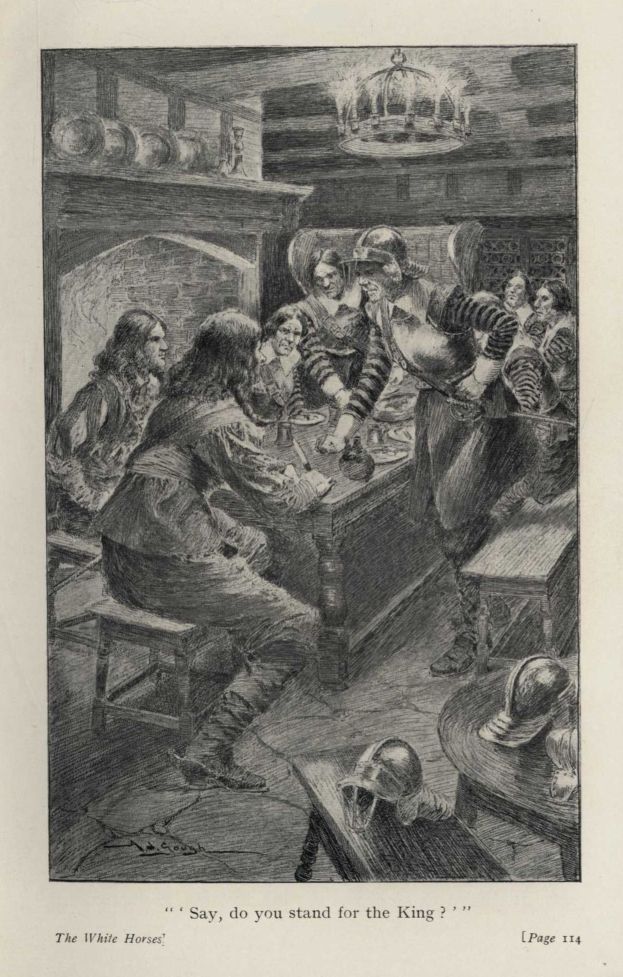
"'Say, do you stand for the King?'"
"Why, yes," said Kit. "Come on, you six crop-headed louts."
This was the end of Kit's solemnity, his over-serious attention to Prince Rupert's needs. And then they were in the thick of it, and the weight of the onset bore them down. When the battle ended—the table overturned, and three of the Roundheads under it—when Kit and Michael could do no more, and found themselves prisoners in the hands of the remaining three, the landlord, sleek and comfortable, bustled in.
"I trust there is no quarrel, gentlemen?" he entreated.
"None, as you see," said Michael airily. "We had a jest, host, about your Christmas pie. They tell me none says Mass in Banbury because the town is altogether heathen."
So then a blow took him unawares, and when Kit and he woke next day, they found themselves in the town's prison.
Michael touched his brother with a playful foot. "You blundered, Kit, about that Christmas pie."
"Yes," said Christopher; "so now it's my affair, Michael, to find a way out of prison."
But Michael only laughed. "I wish we could find a rhyme to Puritane one," he said. "It would help that rogue we met last night."
The grey of early dawn stole through the window of the gaol and brightened to a frosty red as Michael and his brother sat looking at each other with grim pleasantry. Charged with an errand to bring Prince Rupert to the North without delay, they had won as far as this Roundhead-ridden town, a score miles or so from their goal, and a moment's indiscretion had laid them by the heels.
"Life's diverting, lad. I always told you so," said Michael. "It would have been a dull affair, after all, if we had got to Oxford without more ado."
"They need Rupert, yonder in York," growled Kit.
"Ah, not so serious, lest they mistake you for a Puritan."
"It is all so urgent, Michael."
"True. The more need to take it lightly. Life, I tell you, runs that way, and I know something of women by this time. Flout life, Kit, toss it aside and jest at it, and all you want comes tumbling into your hands."
"I brought you into this. I'll find some way out of gaol," said the other, following his own stubborn line of thought.
The window was narrow, and three stout bars were morticed into the walls. Moreover, their hands were doubled-tied behind them. All that occurred to them for the moment was to throw themselves against the door, each in turn, on the forlorn chance that their weight would break it down.
"Well?" asked Michael lazily, after their second useless assault on the door. "High gravity and a long face do not get us out of gaol. We'll just sit on the wet floor, Kit, and whistle for the little imp me call Chance."
Michael tried to whistle, but broke down at sight of Kit's lugubrious, unhumorous face. While he was still laughing, there was a shuffle of footsteps outside, a grating of the rusty door-lock, and, without word of any kind, a third prisoner was thrown against them. Then the door closed again, the key turned in the lock, and they heard the gaoler grumbling to himself as he passed into the street.
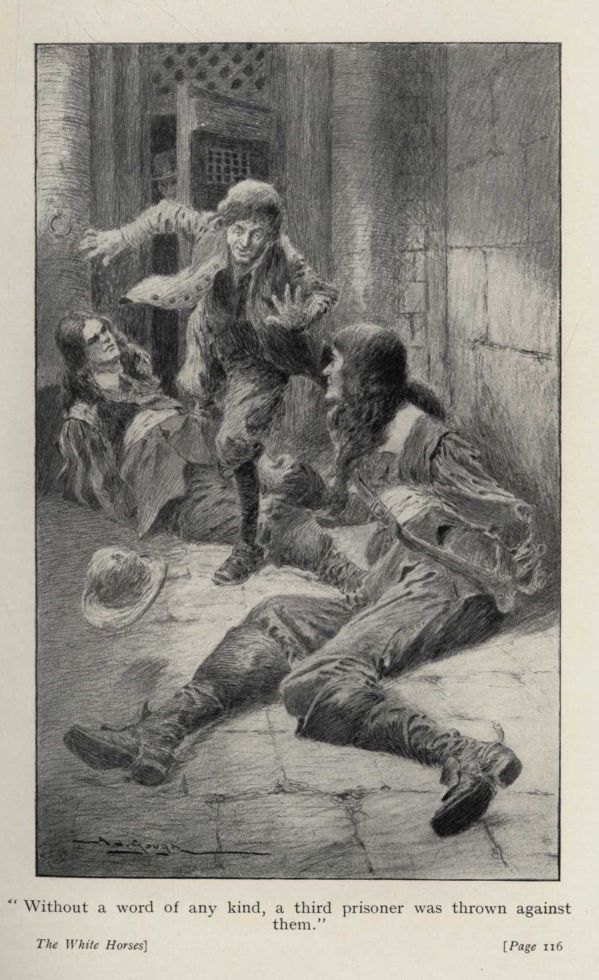
"Without a word of any kind, a third prisoner was thrown against them."
The new-comer picked himself up. He was dripping from head to foot; his face, so far as the green ooze of a horse-pond let them see it, was unlovely; but his eyes were twinkling with a merriment that won Michael's heart.
"Sirs, I warned you that Banbury was no good place for Cavaliers. I am pained to see you here."
Michael remembered the man now—a fellow who had jested pleasantly with them in the tavern just before they were taken by the Roundheads. "We forgot your warning, Mr. Barnaby," he said drily, "so we're here."
"I thank you, sir. Drunken Barnaby is all the address they give me nowadays. Perhaps you would name me Mr. Barnaby again; it brings one's pride out of hiding."
So then they laughed together; and friendship lies along that road. And after that they asked each other what had brought them to the town gaol.
"You spoke of Christmas pie, with Puritans about you?" said Drunken Barnaby. "I could have warned you, gentlemen, and did not. I was always a day behind the fair. They loathe all words that are connected with the Mass."
"We have learned as much," said Michael. "For your part, Mr. Barnaby, how came you here?"
"Oh, a trifle of ale-drinking! My heart was warm, you understand, and I roved down Banbury street with some song of glory coming for King Charles. I'm not warm now, but the cool o' the horse-pond has brought me an astonishing sobriety."
"Then tell us how to be quit of these four walls," snapped Kit, thinking ever of York and the need the city had of Prince Rupert.
"Give me time," said Drunken Barnaby, "and a little sleep. Between the forgetting and the waking, some gift o' luck will run my way."
"Luck!" laughed Michael. "She's a good mare to ride."
Barnaby, with his little body and the traces of the horse-pond about him, had seemed to the gaoler of mean account, not worth the trouble of tying by the wrists. The rogue sat up suddenly, just as he was falling off to sleep.
"It is a mistake, my gentles, to disdain an adversary," he said, with that curious air of his, roystering, pedantic in the choice of phrases, not knowing whether he were ashamed of himself and all men, or filled with charitable laughter at their infirmities. "Our friend with the blue-bottle nose left my hands free, you observe, while yours are bound. Much water has gone into my pockets—believe me, I shall dislike all horse-ponds in the future—but the knife-blade there will not have rusted yet."
With a great show of strategy, still laughing at himself and them, he drew a clasp-knife from his breeches-pocket, opened it, and cut their thongs.
"That's half-way on the road to Oxford," laughed Kit, rubbing the weals about his wrists. "It was kind of you to drink too much ale, Barnaby, and join us here."
Michael glanced at his young brother. "Humour returns to you," he said, with an approving nod. "I told you life was not half as serious as you thought it."
They tried the window-bars, the three of them, but found them sturdy. They battered the doorway again with their shoulders; it did not give. Barnaby drew a piece of wire from his pocket, and used great skill to pick the lock; he might as well have tried to pierce steel armour with a needle.
"There's nothing to be done to-night, gentles," he said, with a noisy yawn; "and, when there's nothing to be done, I've found a safe and gallant rule of conduct—one sleeps. Some day, if I find the Muse propitious, I shall write an ode to sleep. It is the fabled elixir of life. It defies all fevers of the daytime; it is the coverlet that Nature spreads about her tired children. But, gentlemen, I weary you."
"You make me laugh," asserted Michael. "Since I left Yoredale, I've met none who had your grasp of life."
They settled themselves by and by to sleep, as best they could, on a wet floor, with the warmth of the new day rousing queer odours from their prison-house. There was the stealthy tread of rats about their bodies. It was Barnaby, after all, who was false to his gospel of deep slumber. At the end of half an hour he reached over and woke Michael from a thrifty dream of Yoredale and corn yellowing to harvest.
"What is it?" growled Michael.
"I cannot sleep, sir. You recall that, in the tavern yesterday, I confessed myself a poet. The rhymes I have made, sir, are like the sands of the sea for multitude. I was never troubled till I came to Banbury."
"Then journey forward. There are other towns."
"You do not understand me. Towns to be taken by assault, by any rhymes that offer, do not entice me. It is the hardship of attack that tempts your true soldier. You will grant me that?"
"I'll grant you anything, Barnaby, so long as you let me sleep on this wet floor. I dreamed I was lying on a feather-bed."
"But the rhyme? You remember how the poem went: 'Here I found a Puritan one, hanging of his cat on a Monday, for killing of a mouse on a Sunday.' A fine conceit, sir, but I can find no rhyme for Puritan one, as I told you."
Kit, for his part, was awake, too, and some jingle of a poem, in praise of his mistress at Ripley in the north, was heating his brain. But the lad was learning wisdom these days, and held his peace; there was no need to bring other men to Joan Grant by undue singing of her praises.
"Believe me, this verse-making is a fever in the blood," protested Barnaby. "Naught serves until the rhyme is found. It is a madness, like love of a lad for a maid. There is no rhyme to Puritan."
"Friend," said Michael, "I need sleep, if you do not. Remember what I said last night. Puri*tane* one—try it that way. Get your man round to the King's cause, and he becomes a sane one."
"But, sir——"
Michael smiled happily. "We have a saying in Yoredale: 'I canna help your troubles, friend; I've enough of my own.' Take it or leave it at Puri*tane* one. For myself, I'm going to sleep."
Barnaby sat wrestling with the Muse. His mind, like all men's, was full of hidden byways, and the most secret of them all was this lane that led into the garden of what, to him, was poetry. A tramp on life's highway, a drinker at taverns and what not, it was his foible that he would be remembered by his jingling verses—as, indeed, he was, centuries after the mould had settled over his unknown grave.
It might be five minutes later, or ten, that Kit stirred in sleep, then sat bolt upright. He heard steps on the cobbled street outside, the turning of a rusty key in the lock. Then the door opened, and he saw the squat figure of the gaoler, framed by a glimpse of Banbury street, grey and crimson in the clean light of the new day. Without haste he got to his feet, stretched himself to the top of his great height, then went and picked the gaoler up and swung him to and fro lightly, as if he were a child.
"Michael," he said, "what shall we do with this fellow? Michael, wake, I tell you!"
When Michael came out of his sleep, and Drunken Barnaby out of his rhyming, they sat in judgment on the gaoler. They tried him for high treason to King Charles. They sentenced him to detention in His Majesty's gaol sine die, and went into the street, locking the door behind them.
"You shall have the key, Mr. Barnaby," said Michael. "Release him when and how you like. For ourselves, we ride to Oxford."
"Nay, you walk," said Barnaby, with great solemnity. "Oh, I know your breed! You're all for going to the tavern for your horses. It will not do, gentles. The town is thick with Roundheads."
"How can we walk twenty miles, with our errand a day or two old already?" said Kit.
"Beggars must foot it, when need asks. Do you want to sing 'Christmas Pie' again all down Banbury street, and have your errand spoiled? Listen, sirs. This town does not suit my health just now; it does not suit yours. Permit me to guide you out of it along a byway that I know."
Kit was impatient for the risk, so long as they found horses; but Michael saw the wisdom underlying Barnaby's counsel. The three of them set out, along a cart-track first, that led between labourers' cottages on one hand and a trim farmstead on the other, then into the open fields. A league further on they struck into the Oxford highway, an empty riband of road, with little eddies of dust blown about by the fingers of the quiet breeze.
"Here we part, gentles," said Barnaby, with his air of humorous pedantry. "Oxford is for kings and prelates. I know my station, and my thirst for a brew of ale they have four miles over yonder hill."
They could not persuade him that, drunk or sober, he had rescued them from Banbury, that they would be glad of his further company. He turned once, after bidding them farewell, and glanced at Kit with his merry hazel eyes. "I've got that song of Banbury," he said. "It all came to me when I saw you dandling the gaoler with the blue-bottle nose. Strife and battle always helped the poets of a country, sir, since Homer's time."
"There goes a rogue," laughed Michael, listening to the man's song of Banbury as he went chanting it up the rise. "Well, I've known worse folk, and he untied our hands."
CHAPTER IX.
THE LOYAL CITY.
They jogged forward on the road, and the day grew hot with thunder. The slowness of a walking pace, after months in the saddle, the heat to which they were unused as yet, after the more chilly north, seemed to make a league of every mile. Then the storm burst, and out of nowhere a fierce wind leaped at them, driving the rain in sheets before it. The lightning played so near at times that they seemed to be walking through arrows of barbed fire.
"A pleasant way of reaching Oxford, after all one's dreams!" grumbled Kit.
"Oh, it will lift. I'm always gayest in a storm, my lad. The end on't is so near."
The din and rain passed overhead. A league further on they stepped into clear sunlight and the song of soaring larks. Here, too, their walking ended, for a carrier overtook them. He had a light load and a strong, fast horse in the shafts; and, if their way of entry into the city of his dreams jarred on Kit's sense of fitness, he was glad to have the journey shortened.
The carrier pulled up at the gateway of St. John's, and the wonder of their day began. Oxford, to men acquainted with her charm by daily intercourse, is constantly the City Beautiful; to these men of Yoredale, reared in country spaces, roughened by campaigning on the King's behalf, it was like a town built high as heaven in the midst of fairyland. As they passed along the street, the confusion of so many streams of life, meeting and eddying back and mixing in one great swirling river, dizzied them for a while. Then their eyes grew clearer, and they saw it all with the freshness of a child's vision. There were students, absurdly youthful and ridiculously light-hearted, so Kit thought in his mood of high seriousness. There were clergy, and market-women with their vegetables, hawkers, quack doctors, fortune-tellers, gentry and their ladies, prosperous, well-fed, and nicely clothed. A bishop and a dean rubbed shoulders with them as they passed. And, above the seemly hubbub of it all, the mellow sun shone high in an over-world of blue sky streaked with amethyst and pearl.
"Was the dream worth while?" asked Michael, with his easy laugh.
"A hundred times worth while. 'Twould have been no penance to walk every mile from Yoredale hither-to, for such an ending to the journey."
They went into the High Street, and here anew the magic of the town met them face to face. Oxford, from of old, had been the cathedral city, the University, the pleasant harbourage of well-found gentry, who made their homes within sound of its many bells. Now it was harbouring the Court as well.
Along the street—so long as they lived, Christopher and Michael would remember the vision, as of knighthood palpable and in full flower—a stream of Cavaliers came riding. At their head, guarded jealously on either side, was a horseman so sad and resolute of face, so marked by a grace and dignity that seemed to halo him, that Kit turned to a butcher who stood nearest to him in the crowd.
"Why do they cheer so lustily? Who goes there?" he asked.
"The King, sir. Who else?"
So then a great tumult came to Christopher. When he was a baby in the old homestead, the Squire had woven loyalty into the bones and tissues of him. Through the years it had grown with him, this honouring of the King as a man who took his sceptre direct from the hands of the good God. Let none pry into the soul of any man so reared who sees his King for the first time in the flesh.