Front matter (continued 4)
Reading edition
"Oh, he was great that day," said Rawstorn. "'If I were Judas, I should fear thirteen,' said he. 'As the affair stands, I'm stalwart for the King.' He was killed in an attack on the east fort; and when we sortied and brought his body in, there was a smile about his lips."
Little by little Christopher pieced together the fragments of that long siege. Lady Derby's single-mindedness, her courage and sheer charm, were apparent from every word spoken by these gentlemen who drank their liquor. The hazards of the men, too—the persistent sorties, the give-and-take and pathos and laughter of their life within doors—were plain for Kit to understand. At Oxford and elsewhere there had been spite and rancour, jealousy of one King's soldier against another. Here at Lathom there was none of that; day by day of every month of siege, they had found a closer amity, and their strength had been adamant against an overpowering force outside their gates.
Kit learned much, too, of Colonel Rigby, who commanded the attack. A hedge-lawyer by training—one who had defended night-birds and skulkers of all kinds—he had found himself lifted to command of three thousand men because Sir Thomas Fairfax, a man of sound heart and chivalry, grew tired of making war upon a lady. Rigby enjoyed the game. He cared never a stiver for the Parliament, but it was rapture to him to claim some sort of intimacy with the titled great by throwing cannon-balls and insults against my Lady Derby's walls.
"As for Rigby," said the man with the big jowl, "I wish him only one thing—to know, to the marrow of him, what place he has in the thoughts of honest folk. Mate a weasel with a rat, and you'll get his breed."
Captain Chisenhall, who had been pacing restlessly up and down the hall, halted in front of Kit. "It was a fine device of yours, to entrench on this side of their own earthworks. I never had much head myself, or might have thought of it. But, man, you're spent with this night's work."
"Spent?" laughed Kit. A sudden dizziness took him unawares, and their faces danced in a grey mist before his eyes. "I was never more wide-awake. D'ye want another sortie, gentlemen? Command me."
With that his head lolled back against the inglenook. He roused himself once to murmur "A Mecca for the King!" then slept as he had done on far-off nights after harvesting of hay or corn in Yoredale.
"There's a game-pup from over the Yorkshire border among us," laughed Chisenhall. "Let him sleep. Let me get up to bed, too, and sleep. Of all the toasts I ever drank—save that of the King's Majesty—I like this last bumper best. Here's to the kind maid, slumber, and good night to you, my friends."
The next morning, soon after dawn, Kit stirred in sleep. Through the narrow mullions great, crimson shafts of light were stealing. A thrush outside was recalling bygone litanies of mating-time. Sparrows were busy in the ivy. It was so like Yoredale and old days that he roused himself, got to his feet, and remembered what had chanced last night. He had slept hard and truly, and had profited thereby. His bones were aching, and there was a nagging cut across his face; for the rest, he was ready for the day's adventure.
Last night, when he returned from battle, the moonlight had shown him only a littered courtyard, full of men and captured cannonry. He could not guess where the most valiant of cock-throstles found anchor for his feet; and, to settle the question, he went out. The song greeted him with fine rapture as he set foot across the doorway; and in the middle of the yard he saw the trunk of a big, upstanding walnut-tree. Three-quarters of the branches had been shot away, but one big limb remained. At the top of the highest branch a slim, full-throated gentleman was singing to his mate.
"Good Royalist!" said Kit. "Go singing while your branch is left you."
His mood was so tense and alert, his sympathy with the throstle so eager, that he started when a laugh sounded at his elbow. "I knew last night a soldier came to Lathom. He is a poet, too, it seems."
The wild, red dawn—sign of the rainiest summer known in England for fifty years—showed him Lady Derby. The lines were gone from her face, her eyes were soft and trustful, as a maid's eyes are; it did not seem possible that she had withstood a year of siege.
"I was just thanking God," she explained, "that picked men come my way so often. There are so many Rigbys in this world, and minorities need all their strength."
She was so soft of voice, so full of the fragrance which a woman here and there gives out to hearten roughened men, that Kit began to walk in fairyland. So had Captain Chisenhall walked long since, Rawstorn and the other officers, the private soldiery, because the Lady of Lathom was strong, courageous, and secure.
"How have you kept heart so long?" asked Kit, his boy's heedless pity roused afresh.
"And you, sir—how have you kept heart so long?" she laughed.
"Oh, I was astride a horse, plying a sword or what not. It was all easy-going; but for you here——"
"For me there was the bigger venture. You have only one right hand for the spear. I have control of scores. My dear soldiery are pleased to love me—I know not why—and power is sweet. You will believe, sir, that all this is pastime to me."
Yet her voice broke. Tired folk know tired folk when they are climbing the same hill of sadness; and Kit touched her on the arm. "Rough pastime, I should call it," he said, "and you a woman."
She gathered her courage again. Laughter played about her charitable, wide mouth.
"You're in love, Mr. Metcalf—finely in love, I think, with some chit of a girl who may or may not deserve it. There was a reverence in your voice when you spoke of women."
Kit's face was red with confession of his guilt. "There's none else for me," he said.
"Ah, then, I'm disappointed. This zeal last night—it was not for the King, after all. It was because some woman tempted you to do great deeds for her own pretty sake.'
"We've been King's men at Nappa since time began," said Kit stubbornly. "My father has sounded a trumpet from Yoredale down to Oxford. All England knows us stalwart for the King."
Lady Derby allowed herself a moment's happiness. Here was a man who had no shams, no glance forward or behind to see where his loyalty would take him. There was nothing mercantile about him, and, in these muddled times, that was so much to be thankful for.
"Believe me," she said very gently, "I know your breed. Believe me, too, when I say that I am older than you—some of the keen, blue dawn-lights lost to me, but other beauties staying on—and I ask you, when you meet your wide-eyed maid again, to put it to the question."
"I've done that already."
Again laughter crept round Lady Derby's mouth. "I meant a deeper question, sir. Ask her whether she had rather wed you and live at ease, or see you die because the King commands."
"She would choose death for me—I should not love her else."
"One does not know. There are men and women who have that view of life. They are few. Put it to the question. Now I must go indoors, sir, to see that breakfast is readying for these good men of mine. Pluck is a fine gift, but it needs ample rations."
Kit watched her go. He was amazed by her many-sidedness. One moment tranquil, fresh from her dawn-prayers; the next a woman of the world, giving him motherly advice; and then the busy housewife, attentive to the needs of hungry men. Like Strafford, whose head was in the losing, she was in all things thorough.
He went up to the ramparts by and by. The sentry, recognising him as one who had shared the sortie over-night, saluted with a pleasant grin. Kit, as he looked down on the trenches, the many tokens of a siege that was no child's play, thought again of Lady Derby, her incredible, suave courage. Then he fell to thinking of Joan, yonder in the North. She, too, was firm for the cause; it was absurd to suggest doubt of that. Whether she cared for him or no, she would be glad to see him die in the King's service.
He was in the middle of a high dream—all made up of gallop, and a death wound, and Joan weeping pleasant tears above his prostrate body—when there came a sharp, smoky uproar from the trenches, and a bullet plucked his hat away.
"Comes of rearing your head against the sky," said the sentry impassively; "but then they're no marksmen, these whelps of Rigby's."
Another bullet went wide of Kit, a third whistled past his left cheek; so that he yielded to common sense at last, and stooped under shelter of the parapet. The besiegers then brought other artillery to bear. A harsh, resonant voice came down-wind to them:
"Hear the news, you dandies of Lady Derby's! Sir Thomas Fairfax has routed your men at Selby. Cromwell is busy in the east. Three of our armies have surrounded your Duke of Newcastle in York. Is that enough for my lady to breakfast on, or would you have further news?"
The sentry—old, taciturn, and accustomed through long months to this warfare of the tongue—bided his time. He knew the habits of these spokesmen of Rigby's. When no answer came from the ramparts, further taunts and foul abuse swept upward from below. Still there was no reply, till the man, in a fierce rage of his own making, got up and showed head and shoulders above the trench. The sentry fired, without haste.
"One less," he growled. "It's queer to see a man go round and round like a spinning top before he tumbles out of sight."
"Was his news true?" asked Kit, dismayed by the tidings.
"Ah, that's to prove. Liars speak truth now and then. Stands to reason they must break into truth, just time and time, by chance."
Kit left the rampart presently, and found a hungry company of men at breakfast.
"Why so grave, Mr. Metcalf?" laughed Lady Derby, who was serving porridge from a great bowl of earthenware. "You are hungry, doubtless. There's nothing else brings such gravity as yours to a man's face."
"I was thinking of last night's sortie," said Kit.
"So that hunger, too, grows on you as on my other gentlemen? But, indeed, we propose to rest to-day. Even we have had enough, I think."
He told them the news shouted from the trenches. Rough-riding, zeal, and youth had given him a persuasiveness of his own. "The news may be true or false," he said, looking down at them from his full height; "but, either way, it will put heart into the enemy. By your leave, we must harass them."
He had his way, and, knowing it, sat down to a breakfast that astonished all onlookers.
"I find many kinds of admiration for you, sir," drawled Captain Chisenhall, "but especially, I think, for your gift of feeding that fine bulk of yours."
"I'm just like my own homeland in Yoredale," assented Kit; "it needs feeding if strong crops are to follow."
That night they made three sorties on the trenches, five on the next, and for a week they kept the pace. A few of the garrison were killed, more were wounded, but speed and fury made up for loss of numbers, and Colonel Rigby sent a messenger galloping to Manchester for help in need. The besiegers, he explained, were so harassed that they were dropping in the trenches, not from gun-fire, but from lack of sleep.
The sentries on the walls had no chance nowadays to pick off orators who rose from cover of the trenches to shout ill tidings at them. From their vantage-ground on the ramparts they could hear, instead, the oaths and uproar of a disaffected soldiery who voiced their grievances.
On the seventh morning, an hour before noon, a man came into Lathom, wet from the moat, as Kit had been on his arrival here. He told them that Prince Rupert, the Earl of Derby with him, had crossed the Cheshire border, marching to the relief of Lathom.
"So," said Captain Chisenhall, "we'll give them one last sortie before the frolic ends."
Lady Derby smiled pleasantly. "That is your work, gentlemen. Mine is to get to my knees, to thank God that my husband is so near to me."
When they sortied that night, they found empty trenches. The moonlight showed them only the disorder—a disorder unsavoury to the nostrils—that attended a forsaken camp. One man they found with a broken leg, who had been left in the rear of a sharp retreat. He had been bullied by Rigby, it appeared, and the rancour bit deeper than the trouble of his broken limb. He told them that Rigby, and what were left of his three thousand, had pushed down to Bolton, and he expressed a hope—not pious—that all the Cavaliers in England would light a bonfire round him there.
When they gathered for the return to Lathom, the futility about them of hunters who have found no red fox to chase, Kit saluted Captain Chisenhall. "My regards to Lady Derby," he explained; "tell her I'm no longer needed here at Lathom. Tell her that kin calls to kin, and where Rupert is, the Metcalfs are. I go to warn them that Rigby lies in Bolton."
"Good," said Chisenhall. "Rigby has lied in most parts of the country. Go hunt the weasel, you young hot-head."
When they returned, Lady Derby asked where Kit Metcalf was, and they told her. "Gentlemen," she said, with that odd, infectious laugh of hers, "I have no favourites, but, if I had, it is Kit Metcalf I would choose to bring Prince Rupert here. There's the light of youth about him."
"There is," said Chisenhall. "I lost it years ago, and nothing else in life makes up for it—except a sortie."
CHAPTER XIV.
A STANLEY FOR THE KING.
Christopher Metcalf had learned the way of hazard, the need to say little and hear all. As he rode from Lathom House through the summer's dawn, the land was full of blandishment. Last night's heavy rain had brought keen scents to birth—of primrose and leafage in the lanes, of wallflowers in the homestead gardens that he passed. Scents tempt a man to retrospect, and he wondered how it was faring with Joan—remembered the nearness of her and the fragrance, as they roamed the Yoredale hills together in other springs.
He put blandishment aside. There was no before or after for him—simply the plain road ahead. Wherever he found a countryman to greet, he drew rein and passed the time of day, and got into talk with him. Before he had covered six miles, he learned that Rigby, with the three thousand men withdrawn from the siege of Lathom, had in fact retreated behind the walls of Bolton, and that the town was strongly fortified. A mile further on his horse cast a shoe, and, while he waited at the door of a wayside smithy, he joined a company of gossips seated on the bench outside.
"Thanks be, the Lady o' Lathom is safe," said a grey old shepherd.
"A rare game-bird, she," assented the jolly yeoman on his left.
"Ay. She's plucked a few fine feathers from Rigby. Rigby? I mind the time when he was skulking in and out—trying to find wastrel men who'd pay him to prove black was white in court. And now he calls himself a Captain."
"Well, he's as he was made, and of small account at that," said the yeoman. "The man I blame is Colonel Shuttleworth. One o' the gentry, he, and likeable. There's no good comes, say I, when the gentry forget their duty to their King. They go to kirk each Sabbath, and pray for the King's health—well, they mean it, or they don't mean it, and there's no middle way."
Kit felt at home. These men were of the country stock he knew by heart. "Friends," he said, "I'm a stranger here in Lancashire. Who is Colonel Shuttleworth?"
"Oh, just a backslider!" The yeoman's face was cheery by long habit, even when he condemned a man. "He's sent fifteen hundred men to help Rigby garrison the town of Bolton. The likes of him to help the likes of Rigby—it makes us fancy the times are upside down."
Kit Metcalf, when his horse was shod, rode forward swiftly. A league this side of Bolton, where the track climbed steep between banks of ling and bilberry, he saw a man striding a white horse. Man and horse were so big that they blotted out a good part of the sky-line; so he knew that there was a kinsman waiting for him.
"Yoi-hoi!" yelled Kit. "A Mecca for the King."
The horseman shielded his eyes against the sun as he watched the up-coming rider. Then a laugh that Kit remembered floated down-wind to him.
"Why, Michael, what are you doing here?" he asked, as he drew near.
"To be frank, I was yawning just before you came. I've been waiting since daybreak for some messenger from Lathom. And at the end of it you come, white brother of the Metcalf flock—you, who have the luck at every turn."
"I had luck this time—fifteen sorties since I saw you last. Michael, you should have been there with us. We brought their mortar in——"
"Good," drawled Michael. "You had the luck. For my part, I've been sitting on a horse as thirsty as myself for more hours than I remember. Let's get down to camp and a brew of ale there."
"And afterwards we sortied—sortied till we drove them into hiding, like rabbits. The Lady of Lathom welcomed us home each night, her eyes on fire."
"No doubt, brother. The tale will warm me by and by. Meanwhile I don't care a stiver what fire shone in my lady's eyes—blue, or grey, or black. Give me honest ale, of the true nut-brown colour."
"You're a wastrel, Michael," laughed the younger brother, glad to pass badinage again with one of his own folk.
"I am, my lad, and know it. There's luck in being a wastrel—folk expect nothing from a man. He goes free, while such as you—babe Kit, if you guessed how prisoned up you are! They look for sorties, gallops against odds, moonshine of all sorts every day you live. You've a nickname already in Oxford. They name you the White Knight."
"Oh, be done with banter," snapped Christopher. "There's little knighthood about me. Let's get down to camp and see the colour of that ale of yours."
When they came to the heathery, rising land wide of Bolton, and the sentry had passed them forward, Kit found himself face to face with Prince Rupert once again.
"The White Knight brings news," Michael explained in his off-handed way.
"Pleasant news?" the Prince asked. "Is Rigby dead, or the siege raised?"
"By your leave," said Kit, "the siege is raised. Rigby has gone to Bolton-le-Moors, to hide there. He has what are left of his three thousand men, and fifteen hundred others. The town is strong."
"Good, sir!" Fire—deep, glowing fire—showed in Rupert's eyes. "Lady Derby is a kinswoman of mine; and if Rigby is in Bolton, I know where to find the fox she loathes."
A big, tired figure of a man pushed his way through the soldiery. "I heard someone speak of Lady Derby?" he said.
Prince Rupert touched him on the shoulder. "I did, friend," he said, with a quiet laugh. "There's none so touchy as a husband who chances to be his wife's lover, too. My Lord Derby, this is Mr. Metcalf, known otherwise as the White Knight. He brings news that Rigby the fox has slunk into Bolton. Best put our hounds in and drive him out of cover."
"Give me the assault," said Lord Derby drily.
"I cannot. Your name glamours Lancashire. I will not have you risk all in driving a red fox into the open."
Derby yielded to the discipline engrained in him, but with a bad grace. The Prince, himself eager for the assault, but ashamed to take a leadership which on grounds of prudence he had refused the other, asked for volunteers. When these were gathered, the whole force marched on Bolton and halted within five hundred yards of the stout walls. Then the assaulting party came forward at the double.
"Not you, Mr. Metcalf," said Rupert, detaining Christopher as he ran forward to join in any lively venture. "We cannot spare you."
What followed was a nightmare to the lookers-on. They saw the volunteers reach the wall and clamber up—saw a fierce hand-to-hand struggle on the wall-top, and the assault repulsed. And then they saw the victors on the rampart kill the wounded in cold blood.
Some pity, bred of bygone Stuart generations, stirred Rupert. Wrath and tears were so mingled that his voice was harsh. "I give you freedom, Derby, to lead the next attack."
Without pause or word of thanks, Lord Derby got his own company together.
"We fight for my wife, who holds Lathom well," he said to his men.
Then they ran to the attack. Kit, looking on, was astonished to see that Prince Rupert, who had talked of prudence where lives of great men were concerned, was running with the privates of Lord Derby's company. So he, too, ran.
The fight on the wall was bitter, but the King's men prevailed. Over the bodies of their friends, massacred against all rules of war, they leaped into the town. The first man Lord Derby met was a groom, lately in his service at Lathom, who had gone over to the enemy. The man struck a blow at him with the clubbed end of a musket, and Derby parried it, and gave the rogue a better death than he deserved—at the sword's point.
They pressed forward. Once they were hemmed in—six of them—after a fierce rally of the garrison had swept the Royalists aside. One of the six was Prince Rupert; and Kit Metcalf felt the old Yoredale loyalty stir in his veins—a wildness and a strength. He raised a deep-bellied cry of "A Mecca for the King!" cut down the thick-set private who was aiming a blow sideways at Rupert's head, and then went mad with the lust of slaying. Never afterwards could he recall that wonderful, swift lunacy. Memory took up the tale again at the moment when their comrades rallied to their help and thrust back the garrison.
Three of the six were left—the Prince, and Kit, and a debonair, grey-eyed gentleman whose love-locks were ruddied by a scalp-wound. The three went forward with the rest; and, after all was done, they met again in the market-square.
"You, my White Knight?" said the Prince, touching Kit on the arm. "Are you touched? No more than the gash across your cheek? I'm glad of that. Captain Roger Nowell here tells me that I should be lying toes up to the sky if your pike had not been handled nicely. For my part, I saw nothing but Roundhead faces leering at me through a crimson mist."
The instinctive, boyish romance came back to Christopher. He had always been a hero-worshipper, and turned now to the grey-eyed gentleman, who was bandaging his head with a strip torn from his frilled shirt. "You are of the Nowells of Reed Hall?" he asked.
"I am, sir—a queer, hot-headed lot, but I'm one of them."
"My nurse reared me on tales of what your folk did in days gone by. And at Lathom they told me of your sorties. Sir, they thought you dead in your last effort to break through the lines, to bring relief in. They will be glad."
The Prince and Nowell glanced at each other with a quick smile of sympathy. Here, in the reek and havoc of the street, was a simple-minded gentleman, fresh as dawn on the hills that bred him—a man proved many times by battle, yet with a starry reverence for ancient deeds and ancient faith.
"May your nurse rest well where she lies," said Roger Nowell, the laughter in his grey eyes still. "In spite of a headache that throbs like a blacksmith's anvil, I salute her. She reared a man-child. As for those at Lathom, I share their gladness, I admit. A bandaged head is better than none at all."
Then all was bustle and uproar once again. Men came bringing captured colours to the Prince; and in the middle of it Lord Derby found them.
"Welcome, Derby," said the Prince, "though, for the first time since I knew you, you wear the favours of both parties."
"Be pleased to jest," laughed the other. "For my part, I know my wife will soon be seeing me at Lathom."
"But, indeed, you wear both favours—rebel blood on your clothes, and a warmer crimson running from your thigh."
Derby stooped to readjust the bandage. Sickness of body was nothing. Long battle for the King who did not trust him was forgotten, as a service rendered freely, not asking for return. "It is permitted, these bleak days, that a man ask grace to love his wife and hurry to her side?"
"Get home to Lathom, but not just yet. I have a gift for that brave wife of yours."
Through the uproar came other zealots, bringing captured colours in, until seven-and-twenty were gathered in the market-square.
"These speak for the strength of the attack on Lathom," said Rupert, his voice lifted for all men to hear. "Take them to Lady Derby as a token of my high regard. Tell her that it is easy for men to charge at speed and win their battles, but hard for women to sit behind crumbling walls and hold the siege. If I were my Lord Derby, I should be proud of such a wife."
"Your Highness would," assented Derby with sharp, humorous simplicity. "I have husbanded her, and know her mettle."
Again the ebb and flow of the battle scarcely ended swept across their talk. A hot-headed band of Cavaliers was bringing fifteen prisoners through at the double.
The captain of the Royalist band, drunk with the wine of victory, laughed stridently. "To the ramparts with them. Give them short shrift on the walls! Measure for measure, say I, and curse these psalm-singing butchers."
Through the laughter of the troop came Rupert's voice, harsh and resonant. "Who are these, Captain Sturgis?"
Sturgis saluted. He had heard that voice more than once in the thickest of the onset, while Rupert was winning his spurs as a leader of light cavalry. The wine of victory left him. "A few crop-headed folk, your Highness," he said lamely. "We proposed to make them a warning to other butchers of Cromwell's following."
"Captain Sturgis, I am sorry. We have shared many fights, and yesterday you were a gentleman of the King's."
There was silence in the market-place; and presently Sturgis saluted Rupert with extreme precision. "To-morrow, by your leave, I shall report myself. I shall spend a sleepless night."
Rupert laughed pleasantly. "There's no need to waste a night's sleep, Sturgis. It was a madness, and it has left you, that is all."
Then all again was uproar as men pressed up and down the street, some with prisoners, others hurrying to slake their thirst at a convenient tavern.
"Where's Rigby?" asked Lord Derby suddenly "I have a long account to settle with him."
A jolly yeoman caught the question as he went by. "Gone away, like the fox on a hunting morn. I had a thrust at him myself just now, but missed him; and he leaped the ramparts where we broke it at the coming-in."
"So!" growled Derby. "The fox will give us sport another day."
"My lord," said the Prince, his voice grave and full of courtesy, "I give you twenty-seven standards, captured from Rigby's forces. I give you a hundred of my men as a guard of honour. Eat and drink, and then get forward to Lathom, where your wife awaits you. Let the red fox skulk until a more convenient date."
"And you?"
"I stay on here for a while. It seems to be my business these days to batter walls down, and to stay on afterwards to build them up again. This town is worth defending for the King. Tell Lady Derby that my march to the relief of York will go by way of Lathom, if I may claim her hospitality."
Kit Metcalf found himself among the hundred chosen to accompany Lord Derby; and he was glad, for in Oxford—with its deep, unconquerable love of attaching mystic glamour to a person or a cause—the Lady of Lathom had grown to be a toast drunk silently, as if she were above and beyond the noise of praise.
That evening, as the sundown reddened over Lathom House—the sultry, rain-packed heat aglow on broken battlements—they came through the camp deserted lately by Colonel Rigby. A sentry challenged them; and Lord Derby laughed as any boy might do.
"A Stanley for the King! Have I been away so long, Thornthwaite, that you do not know your lord?"
The master, as usual, had the keener vision. In the clear light he had recognised the sentry as one old in service to his household. They passed through; and in the courtyard Lady Derby was standing near the captured mortar, talking of ways and means with one of her captains.
To Kit, looking on, it was like fairyland come true. Lady Derby heard her husband's step, glanced up, and ran to meet him.
"My lord—my dear, dear lord, have you come back?"
"Ay, like a bridegroom, wife."
They forgot the onlookers, forgot turmoil and great hardship. There comes seldom to any man and wife so fine a forgetting. It was well, Kit thought, to carry three wounds to his knowledge—and some lesser ones that did not count—to have seen these two with the red halo of the sundown round them.
"The Prince sends me with the twenty-seven standards, wife, that beleaguered you."
"Oh, my thanks; but, my lord, he sends me you. What care have I for standards?"
CHAPTER XV.
TWO JOLLY PURITANS.
Three days later Rupert came in, after seeing to the needs of Bolton. He came for rest, before pushing on to York, he asserted; but his way of recreation, here as elsewhere, was to set about the reconstruction of battered walls. Christopher Metcalf, raw not long ago from Yoredale, wondered, as he supped with them that night, why he was privileged to sit at meat with these gentles who had gone through fire and sword, whose attire was muddied and bloodstained, for the most part, but who kept the fire of loyalty like a grace that went before and after the meat they ate hungrily. He was puzzled that Lord Derby toasted him, with the smile his own father might have given him—was bewildered when the men rose to the toast with a joyous roar.
"The young Mecca for the King—the White Knight for the King!"
All he had dreamed in Yoredale was in the doing here. Kit was unsteadied by it, as if wine were mounting to his head.
"My thanks, gentlemen," he said. "Be pleased to nickname me. For my part, I feel like the ass Michael rode to York—patient and long-suffering, but no knight at all."
"How did Michael ride to York?" asked Derby, with a gust of laughter.
So then Kit told the tale, losing his diffidence and pointing the narrative with dry, upland humour.
"Good, Mr. Metcalf," said Lady Derby. "I have not laughed since my lord rode out, until to-day. Where is this Michael who rode to York?"
"With the rest of the good Metcalfs," said Rupert. "I left the whole fine brood to guard Lathom from without. They go north with me in two days' time. You shall see them—six-score on their white horses." A shadow crossed his face; the so-called failing of the Stuart temperament was his, and he counted each man lost as a brother to be mourned for.
"Why the cloud on your face, Prince?" asked Lady Derby.
"There are only five-score now. When we counted our dead at Bolton, there were some gallant Metcalfs lying face upward to their God."
A sickness came to Christopher. He turned aside, and longed for the mother who had sheltered his young days. Bloodshed and wounds he had foreseen; but to his boy's view of life, it seemed incredible that any of the jolly Yoredale clan should die—should go out for ever, beyond reach of hand-grip.
"Was my father with the slain—or Michael?" he asked by and by.
"Neither, lad." Rupert came and touched him on the arm. "Oh, I know, I know! The pity of one's dead—and yet their glory—it is all a muddle, this affair of war."
It was on the second morning afterwards, while Rupert was getting his army in readiness for the march on York, that Lady Derby saw Christopher standing apart, the new sadness in his face.
"You are thinking of your dead?" she said, in her brisk, imperative way. "Laddie, do you not guess that the dead are thinking, too, of you?"
"They rest where they lie," he said, stubborn in his grief.
"Oh, go to kirk more often, and learn that they know more than we do. These twenty Yoredale men, they are not dead—they watch you from the Heights."
"My lady," said Christopher, with a smile made up of weariness, "I am a plain man of my hands, like all my folk. I have no gift for dreams."
"Nor I," she agreed. "When wounds conquer all your pride of strength—when you are laid by, and weak as a little child—ask yourself if I spoke dreams or living truth."
He glanced once at her. There was an odd look about her, a light in her eyes that he could not understand.
He forgot it all when he joined his folk to ride behind Rupert for the relief of York. The high adventure was in front, like a good fox, and his thoughts were all of hazard and keen blows. They crossed the Lancashire border; and, when Kit learned that the route lay through Skipton-in-Craven, his heart warmed to the skirmish that his fancy painted. He was looking backward to that crashing fight—the first of his life—when the White Horsemen drove through the Roundhead gun-convoy and swirled down to battle in the High Street. He was looking forward, as a boy does, to a resurrection of that fight, under the like conditions.
Instead, he found the business of market-day in full swing. The Castle was silent. Lambert's guns, away on Cock Hill, were dumb. Farmers were selling ewes and cattle, were standing at inn doors, wind and wine of the country in their honest faces.
"What is all this?" asked Rupert of a jolly countryman.
"Skipton Fair—naught more or less. There's a two days' truce, or some such moonshine, while either side go burying their dead. For my part, I've sold three heifers, and sold 'em well. I'm content."
Rupert had had in mind to go into the Castle, and snatch a meal and an hour of leisure there while he talked with the Governor. He could not do it now. Punctilio—the word spelt honesty to him—forbade it. He glanced about and saw Kit close beside him.
"Knock at the gate, Mr. Metcalf, and bid Sir John Mallory come out and talk with me."
The drawbridge was down in accordance with the truce, and Kit clattered over it on his white horse. He knocked at the gate, and sent Prince Rupert's message forward. In a little while Mallory came out, a pleasant gentleman, built for hard riding and all field sports, whom Providence had entrusted with this do-nothing, lazy business of sitting behind walls besieged.
"The Prince commands you, Sir John," said Kit, with great precision.
Formality was ended on the instant; for Mallory clapped him on the shoulder and laughed like a boy let loose for play. "By the Lord Harry, I'm glad to get out of doors—and for Rupert, of all men."
In the great sweep of roadway that mounted to the Castle gate—the grey, comely church beside it—Prince Rupert met Mallory with hand outstretched.
"Well done, friend! If it had not been a day of truce, I had hoped to come indoors and crack a bottle with you. As matters stand, we hope to slake our thirst at a more convenient time."
"There's no hindrance, your Highness. Lambert, who besieges us, is doubtless entertaining friends at the Quaker meeting-house in this good town. Why should you not accept the warmer sort of hospitality we Cavaliers affect?"
"Oh, a whim. I can tell you in the open here—No Man's Ground—what I came to tell you. It would not be fair to hide my news behind closed gates."
Mallory glanced sharply at him. Rupert's fury in attack, his relentless gallop through one battle after another—-the man's whole record—had not prepared him for this waywardness of scruple. The next moment Rupert's face was keen and hard.
"We ride for York, Sir John," he said, "and I give you the same errand I shall give Knaresborough's garrison later on. Keep Lambert busy. Sortie till these Roundheads have no rest, day or night. Turn siege into attack. The Lady of Lathom has taught us what a slender garrison may do."
"Does she hold out still?" asked the other eagerly. "We have so little news these days."
"She has captured twenty-seven standards, friend, and is rebuilding her walls in preparation for the next siege."
"God be thanked!" said Sir John, lifting his hat. "There are so few great ladies in our midst."
"And so few great gentlemen, Mallory. Nay, friend, do not redden because I praise you to your face. We know Skipton's story."
Lambert was not at the Quakers' meeting-house, as it chanced. He was on Cock Hill, passing the time of inaction away by looking down on the Castle that had flouted him so often. His thrifty mind was busy with new methods of attack, when he saw Rupert with his advance-guard come up the High Street. The light—a strong sun beating down through heavy rain-clouds—-showed a clear picture of the horsemen. By the carriage of their heads, by the way they sat their horses, Lambert knew them for Cavaliers. As he was puzzling out the matter—loth to doubt Sir John Mallory's good faith—a man of the town came running up.
"The truce is broken, Captain Lambert. Here's a rogue with love-locks—they say he's Prince Rupert—come with a press of horsemen. He's talking with Sir John Mallory fair in front of the Castle gateway."
Lambert's temper fired. What he had seen accorded with the townsman's view. Something quixotic in the man's nature, that always waited on his unguarded moments, bade him go down and ask the meaning of it all. It seemed to him that his faith in all men would go, root and branch, if Sir John Mallory were indeed less than a simple, upright gentleman. He reached the High Street, and made his way through the press of soldiery and townsfolk till he reached the wide space, in front of church and Castle, where the Prince stood with Mallory.
"Sir John," he said very coldly, "I come to ask if you break truce by free will or compulsion."
"By compulsion, sir," said Rupert, with a quick smile. "I ride too fast for knowledge of each town's days of truce. Sir John here came out at my request, to talk with me. You are Captain Lambert, I take it? Ah, we have heard of you—have heard matters to your credit, if you will permit an adversary so much freedom."
Lambert yielded a little to the other's easy charm; but it was plain that the grievance rankled still.
"Well, then, I'll give you punctilio for punctilio, sir," went on Rupert. "The King's needs are urgent I could not wait—truce or no, I had to give my orders to Sir John here. To be precise, I urged him to harry you unceasingly. I told him that we were pressing forward to the relief of York. Is honour satisfied? If not, name a convenient hour for hostilities to open. My men are here. Yours are on the hill yonder, where your guns look down on us."
Lambert's humour, deep-hidden, was touched at last. "Press on to York, by your leave. Mallory, I'm in your debt. I doubted your good faith just now."
"That was unwise, Lambert. Eh, man, the troubled days will soon be ended—then, if we're both alive, come sup with me as of old."
Kit, when they took the road again, was bewildered a little by the shifting issues of this madness known as civil war. The Prince, Lambert, and Sir John—three men conspicuously survivals from Crusading days—had talked in the High Street of honour and punctilio—-had shown the extreme courtesy of knights prepared to tilt against each other in the ring at any moment—-and all this with the assault of Bolton and the red havoc of it scarcely ended, with rough fights ahead, and York's garrison in piteous need of succour.
"Why so moody, li'le Christopher?" asked Michael, riding at his brother's bridle-hand.
"I fancied war was simple, and I'm losing myself among the mists, somehow."
"An old trick of yours. Mistress Joan taught it you. There was a lady, too, in Knaresborough, who gave you lessons in the pastime."
"But this Captain Lambert is besieging Skipton, and Mallory defends it, and one asks the other to sup with him when the affair is over. That is not stark fighting, Michael."
"Why not, lad? Lambert's cannon will thunder just as merrily when the truce is ended. The world jogs after that fashion."
It was when they were pressing on to York the next day—after a brief night's sleep in the open and a breakfast captured by each man as best he could—that the Prince rode back to the white company of horses that carried the Metcalf clan. He reined about on finding Michael.
"You found your way into York once for me, sir. You will do it a second time. Bid them be ready. Tell them we travel as quickly as may be, and sorties from their three main gates, when the moment comes, will be of service."
"My thanks for the errand. May I ask a second boon, your Highness?"
"Oh, I think one would grant you anything in reason. A man with your merry eyes is privileged."
"I had a sutler's donkey with me in the first attempt. She brought me luck, undoubtedly—we had the like temperament, she and I—but we lost her during these forced marches. Can I have Christopher here to share the venture?"
Kit reddened, then laughed the jest aside. And the Prince, as he looked at these two, so dissimilar and yet so full of comradeship, thought of his own brother Maurice, and wished that he were here.
"Ay, take him with you," he said; "he will steady your venture. And, gentlemen, take your route at once."
"You heard what he said?" asked Christopher, after the Prince had spurred forward to the main body. "I shall steady your venture. There's a counter for your talk of donkeys, Michael."
Michael said nothing. As one who knew his brother's weakness, he waited till they were well on their way to York, and had reached a finger-post where four cross-roads met.
"We might go by way of Ripley," he hazarded, pointing to the left-hand road.
"Why, yes," said Kit unguardedly. "It is the nearest way, and the road better—
"The road even viler, and the distance a league more. I said we might take the Ripley way. In sober earnest, we go wide of Mistress Joan."
"Who spoke of Joan Grant?"
"Your cheeks, lad, and the note in your voice. Nay, no heat. D'ye think the Prince gave us this venture for you to go standing under yon Ripley casement, sighing for the moon that lives behind it? York would be relieved and all over, before I steadied you."
"You've no heart, Michael."
"None, lad; and I'm free of trouble, by that token."
And Kit, the young fire in his veins, did not know that Michael was jesting at the grave of his own hopes. That upper chamber—the look of Mistress Joan, her pride and slenderness—were matters that had pierced the light surface of his life, once for all.
"The York country was eaten bare when I last went through it," he said, after they had ridden a league in silence. "It will be emptier now. Best snatch a meal at the tavern here, Kit, while we have the chance. Our wits will need feeding if we're to find our way into York."
They found a cheery host, a table well spread with cold meats. When the host returned with wine, ordered hastily, he glanced at his guests with an air that was half humorous and half secretive.
"Here is the wine, Mr. Metcalf," he said—"the best of a good cellar, though I say it."
"Eh?" drawled Michael, always most indolent when surprised. "You know my name, it seems."
"Well, sir, if two big, lusty gentry choose to come riding two white horses—and all the Plain o' York ringing with news of the Riding Metcalfs—small blame to me if I guessed your quality. I'm a King's man, too."
"You'd best prove it quickly," said Michael, with a gentle laugh. "The business we ride on asks for sacrifice, and a fat host or two would not be missed."
"I am asking to prove it." The way of the man, the jolly red of his face, and the eyes that were clear as honesty, did not admit of doubt. "In the little room across the passage there are three crop-headed Puritans dining—dining well, and I grudge 'em every mouthful. They're not ashamed to take their liquor, too; and whether 'twas that, or whether they fancied I was as slow-witted as I seemed, they babbled of what was in the doing."
"I always had the luck," said Michael impassively. "Had they the password through the ranks besieging York?"
"Ay, that; and more. They had papers with them; one was drying them at the fire, after the late storm o' rain that had run into his pocket, and it seemed they were come with orders for the siege. I should say they were high in office with the Puritans, for they carried the three sourest faces I've seen since I was breeked."
"The papers can wait. What was the password, host?"
"Idolatry. It seemed a heathenish word, and I remembered it."
"Good," laughed Michael. "To-morrow it will be Mariolatry, doubtless, and Red Rome on the next day. How these folk love a gibe at His Majesty's sound Churchmanship! They carry papers, you say? It is all diverting, host. My brother here will not admit that luck, pure and simple, is a fine horse to ride. Kit, we must see that little room across the passage."
Michael got to his feet, finished his wine in three leisurely gulps, then moved to the closed door, which he opened without ceremony. The three Parliament men had their heads together at the board, and one was emphasising an argument by drumming with a forefinger on the papers spread before them. They turned sharply as the door opened, and reached out for their weapons when they saw Michael step into the room, followed by a lesser giant.
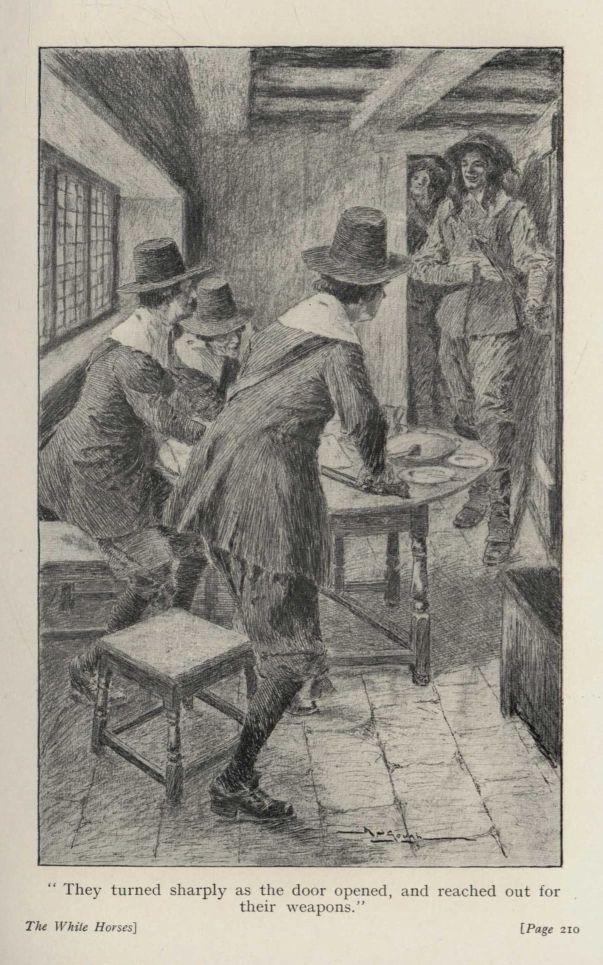
"They turned sharply as the door opened, and reached out for their weapons."
"Idolatry, friends," said Michael suavely.
The three looked at each other with puzzled question. These strangers wore their hair in the fashion dear to Cavaliers, and they carried an intangible air that suggested lightness of spirit.
"You have the password," said one; "but your fashion is the fashion of Belial's sons. What would you?"
"We come with full powers to claim your papers and to do your errand with the forces now besieging York. To be candid, you are suspect of eating more and drinking more than sober Parliament men should—and, faith, your crowded table here bears out the scandal."
The three flushed guiltily, then gathered the dourness that stood to them for strength; and Kit wondered what was passing through his brother's nimble brain.
"Your credentials," snapped the one who seemed to be leader of the three.
Michael, glancing round the board, saw a great pasty, with the mincemeat showing through where the knife had cut it. "Oh, my own password is Christmas-pie, friends! I encountered the dish at Banbury, and a great uproar followed when my brother gave it the true name."
And now the Roundheads knew that they were being played with. So great was their party's abhorrence of anything which savoured of the Mass, that a dish, pleasant in itself, had long since grown to be a shibboleth.
The first man raised a pistol—a weapon that seemed out of keeping with his preacher's garb—but Kit, longing for action instead of all this play of words, ran in with a jolly laugh, lifted his man high, as one lifts a child in frolic, and let him drop. The pistol fell, too, and the trigger snapped; but the Parliament man, however strong his trust in Providence might be, had forgotten Cromwell's other maxim—that he should keep his powder dry.
Michael's voice was very gentle. "I said we came with full powers. It would be wiser not to play with fire. Indeed, we do not wish you ill, and, in proof of friendship, we are willing to change clothes with you."
A little later Michael and Christopher came out, locking the door behind them. They asked the astonished host for scissors, and bade him clip their locks as close as he could contrive without knowledge of the barber's art. And it was odd that these two, who six months ago had been close-cropped in Yoredale, resented the loss of the lovelocks they had grown in deference to fashion. To them it seemed as if they were losing the badge of loyalty, as if the fat host played Delilah to their Samson.
"Keep that easy carriage of your bodies down, gentles, if you're bent on play-acting," said Boniface, with a cheery grin.
"How should we walk, then?"
"With a humble stoop, sir—a very humble stoop—that was how the three Parliament men came in and asked for the best victuals I could give 'em."
Michael's laugh was easy-going; but, for all that, his orders were precise and sharp. Their horses, of the tell-tale white, were to be stabled securely out of eyeshot, and well tended until called for. He and Kit would ride out on the pick of the three Roundhead cattle.
"As for that, sir, there's no pick, in a manner of speaking. They rode in on the sorriest jades I ever saw at a horse-fair."
"We'll take the rough luck with the smooth."
Yet even Michael grew snappish when he saw the steeds they had to ride. It was only when Kit laughed consumedly at sight of them that he recovered his good humour.
"After all, sir," suggested Boniface, "it proves the loyalty of the country hereabouts. They couldn't get decent horseflesh, for love or money. Our folk would only sell them stuff ready for the knacker's yard."
"That has a pleasant sound for us, with all between this and York to travel."
"Take two o' my beasts, gentles, if there's haste. You're cropped enough, and in quiet clothes enough, to ride good horses—always granting their colour doesn't happen to be white. As for these two o' mine, one is a roan, t'other a darkish bay."
Michael was arrested by the host's thoroughness and zeal, his disregard of his own safety. "And you, when you unlock the door on these rogues?"
"I shall fare as I shall fare, and not grumble either way. For your part, get away on the King's business, and God guide him safe, say I."
"But at least there's our reckoning to pay."
"Not a stiver. Nay, I'll not hear of it. Am I so poor a King's man that I grudge a cut from the joint and a bottle to the Riding Metcalfs?"
Michael warmed afresh to the man's loyalty. "Our thanks, host. As for the three in yonder, they'll not trouble you. I told them the door would be unlocked in an hour's time, explained that my folk were in the neighbourhood, and warned them to save their skins as best they could. You'll laugh till there are no more tears to shed when you see two of them in their bravery. Till I die that picture will return—their two sad faces set on top of our gay finery."
With a nod and a cheery call to his horse, he took the road again; and Kit and he spurred fast to recover the lost ground until they reached a steep and winding hill. For their cattle's sake they were compelled to take a breather at the top, and Kit looked over the rolling wolds with a heart on fire for Rupert and the errand. Somewhere yonder, under the blue, misty haze, lay York, the city old to courage and the hazard. New hazards were in the making; it behoved Michael and himself to give no spoiled page to York's long story.
"What a lad for dreams it is!" said Michael, in his gentlest voice.
Kit turned, and the sight of Michael habited in sober gear, with a steeple hat to crown the picture, broke down his dreams. It is good that comedy and the high resolve are friends who seldom ride apart. "The two we changed gear with, Michael—you would not laugh at them if you could see yourself."
"I have a good mirror, Kit, in you."
So they eyed each other for a while, and took their fill of merriment. Then they went forward. What the end of the venture was to be, they hazarded no guess; but at least they had papers and a garb that would pass them safely through the lines at York.
Another Royalist was abroad, as it happened, on a venture that to her own mind was both hazardous and lonely. The donkey that had helped Michael to secure his first entry into York—the patient, strong-minded ass that had followed the Riding Metcalfs south and had grown to be the luck of their superstitious company—had been lost on the march between Lathom House and Skipton. She had been stolen by a travelling pedlar, who found her browsing in a thistle-field a mile behind the army she hoped to overtake a little later on. He owned her for a day; and then, high spirit getting the better of dejection, she bided her time, shot out two hind-feet that left him helpless in the road, and set out on the quest that led to Michael—Michael, who might command her anything, except to go forward in the direction of her head.
To Elizabeth—her name among the Metcalfs—the forward journey was full of trouble and bewilderment. She followed them easily enough as far as Skipton, and some queer instinct guided her up the High Street and into the country beyond Otley. Then tiredness came on her, and she shambled forward at haphazard. At long last she blundered into Ripley; and, either because she knew the look of the Castle gateway, or because she gave up all for lost, she stood there and brayed plaintively.
A sentry peered from the top of the gate-tower. "Who goes there?" he demanded gruffly.
Elizabeth lifted up her head and brayed; and presently William Fullaboy, guardian of the little door set in the main gateway, opened and peered out into the flood of moonlight. Lady Ingilby came running, with Joan Grant, to learn the meaning of the uproar; alarms and sharp assaults had been frequent since the Metcalfs left to find Prince Rupert.
"Why, 'tis Elizabeth, my lady," laughed William—"Elizabeth, the snod, li'le donkey we grew so fond of."
"Give her supper and a warm bed for the night," said Lady Ingilby. "The luck comes home at last."
"But does it?" asked Joan Grant, a pitiful break in her voice. "We have lain warm abed while Kit was nursing his wounds on the open moors——"
"True, girl. He'll be none the worse for it. Lovers have a trick of coming home, like their four-footed kindred."
She would listen to no further trouble of Joan's, but patted Elizabeth's smooth ears, and talked to her, and fed her. The wife of a strong man, and the mother of strong sons, is always tender with four-footed things.
CHAPTER XVI.
THE SCOTS AT MICKLEGATE.
Michael was in high spirits as he rode for York with Christopher. He wore Puritan raiment, and it was troublesome to keep his steeple-hat safely on his head; but the wine of adventure was in his veins, and clothing mattered little.
"Once into York, my lad," he said, breaking a long silence, "and we shall get our fill of turmoil. There'll be sorties and pitched battle when Rupert comes."
Kit was always practical when he had his brother for companion. "We are not into York as yet. What plan have you, Michael?"
"My usual plan—to trust to luck. She's a bonnie mare to ride, I tell you."
"But the papers we took from the three Roundheads in the tavern—we had best know what they pledge us to."
"The Prince was right, after all. He said that you would steady me. It is odd, Kit, but it never entered my daft head to look at the papers; it was enough that they were our passport."
They drew rein, and Michael ran his eye down the papers. "They say that Rupert is marching fast for the relief of York—that will be no news to them by this time—that the Prince has inflicted disastrous reverses on their cause, at Bolton and by relieving Lathom House, and that, at any cost of life, York must be reduced before his coming. Oh, my lad, how all this plays into Rupert's hands!"
There was only one weakness in Michael's gay assurance that all was speeding well. When they reached the outposts of the enemy's lines, their way led them, as it chanced, to that quarter of the city which the Scots beleaguered. Their garb, Michael's peremptory demand that the sentry should pass them forward to the officer in command, backed up by showing of his papers, had their effect. It was when they found themselves in the presence of five Parliament officers, seated at a trestle table ill supplied with food, that they began to doubt the venture.
"Who are these?" asked one of the five, regarding the strangers with mingled humour and contempt.
"They were passed forward by the sentry, Captain. That is all I know."
"Who are they?" laughed a young lieutenant. "Why, Puritans, both of them, and preachers, too, by the look of their wearing-gear. It needs no papers to prove that."
Michael was always steadied by surprise. They had garbed themselves so carefully; they were acknowledged as friends of the Parliament cause; he was at a loss to understand the chilliness of their reception. "Puritans undoubtedly," he said, with a hint of his old levity, "but we've never been found guilty of the charge of preaching."
Captain Fraser glanced through the papers, and his air of rude carelessness changed. "This is of prime importance. By the Bruce, sirs, the Parliament has chosen odd-looking messengers, but I thank you for the bringing of your news."
Within ten minutes the Metcalfs were ushered into the presence of a cheery, thick-set man, who proved to be Leslie, the general in command of the Scots. He, too, read the papers with growing interest.
"H'm, this is good news," he muttered. "At any cost of life. That leaves me free. I've been saying for weeks past that famine and dissensions among ourselves will raise the siege, without any intervention from Prince Rupert. Your name, sir?" he asked, turning sharply to Michael.
Michael, by some odd twist of memory, recalled Banbury and the name of a townsman who had given him much trouble there. "Ebenezer Drinkwater, at your service."
"And, gad, you look it! Your face is its own credential. Well, Mr. Drinkwater, you have my thanks. Go seek what food you can find in camp—there may be devilled rat, or stewed dog, or some such dainty left."
Kit, who did not share his brother's zest in this play of intrigue, had a quick impulse to knock down the general in command, without thought of the consequences. The insolence of these folk was fretting his temper into ribbons.
"Come, brother," said Michael, after a glance at the other's face. "We can only do our work, not needing praise nor asking it. Virtue, we are told, is in itself reward."
A gruff oath from Leslie told him that he was acting passably well; and they went out, Kit and he, with freedom to roam unmolested up and down the lines.
"What is your plan?" asked Kit impatiently.
"We must bide till sundown, and that's an hour away. Meanwhile, lad, we shall keep open ears and quiet tongues."
They went about the camp, and everywhere met ridicule and a hostility scarcely veiled; but there was a strife of tongues abroad, and from many scattered drifts of talk they learned the meaning of the odd welcome they had found. The Scots, it seemed, had found the rift grow wider between themselves and the English who were besieging York's two other gates. The rift had been slight enough when the first joy of siege, the hope of reducing the good city, had fired their hearts. Week by week had gone by, month after month; hunger and a fierce drought had eaten bare the countryside, and hardships are apt to eat through the light upper-crust of character.
The Metcalfs learned that the dour Scots and the dour Puritans were at enmity in the matter of religion; and this astonished them, for they did not know how deep was the Scottish instinct for discipline and order in their Church affairs. They learned, too—and this was voiced more frequently—that they resented the whole affair of making war upon a Stuart king. They had been dragged into the business, somehow; but ever at their hearts—hearts laid bare by privation and ill-health—there was the song of the Stuarts, bred by Scotland to sit on the English throne and to grace it with great comeliness.
It was astounding to the Metcalfs, this heart of a whole army bared to the daylight. There had been skirmishes, they heard, between Lord Fairfax's men and the Scots. The quarrel was based ostensibly on some matter of foraging in each other's country; but it was plain that the Scots were glad of any excuse which offered—plain that they were more hostile to their allies than to the common enemy. Then, too, there was mutiny breeding among the soldiery, because their scanty pay was useless for the purchase of food at famine prices.
"We must find a way in," said Michael by and by. "The garrison should know all this at once. They could sortie without waiting for the Prince's coming."
The Barbican at Micklegate was too formidable an affair to undertake. What Michael sought was some quieter way of entry. They had reached the edge of the Scottish lines by now. The clear, red light showed them that odd neck of land bounded by Fosse Water and the Ouse, showed them the Castle, with Clifford's Tower standing stark and upright like a sentry who kept watch and ward. Within that neck of land were Royalists who waited for the message, as lovers wait at a stile for a lady over-late.
"We must win in," said Michael.
"Well, brothers," said a gruff voice behind them, "are you as sick to get into York as we are? You're late come to the siege, by the well-fed look of you."
"Just as sick," assented Michael cheerfully. "By the look of you, you're one of Lord Fairfax's men at Walmgate Bar. Well, it is pleasant to be among good Puritans again, after the cold welcome given us by the Scots at Micklegate."
So then the trooper talked to them as brother talks to brother. Within five minutes they learned all that the English thought of their Scottish allies, and what they thought would not look comely if set down on paper.
Michael warmed to the humour of it. The man with the heart of a Cavalier and the raiment of a Puritan hears much that is useful from the adversary. He told of their late errand, the safe delivery of their papers, and the contents. He explained—confidentially, as friend to friend—that he had an errand of strategy, and must get into York before sundown. Was there any quiet way of entry?
"Well, there's what they call a postern gate nigh handy," said the trooper, with the burr in his speech that any Wharfedale man would have known. "D'ye hear the mill-sluice roaring yonder? Though it beats me how she can roar at all, after all this droughty season."
"It has been a dry time and a dreary for our friends," put in Michael, with unctuous sympathy.
"Drear? I believe ye. If I'd known what war and siege meant, the King might have bided at Whitehall for ever—Star Chamber taxes or no— for aught I cared. At first it rained everything, save ale and victuals; and then, for weeks on end, it droughted. There's no sense in such weather."
"But the cause, friend—the cause. What is hardship compared with the Parliament's need?"
"Parliament is as Parliament does. For my part, I've got three teeth aching, to my knowledge, and other-some beginning to nag. You're a preacher, by the look o' ye. Well, spend a week i' the trenches, and see how it fares with preaching. There's no lollipops about this cursed siege o' York."
Kit could only marvel at his brother's grave rebuke, at the quietness with which he drew this man into talk—drew him, too, along the bank of Fosse Water till they stood in the deafening uproar of the weir.
"There's the postern yonder," said the trooper—"Fishgate Postern, they call it. Once you're through on your errand, ye gang over Castle Mills Brigg, and the durned Castle stands just beyond."
Michael nodded a good-day and a word of thanks, and hammered at the postern gate. A second summons roused the sentry, who opened guardedly.
"Who goes there?" he asked, with a sleepy hiccough.
Kit thrust his foot into the door, put his whole weight against it, and only the slowness of rusty hinges saved the sentry from an untimely end. "You can talk well, Michael, but give me the doing of it," he growled.
Kit gripped the sentry, neck and crop, while Michael bolted the door. Then they pushed their captive across Mills Bridge, and found themselves in the evening glow that lay over St. George's Field. For a moment they were bewildered. The roar of the mill-sluice had been in their ears so lately that the quietness within York's walls was a thing oppressive. The sounds of distant uproar came to them, but these were like echoes only, scarce ruffling the broad charity and peace of the June eventide. They could not believe that eleven thousand loyalists, horse and foot, were gathered between the city's ramparts.
The sentry, sobered by the suddenness of the attack and Kit's rough handling, asked bluntly what their business was. "It's as much as my skin is worth, all this. Small blame to me, say I, if I filled that skin a trifle over-full. Liquor is the one thing plentiful in this cursed city. What is your business?"
"Simple enough," said Michael. "Go find my Lord Newcastle and tell him two Puritans are waiting for him. They are tired of laying siege to York, and have news for his private ear."
"A likely tale!"
"Likelier than being throttled where you stand. You run less risk the other way. What is the password for the day?"
"Rupert of the Rhine," said the other sullenly.
"That's a good omen, then. Come, man, pluck your heart out of your boots and tell Lord Newcastle that we knocked on the gate and gave the counter-sign. Tell him we wait his pleasure. We shall shadow you until you do the errand."
The sentry had a gift of seeing the common sense of any situation. He knew that Newcastle was in the Castle, closeted with his chief officers in deliberation over the dire straits of the city; and he went in search of him.
Newcastle listened to his tale of two big Puritans—preachers, by the look of them—who had found entry through the postern by knowledge of the password. "So they wait our pleasure, do they?" said Newcastle irascibly. "Go tell them that when my gentlemen of York go out to meet the Puritans, it will be beyond the city gates. Tell them that spies and informers must conform to their livery, and come to us, not we to them. If they dispute the point—why, knock their skulls together and pitch them into Castle Weir."
"They are big, and there are two of them, my lord."
A droll Irishman of the company broke into a roar of laughter. The sentry's face was so woebegone, his statement of fact so pithy, that even Newcastle smiled grimly. "Soften the message, then, but bring them in."
To the sentry's astonishment, the two Puritans came like lambs at his bidding; and after they were safely ushered into the Castle dining-hall, the sentry mutely thanked Providence for his escape, and went in search of further liquor. As a man of common sense, he reasoned that there would be no second call to-night at a postern that had stood un-challenged for these three weeks past.
Michael, when he came into the room, cast a quick glance round the company. He saw Newcastle and Eythin, and a jolly, red-faced Irishman, and many others; and memory ran back along the haps and mishaps of warfare in the open to a night when he had swum Ouse River and met just this band of gentlemen at table. He pulled his steeple-hat over his eyes and stood there, his shoulders drooping, his hands crossed in front of him.
"Well," demanded Newcastle, his temper raw and unstable through long caring for the welfare of his garrison. "If we are to discuss any business, you may remove your quaint head-gear, sirs. My equals uncover, so you may do as much."
"Puritans do not, my lord," Michael interrupted. "What are men that we should uncover to them?"
"Men circumstanced as we are have a short way and a ready with cant and steeple-headed folk."
"Yet the password," insisted the other gently. "Rupert of the Rhine. It has a pleasant sound. They say he is near York's gates, and it was we who brought him."
The Irishman, thinking him mad or drunk, or both, and irritated beyond bearing by his smooth, oily speech, reached forward and knocked his hat half across the room.
"Oh, by the saints!" he roared; "here's the rogue who came in last spring, pretty much in the clothes he was born in, after swimming Ouse River—the jolly rogue who swore he'd find Rupert for us."
"At your service, gentlemen—as dry as I was wet when we last encountered. Will none of you fill me a brimmer?"
Lord Newcastle, if something raw in experience of warfare and its tactics, was a great-hearted man of his world, with a lively humour and a sportsman's relish for adventure. He filled the brimmer himself, and watched Michael drain half of it at one thirsty, pleasant gulp. "Now for your news," he said.
"Why, my lord, I pledged the Metcalf honour that we'd bring Rupert to you, and he lies no further off than Knaresborough."
"Good," laughed the Irishman. "I said you could trust a man who swore by the sword he happened not to be carrying at the moment."
"And your friend?" asked Newcastle, catching sight of Christopher, as he stood moving restlessly from foot to foot.
"Oh, just my brother—the dwarf of our company. Little, but full of meat, as our Yoredale farmers say when they bring small eggs to market. To be precise, Kit here is worth three of me. They call him the White Knight in Oxford."
So Kit in his turn drank the heady wine of praise; and then Michael, with swift return to the prose of everyday, told all he knew of Rupert's movements, all that he had learned of the famine and dissension outside the city gates.
"The Prince bade you all be ready for the sortie when he came," he finished. "For my part, I think we might sortie now and save him the trouble of scattering these ragabouts."
"Ah, life's a droll jade," murmured the Irishman. "We fancied they were doing fairly well out yonder, while we were cooped up here like chickens in a pen. Will you give me the sortie, my lord? The light's waning fast."
"Ay, lead them, Malone," laughed Newcastle. "I shall be glad to give mettled colts their exercise."
The sentry at the Mills postern gate was suffering evil luck to-night. He had scarcely settled himself on his bench inside the gate, a tankard of ale beside him, and a great faith that the odds were all against his being disturbed twice in the same evening, when there came a splutter of running feet outside and a knocking on the door. Memory of the earlier guests was still with him, sharpened by the sting of aches and bruises.
"No more gentle Puritans for me," he growled. "They can knock as they list; for my part, I'm safer in company with home-brewed ale."
He listened to the knocking. Drink and his rough experience of awhile since, between them, brought a coldness to his spine, as if it were a reed shivering in some upland gale.
Then warmth returned to him. A voice he knew told him of what had happened outside York, and insisted that its bearer should bring the good news in.
"Why, Matthew, is it only thee?" asked the sentry, his mouth against the spacious keyhole.
"Who else? Open, thou durned fool. My news willun't bide."
Lord Newcastle had scarcely given consent to the sortie, when the sentry came again to the dining-chamber, pushing in front of him a lean, ragged figure of a man who seemed to have found a sudden shyness, until Michael burst into a roar of laughter. "Here's a gallant rogue! It was by his help I won into York last spring. Sutler, I thank you for the donkey purchased from you."
"Is she well, sir?" asked the other eagerly. "I aye had a weakness for the skew-tempered jade."
"Come, your news?" snapped Newcastle.
"It's this way, gentles. I can talk well enough when I'm selling produce for the best price it will fetch—and prices rule high just now, I own—but I'm shy when it comes to talking wi' my betters."
"Then put some wine into your body," laughed Malone. "It's a fine remedy for shyness."
"And thank ye, sir," said the rogue, with a quiet, respectful wink. "I'm aye seeking a cure for my prime malady."
"Well?" asked Newcastle, after the cup was emptied.
"It tingles right down to a body's toes, my lord—a very warming liquor. As for what I came to say, 'tis just this. I'm for the King myself. I never could bide these Parliament men, though I sell victuals to 'em. I come to tell ye that there's no siege of York at all."
He told them, in slow, unhurried speech, how news had come that Rupert lay at Knaresborough, how the Parliament men had gone out to meet him on the road to York, glad of the chance of action, and trusting by weight of numbers to bear down the man who had glamoured England with the prowess of his cavalry.
Confusion followed the sutler's news. Some—Newcastle himself among them—were eager to send out what men they could along the Knaresborough road to aid Rupert. Others insisted that the cavalry, men and horses, were so ill-conditioned after long captivity that they could not take the road to any useful purpose. A sharp sortie, packed with excitement, was a different matter, they said, from a forced march along the highway.
When the hubbub was at its loudest, another messenger came in. The Prince sent his compliments to Lord Newcastle, and had taken his route by way of Boroughbridge, "lest the enemy should spoil a well-considered plan," that Goring was with him, that they might look for him between the dusk and the daylight. The messenger added that the Prince had his good dog Boye with him, and he knew that the hound carried luck even in fuller measure than his master.
"Ah, the clever head of the man!" said Malone. "I never owned that quality myself. He'll be meaning to cross Swale by way of Thornton Brigg, and all as simple as a game of hide-and-seek."
It was not quite so simple. An hour later word came that Rupert had encountered a strong force of Parliament men at the Brigg. They were guarding a bridge of boats that stretched across the Swale; but Rupert had scattered them, and still pressed forward.
Throughout York the contagion spread—the contagion of a fierce unrest, a wild thanksgiving, a doubt lest it were all a dream, too good to take real shape and substance. For this they had longed, for this they had suffered hunger and disease—hoping always that Rupert of the Rhine would come on a magic horse, like some knight of old, to their relief. And he was near.
The watch-towers were crowded with men looking eagerly out into the gloaming; but a grey mist shrouded all the plain beyond the walls. Women were sobbing in the streets, and, when asked their reason by some gruff passer-by, explained that they must cry, because joy hurt them so.
And then, after long waiting, there came a shouting from the mist outside, a roar of horsemen and of footmen. And they knew the good dream had come true at last.
There is a grace that comes of hero-worship:—grace of the keen young buds that burst in spring. It knows no counterfeit.
Rupert was here. Privation was forgotten. Wounds became so many lovers' tokens, and the world went very well with York.
"As God sees me, gentlemen," said Lord Newcastle to those about him, "I take no shame to bend my knees and thank Him for this gallant business."
A message came from Rupert. He would camp outside the walls that night, and would be glad if my Lord Newcastle and his friends would come to him on the morrow. "We shall breakfast—if any is to be had—a little late," the message ended. "My men have had a forced march."
"Ay, always his men and their needs," laughed Malone, the Irishman. "What a gift he has for leadership."
When the morrow came, Michael and Kit were astonished that Lord Newcastle bade them join the few officers he took with him to meet the Prince outside the walls.
"It was you who brought him to us, gentlemen," he explained, with a cheery nod. "We hold you in peculiar honour."
The meeting itself was unlike Kit's hot-headed pictures of it, framed beforehand. Prince Rupert, straight-shouldered and smiling, was obviously dead weary. His body was that of a usual man, but his head and heart had been big enough to guide some thousands of soldiers who trusted him from Oxford to the plain of York; and none goes through that sort of occupation without paying the due toll. His eyes were steady under the high, wide brows; but the underlids were creased and swollen, and about his mouth the tired lines crossed and inter-crossed like spider's webs. Only Boye, the hound, that had gathered superstition thick about his name, was true to Kit's dream of the meeting; and Boye, remembering a friend met at Oxford, came and leaped up to lick his hand.
"Homage to gallantry, Lord Newcastle," said Rupert, lifting his hat. "The defence of York goes beyond all praise."
"It was well worth while," said Newcastle, and got no further, for his voice broke.
"The day augurs well," went on the other by and by. "I like to fight in good weather. Wet clothes are so devilish depressing."
"But the siege is raised, your Highness. All York is finding tattered flags to grace your welcome in."
"They are kind, but flags must wait. We propose to harry the retreat."
"The retreat," said Eythin quietly, "is so ready for civil war among itself that we should be well advised to leave it to its own devices."
Michael, with the eye that saw so much, caught a glance of challenge that passed from Eythin to the Prince. And he guessed, in his random way, that these two were enemies of long standing. He did not wonder, for he had met few men whom he misliked as he did Eythin.
"Indeed," put in Newcastle, in great perturbation, "we are very rusty. Our men and horses are cramped for want of exercise and food."
"Ah, the gallop will unstiffen them. My lord, we pursue and give battle. It is my own considered judgment—and, more, the King's orders, which I carry, are explicit on that point."
So Newcastle heaved a sigh of relief. The King commanded, and that decided the matter. For himself, he was so glad to be free of wakeful nights and anxious days, so willing to hand over the leadership he had carried well, that imminent battle was in the nature of recreation.
Rupert had mapped out his plans with a speed as headlong and unerring as his cavalry attacks. The rebel army was encamped on the high ground bordering Marston Moor. He would take the route at once, and my Lord Newcastle must follow with the utmost expedition. He could wait with his men, before giving battle, until the garrison of York joined forces with him. Even united, they would be outnumbered; but they were used to odds. They must this day sweep treason out of the North, once for all, and send good news to the King.
Rupert carried them with him. He was on fire with victories won, with faith in victories to come. The one man unmoved was Eythin, who, disappointed in himself and all things, had long since kennelled with the cynics.
"The higher one flies, the bigger the drop to ground," he muttered.
"Ay," said Michael, who was standing close beside him, "but the man who never dares to fly—he lives and dies an earthworm."
"I shall cross swords with you for that pleasantry," drawled Eythin.
"Here and now, then," snapped Michael.
Rupert, who never forgot the record of friend or enemy, interposed. "Gentlemen, I am in command. You may kill each other afterwards, if Marston Moor does not dispatch the business without further trouble. Mr. Metcalf," he added, "you will ride with me—and your brother. It is as well to keep spark from gunpowder just now, and Lord Eythin has work to do in York."
When they set out along the dusty road, the brothers mounted on horses going riderless about the late Roundhead camp, Rupert would have them trot beside him, and chatted pleasantly. They could not understand the quiet deference and honour given them at every turn of these rough-riding days. But Rupert understood. Into the midst of jealousies at Oxford—petty rivalries of man against man, when the crown and soldiers' lives were in the losing—had come the Riding Metcalfs, honest and selfless as God's sunlight, brave to fight well and to be modest.
The day grew insufferably hot. Rupert's promise of good weather proved him no true prophet. Any farmer could have told him what was meant by the stifling heat, the steely sky, the little puffs of wind that were hot and cold by turns.
"A lover's wind," said Rupert lightly, as a fiercer gust met them up the rise of Greet Hill. "It blows east and west, twice in the same minute."
"It blows for a big storm, your Highness," Kit answered, in all simplicity. "The belly of the hills is crammed with thunder."
"Let it break, then, if it must. Meanwhile, our clothes are dry. And, talking of lover's weather, Master Christopher, I was entrusted with a message to you from Knaresborough. I met a lady there, as we passed through—a pretty lady, well-gowned and shod in spite of these disastrous times—and she asked me if a little six-foot youth of the Riding Metcalfs were still alive."
"But who should ask for me in Knaresborough?"
"Were there so many, then? I begin to doubt you, my White Knight."
It was later, as they neared Marston, that the Prince drew Christopher aside. He seemed to have a queer tenderness for this lad to whom life showed a face of constancy and trust. "I told Miss Bingham you were in rude health; and I break confidence, maybe, when I tell you that her eyes filled with tears. Well, forget her till after this day's work is done."
Kit answered nothing, and showed instinctive wisdom. Miss Bingham was no more than a pleasant ghost who had nursed his weakness, and afterwards had sat beside him on the ferry-steps that dipped to the waters of Nidd River. His thoughts lately had been all of battle and of high endurance; but now, as he remembered Joan Grant and the way of her, and the primroses that had starred the lanes of his wooing time in Yoredale, he knew that he must do well at Marston Moor.
The dust and swelter of the ride grew burdensome. Boye, the hound, ran beside his master with lolling tongue.
"Never look so woebegone," laughed Rupert, leaning from saddle to pat the brute's head. "We're to have a glorious day, Boye, and you the luck of it."
Kit had first realised at Oxford how deeply Boye was embroiled in this war of King and Parliament. To the Royalists he was their talisman, the touchstone of success. To the enemy he was a thing accursed, the evil spirit harbouring the body of a dog; they had essayed to shoot and poison him, and found him carrying a charmed life. Their unkempt fancy ran so wild as to name him the worst Papist of the Stuart following, because he went often with Rupert to kirk, and showed great reverence in a place holy to his master. Christopher recalled how the Prince had laughed once when a friend had told him what the Roundhead gossip was. "It's an odd charge to lay against a dog," he had said, "that he's a better Catholic than they."
And now, with battle close ahead and the big deed in the making, Rupert had found leisure to see Boye's hardship and to cheer him forward on the dusty road. He caught Christopher's glance of wonder—as, indeed, he saw most things in these days of trouble—and smiled with disconcerting humour.
"After all, Master Christopher, I've found only three things to love in my hard life—loyalty to the King, and my brother Maurice, and the good Boye here. Love goes deep when its bounds are set in such a narrow compass."
He said nothing of his fourth love—the high regard he had for the Duchess of Richmond—the love that had so little of clay about it, so much of the Pole Star's still, upleading glamour. Instead, he bustled forward on the road; and about noon the vanguard of his army found itself on Marston Moor. It was a wild country, clumps of bog and gorse and heather islanding little farmsteads and their green intaken acres. On the slopes above, wide of Tockwith village, they could see the smoke of camp fires and the passing to and fro of many Roundheads, hefty in the build.
"They were ever good feeders," said Rupert lightly.
His whole face was changed. The lines of weariness were gone. The surety of battle near at hand was stirring some vivid chord of happiness. It was a sane happiness, that sharpened brain and eye. The country was so flat that from the saddle he could see the whole range of this battlefield in prospect. He marked the clumps of intake—bean-fields white with flower, pastures browned by the drought, meadows showing fresh and green after last week's ingathering of the crop. He saw Wilstrop Wood beyond, and the ditch and ragged fence half between Wilstrop and the hill on which the Parliament men were eating a good dinner for the first time in many months.
"My right wing takes position this side the ditch," said the Prince at last, pointing to a gap in the hedge where a rough farm-lane passed through it. "Now that is settled, gentlemen, I'm free of care. Mr. Metcalf," he added, turning to Michael, "go find your kinsmen and bid them join me. It is the only honour I can give them at the moment; and the King's wish—my own wish—is to show them extreme honour."
Christopher remained in close attendance on the Prince. The most surprising matter, in a nine months' campaign of surprises, was Rupert's persistent memory for the little things, of grace and courtesy, when battle of the starkest kind was waiting only for the arrival of Lord Newcastle and the garrison of York.
"They'll not be here within the hour," said Rupert, "and this is a virgin country, so far as food goes. My men shall dine."
CHAPTER XVII.
PRAYER, AND THE BREWING STORM.
He knew his men. After a rousing charge, and a red lane mown along the track their horses took, he had no control of them; they must pillage as they listed. Before the combat, he could trust their pledge to take no more than an hour to dine, to be prompt at the muster afterwards, as he trusted his own honour.
It was an odd hour of waiting. Messengers galloped constantly from the York road, saying there was no speck of dust to show that Newcastle was coming with reinforcements. Rupert's men, with the jollity attending on a feast snatched by unexpected chance, began to reassemble. Two o'clock came, and the heat increasing. Overhead there was a molten sky, and the rye-fields where the enemy were camped showed fiery red under the lash of a wild, pursuing wind.
It was not until another hour had passed that Rupert began to lose his keen, high spirits. He was so used to war in the open, to the instant summons and the quick answer, that he could not gauge the trouble of York's garrison, the slowness of men and horses who had gone through months of wearisome inaction. It is not good for horse or man to be stabled overlong out of reach of the free pastures and the gallop.
About half after three o'clock some of his company brought in to Rupert a big, country-looking fellow, and explained that they had captured him spying a little too close to the Royalist lines.
"What mun we do to him?" asked the spokesman of the party, in good Wharfedale speech. "We've hammered his head, and ducked him i' th' horse-pond, and naught seems to serve. He willun't say, Down wi' all Croppies."
"Then he's the man I'm seeking—a man who does not blow hot and cold in the half-hour. Your name, friend?"
"Ezra Wood, and firm for the Parliament."
"We hold your life at our mercy," said Rupert, with a sharp, questioning glance. "Tell us the numbers and disposition of Lord Fairfax's army."
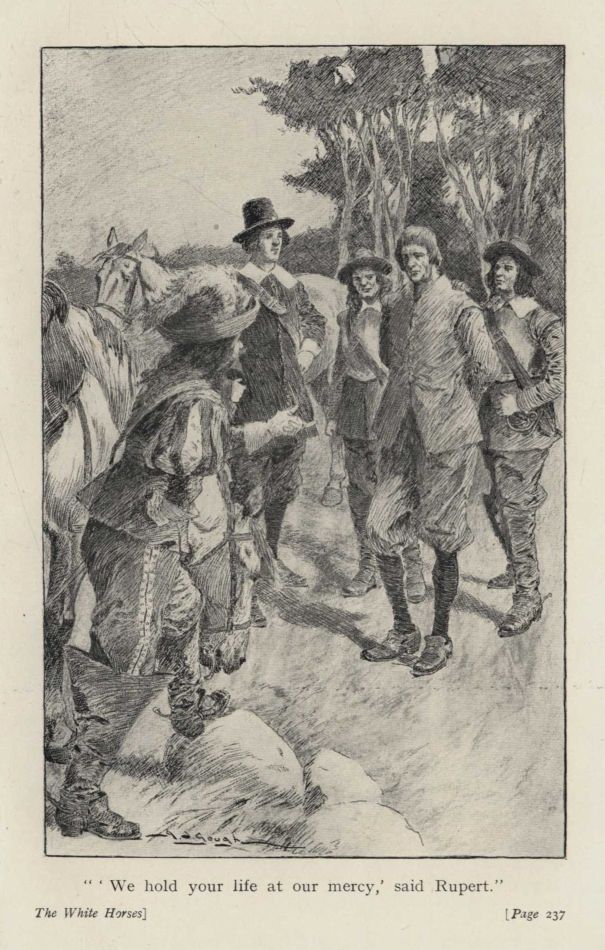
"'We hold your life at our mercy,' said Rupert."
"As man to stark man, I'll tell ye nowt. My mother sat on one stool while she nursed me, not on two."
Rupert had proved his man. The pleasure of it—though Ezra Wood happened to be fighting on the other side—brought the true Prince out of hiding. Through fatigue of hurried marches, through anxiety because York's garrison lingered on the way, the old Crusader in him showed.
"Is Cromwell with your folk?" he asked.
"He is—staunch in prayer and staunch indeed."
"Then go free, and tell him that Prince Rupert leads the right wing of the attack. I have heard much of his Ironsides, and trust to meet them on the left wing."
Ezra Wood had no subtleties, which are mistaken now and then for manners. He looked Rupert in the face with a hard sort of deference. "So thou'rt the man they call Rupert?" he said. "Well, ye look it, I own, and I'll carry your message for ye gladly."
"And you will return, under safe-conduct, with his answer."
About five of the afternoon—all Marston Moor ablaze with a red, unearthly light—the first of the York men came in. Rupert's impulsive welcome grew chilly when he saw that Lord Eythin led them; and Boye, whose likes and dislikes were pronounced, ran forward growling.
"Whistle your dog off, sir—whistle him off," said Eythin irritably.
Rupert, with a lazy smile, watched Boye curvet round Eythin in narrowing circles. "Why should I?" he asked gently. "He never bites a friend."
Eythin reddened. Memory of past years returned on him, though he had thought the record drowned in wine and forgotten out of sight. He asked fussily what plans Rupert had made for the coming battle.
"Monstrous!" he snapped. "Oh, I grant you've a knowledge of the charge, with ground enough in front to gather speed. But what are your cavalry to make of this? You stand to wait their onset, and their horses are heavy in the build."
Rupert nodded curtly. "Get your men into line, sir. You are here to fight under orders, not to attend a council of war."
As Eythin withdrew sullenly, a sudden uproar came down the wind. Then the shouting, scattered and meaningless at first, grew to a rousing cry of "A Mecca for the King!" Michael glanced at Christopher, and pride of race showed plainly in their faces.
"Ah," laughed Rupert, "it was so they came when we played pageantry before the King at Oxford. Go bring your folk to me, Mr. Metcalf."
They came, drew up with the precision dear to Rupert's heart, saluted briskly. "Gentlemen," he said, "I am proud to have you of my company. Is my Lord Newcastle near Marston yet?"
The Squire of Nappa explained that those under Newcastle's command had suffered during the late siege—men and horses were so weak from illness that no zeal in the world could bring them faster than a foot-pace. He knew this, because he had passed them on the road, had had speech of them. Lord Newcastle himself, a man no longer young, had kept a long illness at bay until the siege was raised, and now he was travelling in his coach, because he had no strength to sit a horse.