Front matter (continued 3)
Reading edition
With Michael it was the same. He did not cheer as the crowd did; his heart was too deeply touched for that. And by and by, when the townsfolk had followed the cavalcade toward Christ Church, the brothers found themselves alone.
"It was worth while," said Kit, seeking yet half evading Michael's glance.
They shook themselves out of their dreams by and by, and, for lack of other guidance, followed the route taken by the King. The Cavaliers had dispersed. The King had already gone into the Deanery. So they left the front of Christ Church and wandered aimlessly into the lane that bordered Merton, and so through the grove where the late rains and the glowing sun had made the lilacs and the sweet-briars a sanctuary of beaded, fragrant incense.
From Merton, as they dallied in the grove—not knowing where to seek Rupert, and not caring much, until the wine of Oxford grew less heady—a woman came between the lilacs. Her walk, her vivacious body, her air of loving laughter wherever she could find it, were at variance with the tiredness of her face. She seemed like sunlight prisoned in a vase of clouded porcelain.
Perhaps something of their inborn, romantic sense of womanhood showed in the faces of the Metcalfs as they stepped back to make a way for her. One never knows what impulse guides a woman; one is only sure that she will follow it.
However that might be, the little lady halted; a quick smile broke through her weariness. "Gentlemen," she said, with a pretty foreign lilt of speech, "you are very—what you call it?—so very high. There are few men with the King in Oxford who are so broad and high. I love big men, if they are broad of shoulder. Are you for the King?"
"We are Metcalfs of Nappa," said Kit. "Our loyalty is current coin in the north."
The little lady glanced shrewdly at them both, her head a little on one side like a bird's. "Are you of the company they call the Riding Metcalfs? Then the south knows you, too, and the west country, wherever men are fighting for the King. Gentlemen, you have a battle-cry before you charge—what is it?"
"A Mecca for the King!"
She laughed infectiously. "It is not like me to ask for passwords. I was so gay and full of trust in all men until the war came. The times are difficile, n'est pas, and you were unknown to me. What is your errand here?"
"We came to find Prince Rupert," said Kit, blurting his whole tale out because a woman happened to be pretty and be kind. "The north is needing him. That is our sole business here."
"Ah, then, I can help you. There's a little gate here—one goes through the gardens, and so into the Deanery. My husband lodges there. He will tell you where Rupert finds himself."
Michael, because he knew himself to be a devil-may-care, had a hankering after prudence now and then, and always picked the wrong moment for it. If this unknown lady had chosen to doubt them, and ask for a password, he would show the like caution. Moreover, he felt himself in charge just now of this impulsive younger brother.
"Madam," he answered, his smile returning, "our errand carries with it the whole safety of the north. In all courtesy, we cannot let ourselves be trapped within the four walls of a house. Your husband's name?"
"In all courtesy," she broke in, "it is permitted that I laugh! The days have been so triste—so triste. It is like Picardy and apple orchards to find one's self laughing. You shall know my husband's name, sir—oh, soon! Is it that two men so big and high are afraid to cross an unknown threshold?"
Michael thrust prudence aside, glad to be rid of the jade. "I've seldom encountered fear," he said carelessly.
"Ah, so! Then you have not loved." Her face was grave, yet mocking. "To live one must love, and to love—that is to know fear."
She unlocked the gate with a key she carried at her girdle, and passed through. They followed her into gardens lush, sweet-smelling, full of the pomp and eager riot of the spring. Then they passed into the Deanery, and the manservant who opened to them bowed with some added hint of ceremony that puzzled Michael. The little lady bade them wait, went forward into an inner room, then returned.
"My husband will receive you, gentlemen," she said, with a smile that was like a child's, yet with a spice of woman's malice in it.
The sun was playing up and down the gloomy panels of the chamber, making a morris dance of light and shade. At the far end a man was seated at a table. He looked up from finishing a letter, and Christopher felt again that rush of blood to the heart, that deep, impulsive stirring of the soul, which he had known not long ago in the High Street of the city.
They were country born and bred, these Yoredale men, but the old Squire had taught them how to meet sharp emergencies, and especially this of standing in the Presence. Their obeisance was faultless in outward ceremony, and the King, who had learned from suffering the way to read men's hearts, was aware that the loyalty of these two—the inner loyalty—was a thing spiritual and alive.
The Queen, for her part, stood aside, diverted by the welcome comedy. These giants with the simple hearts had learned her husband's name.
"I am told that you seek Prince Rupert—that you are lately come from York?" said the King.
He had the gift—one not altogether free from peril—that he accepted or disdained men by instinct; there were no half measures in his greetings. Little by little Christopher and Michael found themselves at ease. The King asked greedily for news of York. They had news to give. Every word they spoke rang true to the shifting issues of the warfare in the northern county. It was plain, moreover, that they had a single purpose—to find Rupert and to bring him into the thick of tumult where men were crying for this happy firebrand.
The King glanced across at Henrietta Maria. They did not know, these Metcalfs, what jealousies and slanders and pin-pricks of women's tongues were keeping Rupert here in Oxford. They did not know that Charles himself, wearied by long iteration of gossip dinned into his ears, was doubting the good faith of his nephew, that he would give him no commission to raise forces and ride out. The King and Queen got little solace from their glance of Question; both were so overstrained with the trouble of the times, so set about by wagging tongues that ought to have been cut out by the common hangman, that they could not rid themselves at once of doubt. And the pity of it was that both loved Rupert, warmed to the pluck of his exploits in the field, and knew him for a gentleman proved through and through.
"Speak of York again," said the King. "London is nothing to me, save an overgrown, dull town whose people do not know their minds. Next to Oxford, in my heart, lies York. If that goes, gentlemen, I'm widowed of a bride." He was tired, and the stimulus of this hale, red-blooded loyalty from Yoredale moved him from the grave reticence that was eating his strength away. "It is music to me to hear of York. From of old it was turbulent and chivalrous. It rears strong men, and ladies with the smell of lavender about them. Talk to me of the good city."
So then Michael, forgetting where he stood, told the full tale of his journeying to York. And the Queen laughed—the pleasant, easy laughter of the French—when he explained the share a camp-follower's donkey had had in the wild escapade.
"You will present the donkey to me," she said. "When all is well again, and we come to praise York for the part it took in holding Yorkshire for the King, you will present that donkey to me."
And then the King laughed, suddenly, infectiously; and his Queen was glad, for she knew that he, too, had had too little recreation of this sort. They went apart, these two, like any usual couple who were mated happily and had no secrets from each other.
"How they bring the clean breath of the country to one," said Charles. "Before they came, it seemed so sure that Rupert was all they said of him."
"It was I who made you credit rumours," she broke in, pretty and desolate in the midst of her French contrition. "I was so weary, and gossip laid siege to me hour by hour, and I yielded. And all the while I knew it false. I tell you, I love the sound of Rupert's step. He treads so firmly, and holds his head so high."
The King touched her on the arm with a deference and a friendship that in themselves were praise of this good wife of his. Then he went to the writing-table, wrote and sealed a letter, and put it into Michael's hands.
"Go, find the Prince," he said, "and give him this. He is to be found at this hour, I believe, in the tennis-court. And when you next see the Squire of Nappa tell him the King knows what the Riding Metcalfs venture for the cause."
Seeing Kit hesitate and glance at him with boyish candour, the King asked if he had some favour to request. And the lad explained that he wished only to understand how it came that the Riding Metcalfs were so well known to His Majesty.
"We have done so little," he finished; "and the north lies so far away."
The King paced up and down the room. The fresh air these men had brought into the confinement of his days at Oxford seemed again to put restlessness, the need of hard gallops, into his soul.
"No land lies far away," he said sharply, "that breeds honest men, with arms to strike shrewd blows. Did you fancy that a company of horsemen could light the north with battle, could put superstitious terror into the hearts of malcontents, and not be known? Gentlemen, are you so simple that you think we do not know what you did at Otley Bridge—at Ripley, when the moon shone on the greening corn—at Bingley, where you slew them in the moorland wood? It is not only ill news that travels fast, and the Prince, my nephew, never lets me rest for talk of you."
To their credit, the Metcalfs bore it well. Bewildered by this royal knowledge of their deeds, ashamed and diffident because they had done so little in the north, save ride at constant hazard, they let no sign escape them that their hearts were beating fast.
The King asked too much of himself and others, maybe, stood head and shoulders above the barter and cold common sense of everyday. The Metcalf spirit was his own, and through the dust and strife he talked with them, as if he met friends in a garden where no eavesdroppers were busy.
They went out by and by, the Queen insisting, with her gay, French laugh, that the donkey should be presented to her later on. They found themselves in the street, with its pageantry of busy folk.
"Well, Kit," asked Michael. "We've fought for the King, and taken a wound or so. Now we've seen him in the flesh. How big is he, when dreams end?"
"As big as dawn over Yoredale pastures. I never thought to meet his like."
"So! You're impulsive, lad, and always were, but I half believe you."
They came again into the High Street. It was not long, so far as time went, since these Nappa men had fancied, in their innocence, that because a messenger rode out to summon them to Skipton, the King and all England must also know of them. Now the King did know of them, it seemed. Six months of skirmish, ambush, headlong gallops against odds, had put their names in all men's mouths. Quietly, with a sense of wonder, they tested the wine known as fame, and the flavour of it had a sweetness as of spring before the languor of full summer comes.
"We were strangers here an hour since," said Kit, watching the folk pass, "and now we come from Court."
"What did I tell you, babe Christopher, when I tried in Yoredale to lick your dreaming into shape? Life's the most diverting muddle. One hour going on foot, the next riding a high horse. We'd best find the tennis-court before the King's message cools."
A passer-by told them where to find the place. The door was open to the May sunlight, and, without ceremony or thought of it, they passed inside. Prince Rupert was playing a hard game with his brother Maurice. Neither heard the Metcalfs enter; in the blood of each was the crying need for day-long activity—in the open, if possible, and, failing that, within the closed walls of the tennis-court. The sweat dripped from the players as they fought a well-matched game; then Rupert tossed his racquet up.
"I win, Maurice," he said, as if he had conquered a whole Roundhead army.
"It is all we do in these dull times, Rupert—to win aces from each other. We're tied here by the heels. There's the width of England to go fighting in, and they will not let us."
Rupert, turning to find the big surcoat that should hide his frivolous attire between the street and his lodging, saw the two Metcalfs standing there. He liked their bigness, liked the tan of weather and great hardship that had dyed their faces to the likeness of a mellowed wall of brick. Yet suspicion came easily to him, after long association with the intrigues of the Court at Oxford, and instinctively he reached down for the sword that was not there, just as Michael had done when he came dripping from Ouse river into York.
"You are Prince Rupert?" said Michael. "The King sends this letter to you."
Rupert broke the seal. When he had read the few lines written carelessly and at speed, his face cleared. "Maurice," he said, "we need play no more tennis. Here's our commission to raise forces for the relief of York."
He was a changed man. Since boyhood, war had been work and recreation both to him. In his youth there had been the Winter Queen, his widowed mother, beset by intrigue and disaster, with only one knightly man about her, the grave Earl of Craven, who was watch-dog and worshipper. Craven, hard-bitten, knowledgeable, with the strength of the grey Burnsall fells in the bone and muscle of him, had taught Rupert the beginnings of the need for warfare, had sown the first seeds of that instinct for cavalry attack which had made Rupert's horsemanship a living fear wherever the Roundheads met them. First, he had had the dream of fighting for his mother's honour; when that was denied him he had come into the thick of trouble here in England, to fight for King Charles and the Faith. And then had come the cold suspicion of these days at Oxford, the eating inward of a consuming fire, the playing at tennis because life offered no diversion otherwise. It is not easy to be denied full service to one's king because the tongues of interlopers are barbed with venom, and these weeks of inaction here had been eating into his soul like rust.
The first glow of surprise over, Rupert's face showed the underlying gravity that was seldom far from it. The grace of the man was rooted in a rugged strength, and even the charm of person which none denied was the charm of a hillside pasture field, flowers and green grass above, but underneath the unyielding rock.
"Maurice, these gentlemen are two of Squire Metcalf's lambs," he said, "so the King's letter says. For that matter, they carry their credentials in their faces."
"Tell us just how the fight went at Otley Bridge," said Maurice, with young enthusiasm. "We have heard so many versions of the tale."
"It was nothing," asserted Kit, still astonished to find their exploits known wherever they met Cavaliers. "Sir Thomas Fairfax came back one evening from a skirmish to find we held the bridge. He had five-score men, and we had fifty. It was a good fight while it lasted. Forty of our men brought back wounds to Ripley; but we come of a healthy stock, and not a limb was lost."
Rupert had no easy-going outlook on his fellows; his way of life did not permit such luxury. He was aware that rumour had not lied for once—that the magic of the Metcalf name, filtering down from Yorkshire through many runnels and side-channels, was no will-o'-wisp. Two of the clan were here, and one of them had told a soldier's tale in a soldier's way, not boasting of the thirty men of Fairfax's they had left for dead at Otley Bridge.
"I shall be for ever in your debt," he said impassively, "if you will answer me a riddle that has long been troubling me. Who taught you Metcalfs the strength of cavalry, lightly horsed and attacking at the gallop?"
"Faith, we were never taught it," laughed Michael. "It just came to us as the corn sprouts or the lark sings. The old grey kirk had something to do with it, maybe, though I yawned through many a sermon about serving God and honouring the King. One remembers these little matters afterwards."
"One does, undoubtedly," said Rupert. "Now, sir," he went on, after a grave silence, "I have a great desire. I'm commissioned to raise forces for the relief of York, and I want you men of Yoredale for my first recruits. They are already busy in the north, you'll say. Yes, but I need them here. Six-score of your breed here among us, or as many as their wounds permit to ride, would bring the laggards in."
"With you here?" said Kit impulsively. "The laggards should be stirred without our help."
"By your leave, they are tiring of me here in Oxford. The tales of your doings in the north are whetting jaded appetites. Bring your big men south on their white horses, and show the city what it covets. I'll send a horseman to York within the hour."
"That need not be," said Michael. "We wasted a whole night in Banbury, and your messenger need ride no further than that town, I fancy. The first of our outposts should be there by now."
"You will explain, sir," put in Rupert, with grave question.
"It is simple enough. Six-score men—and I think all of them will ride, wounded or no—cover a good deal of country, set two miles apart. That was my father's planning of our journey south—a horseman playing sentry, on a fresh horse, at every stage, until we sent news that you were coming to the relief of York."
"Thorough!" said Rupert. "Strafford should be here, and Archbishop Laud—they understand that watchword."
The Prince was housed at St. John's, where Rupert had known light-heartedness in his student days. That evening the Metcalfs supped there—just the four of them, with little ceremony about the crude affair of eating—and afterwards they talked, soldiers proven in many fights, and men who, by instinctive knowledge of each other, had the self-same outlook on this dizzy world of battle, intrigue, and small-minded folk that hemmed them in. To them the King was England, Faith, and constancy. No effort was too hard on his behalf; no east wind of disaster, such as Rupert had suffered lately, could chill their steady hope.
"There's one perplexity I have," said Rupert, passing the wine across. "Why are your men so sure that they can find fresh horses for the asking at each two-mile stage? Horses are rare to come by since the war broke out."
So Michael explained, with his daft laugh, that a Yorkshireman had some occult gift of scenting a horse leagues away, and a stubborn purpose to acquire him—by purchase if he had the money, but otherwise if Providence ordained it so.
"Has the rider gone to Banbury?" he asked.
"Yes, two hours since, by a messenger I trust, He is from Yorkshire, too—one Nicholas Blake, who never seems to tire."
Kit's eagerness, blunted a little by good fare and ease after months of hardship, was awake again. "Blake?" he asked. "Is he a little man, made up of nerves and whipcord?"
"That, and a pluck that would serve three usual men."
"I'm glad he has the ride to Banbury. It was he who first brought us out of Yoredale into this big fight for the King. When last I saw him, he was limping in the middle of Skipton High Street, with blood running down his coat—I thought he had done his last errand."
"Blake does not die, somehow. Sometimes, looking at him, I think he longs to die and cannot. At any rate, he rode south last autumn with a letter for me, and I kept him for my own private errands. One does not let rare birds escape."
The next moment Rupert, the gay, impulsive Cavalier, as his enemies accounted him, the man with grace and foolhardiness, they said, but little wit, thrust the débris of their supper aside and spread out a map upon the table. It was a good map, drawn in detail by himself, and it covered the whole country from London to the Scottish border.
"I am impatient for the coming of your clan, gentlemen," he said. "Let us get to figures. Mr. Blake is at Banbury already, we'll say, and has found your first outpost. He covers two miles at the gallop, and the next man covers two, and so to Knaresborough. How soon can they win into Oxford?"
"In five days," said Michael, with his rose-coloured view of detail.
Prince Rupert challenged his reckoning, and the puzzle of the calculation grew more bewildering as the four men argued about it. They had another bottle to help them, but the only result was that each clung more tenaciously to his opinion. Maurice said the journey, allowing for mischances and the scarcity of horses, would take eight days at least; Kit Metcalf hazarded a guess that seven was nearer the mark; and at last they agreed to wager each a guinea on the matter, and parted with a pleasant sense of expectation, as if a horse race were in the running. Soldiers must take their recreations this way; for they travel on a road that is set thick with hazard, and a gamble round about the winning chance is part of the day's work.
"I give you welcome here to Oxford," said Rupert, as he bade them good-night. "Since the tale of your exploits blew about our sleepy climate, I knew that in the north I had a company of friends. When the Squire of Nappa rides in, I shall tell him that he and I, alone in England, know what light cavalry can do against these men of Cromwell's."
The Metcalfs, when they said farewell, and he asked where they were lodging for the night, did not explain that they had come in a carrier's cart to Oxford, without ceremony and entirely without change of gear. They just went out into the street, wandered for an hour among the scent of lilacs, then found a little tavern that seemed in keeping with their own simplicity. The host asked proof of their respectability, and they showed him many guineas, convincing him that they were righteous folk. Thereafter they slept as tired men do, without back reckonings or fear of the insistent morrow. Once only Kit awoke and tapped his brother on the shoulder.
"They'll be here in seven days, Michael," he said, and immediately began to snore.
CHAPTER X.
THE RIDING IN.
Through the quiet lanes Blake, the messenger, rode out to Banbury. Nightingales were singing through the dusk; stars were blinking at him from a sky of blue and purple; a moth blundered now and then against his face. He understood the beauty of the gloaming, though he seemed to have no time to spare for it. Prince Rupert had sent him spurring with a message to the big rider of a white horse, who was to be found somewhere on the road leading from the north to Banbury; and the password was "A Mecca for the King." That was his business on the road. But, as he journeyed, a strange pain of heart went with him. The nightingales were singing, and God knew that he had forgotten love-songs long ago, or had tried to.
Spring, and the rising sap, and the soft, cool scents of eventide are magical to those climbing up the hill of dreams; to those who have ceased to climb, they are echoes of a fairyland once lived in, but now seen from afar. It had all been so long ago. Skirmish and wounds, and lonely rides in many weathers, should have dug a grave deep enough for memories to lie in; but old ghosts rose to-night, unbidden. If it had been his sinning, he could have borne the hardship better; he had the old knightly faith—touched with extravagance, but haloed by the Further Light—that all women are sacrosanct. If he had failed—well, men were rough and headstrong; but it was she who had stooped to meaner issues. And it was all so long ago that it seemed absurd the nightingales should make his heart ache like a child's.
Fame was his. The Metcalfs, big on big horses, had captured the fancy of all England by their exploits in the open. Yet Blake, the messenger—riding alone for the most part, through perils that had no music of the battle-charge about them—had his own place, his claim to quick, affectionate regard wherever Cavaliers were met together. They laughed at his high, punctilious view of life, but they warmed to the knowledge that he had gone single-handed along tracks that asked for comrades on his right hand and his left. But this was unknown to Blake, who did not ask what men thought of him. It was enough for him to go doing his journeys, carrying a heartache till the end came and he was free to understand the why and wherefore of it all.
It was a relief to see the moonlight blinking on the roofs of Banbury as he rode into the town. There were no nightingales here; instead, there was the hum and clamour of a Roundhead populace, infuriated by the news that two Cavaliers had broken prison in the early morning and had locked the gaoler in.
Blake found his bridle seized roughly, and it was doubtful for a moment whether he or his high-spirited mare, or the two of them, would come to grief.
"Well, friend?" he asked of the burly Puritan who held the bridle.
"Your business here?"
"To sell cloth. I come from Oxford, and have done much business there with the Court."
"Then why come selling wares in Banbury? Court fashions find no favour here."
"Cloth is cloth," said Blake impassively, "and I've some remnants going cheap."
A woman in the crowd pressed forward. "How much the yard?" she asked.
With his tired knowledge of the world, he named a price that made the woman ask eagerly for a sample. "I have no samples. The cloth itself will come in by carrier to-morrow. I'm tired and hungry," he said, smiling at the man who held his rein. "Perhaps you will direct me to a lodging for the night?"
"Was there great stir among the sons of Belial in Oxford?" asked his captor, with a shrewd sideways glance.
"They were like bees in a busy hive," assented Blake cheerily.
"You learned something, maybe, of their plans?"
"I did, friend."
"That might be worth free lodging to you for the night, and a supper of the best. What did you learn?"
"Why, that they planned to buy a good deal of my cloth. That's how I measure a man—with the eye of a merchant who has cloth to sell. You, sir—your clothes are of the shabbiest, if you'll pardon my frankness. Will you not come to the tavern to-morrow, after the carrier has brought my bales, and let me show you some good broadcloth—cloth of a sober colour, suited to the pious habits you profess? To-day I clothe a Cavalier, to-morrow a gentleman who fights on the Parliament side—a merchant knows no niceties of party."
Blake had thrust home. This man, named gentle for the first time in his busy life as tradesman, traducer of the King's good fame, and the prime stirabout of anarchy in Banbury, was filled with a heady, spurious pride. This merchant had sold cloth to the dandies of the Court, perhaps to the King himself, and now it was his turn. There were men of this odd, cringing habit among the sterner Roundhead stuff, and Blake knew them as a harpist knows the strings he plays on.
The end of it was that he was directed to a comfortable tavern, was given, though he scarcely seemed to ask for it, the password that ensured him the freedom of the streets, and parted from his captor with an easy-going reminder that the cloth should reach Banbury about nine of the next morning.
The password was useful to him more than once. It saved much trouble with soldiery who held him up at every turn. It saved appeal to the pistol he carried in his holster; and that would have meant the rousing of the town, and odds against him that would put his whole errand into jeopardy.
He halted once only, at the front of the tavern which had been recommended to him. An ostler was standing at the door, chewing a straw and waiting for some fresh excitement to stir these strenuous days. Blake slipped a coin into his hand, and explained that, about nine of the next morning, a townsman would come asking for a merchant who had cloth to sell.
"You will explain, ostler, that I am called away on business—business connected with the two Cavaliers who broke gaol last night. Explain, too, that I hope to return to your town in a few days' time. The townsman's name was Ebenezer Fear-the-Snare—I remember it because of its consuming drollery."
With a cheery nod and a laugh that might mean anything, Blake left the other wondering "what devilment this mad fellow was bent on," and rode out into the beauty of the summer's night that lay beyond the outskirts of Banbury. Here, again, the nightingales assailed him. They could not rest for the love-songs in their throats; and ancient pain, deep where the soul beats at the prison-house of flesh, guided his left hand on the reins until, not knowing it, he was riding at a furious gallop. Then he checked to a sober trot.
The land was fragrant with the warmth of wet soil, the scent of flowers and rain-washed herbage. The moon shone blue above the keen white light of gloaming, and the road ahead stretched silver, miraculous, like some highway of the old romance that was waiting for the tread of kings and knights, of ladies fair as their own fame.
Old dreams clambered up to Blake's saddle and rode with him—wild heartaches of the long ago—the whetstone of first love, sharpening the power to feel, to dare all things—the unalterable need of youth to build a shrine about some woman made of the same clay as himself. They were good dreams, tasted again in this mellow dusk; but he put them by at last reluctantly. He had a live ambition before him—to bring a company of riders, bred in his own stiff Yorkshire county, for the Cavaliers of Oxford to appraise.
He slackened pace with some misgiving. The two Metcalfs, when he bade farewell to them in Oxford, had been so sure that one of their kinsmen would have reached the outskirts of Banbury, would be waiting for him. The horseman, they had explained, would not approach the town too closely, knowing its fame as a place of Parliament men who watched narrowly all Oxford's incoming and outgoing travellers; but Blake had travelled three miles or so already, and he grew impatient for a sight of his man.
Through the still air and the complaint of nightingales he heard the whinny of a horse. His own replied. The road made a wide swerve here through the middle of a beech wood. As he rounded it and came into the open country, he saw a broken wayside cross, and near it a horseman mounted on a white horse as big and raking in the build as its rider.
"A Mecca?" asked Blake, with the indifference of one traveller who passes the time of day with another.
"Nay, that will not serve," laughed the other. "Half a sixpence is as good as nothing at all."
"A Mecca for the King, then, and I was bred in Yorkshire, too."
The freemasonry of loyalty to one King, to the county that had reared a man, is a power that makes all roads friendly, that kills suspicion and the wary reaching down of the right hand toward a pistol-holster.
"How does Yoredale look," went on Blake, with a little, eager catch in his voice, "and the slope of Whernside as you see it riding over the tops from Kettlewell?"
"Bonnie, though I've not seen either since last year's harvest. This King's affair of ride and skirmish is well enough; but there's no time to slip away to Yoredale for a day and smell the wind up yonder. Are Kit and Michael safe?"
"They are in Oxford, accepting flattery with astounding modesty."
"They've found Prince Rupert? The Metcalfs—oh, I touch wood!—keep a bee-line when they know where home lies."
"That is no boast, so why go touching wood? I tell you the King knows what your folk have done and hope to do. The Prince is raising cavalry for the relief of York, and will not rest until you Metcalfs join him. How soon can your company get south?"
The horseman thought the matter over. "It will take five days and a half," he said at last.
"Good for you!" snapped Blake. "Even your brother Christopher, with the starry look o' dreams about his face, was sure that it would take seven days. I wager a guinea to a pinch o' snuff that you're not in Oxford in five days and a half."
"That is a wager?"
"I said as much, sir."
"Then lend me the pinch of snuff. I emptied my box in waiting for you, and was feeling lonely."
Blake laughed as he passed his box over. There was an arresting humour about the man, a streak of the mother-wit that made the Metcalf clan at home in camp or city. "I'll see you to the next stage," he said, reining his horse about—"that is, if you care for an idle man's company. I've nothing in the world to do just now."
The other only nodded, touched his horse sharply with the spur, and Blake found himself galloping with a fury that, even to his experience of night adventures, seemed breakneck and disastrous. At the end of a mile their horses were in a lather; at the end of two they had to check a little up the rise of a hill. On the top of the hill, clear against the sky, they saw a horseman sitting quiet in saddle. They saw, too, that his sword was out, and naked to the moonlight.
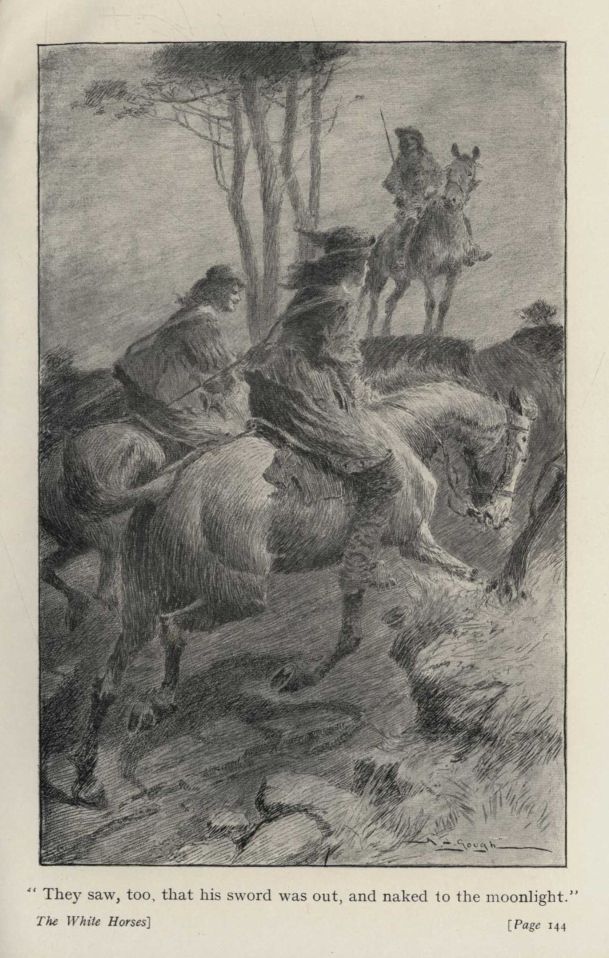
"They saw, too, that his sword was out, and naked to the moonlight."
"A Mecca!" panted Blake's companion.
"Cousin does not slay cousin," said the man on the hill-top, rattling his sword into the sheath again. "Have they found Rupert?" The second rider was given his errand briefly and without waste of breath. Then he flicked his horse, and Blake was tempted to follow him, too. There was something uncanny, some hint of mystery and deep, resistless strength about this picketing of the road north. Blake had a quick imagination; he saw this chain of riders, linking York with Oxfordshire, spurring through a country fast asleep—only they and the moon and the nightingales awake—until, kinsman passing the message on to kinsman at each two-miles stage, the last rider came in with his tale of "Boot and saddle."
Indeed, Blake urged his mare to follow the second horseman; but she was reluctant, and was sobbing under him after the headlong gallop.
"I had forgotten. She has carried me from Oxford already," he said, turning to his companion.
"She's a good little mare," said Metcalf, with instinctive judgment of all horseflesh. "She will have time to rest if you're minded to share the waiting time with me."
"Your five days and a half?" laughed the other, as they returned at a quiet pace to their first meeting-place. "Yes, I shall stay, if only to claim my wager. It is not in human power for your company to muster in the time."
"It is a game we have played often during these last months. Lord Fairfax, in the north, swears there's witchcraft in it, because we have carried news from York to Skipton, from Skipton into Lancashire, while single messengers were spurring half-way on the road."
"I am a messenger of the lonely sort," put in Blake—with a touch of spleen, for he was tired. "Well, I propose to see what comes of your new way of galloping."
"The first that comes"—Metcalf yawned and stretched himself with an air of complete strength and bodily content—"will be my Cousin Ralph, who took the message on just now. When he has passed it on, he rides hitherto. We may expect him in a half-hour or so."
Blake, himself something of a mystic, who rode fine errands by help of no careful planning, but by intuition, was interested in this man, who stood for the Metcalf thoroughness, in detail and in hot battle, that had made their name alive through England. He learned, here in the moonlight, with the jug-jug of nightingales from the thickets on their right, and the stir of moths about their faces, how carefully the old Squire had planned this venture. The clan was a line of single links from Oxford to the north, so long as the message needed to be carried swiftly; but afterwards each messenger was to ride back along the route to Banbury, until the company mustered on its outskirts grew big enough to hold attack from the town in check.
As they talked, and while Metcalf was pushing tobacco—borrowed, like the snuff, from Blake—into the bowl of a clay pipe, there came a little sound from up the road. It was a rhythmical, recurrent sound.
"That is my Cousin Ralph," said Metcalf unconcernedly.
The music grew louder by degrees, till the din of nightingales was lost in the rat-a-tat of hoofs.
"The first to the tryst," laughed Blake, as the new-comer dismounted and picketed his horse close to their own. "We have a wager that your folk will not be in Oxford within five days and a half."
"For my part," said Ralph, "I have a hunger that eats inwards. Have you found nothing for the larder, cousin, all this time of waiting?"
Will Metcalf had, as it happened. Near sundown he had set two traps—simple contrivances of looped wire—in a neighbouring rabbit burrow; and, a little while before Blake rode out from Banbury, he had dismounted to find a coney in each snare.
"We shall do well enough," said Will.
Again Blake was astonished by the downrightness of these people. Ralph, who had not tasted food since noon, was sure that his cousin would have made due provision. Methodically they sought for a likely hollow, screened from the rising wind, gathered brushwood and fallen branches, and made a fire. While it was burning up, they skinned and cleaned the rabbits.
"Gentlemen," said Blake, while their meal was in the cooking, "do you give no homage to the god known as chance? All is planned out, from here to York; but I've travelled the night-roads—have them by heart, as a man knows the whimsies of his wife. Suppose some of your men were thrown badly, or killed by Roundheads, how would it fare with the message up to York?"
Ralph Metcalf turned the rabbits with nice regard for the meal overdue. Then he glanced up. "If there was a gap of four miles, instead of two, the rider would gallop four. If he found another dead man at the next stage, he would gallop six."
So then Blake laughed. "We are well met, I think. I was jealous of your clan, to be candid, when I was told their speed put us poor night-riders to shame. Yet, friends, I think we carry the same loyalty."
Their meal was scarcely ready when again there came the fret of distant hoof-beats. Another giant joined their company. In face and sturdiness he was like the rest; but he happened to be six-foot-four, while his kinsmen here were shorter by two inches. He, too, was hungry.
"That's good hearing," said Ralph. "I was puzzling how to carve two rabbits into three, but it's easy to split them into twice two."
"Half a coney to feed my sort of appetite?"
"Be content. If it had not been for Will here we'd have had no food at all."
The newcomer drew a bottle from the pocket of his riding-coat. "I forget whether I stole it or paid honest money. It's a small bottle, but it will give us the bite of the northern winds again."
When they had ended this queer supper, and had borrowed from the store of tobacco that to Blake was better than a meal, they fell into silence. The languorous beauty of the night wove its spell about them; and the fourth Metcalf, when he rode in presently, jarred them roughly out of dreams. The newcomer, as it happened, had contrived to snatch supper while he waited, six miles further north, to take on the message. He did not ask for food; after picketing his horse, he just wrapped himself in the blanket hastily unstrapped from saddle, turned over once or twice in a luxury of weariness, and snored a litany to the overarching heavens.
Through that night Blake did not sleep or ask for slumber. The nightingales were tireless, as if their throats would break unless they eased them. The Metcalf riders were tireless, too. At longer and at longer intervals they came in from the north, their horses showing signs of stress. Two miles from outpost to outpost was a trifling distance; but, before the last of that night's company joined the muster here at Banbury, he had travelled forty miles.
Blake lay, his face to the moonlight, and could not stifle memory. The sleepy fragrance, the scent of moist earth and flowering stuff, took him, as by sorcery, to a walled garden in Knaresborough and a summer that had been, and the end of blandishment. There had been no nightingales—it lay too far north, that garden, to tempt them—but a stronger song had stirred him. And there had been the same lush smell of summer, the same hovering of bats across the moon's face.
It was as if she sat beside him again—they two listening to the ripple of Nidd River far below—and her voice was low and tender as she chided him for love-making. There had been other meetings—stolen ones and brief—and all the world a-maying to Blake's view of it.
He would not let the dream go—played with it, pretended he had not learned long since what it meant to love a light-of-heart. Her face, of the kind that painters dote on when they picture maiden innocence, the shifting play of light and colour in her eyes, the trick she had of making all men long to be better than they were—surely he could rest this once from many journeyings, and snatch another stolen meeting, there in Knaresborough, with all the roses blowing kisses to them.
As he lay there, the two Metcalfs who were sentrying their little camp grew tired of pacing to and fro, each on his own short beat, and halted for a gossip. Blake did not heed them until they began to talk of Knaresborough, of Michael's dash into the Castle, of a Mistress Bingham he had met there.
"Michael met his match for once," laughed one sentry. "You know his gift of finding the finest eyes in England housed under every other woman's brows? Well, Mistress Demaine plays a good game at hearts, too, they say. Michael was touched in earnest this time. Oh, the jest of it!"
"It would be a better if they began by playing, and ended with the silken noose. Can you picture Michael wedded—Michael, with cut wings and drooping comb, seeking no more for fairest eyes?"
Blake left his dreams as if they scorched him. So Mistress Bingham had been two years ago; so she would be, doubtless, when the King had come to his own again, and had reigned long, and passed on the crown. There is a stability about inconstancy, Blake realised.
He got to his feet, crossed to where the sentries stood, and yawned. "Gentlemen," he said, "I cannot sleep for hunger; and there will be others in my case before the night ends. Can I borrow two of your company to make up a forage-party?"
One of the sentries pointed to a distant belt of wood, high up against the sky. "When dawn rides over the trees yonder, our watch is ended. We'll join you, Mr. Blake, if only because you have the most diverting laugh I ever heard, except Michael's when he's seen a pair of pretty eyes."
A half-hour later they kicked the fresh sentries out of sleep. Then Blake and they went up the pasture-lands on foot. It was a good night for foraging; every pitfall of the ground, every farmstead sleeping in the bosom of its guardian trees, showed clear in the dawn-light. And none of the three men had qualms about the business, for the Banbury country, through and through, was traitorous to the King.
They returned two hours later in high spirits. The Metcalfs asked for a good deal of feeding, after a night in the open had set a razor-edge to appetite; and the scouting-party had commandeered a farmer's horse and gig to bring their booty into camp.
"Who goes there?" snapped the sentries, running to meet this intrusion on the night's quiet.
"A Mecca, lad," laughed the driver, "bringing fowls and cheese, and good home-cured bacon—ay, and a little barrel of rum that nearly bounced out o' the gig when I came to a rutty place in the road."
"'Twould have been a pity to have lost the rum. Where are Blake and your cousin Nicholas?"
"Oh, following! The gig would not hold us all. As for Blake, he has few cares in life. Not one to have his heart touched by a woman—he. He laughs by habit, till you're forced to laugh with him."
CHAPTER XI.
BANBURY CAKES.
At Oxford, there was expectation threading the routine of Court life. The fine light of devotion to lost causes—causes lost because they were ever too high for mean folks' understanding—had cradled this good city. Chivalry, the clean heart and the ruddy, fervid hope, had built her wonderland of colleges and groves and pleasant streets. Men of learning, of passionate fervour for the things beyond, had lived and died here; and such men leave about the place of their bodily sojourn a living presence that no clash of arms, no mire of human jealousies, can overcome.
For this reason, all Oxford awaited the coming of the Metcalfs. They in the north—men well content, not long ago, to follow field-sports and the plough—were different in breed and habits from these folk in the comely city. But, in the matters that touch dull workaday into a living flame, they were of the same company—men who hoped, this side or the other of the veil, to see the Standard floating high above life's pettiness. And, for this reason, Oxford waited the Metcalfs' coming with an expectancy that was oddly vivid. The gamesters of the Court wagered heavily as to the hour of their arrival. Grave dons, who happened to be interested in the mathematics more in favour at the sister University, drew maps of the route from Banbury to York, calculated the speed of messengers spurring at the gallop north, and the return pace of riders coming south on horses none too fresh. These had recourse to algebra, which seemed only to entangle the argument the more.
Queen Henrietta Maria and the ladies of the Court made no calculations. Michael and Christopher were here, big, wind-browned men, who seemed unaware that they had done anything worth praise; and the Queen, with her French keenness of vision, her late-learned English view of life, knew that two gentlemen had come to Oxford, men made in the image of chivalry, ready to live or die with gallantry.
So the two brothers were spoiled outrageously, until, on the second day, Kit was despatched alone to Lathom House in Lancashire.
"Take all the quieter byways," said Rupert, as he saw him get to saddle. "Tell the Lady of Latham to hold out a little longer. And tell her from me, Well done!"
Rupert sighed as he turned away. He was fretting to be at Shrewsbury, raising his company for the relief of York; but he was kept in Oxford here by one of those interminable intrigues which had hampered him for months past. The older men whose counsel the King trusted—Culpepper, Hyde, and the rest—were jealous of Rupert's conspicuous genius for warfare. The younger men were jealous of the grace—a grace clean-cut, not foppish, resolute—which endeared him to the women of the Court. He was accused of treachery at Bristol, of selling his honour for a sum of gold; it was said that he dallied here in Oxford for reasons known to the Duchess of Richmond. No lie was too gross to put in circulation, by hint, or question, or deft innuendo. Day by day, hour by hour, men were dropping poison into the King's ear and the Queen's; and at the Councils, such as this that kept him here just now, he saw across the table the faces of men obstinately opposed to him. Whatever he suggested was wrong because he was the spokesman; whatever was in blunt contradiction to his view of the campaign was applauded. The Duke of Richmond, his friend and ally, was with him, and one or two younger men who had no gift of speech in these times of stress. For the rest, he was alone, a man of action, with his back to the wall in a battle of tongues.
He carried himself well enough even to-day, when the meeting was more stormy than usual. His dignity was not a cloak, but an inbred strength that seemed to grow by contact with adversity.
"So, gentlemen," he said, at the close of the Council, "you have had your way so far as talk goes. Now I have mine. I hold a commission from the King to raise forces for the relief of sundry garrisons. I shall relieve those garrisons in my own way. Meanwhile, you may hold Councils without number, but I would recommend tennis to you as a healthier pastime."
They watched him go. "The d—d young thoroughbred!" spluttered Culpepper. "We'll get a bit between his teeth, one of these days, and teach him discipline."
Rupert made his way across the High Street, a curious soreness at his heart. Discipline? He had learned it in his teens—the self-restraint, the gift of taking blows and giving them with equal zest. But this new school he was passing through was harsh, unlovely. There was York, waiting for relief; there was Lathom House, defended with courage unbelievable by Lady Derby and a handful of hard-bitten men; there were twenty manors holding out in hope of the succouring cavalry who did not come; and he was kept here to attend a Council, to listen to veiled jealousy and derision, when all he asked for was a horse under him and grace to gather a few thousand men.
As he neared Christ Church, intent on seeking audience of the King, and stating frankly his own view of his enemies, he encountered Michael Metcalf crossing hurriedly from a side street.
"Well, sir?" he asked, with a sense of friendship at sight of a man so obviously free of guile. "Have they done wagering in Oxford as to the hour your kinsmen ride in?"
"I think the play runs even faster. Some learned dons have brought the heavy guns of algebra to bear on it, and all the town is waiting for their answer to the riddle."
"All's topsy-turvy," laughed the Prince. "If dons have taken to giving the odds on a horserace, where will Oxford end? But you were hurrying, and I detain you."
Michael explained that the King had commanded his presence at the Deanery; and the other, after a brief farewell, turned on his heel. After all, his own business with the King could wait until this reigning favourite in Oxford had had his audience.
Just across the way was Merton, where the Queen's lodging was. Rupert had had his fill of disillusion and captivity here in the loyal city; he was human, and could not hide for ever his heartache to be out and doing, lest it ate inward with corrosion. He crossed to Merton, asked for the Queen, and was told that she had gone out a half-hour since to take the air. The Duchess of Richmond was within, he learned in answer to a second query.
The Duchess was stooping over a table when he was announced. She added a few quick strokes to the work she was engaged on, then rose.
"You, my Prince?" she said, with frank welcome. "You come from the Council? I hoped that you would come. Were they as always?"
"My lord Cottington's gout was at its worst, and he in the same mood as the disease. Digby's mouth was more like a Cupid's bow than ever, and he simpered well-groomed impertinences. How I loathe them, Duchess."
"You would."
She turned for a moment to the window, looked out on the May sunlight and the dancing leaves. All the vigour of their loyalty to the King—her husband's and her own—all the dreams they had shared of monarchy secure again, and rebellion trampled underfoot, were summed up in Rupert's person. He had done so much already; he was resolute to go forward with the doing, if the curs of scandal and low intrigue would cease snapping at his heels.
She turned from the window. "My Prince," she said, touching his arm with the grace that gives courage to a man, "you do well to come here for sanctuary between the pauses of the battle. If you knew what my husband says of you, if you guessed the many prayers I send you——"
The keen, happy smile broke through from boyhood's days. "Duchess," he said very simply, "I am well rewarded. What were you busy about when I intruded?"
She showed him her handiwork. "One must do something these dull days," she explained, "and it was you who taught me this new art of etching. Am I an apt pupil?"
Rupert looked at the work with some astonishment. The art was in its infancy, and difficult; yet she had done very well, a few crudities apart. The etching showed a kingfisher, triumphant on a rock set in midstream; at its feet lay a half-eaten grayling.
"It is not good art, because it is an allegory," she explained, with the laughter that had been oftener heard before the troubled days arrived. "You, my Prince, are the kingfisher, and the grayling the dull-witted fish named Parliament."
At the Deanery Michael was in audience with the King, whose imagination had been taken captive by the exploits of the Riding Metcalfs, by the stir and wonderment there was about the city touching the exact hour of their coming. Michael, because wind and hazard in the open had bred him, carried himself with dignity, with a reverence rather hinted at than shown, with flashes of humour that peeped through the high gravity of this audience. He explained the wagering there was that York would be relieved, spoke of the magic Rupert's name had in the north. At the end of the half-hour the King's face was younger by ten years. The distrust of his nephew, wearing faith away as dropping water wears a rock, was gone. Here, by God's grace, was a gentleman who had no lies at command, no private grudge to serve. It was sure, when Michael took his farewell, that the commission to raise forces for the relief of York would not be cancelled.
The King called him back, bade him wait until he had penned a letter. The letter—written with the sense that his good angel was looking over his shoulder, as Charles felt always when his heart was free—was a simple message to his wife. He had not seen her for a day, and was desolate. He could not spare time to cross the little grove between this Merton, because he had letters still unanswered but hoped to sup there later in the day. He was a fine lover, whether of Church, or State, or the wife who was lavender and heartsease to him; and, after all, they are three kingly qualities.
He sealed the letter. "You will be so good as to deliver it into the Queen's hand, Mr. Metcalf; there may be an answer you will bring."
Michael, when he knocked at the gate of Merton, was told the Queen was abroad. He said that he would wait for her return; and, when the janitor was disposed to question, he added that he came direct from the King, and, if he doubted it, he would pitch him neck and crop into the street. He was admitted; for the janitor, though sturdy, was six inches shorter.
When he came into the room—that would have been gloomy between its panelled walls, if it had not been for the sunlight flooding it with gold and amber—he saw Rupert and the Duchess of Richmond standing near the window. Sharp, like an east wind from Knaresborough, where he had marked time by dalliance with pretty women, he heard Miss Bingham's voice as she bade him, when he came to Oxford, ask Rupert how the Duchess of Richmond fared.
Michael did not need to ask. With a clean heart and a conscience as easy as is permitted to most men, he saw these two as they were—loyal woman helping loyal man to bind the wounds that inaction and the rust of jealousy had cankered.
"By your leave," he said, "I have a letter for the Queen."
"It will be safe in my hands, Mr. Metcalf."
The Prince was surprised by the other's gravity, his air of perplexity. "I would trust all I have to you," said Michael, "all that is my own. But this letter is the King's, and he bade me give it to the Queen herself. I can do no less, believe me."
"Sir," said Rupert coldly, "you risk your whole advantage here at Court—make me your enemy for life, perhaps—because you stand on a punctilio the King himself would not ask from you."
The Duchess watched the faces of these men. Michael had been the laughter-maker in the midst of disastrous days; his gift of story, his odd susceptibility to the influence of twenty pairs of bright eyes in a day, had made him a prime favourite. Now he was as hard and simple-minded as his brother Christopher. She approved the man in his new guise.
"I stand on the strict command the King gave me," said Michael quietly. "Sir, how could a man do otherwise?"
Rupert turned suddenly. "Duchess," he said, "we stand in the presence of a man. I have tried him. And it always clears the air, after Councils and what not, to hear the north wind sing. I wish your clan would hurry to the muster, sir, if they're all as firm as you are for the King."
An hour later the Queen returned, read the letter, penned a hasty answer. "Ah, it is so good to see you, Monsieur Metcalf, so good! You have the laughter ready always—it is so good to laugh! There is—what you call it?—too much salt in tears, and tears, they fall so quick if one allows it. Now, you will tell me—before you take my letter—when does your big company ride in? Some say to-day, others two, three days later. For myself, I want to see your tall men come. They will make light the King's heart—and he so triste—ah, croyez-vous that he is triste!"
With her quick play of hands and features, her pretty broken English, the air of strength and constancy that underlay her charm, the Queen touched Michael with that fire of pity, admiration, selfless love, which never afterwards can be forgotten. She had bidden him laugh, lest for her part she cried. So he made a jest of this ride of the Metcalfs south. He drew pictures, quick, ludicrous pictures, of men calculating this queer game of six-score men travelling fast as horseflesh could bring them to the loyal city. He explained that he alone had the answer to the riddle, because he was unhampered by Christopher's obstinacy on the one hand, by the grave algebra of dons on the other. All Oxford had been obsessed by the furious gallop of horsemen north between stage and stage. They could reach York in fifteen hours. It was the return journey, of units gathering into companies, of companies resting their horses when need compelled, that fixed the coming of the White Horses into Oxford. And the last of these—the one mustered nearest York—was of necessity the one that guided the hour of coming.
In the north ride, speed and road-dust under the gallop; in the canny muster toward the south, a pace of tiresome slowness.
"How long since we came in, Christopher and I?" asked Michael.
"Six days," said Rupert. "They's been leaden days for me, and so I counted them."
"Then look for our folk to-morrow, somewhere between dawn and sunset."
On the northern road, beyond Banbury, there had been a steady muster of the Metcalfs day by day. Blake, the night-rider, watched the incoming of these northern men—each day a score of them, big on their white horses—with wonder and a keen delight. Those already mustered were so sure of the next day's company; and these, when they rode in, carried the same air of buoyancy, of man-like hardihood and child-like trust.
A new, big dream was stirring round Blake's heart. Six days ago he had lain awake and heard two sentries talk of Miss Bingham, of the coquetry she practised still in Knaresborough, and his old wound had opened. He had staunched the bleeding with prompt skill; and now his heart was aching, not for fripperies over and done with, but for the thing that Oxford was to see, if all went well. He had ridden out to spur the first Metcalf forward with his message to the north. He would bring this gallant company into the city—he, small of body, used only to the plaudits of barn-owls and farmhouse dogs as he galloped over hill and dale on lonely errands—he would come into the full sunlight of Oxford's High Street with the stalwarts he had gathered in.
There's no stimulus so fine as a dream nurtured in good soil. Blake went foraging by day, taking his share of other camp work, too; and, when his sleep was earned o' nights, he lay watching the stars instead and pictured this good entry into Oxford. The dream sufficed him; and, unless a man can feel the dream suffices, he might as well go chewing pasture-grass with other sleepy cattle.
On the sixth evening, when a grey heat-mist was hiding the sun an hour before his time, the last of the Metcalfs came in, the old Squire of Nappa at their head. And Blake put a question to the Squire, after they had known each other half an hour—a question that none of the others had known how to answer, though he had asked it often. "We have had excursions and alarms from Banbury, sir—a few skirmishes that taught them the cost of too great inquisitiveness—and I asked your folk why we gathered here, instead of skirting a town so pestilent."
"They did not tell you," chuckled the Squire, "because they could not, sir. I am used to asking for obedience. My lads learn the reason later on. But you shall know. I shall never forget, Mr. Blake, that it was you who brought me in my old age to the rarest frolic I ever took part in."
He explained, with a jollity almost boyish, that Banbury was notorious in Northern gossip as a hotbed of disloyalty, its folk ever on the watch to vex and hinder Oxford. So he proposed to sweep the town as clean as might be before riding forward.
Soon after dawn the next day, men and horses rested, they set about the enterprise. The sentry posted furthest north of Banbury ran back to give word that the camp was astir; the soldiers and townsmen, not knowing what was in the mind of this company that had been gathering on its borders these six days past, got to arms and waited. And then they heard a roar, as it were of musketry, as the Metcalfs gave their rally-call of "A Mecca for the King!"
There was no withstanding these men. They had more than bulk and good horses at their service. The steadfastness that had brought them south, the zeal that was like wine in their veins, made them one resistless whole that swept the street. Then they turned about, swept back again, took blows and gave them. The Banbury men were stubborn. They took the footman's privilege, when matched against cavalry, of trying to stab the horses; but the Metcalfs loved the white horses a little better than themselves, and those who made an essay of the kind repented it.
At the end of it Squire Metcalf had Banbury at command. "We can breakfast now, friends," he said, the sweat streaming from his jolly face. "I told you we could well afford to wait."
His happy-go-lucky prophecy found quick fulfilment. Not only was the place rich in the usual good food dear to the Puritans, but it happened that the wives of the town had baked overnight a plentiful supply of the cakes which were to give Banbury its enduring fame. "They're good cakes," laughed the Squire of Nappa. "Eh, lads, if only Banbury loyalty had the same crisp flavour!"
CHAPTER XII.
PAGEANTRY.
Oxford was keeping holiday. The Queen, sure that her husband was facing trouble at too short a range, persuaded him—for her own pleasure, she asserted—to hold a pageant in a field on the outskirts of the city. It was good, she said, that well-looking cavaliers should have a chance of preening their feathers until this dull waiting-time was over—good that tired ladies of the Court should get away from men's jealousies and wrangles, and air their graces. So a masque had been written and arranged within a week, the zest in it running side by side with the constant expectation of the Metcalfs' coming.
The masque was fixed for twelve o'clock; and, an hour before noon, the company of players began to ride up the High Street on their way to the playing field. Mary of Scots passed badinage with a Franciscan friar as they rode in company; a jester went by, tickling Cardinal Wolsey in the ribs until the great crowd lining either side the street laughed uproariously. The day was in keeping with it all—sunlight on the storied houses, lush fragrance of the lilac, the song of birds from every branch of every tree.
From up the street there came, sudden as a thunder-clap, the clash of horses' feet. The masqueraders drew aside, to right and left, with little heed for wayfarers. And down the lane, bordered thick with faces, there came a band of men who did not ride for pageantry.
In front of them—he had been thrust into leadership by the Squire of Nappa, who had guessed his ambition and his dream—rode a little man on a little, wiry mare. Blood was dripping from a wound on his cheek; his right arm hung limp. He did not seem to be aware of all this disarray, but rode as a conqueror might do. The dream sufficed him.
A draper in the crowd, whose heart was bigger than the trade that hemmed him in, raised a strident cry: "Why, it's little Blake! Wounds over him, from head to foot—but it's little Blake."
And then Blake's dream came true. To the full he tasted the incense of men's praise, long worked for, yet unsought. All down the High Street the running murmur went that Blake was here; and the people saw his wounds, the gay, courageous smile in answer to their greeting, and their cheers redoubled.
The pageant-makers, thrust aside by the steady, uncompromising trot of the Metcalfs, lost their first irritation—forgot the boredom that had settled on them during these idle days—and raised a cheer as lusty as the townfolks'. The street was one sunlit length of white horses moving forward briskly, four by four; the big men on them were white with dust, and ruddier splashes of the warfare at Banbury showed here and there. It was as if the days of old were back again, and Northmen riding, with a single heart and purpose, to a second Flodden. They moved, not as six-score men, but as one; and when the old Squire drew rein presently, they, too, pulled up, answering the sharp command as a sword answers to the master's hand.
"By your leave, sir," said the Squire, "we come in search of Prince Rupert. Can you direct us to his lodging?"
It happened that it was Digby he addressed—Digby of the soft voice, the face like a cherub's, and the tongue of an old, soured woman. "I could not say," he answered. Of all the Cavaliers there, he only was unmoved by the strength and fine simplicity of these riders into Oxford. "If I were aware where the Duchess of Richmond is to be found, I could direct you."
A stormy light came into the Squire's grey eyes. "We have heard of the Duchess. Her name is fragrant in the North, sir, save where ostlers gather at the tavern and pass gossip on for gaping yokels."
"Countered, you dandy!" laughed Digby's neighbour. "Grooms in Oxford and grooms in the North—hey, where's the difference?"
"We shall prove it, sir, at dawn to-morrow," said Digby, his hand slipping to his sword-hilt.
"Oh, content. I always liked to slit a lie in two, and see the two halves writhe and quiver."
The Squire of Nappa, looking at these two, guessed where the danger of the King's cause lay. Men see clearly when heart and soul and purpose are as one. If two of his own company had offered and accepted such a duel openly, he would have taken them, one in either hand, and knocked their heads together, in the interests of discipline. In Oxford, it seemed usual that private differences should take precedence of the King's service, and the Squire felt chilled for the first time since he rode out from Yoredale.
Prince Rupert had shared a late breakfast with the Duke of Richmond and the Duchess, who was, in heart and soul, a great lady beyond the reach of paltry malice. Rupert was moody, irritable. He was sick for pageantry in the doing—gallop of his cavalry with swords glancing on Roundhead skulls—blows given for the health of the reigning King, instead of play-acting to the memory of buried monarchs. He was passionately disdainful of this pageant in which he was to play a part, though at the moment he was donning mediaeval armour.
"I should have held aloof from it all," he protested.
"No," said the Duchess. "There could have been no pageantry without you. Believe me, it is good for us to have action, if only in the playing—it lights dull days for us."
Rupert strode up and down the floor with his restless, long-legged stride. "I'm to figure as Richard the Crusader," he said, tired of himself and all things. "I ask you, friends, do I show like a Crusader?"
"Your temper of the moment does not, but a man's past goes with him," she broke in, with her soft, infectious laugh. "Of all the King's gentlemen I know, my husband here, and you, stand nearest to the fine crusading days. To please us both, you will play your part?"
Rupert was beyond reach of blandishment. There was a fire from the over-world about him; men and women grew small in the perspective, and only the vigour and abiding zeal he had for the King's service remained to guide him, like a taper shining through a night of trouble.
"Friends," he said, simply as a child, "I had a dream last night. I dreamed that prayers were answered at long last, and that the sea rode into Oxford—a gallant sea, creamed with white horses riding fast."
"How should that be?" laughed the Duke. "It was a tired man's dream."
"It was more," said Rupert sharply. "It was a true vision of the days to come. I tell you, the white horses rode into Oxford like a crested sea. I knew they came to help me, and I grew tired of pageantry." He smiled at his own gravity, and reached out for his Crusader's sword. "Come," he broke off, "Coeur de Lion should be punctual to the tryst."
They came into the High Street, the three of them; and Rupert checked his horse with a thrill of wonderment. Not until now had he guessed what the strain of these last idle days had been. He saw the gallant sea ride into Oxford, as in his dream—saw it ride down to meet him, creamed with white horses moving at the trot. He was a free man again.
And then the crowd's uproar ceased. They saw Rupert, their idol, spur forward sharply, saw the company of Metcalfs halt as one man when their Squire drew rein.
"You are the Metcalfs, come from York, I think," said Rupert. Ten years seemed lifted from him in a moment. "Gentlemen, we've waited for you. The King will make you very welcome."
"We came to find Prince Rupert," said the Squire of Nappa, uncovering, "and, God be thanked, I think we've found him. You are like my picture of you."
The Squire's errand was accomplished. By hard stages, wakefulness o' nights, banter or the whiplash of his tongue by day, he had brought these high-mettled thoroughbreds into Oxford. It was a relief to take orders now, instead of giving them.
"Sir, they're asking for pageantry in Oxford," said the Prince, "and, by Richard Coeur de Lion, they shall have their fill. Permit me to command your troop."
The Duchess, not for the first time, was surprised by the right-to-be-obeyed that Rupert carried with him. Instinctively the Metcalfs made a lane between their sweating horses, and she found herself riding through the pleasant reek of horseflesh until they came to the end of this long avenue of men.
Rupert was himself again—no longer an idler, exchanging growls with enemies in Council, but a man, at the head of the finest cavalry even his proved judgment had encountered so far. When they came to the pageant field, he bade them dismount and do as they pleased for an hour; at the hour's end they were to be ready and alert.
When the King arrived by and by with his Queen, a great wave of loyalty went put to greet them. However it fared with his shifting fortunes, he was here among friends, and knew it. The knowledge was heartening; for Charles had gone through bitter struggle to keep an unmoved face when all he loved seemed racing to disaster.
The pageant moved forward; but the crowd was lukewarm until Richard the Crusader came, and then they went mad about the business.
"How they love him!" said the King, his face flushed with pleasure.
The Queen touched him on the arm as only wives do who have proved their men. "And you—how the good city loves you! To have captured Oxford's heart—ah, will you not understand how big your kingdom is? In London—oh, they are shopkeepers. In Oxford there is the great heart beating. Gain or loss, it does not matter here."
When the Crusading scene was ended, and while some affair of royalty granting a Charter to dull-witted burgesses was in the playing, Rupert came to the King's side. "There's a modern episode to follow, sir, if you are pleased to watch it."
"Ah, no!" pleaded the Queen, with her pretty blandishment. "It would be a pity, Rupert, to be less than Coeur de Lion. The armour fits you like a glove."
"I think you lived once in those days, Rupert of the fiery heart," laughed the King; "but no man thrives on looking back. Go, bring your modern mummers in!"
Rupert brought them in. He doffed his mediæval armour somewhere in the background of the field, and donned the raiment he liked better.
"Are you ready, Metcalfs?" he asked, pleasantly.
With the punctilio that was part of the man, he insisted that the Squire of Nappa should ride beside him at the head of this good company. They thundered over the field, wheeled and galloped back. It was all oddly out of keeping with the pageantry that had gone before. In playing scenes of bygone centuries men gloss over much of the mud and trouble of the times; but here were six-score men who had the stain of present traffic on them.
The King himself, grave and reticent since the troubled days came, clapped hands as he watched the sweeping gallop, the turn-about, the precision of the troop when they reined in and saluted as if one man had six-score hands obeying the one ready loyalty. But the Queen grew pitiful; for she saw that most of these well-looking fellows carried wounds and a great tiredness.
"What is this scene you play?" asked the King.
"Sir, it is the Riding Metcalfs, come to help me raise recruits for the relief of York. Coeur de Lion died long ago, but these Northmen are alive for your service."
"My thanks, gentlemen," said Charles. "By the look of you, I think you could relieve York without other help."
Rupert pressed home his point. "Grant us leave, sir, to go wide through Lancashire and raise the siege of Lathom first. My Lord Derby was here only yesterday, after long travel from the Isle of Man."
The Queen, knowing how persistently Lord Derby had been maligned, how men had poisoned the King's mind against him, caught Rupert's eye and frowned at him. His nimble wit caught the challenge and answered it.
"Sir," he said, with the swiftness and assurance of a cavalry attack, "remember Lady Derby there at Lathom. She has held out for weary months—a woman, with a slender garrison to help her—has held out for the honour of the Stuart. Give me my Metcalfs, and other troops to raise, and grant us leave to go by way of Lathom House."
The King smiled. "I thought you a fighter only, Rupert. Now you're an orator, it seems. Go, rescue Lady Derby; but, as you love me, save York. There are only two cities on the map to me these days—York and Oxford. The other towns count loss and gain, as tradesmen do."
Long stress of misunderstanding, futile gossip of courtiers unemployed, dripping poison into the King's mind, were swept away. "As God sees me, sir, I ride only for your honour. The Metcalfs ride only for your honour."
"Ah, Coeur de Lion," laughed the King, "have your own way of it, and prosper."
At Lathom House, three days ago, there had been a welcome addition to the garrison. Kit Metcalf—he of the sunny smile, because he loved a maid and was not wedded to her whimsies yet—had ridden to the outskirts of the house, had dismounted, left his horse to roam at large, and had crept warily through the moonlight that shone on sleeping men and wakeful sentries. On the left of the moat, near the rounded clump of sedge that fringed its turning, he saw two sentries chatting idly between their yawns.
"It's a poor affair, Giles, this of keeping awake to besiege one woman."
"A poor affair; but, then, what could you look for from an officer of Rigby's breed? Sir Thomas Fairfax had no liking for the business. We've no liking for it."
Kit ran forward through the moonlight, gripped them with his right hand and his left—neither hand knowing just what the other was doing—and knocked their skulls together with the strength given him by Providence. They tumbled forward over the brink of the moat, and Kit himself dived in.
When he came to the water's top again, he swam quietly to the further bank, then went in great tranquillity up the grassy slope that led him to the postern gate, and was surprised when he was challenged sharply. Remembering what he had gone through for the Stuart, he thought, in his simple country way, that comrades of the same breed would know him, as dog knows brother-dog, without further parley. When he was asked who went there, his temper fired, though the wet of his crossing should have damped its powder.
"A Mecca for the King, you wastrel! Have you not heard of us?"
"By your leave, yes," said the sentry, with sudden change of front. "All Lancashire has heard of you. What is your business here?"
"To see Lady Derby instantly."
He was passed forward into the castle, and a grey-headed man-servant came to meet him. Again he said curtly what his business was.
"It is out of question, sir," the man protested. "My lady has had three sleepless nights. She gave orders that she should not be roused till dawn, unless, indeed, there was danger from the enemy."
Kit was headstrong to fulfil his errand to the letter. "Go, rouse her!" he said sharply. "I come from the King at Oxford, and my news cannot wait."
CHAPTER XIII.
THE LADY OF LATHOM.
All folk, even grey and pampered servants, obey the ring of true command in a man's voice; and after Kit had waited for what seemed a week to his impatience, a great lady came down the stair and halted at a little distance from him, and looked him up and down. Her face was lined with trouble; there were crows'-feet about her eyes; but she was dressed fastidiously, and her head was erect with challenge.
"Well, sir?" she asked sharply. "You rob me of sleep for some good reason, doubtless. Sleep? You could have asked no dearer gift. But the King himself commands, you say?"
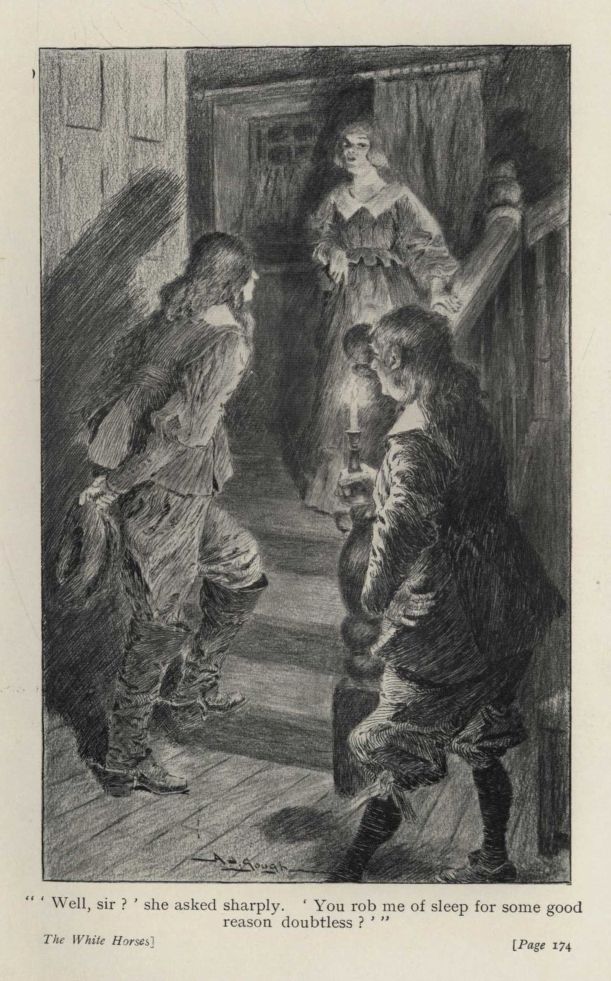
"'Well, sir?' she asked sharply. 'You rob me of sleep for some good reason doubtless?'"
Kit faced her ill-temper, and she liked him for it.
"My lady," he said, "Prince Rupert bids me tell you that he comes your way, for the relief of Lathom. He bids me tell you that Lathom House has lit a fire of loyalty from one end to the other of your county."
"So Rupert comes at last?" she asked eagerly.
"As soon as he can gather forces. Meanwhile, he sends me as his deputy, and that's one more sword-arm at your service."
Again she looked him up and down; and smiled. "I like big men. They help to fill this roomy house I'm defending for my husband and the King—for the King and my husband, I should say, if I were not a better wife than courtier."
Kit, for his part, could not take his eyes away from her. Two women of the breed he had seen before, and two only—the Queen, with courage gloved by French, disarming courtesy, and the downright mistress of Ripley Castle. As Lady Derby stood there, the traces of her twelve months' Calvary were apparent, because she had been roused suddenly from sleep, and pride had not asserted full control as yet. Under her tired eyes the crows'-feet showed like spiders' webs; her face was thin and drawn; and yet there was a splendour about her, as if each day of each week of hardship had haloed her with grace. She was, in deed as in name, the great lady—so great that Kit felt dwarfed for a moment. Then his manhood returned, in a storm of pity to protect this woman.
"Go sleep again," he said. "I was wrong to rouse you with my news."
She laughed, low and pleasantly, like a breeze blowing through a rose-garden. "I slept with nightmares. You are forgiven for rousing me with news that Rupert comes."
Then she, too, saw how weary this Riding Metcalf was, and touched him on the arm with motherly admission of his tiredness. "You need food and wine, sir. I was thoughtless."
The grey old servant, standing like a watch-dog on the threshold, caught her glance, and came in by and by with a well-filled tray.
"Admit that we are well-provisioned, Mr. Metcalf. The siege has left some niceties of the table lacking, but we do well enough."
She nibbled at her food, intent on keeping his riotous appetite in countenance. By the lines in his face, by the temperate haste with which he ate and drank, she knew him for a soldier older than his years.
"Tell me how it sped with your riding from the North?" she asked.
"It went bonnily—a fight down Skipton Raikes, and into the market-place. Then to Ripley, and running skirmishes; and, after that, the ride to Oxford. I saw the King and Rupert, and all the prayers I ever said were answered."
"Oh, I'm tired here, waiting at home with gunshots interrupting every meal. Tell me how the King looked."
"Tired, as you are—resolute, as if he went to battle—and he bade me give you the frankest acknowledgment of his regard."
"Ah, he knows, then—knows a little of what we've done at Lathom?"
"He knows all, and Rupert knows."
On the sudden Lady Derby lost herself. Knowledge that the King praised her, sheer relief that the Prince was marching to her aid, came like rain about her, breaking up the long time of drought. Then she dried her eyes.
"I, too, have fought," she explained, "and have carried wounds. Now, sir, by your leave, are you rested sufficiently? Well, then, I need you for a sortie by and by."
From the boy's laughter, his sharp call to attention, she knew again that he was of the soldier's breed.
"Weeks ago—it seems years by now—this Colonel Rigby who besieges us planted a mortar outside our gates. Our men sallied and killed many, and brought the mortar in."
"Good," said Kit. "I saw it as I came through the courtyard, and wondered whether you or they had put it out of action."
"My folk put it out of action. And now they've brought up another mortar. We dare not let it play even for a day on crumbling walls. There's to be a sortie within the hour. One of my officers is dead, and two are wounded. Sir, will you lead a company for me?"
"Luck always comes my way," assented Kit.
"But you do not ask what strength you have to follow you?"
"What strength you can give me. I am at your service."
When Lady Derby mustered all she could spare from her slender garrison, Kit found himself the leader of twenty men, some hale enough, others stained with the red-rust that attends on wounds.
"Friends," he said, "the moon is up, and there's light enough to guide us in the open."
They liked him. He wasted no speech. He was mired with travel of wet roads, and his face was grey and tired, but they knew him, for they had seen other leaders spur them to the hazard.
Some went out through the main gate of Lathom, and waited under shadow of the walls. Others joined them by way of little doors, unknown to the adversary. They gathered, a battered company, led by officers half drunk with weariness, and ahead they saw the moonlight shining on the mortar, reared on its hillock.
Beyond the hillock a besieging army of three thousand men slept in security, save for the hundred who kept guard about the mortar. These five-score men were wakeful; for Colonel Rigby—a weakling cloaked in self-importance—had blustered round them an hour ago, had assured them that Lady Derby was the Scarlet Woman, known otherwise as Rome, and with quick invective had threatened them with torture and the hangman if they allowed this second mortar to go the way its predecessor had taken weeks ago. He had sent an invitation broadcast through the countryside, he explained, bidding folk come to see the mortar play on Lathom House to-morrow.
Through the dusk of the moonlight Kit and the rest crept forward. Quick as the sentry shouted the alarm, they were on their feet. They poured in a broadside of musketry at close range, then pressed forward, with swords, or clubbed guns, or any weapon that they carried. It was not a battle, but a rout. In ten minutes by the clock they found themselves masters of the field. The mortar was theirs, and for the moment they did not know what to do with it. From behind came the sleepy roar of soldiery, new-roused from sleep by the retreating guardians of the mortar, and there was no time to waste.
One Corporal Bywater, a big, lean-bodied man, laughed as he touched Kit on the arm. "Had a wife once," he said. "She had her tantrums, like yond mortar—spat fire and venom with her tongue. I cured her with the help of a rope's end."
Bywater, remembering the previous escapade, had lashed two strong ropes about his body, in readiness for this second victory. The cordage, as it happened, had saved him from a death-wound, struck hurriedly by a Parliament man. He unwrapped it now with a speed that seemed leisurely. Rigby's soldiery, from the moonlit slopes behind, buzzed like a hornet's nest. There was indeed no time to waste.
Christopher Metcalf was not tired now, because this hazard of the Lathom siege had captured his imagination. His soul was alert, and the travel-stained body of him was forgotten. Captain Chisenhall detached fourteen of the sortie party to drag the mortar into Lathom House. The rest he sent forward, raised a sudden shout of "For God and the King!" and went pell-mell into the first of Rigby's oncoming men. Though on foot, there was something of the dash of cavalry in this impetuous assault, and for a while they drove back the enemy; then weight of numbers prevailed, and Kit, his brain nimble, his heart singing some old pibroch of the hills his forefathers had tilled, entrenched his men on the near side of the earthworks Rigby had built to protect his mortar. There was some stark, in-and-out fighting here, until the Roundheads began to deploy in a half circle, with intent to surround Kit's little company. Then he drew back his men for a score yards, led a last charge, and retreated to the Lathom gateway in time to see the mortar dragged safely into the main courtyard.
When the gate was closed, and Kit came out of the berserk madness known as war, he saw the Lady of Lathom in the courtyard.
"But, indeed, sir, you've done very well," said she, moving through the press of men to give him instant greeting.
"It was pastime." Kit's voice was unsteady yet, his head swimming with the wine that drips, not from red grapes, but from the sword that has taken toll of human life. "We brought the mortar in."
"You did, friends. Permit me to say good-night. I have need to get to my knees, thanking God that he sends so many gentlemen my way."
After she was gone, and the men were gathered round the peat fire in the hall, Kit was aware that he was at home. All were united here, as the Metcalfs were united. Private jealousies were lost in this need to defend Lathom for the King. Captain Chisenhall was here, stifling a yawn as he kicked the fire into a glow, Fox, and Worrall and Rawstorn, and others whose faces showed old with long service to this defence of Lathom—the defence that shone like the pole star over the descending night that was to cover kingship for a while.
They asked news of the Riding Metcalfs; and that, in turn, drew them to talk of Lathom's siege. They told him of Captain Radcliffe, who had led twelve sorties from the house, and had spread dismay among the enemy until they feared even the whisper of his name.
"I was never one for my Lady Derby's prayerful view of life," said Rawstorn, his gruff voice softening, "but Radcliffe was on her side. He'd slip away before a sortie, and we knew he was praying at the altar of the little chapel here. Then he would come among us, cracking a jest; but there was a light about his face as if the man were glamoured."
"I know that glamour, too," said Kit, with his unconquerable simplicity. "There's a cracked bell rings me in on Sabbath mornings to our kirk in Yoredale."
"What do you find there, lad?" asked a rough elder of the company.
"Strength undeserved, and the silver sheen of wings."
So then they were silent; for they knew that he could fight and pray—-two qualities that men respect.
It was the big-jowled elder who broke the silence. "Say, laddie, can you drink?" he growled.
"A bucketful, if I'm not needed on this side of the dawn."
Comfort of the usual kind might be lacking here at Lathom, but the cellar was well filled. And Kit, as the wine passed round, learned the truth that comes from unlocked tongues. They talked of the siege, these gallants who had kept watch and ward; they told how Lady Derby had trained her children not to whimper when cannon-shot broke roughly into the dining-hall; they told how Captain Radcliffe, his head erect, had gone out for the thirteenth sortie, how they had warned him of the ill-omen.